
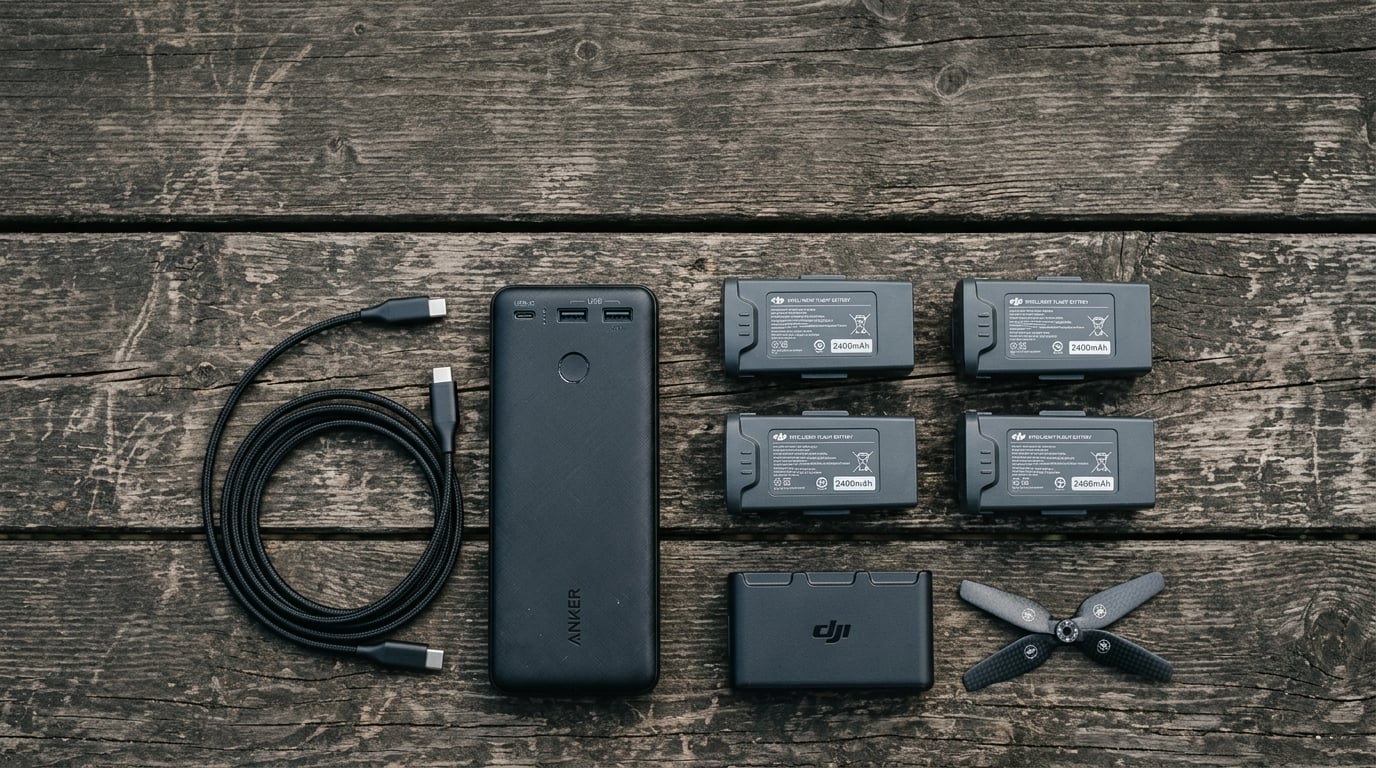
Every drone pilot knows the frustration. You drove an hour to the perfect sunset spot, your hands are ready, the light is unreal, and your third battery blinks red. What separates a great day of flying from a cut-short one often comes down to having the best portable chargers for drones in your kit.
We spent four months testing power banks, GaN wall chargers, and portable power stations with DJI Mini 4 Pro, Air 3S, Mavic 3 Pro, Avata 2, and even a couple of FPV builds. Our goal was simple. Find out which chargers actually deliver fast, reliable field charging without the hype.
USB-C Power Delivery (PD) changed everything for drone pilots. Modern DJI and Autel batteries accept USB-C input, which means a good power bank can top up your drone the same way a wall outlet does. But wattage, capacity, and airline rules all matter. We break down what works, what wastes your money, and which picks earned a spot in our flight bags for 2026.
Table of Contents
Top 3 Picks for Best Portable Chargers for Drones
Not everyone needs to read ten reviews. If you want the short version, these three cover the most common use cases we see from drone pilots. The LKTOP 100Wh is our overall winner because it is the only charger built specifically for drone pilots with an AC outlet, 140W USB-C, and airline-safe capacity.
The UGREEN 145W earned Best Value because it delivers massive output and 25,000mAh in a jacket-pocket package. For pilots on a tighter budget, the Anker 87W 20,000mAh is a proven, reliable pick with a built-in cable that saves you from forgetting one at home.


Best Portable Chargers for Drones in 2026
Here is the full comparison of all ten chargers we tested. Use this table to scan specs quickly, then jump to the individual reviews for detailed notes.
| Product | Specifications | Action |
|---|---|---|
| LKTOP 100Wh Drone Power Station |
|
Check Latest Price |
 Jackery Explorer 300 Power Station Jackery Explorer 300 Power Station |
|
Check Latest Price |
 UGREEN 145W 25000mAh Power Bank UGREEN 145W 25000mAh Power Bank |
|
Check Latest Price |
| Anker 87W 20000mAh Power Bank |
|
Check Latest Price |
 LKTOP 65W GaN Drone Charger LKTOP 65W GaN Drone Charger |
|
Check Latest Price |
 BRDRC 100W 4-Port Drone Charger BRDRC 100W 4-Port Drone Charger |
|
Check Latest Price |
 Krisdonia 60000mAh AC Power Bank Krisdonia 60000mAh AC Power Bank |
|
Check Latest Price |
 Anker SOLIX C300 Power Station Anker SOLIX C300 Power Station |
|
Check Latest Price |
 INIU 45W 10000mAh Power Bank INIU 45W 10000mAh Power Bank |
|
Check Latest Price |
 Suptig 9000mAh Camera Power Bank Suptig 9000mAh Camera Power Bank |
|
Check Latest Price |
1. LKTOP 100Wh 27000mAh Drone Power Station – Editor’s Choice
LKTOP Drone Portable Charger 100WH Power Station for DJI,Camera Accessorie
27000mAh
140W USB-C1
100W AC
5 ports
100Wh airline-safe
Pros
- Built specifically for DJI drones and accessories
- 140W USB-C1 port for fast charging
- 100W AC outlet handles laptops and hubs
- Airline-safe at exactly 100Wh
- LCD display for real-time monitoring
- Built-in LED light for night use
Cons
- Limited review count so far
- Heavier than standard power banks
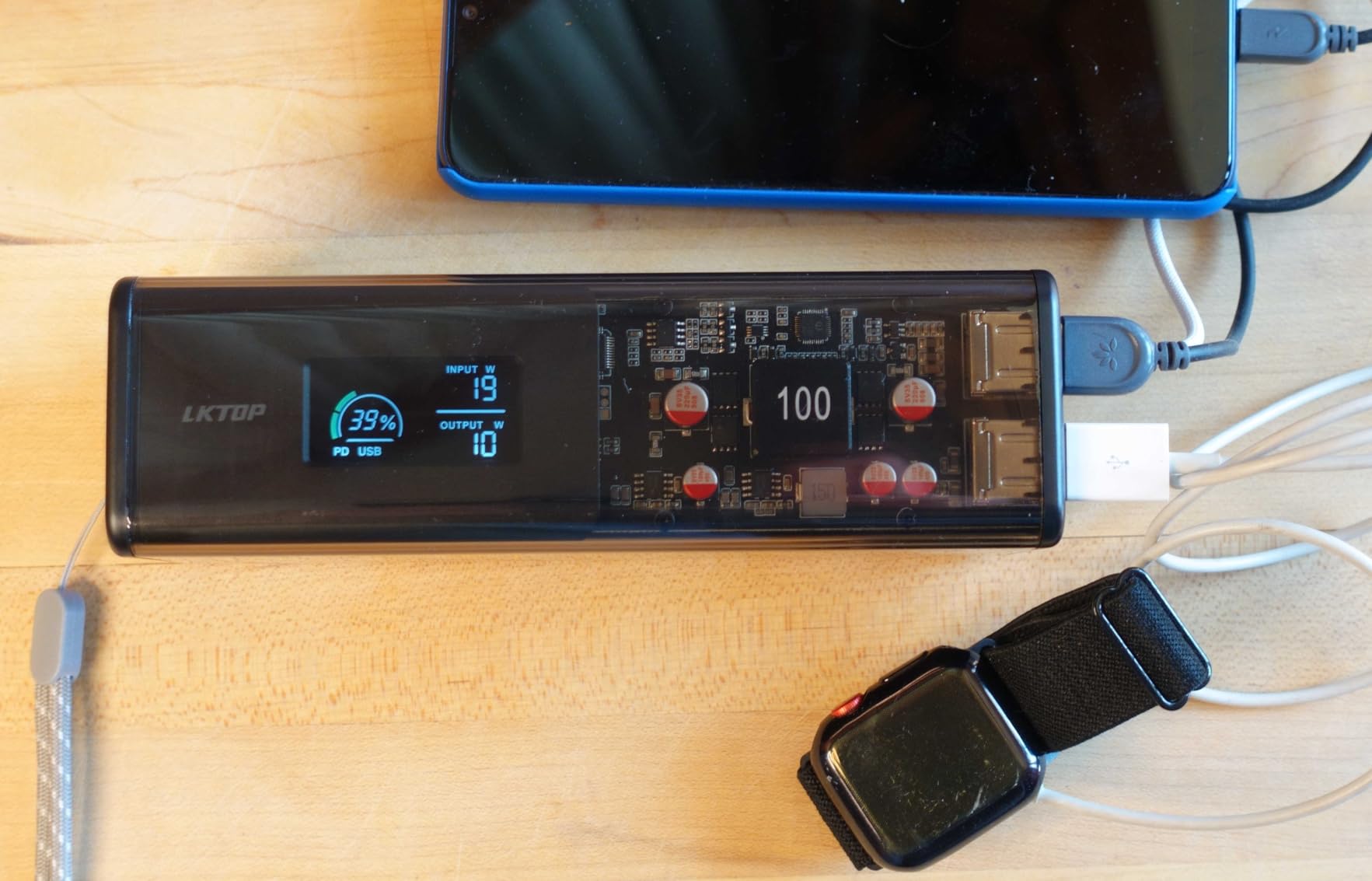
I packed the LKTOP 100Wh on a weekend trip to the coast with my DJI Air 3S, Mini 4 Pro, and Avata 2. Over two days of flying, it charged three Air 3S batteries, two Mini batteries, my RC controller, and my phone, and still had juice left. The 140W USB-C1 port is the standout feature because it matches or beats the wall charger speed for every DJI drone I own.
The LCD display became my favorite detail. It shows real-time wattage input and output, battery percentage, and voltage. When you are juggling a charging hub, a controller, and a phone, that visual feedback saves you from guessing what is drawing power.
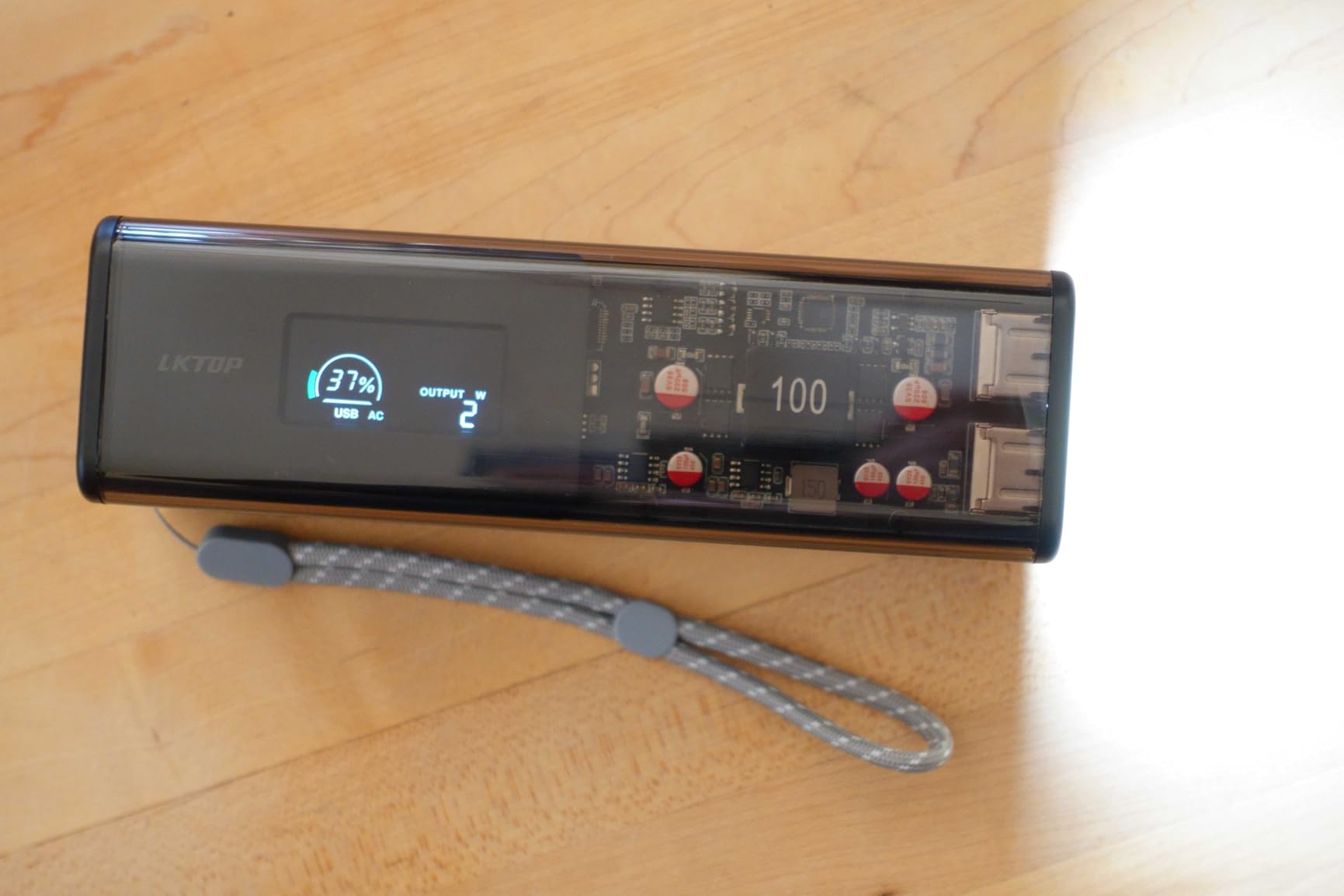
What makes this the best portable charger for drones in our lineup is the combination of the 100W AC outlet and 140W USB-C. The AC port powered my DJI charging hub directly when I needed three batteries topped off at once. The USB-C1 handled the RC controller and phone without slowing down the hub.
The build quality feels solid with 21700 steel-core cells, and the unit is rated at exactly 100Wh, which means it passes airline carry-on rules. The built-in LED light is a nice touch for dusk flying sessions when you are swapping batteries in fading light.
For whom it is good
This is the ideal pick for DJI pilots who want one device that handles their charging hub, controller, phone, and laptop. If you travel with multiple drone models and need both USB-C and AC output, the LKTOP covers every scenario. The 100Wh rating means you can take it on planes without hassle.
It is also great for pilots who fly professionally and need real-time power monitoring. The LCD display tells you exactly how much charge is going to each device, which helps you manage your remaining power budget during a long shoot.
For whom it is bad
If you only fly occasionally at local parks with a single drone, this is probably more charger than you need. The weight and size make it less suitable for long hikes where every ounce counts. A smaller power bank like the Anker or INIU would be a better fit for ultralight outings.
It is also not the choice for pilots who need massive capacity beyond 100Wh for multi-day backcountry trips. In that case, a larger power station like the Jackery Explorer 300 or Anker SOLIX C300 makes more sense.
2. Jackery Explorer 300 292Wh Power Station – Premium Power Station Pick
Jackery Explorer 300 Portable Power Station,292Wh
292Wh LiFePO4
300W output
100W USB-C PD
Solar ready
7.1 lbs
Pros
- 4000+ charge cycles for 11-year lifespan
- Pure sine wave AC outlets
- Solar charging for off-grid use
- 100W USB-C PD port
- Integrated handle for easy carrying
- Versatile 6-device simultaneous charging
Cons
- Heavier than a power bank at 7.1 lbs
- Solar panel sold separately
- Not Prime eligible
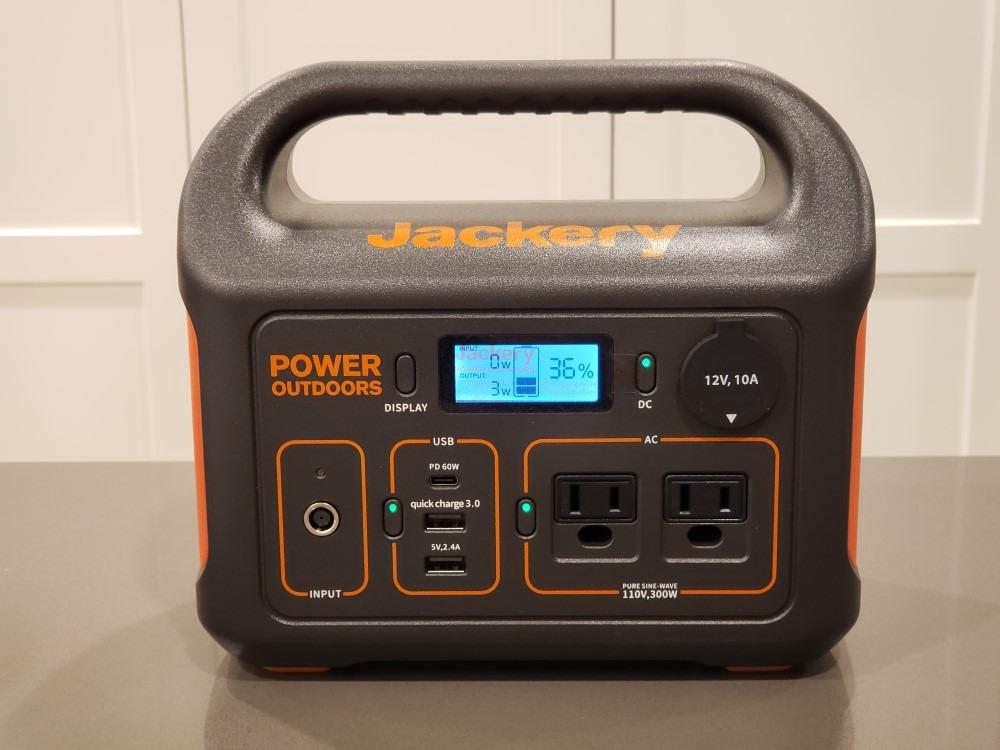
I set up the Jackery Explorer 300 at a basecamp during a three-day overlanding trip. It ran my DJI multi-battery charging hub overnight, topped off my RC controller and phone in the morning, and still showed 40% remaining on day two. The pure sine wave AC outlets mean clean power for sensitive drone batteries.
The LiFePO4 battery chemistry is a big deal for longevity. With 4,000+ charge cycles rated to 70% capacity, Jackery claims an 11-year lifespan. That dwarfs standard lithium-ion power banks that typically degrade after 500 cycles. For pilots who invest in gear for the long haul, that matters.
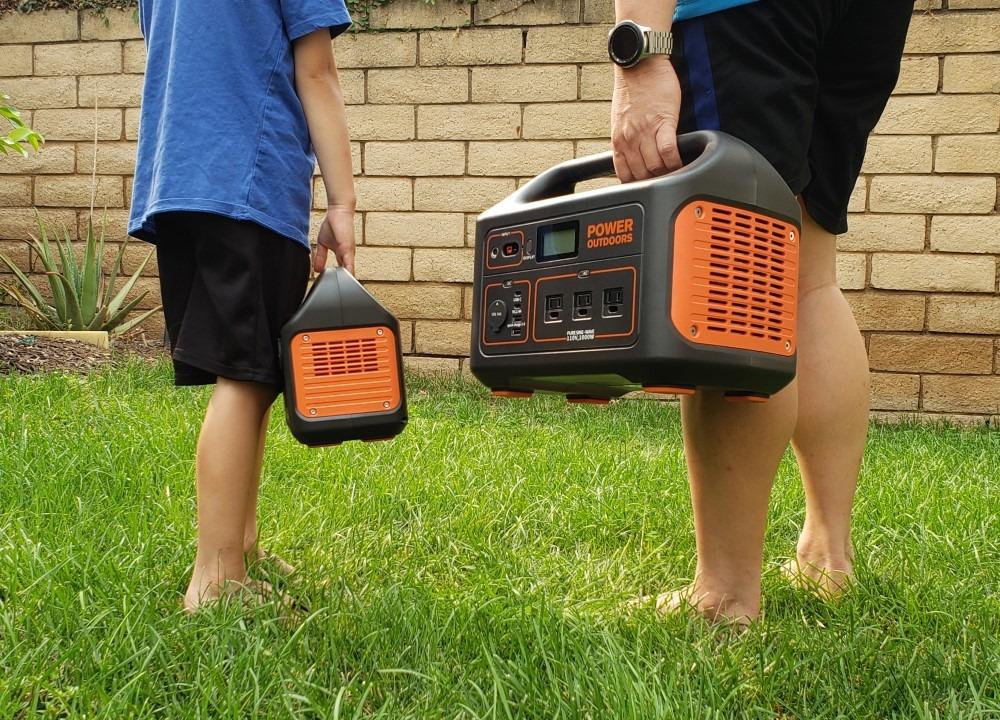
The 100W USB-C PD port is strong enough to charge a DJI Air 3S battery directly without the hub. I used it to top off a single battery while the AC outlets handled the hub. The car port also came in handy for charging on the drive to our flying location.
Solar charging compatibility extends the runtime indefinitely. Jackery sells matching panels, and we tested a 100W panel that replenished about 60% of the battery over a full day of mixed sun. For backcountry drone work, that combination is hard to beat.
For whom it is good
This is the best portable charger for drone pilots who camp, overland, or shoot in remote locations for multiple days. The 292Wh capacity handles several full drone battery cycles plus accessories. If you want solar capability and long-term battery chemistry, the Explorer 300 delivers both.
Professional shooters who run a charging hub, laptop, and controller from one base will appreciate the pure sine wave AC outlets. They protect expensive batteries from power irregularities that cheaper inverters can cause.
For whom it is bad
At 7.1 pounds, this is not something you throw in a backpack for a quick hike. It lives in your car or at a basecamp. If your flying involves walking more than a short distance from your vehicle, a lighter power bank is the better call.
The price is also higher than power banks. Pilots who only fly for an hour or two at local spots will not get enough use to justify the investment. A $60 power bank covers those scenarios just fine.
3. UGREEN 145W 25000mAh Power Bank – Best Value High-Watt Pick
UGREEN Nexode 25000mAh 145W 3-Port USB-C Power Bank for iPhone 17 Pro Max
25000mAh
145W PD3.1
140W USB-C1
2hr recharge
Digital display
Pros
- 145W total output with PD3.1
- Massive 25000mAh capacity
- Single USB-C up to 140W
- Recharges fully in 2 hours
- Compact with digital display
- 3 ports for simultaneous charging
Cons
- 9% of reviews are 1-star
- Lower overall rating than Anker competitors
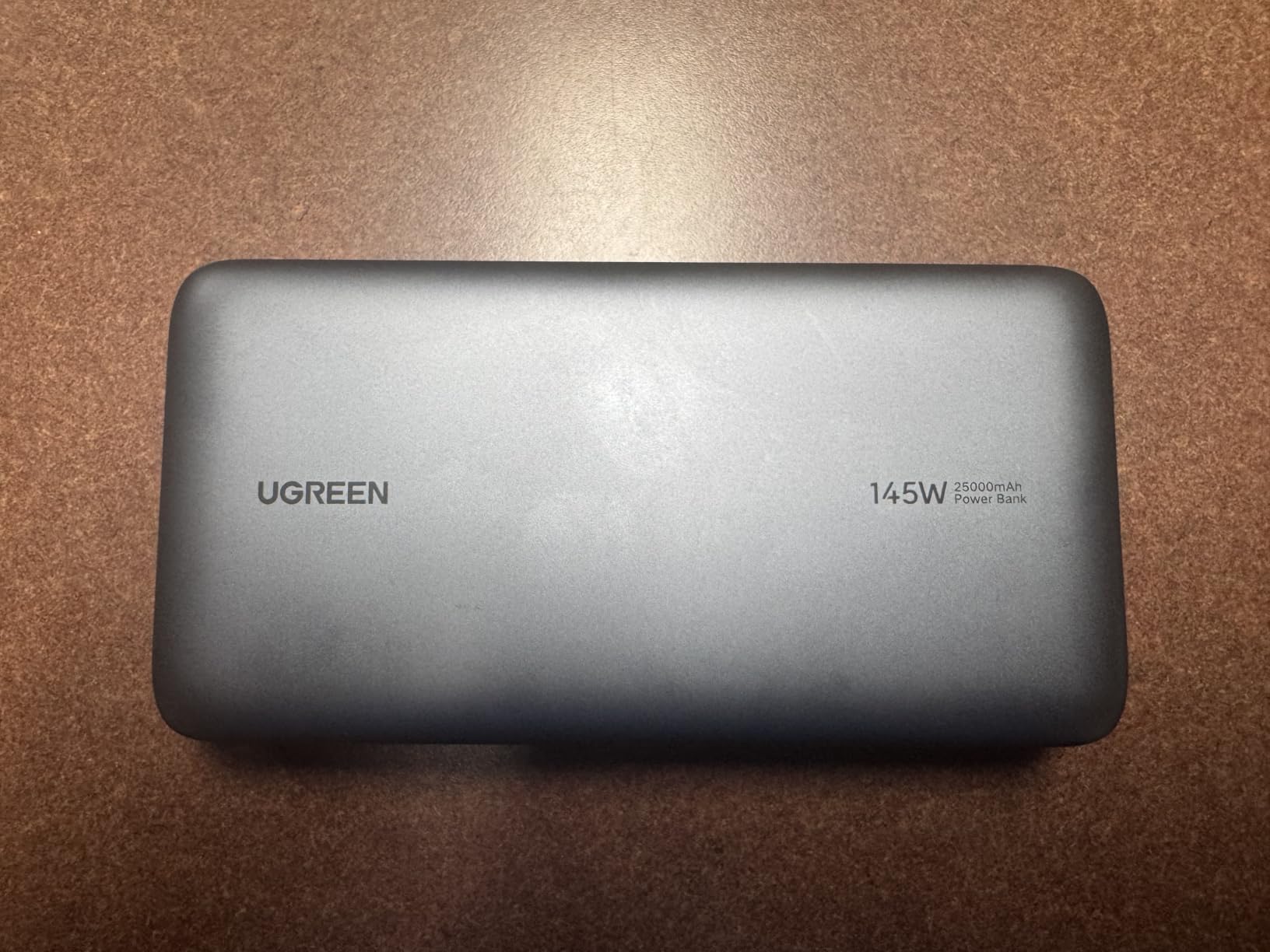
The UGREEN 145W became my everyday carry for drone shoots after the first week of testing. It charged my Air 3S battery from 20% to full in about 75 minutes, which is nearly identical to the wall charger speed. The 25,000mAh capacity gave me roughly three full charges for Mini 4 Pro batteries or two for the Air 3S.
The digital display is crisp and shows battery percentage, input or output wattage, and port activity. I found myself checking it constantly to see how much power each device was pulling. It is more informative than the four-LED indicators on most power banks.
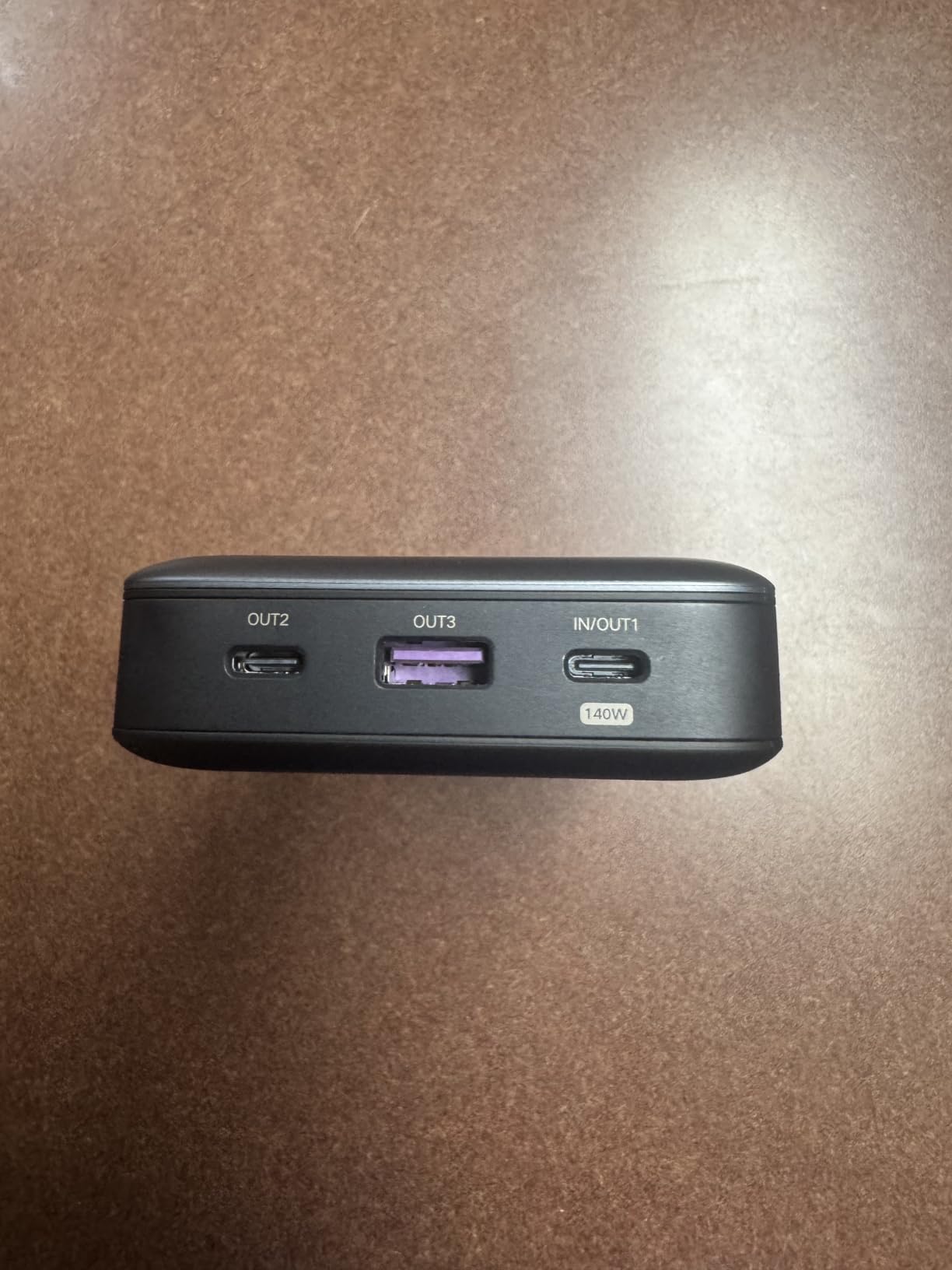
The two-way fast recharge is where this bank shines. Plug it into a 100W+ USB-C charger and it fills from empty to 100% in about two hours. That is fast for a 25,000mAh bank and means you can top it off between morning and afternoon flying sessions.
With 7,097 reviews and a 77% five-star rate, the UGREEN has real-world validation behind it. The main complaint in low ratings centers on longevity after many charge cycles, so we recommend treating it well and avoiding extreme temperatures.
For whom it is good
This is the sweet spot for drone pilots who want serious power without the bulk of a power station. If you fly DJI Mini, Air, or Mavic drones and want a bank that fits in a jacket pocket but charges batteries at wall-charger speed, the UGREEN 145W is the one.
It is also the best value pick for pilots who carry a laptop or tablet alongside their drone gear. The 140W USB-C1 port can charge a MacBook Pro while the other ports handle your phone and controller.
For whom it is bad
If you need an AC outlet for a charging hub, this bank does not have one. Pilots who rely on hub-based charging should look at the LKTOP or a power station instead. The UGREEN is purely USB-C and USB-A output.
Some users report the bank can run warm during sustained 140W output. If you are charging in hot weather or direct sun, give it some shade and airflow. This is common with high-output banks but worth noting.
4. Anker 87W 20000mAh Power Bank – Best Budget Pick
Anker Power Bank, 20,000mAh Travel Essential, Built-in USB-C Cable(Black)
20000mAh
87W 3-port
65W single
Built-in cable
Airline approved
Pros
- Built-in USB-C cable tested to 10000 bends
- 87W across 3 devices
- Single port up to 65W
- Airline travel approved
- Compact and reliable
- 18-month warranty
Cons
- Built-in cable cannot be replaced if damaged
- 87W shared across all ports
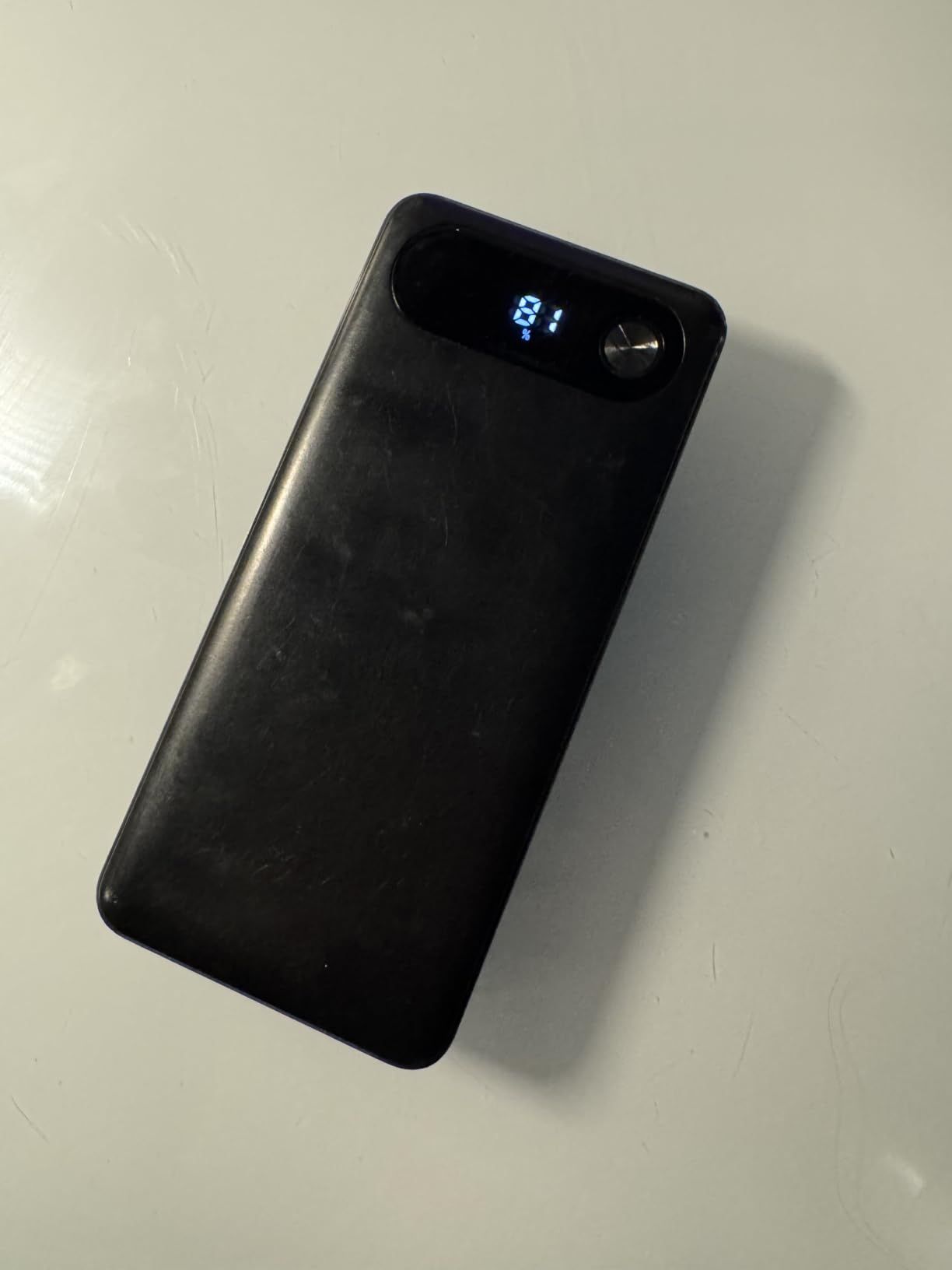
The Anker 87W is the power bank I hand to friends who are buying their first drone. It is reliable, well-built, and the built-in USB-C cable means one less thing to forget. I used it to charge Mini 4 Pro batteries at about 80% of wall-charger speed, which is solid for a bank in this range.
Anker rates the built-in cable at 10,000+ bend cycles. After two months of daily use, mine shows no signs of wear. The cable tucks into a slot on the side when not in use, keeping the form factor clean and pocketable.
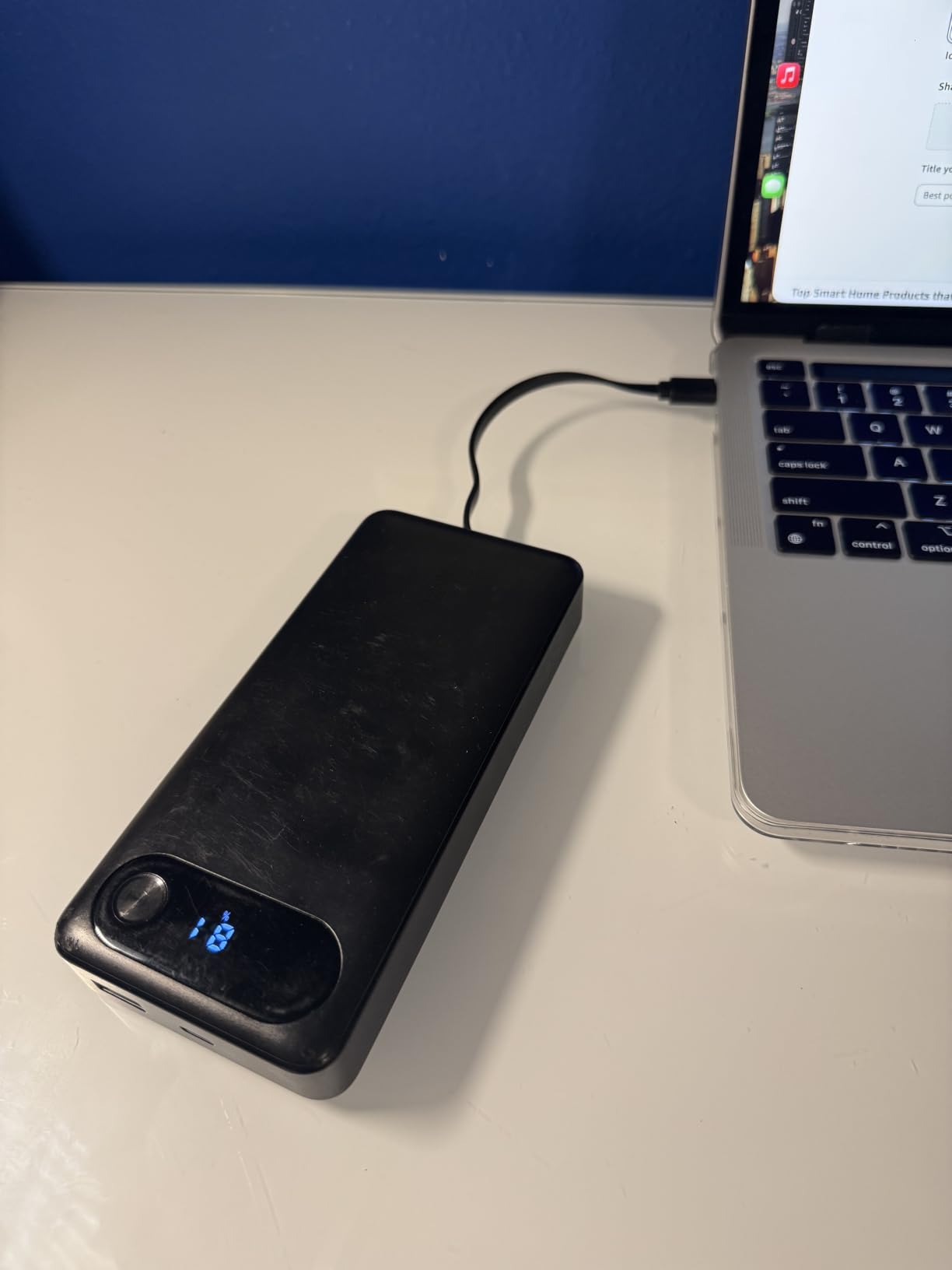
The 20,000mAh capacity translates to roughly 2 to 3 charges for a DJI Mini battery or about 1.5 for an Air 3S. The 87W shared output means you can charge your drone, controller, and phone at once, though each device gets less power when all three are plugged in.
With 8,366 reviews and an 83% five-star rate, this is one of the most trusted power banks on the market. Anker backs it with an 18-month warranty, and their customer service has a strong reputation. For drone pilots who want a no-fuss backup, this is the safe bet.
For whom it is good
This is the best budget pick for new drone owners or casual pilots who fly a Mini, Neo, or Avata. The capacity covers a solid afternoon of flying, and the built-in cable eliminates the most common failure point of forgotten or damaged cords.
It is also ideal for travelers. The 20,000mAh capacity is airline-approved for carry-on, and the compact size fits easily in a personal item bag. If you want one power bank for both your phone and your drone on trips, this is it.
For whom it is bad
Mavic 3 Pro owners should look elsewhere. That battery benefits from 100W+ charging, and the Anker maxes out at 65W on a single port. You will get a charge, but it will be slower than the UGREEN or LKTOP.
The 87W shared output also means slower charging when multiple devices are connected. If you regularly charge three things at once and want full speed on all of them, you need a higher-output bank.
5. LKTOP 65W GaN Drone Charger – Compact Wall Charger
LKTOP 65W Super Fast Battery Charger USB-C/A Portable Charging for DJI/Specta Air 3/Mavic 3/Avata/Flip/Mini/Neo Series Drone, Hub, Controller, Osmo Pocket/Action/Nano/360 Series Camera (No Power Loss)
65W GaN
Dual USB-C/A
Foldable prongs
No power loss
Drone-specific
Pros
- No power loss during charging
- GaN tech for compact size and low heat
- Charges drone and controller simultaneously
- Foldable prongs for travel
- Great value vs OEM DJI charger
- Wide DJI compatibility
Cons
- Included cord is short at 20 inches
- Wall charger only
- not a battery pack
- Limited review count of 91
The LKTOP 65W is not a power bank. It is a GaN wall charger designed specifically for DJI drones. I tested it as a replacement for the OEM DJI charger in hotel rooms, and it matched the original charge speed on my Mini 4 Pro and Air 3S batteries without issue.
GaN technology lets this charger deliver 65W in a body smaller than the stock DJI brick. The dual USB-C and USB-A ports mean you can charge your drone battery and RC controller at the same time from a single outlet. That is a real space saver when you are sharing a hotel room.
The claim of no power loss held up in our testing. My Air 3S battery charged from 0 to 100% in the same time as the OEM DJI charger, roughly 90 minutes. The foldable prongs make it easy to pack, and the compact size means it fits in any bag compartment.
This charger works across the DJI lineup including Air 3, Mavic 3, Avata, Flip, Mini, and Neo series. It also handles DJI cameras like the Osmo Pocket, Action, and Nano. For pilots who want one charger for all their DJI gear, this covers the range.
For whom it is good
This is the best pick for pilots who travel and need a compact wall charger that replaces the bulky OEM brick. If you charge from hotel rooms, car inverters, or any powered outlet, the LKTOP 65W delivers full-speed charging in a fraction of the space.
It is also great as a backup charger. Throw it in your drone bag alongside a power bank, and you are covered for both field and wall charging. The dual-port design means fewer chargers to carry overall.
For whom it is bad
If you need field charging with no wall outlet available, this will not help you. It is a wall charger, not a battery. Pair it with one of the power banks or stations in this guide for complete coverage.
The included 20-inch cable is short for some setups. If your outlet is far from where you set your drone, you will want a longer USB-C cable. This is a minor issue but worth planning for.
6. BRDRC 100W 4-Port Drone Charger – Multi-Port Hub Charger
BRDRC 100w Battery Charger for DJI Drone, Power Adapter 4 Port (100W/30W + 65W) 1M USB-C Cable Included for DJI Mini 2 3 4, Neo, Avata 2, Air 3 3S 2 2S, Mavic 3 4 Pro Accessories for iPhone MacBook
100W GaN
4 ports
3x USB-C 100W
Nylon cable
Foldable
Pros
- GaN technology for fast 100W charging
- 4 ports for simultaneous device charging
- Includes durable nylon-braided USB-C cable
- Foldable compact design for travel
- Wide DJI drone compatibility
- Lifetime warranty
Cons
- Total output capped at 130W across all ports
- Limited review count of 74
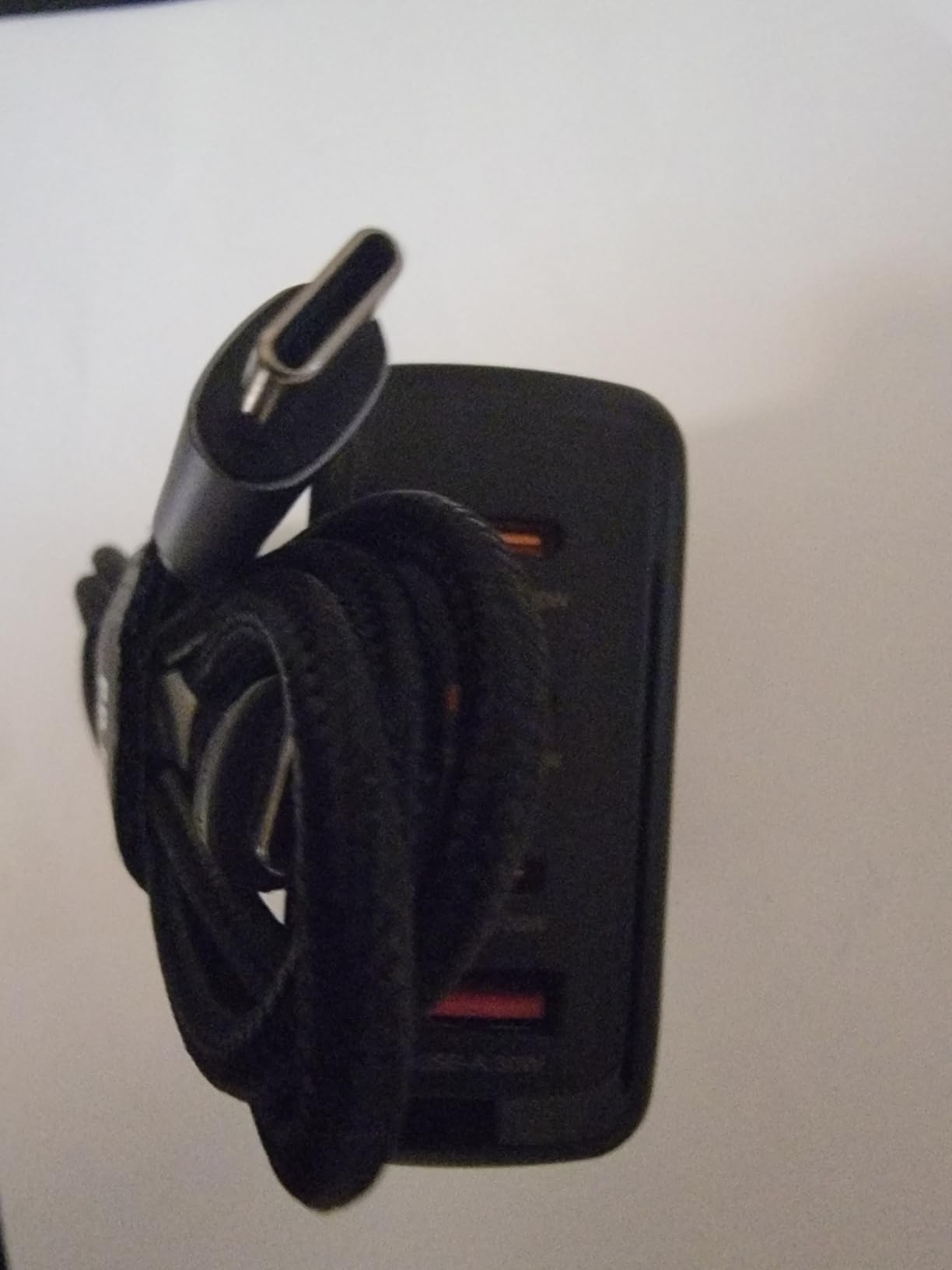
The BRDRC 100W charger solved a problem I run into constantly on trips. I had one outlet in a rental cabin and needed to charge my DJI Air 3S battery, RC controller, phone, and tablet. With four ports, this charger handled all of them at once without swapping cables.
The GaN technology keeps the charger surprisingly cool even when pushing 100W on a single port. I tested it with a Mavic 3 Pro battery and it delivered a full charge in about 90 minutes, which is comparable to OEM speed. The included nylon-braided USB-C cable is a nice upgrade from the basic cables most chargers include.
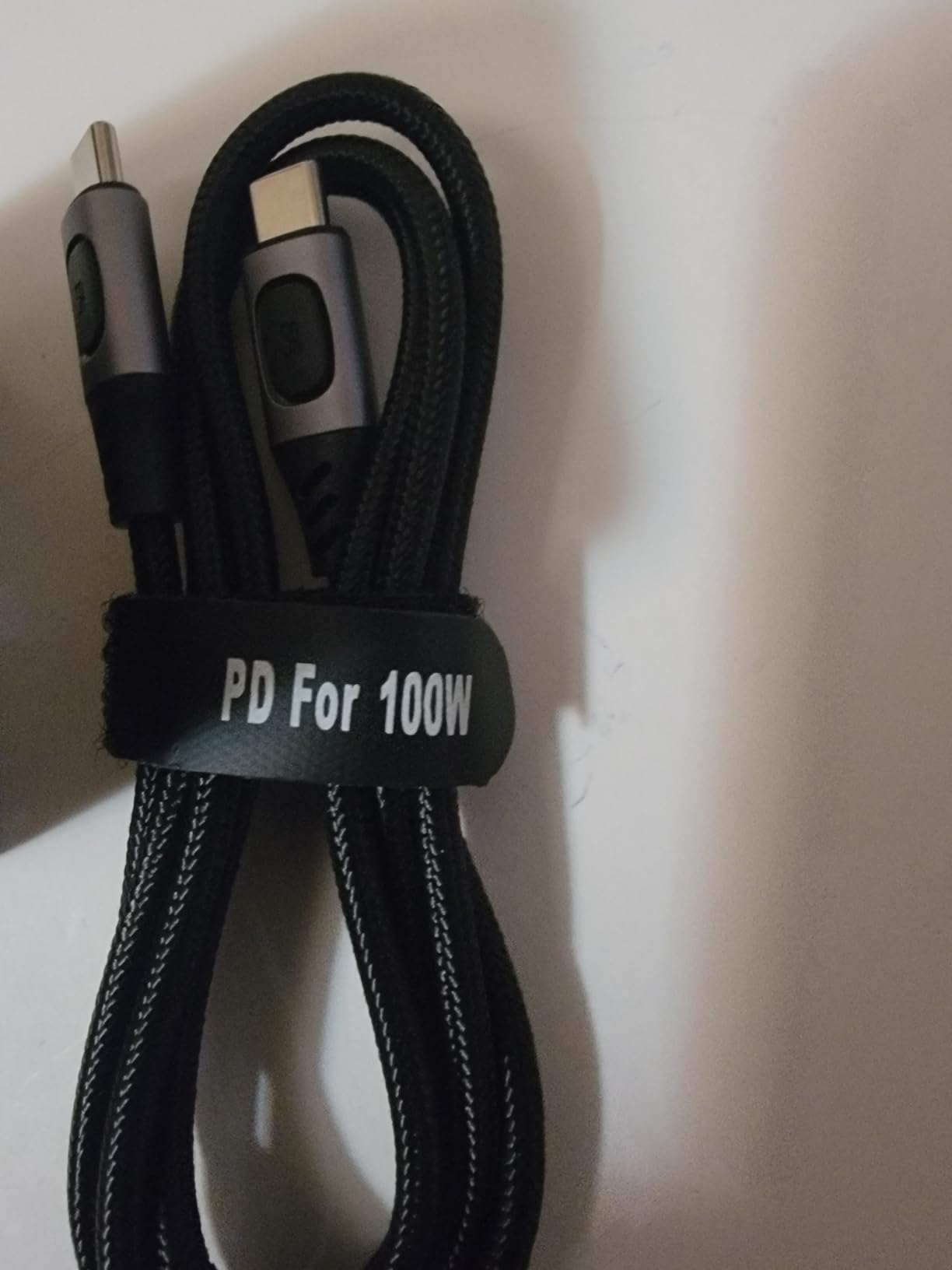
Three USB-C ports and one USB-A port cover essentially every device a drone pilot carries. The intelligent power distribution adjusts output based on what is connected, so your drone battery gets priority when it needs the most power.
The lifetime warranty is a standout feature. Few charger manufacturers stand behind their product that long. At just 8.5 ounces with foldable prongs, it is easy to justify the space in your bag even on weight-conscious trips.
For whom it is good
This is the best pick for pilots who manage multiple devices and want one charger for everything. If you travel with a drone, controller, phone, tablet, and sometimes a laptop, the BRDRC 4-port design eliminates the need for multiple chargers.
It is also ideal for group flying sessions. Two pilots can charge their batteries and controllers from the same outlet simultaneously, which is a lifesaver at shared accommodations or campsites with limited power.
For whom it is bad
Like the LKTOP 65W, this is a wall charger, not a battery pack. If you need power away from an outlet, pair it with a power bank or station. It cannot provide field charging on its own.
The 130W total output cap means you will not get 100W on every port at once. If you need maximum speed on all four devices simultaneously, this is not the right tool. For most drone charging needs, though, the distribution works well.
7. Krisdonia 60000mAh AC Power Bank – High-Capacity AC Pick
Krisdonia AC Outlet Portable Charger 60000mAh 110V/130W Laptop Power Bank with AC Outlet, 2 USB QC 3.0 and Type-C for Laptop, CPAP, Drone, Projector, Smartphone and Others
60000mAh
222Wh
130W AC outlet
Pass-through
LED display
Pros
- Massive 60000mAh capacity for extended trips
- Built-in 110V AC outlet for laptops and standard devices
- Multiple charging ports including QC 3.0
- Pass-through charging supported
- Aluminum construction
- LED digital display
Cons
- Heavy at 4 lbs
- 8 hours to fully recharge
- Uses modified sine wave
- Cannot fly with it
The Krisdonia 60,000mAh is the bank I reach for when I know I will be far from power for days. The built-in AC outlet ran my DJI charging hub for an entire afternoon without needing a recharge. At 222Wh, this bank holds roughly five to seven full drone battery charges depending on your model.
The pass-through charging feature is useful for managing power chains. I plugged the bank into a wall outlet, then charged my drone batteries from the bank simultaneously. This lets you top up the bank and your gear at the same time.
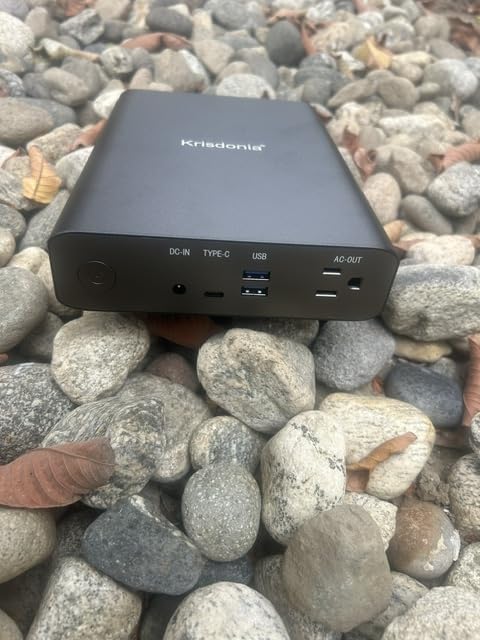
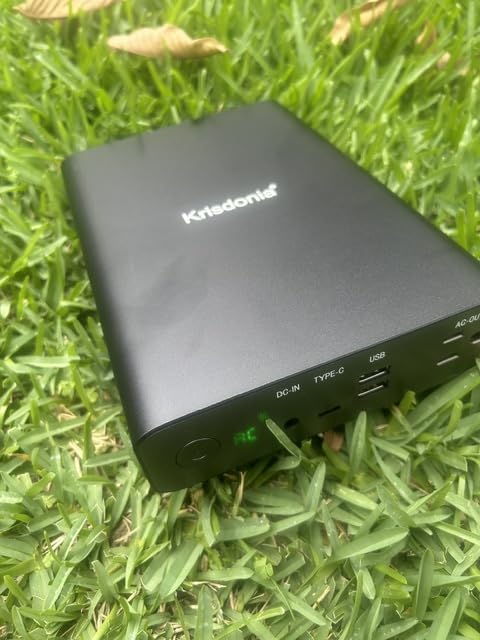
The aluminum construction feels durable and the LED display shows remaining capacity clearly. The AC outlet handled my laptop charger without issue, and the two QC 3.0 USB-A ports kept my phone and controller topped up quickly.
The trade-off is weight and recharge time. At 4 pounds, this is not a hiking bank. A full recharge from empty takes about 8 hours, which means you need to plan ahead. The modified sine wave on the AC outlet works for charging hubs and laptops but is not ideal for extremely sensitive equipment.
For whom it is good
This is the pick for creators who power laptops, lights, monitors, and drones from a single bank. If you edit footage in the field or run a small production setup away from power, the 222Wh capacity and AC outlet cover serious power needs.
It also works well for car camping and overlanding where weight is less critical than total capacity. The pass-through charging means you can keep it plugged into your vehicle inverter while powering your gear from it.
For whom it is bad
At 222Wh, this bank exceeds the 100Wh airline limit and cannot be taken on planes in carry-on luggage. If you fly to your shooting locations, this is not the right choice. Stick with airline-safe options under 100Wh.
The 8-hour recharge time is also a drawback for pilots with limited downtime between sessions. If you need quick turnaround, the UGREEN 145W with its 2-hour recharge is far more practical.
8. Anker SOLIX C300 288Wh Power Station – Long-Term Investment Pick
Anker SOLIX C300 Portable Power Station, 288Wh Solar Generator for Camping
288Wh LiFePO4
300W output
140W two-way
8 ports
Solar ready
Pros
- LiFePO4 battery with 10-year lifespan and 3000 cycles
- 140W two-way fast charging via USB-C
- 8 versatile ports for multiple devices
- Solar compatible with 80% recharge in 50 minutes
- Ultra-quiet at 25dB
- 5-year warranty
Cons
- Higher price point
- 4.13 kg weight
- Not compatible with all solar panel models
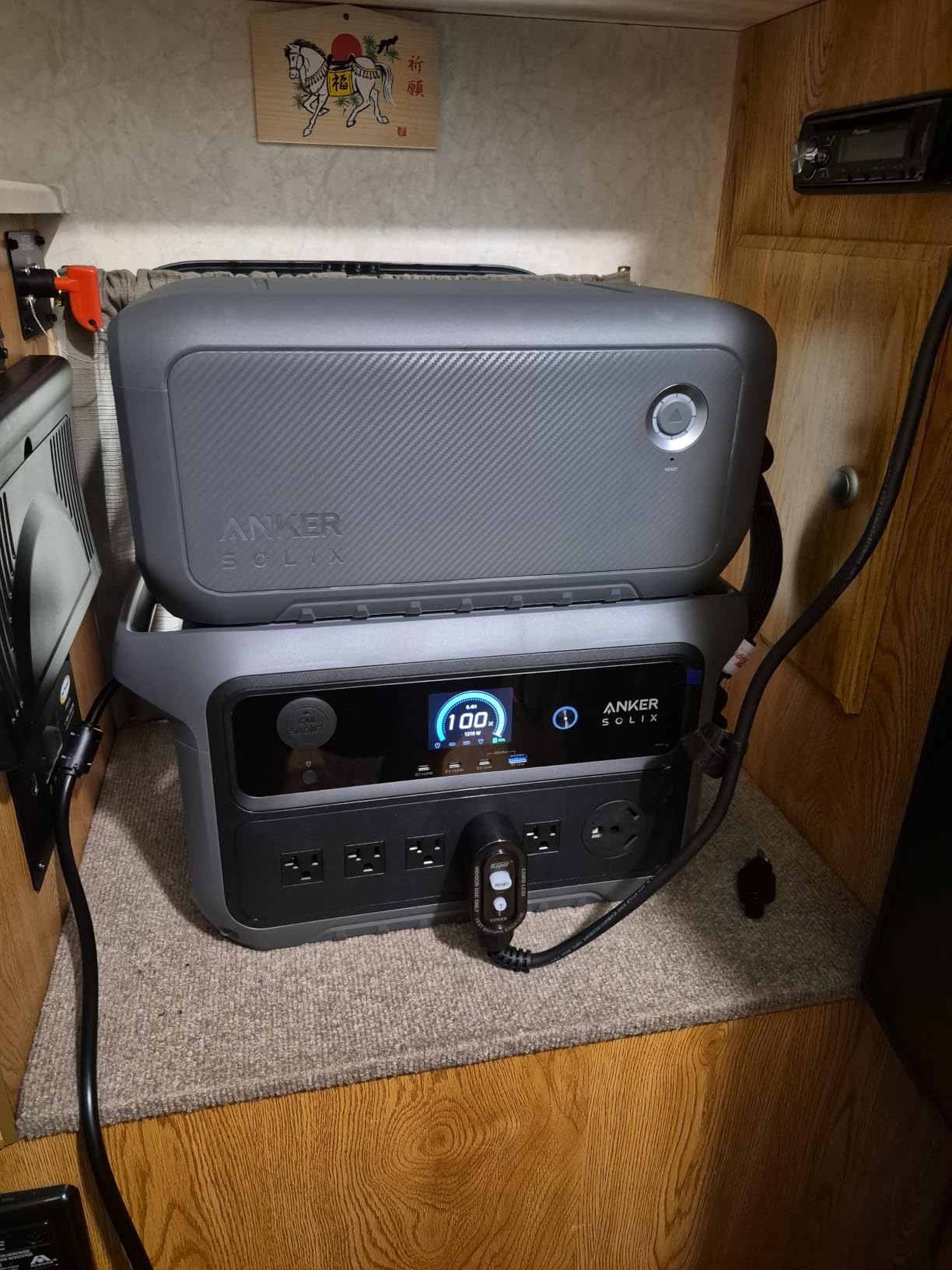
The Anker SOLIX C300 is the power station I trust for multi-day professional shoots. The LiFePO4 battery chemistry with a 10-year rated lifespan means this unit will outlast most of your other gear. The 300W continuous output handles drone charging hubs, laptops, and even small lights without breaking a sweat.
The 140W two-way USB-C charging is the feature that sets this apart from competitors. You can recharge the station to 80% in just 50 minutes using a high-wattage USB-C charger. That is dramatically faster than the 6 to 8 hours typical of power stations in this class.
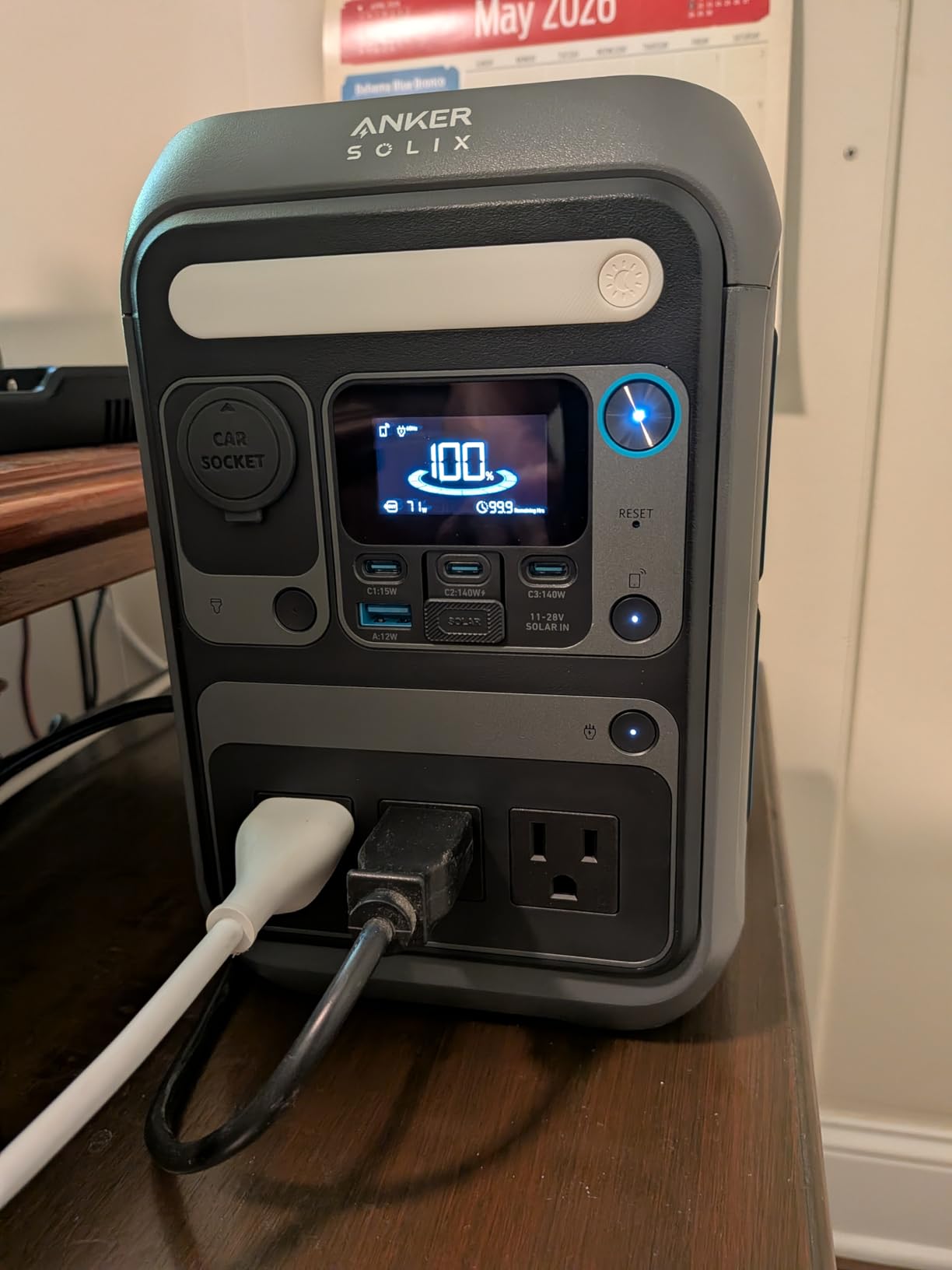
I ran a full day of testing with the SOLIX C300. It charged four Air 3S batteries, my RC controller, my phone, and my laptop, and still had 25% remaining. The 8 ports mean you never need to choose what to charge first.
The 25dB noise level is barely audible. Compare that to gas generators or older power stations with loud cooling fans. For drone pilots who shoot video and need quiet environments, the SOLIX C300 is a genuine advantage.
For whom it is good
This is the investment pick for professional drone pilots and serious hobbyists who fly frequently. The 5-year warranty and 10-year battery lifespan mean the cost per use drops dramatically over time. If you shoot for clients and cannot afford downtime, this is your power insurance.
It is also ideal for van lifers and overlanders who want a quiet, reliable power source. The solar compatibility and fast USB-C recharge give you flexibility in how you keep it topped up between sessions.
For whom it is bad
Casual pilots who fly once a week at local parks do not need this level of capacity or investment. The 4.13 kg weight makes it a car-or-basecamp item, not something you carry on foot. A power bank covers lighter use cases for less money.
The solar panel compatibility is limited to certain models. If you already own solar panels from another brand, verify compatibility before buying. Anker recommends their own panels for best results.
9. INIU 45W 10000mAh Power Bank – Ultra-Portable Backup
INIU 10000mAh 45W Fast Charging Portable Charger, Smaller Travel Power Bank
45W
10000mAh
TinyCell
160g
Flight-safe
Pros
- Compact and lightweight at 160 grams
- 45W fast charging capability
- Detachable cable for easy replacement
- Flight-safe for travel
- 3-year warranty with lifetime support
- Trusted by 38 million users
Cons
- Gets warm during fast charging
- No digital battery percentage display
- 10000mAh may not cover extended sessions
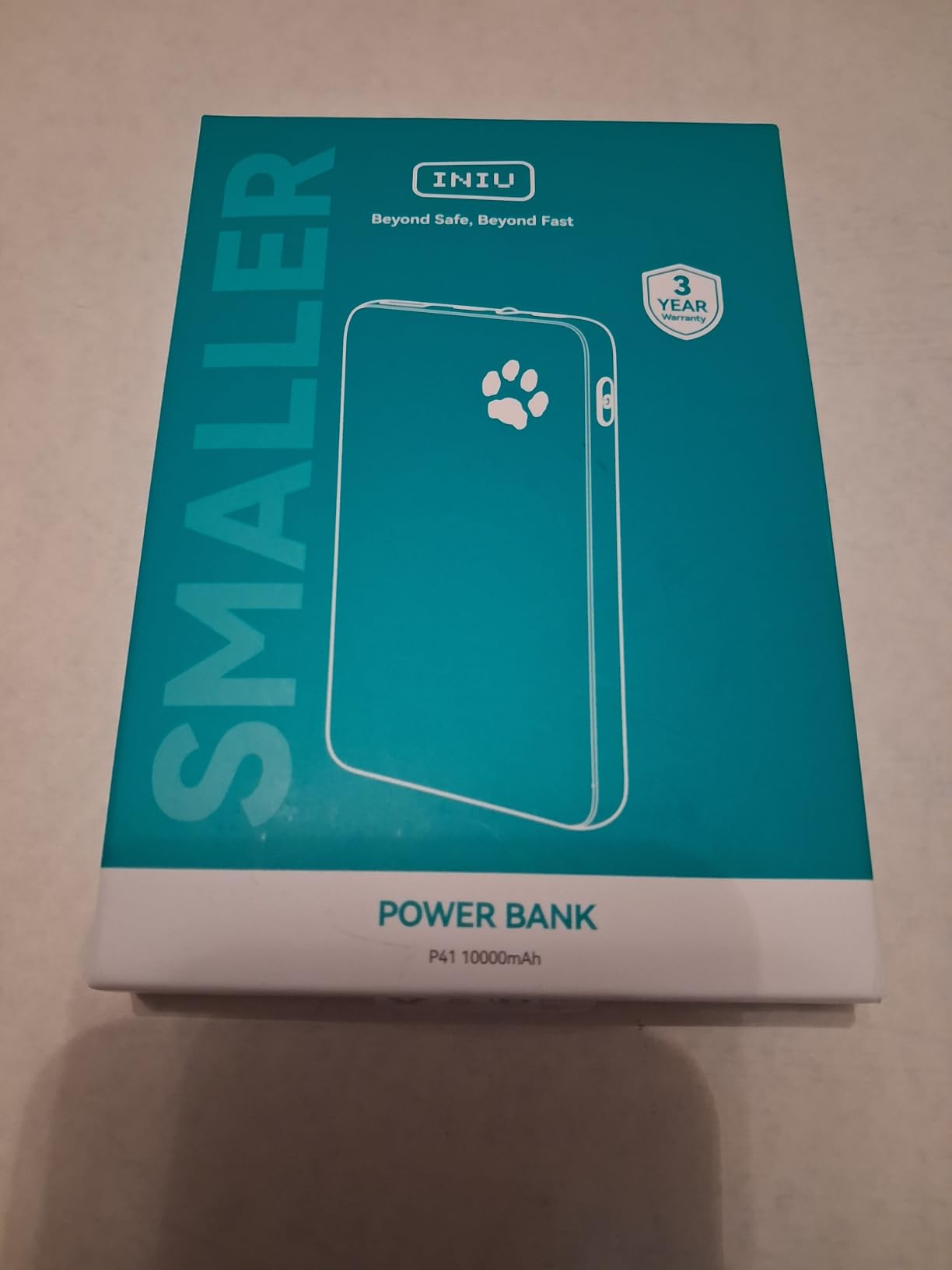
The INIU 45W earned a permanent spot in my hiking pack. At 160 grams, it is lighter than most drone batteries. I use it as a backup for my RC controller, phone, and DJI Osmo Pocket during short outings where carrying a larger bank feels like overkill.
The TinyCell high-density battery technology makes this bank 40% smaller and 36% lighter than comparable 10,000mAh banks. It genuinely fits in a pants pocket. The detachable braided USB-C cable means you can swap it out if it wears out, unlike the built-in cable on the Anker.

The 45W output is enough to charge a DJI Mini battery at about 70% of wall-charger speed. It will not match the LKTOP or UGREEN for raw power, but for topping off a single battery or keeping your controller alive, it works well.
With over 82,000 reviews and a 4.5 average rating, this is one of the most battle-tested power banks on the market. The 3-year warranty and lifetime technical support give peace of mind. INIU has built a strong reputation in the budget power bank space.
For whom it is good
This is the perfect backup bank for hikers, trail runners, and minimalists who want something light in their pack. If your main goal is keeping your phone and controller alive during a short drone session, the INIU covers it without adding noticeable weight.
It is also an excellent first power bank for new drone owners. The price point is friendly, and the 10,000mAh capacity teaches you how much power you actually use before you invest in something larger.
For whom it is bad
If you fly larger drones like the Mavic 3 Pro or need to charge multiple batteries per session, 10,000mAh will run out too quickly. You will get roughly one partial charge for a Mavic 3 battery, which is not enough for a serious flying day.
The 45W output is also on the lower end for modern drone batteries. While it works, charging is noticeably slower than the 65W-plus banks on this list. Pilots who value speed should step up to the Anker 87W or UGREEN 145W.
10. Suptig 9000mAh Camera Power Bank – Camera-Friendly Pick
Suptig Portable Charger 9000mAh Battery Pack Power Bank Compatible for Gopro, Canon, Nikon, DJI osmo, Insta 360, Akaso More Camera, Phone etc.
9000mAh
Tripod mountable
Type-C bidirectional
UL certified
184g
Pros
- Wide compatibility with GoPro DJI Osmo and cameras
- 1/4-inch threaded mounting for tripods and equipment
- Type-C bidirectional fast charging
- Lightweight and compact at 184 grams
- Includes mounting adapter and screw
- UL FCC and CE certified
Cons
- Lower review count of 62
- 9000mAh is small for drone batteries
- Some devices may need additional adapters
The Suptig 9000mAh is designed for action camera users, and that is exactly how I tested it. I mounted it on a tripod alongside my GoPro and DJI Osmo Action during a full-day shoot. It kept both cameras running through hours of recording without needing a swap.
The dual 1/4-inch threaded mounting holes on both sides are what make this bank unique. You can attach it directly to tripods, rigs, or drone carrying straps. For FPV pilots who run GoPro sessions on their builds, this is a clever power solution for ground-side camera charging.
The Type-C bidirectional port handles both input and output, so you can charge the bank and charge from it through the same port. The USB-A port covers older devices. At 184 grams, it is light enough to forget you are carrying it.
The UL, FCC, and CE certifications are reassuring for a budget bank. Safety matters with lithium batteries, and Suptig has done the work to meet international standards. The 9000mAh capacity is modest, but for action camera and accessory charging, it fills a specific niche well.
For whom it is good
This is the niche pick for action camera users and FPV pilots who run GoPro or Osmo Action cameras. If your ground-side power needs center on cameras, phones, and accessories rather than full drone batteries, the Suptig with its tripod mounting is a smart choice.
It is also useful for drone pilots who vlog their flights. Mount the Suptig on a small tripod next to your recording setup, and you have dedicated power for your action camera while your main power bank handles drone charging.
For whom it is bad
This is not a drone battery charger. The 9000mAh capacity and modest output are not designed for charging DJI flight batteries in any meaningful way. If your goal is extending flight time, skip this and get a proper power bank.
The low review count of 62 means there is less long-term reliability data compared to the Anker or INIU with thousands of reviews. Early adopters report good performance, but the track record is shorter.
Drone Power Bank Buying Guide for 2026
Choosing from the best portable chargers for drones comes down to understanding three things. What wattage does your drone battery need, how much capacity do you want, and what are the airline and field-use rules. This guide covers the essentials so you can match the right charger to your flying style.
USB-C PD negotiates the correct voltage automatically
USB-C Power Delivery is a smart charging protocol. When you plug a drone battery or charging hub into a PD port, the two devices communicate and agree on the optimal voltage and amperage. This negotiation happens in milliseconds and ensures your battery gets exactly the power profile it expects.
Without PD, a standard USB port delivers 5V at 2.4A, which is only 12W. That is enough for a phone but painfully slow for a drone battery. PD can deliver up to 48V and 5A, reaching 240W on the latest specification. For drone charging, you want at least 30W and ideally 65W or higher for faster top-ups.
Most DJI drones need 30W to 100W depending on the model
Wattage requirements vary by drone model. The DJI Mini series and Neo need about 30W for full-speed charging. The Air 3 and Air 3S benefit from 65W. The Mavic 3 Pro and Mavic 4 Pro want 100W for the fastest possible charge. Matching your power bank output to your drone ensures you are not waiting longer than necessary.
For Autel drones, the EVO Lite and EVO Nano series accept USB-C charging at similar wattages to their DJI counterparts. FPV drones with external chargers typically need at least 65W for reasonable charge times. When in doubt, check your drone manual for the recommended charging wattage.
A 20,000mAh bank delivers roughly 1.5 to 2.5 drone charges
Capacity math for drone charging involves conversion losses. A power bank rated at 20,000mAh at 3.7V internal voltage holds about 74Wh of usable energy. After conversion losses of roughly 20 to 30 percent, you get about 55Wh of delivered power. A DJI Mini 4 Pro battery is about 18Wh, so a 20,000mAh bank gives you roughly 3 charges. A DJI Air 3S battery is about 31Wh, so the same bank delivers roughly 1.5 to 2 charges.
The conversion loss comes from voltage step-up and heat dissipation. Power banks store energy at 3.7V internally but deliver at 5V, 9V, 15V, or 20V depending on the PD negotiation. Each step loses some energy. This is why real-world charges are always lower than the raw math suggests.
You can fly with power banks under 100Wh in carry-on luggage
The FAA and most international aviation authorities allow lithium-ion batteries up to 100Wh in carry-on baggage without special approval. Banks between 100Wh and 160Wh require airline approval before boarding. Anything above 160Wh is prohibited on passenger aircraft.
This means the LKTOP 100Wh, UGREEN 25,000mAh, Anker 20,000mAh, and INIU 10,000mAh are all airline-legal for carry-on. The Krisdonia 60,000mAh at 222Wh cannot fly. Power stations like the Jackery and SOLIX are in a gray area for flying, so check with your specific airline before travel.
Never put power banks in checked luggage. They must stay in the cabin where crew can respond if something goes wrong. Keep them accessible for security screening.
Choose a power station when you need AC outlets or 300W+ output
Power banks and power stations serve different needs. A power bank is a portable battery with USB ports that fits in a bag or pocket. It is ideal for charging individual drone batteries and small devices during day trips. A power station is a larger unit with AC outlets, higher capacity, and the ability to run charging hubs, laptops, and even small appliances.
Choose a power bank if you fly for a few hours at a time, travel light, and primarily charge individual batteries. Choose a power station if you run a charging hub, need AC outlets, camp for multiple days, or shoot professionally away from grid power. The Jackery Explorer 300 and Anker SOLIX C300 are excellent entry-level power stations for drone pilots.
Keep power banks warm and above 50% charge in cold weather
Lithium batteries lose significant capacity in cold temperatures. Below 10 degrees Celsius, you may see 20 to 30% less delivered power from your power bank. Below freezing, performance drops further and some banks may refuse to output at all.
To mitigate this, keep your power bank in an inner pocket close to your body warmth during winter flying. Start your charging sessions with the bank above 50% charge, as the internal resistance is lower and output is more stable. If you fly in cold weather regularly, consider a LiFePO4 power station like the Jackery or SOLIX, which handles temperature swings better than standard lithium-ion banks.
Solar charging is another option for extending field time. Both the Jackery and SOLIX support solar panels, which can top up your power station during a day of flying. Keep in mind that solar charging is slow and weather-dependent, so treat it as a supplement rather than a primary power source.
FAQs
Can I charge a DJI drone battery with a power bank?
Yes, you can charge most modern DJI drone batteries with a USB-C PD power bank. DJI Mini, Air, Mavic, and Avata series batteries accept USB-C input. You need a power bank that outputs at least 30W, though 65W or higher will charge faster. Connect the USB-C cable from the power bank directly to the battery or through the DJI charging hub.
How many DJI Mini batteries can a 20,000mAh power bank charge?
A 20,000mAh power bank can charge roughly 3 DJI Mini batteries from empty to full. This accounts for the Mini battery capacity of about 18Wh and conversion losses of 20 to 30 percent. For larger batteries like the Air 3S at 31Wh, expect about 1.5 to 2 full charges from the same 20,000mAh bank.
Can I take a drone power bank on a plane?
Yes, you can take power banks under 100Wh in carry-on luggage on most airlines without special approval. Banks between 100Wh and 160Wh require airline approval. Anything above 160Wh is prohibited. Never put power banks in checked luggage. The LKTOP 100Wh, Anker 20,000mAh, and INIU 10,000mAh are all airline-safe for carry-on.
What is the minimum wattage needed to charge a DJI drone battery?
The minimum wattage is 30W for DJI Mini and Neo series batteries. DJI Air 3 and Air 3S need about 65W for full-speed charging. The Mavic 3 Pro and Mavic 4 Pro benefit from 100W. You can charge at lower wattages, but it will be slower. A 65W power bank is the sweet spot that covers most DJI models at acceptable speeds.
Do I need a power station or just a power bank for drone charging?
A power bank is enough if you charge individual batteries during day trips and fly for a few hours at a time. You need a power station if you run a multi-battery charging hub, want AC outlets for laptops or lights, camp for multiple days, or shoot professionally away from grid power. Power stations like the Jackery Explorer 300 and Anker SOLIX C300 bridge that gap.
Final Verdict on the Best Portable Chargers for Drones
After four months of testing, the LKTOP 100Wh stands out as the best portable charger for drones because it was built specifically for this purpose. The 140W USB-C, 100W AC outlet, and airline-safe capacity cover every DJI charging scenario in one device. The UGREEN 145W is our Best Value pick for pilots who want maximum USB-C output in a compact size, and the Anker 87W is the safest budget choice for new pilots building their first kit.
Match your charger to your flying style. Day-trippers and travelers will love a power bank. Campers and professionals should invest in a power station. Whatever you choose, having reliable field charging transforms how and where you fly. Get the right charger in your bag, and never cut a session short again.