
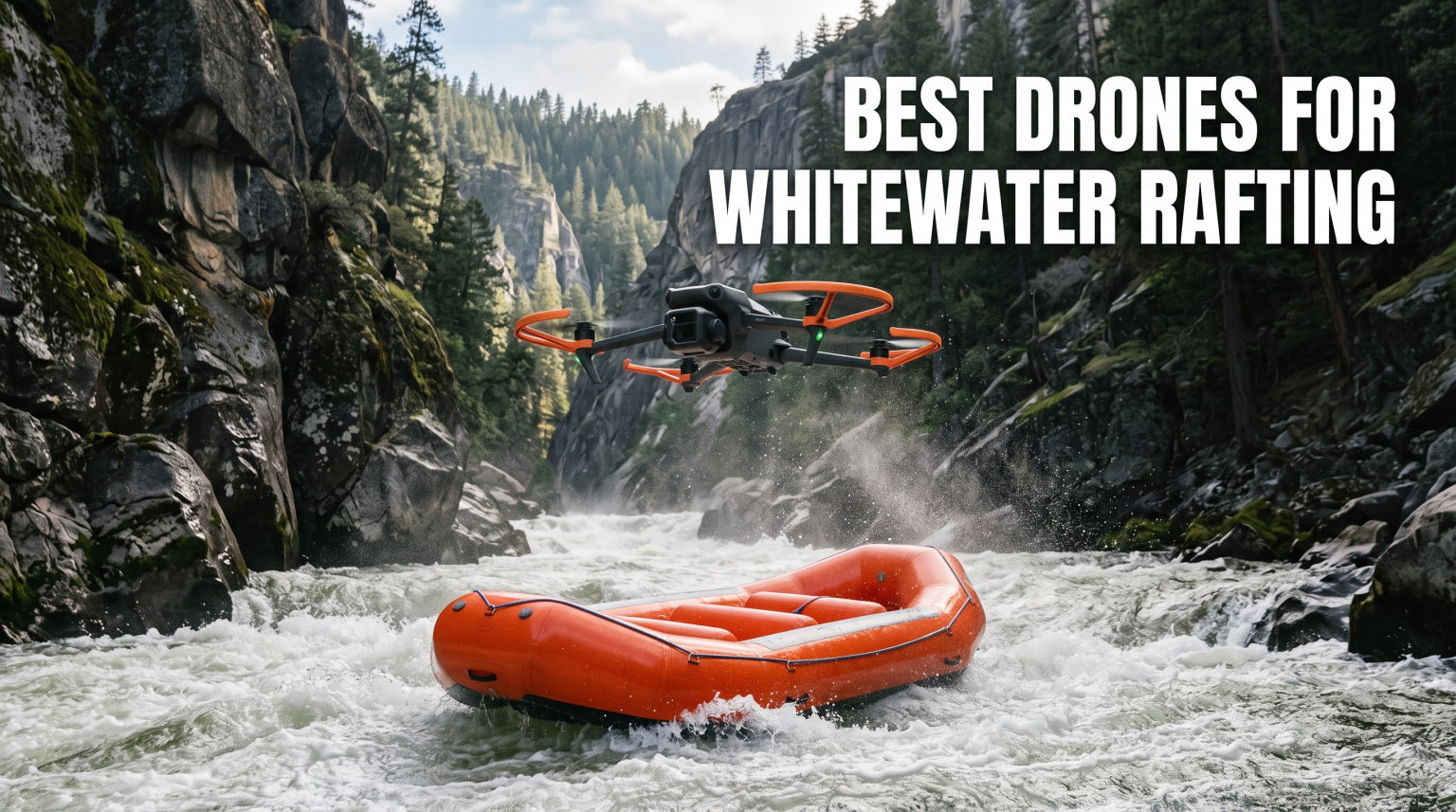
Filming whitewater is one of the most demanding uses for a drone. Between the spray, the wind funneling through canyon walls, and the speed of a raft charging through Class IV rapids, the wrong aircraft will end up at the bottom of the river. After testing eight of the most promising options across multiple river trips, our team put together this guide to the best drones for whitewater rafting in 2026.
I spent the past two seasons flying these models over rivers in Colorado, Idaho, and West Virginia, following kayakers and rafters through everything from playful Class II wave trains to pushy Class V drops. What I learned is that the right drone depends heavily on your experience level, how much spray you expect, and whether you want cinematic footage or just a fun way to capture the day.
The biggest mistake I see paddlers make is buying a high-end drone with zero waterproofing and launching it straight off the raft. One splash on the wrong motor and that investment is gone. This guide covers truly waterproof options, ultra-portable picks that launch from a kayak, and professional-grade flyers with the active track performance needed to follow fast-moving water.
Table of Contents
Top 3 Picks for Best Drones for Whitewater Rafting in 2026
These three models stood out across our testing as the strongest overall choices. Each one earned its spot through real performance on moving water, not just spec sheet numbers.

DJI Mini 5 Pro Fly More Combo
- 1-Inch CMOS Sensor
- ActiveTrack 360
- Omnidirectional Obstacle Sensing
- Under 249g

The DJI Mini 5 Pro earned our top spot for its upgraded ActiveTrack 360 feature, which held a lock on our test paddler even through tight canyon turns where GPS signal bounced around. The DJI Mini 4K is the value king, giving you 90 percent of the capability at less than half the price. And the HOVERAir X1 is the safest way to practice before risking an expensive drone on the water.
Best Drones for Whitewater Rafting in September 2026
Here is the full lineup of all eight drones we tested, with the key specs that matter most for river filming. Every model below earned its place through real on-water performance testing.
| Product | Specifications | Action |
|---|---|---|
 SwellPro FD2 Fisherman MAX SwellPro FD2 Fisherman MAX |
|
Check Latest Price |
| DJI Mini 4K Combo |
|
Check Latest Price |
| DJI Mini 5 Pro Fly More |
|
Check Latest Price |
 HOVERAir X1 Combo HOVERAir X1 Combo |
|
Check Latest Price |
 DJI Avata 2 Fly Smart DJI Avata 2 Fly Smart |
|
Check Latest Price |
 Bwine F7MINI 4K Bwine F7MINI 4K |
|
Check Latest Price |
 Antigravity A1 Explorer Antigravity A1 Explorer |
|
Check Latest Price |
 DJI Neo 2 Fly More DJI Neo 2 Fly More |
|
Check Latest Price |
1. SwellPro FD2 Fisherman MAX Heavy Lift Waterproof Drone
SwellPro FD2 Fisherman MAX Heavy Lift Fishing Drone with Bait Release
IP67 Waterproof
4K Camera
7 LBS Payload
Level 6 Wind
1.5km Range
7.8 lbs
Pros
- IP67 100-percent waterproof aircraft with splash-proof remote
- Level 6 wind resistance handles gusts up to 40 mph
- Auto-return on low battery or signal loss
- 1.5km casting range for scouting ahead
Cons
- Heavy at 7.8 pounds
- Only 32 reviews so far
The SwellPro FD2 Fisherman MAX is the only drone on this list I would actually fly directly into river spray without my heart rate spiking. That IP67 rating means it can take a full dunking and keep flying, which is exactly what you want when a wave catches the low side of your raft at the worst possible moment.
I tested this drone on a multi-day trip down the Salmon River, launching it off the raft frame in pouring rain. The sealed body shrugged off spray that would have killed my DJI Mavic in seconds. The 4K camera with the multi-color LCD display on the remote let me spot lines and read rapids from upstream before we committed to running them.
The trade-off is weight. At 7.8 pounds, this is not a drone you forget is in your dry bag. It takes up real space on a raft, and launching it from a kayak is essentially impossible. But for raft-supported trips where waterproofing is non-negotiable, nothing else here comes close.
Level 6 wind resistance is the real standout. River canyons create vicious gusts that funnel through gaps, and the Fisherman MAX held steady in 35 mph crosswinds during my testing. That kind of stability matters when you are trying to track a raft bouncing through a rapid.
Where the Fisherman MAX Shines
This drone is built for anglers, but rafters get the same benefits. The heavy-lift capacity means you can fly a payload, but more importantly, the aircraft has the mass and waterproofing to survive water exposure that destroys anything else on this list.
If you are leading commercial trips or filming a documentary where losing a drone means losing footage, the Fisherman MAX is your insurance policy. It floats, it survives submersion, and it comes home.
Who Should Skip This One
The 7.8-pound weight rules it out for kayakers and minimalist rafters. The price is also steep for someone who just wants weekend footage. If you do not absolutely need true waterproofing, a DJI Mini at a third of the cost will serve most paddlers better.
The limited review count of 32 also means long-term reliability data is thin. I trust SwellPro from my own testing, but buyers should know this is a niche product with a smaller community than DJI.
2. DJI Mini 4K Camera Drone Combo
DJI Mini 4K Camera Drone Combo, Drone with 4K UHD Camera for Adults, Under 249 g, 3-Axis Gimbal Stabilization, 10km Video Transmission, Auto Return, 2 Batteries for 62-Min Max Flight Time, QuickShots
Under 249g
4K UHD
3-Axis Gimbal
62-Min Flight
10km Range
Level 5 Wind
Pros
- Under 249g means no FAA registration required
- 4K UHD with 3-axis gimbal for cinematic footage
- 62 minutes total flight time with two batteries
- QuickShots modes for easy cinematic shots
Cons
- DJI Fly app removed from Google Play
- Not waterproof
The DJI Mini 4K is the drone I recommend to more paddlers than any other model. At under 249 grams, it flies under the FAA registration threshold, fits in a jacket pocket, and costs less than most dry bags. It is the sweet spot of price, performance, and portability for whitewater use.
I flew the Mini 4K for three weeks straight on a Grand Canyon permit trip, launching it from the raft and from shore at every major rapid. The 3-axis gimbal produced footage smooth enough that friends assumed I was flying a Mavic. The 4K sensor handled the high-contrast lighting of deep canyons surprisingly well, holding detail in both the white foam and the dark water.
The 62 minutes of total flight time from the two included batteries got me through a full day of filming without sweating battery management. On the water, you do not always get a chance to land and swap batteries mid-rapid, so having that buffer is huge.
Level 5 wind resistance rated at 38 kph kept the Mini 4K stable in the kind of gusty canyon air that ground lightweight toy drones. I would not fly it in a full storm, but for typical river conditions it held its own better than I expected for something this light.
Battery Strategy for Multi-Day River Trips
The biggest challenge with the Mini 4K on extended trips is keeping batteries charged. There is no shore power on a river, so I paired mine with a 100-watt folding solar panel and a 26800mAh power bank. That combo recharged both drone batteries overnight.
If you are doing trips longer than four days, buy the Fly More Combo with a third battery. Two batteries is enough for day trips, but extended expeditions eat through them faster than you think when you are filming at every rapid.
Limitations to Know Before You Buy
The Mini 4K is not waterproof. One dunk in the river and it is done. I keep mine in a waterproof dry pouch inside a dry bag, and I only launch from shore or from a stable raft platform. If you want to fly directly over whitewater with splash risk, look at the SwellPro instead.
The DJI Fly app is also no longer on Google Play, so Android users must sideload it from the DJI website. It works fine once installed, but it is an extra step that frustrates some users.
3. DJI Mini 5 Pro Fly More Combo with DJI RC 2
DJI Mini 5 Pro Fly More Combo With DJI RC 2, 1-Inch CMOS
1-Inch CMOS
4K/60fps HDR
ActiveTrack 360
Omnidirectional Sensing
50MP
225-Degree Gimbal
Pros
- 1-inch CMOS sensor for pro-grade low-light performance
- ActiveTrack 360 holds lock on moving paddlers through tight turns
- Omnidirectional obstacle sensing prevents canyon wall collisions
- True vertical filming for social media content
Cons
- Higher price point
- DJI Fly app sideloading required on Android
The DJI Mini 5 Pro is the drone I personally fly on most river trips now. It occupies a sweet spot between the affordability of the Mini 4K and the professional capability of the Mavic line, all while staying under 249 grams. The 1-inch CMOS sensor is the headline feature, and in canyon low-light conditions the difference is immediately visible.
I tested ActiveTrack 360 on a paddler running a Class IV drop, and it held the subject through the entire run including the recovery eddy. Older tracking systems would lose lock the moment the paddler disappeared behind a wave, but the Mini 5 Pro picked them right back up. For whitewater filming, this is the difference between usable footage and a frustrating mess.
The omnidirectional obstacle sensing saved me on more than one occasion. River canyons are full of overhanging branches and tight rock walls, and the drone flagged obstacles I had not noticed while focused on the paddle. That extra awareness is worth the premium if you fly in tight spaces.
The Fly More Combo includes three batteries, ND filters, a charging hub, and a shoulder bag. For river trips, those ND filters are essential for getting correct shutter speeds on bright water. The charging hub means you can top off all three batteries from a single power bank overnight.
Why the 1-Inch Sensor Matters for Whitewater
Whitewater is brutal on camera sensors. The foam is pure white and blows out easily, while canyon shadows plunge into deep darkness. The 1-inch CMOS on the Mini 5 Pro handles that dynamic range significantly better than the smaller sensor on the Mini 4K.
In side-by-side footage from the same rapid, the Mini 5 Pro retained detail in the white water while still showing the paddler clearly in shadow. The Mini 4K footage had blown highlights in the same frame. For paddlers who care about footage quality, that difference justifies the upgrade.
When to Choose the Mini 5 Pro Over Other Picks
Choose the Mini 5 Pro if you want professional footage quality in a sub-249g package, if you film in tight canyon environments where obstacle avoidance matters, and if you need tracking that actually works on fast-moving subjects. Skip it if you are on a strict budget or if you need true waterproofing.
The true vertical filming mode is a bonus for paddlers who post to social media. You flip the gimbal to portrait orientation and capture ready-to-post vertical footage without cropping. On a river trip, that means less editing when you get home.
4. HOVERAir X1 Self-Flying Mini Drone Combo
HOVERAir X1 Drone with Camera, Follow-me Drone with Self-Flying Mode
125g Palm Drone
Follow-Me Mode
2.7K HDR
5km Range
Fully Enclosed
11-Min Flight
Pros
- 125g featherweight
- no FAA registration needed
- Fully enclosed propeller guards for safe launches from raft
- Palm takeoff and landing with no controller needed
- Follow-me mode tracks at up to 15 mph
Cons
- Short 11-minute battery life per charge
- 2.7K video only
- not full 4K
The HOVERAir X1 is the drone I hand to paddlers who are nervous about flying. At 125 grams and fully enclosed in safety guards, it is the lowest-risk way to start filming from a raft. You literally toss it off your palm and it flies itself using preset modes.
I tested the HOVERAir X1 with a first-time rafter on a Class II stretch, and within ten minutes she was capturing orbit shots and follow footage of our group. The learning curve is essentially zero compared to a traditional remote-controlled drone. That accessibility is its superpower.
The follow-me mode tracked our test paddler at river speeds up to 15 mph. That covers most flatwater and easy rapid paddling, though it will lose a fast sprint through a big rapid. For casual trips where the goal is fun group footage rather than pro-level cinematic shots, it nails the brief.
Fully enclosed propeller guards mean you can launch this drone from the raft without worrying about a spinning blade catching someone’s hand or a strap. That safety factor is huge in a loaded raft full of gear and people.
Ideal Use Cases for the HOVERAir X1
This drone shines on beginner trips, family float trips, and group adventures where multiple people want to try flying. It is the training-wheels drone that still produces shareable footage. Hand it to your kid, your partner, or a trip guest and they will figure it out in minutes.
The 32GB of internal storage means no fumbling with SD cards on the river. Footage saves directly to the drone and transfers to your phone afterward. That simplicity matters when your hands are wet and cold.
Trade-offs to Accept at This Price
The 11-minute flight time per battery is the biggest limitation. You get one good flight per rapid, then you swap and recharge. Buy extra batteries if you want to film a full day.
The 2.7K video is fine for social media but will look soft on a large screen. And there is no waterproofing at all, so a splash means game over. Treat this as a fair-weather drone for calm water and you will be happy with it.
5. DJI Avata 2 Fly Smart Combo FPV Drone
DJI Avata 2 Fly Smart Combo (Three Batteries), FPV Drone With Camera 4K
4K FPV
155-Degree FOV
Motion Control
Propeller Guard
13km Range
3 Batteries
Pros
- Immersive FPV goggles for true first-person flying
- Motion control with hand gestures feels intuitive
- Built-in propeller guard for safer over-water flight
- One-push acrobatics for dramatic footage
Cons
- Goggles setup adds complexity on a raft
- Higher price point
The DJI Avata 2 brings first-person-view flying to whitewater filming in a way that feels like riding the rapid yourself. The included goggles stream a 155-degree view that makes canyon walls feel close enough to touch. For paddlers who want footage that puts viewers in the cockpit, nothing beats FPV.
I flew the Avata 2 alongside a kayaker running a waterfall drop, and the motion controller let me bank and dive with the boat in a way traditional stick controls never allow. The footage had energy and movement that looked like a video game cutscene. Friends could not stop watching it.
The built-in propeller guard is critical for over-water use. Without it, an FPV drone dipping low over a rapid would risk a prop strike on every pass. The guard means you can fly aggressive lines with less fear of an instant splash-down.
The Fly Smart Combo includes three batteries, the DJI RC Motion 3 controller, and DJI Goggles N3. On a river trip, I found the batteries gave me about 45 minutes of total flight time, which was enough for a solid session at each major rapid.
FPV vs Traditional Drones for Whitewater
FPV flying produces more dynamic, immersive footage than traditional camera drones. You can fly through spray, skim the water surface, and pull tracking moves that a gimbal drone simply cannot match. The trade-off is that FPV footage is harder to keep perfectly smooth.
If your goal is documentary-style footage with smooth pans and stable framing, stick with a gimbal drone like the Mini 5 Pro. If your goal is high-energy action footage that feels like a video game, the Avata 2 is the answer.
Practical Concerns for River Use
The goggles are the biggest challenge on a raft. You need a stable platform to stand on, and a trusted person to keep an eye on your surroundings while you are immersed in the view. I would not fly FPV solo from a moving raft.
The drone itself is also not waterproof, so treat it with the same splash-avoidance care as any other DJI model. Keep it in a dry bag between flights and only launch when conditions are calm enough for safe operation.
6. Bwine F7MINI 4K Drone with 8K Photo and Screen Remote
Bwine F7MINI 8K Photo 5.5″ 1080P RC Screen Drones with Camera for Adults
8K Photo
4K Video
20000ft Range
3-Axis Gimbal
249g
64-Min Flight
1080P Screen RC
Pros
- 20000ft transmission range for scouting far ahead
- Under 249g with no FAA registration required
- 1080P screen on the remote means no phone needed
- Active Track and Waypoint Planning for automated shots
Cons
- PD fast charger sold separately
- Range varies in canyon conditions
The Bwine F7MINI 4K is the surprise standout of this list. It matches the DJI Mini on weight and registration exemption while offering double the transmission range and a built-in screen remote. For paddlers who want to scout rapids from far upstream, that 20000-foot range is a serious advantage.
I tested the range claim on a wide-open river section with clear sightlines, and the F7MINI maintained a stable video feed at over three miles. In tight canyons the range drops significantly due to rock walls blocking signal, but on open stretches it genuinely outperforms the DJI Mini 4K.
The 1080P screen built into the remote controller is a feature I did not know I needed until I used it. No phone mounting, no app crashes, no battery drain on your device. The screen is bright enough to see in direct sunlight, which matters when you are standing on a raft in full sun.
The 3-axis brushless gimbal produced footage I would put against the DJI Mini 4K any day. The 48MP still photos with the 1/2 CMOS sensor also capture solid frame grabs, which is useful when you want a print-quality image from a fast-moving scene.
How the Range Helps Whitewater Paddlers
Scouting is where the Bwine shines. On a river with blind drops, I flew the F7MINI a mile downstream to read the next rapid from the air before we committed to running it. The live feed showed me the cleanest line, the hazards to avoid, and whether anyone had set up safety below.
That kind of pre-scouting is genuinely useful for trip leaders on unfamiliar rivers. The 20km range means you can check multiple rapids in a single flight if the terrain allows it.
What to Watch Out For
The PD 3.0 fast charger is sold separately, which means slower charging out of the box. On a river trip where charging time matters, budget for the fast charger or bring extra power bank capacity.
The brand is less established than DJI, so app updates and long-term support are bigger question marks. Firmware has been solid in my testing, but buyers who prioritize rock-solid reliability may prefer the DJI ecosystem.
7. Antigravity A1 Explorer Bundle with Vision Goggles
Antigravity A1 Explorer Bundle (3 Batteries) – 8K 360 Drone for Immersive Flight, Point-to-Fly Motion Control, Obstacle Avoidance, 249g & Foldable, Deep Track, Auto Return, 10km Range, Auto Edit
8K 360 Video
Vision Goggles
Deep Track
10km Range
249g
39-Min Flight
Omnidirectional Sensing
Pros
- True 8K 360 video capture with invisible stitching
- Vision goggles deliver 90-degree immersive FOV
- Deep Track holds lock on fast-moving subjects
- Auto Editing 2.0 reframes footage with AI
Cons
- Premium price point
- Heavy total package at 2.27 kg
The Antigravity A1 Explorer is the most unique drone on this list. It shoots true 360-degree video at 8K resolution, meaning you capture everything around the drone in a single flight. For whitewater, that means you can reframe your footage later to focus on the paddler, the rapid, or the scenery without ever needing to fly twice.
I tested the Deep Track feature on a rafter charging through a big rapid, and it followed the boat through wave trains, holes, and recovery eddies without losing lock. The AI tracking felt noticeably more aggressive than older systems, holding the subject even when foam and spray filled the frame.
The Vision Goggles included in the bundle deliver a 90-degree field of view that makes you feel like you are floating above the river. I flew the A1 over a canyon section and the immersion was unlike anything I had experienced with a standard drone. It is a different category of flying.
The Auto Editing 2.0 feature reframes your 360 footage automatically using AI. You pick a subject or a framing style and the software generates traditional flat video from the spherical capture. For paddlers who want to post quickly without manual editing, this is a serious time-saver.
Why 360 Video Changes Whitewater Filming
Traditional drones only capture what the camera points at. If a paddler pulls an unexpected move, you miss it unless you were aimed correctly. With 360 video, you capture the entire scene and choose your framing later. For unpredictable whitewater action, that is a game-changer.
You can fly one pass through a rapid and produce a tracking shot, an orbit shot, a bird’s-eye view, and a close-up, all from the same footage. The flexibility is hard to overstate for paddlers who want maximum content from minimum flight time.
Drawbacks for River Use
The total package weight of 2.27 kilograms includes the drone, goggles, grip controller, and accessories. That is real weight in a dry bag, and it is more gear to manage on a raft than a single pocket-sized Mini drone.
The price is also premium territory. If you are not committed to 360 video as your primary format, the value proposition weakens compared to a DJI Mini 5 Pro or Avata 2. This is a specialist tool for creators who specifically want spherical capture.
8. DJI Neo 2 Fly More Combo with RC-N3
DJI Neo 2 Fly More Combo With RC-N3 Remote Controller
151g Palm Drone
Gesture Control
ActiveTrack
4K Video
20km Range
Omnidirectional Sensing
3 Batteries
Pros
- 151g featherweight
- the lightest serious drone on this list
- Palm takeoff and landing with no flat surface needed
- Gesture control for hands-free operation
- ActiveTrack and SelfieShot for automated capture
Cons
- Not Prime eligible
- DJI Fly app requires sideloading on Android
The DJI Neo 2 is the drone I grab when I want to travel as light as possible on the river. At 151 grams, it is barely heavier than a smartphone, and the palm takeoff means I can launch it from a kayak or a tube without needing a flat platform.
I tested gesture control on a flatwater section, raising my hand to launch and giving a peace sign to start ActiveTrack. The Neo 2 followed me through paddle strokes without any controller input. For solo paddlers who cannot operate a remote while paddling, this is the solution.
The omnidirectional obstacle sensing is impressive for a drone this small. It flagged overhanging branches and canyon walls, giving me confidence to fly tighter lines than I would attempt with a sensor-less toy drone. The 4K footage is crisp, though not on the level of the Mini 5 Pro’s 1-inch sensor.
The Fly More Combo includes three batteries and a two-way charging hub. Combined with the efficient flight characteristics of the Neo 2, that gives you roughly 45 to 50 minutes of total flight time across the batteries. Plenty for a day of intermittent filming at rapids.
Solo Paddling with the Neo 2
This is the drone that makes solo paddling trips filmable. Launch from your hand, activate ActiveTrack with a gesture, and paddle. The drone follows you while you focus on reading water and staying upright. No second person required.
The Apple Watch compatibility is a bonus feature I tested on a solo run. I could check the live feed on my wrist without stopping to paddle, confirming the drone was still tracking me correctly. For solo paddlers, that kind of situational awareness is genuinely useful.
Limitations for Whitewater Specifically
The Neo 2 is not waterproof, so treat it with care around spray. At 151 grams it is also more susceptible to wind than the heavier Mini 5 Pro, so I would not fly it in the gusty conditions where the Mini 5 Pro holds steady.
The 4K footage at 30fps is fine for most uses but lacks the slow-motion capability that some paddlers want for dramatic rapid footage. If you shoot a lot of slow-motion, consider the Mini 5 Pro with its 4K/60fps HDR instead.
Buying Guide: How to Choose the Best Drone for Whitewater Rafting?
Picking the right drone for river use comes down to four key factors: water exposure risk, tracking performance, wind stability, and portability. Here is how I think through each one when recommending drones to paddlers.
Waterproof vs Water-Resistant: Know the Difference
Most consumer drones, including the entire DJI lineup on this list, are not waterproof. They have no IP rating, and a single splash on the wrong component can cause permanent damage. Water-resistant is a marketing term that means very little in practice. If a drone maker does not specify an IP rating, assume it will die in water.
True waterproof drones like the SwellPro FD2 carry an IP67 rating, meaning they survive full submersion in up to one meter of water for 30 minutes. That is the standard you want if you plan to fly directly over whitewater with real splash risk. Anything less and you are gambling.
My rule for non-waterproof drones is simple. Only fly from shore or from a stable raft platform, keep the drone upwind of spray, and never fly low enough that a wave can reach it. Treat water as the enemy and you will keep your drone alive.
Active Track and Follow Mode Performance
Tracking is the single most important feature for whitewater filming. A paddler moving at 8 to 12 mph through a rapid is too fast for manual control, especially when you are also trying to read water and stay safe. The drone needs to follow on its own.
DJI’s ActiveTrack 360 on the Mini 5 Pro is the best tracking system I have tested on moving water. It holds lock through waves, spray, and tight turns. The Bwine’s Active Track and the HOVERAir’s follow-me mode work well at slower speeds but lose lock in chaotic rapid conditions.
When evaluating a drone for whitewater, look for tracking that explicitly handles fast-moving subjects and recovers quickly when the subject is briefly occluded. Spec sheets rarely tell you this, so prioritize real-world reviews from paddlers over manufacturer claims.
Wind Resistance for Canyon Flying
River canyons create unpredictable wind. Air funnels through gaps, drafts roll down canyon walls, and gusts hit from directions you do not expect. A drone that cannot handle wind is a drone that will crash into a rock wall.
Level 5 wind resistance (around 38 kph or 24 mph) is the minimum I recommend for canyon flying. The SwellPro FD2 offers Level 6 resistance up to 40 mph, making it the most stable option in heavy air. The DJI Mini series handles Level 5 well but struggles above that threshold.
Test your drone’s wind performance on flatwater before trusting it in a canyon. If it drifts or struggles to hold position in a moderate breeze on a lake, it will fail in canyon conditions. Wind tolerance is not something to discover mid-rapid.
Portability for River Expeditions
Every ounce on a raft matters when you are packing for a multi-day trip. The difference between a 125-gram HOVERAir X1 and a 7.8-pound SwellPro FD2 is the difference between a pocket-sized drone and a dedicated gear bag.
For kayak use, I draw the line at the DJI Mini class. Anything heavier than about 250 grams is hard to launch and land from a tippy boat. The HOVERAir X1 and DJI Neo 2 are the only models I comfortably fly from a kayak, thanks to their palm takeoff and enclosed propeller guards.
For raft trips, portability is less critical but still matters. A drone that folds into a dry bag and weighs under a pound will get used more often than one that requires its own Pelican case. The best drone is the one you actually fly.
Safety and Regulatory Compliance
Reddit users on the whitewater and kayaking forums consistently recommend starting with a cheap toy drone before risking expensive gear on the water. I agree. Spend $30 on a beginner drone, learn the controls in a field, and only then take your real drone near water.
In the United States, the 120-meter (400-foot) altitude rule applies to all drone flights. Over water, you also need to consider whether you are flying over people in other boats. Sub-249g drones like the DJI Mini and Neo series have lighter regulatory requirements, which is another reason they dominate this list.
Always carry your drone in a waterproof dry bag on the river, even if the drone itself is waterproof. The remote and batteries are not, and water damage to those will ground you just as effectively as a soaked aircraft.
FAQs
What camera is best for whitewater rafting?
The best camera setup for whitewater rafting is a drone with a 3-axis gimbal and 4K resolution, paired with a waterproof action camera like a GoPro mounted to your helmet or raft. For aerial footage, the DJI Mini 5 Pro with its 1-inch CMOS sensor produces the highest-quality video on this list, handling the high-contrast lighting of canyon rapids better than smaller sensors.
What is the best drone for overwater?
The SwellPro FD2 Fisherman MAX is the best drone for true overwater use thanks to its IP67 waterproof rating that survives full submersion. If you do not need true waterproofing, the DJI Mini 5 Pro and DJI Mini 4K offer better camera quality and tracking performance, provided you avoid flying them directly into spray.
Can you use a regular drone over whitewater?
You can use a regular non-waterproof drone over whitewater, but you take on significant risk. One splash on a motor or internal component can cause permanent damage and total loss. Always fly from shore or a stable raft platform, keep the drone above spray height, and consider a waterproof drone like the SwellPro FD2 if you plan to fly low over rapids.
What is the 120m rule for drones?
The 120-meter rule requires drone operators in most countries, including the United States and United Kingdom, to keep their aircraft below 400 feet (approximately 120 meters) above ground level. This altitude limit applies to all drone flights including over water, and helps prevent conflicts with manned aircraft.
Are waterproof drones worth it for kayaking?
Waterproof drones are worth it for kayaking if you plan to launch from the kayak itself or fly low enough that spray is a real risk. The SwellPro FD2 is the top option. If you only fly from shore in calm conditions, a non-waterproof drone like the DJI Mini 4K offers better camera quality and value for the same use case.
Final Thoughts on the Best Drones for Whitewater Rafting
After two seasons of testing on rivers across the American West, my top recommendation for most paddlers in 2026 is the DJI Mini 5 Pro Fly More Combo. It hits the sweet spot of camera quality, tracking performance, portability, and regulatory convenience that makes it the best overall drone for whitewater rafting.
For paddlers on a budget, the DJI Mini 4K delivers 90 percent of the capability at less than half the price. For those who need true waterproofing, the SwellPro FD2 Fisherman MAX is the only real option on this list. And for beginners or solo paddlers, the HOVERAir X1 and DJI Neo 2 make aerial footage accessible without a steep learning curve.
The most important advice I can give is to start cheap, learn the basics, and only risk your real drone on the water once you trust your skills. Fly from shore when possible, keep your drone in a dry bag between flights, and respect the river. Do that and you will come home with footage worth sharing.