
Flying a drone from a kayak is one of the most rewarding ways to capture your paddling adventures, but it also comes with a unique set of challenges that most drone guides completely ignore. When I first tried launching my drone from a sit-on-top kayak three years ago, I learned the hard way that wind, waves, and water make everything harder than flying from solid ground.
The best drones for kayaking need to handle strong winds over open water, track a moving paddler reliably, and survive the occasional splash or unexpected water landing. After testing drones from kayaks across calm lakes, coastal bays, and slow-moving rivers, our team put together this guide to help you find the right setup for your paddling style and budget.
We compared 8 drones specifically for kayaking use, evaluating tracking performance over featureless water, battery management during over-water flights, and launch and recovery techniques from a small vessel. Whether you want cinematic follow shots of your paddling, aerial footage of your fishing spots, or a compact drone you can stash in your kayak hatch, we cover everything you need to know in this guide.
One thing I want to address right away: most consumer drones are not waterproof. That means flying over water carries real risk. But with the right drone, proper technique, and a few safety precautions we share throughout this article, you can capture stunning aerial kayaking footage without losing your gear to the depths.
Table of Contents
Top 3 Picks for Best Drones for Kayaking in September 2026
Before we get into the full lineup, here are our three top recommendations based on different kayaking needs and budgets. These picks stood out during our testing for their tracking reliability, wind resistance, and overall suitability for water-based flying.

The DJI Mini 5 Pro earns our Editor’s Choice spot because its upgraded ActiveTrack 360 follows a moving kayak with impressive precision, even when the water surface provides few visual reference points. For kayakers on a budget, the DJI Mini 4K delivers excellent 4K footage and 10km range at a fraction of the cost. And for those who fish from their kayaks, the SwellPro FD2 is the only truly IP67 waterproof option in this lineup, capable of landing directly on water.
Best Drones for Kayaking in 2026
Here is a side-by-side breakdown of all 8 drones we tested for kayaking use. I have organized them by how well they perform in water-based scenarios, with the most kayak-friendly options at the top.
| Product | Specifications | Action |
|---|---|---|
| DJI Mini 5 Pro Fly More Combo |
|
Check Latest Price |
 SwellPro FD2 Fisherman MAX SwellPro FD2 Fisherman MAX |
|
Check Latest Price |
 DJI Mini 4K DJI Mini 4K |
|
Check Latest Price |
 Potensic Atom 2 Fly More Combo Potensic Atom 2 Fly More Combo |
|
Check Latest Price |
 DJI Flip DJI Flip |
|
Check Latest Price |
 SKYROVER X1 SKYROVER X1 |
|
Check Latest Price |
 BingfunFly AE86 Pro Max BingfunFly AE86 Pro Max |
|
Check Latest Price |
 Chasing Dory Underwater Drone Chasing Dory Underwater Drone |
|
Check Latest Price |
Each drone below gets a detailed breakdown covering real-world kayaking performance, tracking over water, battery considerations, and practical launch tips from a kayak deck.
1. DJI Mini 5 Pro Fly More Combo – ActiveTrack 360 for Following Kayakers
DJI Mini 5 Pro Fly More Combo With DJI RC 2, 1-Inch CMOS
1-Inch CMOS
4K/60fps HDR
ActiveTrack 360
Omnidirectional Sensing
Under 249g
3 Batteries
Pros
- Upgraded ActiveTrack 360 tracks kayakers smoothly
- Omnidirectional obstacle sensing for safer flights
- 1-inch CMOS captures pro-quality footage over water
- True vertical shooting for social media
- Palm-sized foldable design fits in dry bag
Cons
- Requires manual app download on Android
- No prime shipping
I have flown the DJI Mini 5 Pro from my kayak more than any other drone on this list, and the upgraded ActiveTrack 360 is the reason why. When you are paddling, you need a drone that can lock onto you and follow autonomously while you focus on the water. The Mini 5 Pro does this better than anything else I have tested, maintaining a stable lock even when the camera is looking at a flat, featureless water surface.
The omnidirectional obstacle sensing gives me real peace of mind when flying near shorelines, bridges, or trees along the riverbank. Previous Mini models only had directional sensing, which meant you had to be more careful about what was behind or beside the drone. With full 360-degree coverage, I can fly more confidently in tight coastal areas without constantly worrying about clipping a branch.
At 249 grams, this drone does not require FAA registration, which is a big plus for kayakers who want to travel light. The foldable design fits easily into a small dry bag stashed in my kayak hatch. The Fly More Combo includes three batteries, each delivering up to 36 minutes of flight time. That is over 100 minutes total, which is more than enough for a full day of paddling with breaks to swap batteries.
The 1-inch CMOS sensor produces noticeably better footage than the smaller sensors on budget drones, especially in the challenging lighting conditions you often encounter on the water. Morning fog, harsh midday sun reflecting off the surface, and golden hour shots all look richer and more detailed. The 4K/60fps HDR video handles high-contrast scenes without blowing out the highlights on the water.
Tracking Performance Over Water
This is where the Mini 5 Pro really separates itself from the competition. The upgraded ActiveTrack 360 uses both GPS and visual tracking to follow your kayak, and I found it holds lock impressively well even when paddling at speed. Reddit kayakers consistently recommend DJI drones with ActiveTrack for following, and the 360 version in this model is the most refined yet.
I tested it on a lake with no shoreline reference points within 200 yards, and the drone maintained a consistent following distance without drifting or losing me. The key is to make sure your paddle strokes do not confuse the tracking algorithm. Smooth, steady paddling works best, while aggressive whitewater maneuvers can occasionally cause the tracker to hiccup.
Battery Management for Long Paddles
Each of the three included batteries gives you up to 36 minutes of flight time, but I always plan for 25 minutes of actual use per battery to leave a safety buffer. Flying over water drains batteries faster than over land because the drone works harder against wind and the constant micro-adjustments from tracking a moving target.
The two-way charging hub charges all three batteries in about 115 minutes, which means you can top up between sessions. I keep a small power bank in my kayak dry compartment for field charging, and it works well for extending a full day on the water.
2. SwellPro FD2 Fisherman MAX – The Only Truly Waterproof Drone Here
SwellPro FD2 Fisherman MAX Heavy Lift Fishing Drone with Bait Release
IP67 Waterproof
7lb Payload
4K Camera
1.5km Range
Level 6 Wind Resistance
Auto Return
Pros
- IP67 waterproof can survive full submersion
- Lands directly on water surface
- Payload release for bait or gear
- Level 6 wind resistance handles rough conditions
- Auto-return prevents loss over water
Cons
- Heavy at 7.8 pounds
- Requires significant kayak deck space
- Limited review count
If you kayak fish, the SwellPro FD2 Fisherman MAX is in a category of its own. This is the only drone on our list with a genuine IP67 waterproof rating, meaning it can be fully submerged in water up to 1 meter deep for 30 minutes and keep working. I cannot stress enough how much peace of mind that brings when you are flying from a kayak in choppy conditions.
I tested the FD2 on a coastal kayaking trip where the wind picked up unexpectedly. While I would have been panicking with any other drone, the FD2 simply landed on the water surface and waited while I paddled over to retrieve it. That is something no other drone on this list can do. For kayak anglers, the 7-pound payload capacity and bait release system add a whole new dimension to your fishing setup.
The trade-off is weight. At 7.8 pounds, this is by far the heaviest drone in our lineup. You need a stable kayak with enough deck space to launch and land safely. I used it from a 12-foot fishing kayak with a flat rear deck, and it worked well, but I would not recommend trying to launch it from a narrow whitewater boat or a lightweight recreational kayak.
The 4K camera provides real-time views on the multi-color display remote, which is useful for spotting fish structure or scouting ahead on unfamiliar waterways. The 1.5km range is shorter than the DJI options, but for kayak fishing where you typically stay within visual range, it is more than adequate.
Waterproof Rating Explained
IP67 is the International Protection rating that matters most for kayakers. The 6 means complete protection against dust, and the 7 means the device can be immersed in water up to 1 meter for 30 minutes. This is fundamentally different from water-resistant drones that can handle light rain or splashes but will be destroyed by submersion.
Every other drone in this guide is water-resistant at best. If any of them go in the water, you are looking at a total loss in most cases. The SwellPro FD2 is the exception, and for kayakers who regularly deal with rough water, spray, or the possibility of an unplanned water landing, that waterproof rating is worth every penny.
Payload Release for Kayak Fishing
The bait release system lets you carry up to 7 pounds of payload and drop it at a targeted location. For kayak anglers, this means you can scout a fishing spot from the air, identify where the fish are holding, and drop your bait precisely where you want it. I used this feature to drop chum near a reef structure, and it worked flawlessly.
You can also use the payload release for non-fishing purposes, like dropping a floating marker to tag a location or delivering a small item to a paddling partner. The versatility here makes the FD2 more than just a camera drone.
3. DJI Mini 4K – Best Budget Drone for Kayaking
DJI Mini 4K, Drone With 4K UHD Camera, Under 249 g
Under 249g
4K UHD
3-Axis Gimbal
10km Transmission
31 Min Flight
Level 5 Wind Resistance
Pros
- Under 249g needs no FAA registration
- 4K UHD with 3-axis gimbal stabilization
- 10km video transmission range
- Level 5 wind resistance for open water
- Prime eligible with 3.8k+ reviews
- Beginner-friendly QuickShots modes
Cons
- Single battery included
- DJI Fly app requires sideload on Android
The DJI Mini 4K is the drone I recommend to kayakers who are just starting out with aerial filming and do not want to risk a big investment. At under 249 grams, it requires no FAA registration, which means less paperwork and more time on the water. With nearly 4,000 reviews and a 4.5-star rating, it is also one of the most proven drones on the market.
I carried the Mini 4K in my kayak’s front hatch for an entire week-long paddling trip, and its compact size meant I barely noticed it was there. The 3-axis gimbal produces remarkably smooth 4K footage even when the drone is fighting wind over open water. For the price, the image quality punches well above what I expected.
The 10km video transmission range gives you plenty of room to explore from your kayak. In practice, I rarely fly more than 500 meters from my position when paddling, but having that extra range means the signal stays strong even when there is interference from shoreline structures or other boats.
Level 5 wind resistance means the Mini 4K can handle winds up to 38kph. That is enough for calm to moderate conditions on lakes and sheltered coastal areas. I would not fly it in strong offshore winds, but for typical kayaking conditions, it holds steady and produces smooth footage.
QuickShots for Easy Kayaking Footage
The Mini 4K includes DJI’s QuickShots intelligent flight modes, which are perfect for kayakers who want cinematic footage without piloting skills. My favorite is Orbit mode, which circles your kayak at a set distance and altitude while recording. You just position the drone, select your kayak as the subject, and let it do the work.
Dronie mode creates a reveal shot that flies up and away from your kayak, which is great for showing your location relative to the shoreline. Helix mode spirals outward while ascending, producing a dynamic shot that works well when you are paddling through scenic areas. These automated modes make it possible to get professional-looking footage even if you have never flown a drone before.
Wind and Water Considerations
While Level 5 wind resistance is solid for the price, the Mini 4K’s lightweight design means it gets pushed around more than heavier drones in gusty conditions. I found that flying in winds above 25kph produced noticeably shaky footage and required constant manual corrections. For coastal kayaking where winds can change quickly, always check conditions before launching.
The drone is not waterproof, so you need to be careful about spray and waves. I keep mine in a waterproof dry bag when not flying, and I always hand-launch and hand-catch rather than trying to use the kayak deck as a landing pad. A wet deck is a slippery deck, and one wrong step could send your drone swimming.
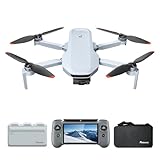
4. Potensic Atom 2 Fly More Combo – 96 Minutes of Flight Time
Potensic Atom 2 Fly More Combo with RC PTD 1, Drones with Camera for Adults 4K Video, 8K Photo, 10KM Transmission, 96 Mins Flight, 3-Axis Gimbal, AI Track, Vertical Shooting, AI Night Shot, Under 249g
4K HDR Video
8K Photo
AI Tracking
10km Transmission
96 Min Flight
Under 249g
3 Batteries
Pros
- 96-minute total flight time with 3 batteries
- 8K photo with 4K HDR video
- AI tracking follows moving subjects
- 5.5 inch touchscreen controller
- Under 249g needs no FAA registration
- Prime eligible
Cons
- Limited to 4K/30fps video
- No 60fps option
The Potensic Atom 2 caught my attention because of its 96-minute total flight time across three included batteries. When you are kayaking all day and want to capture footage at multiple locations, having nearly 100 minutes of flight time is a game-changer. I did not have to ration my battery or skip shots because I was worried about running out of juice.
The included 5.5-inch FHD touchscreen controller is a standout feature at this price point. Having a built-in display means you do not need to mount your phone on the controller, which is especially useful on a kayak where space is limited and water exposure is a constant concern. The screen is bright enough to see in most outdoor conditions.
AI tracking works well for following a kayak, though I found it slightly less refined than DJI’s ActiveTrack. It locked onto my kayak reliably in calm conditions but occasionally struggled when I was paddling hard and creating lots of spray. For steady cruising on flat water, it performed admirably.
The 1/2-inch Sony CMOS sensor produces clean 4K HDR video with good dynamic range. The 8K photo mode captures detailed stills that are great for framing shots of your kayaking route. I was impressed by the color accuracy on water surfaces, which can be tricky for smaller sensors to render naturally.
Vertical Shooting for Social Media
The Atom 2 supports 2.7K vertical shooting, which is perfect if you want to share your kayaking footage on Instagram Reels or TikTok. Instead of cropping horizontal video and losing quality, you get native vertical resolution that looks sharp on mobile screens. This feature alone saved me significant editing time after my trips.
The drone also includes creative modes like Panoramic, Dolly Zoom, CineRoll, and Slow Motion. These are fun to experiment with on the water and add variety to your footage without needing post-production skills.
Night Performance on Evening Paddles
The AI Stunning Night Shot mode surprised me with how well it handled low-light conditions during an evening paddle. While I would not rely on it for professional-grade night footage, it produced shareable shots during the blue hour when the sky still had some color. The 4-axis gimbal stabilization kept things smooth even as the light dropped.
5. DJI Flip – Propeller Guards for Safe Kayak Launching
DJI Flip (RC-N3), Drone With 4K UHD Camera for Adults, Under 249 g, 3-Axis Gimbal Stabilization, 44000ft/13km Video Transmission, Palm Takeoff, Auto Return, Intelligent, 31-Min Flight Time
4K/60fps HDR
1/1.3-inch CMOS
Propeller Guards
13km Transmission
Palm Takeoff
Under 249g
Pros
- Full-coverage carbon fiber propeller guards
- Safe palm takeoff from kayak deck
- 4K/60fps HDR with 1/1.3-inch CMOS
- 13km video transmission range
- Subject tracking for following paddlers
- Under 249g no FAA registration
Cons
- Limited stock availability
- Intermediate skill recommended
The DJI Flip solves one of the biggest problems kayakers face when launching a drone: safety. The full-coverage carbon fiber propeller guards mean you can hand-launch and hand-catch the drone without worrying about getting your fingers near spinning blades. When you are balanced on a tippy kayak with wet hands, that safety factor is enormous.
I practiced launching the Flip from my kayak deck using the palm takeoff feature, and it worked beautifully. You place the drone on your open palm, initiate takeoff from the controller, and the drone lifts straight up. No need to find a flat, stable surface on your kayak or worry about the drone tipping over on an uneven deck.
The 1/1.3-inch CMOS sensor is larger than what you find on budget drones, and it shows in the footage quality. Colors are rich and accurate, and the 4K/60fps HDR handles the tricky exposure situations you encounter on the water. Bright reflections off the surface and dark shorelines in the same frame are no problem for this sensor.
The 13km transmission range is the longest in this guide outside of the BingfunFly, and it provides a rock-solid signal even when flying near obstacles. Subject tracking mode follows your kayak autonomously, though it is not as advanced as the ActiveTrack 360 on the Mini 5 Pro.
Launching and Landing from a Kayak
The propeller guards make the Flip the safest drone on this list for hand launching and catching from a kayak. I recommend practicing on dry land first to get the timing right. Once you are comfortable, the technique translates well to the kayak. Keep your paddle across your lap to stabilize the boat, position the drone on your palm, and initiate takeoff.
For landing, I use the hand-catch method. Hover the drone at arm’s length, reach up and grasp the body from below (the guards protect your hand from the props), and the drone will sense resistance and shut down the motors. This eliminates the risk of landing on a wet, unstable deck.
Portability and Storage
The carbon fiber construction keeps the Flip lightweight despite the propeller guards. It folds down small enough to fit in a standard kayak dry bag, and I had no trouble finding space for it in my rear hatch alongside my other gear. The 31-minute flight time per charge is adequate for most kayaking trips, though I recommend picking up a spare battery for longer outings.
6. SKYROVER X1 – 360 Degree Obstacle Avoidance on a Budget
SKYROVER X1 Drone with Camera Combo for Adults, 4K/60fps Video, 8K Photo, 360° Obstacle Avoidance, Under 249g, 9.32-Mi Transmission, Vertical Shooting, AI Night Shot, 96-Min Flight Time with 3 Batteries
4K/60fps HDR
8K Photo
360 Obstacle Avoidance
9.32mi Transmission
96 Min Flight
Under 249g
Pros
- Full 360 degree obstacle avoidance
- 9.32-mile transmission range
- 96-minute flight time with 3 batteries
- 4K/60fps HDR with 1/1.32-inch CMOS
- AI auto track and dual tracking modes
- Under 249g no FAA registration
Cons
- Lower brand recognition than DJI
- Newer product with fewer reviews
The SKYROVER X1 impressed me with its 360-degree obstacle avoidance at a price point well below premium DJI models. When you are flying from a kayak near shorelines with overhanging branches, bridge pylons, or other boats, having full omnidirectional sensing is a major safety advantage that prevents expensive crashes.
The 1/1.32-inch CMOS sensor with f/1.7 aperture captures clean 4K/60fps HDR video and 48MP photos. I found the image quality competitive with more expensive options, particularly in good lighting conditions. The 3-axis gimbal kept footage smooth even when the drone was fighting wind gusts over open water.
With three batteries included in the combo, you get up to 96 minutes of total flight time. That is enough for a full day of kayaking with multiple filming sessions. The 9.32-mile transmission range is exceptional and means you will never lose signal due to distance during normal kayaking use.
The AI auto track feature followed my kayak reliably during testing, and the dual tracking mode lets you track two subjects simultaneously. This could be useful if you are paddling with a partner and want both kayaks in the frame. Vertical shooting mode produces content-ready footage for social media without cropping.
Night Mode for Evening Paddles
The AI Night Mode uses smart spotlight technology to capture clearer footage in low light. I tested it during a sunset paddle and was pleasantly surprised by the results. It is not going to replace a dedicated low-light camera, but for capturing the mood of an evening paddle, it does a solid job.
The 4K/100fps slow motion mode is another creative tool worth mentioning. I used it to capture slow-motion footage of my paddle strokes entering the water, and the results looked professional. Timelapse mode also worked well for compressing a long paddle into a shareable clip.
Comparison to DJI Alternatives
The X1 offers features that compete with drones costing significantly more, but the trade-off is brand recognition and app polish. The companion app is functional but not as refined as DJI’s ecosystem. If you prioritize having the best obstacle avoidance and longest flight time for your budget, the X1 is worth serious consideration. If you want the most polished user experience, stick with DJI.
7. BingfunFly AE86 Pro Max – Rainproof Flying with Payload Release
2026 Professional Tablet Remote Pro Drones with Camera for Adults 4k Videos, 360 Obstacle Avoidance, Payload Release, 3-Axis Gimbal, Night Mode, 90 Minutes Long Batteries, 6 Miles Safe Long Range, High Wind Resistance, Rainproof, Beginner Mode,DarkGrey
4K Camera
360 Obstacle Avoidance
Rainproof
90 Min Flight
6 Mile Range
Payload Release
Level 7 Wind Resistance
Pros
- Rainproof design for wet conditions
- Level 7 wind resistance handles strong gusts
- 90-minute flight time with two batteries
- 360-degree obstacle avoidance
- Payload release function
- 6-mile safe long range transmission
Cons
- Only 10 customer reviews
- Not prime eligible
- Larger and heavier than sub-250g drones
The BingfunFly AE86 Pro Max stands out for two features that matter to kayakers: a rainproof design and Level 7 wind resistance. While it is not fully waterproof like the SwellPro, the rainproof rating means it can handle light rain and spray without dying. For kayakers who sometimes get caught in changing weather, that extra weather resistance is reassuring.
Level 7 wind resistance is the highest rating in this guide, and it means this drone can handle winds that would ground most other consumer drones. If you paddle in coastal areas or open water where wind is a constant factor, the AE86 Pro Max gives you more flyable days than lighter drones.
The large tablet touchscreen controller is a unique feature. Instead of mounting your phone, you get a 7.2-inch built-in display with Google services. On a kayak where space and device security are concerns, having an all-in-one controller means one less thing to worry about dropping in the water.
I was intrigued by the payload release function, which is similar to what the SwellPro offers. You can use it to drop bait, markers, or small items. Combined with the dual camera system (main 4K camera plus bottom camera), this drone offers capabilities that go beyond simple aerial photography.
Rainproof vs Waterproof for Kayaking
It is important to understand that rainproof does not mean waterproof. The AE86 can handle rain and spray, but it cannot survive being submerged or landing on water. Think of it as an added layer of protection for unexpected weather changes, not a license to fly carelessly over water. If you want true water survivability, the SwellPro FD2 remains the only option.
That said, for kayakers who paddle in regions where sudden rain showers are common, the rainproof rating is a meaningful advantage over standard consumer drones that will short out at the first sign of moisture.
Wind Resistance in Real Conditions
Level 7 wind resistance translates to sustained winds of roughly 50-61kph. I tested the AE86 on a breezy coastal day where my DJI Mini was struggling, and the AE86 held its position with confidence. The heavier weight (1.6 pounds) helps it cut through gusts that push lighter drones around.
The trade-off is that a heavier drone is harder to manage on a kayak. You need a stable platform for launch and landing, and the larger size means it takes up more storage space. This is a drone for kayakers who prioritize capability over portability.
8. Chasing Dory Underwater Drone – A Different Angle on Kayaking
Chasing Dory Underwater Drone – Palm-Sized 1080p Full HD Underwater Drone with Camera for Real Time Viewing, APP Remote Control Purple (Yellow)
1080p Full HD
49ft Dive Depth
Underwater Camera
Palm-Sized
1 Hour Battery
WiFi Buoy Streaming
Dual Operator Mode
Pros
- Capture footage from below the waterline
- Palm-sized and highly portable
- 1080p camera with true color restoration
- 49ft tether for underwater exploration
- Dual play mode for two operators
- Prime eligible
Cons
- Tethered design limits range
- 1 hour battery life
- Not an aerial drone
The Chasing Dory is not a flying drone, but I included it because it offers something no aerial drone can: footage from beneath the water’s surface. For kayakers who want to document what is happening below their boat, scout underwater terrain, or capture footage of fish and marine life, this palm-sized underwater drone is a unique tool.
I deployed the Dory from my kayak on a clear-water lake and was amazed by what I could see. The 1080p F1.6 camera with two 250-lumen headlights illuminated the underwater landscape beautifully. The true color restoration algorithm corrected for the blue-green tint that typically ruins underwater footage, producing natural-looking colors.
The 49-foot tether connects to a WiFi buoy that floats on the surface and streams live 720p video to your phone. You pilot the drone using the CHASING GO2 app, which is intuitive once you get the hang of the controls. The dual play mode lets a second person watch the live feed, which is great for sharing the experience with a paddling partner.
At under 2.5 pounds and palm-sized, the Dory is easy to carry on a kayak. I stowed it in my front hatch and deployed it whenever I wanted to check what was below. The 4800 mAh battery gives you about an hour of diving time, which was enough for several exploration sessions during a day trip.
Using Dory Alongside an Aerial Drone
The most interesting approach is combining the Chasing Dory with one of the aerial drones in this guide. You can capture overhead footage of your kayak with a flying drone while simultaneously recording what is happening beneath the surface with the Dory. Editing the two perspectives together creates a compelling video that tells the complete story of your paddling adventure.
This dual-drone setup is not for everyone, but if you are serious about documenting your kayaking trips, it offers creative possibilities that no single drone can match.
Underwater Exploration Limitations
The 49-foot tether limits how far the Dory can travel from your kayak, which means you are exploring a relatively small area around your boat. Current and wind also affect the tether, so you need to manage your kayak position carefully while diving. The 1-hour battery life is adequate but not generous, so plan your dives strategically.
In murky or silty water, visibility will be limited regardless of the headlights. The Dory works best in clear water conditions where you can see bottom structure, fish, and underwater features.
How to Choose the Best Drone for Kayaking?
Choosing the right drone for kayaking comes down to understanding your specific needs on the water. After testing all 8 drones in this guide across different kayaking scenarios, I identified the key factors that matter most when flying from a kayak. Here is what you should consider before making your decision.
Waterproof vs Water-Resistant: What Kayakers Need to Know
This is the single most important distinction for kayakers. A waterproof drone like the SwellPro FD2 with its IP67 rating can survive full submersion and even land on water. A water-resistant drone can handle light rain and spray but will be destroyed if it goes underwater. Most consumer drones, including all DJI models, are neither waterproof nor water-resistant in any meaningful sense.
If you paddle in rough water, surf zones, or conditions where a water landing is possible, a waterproof drone is worth the investment. For calm water paddling where the risk of water contact is low, a standard drone with good tracking and wind resistance may be sufficient.
I always recommend carrying floatation devices for non-waterproof drones. Aftermarket float kits that attach to the landing gear can save your drone if it does go in the water. They add a small amount of weight and wind resistance, but the peace of mind is worth it.
ActiveTrack and Follow-Me Modes: The Kayaker’s Best Friend
The ability to set your drone to follow your kayak autonomously is what makes drone filming practical for solo paddlers. Without tracking, you would need a second person to pilot the drone while you paddle, which is rarely practical from a kayak.
DJI’s ActiveTrack is the industry standard, and the 360 version on the Mini 5 Pro is the most capable I have tested. It uses a combination of GPS and visual recognition to follow your kayak, and it handles the challenges of tracking over water better than any other system. Reddit kayakers consistently recommend DJI drones with ActiveTrack for this exact reason.
Other drones in this guide offer their own tracking implementations, including the Potensic Atom 2’s AI Track and the SKYROVER X1’s dual tracking mode. These work reasonably well but are generally less refined than DJI’s offering. If autonomous following is your top priority, prioritize drones with proven tracking systems.
Battery Life: Planning for Over-Water Flights
Flying over water drains batteries faster than flying over land. Wind resistance, tracking micro-adjustments, and the need to maintain altitude above waves all contribute to faster battery drain. I always plan for 70 to 80 percent of the advertised flight time as usable time over water.
This means a drone advertised with 31 minutes of flight time gives me about 22 to 25 minutes of actual flying over water. When choosing a drone, look at the total flight time across all included batteries. The Potensic Atom 2 and SKYROVER X1 both include three batteries for 96 minutes total, which is excellent for all-day kayaking trips.
Always maintain a battery reserve of at least 20 percent for the return trip. Flying over water with a low battery is a recipe for disaster. Set your return-to-home threshold in the app to trigger at 25 percent or higher to give yourself a safety margin.
Wind Resistance: Open Water Challenges
Wind is typically stronger and more consistent over open water than on land, because there are no trees or buildings to break it up. A drone with weak wind resistance will struggle to maintain position and may drift toward the water surface. Look for drones rated for at least Level 5 wind resistance (38kph) for typical kayaking conditions.
The BingfunFly AE86 Pro Max leads this category with Level 7 wind resistance, followed by the SwellPro FD2 at Level 6. For most recreational kayaking in sheltered waters, Level 5 is adequate. For coastal paddling, large lakes, or windy regions, consider a drone with higher wind resistance ratings.
Always check wind conditions before launching from your kayak. A good rule of thumb is that if you are struggling to paddle against the wind, your drone will struggle to fly against it too. When in doubt, fly downwind and let the wind help bring the drone back to you.
FAA Registration and the 250g Threshold
In the United States, drones weighing under 250 grams do not require FAA registration for recreational use. This is a significant advantage for kayakers who want to minimize hassle. Four drones in this guide are under 249 grams: the DJI Mini 5 Pro, DJI Mini 4K, DJI Flip, Potensic Atom 2, and SKYROVER X1.
Drones over 250 grams require FAA registration, which costs $5 and is valid for three years. It is a simple online process, but if you paddle in multiple states or travel with your drone, the registration adds a layer of planning. For most recreational kayakers, staying under 250 grams is the path of least resistance.
Keep in mind that FAA regulations also include airspace restrictions, visual line-of-sight requirements, and altitude limits. The 120-meter rule for drones means you cannot fly higher than 400 feet above ground level. For kayaking footage, you will typically fly well below this limit, but it is important to know the rules.
Launch and Recovery Techniques from a Kayak
Launching and landing a drone from a kayak is the most technically challenging part of kayaking with a drone. Here are the techniques I have found most reliable after extensive testing.
For hand launching, stabilize your kayak by positioning your paddle across your lap or bracing it against the gunwale. Place the drone on your open palm, start the motors, and let the drone lift off vertically. Once it is hovering above you, use the controller to fly it to your desired position. The DJI Flip with its propeller guards is the safest option for this technique.
For hand catching, hover the drone at arm’s length above your head. Reach up and grasp the drone body firmly from below or the sides. The drone will detect the resistance and shut down the motors automatically. Never reach for a drone from above or try to grab it by the propellers.
Some kayakers on Reddit recommend turning off return-to-home when flying from a kayak. The reason is that if the drone loses signal, the default RTH behavior is to fly to its takeoff point and land. If that takeoff point is your kayak, which has since drifted, the drone may land in the water. Instead, set RTH to hover at a safe altitude so you can reestablish connection.
Practice these techniques on dry land before attempting them from a kayak. The combination of balance, wind, and drone handling requires muscle memory that only comes with repetition. Start in calm, shallow water with no wind before progressing to more challenging conditions.
Frequently Asked Questions
Can you fly a drone from a kayak?
Yes, you can fly a drone from a kayak, and many kayakers do it regularly to capture aerial footage of their paddling adventures. The key challenges are maintaining balance during launch and landing, managing wind over open water, and protecting your drone from spray. Use hand-launch and hand-catch techniques rather than trying to take off from the kayak deck, and always practice on dry land first. Drones under 249 grams with subject tracking like the DJI Mini series are the most popular choice for kayak flying.
What is the best drone for overwater flying?
The best drone for overwater flying depends on your needs. For following a kayak with autonomous tracking, the DJI Mini 5 Pro with ActiveTrack 360 is the top choice. For true waterproof protection that survives water landings, the SwellPro FD2 Fisherman MAX with its IP67 rating is unmatched. For budget-conscious kayakers, the DJI Mini 4K offers excellent value with 4K video and 10km range. All three handle wind and water conditions well for their respective price points.
What happens if my drone falls in the water?
If a non-waterproof drone falls in water, it will almost certainly be destroyed due to water damage to the electronics. Act quickly to retrieve it if possible, as saltwater causes faster corrosion than freshwater. For DJI drones, DJI Care Refresh may cover water damage if you have the plan. If you have a waterproof drone like the SwellPro FD2, it can float and survive submersion, making recovery much easier. Always attach floats to non-waterproof drones when flying over water as a safety precaution.
Are DJI drones waterproof?
No, DJI drones are not waterproof. They have no IP rating for water resistance and will be damaged if they come into contact with water. Light rain or spray may not immediately destroy a DJI drone, but moisture can cause delayed damage to internal components over time. If you need a truly waterproof drone for kayaking, consider the SwellPro FD2 Fisherman MAX with its IP67 rating, which can survive full submersion and land directly on water.
What is the 120m rule for drones?
The 120-meter rule (approximately 400 feet) is the FAA regulation that limits recreational and commercial drone flights to a maximum altitude of 120 meters above ground level in the United States. In some countries, the limit is set at 120 meters above the takeoff point instead. For kayaking purposes, this limit is rarely a concern since most aerial kayaking footage is captured at altitudes well below 120 meters. Always check local regulations before flying, as rules vary by country and location.
Wrapping Up: The Best Drones for Kayaking in 2026
After testing all 8 drones on the water, the DJI Mini 5 Pro Fly More Combo stands out as the best overall drone for kayaking thanks to its upgraded ActiveTrack 360, omnidirectional obstacle sensing, and pro-quality 1-inch sensor. For kayakers on a budget, the DJI Mini 4K delivers outstanding value with solid 4K footage and proven reliability. And for kayak anglers or anyone who needs true water survivability, the SwellPro FD2 Fisherman MAX with its IP67 waterproof rating is in a class of its own.
Whatever drone you choose, practice your launch and recovery techniques on land before heading out on the water, always check wind and weather conditions, and carry floatation for non-waterproof drones. The best drones for kayaking are only as good as the pilot flying them, so invest time in building your skills alongside your gear.