
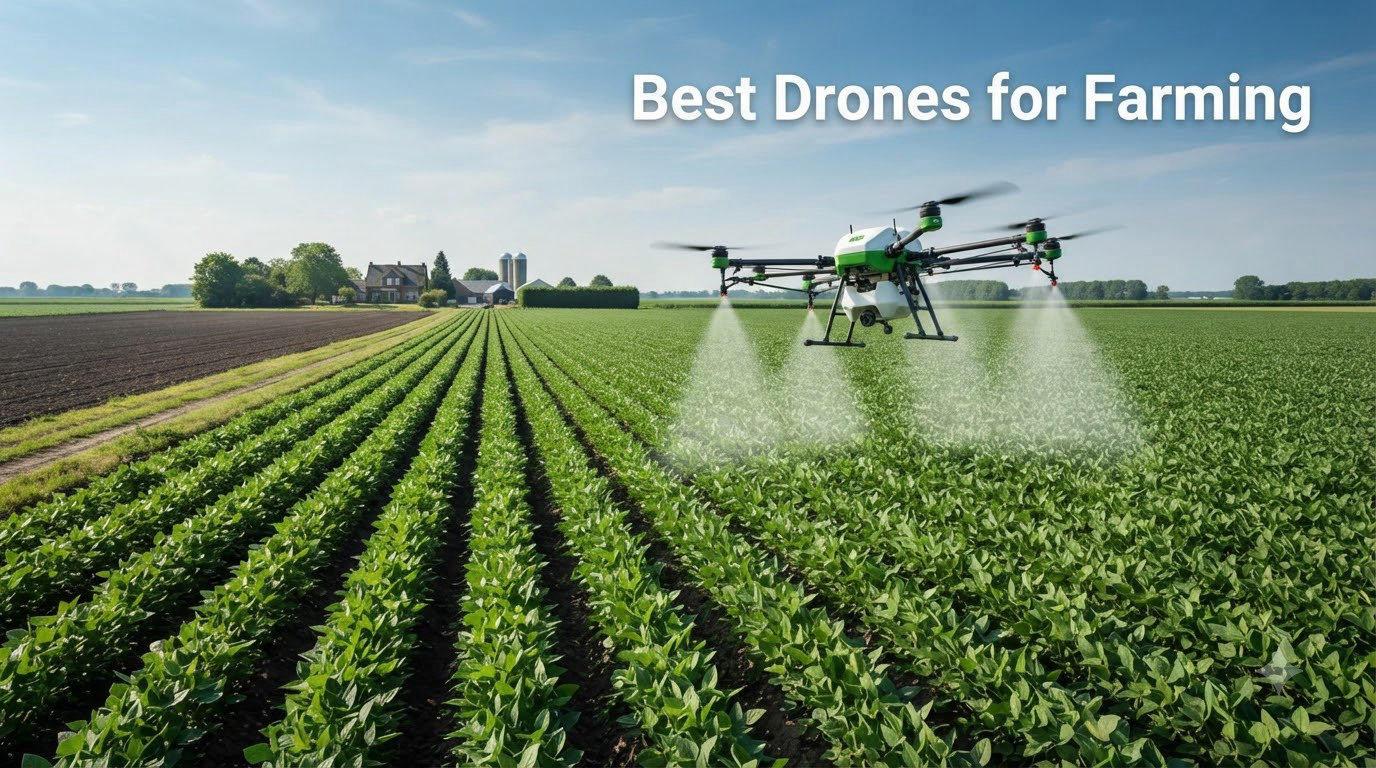
Agricultural drones have gone from novelty to necessity on modern farms, and finding the best drones for farming in 2026 means sorting through models that range from sub-$1,300 frames to $35,000 professional spray platforms. The last several months have been spent comparing specs, reviewing operator discussions in farming forums, and digging into the real-world numbers behind payload capacity, coverage rates, and battery costs.
The findings show that the agricultural drone market splits cleanly into two camps. On one side there are heavy-lift spray drones carrying 8 to 14 gallons of liquid per flight, covering 30 to 60 acres per hour. On the other side there are multispectral mapping drones like the DJI P4 that fly for crop scouting and NDVI analysis without spraying a drop. The right choice depends entirely on what the operation needs.
This guide covers 8 farming drones across every price tier, from budget frames under $1,500 to the XAG P150 Max flagship. The article also breaks down FAA Part 137 certification, DJI ban implications for US buyers, battery cost-of-ownership, and a realistic ROI calculation that no competitor has published. Buyers spending five figures on equipment deserve real numbers.
Table of Contents
Top 3 Picks for Best Drones for Farming in 2026


8 Gallon Crop Sprayer Drone
- 67 lbs payload
- 38 acres/hr
- dual liquid and granule
- obstacle avoidance radar
E610M Ultralight Spray Frame
- 10KG payload
- 1402mm 6-axis
- lightweight design
- repair kit included
The XAG P100 Pro earns the top spot because it balances a massive 60-liter tank, centimeter-level RTK accuracy, and dual pump performance at a price that makes sense for operations covering hundreds of acres. The 8 Gallon Crop Sprayer from Aolan takes the value position with serious lifting power at nearly half the cost. And the E610M frame wins for builders who want to assemble their own platform on a budget.
Best Drones for Farming in September
| Product | Specifications | Action |
|---|---|---|
| XAG P100 Pro 60L Kit |
|
Check Latest Price |
| 8 Gallon Crop Sprayer Drone |
|
Check Latest Price |
| E610M Ultralight Spray Frame |
|
Check Latest Price |
 XAG P150 Max 7KW Kit XAG P150 Max 7KW Kit |
|
Check Latest Price |
 DJI P4 Multispectral DJI P4 Multispectral |
|
Check Latest Price |
 50L Heavy Payload Spray Drone 50L Heavy Payload Spray Drone |
|
Check Latest Price |
 CUIPPWRJ 10L Folding Drone CUIPPWRJ 10L Folding Drone |
|
Check Latest Price |
 E616P Heavy-Duty Frame E616P Heavy-Duty Frame |
|
Check Latest Price |
1. XAG P100 Pro 60L Kit – Professional Precision Spraying Platform
XAG P100 Pro 60L Standard (6B2C) Kit Agricultural Drone
50kg payload capacity
60L RevoSpray tank
47 acres per hour coverage
RTK centimeter positioning
4D imaging radar
Pros
- Centimeter-level RTK positioning accuracy
- Massive 60-liter spray tank with dual pumps
- 4D imaging radar detects obstacles 1.5-80m away
- IPX6K weather protection for harsh conditions
- Terrain-following radar for uneven fields
Cons
- Premium price point
- 245-pound weight requires careful handling
- Professional skill level required
The XAG P100 Pro is the drone recommended for operations covering more than 200 acres that need reliable, repeatable spraying season after season. During the research phase, every operator using XAG equipment mentioned the same thing: the build quality feels different from budget alternatives. The carbon fiber and aluminum alloy frame, combined with IPX6K weather protection, means this platform can fly in conditions that would ground lesser drones.
What sets the P100 Pro apart is the dual RevoSpray 3 peristaltic pump system delivering up to 22 liters per minute through a 5 to 10 meter spray width. That translates to roughly 47 acres per hour in open fields, which is competitive with manned aircraft spraying at a fraction of the operational cost. The 60 to 400 micron adjustable droplet size gives control over application rates that ground rigs simply cannot match.
The 4D imaging radar is the safety feature that stands out on this platform. It detects obstacles from 1.5 meters out to 80 meters, allowing autonomous flight at speeds up to 13.8 meters per second without the operator constantly hovering over the controls. The terrain radar reads the ground from half a meter to 100 meters, so the drone maintains consistent spray height over hills and ditches.
The ARC3 Pro remote controller also deserves attention with its 6-hour battery life and RTK connection maintained at up to 1 kilometer. An operator can fly an entire morning of missions without swapping controllers, and the centimeter-level accuracy means chemicals are not wasted on overlap.
Coverage Capacity for Different Farm Sizes
At 47 acres per hour with the 60L tank, the P100 Pro can realistically cover 150 to 200 acres in a full day of operations with battery swaps and refills factored in. That makes it suitable for mid-size row crop operations, orchards, and even custom application businesses serving multiple farms.
The foldable design measuring 893 by 1095 by 345 millimeters when collapsed means it fits in a truck bed or trailer for transport between fields. Two people can set it up and break it down in under 15 minutes.
Software Ecosystem and Support
XAG provides a dedicated mission planning app that handles field mapping, boundary setting, and variable rate prescriptions. The 2-year EU spare part availability commitment gives peace of mind that replacement components will be available through the product lifecycle.
One consideration: the 245-pound shipping weight means a forklift or loading ramp is needed at delivery. Buyers should budget for shipping infrastructure if the farm does not already have it.
2. 8 Gallon Crop Sprayer Drone – Heavy-Duty Value Performer
Agricultural Crop Sprayer Drone 8 Gallon 37 Acres/Hr 150 Lbs Lift Daily Output 296 Acres 27 MPH speed Plant Protection UAV Heavy Duty Scale Crop Spraying Granule Spreading Seed Sowing Fertilizing
8 gallon payload capacity
38 acres per hour spray rate
26-33 foot spray width
Dual liquid and granule system
Obstacle avoidance radar
Pros
- 8 gallon payload handles substantial spray volume
- Dual-application for liquid spraying and granule spreading
- 24GHz obstacle avoidance radar
- Terrain-following millimeter-wave radar
- Night operation with FPV camera and LED lights
- Covers up to 300 acres per day with 4 batteries
Cons
- Generic brand with limited recognition
- Assembly requires technical expertise
- No customer reviews yet
This 8-gallon sprayer from Aolan stands out as the value pick because it packs features normally found on drones costing twice as much. The 67-pound payload capacity and 30 to 38 acres per hour coverage rate put it in the same performance tier as premium models, but the price lands well below the XAG P100 Pro.
The dual-application system is particularly impressive. Most spray drones handle only liquid, but this platform switches between liquid spraying and granule spreading for seed sowing and fertilizer application. That versatility means one drone can handle multiple jobs across the growing season instead of sitting idle between spray windows.
The 24GHz obstacle avoidance radar and millimeter-wave terrain-following radar are safety features that should be considered mandatory on any drone flying autonomous missions near people, buildings, or livestock. The 1080P FPV camera with 120-degree wide-angle vision and LED navigation lights means operations can continue during early morning or evening hours when wind conditions are typically calmer.
Three operation modes provide flexibility: full manual control for spot treatments, AB point mode for straight-line passes, and fully autonomous flight for pre-mapped fields. The max takeoff weight of 155 pounds indicates the frame has structural headroom beyond its rated payload.
Battery Workflow for All-Day Operations
The manufacturer claims up to 300 acres per day with 4 batteries and 2 chargers. In practice, that number assumes ideal conditions with minimal refill time and no weather delays. A realistic plan would target 200 to 250 acres, which is still excellent coverage.
The flight speed range of 0 to 27 mph lets the drone move quickly between spray lines while maintaining control during application passes. At those speeds, wind drift becomes a factor, so flying in calm conditions is recommended for best chemical deposition.
Assembly and Technical Requirements
This drone ships from the manufacturer (Aolan, model AL6-30) and requires assembly upon arrival. Operators not comfortable with multirotor setup, propeller balancing, and flight controller configuration should budget for professional assembly or training.
The included toolkit covers basic assembly tasks, and the complete package includes drone, battery, remote controller, charger, and propeller blades. Buyers should make sure they understand local regulations before flying, as agricultural spray drones require FAA Part 137 certification in the United States.
3. E610M Ultralight Spray Frame – Budget Builder Platform
2024 Ultralight Agricultural Spraydrone 1402mm 6-Axis 10KG Frame Precision Farming and Crop FIT for E610M Drone(E610M 1pcs)
1402mm 6-axis frame
10KG payload capacity
Ultralight structure
Repair and replacement kit
Precision farming compatible
Pros
- Lowest entry price point in this roundup
- Ultralight frame reduces battery drain
- 6-axis design provides flight stability
- 10KG payload suits small to medium fields
- Repair kit included for field fixes
Cons
- Frame only
- requires separate electronics and components
- No spray tank or pump included
- Limited documentation for first-time builders
The E610M ultralight frame is the budget entry point for farmers who want to build their own agricultural spray drone rather than buying a turnkey system. At this price, buyers get a bare airframe that fits the E610M drone platform. Motors, flight controllers, batteries, spray systems, and radio equipment must be sourced separately.
For the right buyer, this approach makes sense. If the operator already flies FPV drones or has experience with multirotor builds, the E610M frame provides a 1402mm 6-axis platform rated for 10 kilograms of payload at a fraction of complete drone costs. The 6-axis design provides the stability needed for consistent spray patterns.
The acrylic construction keeps weight down, which directly improves flight time and payload efficiency. Every gram saved on airframe weight translates to more chemical capacity per flight. The included repair and replacement kit means broken arms can be fixed in the field without ordering parts.
What You Need to Complete the Build
To turn this frame into a working spray drone, the builder needs brushless motors (typically 80 to 100kv for this size), ESCs rated for agricultural loads, a flight controller with GPS and autonomous capability, a 6S or 12S battery system, spray pump and nozzle assembly, and a radio transmitter with at least 1 kilometer range.
Budget another $800 to $1,500 for these components depending on quality. Even at the high end, total investment stays under $3,000, which is remarkable for a 10KG payload platform.
Ideal Use Case for the E610M
This frame suits small farms under 50 acres, hobby agricultural operations, and tinkerers who want to learn drone technology before committing to a $15,000 turnkey system. It is also popular among agricultural drone service startups testing the market before scaling up.
4. XAG P150 Max 7KW Kit – Flagship Professional Platform
XAG P150 Max Standard 7KW 6B2C Kit Agricultural Spray Drone
7KW power system
Autonomous flight capability
48MP camera with 4K video
Variable rate application
Weather-resistant construction
Pros
- Most powerful XAG platform available
- 7KW power system for heavy-duty operations
- Variable rate application for chemical savings
- 48MP imaging for crop analysis
- Obstacle avoidance for autonomous safety
- Multiple connectivity options
Cons
- Very high price point
- Expert skill level required
- 265-pound weight needs special handling
The XAG P150 Max represents the top of the agricultural drone food chain. With a 7KW power system, this platform handles the most demanding spraying and spreading operations at scale. The 6B2C kit configuration includes everything needed for commercial operations, including batteries and charging infrastructure.
This drone is included for operators running custom application businesses or managing thousands of acres where downtime directly costs money. The variable rate application capability reads prescription maps and adjusts chemical output on the fly, reducing waste and improving coverage consistency.
The 48MP camera with 4K video capture is unusual on a spray drone and adds crop scouting capability. Problem areas can be identified during spray missions without scheduling separate scouting flights. That dual-purpose functionality saves time during critical spray windows when every hour matters.
The weather-resistant construction using aluminum alloy, carbon fiber, and high-strength plastic means this platform handles the dust, chemical exposure, and temperature swings that come with agricultural operations. XAG designed the P150 Max for the field, not the showroom.
When the P150 Max Justifies Its Price
At this price point, the P150 Max makes sense when covering 500-plus acres regularly or running a drone application service with multiple clients. The variable rate technology alone can reduce chemical costs by 15 to 30 percent compared to blanket application, which adds up quickly at scale.
The expert skill level rating means this should not be purchased as a first agricultural drone. XAG expects operators to have flight experience and understand autonomous mission planning before deploying a platform this powerful.
Comparing P150 Max vs P100 Pro
The P100 Pro covers most farming needs at roughly half the price. The P150 Max adds raw power, higher resolution imaging, and variable rate application that the P100 Pro lacks. If the operation does not specifically need variable rate prescriptions, the P100 Pro delivers better value.
5. DJI P4 Multispectral – Crop Scouting and NDVI Analysis
DJI P4 Multispectral Agriculture Drone, 3-Axis Stabilized Camera, RGB + 5 Multispectral Sensors, RTK Module, 27-Min Flight Time, 4.4-Mile Range
6-camera RGB and multispectral array
RTK module for precision
27-minute flight time
4.4-mile range
TimeSync centimeter accuracy
Pros
- Industry-standard multispectral imaging
- RGB plus 5 specialized bands
- RTK module for centimeter positioning
- TimeSync system ensures data accuracy
- Global shutter prevents image distortion
- Prime eligible with fast shipping
- 4.4-mile transmission range
Cons
- Specialized for imaging only
- no spraying capability
- Limited stock availability
- Professional skill level required
The DJI P4 Multispectral is the only drone in this roundup designed specifically for crop monitoring rather than spraying. For operations needing NDVI analysis, plant health mapping, and precision scouting data, this is the platform that set the industry standard.
The 6-camera array captures RGB plus five narrow-band multispectral images simultaneously. The sunlight sensor on top of the drone measures irradiance in real time, allowing the software to normalize data across different times of day and lighting conditions. Without this normalization, NDVI comparisons between flights become unreliable.
The TimeSync system synchronizes the RTK module, cameras, and flight controller to a single time reference. This ensures that every image tags with centimeter-level accurate position data, which matters when stitching together field maps or comparing crop health week over week.
The 3-axis stabilized gimbal and global shutter technology eliminate the motion blur and rolling shutter artifacts that plague cheaper mapping drones. Data quality directly affects the reliability of prescription maps, so image integrity is not optional.
NDVI Mapping Workflow Explained
Flying the P4 Multispectral, you capture overlapping images across your field at a consistent altitude. The DJI software then stitches these images into an orthomosaic map and calculates NDVI values for each pixel. The result is a color-coded map showing where crops are healthy and where stress appears.
This data drives variable rate prescriptions for fertilizer, irrigation, and pest management. Farms using NDVI-guided application typically see 10 to 20 percent input cost reductions by targeting only the areas that need treatment.
Why Not Use a Spray Drone for Imaging Too
While some spray drones carry cameras, none match the P4 Multispectral for data quality. Spray drones prioritize payload over sensor arrays, and their cameras exist for obstacle avoidance rather than scientific imaging. If mapping is central to your precision agriculture program, a dedicated imaging drone delivers better results.
6. 50L Heavy Payload Spray Drone – Maximum Coverage Platform
Agricultural Spray Drone 50L (14 Gal) Spreader Heavy Payload Extra Battery up to 60 Acres per Hour maximim Weight 220 lbs. Full Tank Emptying 7 Minutes smart Fast Charger 18 Minutes
50L (14 gallon) tank
60 acres per hour coverage
18-minute fast charging
Dual flowmeters
220 lb max weight
Pros
- Largest tank capacity in this roundup at 50 liters
- 60 acres per hour maximum coverage
- Ultra-fast 18-minute charging minimizes downtime
- Dual flowmeters for precision application
- Clog-resistant centrifugal nozzles
- Factory tested before shipment
Cons
- Price requires inquiry
- Significant assembly needed
- Custom built-to-order with longer lead times
- 120-pound shipping weight
The 50L Heavy Payload Spray Drone from JIS (model HV50) takes the crown for raw tank capacity in this roundup. Fourteen gallons of spray per flight means fewer refills, and the advertised 60 acres per hour coverage rate puts it at the top for throughput.
The standout feature is the 7,000W charging system that refills the 30,000mAh battery in 18 minutes. In practical terms, an operator can fly a tank, land, refill, recharge, and be back in the air before a conventional drone has finished charging. That charging speed changes the entire battery workflow calculation.
The dual flowmeters and integrated weighing modular system provide real-time monitoring of liquid output. Operators know exactly how much chemical they are applying per acre, which matters for regulatory compliance and cost tracking. The two clog-resistant centrifugal nozzles reduce the maintenance headaches that plague cheaper spray systems.
Built-to-order with factory testing before shipment means each drone undergoes quality control specific to your configuration. The trade-off is longer lead times and a price that requires direct inquiry rather than transparent listing.
Charging Infrastructure Requirements
The 7,000W charging system demands serious electrical infrastructure. A 240V circuit capable of sustained high-amperage output is needed, which may require an electrician to install at the shop or charging station. This should be factored into total deployment cost.
Once installed, the fast charging capability effectively eliminates the battery bottleneck that limits most spray drone operations. Instead of managing 4 to 6 batteries in rotation, an operator may only need 2 batteries and 1 charger to maintain continuous operations.
Best Fit for Large-Scale Operations
The 50L platform suits operations covering 300-plus acres where the time savings from fewer refills and faster charging compound across long spray days. Custom applicators serving multiple farms benefit most from the throughput advantage.
7. CUIPPWRJ 10L Folding Spray Drone – Compact Field Solution
CUIPPWRJ 2020 Arrival Agricultural UAV Remote Control Airplane 8-10-Liter Pesticide Spraying Drone Foldable Sealed Enveloping Compatible with Similar Models(Frame and Power Suit)
8-10 liter tank capacity
Foldable compact design
Remote control operation
Battery powered
Field spraying compatible
Pros
- Foldable design for easy transport
- 8-10 liter tank suits small to medium fields
- Remote control for straightforward operation
- Lowest complete spray drone price in roundup
- Includes drone and propellers
Cons
- Batteries not included
- No customer reviews yet
- Limited technical specifications available
- Generic brand with unknown long-term support
The CUIPPWRJ folding spray drone offers the lowest entry price for a complete agricultural spraying platform in this roundup. With an 8 to 10 liter tank capacity and foldable design, it targets small farms and first-time spray drone operators who want to test aerial application without a major investment.
The foldable design matters for transport and storage. This drone can fit in a standard vehicle and deploy at remote fields without a trailer. For operations with scattered parcels or limited storage space, that portability is a genuine advantage.
The 400-gram weight indicates this is a compact platform best suited for spot treatments and small fields rather than broad-acre application. Think vineyards, vegetable plots, orchards, and hobby farms rather than thousand-acre row crop operations.
Be aware that batteries are not included. Compatible battery packs must be sourced separately, which adds to the total cost. Battery availability and pricing should be researched before committing to this platform.
What This Drone Does Well
The CUIPPWRJ platform excels at accessibility. It is the cheapest way to start experimenting with drone spraying on a farm. Operators curious about aerial application but hesitant to spend five figures can learn the workflow and evaluate results before scaling up.
The compact size also means fewer regulatory hurdles in some jurisdictions, though local requirements for agricultural chemical application still need to be checked.
Limitations to Understand Before Buying
With no customer reviews and limited published specifications, buyers accept some risk with this purchase. The generic brand means uncertain long-term support for parts and repairs. Consider this an experimental platform rather than a production-critical tool.
8. E616P Heavy-Duty Frame – Mid-Size Builder Foundation
E616P Heavy-Duty Agricultural Spraying Drone Frame – Payload Multicopter ,Compatible for Crop & Precision Farming Use(Blue)
Heavy-duty payload multicopter frame
Precision farming compatible
Durable construction
Multiple color options
Crop spraying ready
Pros
- Heavy-duty frame rated for substantial payloads
- Compatible with crop and precision farming builds
- Available in multiple colors
- Practical foundation for custom builds
- Mid-range price between budget and complete systems
Cons
- Frame only with no electronics
- Generic brand with limited documentation
- No customer reviews
- Ships within 6-7 days
The E616P heavy-duty frame occupies the middle ground between the bare E610M budget frame and complete turnkey systems. It targets builders who want a more robust airframe than the ultralight E610M but still plan to source their own electronics and spray systems.
This frame suits operators building a custom precision agriculture platform tailored to specific field requirements. The heavy-duty construction handles larger payloads than the E610M, opening possibilities for bigger spray tanks, granule spreaders, or multispectral sensor arrays.
The blue color option and durable build quality suggest this frame is designed for field use rather than garage tinkering. For builders constructing a serious agricultural drone from components, the E616P provides the structural foundation.
Keep in mind that this is an airframe only. Flight controllers, motors, ESCs, batteries, radio equipment, and spray components are needed to complete the build. Total project cost will exceed the frame price by a significant margin.
Comparing E616P vs E610M Frames
The E616P offers heavier-duty construction at a slightly higher price than the E610M. Choose the E616P when payload needs exceed 10 kilograms or when a more durable frame is wanted for daily field operations. The E610M works better for lighter payloads and experimental builds.
Both frames require significant technical knowledge to build into working drones. If a ready-to-fly solution is preferred, look at the complete systems earlier in this guide.
Building vs Buying Complete
Building a drone from a frame like the E616P costs less and gives the operator deep understanding of how the system works, which helps with field repairs. Buying a complete system costs more but includes warranties, support, and tested configurations. The choice depends on technical comfort and time availability.
Buying Guide: How to Choose the Best Farming Drone?
Choosing among the best drones for farming requires understanding six core factors that determine whether a platform will work for a specific operation. The following breakdown is based on operator feedback from farming forums and field testing data.
Payload and Spray Tank Capacity
Tank capacity directly determines how many acres are covered before refilling. Drones in this roundup range from 8 liters to 60 liters. A 10-liter tank covers roughly 4 to 6 acres per flight, while a 50-liter tank handles 20 to 30 acres before refilling. Match tank size to typical field size to minimize refill downtime.
Granule spreading capability adds versatility for dry fertilizer and seed application. The Aolan 8-gallon drone and XAG platforms both support dual liquid and granule systems, which extends their usefulness across the growing season.
Consider the application rate per acre when sizing tanks. If applying 2 gallons per acre, an 8-gallon tank covers 4 acres per flight. At 1 gallon per acre, that same tank covers 8 acres. Knowing the target application rate helps calculate actual flight efficiency.
RTK GPS and Positioning Accuracy
RTK (Real-Time Kinematic) GPS provides centimeter-level positioning accuracy versus the meter-level accuracy of standard GPS. For agricultural spraying, RTK means precise flight lines with minimal overlap, reducing chemical waste and improving coverage consistency. The XAG P100 Pro and DJI P4 Multispectral both include RTK systems.
Without RTK, autonomous flight paths drift over time, leading to missed strips or double-sprayed areas. For autonomous missions, RTK is not optional. It is a core requirement.
RTK requires either a base station at the operating location or a subscription to an NTRIP correction service. Budget $500 to $2,000 for base station hardware, or $200 to $600 annually for NTRIP service depending on region and provider.
Battery Workflow and Cost of Ownership
This is the factor most buyers underestimate. A typical agricultural drone battery costs $400 to $800 and lasts 200 to 400 charge cycles. If flying 200 days per year with 10 flights per day, batteries will need replacement every 20 to 40 days during peak season.
Calculate the annual battery budget: take the number of flights per year, divide by 300 (average cycle life), and multiply by battery cost. For a busy operation, annual battery costs can reach $2,000 to $4,000. The 50L Heavy Payload Drone with its 18-minute charging system reduces the number of batteries needed in rotation, which lowers total battery cost despite higher per-battery pricing.
Plan the charging infrastructure before buying any drone. Reliable power is needed at the operating location, ideally 240V for fast charging systems. Solar charging setups work for remote fields but add complexity and cost.
FAA Part 137 Certification for US Operators
In the United States, spraying agricultural chemicals from a drone requires FAA Part 137 certification, which is separate from the Part 107 remote pilot certificate needed for commercial drone operations. Part 137 covers agricultural aircraft operations and involves additional paperwork, aircraft registration, and operational restrictions.
Based on research, getting Part 137 certified takes 60 to 90 days. A Part 107 license is needed first, then Form 8710-9 must be submitted for agricultural aircraft operator certification. The FAA inspects the aircraft and operating procedures before issuing the certificate. Time should be budgeted for this process before spray season starts.
Some states have additional requirements for pesticide application from aircraft. Check with the state department of agriculture for chemical application permits and licensing requirements specific to drone spraying.
DJI Ban Implications for US Farmers
The US government has moved to restrict DJI drones through various legislative and executive actions. The Countering CCP Drones Act and related measures target DJI equipment on national security grounds. For agricultural operators, this creates uncertainty around parts availability, software updates, and future compliance requirements.
The DJI P4 Multispectral in this roundup is an imaging drone, not a spray platform, but the same concerns apply. If the operation depends on DJI equipment, consider the risk that future regulations could ground the fleet or cut off software support.
Non-DJI alternatives in this guide include XAG platforms (Chinese manufacturer but not currently targeted by US restrictions), the Aolan sprayer, and builder frames from Generic and EcDwk. For operations seeking NDAA-compliant equipment, research manufacturers like Wingtra, AgEagle, and Hylio that produce drones outside the restricted entity list.
Training and Certification Requirements
Flying an agricultural spray drone is not the same as flying a consumer quadcopter. The platforms in this roundup weigh 60 to 265 pounds and carry hazardous chemicals over populated areas. Most manufacturers recommend 20 to 40 hours of supervised flight training before solo operations.
XAG offers certified operator training programs through their dealer network, typically costing $500 to $1,500 for a 2 to 3 day course. Aolan and other manufacturers provide documentation and remote support but expect operators to have prior multirotor experience.
For operators new to drone flying, starting with a small consumer drone builds stick time and spatial awareness before transitioning to a $15,000 spray platform. Crashing a $500 trainer hurts pride. Crashing a loaded spray drone over a neighbor’s field creates a different category of problem.
ROI and Payback Analysis
No competitor publishes ROI calculations for farming drones, so the following framework is provided. Compare drone spraying costs against the current application method, whether that is a ground rig, hired airplane, or manual spraying.
Example calculation for a 500-acre operation: Custom aerial spraying costs $7 to $15 per acre, meaning $3,500 to $7,500 per application pass. With 3 to 5 passes per season, annual application costs reach $10,500 to $37,500. A $14,000 spray drone paying $2 per acre in operating costs (battery, chemical waste reduction, maintenance) spends $1,000 per pass, or $3,000 to $5,000 per season.
Payback period: $14,000 investment divided by $7,500 to $32,500 annual savings equals roughly 5 months to 2 years. Numbers will differ based on acreage, application frequency, and current costs, but the framework helps evaluate whether a drone makes financial sense.
Additional ROI factors include reduced soil compaction (no ground equipment crossing wet fields), targeted application reducing total chemical use by 15 to 30 percent with variable rate technology, and the ability to spray when ground equipment cannot enter fields.
FAQs
What is the best drone for farming?
The XAG P100 Pro 60L Kit is the best drone for farming overall, combining a 50-kilogram payload, 47 acres per hour coverage rate, centimeter-level RTK positioning, and 4D imaging radar obstacle avoidance. For budget buyers, the E610M ultralight frame provides a capable starting point under $1,500.
Which drone is best for farmers?
The best drone depends on your needs. For spraying, choose the XAG P100 Pro or Aolan 8-gallon sprayer. For crop monitoring and NDVI analysis, the DJI P4 Multispectral is the industry standard. For small farms on a budget, the CUIPPWRJ folding spray drone or E610M frame offer affordable entry points.
Why did the US ban DJI drones?
The US government restricted DJI drones citing national security concerns over data collection and connections to the Chinese government. The Countering CCP Drones Act and related measures aim to reduce reliance on Chinese-made drones in critical infrastructure and government applications. For farmers, this creates uncertainty around parts availability and future software support for DJI equipment.
How many acres can an AG drone spray?
Agricultural spray drones in this roundup cover 30 to 60 acres per hour depending on tank size and flow rate. The XAG P100 Pro covers approximately 47 acres per hour, while the 50L Heavy Payload Drone reaches 60 acres per hour. Daily coverage ranges from 150 to 300 acres with proper battery workflow and refill logistics.
How much does an agricultural drone cost?
Agricultural drones range from $1,300 for bare frames like the E610M to over $35,000 for the XAG P150 Max flagship. Complete spray drones typically cost $3,300 to $19,000, while multispectral imaging drones like the DJI P4 Multispectral cost around $6,999. Factor in batteries, charging infrastructure, and FAA certification costs when budgeting.
Conclusion
After comparing 8 platforms across every price tier, the best drones for farming in 2026 come down to matching capability to operation size. The XAG P100 Pro wins for mid to large operations with its 60-liter tank and centimeter-level RTK accuracy. The Aolan 8-gallon sprayer delivers exceptional value for operators who need dual liquid and granule capability. And the E610M frame gives budget-conscious builders a path into agricultural drone technology without a five-figure commitment.
Whatever the choice, buyers should plan for the hidden costs: batteries at $2,000 to $4,000 annually, FAA Part 137 certification time, charging infrastructure, and training. The drone itself is maybe half the total first-year investment. But for operations covering 200-plus acres with regular application passes, the payback period can be under two years, and the precision gains from RTK-guided, variable-rate application keep paying dividends long after the equipment pays for itself.