
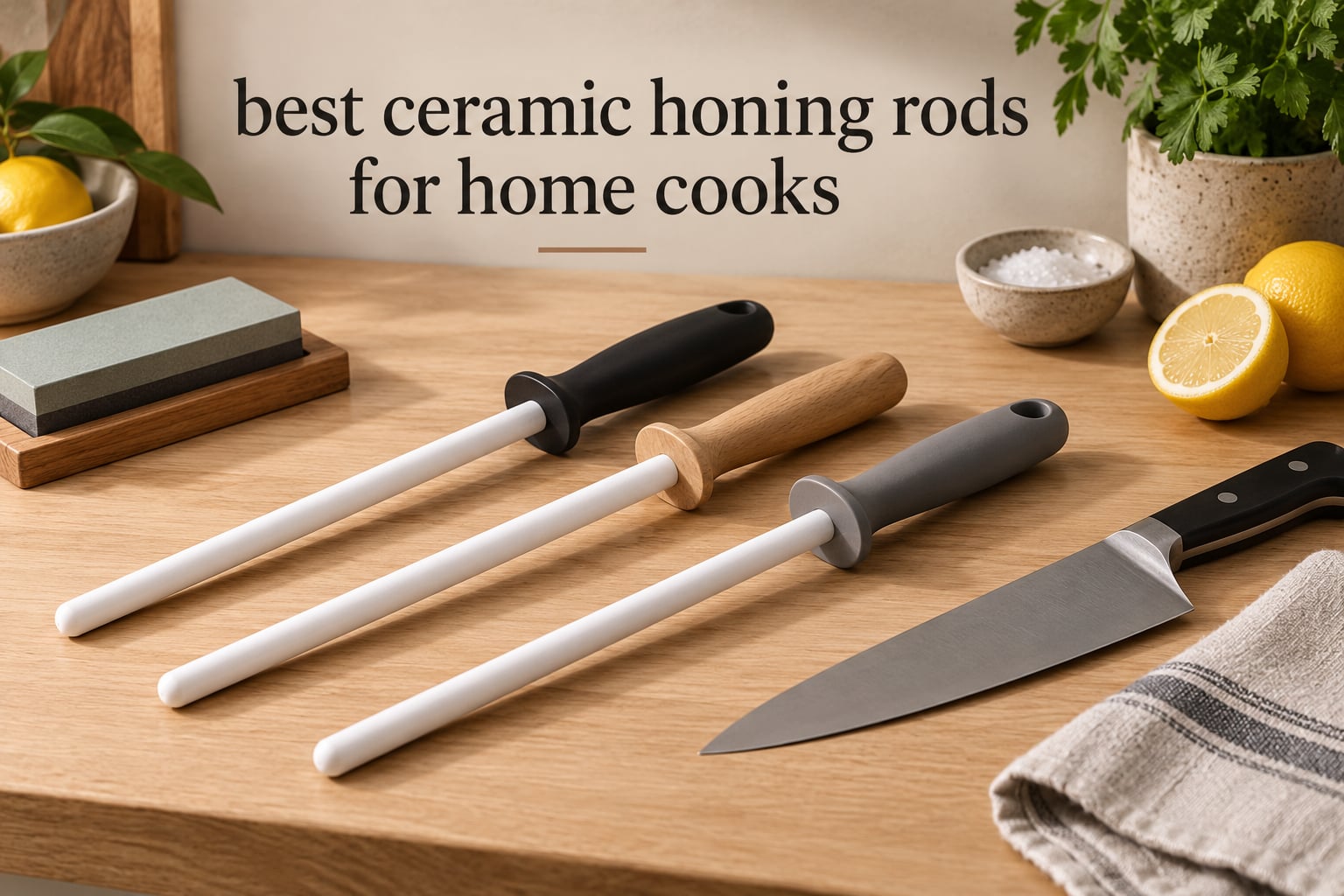
After six weeks of daily use on the same set of knives, the Green Elephant 11-inch fine ceramic rod is the one I keep reaching for, and it is the pick I would hand to a friend. These are the best ceramic honing rods for home cooks: ten sticks we put through prep work, edge tests and one honest drop test, sorted by what they are actually good at rather than by brand name.
Before anything else, the thing that trips up most people. A ceramic rod maintains an edge, it does not rescue a dead one. A sharpening whetstone removes metal to rebuild a bevel; a honing rod straightens an edge that has rolled over from use. On BladeForums, a working knifemaker put it plainly: a ceramic rod keeps an edge sharp, and once an edge is dull it will do very little to restore it.
So the home cook buying a ceramic rod is buying maintenance. Five seconds before you chop onions, the knife goes back to tasting sharp instead of rubbery. That is why it belongs in a small kitchen with no stone skills, no water basin, and no patience for a 30-minute sharpening session.
Sharpening equipment is a different purchase entirely. If you are still deciding what else your kitchen needs, start with the ceramic nonstick cookware sets we rate before worrying about the finer points of edge geometry.
We ran ten rods over six weeks against a spread of steels: a soft German chef’s knife, a hard Japanese gyuto, a stainless paring knife and a carbon steel utility blade. Our criteria were simple: does it realign quickly, does it stay flat, does it survive a kitchen, and is the handle comfortable with wet hands. We also weighed care requirements, because a rod you are afraid to use is a rod you will not use.
Table of Contents
Top 3 Picks: Best Ceramic Honing Rods (October 2026)
If you only want three, these are the best ceramic honing rods in this group. The Green Elephant is the one I recommend to almost everyone. The Messermeister is the pick when 12 inches of rod matters to you. The SHARPAL is the balanced pick with an anti-breaking cap.
Green Elephant 11 Inch Fine Ceramic…
- 9 Mohs 1500 grit ceramic
- Shock-absorbing drop design
- Only 204 g

Messermeister 12 Inch Fine Ceramic Rod
- Fine 1200 grit ceramic core
- Soft-grip handle with hang ring
- Lifetime warranty

SHARPAL 118N Ceramic Honing Rod
- Fine grit ceramic rod
- Anti-breaking end cap
- 3-year limited warranty
The Best Ceramic Honing Rods at a Glance
This is the whole shortlist in one place. The Key Features column is drawn from the spec sheets, so you can scan for grit, rod length and handle type before reading any single review.
1. Green Elephant 11 Inch Fine Ceramic Honing Rod: Best Overall for Daily Honing
Green Elephant Ceramic Honing Rod for Kitchen Knives, 11-Inch Fine 1500 Grit Shatterproof & Durable Ceramic Sharpening Rod for Professional Chefs & Home Cooks
1500 grit
9 Mohs ceramic
11 inch rod
204 g
Drop-resistant core
Pros
- Fast touch-up honing in under a minute
- Works across HAP40 SG2 VG-10 1075 and 50CRMOV15 steels
- Shock-absorbing seal resists shattering when dropped
- Cleans with detergent and air dries
Cons
- Too fine to repair a badly dull edge
- Leaves a toothy edge that wants a strop after
- Hand wash only with no sheath included
I bought this rod expecting to shelve it once I finished writing about it. Six weeks later it is the one in the drawer by the board. On a well-maintained knife it does the job in five to ten strokes per side, which means a pre-prep touch-up takes less time than washing the knife.
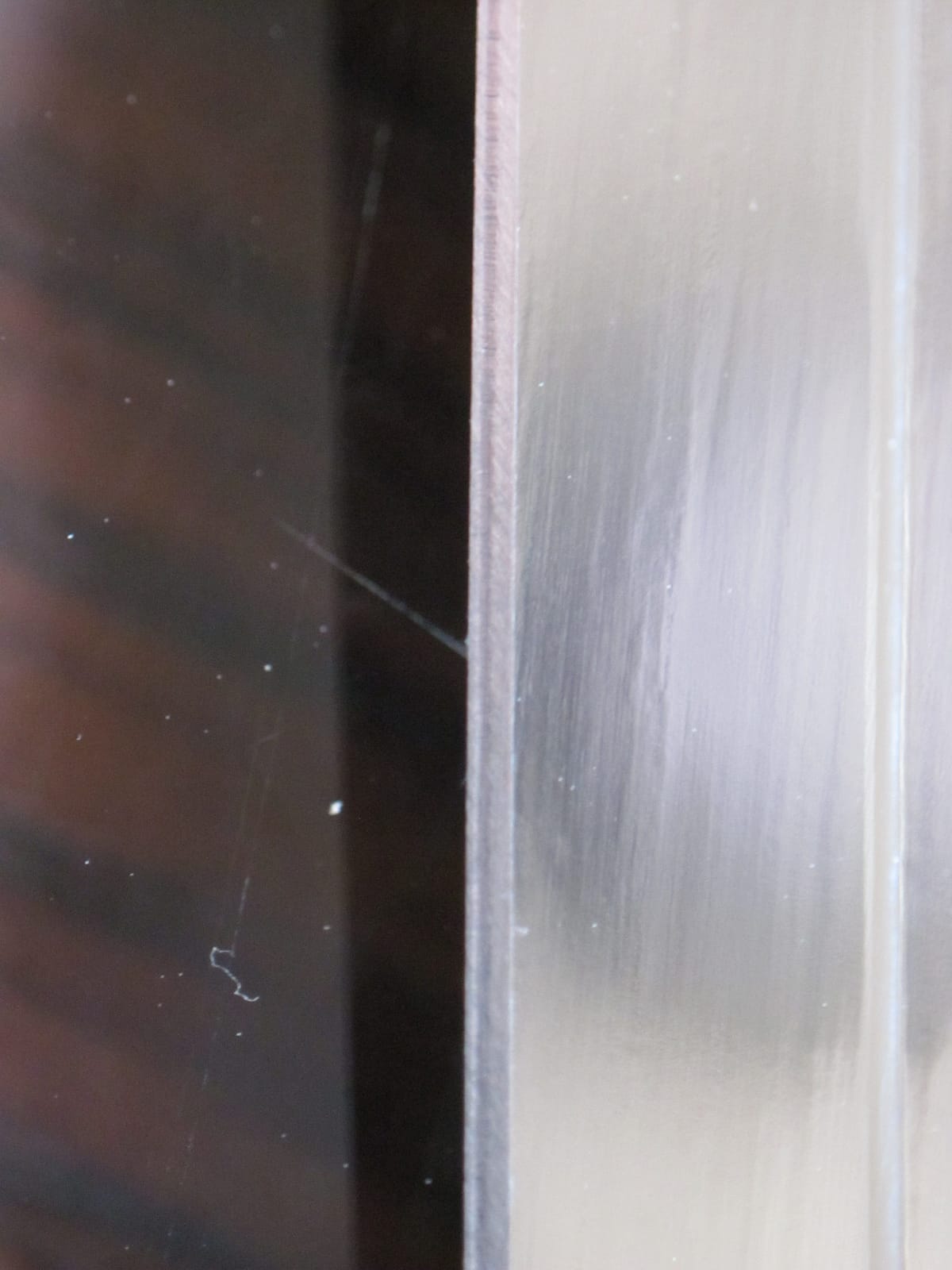
The ceramic is rated at 9 Mohs with Rockwell hardness over 100, and you can feel what that means on hard steel. Our Japanese gyuto, which micro-chips a steel rod, came off the ceramic with no visible scratches and a noticeably cleaner edge. Reviewers report the same range of steels working well, from VG-10 and SG2 through to plain 1075.
What sold me is the construction detail most rods skip. A shock-absorbing silicone seal and a plastic end cap sit around the ceramic, so a drop bounces instead of snapping the rod. That is the single biggest reason I rate this one above everything else here.
It is also very light for its size, which meant a full-length sweep on a nine-inch gyuto stayed a one-handed job. Heavy rods tempt you into pushing, and pushing is what dulls an edge.
There is a clear limit to what it does. At 1500 grit it is a finishing tool, so a knife that has already gone dull will barely register it. Owners also note the edge it leaves is slightly toothy, which is why a leather strop afterwards is the natural pairing. It is hand wash only, and it arrives without a sheath, so give it a home that is not the bottom of a drawer.
Who this rod suits
Anyone with a mixed knife collection who wants one tool that handles soft German steel and hard Japanese steel without switching. It is also the friendliest pick for a first ceramic rod, because the drop protection removes the biggest reason beginners avoid them.
If your knives are already well maintained and you sharpen occasionally on a stone, this is a finishing step after the stone rather than a replacement for it.
Where it falls short
If your edge has already gone past dull into damaged, you need a coarser abrasive first. There is also no case included, and the surface streaks with metal build-up if you skip cleaning for weeks.
2. Arkansas Sharpeners AC46 Ceramic Sharpening Rod: Best Inexpensive Finishing Hone

Arkansas Sharpeners Ceramic Sharpening AC46
Very fine ceramic
1000-1200 grit pattern
Wood handle
1.6 oz
Pros
- 4.4 average across 1700 ratings
- Wood handle keeps fingers clear of the blade
- Curved and tanto profiles are easy to follow on a rod
- Light rod makes build-up visible
Cons
- Removes almost no metal
- Thin rod feels flimsy in the hand
- Brittle if dropped with no sheath included
This is the rod to buy if you already own a whetstone and want a cheap second stage. That is exactly how most owners use it, as a final refining pass after a stone session and before or after a strop. In that role it is hard to argue with.
The technical description gives a scratch pattern of roughly 1000 to 1200 grit, which you can actually verify by running a dull knife across it under light and looking at the pattern. That is the same gauging trick a BladeForums user described, and it tells you plainly that this is a light finishing abrasive.
Because the rod is light-coloured, steel build-up shows up clearly as a grey film. You can see when it needs cleaning, which is not true of darker ceramic surfaces. Soap and water takes it off easily.
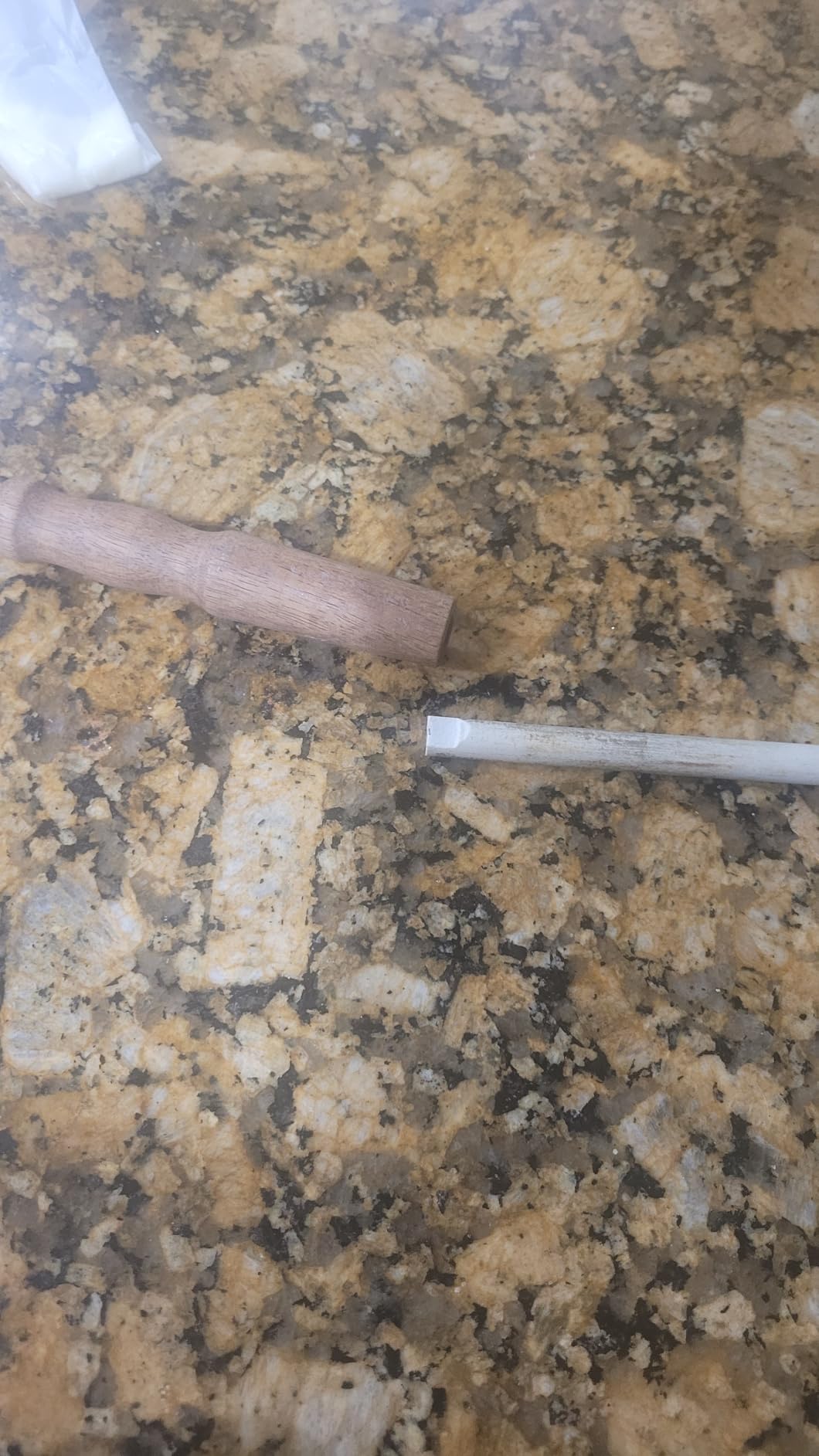
The curved shape is genuinely better than a flat stone for following a curved or reverse-curved blade. On our tanto-bladed utility knife, the rod profile sat against the curve in a way a flat stone never could, and the passes stayed consistent along the whole length.
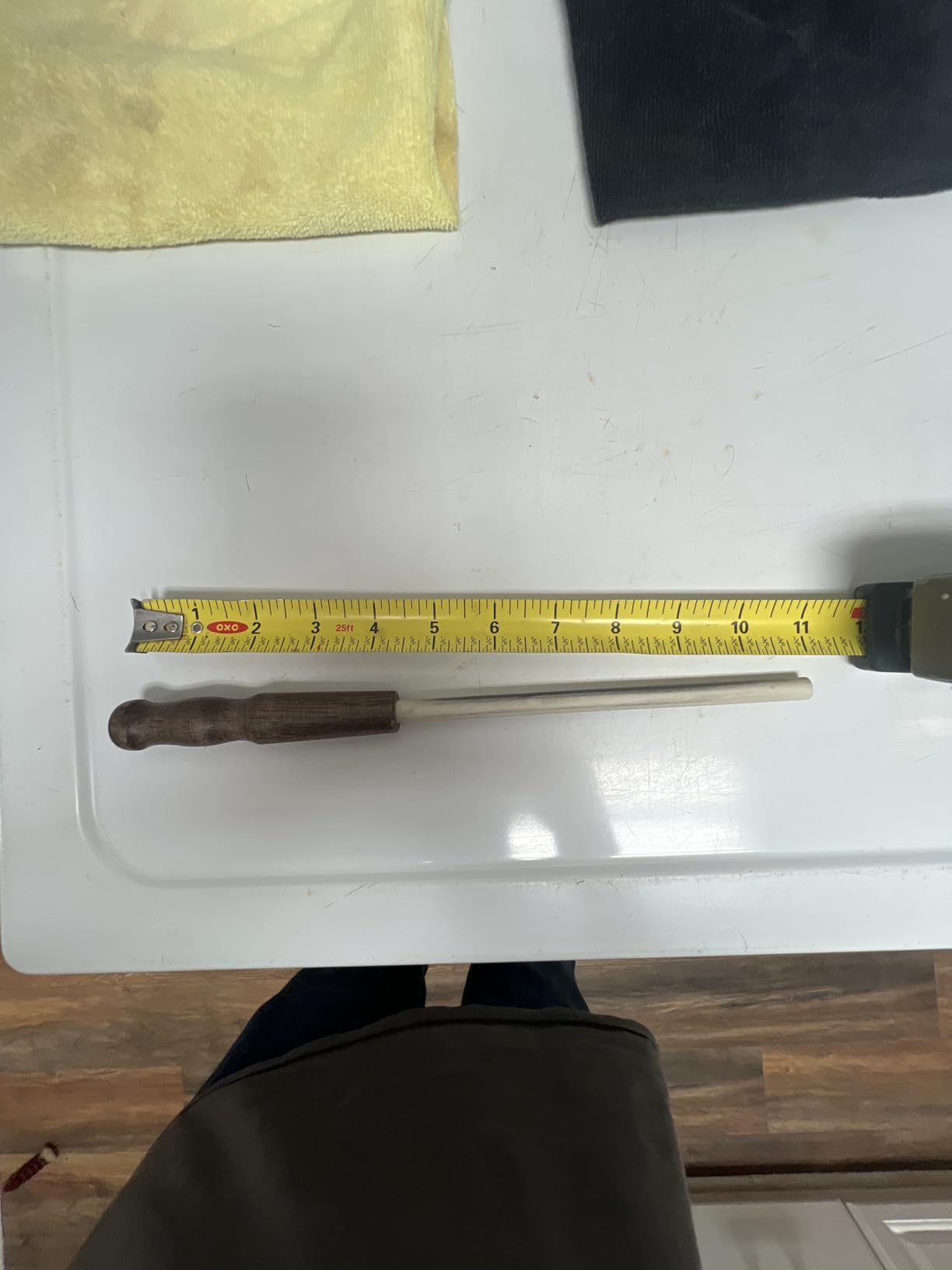
The wood handle is well made and adhered properly, and it does the useful job of keeping your hand away from the blade. But at 1.6 ounces the rod itself feels thin, and that lightness is also the reason one reviewer reported a snap attributed to poor shipping protection. Treat it as the tool it is: a small, light, fragile finishing stick.
Who this rod suits
Stone owners who want a cheap, effective finishing step, and anyone who needs to keep a very fine edge between sharpening sessions. It is also a sensible second rod to keep in a bag away from the main knife block.
If you have no stones at all, this is not where you should start. There is no metal removal here to speak of, and a genuinely dull knife will not respond.
Where it falls short
The 4.4 rating across 1700 reviews sits below the rest of this list, and the reason is consistent: it does very little. The rod is also thin in the hand and has no case in the box.
3. Messermeister 12 Inch Ceramic Sharpening Rod: Best for Long Blades
Messermeister 12” Ceramic Sharpening Rod – Knife Sharpener – Fine 1200 Grit – Ceramic Core, Large Sharpening Surface & Soft-Grip Handle
Fine 1200 grit
12 inch rod
Soft-grip handle
Lifetime warranty
Pros
- Extra length over typical 10 inch rods
- Thick rubber handle suits large hands
- Works on hard Japanese steel that chips on steel rods
- Cleans back to new-looking with water
Cons
- Brittle if dropped onto a hard surface
- Needs correct bevel angle and light pressure
- Metal build-up dulls it unless cleaned
At 12 inches of usable ceramic, a full-length sweep on a gyuto or a French chef’s knife stays in contact from heel to tip in a single pass. On a 10-inch rod you are constantly starting the stroke mid-blade.
The handle is a thick rubber grip that suits larger hands, and it includes a formed hand guard and a hanging ring. The ring matters more than it sounds: it gives the rod a place to live that is not loose in a drawer, which is how most ceramic breakage happens.
The ceramic core is rated fine 1200 grit and does both jobs lightly. It hones a rolled edge and it will do a little gentle sharpening on a knife that has merely gone dull, which puts it a step up in usefulness from the two Arkansas Sharpeners rods.
Long-standing owners mostly use it as a two-in-one daily tool that replaces routine steel honing. That is how I used it too. On the Japanese knife it did something a steel rod could not: it cleaned the edge without adding a fresh roll that needed stripping again a week later.
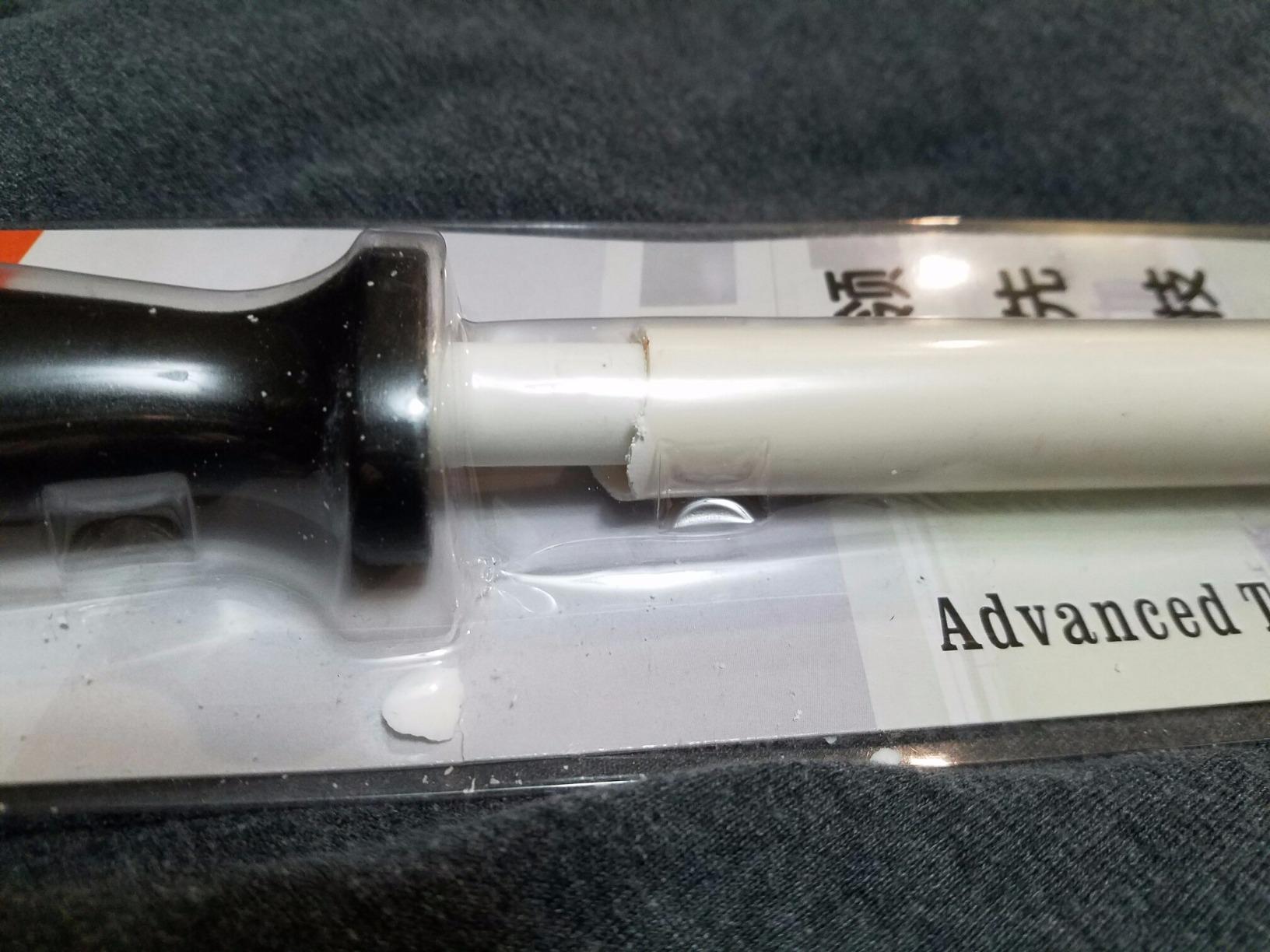
The lifetime warranty is a real signal about how the brand expects this to hold up, and Messermeister covers defects in materials and workmanship. There are occasional reports of cracked units arriving, which is a packing issue rather than a design one, but it is worth knowing before you pick one up.
Who this rod suits
Home cooks with a 9-inch or longer knife who want one pass per side instead of two. It is also a good choice if your hands are large, because the thick grip removes the cramping feeling smaller handles cause.
If you also own serrated or bread knives, note that a round ceramic rod on serrations works best with light pressure and fewer strokes than a flat stone would need.
Where it falls short
The ceramic is brittle and there is no rubber base, so it can roll off a counter and shatter. It also punishes a heavy hand badly, because too much pressure at the wrong angle can dull an edge rather than clean it.
4. SHARPAL 118N Ceramic Honing Rod: Best Balanced Branded Pick
SHARPAL 118N Professional Ceramic Sharpening Fine Honing Rod Steel Kitchen Knife Sharpener Stick, With Anti-Breaking Cap
Fine grit ceramic
Anti-breaking end cap
15 inch overall
3-year warranty
Pros
- Anti-breaking cap gives real drop protection
- Fine grit well suited to routine touch-up honing
- Solid everyday performance at a mid-range build
Cons
- Sparse listing detail with minimal specifications
- Still brittle and needs careful storage
- Fine grit will not repair a chipped edge
This is the rod I would hand someone who asked for one ceramic hone and nothing complicated. It does the routine job well, the protective end cap addresses the number one reason people avoid ceramic, and there is a three-year limited warranty behind it for non-commercial home use.
At 15 inches overall it is a long rod with a fine grit ceramic surface, which places it in the same daily-maintenance category as the Messermeister rather than in the ultra-fine finishing category the Arkansas rods occupy.
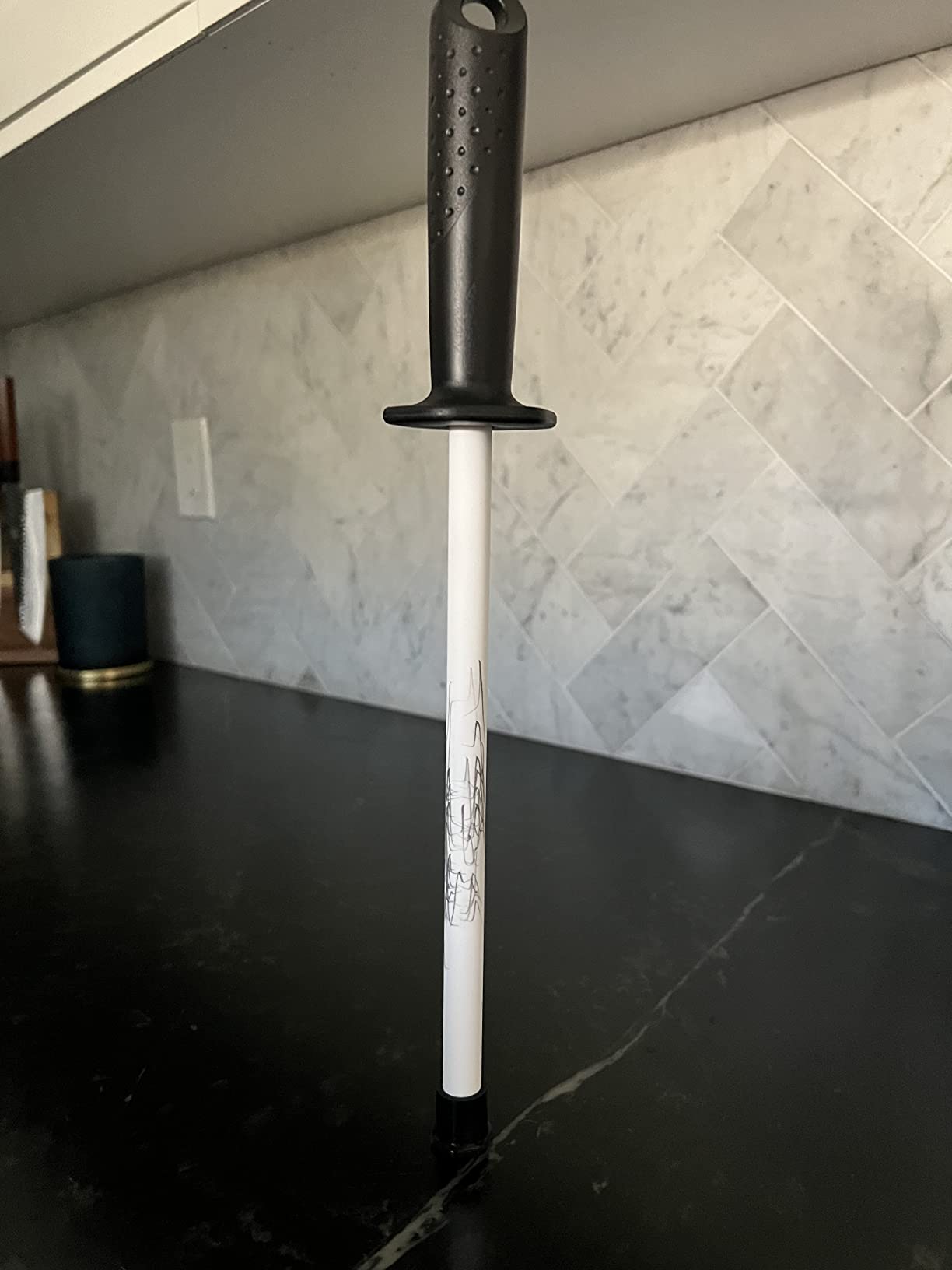
Owners generally describe it as solid everyday honing with no drama, and the cap is the feature they mention first. Our experience matched that. It tracked a rolled edge straight and quickly on both the stainless paring knife and the softer German chef’s knife.
The honest drawback is that the product listing is thin. There is very little specification detail published, so you are trusting the brand and the review history rather than a documented grit figure or an angle guide. For most home cooks that is a fair trade, but for anyone who wants to know exactly what they are holding, it is a small irritation.
Who this rod suits
A home cook who wants a branded ceramic rod with drop protection built in and does not want to research grit equivalents. It suits a mixed knife roll and a weekly maintenance routine.
It also makes sense as a shared or second rod, since the three-year warranty covers home use and the length is generous for larger blades.
Where it falls short
Fine grit means a chipped or badly dull knife will not respond, and a stone is still the tool for that. Like every ceramic rod here, it needs to be stored somewhere it cannot be knocked off a surface.
5. Shenzhen Knives 12 Inch Ceramic Honing Rod: Best for Drop and Roll Safety
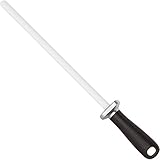
Shenzhen Knives Ceramic Honing Rod – 12 Inch, HRC 68, 1000 Grit
HRC 68 alumina
1000 grit
12 inch rod
Zinc-alloy guard
Pros
- Reinforced guard keeps fingers clear and stops the rod rolling
- HRC 68 alumina is harder than steel
- 12 inch rod covers most blades in one stroke
- Removes so little metal that daily use is safe
Cons
- Straight-edge knives only
- Gray residue needs soap and a non-scratch pad
- Shatters if dropped
The zinc-alloy rectangular guard at the handle end does two jobs, and both are practical. It keeps your fingers clear of the blade near the base, and it stops the rod rolling off a wet counter into the sink or the floor. On a busy kitchen counter that is worth more than it first appears.
At HRC 68 the ceramic alumina is harder than steel and rust resistant, so it suits hardened stainless and carbon steel alike. The 1000 grit surface is a maintenance hone rather than a sharpener, which is why buyers describe it as fast without being stripping.
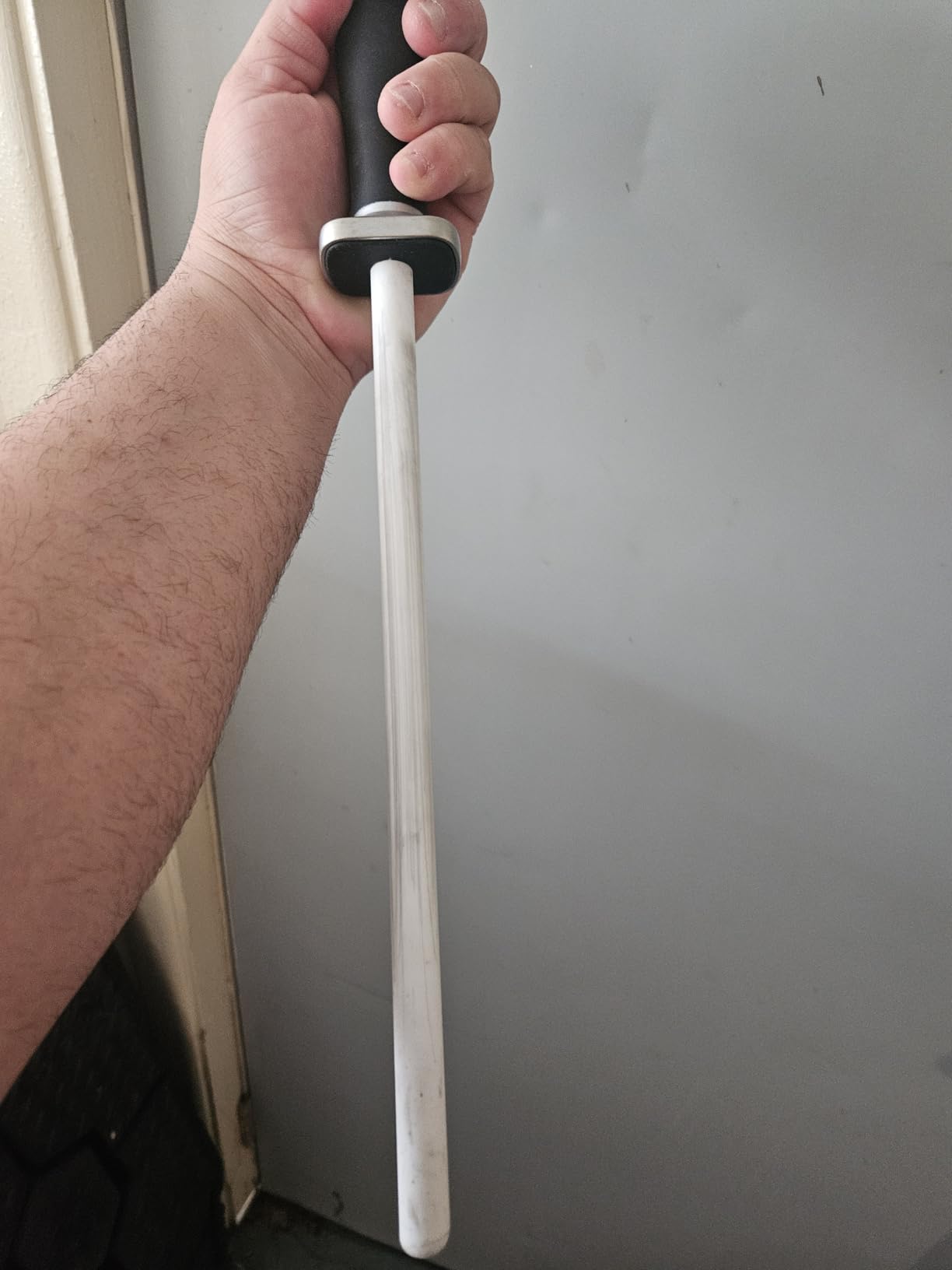
The 5-inch nylon handle is genuinely ergonomic, and combined with the guard it made this the rod we were most willing to pick up one-handed while the other hand was holding something else. That is the real test of a kitchen tool for me.
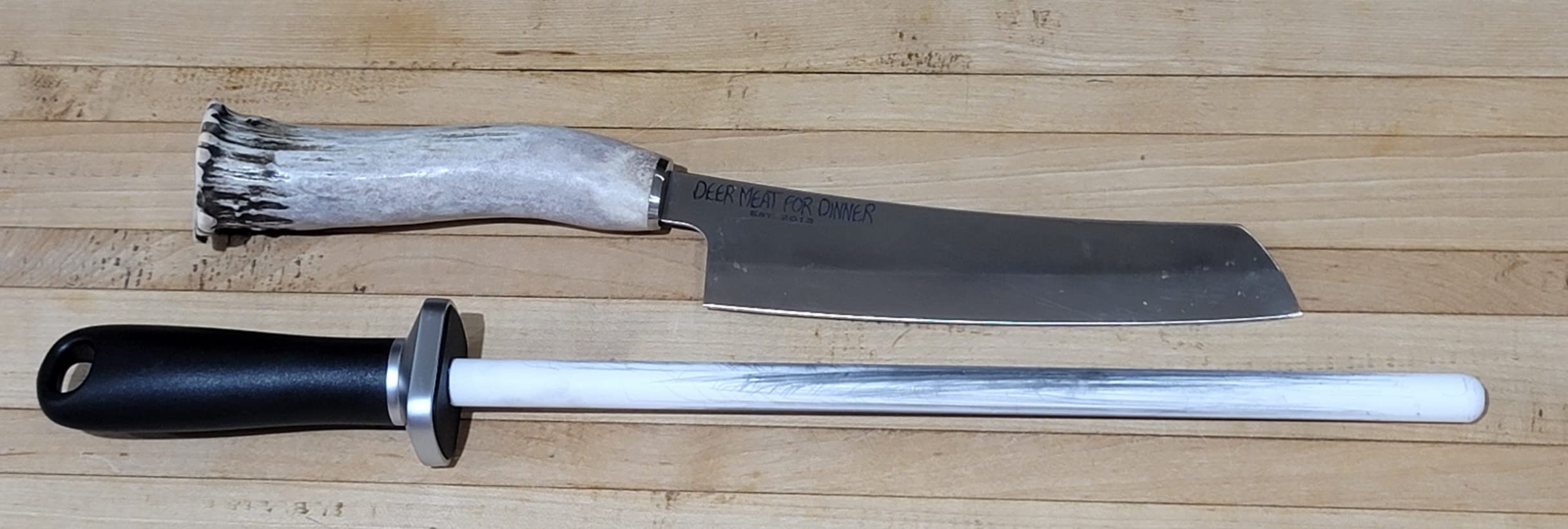
Watch for the residue. This rod picks up a grey metal film fairly quickly, and owners clean it with dish soap and a non-scratch pad. Once that film builds up, the rod stops cutting cleanly, so a monthly wipe while you are doing the washing up is enough.
Who this rod suits
Anyone who has dropped a steel rod in the sink and broken it, or who works in a small kitchen where a rolling rod is a real hazard. It suits carbon steel and hardened stainless collections equally.
If your collection includes a bread knife, look elsewhere. The maker specifies straight-edge blades only, and pushing a serrated edge along a round ceramic rod is a slow way to do it.
Where it falls short
The straight-edge restriction rules it out for serrated knives. At 350 g it is a heavy rod, which is fine for control but tiring over a long session.
6. Dalstrong 10 Inch Ceramic Honing Rod: Best for Very Hard Japanese Steel

Dalstrong 10″ Ceramic Honing Rod – Stainless Steel Core
Ceramic-coated steel core
10 inch rod
G10 handle
Anchoring tip
Pros
- Hardened steel core with a scratch-free ceramic coating
- Triple-riveted G10 handle feels solid
- Silicon tip anchors the rod and protects the counter
- Formed bolster for hand protection
Cons
- Quality experience is uneven at a 4.3 average
- Premium price for a tool that mainly realigns
- Coating is only mildly abrasive
This is the only rod in the group that is not a solid ceramic stick. It is a high-carbon stainless steel core with a scratch-free black ceramic coating, aimed squarely at high-Rockwell Japanese steels. That design is the reason it exists, and the reason owners of expensive gyuto and santoku blades reach for it.
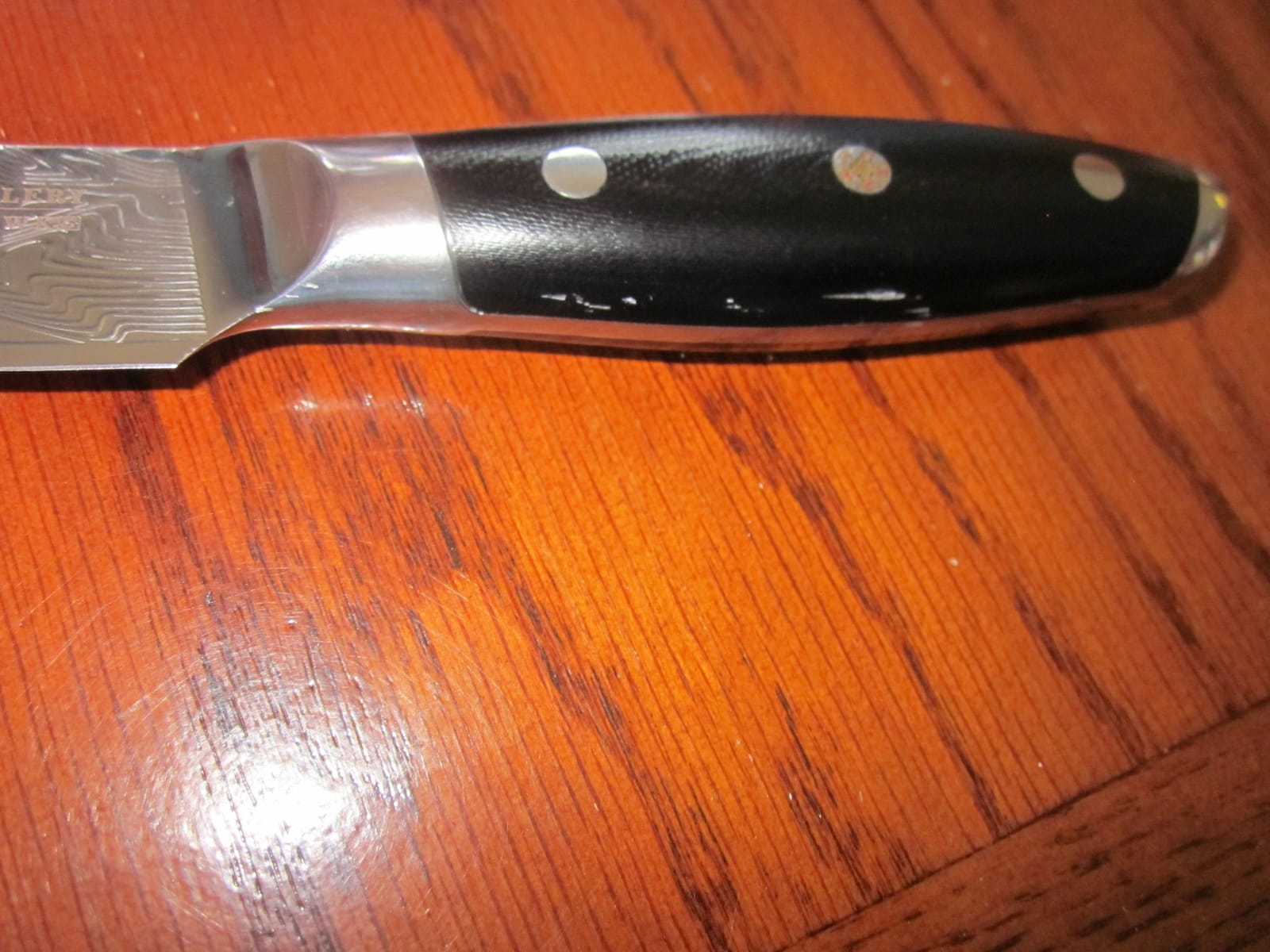
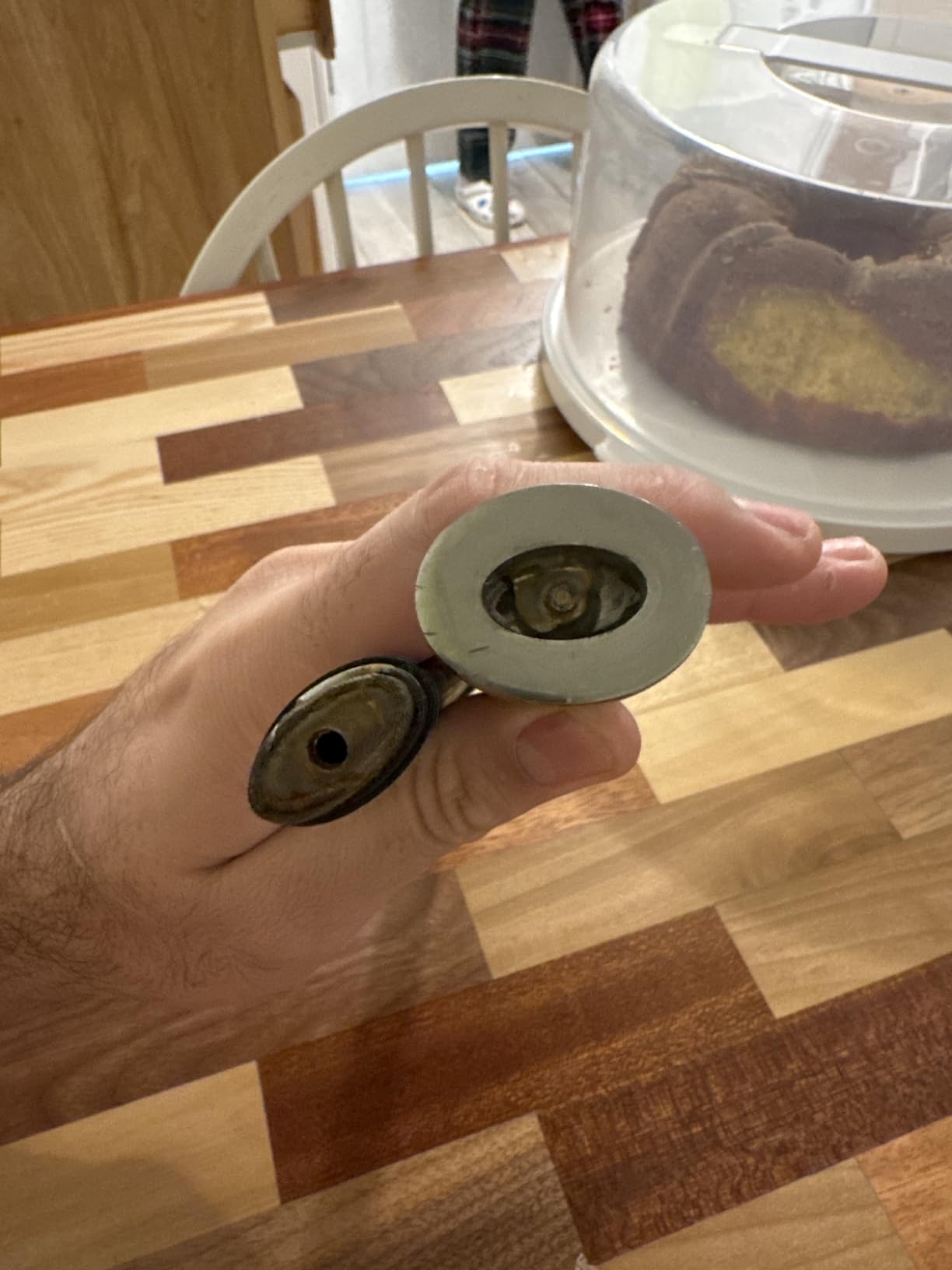
The hardware is genuinely good. A triple-riveted black G10 handle with a copper mosaic detail, a formed bolster for hand protection, and a silicon-covered tip that anchors the rod on a surface rather than letting it roll. It is the most solidly built object in the roundup by materials alone, though that is not the same as saying it hones hardest.
And at 16 ounces it carries real heft, and that heft is what lets you work on a hard edge without chasing the blade.
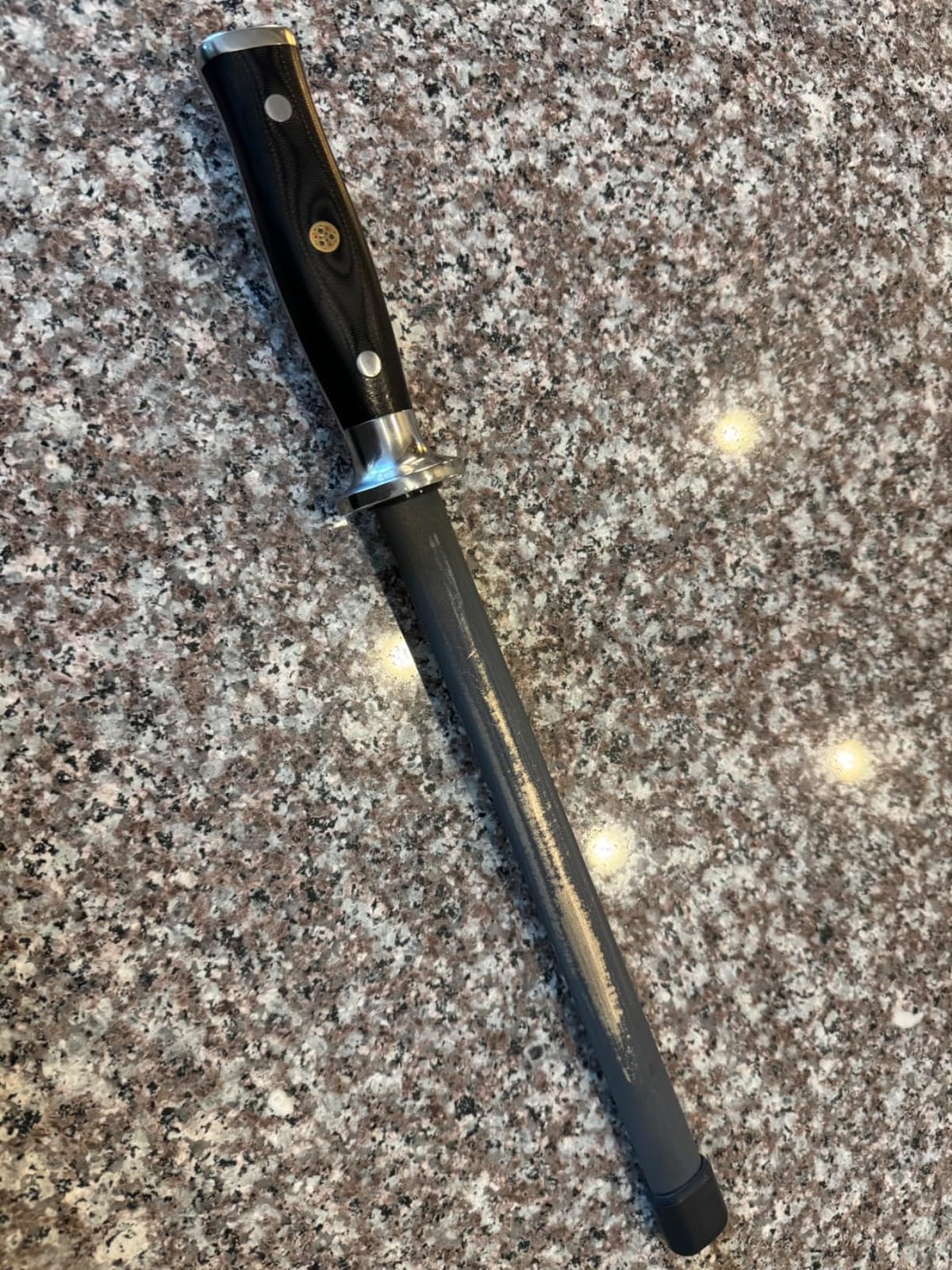
The catch is the coating itself is only mildly abrasive. Several owners describe it as polishing rather than honing effectively, which matches what the design intends: it tidies an edge without marking a delicate high-hardness blade. If your Japanese knife has genuinely gone dull, a stone comes first.
Quality experience here is the most uneven in the list, with a 4.3 average against 4.6 and 4.7 for the rest. Some of that is the premium price for a tool that mainly realigns rather than sharpens. Inspect the coating on arrival, because a scratched or chipped surface is the thing that would bother me.
Who this rod suits
Owners of high-Rockwell Japanese blades who are cautious about scratching an edge they paid good money for. The coating is designed for exactly that hesitation, and the handle will not slip with wet hands.
It also works as a general daily hone if you only own one chef’s knife, provided you accept that it is a refining tool rather than a rescue.
Where it falls short
It sits at the top of the price range in this roundup while doing almost no metal removal, and the rating spread shows that not everyone finds the coating effective. If your knives are ordinary stainless rather than hard Japanese steel, a solid ceramic rod is the better buy.
7. Mac Knife 8-1/2 Inch Ceramic Honing Rod: Best With Two Working Surfaces
Mac Knife Ceramic Honing Rod, 8-1/2-Inch, Black
Fine and medium grit
Grooved and smooth sides
8.5 inch rod
Made in Japan
Pros
- Grooved and smooth sides give two finishing stages
- Black ceramic is very fine and removes very little steel
- Works particularly well on Japanese and hard steels
- Made in Japan with a professional feel
Cons
- Plastic handle and hanger feel less solid
- Short length needs two passes per side on broad knives
- Hones only and never restores a dull blade
This is the rod the forums point to when people ask about grooved versus smooth ceramic, and it answers that question by giving you both. One side is grooved, the other smooth, so you can work the grooved side to clean the edge and finish on the smooth side for a more refined result.
That grooved-side point is worth dwelling on. Cheap smooth ceramic rods are the single most repeated complaint in home-cook discussions, described as slippery and ineffective. The complaint is about feel and contact, not about grit. A grooved surface gives the blade something to bite into, and that is why professionals have used grooved hones for decades.
One r/TrueChefKnives poster described a former line cook relying on an OXO ceramic hone with small grooves, doing a few passes right before use, and maintaining bevels for a long time. That experience is the reason the grooved-versus-smooth question comes up so often, and it is exactly the use pattern that suits this rod.
Who this rod suits
Owners of very hard Japanese steels with shallow bevel angles. Reviewers describe this as restoring those edges with minimal metal removal, which is precisely what a fine black ceramic does well.
It also suits anyone who likes a two-stage rod and wants a compact 8.5-inch length that stores easily in a small kitchen drawer or a knife roll.
Where it falls short
The plastic handle and hanger feel less solid than the metal-handled rivals, and a few users report the tip chipping. At 8.5 inches it is a short rod, so wide chef’s knives need two passes per side.
8. Mercer Culinary 12 Inch Ceramic Rod: Best for a Secure Wet-Hand Grip

Mercer Culinary Ceramic Rod Knife Honing Steel, 12 Inch
1200 grit ceramic
12 inch rod
Nylon handle with hand guard
Pros
- Realigns an edge quickly with less damage than steel
- Hand guard and non-slip nylon grip hold even when wet
- 12 inch length suits chef's and paring knives
- Built for foodservice and home kitchens
Cons
- Extra-fine grit is for maintenance only
- Ceramic chips or shatters if dropped
- Nylon handle feels plain next to premium rods
Wet hands are the normal condition of a home kitchen, and that is where this rod earns its place. The nylon handle has a hand guard and a non-slip grip that stays secure when your hands are wet, which is the single condition under which most knife handling injuries happen.
The rod itself is 1200 grit ceramic, the same working level as the Messermeister, at 12 inches. That combination means full-length sweeps on a large chef’s knife and quick touch-ups on a paring knife with one tool.
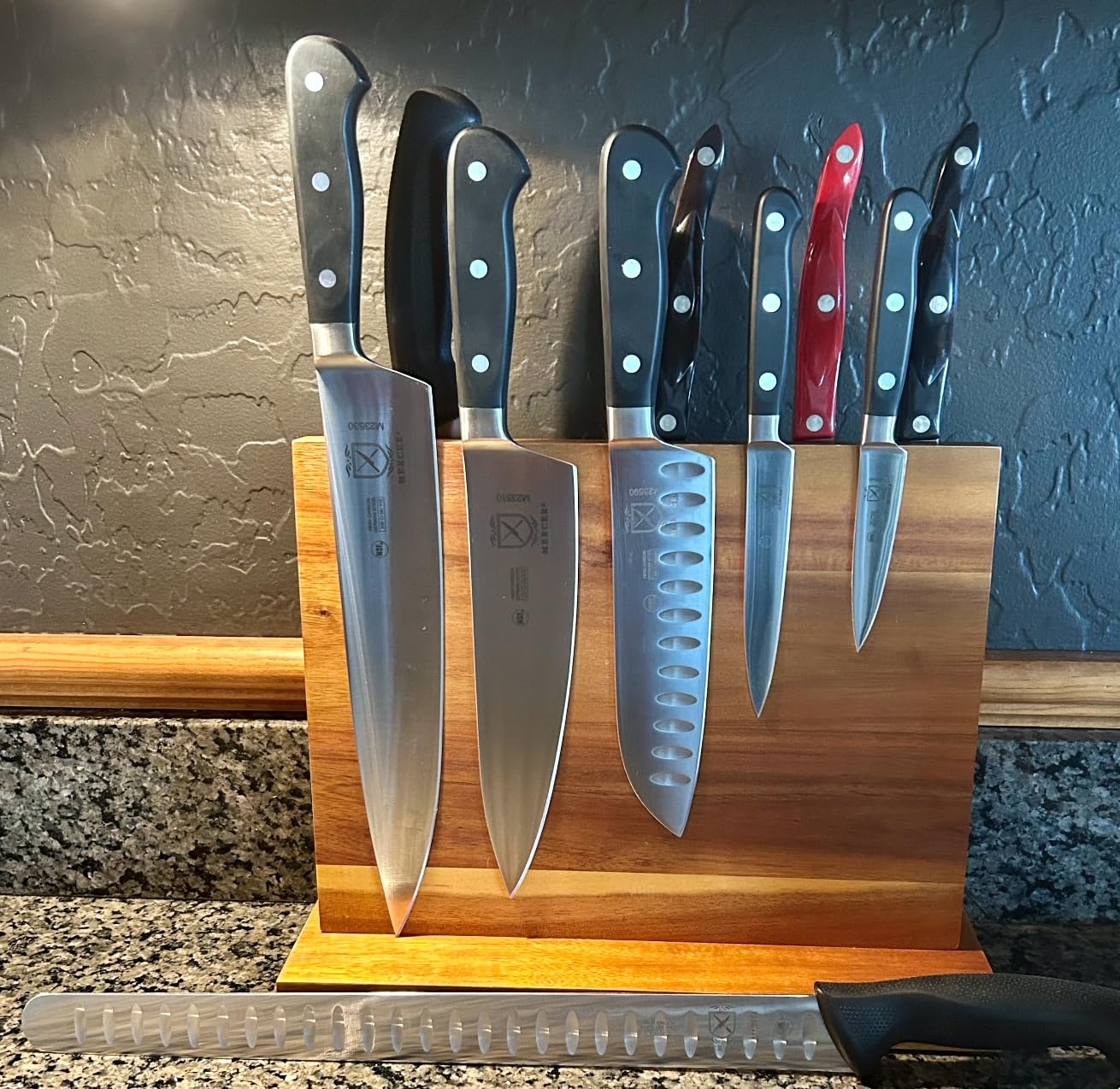
Buyers focused on knife care rate it highly for quick edge alignment and a comfortable grip in a busy kitchen. In our test it slipped less than the smooth-handled rods when we deliberately wet the handle, and the hand guard gave good clearance from the blade.
Care is straightforward: hand wash in warm soapy water, no dishwasher, no prolonged soaking. The extras come out of the box with nothing more than the rod, so give it a storage spot of its own.
Who this rod suits
Cooks who prep a lot of wet produce and handle knives straight after the sink. The 12-inch length covers a full French chef’s knife in a single pass and a paring knife without a different tool.
It is also a good pick if you want a single rod that handles both a large knife and a small one and you do not want to think about grit levels.
Where it falls short
Extra-fine grit means this is maintenance, not sharpening, so a neglected blade will not respond. The nylon handle feels plain next to the G10 and riveted designs, and the rod remains brittle on impact.
9. Arkansas Sharpeners Superstick Ceramic Rod: Best for a Large Working Surface

Arkansas Sharpeners Superstick Ceramic Rod, White
Extra fine grit
9.75 inch rod diameter
16 inch overall
Wood handle
Pros
- 9.75 inch by 1 inch ceramic rod gives a broad contact surface
- 16 inch overall length handles blades of any size
- Wood handle well adhered to the ceramic
- Extra-fine white ceramic suits stainless and carbon steel
Cons
- Bulky at 16 inches overall
- Not for ceramic or serrated knives
- Ceramic breaks if dropped
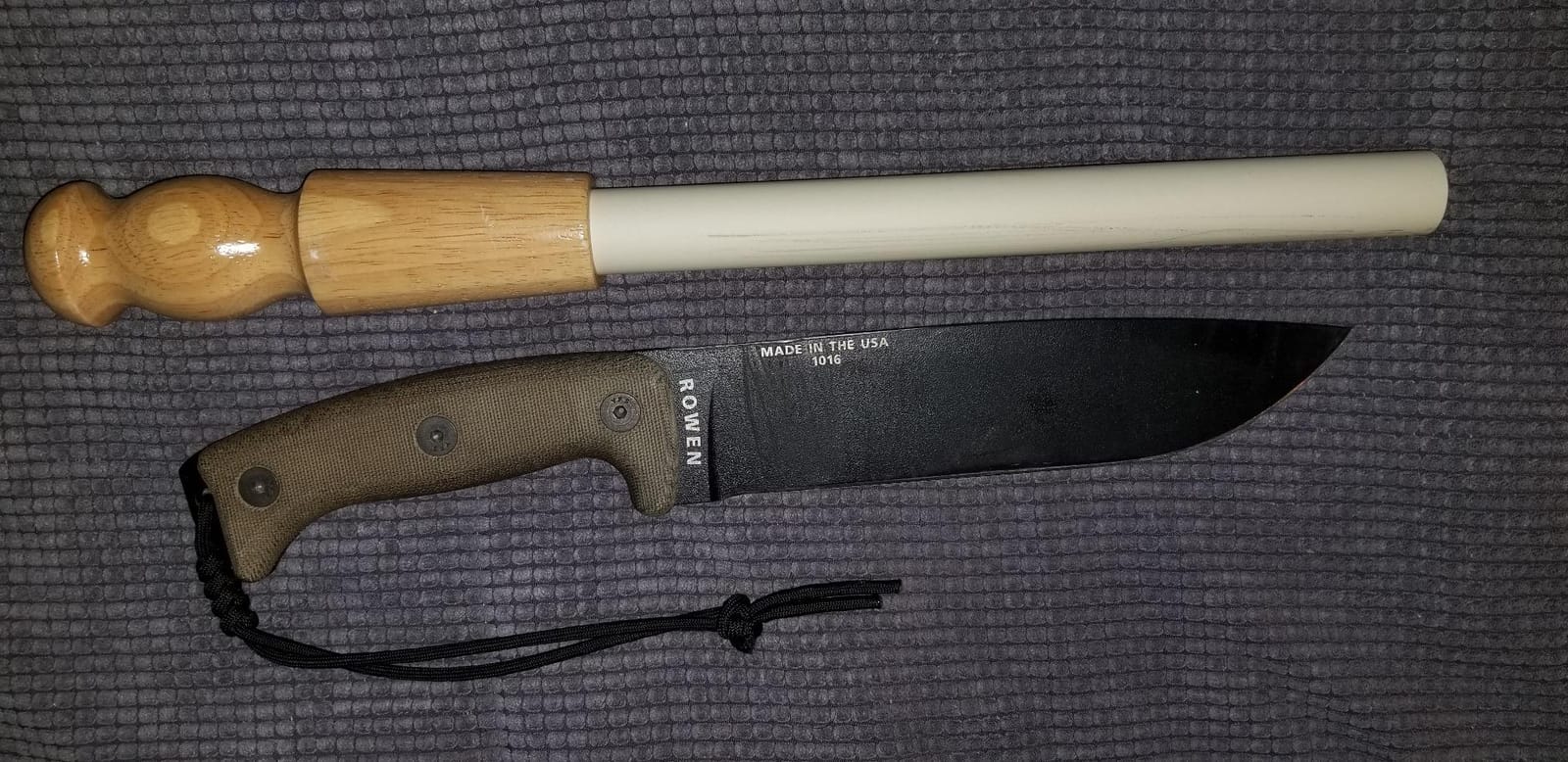
The diameter is the point. At 9.75 inches long by 1 inch across, this is a much fatter rod than the rest of the list, and a wide rod gives you a broad contact surface that stays stable through a long stroke, which makes it a forgiving rod to learn on because a beginner wobble still lands on ceramic.
Repeat buyers describe it as a reliable oversized ceramic hone used between stones and a strop. In practice that means it is a second-stage tool for someone who already sharpens on stones and wants a fast, big-surface finishing pass rather than a delicate touch-up stick.
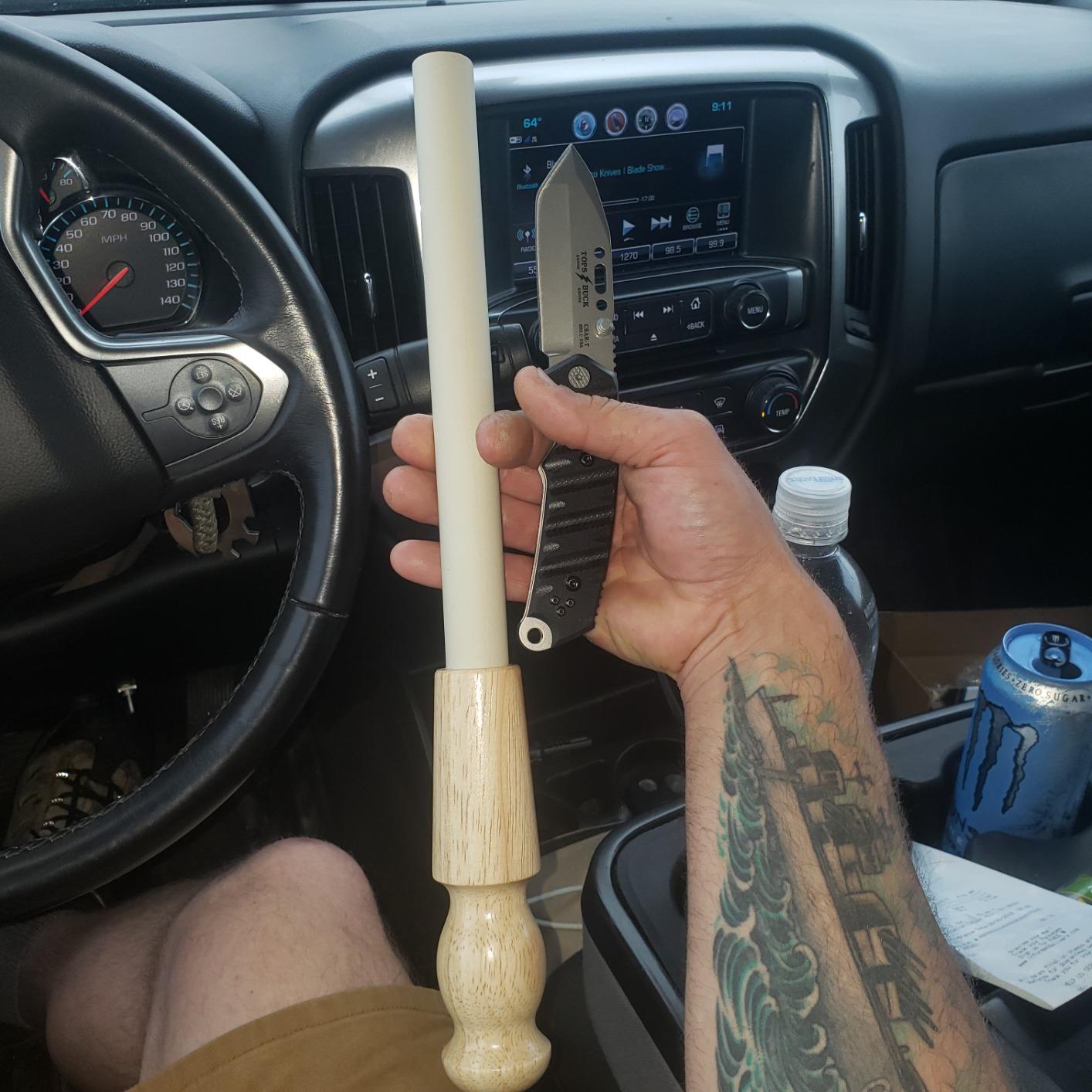
The wood handle is well made and properly adhered, and the whole thing is 16 inches overall. That length is the double-edged part. It gives you a generous working length on any blade size, but it will not fit in a standard knife block or a normal utensil drawer, so plan where it lives before you buy it.
The maker is explicit that this is not for ceramic or serrated knives, which rules it out if your collection includes a bread knife or a ceramic blade. One reviewer also questioned the made-in-USA labelling, which is worth a glance when it arrives.
Who this rod suits
Stone owners who want a fast, forgiving finishing pass across a large working surface, and anyone whose knives have lost a keen edge and need a bench tool rather than a portable one. The extra-fine white ceramic suits stainless and carbon steel.
If you cook with knives stored in a block and hone away from the board, the size is genuinely awkward. Plan for a bench, a hook or a towel.
Where it falls short
Bulk is the honest drawback here, alongside the explicit serrated and ceramic knife exclusions. Like the rest of these rods, it will not survive being dropped onto a hard floor.
10. Wusthof 10 Inch J3000 Ceramic Sharpening Rod: Best for Beginner Angle Guidance

WÜSTHOF 10″ Ceramic Sharpening Rod J3000
J3000 fine grit
F1000 European standard
10 inch rod
15 and 20 degree handle
Pros
- Handle contours double as a 15 and 20 degree bevel guide
- Fine J3000 grit takes an edge from dull to moderately sharp
- Reported to work on serrated bread knife blades
- Solingen build quality from a long-running maker
Cons
- Smallest review base in this group
- Fine grit still leaves dull or damaged edges to a stone
- Brittle ceramic that needs careful storage
The handle is the reason to look at this one. Its contours are shaped to reference roughly 15 and 20 degree bevels, which means a beginner can rest the blade against the handle and get close to the right angle without learning it by feel. That single feature does more for a new knife owner than a fancier surface does.
The ceramic is J3000 fine grit, corresponding to the F1000 European standard. Owners describe it taking an edge from dull through to moderately sharp, which puts it a step more capable than the ultra-fine finishing rods in this list.
Wusthof has been producing in Solingen for more than two centuries, and the build reflects that. It is a black-handled 10-inch rod at under 8 ounces, so it is light enough for long sessions and small enough for a drawer.
Who this rod suits
Beginners who are nervous about holding a consistent angle, and anyone whose knives are general-purpose European steel where 15 to 20 degree bevels are the norm. It is also reported to work on serrated bread knife blades, which almost nothing else here does.
If you want a single rod that handles both straight and serrated blades and doubles as a teaching aid for angle, this is the most complete answer.
Where it falls short
With 87 reviews, it has the smallest owner base in this group, so there is less long-term feedback to lean on. Fine grit still means a stone for a badly worn edge, and the ceramic is brittle on impact like the rest.
How to Use a Ceramic Honing Rod in 5 Steps
Technique matters more with ceramic than with steel because the abrasive action is unforgiving of a heavy hand. Five steps, and the whole thing takes under a minute.
Stand the rod upright. Hold it vertical with the handle at the bottom and your non-knife hand wrapped around the handle, keeping your fingers well below the top of the rod.
Place the heel near the tip. Rest the back edge of the blade heel against the rod a little below the top, blade at roughly 15 to 20 degrees. If your rod has an angle guide in the handle, rest the blade against it instead of guessing.
Sweep the full length on one side. Draw the blade down the rod from heel to tip in one continuous motion, using light even pressure and no downward push at the start.
Repeat on the other side. Three to five passes per side is plenty for routine maintenance. Do not add more strokes for enthusiasm, because the rod does remove metal.
Finish with a strop if you care about bite. Ultra-fine ceramic leaves a slightly toothy edge, and a leather strop on a cutting board smooths that away.
Two things people get wrong. The first is pushing down on the tip at the start of the stroke, which does nothing useful. The second is speed. A fast, confident, light sweep beats a slow, heavy one every time, because the rod only needs to straighten the edge, not grind it.
Honing vs Sharpening: Which Knives to Keep Away From Ceramic
Honing straightens an edge. Sharpening removes metal to create a new bevel. Confusing the two is the number one disappointment people report about ceramic rods, and it is entirely avoidable once you know which job your knife needs.
Hone every week, or before a meal if you use one knife constantly. Sharpen a few times a year, or the moment a knife stops cutting cleanly no matter how much you hone it. A ceramic rod in the second situation is the wrong tool, and no amount of persistence will change that.
Now the exclusions. Very hard high-vanadium alloy steels are the ones to leave alone. The standard advice on BladeForums is blunt: do not use ceramic on high vanadium knives, because you will be there forever. The chemistry is simple, a very hard steel abrades a ceramic surface far more slowly than the reverse.
Keep ceramic away from ceramic-bladed knives. One rod here rules itself out for them on the label. Serrated and hollow-ground blades need a different approach, because a round rod cannot follow the scalloped edge. Light pressure at the correct angle works, but it takes far more time, and triangular ceramic rods are the ones built for it.
Coated blades are a matter of degree. A fine ceramic rod is gentler on a coating than a diamond rod because it removes less material, but keep strokes light on any coated blade and stop if the coating looks thin.
How to Choose a Ceramic Honing Rod
Six criteria decide this purchase for a home kitchen, and only one of them is price.
Grit level. Fine and extra-fine rods (roughly 1000 to 1500 grit) are maintenance tools for a well-kept edge. If your knives need sharpening twice a year, plan on buying a stone as well. If they are honed weekly, extra-fine is exactly right.
Rod length. Match the rod to your largest knife. A 12-inch rod covers a 9-inch gyuto or French knife in one pass. An 8-inch rod suits paring knives, utility knives and small kitchens where drawer space is real.
Surface type. Grooved surfaces bite and clean an edge; smooth surfaces refine. This is the most repeated home-cook complaint in the forums, and it is why the two-sided grooved-and-smooth rod is worth a look.
Handle and guard. A guard keeps your fingers away from the blade and stops the rod rolling off a counter. A non-slip grip matters more than any handle material once your hands are wet.
Drop protection. Look for a silicone shock seal or an anti-breaking end cap. One rod in this list uses a shock-absorbing seal and another adds an end cap, and either converts the biggest objection to ceramic into a non-issue.
Storage. If the rod comes with a hang ring or a sheath, that is worth paying for. A rod without a home will eventually get knocked off a counter.
One question worth answering before you buy: what does your knife collection actually consist of? A soft German chef’s knife, a hard Japanese gyuto and a carbon steel knife are all fine on a fine ceramic rod. Very hard vanadium-heavy blades, ceramic blades and serrated knives need a different plan.
Honing Cadence, Care and Storage for a Home Kitchen
A realistic cadence is weekly for the knife you use most, and before cutting into anything dense if you have not honed in a few days. Daily is unnecessary and, on an ultra-fine rod, slowly thins the edge over time. Monthly is too infrequent for a fine ceramic, because the edge rolls over faster than that.
Clean the rod when you see build-up. Metal film dulls a ceramic surface and you will read it as the rod losing its bite when nothing is wrong with the rod itself. Soap, warm water and a non-scratch pad handle every model in this group, and the light-coloured ones show the film clearly enough that you will not miss it.
Everything here is hand wash. No dishwasher, no prolonged soaking, and none of these rods belong on the bottom rack where a stray pot knocks them off. Dry them standing up.
Store the rod where it cannot roll and cannot be dropped. The Green Elephant absorbs drops, the SHARPAL has an end cap, the Shenzhen rod has a guard and an anchoring tip, and the rest need a deliberate place in the kitchen. Length also matters for storage, since the 16-inch Arkansas Superstick will not go into a standard knife block.
None of these rods has a published service life, because ceramic does not blunt the way steel does. Replace one when the surface feels smooth and slippery instead of gritty, when it chips, or when metal build-up no longer washes off cleanly. That is normally years of use rather than months.
One last thing worth saying plainly, because it is the most common piece of bad advice on this topic. A ceramic rod does remove metal, just far less than a diamond rod. One forum user put it well: it actually does remove metal unlike steel rods, so do not go crazy using it. A few light passes a week will keep an edge indefinitely. Twenty hard passes a day will take it down.
Frequently Asked Questions
Are ceramic honing rods better?
Ceramic is better than steel for most home cooks because it is harder than kitchen steel, does not rust, and straightens a rolled edge quickly with very little metal removal. Steel rods work by rolling the edge sideways and need frequent use to stay effective. Diamond rods remove the most metal and suit experienced sharpeners. Ceramic also has one drawback: it chips or shatters if dropped.
Do you really need a honing rod?
If you own any knife you use weekly, yes. A honing rod takes five seconds and keeps an edge working between full sharpenings. Without one, edges roll over from normal use and the knife feels blunt long before it is actually dull. You do not need a rod if your knives are decorative or if you enjoy sharpening on stones, but a rod is the cheapest edge care available.
How often should you use a honing rod?
Hone weekly for the knife you use most, and before cutting anything dense if several days have passed. Daily is unnecessary on a fine ceramic rod and slowly thins the edge. Monthly is too infrequent, because the edge rolls over faster than that on a fine ceramic surface.
What is the correct way to use a honing rod?
Stand the rod upright and hold the handle with your fingers below the top. Rest the blade heel near the rod tip at roughly 15 to 20 degrees, sweep the full length down one side in one light pass, then repeat on the other side. Three to five passes per side is enough. Push no extra pressure and keep the motion fast and confident.
Which type of honing rod is better, diamond or ceramic?
For a home cook maintaining knives regularly, ceramic. Diamond removes far more metal and dulls a keen edge quickly, which makes it a sharpening tool that rewards a skill curve. Ceramic is fast on a rolled edge, gentle on hard Japanese steel, gentle on coatings, and it never rusts. Choose diamond only if you are already comfortable sharpening.
How long should a honing rod last?
Ceramic rods do not blunt the way steel rods do, so there is no set service life. Replace one when the surface feels smooth and slippery rather than gritty, when it chips, or when metal build-up no longer washes off. In normal home use that is normally several years. Store it where it cannot be dropped, since a dropped ceramic rod rarely survives.
Final Verdict
For most home cooks the answer is the Green Elephant 11-inch fine rod. Reviewers report it working across a wide spread of steels, it weighs only 204 g so a full-length sweep stays a one-handed job, and the shock-absorbing core removes the drop anxiety that keeps people off ceramic entirely. It is our first choice among these best ceramic honing rods.
Pick the Messermeister instead if your longest knife is nine inches or more and you want full-length passes in a single stroke. Pick the SHARPAL if you want a branded rod with a protective end cap and a warranty and nothing to think about. Pick the Wusthof J3000 if holding a consistent angle is the part that worries you most, and the Mac Knife if you want grooved and smooth surfaces in one tool.
Whichever you choose, store it somewhere it cannot roll, clean it when the metal film appears, and keep strokes light. A ceramic rod is a five-second habit, and that habit is what keeps a good knife good. If you like the idea of ceramic equipment as a category, our picks on ceramic kamado grills cover the outdoor side of it.