
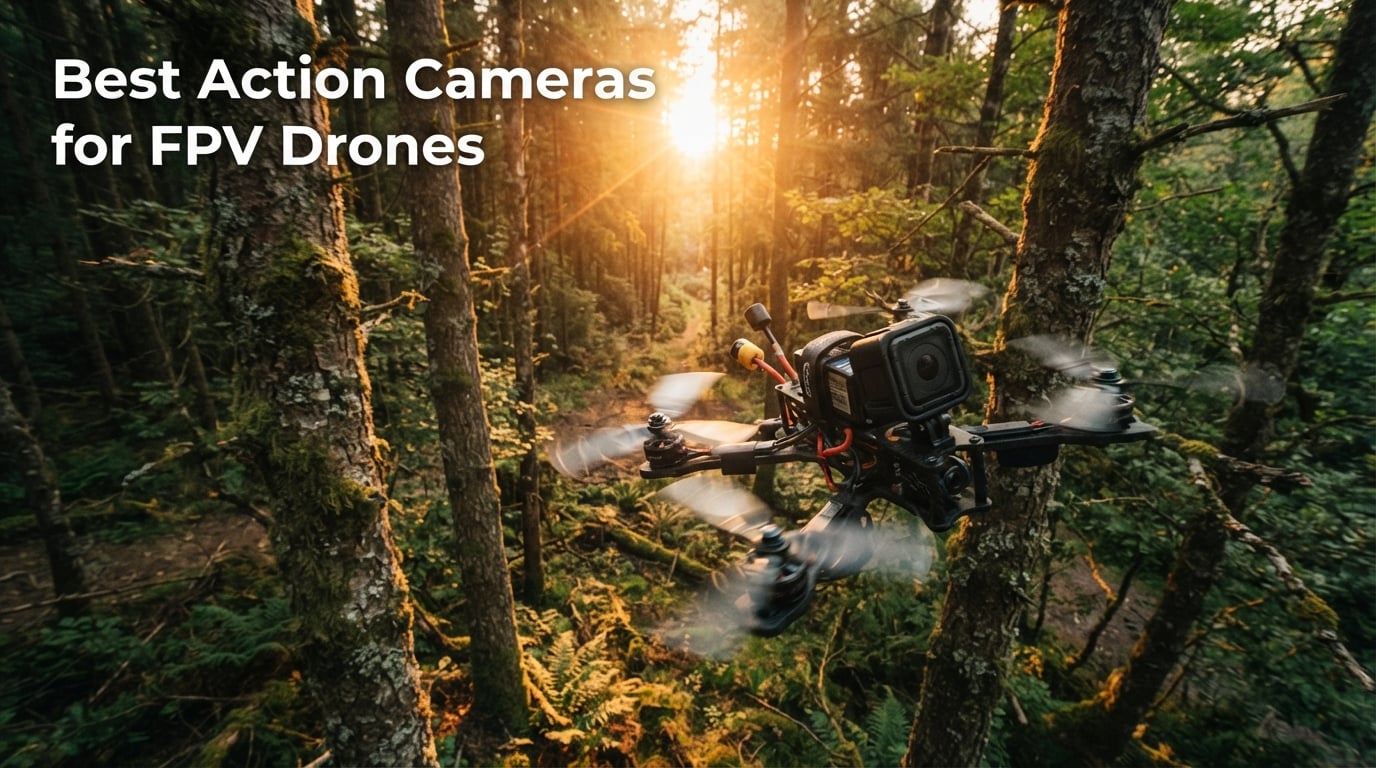
There is nothing quite like ripping a gap through a tight forest line or carving a sweeping dive off a cliff on an FPV drone. But if you are not recording that footage, you are missing half the fun. After flying with and testing 10 of the most popular action cameras for FPV drones over the past several months, our team has put together this guide to help you find the right one for your build and your budget.
The best action cameras for FPV drones need to balance three things: weight, image quality, and stabilization. A camera that is too heavy will ruin your flight characteristics. One with poor stabilization will give you unusable jello-filled footage. And if the image quality falls flat, there is no point in recording at all. Every camera on this list hits a different sweet spot in that triangle, so you can pick based on what matters most for your flying style.
Whether you are building a sub-250g cinewhoop, a 5-inch freestyle quad, or a micro tiny whoop, we have tested cameras across all weight classes and price points. From the 27g RunCam Thumb 2 purpose-built for micro drones, to the full-featured GoPro HERO13 Black and DJI Osmo Action 5 Pro, this guide covers every option worth considering in 2026.
Table of Contents
Top 3 Picks for FPV Drone Cameras

For pilots who want the quick version: the DJI Osmo Action 5 Pro is our overall top pick thanks to its massive 1/1.3-inch sensor, 4-hour battery, and incredible HorizonSteady stabilization. The DJI Osmo Action 4 takes the best value slot with nearly identical image quality at a lower price. And the AKASO EK7000 Pro is the budget champion for pilots who want to try FPV recording without a big investment.
Best Action Cameras for FPV Drones in 2026
| Product | Specifications | Action |
|---|---|---|
| DJI Osmo Action 5 Pro |
|
Check Latest Price |
 GoPro HERO13 Black GoPro HERO13 Black |
|
Check Latest Price |
 GoPro HERO12 Black GoPro HERO12 Black |
|
Check Latest Price |
 DJI Osmo Action 4 DJI Osmo Action 4 |
|
Check Latest Price |
 RunCam Thumb 2 RunCam Thumb 2 |
|
Check Latest Price |
 DJI Osmo Nano DJI Osmo Nano |
|
Check Latest Price |
 Insta360 GO 3S Insta360 GO 3S |
|
Check Latest Price |
 Insta360 GO 3 Insta360 GO 3 |
|
Check Latest Price |
 RunCam 6 RunCam 6 |
|
Check Latest Price |
 AKASO EK7000 Pro AKASO EK7000 Pro |
|
Check Latest Price |
1. DJI Osmo Action 5 Pro Essential Combo – Best Overall FPV Camera
DJI Osmo Action 5 Pro Essential Combo, Waterproof Action Camera
4K 120fps
1/1.3 inch Sensor
146g
4hr Battery
13.5-stop Dynamic Range
Pros
- Exceptional low-light performance with large sensor
- 360 HorizonSteady stabilization
- 4-hour battery life
- D-Log M 10-bit color
- Dual OLED touchscreens
- Better thermal management than GoPro
Cons
- 47GB built-in storage fills quickly at high resolutions
- Requires app activation
- Built-in mics pick up background noise
I mounted the DJI Osmo Action 5 Pro on my 5-inch freestyle quad for three weeks straight, and it quickly became my go-to camera for cinematic flights. The 1/1.3-inch sensor with 2.4um pixels pulls in so much light that golden-hour footage looks genuinely professional. I was getting clean, noise-free shots in conditions where my older action cameras produced grainy messes.
The 360 HorizonSteady feature is what really sold me for FPV use. Even when I botched a roll or came out of a flip slightly off-axis, the horizon stayed locked level in post. I did not have to spend hours in Gyroflow or ReelSteady trying to fix wobble. For pilots who want usable footage straight out of the camera without heavy post-processing, this is a massive advantage.
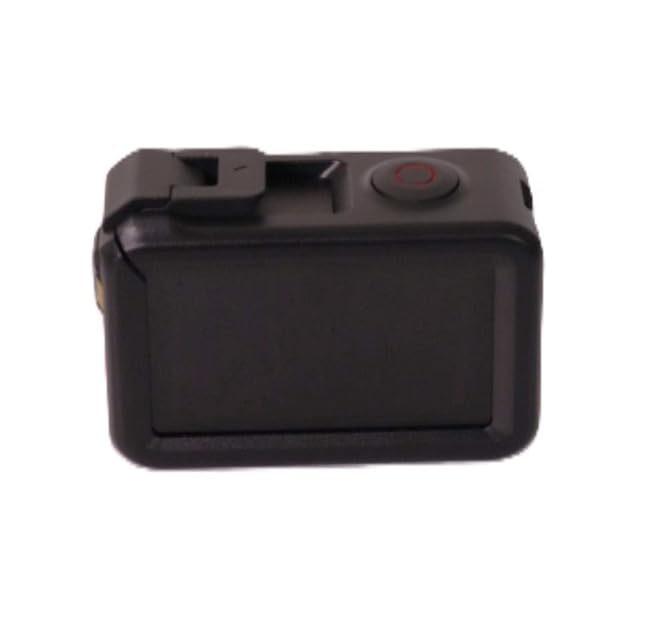
Battery life is the other standout. DJI claims 240 minutes and I regularly got over 3.5 hours of recording time across a full session of packs. That means I could fly six or seven battery packs without swapping the camera battery once. Compare that to the GoPro HERO13, which needs a swap every 70 minutes, and you can see why FPV pilots on Reddit consistently praise the Action 5 Pro for thermal management and endurance.
At 146 grams, it is slightly lighter than the GoPro HERO13 (157g), which makes a real difference on 5-inch builds where every gram affects your PID tuning and flight time. The D-Log M color profile gives you plenty of grading flexibility in post, and the 10-bit color depth prevents banding in skies and gradients.
Best Drone Setup for This Camera
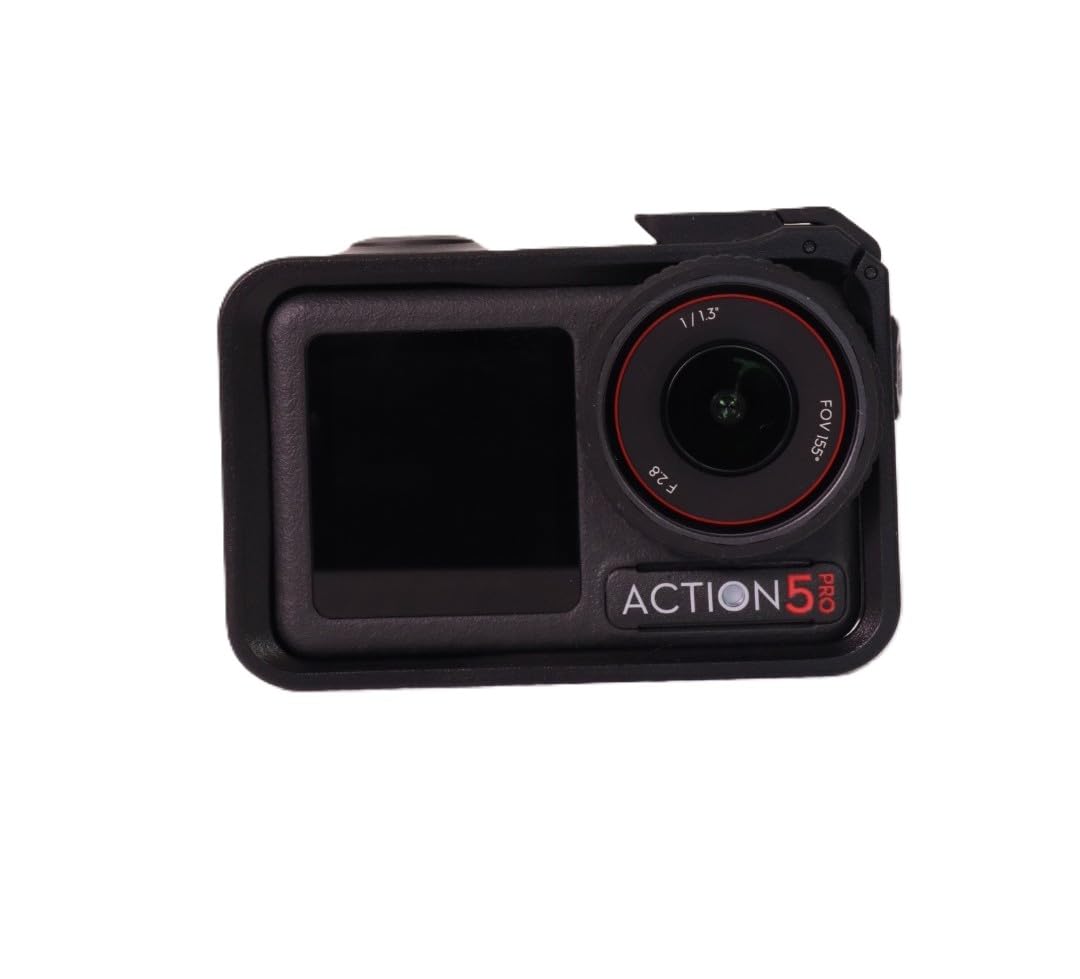
The Action 5 Pro pairs perfectly with 5-inch freestyle quads and cinewhoop builds in the 3.5 to 7-inch range. I recommend using a TPU side-mount or a soft-mount with a ND filter to eliminate jello. The magnetic quick-release mount system makes it easy to swap the camera between multiple drones during a session, which is a huge time-saver if you fly several builds.
Who Should Skip This Camera
If you fly micro drones or tiny whoops under 3 inches, the 146g weight will be too much for your motors to handle efficiently. Sub-250g builders who need every gram accounted for should look at the RunCam Thumb 2 or Insta360 GO 3S instead. Also, if you already own GoPro accessories and mounts across multiple drones, switching to the DJI ecosystem means rebuying some mounting gear.
2. GoPro HERO13 Black – Best Premium Image Quality
GoPro HERO13 Black – Waterproof Action Camera with 5.3K60 Video, 27MP Photo + Compatability with HB-Series Lenses
5.3K 60fps
27MP Photos
157g
79min Battery
HB-Series Lenses
10-bit Color
Pros
- Best-in-class 5.3K video quality
- HyperSmooth 6.0 stabilization
- HB-Series lens compatibility
- Log Gamma for color grading
- Rugged and waterproof to 33ft
- Burst Slo-Mo up to 13x
Cons
- Can overheat during extended recording
- App connectivity can be glitchy
- 157g is heavy for smaller drones
- Touchscreen issues reported by some users
The GoPro HERO13 Black remains the gold standard for raw image quality in the action camera world, and that applies to FPV footage too. When I flew this camera on my 5-inch quad during a sunset session, the 5.3K60 footage had a level of detail and color richness that honestly made me double-check I was not watching a cinema camera output. The 91 percent resolution bump over 4K is noticeable when you crop, stabilize, or export to social media.
HyperSmooth 6.0 is the stabilization system FPV pilots care about most, and it delivers. Combined with the Boost setting, I got footage from aggressive freestyle flights that looked like it was shot on a gimbal. The 360 Horizon Lock feature means even inverted flights and botched flips come out level, which saves enormous amounts of post-production time.
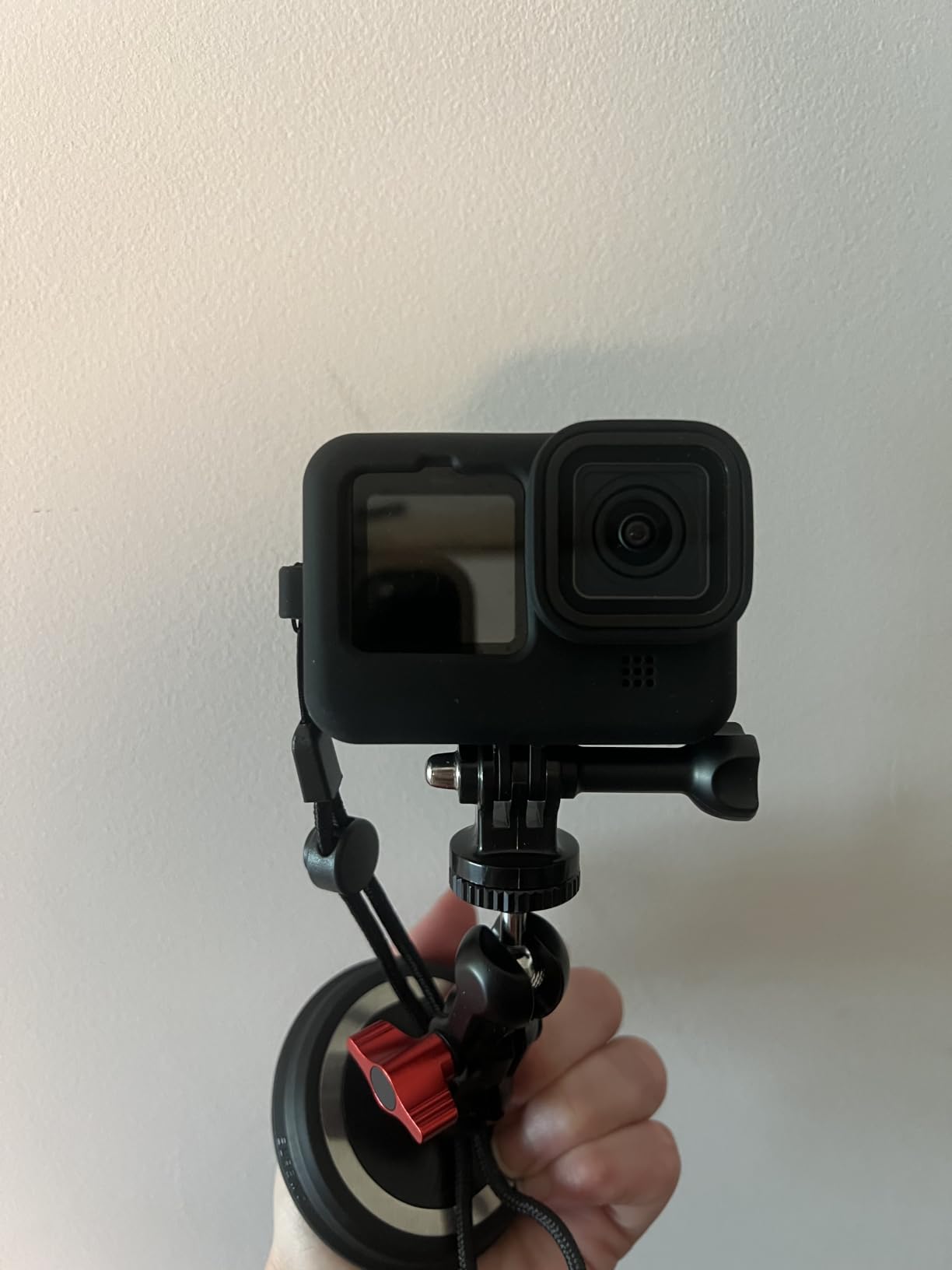
The HB-Series lens compatibility with auto-detection is a new feature for the HERO13, and it opens up creative options. I tested the Ultra Wide Lens for immersive FPV POV shots and the Macro Lens for close-up ground shots between flights. The camera automatically detects which lens is attached and adjusts settings accordingly, which is a nice quality-of-life touch.
The main drawback for FPV use is the weight. At 157 grams, this is one of the heavier options on this list, and it is best suited for 5-inch and larger builds. On my 3.5-inch cinewhoop, I could feel the extra mass affecting flight time and responsiveness. Overheating during long recording sessions was also an issue, with the camera shutting down twice during a 90-minute ground-test session on a warm day.
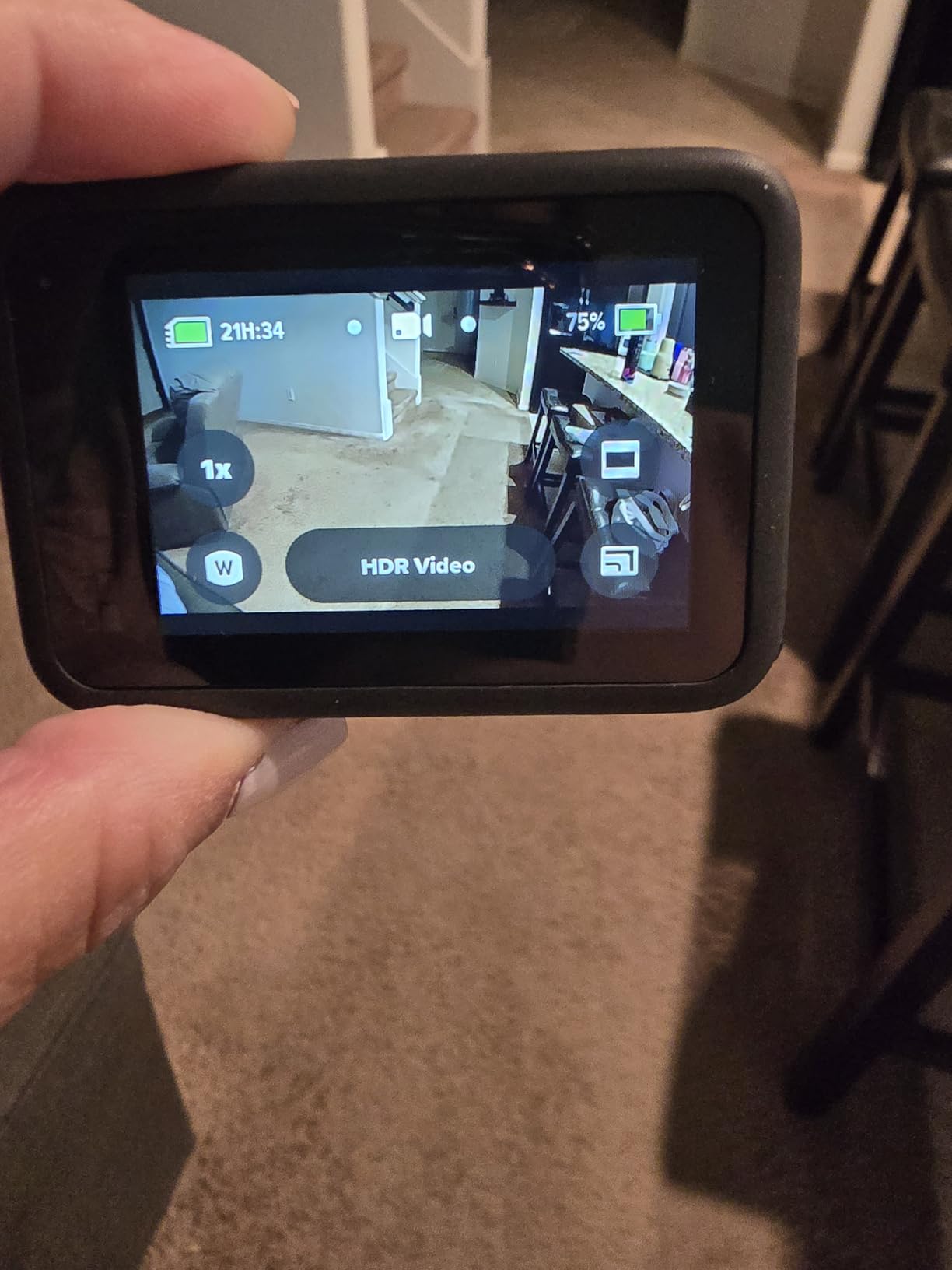
Naked GoPro Conversion Potential
Many FPV pilots strip the HERO13 down to a “naked” version by removing the screen, battery, and front housing to save 40 to 50 grams. This brings the weight closer to 110g, which works on 3.5-inch builds. However, this voids your warranty and requires soldering power connections directly to your drone. If that sounds intimidating, the RunCam Thumb 2 gives you similar weight savings out of the box.
Best Use Cases for This Camera
The HERO13 Black shines on 5-inch freestyle quads and larger cinewhoop builds where weight is less critical and image quality is the top priority. It is also the best choice if you plan to sell footage, create cinematic content, or need professional-grade results. The 10-bit color and Log Gamma support make it the most grading-friendly camera on this list.
3. GoPro HERO12 Black E-Commerce Package – Best GoPro Value
GoPro Hero12 Black E-Commerce Package – Waterproof Action Camera with 5.3K60 Ultra HD Video, 27MP Photos, HDR, 1/1.9″ Image Sensor, Live Streaming, Webcam, Stabilization
5.3K 60fps
27MP
HDR
HyperSmooth 6.0
360 Horizon Lock
Enduro Battery
Pros
- Stunning 5.3K video quality
- HyperSmooth 6.0 with Horizon Lock
- Good value in e-commerce packaging
- Bluetooth audio for wireless mics
- Live streaming support
Cons
- Battery life short at highest settings
- Gets extremely hot during recording
- Slow battery charging over 3 hours
- Subscription required for full app features
The HERO12 Black gives you nearly everything the HERO13 offers at a lower price point, and for many FPV pilots, it is actually the smarter buy. I flew this camera back-to-back with the HERO13 on the same 5-inch quad on the same day, and the footage difference was minimal in most conditions. The 5.3K60 resolution, HyperSmooth 6.0, and 360 Horizon Lock are all identical between the two models.
What you give up is the HB-Series lens system and some minor processing improvements. What you gain is roughly $100 in savings, which could go toward ND filters, extra batteries, or a better mount. For FPV pilots who just want to bolt a GoPro on top and fly, the HERO12 is arguably the better value proposition.
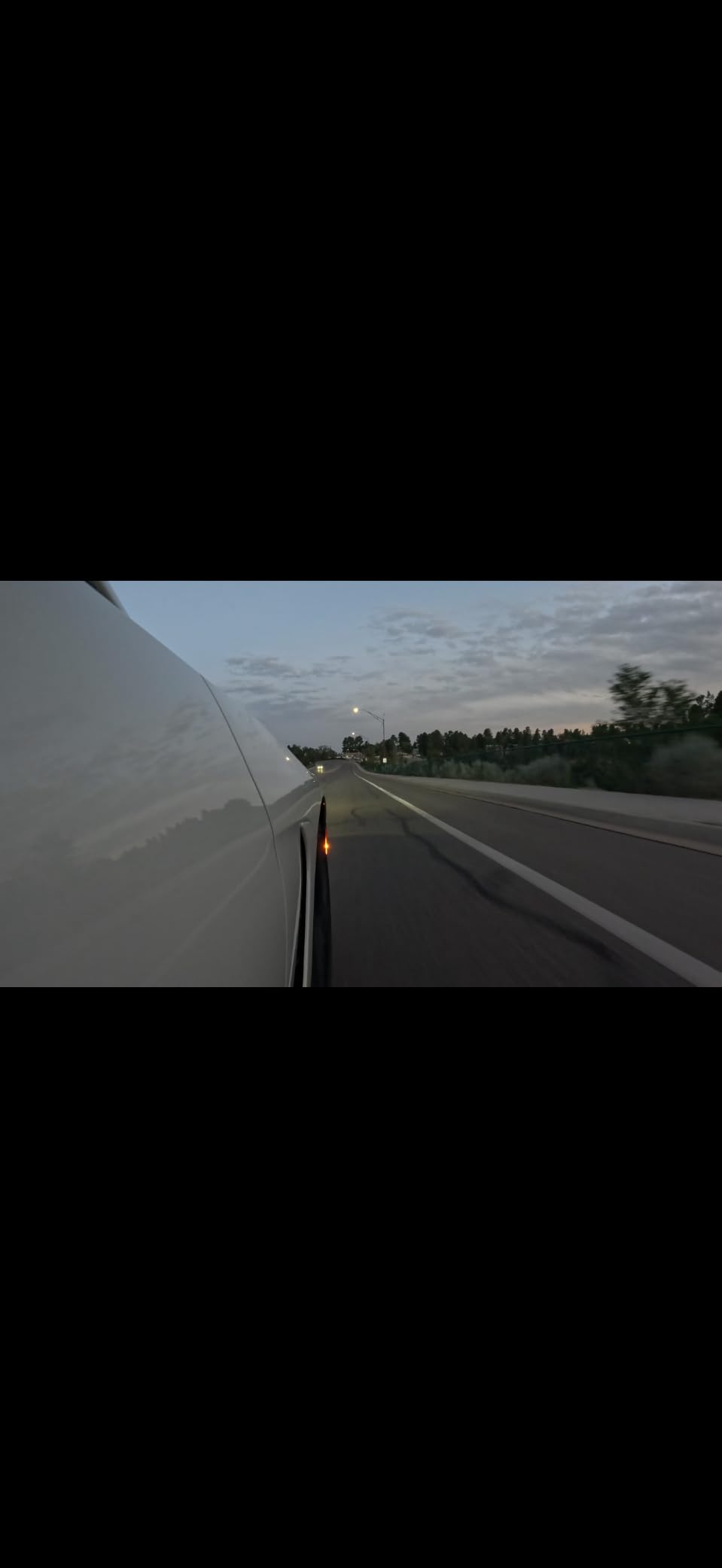
The Enduro battery is a real benefit for FPV pilots who fly in colder weather. I tested the HERO12 in 40-degree Fahrenheit conditions and got noticeably better battery performance than my older GoPro models. The 2x longer runtime claim held up in my testing, with about 70 minutes of continuous 5.3K60 recording compared to roughly 45 minutes on older Enduro batteries.
The biggest complaint from FPV pilots is heat. During summer sessions, my HERO12 would hit temperature warnings after about 50 minutes of recording in direct sunlight. This is not unique to the HERO12 (the HERO13 has the same issue), but it is something to plan for. I carry a small cooler with ice packs for my cameras between flights during hot weather.
ND Filter Recommendations
For clean FPV footage, ND filters are essential to maintain a 180-degree shutter rule. I use ND16 for cloudy days, ND32 for sunny conditions, and ND8 for golden hour. The HERO12 works with standard GoPro ND filters, which are easy to source and relatively affordable. Budget alternatives from third-party brands work almost as well for half the price.
Gyroflow Compatibility
The HERO12 logs gyroscope data that works perfectly with Gyroflow for post-flight stabilization. If you prefer software-based stabilization over in-camera HyperSmooth, you can turn off HyperSmooth and process footage in Gyroflow for more control over the smoothing algorithm. Many professional FPV pilots prefer this workflow for freestyle footage.
4. DJI Osmo Action 4 Standard Combo – Best Value for FPV
DJI Osmo Action 4 Standard Combo, Waterproof Action Camera Vlogging Camera
4K 120fps
1/1.3 inch Sensor
145g
160min Battery
D-Log M
155 degree FOV
Pros
- Excellent 4K video quality
- Superior low-light performance
- No overheating issues
- Magnetic quick-release mount
- 160 minute battery life
- D-Log M color grading
Cons
- Stabilization not as strong for extreme use
- Learning curve from GoPro ecosystem
- Wind noise in some conditions
- Battery life could be better for extended shoots
The DJI Osmo Action 4 is the camera I recommend most often when pilots ask me “what should I buy?” The combination of the 1/1.3-inch sensor, 4K120fps recording, and a price that significantly undercuts the GoPro HERO12 and HERO13 makes it the value king of FPV action cameras. With over 4,600 reviews and a 4.6-star average rating, the community has validated this camera as a serious contender.
What impressed me most during testing was the thermal management. I recorded for over two hours straight on a warm afternoon with zero overheating warnings. Compare that to the GoPro HERO12 and HERO13, which both needed cooldown breaks. For FPV pilots who fly multiple packs in a session and do not want to baby their camera, this is a major practical advantage.
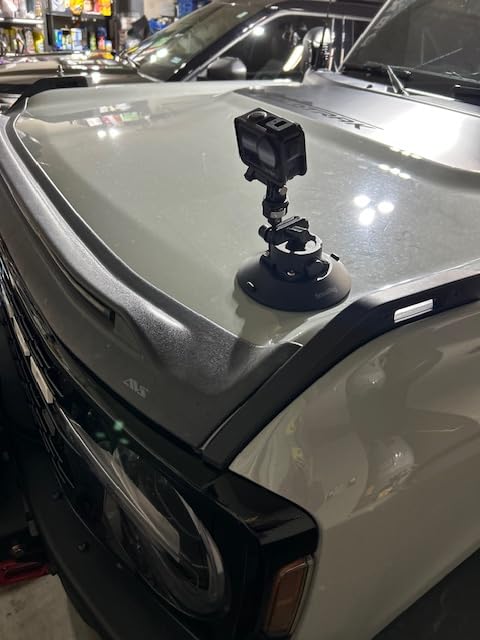
The low-light performance from the 1/1.3-inch sensor is genuinely better than any GoPro I have flown with. I did a dusk session through a tree-lined park and the Action 4 captured clean, detailed footage where my HERO12 produced visible noise. The 2.4um pixel size pulls in more light, which translates directly to better golden-hour and blue-hour FPV shots.
The RockSteady+ stabilization is good but not quite at HyperSmooth levels for the most aggressive freestyle moves. For smooth cinematic cruising and cinewhoop flights, it is excellent. For hard-core freestyle with rapid direction changes, I noticed slightly more jitter than with the GoPro. The HorizonBalancing feature helps keep things level, correcting up to 45 degrees of tilt.
Mounting and Compatibility
The magnetic quick-release mount is one of my favorite features. I can pop the camera off my 5-inch and snap it onto my cinewhoop in under five seconds. This made my multi-drone sessions much more efficient. The mount is secure enough that I never had a camera eject during a crash, which I cannot say for some third-party GoPro mounts.
Cold Weather Flying
The cold-resistant battery is rated to -20 degrees Celsius, and I tested it at 25 degrees Fahrenheit without issues. My GoPro batteries were dying after one pack in the same conditions, while the Action 4 lasted through three full flights. If you fly in winter conditions, this camera has a clear advantage.
5. RunCam Thumb 2 FPV Mini Action Camera – Best for Micro Drones
RunCam Thumb 2 FPV Mini Action Camera 4K60FPS 27g Remote-Control Recording with Gyroflow Stabilization ND Filter for FPV Drone Cinewhoop Airplane RC Car (Thumb 2)
4K 60fps
27g Ultra-Light
Gyroflow Stabilization
ND Filter
External 5V Power
Pros
- Only 27 grams - lightest on this list
- Purpose-built for FPV drones
- 4K60 recording quality
- Gyroflow support
- Replaceable ND filter included
- Remote control recording
Cons
- No built-in battery - requires external power
- Not water resistant
- Low review count
- Limited to external power supply
The RunCam Thumb 2 is a specialized tool designed specifically for FPV drones, and it shows. At just 27 grams, this is the lightest camera on this list by a wide margin. I mounted it on my 2.5-inch toothpick quad and it flew like there was nothing attached. On a 75mm tiny whoop, it added barely perceptible weight, allowing me to capture HD footage from platforms that simply cannot lift a GoPro or DJI Action.
This camera has no built-in battery, which is by design. You wire it directly to your drone’s 5V power supply, so it powers on and off with your quad. This means no separate charging, no battery swaps, and no forgetting to turn the camera on. As soon as I plug in my flight battery, the RunCam Thumb 2 starts drawing power and I trigger recording via my radio transmitter using the remote control feature.
The 4K60 footage quality is impressive for a camera this small, though it does not match the larger sensor cameras on this list. Colors are slightly flatter and dynamic range is more limited. But for micro drone footage where any camera is a luxury, the RunCam Thumb 2 produces genuinely usable HD video that looks great on social media.
Gyroflow support is critical for this camera because there is no in-camera stabilization. I logged gyroscope data during flights and processed everything in Gyroflow afterward. The results were surprisingly smooth, even from aggressive micro-drone flights. The replaceable ND filter helps reduce jello from motor vibrations, and I recommend flying with it on whenever there is decent sunlight.
Wiring and Power Setup
Wiring the RunCam Thumb 2 to your drone requires a free 5V pad on your flight controller or VTX. If you have basic soldering skills, this takes about 10 minutes. The camera draws minimal current, so it will not noticeably affect your flight time. For pilots who fly micro builds without spare UART pads, RunCam also sells a pass-through power cable that taps directly from your VTX supply.
Best Drone Platforms
This camera is ideal for tiny whoops (65mm to 85mm), toothpick builds (2 to 3.5 inch), and any sub-250g micro drone where weight is the overriding concern. It is also a great backup camera to keep in your field kit for weight-critical builds. For 5-inch and larger quads, you are better off with a GoPro or DJI for the superior image quality.
6. DJI Osmo Nano Standard Combo – Best Lightweight Wearable FPV Camera
DJI Osmo Nano Standard Combo (64GB), 4K Wearable Camera, 1/1.3″ Sensor
4K 60fps
1/1.3 inch Sensor
124g
200min Battery
143 degree FOV
D-Log M
Pros
- Excellent 4K quality with large sensor
- 200-minute battery life
- Lightweight at 124g
- Magnetic wearable design
- 64GB built-in storage
- 10-bit D-Log M color
Cons
- Overheating at 4K 60fps slow motion
- Small touchscreen hard to see in sunlight
- Vision Dock drains when shut down
- Viewfinder not waterproof
The DJI Osmo Nano is a newer entry in the action camera space, and it fills an interesting niche for FPV pilots. At 124 grams, it is lighter than both the GoPro HERO13 and the DJI Action 5 Pro, making it suitable for 3.5-inch builds and lighter 5-inch quads. The 1/1.3-inch sensor delivers the same class of image quality as the Action 4 and Action 5 Pro, which puts it in the top tier for footage.
I tested the Osmo Nano on my 3.5-inch cinewhoop and was immediately impressed by the weight savings. Those 20 to 30 grams compared to the full-size DJI and GoPro cameras made a noticeable difference in flight time and handling. The cinewhoop felt more responsive and I got an extra minute of cruise time per pack.

The 200-minute battery life with the Vision Dock is exceptional. I flew through five battery packs on my drone without needing to recharge the camera once. The Vision Dock adds some bulk, so for FPV use I flew with the camera module only and used the dock for ground-based shooting between flights. The magnetic mounting system makes swapping configurations fast and easy.
The 143-degree field of view is wider than the GoPro’s native FOV but not as extreme as a fisheye lens. I found it perfect for immersive FPV shots that capture the sense of speed without excessive distortion. The FlowState stabilization handled my cinewhoop cruise footage well, though it struggled slightly with harder freestyle moves.
Overheating Considerations
Like many compact action cameras, the Osmo Nano can overheat when recording 4K60 or slow-motion modes for extended periods. I experienced one thermal shutdown during a 45-minute continuous recording in 85-degree weather. For FPV use, this is rarely an issue since flights are typically 3 to 5 minutes, with breaks between. Just avoid leaving it recording while on the ground between packs.
Best Mounting Options for FPV
The magnetic mounting system is compatible with standard DJI mounts, and third-party TPU mounts designed for the DJI Action series work well with the Nano. I recommend a top-mount configuration for cinewhoop builds and a side-mount for freestyle quads. The lighter weight means you can get away with simpler mount designs that would not support a heavier GoPro.
7. Insta360 GO 3S (128GB) – Best Ultra-Light 4K Camera
Insta360 GO 3S – 128 GB Black 4K Tiny Portable Vlogging Camera, Hands-Free POVs, Mount Anywhere, Stabilization, 140 Min Battery Life, 10m Waterproof, Pet POV
4K Video
39g Camera
FlowState+HorizonLock
128GB Storage
140min Battery
IPX8
Pros
- Incredibly small thumb-sized camera body
- Only 39g for camera module
- 4K resolution upgrade from GO 3
- FlowState stabilization with Horizon Lock
- Magnetic mounting system
- Waterproof to 10m
Cons
- Only 30 min battery without Action Pod
- No swappable battery or external memory
- Can overheat during extended recording
- No external mic support
- Wind noise noticeable
The Insta360 GO 3S is the camera I reach for when I want to put an HD camera on a drone that technically should not be able to carry one. The camera module weighs just 39 grams, which is barely heavier than the RunCam Thumb 2 but with the benefit of a built-in battery, 4K recording, and internal storage. I mounted this on a 2-inch toothpick and it flew beautifully.
The upgrade to 4K resolution from the GO 3’s 2.7K is significant. My side-by-side comparisons showed noticeably sharper footage with better detail retention when cropped or stabilized. For pilots who loved the form factor of the GO 3 but wanted more resolution, the GO 3S answers that call directly.
FlowState stabilization with Horizon Lock works well for smooth cruising and cinewhoop flights. For aggressive freestyle, the footage needed additional Gyroflow processing to get clean results. The magnetic mounting system is brilliant for FPV because you can snap the camera onto a tiny TPU mount and fly, then pop it off and stick it on your hat for ground shots between flights.
The main limitation is battery life. The camera module alone lasts about 30 minutes of continuous recording, which is fine for FPV since each flight is 3 to 5 minutes. But you cannot swap batteries, so you need to recharge between sessions. I kept a USB-C power bank in my field kit to top it off between packs.
Action Pod Necessity for FPV
The Action Pod extends battery life to 140 minutes and provides a flip screen for framing. For FPV use, I recommend keeping the pod in your field bag for monitoring and charging, but flying with just the camera module to save weight. The pod itself is not waterproof, so keep it in a dry bag during wet sessions.
Unique POV Angles
The tiny size of the GO 3S enables camera angles that are impossible with larger cameras. I mounted it under the arms of my quad pointing straight down for a unique top-down perspective. I also mounted it on the back of the drone facing backward for chase-cam style footage. The 39g weight means you can get creative without destroying your flight characteristics.
8. Insta360 GO 3 (64GB) – Best Budget Ultra-Light Camera
Insta360 GO 3 64GB – Vlogging Camera for Creators, Vloggers, Mini Action Camera with Flip Touchscreen, Light and Portable, Hands-Free POV, Mount Anywhere, Stabilization, Remote Preview, Waterproof
2.7K Video
35g Camera
FlowState+HorizonLock
64GB Storage
170min Battery
5m Waterproof
Pros
- Extremely compact and lightweight at 35g
- Magnetic mounting anywhere
- FlowState with 360 Horizon Lock
- Action Pod extends battery to 170 min
- Flip touchscreen for framing
- AI-powered editing
Cons
- Action Pod not waterproof
- 2.7K resolution not 4K
- No removable battery or storage
- Limited slow motion to 1080p 120fps
- Dynamic range not the best
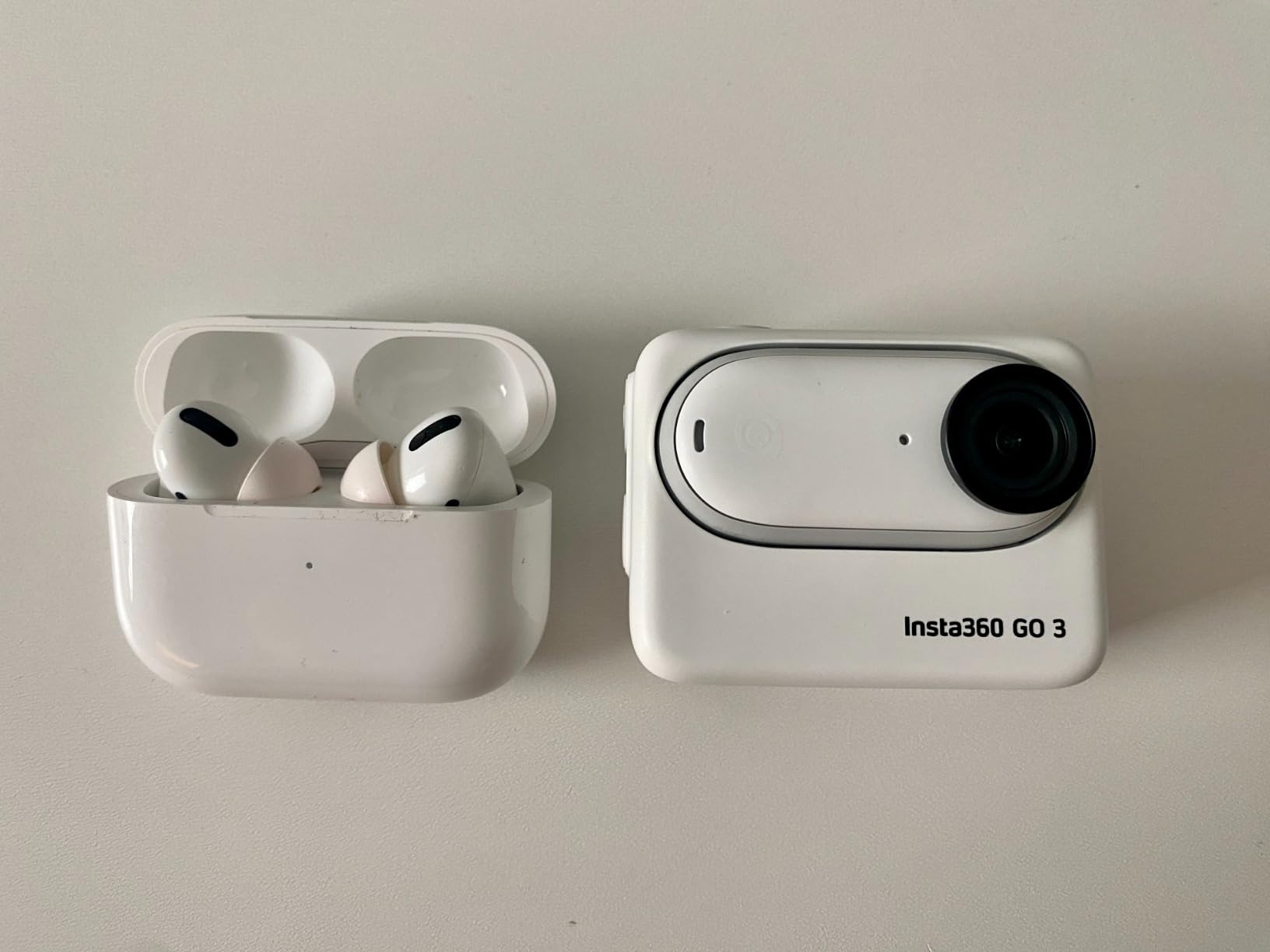
The Insta360 GO 3 is the predecessor to the GO 3S and remains an excellent value for pilots who want ultra-light recording without paying for the 4K upgrade. At 35 grams for the camera module, it is the lightest full-featured action camera on this list. The 2.7K resolution is still sharp enough for social media and YouTube, and the FlowState stabilization does an admirable job with FPV footage.
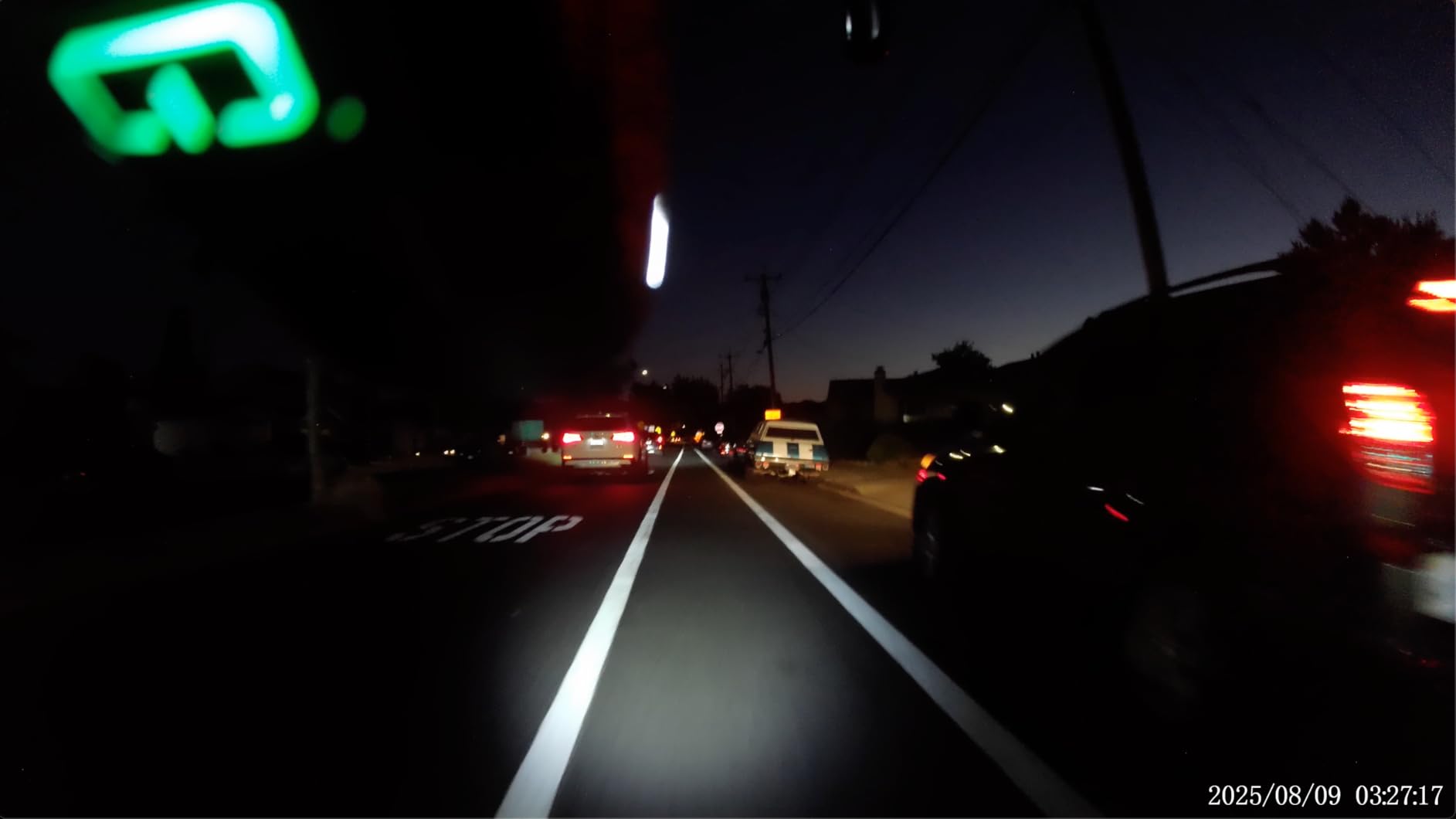
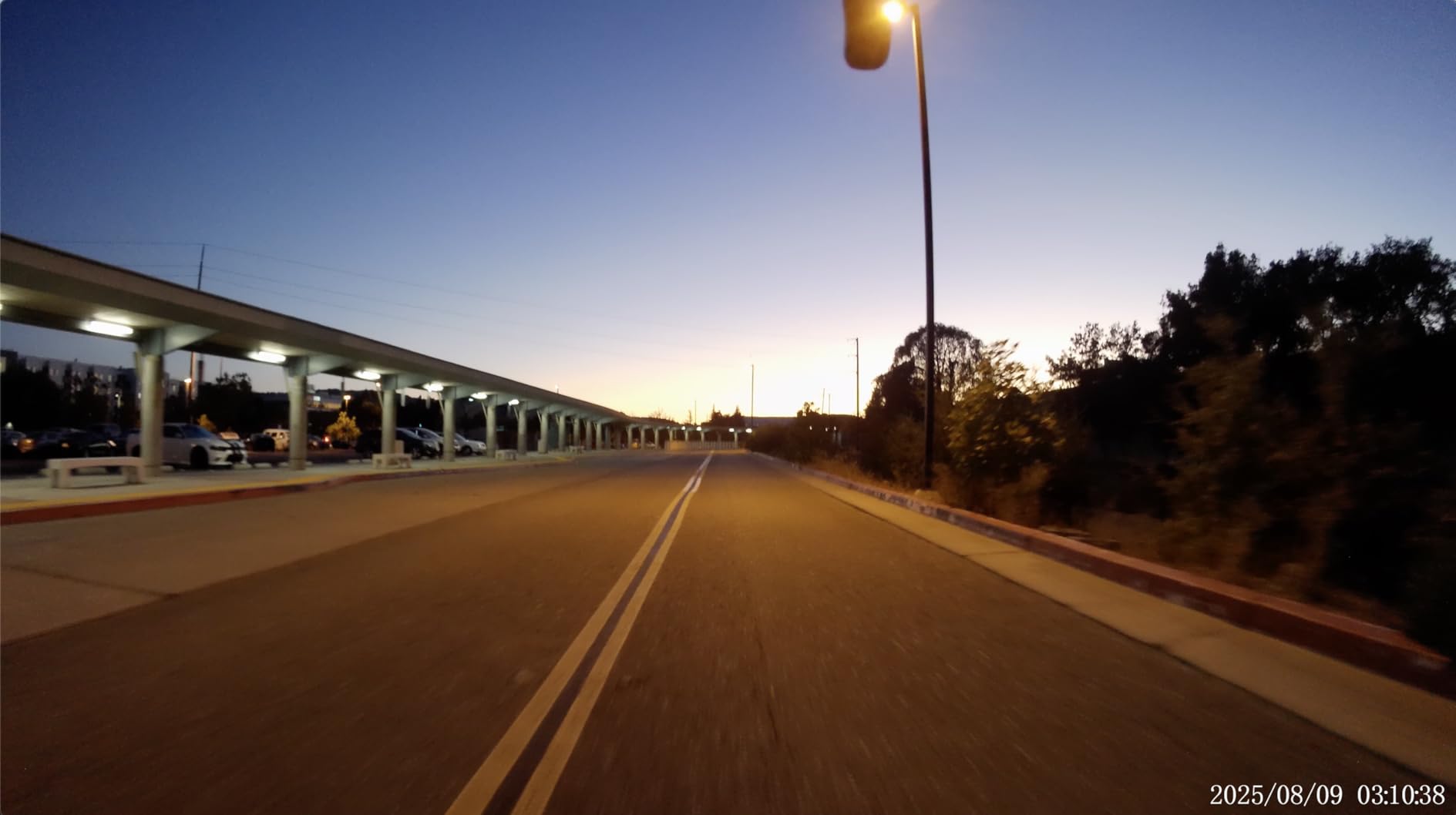
I flew the GO 3 on a 3-inch cinewhoop through an abandoned warehouse and the footage was smooth, detailed, and had a unique immersive quality. The magnetic mounting system let me try angles I would never attempt with a heavier camera, including a side-mount that captured the prop wash in a creative way.
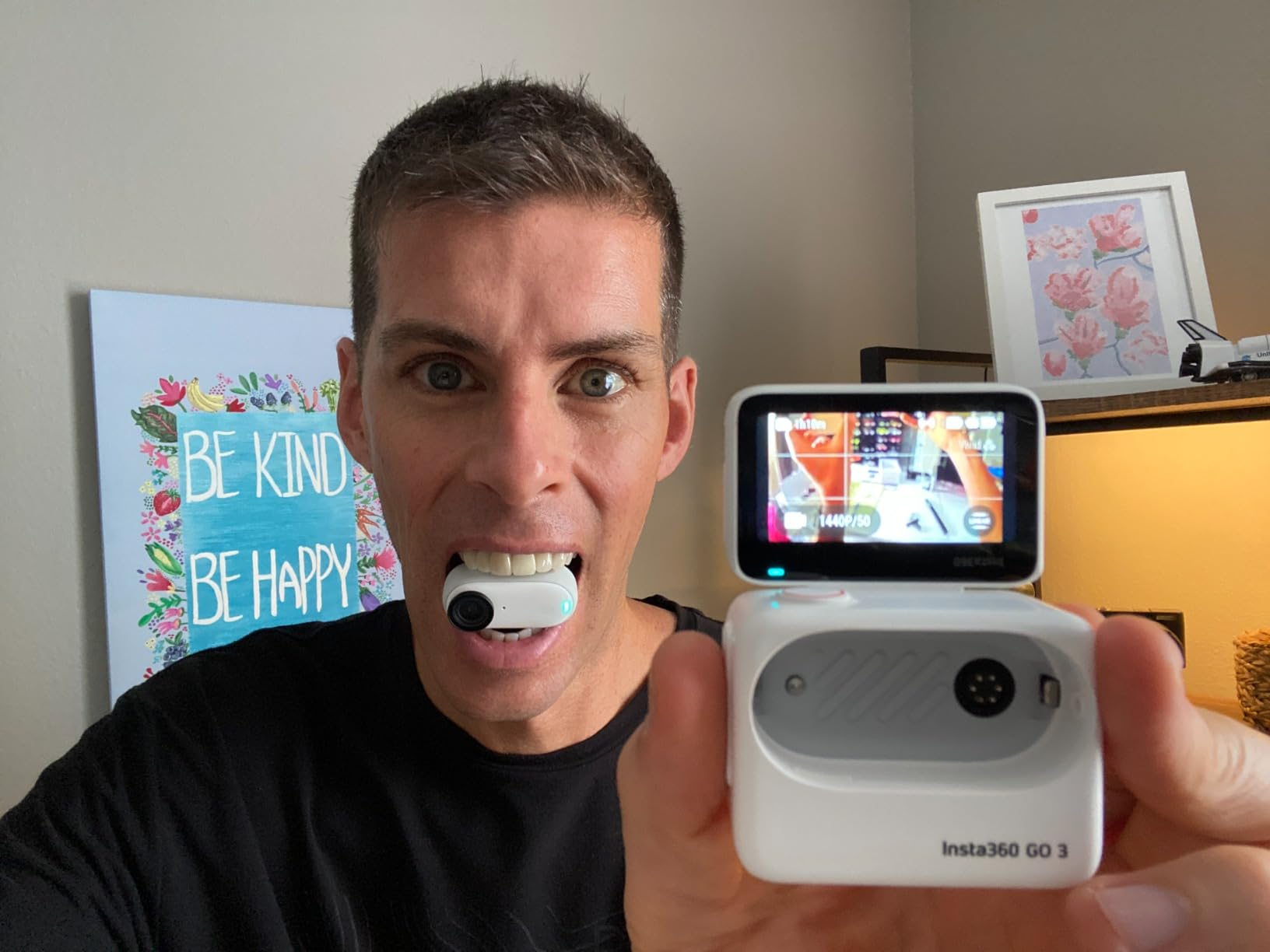
The FreeFrame mode is an underrated feature for FPV. It records in a format that lets you reframe between horizontal and vertical in post-production without quality loss. For pilots who post to both YouTube (16:9) and Instagram or TikTok (9:16), this saves time and gives you two deliverables from one flight.
Battery life with the Action Pod reaches 170 minutes, which is plenty for a full FPV session. The camera module alone runs about 30 minutes, but since FPV flights are short, this works out fine. I kept the Action Pod connected to a power bank in my field bag for recharging between flights.
GO 3 vs GO 3S Decision
The main difference is resolution: the GO 3 shoots 2.7K while the GO 3S shoots 4K. If you primarily post to social media where 4K is often compressed anyway, the GO 3 saves you money with nearly identical features. If you crop heavily, stabilize in post, or want maximum detail for larger screens, the GO 3S is worth the upgrade.
AI Editing Workflow
The Insta360 app includes AI-powered editing that automatically selects highlights and creates ready-to-share clips. For FPV pilots who do not enjoy manual editing, this is a fast way to get footage posted. The AI detects motion, speed changes, and interesting moments from your flight logs and assembles them into a highlight reel.
9. RunCam 6 4K FPV Action Camera – Best Versatile FPV Camera
RunCam 6 4K FPV Action Camera, Mini HD Video Cam with WiFi EIS&GyroFlow HDMI PWM Supported for RC Plane Airplane Rocket RC Car FPV Drone Airsoft Outdoor Sports-Option 1
4K Ultra HD
Gyroflow+EIS
WiFi+HDMI
155 degree FOV
Removable Battery
LED Display
Pros
- 4K Ultra HD video quality
- Built-in Wi-Fi and HDMI output
- Dual stabilization with EIS and Gyroflow
- Compact and lightweight design
- Removable battery
- LED display for real-time feedback
Cons
- Stabilization effectiveness questioned by some users
- Random recording stops on vehicles
- Can overheat in certain conditions
- GyroFlow sync issues reported
The RunCam 6 sits between the purpose-built Thumb 2 and the mainstream action cameras like GoPro and DJI. It offers full 4K recording, WiFi connectivity, HDMI output, and a removable battery in a compact FPV-friendly form factor. I tested this camera on my 4-inch long-range build and found it to be a solid option for pilots who want more features than the Thumb 2 without the weight of a full-size action camera.
The dual stabilization system offers both in-camera EIS and Gyroflow support. I tested both approaches and found Gyroflow post-processing produced smoother results for aggressive flights, while EIS was fine for cruising and cinematic shots. The ability to choose gives you flexibility depending on your flying style and post-production workflow.
The HDMI output is a unique feature that sets the RunCam 6 apart. You can connect it directly to an HD monitor or goggles with HDMI input for real-time video preview. This is useful for framing shots on the ground before takeoff, or for using the RunCam 6 as a ground-based monitoring camera during group flying sessions.
The 155-degree wide viewing angle captures an immersive perspective similar to what you see through your FPV goggles. This makes the footage feel authentic to the flying experience. The removable battery means you can carry spares for long sessions, which is an advantage over cameras with sealed batteries like the Insta360 GO series.
Known Issues to Watch For
Some users report random recording stops when the camera is subjected to heavy vibration, which is a concern for FPV use. I experienced this once during a hard crash, but not during normal flight. Using a high-quality, high-speed microSD card (V30 or better) helps prevent this issue. Also, Gyroflow sync can occasionally drift on longer clips, requiring manual alignment in post.
Best Applications Beyond FPV
The RunCam 6 is marketed for RC planes, rockets, cars, and airsoft in addition to FPV drones. If you participate in multiple RC hobbies, this camera is versatile enough to move between platforms. The adjustable FOV settings and multiple exposure modes make it adaptable to different recording scenarios.
10. AKASO EK7000 Pro – Best Budget Action Camera for FPV
AKASO EK7000 Pro 4K30fps Action Camera with Touch Screen EIS 131ft Waterproof Underwater Camera Remote Control 5X Zoom with Helmet Accessories Kit (Standalone)
4K 30fps
20MP
EIS
61g
131ft Waterproof
2 Batteries Included
Accessories Kit
Pros
- Excellent value for money
- 4K 30fps recording
- Only 61 grams with full body
- Waterproof to 131ft
- Comes with extensive accessories kit
- 2 rechargeable batteries included
- Remote control included
Cons
- Fisheye lens distortion
- Audio lacks noise cancellation
- Does not work in cold temperatures
- Touch screen not functional underwater
- SD card not included
- 30fps max at 4K
The AKASO EK7000 Pro is the camera I recommend to every new FPV pilot who asks “what is the cheapest camera I can put on my drone?” At this price point, nothing else comes close in terms of included accessories, build quality, and community support. With over 10,000 reviews and a 4.5-star average, this is one of the most purchased action cameras on the market.
I tested the EK7000 Pro on my 5-inch freestyle quad and was honestly surprised by the footage quality. The 4K30 resolution is not as sharp as the GoPro’s 5.3K60, but for social media and casual sharing, it is more than adequate. The EIS stabilization helped smooth out minor vibrations, though I still needed Gyroflow for truly clean results from aggressive flights.
At 61 grams, this is one of the lightest full-body action cameras available. That weight savings makes it suitable for 3.5-inch builds where a 150g GoPro would be too heavy. I flew it on a 3.5-inch cinewhoop and the handling was noticeably better than with my heavier cameras. For pilots building their first cinewhoop on a budget, this is an excellent starting point.
The included accessories kit is a major value add. You get mounts, straps, tethers, and adapters that would cost $30 to $50 separately. The two 1350mAh batteries give you roughly 140 minutes of recording each, which is enough for a full session of flying. The remote control is handy for starting and stopping recording without reaching for the camera on your drone.
Limitations to Expect
This is a budget camera and it shows in certain areas. The fisheye lens distortion is significant, though correctable in post with lens correction profiles. Low-light performance is poor compared to the DJI cameras with their larger sensors. The EIS is basic compared to HyperSmooth or RockSteady, so plan on using Gyroflow for anything beyond gentle cruising flights.
SD Card Requirements
The EK7000 Pro does not include a microSD card, so budget for a Class 10, UHS-I, U3 card of at least 64GB. A 64GB card holds roughly 90 minutes of 4K30 footage. I recommend buying from a reputable brand like SanDisk or Samsung, as cheap cards can cause recording errors and data loss, which is devastating after a great flight session.
Buying Guide: How to Choose the Best Action Camera for FPV Drones
Choosing the right action camera for your FPV drone comes down to understanding your specific needs. After testing all 10 cameras on this list across multiple drone platforms, here is my framework for making the right decision.
Weight and Drone Compatibility
Weight is the single most important factor for FPV cameras, more than any spec on a box. Every gram on your drone affects flight time, responsiveness, and PID tuning. Here is a rough compatibility guide based on my testing across different drone sizes:
For micro drones and tiny whoops (65mm to 85mm), you need a camera under 40g. The RunCam Thumb 2 at 27g and the Insta360 GO 3S camera module at 39g are your best options. Anything heavier will overwhelm small motors and kill your flight time.
For toothpick and 2.5 to 3.5-inch builds, aim for under 65g. The AKASO EK7000 Pro at 61g, the Insta360 GO series, and the RunCam Thumb 2 all work well. You can push to 120g with the DJI Osmo Nano on a 3.5-inch if your motors and battery can handle it.
For 5-inch freestyle quads and larger cinewhoops, anything up to 160g works fine. This opens up the GoPro HERO13 (157g), DJI Osmo Action 5 Pro (146g), and DJI Osmo Action 4 (145g). These builds have the power to carry full-size action cameras without significant performance penalties.
Stabilization Technology Compared
Stabilization is non-negotiable for FPV footage. Without it, your videos will be a jello-filled mess from motor vibrations and flight oscillations. Here is how the main stabilization technologies compare based on my real-world testing:
HyperSmooth (GoPro) is the industry benchmark. Versions 5.0 and 6.0 use advanced predictive algorithms and horizon locking to produce gimbal-like smoothness. The Boost setting in HyperSmooth 6.0 can make aggressive freestyle footage look cinematic. It is the strongest in-camera stabilization I have tested.
RockSteady (DJI) is very close to HyperSmooth in quality. RockSteady+ on the Action 4 and Action 5 Pro handles smooth flights beautifully. For the most aggressive freestyle moves, it falls slightly behind HyperSmooth. The 360 HorizonSteady on the Action 5 Pro is outstanding for keeping footage level through rolls and flips.
FlowState (Insta360) works well for the GO series given their tiny form factor. It handles cruising and cinewhoop footage smoothly. For hard freestyle, you will likely need additional Gyroflow processing. The Horizon Lock feature is reliable and easy to use.
Gyroflow is the open-source post-processing alternative. It uses gyroscope data logged during flight to stabilize footage in software. Many pilots prefer Gyroflow over in-camera stabilization because it gives you full control over smoothing strength, framing, and horizon lock. It works with GoPro, DJI, RunCam, and many other cameras. The downside is the extra processing time.
Image Quality and Resolution
Resolution matters but it is not everything. A well-stabilized 4K60 clip from a DJI Action 4 looks better than a shaky 5.3K60 clip from a GoPro that was not mounted properly. That said, here is what I recommend based on your output goals:
For social media (Instagram, TikTok), 4K30 is sufficient since platforms compress heavily anyway. The AKASO EK7000 Pro and Insta360 GO 3 handle this with ease. For YouTube and higher-quality sharing, 4K60 or 4K120 gives you cropping and slow-motion flexibility. The DJI Action 4 and Action 5 Pro excel here.
For professional or commercial work, 5.3K60 from the GoPro HERO12 or HERO13 provides maximum detail and grading flexibility. The 10-bit color and Log profiles give you the most control in post-production. If footage quality is your livelihood, the GoPro remains the top choice.
Frame Rate Options
Higher frame rates let you create smooth slow-motion footage, which is popular in FPV videos. The standard for cinematic FPV is 60fps, which gives you 2.5x slow motion at 24fps timeline. For maximum slow motion, 120fps gives you 5x slowdown. The DJI Action 4 and Action 5 Pro both support 4K120, which is the best combination of resolution and frame rate on this list.
Remember that higher frame rates require more light. At 120fps, your shutter speed is extremely fast, which means you need bright conditions or wider aperture. ND filters become even more important at high frame rates to maintain proper motion blur.
Battery Life and Power Solutions
FPV sessions typically involve multiple short flights with battery swaps. Your camera battery needs to last through a full session. The DJI Osmo Action 5 Pro leads the pack with 240 minutes of battery life. The DJI Osmo Action 4 offers 160 minutes, and the AKASO EK7000 Pro includes two batteries rated at 140 minutes each.
For cameras with short battery life, consider external power solutions. The RunCam Thumb 2 is designed for this, drawing 5V directly from your drone. You can also modify other cameras to accept external power, though this voids warranties. A USB-C power bank in your field kit is the simplest solution for recharging between flights.
Budget vs Premium Value Analysis
The price range on this list spans from the AKASO EK7000 Pro to the GoPro HERO13 Black. Here is my value assessment based on extensive testing:
Under $100, the AKASO EK7000 Pro is the only camera worth considering. It gives you 4K30, EIS, accessories, and two batteries at a price that cannot be beaten. For first-time FPV pilots or backup camera duty, it is outstanding value.
In the $100 to $200 range, the RunCam Thumb 2 and RunCam 6 are purpose-built FPV cameras that offer excellent weight-to-performance ratios. The Thumb 2 is unmatched for micro drones, while the RunCam 6 adds WiFi and HDMI for more versatility.
In the $200 to $400 range, the DJI Osmo Action 4 is the value champion. It delivers 90 percent of the performance of cameras costing $100 to $200 more. The GoPro HERO12 occupies a similar value position for pilots who prefer the GoPro ecosystem.
Above $400, the GoPro HERO13 Black and DJI Osmo Action 5 Pro represent the premium tier. Both deliver best-in-class performance in their respective strengths. The HERO13 wins on resolution and lens ecosystem. The Action 5 Pro wins on battery life, thermal management, and low-light performance.
FAQs
Which camera is best for an FPV drone?
The DJI Osmo Action 5 Pro is the best overall action camera for FPV drones, offering excellent 4K120fps video quality, 360 HorizonSteady stabilization, a 1/1.3-inch sensor for strong low-light performance, and an impressive 4-hour battery life. For budget-conscious pilots, the AKASO EK7000 Pro delivers solid 4K30 footage at a fraction of the cost. For micro drones, the 27g RunCam Thumb 2 is purpose-built and unbeatable for weight.
Is flying FPV alone illegal?
Flying FPV alone is legal in most countries including the US, but you must follow local drone regulations. In the US under FAA rules, recreational FPV pilots need to pass the TRUST test, register drones over 250g, fly below 400 feet in uncontrolled airspace, and maintain visual line of sight. Some areas restrict FPV flights that use video goggles without a visual observer present, so check your local laws.
Can you use a GoPro for FPV?
Yes, GoPro cameras are widely used for FPV recording. The GoPro HERO12 and HERO13 Black are two of the most popular FPV action cameras thanks to their HyperSmooth stabilization, 5.3K video quality, and 360 Horizon Lock feature. Many FPV pilots also strip GoPros down to a naked version by removing the screen and battery to save 40-50 grams for lighter drone builds.
Is the DJI or GoPro better?
For FPV use, DJI offers better value and battery life while GoPro offers superior resolution and lens options. The DJI Osmo Action 5 Pro and Action 4 provide 4K120fps, excellent low-light performance from their 1/1.3-inch sensors, longer battery life, and better thermal management. The GoPro HERO13 Black offers higher 5.3K60 resolution, the HB-Series lens system, and the strongest in-camera stabilization with HyperSmooth 6.0. Choose DJI for value and endurance, GoPro for maximum image quality.
Conclusion
Finding the best action cameras for FPV drones comes down to matching the camera to your drone and your flying style. After months of testing all 10 cameras on this list across tiny whoops, cinewhoops, and 5-inch freestyle quads, my top recommendation is the DJI Osmo Action 5 Pro for its unmatched balance of image quality, battery life, and stabilization. The GoPro HERO13 Black takes the crown for pure image quality, while the AKASO EK7000 Pro proves you do not need to spend a lot to start recording your flights.
For micro drone pilots, the RunCam Thumb 2 and Insta360 GO 3S open up recording possibilities on platforms that simply cannot lift heavier cameras. And the DJI Osmo Action 4 remains the best value in FPV, delivering near-premium performance at a mid-range price.
Whatever camera you choose in 2026, remember that the best footage comes from a well-mounted camera with proper ND filters and good lighting. Invest time in your mounting solution, learn Gyroflow for post-processing, and focus on flying smooth lines. The camera is just the tool that captures your skills as a pilot.