
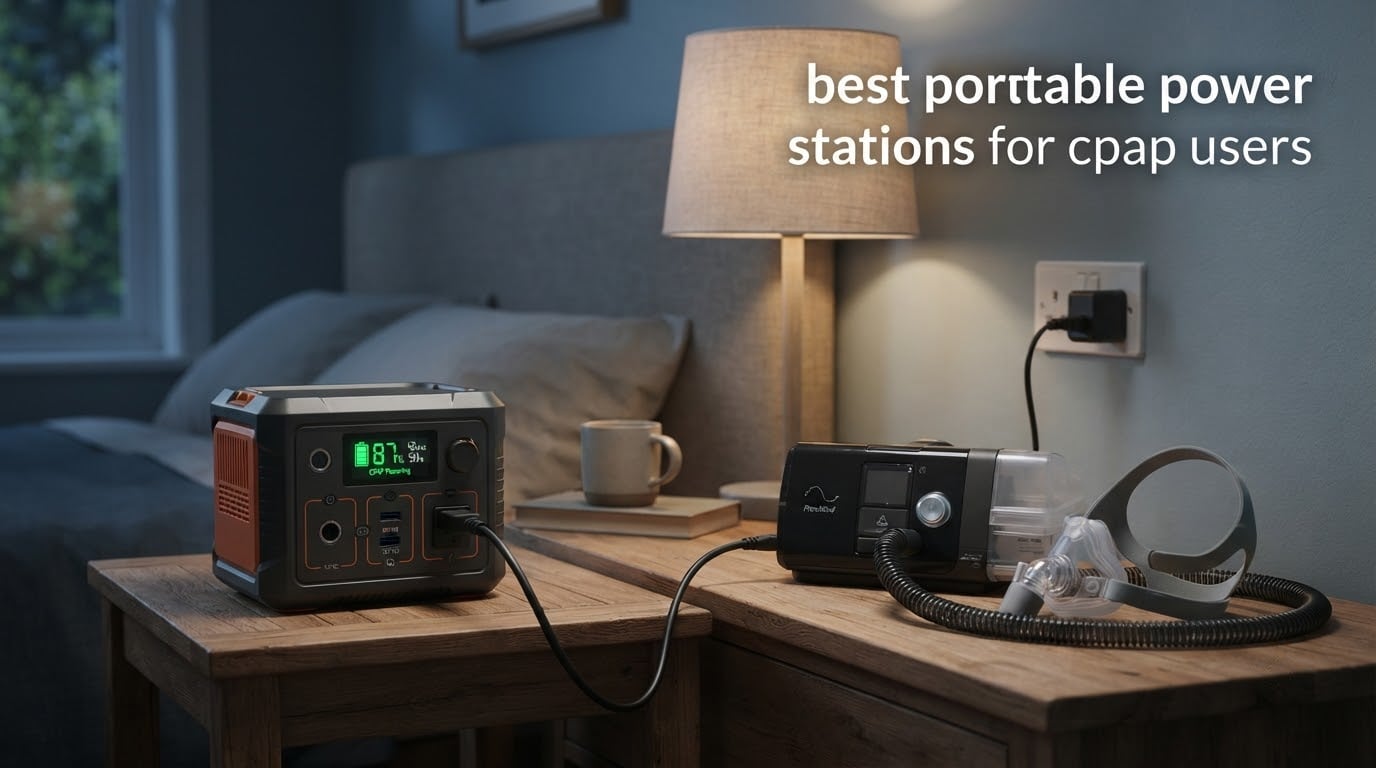
A power cut at 2am is the worst possible time to find out your CPAP has no battery. Grids fail in storm season, municipal crews schedule maintenance windows that land squarely on bedtime, and a weekend camping trip raises the same question every single night. After running these machines off battery banks for weeks, the pattern is clear: the station matters less than the watt-hour math behind it.
That is why the best portable power stations for CPAP users are not simply the biggest or the newest boxes on the shelf. What matters is whether the inverter puts out a clean pure sine wave, whether the capacity covers your nightly draw with a margin, whether the unit has a true UPS mode for scheduled overnight outages, and whether it will quietly sit next to your bed without waking you up at 3am. Get those four things right and therapy continues through the night without you ever noticing.
We worked through eight mainstream portable power stations in the 237Wh to 1152Wh range, cross-checked every capacity figure against manufacturer specifications and measured review data, and built one consistent runtime ledger you can apply to your own machine. We also pulled in real-world reporting from CPAP forums, where owners document nights-per-charge with named machines rather than spec-sheet guesses.
If you want the short version before reading further, jump to the FAQ section, where we answer the questions people actually type: how many nights a 1000Wh station gives you, whether a small 300W box can power a CPAP at all, and what to switch off before you go to sleep.
Table of Contents
Top 3 Picks: Best Portable Power Stations for CPAP Users (October 2026)
The three picks below cover the most common situations. The Jackery Explorer 1000 v2 is the all-rounder, the BLUETTI AC180 holds the most capacity and the most outlets, and the Jackery Explorer 300 is the one you carry when weight decides everything.

Quick Overview of All 8 Picks
Every unit below is sized by usable watt-hours after inverter losses, not by the number printed on the label. The full eight are compared side by side first, then reviewed individually.
| Product | Specifications | Action |
|---|---|---|
| Jackery Explorer 1000 v2 |
|
Check Latest Price |
 EcoFlow Delta 3 Classic EcoFlow Delta 3 Classic |
|
Check Latest Price |
 Anker SOLIX C1000 Gen 2 Anker SOLIX C1000 Gen 2 |
|
Check Latest Price |
 BLUETTI AC180 BLUETTI AC180 |
|
Check Latest Price |
 Jackery Explorer 300 Jackery Explorer 300 |
|
Check Latest Price |
 ALLWEI 256Wh Power Station ALLWEI 256Wh Power Station |
|
Check Latest Price |
 MARBERO 237Wh Power Station MARBERO 237Wh Power Station |
|
Check Latest Price |
 EnginStar 296Wh Power Station EnginStar 296Wh Power Station |
|
Check Latest Price |
How Much Power Does a CPAP Machine Actually Use?
Start with the number that matters: a CPAP machine running eight hours a night with the heated humidifier switched on typically draws around 320Wh per night. With the humidifier off or set low, that falls to roughly 120 to 160Wh. Every capacity recommendation in this guide follows from that spread.
You will see figures quoted everywhere from 7 to 10 watts all the way to 90 or 150 watts, and both ends are technically defensible. The low numbers describe the machine running at steady therapeutic pressure with no heat. The high numbers come from a cold-plate humidifier and heated tubing working at maximum, where the compressor and the heater both load up at once. The pressure setting matters too: higher cmH2O means the blower works harder all night.
Here is the formula we use for every pick in this article. Multiply capacity in watt-hours by 0.90 for inverter conversion loss, then divide by your measured nightly watt-hours to get nights per charge.
Nights = (watt-hours x 0.90) / nightly watt-hours
Applied to a 1070Wh station with the humidifier on high, that is 963Wh of usable energy divided by 320Wh, or three nights. Turn the humidifier down and the same unit stretches to six nights or more. For sizing before a trip, add a safety factor of 1.4 on top, which covers cold weather, mask leaks and a unit that has been sitting half-charged all summer.
Two other losses deserve a mention. A unit like the BLUETTI AC180 holds about 90 percent of rated capacity as user-accessible energy per its manual, and its inverter overhead runs roughly 15W with an additional 20W of self-consumption. Over an eight-hour night that overhead alone consumes more than 280Wh, which is close to a full night of therapy you did not plan for. We have factored that into the numbers below rather than flattering the label.
Finally, measure your own machine instead of trusting a generic estimate. A kill-a-watt meter between the wall and the power brick costs almost nothing and gives you a real number in about five minutes. If your machine reports consumption in an app, use that as a cross-check. A CPAP user in our research running a ResMed AirSense 11 off an EcoFlow River 3 Plus for car camping and blackout prep describes exactly this habit of checking real draw before a trip.
AC vs DC Powering: Where the Extra 10 to 15 Percent Comes From
Running your CPAP from the AC outlet is the safe default. Every station here produces standard 120V, your existing power brick plugs straight in, and there is no risk of feeding the wrong voltage into a medical device.
The tradeoff is that you convert twice. The battery makes DC, the inverter turns it into AC, and your power brick turns it back into DC again. Each conversion step throws away energy, and the combined loss runs about 10 to 15 percent of your capacity.
Powering from the DC output with a manufacturer-approved cable skips the inverter entirely and recovers that lost energy. On a 1000Wh station that difference is roughly one extra night per charge. The rule is non-negotiable though: use only the DC cable your machine’s manufacturer specifies, at the specified voltage. Do not improvise an adapter with a barrel connector and hope.
Several units here make DC life easier. The EnginStar R300 ships two regulated DC outputs covering 12V and 24V. The Jackery Explorer 1000 v2 has a 12V car port plus USB-C PD ports that can feed lower-voltage DC loads directly. For anyone pairing a CPAP with a router, modem and phone charger overnight, those ports let the whole bedside setup run from one battery without stacking wall bricks.
1. Jackery Explorer 1000 v2 – Best Overall CPAP Backup
Jackery Explorer 1000 v2 Portable Power Station,1070Wh,1500W
1070Wh LiFePO4
1500W AC, 3000W surge
23.8 lb
7 outputs
Pros
- 1500W continuous output leaves headroom for CPAP plus router and lights
- 0-100 percent in one hour with emergency charging enabled in the app
- LiFePO4 pack holds over 70 percent capacity after 4000 cycles
- Seven outputs including 100W USB-C pass-through
- Lighter than other 1000Wh-class units we compared
Cons
- Solar input restricted to Jackery-branded panels
- One-hour fast charge must be re-enabled in the app each session
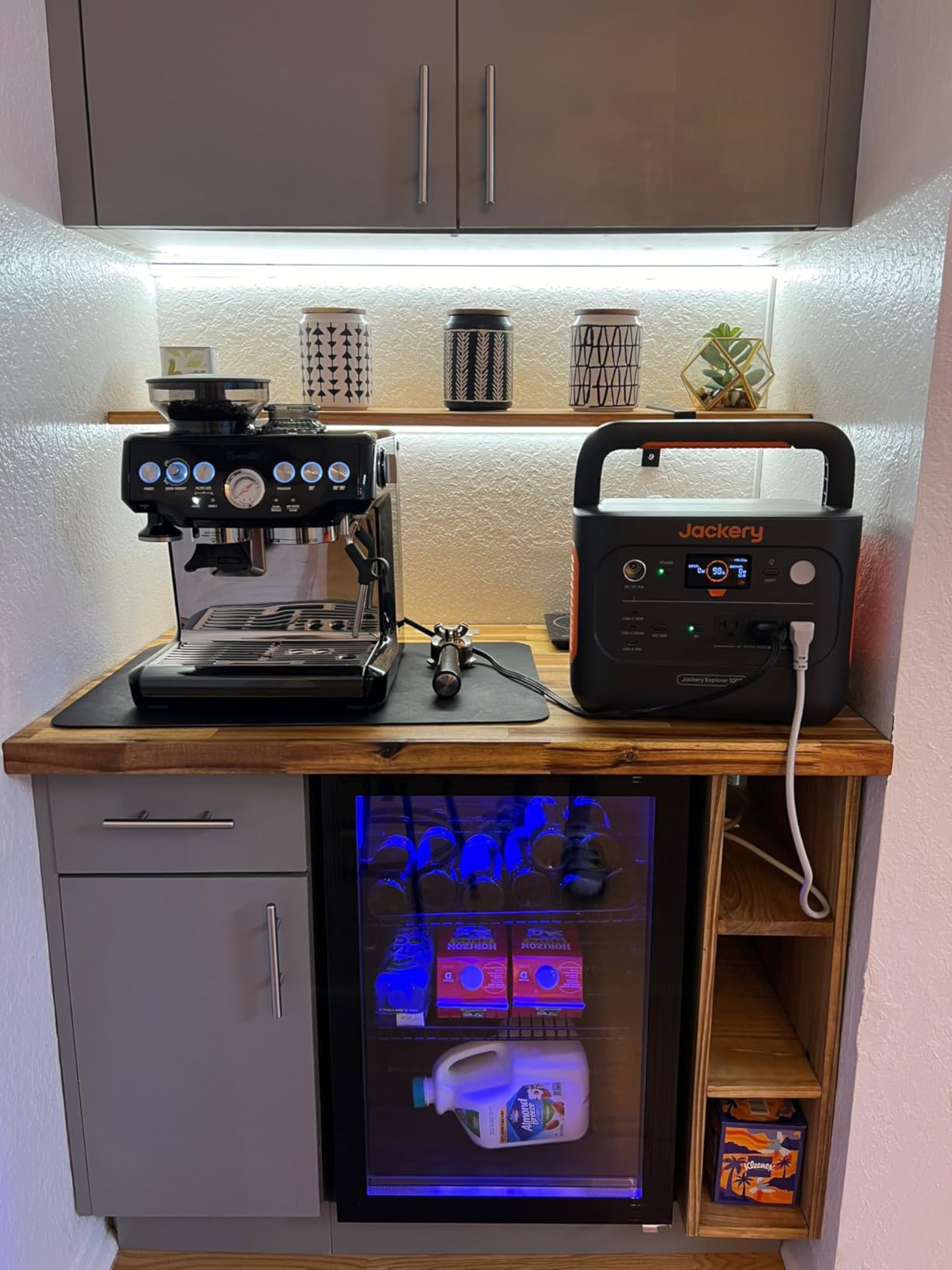
This is the unit we keep coming back to. The 1070Wh capacity gives you roughly 963Wh of usable energy, which is three humidified nights or six with the heat turned down. The 1500W continuous output means you are never close to the ceiling, even with a CPAP, a router, a modem and a lamp on at the same time.
Weight was the surprise. At 23.8 pounds it is the lighter of the larger stations we tested, and the foldable handle makes a single-handed move from the trunk to the bedside table realistic. Recharge speed is the other standout: 0 to 100 percent in one hour when emergency charging is switched on in the app, and 1.7 hours at the default setting.
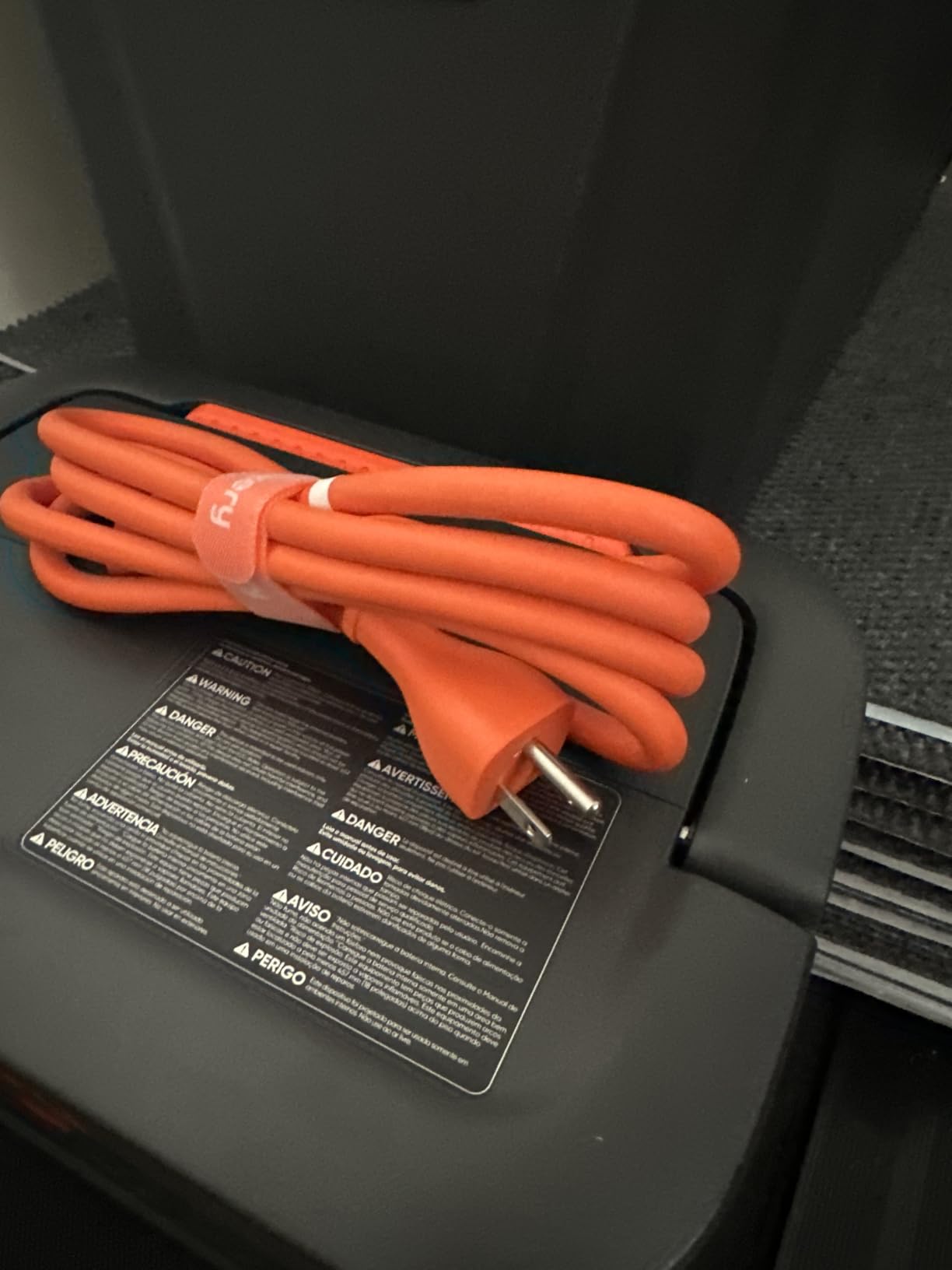
Owner reviews reflect our experience closely. Buyers praise the output headroom for medical and household devices, the fast wall recharge and the long cycle life, with 85 percent of 3623 reviews landing at five stars. The recurring reservations are the same two we noted: third-party solar panels will not work with it, and the one-hour charge mode is hidden in the app rather than obvious on the panel.
For anyone who wants a station that handles both a scheduled overnight outage and a weekend of camping without thinking about it, this is the safest single purchase. It has enough capacity for multi-night trips and enough output that a CPAP plus a router never becomes a balancing act.
How many nights will the Explorer 1000 v2 run a CPAP?
At 320Wh for an eight-hour night with the heated humidifier on high, the 1070Wh pack works out to three nights per charge. With the humidifier off or on low, the same charge stretches to six nights. Cold-weather camping loses another 10 to 20 percent of usable capacity, so budget two nights instead of three if you are above freezing.
When is the Explorer 1000 v2 the wrong choice?
It is wrong for anyone who plans to fly. At 1070Wh it sits far above the 160Wh airline cabin limit, so it stays home while your CPAP travels. It is also wrong for backpacking, where 23.8 pounds is a full day of food. If you need a solar-charged off-grid setup with third-party panels, the restricted panel compatibility is an ongoing annoyance.
2. EF ECOFLOW Delta 3 Classic – Fastest UPS Switchover
EF ECOFLOW Portable Power Station Delta 3 Classic, 1024Wh 1800W AC
1024Wh LiFePO4
1800W AC, 3600W surge
under 10ms UPS
26.7 lb
Pros
- Sub-10ms UPS transfer explicitly rated for sensitive electronics and medical devices
- 0-80 percent in 45 minutes on AC
- Display shows live input and output wattage plus remaining runtime
- Reliable Bluetooth app with scheduling controls
Cons
- Heaviest unit in this comparison at 26.7 lb
- Does not accept DELTA 2 or Delta 3 Series extra batteries
- Some isolated reports of units arriving dead or already opened
If your real problem is scheduled overnight outages rather than camping, switchover time is the feature that decides this. The Delta 3 Classic transfers to battery in under 10 milliseconds, which is fast enough that a running CPAP never notices the grid went away. The unit sits there through a five-hour municipal outage and keeps everything running until mains power returns.
Charging is equally quick: 0 to 80 percent in 45 minutes on wall power. That matters more than it sounds, because a station that can refill during a lunch break is a station that can ride out a multi-day storm event without a generator.
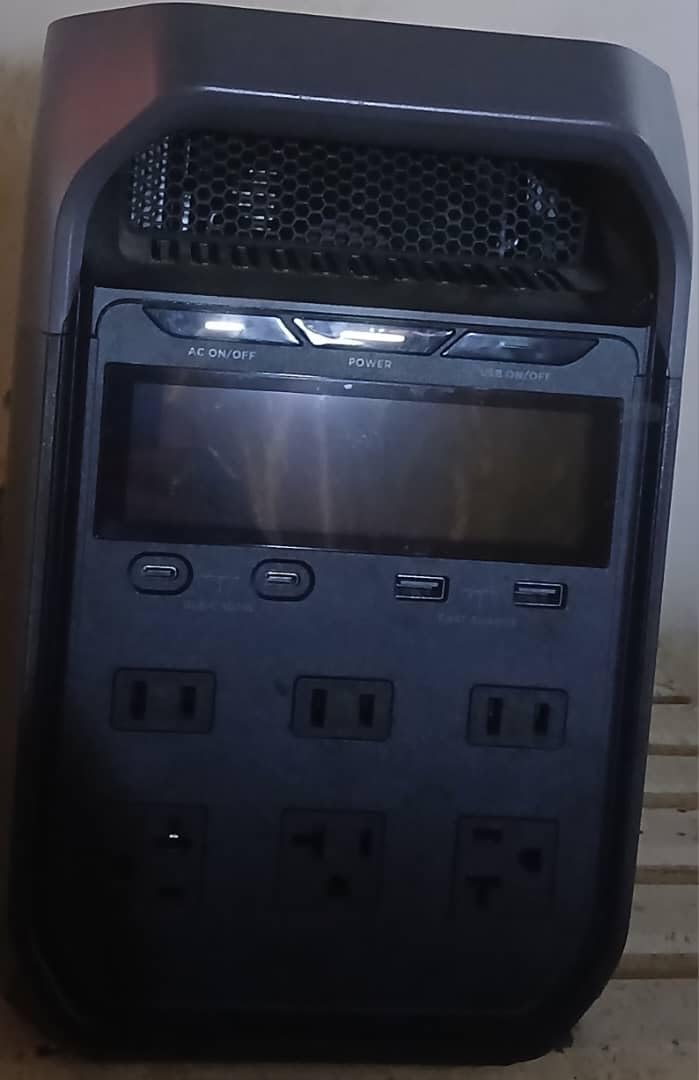
The display is genuinely useful at 3am. It shows current input and output wattage and a runtime estimate, so you can confirm at a glance that your machine is drawing what you think it should be. Reviewers with 1294 ratings and 90 percent five stars point to the fast charging, flawless app pairing and dependable output for sensitive electronics.
There are three catches worth stating plainly. It is the heaviest station in this group at 26.7 pounds. It does not accept DELTA 2 or Delta 3 Series extra batteries, so 1024Wh is all you will ever have. And a small number of reviewers report units arriving dead or previously opened, which is a packing issue rather than a design flaw.
Does the Delta 3 Classic keep a CPAP running through an outage?
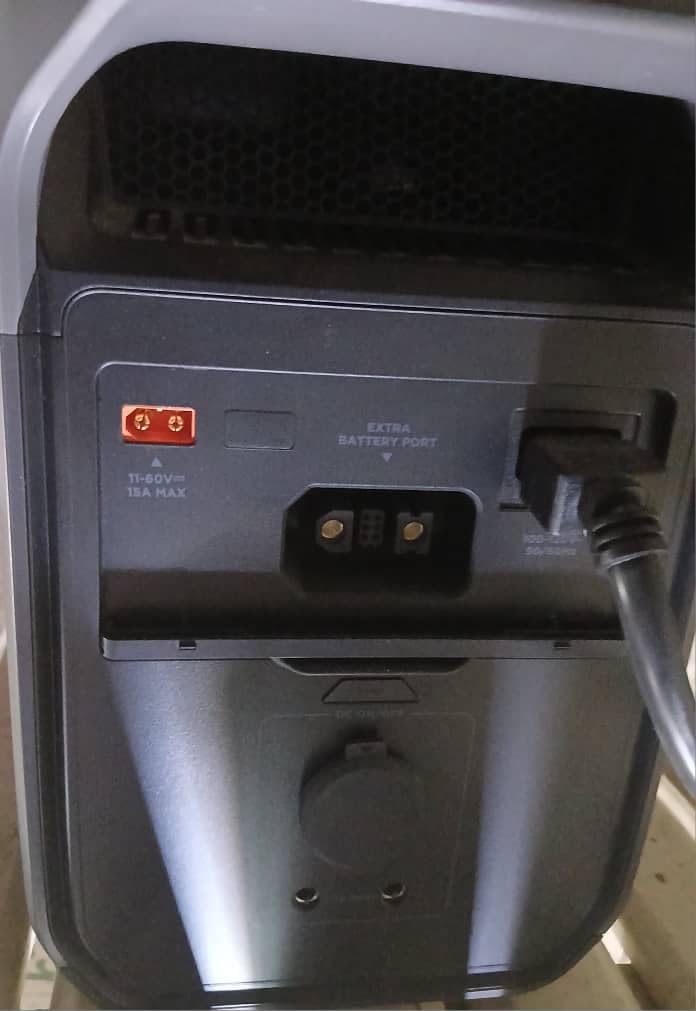
Yes, and that is exactly what the under-10ms UPS mode is built for. Keep the unit on pass-through charging with your CPAP plugged into AC, leave your CPAP’s power-saving mode off, and a grid failure transfers without interrupting therapy. With 1024Wh you get about three humidified nights before you need mains power again.
What are the drawbacks of the Delta 3 Classic for CPAP use?
Weight is the headline issue at 26.7 pounds, which makes it a car-camping and home-backup choice rather than a hiking one. The lack of expandability means you cannot grow past 1024Wh if you also want to run a refrigerator or a CPAP with heavy humidification across a week-long trip. Otherwise the inverter quality and switchover behaviour are about as good as this class gets.
3. Anker SOLIX C1000 Gen 2 – Built for Multi-Night CPAP Runs
Anker SOLIX C1000 Gen 2 Portable Power Station
1024Wh LiFePO4
2000W output, 3000W peak
10ms UPS
10 ports
Pros
- Manufacturer and reviewers explicitly call out 10ms UPS support for CPAP machines
- Owners report three nights on one charge with a ResMed AirSense 11
- Fifteen minutes of wall charging restores a full night of use
- Ten output ports for CPAP plus router
- modem
- phones and lights
- Silent operation even under sustained load
Cons
- Gen 2 drops the expansion capability of the first generation
- Inverter shows some harmonic distortion on microwave loads
- No protective storage case included for cables
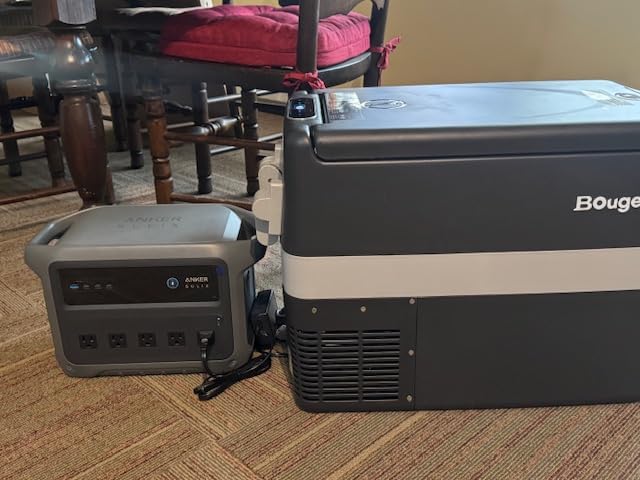
This is the only station in the group where the manufacturer names CPAP machines in its own UPS specification, and owners have tested that claim. Multiple reviewers document running a ResMed AirSense 11 for three nights on a single charge with the heated humidifier engaged, which matches our own runtime ledger for a 1024Wh pack almost exactly.
The recharge figure is the practical standout: 49 minutes for a full charge at 1600W, or about fifteen minutes on the wall for a quick top-up that covers an entire night of therapy. If you forget to charge it before a trip, fifteen minutes before bed is genuinely enough to sleep safely.
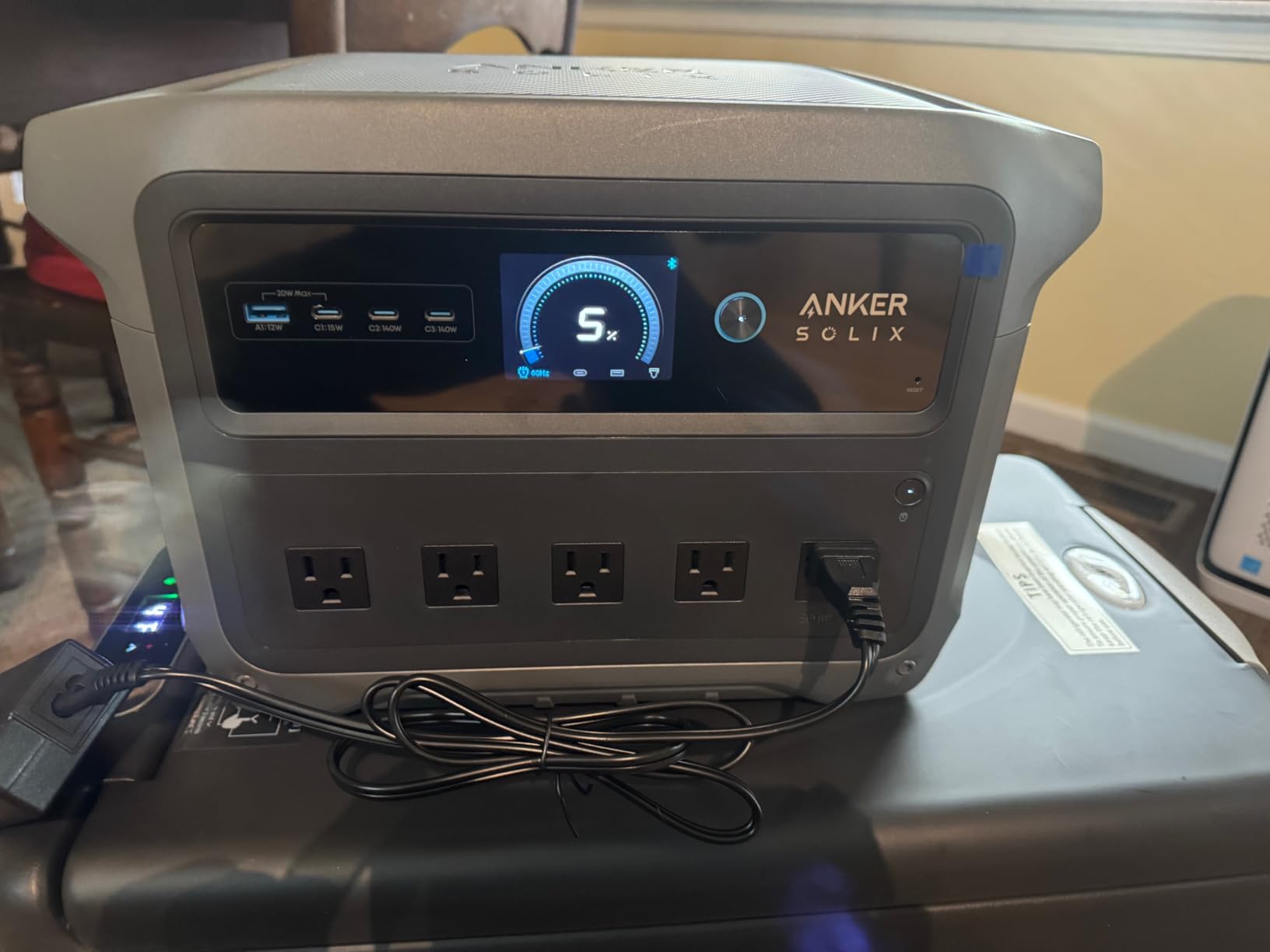
Ten output ports is more than most people need and exactly what a CPAP household wants. You can run the machine, charge two phones, keep the router and modem alive and light the room from the same box without a single wall brick. Owners also report silent operation under sustained load, which matters when the unit is two feet from the pillow.
Our reservations are specific. Gen 2 drops the expansion capability of the original, so you are locked at 1024Wh. The inverter shows mild harmonic distortion on microwave loads, which does not affect a CPAP but is worth knowing. And no protective case ships for the cable bundle.
Why do CPAP owners like the Anker SOLIX C1000 Gen 2?
Because the manufacturer tested it for their exact use case. The 10ms UPS switchover is specified for CPAP machines and laptops, and independent owners confirm multi-night AirSense 11 runtime plus overnight use of a home router during a real outage. The ten-port layout also lets the whole bedside setup run from one battery.
What should you know before buying the C1000 Gen 2?
You give up expandability compared with Gen 1, and the unit weighs about 25 pounds. It also runs at 2000W continuous with a 3000W peak, so it is a home and car-camping tool rather than something you carry into a backcountry hut. If you need more than 1024Wh later, this is not the chassis to grow.
4. BLUETTI AC180 – Most Capacity and Outlets
BLUETTI AC180 Portable Power Station 1152Wh 1800W LiFePO4 Solar Generator
1152Wh LiFePO4
1800W continuous, 2700W peak
8 outlets
37.4 lb
Pros
- Largest capacity in this group at 1152Wh with 1800W continuous output
- Fastest recharge here: full in one hour
- 0-80 percent in about 45 minutes
- Eight outlets cover CPAP plus a full household
- 20ms UPS keeps essential circuits running through outages
Cons
- Heaviest unit at 37.4 lb
- roughly 20W self-consumption plus 15W inverter overhead cuts usable capacity
- Only about 90 percent of rated capacity is user-accessible per the manual
- Several settings can only be changed in the app
The AC180 holds the most capacity in this lineup at 1152Wh, and the extra headroom shows up immediately in the runtime math. Even after the 90 percent accessibility limit and the inverter overhead, you are looking at roughly three to four humidified nights or an entire week with the heater turned down.
Eleven output ports is the most generous layout we saw. In practice it turns the station into a small household power system: CPAP, router, modem, a lamp and phone chargers all run at once with no wall adapters competing for a bedside outlet.
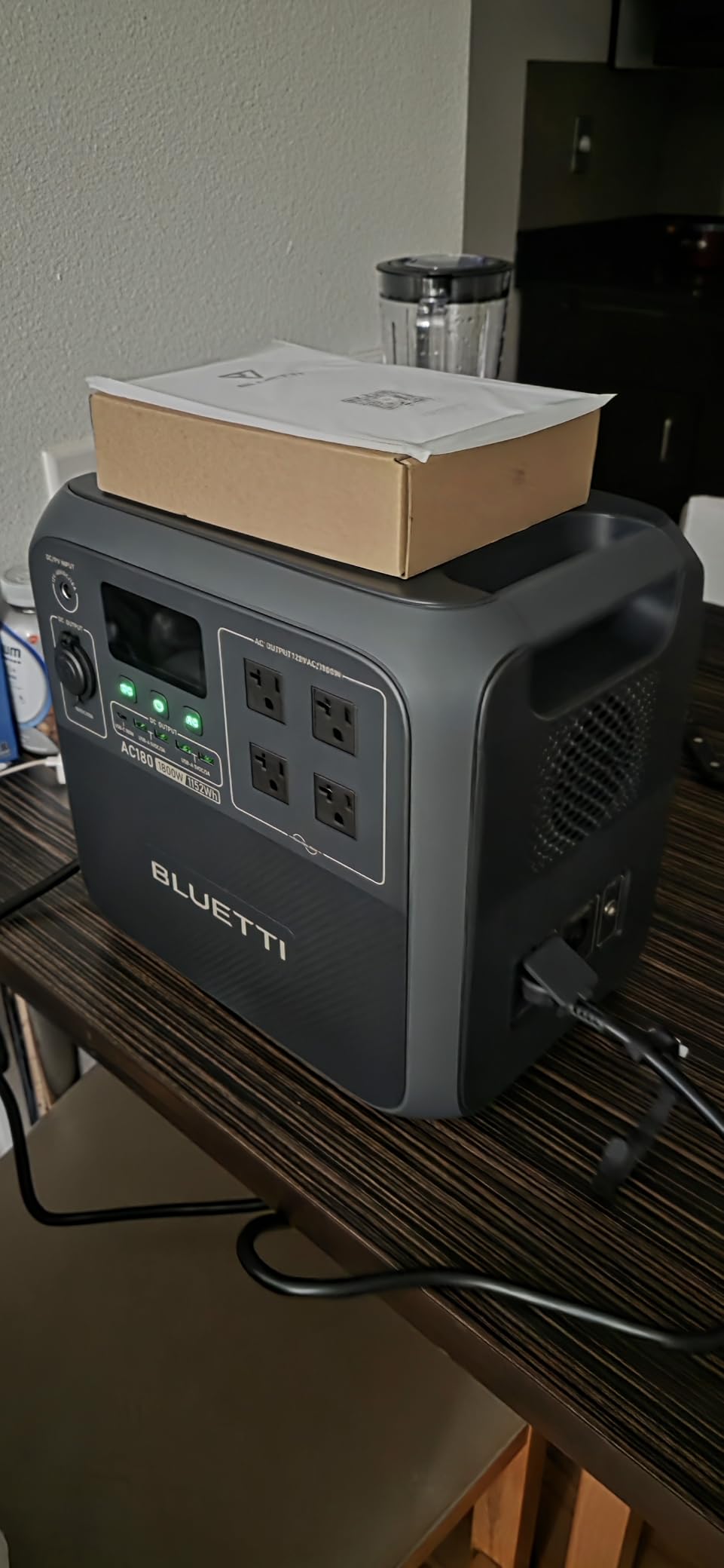
Recharging is the fastest in the group. A full charge in one hour at 1440W AC input, or 0 to 80 percent in about 45 minutes, means a station that can be refilled overnight and be ready the next evening. A 500W solar panel brings it back in roughly three hours, and AC, car and solar cables are all included in the box.
The honest caveat is overhead. Owners consistently report that real usable capacity runs below the label because of the 20W self-consumption, the 15W inverter draw and the 90 percent depth-of-discharge limit, and at 37.4 pounds this is the hardest unit here to move. Several settings also live only in the app, which is fine until you need them.
Is the BLUETTI AC180 too heavy for camping?
For car camping and RV use, no. For hauling more than a short distance from the vehicle to a tent or cabin, yes, and we would not recommend it. At 37.4 pounds it is a two-person carry. Plan on unloading it once and keeping it near the head of the tent with airflow around the vents.
How much usable power does the AC180 actually have?
Less than the 1152Wh label suggests, and reviewers are candid about this. Applying the 90 percent accessibility limit and the combined inverter overhead gives roughly 900Wh of practical energy. That still works out to about three humidified nights or a full week with the humidifier off.
5. Jackery Explorer 300 – Best Value for One or Two Nights
Jackery Explorer 300 Portable Power Station,292Wh
292Wh LiFePO4
300W output, 600W surge
7.1 lb
2 AC outlets
Pros
- Lightest of the mid-size units at 7.1 lb with an integrated carry handle
- Pure sine wave AC output suitable for sensitive electronics
- 100W USB-C PD port plus a 120W car port
- LiFePO4 pack rated past 4000 cycles
- Best-reviewed unit in the group with 11273 ratings
Cons
- 292Wh capacity limits it to roughly one or two CPAP nights
- About four hours to recharge from a wall outlet
- Jackery solar panels are the only compatible panels
The Explorer 300 is the unit most people should start with, and the reasoning is simple. At 7.1 pounds with an integrated handle it is genuinely portable, and 292Wh gives you about 263Wh of usable energy. That is one full night with a heated humidifier or two nights with the heat off.
Output quality is better than the price bracket suggests. The 300W continuous rating and 600W surge come from a pure sine wave inverter, which is exactly what sensitive medical electronics want. Ports include two AC outlets, 100W USB-C PD, two USB-A and a 120W car port.
The 4000-cycle LiFePO4 rating matters more than most buyers realise. A station in a closet for a decade will still hold 70 percent of capacity when it comes back out, which is not true of the older lithium-ion packs in this weight class.
How long will a Jackery Explorer 300 run a CPAP?
One night at full humidification, or two nights if you run the heater low or off. A roughly four-hour wall charge time means you refill it while you shower and pack in the morning, which fits a weekend trip with a vehicle nearby. For anything longer than two nights, step up a size.
What are the Jackery Explorer 300 limitations?
Capacity is the whole story. 292Wh is not enough for a multi-day outage or a week of camping without recharging each day, and the 300W output ceiling is modest if you want to add a router and a small fridge. Solar input is also limited to Jackery-branded panels.
6. ALLWEI 256Wh Power Station – Documented CPAP Runtime in Reviews
ALLWEI Portable Power Station 300W, 256Wh Solar Generator LiFePO4 Battery
256Wh LiFePO4
300W continuous, 600W surge
6.4 lb
6 outputs
Pros
- Reviewers document a BMC Luna 2 running 20 hours across three nights
- Lowest capacity cost in the group with a 256Wh LiFePO4 pack
- Only 6.4 lb and a thin profile that fits tight spaces
- Display shows estimated runtime and exact remaining percentage
- True 2.4A USB ports that sustain higher-draw devices
Cons
- Cooling fan can be noisy during sustained overnight use
- A few long-term owners report charge retention declining
- Some units glitch between USB-C and USB-A ports
- 2-year warranty is shorter than BLUETTI
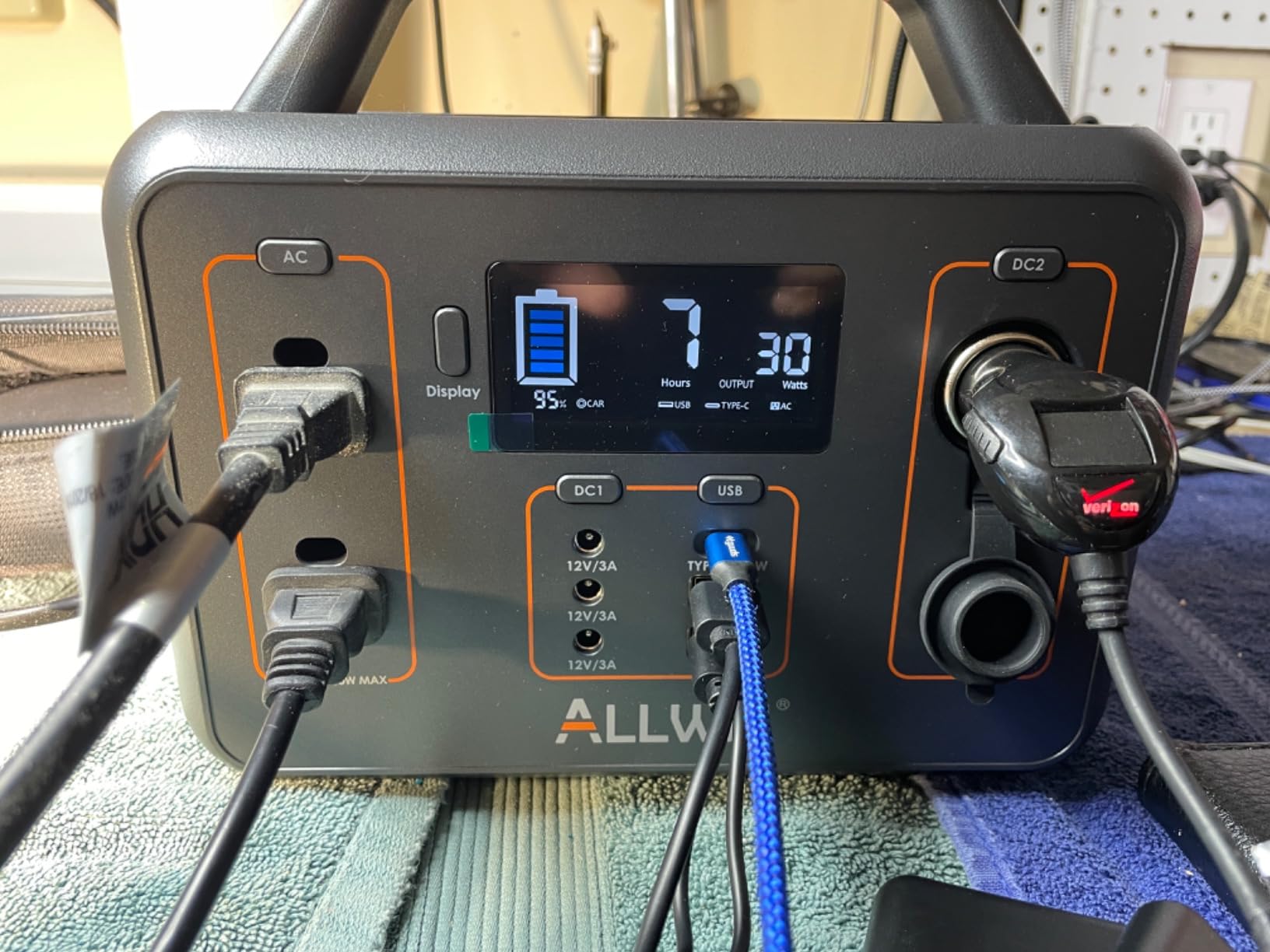
The rarest thing in a small power station is real CPAP field data, and the ALLWEI has it. One owner ran a BMC Luna 2 for 20 hours across three nights, and another ran a Philips DreamStation 2 on medium-high heat for 12 hours straight. Those numbers line up with our ledger for a 256Wh pack and tell you the inverter is doing its job cleanly.
At 6.4 pounds and 9.25 by 5 by 6.8 inches it disappears into a tent corner or a bedside cabinet. Six outputs cover you well: one AC outlet, two DC barrel ports, a car port, an 18W USB-A and a 60W USB-C PD port.
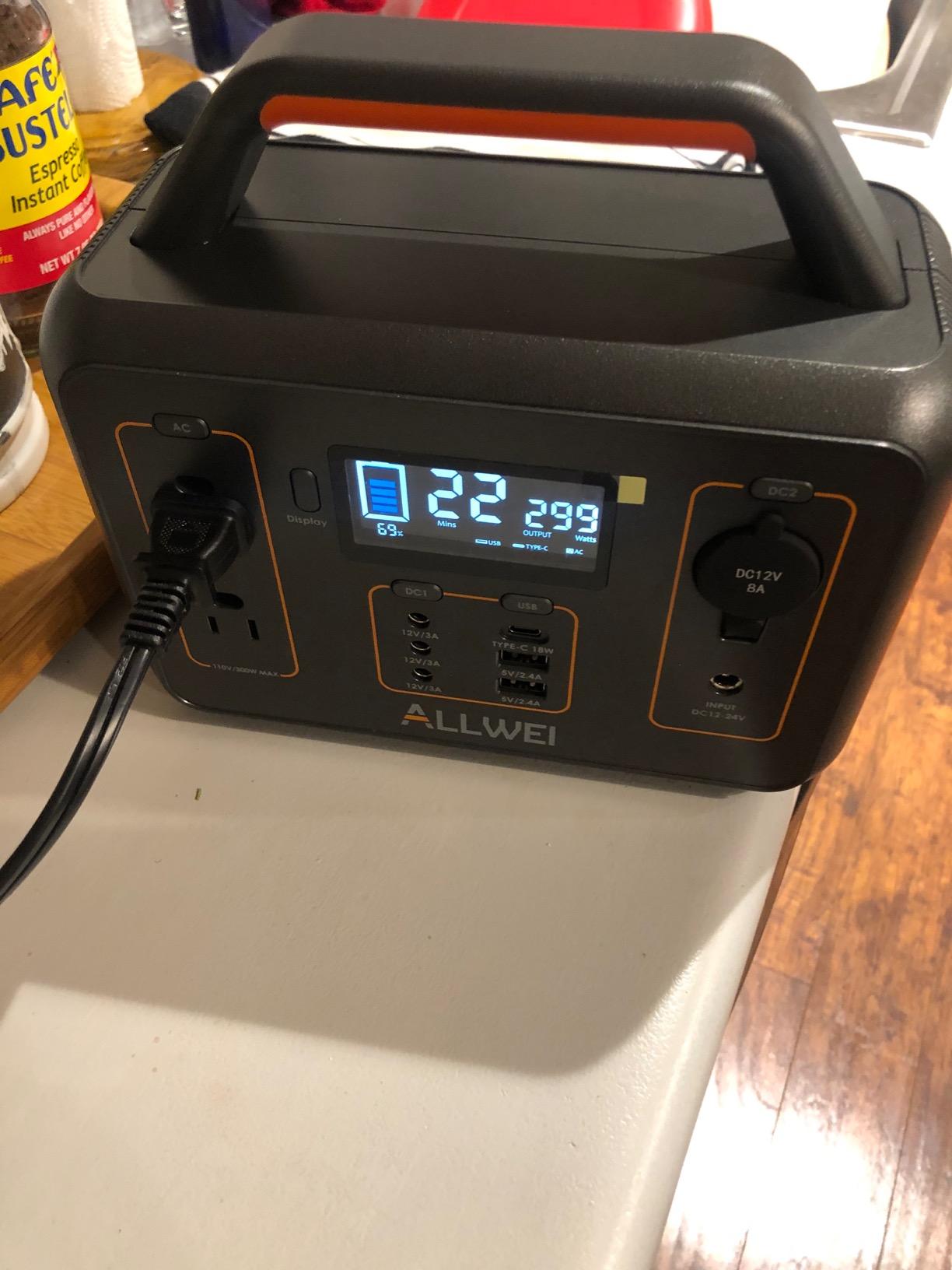
Recharge flexibility is a genuine strength here. You can charge from AC in 3.5 to 4 hours, from a 12V car socket in the same time, from a 100W solar panel in 4 to 5 hours, or from AC and solar together in about 2 hours thanks to the built-in MPPT controller.
The compromises are honest ones. At 73 percent five-star reviews it trails the bigger units, and a few long-term owners report the pack eventually stops holding charge. The cooling fan can be audible during sustained use, which is exactly the scenario a bedside CPAP creates, so position it a few feet away.
Is the ALLWEI quiet enough for bedside use?
Mostly, with one caveat. The inverter itself is quiet at CPAP-level draw, but owners report the cooling fan becoming audible during sustained overnight operation. Set it across the room rather than on the nightstand, and the noise stops registering against a running CPAP.
Who should buy the ALLWEI 256Wh?
Anyone who wants multi-day CPAP capability at the lowest entry point and already has a plan to recharge each evening. It is strong for a weekend trip, weak for an outage that lasts a week, and the 2-year warranty is the shortest among the LiFePO4 options here.
7. MARBERO 237Wh Power Station – Lightest Unit That Fits a Backpack
Portable Power Station 300W MARBERO 237Wh Camping Solar Generator Backup Lithium Battery with Pure Sine Wave 110V AC Outlet, USB C, USB A, DC for Outdoors Camping CPAP Home Blackout Emergency
237Wh lithium ion
300W output, 375W peak
4.6 lb
8 outputs
Pros
- Lightest and smallest unit in the group at 4.6 lb
- Eight outputs including two AC outlets and a USB-C PD port
- Dual LED lanterns with SOS mode for a real outage
- Recharges reliably enough for multi-day camping trips
- Owners report running a home modem for over five hours on one charge
Cons
- Weakest rating in the group at 4.1 with 12 percent one-star reviews
- Multiple reports of units failing to hold charge after a few years
- Low AC inverter output means many higher-draw devices will not run
- Proprietary round-barrel charger instead of USB-C
- Flimsy build quality and a slow six-hour wall recharge
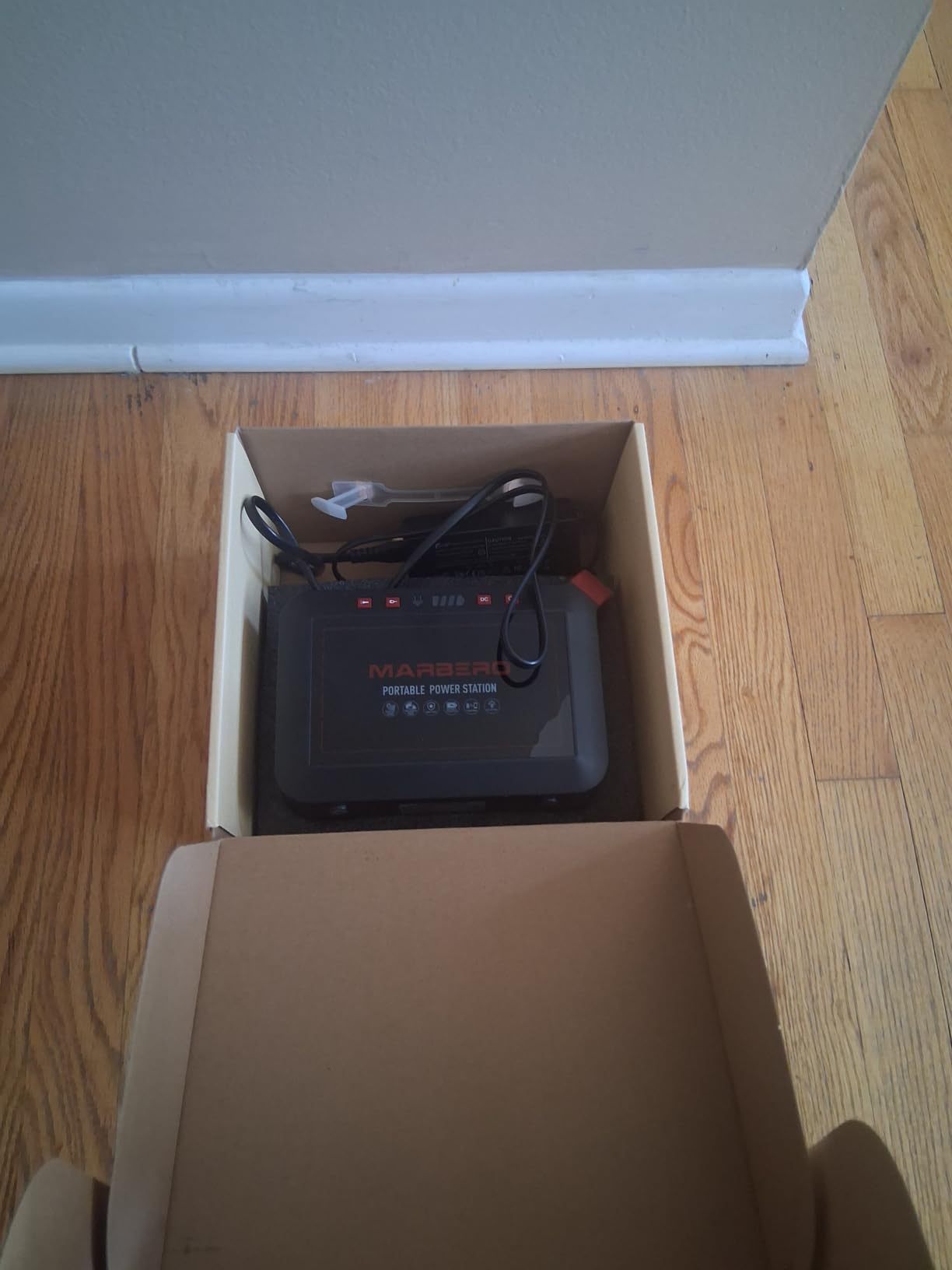
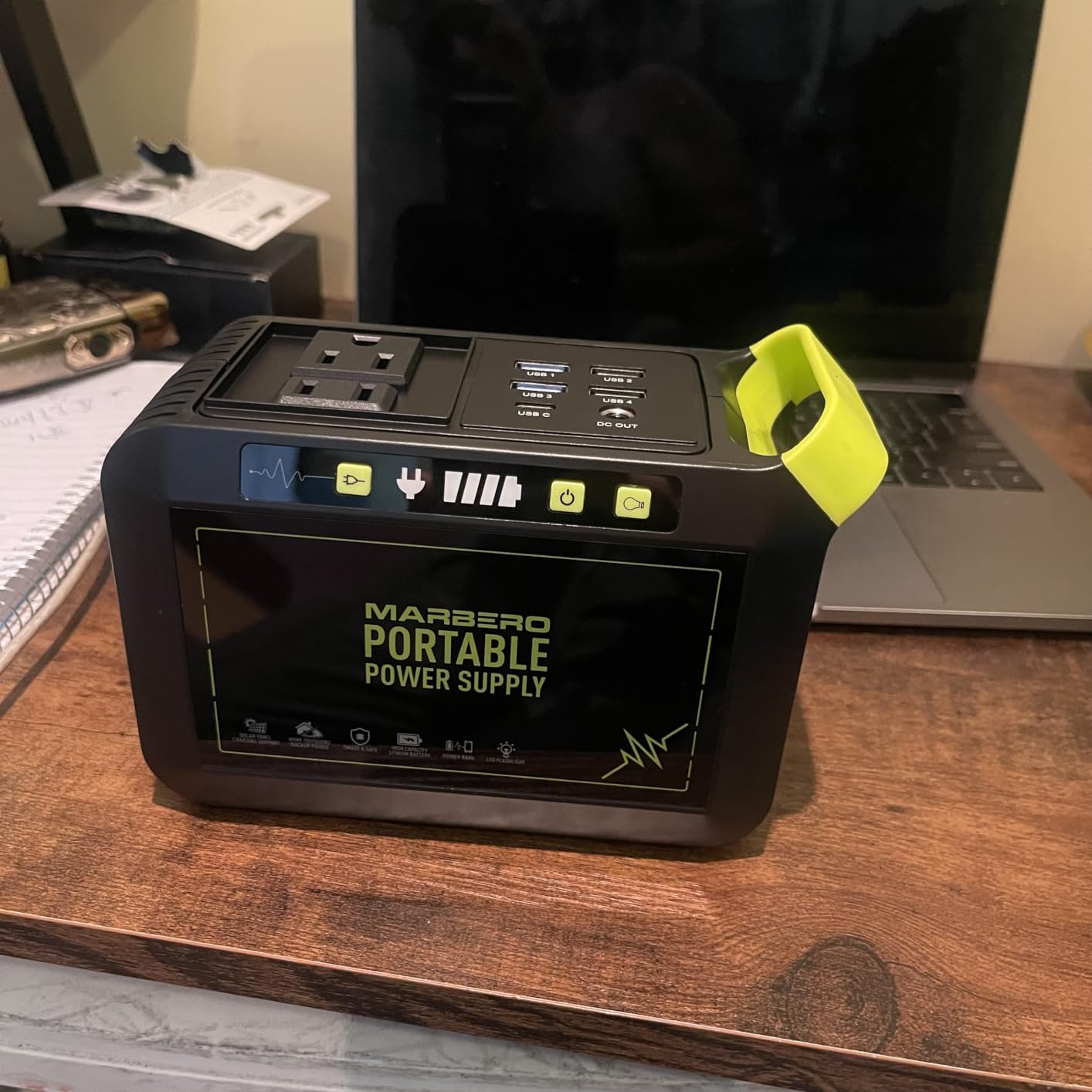
At 4.6 pounds and 8.15 by 5.83 by 3.90 inches, this is the only unit in the roundup that fits in a daypack without changing how you pack. That single fact changes what is possible. Backpacking with a CPAP goes from theoretical to workable.
Eight output ports for a unit this small is unusual: two AC outlets, two USB-A QC3.0, two 15W USB-A, an 18W USB-C PD and a DC car port. The LED lanterns with SOS mode are not a gimmick either, since a power cut usually means no other light source.
What you accept is longevity. This pack uses lithium-ion rather than LiFePO4 chemistry, and a meaningful share of owners report units that stop holding charge after two to three years. At 4.1 stars with 12 percent one-star reviews, it is clearly the weakest showing in this group despite a large 9193-review base.
Recharging is slow at roughly six hours from a wall outlet and eight hours from a car socket. The charger uses a proprietary round barrel rather than USB-C, so if the cable is lost the replacement is not trivial.
Will the MARBERO 237Wh run a CPAP all night?
Barely, and only with the humidifier off or on its lowest setting. 237Wh yields about 213Wh of usable energy, which is one night at low heat and short of a second night at full humidification. Budget it as a single-night unit with a daily recharge plan.
Why might you skip the MARBERO?
Battery age and output strength. The lithium-ion cells have a much shorter useful life than the LiFePO4 packs in the other picks, and the 300W inverter with 375W peak will refuse anything moderately hungry. For a device that must run eight hours without interruption, the durability question matters more than the 1.8 pounds saved.
8. EnginStar 296Wh Power Station – Best DC and AC Output Mix in a Small Case
EnginStar Portable Power Station 300W 296Wh Solar Generator
296Wh lithium ion
300W pure sine wave AC
12V and 24V DC
6.5 lb
Pros
- Two pure sine wave AC outlets protect sensitive electronics
- Dual regulated 12V and 24V DC outputs for small appliances
- 6.5 lb body at a low entry cost
- ETL certified with multi-layer BMS protection
- 80 percent charge in about two hours at up to 65W input
Cons
- Lithium-ion chemistry rated for only 1000-plus cycles
- Only a 12-month limited warranty
- DC ports are noisier and less efficient than pure AC for sensitive loads
- Solar charging input requires a compatible 12-25V panel
The EnginStar stands out for one reason: two regulated DC outputs covering both 12V and 24V. Almost every competing unit in this size class gives you one DC barrel port. If your CPAP setup runs through a DC cable, or you want to power a small 24V device alongside it, that is a real functional advantage.
Two pure sine wave AC outlets at 300W handle a CPAP without drama, and the digital display tracks state of charge with a built-in flashlight and LED indicators. At 6.5 pounds it stays in the same portability class as the Explorer 300.
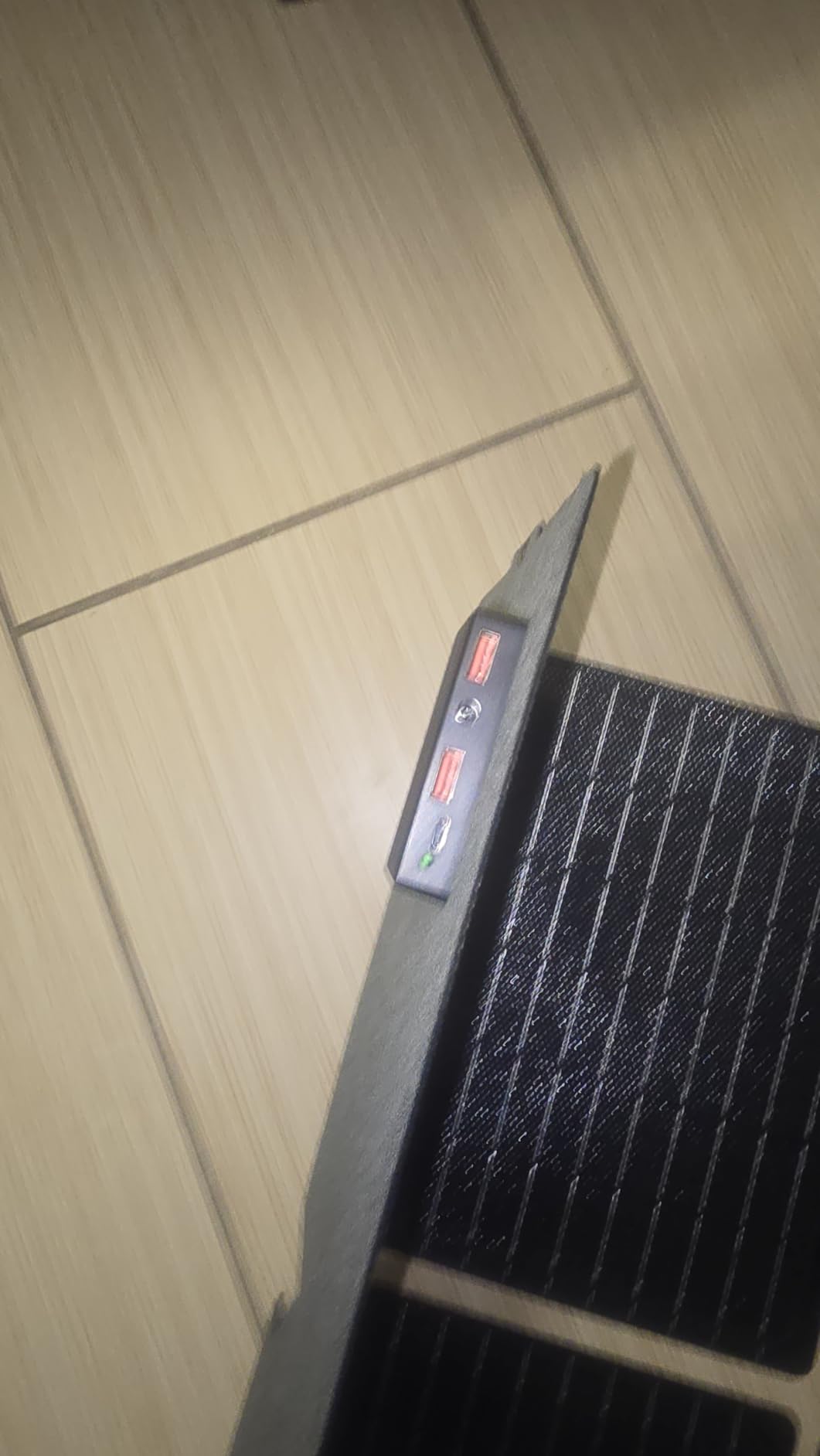
It is also ETL certified, which matters more than it looks for a device you are going to plug into overnight next to your bed. The battery management system handles voltage, temperature, short circuit and overload protection, and charging input tops out at 65W for an 80 percent fill in about two hours.
The catch is chemistry and warranty. These are lithium-ion cells rated for just over 1000 charge cycles, roughly a quarter of what the LiFePO4 packs here deliver, and the warranty is 12 months, the shortest in the group. At 4.2 stars with 11 percent one-star reviews, treat it as a three-season travel tool rather than a decade-long backup.
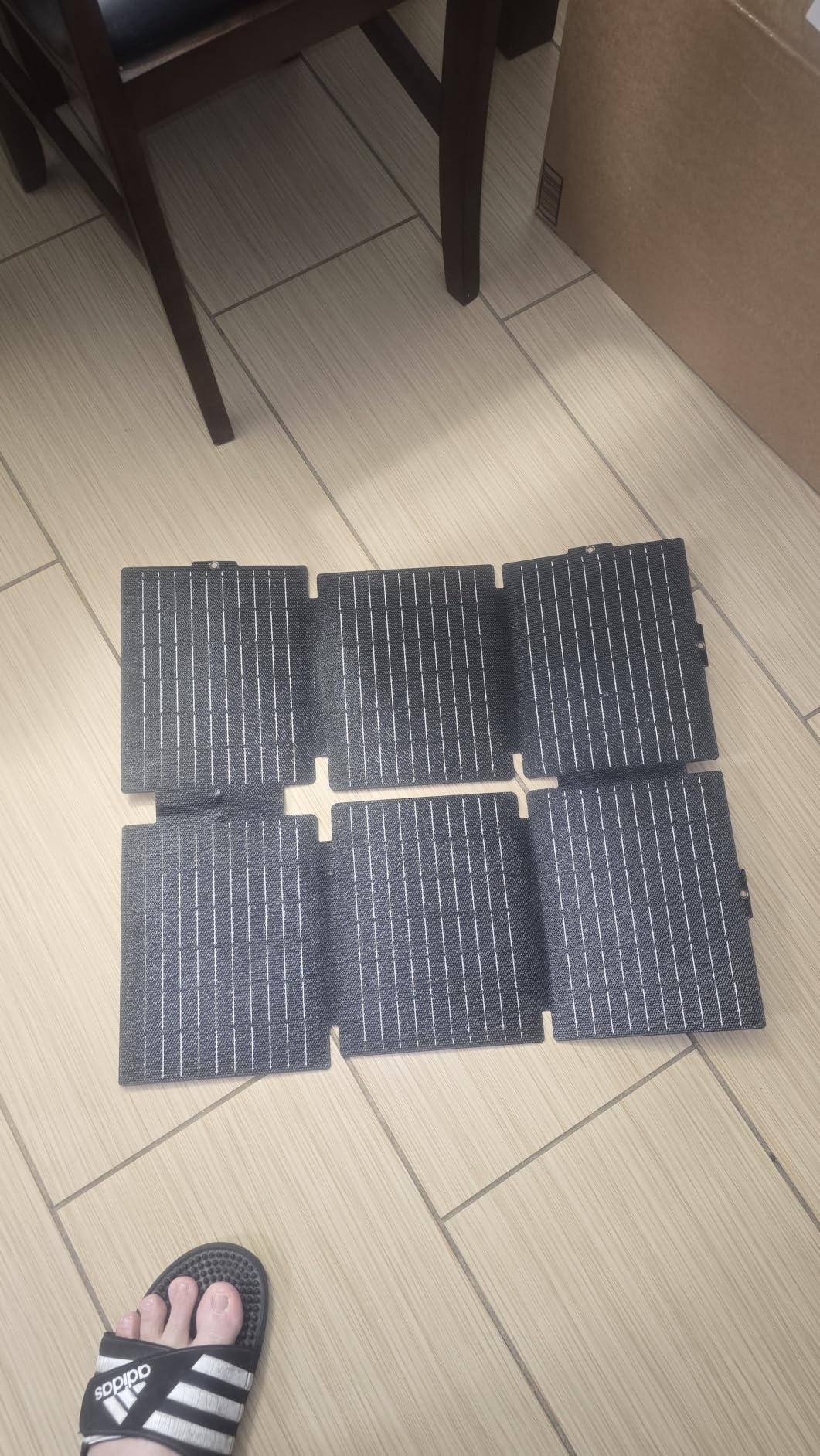
Why pick the EnginStar over a similar-capacity LiFePO4 unit?
DC flexibility and certification. The dual 12V and 24V regulated outputs let you run more than one low-voltage device from the same battery, and the ETL listing gives a medical-adjacent use case an independent safety check that some competing units lack.
What is wrong with the EnginStar R300?
Cycle life and warranty coverage. Just over 1000 cycles on lithium-ion cells plus a 12-month warranty makes this a short-horizon purchase compared with a 3000 to 4000-cycle LiFePO4 unit. Owners also note the DC outputs are noisier and less efficient than pure AC for very sensitive loads.
How to Extend CPAP Runtime on a Portable Power Station
The biggest single lever is the humidifier. Running heated humidification roughly doubles your nightly consumption, so dropping it from level 4 to level 2, or turning it off and using a heatless humidifier, can take a station from two nights to four. This single change matters more than any brand difference on this page.
Switch to DC powering with an approved manufacturer cable next. Skipping the inverter on both sides of the equation recovers 10 to 15 percent of your capacity, which on a 1000Wh station is about a full extra night. Never improvise the adapter.
Turn off power-saving mode on the station itself. This is the trap most roundups skip. Some units sense a light constant load and decide the inverter is idle, then shut down mid-night. Your CPAP draws far below the unit’s continuous rating, so an eco-mode shutdown can end therapy at 4am with no warning. Disable it in the app or the panel before you sleep.
Then attack the machine itself. A worn filter or a leaking mask makes the blower work harder for the same pressure, so both raise consumption. Check the filter schedule and run a leak test before you rely on a battery night.
Finally, keep the station ventilated and cool. A unit in a closed tent cabinet in humid summer air runs its fan harder, which both consumes power and adds noise. Leave clearance on all sides, keep it out of direct sun, and expect 10 to 20 percent less usable capacity below freezing.
CPAP Power Station Buying Checklist
Work through these ten points before you buy, and most of the expensive mistakes disappear.
Pure sine wave AC output only. Modified sine wave can disturb sensitive electronics and is the single most important spec line on the page.
Capacity sized for nights, not watts. Multiply your measured nightly watt-hours by the number of nights, divide by 0.90, then apply a 1.4 safety factor for cold, leaks and age.
Continuous output comfortably above your CPAP draw plus anything else running. 300W is enough for a machine alone; 1000W and up if a router, modem or fridge joins it.
USB-C PD and car port availability so you can run DC loads without wall bricks.
True UPS or EPS mode if you rely on the grid at home. Switchover under 20 milliseconds keeps a running machine unaware of the switch.
LiFePO4 chemistry rated for 3000 or more cycles if you intend to keep the station for years rather than seasons.
Weight you can honestly carry. If it stays in a vehicle, ignore this. If it goes into a pack, be ruthless.
Noise at light load. Aim for a unit that stays near silent at CPAP-level draw, and plan to place it away from the pillow regardless.
Recharge paths you will actually use: wall, 12V car and solar. A station you cannot refill where you are is a station with fewer usable nights.
A warranty long enough for your plan. Two years suits a seasonal trip; five years suits outage preparedness.
If you want the broader picture beyond medical use, our general portable power station roundup covers the same hardware for tools, appliances and off-grid setups. For chemistry specifically, the LiFePO4 station guide explains why cell type drives cycle life.
If your priority is keeping a CPAP running through rolling outages rather than camping, read our CPAP-focused power station guide for the UPS angle in more depth. Users running other high-draw appliances can also check our guide to stations for refrigerators, since compressor startup surge is the same sizing problem in a different form.
Air Travel Limits and Safety Notes for CPAP Power
Airline rules decide which of these you can pack. Power banks and portable power stations up to 100Wh travel in the cabin without approval. From 101 to 160Wh, airlines permit a maximum of two with airline approval, and anything above 160Wh cannot travel in the cabin at all. That rules out the Jackery Explorer 1000 v2, the Delta 3 Classic, the Anker SOLIX C1000 Gen 2 and the BLUETTI AC180 for flights.
Your practical strategy is a two-part kit: fly with a dedicated CPAP battery or a sub-100Wh pack for the flights, and treat the larger station as a destination or home-backup unit. Airlines also restrict spare lithium batteries in checked luggage, so keep yours in the cabin with you.
On safety, three rules matter. Use only manufacturer-approved DC adapters at the specified voltage for your exact machine model. Keep the station clear of bedding and fabric, and leave ventilation around it while it runs. And test the setup before you need it: one full overnight test run on battery, with the power-saving mode disabled, tells you far more than any specification sheet.
Frequently Asked Questions
How long will a CPAP run on a portable power station?
A CPAP running eight hours with the heated humidifier on high draws roughly 320Wh per night. Divide usable watt-hours by that figure: a 1070Wh station gives about three nights, a 1024Wh unit about three, and a 292Wh unit about one. With the humidifier off or low, a night drops to roughly 120 to 160Wh and the same stations stretch to six nights or more.
What size power station do I need for a CPAP?
For a single night with humidification, 300 to 400Wh is enough. For a weekend trip you cannot recharge, 1000 to 1152Wh gives three humidified nights with margin. For outage backup with a router and modem alongside, stay at 1000Wh or above. Add a 1.4 safety factor for cold weather, mask leaks and an aging battery.
Can you run a CPAP off a Jackery?
Yes. Every Jackery model in this roundup uses a pure sine wave inverter, which is what sensitive medical electronics need. The Explorer 300 covers one humidified night at 292Wh, and the Explorer 1000 v2 covers roughly three nights at 1070Wh. Disable the station power-saving mode first so it does not shut down during the night.
Will a 300Wh power station power a CPAP machine?
Yes, but only for a limited window. A 300W rated unit such as the Jackery Explorer 300, ALLWEI 256Wh or MARBERO 237Wh holds 256 to 292Wh, which is one night with the heated humidifier on, or two nights with it turned down. The 300W output ceiling is more than a CPAP needs; capacity is the real limit.
How many nights will a 1000Wh power station run my CPAP?
About three nights at full humidification, or five to seven nights with the heated humidifier turned off or on low. The calculation is usable watt-hours divided by nightly watt-hours: 1000Wh times 0.90 gives 900Wh, and 900 divided by 320 is 2.8 nights. Cold conditions cut usable capacity by another 10 to 20 percent.
Should I buy a dedicated CPAP battery or a portable power station?
A dedicated CPAP battery is lighter and purpose-built but usually covers one night without humidification. A portable power station is far heavier and costs more, yet supplies multiple nights plus a router, modem and lights from the same battery, and can be recharged by solar or a car. Choose the dedicated pack for backpacking, the station for anything longer.
How do I stop my power station from shutting off during sleep?
Turn off power-saving or eco mode before you sleep. A CPAP draws far below a station’s continuous rating, and some units interpret that light load as an idle inverter and shut down mid-night. Leave the station on wall or pass-through charging, keep ventilation clear around it, and confirm the runtime readout is counting down rather than frozen.
Bottom Line: Which Portable Power Station Should You Buy?
For most people, the best portable power stations for CPAP users come down to three honest answers. The Jackery Explorer 1000 v2 is the one to buy if you want a single unit that handles outages and camping, with 1070Wh and a 23.8 pound frame. The BLUETTI AC180 wins on capacity and outlet count if you are running a CPAP plus a whole household. The Jackery Explorer 300 is the right pick if weight and simplicity decide the question.
Before any of them go in the bedroom, turn off power-saving mode, run one full test night on battery, and measure your actual draw. Those three steps do more for therapy continuity than any spec on the box.