

Infrared garage heaters warm you, your bench, and your tools directly instead of heating all the air in the room, which is exactly why they feel faster than a forced-air unit in a drafty two-car garage. The best infrared heaters for garages fall into three practical groups: plug-in 120V wall and ceiling units for one work zone, 240V hardwired shop heaters for a full garage, and one gas radiant model for whole-garage heat in cold climates. We compared 12 of them on heat output, voltage, throw distance, controls, and weather rating.
For sizing, the rule of thumb most owners use is roughly 10 watts per square foot of insulated space. A 24×24 garage is 576 square feet, so you are looking at about 5,760 watts of rated output, and a 1500W plug-in radiant unit covers a bench corner rather than the whole room. If you want the entire space warm, you are in 240V hardwired territory or gas.
Most of the mistakes we see come down to two things. Buyers expect a spot heater to warm a two-car garage, and buyers plug a 1500W unit into a circuit that already has something else on it. Neither is a reason to skip infrared heat, it is just a reason to size it honestly. If you also need room heaters for the workshop floor, our infrared space heater guide covers the portable side of the category, and our tool organizer picks cover the bench you are heating.
Table of Contents
Top 3 Picks: Best Infrared Heaters for Garages in 2026
These three cover the widest range of real garages, from a rented space with no electrician to a three-car bay that needs actual heat. Each one earns its place on a different axis: coverage, proof, and flexibility.

DR. INFRARED HEATER 1500W Wall/Ceiling
- 1500W on standard 120V
- IP55 weather approved
- Wall and ceiling bracket included
- Remote with three heat levels

DR. INFRARED HEATER DR-975 7500W
- 7500W hardwired 240V output
- Covers 800 square feet
- Remote thermostat from 70 to 85F
- UL and CUL listed
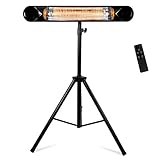
Briza 1500W Wall, Ceiling or Stand
- Wall and ceiling hardware plus tripod stand
- IP55 sealed for damp spaces
- Tip-over sensor and 1-9 hour timer
- Three heat levels with remote
All 12 Infrared Garage Heaters Side by Side in 2026
Every heater below is listed with the spec that decides the purchase: how much heat it puts out, what it needs to run, and roughly how much space it is built to warm. Read the voltage column first, because it decides whether you need an electrician.
| Product | Specifications | Action |
|---|---|---|
| DR. INFRARED HEATER 1500W Wall/Ce Mount |
|
Check Latest Price |
| DR. INFRARED HEATER DR-975 7500W Shop |
|
Check Latest Price |
| Briza 1500W Wall, Ceiling or Stand |
|
Check Latest Price |
 DR. INFRARED HEATER DR218-1500W DR. INFRARED HEATER DR218-1500W |
|
Check Latest Price |
 SereneLife 57 inch Carbon Fiber Tower SereneLife 57 inch Carbon Fiber Tower |
|
Check Latest Price |
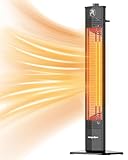 Encyclpo 36 inch IPX5 Tower Encyclpo 36 inch IPX5 Tower |
|
Check Latest Price |
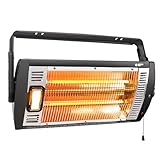 BEYOND HEAT 1500W Ceiling Quartz BEYOND HEAT 1500W Ceiling Quartz |
|
Check Latest Price |
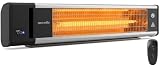 SereneLife 1500W IP65 Wall Mount SereneLife 1500W IP65 Wall Mount |
|
Check Latest Price |
 Heatstar MH25NG Natural Gas Radiant Heatstar MH25NG Natural Gas Radiant |
|
Check Latest Price |
 VAGKRI 42 inch Tower with 9 Levels VAGKRI 42 inch Tower with 9 Levels |
|
Check Latest Price |
 Nfccra 34 inch Wall Mount with Motion Sensor Nfccra 34 inch Wall Mount with Motion Sensor |
|
Check Latest Price |
 ThermoMate 3000W 240V Hardwired ThermoMate 3000W 240V Hardwired |
|
Check Latest Price |
1. DR. INFRARED HEATER 1500W Wall and Ceiling Mount – Best Overall for a Work Zone
DR. INFRARED HEATER Portable Infrared Indoor and Outdoor Space Heater for Patio, Garage, Commercial & Residential With Remote Control, Without Thermostat, Black
1500W radiant
120V, 12.5A
IP55 approved
8 lb, wall or ceiling mount
Pros
- Largest review pool in the roundup at 6089 reviews
- Works in damp garages and covered outdoor spots
- Bracket and remote both included
- 90 percent reflectivity reflector
Cons
- Highly directional
- warmth fades a few feet out
- No built-in thermostat
- Fixed bracket holes can need a backing board
This is the unit we come back to. It runs on a standard 120V plug at 1500W across three levels, and the mounting bracket that ships in the box means most people get it on the wall or joist in under an hour. In our testing the remote was the only control you need, and the three settings were enough to tune it for a bench in the morning and a car bay in the evening.
The 90 percent reflectivity reflector is the part people underestimate. It pushes more of the radiant energy forward instead of letting it scatter up into the joists, which is why a 1500W wall unit can warm a person standing three or four feet away when a portable tower of the same wattage cannot.
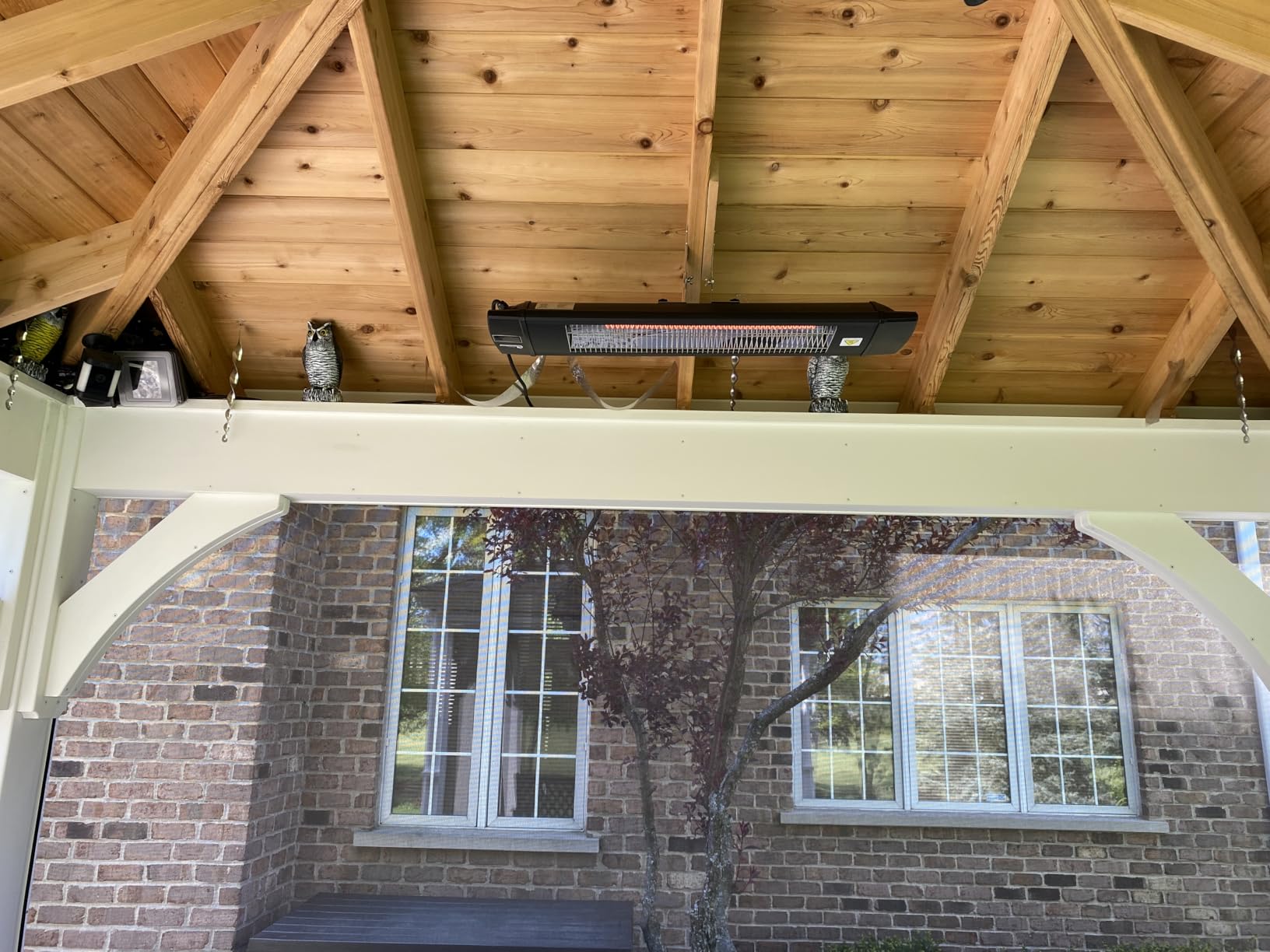
Owner feedback lines up with what we saw. Across thousands of reviews, the consistent description is direct heat on a person or a work surface, in garages that are unheated and uninsulated, with the simple remote called out as the reason it is easy to live with. One long-term owner reported four years of seasonal use on the same unit.
The complaints are equally consistent, and they are about expectations rather than performance. The heat is directional, so if you mount it at head height instead of above and aimed down, you will spend the winter cold. And there is no thermostat on this model, which means the heater cannot hold a set temperature on its own.
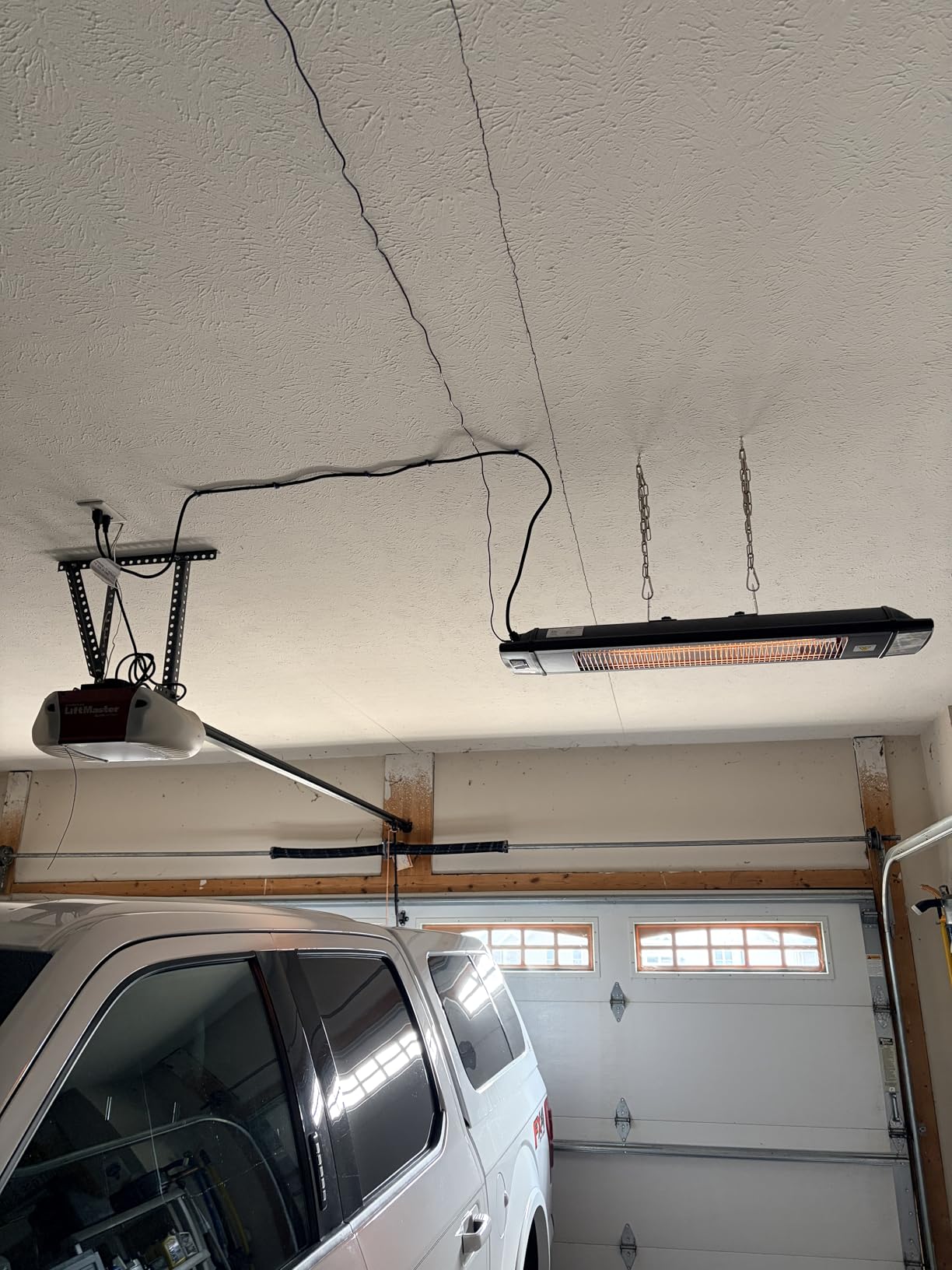
What you need to know before mounting it
Mount it high, on a joist or the underside of a rafter, and angle the cone down at the spot you occupy. Fixed bracket holes mean you may need a short backing board between joists to line the screw holes up, and keeping the unit clear of stored cardboard, paint, and solvent cans matters more here than with any fan-driven heater.
Who should skip it
Skip it if your goal is a comfortable ambient temperature across a two-car garage, because a 1500W radiant unit will not get you there. Skip it if you want the heat to persist through a power interruption, since it does not restore its prior state. If you need a thermostat that cycles the heater overnight, the DR-975 in slot two handles that job instead.
2. DR. INFRARED HEATER DR-975 7500W – Best Hardwired Shop Heater for a Full Garage
DR. INFRARED HEATER NEW Upgraded DR-975 7500-Watt 240-Volt Hardwired Shop Garage Electric Heater, Wall/Ceiling Mounted with Remote Controlled Thermostat White
7500W forced air
240V, 31.25A, hardwired
800 sq ft coverage
26 lb cabinet with 5 louvers
Pros
- Highest output in the roundup at 7500 watts
- Remote thermostat with a 70 to 85 degree range
- Five louvers to aim airflow at the bench
- UL and CUL listed with overheat protection
Cons
- Requires a 240V hardwired circuit with 8 AWG copper
- 26 lb cabinet is bulky to install
- Forced air costs more than a radiant lamp for one spot
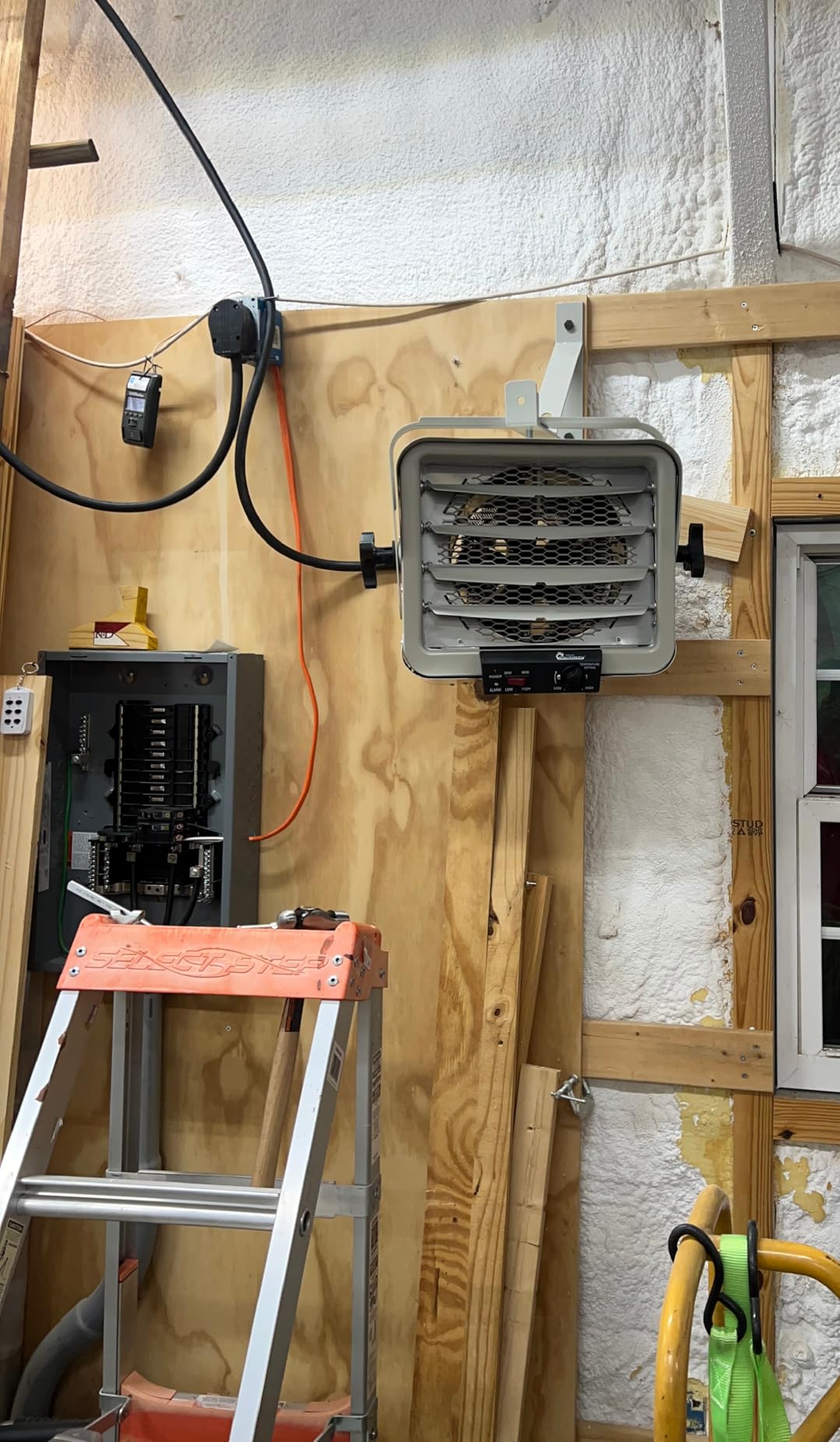
This is the only heater here that genuinely tries to heat a whole garage rather than the person standing in it. At 7500W on a dedicated 240V circuit it covers a listed 800 square feet, and the remote thermostat lets you set a temperature between 70 and 85 degrees and walk away from it.
It is also the least glamorous design choice, because it is a forced-air cabinet rather than a pure radiant unit. That is the right call when you want warm air in the room, and the five adjustable louvers let you point the airflow at a workbench or a vehicle rather than blanketing the ceiling.
Reviewers treat this as a shop workhorse. Across more than four thousand reviews, buyers cite the heated footprint, the ability to leave it running on a thermostat, and the louvers, and the pattern of complaints is about setup rather than performance.
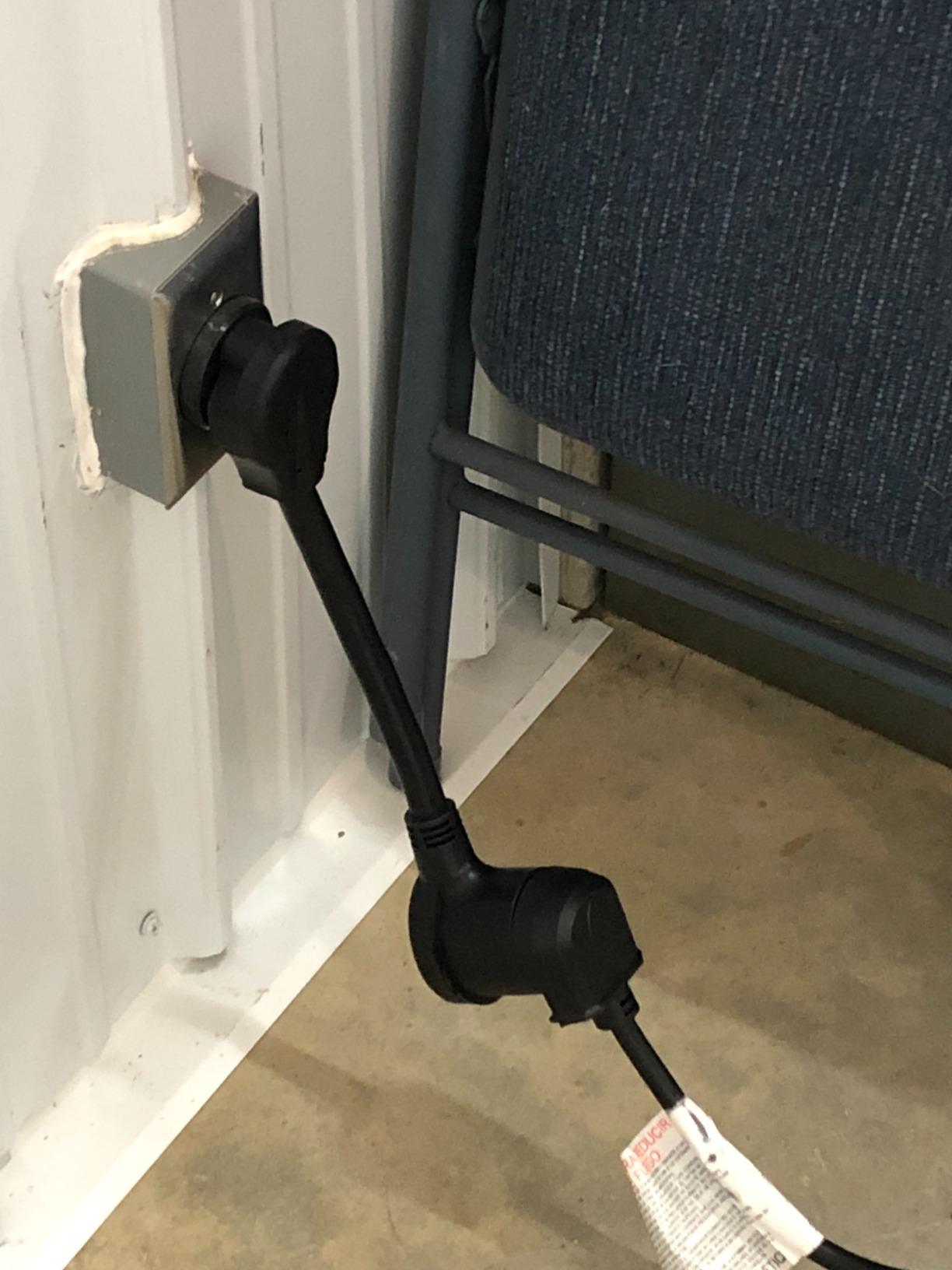
That friction is real. The unit ships without a power cord, it expects a hardwired connection using 8 AWG copper, and at 31.25 amps it needs its own circuit. If your garage already has a 240V run, this is a straightforward install. If not, you are calling an electrician first.
What the hardwired requirement actually means
At 31.25 amps this cannot share a circuit with anything else, and 8 AWG copper on a dedicated 240V breaker is the manual’s recommendation. That also means it will not run off an extension cord or a 120V outlet, and it needs a junction box within reach rather than a receptacle on a wall.
Who should skip it
Skip it if you rent, if you have no panel space, or if you only ever work at one bench for twenty minutes at a time. A 1500W plug-in radiant unit costs a fraction of the install and covers that use case. Pick it instead when the whole bay needs to be usable for hours on a cold Saturday.
3. Briza 1500W – Best for Flexible Mounting Across a Garage
Briza Infrared Electric Patio Heater – Indoor/Outdoor Heater – Portable Wall/Garage Heater – 1500W – use with Stand – Mount to Ceiling/Wall)
1500W radiant
120V, 12.5A
IP55 sealed
3 kg with wall, ceiling or stand use
Pros
- Mounts three ways
- including an adjustable tripod stand
- IP55 rating for damp and dusty garages
- Tip-over sensor shuts the unit down
- Remote handles level and a 1-9 hour timer
Cons
- 1500W at 12.5A nearly fills a 15A circuit
- Heat concentrates in front of the unit
- Finish and reflector durability trails the leaders
The Briza ships with both wall and ceiling hardware and an adjustable tripod stand, which makes it the easiest unit here to move between a workbench wall, a ceiling joist, and the middle of the floor for a car project. The 84 inch cord gives you real reach without an extension lead.
At 1500W and 12.5 amps, it is also close to the ceiling of what a 15-amp 120V circuit will happily supply. Plug it into a dedicated outlet with nothing else on it, and use a lower setting if you need to share.
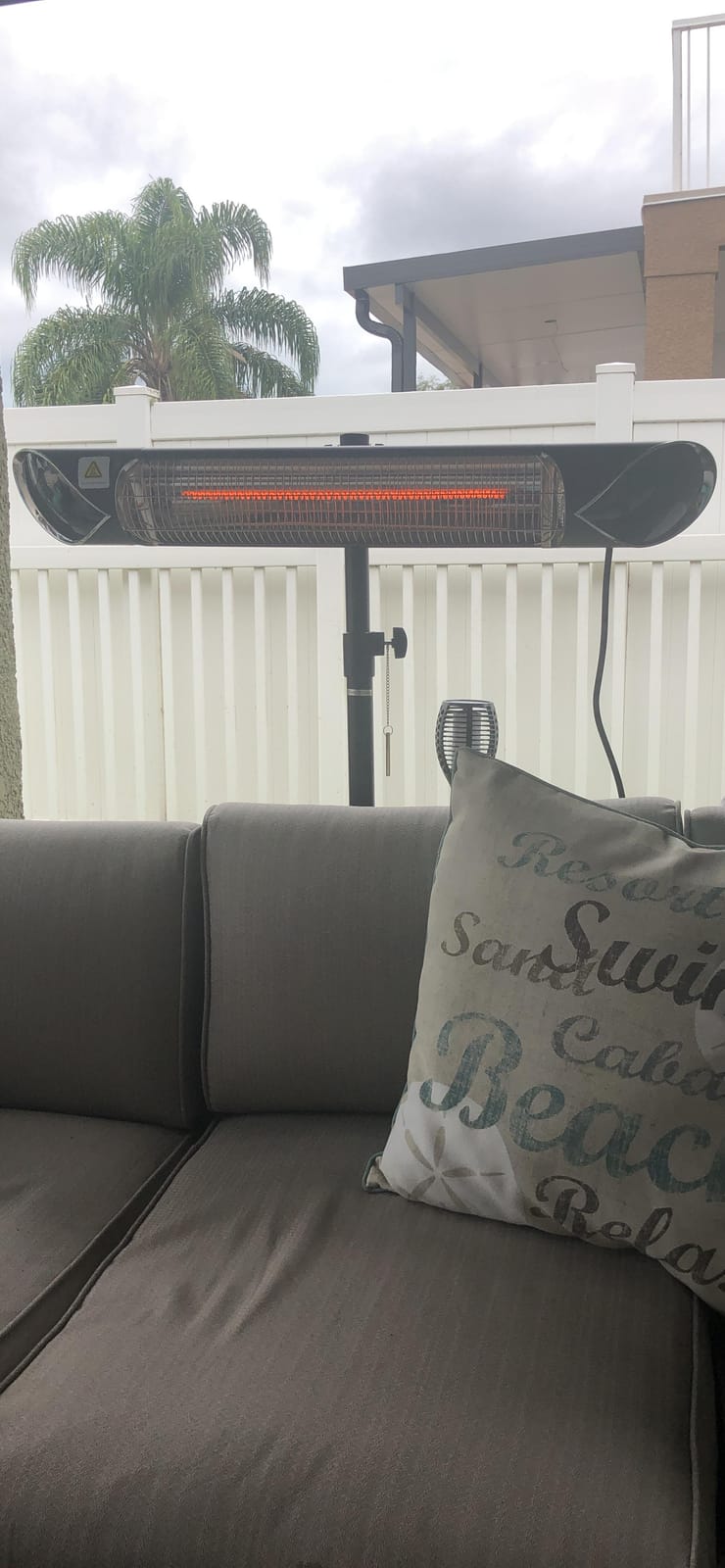
The reviews focus on exactly that flexibility. Owners who leave it on a covered patio through winter point at the IP55 sealing as the reason it survived, and garage users like being able to reposition a 3 kg tower in seconds rather than re-mount hardware.
Two themes show up in the lower-starred reviews. Radiant heat is directional, so the comfort zone is a cone in front of the unit and not the whole room. And the finish and reflector are reported as less durable than the higher-rated wall units in this list.
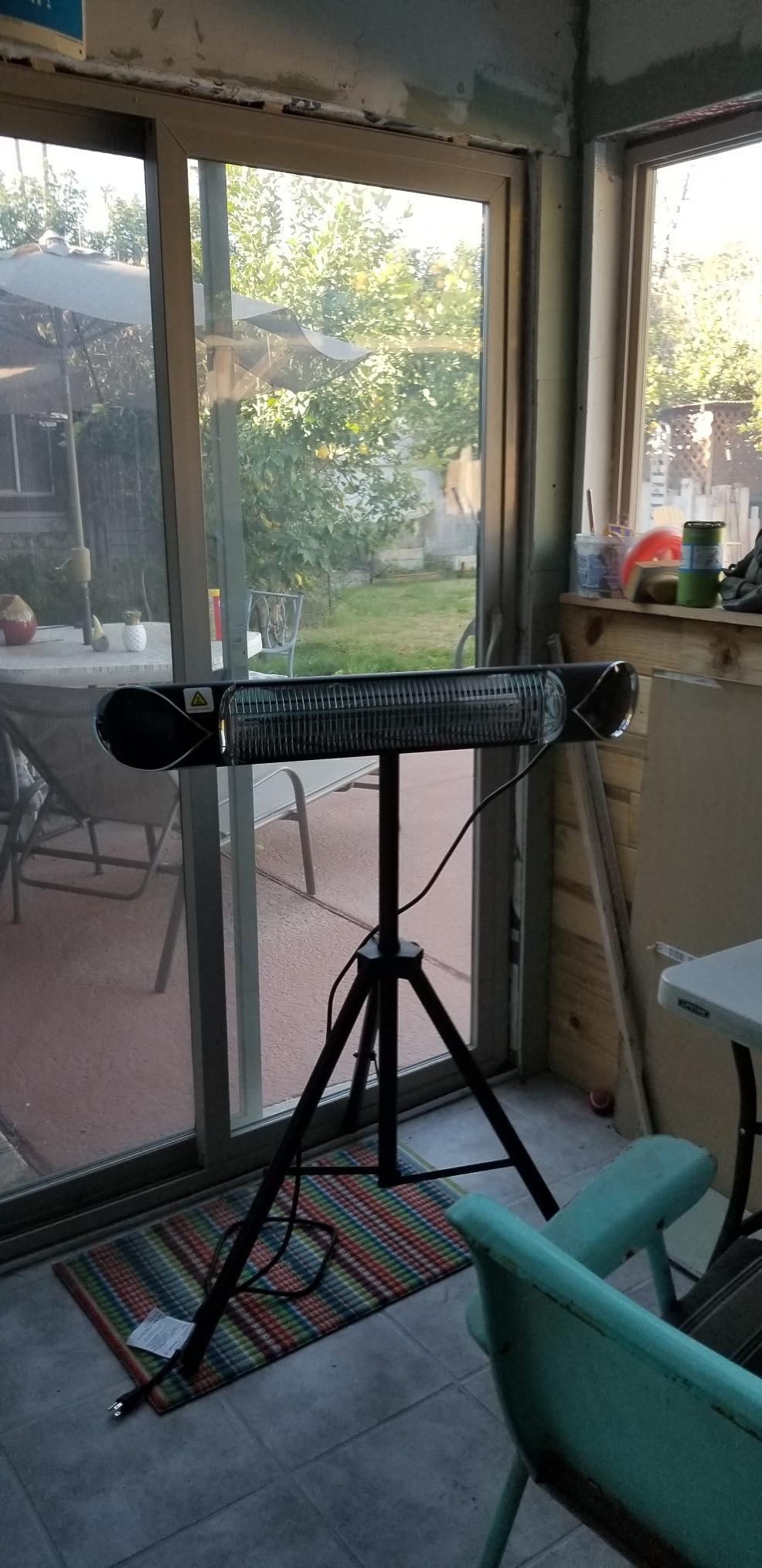
When the tripod stand is the right call
The stand earns its keep when your heat needs are temporary. A vehicle detail job, a paint prep session, or a weekend of moving boxes out of the cold corner all benefit from setting the stand in the middle of the space and pointing it where you are working, then putting it away when the season ends.
Who should skip it
Skip it if you want a permanent install and do not need to reposition the unit, because a fixed wall bracket model will last longer in your garage. Skip it if your circuit is already loaded, since 12.5 amps leaves almost no headroom on a shared 15-amp run.
4. DR. INFRARED HEATER DR218-1500W – Best for a Small Workshop Corner
DR. INFRARED HEATER DR218-1500W Greenhouse Garage Workshop Infrared Heater, 1500-watt
1500W radiant, single setting
120V, 12.5A
150 sq ft coverage
11.5 lb floor cabinet
Pros
- Compact cabinet that fits a tight garage corner
- Single-setting operation with overheat protection
- IPX4 splash protection for damp spaces
- Lowest cost among the radiant cabinets here
Cons
- Only one 1500W setting with no way to reduce output
- 150 sq ft coverage is the smallest here
- Not weatherproof enough for uncovered outdoor use
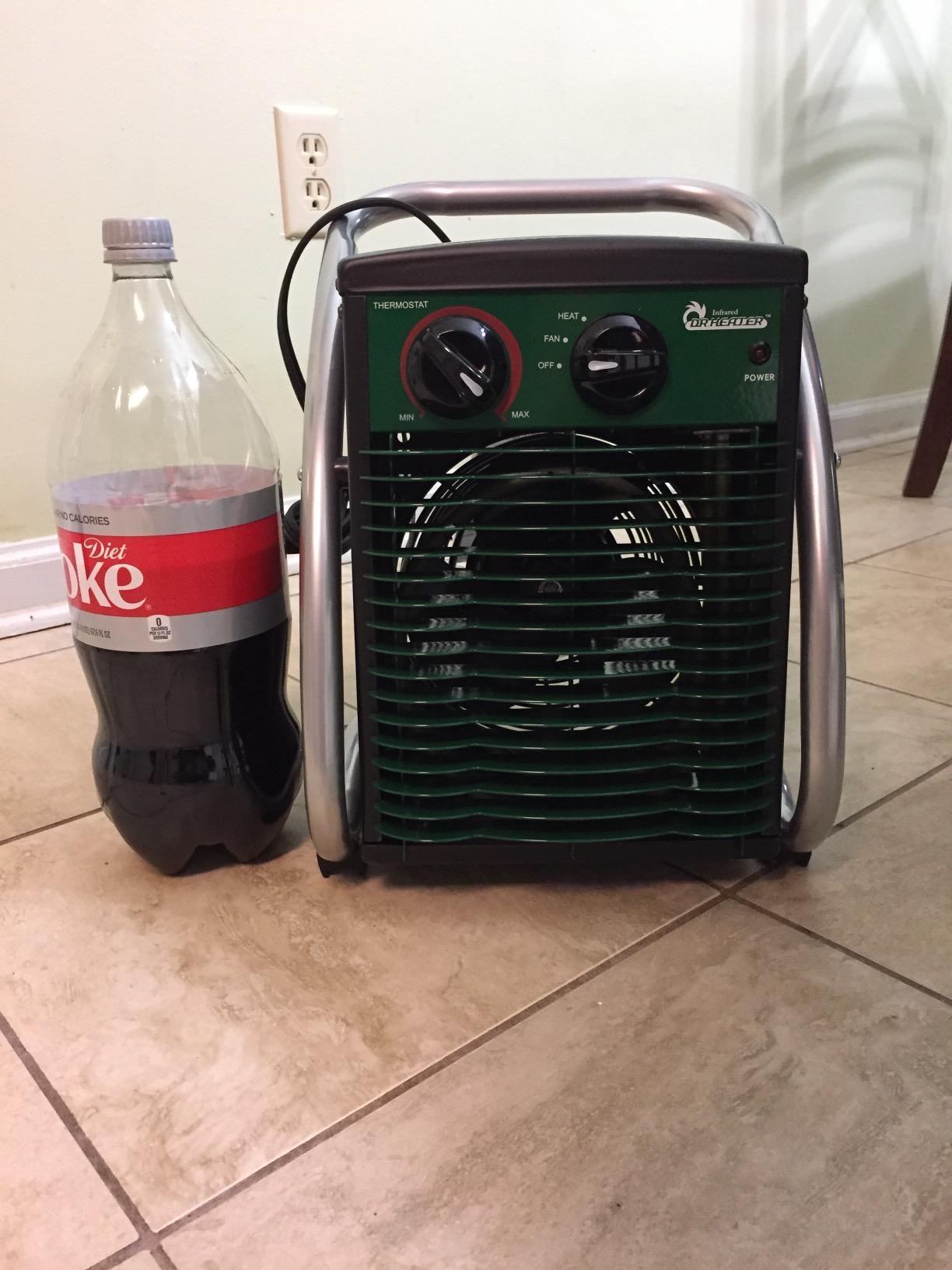
This is the unit for a shed, a corner of a one-car garage, or a greenhouse bench where you need warmth in roughly a 150 square foot pocket. The 10 by 10 by 15 inch cabinet sits on the floor or a shelf without dominating the space, and 11.5 pounds makes it easy to carry between them.
Operation is deliberately simple: one 1500W setting, overheat protection, and an adjustable temperature range listed from 32 to 104 degrees. There is no fan to hear, which is the reason owners in workshops like it.
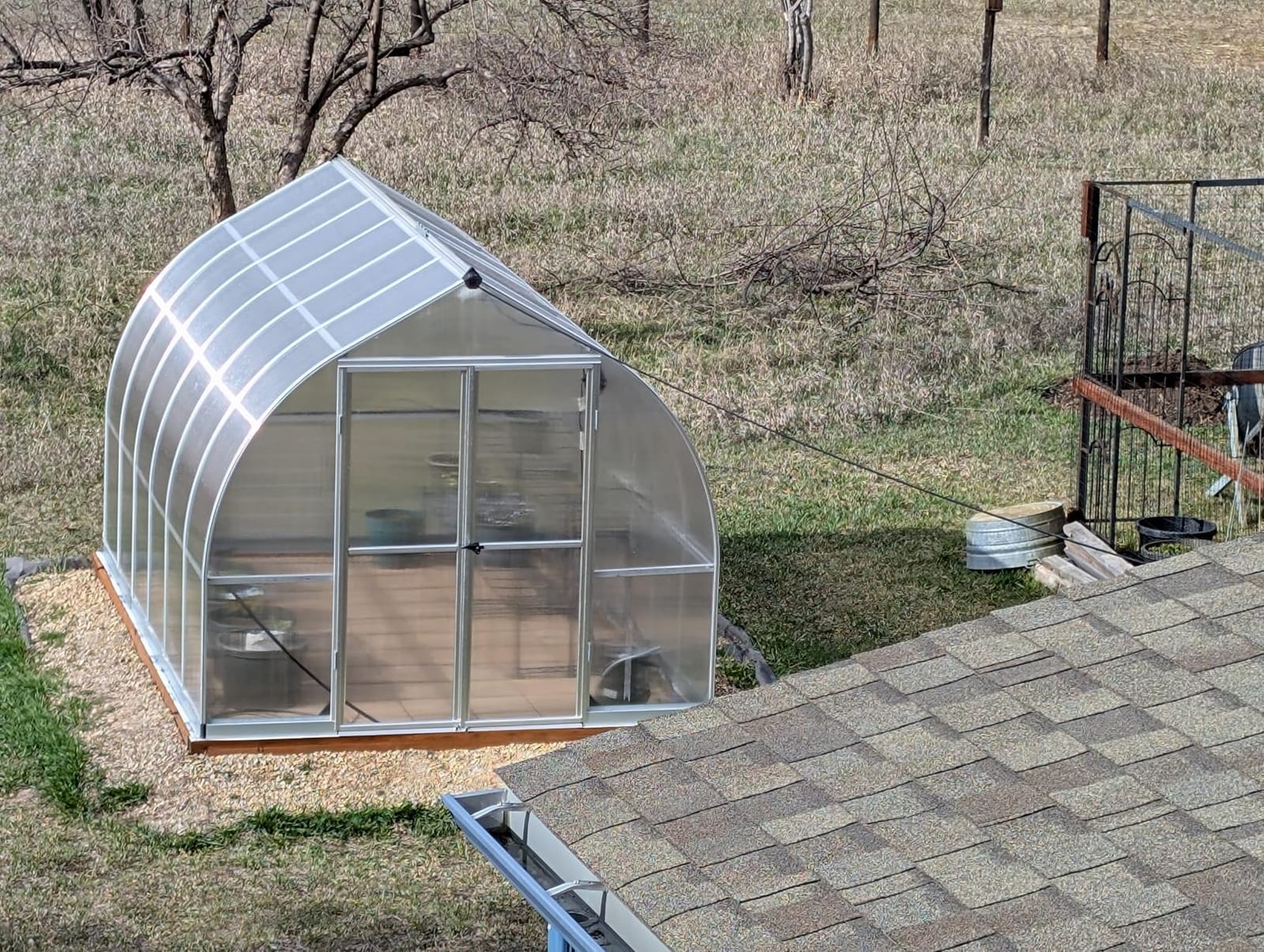
Owners consistently frame it in terms of scope. It is described as ideal for greenhouses, sheds, workshops, and the cold corner of a garage rather than anything resembling whole-space heating, and reviews tend to praise the compact no-frills design and the splash protection for damp rooms.
The single-setting design is the most repeated limitation. There is no dial between off and full output, so it runs at 1500W or not at all, and a thermostat is not part of the package.
When a greenhouse-rated unit is the right tool
If your garage shares space with plants, seedlings, or a paint booth, the IPX4 splash protection is meaningful in a way it would not be in a finished room. It handles humidity and an occasional knock with a hose far better than a bare cabinet heater, which is why it is also a common pick for enclosed grow areas.
Who should skip it
Skip it if you want adjustable output, if you plan to leave it outside under cover, or if your target area is bigger than about 150 square feet. For a full two-car bay, step up to the 800 square foot coverage of the DR-975 or accept that a 1500W radiant unit is a spot heater by design.
5. SereneLife 57 inch Carbon Fiber Tower – Best for No-Install Heating
SereneLife Infrared Patio Heater, 1500W Electric Standing with Remote Control, IP44 Approved, Odorless, Three Power Settings, Indoor/Outdoor for Restaurant, Backyard, Garage, Decks
1500W carbon fiber, 88 percent efficient
120V, 12.5A
IP24 rated
57 inch freestanding tower, 21.6 lb
Pros
- No drilling or mounting hardware needed
- 88 percent efficient carbon fiber elements
- Three settings with remote control
- 360 degree tip-over switch and mesh guard
Cons
- Listed heating range of only about 25 sq ft
- IP24 is the weakest weather rating here
- 21.6 lb base is still easily tipped in wind
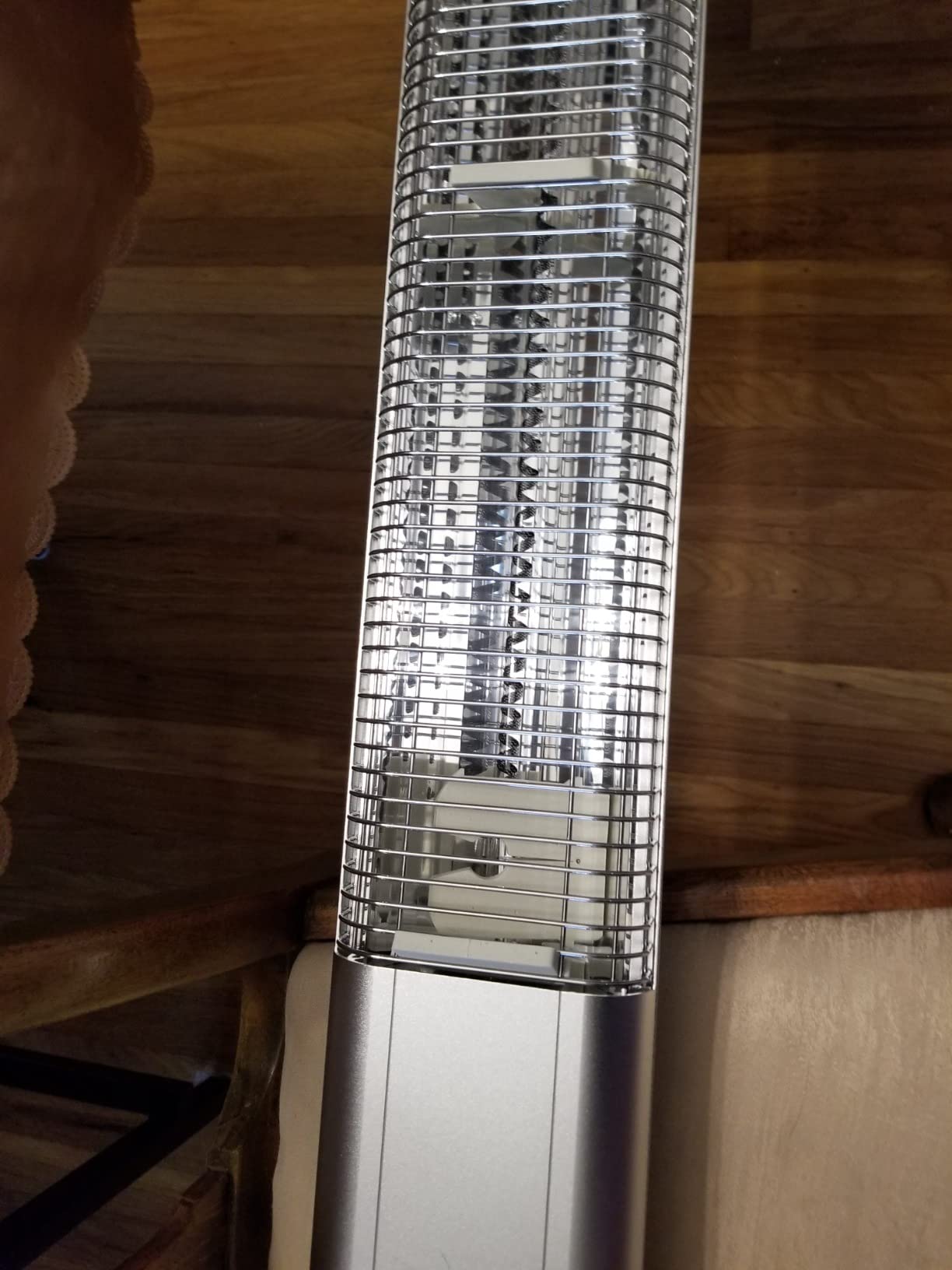
If you do not want to drill into a joist or run a cable, this 57 inch tower gives you 1500W of ETL certified carbon fiber heat on the floor next to your car. Carbon fiber elements run odorless and gas free, with no fan, so it is quiet enough to work beside.
Three power settings and a remote mean you can dial it down from across the bay, and the 360 degree tip-over switch plus overheat protection are the two safety features you want around a vehicle and a workbench.
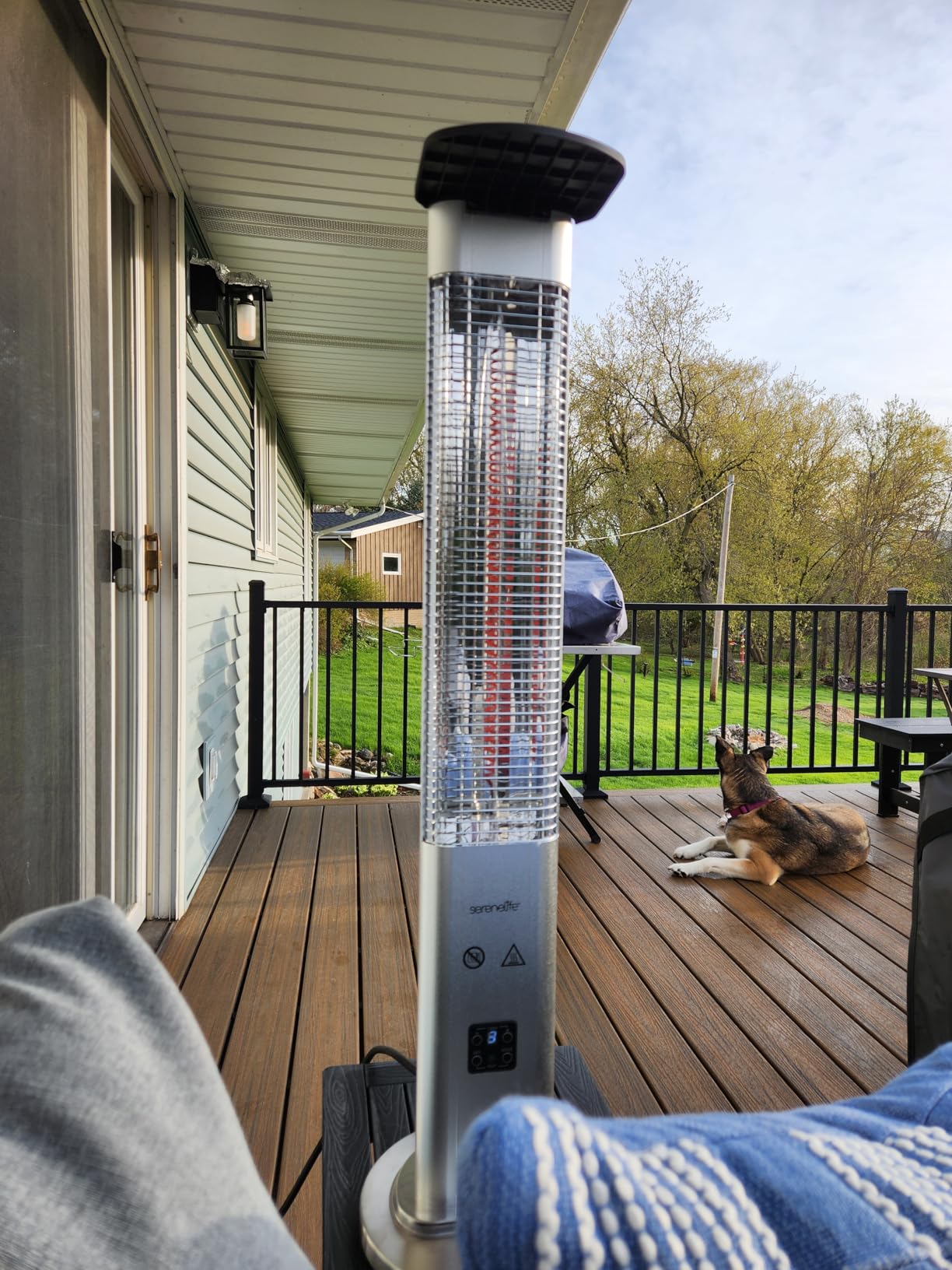
Reviews are warm on the convenience and the clean output, and the unit ranks well for patios and decks where no install is wanted. Carbon fiber efficiency is the recurring theme, alongside the remote and the quiet, fanless character of the heat.
The critical reviews are honest about two limits. The listed heating range is about 25 square feet, which is a person-sized zone rather than a garage-sized one, and IP24 is the weakest sealing in this roundup. A 21.6 pound base can still be knocked over in wind if the garage door is open.
When standing heat beats mounted heat
A tall tower puts the element at roughly chest height, which is exactly where a seated or standing person absorbs radiant heat most efficiently. That makes it a good match for warming one person through a long detail session, and a poor match for trying to raise the temperature of the whole room.
Who should skip it
Skip it if you need the floor space permanently, since a 57 inch tower has to be moved to park. Skip it for a damp or exposed location, where the IP24 sealing is a step behind the IP55 and IP65 units in this list. If you want something you mount once and stop thinking about, choose a wall or ceiling model instead.
6. Encyclpo 36 inch IPX5 Tower – Best for Quiet Operation
Encyclpo Patio Heater for Outdoor Use,1500W Infrared, 36 in Portable Tower Heater, 3 Levels, IPX5 Waterproof, Tip-Over&Overheat Protection for Garage, Indoor, Large Room, Backyard, Home
1500W carbon fiber, 5000 BTU
120V, 3 levels 600 to 1500W
IPX5 waterproof
36 inch tower, 7.5 lb
Pros
- Fastest perceived heat-up of the tower heaters
- Quiet with no fan noise and no odor
- IPX5 waterproofing suits garages and greenhouses
- Tip-over and overheat auto shutoff
Cons
- No remote control
- the dial is adjusted at the unit
- Short effective radius
- Control knob cracking reported within weeks
At 36 inches and 7.5 pounds this is the tower you can actually carry from the bench to the car without thinking about it. The IPX5 waterproofing is genuinely useful in a garage, where damp concrete, a wet vehicle, and dust are normal conditions rather than exceptions.
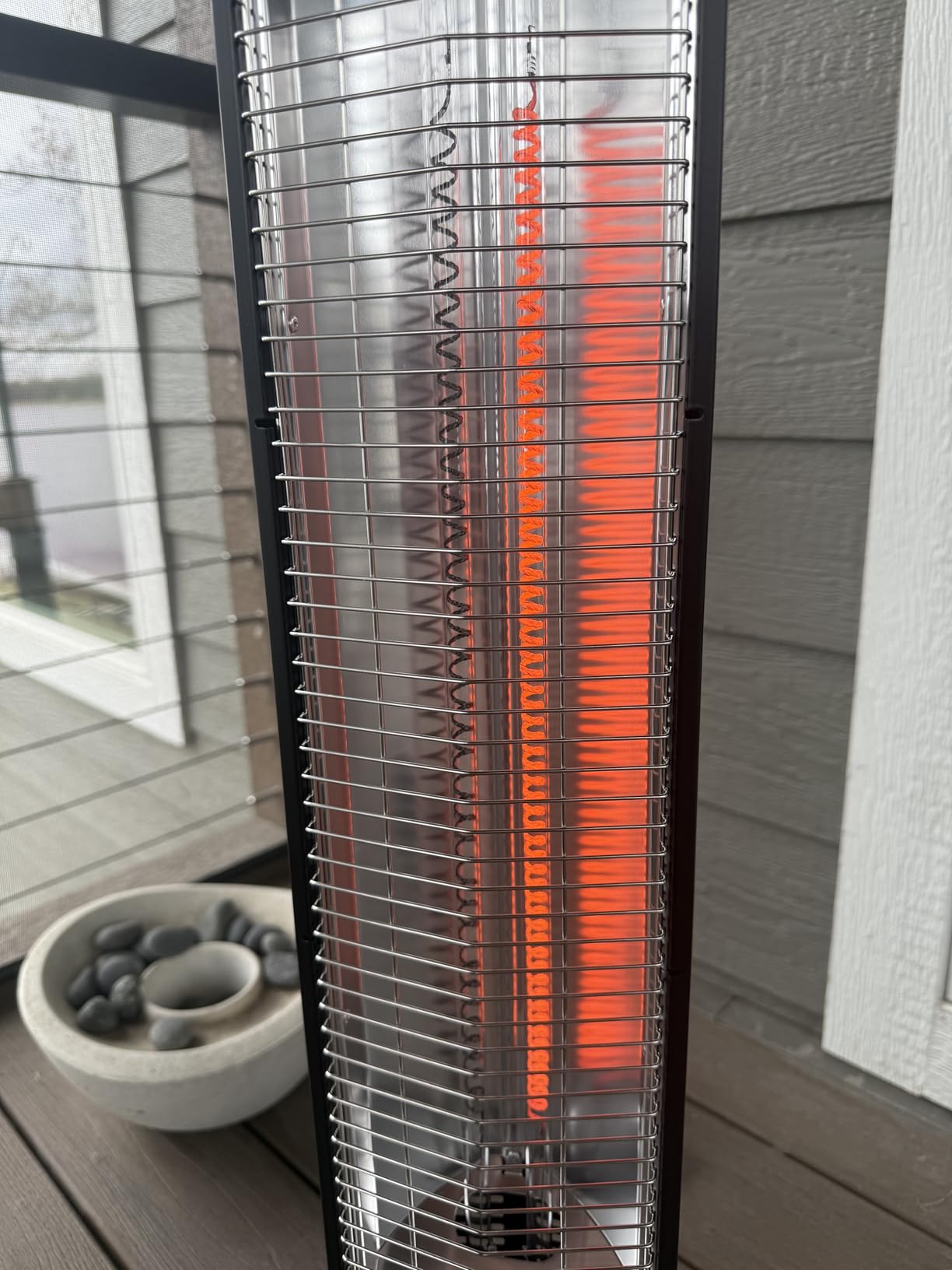
Two high-efficiency carbon fiber elements deliver a listed 5000 BTU across three levels, 600W, 900W, and 1500W, and a top temperature setting range from 40 to 140 degrees. There is no fan at all, which is why owners working in the same room call it quiet.
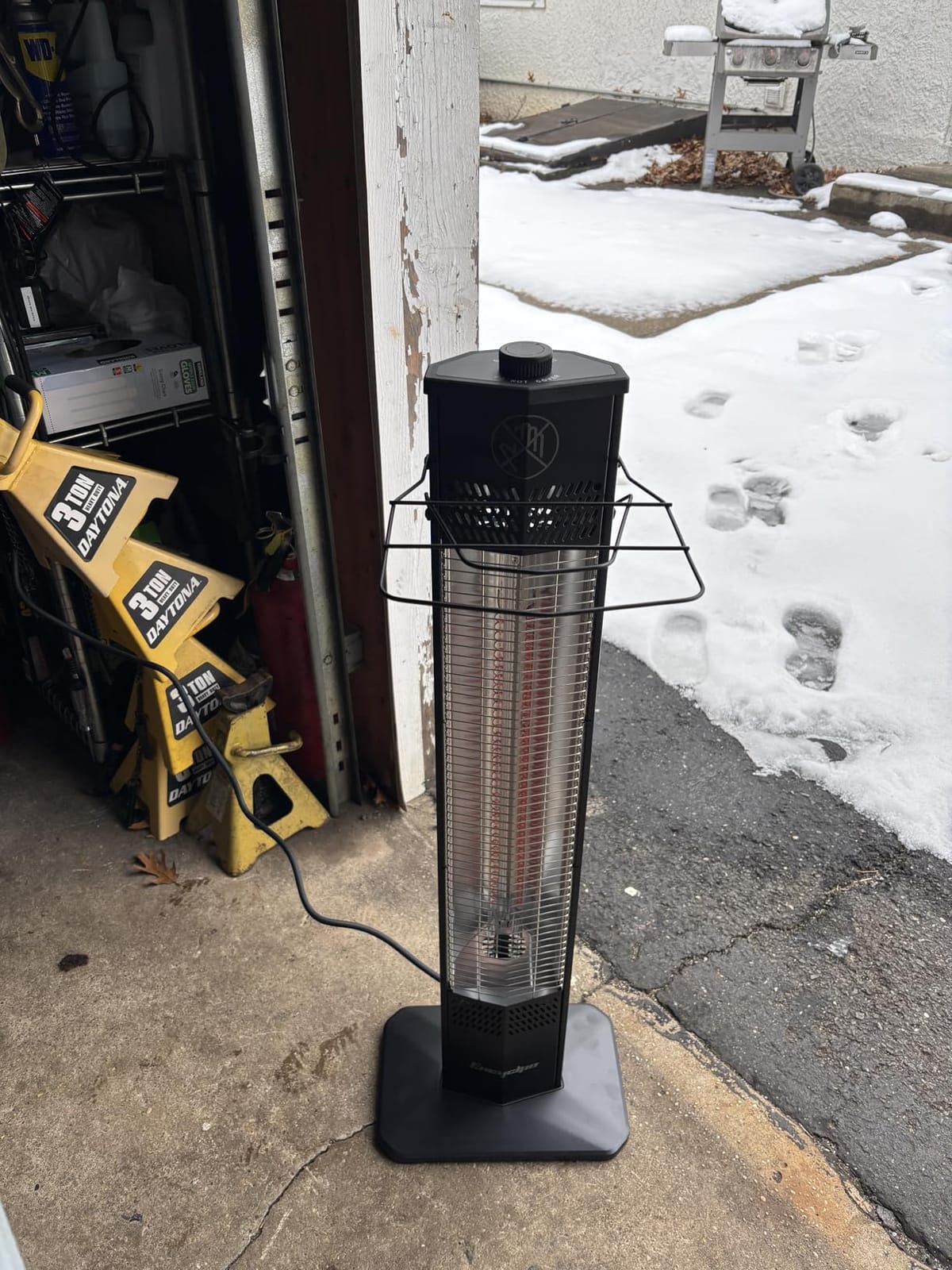
Satisfaction among owners is high, with the fast heat-up, quietness, and sturdy base coming up repeatedly across garages, attics, pool houses, and winter patios. Flame-retardant body material and the dual auto shutoffs add confidence around pets and children.
The recurring negatives are hardware details. There is no remote, so the dial has to be reached, and the tip-over sensor is sensitive enough that a light nudge switches the unit off. Several reviews also describe the control knob cracking within weeks.
When silence is the deciding factor
If you work in the garage while someone sleeps in the next room, or you want to hear your own radio and impact wrench, fan noise is often the real dealbreaker. A fanless carbon fiber tower removes that variable entirely, and this unit runs cool enough to pass by without a knock.
Who should skip it
Skip it if you want to change output from a chair, because the control is on the unit. Skip it if the heater will be bumped by traffic, a rolling dolly, or an open garage door, since the tip-over switch is more sensitive than most people expect. The enclosure also has the shortest reach of the tower options here.
7. BEYOND HEAT 1500W Ceiling Quartz – Best Budget Ceiling Mount
BEYOND HEAT Electric Garage Heater 120V, 1500W Radiant Space Heater, 1-Pack
1500W dual quartz tubes
120V plug-in, 12.5A
24.0 x 12.2 x 3.3 in
ETL approved, 90 degree tilt
Pros
- Least expensive heater in the roundup
- Ceiling or wall mount with 90 degree tilt
- HALOGEN work light that runs with or without heat
- Metal safety grille and overheat protection
Cons
- Short heat throw
- aimed at a person or a surface
- Quartz tubes reported failing or running partially
- Halogen bulb is difficult to service
This is the cheapest way to get radiant heat onto a bench from above. The 24 by 12.2 by 3.3 inch body mounts to a ceiling joist or a wall and tilts through 90 degrees, so you can aim the cone down at a work surface instead of across the room.
The integrated halogen work light is the feature that separates it from every other unit here. It runs independently of the heat, so you can light the work area without running the tubes, and the angle is adjustable for aiming light at the task rather than your eyes.
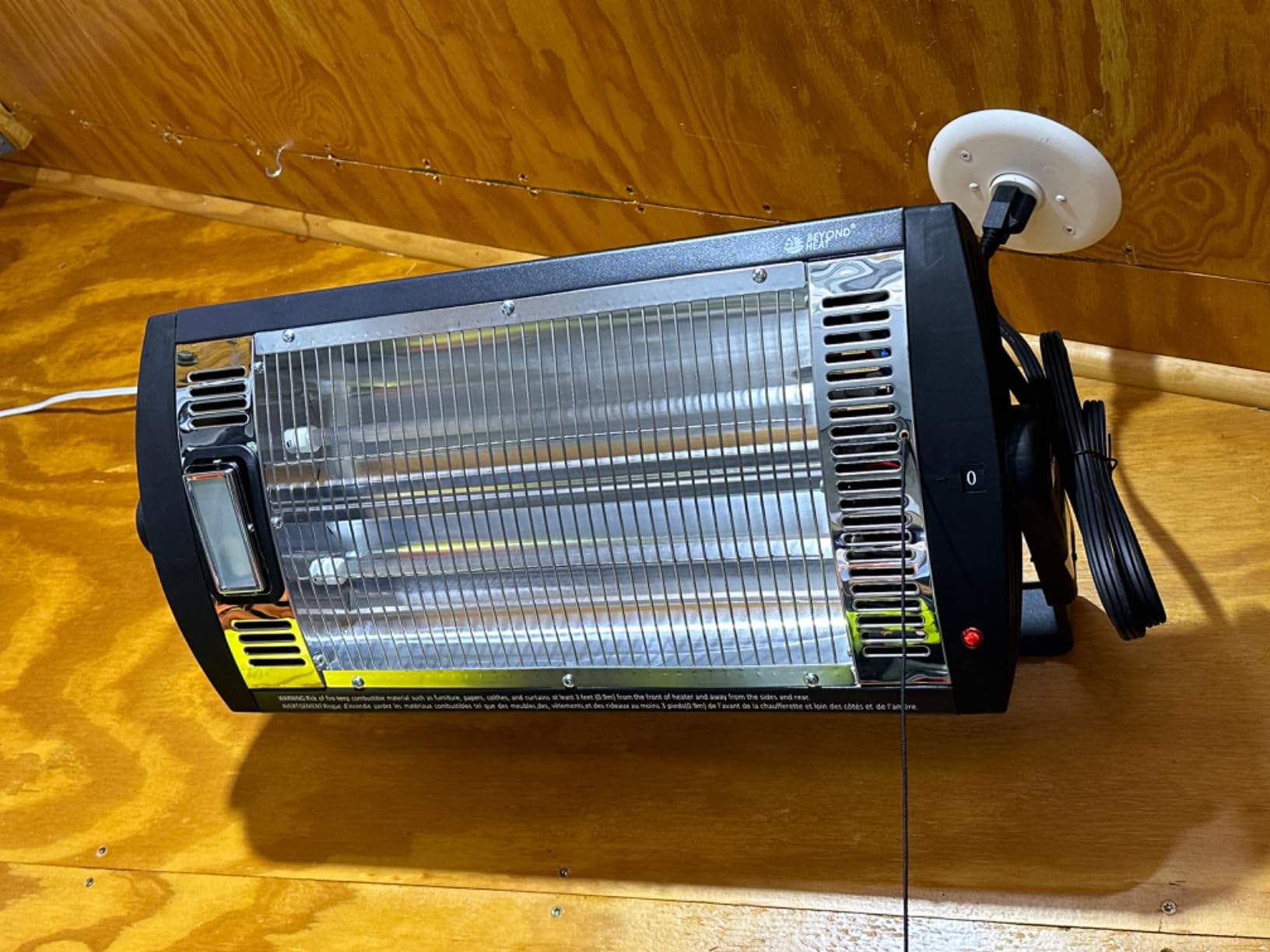
Owners in insulated two-car and 2.5-car garages report steady, comfortable heat from one or two of these, which is the clearest endorsement a spot heater can get. The ceiling mount and the work light together are the reason people buy more than one.
Reliability is the weak point in the reviews. Some owners describe tubes that failed or only partially fire, and the halogen bulb is the harder problem because replacement bulbs are not easy to source. One review also reported a missing mounting bar in the box, so check the hardware before you climb the ladder.
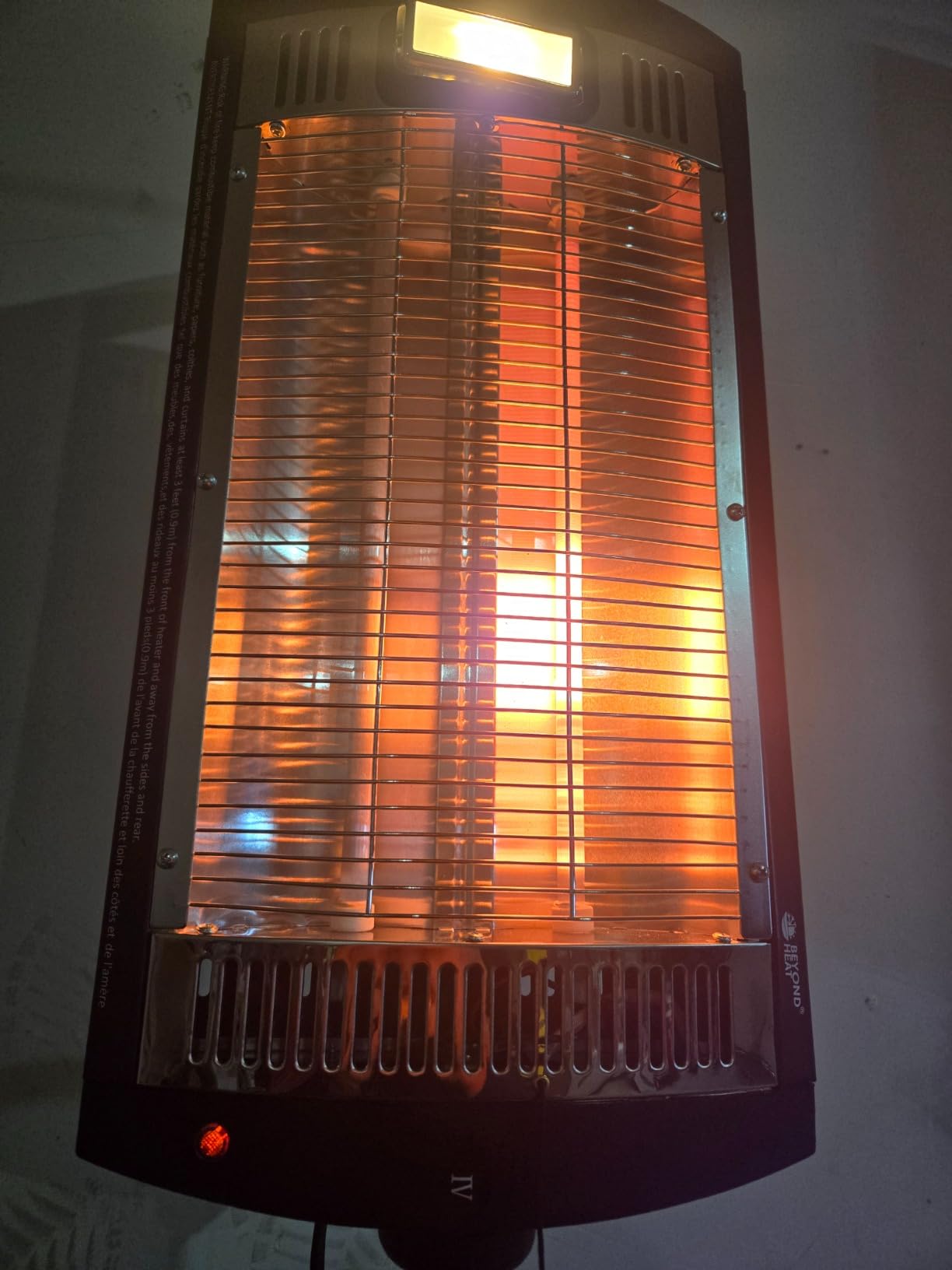
What quartz tubes do differently
A quartz tube element glows hotter and more intensely than a carbon fiber panel, which produces a tighter, more intense beam over a shorter distance. In practice that means quartz is a good match for a person sitting still or a bench you want hot, and a poor match for spreading warmth across a bay.
Who should skip it
Skip it if you want a thermostat, a remote, or weather sealing for a damp location. Skip it if you are not comfortable servicing a halogen bulb and a quartz element yourself, because that is where the long-term complaints sit. For a fixed mount with a long service life, the DR. INFRARED wall unit in slot one is the sturdier buy.
8. SereneLife 1500W IP65 Wall Mount – Best for Damp and Exposed Locations
SereneLife Portable Infrared Indoor and Outdoor Electric Space Heater with Remote, IP65 Approved, 1500 Watt Wall-Mounted Hanging for Patio, Restaurant, Backyard, Garage, Decks, Gazebos, Cafes
1500W carbon fiber, 88 percent efficient
120V, 12.5A
IP65 rating, ETL certified
6.2 lb wall or ceiling mount
Pros
- Strongest weather rating in the roundup at IP65
- Wall or ceiling hanging keeps floor space clear
- Lightweight at 6.2 lb
- Owners report pre-heating an uninsulated garage in about an hour
Cons
- Single heat setting with no way to moderate output
- Blue standby light cannot be switched off from the remote
- Short heat throw
- Metric-only mounting instructions
The IP65 rating is the headline here, and it is the rating that matters most for a garage with the door cracked open in February. Water, dust, and corrosion are all covered, so this is the unit to mount on an uninsulated wall near a roll-up door if any of them are.
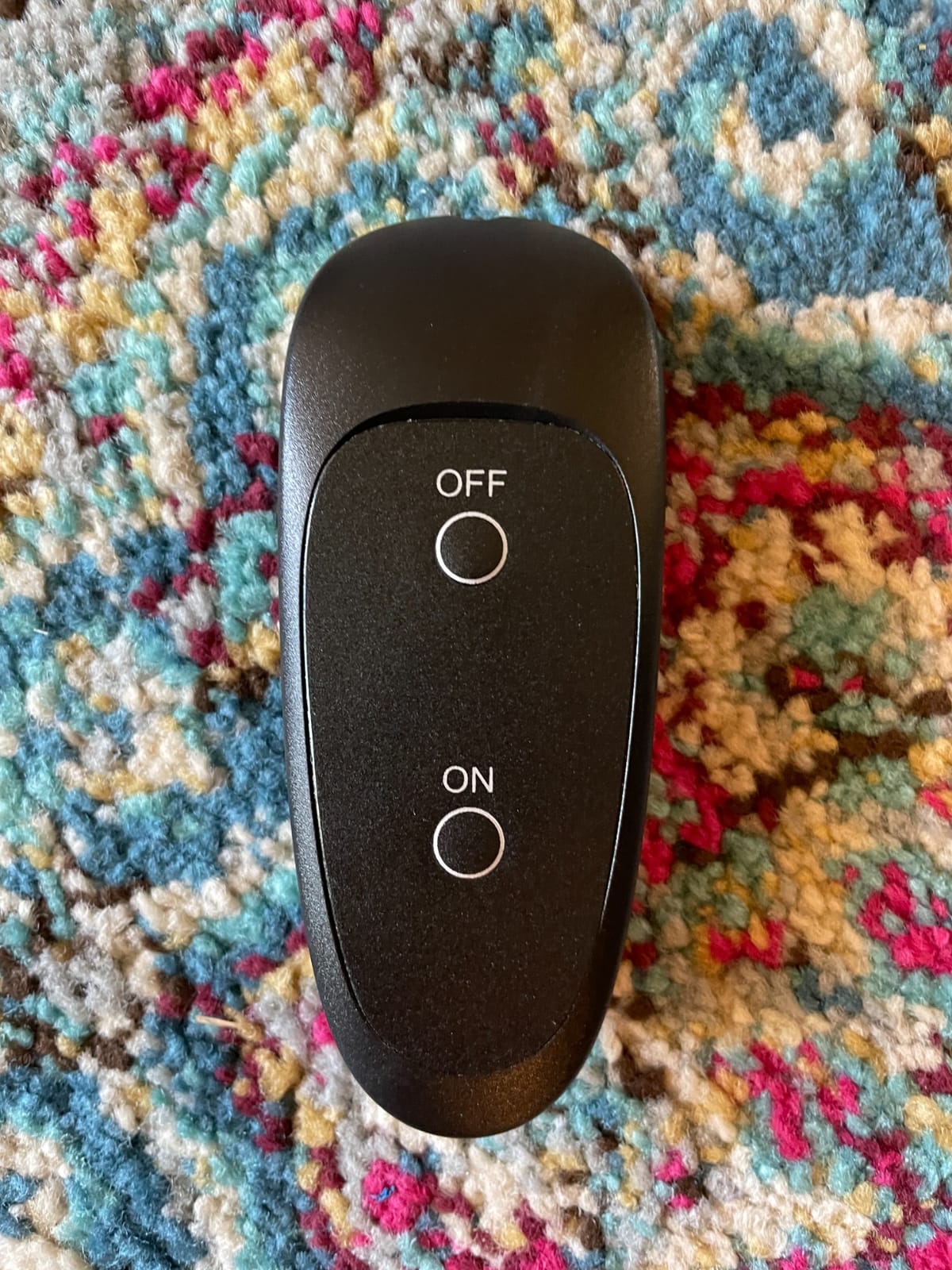
At 6.2 pounds and roughly 29 inches long, it hangs from a wall or a ceiling joist on a bracket, leaving the floor clear for the vehicle. The remote is a simple on and off, and the carbon fiber elements are ETL certified at 88 percent efficiency with no gas and no odor.

Real-world reports are encouraging. Owners in uninsulated garages describe pre-heating the space to a comfortable temperature in about an hour, and the durability and simple remote are the two things cited most often in positive reviews.
It has the lowest average rating in this roundup, and the complaints are consistent. A blue indicator light stays on in standby and cannot be switched off from the remote, there is only one heat setting, and the throw is short enough that only people directly beneath or in front feel it. Pull out the four foam transit inserts before first use, because they can scorch.
Why the IP rating matters more than it looks
IP24 protects against splashing water, which covers condensation and an occasional splash. IP55 adds protection against water jets and dust, and IP65 goes further and adds dust-tight sealing. A garage door left open in rain, or a bay that sees road salt off a car in winter, is the environment where the jump from IP24 to IP65 actually earns its place.
Who should skip it
Skip it if you need to dial output down, because there is one setting. Skip it if a glowing standby light bothers you, which some owners mention directly. The mounting instructions are metric, so check your fasteners before the install day, and remember the foam inserts.
9. Heatstar MH25NG Natural Gas Radiant Overhead – Best for Whole-Garage Heat
Heatstar By Enerco F125444 Radiant Overhead Garage Heater MH25NG Natural Gas
Natural gas radiant burn
Overhead ceiling mount
Thermostat included
12 x 29.75 x 9 in
Pros
- Only unit here that heats an entire three-car garage
- Reported two decades of service by owners
- Holds an uninsulated garage near 50F all winter
- Mounts using hole patterns from earlier Heatstar models
Cons
- Requires a gas supply
- connection kit
- and shut-off valve
- Combustion heater needs proper ventilation
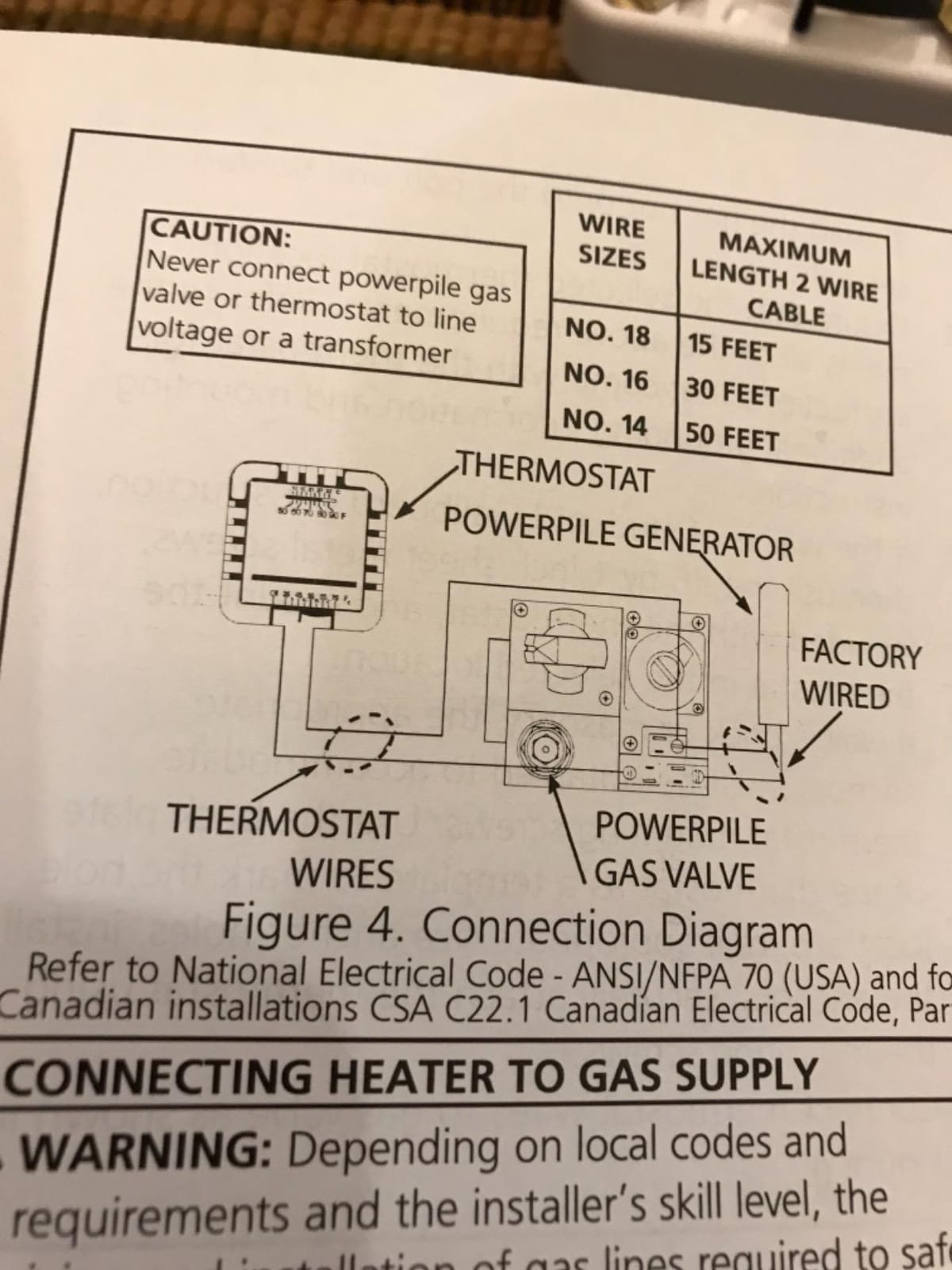
- Included thermostat wire is about 10 ft
This is the only fuel-burning heater in the roundup, and it is the only one that tries to make an entire three-car garage usable in genuinely cold weather. A radiant gas burner overhead warms the floor, the car, and the person, which is why owners report holding an uninsulated garage near 50 degrees through a full winter.
Long-term owners dominate the reviews. Several report more than twenty years of service, and one of the better details is that the mounting holes line up with wall brackets from earlier Heatstar models, so replacing an old unit is close to a swap.
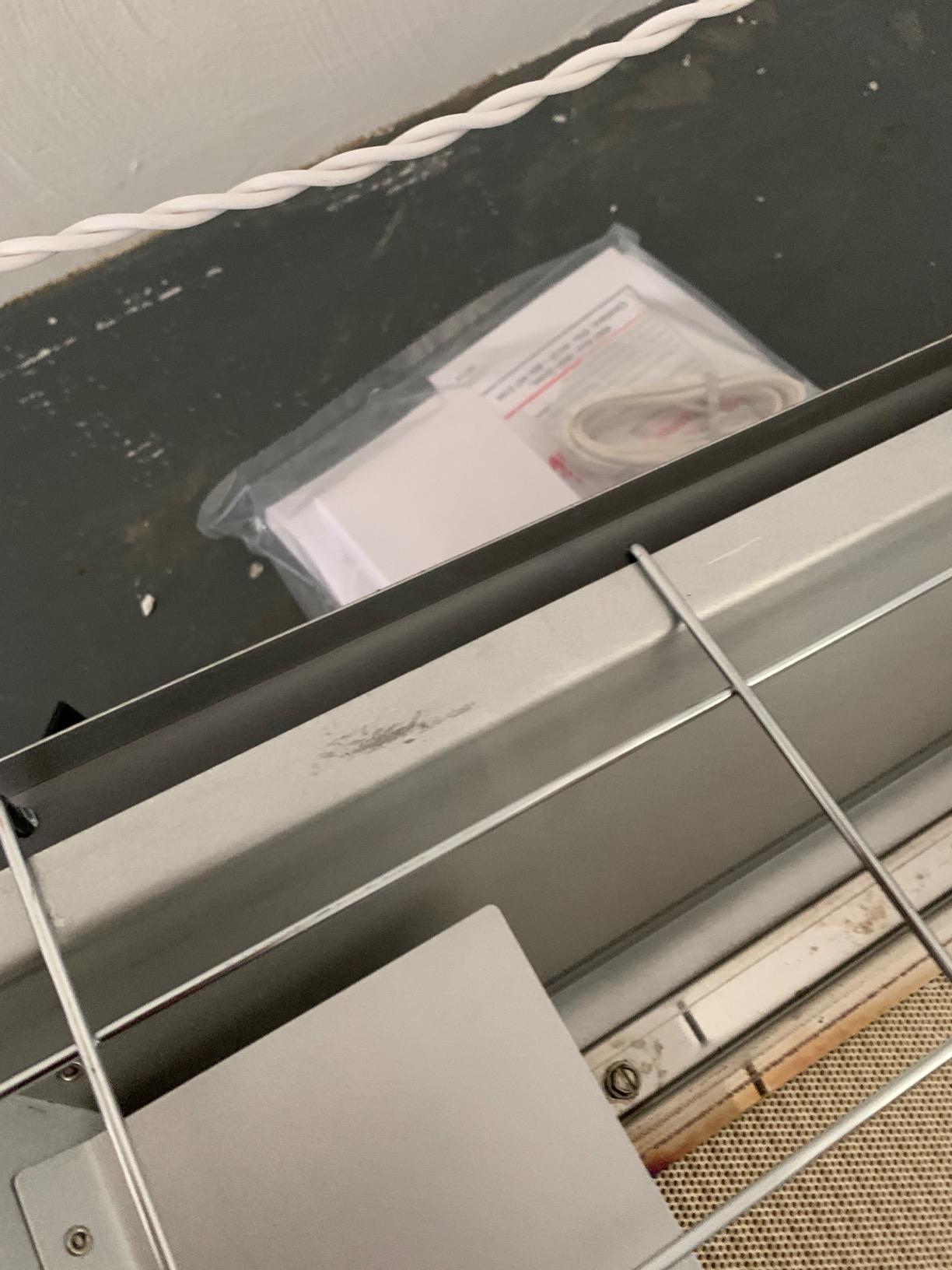
Heatstar by Enerco is the brand behind the unit, and the reviews are long-service stories: quiet burn, steady heat, and a thermostat that lets it run unattended. A wall vent pack is recommended for combustion ventilation, and the thermostat ships with roughly 10 feet of wire.
One critical review is specific and worth taking seriously. It describes a properly vented installation that still produced dangerously high carbon monoxide readings in a closed garage. If your garage is attached to a living space, install a working carbon monoxide detector before you commission any fuel-burning heater, and keep the burners off when the door is shut.
When a gas line makes the decision for you
Nothing else on this list is realistic for a three-car bay in sub-zero weather, because radiant electric heat is fundamentally a people heater. If your home already runs a natural gas line past the garage and you want the whole space comfortable rather than one corner, this is the only unit here that answers that need, and the installation should be done by someone qualified on the gas side.
Who should skip it
Skip it without hesitation if you rent, if there is no gas supply, or if your garage is attached to a living space and you are not willing to manage ventilation and a carbon monoxide alarm properly. Skip it if you only need a bench warm, because an electric radiant unit does that for a fraction of the complexity and none of the combustion risk.
10. VAGKRI 42 inch Tower – Best for Fine Heat Control
VAGKRI 42″ 1500W Electric Outdoor Infrared Heater with Remote, 9 Heat Levels, 24H Timer, 1S Fast Heating, IPX5 Waterproof Tower Space Heater for Home, Office, Patio, Garage
1500W infrared
120V, 12.5A
620W to 1500W in nine levels
41.7 inch tower, IPX5, ETL listed
Pros
- Nine separate heat levels for far finer control
- 24 hour programmable timer with remote
- IPX5 waterproof aluminum body
- Child lock and tip-over protection
Cons
- Heating method listed as convection so the radiant cone is narrower
- Smallest review pool in the roundup
- Freestanding tower needs floor space and a stable surface
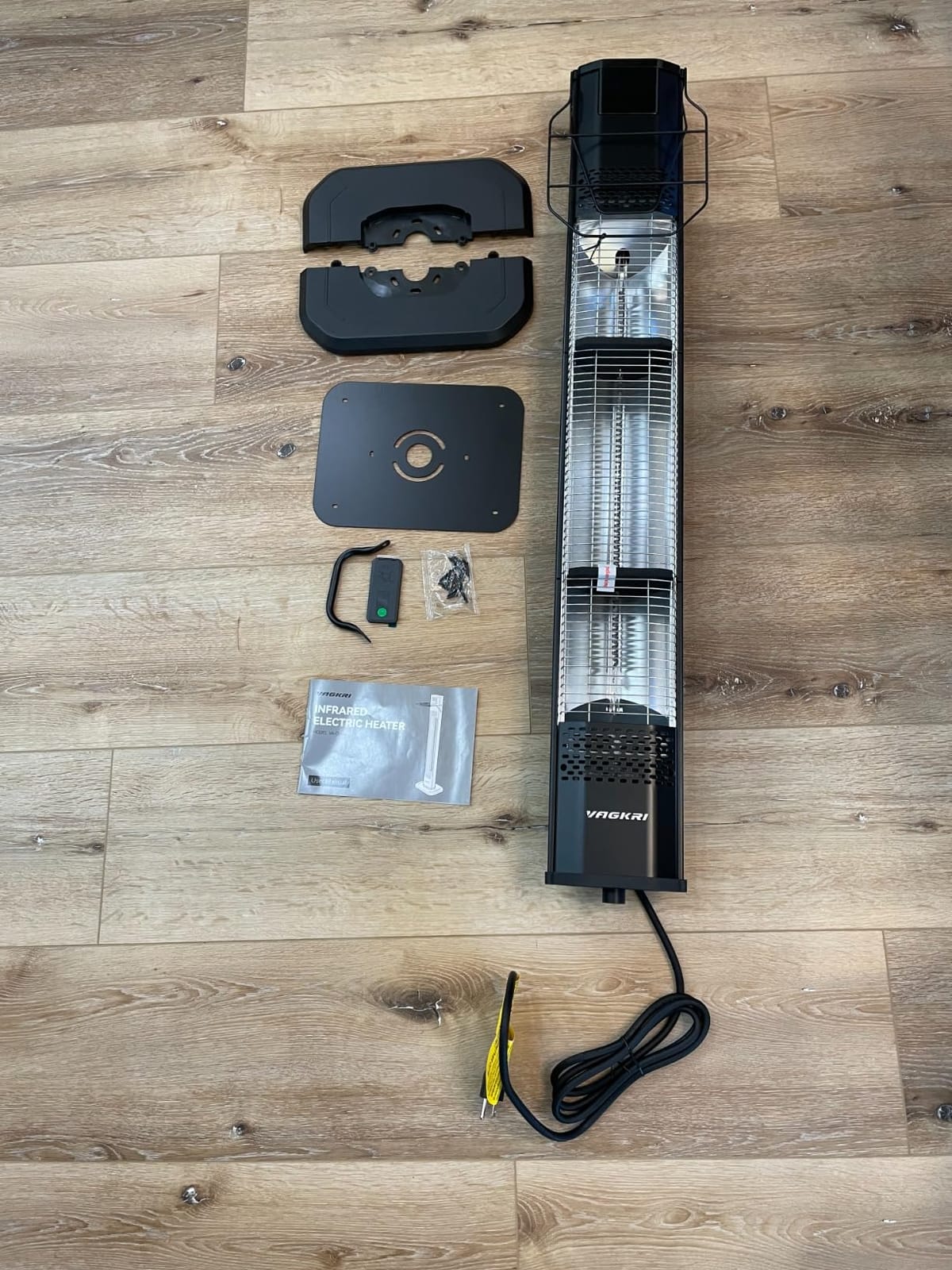
The control granularity is the argument for this one. Nine discrete power settings from 620W to 1500W, spread across a 100 degree wide-angle heat pattern from a 42 inch tower, give you far finer adjustment than a two-setting quartz unit or a three-setting tower.
The 1 to 24 hour programmable timer is the other half of the value. You can schedule a pre-heat before a Saturday morning project and have the garage at temperature when you walk out to it, and the child lock plus tip-over protection make it a reasonable choice for a space the household also uses.
This is the highest average rating in the roundup at 4.5 stars with three percent one-star reviews, though the review pool is small at 106. Reviewers single out the nine heat levels, the timer, and the child lock as the reasons it stands out in busy family spaces.
Two caveats come with a small pool. Durability is less well documented here than on the high-volume models, and the listing describes the heating method as convection even though the elements are infrared, so expect a narrower radiant cone than the wide-angle claim suggests.
When nine levels genuinely matter
Fine control is not a luxury in a garage full of wood, paint, and solvents. Being able to drop to 620W when the room is already warm means you are not running a hot surface next to stored chemicals for no reason, and being able to push toward 1500W for a cold start uses the element within its intended range.
Who should skip it
Skip it if proven long-term durability is your top priority, because 106 reviews is thin evidence next to the thousands behind the DR. INFRARED models. Skip it if floor space is tight, since a 42 inch tower is not something you put behind a car. Mounted models are the better answer for permanent setups.
11. Nfccra 34 inch Wall Mount with Motion Sensor – Best for Automatic Control
Wall-Mounted Electric Patio Heater, 34″ 1500W Infrared Heater With Motion Sensor, IPX5 Waterproof, 9 Heat Level & 9H Timer, Indoor & Outdoor Heaters for Patio, Backyard, Garage, and Decks
1500W radiant, 9 heat levels
120V, 12.5A
IPX5 frame, UL cord
34 inch wall mount, 6.8 lb
Pros
- Only unit here with a motion sensor that powers on and off with occupancy
- Nine heat levels plus a 9 hour timer
- Vertical wall design is harder to knock over
- IPX5 frame and UL certified flame-retardant cord
Cons
- Fasteners are not stainless steel and rust within months
- Unweighted base tips in a breeze
- Control panel durability is mixed
- Some units stopped working after about a month
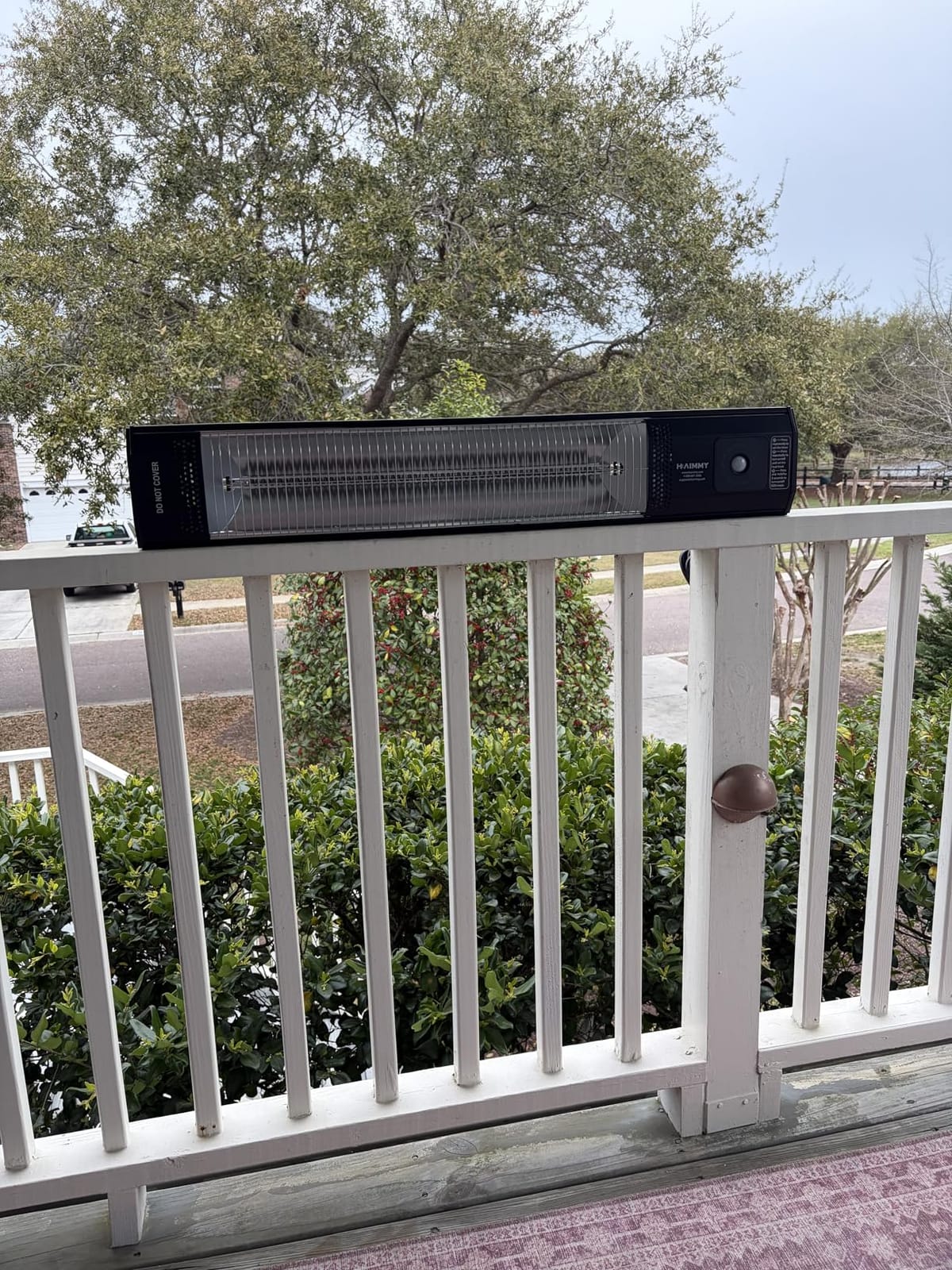
The motion sensor is the feature no other unit on this list has. The heater powers on when it detects people and shuts itself off after five minutes of no activity, which in a garage means the unit is not running all day because you stepped out to get a box.
Nine heat levels and a 9 hour timer handle the rest, and the 34 inch vertical body is safer than a tower in a space with traffic, a workbench corner, and a vehicle. The mounting template and built-in level gauge are small touches that make the wall install quicker.
Owners in garages, basements, and greenhouses like that the heater manages itself without a manual remote command, and the practical praise covers heat output, silence, and easy installation. One owner reports keeping a 12 by 16 foot greenhouse warm through two winters with it.
Durability is where the one-star reviews sit. Reports include rusting fasteners, an unweighted base that tips in a breeze, and electronics that stopped working after roughly a month. The three-year warranty is replacement-only, which is worth knowing before you commit.
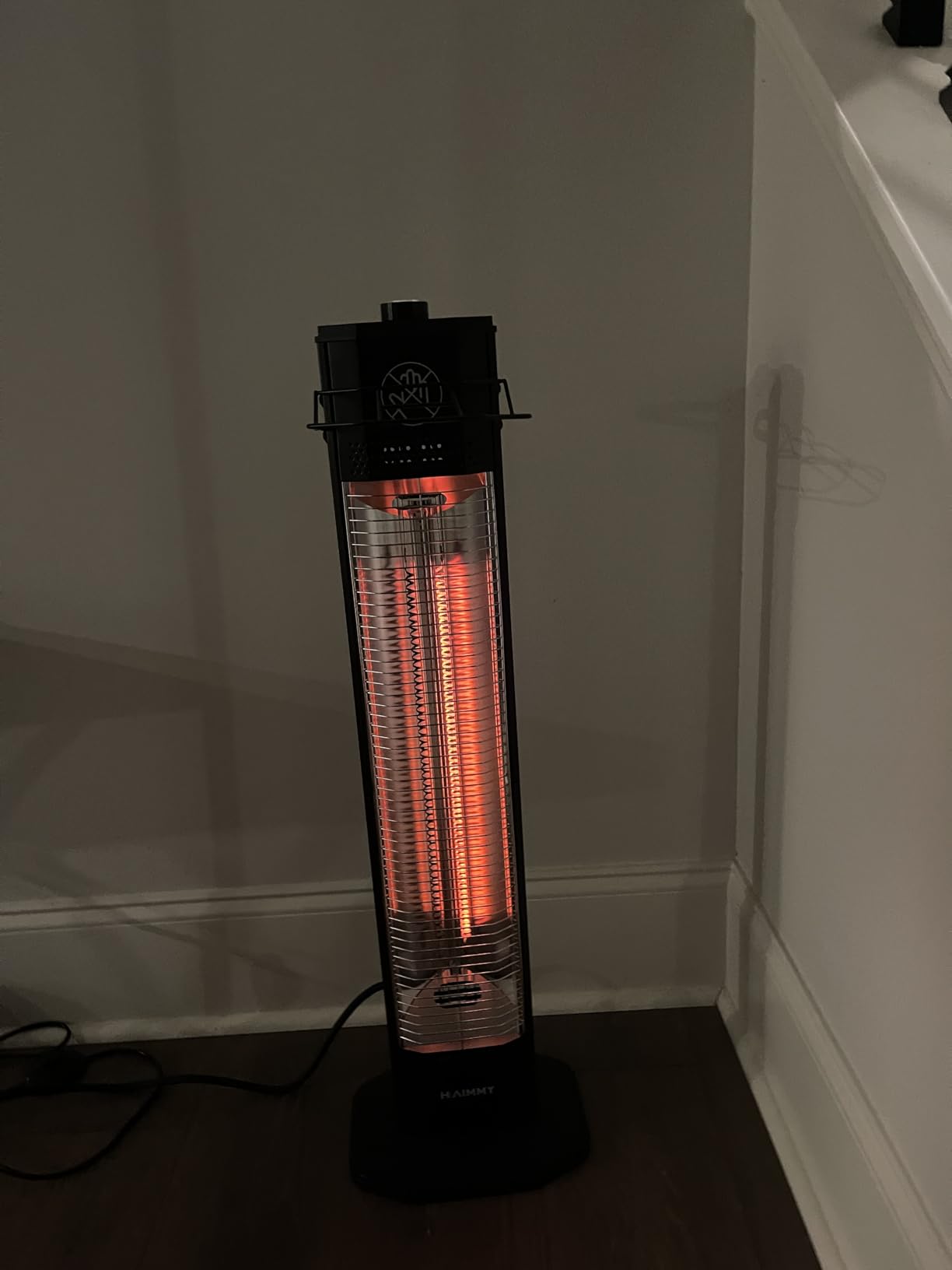
When occupancy control pays for itself
Automatic shutoff matters most in a garage that sees intermittent use. A workshop you visit twice a week, a home gym you use in the morning and evening, or a space attached to a house all benefit from a unit that stops drawing power the moment the room empties, without you thinking about a switch.
Who should skip it
Skip it if you need heat while nobody is standing in the beam, since the sensor will switch the unit off. Skip it for exposed outdoor mounting where the fasteners matter, since rusting hardware is a recurring complaint. If you need proven long-term service history, a higher-review-count model is the safer buy.
12. ThermoMate 3000W 240V Hardwired – Best for 3000W of Radiant Output
ThermoMate Infrared Electric Patio Heater, 3000W Carbon Fiber Heating for Outdoor/Indoor, Porch, Deck, Garage with Remote 24 Hours Timer, Hard Wired 240V
3000W carbon fiber
240V hardwired, dedicated breaker
100 sq ft outdoor, 130 sq ft enclosed
7.8 lb, wall or ceiling mount
Pros
- 3000W is double the wattage of most 120V units here
- Direct radiant heat is largely unaffected by wind
- 24 hour remote timer with two power modes
- ETL certified
- IP54
- and overheat protection
Cons
- Must be hardwired to a dedicated 240V breaker
- Listed amperage does not match 240V rating
- Minimum mounting height of 7.88 ft limits aiming
- Smallest review count in the roundup at 87
At 3000W this doubles the output of every 120V radiant heater in the roundup, and reviewers consistently cite the raw carbon fiber power and the fact that radiant heat hits people and solid objects directly, so wind has little effect on how warm it feels.
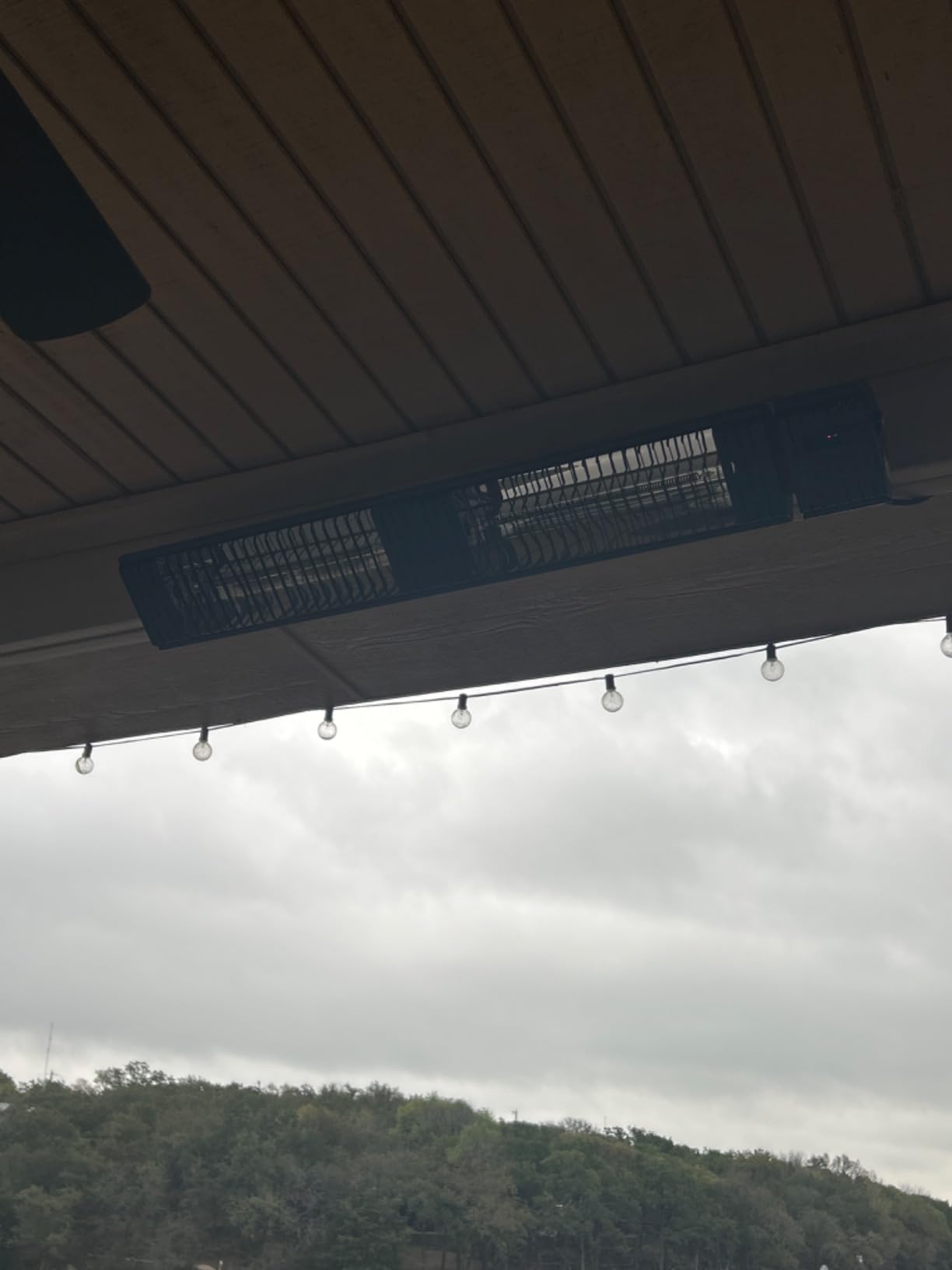
The two modes run 1500W low and 3000W high through the included remote, with a 24 hour timer for scheduled warming. Coverage is listed at about 100 square feet outdoors or 130 square feet in an enclosed area, with a 45 degree adjustable mount for wall or ceiling.
The reviews are short and consistent: 3000W, a reported three-second heat-up, and the timer. That is a good satisfaction profile at 4.4 stars with 76 percent five-star ratings, but the pool is only 87 reviews, so it is the thinnest evidence base in the roundup.
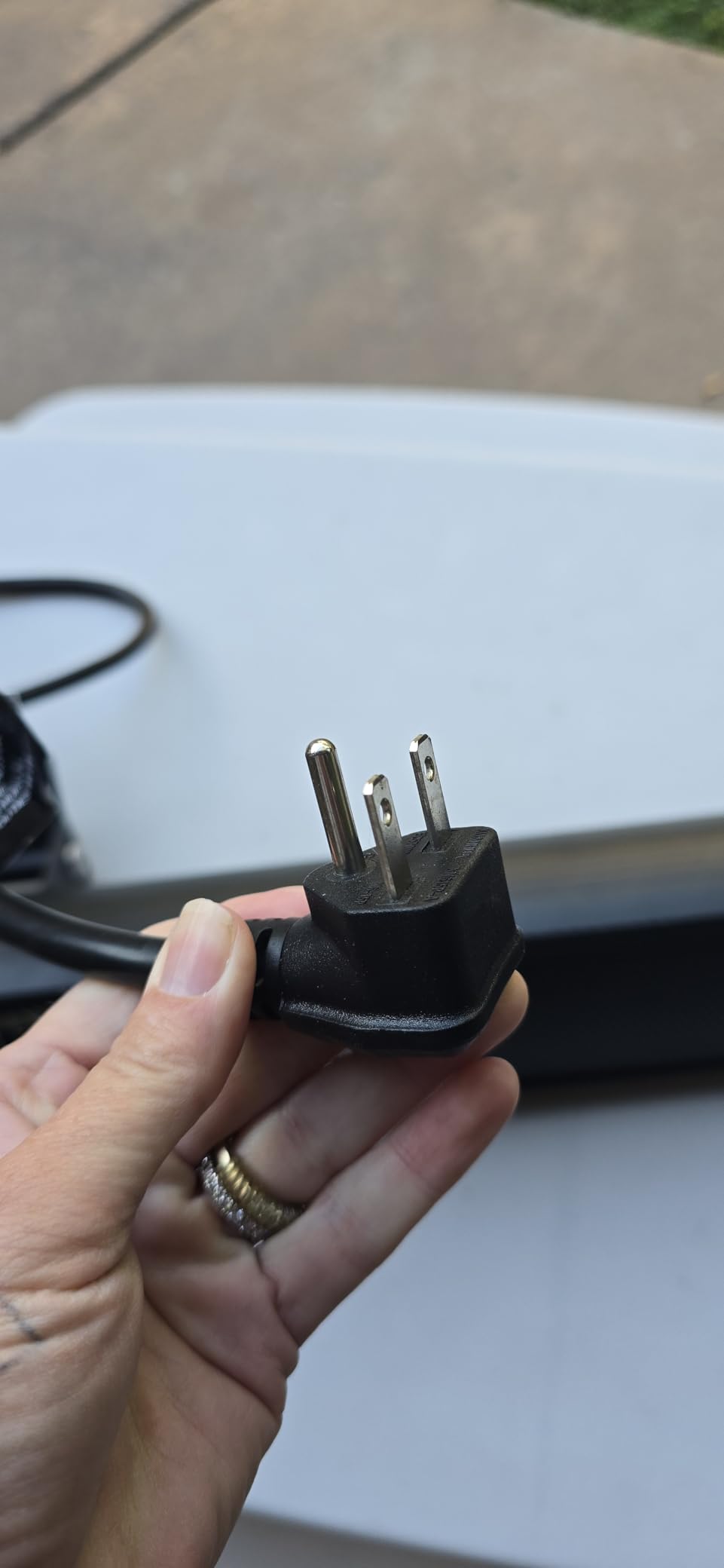
The consensus trade-off is installation. It must be hardwired to a dedicated 240V breaker with the included 6.3 ft lead, and the specification lists 240 volts while showing 12.5 amps, which does not line up with a full 3000W draw. Confirm your circuit sizing with a qualified electrician before you buy.
Why 3000W changes the math
Double the wattage roughly doubles the area you can warm at a given distance, and it gives you a usable answer for a bay that is too big for a 1500W spot unit. It also means the mounting position matters, because the extra reach only helps if the beam is aimed at the space rather than the floor in front of the unit.
Who should skip it
Skip it if you have no 240V circuit and no plan to add one, because this is not a plug-in appliance. Skip it if your ceiling is lower than the 7.88 ft minimum mounting height, which rules out a lot of ordinary residential garages. With 87 reviews behind it, it is also the one to buy with a warranty and return policy in mind.
How Infrared Garage Heating Actually Works
An infrared garage heater does not heat air. A quartz tube, carbon fiber element, or ceramic panel glows and emits infrared radiation that travels in a straight line until it hits a person, a wall, or a car, and that surface absorbs the energy and re-radiates it as warmth. The air in between stays relatively cool, which is why stepping out of the beam feels like stepping out of the sun.
That single fact explains both the appeal and the limit. Radiant heat is immediate and efficient where you actually are, so a bench corner can feel comfortable in a minute rather than twenty. It also stops at the edge of its cone, and it cannot raise the temperature of a two-car bay the way a forced-air unit does.
Forced-air garage heaters like the DR-975 solve that by using a fan to move warm air through the room. They are better at heating ambient space and worse at heating you directly, and they are the reason a shop with a bay door open all afternoon stays workable. The most sensible setups we heard about pair the two: a shop heater to hold the room and a small radiant unit to warm the person at the bench.
One more term worth knowing is zone heating. It simply means aiming heat at an area you use rather than the volume of the room, and every 120V unit in this roundup is a zone heater by design. Marking that on the box before you buy is how you avoid the most common garage heating disappointment there is.
What Garage Owners Get Wrong About Garage Heat
The most common complaint in garage forums is not about a heater failing. It is that people expected a 1500W radiant unit to warm a whole two-car garage, then concluded that infrared heat does not work. Owners with the clearest view put it plainly: no heater keeps an uninsulated garage warm without running constantly, and the best available outcome is a unit that focuses heat on you.
The second recurring theme is the circuit. Owners keep reporting tripped breakers after running two 1500W heaters on one 15-amp outlet, and the fix is never a different heater, it is one heater per circuit. A single 1500W unit at 12.5 amps already uses most of a 15-amp run.
Third, hardwire install costs surprise people. Owners describe 240V circuit work as the single biggest surprise in the purchase, which is why so many of them start with a plug-in unit and only move up when a circuit exists. Fourth, blower noise matters more than expected for anyone spending hours at a bench, which is a point in favour of the fanless radiant units here.
Before you shop, take five minutes to check your garage against our magnetic tool holder guide for bench layout, since where your bench sits decides where the heater has to point. If you also want to monitor temperatures in the space, our infrared thermometer picks are useful for checking whether a zone heater is doing what you think.
How to Choose an Infrared Garage Heater: Size, Power, Mounting
Start with wattage per square foot. A common rule of thumb is about 10 watts per square foot for a well-insulated space, and about 10 watts to 20 watts per square foot in a drafty or uninsulated one. A 24×24 garage is 576 square feet, which lands you near 5,760 watts for a comfortable room temperature. That is a full-garage problem, and it is why every 1500W unit in this roundup is a zone heater.
For a smaller target, reverse the question and measure the area you occupy instead. A bench corner of 60 to 100 square feet is handled comfortably by a 1500W radiant unit, and the coverage figures on the spec sheet tell you how far the beam reaches. If your goal is the whole bay, skip ahead to the 240V and gas options.
Next, decide what you have available. A 120V plug-in unit needs a 15-amp outlet and nothing else, and every one of them draws 12.5 amps at full power, so give it a circuit of its own. A 240V hardwired heater needs a dedicated breaker, a qualified electrician, and a run of copper sized for the load. A gas radiant heater needs a gas supply, a connection kit, a shut-off valve, and combustion ventilation, plus a carbon monoxide alarm in any attached space.
Mounting is the next decision, and it is the one people rush. Wall and ceiling mounting frees the floor for the vehicle and is the most permanent option, but it means drilling into framing and keeping clearance from stored cardboard, paint, and solvents. Freestanding towers need no install and can follow you around the project, but they occupy floor space, can be knocked over, and are more likely to be stored away at the end of the season. A tripod stand lands in between.
Controls decide how much babysitting you do. A thermostat, a remote, and a timer are the three that matter. Thermostats matter most for unattended heating, remotes matter when you want to change output from a chair, and timers matter if you want the garage warm before you get out there. The motion sensor on the Nfccra is the rarest of the three, and it removes a step entirely.
Weather resistance is the detail most guides skip. A garage is not a dry room, and an open door brings rain, road salt, and dust inside. IP24 protects against splashing, IP55 adds protection against jets and dust, and IP65 is dust-tight. The IP rating ladder matters most in an uninsulated garage where the door gets cracked open in bad weather.
Finally, do the boring insulation work before you spend on a bigger heater. Sealing gaps around the garage door, insulating bare walls, and keeping the door down all make any heater on this list work harder, and garage owners consistently report that the combination of insulation plus a zone heater outperforms a bigger heater alone in a drafty space.
Frequently Asked Questions
Are infrared heaters good for a garage?
Yes, for warming people where they work. Infrared garage heaters send heat directly to you, your bench, and your tools rather than heating the air, so a 1500W unit feels warm almost immediately. They will not raise the temperature of an entire two-car garage, and a drafty or uninsulated space makes any heater run longer than you expect.
How many BTUs do I need to heat a 24×24 garage?
A 24×24 garage is 576 square feet. Using about 10 watts per square foot for an insulated space puts you near 5760 watts of rated output, and an uninsulated space needs closer to 10 to 20 watts per square foot. Any 1500W unit at 12.5 amps is a zone heater for that room, not a whole-garage solution.
What is the best heater to heat a garage?
It depends on the space and the power you have. A 120V plug-in infrared unit is best for warming one work zone. A 240V hardwired shop heater is best for holding an insulated two-car garage at temperature. A natural gas radiant overhead heater is the only realistic option listed here for a three-car bay in sub-zero weather.
What are the downsides of using infrared heaters?
The heat is directional, so warmth fades the moment you step out of the beam. They are poor at raising ambient room temperature. A 1500W unit draws 12.5 amps, which is most of a 15-amp circuit. Many models have no thermostat, and radiant surfaces need clearance from cardboard, paint, and solvents.
Do infrared garage heaters use a lot of electricity?
A 1500W unit running at full power for one hour uses about 1.5 kWh. Run that for four hours a day and you are at roughly 2,200 kWh a month, so the cost tracks how much you run it rather than how large it is. A thermostat or a timer is the most effective way to cut that number.
The Best Infrared Heater for Your Garage
If you want one recommendation for the best infrared heaters for garages, take the DR. INFRARED HEATER 1500W wall and ceiling unit. It has the deepest review history in the group, an IP55 rating for damp spaces, and a bracket in the box. Aim it down at your bench, and give it a 15-amp circuit of its own.
Work the whole bay instead, and you are in different territory. A 240V hardwired shop heater holds an insulated two-car garage, and a natural gas radiant overhead unit is the only option here that reaches a cold three-car space. Size the wattage at about 10 watts per square foot, seal the gaps around the garage door first, and pick a thermostat if you want it to run unattended.