
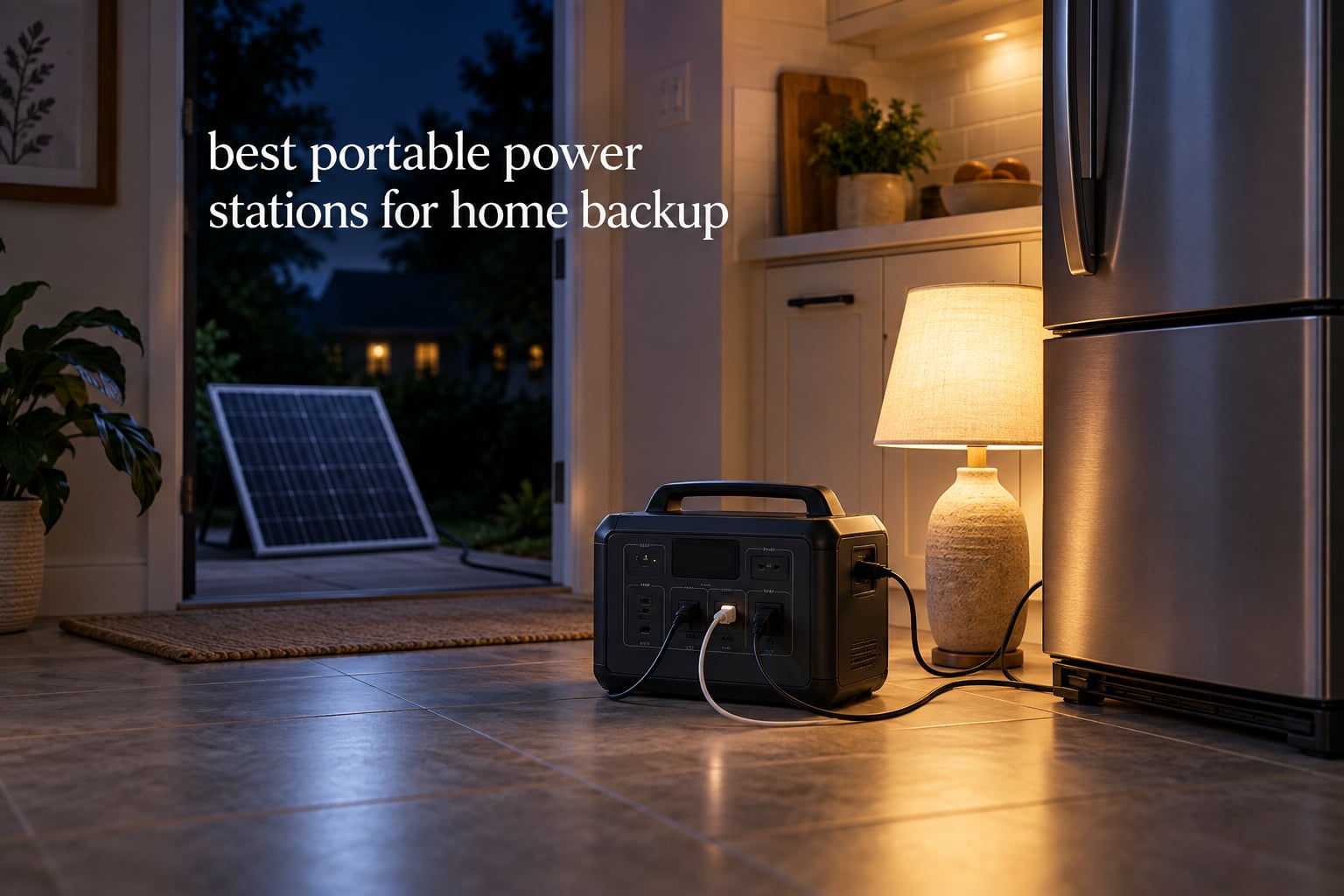
Three stations lead the best portable power stations for home backup right now. The Jackery Explorer 1000 v2 (1,070Wh, 1,500W continuous, 3,000W surge) is the most balanced all-rounder. The EF ECOFlow Delta 3 (1,024Wh, 1,800W output, expandable to 5kWh) wins on port count and carries the highest rating in the group. The Anker SOLIX C1000 Gen 2 (1,024Wh, 2,000W continuous, sub-10ms UPS) refills fastest and handles a CPAP machine or a network rack better than anything else at this size.
A home backup station is one of the most specification-dense purchases you can make, and the number that decides whether it works is rarely the one printed on the front of the box. Homeowners on forums describe staring at spec sheets for weeks without knowing whether to trust watt-hours, continuous watts, or startup surge.
This guide ranks ten stations on the numbers that matter during an outage and is explicit about where each falls short. If you want the category from a different angle, our general portable power station roundup and home backup station guide cover the same hardware.
Everything here is current as of 2026. We compare published specifications, warranty terms and patterns in buyer reviews rather than claiming lab measurements we did not take.
Table of Contents
Top 3 Picks: Best Portable Power Stations for Home Backup (October 2026)


Best Portable Power Stations for Home Backup in 2026
| Product | Specifications | Action |
|---|---|---|
| Jackery Explorer 1000 v2 |
|
Check Latest Price |
 BLUETTI AC180 BLUETTI AC180 |
|
Check Latest Price |
| Anker SOLIX C1000 Gen 2 |
|
Check Latest Price |
 OUPES Mega 1 OUPES Mega 1 |
|
Check Latest Price |
 EF ECOFLOW Delta 3 EF ECOFLOW Delta 3 |
|
Check Latest Price |
 Anker SOLIX S2000 Anker SOLIX S2000 |
|
Check Latest Price |
 Anker SOLIX F3800 Kit Anker SOLIX F3800 Kit |
|
Check Latest Price |
 BLUETTI Elite 300 BLUETTI Elite 300 |
|
Check Latest Price |
 Dabbsson 2000L Dabbsson 2000L |
|
Check Latest Price |
 AFERIY P310 AFERIY P310 |
|
Check Latest Price |
How We Chose These Stations
This is a spec-and-evidence comparison, not a hands-on test log. We have not bench-tested a refrigerator against each unit, so no runtime figure here is presented as a measurement.
We did read every specification sheet, check warranty and cycle-life claims, and work through recurring patterns in buyer reviews. Where reviews flag something the spec sheet hides, such as inverter overhead draw or a surge rating that fails under load, we say so.
Every unit here uses lithium iron phosphate cells, outputs pure sine wave from a single inverter, and has some form of automatic backup mode. What separates them is recharge speed, expansion, outlet count and idle draw.
Capacity and inverter size have to be bought together. A 5,000Wh battery behind a 1,200W inverter fails a hair dryer; a 1,000Wh battery behind a 2,000W inverter is empty by breakfast.
1. Jackery Explorer 1000 v2 – The Best All-Rounder for Home Backup
Jackery Explorer 1000 v2 Portable Power Station,1070Wh,1500W
1,070Wh LFP
1,500W continuous AC
3,000W surge
23.8 lb
Pros
- Full charge in about an hour on emergency mode
- Lightest handling weight in the 1kWh class
- Three pure sine wave AC outlets plus 100W USB-C
- App control over charging modes
Cons
- Solar charging limited to Jackery panels
- 1070Wh is modest for an overnight refrigerator run
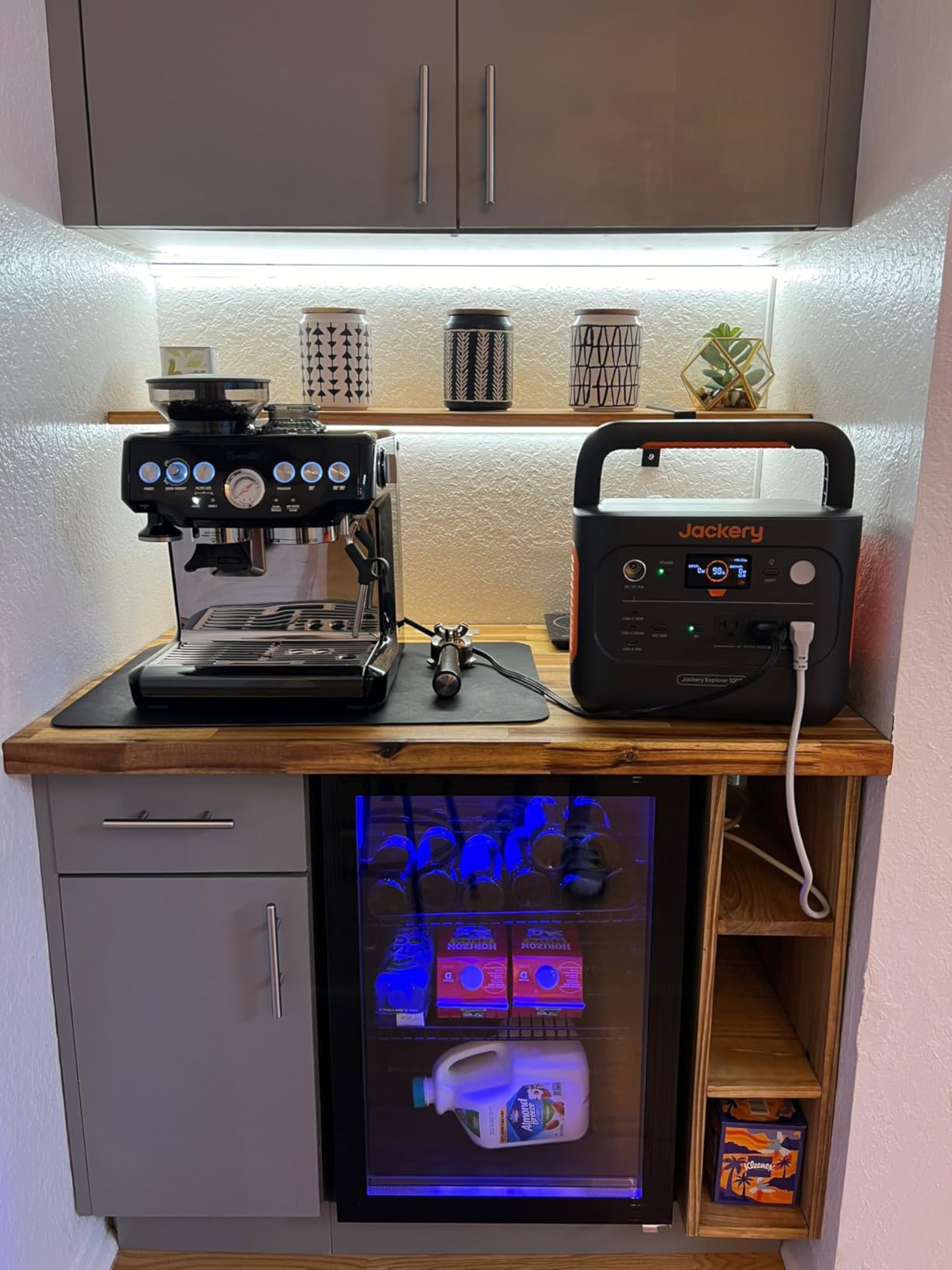
The Explorer 1000 v2 carries 1,070Wh of LiFePO4 capacity, a 1,500W continuous inverter and 3,000W of surge headroom at 23.8 pounds. That weight is light enough for one person to move it from a closet to the kitchen without a dolly.
Emergency fast charge takes the pack from zero to full in roughly an hour through the app, with 1.7 hours as the default. If you learn about an outage a few hours out, that hour decides whether you drive home to a wall outlet first.
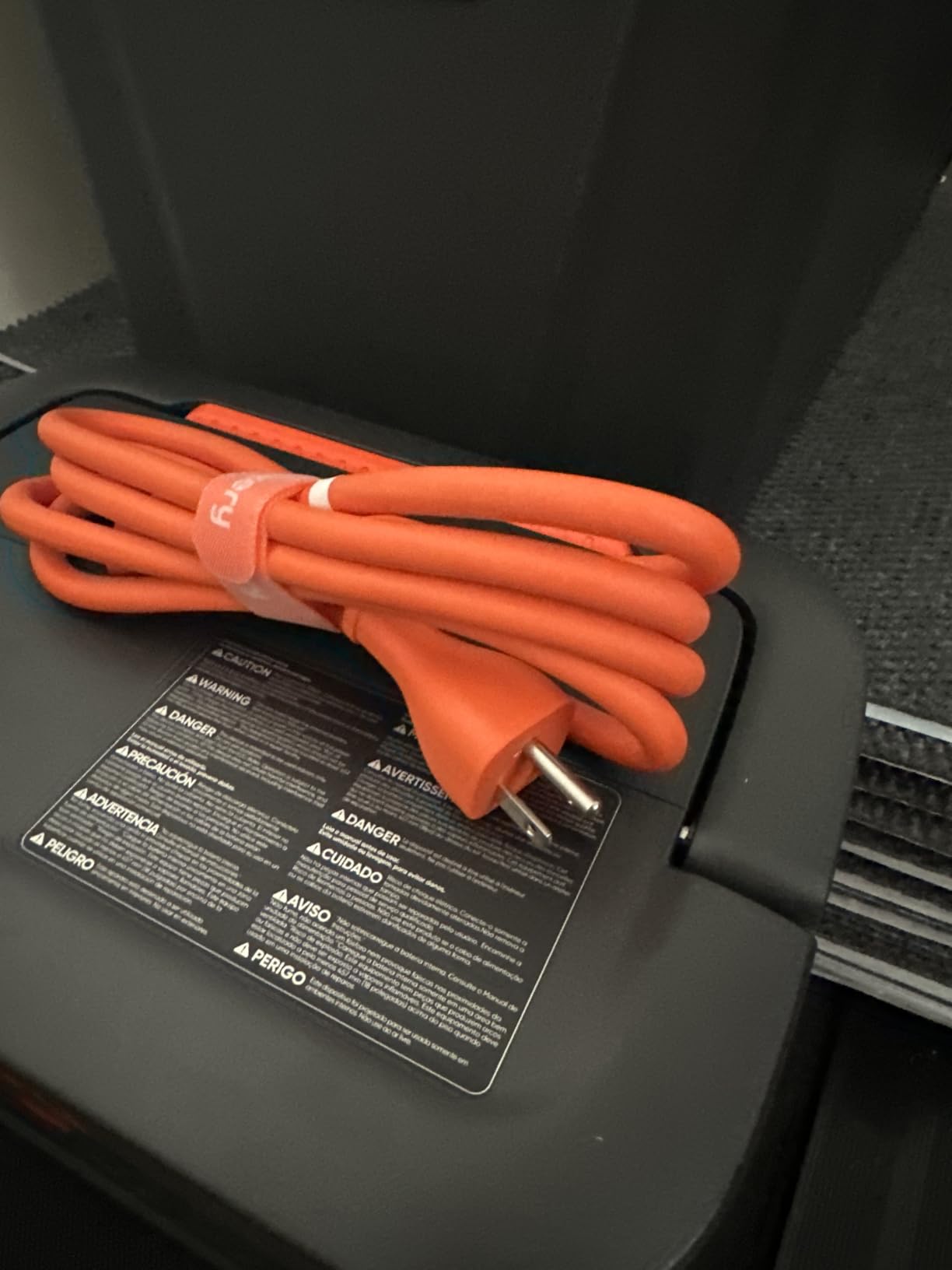
The battery is rated to hold more than 70% of capacity after 4,000 cycles, and the brand rates the chemistry for a 10-year lifespan. The stated warranty on this listing is one year, the shortest of the ten models we reviewed, against 5-year terms from BLUETTI, Anker and EF ECOFlow.
Ports suit a home rather than a campsite: three pure sine wave AC outlets, two USB-C ports at 100W PD, one USB-A and a 12V DC car port. The pure sine wave output is the safe choice for a NAS or a network switch.
Solar input is the one limit. The unit is compatible only with Jackery panels, so a panel from another brand will not charge it. That matters if you plan to buy panels on price per watt.
Who the Explorer 1000 v2 suits
This is the station for a household wanting one device covering phones, a router, lamps and a small refrigerator for a day, with no permanent installation. The foldable handle also makes it realistic to move between a camping trip and a storm weekend.
Where it falls short
One thousand watt-hours is limited for refrigeration. An efficient fridge drawing around 100W on average, cycling rather than running continuously, will stretch the pack but will not comfortably carry a fridge through a second full night. Plan on wall power the next morning.
Add the one-year warranty and the Jackery-only solar restriction and this is a station for short outages and light loads. Anyone with a sump pump, a well pump, or an expectation of multi-day coverage should read the 2kWh and 3kWh entries below.
2. BLUETTI AC180 – Best for an Installed UPS Setup
BLUETTI AC180 Portable Power Station 1152Wh 1800W LiFePO4 Solar Generator
1,152Wh LiFePO4
1,800W continuous
2,700W power lift
20ms UPS
Pros
- Full charge in about an hour at 1440W AC input
- 20ms UPS transfer keeps network gear connected
- LCD shows live input and output watts
- Quiet running with little heat
- Five-year warranty
Cons
- Heavy at roughly 37 lb for a 1.15kWh pack
- Wireless charging pad on top is unreliable
- Draws 15-20W of overhead power with the inverter active
The AC180 is the unit owners describe as an installed home UPS rather than a trunk accessory, and the 20ms transfer time is why that works. Routers, a television and a laptop stay connected through a grid drop without registering it.
Charging is the other headline. A 1,440W AC input refills 1,152Wh in about an hour, and 500W of solar input brings it up in roughly three hours alone. Car and alternator charging widen the refill options if the grid stays down.
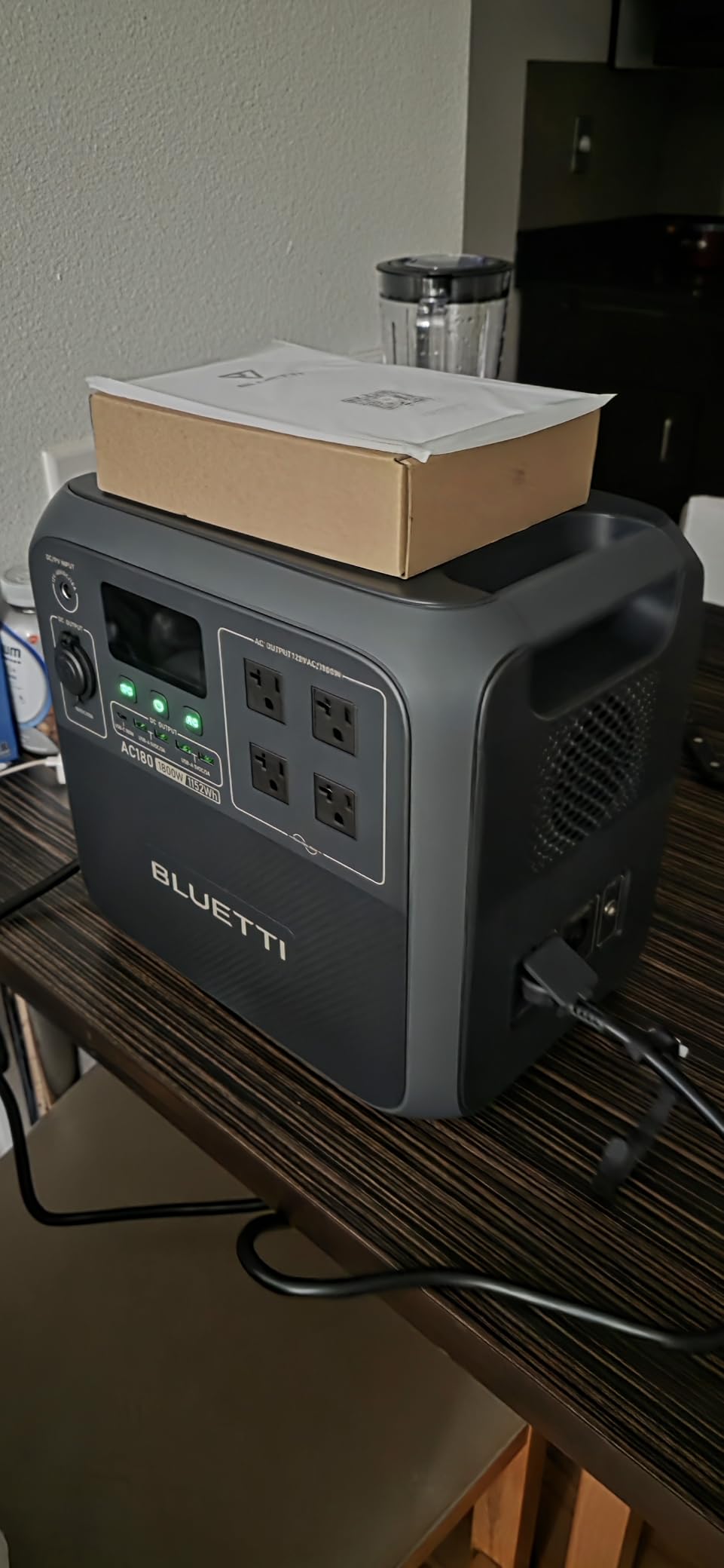
Eight outlets cover AC, USB-C, USB-A, a car port and a wireless charging pad on top. The app can push the unit from 1,800W to 2,700W through BLUETTI’s power lifting feature, which is a software allowance rather than extra hardware, so treat it as headroom for resistive loads and not for a motor start.
The display is more informative than most, showing live input watts, output watts and estimated runtime. That is exactly what you want when deciding whether the microwave is affordable at the current charge.
BLUETTI advises installing firmware at first setup and running a full calibration discharge. Several reviewers reported better performance afterwards, so do that before judging the unit on day one.
Who the AC180 suits
This is my pick for a home office, a network closet, or anyone keeping a medical device plugged in continuously. The transfer time, the fast AC recharge and the five-year warranty make it the most set-and-forget installation in the group.
Where it falls short
The overhead draw deserves attention. With the inverter on, the unit pulls roughly 15-20W before powering anything, so on a router and two lamps that fixed cost eats a real slice of the 1,152Wh rating. Your runtime will be shorter than the label suggests.
At roughly 35-37 pounds it is the heaviest 1kWh-class unit here, and the top wireless charging pad fails often enough that you should not plan on it. For a genuine 2,000W continuous load, read the 2kWh models below.
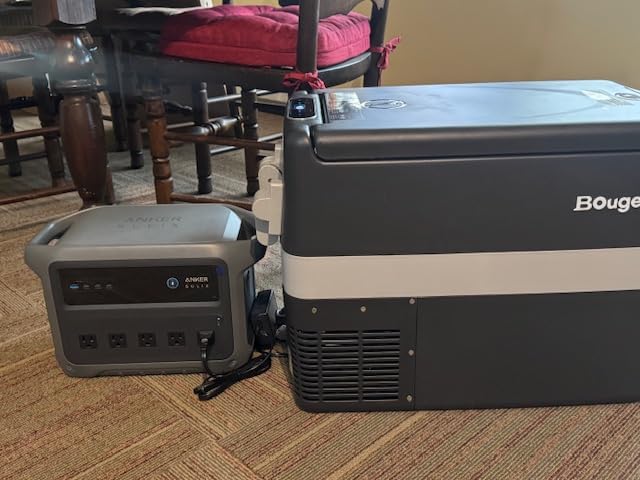
3. Anker SOLIX C1000 Gen 2 – Best for Fast Refill and Medical Devices
Anker SOLIX C1000 Gen 2 Portable Power Station
1,024Wh LiFePO4
2,000W continuous
3,000W surge
under 10ms UPS
Pros
- Roughly 49-minute full recharge at 1600W
- Sub-10ms switchover for CPAP and network gear
- 600W solar input refills in about 1.8 hours
- 14% smaller and 11% lighter than comparable models
Cons
- No battery expansion on the Gen 2 model
- Some inverter distortion measured on a microwave load
- No protective storage case included
The C1000 Gen 2 is the fastest refill in the 1kWh class, and for backup that matters more than most spec debates suggest. At 1,600W of AC input a full charge takes about 49 minutes with HyperFlash enabled, and a 20% top-up takes minutes.
That speed changes the planning math. Given a 12-hour warning window, a station that refills in an hour can be topped up twice, which effectively doubles available energy across a day and a half.
Output leads the capacity class at 2,000W continuous and 3,000W surge. That is enough for a microwave, a hair dryer or a small space heater, none of which the other 1kWh units here will handle unaided.
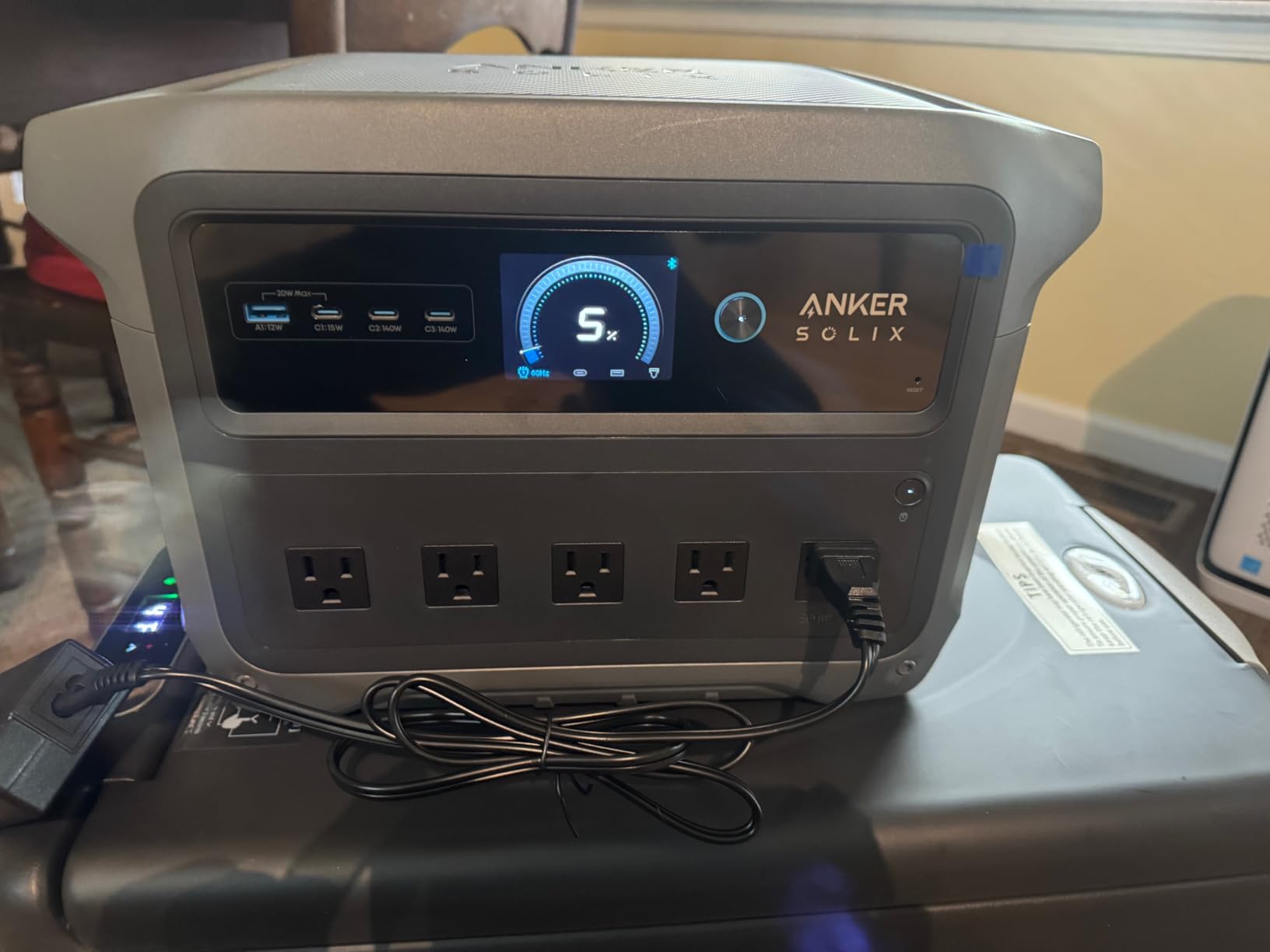
For medical use the sub-10ms UPS transfer is the headline. Owners report running CPAP machines for three nights on a charge, and the app includes a time-of-use mode for scheduling charging around off-peak rates or a solar window.
The InfiniPower system is rated to hold at least 80% of capacity after 4,000 cycles under a five-year warranty. Ten total outlets keep a large mixed load connected without swapping cables, and the unit measures 15.1 by 8.2 by 9.6 inches.
Ten outlets is also a lot of surface for a 1kWh pack to support. If you plan to run a heater and a refrigerator together continuously, the runtime maths works against you regardless of port count.
Who the C1000 Gen 2 suits
If a CPAP machine, an oxygen concentrator or a medical freezer has to keep running, this is the first station to look at. The transfer time is fast enough that the equipment does not register an interruption.
Where it falls short
Removing expansion capability is the significant drawback. The first generation allowed extra battery packs; the Gen 2 does not. If you are buying with the idea of growing to 2,000Wh or 3,000Wh later, that conversation ends at 1,024Wh.
Two smaller points: some buyers measured 15-20% waveform distortion on a microwave load without causing failures, and no protective case is included, so cables live loose in a drawer until you buy one.
4. OUPES Mega 1 – Best Expandable Power in the 1kWh Class
OUPES Mega 1 Portable Power Station 1024Wh 2000W (4500W Surge)
1,024Wh LiFePO4
2,000W continuous
expands to 5,120Wh
0-80% in 36 min
Pros
- 0-80% in 36 minutes on AC
- Expands to 5120Wh with two B2 extra batteries
- 2000W continuous output for this class
- Well-spaced front AC outlets
Cons
- Advertised 4500W surge not achieved in practice
- Charging fan runs continuously and is noticeable
- Basic Bluetooth app with unreliable Wi-Fi pairing
The Mega 1 does something no other station in this group manages at this capacity: it grows. Two B2 extra batteries take 1,024Wh to 5,120Wh, matching the ceiling EcoFlow reaches through its own expansion ecosystem.
Recharge speed is the second selling point. Zero to 80% takes 36 minutes on AC and 26 minutes with solar combined, from 1,400W of AC input and 800W of solar input.
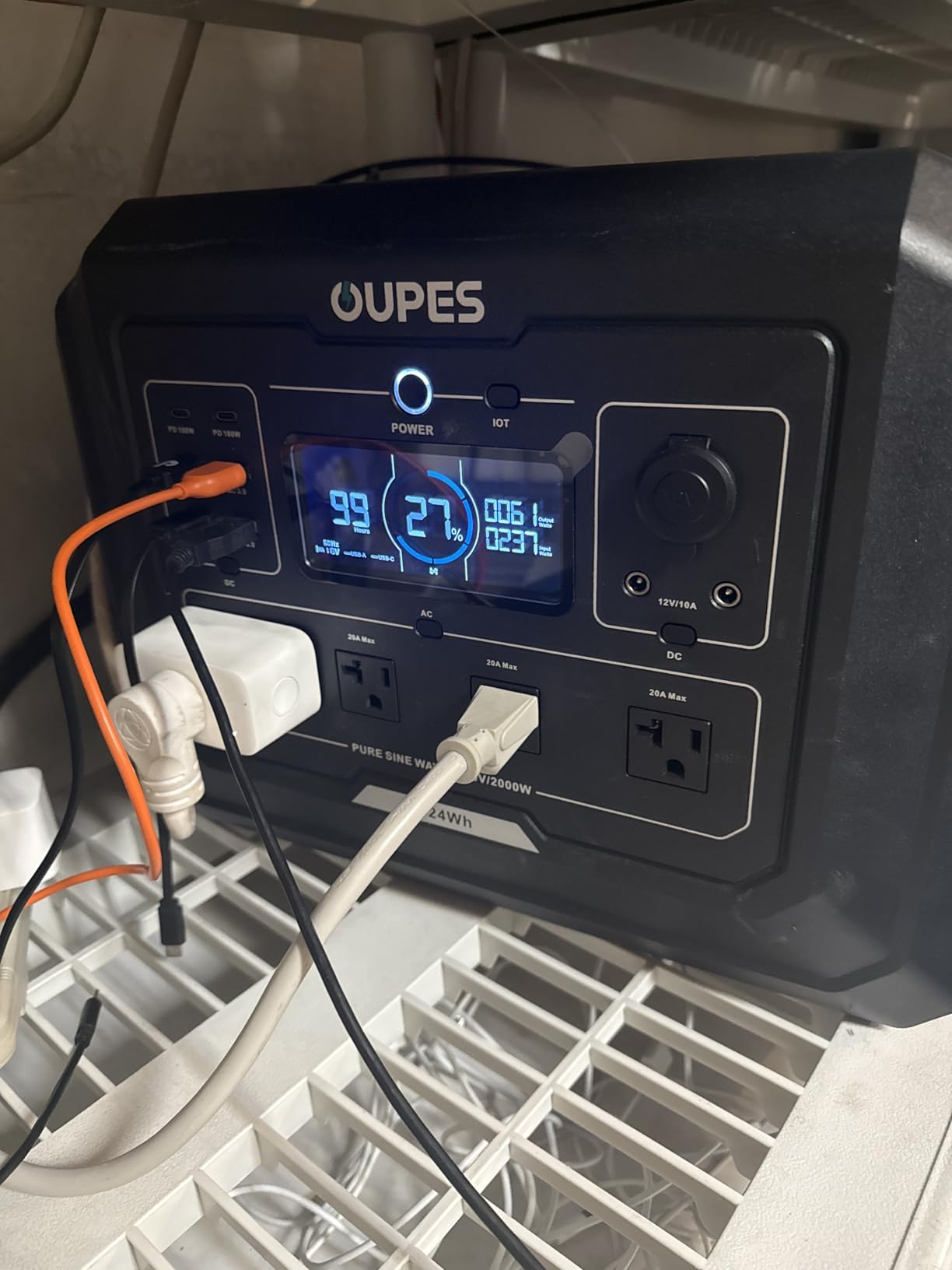
Output is a genuine 2,000W of continuous pure sine wave output, and the port set includes dual 100W USB-C PD, four QC3.0 USB-A, 12V DC outputs and four 120V AC outlets. Charging inputs sit on the side panel, which matters when you are plugging in by flashlight.
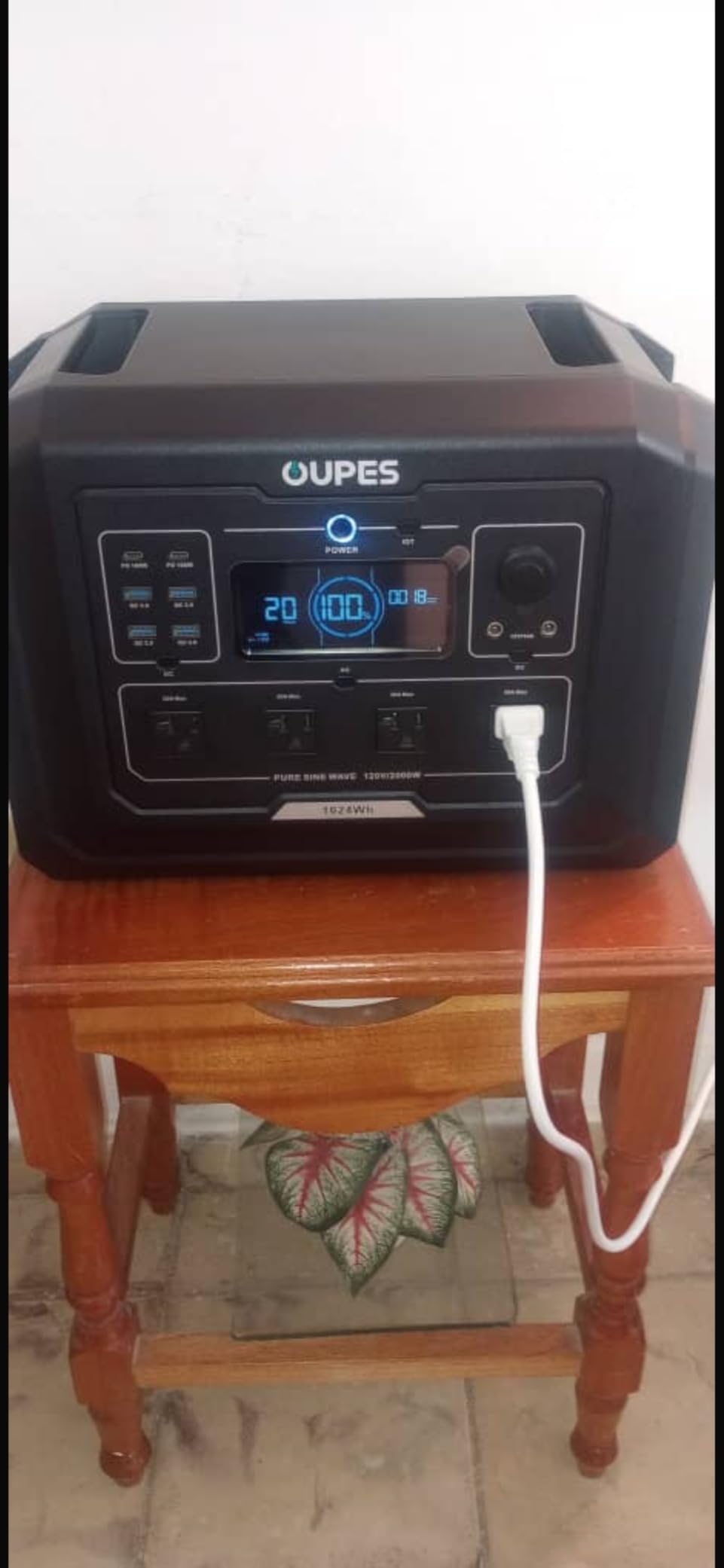
The 3,500-plus cycle LFP cells hold around 80% capacity after years of heavy use under a five-year warranty, and the smart BMS handles cell balancing and thermal control. The app also offers high and low input settings, roughly 1,200W or 600W, for weak circuits.
Value is the reason most buyers land here. Reviewers treat the Mega 1 as a power-per-dollar leader against the EcoFlow, Jackery and BLUETTI equivalents, and OUPES support is frequently credited with fast replacement on early failures.
At 27.8 pounds it sits mid-pack for weight, and the high and low charge modes mean you can protect a small inverter or shared circuit instead of overdriving it.
Who the Mega 1 suits
This is the pick for someone who knows a short outage is likely but wants the option of a long one. Buying the base unit now and adding a battery later means starting at a manageable size without changing platforms.
Where it falls short
The surge claim is the problem. OUPES advertises 4,500W and buyers report units tripping consistently around 2,050-2,200W in practice. For a sump or well pump, plan on the continuous rating rather than the surge number.
Noise and software are the other drawbacks. The cooling fan runs continuously during charging and is audible in a quiet room, and the Bluetooth app is thin, with no cell state or temperature detail and unreliable Wi-Fi pairing. The charge cable is also proprietary.
5. EF ECOFlow Delta 3 – Best Port Count and Expandability
EF ECOFLOW Delta 3 Portable Power Station, 1024Wh 1800W
1,024Wh LiFePO4
1,800W AC output
expands to 5kWh
13 appliances
Pros
- Highest average rating in the group with a strong five-star share
- 80% charge in about 30 minutes
- 13 appliances powered simultaneously
- Expands to 5kWh across EcoFlow battery packs
Cons
- 1800W continuous is the lowest in this 1kWh group
- X-Boost needed for resistive loads above that level
The Delta 3 holds the highest average rating of anything in this comparison, and the reasons repeat across reviews: fast charging, quiet running, a wide port selection and straightforward expansion.
Charging is the standout. With 500W of solar input combined with up to 1,500W of AC, the pack reaches 80% in about 30 minutes and full in 56. If you already own a folding panel, dual input cuts refill time more than buying a bigger station would.
It powers 13 appliances at once, the widest port selection in the group, and expands to 5kWh using DELTA 3, DELTA Pro 3 or DELTA 2 Max packs. That cross-platform path means the accessories you buy keep working if you move up a size later.
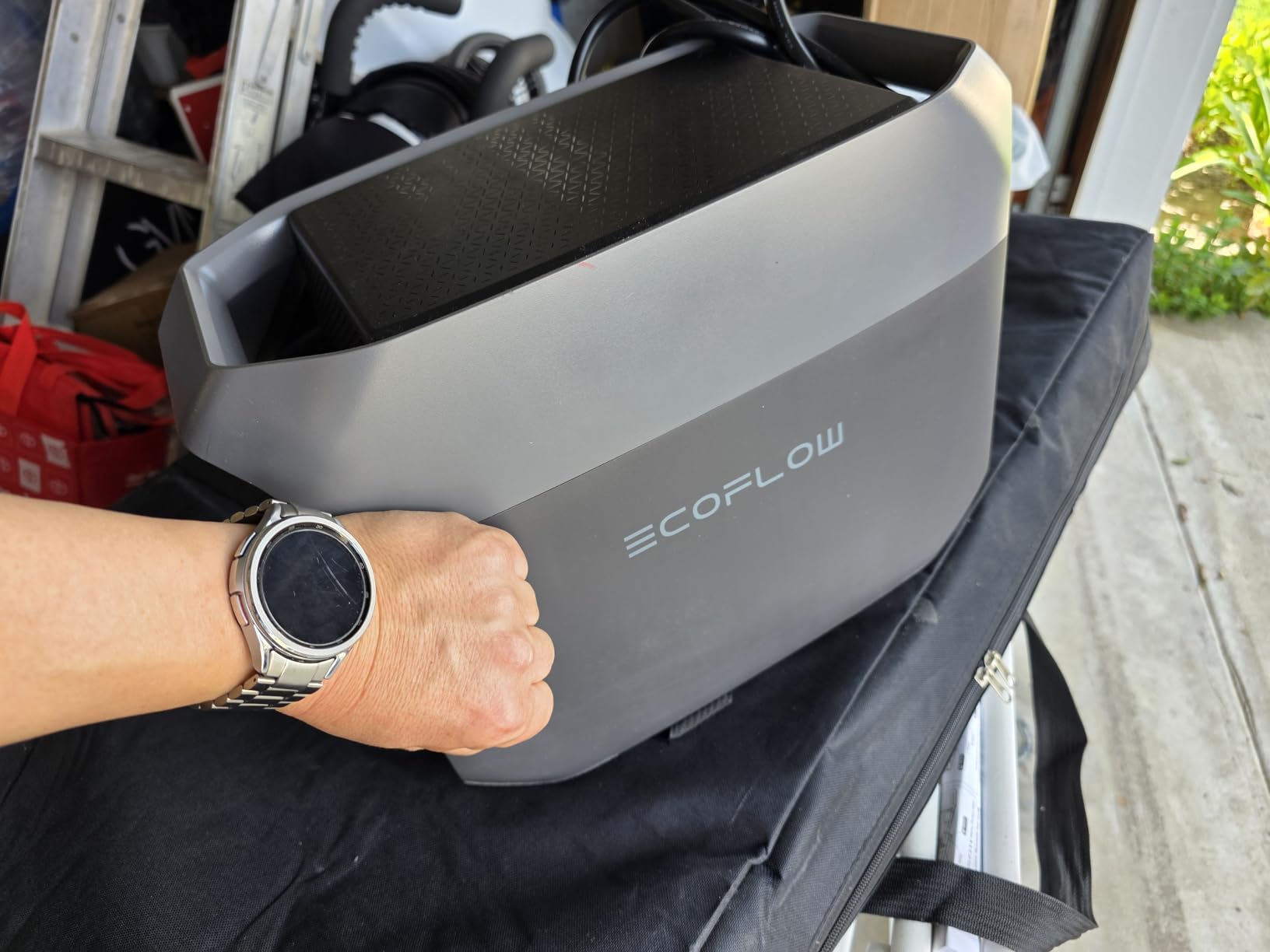
Durability is handled properly. The pack carries IP65 for splash, dust and oil resistance, the cells are rated for 4,000 cycles to 80%, and EcoFlow supports it with a five-year warranty and service period.
Noise is a real strength. Published figures put it under 30dB at 600W and under 40dB at 1,200W, which matches owner reports in a bedroom or office.
Output is 1,800W AC, and X-Boost pushes resistive loads higher, around 2,200W or 3,600W depending on the appliance. Treat the boost as headroom for a heater or kettle, not a motor start.
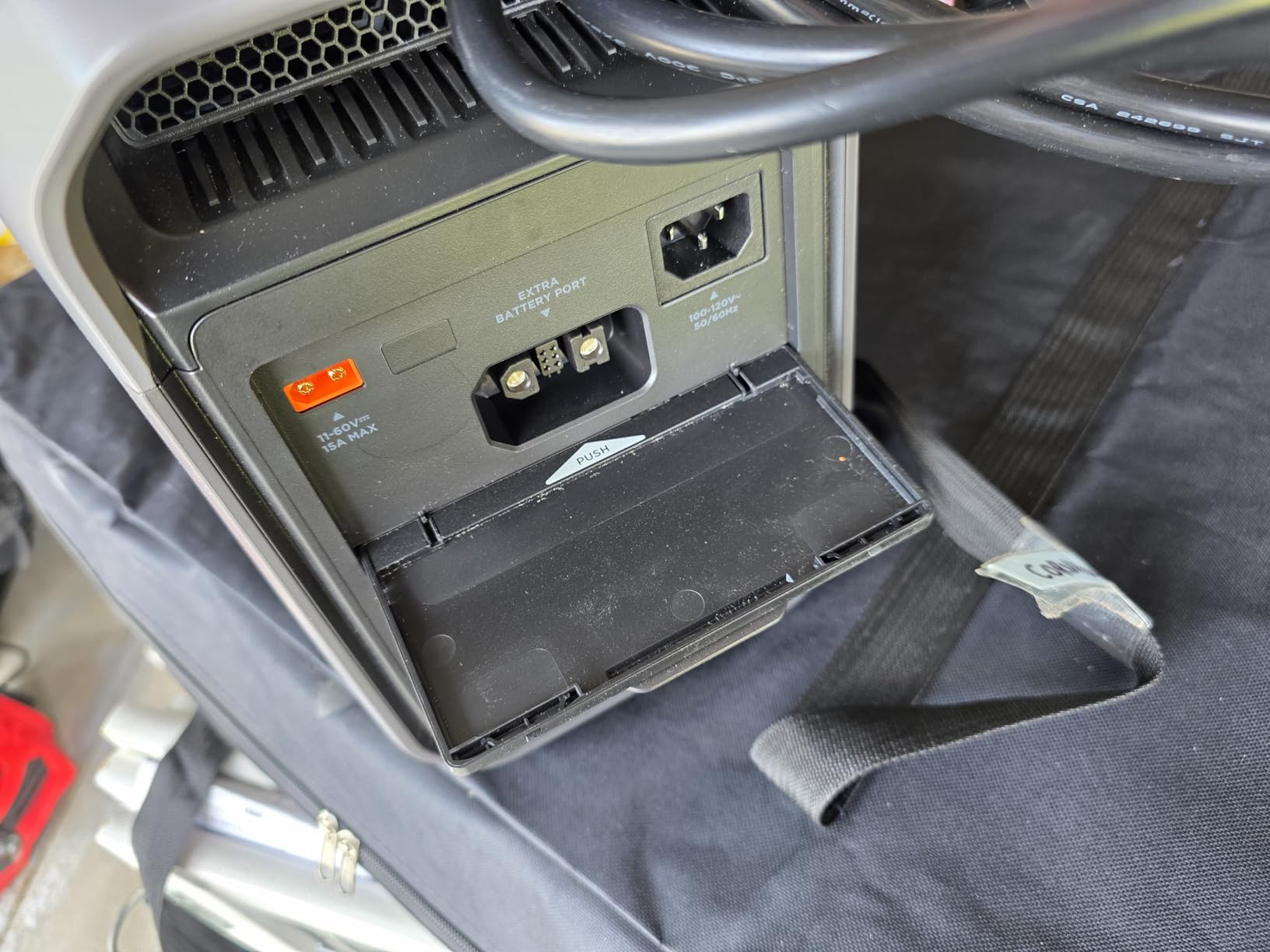
Who the Delta 3 suits
This is the station for a household with a long list of small things to keep alive at once. Routers, a modem, an NVR, several cameras, lights, a laptop and a television all fit inside 13 simultaneous outputs, and IP65 lets it live in a damp garage or utility room.
Where it falls short
The 1,800W continuous output is the lowest among the 1,024Wh stations here, behind both the OUPES Mega 1 and the Anker C1000 Gen 2 at 2,000W. If your list includes a microwave or a space heater, boost is less reliable with motor-driven loads.
At roughly 27.6 pounds it is not the lightest unit in the group. For a battery-first household that will never touch a high-draw appliance, the Jackery Explorer 1000 v2 is lighter and simpler.
6. Anker SOLIX S2000 – Best Long-Life Fridge Backup
Anker SOLIX S2 Portable Power Station, 2,010Wh, 1,500W
2,010Wh LFP
1,500W continuous AC
10,000-cycle battery
6W idle draw
Pros
- 10000-cycle 314Ah LFP cells rated for a 15-year lifespan
- 6W idle draw supports long standby fridge backup
- Six recharge paths including alternator and generator
- 30% smaller and 25% lighter than the 2kWh category average
Cons
- No 12V DC port
- 1500W output is modest for 2010Wh
- Only 8 outlets for a unit this size
The S2000 is built around one job: keeping a refrigerator and the network alive for a long time with minimal supervision. Its 2,010Wh capacity, 6W idle draw and stated efficiency gains translate into a published figure of up to 35 hours of fridge backup, the longest in this roundup.
The battery specification is the most aggressive claim in the group. Anker rates the 314Ah LFP cells for 10,000 cycles and a 15-year lifespan, against 3,500 to 4,000 cycles for everything else listed here.
Recharge flexibility is unusually good: six paths covering wall outlet, solar, a 400W panel, a car outlet, an alternator charger and a generator. In a long outage the alternator charger is the one most people forget exists.
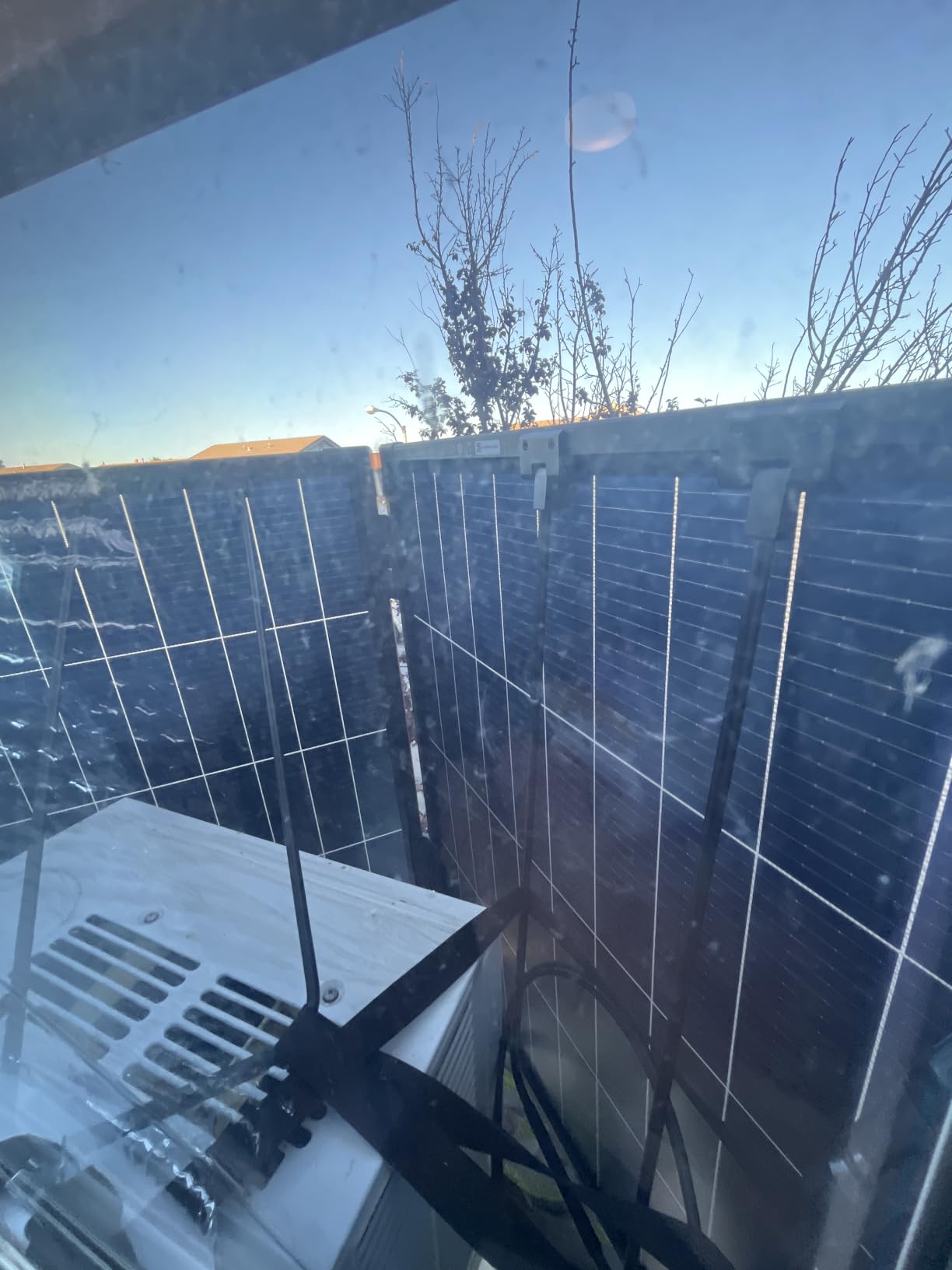
At 8.19 by 11.1 by 12.7 inches and 35.7 pounds, Anker states it is 30% smaller and 25% lighter than the category average. Eight outlets split between front and rear panels let cables run cleanly to appliances in different rooms.
Under 10ms UPS switchover keeps a network stack connected through a transition, and there is no fan noise to speak of on light loads. The trade is a 303-review base, which is thin next to the 1kWh units with thousands, and the cycle claim has had less time to be tested by ordinary households.
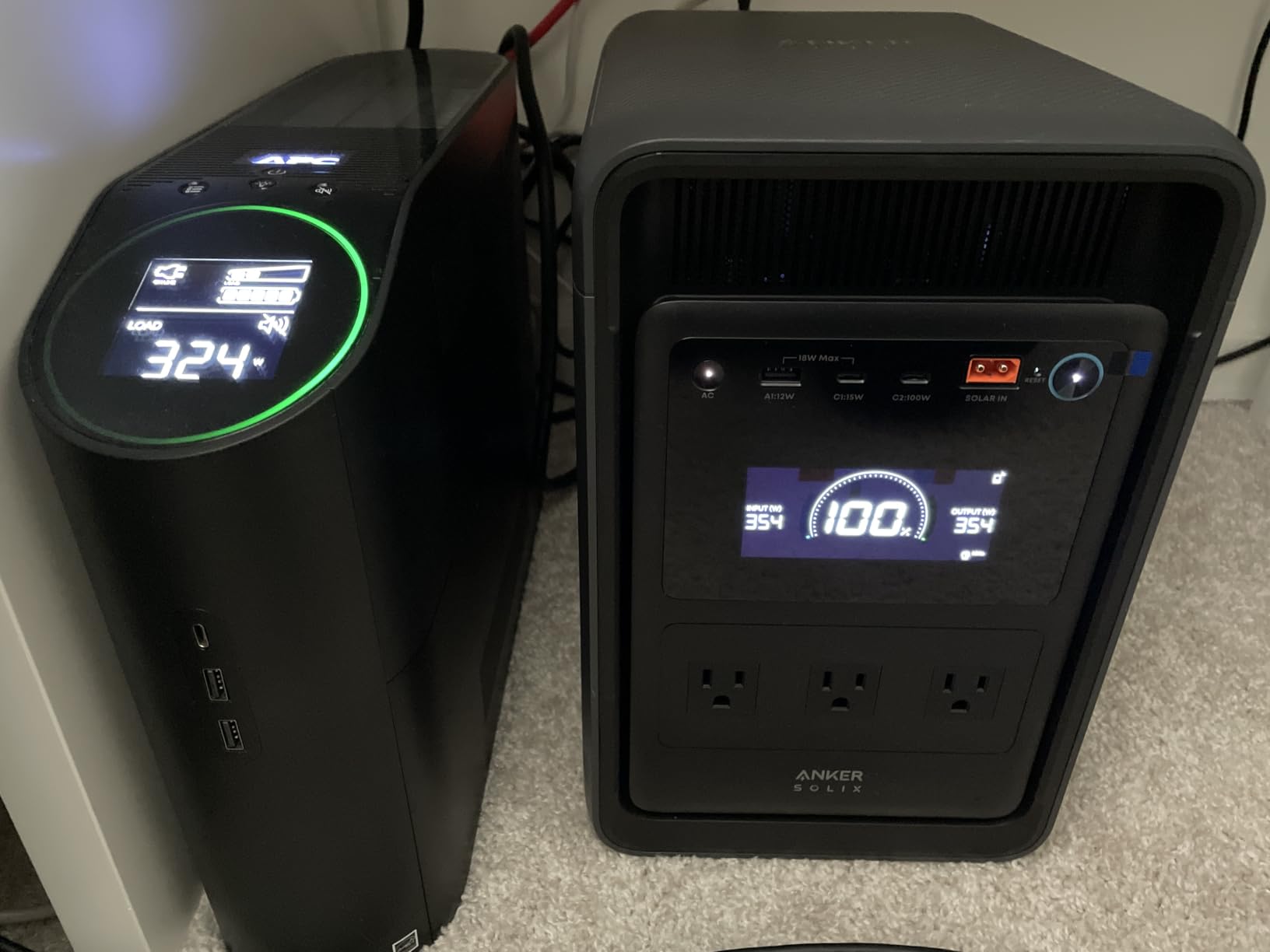
Who the S2000 suits
This is the one I would consider for an elderly relative living alone, provided someone visits periodically. A station set up once, left holding a small load for 35 hours, and recharged from a car during a power cut demands far less attention than one checked weekly.
It also suits a second home or a cabin, and our RV power station guide covers the sizing questions for that use in more detail.
Where it falls short
Capacity and output are mismatched for high-draw work. 2,010Wh behind a 1,500W inverter means a long fridge run but not much else at the same time, and any heating appliance over 1,500W trips it.
There is no 12V DC port for running 12V accessories directly, and 8 outlets is lean for a unit meant to keep a whole kitchen alive.
7. Anker SOLIX F3800 Kit – Best for 240V and Whole-Home Essentials
Anker SOLIX F3800 Portable Power Station and Transfer Kit, 3840Wh, 6000W
3,840Wh LFP
6,000W 120V/240V
expands to 26.9kWh
dual voltage
Pros
- Genuine 6000W dual-voltage output for 240V appliances
- 3840Wh base capacity expandable to 26.9kWh
- NEMA 14-50 charges an EV and powers an RV
- Includes a Smart Generator 5500 for automatic start-stop
Cons
- Very heavy at 132.3 lb and bulky at 34-inch cube
- Highest price point in the group
- 4.4 average rating with the widest one-star share here
The F3800 is the only station here that stops being a portable device. At 3,840Wh and 6,000W of dual-voltage 120V/240V output, it is built to sit in a garage and behave like a small home battery system, and it is the answer when your load list includes a dryer, a well pump or a workshop.
That 240V output is the headline. Almost everything else in this roundup is 120V only, so a clothes dryer, a large electric water heater or a 240V well pump cannot be connected at all. The F3800 has both, plus NEMA 14-50 and L14-30 outlets for RV shore power.
It also charges an electric vehicle directly through the NEMA 14-50 port at up to 6,000W, a genuinely useful capability for a household that relies on an EV to leave an evacuation zone.
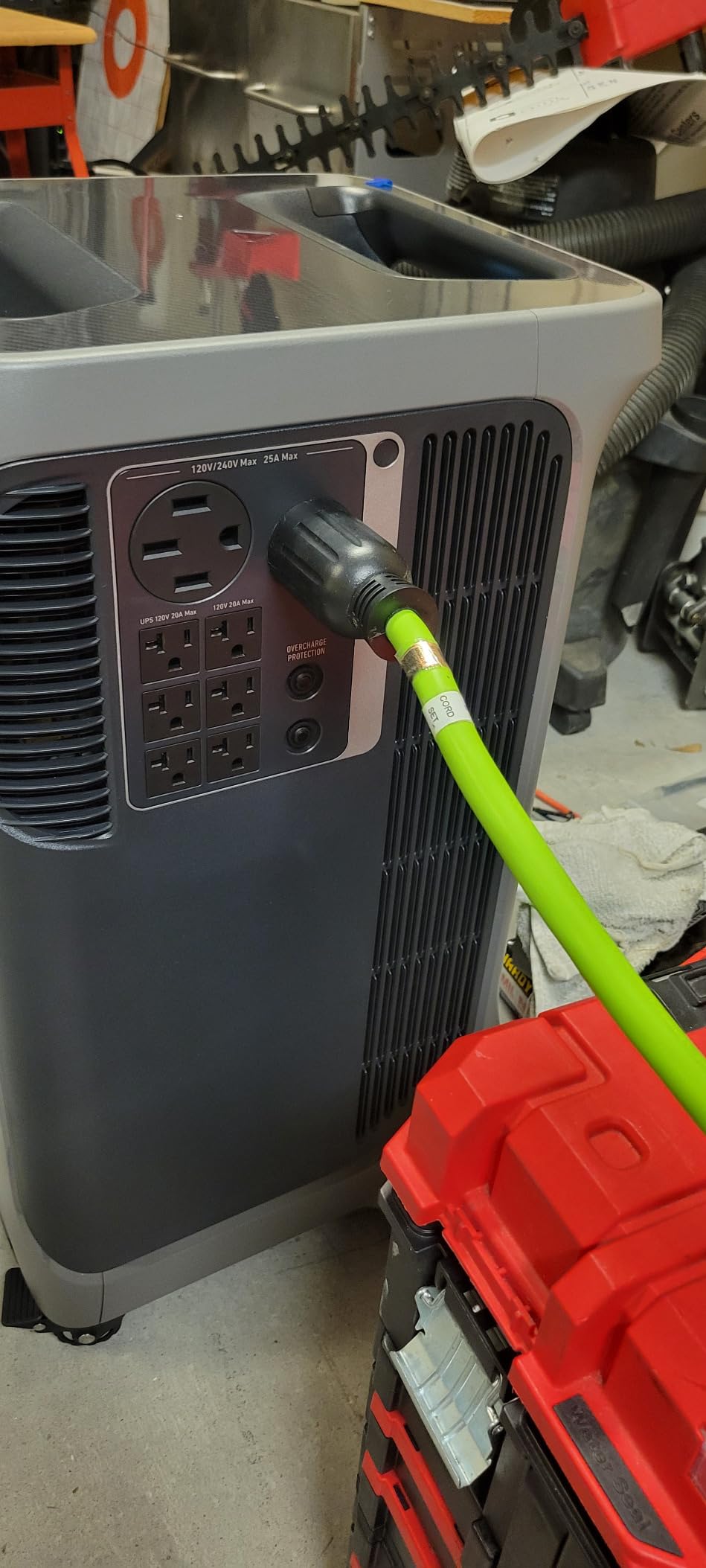
Expansion runs to 26.9kWh with up to six battery packs, and two units pair for 12,000W. The included Smart Generator 5500 adds automatic start and stop with a fuel generator, the hybrid approach that extends runtime indefinitely.
The battery uses EV-class LFP cells with a smart temperature system under a five-year warranty, monitored through the app over Wi-Fi or Bluetooth. The 4.4 average with a 7% one-star share is the widest spread here: buyers needing 240V rate it very highly, buyers wanting trunk portability rate it poorly.
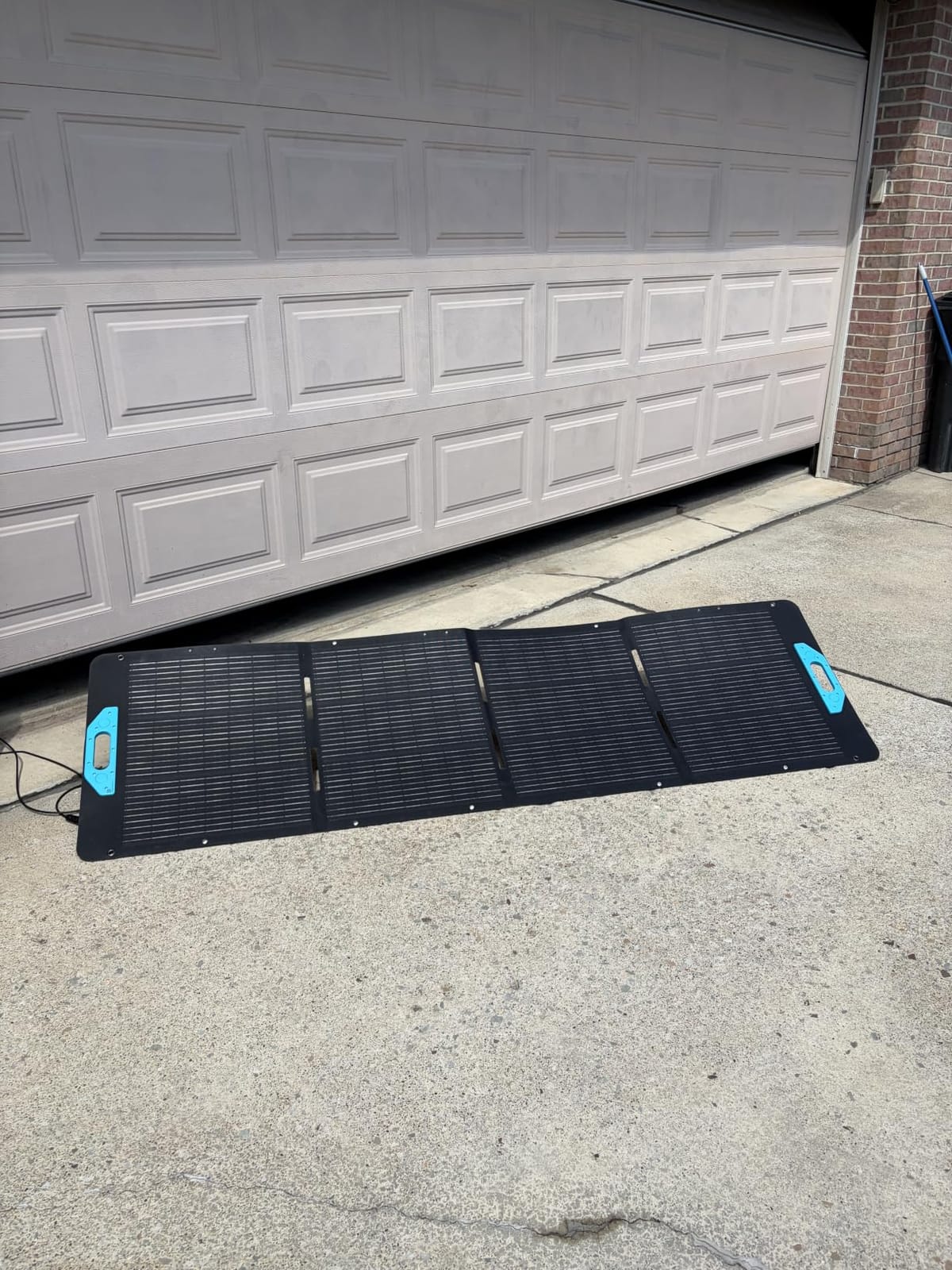
Who the F3800 suits
This is for a household that has decided portable stations will not be enough and wants a modular system that grows, rather than a permanently installed battery with a permitting process. If your loads include 240V appliances or a well pump, nothing else on this list serves you.
Where it falls short
At 132.3 pounds and 34 inches per side, this is not portable by any reasonable definition. Two people can move it, and it stays where it is put. If you wanted one box for the trunk and the closet, the mismatch is severe.
It is also the most expensive option here by a wide margin, and 320 reviews is thin for a machine at this end of the market. Stepping up from a 1kWh station is a much larger commitment than stepping up from 2kWh.
8. BLUETTI Elite 300 – Best Compact 3kWh for RV and Home Use
BLUETTI Elite 300 Portable Power Station for RV & Home Backup 3014.4Wh
3,014Wh LiFePO4
2,400W continuous
4,800W surge
10ms UPS
Pros
- 3014Wh in a footprint close to two ammo cans
- 10ms UPS switchover tested with a computer
- TT-30 outlet plus 12V/30A DC for RV fridges and water pumps
- 0-80% charge in as fast as 78 minutes
Cons
- No battery expansion port
- DC solar input capped at 60V/20A
- 58 lb weight
- Soft-start ramp failed to start a 500W dehumidifier
The Elite 300 solves a problem the other 3kWh stations create: they are enormous. Frost & Sullivan recognized it as the world’s smallest 3kWh portable power station, nearly 59% smaller than traditional large units, and at 14.4 by 12 by 11.7 inches it fits where other 3,000Wh boxes do not.
Output is 2,400W continuous with 4,800W of surge, and the 10ms UPS switchover has been tested with a computer through a grid transition without interruption. That makes it a strong home office station as well as an RV one.
The RV hardware is the separator. A TT-30 outlet and 12V/30A high-current DC output will run an RV refrigerator, a water pump or a diesel heater directly, and no other 3kWh unit in this list offers that. There is also a 140W USB-C output for laptops.
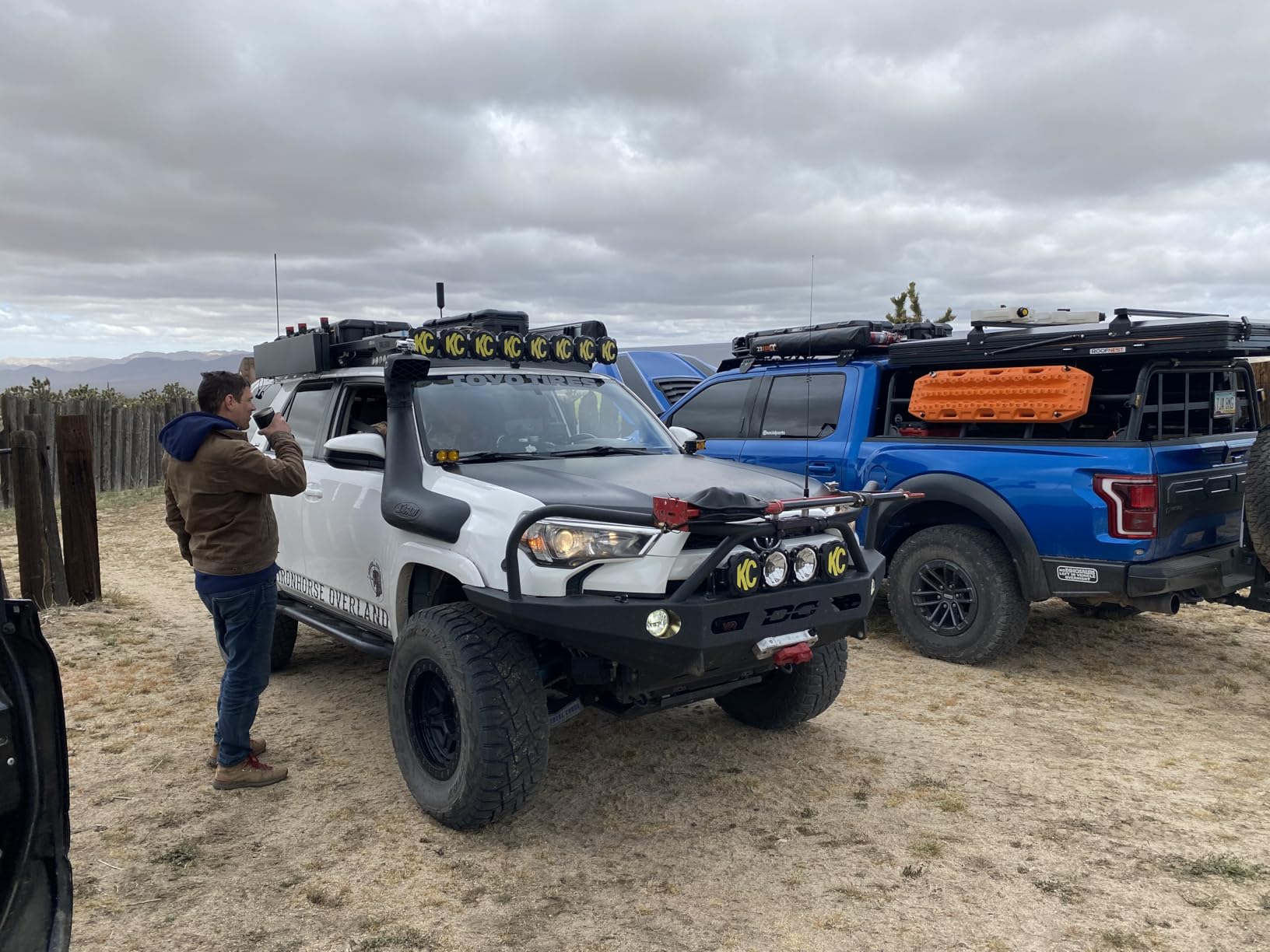
Charging reaches 80% in as fast as 78 minutes, and firmware can pull roughly 520W from a 480W bifacial panel in good conditions. Measured round-trip throughput lands around 77%, respectable for the size.
The display shows real battery watts rather than only output watts, and the true 20A NEMA outlets accept full-size plugs. Buyers report holding a sustained 2,400W load for about half an hour without trouble.
Several settings can only be changed from the app, firmware updates require Wi-Fi, and the display is hard to read in direct sunlight if the unit lives near a garage door.
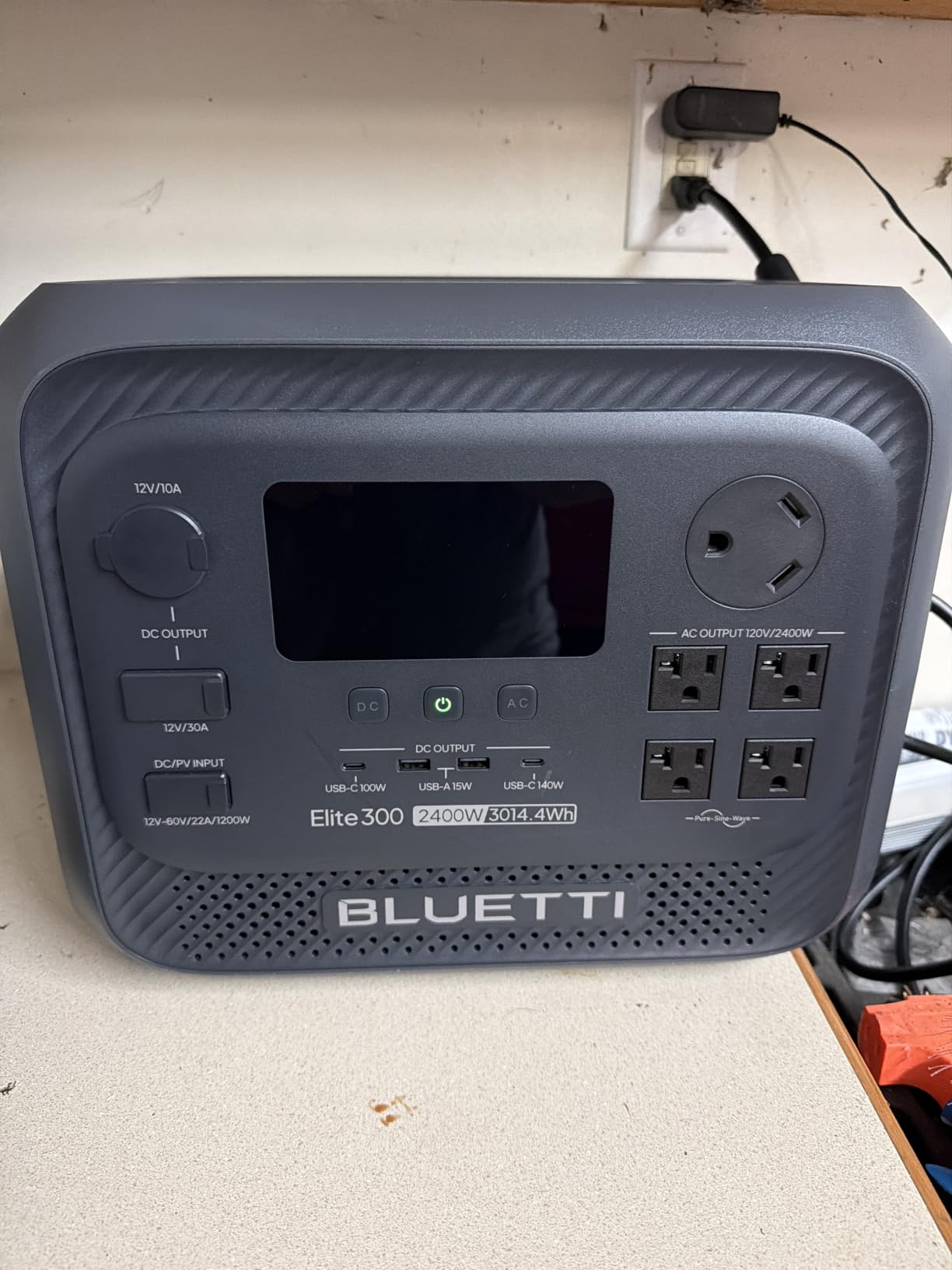
Who the Elite 300 suits
This is the choice when you need 3kWh but cannot dedicate four square feet of floor to it. The footprint makes it usable in a mudroom, a closet or inside an RV, which is not true of the other 3,000Wh options at this size.
Where it falls short
There is no expansion port. Capacity is fixed at 3,014Wh, so an outage lasting beyond three days leaves you no upgrade path on the same unit.
Solar input is capped at 60V and 20A, below the 150V ceiling some competitors accept, which restricts which panels you can attach and can affect the MPPT warranty if exceeded. The soft-start ramp also stopped a 500W dehumidifier’s compressor from starting in testing.
9. Dabbsson 2000L – Value Pick with Genuine 2kWh Capacity
DABBSSON Portable Power Station 2000L, 2048Wh Semi-Solid LiFePO4 Battery, 2200W AC Output 6, 3300W Power Boost, 1 Hr Fast Charge, Solar Generator for Home Backup, Camping & RVs (Solar Panel Optional)
2,048Wh semi-solid LFP
2,200W continuous
3,300W power boost
800W MPPT
Pros
- Strong capacity-to-weight ratio at 41 lb for 2048Wh
- Semi-solid LFP cells claimed at about 1.3x standard runtime
- Full charge in roughly an hour on AC with pass-through
- 6 AC outlets
- more than most rivals
Cons
- Cooling fan cycles on audibly at near-zero load
- App Wi-Fi pairing is difficult
- Charge limit setting does not reliably apply
The 2000L is the value entry into the 2kWh class, and the numbers back that up: 2,048Wh of semi-solid LiFePO4, 2,200W continuous output and 800W of MPPT solar input, at 41 pounds.
The semi-solid electrolyte is the interesting part. Dabbsson claims roughly 1.3 times the runtime of a standard 2,048Wh LiFePO4 station, which would put usable capacity nearer a nominal 2,600Wh. Treat that as a manufacturer claim, but the capacity-to-weight ratio is independently noticeable.
Full AC charge takes about an hour, and pass-through charging means you can run a refrigerator while the pack refills, which matters during a long outage.
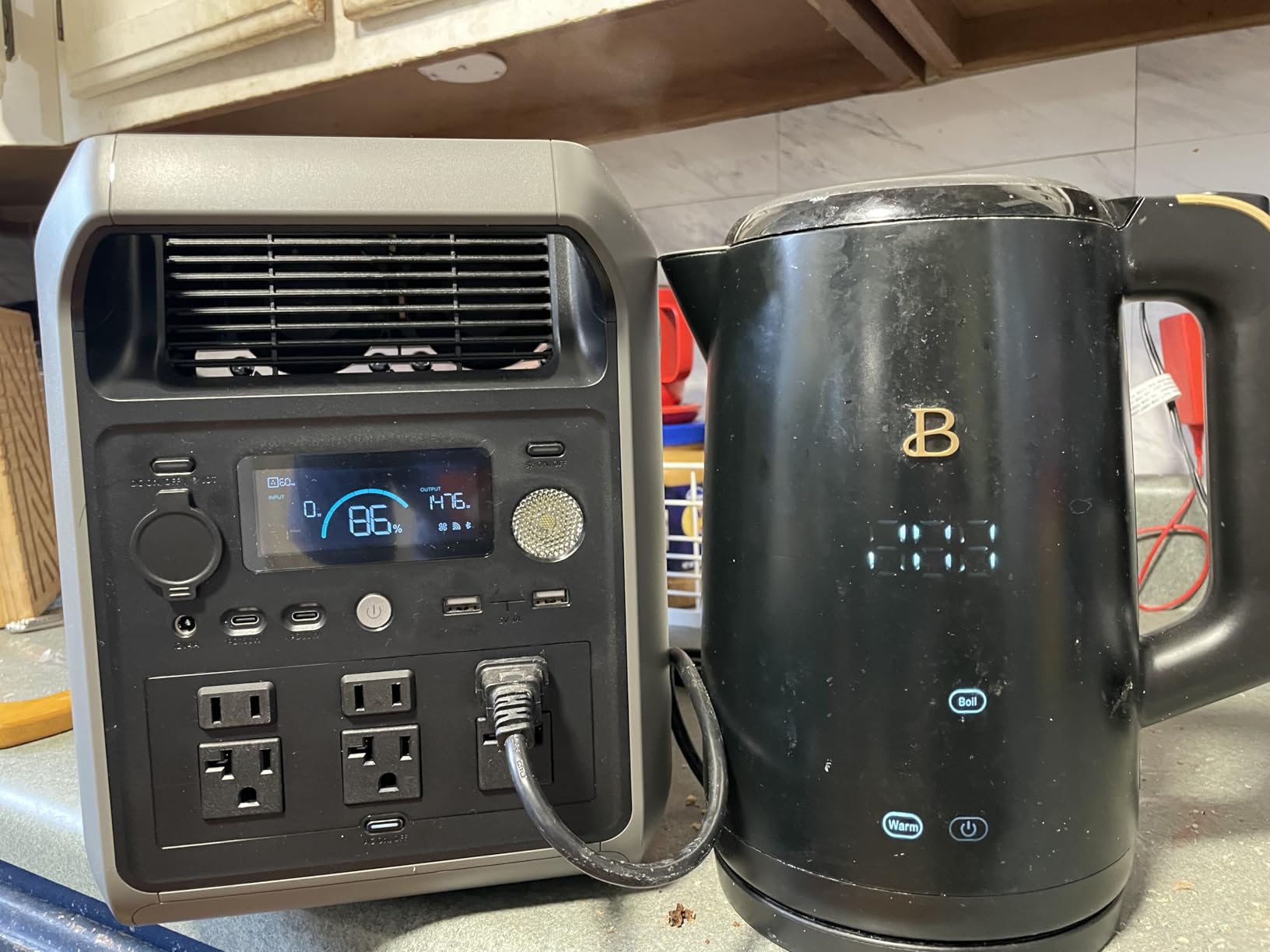
The EPS switchover is under 15ms, keeping computers, a NAS and routers running through a transition. Buyers run refrigerators, freezers, air fryers, microwaves and even a coffee maker off it.
Safety is handled with a UL94-V0 flame-retardant housing and full overcharge, overheat, short-circuit and voltage protection. Cells are rated for 4,000-plus deep cycles to 80%, and the warranty is three years with a two-year extension. Only AC and car charging cables are included.
The app covers charge speed, scheduling and usage monitoring, with a three-setting light mode for outage use.
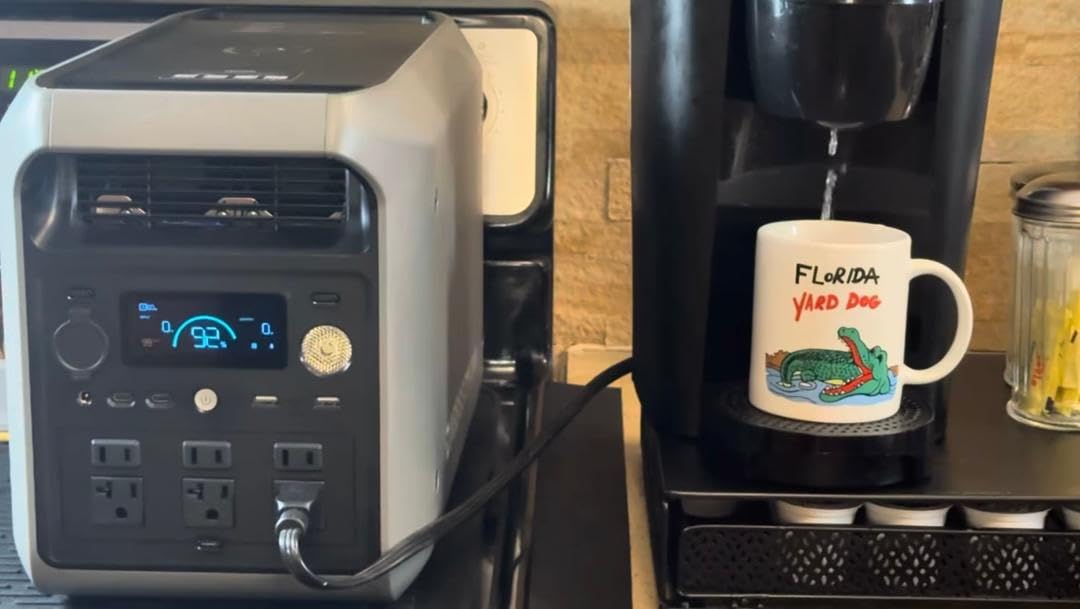
Who the 2000L suits
This is the station for a household that has done the math, decided it needs around 2,000Wh, and wants the most capacity for the money. Owners use it for refrigerators and freezers during outages, then take it camping, where 41 pounds is manageable for two people.
Where it falls short
Noise in a quiet room is the most reported complaint. The fan cycles on intermittently even at near-zero load and carries about 20 feet, and is louder under heavy draw. In a bedroom at 3am that is a real drawback.
There is also a constant clicking sound on AC power with a device plugged in, caused by pass-through switching. App Wi-Fi pairing is difficult, one owner reported the unit switching itself off at roughly 40% charge under a 100W load, and there is a single USB-C port that cannot be used to charge the unit.
10. AFERIY P310 – Best High-Capacity Output for the Money
AFERIY 3840Wh Portable Power Station,Expandable Solar Generator to 11520Wh
3,840Wh LiFePO4
3,600W continuous
7,200W peak
expands to 11,520Wh
Pros
- 3840Wh of capacity with 3600W continuous output
- Expands to 11520Wh with expansion packs
- 15 output ports
- the widest selection in the group
- UL Listed with a 7-year support period
Cons
- Heavy
- with listed weights ranging from 80 to 105 lb
- 4.4 average rating with a 7% one-star share
- Smallest review base among the 3kWh-plus units
The AFERIY P310 is the most straightforward high-capacity unit here: 3,840Wh of LiFePO4 behind a 3,600W continuous inverter with 7,200W of peak output. That pairing is unusual, because most 3kWh-plus units put big batteries behind a 2,400W or 3,000W inverter.
It also expands. Expansion packs take it to 11,520Wh, a longer runway than the F3800 reaches from a smaller base and less than the Anker reaches from a larger one.
Fifteen output ports is the widest here: five 120V AC outlets, USB-A, USB-C PD 3.0, DC5521 and barrel outputs, an XT60 connector and a 12V car socket. For cameras, a medical freezer, a router and a pet feeder, that is a lot of flexibility without an adapter.
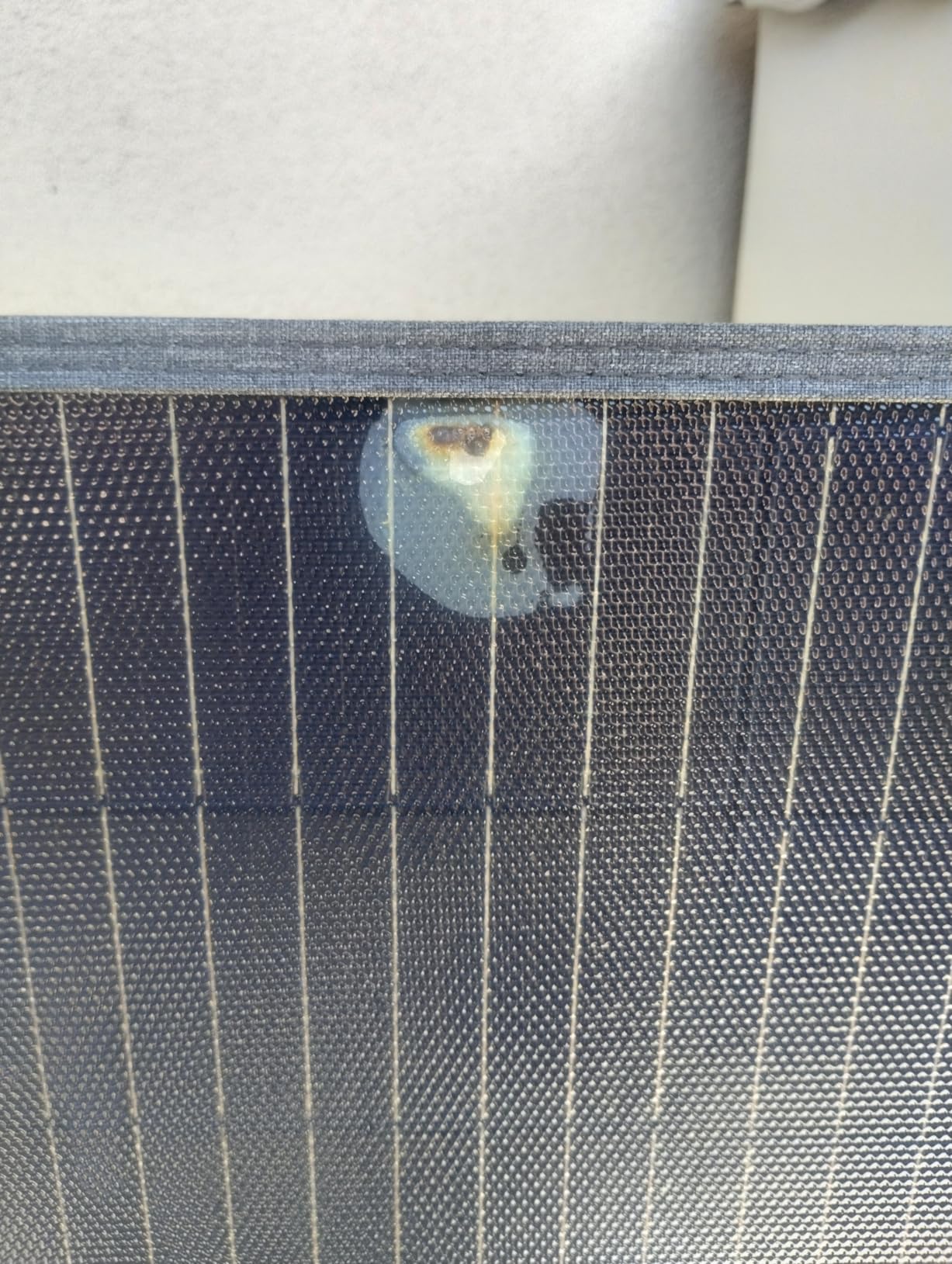
Under 10ms UPS transfer keeps computers, security cameras, medical freezers and pet feeders running. The app controls charge and discharge status, scheduling, light modes and remote power off, and four recharge paths reach full in as fast as 1.5 hours.
Published runtime is about 17 hours for common household essentials and one to two days for a refrigerator, consistent with the capacity. It is UL Listed with a 7-year support period, among the longest coverage terms here.
Weight is the real compromise. Listed figures vary between roughly 80 and 105 pounds, and dimensions are large either way. A pull handle is included for transport.
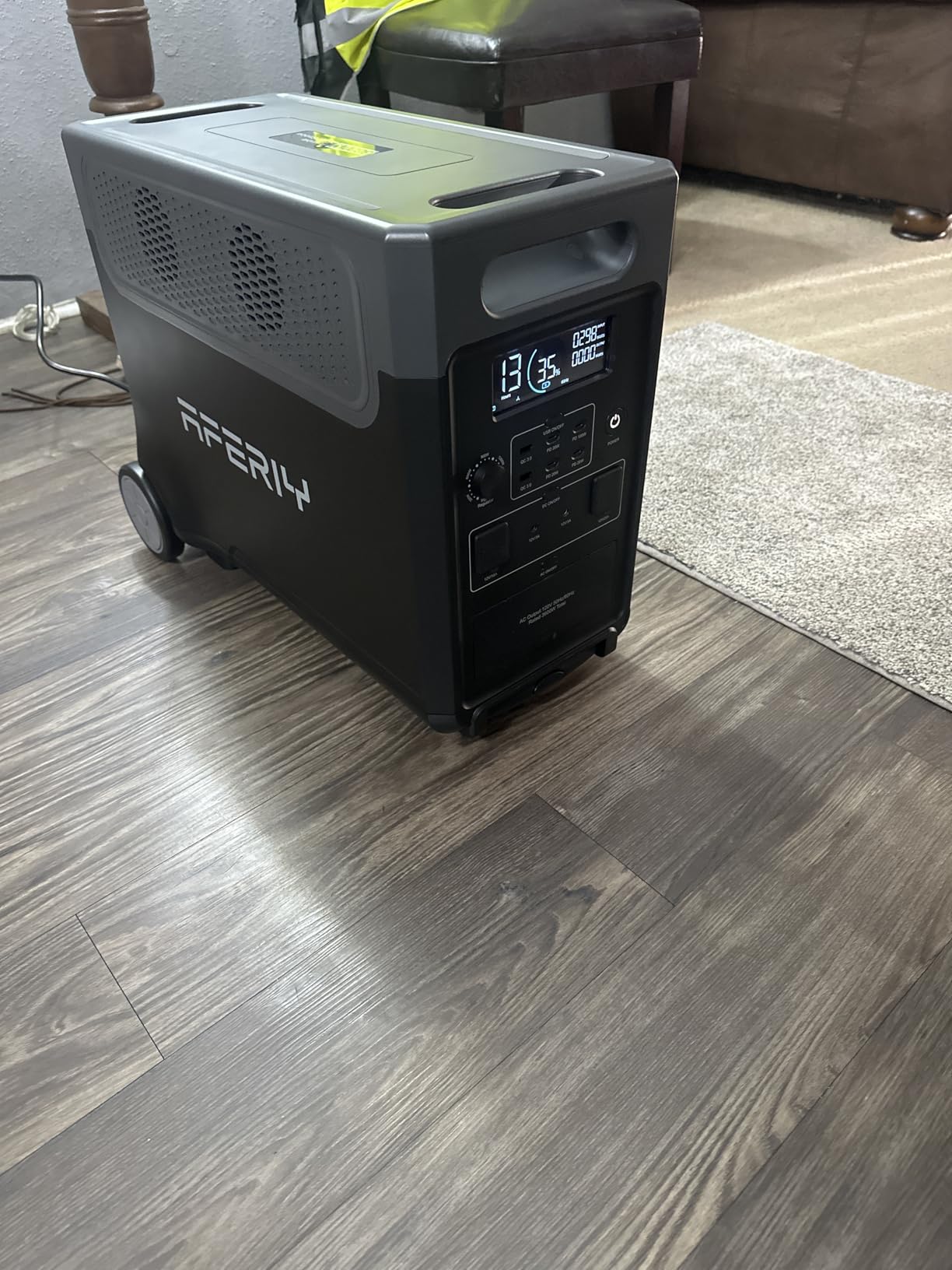
Who the P310 suits
This is a strong choice for a family that wants 3,600W of genuine continuous output rather than 2,400W, and accepts that the unit will live in one place. A workshop, a finished basement or a garage with a level floor is the realistic home for it.
Where it falls short
The 4.4 average and 7% one-star share suggest more variability in early-unit experiences than the better-rated models, and 206 reviews is the thinnest field history among the 3kWh-plus units. Buyers who want proven longevity over a decade should prefer a longer review record.
There is also a documentation gap: the manufacturer publishes one set of dimensions and weight that differs from the listing figures, and there is no third-party lab data on the cycle rating. With 3,840Wh of lithium storage in the house, that is a consideration rather than a dealbreaker.
How to Size a Portable Power Station for Home Backup
Stations are sold by watt-hours, but watt-hours tell you how much energy is stored, not how much power you can draw at once. Those are different numbers, and confusing them is the most common sizing mistake. A station with 2,000Wh behind a 1,500W inverter can hold a night of lights and a fridge but will refuse to run a space heater. The reverse empties in an afternoon.
Step one: write the load list. Go room by room and write what you would plug in during a 12-hour outage, using the running wattage printed on each label rather than a guess. For a refrigerator, note the running figure and remember the compressor start is several times higher for a second or two.
Step two: multiply watts by hours, then divide by 0.85. That gives the watt-hours you must store, allowing for inverter losses and battery management headroom. A 100W fridge running 24 hours is 2,400Wh of energy, so plan on about 2,800Wh of battery capacity to deliver it.
Step three: add the largest startup surge in your list. Refrigerator compressors, sump pumps, well pumps, washing machines and dehumidifiers draw three to five times running wattage at start. Check that peak against the surge rating, not the continuous one. The OUPES Mega 1 is the cautionary case: advertised at 4,500W of surge, it trips near 2,100W in practice.
Step four: round up to the next capacity tier. Roughly 300-500Wh covers phones and lights, 1,000-2,000Wh adds a refrigerator and network gear, 2,000-4,000Wh adds a sump pump or medical device alongside the fridge, and 5,000Wh and up covers multi-day or 240V needs.
Jackery vs Anker SOLIX vs EcoFlow vs BLUETTI
The brands differ more in ecosystem than in raw capability. Anker SOLIX covers the widest range, from a 1,024Wh unit with a 49-minute recharge to a 3,840Wh 240V system, and publishes the most aggressive longevity claim at 10,000 cycles. EcoFlow builds the broadest expansion path, letting 1,024Wh reach 5kWh across several pack models. BLUETTI offers the most compact 3kWh unit and the strongest installed-UPS option at 1,152Wh, both on five-year warranties. Jackery is the simplest and lightest, with the largest review base and the shortest warranty.
OUPES is the value outlier, matching 2,000W of continuous output and 5,120Wh of expandable capacity below all four. The trade is firmware maturity, fan noise and a surge figure that overstates the hardware.
What to run first during an outage
Order matters more than capacity. Start with anything medical: a CPAP machine, an oxygen concentrator, an insulin refrigerator. Next the sump pump, because a flooded basement is a bigger problem than a dark living room. Then the network, so the router and modem keep cameras and phones online. After that, one refrigerator rather than two, and lighting. Heating appliances, water heaters, dryers and microwaves go last, if at all.
Get that order right and a 1,000Wh station covers a genuine evening instead of dying at 9pm with the fridge still unplugged.
Portable Power Station vs Gas Generator
They solve different problems. A lithium station is quiet, emits no fumes, needs no fuel storage and can sit in a living room, but it holds finite energy and refills only from wall power, solar or a vehicle. A gas generator runs as long as you have fuel, but it is loud, produces carbon monoxide, cannot be used indoors and must be started in the weather.
Forum consensus leans the same way. Short outages and indoor use favour batteries; multi-day events still favour fuel. Owners running 500-600Wh units report finding them insufficient for a fridge, which is the clearest argument for sizing up rather than switching category.
Some owners argue a lithium station is no substitute for fuel-backed runtime at all, and for a 1/2 HP well pump or a week-long ice storm that is defensible. The practical middle ground is hybrid: a large station for the essential load, with a generator refilling it. The Smart Generator 5500 bundled with the Anker SOLIX F3800 is built for exactly that.
Refilling a Drained Station During a Multi-Day Outage
Every recharge path you can physically reach in an emergency is one more day of runtime, and most people plan only one.
Wall power is fastest when the grid is up, which makes the first night the important one. A station with a 49-minute full recharge, such as the Anker SOLIX C1000 Gen 2, can be topped up twice in a twelve-hour window. The EF ECOFlow Delta 3 reaches 80% in about 30 minutes on combined AC and solar, the fastest genuine top-up here.
Solar is the workhorse when the grid stays down. These units accept between 500W and 800W of panel input, and 600W refills the C1000 Gen 2 in about 1.8 hours in good sun. The real limitation is weather: the storm that caused the outage will usually also kill solar for its duration. Panels help after the storm passes, not during it.
Vehicle charging is the overlooked option. The BLUETTI AC180, the Anker SOLIX S2000 and the AFERIY P310 all list car outlet or alternator paths. One caveat: a station cannot be recharged from a dead car battery. If you plan to use a vehicle, the vehicle has to start.
Safety, Storage and Battery Longevity
Lithium iron phosphate is the safest of the mainstream lithium chemistries, with better thermal stability than the NMC packs used in earlier portable stations. Every unit in this roundup uses LFP, and that matters for a device holding several kilowatt-hours inside your house.
Basic handling still applies. Keep the station out of direct sunlight and away from heat sources, never charge it in a space you cannot ventilate, and do not use it in rain or standing water even when the pack carries IP65, since that rating covers the battery rather than the enclosure. Do not exceed the DC solar input voltage; on the BLUETTI Elite 300’s 60V/20A limit it can affect the MPPT warranty.
Storage is where the expensive mistake happens. A 3,000Wh-plus unit left in an unheated garage ages faster than its cycle rating suggests, because cold and heat both stress lithium cells. Store it at partial charge in a dry location at moderate temperature and top it up every few months.
For a 10-year ownership life, cycle count matters more than any other spec. A 4,000-cycle unit used only for emergencies will never approach its limit, because backup duty runs roughly 50 to 100 cycles a year. The S2000’s 10,000-cycle rating is the best here for that reason, though no buyer will ever collect the difference.
Frequently Asked Questions
How many watts do I need in a portable power station?
For a refrigerator, router, modem and lights, 1,000W of continuous output covers the load. Add 1,000W for a microwave, hair dryer or dehumidifier, and 2,000W if you plan to run a space heater. For 240V appliances such as a dryer or well pump you need a dual-voltage unit like the Anker SOLIX F3800. Always check motor startup surge before the continuous figure.
How do I choose the right size portable power station for my needs?
List every appliance you would plug in during a 12-hour outage, note each running wattage, multiply by hours of use, then divide by 0.85 for inverter losses. Add the highest startup surge in your list. Round up to the next capacity tier: 1,000-2,000Wh for a fridge and network gear, 2,000-4,000Wh for a fridge plus a sump pump or medical device.
How long will a 1200 watt power station last?
It depends on capacity, not the wattage figure. A 1,024Wh station with roughly 85% usable energy powers a 100W refrigerator for about eight hours, a router and modem plus lighting for two to three days, and a CPAP machine for several nights. A 2,010Wh unit doubles those figures, and the Anker SOLIX S2000 is rated for up to 35 hours of fridge backup on published figures.
How long will a 600 watt power station last?
Small 500-600Wh stations are sized for phones, lights and laptops rather than a refrigerator. Expect roughly five to six hours of continuous lighting load, a full day of phone charging, and one to two nights of CPAP use. Forum members running these units report they are insufficient for a fridge, which is the point a 1,000Wh class machine becomes necessary.
Do portable power stations work in a power outage automatically?
Only in UPS mode. The station must be charged, connected to the same outlet as the load, and switched into UPS or EPS mode, after which it takes over in under 20ms on most models. The Anker SOLIX C1000 Gen 2 and S2000 switch in under 10ms, fast enough for network equipment and medical devices to stay connected.
Is Jackery or Anker better?
For home backup, Anker SOLIX generally offers more: sub-10ms UPS transfer, faster recharge, more recharge paths and a 2,010Wh model rated for 10,000 cycles. Jackery is lighter at 23.8 pounds, simpler to operate, and carries a much larger review base. Choose Jackery for portability, Anker for UPS behaviour and refill flexibility.
Which one is better, Jackery or EcoFlow?
EcoFlow leads on port count at 13 simultaneous appliances, on combined AC and solar charging that reaches 80% in about 30 minutes, and on an expansion path reaching 5kWh across several pack models. Jackery leads on weight and on the depth of its owner review history. EcoFlow’s 1,800W continuous output is lower than several 1kWh rivals, which matters if you run heating appliances.
Which portable power station is the most recommended?
The Jackery Explorer 1000 v2 is the most recommended overall for home backup, combining 1,070Wh, 1,500W continuous output and a 23.8-pound weight with the largest review base in this group. The Anker SOLIX C1000 Gen 2 leads for CPAP and network equipment, and the Anker SOLIX S2000 leads for multi-night refrigerator coverage on a 2,010Wh pack.
Can a portable power station replace a generator?
For short outages and indoor use, yes, and it is quieter with no carbon monoxide. For multi-day events, no, because a lithium station holds only what you stored and solar rarely helps during the storm that caused the outage. The practical answer is a large station for essential loads plus a generator for extended events, which is what the Smart Generator 5500 bundled with the Anker SOLIX F3800 is built for.
How do I store a portable power station long term?
Store it partially charged rather than full, in a dry location at moderate temperature, away from direct sunlight or a heat source. Recharge it every few months during storage. A large unit kept in an unheated garage will age faster than its cycle rating suggests, because temperature extremes stress lithium cells even when the battery is not in use.
Which Portable Power Station Should You Buy?
Start with the Jackery Explorer 1000 v2. It is the most balanced machine here for a household wanting one station to cover a refrigerator, a network and lights through an evening, and at 23.8 pounds it is the only 1kWh-class unit a single person can move without a dolly.
Choose a different one when your load list says so. The Anker SOLIX C1000 Gen 2 belongs in a house with a CPAP machine or a home office. The Anker SOLIX S2000 covers a refrigerator for two nights and beyond on a 2,010Wh pack rated for 10,000 cycles. The BLUETTI Elite 300 gives you 3,014Wh in a box small enough for a closet or an RV, and the OUPES Mega 1 is the only option near 1,100Wh that grows to 5,120Wh later.
If you run 240V appliances, need a well pump or want to charge an electric vehicle in an emergency, the portable category has already ended for you. Move up to a dual-voltage system like the Anker SOLIX F3800 or a permanently installed home battery, and plan for that as a project rather than a purchase.
Whichever you choose, size it to a written load list rather than to the largest number you can afford. The best portable power stations for home backup are not the biggest ones, they are the ones that cover your actual load list for the outage you are most likely to have. Check current pricing and warranty terms before you buy, and keep it charged.