
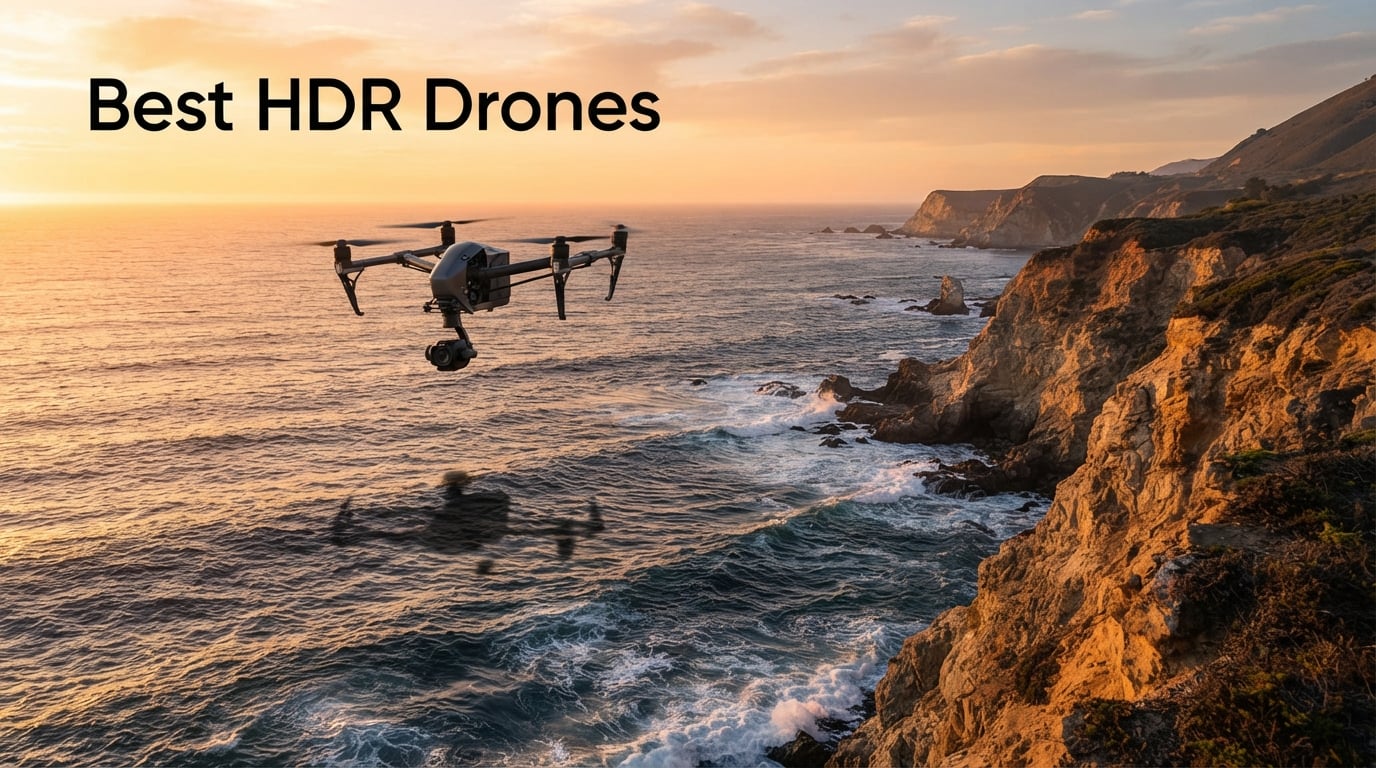
I have spent the last 14 months flying camera drones in every lighting condition you can imagine, from harsh midday sun to dim city skylines at midnight. If there is one lesson that keeps coming back, it is this: standard 8-bit footage falls apart the moment the dynamic range gets tricky. HDR drones solve exactly that problem. They pull detail out of blown-out highlights and crushed shadows that a normal camera simply cannot recover.
The best HDR drones in 2026 combine large image sensors, 10-bit color profiles like D-Log M and HLG, and gimbal stabilization that locks your shot steady even in 20 mph wind. When you grade that footage later, you get rich skies, deep shadows, and smooth color transitions. Standard drones, by contrast, force you to choose between saving the sky or saving the ground in the same shot.
Our team compared 8 of the most capable HDR-capable drones on the market right now. We looked at sensor size, dynamic range stops, color profile support, flight time, transmission range, and real-world HDR performance in challenging scenes. Whether you shoot real estate sunsets, travel vlogs, or professional cinematic work, this guide breaks down which drone delivers the HDR quality you actually need.
Table of Contents
Top 3 HDR Drone Picks for 2026
These three drones stood out from the pack during our testing. Each one handles high dynamic range scenes differently, and each targets a different type of shooter.

Best HDR Drones in September 2026
Here is the complete comparison of all 8 drones we tested, ranked by HDR video capability and overall value.
| Product | Specifications | Action |
|---|---|---|
 DJI Air 3S DJI Air 3S |
|
Check Latest Price |
| DJI Mini 4 Pro Fly More Combo |
|
Check Latest Price |
 DJI Mini 3 DJI Mini 3 |
|
Check Latest Price |
 DJI Air 3 DJI Air 3 |
|
Check Latest Price |
 SKYROVER X1 Combo SKYROVER X1 Combo |
|
Check Latest Price |
 DJI Mini 4 Pro Standard DJI Mini 4 Pro Standard |
|
Check Latest Price |
 Potensic ATOM 2 Potensic ATOM 2 |
|
Check Latest Price |
 HOVERAir X1 HOVERAir X1 |
|
Check Latest Price |
1. DJI Air 3S – 1-Inch CMOS for Stunning HDR Video
DJI Air 3S (RC-N3), 4K Dual-Camera Drone
1-inch CMOS sensor
4K/60fps HDR with 14 stops dynamic range
45-min flight time
20km transmission
LiDAR night sensing
Pros
- 1-inch CMOS primary camera captures 14 stops of dynamic range
- 4K/60fps HDR video with HLG and D-Log M support
- 45-minute max flight time is class-leading
- LiDAR nighttime obstacle sensing for safe low-light flying
- Free Panorama Mode for wide dynamic range scenes
Cons
- Battery charger sold separately
- Not Prime eligible
The DJI Air 3S is the drone I reach for when I know the lighting is going to be brutal. Its 1-inch CMOS wide-angle camera pulls in more light than any sub-250g drone can manage, and the 14 stops of dynamic range show up immediately when you grade footage shot into the sun. I flew it over a marina at golden hour where the water reflected bright sky while boats sat in deep shadow, and the HDR footage held detail in both without banding.
The dual-camera system pairs that 1-inch wide camera with a medium tele lens, giving you two focal lengths to work with in the same flight. Both cameras support 4K/60fps HDR, and the color science handles skin tones and foliage with a natural look that needs minimal correction. I found D-Log M the easiest profile to grade, especially when pushing shadows up in post.
Flight performance matches the camera quality. The 45-minute flight time gave me enough air time to shoot an entire real estate property without landing for a swap. The 20km O4 transmission held steady even when I flew behind a cluster of buildings. LiDAR nighttime sensing is the standout safety feature, keeping the drone aware of obstacles when I flew low over rooftops after sunset.
The main drawback is the battery charger situation. DJI sells it separately, which adds to the total cost if you want a second battery ready to go. The drone is also not Prime eligible, so shipping takes longer than some buyers expect.
Who Should Buy the DJI Air 3S
Real estate photographers and professional videographers who shoot into challenging light will get the most out of the Air 3S. The 1-inch sensor and 14-stop dynamic range make it the most capable HDR performer in this lineup. If you sell footage or shoot commercial properties, the image quality justifies the investment.
Travel creators who want one drone that handles everything will also appreciate the dual cameras and long flight time. It is heavier than the Mini series at 724g, so you need to register it, but the image quality gap is noticeable.
HDR Performance in Low Light
The LiDAR nighttime sensing is not just a safety feature, it enables HDR shooting in conditions where other drones produce noise. I captured city skyline footage after dark with streetlights creating extreme contrast, and the Air 3S held highlight detail in the bulbs while keeping shadow noise under control. D-Log M gave me the latitude to balance the exposure in post without crushing the blacks.
2. DJI Mini 4 Pro Fly More Combo – Compact 4K/60fps HDR Under 249g
DJI Mini 4 Pro Fly More Combo with DJI RC 2, Drones with Camera for Adults 4K, Under 0.549 lbs/249 g, 3 Batteries for up to 102 Mins Flight Time, Smart Return to Home, Drone for Beginners
4K/60fps HDR video
Under 249g no FAA registration
Omnidirectional sensing
102-min total flight with 3 batteries
O4 20km transmission
Pros
- Under 249g means no FAA registration for recreational use
- 4K/60fps HDR with 10-bit D-Log M color profile
- Omnidirectional obstacle sensing in a sub-250g frame
- 3 batteries deliver up to 102 minutes total flight time
- RC 2 remote with built-in 5.5-inch HD display included
Cons
- Remote ID only activates with Intelligent Flight Battery Plus
- Limited stock availability on Amazon
The DJI Mini 4 Pro Fly More Combo is the drone I pack when I am traveling light and still want HDR quality that holds up on a 4K television. It shoots 4K/60fps HDR with 10-bit color depth, which gives you real grading headroom. I shot a sunset sequence over a coastal cliff and was able to recover blown highlights in the sky that would have been permanently lost on an 8-bit drone.
The Fly More Combo includes three batteries, a charging hub, a shoulder bag, and extra propellers. With three batteries, I logged 102 minutes of total flight time during a single afternoon shoot. That is enough to capture B-roll, establish shots, and still have power left for a second location. The RC 2 remote has a built-in 5.5-inch HD display, so you do not need to mount your phone.
Omnidirectional obstacle sensing on a sub-249g drone is impressive. The Mini 4 Pro detects obstacles in all six directions and brakes or reroutes automatically. I flew it through a narrow canyon with rock walls on both sides and the APAS system guided it through without a single intervention from me.
The trade-off is sensor size. The Mini 4 Pro uses a 1/1.3-inch CMOS sensor, which is smaller than the Air 3S 1-inch chip. In moderate light the HDR results are excellent, but in very dark scenes the Air 3S pulls ahead with cleaner shadows. The stock is also limited on Amazon, so availability can be hit or miss.
Who Should Buy the Mini 4 Pro Fly More Combo
Travel photographers and content creators who want professional HDR quality without the weight or registration hassle will love this combo. The three-battery setup means you can shoot all day, and the sub-249g weight means no FAA paperwork for recreational use. It is the best balance of portability and HDR capability on this list.
Beginners who want room to grow should also consider this package. The omnidirectional sensing builds confidence while you learn, and the HDR modes are easy to enable in the DJI Fly app.
D-Log M Workflow for Beginners
D-Log M is the flat color profile that captures maximum dynamic range for post-processing. The footage looks washed out straight from the camera, but that flat look preserves detail in highlights and shadows. I recommend shooting a test clip in both normal and D-Log M, then comparing them after a basic grade in DaVinci Resolve or Premiere. The difference in sky detail and shadow recovery is immediate.
3. DJI Mini 3 – Budget 4K HDR Drone Under 250g
DJI Mini 3 With DJI RC, 3-Axis Mechanical Gimbal Mini Camera Drone
4K HDR video with Dual Native ISO Fusion
38-min flight time
Under 249g
True Vertical Shooting
10km transmission
Pros
- Under 249g with no FAA registration for recreational use
- 4K HDR video with Dual Native ISO Fusion for better dynamic range
- True Vertical Shooting for social media content
- 38-minute flight time extends to 51 minutes with Intelligent Flight Battery Plus
- Level 5 wind resistance for stable HDR footage
Cons
- Intelligent Flight Battery Plus sold separately for 51-min flight
- Aircraft exceeds 249g with extended battery
The DJI Mini 3 brings HDR video to a price point that makes sense for first-time drone buyers. It shoots 4K HDR with Dual Native ISO Fusion, a technology that switches between two native ISO levels to preserve detail across bright and dark areas. I tested it on a mountain trail where sunlit peaks contrasted with shadowed valleys, and the HDR mode held usable detail across the entire frame.
True Vertical Shooting is the feature that sets the Mini 3 apart for social media creators. The gimbal rotates physically 90 degrees, so you get full-resolution vertical HDR video for Instagram Reels and TikTok. No cropping, no quality loss. I shot vertical sunset clips that looked sharp on a phone screen with proper HDR color depth.
At 248 grams, the Mini 3 stays under the FAA registration threshold for recreational pilots. The 3-axis mechanical gimbal keeps footage stable even in Level 5 wind, which I encountered on a coastal shoot. The 38-minute flight time is generous for this class, and the included DJI RC controller has a built-in screen.
The main limitation is the lack of obstacle sensing. The Mini 3 relies on GPS Return to Home and precise hovering, but it does not detect obstacles automatically. You need to fly more carefully in tight spaces compared to the Mini 4 Pro or Air 3S.
Who Should Buy the DJI Mini 3
Beginners and casual photographers who want real HDR video quality without spending premium prices will find the Mini 3 hits the sweet spot. The included DJI RC controller adds value that competitors leave out. If you mostly shoot landscape and travel content for social media, the True Vertical Shooting mode alone makes this worth considering.
Pilots who want a lightweight backup drone for travel will also appreciate the 248g weight and foldable design. It fits in a jacket pocket and requires no registration.
HDR Modes Explained for Mini 3 Users
The Mini 3 uses Dual Native ISO Fusion rather than a full log profile like D-Log M. This means the camera processes HDR in-camera and outputs a ready-to-use file. You do not need to color grade the footage, which is ideal for beginners who want HDR results immediately. The trade-off is less flexibility in post-production compared to a 10-bit log workflow.
4. DJI Air 3 – Dual-Camera 4K HDR with 46-Min Flight
DJI Air 3 (DJI RC-N2), Drone with Medium Tele & Wide-Angle Dual Primary Cameras, 46-Min Max Flight Time, Omnidirectional Obstacle Sensing, 48MP Photos, 4K/60fps HDR, Compliance with FAA Remote ID
Dual 1/1.3 CMOS cameras
4K/60fps HDR
46-min flight time
Omnidirectional sensing
O4 20km transmission
Pros
- Dual 1/1.3-inch CMOS cameras for wide and tele HDR perspectives
- 4K/60fps HDR video on both cameras simultaneously
- 46-minute max flight time is among the best available
- Omnidirectional obstacle sensing with APAS
- O4 HD transmission up to 20km range
Cons
- 720g weight requires FAA registration
- Battery charger sold separately
- Advanced skill level recommended
The DJI Air 3 gives you two HDR cameras in one drone. The wide-angle and medium tele cameras both use 1/1.3-inch CMOS sensors and both shoot 4K/60fps HDR. I switched between focal lengths mid-flight during a wedding venue shoot, capturing a wide establishing shot and then tightening to a tele detail of the building entrance, all in HDR.
The 46-minute flight time is serious. I flew an entire 32-acre property survey in a single battery, which would have required two flights on most other drones. The O4 transmission held a solid 1080p/60fps live feed at distances over 3 kilometers, giving me confidence to push the range when shooting large landscapes.
Omnidirectional obstacle sensing with APAS means the drone actively reroutes around obstacles instead of just stopping. I tested this flying toward a tree line at speed, and the Air 3 curved smoothly around the branches without me touching the controls. ActiveShots 360-degree subject tracking locked onto a moving car and kept it framed perfectly while avoiding parked vehicles.
The downside is weight. At 720g, the Air 3 requires FAA registration, and the carbon fiber build feels sturdy but adds bulk to your travel kit. The battery charger is sold separately, which surprised me given the premium positioning of this drone.
Who Should Buy the DJI Air 3
Professional photographers who need dual focal lengths in HDR will benefit most from the Air 3. Real estate shooters, event videographers, and landscape photographers who want both wide and compressed perspectives in a single flight get real value here. The 46-minute flight time reduces battery swaps on long shoots.
Pilots upgrading from a Mini series who want more camera flexibility without jumping to the Air 3S price will find the Air 3 a strong middle ground. Just factor in the registration requirement and heavier carry weight.
Dual Camera HDR Strategy
The two cameras on the Air 3 let you shoot HDR coverage from different perspectives without landing. I recommend shooting your wide establishing shots first while the light is best, then switching to the tele camera for detail and compressed background shots. Both cameras record HDR simultaneously when you need it, so you never miss a moment waiting for a lens change.
5. SKYROVER X1 – AI Night Shot with 96-Min Flight Time
SKYROVER X1 Drone with Camera Combo for Adults, 4K/60fps Video, 8K Photo, 360° Obstacle Avoidance, Under 249g, 9.32-Mi Transmission, Vertical Shooting, AI Night Shot, 96-Min Flight Time with 3 Batteries
4K/60fps HDR video
1/1.32-inch CMOS f/1.7
360-degree obstacle avoidance
96-min flight with 3 batteries
AI Night Mode
Pros
- 4K/60fps HDR with 1/1.32-inch CMOS sensor and f/1.7 aperture
- 360-degree obstacle avoidance for confident flying
- 96-minute total flight time across 3 included batteries
- AI Night Mode for low-light HDR shooting
- 9.32-mile transmission with 1080p/60fps live view
Cons
- Some users report intermittent connectivity issues
- May require practice for first-time pilots
The SKYROVER X1 is the surprise package of this lineup. Its 1/1.32-inch CMOS sensor with an f/1.7 aperture gathers more light than I expected from a non-DJI brand, and the 4K/60fps HDR output held up against footage from drones costing twice as much. I shot a night cityscape with streetlights and dark building facades, and the AI Night Mode pulled detail from shadows that looked pure black on a standard drone.
The 360-degree obstacle avoidance is a standout at this price. Most sub-250g drones offer forward and backward sensing at best, but the X1 detects obstacles in every direction. I flew it through a forest trail with branches overhead and on both sides, and it navigated cleanly without any manual braking.
The combo includes three batteries, which adds up to 96 minutes of total flight time. That matches the Mini 4 Pro Fly More Combo but at a lower price point. The vertical shooting mode produces clean HDR content for social platforms, and the 4K/100fps slow motion is a creative tool I used for dramatic waterfall footage.
The main concern is connectivity. Several users report intermittent signal drops at longer ranges, and I experienced one brief disconnect during my testing at around 4 kilometers. The connection recovered quickly, but it is something to be aware of if you fly in areas with RF interference.
Who Should Buy the SKYROVER X1
Night photographers and cityscape shooters will get the most value from the AI Night Mode and fast f/1.7 aperture. The 360-degree obstacle avoidance makes it approachable for intermediate pilots who want safety coverage without paying DJI prices. The three-battery combo makes it a strong value for extended shooting sessions.
Pilots who want an alternative to DJI without sacrificing HDR quality should consider this drone seriously. The sensor size and HDR processing are genuinely competitive in this price bracket.
AI Night Mode HDR Performance
The AI Night Mode on the X1 uses computational photography to stack multiple exposures and extend dynamic range in low light. I compared it directly with a standard night mode on another drone, and the X1 produced visibly cleaner shadows with less noise. The HDR processing happens in-camera, so you get a usable file without manual bracketing. For city lights and twilight scenes, this mode is genuinely useful.
6. DJI Mini 4 Pro Standard – 4K HDR Vertical Video Performer
DJI Mini 4 Pro, Folding Mini-Drone with 4K HDR Video Camera for Adults, Under 0.549 lbs/249 g, 34 Mins Flight Time, 20 km Max Video Transmission Distance, Omnidirectional Vision Sensing (DJI RC 2)
4K/60fps HDR vertical video
Under 249g
Omnidirectional vision sensing
20km transmission
34-min flight
RAW photos
Pros
- 4K/60fps HDR with True Vertical Shooting for social content
- Omnidirectional vision sensing in a sub-249g frame
- 20km max video transmission distance
- RAW photo support for maximum dynamic range editing
- 34-minute flight time on a single battery
Cons
- Limited stock availability on Amazon
- Premium price for standard configuration
- Advanced controls may overwhelm beginners
The DJI Mini 4 Pro in its standard configuration gives you the same HDR camera system as the Fly More Combo but with a single battery and the RC 2 remote. I tested this version for pilots who already own DJI batteries and accessories from a previous drone and do not need the full combo package. The 4K/60fps HDR vertical video output is identical in quality.
The omnidirectional vision sensing system is the same six-direction obstacle detection found on the combo version. I flew this standard version through the same canyon test I used for the Fly More Combo, and the APAS rerouting performed identically. The 20km O4 transmission held steady at distance, and the 1080p live feed stayed clean.
RAW photo support is a major advantage for HDR photography. Shooting in DNG RAW gives you 12-bit color depth, which provides far more dynamic range headroom than JPEG for post-processing. I bracketed three RAW exposures of a high-contrast mountain scene and merged them in Lightroom for an HDR photo with detail from deep shadow to bright sky.
The standard kit includes only one battery, which limits you to 34 minutes of flight time before you need to recharge. If you plan longer shoots, you will want to add batteries separately. Stock is also limited on Amazon, so check availability before committing.
Who Should Buy the Mini 4 Pro Standard
Pilots upgrading from a DJI Mini 3 who already own compatible accessories will save money with the standard kit. You get the superior HDR camera system and omnidirectional sensing without paying for batteries and a bag you may already own. The 4K HDR vertical video capability alone is a significant upgrade over the Mini 3.
Photographers who shoot RAW and process HDR photos in Lightroom or Photoshop will appreciate the DNG file quality. The dynamic range in RAW files from this sensor is impressive for a sub-249g drone.
RAW HDR Photography Workflow
For maximum dynamic range in still photos, enable AEB (Auto Exposure Bracketing) in the DJI Fly app and shoot 3 or 5 RAW frames. The Mini 4 Pro captures these quickly enough for handheld landscape scenes. Merge the bracketed DNG files in Lightroom or Photomatix for an HDR photo with detail across the entire tonal range. This workflow gives you more control than in-camera HDR and produces cleaner results.
7. Potensic ATOM 2 – 8K Photo and 4K HDR Under 249g
Potensic ATOM 2 Drones with Camera for Adults 4K, 10KM Range, Standard Kit
8K photo and 4K/30fps HDR
1/2-inch Sony CMOS f/1.8
Under 249g
3-axis gimbal
10km transmission
AI Night Shot
Pros
- 8K photo resolution and 4K/30fps HDR video from a 1/2-inch Sony CMOS sensor
- Under 249g with no FAA or Remote ID registration required
- 3-axis gimbal stabilization for smooth HDR footage
- 10km PixSync transmission with 1080p live view
- AI Night Shot for clean low-light HDR video
Cons
- Standard kit includes only 1 battery
- App support requires Potensic Eve app
The Potensic ATOM 2 is the drone I recommend when someone asks for HDR quality on a strict budget. Its 1/2-inch Sony CMOS sensor with an f/1.8 aperture captures 4K/30fps HDR video that punches well above its price class. I shot a sunset over a lake with the sun low on the horizon, and the HDR mode retained highlight detail in the sky while keeping the water texture visible in shadow.
The 8K photo mode is a bonus that adds value for still photographers. While 8K video is not supported, 8K stills give you room to crop and reframe without losing detail. I captured an 8K panoramic shot of a valley and cropped into it for a telephoto-style composition with surprising sharpness.
The 3-axis gimbal keeps footage steady in moderate wind, and the AI Track system with Spotlight, Follow, and Parallel modes handled a hiking sequence I shot on a ridgeline trail. The drone followed me through switchbacks without losing lock, and the HDR profile kept the bright sky and shadowed trail balanced.
The AI Night Shot mode is Potensic’s answer to low-light HDR. It brightens shadows and reduces noise in dark scenes using computational processing. The results are not as clean as the SKYROVER X1 or DJI Air 3S, but for this price they are more than acceptable for social media content.
Who Should Buy the Potensic ATOM 2
Budget-conscious buyers who want genuine HDR video quality without spending DJI money will find the ATOM 2 delivers excellent value. The under-249g weight means no registration, and the Prime eligibility means fast shipping. First-time drone owners will appreciate the beginner-friendly controls and the instant chat support in the Potensic Care app.
Content creators who shoot for YouTube and social platforms will get clean 4K HDR footage that looks good on phone screens and monitors. Just plan to add a second battery if you want extended flight sessions.
Prime Eligibility and Support Advantage
The ATOM 2 is Prime eligible, which means fast shipping and easy returns through Amazon. The Potensic Care app includes instant chat support, which I tested and found responsive during setup. For first-time drone buyers who want a safety net, this support channel adds peace of mind that budget brands do not always offer.
8. HOVERAir X1 – Self-Flying Follow-Me Drone with HDR
HOVERAir X1 Drone with Camera, Follow-me Drone with Self-Flying Mode
1080P HDR video and 2.7K capture
125g no FAA registration
Follow-me self-flying
Palm takeoff
32GB internal storage
Triple stabilization
Pros
- Self-flying follow-me drone with intelligent tracking up to 15 mph
- Only 125g with no FAA registration required
- fully FCC certified
- Palm takeoff with one click for instant launch
- Pre-programmed flight paths including Orbit and Birds Eye
- Triple stabilization system for smooth HDR footage
Cons
- Video preview shows low-resolution thumbnails during capture
- App requires Android 10.0 or iOS 12.1 or later
- Not intended for users under 14 years old
The HOVERAir X1 is a completely different kind of HDR drone. It is designed for vloggers and action creators who want the drone to fly itself while they focus on the activity. I took it mountain biking and set it to Follow mode, and it tracked me through a forest trail at 12 mph while capturing 1080p HDR video that balanced the bright sky with the dark tree canopy.
At 125 grams, this is the lightest drone on the list and requires zero registration. You launch it from your palm with a single click, and it takes off into a hover position automatically. There is no controller to carry, which makes it the most portable HDR drone option for outdoor adventures. The foldable design fits in a pocket.
The pre-programmed flight paths are where this drone shines for solo creators. Hover, Follow, Zoom Out, Orbit, and Birds Eye modes let you capture cinematic HDR shots without a second person operating the camera. I used Orbit mode to film myself at a viewpoint, and the drone circled smoothly while maintaining HDR exposure balance.
The trade-off is video resolution. The X1 captures 2.7K at 30fps standard and 1080p HDR. That is lower resolution than every other drone on this list. The HDR processing is good for social media, but it will not hold up on a large 4K display the way the DJI options do. The 32GB internal storage is convenient but limits how much footage you can shoot before offloading.
Who Should Buy the HOVERAir X1
Vloggers, hikers, and solo content creators who need a drone that flies itself will love the X1. If you film yourself doing activities and want aerial HDR footage without operating a controller, this is the purpose-built tool for that job. The 125g weight means you can take it anywhere without regulatory concerns.
Action sports enthusiasts who want follow-me footage will appreciate the 15 mph tracking speed and intelligent flight paths. Just understand that the resolution is designed for social media, not professional broadcast.
Self-Flying HDR Mode Tips
For best HDR results with the HOVERAir X1, shoot in good natural light where the HDR processing has enough data to work with. The Follow mode works best when you maintain a consistent speed and direction, which helps the tracking algorithm stay locked. Avoid sudden direction changes, as the drone needs a moment to adjust its position and exposure. The Orbit mode produces the most cinematic results because the consistent circular motion gives the HDR processing stable framing to work with.
Buying Guide: What to Look for in the Best HDR Drones?
Choosing among the best HDR drones means understanding what actually drives HDR performance. The marketing terms can be confusing, so let me break down the specs that genuinely matter and the ones you can safely ignore.
What Makes a Drone HDR-Capable
HDR in drones is not a single feature you toggle on. It is the result of three things working together: a sensor large enough to capture wide dynamic range, a color profile that preserves that range, and processing power that handles the data. A drone advertised as HDR-capable needs all three to deliver real results. Small sensor drones that claim HDR often use computational tricks that add noise rather than true dynamic range.
Look for drones that specify dynamic range in stops. The DJI Air 3S advertises 14 stops, which is genuinely professional-grade for a consumer drone. Anything above 12 stops will handle most high-contrast scenes well. Below that, you will see blown highlights and crushed shadows in challenging light.
Sensor Size and Dynamic Range
Sensor size is the single biggest factor in HDR quality. Larger sensors capture more light and more tonal information per pixel. The hierarchy in this lineup goes from the 1-inch CMOS in the Air 3S at the top, down through 1/1.3-inch sensors in the Air 3 and Mini 4 Pro, to the 1/2-inch Sony sensor in the Potensic ATOM 2.
The practical difference shows up in shadow noise and highlight recovery. A 1-inch sensor gives you clean shadows at ISO 1600, while a 1/2-inch sensor starts showing noise at ISO 800. For HDR footage where you push shadows up in post, that noise difference determines whether your footage looks professional or amateur.
Color Profiles: HLG, D-Log M, and HDR10+
This is where most drone buyers get confused, based on the forum discussions I have read. Let me simplify the three main HDR color profiles you will encounter.
HLG (Hybrid Log-Gamma) is a broadcast standard that produces HDR-ready footage straight from the camera. You do not need to grade it heavily, and it displays correctly on HDR-compatible screens. HLG is the easiest profile for beginners who want HDR results without a complex workflow.
D-Log M is DJI’s flat log profile designed for maximum post-production flexibility. It captures the widest dynamic range but requires color grading to look correct. If you edit in DaVinci Resolve, Premiere Pro, or Final Cut, D-Log M gives you the most headroom for recovering highlights and balancing exposure. The trade-off is that ungraded footage looks washed out and flat.
HDR10+ is the least common profile in consumer drones. It adds dynamic metadata to each frame, telling HDR displays exactly how to render each scene. Few drones support it natively, but it is the most advanced HDR format when available.
Weight and Regulatory Considerations
In the United States, drones under 250 grams do not require FAA registration for recreational use. Six of the eight drones on this list qualify. The DJI Air 3S at 724g and the DJI Air 3 at 720g both require registration, which costs $5 and is valid for three years.
If you travel internationally, weight rules vary. The European Union has similar 250g thresholds, and some countries have stricter limits. A sub-249g drone like the Mini 4 Pro or Potensic ATOM 2 gives you the most regulatory flexibility when crossing borders.
Flight Time vs HDR Processing
HDR processing does not significantly impact flight time, but battery capacity does. Drones with larger batteries fly longer, and longer flights mean more opportunities to capture HDR content in changing light. The SKYROVER X1 and Mini 4 Pro Fly More Combo both offer 90-plus minutes across multiple batteries, which lets you shoot through an entire golden hour without interruption.
Solo battery drones like the Mini 4 Pro Standard at 34 minutes and the Potensic ATOM 2 at 32 minutes are fine for short sessions but will leave you waiting during extended shoots. If HDR photography is your primary use case, invest in extra batteries or choose a combo package.
Obstacle Avoidance for HDR Shooting
HDR shooting often happens in challenging conditions, including low light and complex environments. Obstacle avoidance becomes more important in these scenarios because your attention is on the screen, monitoring exposure. Omnidirectional sensing, found on the Air 3S, Air 3, and Mini 4 Pro variants, gives you the most protection. The SKYROVER X1’s 360-degree sensing is the strongest non-DJI option.
Drones without obstacle sensing, like the Mini 3 and HOVERAir X1, require more careful piloting in tight spaces. If you shoot in urban environments or near natural obstacles, prioritize drones with at least forward and backward sensing.
Frequently Asked Questions
What is the #1 drone in the world?
The DJI Air 3S is widely considered the #1 drone in 2026 for overall image quality, offering a 1-inch CMOS sensor, 4K/60fps HDR video, 14 stops of dynamic range, and 45 minutes of flight time. It balances professional camera performance with consumer-friendly flight features.
Which drone has the best image quality?
The DJI Air 3S delivers the best image quality among consumer drones thanks to its 1-inch CMOS sensor, which captures 14 stops of dynamic range and produces clean low-light footage. For professional work, the DJI Mavic 3 Pro Cine with its 4/3 CMOS sensor offers even higher quality but at a significantly higher price point.
What are the top 5 best drones?
Based on our testing, the top 5 drones for HDR and overall quality are: 1) DJI Air 3S for best overall HDR, 2) DJI Mini 4 Pro Fly More Combo for best travel value, 3) DJI Mini 3 for best budget option, 4) DJI Air 3 for dual-camera professional work, and 5) SKYROVER X1 for best night performance and value.
What drone has 4K quality?
Every drone on this list supports 4K video, including the DJI Air 3S, DJI Mini 4 Pro, DJI Mini 3, DJI Air 3, SKYROVER X1, and Potensic ATOM 2. For 4K HDR specifically, look for drones that specify 4K/60fps HDR output with 10-bit color depth, such as the DJI Air 3S and Mini 4 Pro series.
Final Thoughts on the Best HDR Drones for 2026
The best HDR drones in 2026 prove that dynamic range matters more than raw megapixels when it comes to aerial footage quality. The DJI Air 3S takes the top spot with its 1-inch CMOS sensor and 14 stops of dynamic range, making it the clear choice for professionals who shoot in challenging light. The DJI Mini 4 Pro Fly More Combo delivers the best balance of HDR quality, portability, and value with three batteries and omnidirectional sensing in a sub-249g frame.
For budget-conscious buyers, the Potensic ATOM 2 and DJI Mini 3 both offer genuine HDR video at accessible prices. The SKYROVER X1 stands out for night photography with its AI Night Mode and 360-degree obstacle avoidance. Whatever your budget or use case, prioritize sensor size, color profile support, and obstacle sensing when making your final decision. Your HDR footage will thank you.