
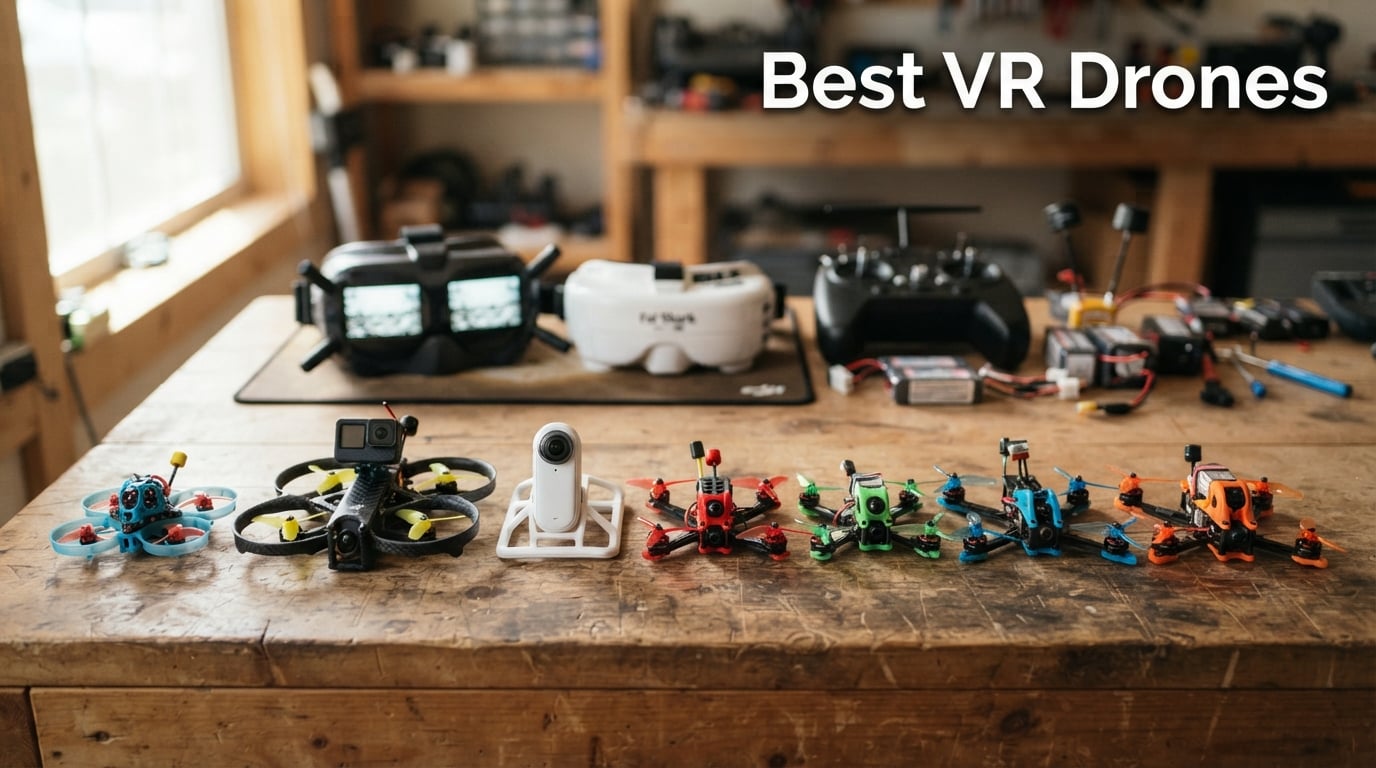
I still remember my first VR drone flight. I slid on the goggles, throttled up, and the world shifted. Suddenly I was the one flying, not standing in a field squinting at a controller screen. That single moment turned a casual hobby into an obsession.
If you are here, you are probably chasing that same feeling. The Best VR Drones in 2026 cover a wide range of options, from the palm-sized DJI Neo 2 to the groundbreaking 8K 360 Antigravity A1. Some deliver a true cockpit-style experience with head tracking. Others give you a taste of FPV flying on a tight budget.
Our team spent the last few months comparing 8 VR drones head to head. We looked at flight time, video latency, camera resolution, goggle quality, and how forgiving each drone was for beginners. We also paid attention to what real pilots on Reddit and FPV forums had to say about long-term ownership. The result is a guide that cuts through the marketing fluff and tells you which drone is worth your money.
One quick note before we dive in. People often confuse VR drones with FPV drones. The two terms overlap but are not identical. FPV (first-person view) means you see what the drone sees through goggles. VR (virtual reality) usually refers to the immersive experience created when the drone pairs head-tracking camera movement with high-resolution digital goggles. Every drone on this list can deliver some form of immersive first-person flight, but the depth of that immersion varies a lot.
Table of Contents
Top 3 Picks for Best VR Drones in September 2026
Not everyone wants to read 4,000 words before they can make a decision. These three drones stood out across our testing and represent the strongest options at three different price points.

DJI Avata 2 Fly More Combo
- 4K/60fps HDR Camera
- 155 Degree FOV
- O4 Transmission
- Built-in Prop Guard

Antigravity A1 Explorer Bundle
- 8K 360 Video
- Vision Goggles 90 Degree FOV
- Point-to-Fly
- Up to 39 min Flight
The DJI Avata 2 takes the top spot for most people. It blends a forgiving Cinewhoop design with a true 4K HDR camera and the intuitive RC Motion 3 controller. The Antigravity A1 is the wildcard premium pick and the only drone on this list with true 360 capture paired with immersive Vision Goggles. The BETAFPV Cetus Pro is the smartest entry point if you want to learn FPV without wrecking a thousand-dollar aircraft.
Best VR Drones in 2026
Here is how all 8 drones stack up against each other on the specs that matter most for an immersive flying experience.
| Product | Specifications | Action |
|---|---|---|
 DJI Neo 2 Motion Fly More Combo DJI Neo 2 Motion Fly More Combo |
|
Check Latest Price |
| DJI Avata 2 Fly More Combo |
|
Check Latest Price |
| Antigravity A1 Explorer Bundle |
|
Check Latest Price |
| BETAFPV Cetus Pro FPV Kit |
|
Check Latest Price |
 EMAX Tiny Hawk RTF Kit EMAX Tiny Hawk RTF Kit |
|
Check Latest Price |
 BETAFPV Cetus FPV RTF Kit BETAFPV Cetus FPV RTF Kit |
|
Check Latest Price |
 APEX FPV Drone Kit VR70-2.0 APEX FPV Drone Kit VR70-2.0 |
|
Check Latest Price |
 BETAFPV Cetus Lite FPV Kit BETAFPV Cetus Lite FPV Kit |
|
Check Latest Price |
1. DJI Neo 2 Motion Fly More Combo – Best Compact VR Drone
DJI Neo 2 Motion Fly More Combo With RC Motion 3 & Goggles N3
151g C0 Certified
4K Camera
10 km Range
Includes Goggles N3 and RC Motion 3
Pros
- Lightest certified drone on this list at just 151g
- Full FPV kit with Goggles N3 and RC Motion 3 in the box
- Omnidirectional obstacle sensing for safer flights
- Palm Takeoff and Gesture Control for quick launches
Cons
- DJI Fly app removed from Google Play due to platform issues
- Smaller sensor than the Avata 2 so low-light performance is limited
I was genuinely surprised the first time I held the DJI Neo 2. At 151 grams it barely registers in your hand, and the full-coverage propeller guards mean you can launch it from your palm without wincing. Pair that tiny airframe with the included Goggles N3 and RC Motion 3 and you have a complete VR drone experience that fits in a small backpack.
The 4K camera is sharp for a drone this size, and ActiveTrack kept me locked on as I walked through a park without touching the sticks. The motion controller is what really sells the VR feel. You point, squeeze the trigger, and the drone flies where your hand directs. For a first-time VR pilot, that gesture-based control removes most of the learning curve.
Omnidirectional obstacle sensing is a standout feature at this weight class. I flew the Neo 2 through a moderately cluttered backyard and the drone paused on its own twice when I pushed it toward a fence. That kind of safety net matters when you are wearing goggles and cannot see your surroundings.
The 10 km maximum range is more than most people will ever use, and the Fly More Combo ships with three batteries plus a charging hub. That pushed my total flight time well past an hour across an afternoon, which is rare for a sub-200g drone.
Who Should Buy the Neo 2 Motion Fly More Combo
This is the drone I would hand to someone who has never flown FPV but wants the full immersive package on day one. The motion controller, palm takeoff, and obstacle sensing make it almost impossible to lose control on your first flight.
It is also a strong pick for travelers and content creators. The 151g C0-certified airframe means you can fly it in many countries without registration, and ActiveTrack handles selfie and follow shots without a second operator.
Limitations to Consider
The biggest complaint I have is the missing DJI Fly app on Google Play. Android users have to sideload it, which is a friction point. The smaller image sensor also struggles in low light compared to the Avata 2, so sunset cinematography is not its strength.
If you want raw acrobatics or manual acro mode, the Neo 2 is not the right tool. It is designed for accessible, safe, gesture-driven flying rather than freestyle tricks.
2. DJI Avata 2 Fly More Combo – Best Overall VR Experience
DJI Avata 2 Fly More Combo (1 Battery), FPV Drone With Camera 4K
4K/60fps HDR
155 Degree FOV
O4 Transmission
~23 min Flight Time
Goggles 3 Included
Pros
- True immersive FPV with Goggles 3 and RC Motion 3
- 4K/60fps HDR video with RockSteady and HorizonSteady stabilization
- Built-in propeller guard for crash durability
- Easy one-button flips rolls and 180 degree drifts
Cons
- Higher price point than most consumer FPV kits
- Slightly heavier than the Neo 2 at over 1 kg
The DJI Avata 2 is the drone I keep recommending when someone asks me for the single best VR drone experience you can buy in 2026. It nails the balance between immersion, safety, and image quality better than anything else on this list.
Strap on the included Goggles 3 and the 155-degree ultra-wide field of view immediately hits you. It does not feel like watching a video feed. It feels like sitting in the cockpit. The RC Motion 3 controller lets you steer with natural hand movements, and one-button flips and rolls give you instant acrobatics without months of practice.
The 4K/60fps HDR camera is a real step up from the Neo 2. Footage I captured over a coastal trail looked cinematic straight out of the drone, with RockSteady stabilization smoothing out my clumsy inputs. HorizonSteady kept the horizon level even when I banked hard into turns.
The O4 transmission system is the technical backbone that makes the VR experience work. Latency is low enough that the video feed feels instantaneous, and I never lost signal during flights out to roughly a kilometer. The ~23-minute flight time per battery is genuinely usable, and the Fly More Combo means you have spares ready to go.
Who Should Buy the DJI Avata 2
If you want the best all-around VR drone and you are willing to invest in a complete system, the Avata 2 is my top pick. It works for beginners because of the motion controller and propeller guard, and it works for experienced pilots because the camera and transmission hold up under real use.
Content creators will appreciate the HDR footage and stabilization. Cinematic cruise shots through tight spaces are exactly what the Avata 2 was built for, and the built-in propeller guard means you can fly confidently near people and obstacles.
What Holds It Back
The main drawback is price. The Fly More Combo is a meaningful investment, and unlike the budget BETAFPV kits on this list, a crash still hurts. The drone weighs over a kilogram, so it is not the right choice if you want something you can fly indoors without worry.
The acrobatics are also limited to the pre-programmed flips and rolls. If you eventually want to fly full manual acro mode, you will need a different controller and a different skill set.
3. Antigravity A1 Explorer Bundle – Best Premium 360 VR Drone
Antigravity A1 Explorer Bundle (3 Batteries) – 8K 360 Drone for Immersive Flight, Point-to-Fly Motion Control, Obstacle Avoidance, 249g & Foldable, Deep Track, Auto Return, 10km Range, Auto Edit
8K 360 Video
Vision Goggles 90 Degree FOV
249g Airframe
Up to 39 min Flight
10 km Range
Pros
- Worlds first 8K 360 drone with true immersive 360 flight
- Point-to-Fly motion control is intuitive for beginners
- Omnidirectional obstacle avoidance
- Up to 39 minutes of flight time with High-Capacity Battery
Cons
- Highest price on this list by a wide margin
- Limited review base so long-term reliability is still emerging
The Antigravity A1 is the most ambitious drone on this list. It is the first consumer drone I have flown that captures true 360-degree video, and when you pair that footage with the included Vision Goggles, the experience is unlike anything else here.
Put the Vision Goggles on and you get a 90-degree field of view fed by dual 1-inch Micro-OLED displays. The image is crisp, and because the drone is capturing in every direction at once, you can look around naturally as if you were floating in midair. Antigravity calls this Immersive 360 Flight, and in my testing the marketing actually matches the reality.
FreeMotion Mode is the headline feature. Instead of flying with sticks, you point the grip controller where you want the drone to go and it heads that direction. For someone who has never flown a drone before, this is the closest thing to just thinking about where you want to be.
The 249g airframe is regulation-friendly in most countries, and the High-Capacity Battery pushed my flight time to roughly 39 minutes in calm conditions. That is more than double what most drones on this list deliver. Auto Editing 2.0 also takes the headache out of reframing 360 footage for standard social media posts.
Who Should Buy the Antigravity A1
This is the drone for the early adopter who wants the absolute bleeding edge of immersive flight. If you are a content creator who wants to capture everything in 360 and reframe later, or if you want the deepest VR-style immersion on this list, the A1 is unmatched.
The 249g weight and obstacle avoidance also make it approachable for someone who has never flown before. You are paying a premium for the technology, but you get a system that genuinely does something no other drone here can do.
Risks to Weigh
The biggest concern is the small review base. With under 100 reviews at the time of writing, long-term reliability and firmware support are still open questions. The price is also steep enough that this is not a casual purchase.
The 360 workflow also has a learning curve. If you just want standard 4K footage without reframing, the Avata 2 or Neo 2 will serve you better for less money.
4. BETAFPV Cetus Pro FPV Kit – Best Budget VR Drone for Beginners
BETAFPV Cetus Pro FPV Kit, LiteRadio 2 SE Transmitter, VR02 FPV Goggles
3 Flight Modes
Altitude Hold
Self-Protection
Turtle Mode
LiteRadio 2 SE and VR02 Goggles
Pros
- Complete ready-to-fly FPV kit at a fraction of DJI pricing
- 3 flight modes let beginners progress from Normal to Manual
- Self-protection triggers emergency landing on low battery or collision
- Turtle Mode flips an upside-down drone without walking over to it
Cons
- Brushed motors are less durable than brushless alternatives
- Maximum range is only about 80 meters
The BETAFPV Cetus Pro is the kit I wish I had owned when I was learning FPV. It gives you the full experience, goggles and radio included, at a price that does not make you sick to your stomach when you inevitably crash.
Three flight modes are what make this kit so approachable. Normal mode holds altitude for you so you can focus on steering. Sport mode unlocks more speed and agility. Manual mode turns off all assistance and gives you the raw acro experience that real FPV pilots eventually want. I spent my first week in Normal, graduated to Sport, and only flipped to Manual once I could consistently keep the drone in the air.
The self-protection function saved me more than once. When I clipped a doorframe indoors, the drone disarmed automatically instead of eating its own props. When the battery dipped low, it landed itself instead of falling out of the sky. Turtle Mode was a genuine lifesaver when I flipped it upside down in tall grass and did not want to wade through brush to recover it.
The VR02 goggles are basic analog units, but they get the job done. The feed is not as crisp as the DJI Goggles 3, but it has the low latency that matters for FPV flying. The LiteRadio 2 SE transmitter doubles as a USB controller for simulators, which is how I spent many rainy evenings building muscle memory before flying for real.
Who Should Buy the Cetus Pro Kit
This is the best VR drone kit for someone who wants to actually learn FPV rather than just experience it. The progression through three flight modes mirrors the real learning curve, and the bundled simulator support means you can practice for free.
It is also the right choice for a teenager or older kid who is serious about drones. The durable airframe and self-protection features keep crashes cheap, and the analog system teaches fundamentals that transfer directly to bigger custom builds.
What to Watch Out For
The 80-meter range limits you to backyard and indoor flying. Do not expect to cruise across a field. The analog video feed also picks up static at distance, which is part of the FPV aesthetic but takes getting used to if you have only seen DJI digital feeds.
The brushed motors on the Cetus line wear out faster than brushless alternatives. If you fly daily, expect to replace motors eventually. That is the trade-off for the low entry price.
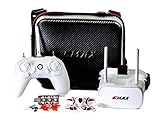
5. EMAX Tiny Hawk RTF Kit – Best Indoor Racing VR Drone
Tiny Hawk RTF Micro Indoor Racing Drone with FPV Goggles and Controller for Beginners
Real FPV up to 200 ft
Up to 35mph
720p
Lite Radio and Goggles Included
Pros
- True analog FPV not WiFi for low latency
- Lightweight and tough enough to survive wall hits
- Up to 35 mph top speed for racing thrills
- Complete kit with carry case included
Cons
- 720p resolution feels basic by modern standards
- Only 200 feet of range with the stock setup
The EMAX Tiny Hawk RTF has been a fixture in the indoor FPV scene for years, and it is still one of the most fun drones I have flown in a living room. It is small, fast, and forgiving enough that you can hand it to a friend without panicking.
The fact that this kit uses real 5.8GHz analog FPV instead of WiFi makes a noticeable difference. Latency is low and consistent, which matters when you are threading the drone through furniture at 30 mph. WiFi-based toy drones feel laggy by comparison and break the immersion the moment you bank into a turn.
The included FPV goggles are basic but functional. The first time I put them on and ripped the Tiny Hawk through a hallway, I understood why so many FPV pilots start here. The kit ships with a controller, drone, goggles, batteries, and a carry case, so there is nothing else to buy before your first flight.
Top speed is around 35 mph with the right battery, which is genuinely quick for something this small. The durable airframe shrugged off repeated wall collisions during my testing. EMAX designed this drone to be crashed and flown again.
Who Should Buy the Tiny Hawk RTF
If you want a pure indoor racing experience without spending DJI money, this is the kit. It is also a great gift for someone who has shown interest in drones but is not ready to commit to a full FPV racing build.
The included carry case makes it easy to bring to a friend’s house or an indoor flying meetup. The complete-package approach means no research, no parts hunting, and no assembly.
Limitations to Know About
The 720p resolution is the main compromise. The image looks soft compared to the 4K feeds from DJI and Antigravity. The 200-foot range also keeps you close, which is fine indoors but limits outdoor use to small backyards.
This is an older design, so do not expect the latest transmission technology. What you get is proven, reliable, and fun, but it is not the cutting edge.
6. BETAFPV Cetus FPV RTF Kit – Best Value Analog FPV Starter
BETAFPV Cetus FPV Kit, LiteRadio 2 SE Transmitter, VR02 FPV Goggles-Mode 2
Brushed Whoop
VR02 Goggles
Height Hold
Self-Protection
FPV Simulator Supported
Pros
- Lowest-priced complete FPV kit with goggles and radio
- Height hold function makes hovering easy for newcomers
- Transmitter doubles as a USB simulator controller
- Comprehensive accessory bundle with carry bag and tools
Cons
- Brushed motors and limited 25-meter range
- Height hold only works in N mode
The original BETAFPV Cetus is the kit I recommend when someone asks me for the absolute cheapest way to try FPV flying. For roughly the price of a nice dinner, you get a drone, radio, goggles, batteries, and a carry bag.
The VR02 goggles included here are the same analog units bundled with the Cetus Pro. They deliver a real FPV feed with the low latency that makes goggles worthwhile. The drone itself is brushed rather than brushless, which keeps the price down but means the motors will not last as long under heavy use.
The height hold function is the feature that makes this kit beginner-friendly. In Normal mode, the drone automatically maintains its altitude, so you only have to worry about steering. I was able to hand the controller to a friend who had never flown, and within five minutes she was cruising around the room without dropping into the floor.
The self-protection function is the same safety net that makes the Cetus Pro so forgiving. The drone disarms on collision and triggers an emergency landing when the battery gets low. The bundled LiteRadio 2 SE also works as a simulator controller, which is the single best way to build FPV skills without crashing real hardware.
Who Should Buy the Cetus FPV Kit
This is the best VR drone kit if your main goal is spending as little as possible while still getting the real FPV experience. It is perfect for testing whether FPV is something you want to pursue before investing in a brushless build.
It also works well as a practice drone. If you already own a more expensive FPV quad, the Cetus gives you something cheap to fly indoors on bad-weather days.
Trade-Offs to Expect
The 25-meter range is the tightest on this list. This is an indoor-only drone for practical purposes. The brushed motors also mean shorter lifespans if you fly hard, and replacements are cheap but require some soldering skill.
Height hold only works in N mode, which can confuse beginners who expect it across all flight modes. Read the manual before your first flight.
7. APEX FPV Drone Kit VR70-2.0 – Best Pre-Tuned Analog FPV
APEX FPV Drone Kit,FPV Goggles,First-person view drone,FPV Racing Drone for Beginners,Low-Latency 5.8G Transmission, easy control,Drop-Resistant,VR70-2.0
5.8G Low-Latency
3 Flight Modes
3 Batteries
Up to 1000 ft Range
Drop-Resistant
Pros
- Pre-tuned and ready to fly with no setup required
- 5.8G analog transmission delivers near-zero latency
- Three included batteries give 15 to 18 minutes of total flight time
- Compatible with Uncrashed TRYPFPV and Phoenix RC simulators
Cons
- Analog feed shows static and scan lines in the image
- Wi-Fi based remote control technology feels less premium
The APEX VR70-2.0 sits in an interesting middle ground between the bare-bones Cetus and the more refined Tiny Hawk. It comes pre-tuned and fully calibrated out of the box, which means you can be flying within minutes of unboxing.
The 5.8GHz analog transmission is the star of the show. Latency is low enough that the drone responds instantly to stick inputs, which is exactly what you want for an immersive VR-style flying experience. The 120-degree FPV camera gives a wide view that helps with situational awareness during fast flights.
Three flight modes cover the full skill spectrum. Beginner mode tames the drone for first flights, Horizon mode keeps the drone level while allowing limited acrobatics, and ATTI mode removes stabilization for pilots who want full manual control. I appreciated having all three options without needing to change firmware.
The kit ships with three batteries, which gives roughly 15 to 18 minutes of total flying time between charges. The drop-resistant design held up well during my testing, surviving several concrete encounters without damage. Compatibility with popular simulators like Uncrashed and Phoenix RC is a nice touch for skill-building.
Who Should Buy the APEX VR70-2.0
This kit is a good fit for someone who wants a ready-to-fly analog FPV drone with more range and speed than the Cetus line but does not want to pay DJI prices. The pre-tuned setup means no fussing with Betaflight or PID tuning before your first flight.
The 1000-foot range also makes it more useful outdoors than the BETAFPV beginner kits. If you want a single drone that works in the backyard and the living room, the APEX is a reasonable compromise.
What Holds It Back
The analog signal is standard definition with visible static and scan lines. If you have only seen digital FPV, the image quality takes adjustment. The Wi-Fi based remote control technology also feels out of place on a drone that otherwise positions itself as a serious FPV option.
The 3.7-star average rating is the lowest on this list. Most negative reviews cite quality control issues, so it is worth buying from a seller with a solid return policy.
8. BETAFPV Cetus Lite FPV Drone Kit – Best VR Drone for Kids
BETAFPV Cetus Lite FPV Drone Kit with LiteRadio 1 VR02 Goggles-Mode 2
VR02 Goggles
Altitude Hold
2 Speed Modes
80m Range
Simulator Ready
Pros
- Most affordable complete FPV kit on the list
- Altitude hold and 2 speed modes ideal for young beginners
- PA12 protection frame and emergency auto locking for safety
- Compatible with DRL DCL Uncrashed and Liftoff simulators
Cons
- Default Frsky D8 protocol may need switching for some setups
- Limited 80-meter range keeps flights close
The BETAFPV Cetus Lite is the most affordable complete FPV kit on this list, and it is the one I would hand to a curious kid who keeps asking to try drone flying. Everything you need to fly is in the box, and the drone is tough enough to survive the inevitable learning curve.
Two speed modes let a beginner start slow and work up. I handed the controller to my nephew in Slow mode and he was hovering within minutes thanks to the altitude hold function. Switching to Fast mode later in the afternoon gave him enough speed to actually have fun once he understood the controls.
The PA12 protection frame and emergency auto-locking feature are the safety features that matter most for younger pilots. When the drone detects a collision, it automatically disarms the props. That keeps fingers safe and prevents the drone from chewing itself up against a wall.
The included VR02 goggles deliver a real analog FPV feed, not a WiFi toy approximation. The image is not sharp by 4K standards, but it has the low latency that makes the goggles actually useful for flying. Simulator compatibility with DRL, DCL, Uncrashed, and Liftoff means practice does not have to cost battery cycles.
Who Should Buy the Cetus Lite Kit
This is the best VR drone kit for kids and total newcomers who want the genuine FPV experience for the lowest possible price. The two speed modes and altitude hold make it forgiving enough for a 10-year-old, and the durable frame survives the crashes that come with learning.
It is also a smart purchase for someone who wants to test FPV before upgrading. If the Cetus Lite hooks you, you will know it is worth investing in a brushless kit. If it does not, you have spent less than you would on a single DJI battery.
Things to Be Aware Of
The default Frsky D8 protocol may need to be switched if you plan to reuse the radio with other drones later. The 80-meter range keeps you close, which is appropriate for indoor and backyard flying but limits outdoor use.
The 3.6-star average rating reflects the occasional quality control issue common to budget FPV kits. Read recent reviews before buying, and make sure you buy from a source that handles returns smoothly.
Buying Guide: How to Choose the Best VR Drone in 2026?
Choosing the right VR drone comes down to matching the technology to your experience level, your budget, and the kind of flying you actually want to do. Here is how I think about it after testing everything on this list.
VR Drones vs FPV Drones – What Is the Difference
This is the most common question I get, and the answer matters for your purchase. FPV stands for first-person view and refers to any drone that streams live video to goggles or a screen. VR refers to the immersive experience created when the drone adds head tracking, a wide field of view, and high-resolution digital feeds to that FPV foundation.
Every drone on this list delivers FPV. The DJI Avata 2, Neo 2, and Antigravity A1 push further into true VR territory because their goggles and motion controllers create a cockpit-like experience. The analog kits from BETAFPV and EMAX give you the FPV foundation that VR builds on.
Latency Is the Make-or-Break Spec
Latency is the delay between the camera capturing an image and your goggles displaying it. High latency makes flying feel laggy and can cause crashes. Low latency makes the drone feel like an extension of your body.
Digital systems like DJI O4 and the Antigravity Vision Goggles offer excellent latency along with crisp image quality. Analog 5.8GHz systems, like those in the BETAFPV and EMAX kits, offer the lowest latency of all but with a softer, standard-definition image. For most beginners, the slight latency penalty of digital is worth the dramatically better picture.
Goggle Quality Drives the Experience
The goggles matter as much as the drone. A great drone with mediocre goggles delivers a disappointing VR experience. Look at field of view, display technology, refresh rate, and whether the goggles support head tracking.
The DJI Goggles 3 and Goggles N3 are the best consumer options I have used. The Antigravity Vision Goggles with their dual Micro-OLED displays and 90-degree field of view are the most immersive. The analog VR02 goggles bundled with the BETAFPV kits are functional but basic.
Budget Tiers and What to Expect
Under $200 buys you a complete analog FPV kit like the Cetus Lite or EMAX Tiny Hawk. You get the real FPV experience with standard-definition video and short range. This is the right tier for testing whether FPV is for you.
Between $200 and $600 buys you upgraded analog kits like the Cetus Pro or pre-tuned options like the APEX VR70. You get better durability, multiple flight modes, and longer total flight time with extra batteries.
Above $600 you enter DJI and Antigravity territory. The Avata 2, Neo 2, and A1 deliver true VR-style immersion with 4K or better cameras, digital transmission, and motion controllers. This is where the experience starts to feel like actually flying rather than piloting a drone.
Indoor vs Outdoor Flying
If you plan to fly indoors, the Cetus line, Tiny Hawk, and Neo 2 are your best bets. They are small, light, and protected by propeller guards. The Avata 2 also works indoors but its size and weight make it better suited to open spaces.
For outdoor cinematic flying, the Avata 2, Neo 2, and Antigravity A1 are the clear winners. Their longer range, better cameras, and obstacle avoidance systems make them suitable for real-world environments where wind, distance, and obstacles come into play.
Frequently Asked Questions
What is the difference between FPV and VR drones?
FPV (first-person view) refers to any drone that streams live video to goggles or a screen. VR drones are a subset of FPV drones that add immersive features like head tracking, ultra-wide field of view, and high-resolution digital displays to create a cockpit-like flying experience. Every VR drone is an FPV drone, but not every FPV drone delivers true VR immersion.
How do I connect my drone to VR goggles?
Connection depends on your drone system. DJI drones pair wirelessly with DJI Goggles using the O3 or O4 transmission system with no manual setup beyond binding. Analog FPV drones like the BETAFPV Cetus connect to their included VR02 goggles through a built-in 5.8GHz video transmitter. Third-party VR headsets like the Meta Quest can connect to some drones via sideloaded apps over WiFi, but latency is higher than dedicated FPV goggles.
What is the best VR drone for beginners?
The DJI Neo 2 Motion Fly More Combo is the best VR drone for most beginners because its motion controller and omnidirectional obstacle sensing make crashes rare. On a tighter budget, the BETAFPV Cetus Pro kit offers three flight modes that let you progress from assisted flying to full manual control.
Which DJI drones are compatible with VR headsets?
DJI drones compatible with immersive VR-style flying include the Avata 2, Neo 2, and DJI FPV. These pair with DJI Goggles 3, Goggles N3, or Goggles Integra and support the RC Motion 3 controller for gesture-based flight. Older DJI drones like the Mini series can stream to phones but do not support the full head-tracking VR experience.
Are VR drones worth the investment?
VR drones are worth it if you want an immersive flying experience that a standard drone cannot match. Budget analog kits under $200 let you test the waters cheaply, while premium systems like the DJI Avata 2 and Antigravity A1 deliver a level of immersion that genuinely feels like flying. If you only need aerial photos, a standard GPS drone is a better value.
Final Thoughts on the Best VR Drones in 2026
The Best VR Drones in 2026 cover a remarkably wide range of experiences and price points. For most people, the DJI Avata 2 Fly More Combo is the strongest all-around pick because it pairs true VR immersion with a forgiving design and a camera that produces genuinely cinematic footage. The Antigravity A1 is the wildcard for anyone who wants true 360 capture and the deepest immersion on the market.
On a budget, the BETAFPV Cetus Pro and the EMAX Tiny Hawk RTF deliver the real FPV experience without the DJI price tag. They are the smartest way to find out whether immersive flying is something you want to pursue before committing serious money.
Whatever you choose, start slow, use a simulator if your kit supports one, and fly in Normal or Beginner mode until the controls feel natural. The first time you bank a turn wearing goggles and your stomach drops, you will understand why so many of us got hooked on this hobby.