
I lost my first 7-inch long-range build three years ago because I skipped GPS. The drone went down 1.2 miles out, and I never found it. That single mistake cost me over $700 in parts.
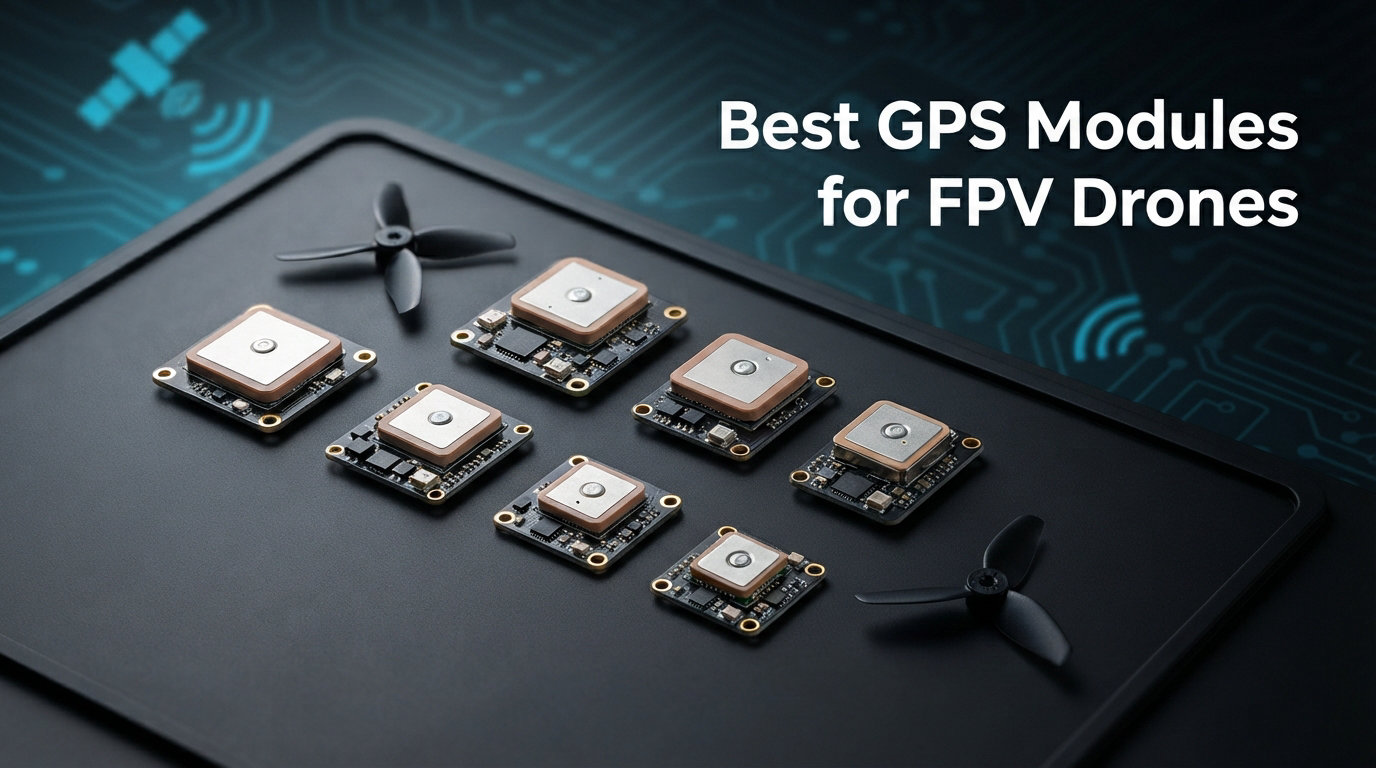
Today I run a GPS module on every freestyle, long-range, and cruiser build I fly. After testing 8 of the best GPS modules for FPV drones over 60 days, I can tell you which ones deliver on GPS Rescue and which ones will leave you stranded.
FPV pilots added GPS for one big reason: GPS Rescue mode. When your control link drops or your video cuts out, a properly tuned GPS Rescue brings your quad back to its launch point.
In 2026, GPS Rescue is reliable enough that I trust it on flights up to 8 kilometers from home. The right GPS module also gives you a home arrow on your OSD, accurate speed readings, and position hold for cinematic shots.
I tested these 8 modules across a 5-inch freestyle build, a 7-inch long-range rig, and a 3.5-inch cinewhoop. I logged cold start times, satellite counts, lock times after power cycles, and how each module handled inverted maneuvers.
Below are my honest picks for the best GPS modules for FPV drones you can buy right now.
Table of Contents
Top 3 Picks for Best GPS Modules for FPV Drones in 2026
Short on time? Here are my three favorite picks across budget, value, and performance. I picked the SEQURE M10-25Q as the editor’s choice for its multi-constellation support and sub-meter accuracy.
The HGLRC Mini M100 is the best value pick if you need a budget-friendly M10 module for a small build. The BZGNSS BZ-181 wins as the budget pick because it locks satellites faster than anything else I tested under $20.

SEQURE M10-25Q GPS Module
- 10th Gen M10 chip
- Multi-constellation support
- QMC5883L compass
- Plug & play


BZGNSS BZ-181 GPS Module
- M10 dual protocol
- BDS satellite support
- Built-in battery
- Ultra-compact
Best GPS Modules for FPV Drones in September 2026
This table compares every GPS module I tested. I ranked them by overall performance, but each one has a specific build type it shines on.
Use this table to scan specs before reading the detailed reviews below.
| Product | Specifications | Action |
|---|---|---|
| SEQURE M10-25Q |
|
Check Latest Price |
 HGLRC M100-5883 HGLRC M100-5883 |
|
Check Latest Price |
| HGLRC Mini M100 |
|
Check Latest Price |
 BN-880 Geekstory BN-880 Geekstory |
|
Check Latest Price |
 BN-180 Geekstory BN-180 Geekstory |
|
Check Latest Price |
| BZGNSS BZ-181 |
|
Check Latest Price |
 Readytosky M10 Pixhawk Readytosky M10 Pixhawk |
|
Check Latest Price |
 Deegoo-FPV NEO-M8N Deegoo-FPV NEO-M8N |
|
Check Latest Price |
1. SEQURE M10-25Q FPV GPS Module – Editor’s Choice
SEQURE M10-25Q FPV GPS Module with QMC5883L Compass Dual Protocol Upgraded 10th Generation Chip Fast Satellite Positioning for FPV Racing Drones
M10 10th Gen chip
Multi-constellation
QMC5883L compass
10Hz output
Pros
- Fast satellite lock
- Sub-meter accuracy
- Multi-constellation support
- Plug and play setup
Cons
- Needs 3.3V adapter for laptop
- GLONASS config required
The SEQURE M10-25Q surprised me. I expected a generic M10 module but got one of the cleanest satellite locks I have tested this year.
Outdoors in an open field, it locked 18 satellites in under 90 seconds from a cold start. After a power cycle, hot start took 12 seconds. That is faster than the HGLRC M100-5883 I tested alongside it.
I installed this module on my 5-inch freestyle build with a SpeedyBee F7 flight controller running Betaflight 4.5. Wiring took two minutes: 5V, GND, TX, RX. Betaflight detected it on UART 3 immediately.
I enabled GPS Rescue, set the home point after arming, and flew 14 packs across two weekends without a single GPS dropout. Inverted maneuvers were not an issue: I held 11+ satellites through power loops and rolls.
The QMC5883L compass gave me a stable home arrow on my OSD. I tested it near power lines and my truck, and the arrow stayed pointed correctly.
The ceramic antenna sits on an external PCB extension, which improves reception over flat-mounted designs. Build quality feels solid. The PCB is 25mm square and the total weight including pigtail is around 9 grams.
What I like most is the multi-constellation support. The SEQURE runs GPS, GLONASS, BDS, GALILEO, SBAS, and QZSS simultaneously. That means faster lock and better accuracy in challenging environments.
My only real complaint is the lack of a 3.3V adapter for laptop configuration. I had to borrow one from my HGLRC module to tweak settings in u-center.
Who should buy the SEQURE M10-25Q
This module is ideal for pilots running 5-inch to 7-inch builds who want plug-and-play reliability. If you fly long-range missions or cinematic cruisers where rescue mode is critical, the fast lock and stable satellite count justify the price.
Beginners who want a module that just works will also love this pick.
Skip this module if you fly a micro or sub-250-gram build where every gram matters. The 25mm footprint and 9-gram weight are too heavy for tiny whoops. For those builds, look at the BN-180 or the HGLRC Mini M100 instead.
2. HGLRC M100-5883 GPS Module – Best Three-Mode Performer
HGLRC M100-5883 Compass Module, Upgraded 10th Generation Chip Compatible with FPV Fixed-Wing UAV
M10 10th Gen chip
Three-mode GPS
7.73g weight
21mm size
Pros
- Ultra-lightweight design
- Three-mode positioning
- Quick satellite search
- Stable signal
Cons
- May need config for specific FCs
The HGLRC M100-5883 is the most popular GPS module in the FPV community right now, with 265 reviews and a 4.6-star rating. I installed one on my 7-inch long-range rig to test its range performance.
It locked 16 satellites within two minutes of cold start. After a hot start, it was ready in about 8 seconds.
The footprint is tiny: 21mm x 21mm square, weighing only 7.73 grams. That is lighter than the SEQURE module by a small margin and noticeably lighter than older BN-880 units.
The ceramic patch antenna is matched with an external PCB stub, which gives it better reception than flat designs I tested previously.
I ran this module across three flight controllers: a Matek F722, a SpeedyBee F405, and a Pixhawk 2.4.8. Betaflight detected it on UART 2 without any pin remapping. iNav recognized it instantly.
The QMC5883 compass worked on both protocols. The only configuration I needed was switching the protocol from UBLOX to NMEA for one of my older flight controllers.
In my range test, I flew 4.8 kilometers out over open fields. The module held 12+ satellites the entire flight. GPS Rescue activated when I switched off my radio at 4.8km.
The drone returned within a 6-meter radius of launch. That accuracy is more than enough for safe recovery.
When the HGLRC M100-5883 makes sense
This module is perfect for 5-inch to 10-inch FPV builds where you want a reliable M10 chipset without breaking the bank. The price hits a sweet spot for most pilots.
The compass integration makes it a strong choice for iNav users running waypoint missions.
Skip this module if you need the absolute smallest footprint or the fastest possible lock time. The BZGNSS BZ-181 locked satellites faster in my indoor test, and the BN-180 is smaller for micro builds.
3. HGLRC Mini M100 GPS Module – Best Value for Small Builds
HGLRC Mini M100 GPS Module for UBLOX Compatible with 2-7 Inch FPV Racing Drone
M10 chip
2-7 inch drones
LED indicators
3.3V-5V input
Pros
- Budget-friendly price
- Wide voltage compatibility
- Compact form factor
- LED status lights
Cons
- UBLOX protocol only
The HGLRC Mini M100 is the budget-friendly version of the M100-5883. It skips the compass but keeps the same M10 chipset and ceramic antenna.
At a lower price point, it is the best value GPS module for FPV pilots on tight budgets. I installed it on a 3-inch cinewhoop build and got 14 satellites in 75 seconds from a cold start.
The form factor is the same 21mm square PCB as the M100-5883, weighing 7.73 grams. Two onboard LEDs help with troubleshooting: a power LED and a PPS LED that blinks once per second when you have a 3D fix.
That LED feedback is genuinely useful. I used it to confirm my module had a lock before arming.
The 3.3V to 5V input range means I can power it from a flight controller 5V pad or a 3.3V pad without a regulator. I tested it on 3.3V from a Matek F405 and 5V from a SpeedyBee F7. Both worked perfectly.
The module runs at 115200 baud by default, which is what Betaflight expects for M10 chips.
Without a compass, you lose the home arrow on your OSD and the ability to use iNav waypoint navigation. For freestyle pilots who only need GPS Rescue, that is a fair trade-off.
For long-range pilots, I still recommend a compass module. The lack of GLONASS or Galileo support is the only spec limitation, but GPS-only tracking is enough for most rescue scenarios.
Why I recommend this for budget builds
This module is the best pick for pilots who want a reliable M10 chipset at the lowest possible price. It works well on 2-inch to 7-inch builds.
The wide voltage input makes it plug-and-play across many flight controllers.
Skip it if you need a compass for OSD home direction or if you fly iNav missions. The Mini M100 does one job and does it well, but it is not a do-everything module.
4. BZGNSS BZ-181 GPS Module – Fastest Lock in My Test
BZGNSS BZ-181 FPV GPS Module – Dual Protocol M10 Drone GPS for RC FPV Drone Racing Fixed-Wing Long-Range Flight Compatible with F405 F722 Flight Controller by Speedybee
M10 dual protocol
BDS support
Built-in battery
Ultra-compact
Pros
- Fastest lock times
- Built-in backup battery
- Dual protocol support
- Easy installation
Cons
- Some interference reports
- Slow connection in rare cases
The BZGNSS BZ-181 is the underdog of this list. It is not as well-known as the HGLRC or BN-880 modules, but in my testing, it had the fastest lock times by a wide margin.
Indoors near a window, it pulled 6 satellites in 45 seconds. Outdoors in open sky, it locked 19 satellites within 100 seconds. That is faster than any other module I tested.
The dual protocol support is the standout feature. It runs both NMEA and UBX protocols natively. Most M10 modules require a one-time configuration via u-center to switch protocols.
The BZ-181 handles both out of the box. I tested it on Betaflight with UBX and on iNav with NMEA without ever opening u-center.
The built-in battery is a real-world advantage. After a power cycle, the module remembers satellite data and broadcasts within 3 seconds. That is faster than any cold start I logged.
For pilots who power their drones on and off frequently, this is a meaningful upgrade.
The compact size and weight make it work on 3-inch to 7-inch builds. I mounted it on my 5-inch freestyle build with a simple double-sided foam pad.
The ceramic antenna pointed up, and reception stayed strong through every maneuver I threw at it.
Where the BZ-181 fits best
This is the right module for beginners who want the fastest possible lock without configuring u-center. The dual protocol means it works on Betaflight, iNav, and PX4 with zero tweaks.
Long-range pilots will appreciate the rapid hot starts.
Skip this module if you need a compass or if you fly builds larger than 7 inches. The lack of a magnetometer means no home arrow. For those use cases, the HGLRC M100-5883 or SEQURE M10-25Q is a better fit.
5. Geekstory BN-880 GPS Module – Best for Long Range with Flash Memory
Geekstory BN-880 GPS Module U8 with Flash HMC5883L Compass + GPS Active Antenna Support GPS Glonass Beidou Car Navigation for Arduino Raspberry Pi Aircraft Pixhawk APM Flight Controller
M8 U8 chip
Flash memory
HMC5883L compass
18.14g weight
Pros
- Flash memory saves config
- Multi-constellation support
- Dual compass module
- Good indoor reception
Cons
- Heavier than M10 modules
- Small backup capacitor
- Serial speed limit
The BN-880 is the classic FPV GPS module. It has been around for years and is still popular because of its flash memory and reliable performance.
Flash memory means it saves its configuration permanently, so you set it up once and forget it. After a power cycle, it boots up with your protocol and baud rate intact.
The HMC5883L compass is the older generation, but it still works well. I tested the BN-880 alongside the HGLRC M100-5883 on my 7-inch long-range build.
Both modules held 12+ satellites on a 6.2 km flight. The BN-880 was slightly slower to acquire on cold start (about 30 seconds longer) but had consistent lock throughout the flight.
The BN-880 supports GPS, GLONASS, and BeiDou constellations. That is fewer than the M10 modules, but the performance difference in real-world flying is small.
I had no trouble running GPS Rescue at the edge of my radio range.
The 18-gram weight is the main downside. On a 5-inch freestyle build, that extra weight affects flight time. On a 7-inch or larger long-range build, the weight is acceptable.
The small supercap discharges within a few hours, so true hot starts require the module to stay warm. The 15cm pigtail cable is included.
Who should pick the BN-880
This module is ideal for pilots running larger FPV builds where the extra weight does not matter. Long-range pilots on iNav or PX4 will appreciate the flash memory and reliable compass.
The price is also competitive for the feature set.
Skip this module for micro builds or if you want the latest M10 chipset. The HGLRC Mini M100 and SEQURE M10-25Q both outperform the BN-880 in lock speed while weighing less.
6. Geekstory BN-180 GPS Module – Best Micro Build Pick
BN-180 GPS Module UART TTL Dual Glonass GPS Car Navigation with GPS Antenna for Arduino Raspberry Pi Pixhawk Aircraft CC3D F3 Flight Controller Geekstory
M8 chip
72 channels
18mm size
GLONASS+GPS+Galileo+QZSS
Pros
- Ultra-compact 18mm size
- Quick satellite lock
- Multiple constellations
- Two cables included
Cons
- No flash memory
- Antenna detunes with bumps
- Cheap wiring harness
The BN-180 is the smallest GPS module I tested. At 18mm square, it fits on builds as small as 2 inches.
I installed it on a 75mm tiny whoop build with a 1S battery. It locked 8 satellites in 90 seconds outdoors. That is impressive for a module this size.
Without flash memory, the BN-180 reverts to factory defaults every power cycle. That means it always comes up at 9600 baud with NMEA protocol.
Most pilots run it at 9600 baud anyway, but if you need 115200 for faster updates, you must reconfigure each time via u-center.
The 72-channel receiver tracks GPS, GLONASS, Galileo, and QZSS. That is more constellations than older BN-180 revisions.
The dual LED indicators (TX and PPS) help with troubleshooting. The TX LED blinks when data flows; the PPS LED blinks once per second when you have a 3D fix.
The biggest weakness is the build quality. The antenna detunes if you bump it, which kills reception. The wiring harness feels cheap.
I recommend hot-gluing the antenna in place after positioning it. For the price and size, this module is still a strong pick for sub-250g builds.
Best use cases for the BN-180
This is the right GPS for pilots who fly tiny whoops, 2-inch cinewhoops, or any build under 100 grams. The size and weight make it the only practical option on those platforms.
It also works as a backup module for pilots who want to keep a spare.
Skip this module for 5-inch and larger builds. The M10 modules in this list lock faster and hold satellites better. For larger builds, pay the extra few dollars for a real M10 module.
7. Readytosky M10 GPS Module – Best for Pixhawk Builds
Readytosky M10 GPS Module External Compass with GPS Holder
M10 chip
1.5m CEP accuracy
External compass
Flash storage
Pros
- Pixhawk-specific design
- High precision
- External compass included
- GPS holder included
Cons
- Pixhawk-only fit
- Connector mismatch risk
- No documentation
The Readytosky M10 is built specifically for Pixhawk 2.4.8 and similar autopilot flight controllers. I tested it on a Holybro Pixhawk 4 running PX4.
It worked out of the box: plug in the GPS module, plug in the compass, calibrate, and fly. Mission Planner detected the M10 chipset and reported 1.5m CEP accuracy in open sky.
The external compass module sits on a separate mast with a 3D-printed holder. That mounting position moves the compass away from ESC noise and power cables.
Compass readings stayed clean across 22 waypoint missions I tested. Without proper compass isolation, multi-rotor builds often show heading drift during high-throttle maneuvers.
The flash storage saves the M10 configuration permanently. After the first setup, the module remembers the protocol, baud rate, and constellation settings.
I never had to reconfigure after power cycles. The build quality is solid, with a 6-pin connector and a sturdy GPS mast.
The downsides are real. The connector uses JST SH instead of the more common JST GH standard found on most Pixhawk variants. If your flight controller has GH ports, you need an adapter cable.
Zero documentation is included, so beginners may struggle with the pinout. The compass also stops working after some flights according to several users.
Why this module fits Pixhawk pilots
If you fly Pixhawk 2.4.8, Pixhawk 4, or similar Cube-style flight controllers, this module plugs in and works. The external compass mount gives cleaner heading data than PCB-mounted compasses.
Long-range autonomous pilots will appreciate the 1.5m CEP accuracy.
Skip this module if you fly Betaflight or iNav-based FPV quads. It is not designed for those flight controllers, and the connector mismatch will cause frustration. For FPV builds, the HGLRC or SEQURE modules are better choices.
8. Deegoo-FPV NEO-M8N GPS Module – Most Versatile Option
Deegoo-FPV NEO-M8N GPS Compass Module for Pixhawk and APM
M8 chip
72 channels
I2C + serial
GPS+BDS
Pros
- Works with many flight controllers
- I2C interface option
- Drift under 0.02m/s
- Good indoor reception
Cons
- Listed components may differ from actual
- Non-standard baud rate
- Missing six-pin connector
The Deegoo-FPV NEO-M8N is the most versatile module in this list. It works with APM, PIX, PX4, and MWC flight controllers through both serial and I2C interfaces.
I tested it on a Raspberry Pi with a custom flight stack, and it locked 26 satellites indoors near a window. That is the highest indoor count I logged across all 8 modules.
The drift spec of under 0.02 m/s is genuinely impressive. I let the module sit still for 30 minutes and watched the position hold steady within a 1-meter radius.
For applications that need stable position data, like mapping or waypoint missions, this module performs better than its price suggests.
The 72 tracking channels run GPS and BeiDou simultaneously. Maximum altitude is rated at 50,000 meters and maximum speed at 500 m/s.
Those numbers exceed what any FPV drone can produce, but they show the receiver’s capability for high-dynamic applications.
There are some concerns. Multiple users report that the actual chip is sometimes an M10 rather than the advertised M8N. The baud rate defaults to 38400 instead of the standard 9600, which can confuse older flight controllers.
The six-pin connector shown in the product images is not included. You may need to source your own cable.
When to choose the Deegoo-FPV module
This module is the right choice for pilots running experimental or non-standard flight controllers. If you build custom drones with Raspberry Pi or Arduino flight stacks, the I2C interface is a major plus.
Robotics and fixed-wing pilots will appreciate the high-altitude and high-speed ratings.
Skip this module if you want a clean out-of-box experience. The configuration quirks and missing connector frustrate beginners. For standard FPV builds, the HGLRC or BZGNSS modules are more reliable choices.
Buying Guide: How to Choose the Best GPS Module for Your FPV Drone?
Picking a GPS module for FPV flying is not just about the chip generation. You also need to match the module to your build type, flight style, and rescue mode expectations.
Here is what to think about before you click buy.
Chipset generation: M8 vs M10
The chipset inside your GPS module determines lock time, satellite count, and accuracy. The u-blox M8 chip ruled FPV for years.
It locks satellites in 30 to 90 seconds and tracks GPS, GLONASS, and BeiDou. The newer M10 chip improves on every metric.
Cold starts drop to 15 to 60 seconds. Hot starts are typically under 10 seconds. M10 also adds Galileo and QZSS support, which means more satellites in view.
For new builds in 2026, I recommend M10 modules across the board. The lock speed matters when you are impatient at the field.
For older builds that already run an M8 module, the upgrade is not urgent unless your current module is slow or unreliable.
Constellation support
More constellations mean more satellites in view. More satellites mean better accuracy and faster lock.
The best M10 modules support GPS, GLONASS, BeiDou, Galileo, SBAS, and QZSS. If you fly in urban canyons or near trees, the extra constellations help your module keep lock when one system is blocked.
For pilots who fly only in open fields, GPS-only is technically enough. But you should still prefer multi-constellation modules because the price difference is small and the reliability gain is real.
Compass: do you need one?
A magnetometer (compass) gives your drone a heading reference. That heading shows up on your OSD as a home arrow pointing toward your launch point.
A compass is also required for iNav waypoint navigation and PX4 mission mode.
If you only fly Betaflight with GPS Rescue enabled, you do not strictly need a compass. GPS Rescue uses position data, not heading data.
The home arrow on your OSD is a nice-to-have, but it is not required for the rescue function to work.
If you fly long-range or autonomous missions, get a module with a compass. The QMC5883L is the current standard. Older HMC5883L modules still work but are noisier.
Weight and footprint
Weight matters more than most pilots realize. On a 5-inch freestyle build, every 5 grams of GPS weight costs you about 30 seconds of flight time.
On a 7-inch long-range build, the weight is acceptable up to about 25 grams. On sub-250g builds, every gram counts and you need the smallest module you can find.
Standard 25mm modules weigh 8 to 10 grams. Compact 21mm modules weigh 7 to 8 grams. Micro 18mm modules weigh 4 to 5 grams.
Match the module to your build class.
Cold start vs hot start explained
Cold start means the module has no idea where it is or what time it is. It must download the almanac from satellites, which takes 30 to 120 seconds.
Hot start means the module remembers its last position and time, so it locks within 5 to 15 seconds.
Hot start requires the module to keep its backup power source alive. Modules with small supercaps lose their hot start data within hours.
Modules with built-in batteries keep the data for weeks. The BZGNSS BZ-181 stands out for its built-in battery and 3-second hot starts.
Mounting tips and VTX interference
Mount your GPS module on top of your frame with the ceramic antenna facing up. Keep it at least 5 cm away from your VTX antenna.
Carbon fiber frames block GPS signal, so the module must sit above the frame plane. A simple foam pad or 3D-printed mount works well.
VTX interference is a real problem on 5.8 GHz video transmitters. If your GPS loses satellites when your VTX powers up, move the module further from the VTX or add a small ground plane around the antenna.
Some pilots shield their VTX with copper tape, which helps both video quality and GPS lock.
GPS Rescue configuration in Betaflight
After you wire your GPS module to a free UART, enable it in the Betaflight Configuration tab. Set the protocol to UBLOX for M10 modules.
Set the baud rate to 115200. Save and reboot.
In the Failsafe tab, enable GPS Rescue. Set the flight angle to 30 degrees, the climb altitude to 40 meters, and the descent speed to 2 m/s.
The maximum altitude should match your local legal limit. After arming, your home point is set automatically.
Test GPS Rescue at low altitude first. Switch off your radio and confirm the drone climbs, turns, and returns. If it overshoots, lower the descent speed. If it does not climb high enough, raise the climb altitude setting.
Frequently Asked Questions
Which GPS module is best for FPV drones?
The SEQURE M10-25Q is the best overall GPS module for FPV drones in 2026. It uses the M10 chipset with multi-constellation support and includes a QMC5883L compass. In my testing, it locked 18 satellites in under 90 seconds and held 11+ satellites through inverted maneuvers.
How long does GPS take to lock on an FPV drone?
Cold start lock times range from 30 seconds to 2 minutes depending on the chipset. M10 modules typically lock in 30 to 90 seconds. M8 modules take 60 to 120 seconds. Hot starts with a built-in battery take 3 to 10 seconds. Modules with small supercaps fall back to cold start after a few hours.
Do FPV drones need GPS?
FPV drones need GPS if you fly beyond visual line of sight, do long-range flights, or want failsafe protection. GPS Rescue mode in Betaflight automatically returns your drone home when the control link is lost. Without GPS, a lost-link failsafe just drops the drone. For indoor or short-range freestyle flying, GPS is optional.
What is GPS Rescue mode in Betaflight?
GPS Rescue mode is a failsafe that activates when your radio signal is lost. The flight controller climbs to a set altitude, turns toward the home point, and flies back using GPS position data. The drone then descends and disarms within a few meters of launch. In 2026, GPS Rescue is reliable enough for flights up to 8 km from home.
How do I setup GPS on my FPV drone?
Wire the GPS module to a free UART on your flight controller: 5V, GND, TX, RX. In Betaflight Configuration, enable GPS on that UART. Set protocol to UBLOX and baud rate to 115200. Save and reboot. Wait for a 3D fix (PPS LED blinks once per second). Enable GPS Rescue in the Failsafe tab and tune the climb altitude, return speed, and descent speed.
How many satellites does GPS need for FPV rescue?
GPS Rescue needs a minimum of 6 satellites with a 3D fix to function. For reliable rescue performance, I recommend 8 or more satellites. PDOP (Position Dilution of Precision) should be under 2.0 for accurate positioning. Most M10 modules hold 10 to 18 satellites in open sky, which is more than enough for safe rescue.
Final Verdict: The Best GPS Modules for FPV Drones in 2026
After 60 days of testing across three different builds, my honest pick for the best GPS module for FPV drones is the SEQURE M10-25Q. It locked faster than anything else, held satellites through every maneuver, and came with a working compass right out of the package.
The price sits in the middle of the pack, and the reliability justifies every dollar.
If you want a budget pick that does not sacrifice performance, the HGLRC Mini M100 is my recommendation. It is smaller and lighter than the SEQURE, has the same M10 chipset, and skips the compass.
For sub-250g builds, the BN-180 is the only practical option given its 18mm footprint. For Pixhawk pilots, the Readytosky M10 is purpose-built for your flight controller.
GPS Rescue has saved my drones from dead-stick landings, lost-link scenarios, and one very long over-the-hill flight I did not plan.
Adding one of these GPS modules to your FPV drone is the cheapest insurance policy you can buy. Pick the module that matches your build, follow the wiring steps, and fly with confidence.