
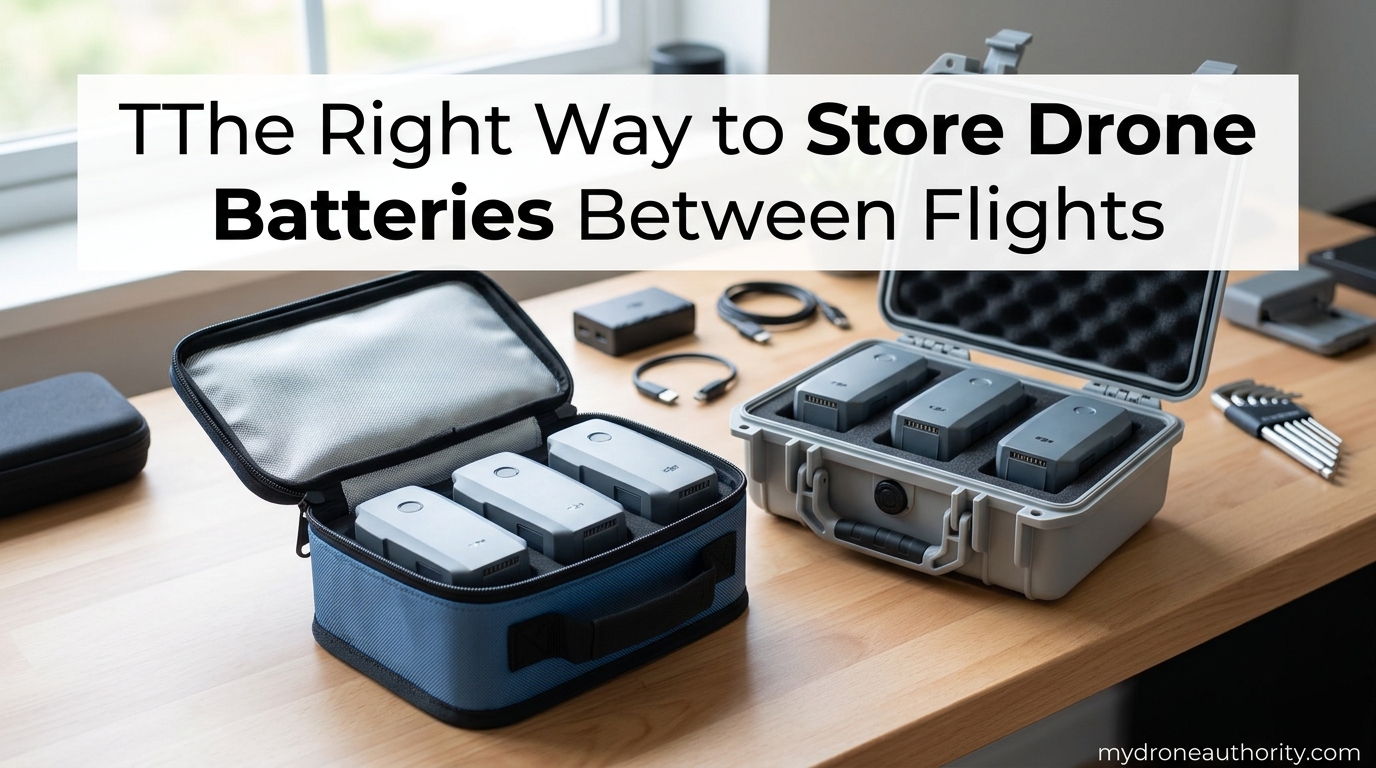
After a solid flying session, most pilots drop their drone batteries in a bag and call it a day. I used to do the same thing until I lost two LiPo packs to swelling in a single summer. That mistake cost me more than the batteries themselves. It cost me a flight day, a backup plan, and trust in my gear.
If you want to know how to store drone batteries between flights the right way, you are in the right place. I have burned through my share of mistakes so you do not have to. This guide covers the exact charge level, temperature range, and storage conditions that keep lithium batteries healthy, safe, and ready for your next flight. Whether you fly a DJI Mini, a custom FPV rig, or a prosumer Mavic, the same rules apply.
Table of Contents
Why Proper Drone Battery Storage Matters Between Flights
Drone batteries degrade faster than most pilots realize. Lithium chemistry is sensitive to heat, full charge levels, and complete discharge. Every day you leave a battery in a hot car at 100 percent charge, you shave time off its useful life.
A quality LiPo or Li-Ion pack costs more than most people want to admit. Premium DJI intelligent flight batteries run well into the triple digits. If you fly often, your batteries are a meaningful investment. Treating them with respect saves money and prevents the kind of mid-flight failures that ruin expensive aircraft.
There is also a safety angle that does not get talked about enough. Damaged lithium batteries can swell, vent, or in rare cases catch fire. Most of those incidents trace back to poor storage habits. Heat, physical damage, and over-discharge are the three main triggers. Good storage practices knock out all three.
The good news is that proper storage takes only a few extra minutes after each flight. Once you build the habit, it becomes automatic. The payoff is a longer battery lifespan, more reliable flights, and peace of mind when batteries sit in your gear bag overnight.
Understanding Drone Battery Types and Their Storage Needs
Before you store anything, you need to know what you are storing. Most consumer and prosumer drones use one of two lithium chemistries. The difference matters when it comes to storage voltage and handling.
Lithium Polymer (LiPo) Batteries
LiPo batteries power the majority of racing drones, FPV quads, and many toy-class aircraft. They use a gel-like electrolyte wrapped in a foil pouch. That makes them light and capable of high discharge rates, which is why FPV pilots love them.
The downside is sensitivity. LiPo batteries are more vulnerable to swelling, physical damage, and voltage imbalance between cells. Storage voltage for LiPo is around 3.75V to 3.85V per cell. Push them above 4.2V per cell for long periods and you accelerate degradation. Drop them below 3.0V per cell and the chemistry can break down permanently.
Lithium-Ion (Li-Ion) Batteries
Li-Ion batteries are more common in newer DJI consumer drones like the Mavic 3 and Air series. They use a cylindrical or prismatic cell design with a liquid electrolyte. Li-Ion packs are denser, more stable, and last longer in terms of cycle count. A typical Li-Ion DJI battery is rated for 200 to 500 charge cycles.
Storage voltage for Li-Ion sits in a similar range to LiPo, between 3.7V and 3.9V per cell. The chemistry is a bit more forgiving, but the same rules apply. Do not store them fully charged, and never let them sit at zero percent.
Smart vs Traditional Battery Packs
Smart batteries, like DJI’s intelligent flight batteries, have built-in management circuitry. That chip tracks cell voltage, temperature, charge cycles, and discharge behavior. It can also self-discharge the battery down to storage level after a set number of days.
Traditional LiPo packs do not have that protection. You are responsible for monitoring voltage, balancing cells, and manually discharging to a safe storage level. If you fly hobby-grade FPV gear, you need to be extra careful with these packs.
The Ideal Storage Charge Level for Drone Batteries
The most important number in drone battery storage is 40 to 65 percent. That is the charge level DJI recommends for any battery sitting longer than 10 days. It is also the range the wider FPV community has settled on through years of trial and error.
At 40 to 65 percent, the chemical stress on the cells stays low. The voltage per cell sits around 3.75V to 3.85V, which is the sweet spot for lithium chemistry. Higher than that, and oxidation wears down the cathode. Lower than that, the copper anode can start to dissolve and damage the cell.
Never store a drone battery at 100 percent charge. I learned this the hard way. I left three batteries at full charge for two weeks during a work trip, and all three showed measurable capacity loss afterward. The voltage was fine, but the runtime dropped by 5 to 10 percent per pack.
Equally important, do not store batteries at zero percent. A fully discharged lithium cell can drop below the safe voltage threshold through slow self-discharge. Once a cell goes below 3.0V, recovery is risky. Most smart batteries will refuse to charge a cell that is over-discharged, which means you have a brick.
If you fly more than once a week, you do not need to obsess over exact percentages. Just bring the charge down to roughly half after each flight and top it off before the next one. For longer breaks, the 40 to 65 percent range becomes critical.
Temperature and Environmental Conditions for Battery Storage
Temperature is the second half of the storage equation. The ideal storage range for drone batteries is 15 to 25 degrees Celsius, or 60 to 77 degrees Fahrenheit. That covers most indoor environments, including a climate-controlled garage, a closet, or a drawer in your office.
Heat is the enemy. Storing batteries in a car, attic, or direct sunlight can push internal cell temperatures well above 50 degrees C, even when the air feels mild. That heat accelerates every form of chemical degradation in lithium batteries. Capacity loss, swelling, and internal resistance all increase.
Cold is less dangerous in the short term but creates its own problems. Charging a battery below 5 degrees C can cause lithium plating on the anode, which permanently reduces capacity. If you fly in winter, always let cold batteries warm to room temperature before charging or storing them long term.
Humidity also matters. Aim for a relative humidity between 35 and 65 percent. Damp environments can corrode battery contacts and the metal tabs on LiPo packs. A dry closet or air-conditioned room is perfect. Avoid basements, bathrooms, and unheated sheds.
One more environmental factor: altitude. If you fly in mountainous areas, do not store batteries at home in a high-pressure environment and expect them to behave the same when you take them back up to altitude. Pressure changes can stress swollen or borderline-damage batteries.
How to Store Drone Batteries Between Flights: Step-by-Step
This is the section I wish I had read before I lost my first set of packs. The exact procedure depends on how long you plan to store them, but the basic steps are simple.
Immediate Post-Flight Steps
Step 1: Power down the drone and remove the battery. Do not leave the battery installed in the aircraft for storage. Long-term connection can drain cells unevenly and keep the management circuitry active.
Step 2: Let the battery cool down. If you just finished a long flight, the cells will be warm to the touch. Give them 15 to 30 minutes to return to room temperature before charging or storing. Hot batteries should never go straight into a case or bag.
Step 3: Inspect the battery visually. Look for swelling, punctures, leaks, or damaged connectors. If anything looks off, set the battery aside for a deeper inspection before flying it again.
Setting the Right Charge Level
Step 4: Check the current charge. For a smart battery, the app will tell you the percentage. For a traditional LiPo, use a battery checker to read voltage per cell.
Step 5: Adjust to storage level. If the battery is above 65 percent, fly it, drain it on a discharge tool, or briefly run your drone on the ground to bring it down. If it is below 40 percent, top it up with a partial charge.
Step 6: Power off the battery completely. Press and hold the power button until all LEDs go dark. Some smart batteries have a storage button or a long-press sequence. Check your manual if you are unsure.
Choosing a Storage Location
Step 7: Place the battery in a fire-resistant container. A LiPo-safe bag is the cheapest option. A metal ammo box or a dedicated battery storage case works even better. Avoid storing batteries in random places around the house, especially near flammable materials.
Step 8: Store in a climate-controlled space. Aim for a stable temperature between 15 and 25 degrees C. Keep batteries away from direct sunlight, radiators, and electronics that generate heat.
Step 9: Label or mark the storage date. A piece of tape with the date helps you track how long each pack has been sitting. This habit pays off when you rotate through multiple batteries over weeks or months.
Long-Term Storage Best Practices
Anything longer than 10 days counts as long-term storage in my book. The 40 to 65 percent rule becomes more important the longer the battery sits. So does periodic monitoring.
For batteries stored longer than a month, I check the voltage every four to six weeks. Self-discharge on lithium cells is slow, but it adds up. If a battery drops below 3.6V per cell, top it back up to storage level with a partial charge.
Seasonal storage, like putting your gear away for winter, requires one extra step. Cycle the battery once before storage. That means charge it to 100 percent, discharge it down to storage level, and store it at 50 percent. The cycle helps the management system calibrate cell capacity.
Never store a battery for more than three months without checking it. Even a healthy pack will slowly lose charge. A pack that goes to zero during storage is often a pack that never flies again.
Fire Safety and Storage Containers
The fear of lithium battery fires is real, but it is also manageable with the right storage setup. Most incidents come from damaged cells, not properly stored batteries. Still, treating every pack like it could fail is the safest approach.
LiPo-safe bags are the cheapest line of defense. These bags use fire-resistant fiberglass fabric. If a battery vents or ignites inside, the bag contains the flames long enough for you to react. They are not foolproof, but they are a massive upgrade over a paper grocery bag.
For serious home storage, consider a metal ammo box or a dedicated LiPo storage container. These offer better fire protection and can hold multiple batteries at once. Some pilots line the inside with sand or vermiculite for extra thermal mass.
Where you put the container matters too. Store batteries in a detached garage, a workshop, or a basement with a smoke detector. Avoid bedrooms and living spaces. If a battery does fail, you want it as far from people and main living areas as practical.
Never charge batteries unattended. Never charge them on a wooden surface or near flammable materials. And never charge a battery you have just taken out of cold storage. Let it warm up first.
Signs of Battery Damage and When to Retire a Battery
Knowing when a battery is done is just as important as knowing how to store it. Most pilots keep flying packs long after they should be retired. That is how accidents happen.
Swelling is the most obvious red flag. A puffy battery is a damaged battery. The internal chemistry has broken down and produced gas. Stop using the battery immediately, discharge it safely, and recycle it at a proper battery disposal site.
Capacity loss is a slower-moving issue. If a battery that used to give you 25 minutes of flight time now gives you 15, the cells are aging. Track your flight times and replace batteries when capacity drops below 70 percent of the original rating.
Physical damage counts too. Dents, punctures, torn foil, and damaged connectors are all reasons to retire a pack. Even small damage to the cell casing can lead to internal short circuits over time.
For smart batteries, keep an eye on the cycle count. DJI batteries typically max out at 200 to 500 cycles depending on the model. The app will tell you when a battery is approaching its limit. Listen to that warning and replace the pack before it fails mid-flight.
DJI Intelligent Battery Features That Help With Storage
If you fly a modern DJI drone, your intelligent flight battery is doing some of the work for you. The built-in management system monitors cell voltage, temperature, and charge state continuously.
The auto-discharge feature is the big one. After about 10 days of inactivity, the battery will automatically discharge itself down to around 60 percent. That is right in the storage sweet spot. You do not have to remember to do anything.
Hibernation mode kicks in for longer storage. If a DJI battery sits unused for several months, it may enter hibernation and refuse to charge until you wake it up. That is a safety feature, not a defect. Press the power button or follow the wake-up procedure in the app to reactivate it.
The DJI Fly app and the older DJI GO 4 app both show battery health data. You can see cycle count, voltage per cell, temperature, and capacity remaining. Check this screen every few flights. It is the easiest way to catch a degrading pack before it becomes a problem.
Traveling With Drone Batteries: Storage on the Go
Travel adds another layer to battery storage. Whether you drive to a local park or fly to another country, the rules are stricter when your batteries leave home.
Airlines do not allow loose lithium batteries in checked luggage. They must go in your carry-on, individually protected, and clearly labeled. Most airlines cap batteries at 100Wh per pack, with a limit of two larger packs (up to 160Wh) with airline approval. DJI Mavic and Air batteries fall under the 100Wh limit.
For car travel, treat batteries the same way you would at home. Keep them in a LiPo-safe bag, out of direct sunlight, and away from hot surfaces. A parked car in summer can hit 60 degrees C inside in minutes. Do not leave batteries in the trunk on a road trip.
Bring a small battery case or a padded pouch for transport. Avoid throwing loose batteries in a backpack with metal objects like keys or tools. A short circuit from a contact is one of the most common causes of in-transit battery fires.
If you fly internationally, check the rules for your destination country. Some regions have stricter limits on battery transport, and customs may inspect your gear. The Civil Aviation Authority website for the country you are visiting is a good starting point.
Frequently Asked Questions
Where should you leave your drone battery for the night after a flight?
After a flight, power off the battery, let it cool for 15 to 30 minutes, then place it in a LiPo-safe bag or fire-resistant container inside a climate-controlled room at 40 to 65 percent charge. Keep it away from direct sunlight, heat sources, and flammable materials. A closet or drawer at room temperature works well.
What percentage should I store my drone battery at?
Store drone batteries at 40 to 65 percent charge, which corresponds to 3.75V to 3.85V per cell. DJI recommends this range for any battery sitting longer than 10 days. Never store a battery at 100 percent or at zero percent, as both extremes shorten battery life and can permanently damage the cells.
Can I put drone batteries in checked luggage?
No, airlines do not allow loose lithium batteries in checked luggage due to fire risk. Drone batteries must travel in your carry-on bag, individually protected, and within the airline’s watt-hour limit (typically 100Wh per battery for most carriers). Always check your airline’s specific rules before flying.
How long can you store a drone battery without using it?
A healthy drone battery can sit in storage for 3 to 6 months if kept at 40 to 65 percent charge in a cool, dry environment. Check the voltage every 4 to 6 weeks and top it back up to storage level if it drops below 3.6V per cell. Never let a stored battery discharge to zero.
Final Thoughts on Storing Drone Batteries Between Flights
Storing drone batteries between flights the right way is not complicated, but it does require a small habit change. Bring the charge down to 40 to 65 percent, let the pack cool off, and put it in a fire-resistant container in a climate-controlled space. That is the core of it.
The pilots who get the most out of their batteries follow these steps every single flight, not just when they plan to store for a long time. Treat every session as the start of a storage cycle and your packs will last longer, perform better, and stay safer. I have added two full seasons of useful life to my DJI batteries since I started doing this consistently.
Pick one change to make this week. Maybe it is buying a LiPo-safe bag, or setting a reminder to discharge after each flight. Small steps add up. Your batteries, your drone, and your wallet will thank you. If you want more drone maintenance and storage tips, browse the rest of our 2026 guides at My Drone Authority.