
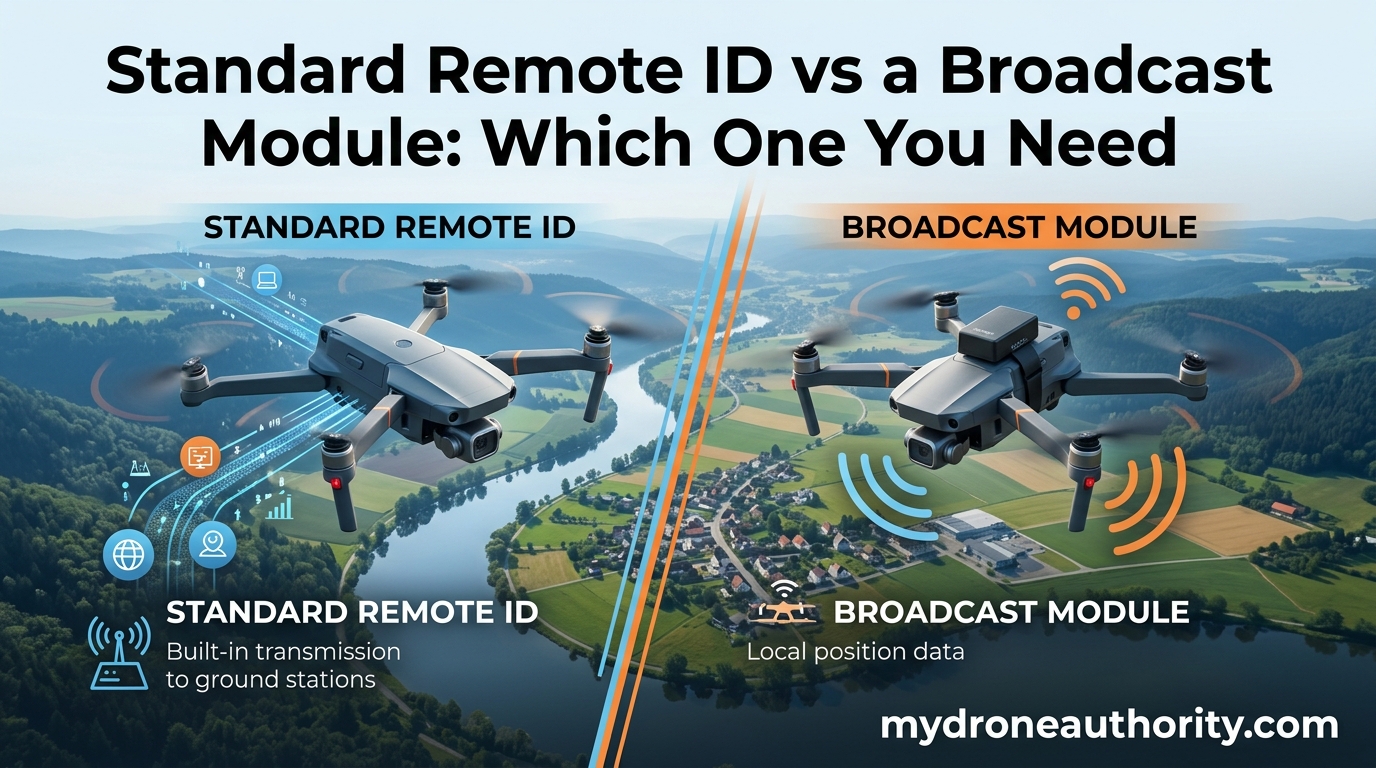
If your drone weighs between 0.55 and 55 pounds, the FAA requires it to broadcast Remote ID during every flight. The choice between Standard Remote ID and a Remote ID Broadcast Module comes down to one question: does your drone already broadcast identification from the factory, or do you need to add a separate device?
Standard Remote ID is built into newer drones like the DJI Air 3, Mavic 3 series, and Autel Evo II. A Remote ID Broadcast Module is an add-on device for older drones that lack built-in compliance. I’ll walk you through the exact differences, what each one broadcasts, and which option matches your situation.
Table of Contents
What Is Drone Remote ID and Why the FAA Requires It
Drone Remote ID is a digital license plate system for drones. It broadcasts identification and location information that other parties can receive during flight. Think of it like the transponder on a manned aircraft, scaled for consumer and commercial drones.
The FAA finalized this rule to address airspace security concerns. Law enforcement needs a way to identify drones flying near sensitive areas. Air traffic controllers need visibility into unmanned aircraft sharing their airspace. Remote ID solves both problems.
The rule applies to any drone weighing 0.55 to 55 pounds operating in U.S. airspace. This covers most recreational drones, all commercial Part 107 operations, and public safety missions. Drones under 0.55 pounds (250 grams) face limited requirements, but I’ll cover that exception below.
Remote ID transmits four core data points: drone identification (serial number or session ID), real-time location, altitude, and velocity. It also broadcasts emergency status if something goes wrong during flight.
Three Ways to Comply with Remote ID
The FAA gives drone operators three paths to compliance. Your flying situation determines which path applies.
Path 1: Standard Remote ID (Built-In)
The drone broadcasts Remote ID signals directly from the aircraft. The manufacturer integrated this capability into the drone’s design. You register the drone’s serial number with the FAA and you’re compliant.
Path 2: Remote ID Broadcast Module (External Device)
You attach a separate module to a drone that doesn’t have built-in Remote ID. The module broadcasts identification and the drone’s takeoff location. You register the module’s serial number, not the drone’s.
Path 3: Fly at a FRIA
An FAA-Recognized Identification Area (FRIA) is a designated location where you can fly without Remote ID. These are typically model aircraft fields and approved community flying sites. You still need to be a member of a community-based organization recognized by the FAA.
Standard Remote ID Explained: Built-In Compliance
Standard Remote ID means the drone itself does the broadcasting. No extra hardware, no add-ons, no firmware gymnastics on your end. The manufacturer handled compliance before the drone shipped.
What Drones Have Standard Remote ID Built-In?
Most drones released after September 2022 include Standard Remote ID. The DJI Air 3, DJI Mavic 3 Enterprise, Autel EVO II V3 series, Skydio 2+, and newer Parrot models all qualify. DJI added Remote ID support to several older models through firmware updates. Check the DJI official Remote ID compatibility list if you own an older DJI drone.
What Standard Remote ID Broadcasts
Standard Remote ID transmits the most complete data set. During flight, it sends the drone’s serial number, real-time location, altitude, velocity, and the live location of the ground control station (where the pilot stands). It also includes a timestamp and emergency status indicator.
This matters because standard Remote ID gives regulators and other observers a complete picture. They see not just where the drone is, but where the pilot is. For commercial operators, this provides an extra layer of accountability.
VLOS Requirement for Standard Remote ID
Standard Remote ID does not impose additional visual line of sight (VLOS) restrictions beyond what’s already required by Part 107 or recreational rules. You can still pursue Beyond Visual Line of Sight (BVLOS) waivers if your operations qualify. The drone broadcasts location data continuously regardless of whether you can see it.
How to Register Standard Remote ID
During FAA drone registration, you list the serial number of each Standard Remote ID drone you own. This links your registration to the specific aircraft broadcasting your identification. If you own five compliant drones, you list five serial numbers.
Remote ID Broadcast Module Explained: External Compliance
A Remote ID Broadcast Module is a small device you attach to a drone that lacks built-in Remote ID. It transmits identification information independently of the aircraft’s systems.
Who Needs a Broadcast Module
You need a broadcast module if your drone is older and the manufacturer never issued a Remote ID firmware update. Custom-built drones, FPV racing quads, and many older prosumer models fall into this category. If you can’t get an official Declaration of Compliance from your manufacturer, a module is your practical path.
I see this question come up constantly on drone forums: “My drone is from 2020 and the manufacturer stopped supporting it. What do I do?” The broadcast module is the answer. It’s the FAA’s officially sanctioned way to bring legacy equipment into compliance.
What Broadcast Modules Transmit
Broadcast modules transmit the drone’s takeoff location rather than its real-time position. They send the serial number of the module itself (not your drone), the latitude and longitude where the drone launched, altitude at takeoff, and velocity data. Once the drone moves away from that point, the module keeps broadcasting that initial location.
This is the key functional difference from Standard Remote ID. With a module, anyone receiving the signal knows where you started flying, not where the drone is right now.
VLOS Requirement for Broadcast Modules
The FAA requires that pilots using a Remote ID Broadcast Module maintain visual line of sight with their drone at all times during flight. This is explicit in the rule text and reiterated in FAA guidance.
If you fly FPV with goggles, a broadcast module won’t satisfy Remote ID requirements unless you also have a visual observer maintaining VLOS. This is a significant limitation for FPV pilots and anyone flying behind obstacles.
Popular Broadcast Module Options
Several manufacturers make FAA-compliant modules. Dronetag produces popular Bluetooth-based modules that attach to most drone frames. BlueMark, Apollo Shields, and uAvionix also offer compliant options. These typically weigh between 5 and 30 grams and broadcast on Bluetooth or WiFi frequencies.
Standard Remote ID vs Broadcast Module: Side-by-Side Comparison
Here’s how the two compliance paths stack up against each other.
Information Broadcast
Standard Remote ID transmits real-time drone location and pilot location. Broadcast modules transmit takeoff location only. The standard option gives observers a moving target; the module gives them a fixed point.
Serial Number Registration
Standard Remote ID requires registering the drone’s serial number with the FAA. Broadcast modules require registering the module’s serial number. If you swap modules between drones, you need to update your registration.
BVLOS Eligibility
Standard Remote ID does not restrict BVLOS operations beyond existing waiver requirements. Broadcast modules require strict VLOS during all flights. If you hold or plan to seek a BVLOS waiver, standard compliance gives you more operational flexibility.
Hardware Requirements
Standard Remote ID needs nothing extra. The drone broadcasts from internal hardware. Broadcast modules require you to purchase, charge, mount, and maintain a separate device. Module weight affects flight time and payload capacity on smaller drones.
Best For
Standard Remote ID works best for newer commercial and prosumer drones where the manufacturer built in compliance. Broadcast modules work best for older drones, custom builds, and FPV setups where adding a lightweight module is more practical than replacing the aircraft.
Which One Do You Need? A Decision Guide
Walk through these questions to determine your compliance path.
Does Your Drone Have Built-In Standard Remote ID?
Check the manufacturer’s documentation or the FAA’s Declaration of Compliance database. If your drone model appears on the compliance list and you’ve applied any required firmware updates, you have Standard Remote ID. Register the drone’s serial number and you’re done.
Is Your Drone Older or Unsupported by the Manufacturer?
If the manufacturer never issued a Remote ID update and the drone isn’t on the Declaration of Compliance list, you need a broadcast module. This is the most common scenario for pilots flying drones from 2018 to 2021 that manufacturers abandoned.
Do You Fly FPV with Goggles?
If you fly FPV and don’t have a visual observer, a broadcast module won’t meet the VLOS requirement. You either need to add a visual observer, find a FRIA location, or limit operations to tethered or sight-aided flights where VLOS is technically maintained.
Do You Hold a BVLOS Waiver or Plan To?
Standard Remote ID is better suited for BVLOS operations because it doesn’t impose the strict VLOS constraint that broadcast modules do. If you have an active BVLOS waiver or are pursuing one, prioritize drones with built-in compliance.
Are You Flying Under Part 107 or Recreationally?
Both commercial and recreational pilots face the same Remote ID requirements. Your pilot status doesn’t change which compliance method you use. A recreational flyer with a 2020 Mavic Air 2 needs the same broadcast module as a commercial operator with the same drone.
Quick Decision Summary
If your drone has built-in Standard Remote ID, use that. If it doesn’t and you can see your drone throughout the flight, a broadcast module works. If it doesn’t and you can’t maintain VLOS, you need to find a FRIA or replace the drone.
FRIA: The Third Compliance Path
If neither Standard Remote ID nor a broadcast module fits your situation, you might still fly legally at a FRIA. These are FAA-approved flying sites, typically operated by model aircraft clubs or educational institutions.
At a FRIA, you don’t need any Remote ID equipment. You simply need to be a member of a recognized community-based organization and fly within the approved area boundaries. The FAA maintains a list of approved FRIA locations on their website.
FRIA works well for hobbyists flying at club fields, instructors running training programs at approved sites, and anyone whose drone can’t practically support a broadcast module. It doesn’t work for commercial work, property inspections, or any operation that takes you beyond the FRIA boundary.
Compliance Steps and Deadlines
The FAA’s Remote ID rule took full effect in March 2024. From that date, all drone operations subject to the rule must use compliant equipment. There’s no grace period or grandfather clause for non-compliant drones operating outside FRIA locations.
If you’re flying without compliance now, you’re operating illegally. The FAA can issue fines, revoke pilot certificates, and pursue enforcement actions. The practical risk of enforcement remains low for isolated incidents, but the regulatory exposure is real.
To get compliant: Register your drone at faa.gov, check whether it has Standard Remote ID, add a broadcast module if needed, and update your registration to include the appropriate serial numbers. The whole process takes about 20 minutes if you have your drone information ready.
Common Questions from Real Drone Pilots
Based on forum discussions and pilot questions, these are the issues that come up most often when deciding between Standard Remote ID and a broadcast module.
Many pilots ask whether the takeoff location broadcast from a broadcast module updates if they move their controller. It doesn’t. The module broadcasts the location where the drone launched, not where the pilot currently stands. This is fundamentally different from Standard Remote ID, which transmits the pilot’s real-time position.
Sub-250 gram drones like the DJI Mini series have a different compliance path. Since September 2023, these drones must broadcast Remote ID, but the FAA treats them slightly differently for registration purposes. Check the current rules for your specific model.
DIY builders often worry that Remote ID rules prohibit custom aircraft. They don’t. You can register a custom-built drone and use a broadcast module to satisfy requirements. The FAA’s framework accommodates experimental and custom builds as long as the equipment broadcasts compliant identification.
Frequently Asked Questions
Who needs Remote ID for drones?
Any drone operator flying a drone that weighs between 0.55 and 55 pounds in U.S. airspace must comply with Remote ID. This applies to recreational flyers, Part 107 commercial operators, and public safety missions equally.
When can a person not use a Remote ID broadcast module?
A person cannot use a Remote ID broadcast module when they cannot maintain visual line of sight with the drone throughout the entire flight. The FAA explicitly requires VLOS at all times for operations using broadcast modules. Additionally, broadcast modules cannot be used as substitutes for Standard Remote ID on operations where BVLOS waivers apply.
Does the DJI Air 3 have Standard Remote ID or a broadcast module?
The DJI Air 3 has built-in Standard Remote ID. DJI integrated Remote ID broadcasting directly into the Air 3 hardware, so no external module is required. You register the Air 3’s serial number with the FAA during drone registration.
Can I fly without Remote ID?
You can fly without Remote ID if you operate exclusively within an FAA-Recognized Identification Area (FRIA) and are a member of a recognized community-based organization. Outside of FRIA locations, all drones weighing 0.55 to 55 pounds must have Remote ID compliance via Standard Remote ID or a broadcast module.
What is the best Remote ID module for drones?
The best Remote ID module depends on your drone type and flying style. Dronetag modules are popular for their compact size and Bluetooth broadcasting. BlueMark and uAvionix offer alternatives with different mounting options. Choose an FAA-compliant module from a manufacturer with a valid Declaration of Compliance.
What are the penalties for not complying with Remote ID?
The FAA can issue fines, revoke pilot certificates, and pursue enforcement actions against operators flying without Remote ID compliance. Civil penalties can reach thousands of dollars per violation. The FAA also has authority to detain non-compliant drones in certain circumstances.
How much does Remote ID cost?
Standard Remote ID costs nothing extra because it’s built into compliant drones. Broadcast modules typically cost between $50 and $200 depending on the manufacturer and features. FAA drone registration costs $5 for recreational flyers (covering all drones in your fleet) and $5 per drone for Part 107 commercial registration.
Making Your Decision
The decision between Standard Remote ID and a broadcast module depends almost entirely on your existing equipment. If your drone has built-in compliance, that’s your path. If not, a broadcast module is the practical solution as long as you can maintain VLOS.
For most pilots reading this, the answer is simple. Check whether your drone has Standard Remote ID by looking up the manufacturer’s Declaration of Compliance. If it does, register the serial number and fly. If it doesn’t, evaluate whether a broadcast module fits your flying style, or consider whether it’s time to upgrade to a compliant drone.
The Remote ID rule has been in full effect since March 2024. Compliance isn’t optional for drones in the regulated weight range. Take 20 minutes today to verify your setup and update your FAA registration if needed. That’s the entire process, and it keeps you flying legally.