
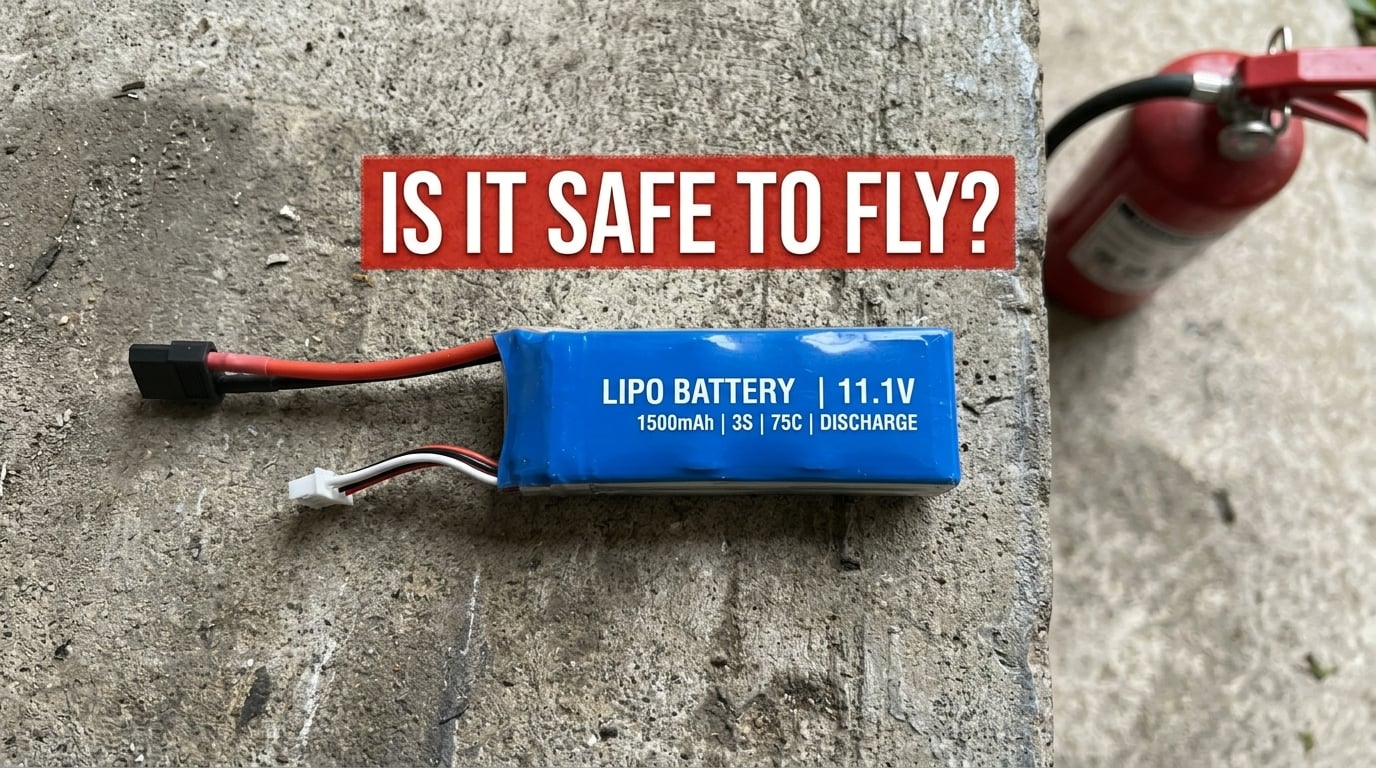
I’m going to give you the same answer I’d give a friend at the flying field: it depends, and the honest version is harsher than most blog posts admit. A slightly puffy LiPo can still be flown in specific, limited cases, but the moment you start hoping the swelling will go away, you’re already gambling with something that can burn your house down.
After talking with FPV pilots, RC racers, and a few battery techs, here’s the straight story. If you want the one-line answer: a slightly puffy LiPo is safe to fly only if the swelling fully disappears after cooling, the cells still hold a balanced voltage, and you’ve never had a hard crash or over-discharge event. Anything else, and you should retire the pack.
In this guide, I’ll walk through why LiPos puff, the real safety risks of flying with one, and the exact checklist I use before deciding a swollen battery still belongs in the air.
Table of Contents
The Honest, Short Answer About Flying With a Puffy LiPo
No, you should not fly with a puffy LiPo battery in most cases. A slightly puffy LiPo is only safe to fly when the puffing is purely heat-related (it goes flat after cooling), the cells still balance correctly, and the pack has not been crashed, over-discharged, or stored at full charge. If the swelling stays after the pack cools, or the battery was damaged, the battery is a fire hazard and must be retired.
That answer sounds strict because the data backs it up. In the multicopter community, packs that puff and stay puffed are the ones that vent, catch fire mid-flight, or fail on the next charge cycle. Packs that puff only when hot and shrink back when cool are usually degrading cells that will eventually go the same route, just slower.
I’ll say it once more for the featured snippet: a puffy LiPo battery is not safe to fly. Even a slightly puffy one is a sign of internal chemical breakdown, and the fire risk is real, on the ground or in the air.
Why LiPo Batteries Puff in the First Place
LiPo batteries puff because the cells are producing gas they cannot release. Inside every pouch-style LiPo, the chemistry that stores energy is sensitive to heat, voltage, and physical damage. When any of those go wrong, the electrolyte breaks down and releases gas. That gas has nowhere to go, so the sealed pouch swells. You see that as puffing.
The most common causes I see in our own fleet are:
- Over-discharging below 3.0V per cell during a flight. This permanently damages the cell chemistry.
- Overcharging above 4.2V per cell, even by a small amount over many cycles.
- Heat buildup from high C-rating draws, especially in summer flying or with undersized packs.
- Physical damage from crashes, even small ones, that dent the pouch.
- Age and storage, especially when stored at full charge for weeks or months.
Internal resistance is the hidden driver behind most of these. As a cell ages, internal resistance climbs, which creates more heat under load, which produces more gas, which causes more swelling. It’s a slow feedback loop. By the time you can see the puff, the damage is already done to the cell’s internal structure.
The Real Safety Risks of a Slightly Puffy LiPo
The biggest risk of a puffy LiPo is thermal runaway. That’s the chain reaction where one cell overheats, ignites its own electrolyte, and triggers the cell next to it. Once thermal runaway starts in a LiPo, it cannot be stopped with water. It burns at over 1,000 degrees F, produces toxic gas, and re-ignites every time you think it’s out.
For a pilot, that risk plays out three ways:
- Mid-flight failure. A puffed cell can vent and catch fire while you’re 200 feet up. Your drone comes down on fire, possibly on someone else’s property.
- Charging fires. Most LiPo fires start during charging, not flying. A puffed cell is far more likely to go during the next balance charge.
- Storage fires. Puffed cells that get tossed in a LiPo bag or, worse, a drawer can fail days later with no warning.
I’ll be blunt: a LiPo fire in your car, garage, or living room is a life-safety event. House fires from RC batteries kill pets and burn homes. The cost of a new pack is trivial compared to that. Our team has talked to multiple pilots who had a “slightly puffy” pack fail within a week. Some of them were lucky. Some lost workbenches.
How to Tell If Your Puffy LiPo Is Still Safe to Fly
Here’s the assessment process I run through before any puffed pack goes back in a drone. If the battery fails any one of these checks, it gets retired. No debate.
Step 1: Let It Cool Completely
Pull the pack and let it sit at room temperature for at least 30 minutes. Heat-induced puffing is the only kind that’s even debatable. A pack that’s flat when cool is showing you something different than a pack that’s still fat an hour later.
Step 2: Measure Each Cell Voltage
Use a hobby charger or a cell checker to read every cell. You’re looking for:
- All cells between 3.7V and 4.2V at full charge.
- Cell delta under 0.05V across the pack.
- No cell reading below 3.0V at any point during a discharge.
If one cell is sagging below the rest, that cell is failing. The pack is unsafe.
Step 3: Look at the Puff Severity
Severity matters. Here’s the rough scale our team uses:
- Level 1 (minor): Slight pillow feel. Pack looks mostly flat from the side. May or may not go away when cool.
- Level 2 (moderate): Clear bulge. Visible rounding on the cell edges. Stays puffy when cool.
- Level 3 (severe): Soft, marshmallow-like feel. Strong gas smell (sweet, chemical odor). Possibly hissing.
For flying, I personally only consider Level 1 packs that go fully flat when cool, and only after I see them behave that way across multiple cycles. Anything Level 2 or above is a retirement pack. If you can smell the pack, you should already be moving it outside.
Step 4: Check the Pack History
Honest question: did this pack ever crash, over-discharge, or sit at full charge for a month? If yes, puffing isn’t “just heat.” It’s damage. Retire it.
What to Do With a Puffy LiPo Battery
If your battery fails the assessment above, here’s what to do. Don’t throw it in the trash. Don’t toss it in a LiPo bag and forget about it. Puffed LiPos need to be discharged and disposed of properly.
Step 1: Move It Outside
Carry the puffed pack to a concrete or dirt surface outdoors, away from anything flammable. Do this immediately after you notice it.
Step 2: Discharge the Pack
The safest method is a saltwater bath. Submerge the pack in a bucket of salt water (about 1/4 cup of salt per gallon) for 1 to 2 weeks. The salt water slowly drains the cells to zero. Only do this outdoors or in a well-ventilated area, because the pack will off-gas as it discharges.
Step 3: Tape the Leads and Recycle
Once the cells read 0V, cover the connector leads with electrical tape. Take the pack to a Call2Recycle drop-off, a hobby shop with a battery program, or a local e-waste facility. Don’t put LiPos in regular recycling or trash.
For pilots who travel with drones: TSA does not allow damaged or recalled lithium batteries on aircraft, period. A puffy pack is treated as a damaged battery. If you’re flying commercially to a race, leave puffed packs at home, period. Check airline policies in 2026 for specific watt-hour limits on undamaged packs.
How to Prevent Your LiPos From Puffing
Most puffing is preventable. Our team has extended pack life by 2x or more by following these rules:
- Store at 3.8V per cell. Full charge storage kills LiPos. Use storage mode on your charger if you’re not flying within 24 hours.
- Don’t over-discharge. Set a low voltage cutoff in your flight controller. 3.3V per cell is a safer floor than 3.0V.
- Avoid heat. Don’t charge hot packs. Let them cool before recharging. Don’t leave them in a hot car.
- Use a proper C-rating. Underrated packs run hot. Match the C-rating to your drone’s draw.
- Balance charge every time. Even if you’re in a hurry, balance charging keeps the cells even and reduces stress on the weakest cell.
Finally, retire packs proactively. A pack that has 200+ cycles, has been crashed, or just feels “off” is a candidate for replacement. LiPos are consumables. A $25 pack is cheaper than a $500 drone, a garage fire, or a hospital visit.
Frequently Asked Questions
Are puffed LiPo batteries safe?
No, puffed LiPo batteries are not considered safe. A puffy LiPo shows gas buildup from internal chemical breakdown, which is the same failure mode that leads to thermal runaway and fire. Even a slightly puffy battery is a sign the cells are damaged.
How swollen is too swollen for LiPo batteries?
A LiPo is too swollen to fly when the puffing stays after the pack cools, when one cell reads noticeably lower voltage than the others, or when you can see clear bulging on the cell edges. Any sweet or chemical smell means the pack is past safe use and should be retired immediately.
What do you do if your LiPo battery is puffed?
Move the puffed LiPo outside to a non-flammable surface, discharge it in a saltwater bath for 1 to 2 weeks, tape over the leads, and take it to a Call2Recycle drop-off or a hobby shop battery program. Do not throw puffed LiPos in the trash or regular recycling.
What happens when a LiPo battery swells?
When a LiPo swells, gas builds up inside the sealed pouch because the cell chemistry is breaking down from overcharge, over-discharge, heat, physical damage, or age. The swelling means the internal structure of the cell is compromised, which raises the risk of fire and thermal runaway.
Is it safe to use a swollen LiPo battery?
A swollen LiPo battery is not safe to use in most cases. The only borderline exception is a pack that puffs only from heat, returns to a flat shape after cooling, holds balanced cell voltage, and has no history of crash damage or over-discharge. Any other type of swelling means the pack should be retired and recycled.
The Bottom Line on Flying With a Slightly Puffy LiPo
Here’s how I land this question: a slightly puffy LiPo is not safe to fly by default. The only packs I’d consider airworthy are heat-induced Level 1 puffs that fully recover when cool, pass the cell voltage check, and have a clean history. Everything else goes to the discharge bucket.
If you’re unsure, ground the pack. A $25 replacement is a small price for not gambling with a fire in your home or a flaming drone over a crowd. Trust the assessment, not the hope that “it’ll be fine this time.”