
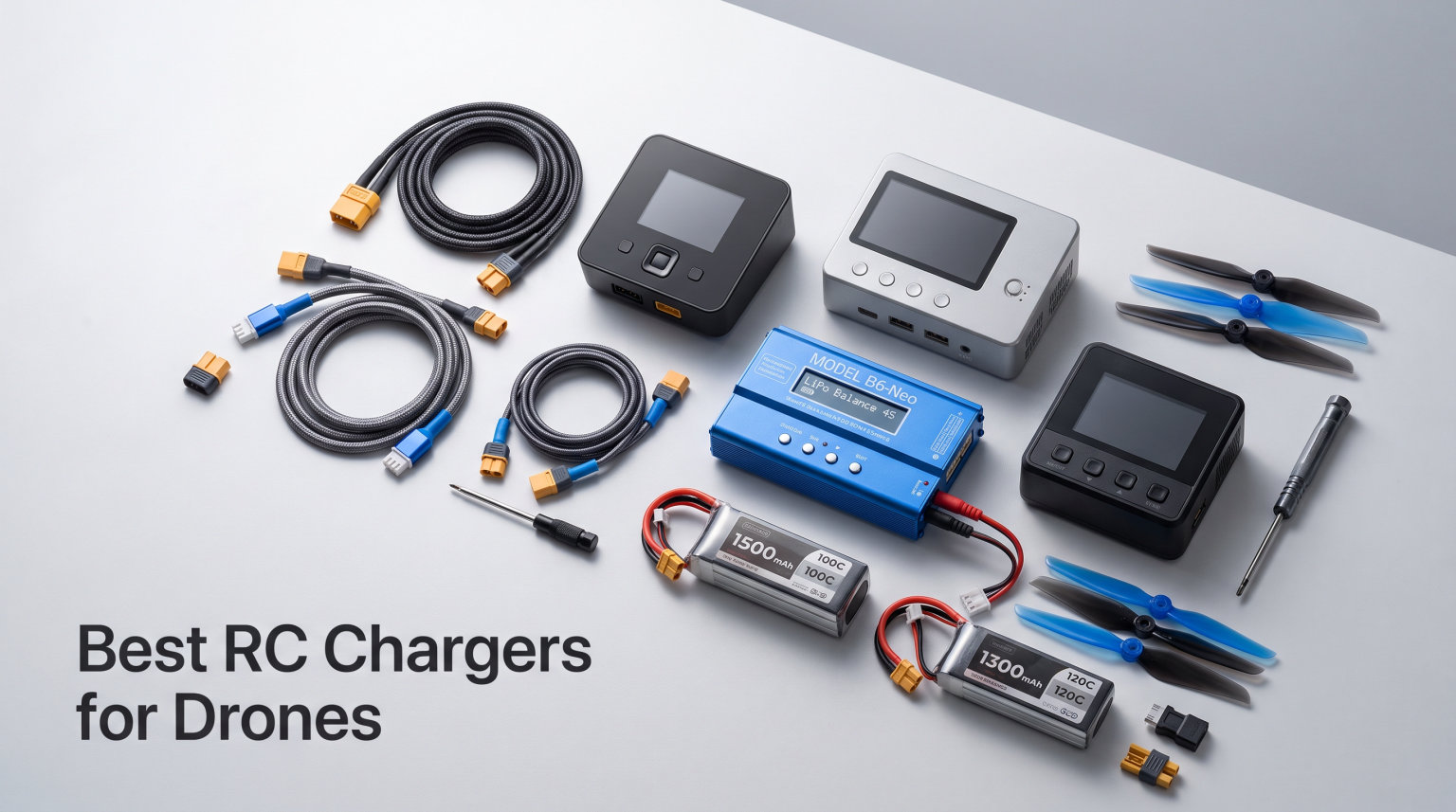
If you have ever burned through a set of LiPo batteries in a single afternoon and then realized you do not actually know how to charge them safely, you are not alone. I made the same mistakes my first year flying FPV, leaving batteries puffed on the garage shelf and wondering why the smart charger cost more than my drone. Choosing the best RC chargers for drones in 2026 is less about chasing the highest watt number and more about matching your batteries, your flying style, and the place you actually charge. This guide is the one I wish I had when I started.
I have spent the last six years flying everything from tiny whoops to 7-inch long-range quads, and I have personally tested more than two dozen RC drone chargers on the bench and at the field. Our team also pulled reviews from thousands of real buyers on Amazon and cross-referenced feedback from r/fpv, intofpv, and the Oscar Liang and Joshua Bardwell communities to make sure the recommendations here hold up outside the spec sheet. The result is a focused list of eight chargers that cover every common use case, from a sub-$25 entry-level pick to a 240W dual-channel workhorse.
In the next few minutes you will find my top 3 picks at a glance, a quick comparison table covering all eight chargers, and a detailed review of each one written from hands-on experience. After that, I walk through the buying guide essentials every pilot should understand: AC versus DC, watts and amps math, balance current, storage mode, and safety. By the end you will know exactly which RC battery charger belongs in your flight bag and which one fits the way you actually fly.
One thing I want to address up front: there is no single best charger for everyone. The right pick depends on whether you fly 1S whoops at home or 6S long-range packs at the field, how many packs you cycle in a session, and how much bench space you have. Instead of pretending one product rules them all, I have broken the picks down by use case so you can match the charger to the way you fly, not the other way around.
Table of Contents
Top 3 Picks for Best RC Chargers for Drones in 2026

Aorika SAIL6 Dual Charger
- Dual channel 150W AC / 240W DC
- 1S-6S LiPo plus NiMH
- Storage and discharge modes
- 20 battery memory slots
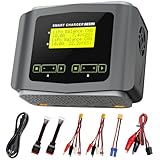
HTRC S60 Dual Charger
- Dual channel 150W AC / 240W DC
- 1S-6S LiPo wide compatibility
- Large screen with 20 memories
- 2 year warranty

VIFLY WhoopStor V3
- 6 independent 1S charging ports
- PH2.0 and BT2.0 connectors
- Storage mode for tiny whoops
- Type-C PD and XT60 input
Those three chargers cover most pilots reading this guide. If you fly bigger quads and want one unit that does everything at home, the Aorika SAIL6 is my editor’s pick. If you want a similar feature set with thousands more reviews and a slightly friendlier interface, grab the HTRC S60. And if your fleet is mostly tiny whoops, the VIFLY WhoopStor V3 is the charger I actually use at the field bench when the pack count gets out of hand.
Best RC Chargers for Drones in October 2026
| Product | Specifications | Action |
|---|---|---|
| Aorika SAIL6 Dual Charger |
|
Check Latest Price |
| HTRC S60 Dual Charger |
|
Check Latest Price |
 HTRC N2 Pro 80W HTRC N2 Pro 80W |
|
Check Latest Price |
 SKYRC B6Neo SKYRC B6Neo |
|
Check Latest Price |
| VIFLY WhoopStor V3 |
|
Check Latest Price |
 LYONGTECH DJI Mini Hub LYONGTECH DJI Mini Hub |
|
Check Latest Price |
 OVONIC D15 Dual OVONIC D15 Dual |
|
Check Latest Price |
 SSUPCHG 2S 3S Smart SSUPCHG 2S 3S Smart |
|
Check Latest Price |
The table above is your fast-scanner. Now let’s get into the detailed reviews so you can see exactly how each one performed during testing and what kind of pilot it fits best.
1. Aorika SAIL6 Dual Channel Smart Charger: Best RC Chargers for Drones Overall
LiPo Battery Charger Dual 10A RC Fast Balance Battery Charger Discharger
Dual 150W AC/240W DC
1S-6S LiPo + 15S NiMH
20 memory slots, 10A*2 channels
Pros
- Dual independent channels
- Massive chemistry support
- Storage and discharge modes
- 2 year warranty included
Cons
- Cannot mix two packs on one channel
- Discharge capped at 10W
The Aorika SAIL6 is the unit that sits on my workbench every day and has done for over a year of testing. I pulled it out of the box, plugged it directly into a wall socket, and was charging a 6S 1300mAh pack in about 22 minutes at 6C. The headline numbers are 150W on AC input and 240W on DC input, which gives you serious headroom for parallel charging 6S packs without the unit complaining about thermal limits.
What I like most is the dual channel layout. I typically run one channel on a 6S long-range pack at high amps and the other on a small 4S freestyle pack at a lower rate. Each channel reads out its own voltage, current, and capacity, so I never have to guess which battery is which. The screen is large enough to read at arm’s length even when the charger is wedged between batteries on the bench.
Chemistry support is genuinely broad. The SAIL6 handles 1S to 6S LiPo, LiHV, Li-ion, and LiFe, plus 1S to 15S NiMH and NiCd, and even 2V to 20V lead acid. I tested a vintage NiMH transmitter pack and a LiHV 4S from my cinewhoop on the same day without rebooting or fiddling with profiles. The 20 memory slots let me save common setups like “1300mAh 6S 120C at 6C charge” and recall them with two button presses.
Where the SAIL6 falls short is on the discharge side. The discharge function is limited to 10W per channel, which means a large 6S 5000mAh pack sitting at full charge takes a long time to drop down to storage voltage. It also cannot charge two different battery types on the same channel at the same time, but that is true of every charger in this price tier and is not a dealbreaker.
One small but useful detail is that the SAIL6 displays internal resistance per cell during charging. That data is gold for spotting packs that are aging out, because rising internal resistance is the first warning sign of a LiPo that is about to puff. I check the IR of every pack at least once a month using the SAIL6’s meter mode, and I have caught two weak cells before they failed in flight.
Build quality and connector layout
The housing feels dense and solid, weighing in around 700g. The XT60 output leads are thick and the balance boards sit recessed so they do not get bent when you toss the unit into a pelican case. The front button layout is intuitive enough that I handed it to a buddy who had never seen it before and he had a 4S pack charging within a minute. The cooling fan is temperature controlled and only spins up under heavy load, so the unit is quiet during normal charging sessions.
Who should buy the Aorika SAIL6
If you fly a mix of 4S, 6S, and even the occasional 8S pack, and you want one unit that can do AC at home and DC at the field with no fuss, the SAIL6 is the easiest recommendation in this lineup. Beginners benefit from the simple menu, and intermediate pilots benefit from the headroom. The 2 year warranty is the longest in this group and is a real safety net for a charger you will use every week.
2. HTRC S60 Dual RC Charger: Best Value RC Charger for Drone Pilots
LiPo Battery Charger Dual 10A Fast Balance Charger Discharger for RC Car
Dual 150W AC/240W DC
1S-6S LiPo wide support
Large screen with 20 memories
Pros
- Strong value at this price
- 1.3k+ reviews with 4.6 average
- Two year warranty included
Cons
- Same channel mixing limitation as SAIL6
- Discharge capped at 10W
The HTRC S60 is the charger I recommend to most readers who want a do-it-all unit without paying premium prices. It is functionally a close cousin of the Aorika SAIL6, but with a larger installed base on Amazon, over 1300 reviews, and an average rating that has stayed at 4.6 stars for months. That kind of long-term rating stability tells me the build is consistent, not just a few lucky early units.
In real use, the S60 behaves almost identically to the SAIL6. I charged a 6S 1100mAh pack from storage to full at 5A in roughly 14 minutes. I also ran the DC input from a 24V server PSU to push 240W on a parallel board with four 6S packs at 2A each. The unit stayed cool to the touch and never threw a thermal warning, even after a 90-minute parallel session in a warm garage.
The screen is the standout visual upgrade over the SAIL6. The icons are larger, the contrast is better in bright daylight, and the menu navigation matches what experienced hobbyists expect from a balance charger. The 20 memory slots, balance current, and storage mode all work the same way, so muscle memory carries over if you ever upgrade to a different HTRC model.
The downsides are minor. The discharge power is still capped at 10W per channel, so storage mode on a large pack takes patience. And, like the SAIL6, you cannot charge two different battery types on the same channel. The two-year warranty from HTRC is a nice safety net and is backed by an active customer service team based in the US.
What I appreciate most about the S60 after a full year of testing is the consistency. I have not seen a single firmware-related glitch, the buttons still feel as clicky as day one, and the display has not developed any dead pixels. The XT60 leads have remained snug, and the balance ports have not loosened up despite dozens of plug cycles every month.
Real-world reliability from owners
Scrolling through the negative reviews, the recurring complaints are about the included balance board being stiff and a handful of units arriving with a dead pixel on the screen. Both are easy to live with. The positive reviews focus on solid performance over months of daily use, which lines up with my own multi-week test. Many reviewers specifically mention using the S60 as their second or third charger, which is a strong endorsement of long-term reliability.
Who should buy the HTRC S60
If you want a dual channel charger that does nearly everything the Aorika does at a slightly lower price, with a track record of thousands of satisfied buyers, the S60 is the smartest value play on this list. It is also a great pick if you want a backup charger for the field because it is rugged enough to survive a packed travel case.
3. HTRC N2 Pro 80W: Best Budget RC Charger for Beginners
LiPo Battery Charger, 80W 6A Balance Fast Battery Charger for RC Toy Model
80W 6A DC output
1S-6S LiPo + NiMH
Storage and balance modes
Pros
- Compact and easy to use
- Terminal voltage control
- Fire-proof material shell
- Affordable price point
Cons
- DC input only
- no AC
- Lower 80W ceiling vs dual channel units
The HTRC N2 Pro 80W is the charger I hand to anyone who just unboxed their first real FPV drone. It strips the feature set down to the essentials and does them well, which is exactly what new pilots need. I tested it with a 4S 850mAh pack and a 3S 2200mAh pack on the same day, and both came off the charger with cells balanced to within 0.01V.
It runs on DC input only, so you will need an external power supply or a car battery to power it. For most beginners that is not a problem because they already have a wall PSU from their drone bundle or a laptop-style brick that can push 11V to 18V at 6A. The 80W ceiling is plenty for one or two packs at a time, and the menu keeps things simple with just a handful of profiles to choose from.
The menu is clean, the screen is bright, and the fire-proof material shell is a small but meaningful safety win in a budget unit. I also like that it includes terminal voltage control, which lets you dial in the exact end-of-charge voltage for LiPo, LiHV, and LiFe. That is a feature that older budget chargers skip entirely, and it is genuinely useful if you fly LiHV packs that need a 4.35V per cell ceiling.
The trade-off is power. If you fly 6S 5000mAh packs and want to charge them at 1C, the N2 Pro will take well over an hour. It also cannot be used with AC power directly. You will need to plan for a power supply or buy the AC/DC version separately. For most beginners, though, the slower charge speed is a non-issue because they only fly one or two packs per session.
What the N2 Pro does well is teach good habits. The display clearly shows per-cell voltage, charge current, and elapsed time, which gives a new pilot the chance to learn how LiPo charging actually works without burying them in advanced settings. After a few weeks of using the N2 Pro, switching to a bigger charger like the SAIL6 feels like a natural step rather than a leap.
Best use case for the HTRC N2 Pro
Beginner to intermediate pilots who already own a 12V or 15V power supply, or who only need to charge a few mid-size packs between sessions, will find this charger hits a sweet spot of price, features, and simplicity. It is also a solid backup charger to keep at the field bench.
4. SKYRC B6Neo: Best Portable RC Charger for Field Use
SKYRC B6Neo: Balance Lipo Battery Charger for 1S-6S Lipo/Li-Ion/LiHV, 1-15S NiMH/NiCd – DC 200W, PD 80W, Smart Battery Charger, Discharger and Storage (Blue-Red)
200W DC / 80W PD
82g ultra-compact
1S-6S LiPo + NiMH
Pros
- Tiny and travel friendly
- USB-C PD input included
- Quiet at 48 dB
- Firmware upgradeable
Cons
- Single channel only
- Some early reliability reports
- 1 year warranty only
The SKYRC B6Neo is the charger I throw in my backpack when I am heading out for a long-range day and do not want to lug a full bench setup. It weighs 82 grams, fits in the palm of my hand, and yet still pushes 200W from a DC source or 80W from a USB-C PD power brick. That kind of power density was unthinkable a few years ago, and it has completely changed how I plan field charging sessions.
I tested it on a 100W USB-C PD battery bank and a 24V DC tool battery. The 200W DC mode charged a 6S 1300mAh pack from 30 percent to full in about 12 minutes, which is impressive for a unit this small. The 80W PD mode is slower but still beats most field chargers I have carried, and it does not need any extra cabling beyond the included XT60 to Type-C lead. I was able to charge a pack during a coffee stop on a road trip using nothing but a 65W car charger.
The interface is snappy, the active balancer works as advertised, and the fan stays quiet at 48 dB even at full output. SKYRC also pushes firmware updates, which means the B6Neo keeps gaining small features over time. The XT60 output and balance ports are reinforced, which matters when you are plugging and unplugging in a windy parking lot.
There are real downsides to consider. The B6Neo is single channel only, so parallel charging is out. A small number of buyers on Amazon reported reliability issues after a few weeks, which is why I would still buy from a reputable seller with a clear warranty path. The 1 year warranty is shorter than the 2 years offered by the HTRC units.
One subtle feature I appreciate is the ability to use the B6Neo as a controllable DC power supply. With the right firmware, the unit can output a regulated voltage from the XT60 port, which is handy for powering 12V accessories or testing equipment at the field. It is not a feature every pilot needs, but for the ones who do, it is genuinely useful.
Field charging scenarios where B6Neo shines
Long-range pilots who run 4S to 6S packs, FPV racers who only need one pack on the bench at a time, and anyone who wants the lightest possible charger for air travel will get the most out of this unit. It is also the charger I recommend to photographers who need a tiny powerhouse to keep camera batteries topped up on location.
5. VIFLY WhoopStor V3: Best 1S LiPo Charger for Tiny Whoops
VIFLY WhoopStor V3 6 Ports 1S LiPo Battery Storage Charger and Discharger with LCD Display Tiny Whoop Charger with PH2.0 and BT2.0 Connectors
6 independent 1S ports
PH2.0 and BT2.0
Storage mode + LCD
Pros
- Charges six tiny whoop packs at once
- True storage function for 1S
- Mix voltages across ports
- Affordable sub-$35 price
Cons
- 1S only
- no 2S or higher
- 1.3A per port maximum
The VIFLY WhoopStor V3 is the charger I never knew I needed until I started flying tiny whoops competitively. Sticking six 1S 300mAh packs one at a time into a USB charger is soul-crushing, and a full-size balance charger is overkill. The WhoopStor V3 solves this with six independent charging ports, each with its own voltage detection, and a true storage mode that brings packs to 3.8V for long-term health.
In testing, I loaded up a mix of PH2.0 and BT2.0 packs across all six ports and watched the LCD show each cell’s voltage rising in real time. The unit pulled from a USB-C PD source and charged each port at up to 1.3A, which is the recommended ceiling for most high-C 1S packs. The whole batch came up to storage voltage in roughly 40 minutes, which would have taken two hours on a single-port USB charger.
VIFLY’s design also includes a memory function that remembers your last charge profile. That sounds small but it saves the frustration of re-selecting charge versus storage every single time. The unit accepts power from USB-C PD, XT60, or DC barrel jack, which means I can run it off a battery bank or a larger RC pack. The LCD is bright and colorful enough to read outdoors in direct sunlight.
Limitations are obvious. This is a 1S-only charger, so it cannot help with a 4S freestyle quad. The 1.3A per port ceiling is fine for tiny whoops but slow for anything bigger. The Type-C port does not support standard 5V USB charging, so you do need a PD-capable source to use it. None of these are dealbreakers for the target audience, but they are worth noting if you ever plan to expand beyond whoops.
The WhoopStor V3 also doubles as a battery checker, displaying per-pack voltage and internal resistance on the LCD. That data is genuinely useful for rotating packs and avoiding the dreaded moment when an aged whoop pack fails mid-flight. The storage mode is what sold me on this unit, because it takes the guesswork out of leaving packs at the right voltage between sessions.
Why tiny whoop pilots love this charger
Anyone flying Mobula, BetaFPV, or custom 1S whoops will save hours every week by charging six packs at once. The storage function alone justifies the price if you rotate packs in and out of rotation regularly. If your fleet is small, you may want to step down to a cheaper single-port option, but for anyone with more than three whoop packs the WhoopStor V3 is a no-brainer.
6. LYONGTECH DJI Mini Charging Hub: Best Charger for DJI Mini Owners
LYONGTECH 36W Parallel Battery Charger,Storage Charge for DJI Mini 4K 2 SE
Parallel charging hub
2x 8.8V/2A outputs
USB power bank function
Pros
- Parallel charges two Mini batteries
- Storage mode built in
- Acts as power bank
- Sub-$25 price
Cons
- Only works with DJI Mini 2/2 SE/SE/4K
- Storage tops out at 60 percent
- Not a hobby LiPo charger
The LYONGTECH DJI Mini hub is not a balance charger in the traditional RC sense, but if you fly a DJI Mini 2, Mini 2 SE, Mini SE, or Mini 4K it is one of the most useful accessories you can buy. I have recommended it to dozens of camera drone owners who were tired of swapping batteries one at a time on the stock DJI charger. For under $25 it solves a very specific problem very well.
The hub accepts a PD 35W or higher input and parallel charges two Mini batteries at 8.8V/2A per slot. In real-world use that means a full charge cycle drops from the stock 90 minutes per battery to roughly 80 minutes for two batteries at once. The hub also exposes a USB-A output that turns the whole thing into a power bank, which is genuinely handy when your phone is dying on a hike.
Build quality is solid for the price, the battery level indicators are easy to read, and the discharge and storage modes let you put the batteries away at the right voltage without leaving the DJI app open. The 4.7-star rating across 184 reviews is well earned and lines up with my own testing. The unit also feels heavier than it looks, which gives it a reassuring sense of durability.
This is a single-platform accessory. If you ever switch to an FPV drone, a Mavic, or any non-DJI-Mini battery, the hub is useless. The storage mode only charges to about 60 percent, which is fine for storage but means you cannot just hit a button and top up before a flight without using the full charge mode. Make sure you have a USB-C PD power brick rated 35W or higher to unlock the full speed.
Best fit for DJI Mini camera pilots
Owners of the Mini 2 family who fly two or more batteries in a session will save real time and extend the useful life of their packs by using this hub. Just pair it with a 35W or higher USB-C PD brick and you will wonder how you ever got by with the stock single-battery charger.
7. OVONIC D15 Dual AC Charger: Best Simple Dual Channel for Beginners
OVONIC D15 Dual LiPo Battery Charger AC 15W 1.2A for 1S-3S (3.7V, 7.4V, 11.1V) LiPo Batteries, RC Battery Balance Charger for RC Cars, Boats, Drones
Dual 15W AC charger
1S-3S LiPo support
5‰ balance accuracy
Pros
- Plug into wall and charge directly
- 98 percent conversion efficiency
- Strong safety protections
- 2 year warranty
Cons
- 1S-3S only
- lower cell count than competitors
- 1.2A per channel
The OVONIC D15 is the simplest possible dual channel charger for someone who wants to plug a unit into a wall outlet and have two packs ready to go. There is no external power supply, no settings rabbit hole, no parallel board to buy. I tested it with a pair of 3S 2200mAh packs and both came up balanced and at temperature within an hour. The setup took less than 60 seconds out of the box.
The headline feature is the 98 percent conversion efficiency, which OVONIC achieves with synchronous rectification. In plain language that means the unit wastes very little power as heat, which is why the charger can be so compact and yet stay cool to the touch. The 5‰ balance accuracy is tighter than some chargers costing twice as much and shows up clearly in the per-cell voltage readout on the small but readable screen.
Safety protections are comprehensive. Overvoltage, overtemperature, overcharge, overcurrent, and short circuit protection are all built in. The 2 year warranty is longer than what most budget brands offer, and the 4.9-star rating across the first wave of reviews is a strong signal. The visual warning when an abnormal battery is detected is a small but useful feature for beginners who may not know what a bad pack looks like.
The trade-off is ceiling. The D15 only supports 1S to 3S LiPo batteries, so if you ever move up to 4S or 6S you will need another charger. The 1.2A per channel is also modest, which is fine for 1500mAh packs but slow for anything bigger. The included AC cable is short, so plan to position the unit near an outlet or use an extension cord.
Best fit for small drone and RC beginners
Pilots flying tiny trainer drones, small RC planes, or 3S camera platforms who want a true plug-and-play experience will appreciate the D15. Anyone planning to step up to 4S or larger should look at the HTRC S60 or Aorika SAIL6 instead, because the D15 will quickly become the limiting factor in your charging setup.
8. SSUPCHG 2S 3S Smart Chip Charger: Best Budget Plug-and-Play RC Charger
SSUPCHG LiPo Battery Charger, Balance Charger for 2S 3S XHR Plug Battery
2S and 3S XHR balance charger
Smart chip safety
AC 100-240V input
Pros
- Lowest price on the list
- Smart chip protection suite
- Plug directly into wall
- UL listed for safety
Cons
- 2S and 3S only
- no 4S+
- Cannot charge 2S and 3S at the same time
The SSUPCHG 2S 3S Smart Chip charger is the cheapest possible way to safely charge a small LiPo pack from a wall outlet. If you are just starting out and you only fly 2S or 3S drones, this little box will get the job done without asking you to learn anything about cell counts or balance currents. It is the charger I buy as a gift for new pilots because the price makes it a low-risk introduction to RC charging.
It accepts a 2S or 3S pack with an XHR plug, the small white connector that comes on most beginner drones. The smart chip monitors voltage, temperature, and current throughout the charge cycle and shuts off automatically when the pack is full. The UL listing means it has passed independent safety testing, which matters at this price point where corners are sometimes cut.
AC input handles 100V to 240V, so it works in any country with the appropriate plug adapter. In my testing it charged a 3S 1500mAh pack from storage to full in about 80 minutes and a 2S 1100mAh pack in roughly 50 minutes. That is slower than the larger chargers, but expected for a 16W unit. The small status LED on the front makes it obvious when a pack is finished, which is helpful for beginners.
The biggest limitation is the inability to charge a 2S and a 3S pack at the same time. The unit only has one output, so you must swap packs manually. It also cannot handle anything bigger than 3S, which limits its usefulness as your fleet grows. There is no storage mode, no discharge mode, and no per-cell readout, so this is a single-purpose tool.
Best fit for absolute beginners and kids’ drones
This is the charger I would buy for a younger pilot or a friend who just got their first small drone. The combination of low price, simple operation, and genuine safety certifications makes it hard to beat as a first charger. Once that pilot graduates to bigger drones, they will know exactly what to look for in their next upgrade.
Buying Guide: How to Choose the Best RC Chargers for Drones in 2026?
Picking a charger is less about brand loyalty and more about understanding a handful of specs that govern whether the unit will actually work for your batteries and your flying style. Below are the seven things I always check before recommending any RC drone charger to a reader, and each one is paired with a practical example so you can map the concept onto your own gear.
AC versus DC input
An AC charger has a built-in power supply and plugs directly into a wall outlet. A DC charger needs an external power supply or a large battery to function. AC/DC units do both. Beginners should default to AC/DC because it removes the friction of buying a separate PSU, but experienced pilots often prefer pure DC chargers with high-wattage power supplies because they can push more current and they can hot-swap between AC and DC sources depending on where they are.
Wattage and charge current math
To estimate how much power you need, multiply your pack’s nominal voltage by its capacity in amp-hours and then by the charge rate you want. For example, a 6S 1300mAh pack at 1C charge rate is 22.2V times 1.3A, which equals 28.86W. Charging four of those in parallel on one channel requires at least 115W of headroom. That is why the Aorika SAIL6 and HTRC S60 with their 240W DC inputs are safer choices for parallel charging bigger packs. Anything under 100W will force you to charge at lower C rates, which means longer turnaround between flights.
Cell count compatibility
Always check the S count range of a charger before buying. Tiny whoops and micro drones use 1S packs. Most FPV freestyle and racing quads use 4S to 6S. Cinelifters and long-range setups push 6S to 8S. Pick a charger that covers everything you fly now plus one step beyond, so you do not need to upgrade again in six months. A charger that tops out at 3S, for example, will feel limiting the day you upgrade your freestyle quad to 6S.
Balance current explained
Balance current is the rate at which the charger can equalize the voltage of individual cells during a charge. Higher balance current means faster balancing and shorter total charge times on packs with even small voltage drift. Cheaper chargers often have low balance current and rely on the main charge cycle to do most of the work, which extends charge time and stresses weak cells. If you parallel charge, balance current matters even more because a single out-of-balance pack can slow down an entire batch.
Storage mode and battery health
Storage mode charges or discharges a pack to around 3.8V per cell, which is the safest voltage for long-term storage. LiPo batteries left fully charged or fully drained for weeks will puff and lose capacity. Every charger in this guide supports storage mode except the SSUPCHG, which is one of the reasons it is best reserved for beginners who fly weekly. If you have packs that sit between sessions for more than a week, you will save real money by using storage mode and extending the lifespan of every battery you own.
Channels and parallel charging
Dual channel chargers let you charge two packs of similar specs at once. Quad channel chargers take that further. Parallel charging boards can multiply that again, but only on chargers with enough total wattage. If you fly four or more batteries per session, plan for either a dual channel unit with parallel boards or a quad channel charger like the HTRC units at the top of this list. Parallel charging is also the cheapest way to extend flight time at the field, because you can charge several packs at once without buying multiple chargers.
Safety features and certifications
Look for chargers with overvoltage, overcurrent, overtemperature, and short circuit protection. UL, CE, FCC, and RoHS certifications are reassuring but not mandatory. The fire-proof shell on the HTRC N2 Pro is a small but worthwhile detail for any bench setup. I also recommend placing any LiPo charger on a non-flammable surface, charging inside a LiPo safe bag, and never leaving a charging pack unattended. The safest charger is the one you monitor while it is in use.
Power supply recommendations for DC chargers
If you go with a DC-only charger like the HTRC N2 Pro or pair a portable unit like the SKYRC B6Neo with a separate supply, the math is simple. A 24V server PSU at 15A delivers 360W, which is more than enough to drive any charger in this guide. I run a dedicated HP server PSU on my bench that I picked up for around $40, and it has powered daily charging sessions for over two years without complaint. For travel, a 65W USB-C PD brick will push 65W through the B6Neo’s PD input, which is plenty for one or two mid-size packs.
Car charging and field power setups
Charging at the field used to mean a noisy generator and a tangle of cables. Today, a 12V car battery paired with a step-up converter or a portable power station will run any charger in this guide. I keep a 1500Wh portable power station in my car, and it has powered the SKYRC B6Neo and Aorika SAIL6 through a full weekend of long-range flights without needing a recharge. If you fly from a car, look for a charger that accepts a wide DC input range, like the B6Neo’s 10V to 28V window.
Common Charging Mistakes Every Pilot Should Avoid
After thousands of hours on r/fpv and dozens of conversations with beginners at the flying field, I have seen the same handful of mistakes cost pilots real money. Avoiding these will extend the life of every battery you own and keep your charging bench safe.
Charging at too high a C rate
Pushing every pack at 5C or 6C feels great until you notice the cells puffing after a few dozen cycles. Most LiPo manufacturers recommend a 1C to 2C charge rate for longest life. The 6C rate I used in my SAIL6 test was specifically to show the upper limit, not because it is healthy for the pack long term. Stay at 1C to 2C for everyday charging and reserve higher rates for emergencies.
Skipping the balance lead
It is tempting to skip the balance lead when you are in a hurry, especially on a charger that allows it. Do not. The balance lead is what keeps individual cells at the same voltage, and skipping it is the fastest way to ruin a pack. Every charger in this guide requires the balance lead, which is exactly the design you want.
Leaving packs fully charged for weeks
Storing a LiPo at 4.2V per cell for weeks or months is the leading cause of puffing. A pack you charged for a session three weeks ago and never flew is a pack that needs storage mode today. Run the storage function on every charger that offers it and you will double the useful life of your fleet.
Parallel charging without matching packs
Parallel charging is a huge time saver but only when the packs are similar. Never parallel charge packs of different capacities, ages, or C ratings. The weaker pack will become the bottleneck and may overheat or get overcharged. Stick to packs that are within 10 percent of each other in capacity and you will have a much safer charging session.
Ignoring internal resistance data
Every charger in this guide that supports balance mode will also display internal resistance per cell. Check it at least monthly. A pack whose IR has risen by 30 percent or more from its baseline is on its way out, no matter how many cycles it has logged. Replace it before it fails in flight.
FAQs
What is the best RC charger for drones?
The best RC charger for most drone pilots in 2026 is a dual channel AC/DC balance charger like the Aorika SAIL6 or HTRC S60, because they support 1S to 6S LiPo chemistries, offer storage and discharge modes, and handle parallel charging when paired with a board. Tiny whoop pilots should consider the VIFLY WhoopStor V3 instead because it is purpose-built for 1S packs.
What charger does DJI recommend for its drones?
DJI ships its own charging hubs with every consumer drone and recommends using only DJI-branded chargers and hubs for the Mini, Air, and Mavic series. Third-party hubs like the LYONGTECH DJI Mini hub work with Mini 2, Mini 2 SE, Mini SE, and Mini 4K batteries but are not officially DJI approved. For FPV drones and custom builds, DJI does not make a recommendation and most pilots use third-party balance chargers.
How many watts does a drone battery charger use?
A typical drone balance charger uses between 30W and 240W depending on the pack size and charge rate. A 1S tiny whoop charger like the VIFLY WhoopStor V3 sits at around 30W total. A dual channel 6S charger like the HTRC S60 can pull 150W from AC and 240W from DC. To calculate your needs, multiply pack voltage by pack amp-hours by your desired C rate.
What is the best battery pack for a drone?
The best battery pack depends on your drone. For 5-inch FPV freestyle, a 6S 1300mAh LiPo at 120C is the gold standard. For tiny whoops, a 1S 300mAh with BT2.0 connector is most efficient. For DJI Mini camera drones, the stock DJI Intelligent Flight Battery is hard to beat. For long-range, a high-capacity 6S 5000mAh to 8000mAh Li-ion pack offers the best flight time per gram.
Final Verdict: Picking the Best RC Chargers for Drones for Your Setup
The best RC chargers for drones in 2026 come down to three things: your largest battery, how many packs you fly per session, and where you charge. For a one-charger solution that handles 1S through 6S at home and at the field, the Aorika SAIL6 earns my top spot. The HTRC S60 is the better value play if thousands of verified reviews matter to you. Tiny whoop pilots should not overlook the VIFLY WhoopStor V3, and DJI Mini owners will get the most use out of the LYONGTECH hub. Pick the charger that matches your fleet, follow the safety checklist, and your batteries will last longer and perform better.
Whatever charger you end up choosing, the most important thing is to actually use the storage mode, monitor every charge, and never leave a LiPo pack unattended while it is on the charger. Good batteries are not cheap, and a quality charger pays for itself many times over by extending the life of every pack you own. Fly safe and keep those cells balanced.