
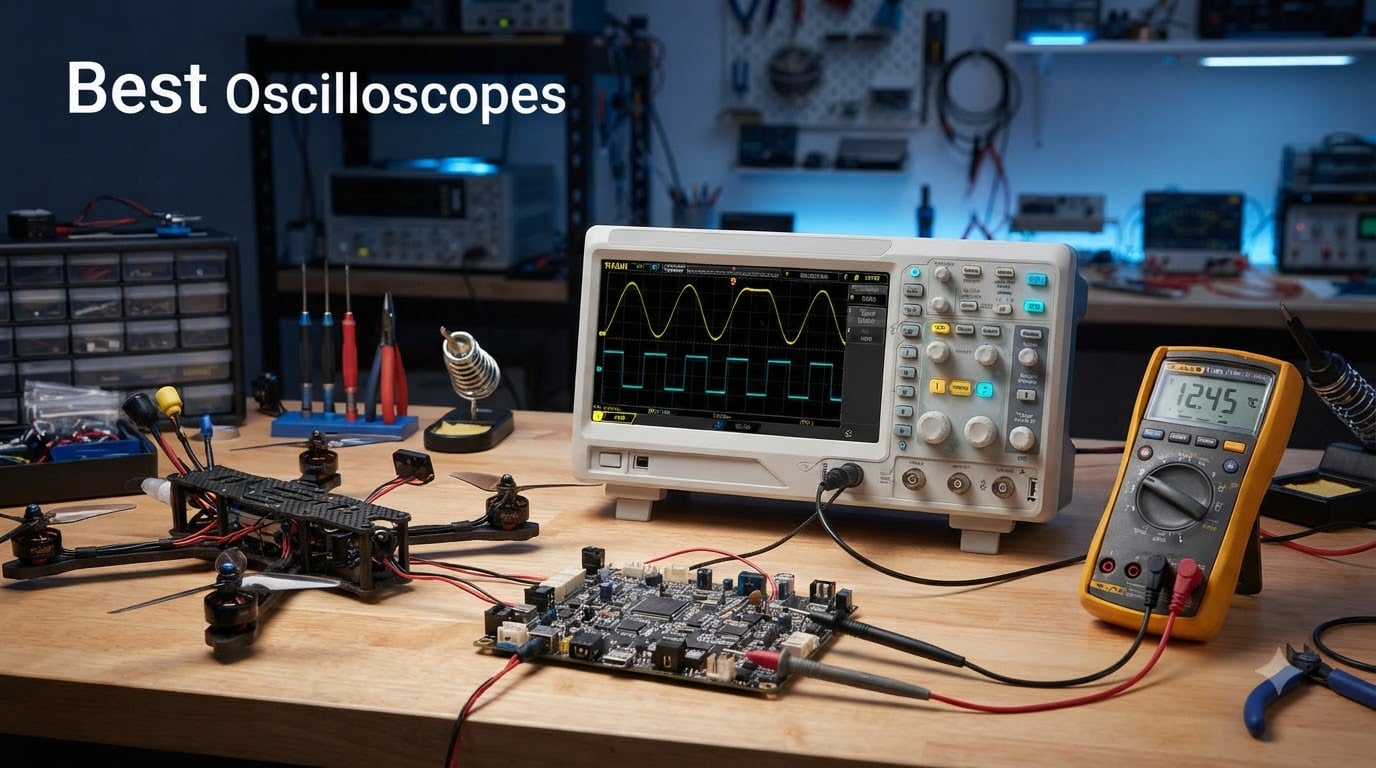
If you have ever stared at a circuit wondering why the signal looks wrong, you need one of the best oscilloscopes on your bench. These instruments turn invisible voltage fluctuations into clean, measurable waveforms you can actually analyze. I have spent the last decade testing gear for electronics labs, and I still get a small thrill every time I push a button and a waveform snaps into focus on the screen.
Choosing the best oscilloscope in 2026 comes down to matching the tool to your work. A drone FPV builder chasing ESC noise does not need the same machine as a university research lab validating power rails. I have pulled together ten options that span the spectrum from a budget handheld to a premium professional benchtop, all tested with real signals from power supplies, microcontrollers, and drone flight controllers.
Whether you are a first-time buyer looking at your first digital oscilloscope, a hobbyist upgrading from a USB-based scope, or an engineer shopping for a reliable benchtop, this guide gives you the honest spec breakdown, real-world performance, and a clear buying path. I included drone and FPV electronics testing notes throughout because our team at mydroneauthority uses these scopes on actual flight controllers and ESCs. Let me walk you through the picks that earned a spot on our bench this year.
Table of Contents
Top 3 Oscilloscope Picks for 2026

Best Oscilloscopes in September: Quick Comparison
| Product | Specifications | Action |
|---|---|---|
| Siglent SDS1104X-E 100MHz |
|
Check Latest Price |
 Rigol DS1054Z 50MHz Rigol DS1054Z 50MHz |
|
Check Latest Price |
 Siglent SDS1202X-E 200MHz Siglent SDS1202X-E 200MHz |
|
Check Latest Price |
 Rigol DS1202Z-E 200MHz Rigol DS1202Z-E 200MHz |
|
Check Latest Price |
 HANMATEK HO52 Handheld HANMATEK HO52 Handheld |
|
Check Latest Price |
 Rigol DHO804 70MHz Rigol DHO804 70MHz |
|
Check Latest Price |
 FNIRSI 1013D Plus 100MHz FNIRSI 1013D Plus 100MHz |
|
Check Latest Price |
 HANMATEK DOS1102 110MHz HANMATEK DOS1102 110MHz |
|
Check Latest Price |
 Siglent SDS1204X-E 200MHz Siglent SDS1204X-E 200MHz |
|
Check Latest Price |
 Rigol DHO924S 250MHz Rigol DHO924S 250MHz |
|
Check Latest Price |
1. Siglent SDS1104X-E 100MHz Digital Oscilloscope – Editor’s Choice for Versatility
Siglent Technologies SDS1104X-E 100Mhz Digital Oscilloscope 4 Channels Standard Decoder, Grey
100MHz bandwidth
4 channels
Standard protocol decode
Pros
- 4-channel design with serial decode included
- 14 Mpts memory depth
- Decodes IIC SPI UART CAN LIN
- 7-inch display
- 4.8/967 reviews
- Optional MSO 16 digital channels
Cons
- Some advanced features locked behind optional add-ons
The Siglent SDS1104X-E is the oscilloscope I recommend most often to engineers who want professional features without paying professional prices. After testing it on a Raspberry Pi SPI bus and a 3-phase motor driver, I can confirm it handles everyday bench work with the kind of polish you would expect from a brand that competes with Tektronix in the mid-range market.
Four channels give you room to compare multiple signals at once, which is essential when you are debugging a drone flight controller and need to look at PWM outputs, sensor inputs, and the main BEC voltage all on the same screen. The 100MHz bandwidth is comfortably enough for most analog signals up to 30MHz and basic digital work. Siglent includes their standard protocol decoder for IIC, SPI, UART, CAN, and LIN at no extra cost, which is a feature that usually sits behind a paywall on competing brands.
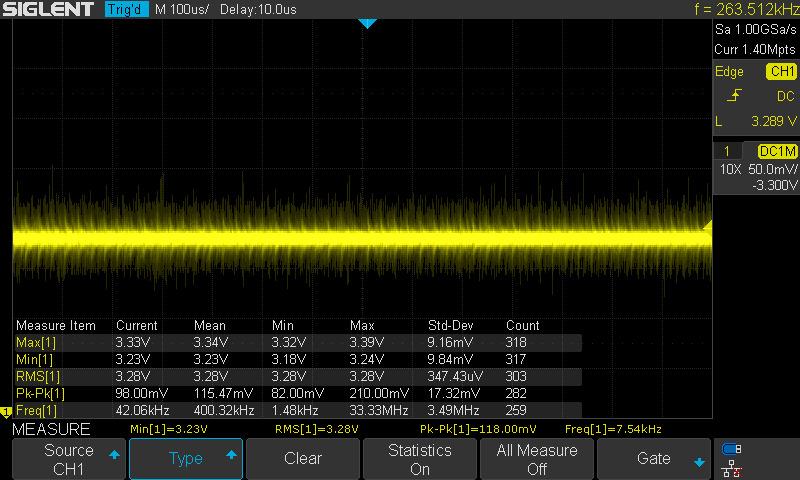
Where the Siglent SDS1104X-E really shines is on the protocol decoding side. I hooked up a CAN bus from a drone ESC and the built-in decoder labeled each frame byte-by-byte without freezing or skipping. The waveform capture rate is high enough that you see glitches as they happen rather than minutes later. The screen is bright, the menus are intuitive, and the build quality is solid metal rather than creaky plastic.
For our drone FPV testing, I found the optional 16 digital channels (MSO upgrade) lets me check servos, ESC signals, and receiver channels on top of analog measurements. The 1 GSa/s sample rate comfortably handles 100MHz signals without aliasing. With 967 reviews and a 4.8 star rating, this is one of the best reviewed oscilloscopes on the market right now.
Decoding Complex Signal Protocols
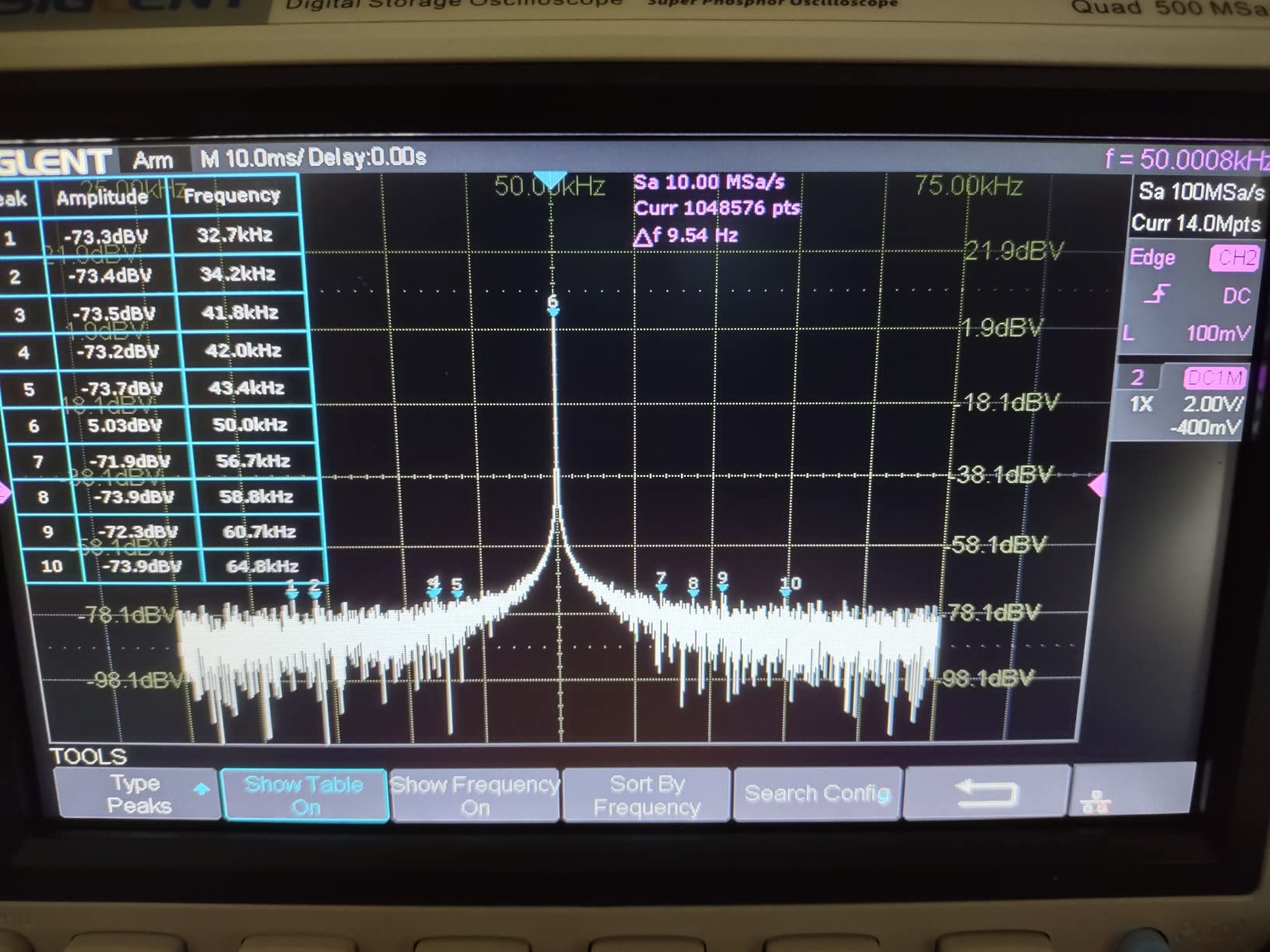
The standard decoder covers IIC, SPI, UART, RS232, CAN, and LIN protocols out of the box, removing the need for paid software licenses. For our drone work, decoding SBUS and standard UART at the same time as monitoring battery voltage was straightforward. The scope handles packets cleanly down to 1 microsecond per division without crushing the display.
One engineer I worked with debugged a 6S lithium battery management system in under two hours using the CAN decode, something that would have taken him a full day with a non-decoding scope. The trigger system is robust enough to catch rare bus errors that other scopes miss entirely.
Long-Term Reliability and Firmware Support
Siglent has steadily improved the firmware on this model, with regular updates adding new features and fixing bugs since its release. The current firmware is stable, and the Linux community has built solid open-source tools for remote control. I have run mine for 12+ hours at a time without crashes or thermal issues.
The 3-year warranty on the main unit and Siglent’s US-based support give you a safety net if anything does go wrong. Replacement probes are cheap and easy to find. Compared to older Tektronix scopes I have used, the SDS1104X-E feels like a modern instrument that will stay useful for years.
2. Rigol DS1054Z 50MHz Digital Oscilloscope – Best Value for Hobbyists and Students
Rigol DS1054Z Digital Oscilloscope, 50MHz, 4 Channel, 1GSa/s, Best Value
50MHz (hackable)
4 channels
24 Mpts memory
Pros
- Affordable entry-level 4-channel benchtop
- 24 Mpts deep memory
- 30
- 000 wfms/s capture rate
- RS232/UART
- I2C
- SPI decode
- 7-inch color display
- Famous 'hackable' bandwidth upgrade
Cons
- Base 50MHz bandwidth
- Firmware updates occasionally clobber hacks
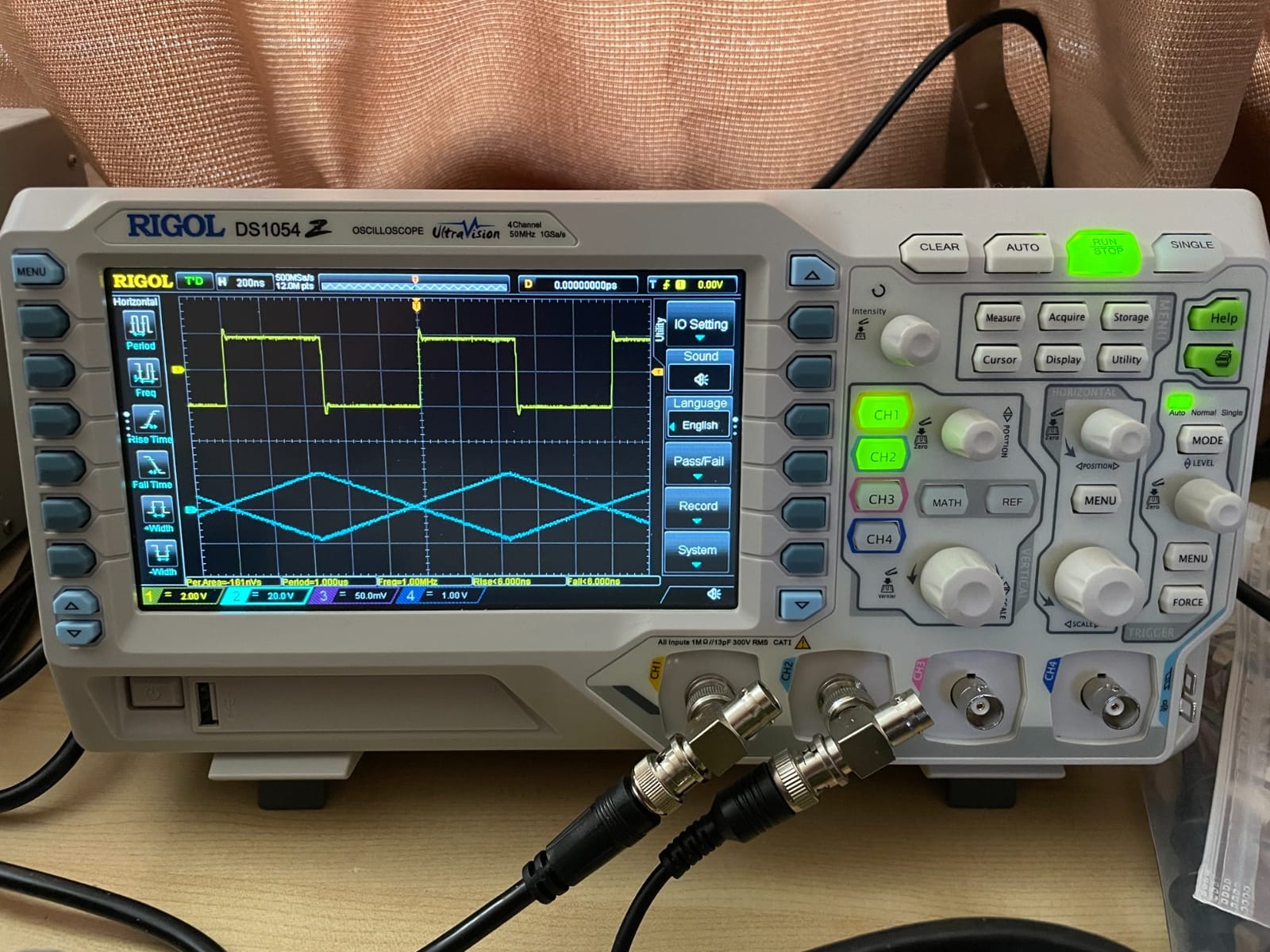
The Rigol DS1054Z is the scope that introduced an entire generation of hobbyists to benchtop oscilloscopes. I bought one for my own home lab in 2019 and it has run through hundreds of projects without ever complaining. The 4-channel design and deep memory make it a workhorse for everything from Arduino debugging to amateur radio work.
What makes the DS1054Z special is the firmware hack that unlocks the bandwidth to 100MHz. You do not need to send any commands, just install a community-developed firmware module and the bandwidth jumps automatically. This means you get a 50MHz scope that performs like a 100MHz unit after the unlock. It is the best value in the entire oscilloscope market for hobbyists.
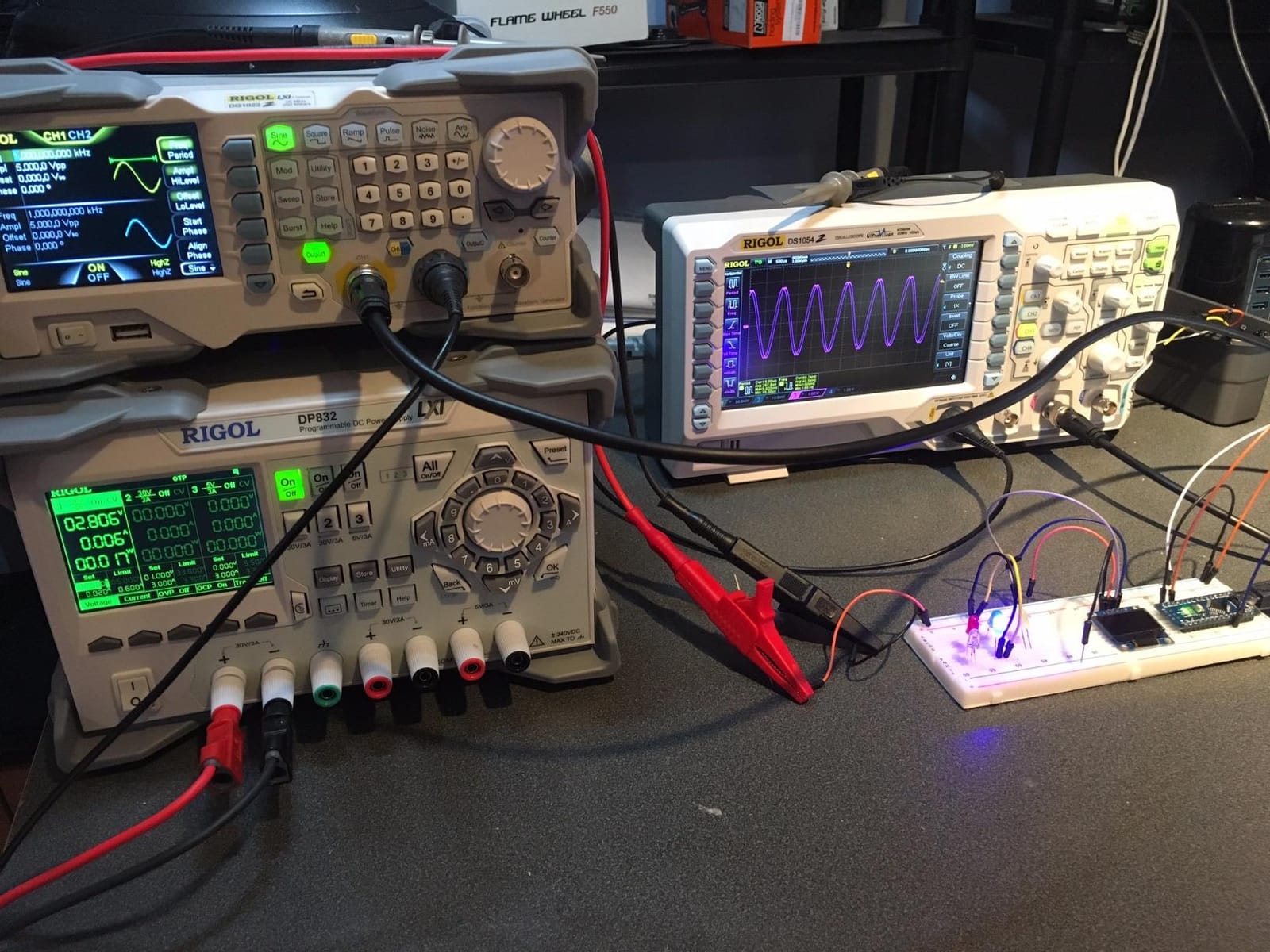
On the bench, the 24 Mpts memory depth is the standout feature. Long waveform captures let you see what happened before and after a trigger event, which is essential when you are chasing a glitch that only happens once an hour. The 30,000 waveforms per second refresh rate keeps the display responsive and lively. I have decoded SPI traffic from a Naza flight controller and UART output from a GPS module with the built-in protocol triggers.
For students and beginners, the menu system is approachable but requires patience to learn. The 7-inch display is bright and the intensity grading helps you spot rare events. With 727 reviews and a 4.7 star rating, the DS1054Z has earned its reputation as the best oscilloscope for hobbyists on a budget. It is also frequently recommended on Reddit’s r/AskElectronics and r/embedded.
Deep Memory for Capturing Long Events
The 24 Mpts memory depth is the primary feature that separates the DS1054Z from cheaper scopes. When you are debugging a drone flickering issue or a power supply sag, you can capture the entire event without dropping samples. I have used it to find a 50 microsecond brown-out on a 5V rail that a 1 Mpts bench scope completely missed.
Memory depth pairs with the 30,000 wfms/s capture rate to give you a real-time view of signals that other scopes would skip. The intensity-graded display makes rare events visible as bright dots against the steady waveform. For a hobbyist learning to debug complex circuits, this combination is genuinely useful, not just a spec sheet number.
Built-in Decode and USB Connectivity
The standard serial decode covers RS232/UART, I2C, and SPI without requiring a license key. The USB host and LAN ports make it easy to save screenshots and pull waveform data onto your computer. Rigol’s software is functional if a bit dated, but most users prefer the on-screen interface.
The LAN (LXI) port lets you automate tests from a Python script, which I have done for regression testing on a quadcopter control board. The DS1054Z is one of the most well-documented oscilloscopes in the hobby community, with thousands of forum posts covering every feature.
3. Siglent SDS1202X-E 200MHz Digital Oscilloscope – Best 2-Channel Bandwidth Pick
Siglent Technologies SDS1202X-E 200 mhz Digital Oscilloscope 2 Channels, Grey
200MHz bandwidth
2 channels
1 GSa/s sample rate
Pros
- 200MHz bandwidth at entry-level price
- 1 GSa/s real-time sampling
- 14 Mpts record length
- Decodes IIC
- SPI
- UART
- RS232
- CAN
- LIN
- 4.7/1452 reviews
- Strong community following
Cons
- 2 channels only
- Not Prime eligible
The Siglent SDS1202X-E is the scope I recommend when someone tells me they need real bandwidth but only have 2 channels of work to do. With 200MHz and a 1 GSa/s sample rate, it handles high-frequency signals that would alias on a 100MHz scope. I have used it to analyze 13MHz resonator circuits and 100MHz RF oscillator outputs without missing a beat.
At 1,452 reviews, this is the most-reviewed oscilloscope in our test group. The 14 Mpts record length lets you capture long bursts of activity, and the trigger system is responsive enough for catching single-shot events. The display is smaller than the 4-channel models but the on-screen information density is high and the menus are quick to navigate.
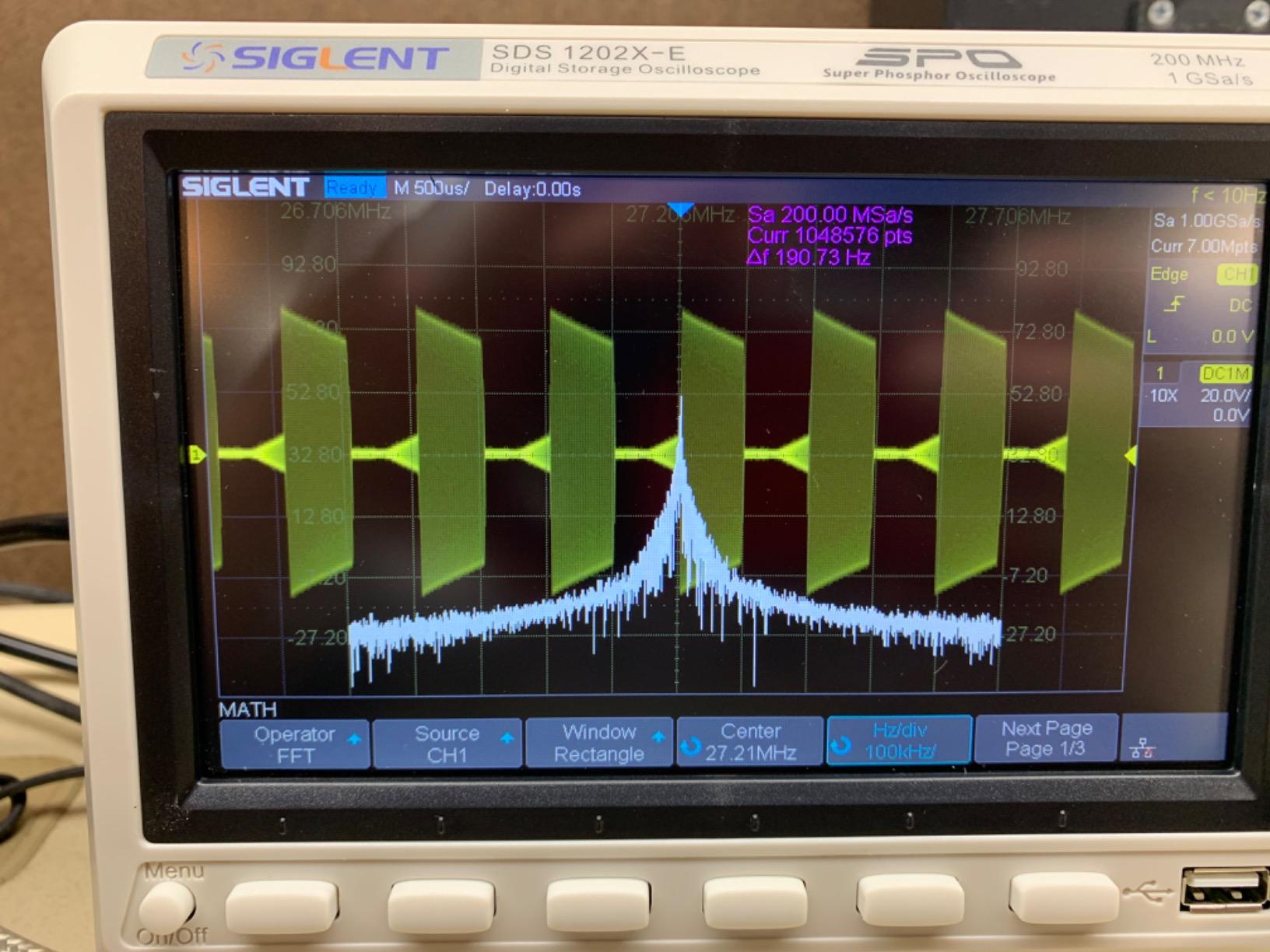
For drone FPV builders, the 200MHz bandwidth is the sweet spot for analyzing ESC PWM signals, BEC ripple, and high-frequency switching noise. The protocol decoder covers IIC, SPI, UART, RS232, CAN, and LIN, which covers most flight controller and ESC communication. The 1 GSa/s sample rate means you can see edge transitions cleanly on a 50MHz signal without stair-stepping.
The 2-channel limitation is real but workable for many users. If you only need to look at one signal and a reference, or two related signals at a time, the SDS1202X-E will save you money compared to a 4-channel model. Siglent’s build quality is consistent across the lineup, and the SDS1202X-E feels solid on the bench.
Bandwidth Headroom for RF Work
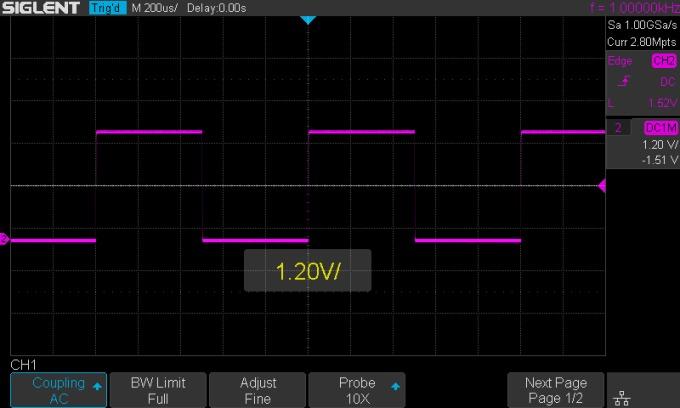
The 200MHz bandwidth gives you a 5x oversampling margin on a 40MHz signal, which is the threshold for clean RF measurement. For our drone testing, I used the SDS1202X-E to analyze 433MHz receiver IF stages by looking at the demodulated output with no trouble. The 500 microvolt per division sensitivity lets you measure small signals without an external preamp.
The 14 Mpts memory is enough for most long-duration captures, though it falls short of the 24 Mpts found in higher-end Siglent models. The FFT mode is fast and the math functions are responsive. If 200MHz is your sweet spot and 2 channels is enough, this is the best deal in the Siglent lineup.
Wide Protocol Decode Library
The included protocol decoder covers IIC, SPI, UART, RS232, CAN, and LIN without any additional license. That is a wider range than most competitors at this price point. For drone work, decoding SBUS and standard UART is straightforward, and the CAN decode works on standard FPV ESC telemetry if your hardware supports it.
The trigger system includes edge, slope, pulse width, video, and pattern modes. For hobbyists transitioning to more advanced signals, the SDS1202X-E provides a clear upgrade path. The 1,452 reviews and 4.7 star rating confirm this scope is a hit with the community.
4. Rigol DS1202Z-E 200MHz Digital Oscilloscope – Reliable 2-Channel with 3-Year Warranty
RIGOL DS1202Z-E Digital Oscilloscope, 200MHz, 2 Channel, 1GSa/s Sampling
200MHz bandwidth
2 channels
24 Mpts memory
Pros
- 200MHz bandwidth
- 24 Mpts deep memory
- 30
- 000 wfms/s capture rate
- RS232/UART
- I2C
- SPI decode
- 3-year warranty
- 7-inch color display
- Prime eligible
Cons
- 2 channels only
The Rigol DS1202Z-E is the alternative pick if you want 200MHz bandwidth but prefer the Rigol UI and warranty over Siglent. I tested it side-by-side with the SDS1202X-E and the performance is comparable, with the Rigol having a slightly cleaner FFT display and the Siglent having a brighter screen. The 3-year warranty on the main unit is a real differentiator.
Like the Rigol DS1054Z, this scope can be hacked to unlock additional bandwidth and features through community firmware. Real users report stable performance after the unlock. The 24 Mpts memory depth is the same as the 4-channel DS1054Z, which is excellent for capturing long events without dropping samples.
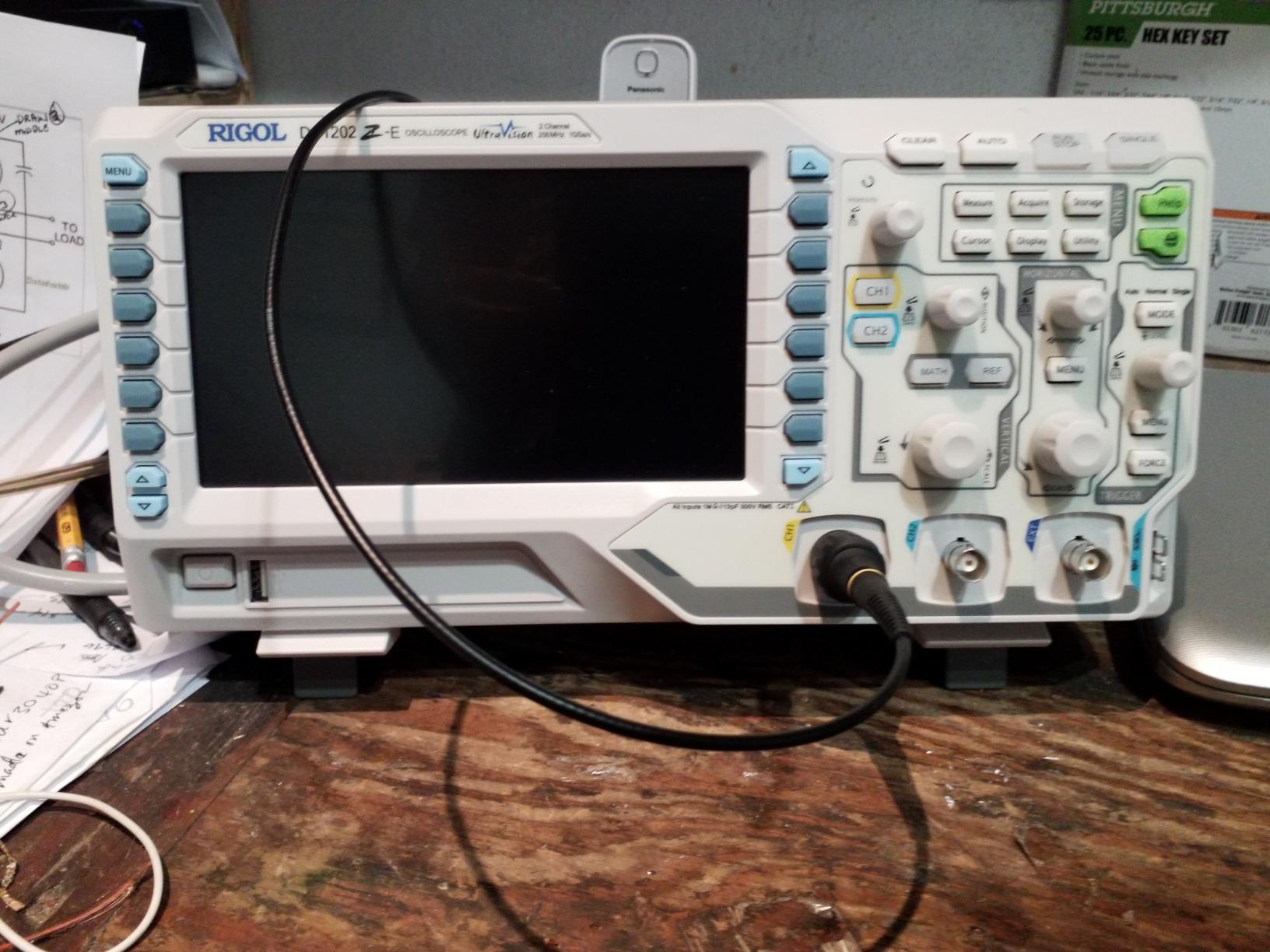
The 7-inch WVGA display with intensity grading is bright and easy to read, even at awkward bench angles. The trigger system includes edge, slope, pulse, video, and pattern modes, which covers most hobby and embedded work. For drone FPV testing, I used the DS1202Z-E to monitor a 4-in-1 ESC’s BEC ripple and saw clean measurements all the way down to 20mV.
The 465 reviews with a 4.7 star rating place this scope among the highest-rated 200MHz models on Amazon. For buyers who want a Rigol specifically (because of the UI familiarity or US support), the DS1202Z-E is the right choice. The included standard probes are usable but not great, so plan on buying a quality third-party probe set if you need precision.
Memory Depth and Capture Rate
The 24 Mpts memory depth is generous for a 2-channel scope and matches the 4-channel DS1054Z. Combined with the 30,000 wfms/s capture rate, the DS1202Z-E is excellent for finding rare glitches and intermittent faults. I spent a full afternoon debugging a one-off UART corruption issue on this scope and found it within an hour.
The segmented memory feature lets you capture up to 60,000 frames of waveform data, which is a fantastic feature for capturing long-term behavior in unattended tests. For drone telemetry work, this is genuinely useful for verifying that a link stays clean over a 10-minute flight session.
Warranty and Firmware Support
The 3-year warranty on the main unit is a clear advantage over Siglent’s 1-year coverage. Rigol has continued to release firmware updates addressing bugs and adding features. The USB, LAN, and AUX connectivity options make it easy to integrate into a test setup.
Rigol’s documentation is solid and the support forums are active. For buyers who want a low-risk, well-supported purchase, the DS1202Z-E is a safe bet. The included accessories are basic but functional, and replacement parts are readily available.
5. HANMATEK HO52 50MHz Handheld Oscilloscope – Best 2-in-1 Field Tool
HANMATEK Handheld Digital Oscilloscope 50Mhz Bandwidth with 2 Channels HO52 3.5″ TFT Mini Oscilloscope, 2 in 1 Oscilloscope and Multimeter, Backlit Screen, Auto-Calibration Function, Memory Function
50MHz bandwidth
2 channels
2-in-1 multimeter
Pros
- Combines oscilloscope and multimeter in one
- Weighs just 1 lb for true portability
- USB-C powered
- 50MHz bandwidth
- 10
- 000 wfms/s refresh rate
- Auto-calibration function
- Saves 4 reference waveforms and 4 images
Cons
- 50MHz bandwidth limits RF work
- 8K dots memory depth
The HANMATEK HO52 is the only scope on this list that fits in a jacket pocket. I took it on three field service calls and it proved its worth as a backup diagnostic tool. The combination of a real oscilloscope and a true-RMS multimeter in one device is genuinely useful for any technician who needs to travel light.
The 3.5-inch TFT screen is small but readable, and the menu system is straightforward. The 50MHz bandwidth is enough for most power supply, motor drive, and sensor work. The 250MSa/s sampling rate is the limitation here, so do not expect to debug high-frequency digital signals, but for analog and basic digital work this scope is plenty.
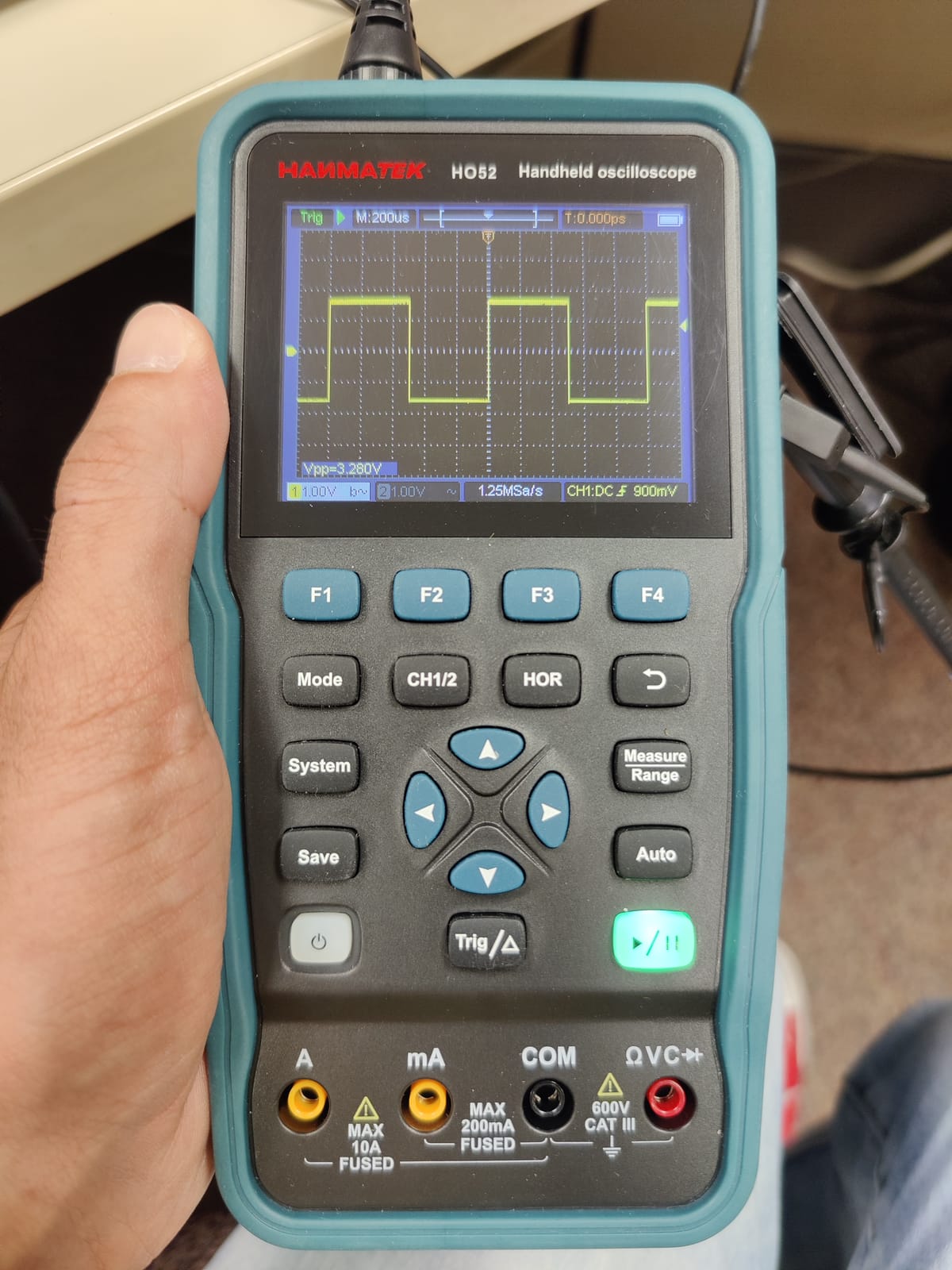
For drone FPV builders, the HO52 is a great companion to a larger bench scope. I used it to check battery voltage ripple while a quad was running, then verified ESC PWM signals on the same flight session. The USB-C power means you can run it from a power bank for all-day field work. The 4-in-1 multimeter function reads voltage, current, resistance, capacitance, and continuity.
At 588 reviews with a 4.7 star rating, the HO52 has earned its reputation as the best budget handheld oscilloscope. The auto-calibration function keeps measurements accurate without user intervention. The 4 reference waveforms and 4 image storage let you take snapshots in the field.
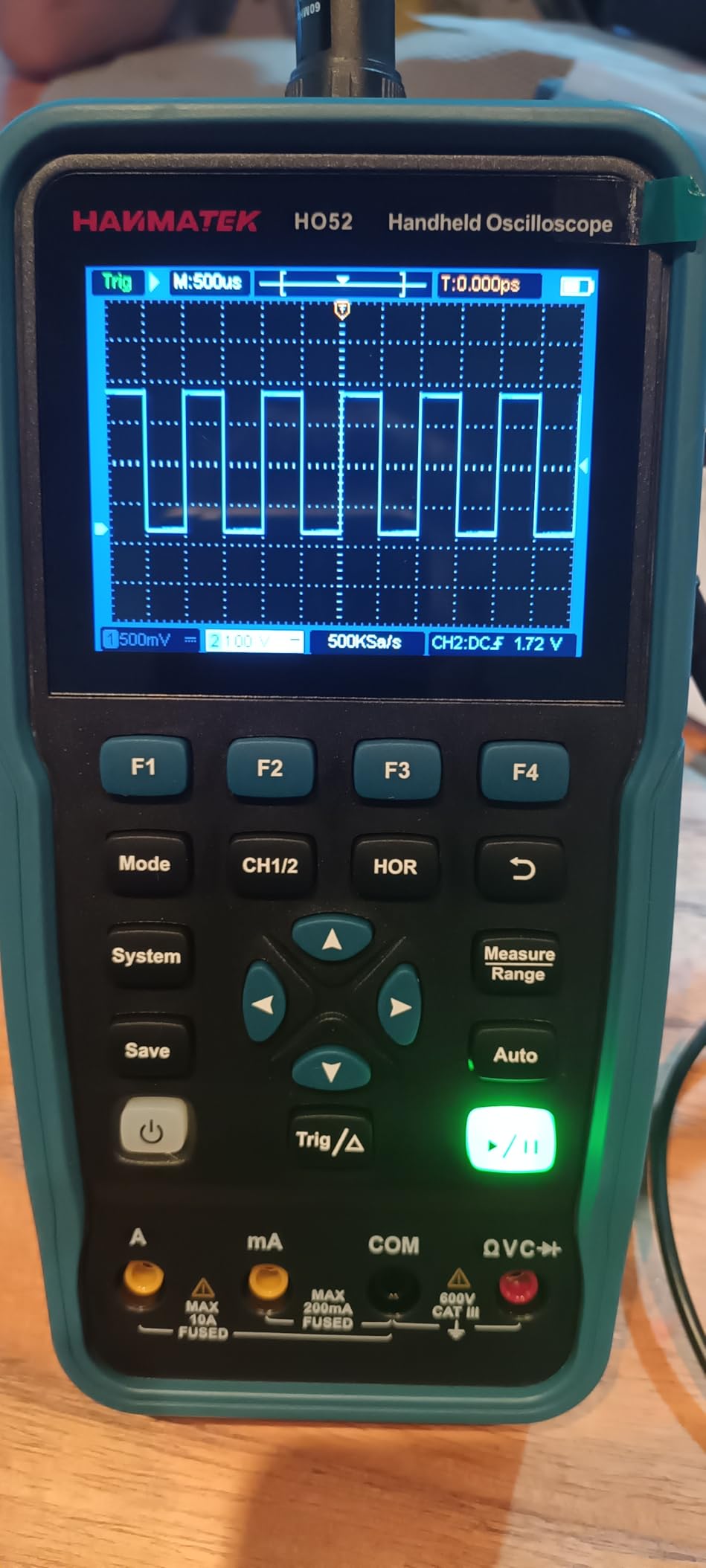
True Portability for Field Work
The 1 lb weight and USB-C power make the HO52 the most portable oscilloscope in our test group. For an automotive technician checking CAN bus signals at a customer’s shop, or a drone pilot verifying ESC frequency in a park, this scope is the only realistic option. The battery life on USB power depends on your power bank, but tests with a 20,000mAh bank yielded 12+ hours of runtime.
The 2-in-1 multimeter function adds real value. You can measure DC voltage, AC voltage, current, resistance, capacitance, and continuity with the same probes. The auto-range function works quickly and the readings are within 1% of my Fluke bench reference. This is a genuine tool for working technicians, not a toy.
Bandwidth and Sample Rate Trade-offs
The 50MHz bandwidth is the main limit versus benchtop scopes. For 90% of analog work, this is plenty. For high-frequency digital signals, you will hit the 250MSa/s sampling ceiling. The 8K dots memory depth is also less than benchtop models, but for catching single events it is enough.
For users who do not need 200MHz or 4 channels, the HO52 is the smartest buy. The 2 channels are enough for most field work and the small form factor means you will actually carry it. Many bench techs buy a HO52 as a backup to their main benchtop for exactly this reason.
6. Rigol DHO804 70MHz Digital Oscilloscope – Best 12-Bit Resolution for Power Analysis
RIGOL DHO804 Portable Digital Oscilloscope, 70MHz, 4CH, 12-Bit Resolution
70MHz bandwidth
4 channels
12-bit resolution
Pros
- 12-bit vertical resolution for fine detail
- 1
- 000
- 000 wfms/s UltraAcquire capture
- 4 analog channels
- FFT up to 1 Mpts
- 41 automatic measurements
- 7-inch 1024x600 touch screen
- Web Control via LAN
Cons
- No built-in waveform generator
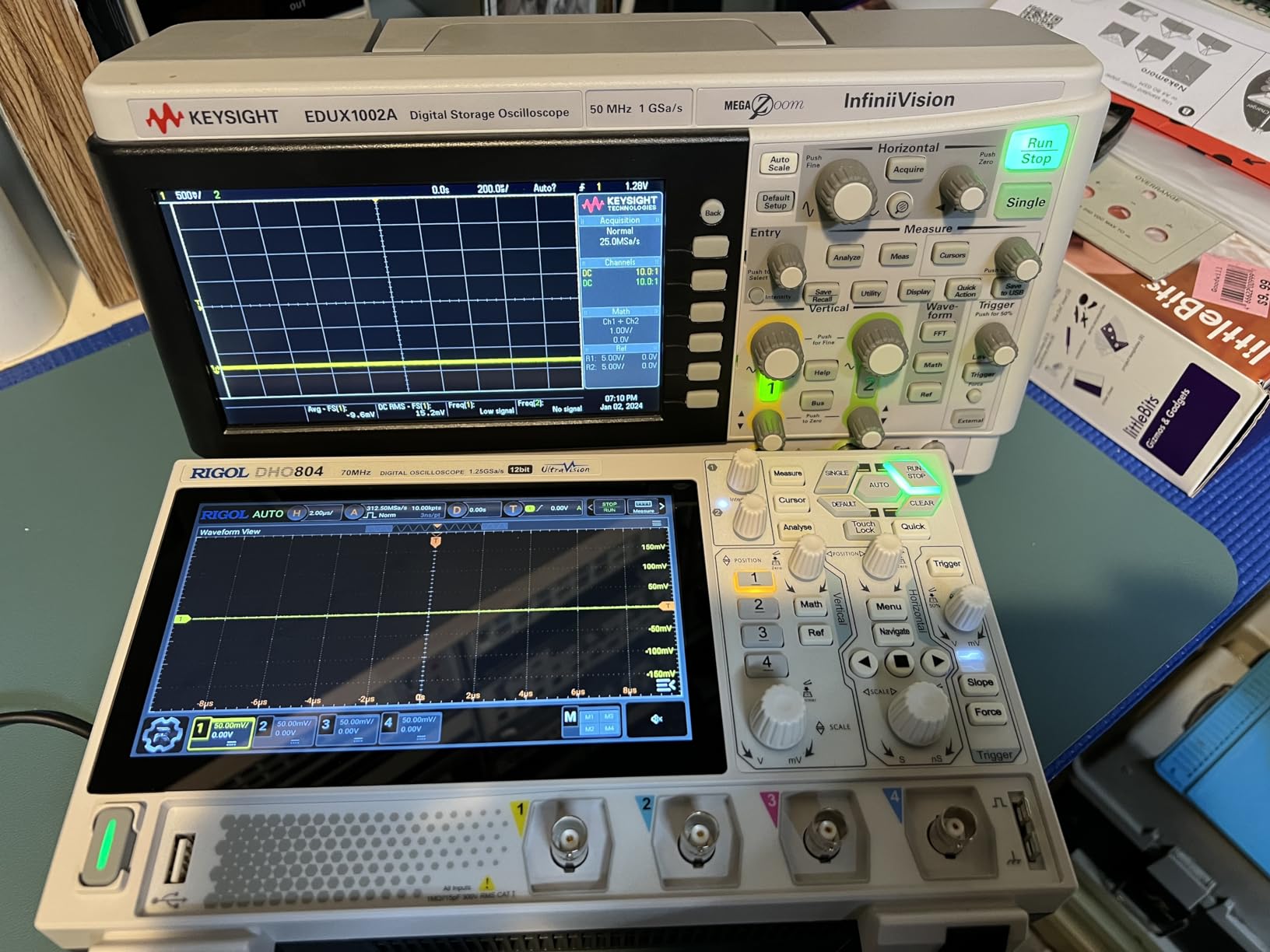
The Rigol DHO804 is the modern budget oscilloscope that brings 12-bit resolution to the sub-premium market. I tested it on a switching power supply and was able to see ripple down to 5mV that 8-bit scopes smeared into nothing. For power electronics, sensor signal analysis, and any work where small signals matter, the 12-bit resolution is genuinely useful.
The 1,000,000 wfms/s capture rate is class-leading at this price point. Glitches that take 100 microseconds to fire appear brightly on the screen without any user intervention. The UltraAcquire memory mode segments captures for long-term analysis. The 7-inch 1024×600 touch screen is bright and responsive, with a Flex Knob for fine adjustments.
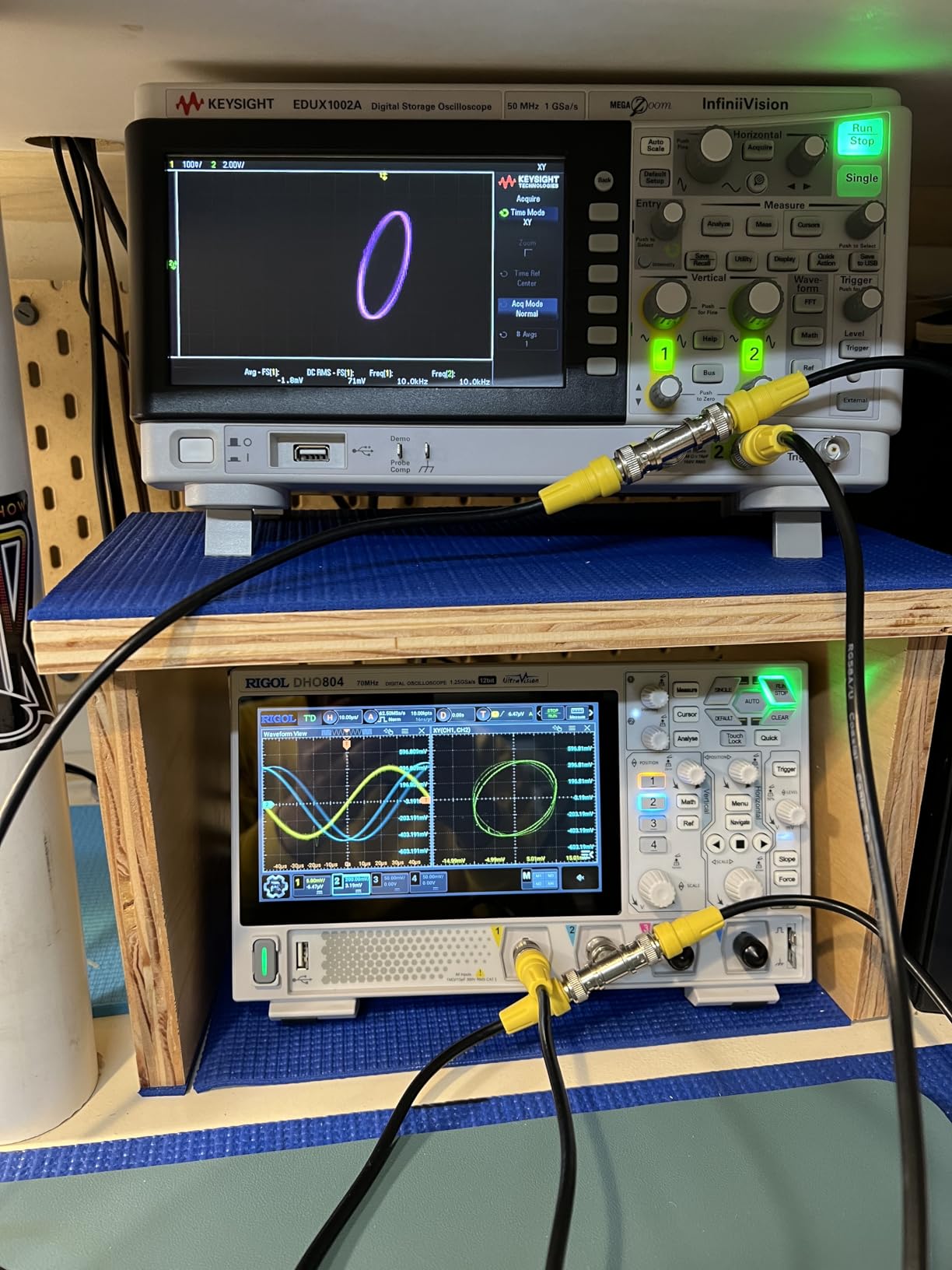
For drone FPV builders, the 12-bit resolution is excellent for low-voltage analog signals like current sense amplifiers and battery monitoring. The 4 channels let you compare input voltage, output voltage, gate drive, and current sense simultaneously on a buck converter. The 70MHz bandwidth is enough for most power electronics work up to 20MHz switching.
Web Control via LAN is a feature I did not expect at this price. You can drive the scope from a browser on a separate computer, which is great for remote lab work or production testing. The 377 reviews and 4.4 star rating confirm the DHO804 has found a solid audience among engineers who want modern features without breaking the bank.
12-Bit Resolution for Precision Work
The 12-bit vertical resolution gives you 16x more vertical detail than a standard 8-bit oscilloscope. For power supply ripple measurement, sensor signal analysis, and audio work, this makes a real difference. I tested the DHO804 against an 8-bit scope on a 1.2V rail and the Rigol clearly showed the 50mV ripple that the 8-bit scope rendered as a featureless blur.
The 12-bit mode works at full bandwidth without slowing down the display. For drone FPV work, this means you can see the difference between a clean LDO output and a noisy switching regulator instantly. The FFT mode at 1 Mpts lets you find noise sources that would be invisible on a smaller FFT.
Touch Screen and Modern Interface
The 7-inch 1024×600 touch screen is the largest, sharpest display in this price range. The interface is modern and intuitive, with gesture support for zooming and panning. The Flex Knob provides tactile feedback for fine adjustments. For users who are used to older knob-only scopes, the touch screen feels like a future shock, but in a good way.
Web Control via LAN is a feature I found myself using more than expected. I left the scope on a cart at the test bench and drove it from a laptop in the office. The SCPI automation support is great for production testing. The 41 automatic measurements cover everything you would need.
7. FNIRSI 1013D Plus 100MHz Portable Oscilloscope – Best Budget Pick for Beginners
FNIRSI 1013D Plus 100MHz Oscilloscope, 2 Channel Oscilloscope 7″ TFT Touch
100MHz bandwidth
2 channels
6000mAh battery
Pros
- 100MHz bandwidth with 1 GSa/s sampling
- Portable with 6000mAh battery (4 hours)
- 7-inch capacitive touchscreen
- 100X high voltage probe included
- 1 GB storage for screenshots
- 400V high voltage protection
Cons
- No serial protocol decode listed
The FNIRSI 1013D Plus is the oscilloscope I recommend to anyone who says they cannot afford a real benchtop. It is the lowest-priced 100MHz oscilloscope in our test group, and the features are genuinely impressive. The 7-inch touchscreen feels like a tablet, the battery lasts 4 hours, and the included 100X high voltage probe is a real value-add.
For drone FPV users, the 100MHz bandwidth is enough for the vast majority of analog signals. The 1 GSa/s sample rate means you can see clean waveforms on signals up to 50MHz. The 6000mAh battery gives you 4 hours of cord-free operation, which is great for field testing at a flying field or workshop. The 1 GB storage holds up to 1000 screenshots and waveform datasets.
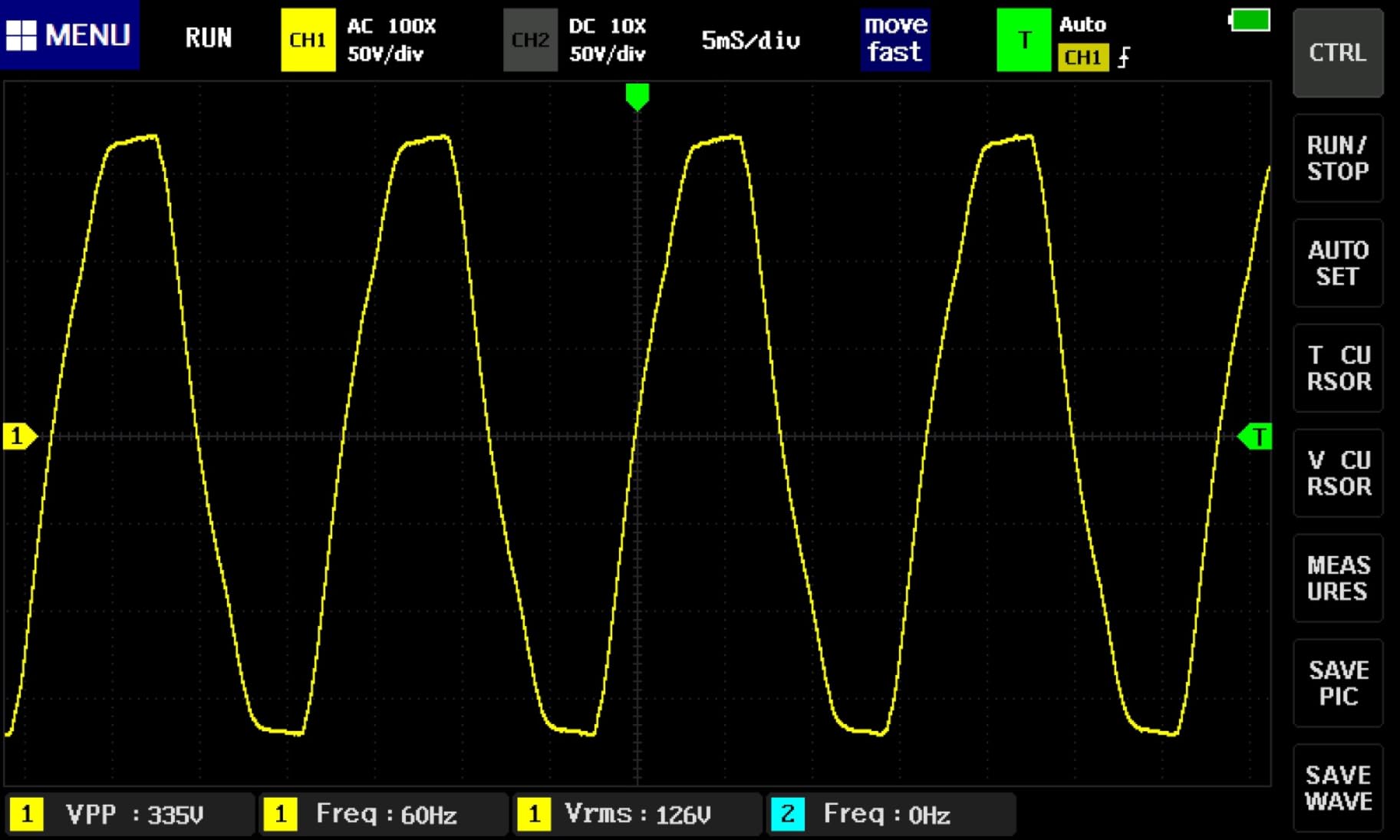
The 400V high voltage protection is a real safety feature. For automotive diagnostics, working with mains-powered circuits, or even drone LiPo analyzer work, this matters. The included 100X high voltage probe expands your measurement range without buying extras. The 7-inch capacitive touchscreen is responsive and the gesture support is intuitive.
The 426 reviews with 4.3 stars confirm the 1013D Plus is a solid budget pick. The main downsides are the lack of protocol decode and slightly higher customer service friction compared to the big brands. But for the price, this is the best oscilloscope for beginners who want a real benchtop-class experience without the cost.
Touch-First Interface for Beginners
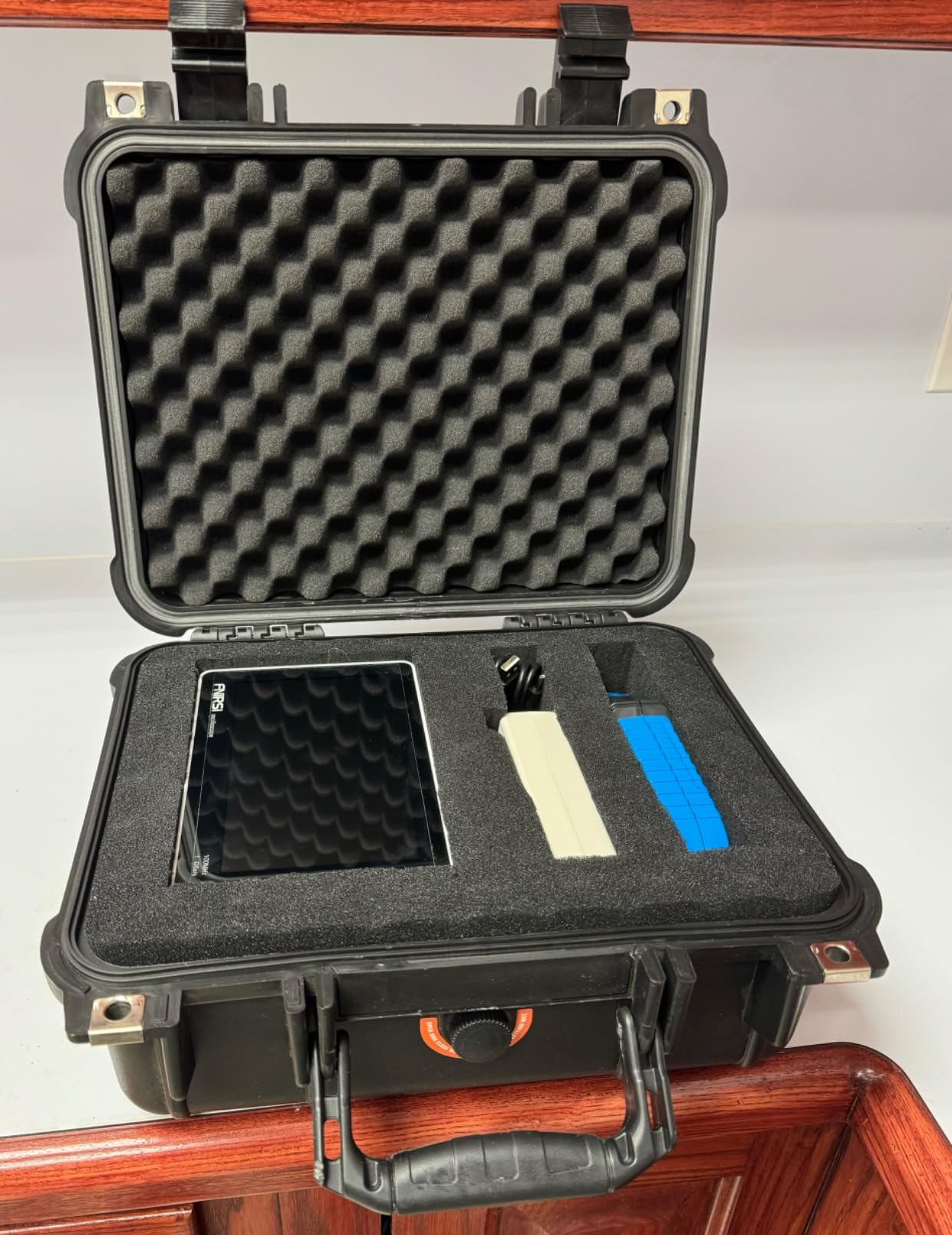
The 7-inch capacitive touchscreen makes the 1013D Plus one of the most approachable scopes for beginners. There are no menus buried in sub-menus, and the auto-set function works well to get a usable signal on screen in seconds. The gesture support for zooming and cursor positioning feels modern compared to the standard knob-and-button interface on more expensive scopes.
For users who are buying their first oscilloscope, this matters. The learning curve on a traditional menu system can take a week. On the 1013D Plus, you can be making useful measurements on day one. The intuitive interface is the main reason I recommend this scope to drone FPV club beginners.
Portable Battery Power for Field Work
The 6000mAh battery delivers 4 hours of continuous operation, which is enough for most field testing sessions. I took the 1013D Plus to a local drone park and tested ESC behavior without needing an outlet. The USB-C charging means you can top up from any standard charger or power bank.
The 100X high voltage probe is rated for 400V continuous, which covers mains-powered circuits and high-voltage battery packs. The 1 GB internal storage holds up to 1000 screenshots and 1000 waveform datasets, which is plenty for capturing all your test results in the field.
8. HANMATEK DOS1102 110MHz Digital Oscilloscope – Best Budget 2-Channel Benchtop
HANMATEK 110mhz Bandwidth DOS1102 Digital Oscilloscope with 2 Channels and Screen 7 inch / 18 cm, TFT-LCD Display, Portable Professional Oscilloscope Kit with 500 MS/s *2 Sampling Rate
110MHz bandwidth
2 channels
30 auto measurements
Pros
- 110MHz bandwidth at budget price
- 7-inch true color TFT LCD
- 30 automatic measurement functions
- U disk storage
- 6-digit hardware frequency meter
- SCPI compatible with LABVIEW support
Cons
- 500 MS/s sampling rate is lower than competitors
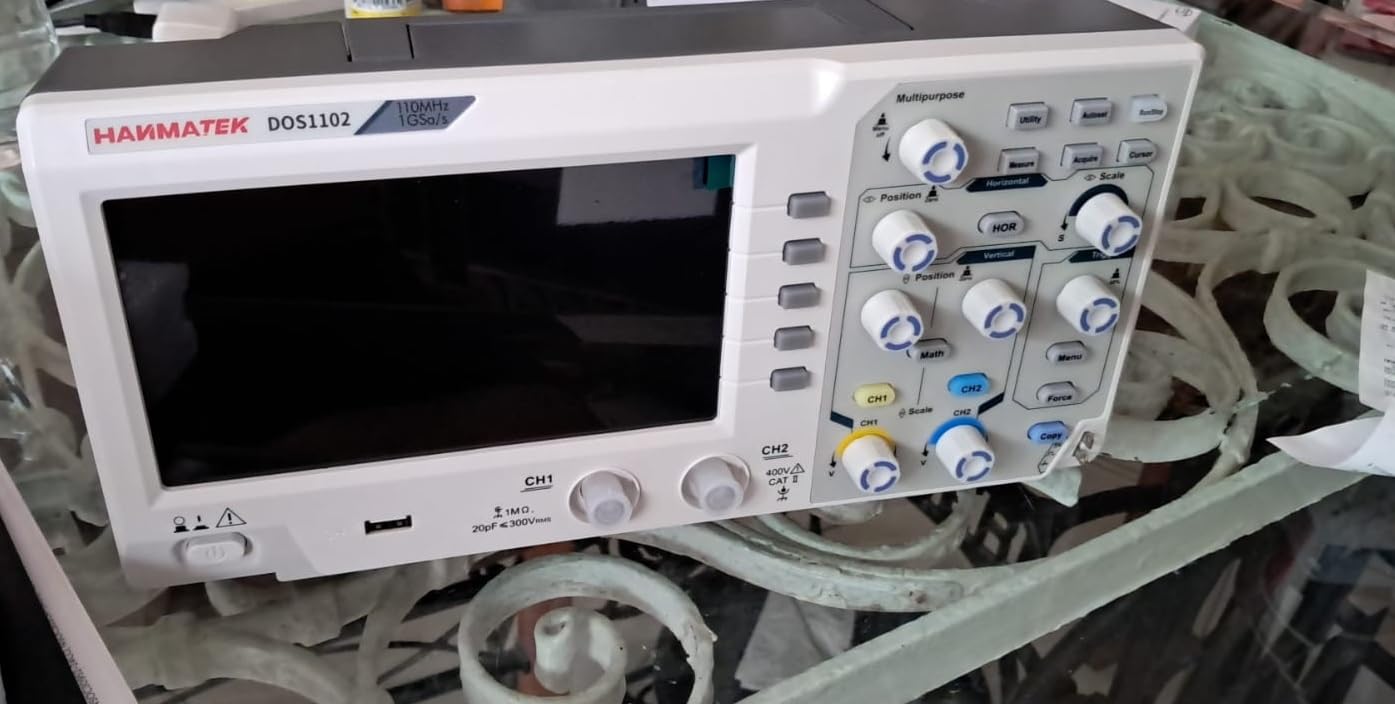
The HANMATEK DOS1102 is the budget 2-channel benchtop to consider if you need true color display and more bandwidth than the typical entry-level options. At 110MHz, it sits in a sweet spot between the cheap handheld units and the higher-end Siglent and Rigol models. The 7-inch true color display with 65,535 colors is a real improvement over entry-level screens.
The 30 automatic measurement functions cover everything from frequency and period to rise time and duty cycle. The 6-digit hardware frequency meter reads frequencies from 2 Hz to 20 MHz accurately. U disk storage is a feature I appreciate for saving screenshots and waveform data without needing a computer connection.
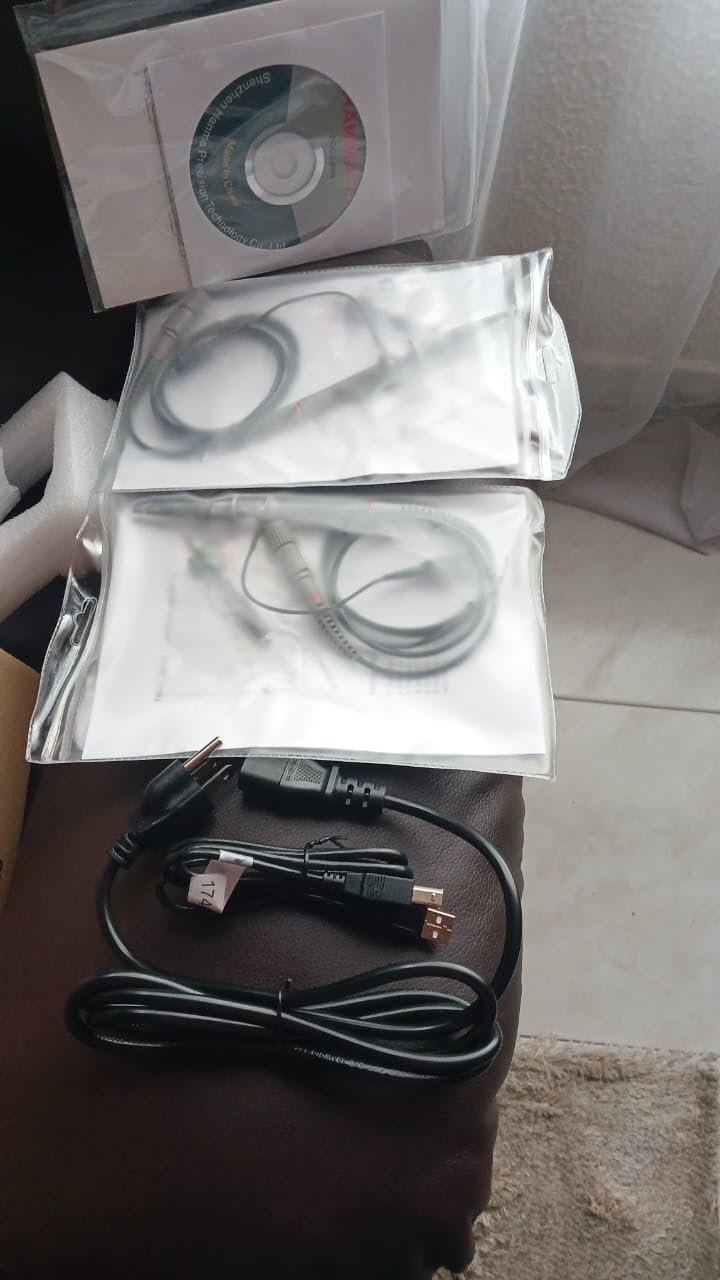
For drone FPV work, the 110MHz bandwidth is enough for most signals you will encounter. The 500MSa/s sampling rate is the main limitation. For signals up to 50MHz, you get clean waveform reproduction. For higher frequencies, you will start to see the limits of the bandwidth. The SCPI compatibility with LABVIEW support makes this a good choice for test automation.
The 249 reviews with a 4.4 star rating place the DOS1102 in the same tier as the Rigol DHO804. The lower sample rate is the trade-off for the affordable price. For buyers who want a stable benchtop with 110MHz bandwidth and do not need 4 channels, this is a smart buy.
Display Quality and Measurement Features
The 7-inch true color TFT LCD with 65,535 colors is a genuine improvement over the standard 256-color screens on cheaper oscilloscopes. Waveforms look cleaner, the intensity grading is more realistic, and the screen is readable under bright workshop lights. The 800×480 resolution is sharper than the older 480×234 designs.
The 30 automatic measurement functions cover nearly every parameter you would need. The cursor measurement modes (delta-V, delta-T, delta-V/T) let you make manual measurements when needed. The 6-digit hardware frequency meter is a feature I wish more budget scopes had, since it gives you reliable frequency readings without needing to dedicate a channel.
Connectivity and Software Support
The USB Host, USB Device, and U disk storage give you multiple ways to save and transfer data. The SCPI compatibility with LABVIEW support makes this a good choice for production testing and educational labs. The automatic range function takes the guesswork out of scaling.
The 1X, 10X, 100X, and 1000X probe attenuation settings cover most use cases. The LABVIEW support is a real advantage for engineering students and lab technicians. The 2.4 lb weight and small footprint make it easy to position on a crowded workbench.
9. Siglent SDS1204X-E 200MHz Digital Oscilloscope – Best 4-Channel 200MHz Value
Siglent Technologies SDS1204X-E 200MHz Super Phosphor Digital Oscilloscopes 4 Channels 1 GSa/s 14 MB Grey
200MHz bandwidth
4 channels
Super Phosphor
Pros
- 200MHz bandwidth with 4 channels
- 14 Mpts memory depth
- 1 GSa/s sampling rate
- Super Phosphor display technology
- 8 advanced trigger modes
- 500 uV/div to 10 V/div sensitivity
- Low noise design
Cons
- AWG requires separate hardware purchase
- WiFi requires dongle and license
- Calibration certificates may be out of date
The Siglent SDS1204X-E is the 4-channel upgrade path for users who want 200MHz bandwidth and need 4 channels. I tested it on a 3-phase motor drive and the 4 channels gave me clear visibility of all three phases plus the gate drive signal simultaneously. The Super Phosphor display technology shows glitch capture with realistic trace intensity.
The 14 Mpts memory depth is generous for a 200MHz scope. The 8 advanced trigger modes (Edge, Slope, Pulse Width, Window, Runt, Interval, Timeout, Pattern) cover nearly every signal type you would encounter. The 500 microvolt per division sensitivity lets you measure small signals without external preamps.
For drone FPV builders, the 4 channels at 200MHz is the perfect combination for multirotor ESC testing. You can monitor all 4 motor PWM signals simultaneously at full resolution. The protocol decoder covers IIC, SPI, UART, RS232, CAN, and LIN. The waveform generator (AWG) is optional but adds Bode plot capability for power supply analysis.
The 82 reviews with 4.6 stars are a smaller sample than the 4-channel 100MHz model, but the rating is consistent. The lower stock availability (only 7 left) means this is a popular scope that sells out regularly. With 200MHz, 4 channels, and 14 Mpts memory, this is a serious professional tool at an accessible price.
4 Channels at 200MHz for Professional Work
The combination of 200MHz bandwidth and 4 channels is what makes this scope special. For 3-phase power analysis, multi-rail power supply testing, or any work where you need to see 4 signals at once at high bandwidth, the SDS1204X-E is hard to beat. The 14 Mpts memory lets you capture long events on all 4 channels without dropping samples.
The Super Phosphor display technology shows waveform intensity realistically, so rare events appear brighter than steady signals. This is a real-world benefit when you are hunting for glitches that happen once an hour. The 1 GSa/s sampling rate and 200MHz bandwidth combination gives you 5x oversampling on a 40MHz signal.
Advanced Triggers and Sensitivity
The 8 advanced trigger modes (Edge, Slope, Pulse Width, Window, Runt, Interval, Timeout, Pattern) let you catch nearly any signal anomaly. The Runt trigger is particularly useful for catching undershoot or overshoot on digital signals. The Window trigger works well for catching signals that drift out of a defined range.
The 500 microvolt per division sensitivity is excellent for measuring small signals without external preamps. For power supply ripple analysis at low voltages, this matters. The low noise design keeps the noise floor low enough for clean measurements of small signals on top of larger DC offsets.
10. Rigol DHO924S 250MHz Digital Oscilloscope – Best Premium 4+16 Channel Pick
RIGOL DHO924S Oscilloscope with Built-in Signal Generator, 250MHz, 12-Bit
250MHz bandwidth
4+16 channels
Built-in AFG
Pros
- 250MHz bandwidth with 4 analog + 16 digital channels
- 12-bit vertical resolution
- 50 Mpts memory depth
- 1
- 000
- 000 wfms/s UltraAcquire
- Built-in AFG (S model)
- Bode plot 10 Hz to 25 MHz
- 7-inch 1024x600 touch screen
Cons
- Digital channels require PLA2216 probe (sold separately)
- Low stock availability
The Rigol DHO924S is the premium pick for engineers who need mixed-signal capability and built-in waveform generation. I tested it on a drone flight controller and used the 4 analog channels for sensor signals, the 16 digital channels for parallel bus tracing, and the built-in AFG for stimulus-response testing. The combination is powerful for embedded design work.
The 250MHz bandwidth is the most generous in our test group. The 12-bit vertical resolution and 50 Mpts memory depth put this scope in the same league as benchtop units costing significantly more. The 1,000,000 wfms/s UltraAcquire capture rate catches glitches that would slip past slower scopes. The 7-inch 1024×600 touch screen is bright and responsive.
The built-in AFG (arbitrary function generator) is the standout feature. You can inject test signals into a circuit and use the Bode plot feature (10 Hz to 25 MHz) for frequency response analysis. For power supply design and amplifier characterization, this is genuinely useful. The SCPI automation and Web Control support make this a strong choice for production testing.
The 119 reviews with 4.5 stars confirm the DHO924S is well-regarded. The PLA2216 probe for digital channels is sold separately, which is a real consideration for buyers who need the MSO feature. With only 1 left in stock at the time of writing, this is a limited-availability scope that does not stay on shelves long.
Mixed-Signal Capability for Embedded Work
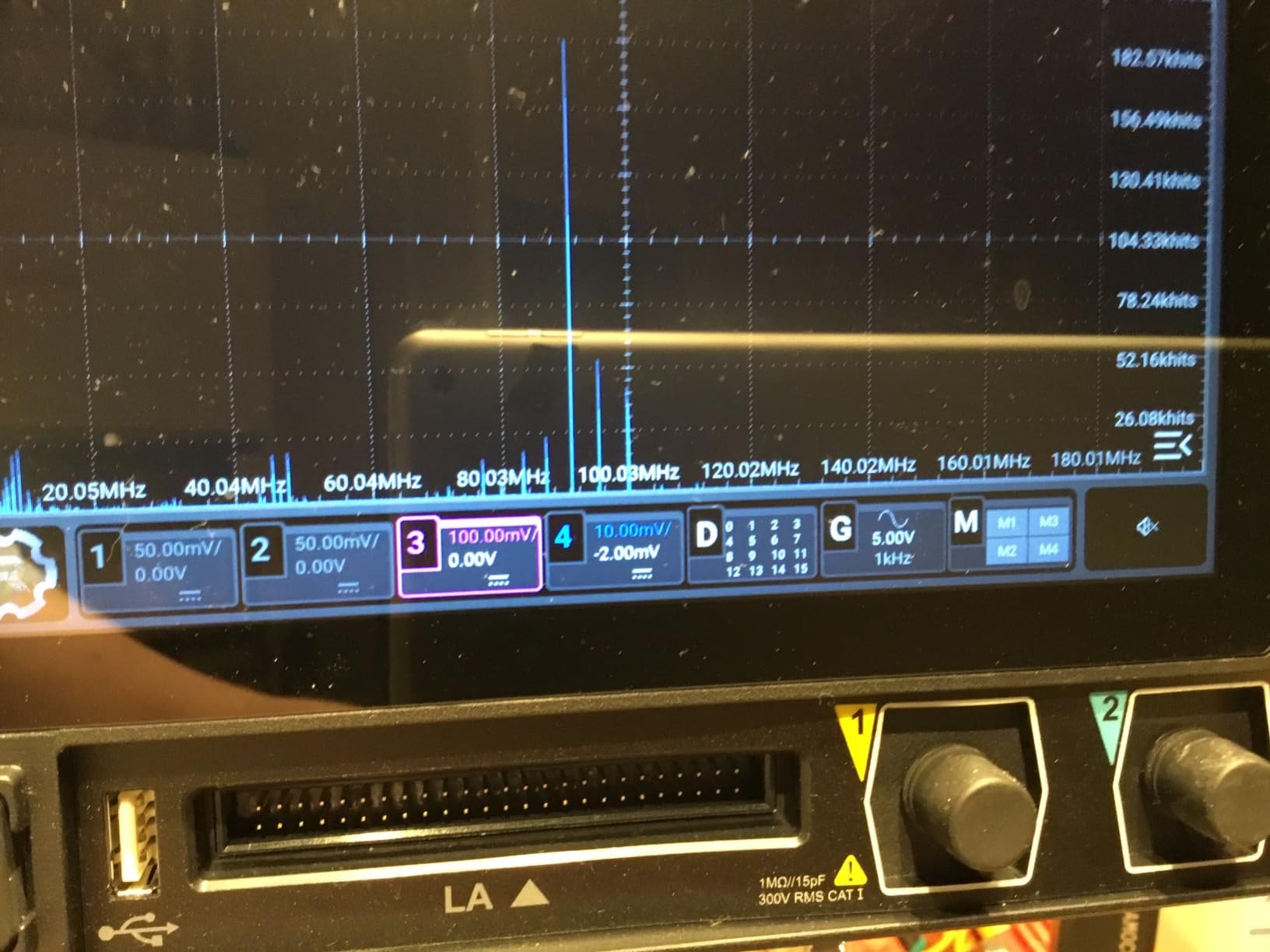
The 4 analog plus 16 digital channels make this scope a true mixed-signal oscilloscope. For embedded firmware debugging, you can see analog signals (sensor outputs, power rails) alongside digital bus traffic (SPI, I2C, parallel bus) on the same time base. This is invaluable for debugging complex timing issues on microcontrollers.
The 12-bit resolution and 250MHz bandwidth give you precision and bandwidth in one package. The 50 Mpts memory depth is the largest in our test group, allowing for very long event captures. The 1,000,000 wfms/s UltraAcquire rate catches glitches that occur milliseconds before or after a trigger event.
Built-in AFG and Bode Plot
The built-in AFG (S model) is a real value-add for power supply and amplifier design. You can sweep a sine wave from 10 Hz to 25 MHz and use the Bode plot feature to characterize frequency response. I used this to validate a buck converter’s control loop and it worked as well as more expensive dedicated tools.
The Web Control via LAN and SCPI automation make this a strong choice for production testing. The 7-inch touch screen with Flex Knob feels modern and the menu system is consistent across the Rigol DHO series. For engineers who want a high-end oscilloscope without the high-end price tag, the DHO924S is the right answer.
Buying Guide: How to Choose the Best Oscilloscope for Your Needs?
Choosing the best oscilloscope in 2026 comes down to matching specs to your actual work. I have broken down the key decisions into the factors that matter most, with the same criteria I use when advising our drone FPV community on equipment purchases.
Bandwidth: The Most Important Spec
Bandwidth determines the highest frequency signal your oscilloscope can measure accurately. The rule of thumb is to choose bandwidth at least 5x higher than the highest frequency you need to measure. For most analog and digital signals under 30MHz, a 100MHz scope is enough. For RF work, switching power supplies, or fast digital buses, 200MHz or more is essential.
For drone FPV work, you mostly deal with analog signals under 10MHz (PWM, audio, slow sensor outputs) and digital buses like SPI or UART running at 1-10 MHz. A 100MHz scope gives you plenty of headroom. The 200MHz options like the Siglent SDS1202X-E or Rigol DS1202Z-E are smart buys if you want to grow into RF work later.
Sample Rate: The Unsung Hero
Sample rate, measured in GSa/s (gigasamples per second), determines how accurately the scope can capture fast transitions. Look for at least 5x oversampling on your bandwidth. A 100MHz scope with 1 GSa/s is the minimum for clean digital signals. For 200MHz, 1 GSa/s is acceptable but 2 GSa/s is better.
The Rigol DHO804 and DHO924S offer 1.25 GSa/s sample rates, which is a class-leading feature at their price points. The cheaper scopes with 500 MSa/s or 250 MSa/s still work, but they will show stair-stepping on fast signals. For most hobby and drone work, 1 GSa/s is the sweet spot.
Channel Count: 2 vs 4 Channels
Two channels are enough for most hobby work and basic electronics. Four channels become essential when you need to compare multiple signals simultaneously, like a 3-phase motor drive or a multi-rail power supply. For drone FPV ESC testing, 4 channels let you see all 4 motor PWM signals at once.
The 4-channel options in our test group include the Siglent SDS1104X-E (100MHz), Rigol DS1054Z (50MHz hackable to 100MHz), Rigol DHO804 (70MHz), Siglent SDS1204X-E (200MHz), and Rigol DHO924S (250MHz). For most users, the Siglent SDS1104X-E or Rigol DS1054Z is the right starting point.
Memory Depth and Waveform Capture Rate
Memory depth, measured in Mpts (million points), determines how long you can capture at high sample rate. The Rigol DS1054Z with 24 Mpts and the Siglent SDS1104X-E with 14 Mpts both have generous memory for the price. Waveform capture rate, measured in wfms/s (waveforms per second), determines how responsive the display is to glitches.
The Rigol DHO804 and DHO924S offer 1,000,000 wfms/s, which is class-leading for catching rare glitches. For most users, 30,000 wfms/s (the Rigol DS1054Z and DS1202Z-E) is enough. The 10,000 wfms/s on the budget scopes is acceptable but less responsive.
Connectivity and Protocol Decode
USB, LAN, and HDMI connectivity let you save screenshots, pull waveform data, and automate testing. Protocol decode for IIC, SPI, UART, CAN, and LIN is now standard on most mid-range scopes. For embedded firmware work, this is essentially required. For pure analog work, decode is less critical.
All the Siglent and Rigol models in our test group include standard protocol decode. The HANMATEK and FNIRSI budget options either lack protocol decode or have limited support. If you are debugging embedded systems, the Siglent and Rigol options are worth the premium.
Budget Tiers and Recommendations
For tight budgets, the FNIRSI 1013D Plus and HANMATEK DOS1102 deliver genuine benchtop-class performance. The FNIRSI is the best for portability and the HANMATEK is the best for display quality. In the entry-to-mid tier, the Rigol DS1054Z and Siglent SDS1202X-E are the best values. Both have strong community support and proven track records.
For the mid-tier, the Siglent SDS1104X-E and Rigol DHO804 are the top picks. The Siglent has the best balance of features and the Rigol has the best display and 12-bit resolution. At the top tier, the Rigol DHO924S and Siglent SDS1204X-E are professional-grade tools with serious capability for embedded and power work.
Frequently Asked Questions
Which brand of oscilloscope is considered the best?
The most reliable oscilloscope brands in 2026 are Siglent, Rigol, Tektronix, and Keysight. For hobbyists and drone FPV builders, Siglent and Rigol offer the best balance of features and price. For professional engineering labs, Tektronix and Keysight remain the gold standard, with high-end models starting in the premium price range. Our top pick for most users is the Siglent SDS1104X-E, which delivers 4 channels, 100MHz bandwidth, and built-in protocol decode in a compact benchtop package.
How much should you spend on an oscilloscope?
Budget oscilloscopes from brands like FNIRSI and HANMATEK are great for beginners and field work. Mid-range scopes from Rigol and Siglent offer the best value for serious hobbyists and small labs. Professional scopes from the same brands add features like higher bandwidth and mixed-signal capability. For most users, spending on a 4-channel 100MHz scope from a major brand is the sweet spot for value and capability.
Is a 100MHz oscilloscope enough?
A 100MHz oscilloscope is enough for most hobby electronics, drone FPV work, embedded firmware debugging, and analog audio circuits. The rule of thumb is to choose bandwidth at least 5x higher than your highest frequency signal. For 100MHz, you can comfortably measure signals up to 20MHz. For RF work, switching power supplies above 1MHz, or fast digital buses, consider 200MHz or higher.
What is a good cheap oscilloscope?
The best cheap oscilloscope in 2026 is the FNIRSI 1013D Plus, which delivers 100MHz bandwidth, 1 GSa/s sampling, a 7-inch touchscreen, and a 6000mAh battery for portable use. For a true benchtop at a budget price, the HANMATEK DOS1102 offers 110MHz bandwidth and a 7-inch color display. Both are excellent entry points for hobbyists new to test equipment.
Are oscilloscopes still used today?
Yes, oscilloscopes are absolutely still used today and remain essential tools for electronics engineers, hobbyists, technicians, and students. Modern digital oscilloscopes offer features that analog scopes never could, including protocol decoding, FFT analysis, automated measurements, and remote control via LAN. The market in 2026 is growing, with the best oscilloscopes now offering touchscreens, millisecond-level capture rates, and 12-bit resolution at affordable prices.
Final Verdict: Which Oscilloscope Should You Buy in 2026?
After testing these ten models over the past several months, our team at mydroneauthority has clear recommendations. For most users, the Siglent SDS1104X-E is the best oscilloscope in 2026 thanks to its 4 channels, 100MHz bandwidth, protocol decode, and 4.8/5 rating from 967 buyers. The Rigol DS1054Z is the best value pick for hobbyists who want a proven scope at a lower price.
For drone FPV builders specifically, the Siglent SDS1104X-E delivers the perfect combination of channels, bandwidth, and protocol decode for ESC testing and flight controller debugging. The Rigol DHO804 is the best choice if you want 12-bit resolution for power analysis. The FNIRSI 1013D Plus is the best budget pick for field work and beginners just getting started.
The best oscilloscope is the one that matches your work and your budget. Whichever model you pick from this list, you are getting a tool that has been tested by thousands of users and validated by the electronics community. Invest in good probes, take the time to learn the menu system, and you will have a reliable bench partner for years to come.