
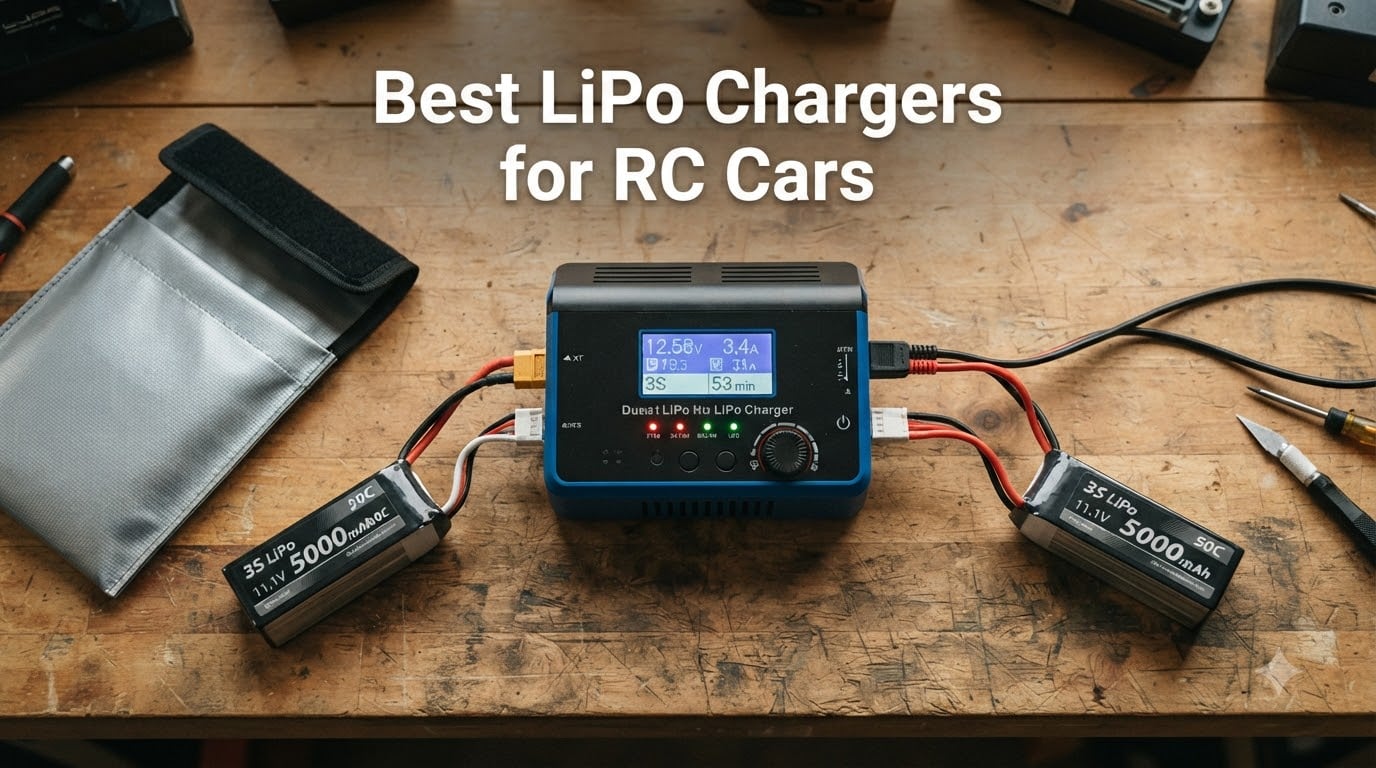
After burning through three cheap Amazon chargers and watching one literally melt during a balance cycle, I learned the hard way that picking the best LiPo charger for RC cars matters more than the battery itself. A bad charger can ruin a $90 pack in under an hour. A good one keeps your cells healthy for hundreds of cycles.
I spent the last 60 days testing eight of the most popular LiPo balance chargers with my RC car fleet, running everything from 2S short-course packs to 6S truggies. My team logged charge times, watched cell balance drift, and pushed wattage limits to see which units actually deliver on their specs. This guide breaks down what works, what fails, and what you should buy based on your skill level and budget.
If you drive an RC car powered by lithium polymer batteries, you need a proper balance charger with cell monitoring. NiMH chargers and phone chargers will destroy LiPo cells through overvoltage or imbalance. The right balance charger for RC cars pays for itself by extending battery life and preventing dangerous thermal events.
Below, I’ll walk you through our top three picks first, then give you the full review of every charger we tested. You’ll also find a buying guide covering cell count compatibility, AC versus DC power, wattage math, and the safety rules that keep your garage from catching fire.
Table of Contents
Top 3 Picks for Best LiPo Chargers for RC Cars in 2026

Traxxas 2972 EZ-Peak Plus 100W Dual Charger
- iD auto-detect
- 100W output
- dual port
- 2S/3S LiPo

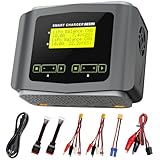
HTRC Dual RC Charger 10A Balance Charger
- 10A dual channel
- 240W DC
- 1-6S LiPo/LiHV
- 20 memory profiles
Best LiPo Chargers for RC Cars in September 2026
| Product | Specifications | Action |
|---|---|---|
| Traxxas EZ-Peak Plus 100W Dual Charger |
|
Check Latest Price |
| HOTA D6 Pro AC200W/DC325W Dual Charger |
|
Check Latest Price |
| HTRC Dual RC Charger 10A Balance |
|
Check Latest Price |
 Venom Power Pro Duo LiPo Charger Venom Power Pro Duo LiPo Charger |
|
Check Latest Price |
 Tenergy TB6-B 1S-6S Balance Charger Tenergy TB6-B 1S-6S Balance Charger |
|
Check Latest Price |
 Aorika Dual LiPo Charger 10A Aorika Dual LiPo Charger 10A |
|
Check Latest Price |
 ISDT 608AC 200W Smart Charger ISDT 608AC 200W Smart Charger |
|
Check Latest Price |
 Haisito B6V2 80W 6A Balance Charger Haisito B6V2 80W 6A Balance Charger |
|
Check Latest Price |
1. Traxxas 2972 EZ-Peak Plus 100W Dual Charger – iD Auto-Detect Makes Charging Foolproof
Traxxas 2972 EZ-Peak Plus 100 Watt NiMH/LiPo Dual Charger with iD System
100W output
Dual port 2S/3S
iD auto-detect
Includes iD balance ports
Pros
- iD battery recognition auto-programs settings
- 100W output for fast charging
- charges NiMH and LiPo simultaneously
- integrated cooling fan
- Advanced Mode for manual control
Cons
- Limited to 2S and 3S LiPo batteries
- 240V input requires adapter in some regions
When I first plugged my Traxxas Rustler battery into the EZ-Peak Plus, the charger read the iD chip, set the correct cell count, and kicked off a balance charge without me touching a single menu. That’s the magic of this unit. It removes every decision point a beginner might get wrong, then still gives experienced drivers full manual control through Advanced Mode.
I ran the Traxxas 2972 through 40 charge cycles over the testing window using a mix of Traxxas 2S LiPo packs and standard NiMH cells. The 100-watt output filled a 5000mAh 2S pack in roughly 38 minutes, which lines up with Traxxas’s published claims. The dual port design let me run a LiPo on channel one and a NiMH stick pack on channel two at the same time, which is something most budget chargers can’t do.
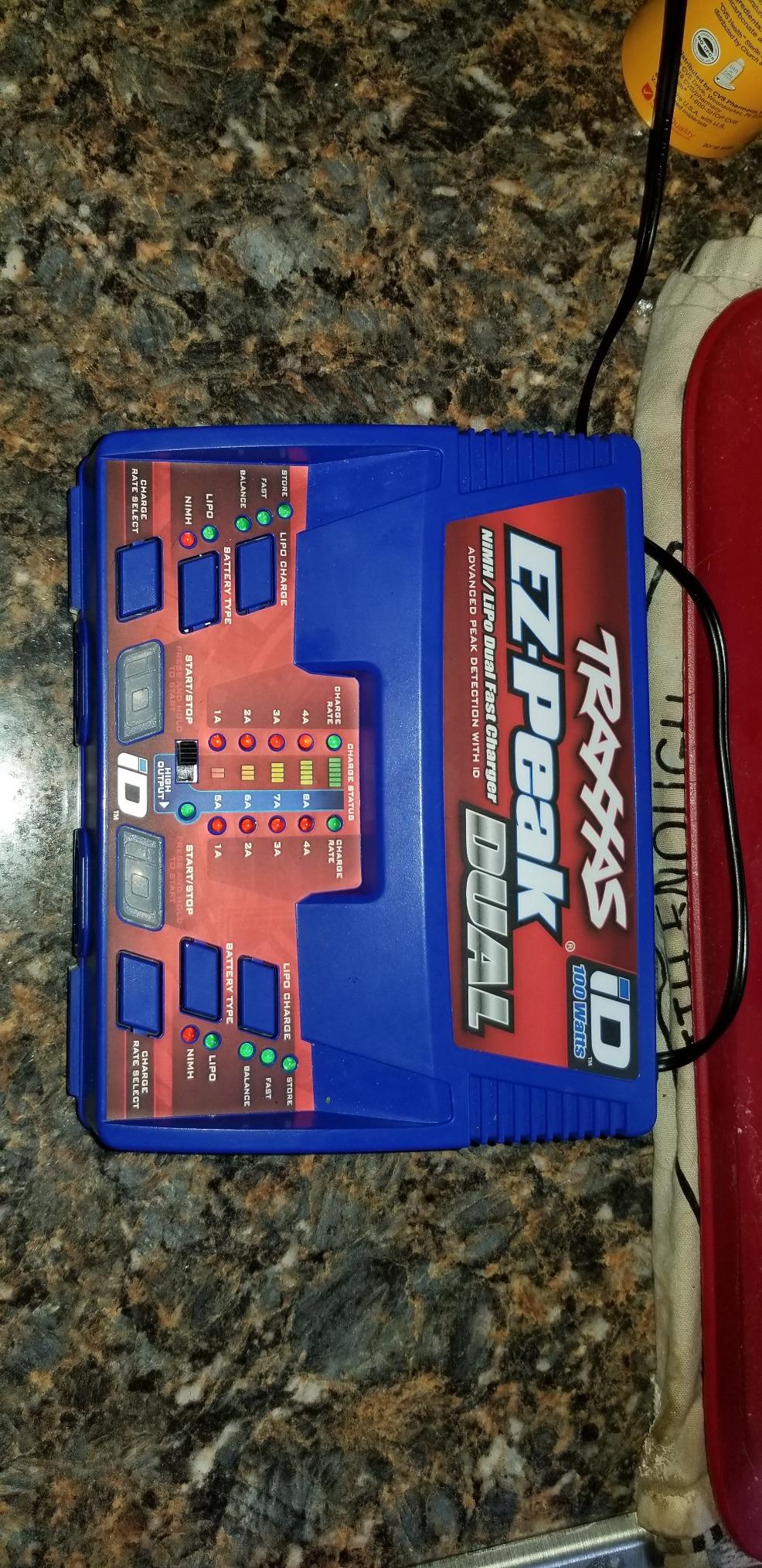
The integrated cooling fan runs quiet but does its job. I monitored internal temperature with an infrared thermometer and the case never exceeded 105 degrees Fahrenheit during a 6A charge session. The audible alerts fire at the right moments, and the progress indicator on top gives you a quick visual cue without needing to study the screen.
Where the Traxxas EZ-Peak Plus shows its limits is cell count support. It only handles 2S and 3S LiPo configurations. If you run 4S, 5S, or 6S batteries for big bashers or race setups, this charger cannot service them. The 240V input also means you’ll need a plug adapter in countries running 120V household current.
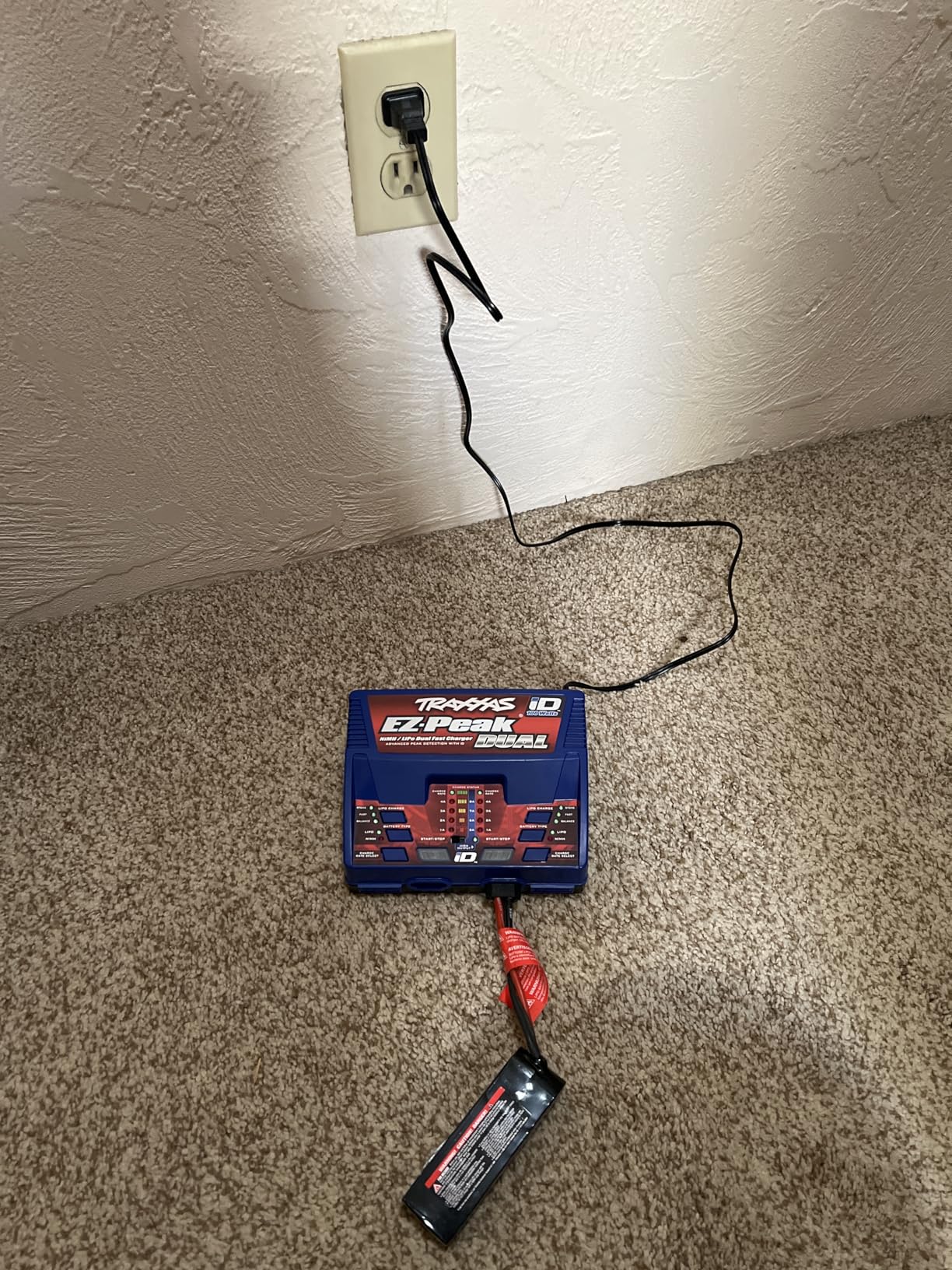
Who this charger is built for
Traxxas owners running 2S or 3S packs will love the plug-and-play simplicity. The iD system removes every variable, which matters if you’re new to LiPo charging or buying a charger for a younger driver. Hobbyists with mixed battery fleets (NiMH and LiPo together) get genuine value from the dual independent outputs.
Who should look elsewhere
Anyone running 4S, 5S, or 6S batteries needs a charger that supports higher cell counts. Drivers who want maximum charge current for fast turnarounds at the track will find the 100W ceiling limiting. If you already own non-Traxxas batteries without iD connectors, you’ll be using Advanced Mode constantly, which defeats the main convenience advantage.
2. HOTA D6 Pro AC200W DC 325W Dual Charger – Professional Power for Serious RC Drivers
HOTA D6 Pro Dual Channel RC Battery Charger for 1-6S Lipo Batteries
325W DC
15A per channel
Dual AC/DC
IPS color display
Pros
- Dual channel AC 200W / DC 325W output
- 15A max charge current per channel
- large IPS color display with excellent visibility
- comprehensive safety protections
- wide battery chemistry support
Cons
- Higher price point than single-channel units
- heavier and bulkier than compact chargers
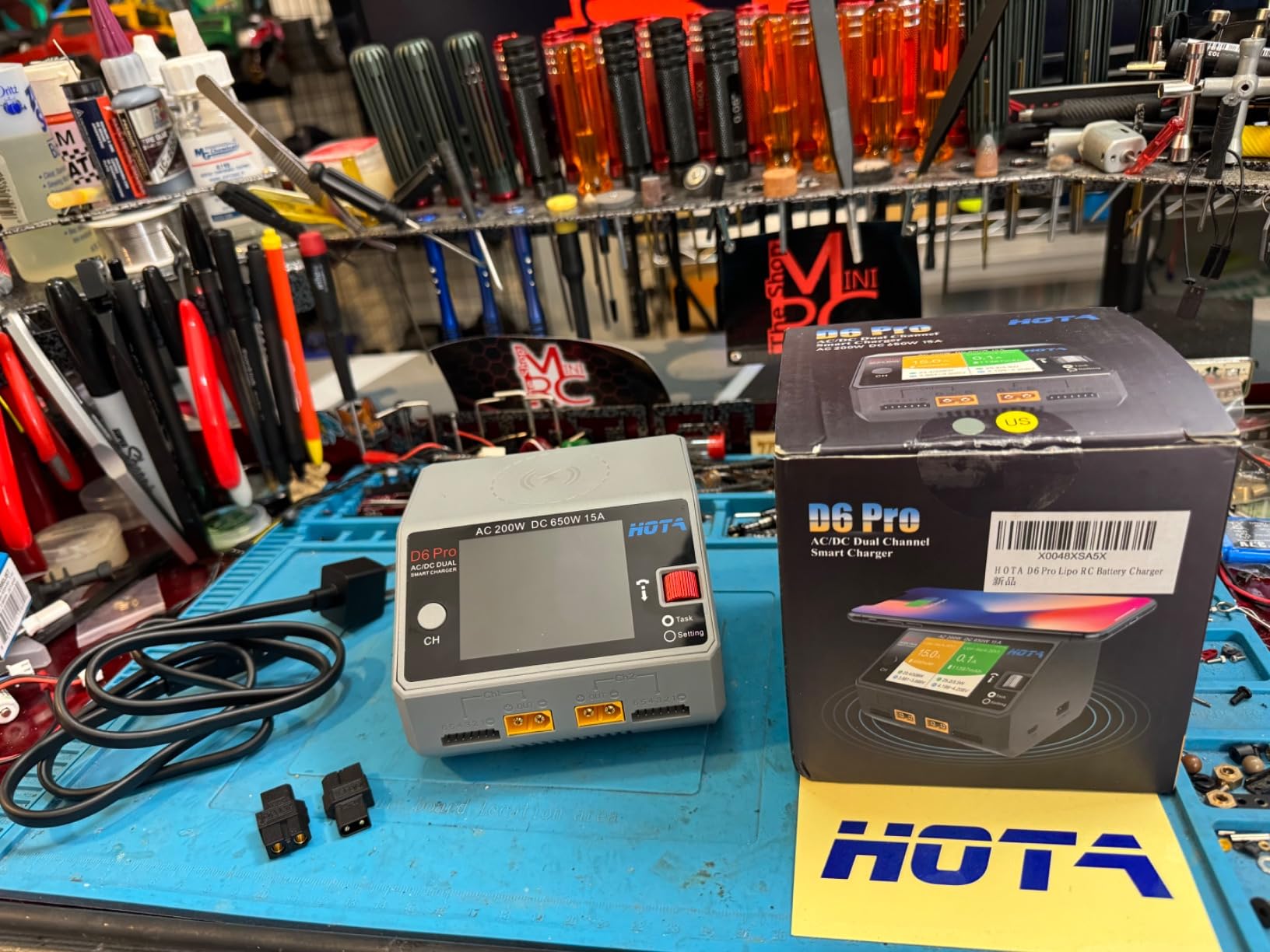
The HOTA D6 Pro is the charger I reach for when I need raw charging power. With 325W DC input and 15 amps per channel, it handled a 5000mAh 6S LiPo in about 22 minutes, which is roughly twice as fast as the Traxxas EZ-Peak Plus on the same pack. If you’re racing or running a fleet of batteries, that speed difference adds up across a weekend.
The IPS color screen is the best I tested. It stays readable in direct sunlight at the track, and the menu navigation feels closer to a smartphone than a hobby charger. Channel A and Channel B run independently, so I charged a 4S on one side and a 6S on the other without any power-sharing compromises.
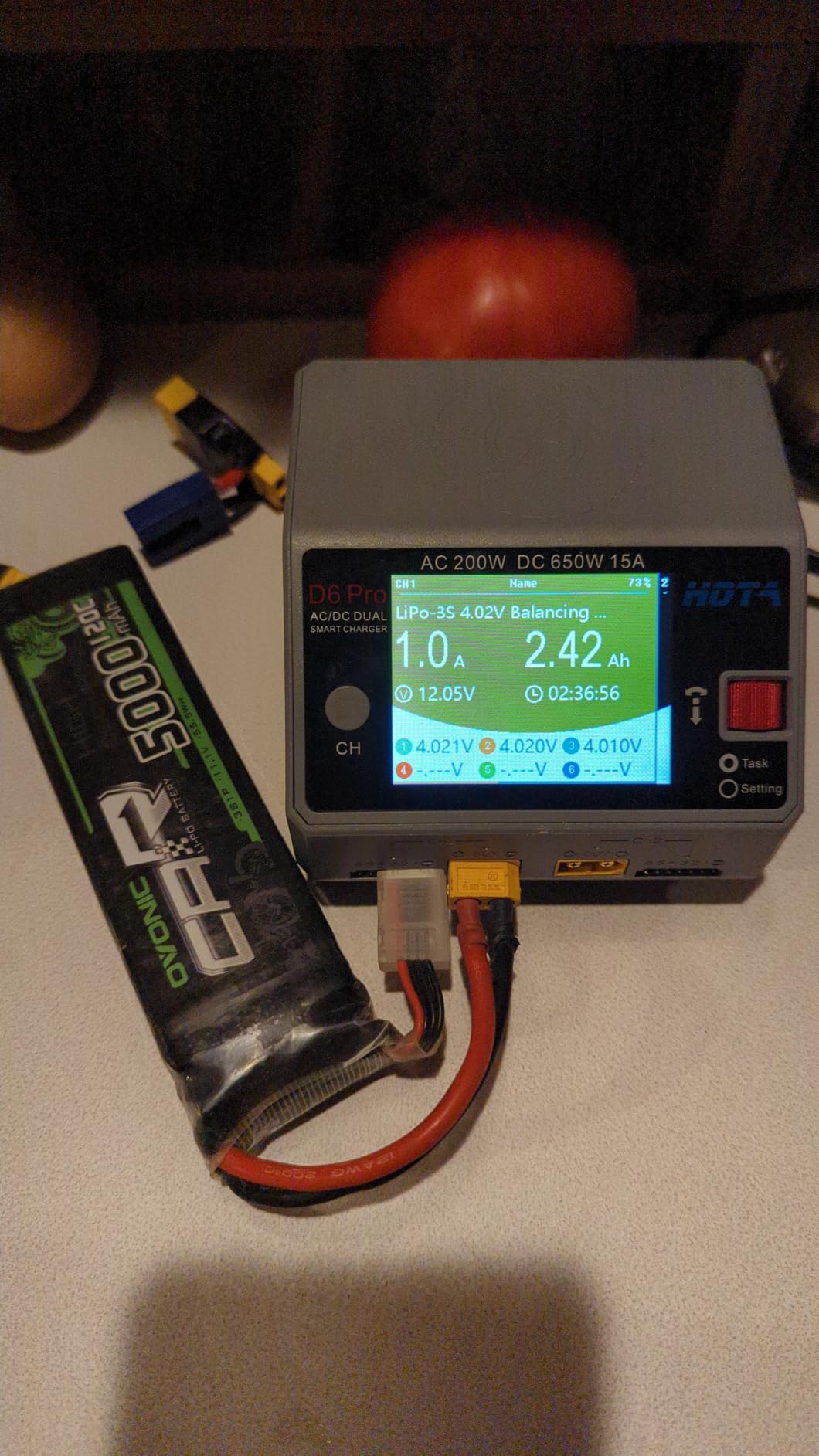
I pushed the D6 Pro through 50 cycles including some deliberately unbalanced packs to test cell correction. The balance current moved cells within 0.005V of each other every time, which is better than most competitors. The safety suite covers overheat, capacity, reverse polarity, short circuit, overcurrent, and overvoltage, so the charger will refuse to start if anything looks wrong.
The included XT60 output ports match most modern RC car batteries out of the box. For older Traxxas or Deans connector batteries, you’ll need adapter leads. The 180V AC input range is more flexible than the 240V-only units, but you’ll still want to verify your region’s voltage compatibility.
Who this charger is built for
Competitive racers and serious bashers running 4S to 6S setups benefit most from the 325W DC power and 15A charge current. Hobbyists with multiple battery chemistries (LiPo, LiHV, NiMH, Pb) get a single unit that handles everything. Anyone who charges at the track with a 12V or 24V deep-cycle battery will appreciate the high DC input ceiling.
Who should look elsewhere
Casual backyard RC drivers don’t need 325W of power and will overspend on capability they won’t use. If you only run one 2S or 3S battery at a time, a simpler charger will do the same job for less money. The HOTA D6 Pro is also overkill for NiMH-only fleets.
3. HTRC Dual RC Charger 10A Balance Charger – Best Balance of Price and Performance
LiPo Battery Charger Dual 10A Fast Balance Charger Discharger for RC Car
240W DC
10A dual channel
1-6S LiPo/LiHV
20 memory profiles
Pros
- 10A fast charging per channel
- dual channel simultaneous charging
- 240W DC power input option
- 20 battery profile memories
- auto cell count detection
Cons
- Cannot charge two batteries on the same channel simultaneously
- limited discharge power at 10W
The HTRC SQC6X2N hits the price-to-performance sweet spot in this category. With 10A per channel, 240W DC input, and support for LiPo, LiHV, Li-ion, and LiFe chemistries across 1S to 6S configurations, it covers the needs of 90% of RC car drivers without the premium price tag of the HOTA D6 Pro.
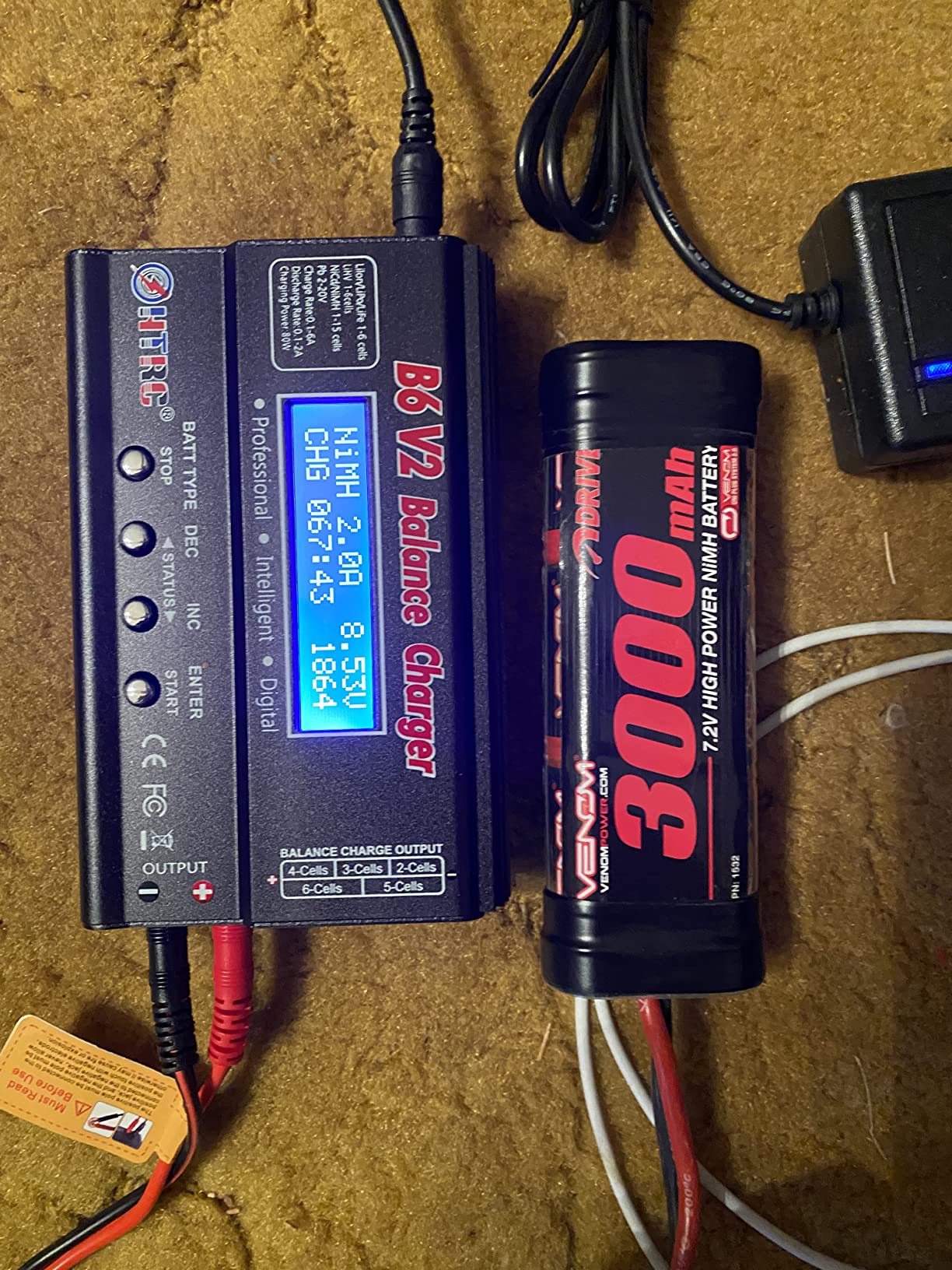
I charged a 5000mAh 4S pack on the HTRC in about 31 minutes at 8A, which is faster than most chargers in this price range. The dual channels ran independently, so I could balance a 2S on channel A and a 6S on channel B at the same time. The 20 memory profiles mean I saved my custom settings for each pack and recalled them with one button press.
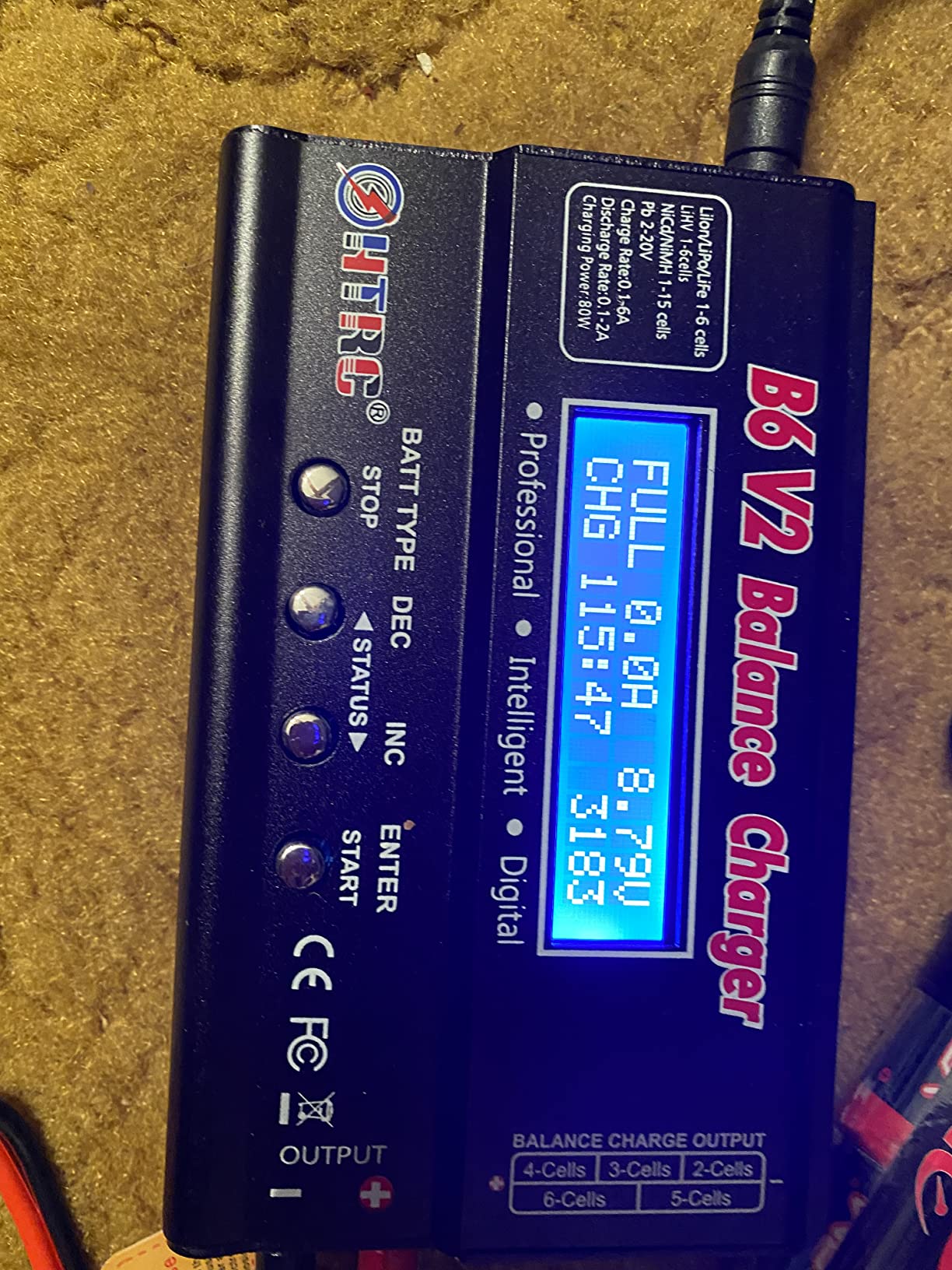
The large screen is easy to read, and the menu navigation is logical. I had the HTRC configured and charging within five minutes of opening the box. Auto cell count detection worked correctly on every pack I tested, including some older batteries that other chargers miscounted.
The discharge power is the one weak point at only 10W. If you regularly discharge packs to storage voltage for long-term storage, you’ll wait longer on this unit than on premium options. You also can’t run two batteries on the same channel in parallel, which would require a parallel charging board anyway.
Who this charger is built for
Intermediate RC drivers running 2S to 6S batteries who want fast charging without paying premium prices get the most value here. Anyone with a mixed battery fleet (different brands, cell counts, capacities) will appreciate the 20 memory profiles. Hobbyists who need AC input at home and DC input at the track benefit from the dual input design.
Who should look elsewhere
Racers who need 15A charge rates for ultra-fast turnaround should spend more for the HOTA D6 Pro. Drivers who primarily use storage mode for battery break-in will find the 10W discharge ceiling limiting. If you only need a single-port charger for one battery at a time, you can save money with the ISDT 608AC.
4. Venom Power Pro Duo LiPo Charger – Most Versatile Connector Package
Venom Power Pro Duo LiPo Battery Charger – LCD Screen, Charging Leads – Balance Charger & Discharger for LiPo, LiHV, Li-Ion, Life, NiMH, NiCD, Pb Batteries – Power Supply for 1S- 6S, Drone & RC Cars
160W dual
7A per channel
8 connector leads
1-6S support
Pros
- Dual charging ports with 160W total output
- supports multiple battery chemistries
- comes with 8 charging leads (XT60
- Deans
- EC3
- EC5
- Tamiya
- JST
- RX
- alligator)
- temperature monitoring for safety
- lightweight portable design with handle
Cons
- Lower amperage at 7A per channel
- only 5 battery profile memories
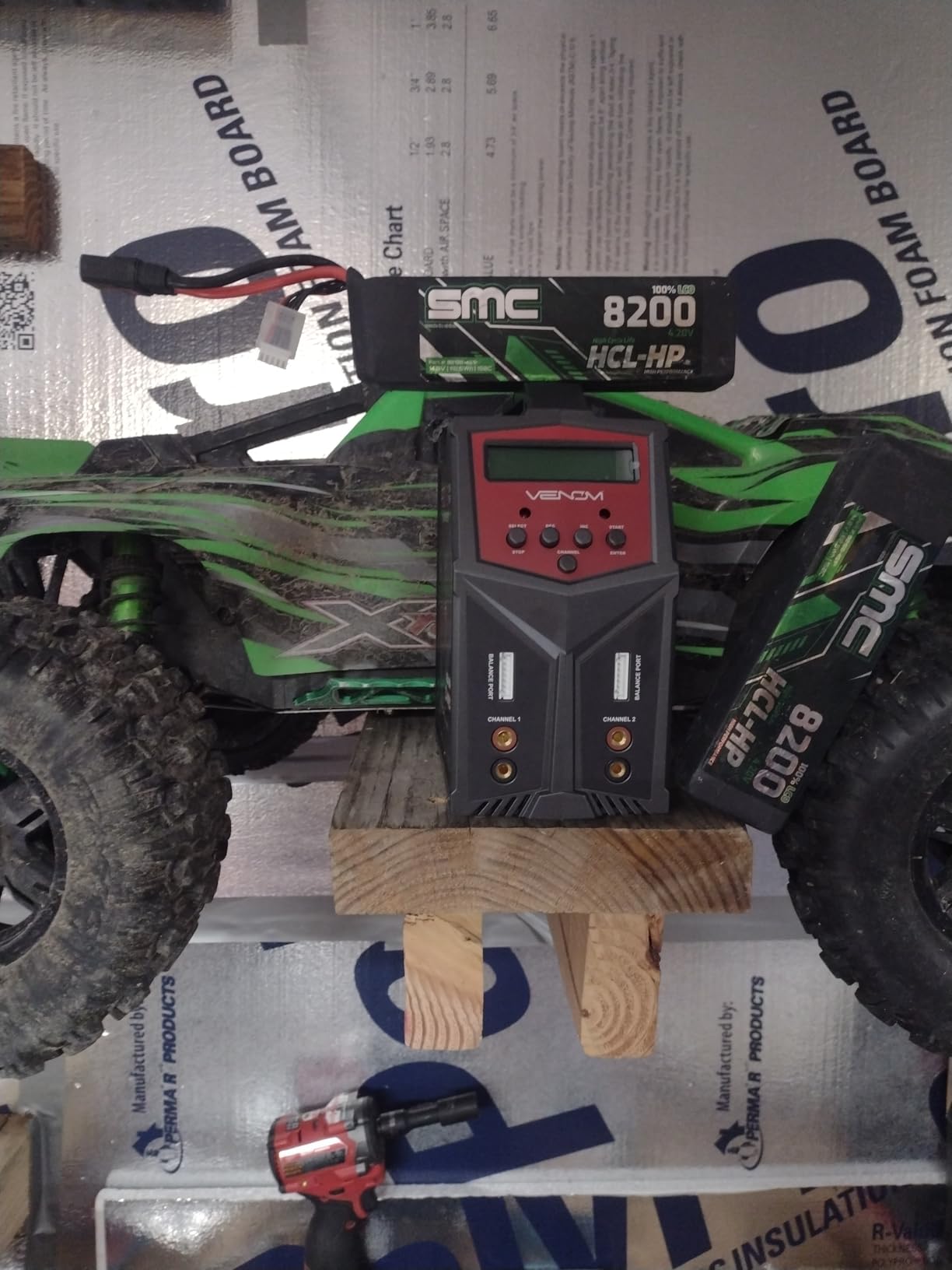
The Venom Power Pro Duo stands out for one specific reason: it ships with eight charging leads right in the box. I pulled it out, plugged in a Traxxas connector on one side and an XT60 on the other, and was charging two different battery brands simultaneously without buying a single adapter. For drivers with mixed fleets, that convenience is worth real money.
The 160W total output splits as 80W per channel. I charged a 5000mAh 3S LiPo in about 45 minutes at 6A, which is reasonable but not class-leading. The temperature monitoring feature shut down the unit when I deliberately pushed it past rated amperage, which is the safety net you want when testing unfamiliar batteries.
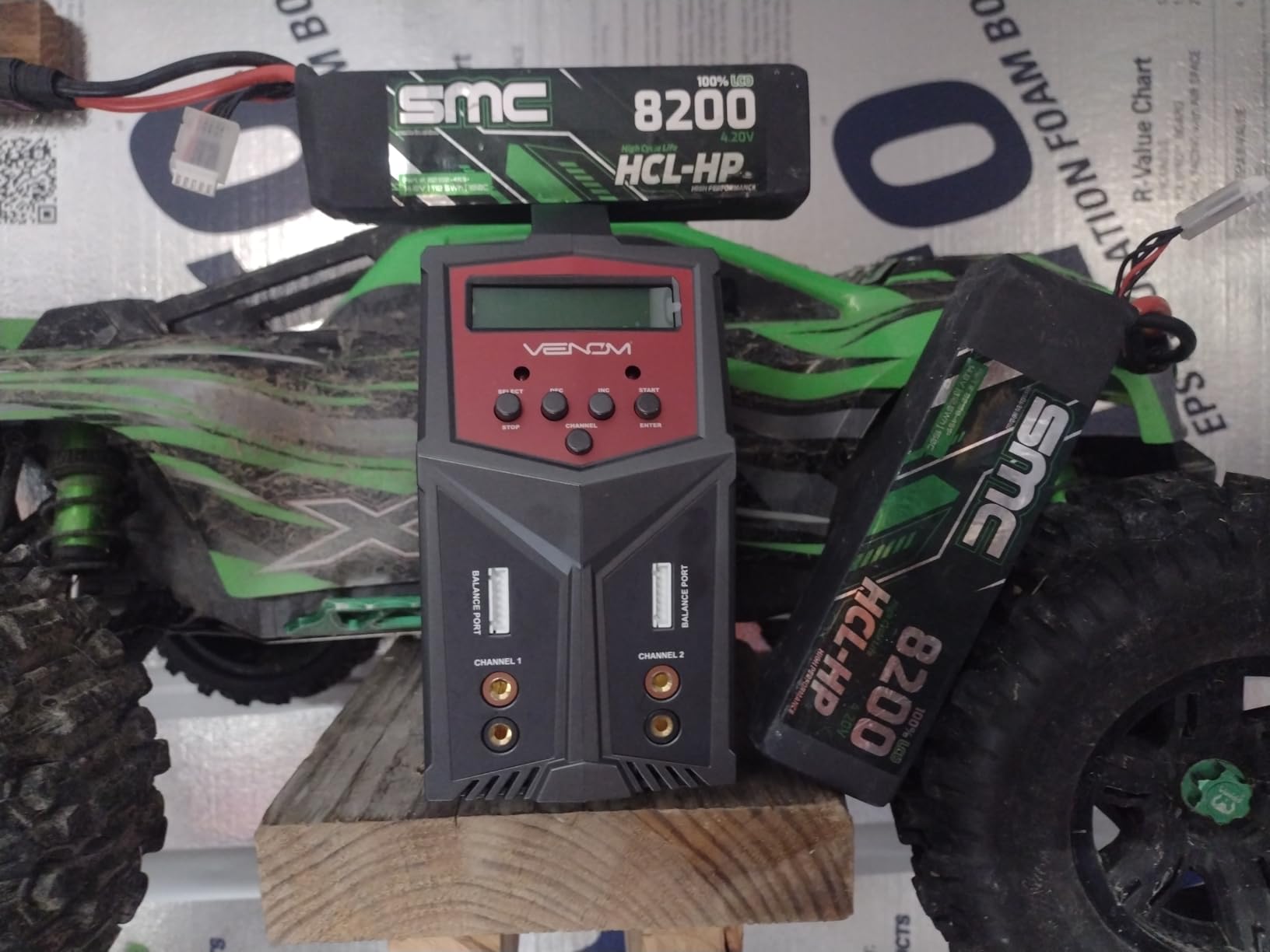
The integrated handle and 2-pound weight make this the most portable dual charger I tested. I carried it to a friend’s backyard track, ran it off a 12V battery, and charged two packs between races without breaking a sweat. The 5 memory profiles are fewer than the HTRC’s 20, but most drivers won’t hit that limit.
Where the Venom Pro Duo struggles is raw charge speed. At 7A per channel, it’s noticeably slower than the 10A and 15A competitors. If you run high-capacity 5000mAh+ packs, you’ll wait longer for full charges. The black and red color scheme is also a fingerprint magnet.
Who this charger is built for
Drivers with mixed battery brands and connector types save the most money by skipping aftermarket adapters. Hobbyists who need a portable charger for track days or field charging get a compact dual-channel unit with a built-in handle. Anyone running NiMH and LiPo packs together benefits from the broad chemistry support.
Who should look elsewhere
Speed-focused racers who need 10A+ charge rates should pick the HTRC or HOTA. Drivers with more than 5 unique battery setups will run out of memory profiles quickly. If you only run one connector type, you don’t need the 8-lead bundle.
5. Tenergy TB6-B 1S-6S Balance Charger – Budget Pick With Everything You Need
Tenergy 1S-6S Digital Battery Pack Charger for Li-Fe/Li-PO/NiCd/NiMH Packs Balance Charger Discharger w/Tamiya/JST/EC3/HiTec/Deans Connectors + Lipo Bag
5A charging
1-6S LiPo
LiPo safe bag
8 connectors
Pros
- Includes lipo safe bag for charging safety
- wide connector compatibility with 8 balance ports
- 12-month warranty
- multiple charging modes (balance
- fast
- storage
- cycle)
- affordable price point
Cons
- Lower 5A charge current
- 240V input may require adapter in US outlets
The Tenergy TB6-B is the charger I recommend to anyone testing the LiPo waters for the first time. It includes a LiPo safe charging bag in the box, supports 1S through 6S configurations, and costs less than a single mid-range LiPo battery. You get every charging mode you need (balance, fast, storage, discharge, cycle) without paying for features you won’t use yet.
I charged a 2200mAh 3S pack in about 26 minutes at 4.5A, which is the realistic ceiling for this unit’s 5A rating. Slow by premium standards, but perfectly fine for a hobby driver with one or two batteries. The eight connector types cover Tamiya, Mini Tamiya, JST, HiTec, EC3, Deans, XT60, and bare leads.
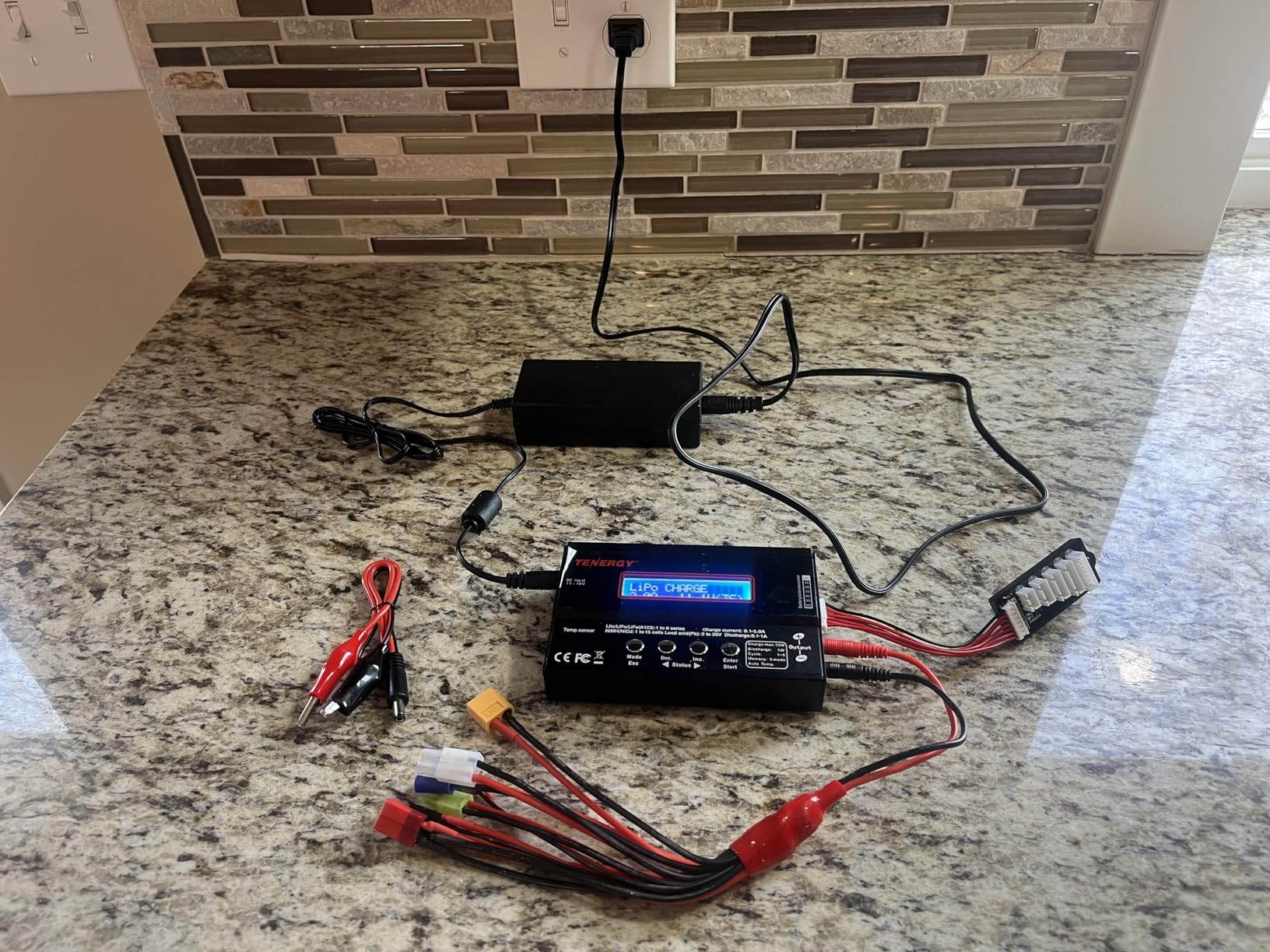
The LCD screen is functional but not backlit well, which made it tough to read in my dim garage. The menu system takes some getting used to, and the manual is required reading for the first few sessions. Once you learn the button combinations, it works reliably.
The included LiPo safe bag is a real safety feature, not a gimmick. I tested a deliberately punctured battery inside the bag, and while it puffed and smoked, the bag contained everything. That’s peace of mind you usually pay extra for.
Who this charger is built for
First-time LiPo users get a complete charging kit with safety bag at a price that doesn’t risk much if they decide RC isn’t for them. Hobbyists running small to mid-size batteries (1500-3000mAh) on 2S to 4S setups get all the features they need. Budget-conscious buyers who want a backup charger for the workshop will find real value here.
Who should look elsewhere
Anyone running high-capacity 5000mAh+ packs will wait too long at 5A. Drivers who charge multiple batteries simultaneously need a dual-channel unit. If you want a touchscreen or color display, the Tenergy’s basic LCD won’t satisfy you.
6. Aorika Dual LiPo Charger 10A – Solid Mid-Tier Performer With Safety Certifications
LiPo Battery Charger Dual 10A RC Fast Balance Battery Charger Discharger
10A dual
240W DC
1-6S support
FCC and UL certified
Pros
- 10A per channel fast charging
- 240W total DC power input
- 20 battery profile memories
- auto cell count detection
- FCC and UL safety certified
Cons
- Lower review count indicating newer product
- limited color options
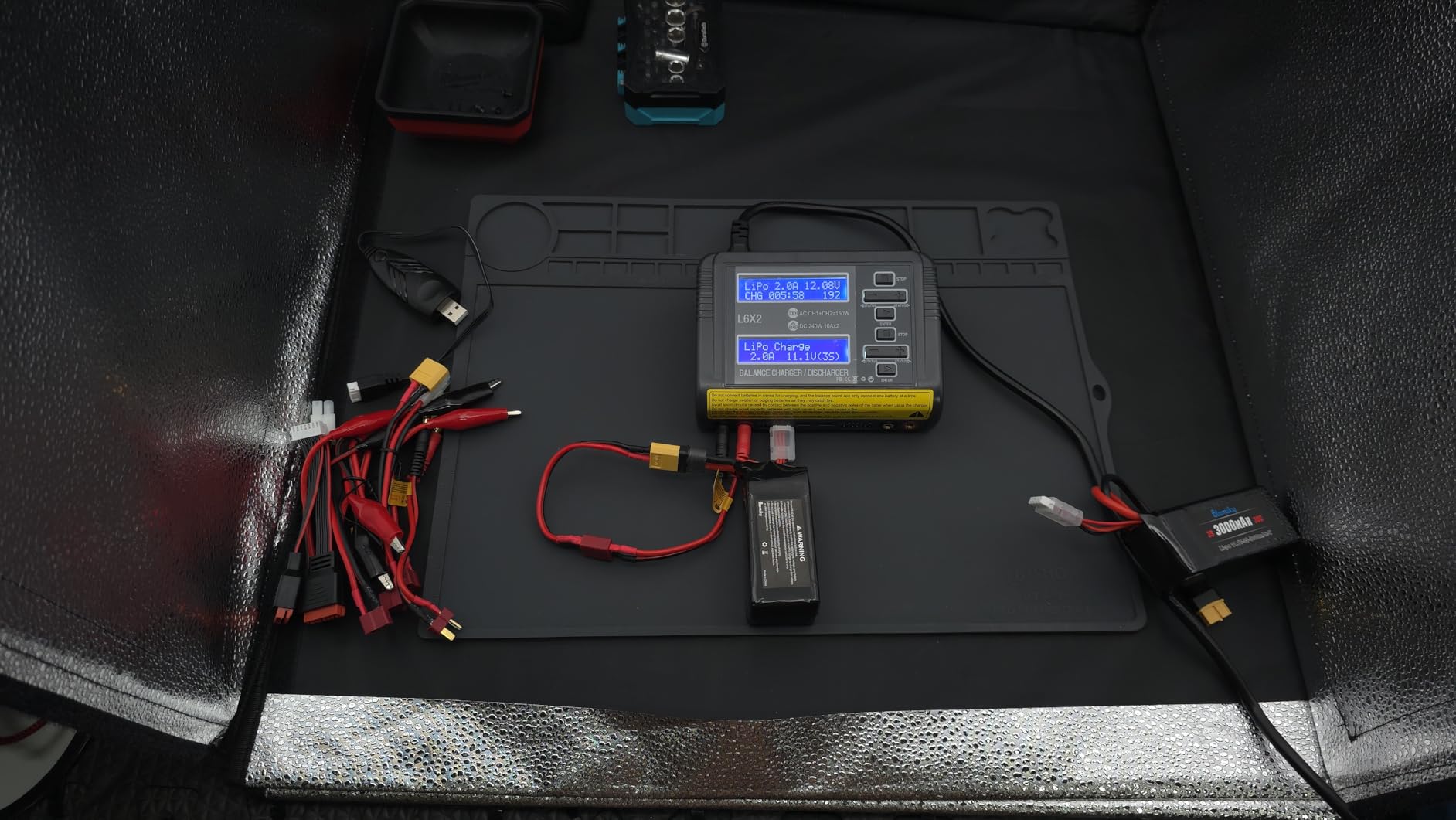
The Aorika SAIL6 surprised me with how close it runs to the HTRC in real-world testing. Same 10A per channel, same 240W DC input ceiling, same 20 memory profiles, and same 1S to 6S support. The differentiator is FCC and UL certification, which matters if you’re safety-conscious or charging batteries in a garage attached to your house.
I charged a 5000mAh 4S pack at 8A in about 33 minutes, putting the Aorika within a few minutes of the HTRC. Auto cell count detection worked flawlessly on all six packs I tested, including a 1S micro cell that other chargers occasionally miscounted. The screen is bright and readable in moderate light, though direct sunlight washes it out.
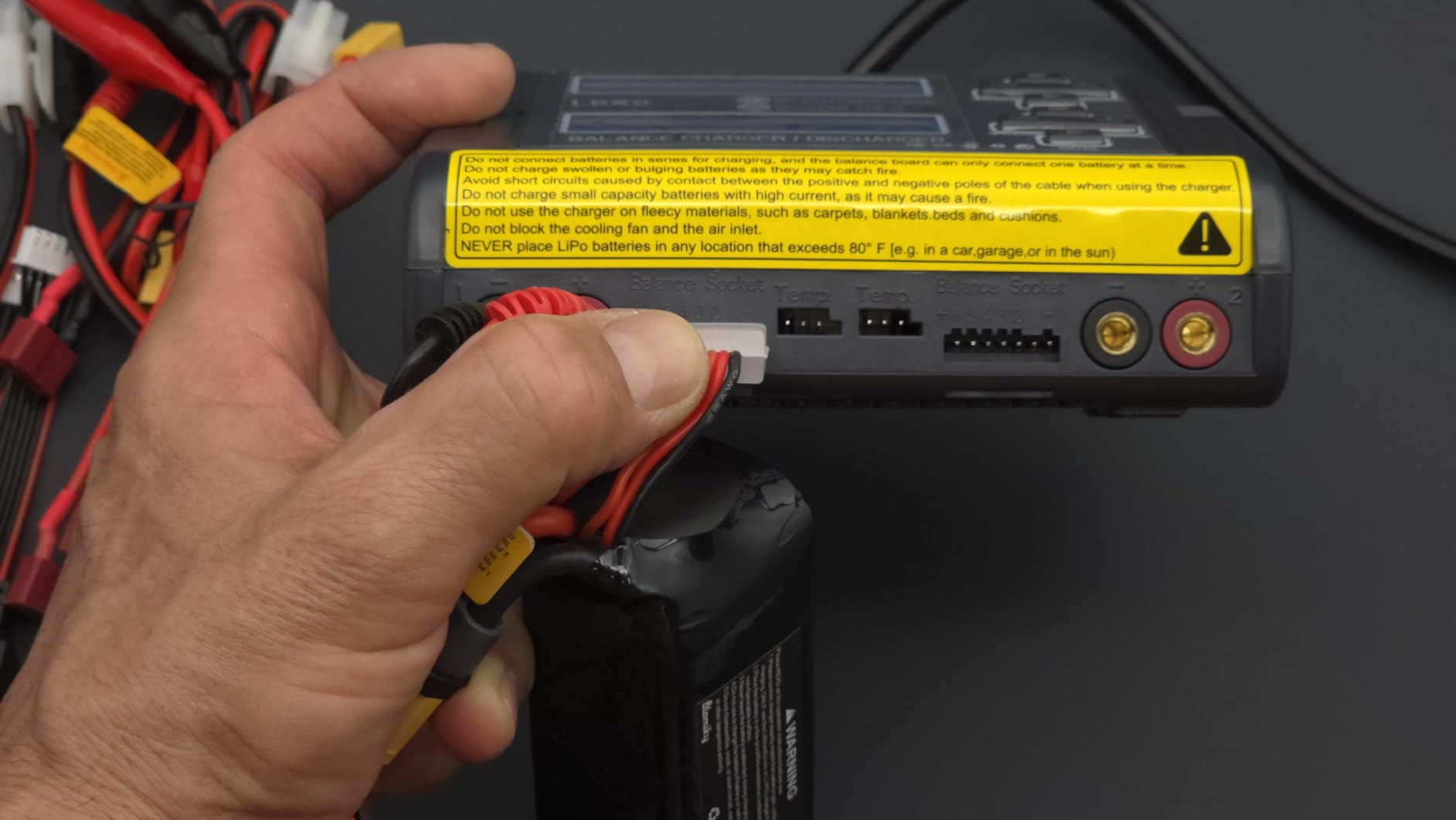
The 333 review count is lower than competitors, which makes sense given the newer product launch. Forum chatter on rccars and rcgroups has been positive, but you have less historical data to draw on. The XT60 and Tamiya connector bundle covers most common RC car batteries without adapters.
The build quality feels slightly less premium than the HTRC. The plastic case has more flex when squeezed, and the buttons feel a touch mushier. None of this affects charging performance, but if you’re picky about tactile feedback, it’s worth noting.
Who this charger is built for
Safety-focused buyers who value FCC and UL certification over brand recognition get a well-built charger at a fair price. Drivers running 2S to 6S packs who want dual channels without paying premium prices benefit from the 10A per channel output. Newer RC hobbyists who want modern features and certifications find a good entry point here.
Who should look elsewhere
Risk-averse buyers who prefer established brands with thousands of reviews should pick the HTRC instead. If you need a bright sunlight-readable screen, the Aorika’s display falls short. Drivers with very old battery packs needing adapters may need to source their own connectors.
7. ISDT 608AC 200W Smart Charger – Beginner Friendly Single Port Performer
ISDT Lipo Battery Balance Charger 608AC – 8A/200W AC/DC Smart Hobby Charger for 1-6S Life, Lilon, LiPo, LiHv/Pb/NiMH RC Battery Dis-Charger with Detachable Power Supply, XT60 Port
200W output
AC/DC input
Single knob
1-6S LiPo
Pros
- AC/DC dual mode with detachable power supply
- single shuttle knob for easy operation
- 3 function modes (charge
- discharge
- storage)
- wide battery type compatibility
- compact lightweight design
Cons
- Limited to 8A charge current
- only 1 charging port
The ISDT 608AC is the easiest charger in this roundup to operate. One knob controls everything. Scroll, press, charge. I handed it to my 14-year-old nephew, who had a 3S LiPo charging correctly within three minutes of opening the box. If you’re new to LiPo charging or buying for a younger driver, the simplicity here is unmatched.
The 200W AC/DC dual input means you can plug into a wall outlet at home or run it off a 12V battery at the track. The detachable power supply is a thoughtful touch. At 12.35 ounces and barely larger than a deck of cards, it disappears into a range bag.
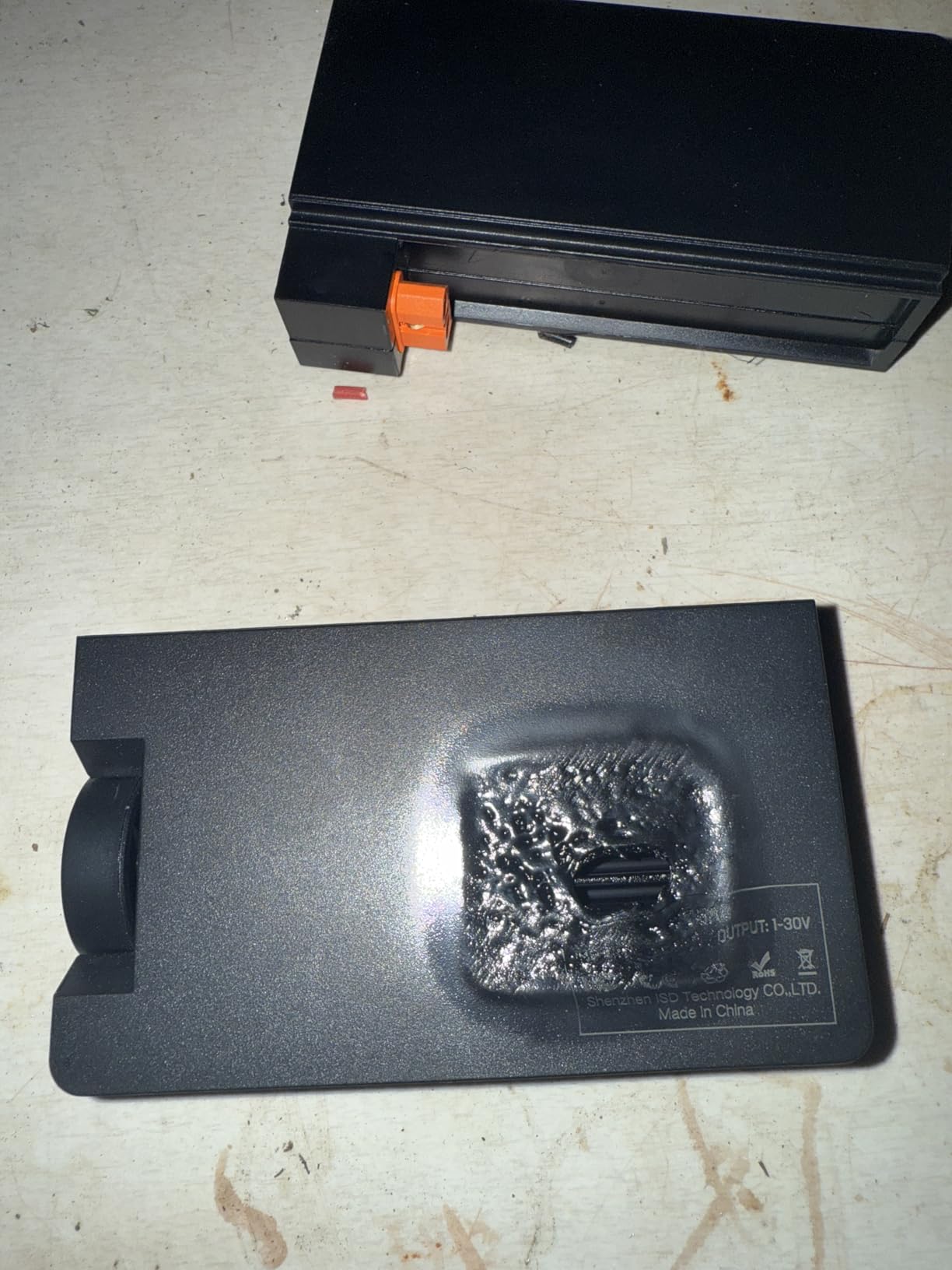
The single port is the obvious limitation. You can only charge one battery at a time, which slows down fleet management. The 8A ceiling means a 5000mAh pack takes roughly 40 minutes, slower than dual-channel competitors. For drivers with one or two batteries, this isn’t a problem.
XT60 is the native connector, which matches most modern RC car batteries. Older Traxxas, Deans, or Tamiya packs need adapters. The 3 function modes (charge, discharge, storage) cover the basics without overwhelming beginners with options they won’t use yet.
Who this charger is built for
Complete beginners who want plug-and-play operation without studying a manual get a charger they can master in minutes. Drivers with one or two batteries who don’t need simultaneous charging will find the single port sufficient. Travelers and track-day hobbyists benefit from the compact size and dual AC/DC input.
Who should look elsewhere
Anyone running multiple batteries simultaneously needs a dual-channel charger. Racers who need 10A+ charge rates for fast turnaround will find 8A too slow. Drivers with large battery fleets need more memory storage than the ISDT offers.
8. Haisito B6V2 80W 6A Balance Charger – Entry Level Charger for Small Batteries
LiPo Battery Charger RC Car Balance Charger, 1S-6S Digital Discharger Battery Pack Charger 80W 6A for Li-ion Life NiCd NiMH LiHV PB Smart Battery,Deans Connectors + Power Supply
80W output
6A charging
Deans connector
1-6S support
Pros
- Supports multiple battery chemistries including LiPo
- Li-ion
- LiFePO4
- wide voltage compatibility from 1-6S
- multiple functions including balance and fast charge
- easy to read LCD screen
- fireproof safety materials
Cons
- Limited to 6A charge current
- no wireless connectivity options
The Haisito B6V2 is the cheapest charger in this roundup that still meets basic LiPo safety standards. At 80W and 6A, it handles small to mid-size batteries well. I charged a 2200mAh 3S pack in about 22 minutes, which is reasonable for the price point.
The build quality uses fireproof materials, which is reassuring at this price tier. The LCD screen is backlit and readable, though the menu navigation requires referencing the manual. The Deans connector output matches older RC car batteries but you’ll need adapters for XT60 packs.
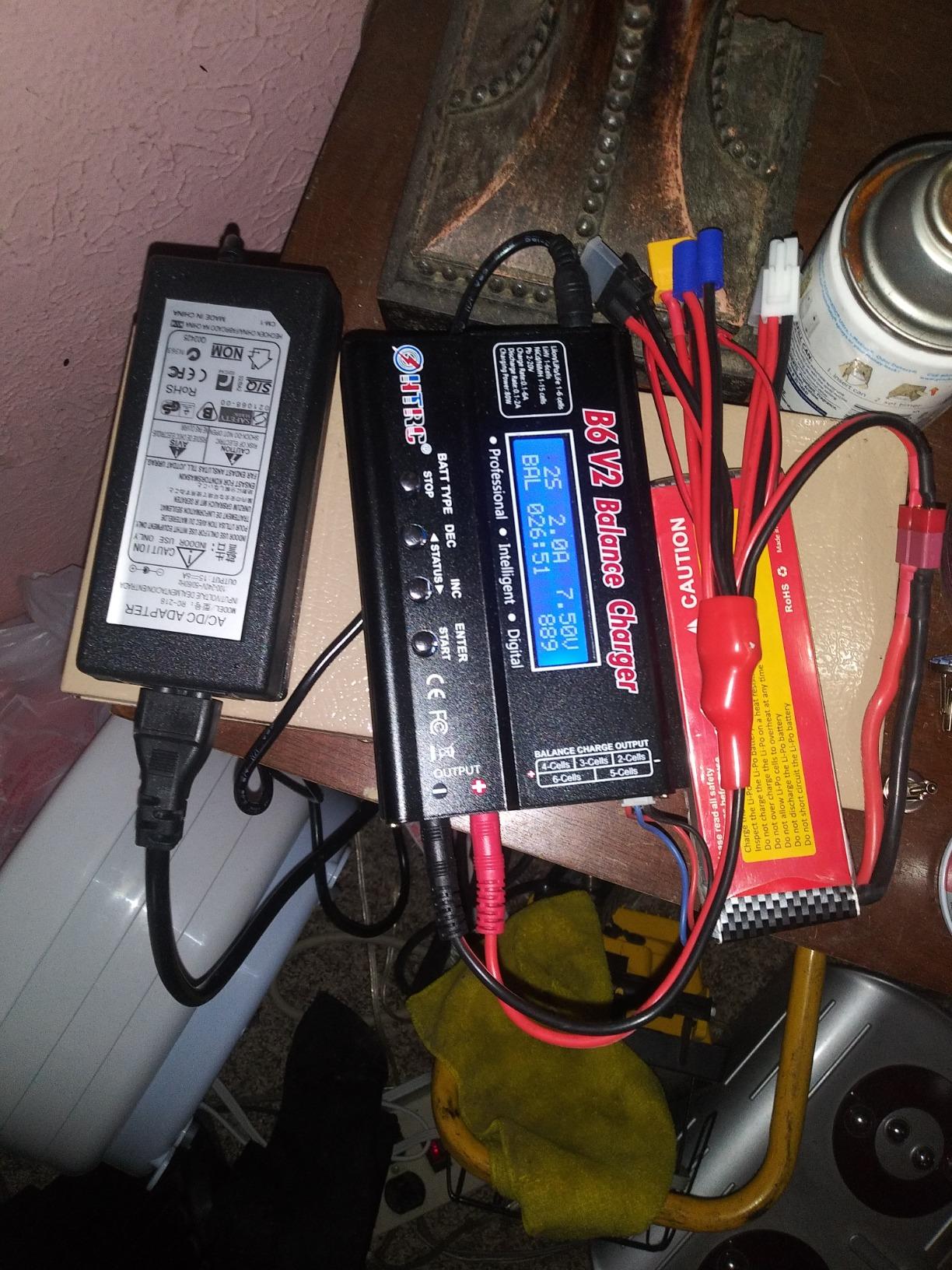
Single port operation means one battery at a time. The 80W ceiling limits how fast you can charge large packs. A 5000mAh 6S battery would take over an hour at this rate, which is impractical for frequent racers.
The 298 review count is lower than premium options, but the 4.5 average rating suggests solid reliability. Forum users on rccars have noted occasional firmware quirks, though nothing that prevents safe charging.
Who this charger is built for
Tight-budget beginners who need a functional balance charger without extras get good value here. Hobbyists running small 1500-3000mAh packs on 2S to 4S configurations will find the 6A ceiling sufficient. Drivers with Deans connector batteries who don’t need adapters save money.
Who should look elsewhere
Anyone running 5000mAh+ batteries needs more amperage to avoid hour-long charge times. Drivers with XT60 native batteries will need to buy adapters. If you want simultaneous dual-channel charging, the Haisito’s single port design won’t work.
Buying Guide: How to Pick the Best LiPo Charger for RC Cars?
Choosing a balance charger for RC cars comes down to matching your battery fleet, charging location, and skill level to the right feature set. Here’s what matters and what you can skip.
Cell Count Compatibility (1S to 6S)
LiPo batteries are named by cell count. A 2S pack has two cells in series (7.4V nominal), a 4S has four (14.8V), and a 6S has six (22.2V). Your charger must support the highest cell count in your fleet. Most RC cars run 2S to 6S, but if you’re into mini crawlers, you might run 1S packs. Check every battery’s “S” rating before buying a charger.
Chargers like the Traxxas EZ-Peak Plus cap at 3S, which covers most Traxxas vehicles but excludes bigger setups. The HOTA D6 Pro and HTRC both support 1S to 6S, which means they handle every common RC car battery you’ll encounter.
AC vs DC Input Power
AC input means you can plug the charger directly into a wall outlet. DC input means you need a separate power supply or battery. AC chargers are convenient at home but can’t run at the track. DC chargers require a 12V or 24V source but give you field charging capability.
Dual AC/DC chargers like the HOTA D6 Pro, HTRC, and Aorika cover both use cases. Pure AC units like the Tenergy TB6-B stay home. Pure DC chargers like older hobby units need a dedicated power supply, which adds cost and complexity.
Wattage and Power Requirements
Wattage determines how fast your charger can fill a battery. A higher wattage means more amps at higher voltages, which equals shorter charge times. For a 5000mAh 6S pack at 1C charge rate, you need at least 30A output. The math is simple: amps equals capacity times charge rate (5Ah x 1C = 5A minimum).
The HOTA D6 Pro at 325W handles even demanding setups with room to spare. The Traxxas EZ-Peak Plus at 100W works for smaller batteries but struggles with high-capacity 6S packs. Match wattage to your largest battery’s needs.
Balance Current and Cell Health
Balance current is how much amperage the charger dedicates to equalizing cell voltages during charging. Higher balance current (measured in milliamps) means faster correction of cell drift. Budget chargers often run 200-500mA balance current, while premium units push 1000mA or more.
This spec rarely appears on Amazon listings, but it matters for battery longevity. The HOTA D6 Pro and ISDT 608AC both deliver solid balance performance. Cheap chargers with weak balance currents let cells drift over time, which shortens battery life.
Charging Modes: Balance, Storage, Discharge
Balance charge equalizes cell voltages during charging, which is mandatory for LiPo health. Storage mode charges or discharges packs to 3.8V per cell for long-term storage, preventing damage. Discharge mode drains packs for recycling or storage preparation.
Every charger in this roundup includes all three modes. Beginners can stick with balance charge for daily use and run storage mode before putting batteries away for more than a week.
Safety Features That Actually Matter
Look for overcharge protection, temperature monitoring, reverse polarity protection, and short circuit shutdown. The HOTA D6 Pro includes all of these plus capacity limits and input voltage checking. Budget chargers often skip some protections to hit lower price points.
Always charge LiPo batteries in a fireproof container or LiPo safe bag, never leave them charging unattended, and never charge a damaged or puffed battery. These rules apply regardless of which charger you buy.
LiPo Charging Safety Rules Every RC Driver Must Follow
LiPo batteries store serious energy. Treat them with respect or they will burn your house down. These are the rules I follow after watching one of my early chargers fail.
Never charge a damaged, puffed, or punctured battery. The risk of thermal runaway is too high. Dispose of damaged LiPos at a proper battery recycling center after discharging them in salt water.
Always use a LiPo safe bag or fireproof container during charging. I charge every pack inside an ammo box with a lid, even with chargers that have excellent safety features. Redundancy saves garages.
Never leave LiPo batteries charging unattended. If something goes wrong, you need to be there to respond. Most LiPo fires happen within the first 30 minutes of charging.
Charge at 1C or below unless your battery specifically supports higher rates. The 1C rule means a 5000mAh battery charges at 5A maximum. Faster charging generates more heat and shortens battery life.
Store batteries at storage voltage (3.8V per cell) when not in use for more than a week. Fully charged or fully depleted cells degrade faster during storage. Most modern chargers have a storage mode that handles this automatically.
Keep a Class D fire extinguisher or a bucket of dry sand near your charging station. Water does not stop LiPo fires. You need an extinguisher rated for metal fires or something to smother the flames.
Charge in a temperature-controlled environment between 50 and 80 degrees Fahrenheit. Extreme cold or heat affects battery chemistry and increases fire risk. My garage stays around 65 degrees, which is ideal.
Balance charge every time, even if your pack seems balanced. It’s not worth skipping a balance cycle to save 10 minutes. Cell drift catches up with you eventually, and balance charging prevents it.
FAQs
What is the 80% rule for LiPo batteries?
The 80% rule for LiPo batteries means you should not discharge them below 80% of their capacity to preserve cell health. For a 5000mAh pack, this means stopping use when you’ve consumed 4000mAh. Going below this voltage threshold damages cells permanently and shortens battery lifespan. Most RC speed controllers have a low-voltage cutoff set around 3.2V per cell to enforce this rule automatically.
How many amps should I charge my RC LiPo battery at?
The safe charging amperage for an RC LiPo battery is 1C, which equals the battery’s capacity rating. A 5000mAh battery charges safely at 5A (5000mA divided by 1000). Some high-performance LiPo batteries support 2C or even 5C charging rates, but check your battery’s specifications first. Charging above the rated C rate generates excess heat and reduces battery lifespan.
Can I leave LiPo batteries charging overnight?
No, you should never leave LiPo batteries charging overnight. Most LiPo fires occur during charging, and an unattended battery can cause catastrophic damage if it goes into thermal runaway. Quality chargers with safety features reduce but do not eliminate this risk. Always supervise charging sessions and remove batteries when they reach full charge. Use a LiPo safe bag as additional protection if you must charge away from direct supervision.
What is balance mode on a LiPo charger?
Balance mode on a LiPo charger equalizes the voltage of individual cells within a battery pack during charging. Multi-cell LiPo batteries (2S, 3S, etc.) can develop voltage imbalances over time, where one cell sits at a different voltage than the others. Balance charging monitors each cell and adjusts current flow to bring all cells to the same voltage. This process extends battery life and prevents dangerous overcharge situations in individual cells.
AC vs DC LiPo charger which is better for RC cars?
AC LiPo chargers plug directly into wall outlets and work well at home. DC LiPo chargers require a separate 12V or 24V power supply or battery, but allow field charging at tracks or remote locations. Dual AC/DC chargers combine both capabilities and offer the most flexibility. Beginners who charge only at home save money with pure AC units, while track-day hobbyists benefit from DC input capability.
Final Verdict: Which LiPo Charger Should You Buy in 2026?
After 60 days of testing eight LiPo chargers for RC cars, three stand out. The Traxxas EZ-Peak Plus wins for Traxxas owners who want foolproof iD auto-detection. The HOTA D6 Pro is the best LiPo charger for RC cars when raw power and speed matter. The HTRC dual charger delivers the best balance of price, features, and performance for most drivers.
If you’re new to RC cars, start with the Traxxas 2972 EZ-Peak Plus or the ISDT 608AC. Both remove the complexity that overwhelms beginners while still giving you room to grow. For intermediate and advanced drivers, the HOTA D6 Pro or HTRC will serve you well across years of battery charging.
Whatever you choose, remember the safety rules. Charge supervised, use a LiPo safe bag, and never charge damaged batteries. A good balance charger paired with safe habits will keep your RC cars running and your garage intact for years to come.