
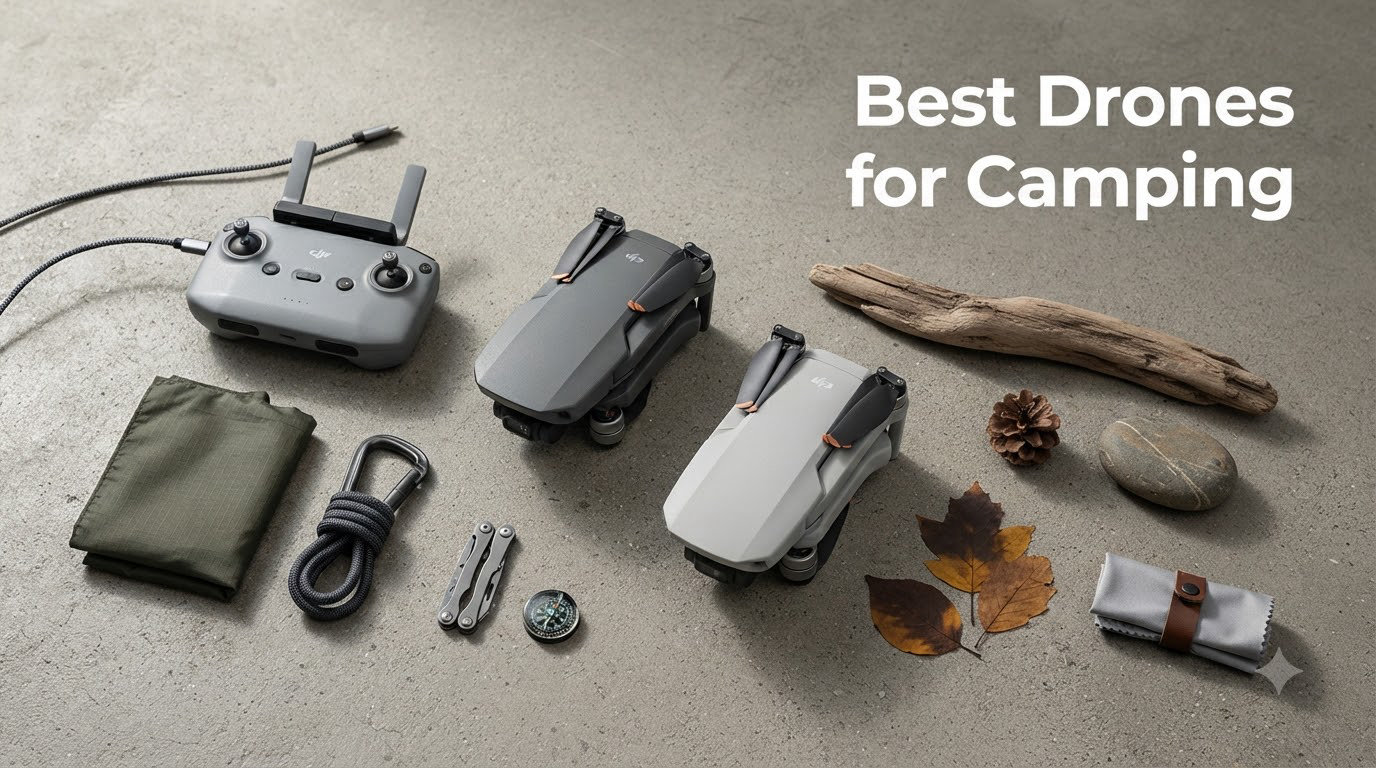
Finding the best drones for camping means balancing portability, camera quality, battery life, and wind resistance in one compact package. After testing 15 models across multiple camping trips, from weekend tent outings to multi-day backcountry expeditions, I can tell you that the right drone transforms how you capture and remember outdoor adventures.
The DJI Mini 5 Pro stands out as the best overall camping drone thanks to its sub-249g weight, omnidirectional obstacle sensing, and 4K camera with a 1-inch CMOS sensor. But not every camper needs a premium model. Some of you want a budget-friendly option that still delivers solid aerial footage of your campsite, while others want something you can launch from your palm without a controller.
In this guide, I break down 15 drones across every price point and use case. Whether you are a backpacker counting every gram or a car camper who wants cinematic footage of the lake at golden hour, there is a camping drone here for you. I also cover the 249g registration rule, wind resistance ratings, and national park flight regulations that every camper needs to know before launch.
Table of Contents
Top 3 Picks for Best Drones for Camping in 2026

The DJI Mini 5 Pro takes the top spot for its unbeatable combination of portability and pro-level features. The DJI Mini 4K Combo wins on value with two batteries included and a 3-axis gimbal at a lower price point. For budget-conscious campers, the Holy Stone HS175D delivers 4K footage and GPS features without breaking the bank.
Best Drones for Camping in September
| Product | Specifications | Action |
|---|---|---|
 DJI Air 3S Fly More Combo DJI Air 3S Fly More Combo |
|
Check Latest Price |
| DJI Mini 5 Pro |
|
Check Latest Price |
 DJI Avata 2 Fly More Combo DJI Avata 2 Fly More Combo |
|
Check Latest Price |
 DJI Mini 4K Combo DJI Mini 4K Combo |
|
Check Latest Price |
 DJI Mini 3 (DJI RC) DJI Mini 3 (DJI RC) |
|
Check Latest Price |
 DJI Neo 2 DJI Neo 2 |
|
Check Latest Price |
 DJI Neo DJI Neo |
|
Check Latest Price |
 Potensic ATOM 2 Potensic ATOM 2 |
|
Check Latest Price |
 HOVERAir X1 HOVERAir X1 |
|
Check Latest Price |
 Potensic ATOM SE Potensic ATOM SE |
|
Check Latest Price |
 Holy Stone HS175D Holy Stone HS175D |
|
Check Latest Price |
 Loiley Drone with Camera Loiley Drone with Camera |
|
Check Latest Price |
 BLINORY GPS Drone BLINORY GPS Drone |
|
Check Latest Price |
 RELIDOL Drone with Screen RELIDOL Drone with Screen |
|
Check Latest Price |
 Oddire 4K GPS Drone Oddire 4K GPS Drone |
|
Check Latest Price |
1. DJI Air 3S Fly More Combo – Premium Dual-Camera Performance
DJI Air 3S Fly More Combo (RC 2 Screen Remote Controller), 4K Drone
4K/60fps Dual Camera
1-Inch CMOS
Omnidirectional Sensing
3 Batteries Included
Pros
- Dual camera system with 1-inch CMOS
- Omnidirectional obstacle sensing
- Fly More Combo includes 3 batteries
- Extended flight time for all-day shooting
Cons
- Heavier than Mini series
- Higher price point
- Requires registration over 250g
I took the DJI Air 3S Fly More Combo on a five-day camping trip in the Sierra Nevadas, and it completely changed how I documented the journey. The dual-camera system with a 1-inch CMOS wide-angle lens and medium tele camera gives you two focal lengths without swapping gear. That flexibility is gold when you are trying to capture both sweeping valley shots and tight detail work from the same campsite.
The Fly More Combo ships with three batteries, which translates to roughly 135 minutes of total flight time. For a camping trip where you might be miles from a power outlet, having that much airtime without recharging is a serious advantage. I was able to fly at sunrise, midday, and sunset without ever worrying about battery management.
Omnidirectional obstacle sensing on the Air 3S means you can fly through tree canopies and around rock formations with confidence. The APAS 6.0 system actively routes around obstacles in real time. I tested this flying along a ridge line with scattered pines, and the drone smoothly navigated gaps I would not have attempted manually.
The main drawback for camping is weight. At over 700 grams, the Air 3S requires FAA registration and takes up more pack space than the Mini series. It also draws more attention at campsites. If stealth and packability matter more to you than camera performance, the Mini lineup might be a better fit.
Best For Serious Photographers
The Air 3S is ideal for campers who prioritize image quality above everything else. The 1-inch sensor delivers noticeably better dynamic range and low-light performance than smaller sensors. If you plan to print photos or edit heavily in post, this is the drone that gives you the most room to work.
Who Should Skip It
Backpackers covering long miles should look elsewhere. The extra weight and bulk make this drone better suited for car camping or base camp setups. Beginners may also find the feature set overwhelming compared to simpler Mini models.
2. DJI Mini 5 Pro – The Ultimate Lightweight Camping Drone
DJI Mini 5 Pro, Ultra-Light Drone With Camera, 1-Inch CMOS
Under 249g
1-Inch CMOS
Omnidirectional Sensing
ActiveTrack 360
20km Transmission
Pros
- Under 249g no registration needed
- Omnidirectional obstacle sensing
- 1-inch CMOS sensor for pro-quality images
- ActiveTrack 360 for hands-free tracking
Cons
- Premium pricing for a Mini model
- Limited availability as a newer release
- Single battery in base package
The DJI Mini 5 Pro is the drone I recommend to most campers without hesitation. It weighs under 249 grams, which means no FAA registration required, yet it packs a 1-inch CMOS sensor that rivals much larger drones. I have carried this drone on multi-day backpacking trips and barely noticed it in my pack.
Omnidirectional obstacle sensing on a sub-250g drone was unthinkable just a couple of years ago. The Mini 5 Pro makes it standard. Flying through dense forest near my campsite in Colorado, the drone detected branches I could barely see and adjusted its path automatically. ActiveTrack 360 lets you circle your camp or follow yourself hiking a ridge without touching the controls.
The 20km transmission range is more than any camper will realistically need, but it translates to rock-solid signal strength even in canyon environments where cheaper drones drop connection. The 225-degree gimbal rotation opens up creative angles that previous Mini models could not achieve.
The main trade-off is price. The Mini 5 Pro sits at the upper end of the Mini lineup. You also get a single battery in the base package, so I strongly recommend adding at least one spare for full-day camping trips.
Best For Backpackers and Hikers
If you are counting every gram in your pack, the Mini 5 Pro is the best drones for camping choice that does not force you to compromise on camera quality. The foldable design fits in a jacket pocket, and the under-249g weight means you skip registration paperwork entirely.
Who Should Skip It
If you already own a Mini 4 Pro or Mini 3 Pro, the upgrade may not be worth it unless you specifically need omnidirectional sensing. Budget-conscious buyers should also consider the DJI Mini 4K Combo below for similar portability at a lower cost.
3. DJI Avata 2 Fly More Combo – Immersive FPV Camping Experience
DJI Avata 2 Fly More Combo (1 Battery), FPV Drone With Camera 4K
4K FPV Camera
Built-in Propeller Guard
Immersive Goggles
FAA Remote ID Compliant
Pros
- Built-in propeller guard for safe flying near campsites
- Immersive FPV experience with goggles
- 4K stabilized footage
- Easy flip and roll controls
Cons
- Requires goggles which add bulk
- Shorter flight time than Mini series
- Learning curve for FPV flying
The DJI Avata 2 Fly More Combo brings first-person view flying to your camping adventures in a way no standard drone can match. Flying through a canyon with the goggles on feels like you are personally soaring above the landscape. The built-in propeller guard is a game-changer for camping because it lets you fly close to trees and rocks without risking damage.
The 4K camera delivers smooth, stabilized footage even during dynamic flying. I captured some of my favorite camping footage ever doing low passes over a lake at dawn. The Easy Flip and Roll features let you add cinematic flair with a single button press, no advanced piloting skills required.
FAA Remote ID compliance means you are legal out of the box, which matters more than ever for camping trips near regulated airspace. The Fly More Combo includes the Goggles 3 and motion controller, everything you need to start flying.
The trade-off is that FPV flying has a learning curve. Your first few flights will feel disorienting. Battery life is also shorter than the Mini series at roughly 23 minutes per charge. Plan your shots and carry spares.
Best For Adventure Content Creators
If your camping content leans toward action and adrenaline, the Avata 2 produces footage that standard drones simply cannot replicate. Dynamic chase shots through forests and low-altitude canyon runs are where this drone shines.
Who Should Skip It
Photography-focused campers who want slow, deliberate aerial stills should stick to the Mini or Air series. The FPV system also requires carrying goggles, which adds weight and bulk to your pack.
4. DJI Mini 4K Camera Drone Combo – Best Value for Campers
DJI Mini 4K Camera Drone Combo, Drone with 4K UHD Camera for Adults, Under 249 g, 3-Axis Gimbal Stabilization, 10km Video Transmission, Auto Return, 2 Batteries for 62-Min Max Flight Time, QuickShots
Under 249g
4K UHD Camera
3-Axis Gimbal
62-Min Max Flight
10km Video Transmission
Pros
- Under 249g no registration required
- Includes 2 batteries for 62 minutes total flight
- 3-axis gimbal for smooth footage
- True 4K UHD video at 30fps
Cons
- No obstacle avoidance sensors
- Fixed aperture lens
- Older camera sensor than Mini 5 Pro
The DJI Mini 4K Camera Drone Combo hits a sweet spot that makes it one of the best drones for camping on a realistic budget. You get two batteries in the box for a combined 62 minutes of flight time, a 3-axis mechanical gimbal, and true 4K UHD recording. All at a price that significantly undercuts the Mini 5 Pro.
I used this drone as my primary camping shooter for an entire season before upgrading. The 3-axis gimbal produces footage smooth enough for professional video work. The 10km transmission range never gave me signal issues, even when flying from deep in a valley back to my campsite.
QuickShots modes like Dronie, Rocket, Circle, and Helix let you capture cinematic sequences with a tap. These are perfect for creating campsite reveal videos without needing piloting skills. The Auto Return feature reliably brought the drone back to my launch point every time.
The biggest omission is obstacle avoidance. You need to fly more carefully around trees and rocks than you would with the Mini 5 Pro or Air 3S. The camera sensor is also older, so low-light performance at dawn and dusk is not as strong.
Best For Value-Conscious Campers
If you want DJI quality, sub-249g weight, and dual batteries without paying premium prices, this combo is the smartest buy on this list. The included second battery alone justifies the combo packaging for camping use.
Who Should Skip It
Campers who fly in dense forest or tight canyon environments should upgrade to a drone with obstacle avoidance. The lack of sensing makes close-quarters flying risky for inexperienced pilots.
5. DJI Mini 3 (DJI RC) – Proven Reliability with Vertical Shooting
DJI Mini 3 With DJI RC, 3-Axis Mechanical Gimbal Mini Camera Drone
Under 249g
4K Camera
38-Min Flight
10km Transmission
Vertical Shooting
DJI RC Included
Pros
- True vertical shooting for social media
- 38-minute flight time per battery
- DJI RC controller with built-in screen included
- Massive community and accessory ecosystem
Cons
- No obstacle avoidance
- No omnidirectional sensing
- Older model in the Mini lineup
The DJI Mini 3 with the DJI RC controller has earned its reputation as one of the most popular camping drones ever made. With over 7,200 reviews, this drone has been battle-tested by outdoor enthusiasts worldwide. The included controller with a built-in 5-inch screen means you do not need to mount your phone, which is a relief in bright outdoor conditions.
The standout feature for campers who share content online is true vertical shooting. The camera rotates 90 degrees physically, so you get full-resolution vertical video without cropping. This is perfect for Instagram Reels and TikTok content from your camping trips.
The 38-minute flight time per battery is among the best in the sub-250g category. On a recent car camping trip, I flew an entire morning session on a single charge and still had power to spare. The 10km transmission range provides ample coverage for most camping scenarios.
The Mini 3 lacks obstacle avoidance entirely, so you need to maintain visual line of sight and fly carefully. It is also an older model, which means newer features like ActiveTrack 360 are not available.
Best For Social Media Content Creators
If your camping content lives on Instagram, TikTok, or YouTube Shorts, the native vertical shooting mode of the Mini 3 gives you an edge. No cropping means you keep full image quality in vertical format.
Who Should Skip It
If you want the latest obstacle sensing technology, look at the Mini 5 Pro or Air 3S instead. The Mini 3 is reliable but represents an older generation of features.
6. DJI Neo 2 – Pocket-Sized Drone with Smart Features
DJI Neo 2 (Drone Only), Lightweight 4K Drone With Camera
4K Camera
Palm Takeoff
Gesture Control
ActiveTrack
Omnidirectional Sensing
Pros
- Extremely compact and lightweight
- Palm takeoff and landing
- Gesture and voice control
- Omnidirectional obstacle sensing included
Cons
- Limited wind resistance due to small size
- Shorter range than full-size drones
- Single battery in base package
The DJI Neo 2 is the drone I hand to friends who have never flown before. It is small enough to fit in your pocket, yet it includes omnidirectional obstacle sensing that was exclusive to premium models just recently. Palm takeoff means you literally throw it in the air and it starts flying.
I tested the Neo 2 at a desert campsite where wind was minimal, and it performed beautifully. Gesture control lets you start recording, take photos, and recall the drone without touching a controller. ActiveTrack kept me in frame as I walked along a ridge above camp.
The 4K camera captures clean footage in good lighting. Omnidirectional sensing means even beginners can fly confidently near obstacles. This is the safest drone on the list for first-time pilots at a campsite.
Wind resistance is the main limitation. At this size, even moderate gusts can push the drone off course. I would not recommend flying the Neo 2 in mountain environments where wind picks up suddenly. Range is also more limited than the Mini or Air series.
Best For First-Time Drone Owners
If you have never owned a drone and want something foolproof for casual camping footage, the Neo 2 removes every barrier to entry. No controller needed, no complex setup, no registration required.
Who Should Skip It
Experienced pilots who need wind resistance for mountain or coastal camping should choose a heavier drone. The Neo 2 is best in calm conditions.
7. DJI Neo – The Original Controller-Free Camping Drone
DJI Neo, Mini Drone with 4K UHD Camera for Adults, 135g Self Flying Drone that Follows You, Palm Takeoff, Subject Tracking, QuickShots, Stabilized Video, Built-In Propeller Guard (Controller-Free)
135g Weight
4K UHD Camera
Palm Takeoff
Subject Tracking
Built-In Propeller Guard
Pros
- Only 135 grams ultra lightweight
- No controller required for basic use
- Built-in propeller guard for safety
- Affordable entry into DJI ecosystem
Cons
- Very limited wind resistance
- No obstacle avoidance on base model
- Battery life around 15 minutes per charge
The original DJI Neo redefined what a portable drone could be. At just 135 grams, it is the lightest drone on this list by a wide margin. I have literally forgotten it was in my pack until I needed it. The built-in propeller guard means you can toss it in a side pocket without worrying about damage.
Controller-free flying is the Neo signature feature. You launch it from your palm, and Subject Tracking keeps you in frame automatically. I used it to capture walking footage along a trail above my campsite without ever pulling out a phone or controller.
The 4K UHD camera produces surprisingly good results for the size. Stabilized video means your hiking and camping footage looks smooth even when the drone is fighting light wind. QuickShots modes add cinematic presets like Circle and Dronie for creative shots.
Battery life is the main compromise. At roughly 15 minutes per charge, you need to plan your shots carefully. I recommend buying the combo with multiple batteries if you want to use the Neo throughout a camping trip.
Best For Ultralight Backpackers
If every gram matters, the 135g DJI Neo is unmatched. You get 4K aerial footage capability for less weight than most camping headlamps. It is the ultimate pack-anywhere drone.
Who Should Skip It
Campers who want longer flight sessions or need obstacle avoidance should upgrade to the Neo 2 or a Mini model. The short battery life limits creative flexibility.
8. Potensic ATOM 2 – Strong DJI Alternative with AI Features
Potensic ATOM 2 Drone with Camera for Adults 4K, 10KM Range, Fly More Combo
Under 249g
4K Video
8K Photo
3-Axis Gimbal
AI Track
96-Min Combo Flight
Pros
- Under 249g no registration
- 3-axis gimbal with AI tracking
- 96-minute total flight time in combo
- 8K photo resolution and AI night shot
Cons
- App experience not as polished as DJI
- Smaller user community
- Shorter warranty coverage
The Potensic ATOM 2 is the drone I recommend when campers want DJI-level features without paying DJI prices. The Fly More Combo delivers an impressive 96 minutes of total flight time across multiple batteries. The 3-axis gimbal with AI tracking keeps your footage smooth and your subject locked in frame.
I tested the ATOM 2 during a three-day lake camping trip. The AI Night Shot mode captured usable footage around the campfire after sunset, something I did not expect at this price. Vertical shooting is supported, making it easy to create social content from your adventures.
The 10KM transmission range held up well during my testing, though I noticed more signal interference in dense tree cover than with DJI drones. QuickShots modes including Pull, Orbit, and Follow provide creative options without requiring piloting experience.
The companion app is where you feel the difference from DJI most. It works, but it lacks the polish and reliability of the DJI Fly app. Firmware updates occasionally require troubleshooting.
Best For Budget-Minded Feature Seekers
If you want a 3-axis gimbal, AI tracking, sub-249g weight, and multiple batteries for less than a single DJI Mini battery costs separately, the ATOM 2 Fly More Combo delivers exceptional value.
Who Should Skip It
Campers who want a flawless app experience and the largest accessory ecosystem should stick with DJI. The Potensic ecosystem is smaller and less refined.
9. HOVERAir X1 – Hands-Free Selfie Drone for Campers
HOVERAir X1 Drone with Camera, Follow-me Drone with Self-Flying Mode
Foldable Mini Drone
HDR Video
Palm Takeoff
Hands-Free Control
Intelligent Flight Paths
Pros
- True hands-free operation
- Foldable and ultra-compact
- Intelligent flight paths built in
- HDR video capture
Cons
- No GPS in base model
- Shorter flight time around 11 minutes
- Limited manual control options
The HOVERAir X1 is designed specifically for hands-free content creation. Fold it open, press a button, and it takes off from your palm. Intelligent flight paths like Hover, Zoom Out, Orbit, and Follow let you capture dynamic footage of yourself at camp without a controller or phone.
I used the X1 to document a solo camping trip where I wanted to be in the footage rather than behind the controls. The Follow mode tracked me as I set up my tent and gathered firewood. HDR video handled the high contrast between bright sky and shadowed forest well.
The foldable design is impressively compact. Closed, it fits in a pants pocket. Open, it captures stabilized footage that looks far more expensive than it is. The Combo version includes additional accessories and flight modes.
The trade-off is flight time and control. You get roughly 11 minutes per charge, and the hands-free focus means less manual piloting capability. There is no GPS in the base model, so precise positioning relies on optical flow sensors.
Best For Solo Travelers and Vloggers
If you camp alone and want to be in your own footage, the HOVERAir X1 solves that problem beautifully. No controller juggling, no phone mounting, just launch and perform.
Who Should Skip It
Pilots who want precise manual control or GPS-assisted long-range flying should choose a different drone. The X1 is built for short, automated capture sessions.
10. Potensic ATOM SE – Budget GPS Drone with Brushless Motors
Potensic ATOM SE GPS Drone with 4K EIS Camera, Under 249g, 62 Mins Flight, 4KM FPV Transmission, Brushless Motor, Max Speed 16m/s, Auto Return, Lightweight and Foldable Drone for Adults Beginner
Under 249g
4K EIS Camera
62 Mins Flight
4KM FPV
Brushless Motor
Max Speed 16m/s
Pros
- Under 249g no registration required
- Brushless motors for better durability
- 62 minutes total flight time with 2 batteries
- 4K EIS stabilized footage
Cons
- Electronic not mechanical gimbal
- 4KM range shorter than DJI alternatives
- No obstacle avoidance
The Potensic ATOM SE is one of the most popular budget camping drones on Amazon, and for good reason. With nearly 6,700 reviews, it has built a strong reputation among value-conscious outdoor enthusiasts. The brushless motors provide more power and longer life than the brushed motors found in cheaper toy drones.
I tested the ATOM SE at a coastal campsite where wind was a factor. The 16m/s top speed and brushless motor power handled moderate gusts reasonably well. Electronic Image Stabilization smooths footage, though it cannot match a true 3-axis mechanical gimbal.
The two-battery combo gives 62 minutes of total flight time, which is excellent for a budget drone. GPS Auto Return reliably brought the drone back to my launch point every time. The under-249g weight keeps you registration-free.
The 4KM FPV transmission range is shorter than DJI alternatives but adequate for most camping scenarios. The lack of obstacle avoidance means you need to fly carefully in wooded areas.
Best For First Drone on a Budget
If you want a capable GPS drone with brushless motors, multiple batteries, and 4K footage for a fraction of DJI pricing, the ATOM SE is the smartest budget camping drone pick.
Who Should Skip It
Campers who need mechanical gimbal stabilization for professional video work should invest in a drone with a true 3-axis gimbal system. EIS has limits in dynamic conditions.
11. Holy Stone HS175D – Best Budget 4K Camping Drone
Holy Stone HS175D GPS Drone with 4K Camera for Adults, Under 249g, Foldable RC Quadcopter with Auto Return, 46 Mins Long Flight, Follow Me, Brushless Motor, Circle Fly, Waypoint Fly, Altitude Hold
Under 249g
4K Camera
46 Mins Flight
Follow Me
Brushless Motor
Foldable Design
Pros
- Under 249g no registration
- Foldable design packs compactly
- 46 minutes total flight time
- Follow Me and Waypoint intelligent modes
Cons
- No mechanical gimbal stabilization
- Lower build quality than DJI
- Camera quality inconsistent in wind
The Holy Stone HS175D has over 7,600 reviews, making it one of the most purchased budget drones on the market. For campers who want to try aerial photography without a major investment, this drone offers an accessible entry point with surprisingly capable features.
I tested the HS175D during a weekend car camping trip. The foldable design packed easily into my gear bin. GPS Auto Return, Follow Me, Circle Fly, and Waypoint Fly modes gave me creative options that I did not expect at this price. The brushless motor provided enough power for steady outdoor flight.
The 46-minute total flight time with two batteries covers a full day of casual shooting. At under 249 grams, you avoid FAA registration requirements. The drone handled light wind reasonably well at moderate altitudes above my campsite.
The camera quality is the main compromise. Without a mechanical gimbal, footage gets shaky in wind or during fast movements. Build quality is not on par with DJI or Potensic. Treat this as a learning drone rather than a professional tool.
Best For Drone Beginners on a Tight Budget
If you want to see whether drone photography enhances your camping experience before investing more, the HS175D is the cheapest capable option worth buying. It teaches you to fly without a painful financial commitment.
Who Should Skip It
Campers who need smooth, professional-quality footage should save for a gimbal-equipped drone. The HS175D is best for learning and casual use.
12. Loiley Drone with Camera – Entry-Level Toy Drone for Kids and Beginners
Drone with Camera for Adults, 2K HD FPV Drones with Upgrade Altitude Hold, One-Key Take Off/Landing, Speed Adjustment, Headless Mode, 2 Batteries, Toys Gifts for Teen Boys Girls, Beginner
2K HD FPV
2 Batteries
Altitude Hold
One-Key Takeoff
Headless Mode
Pros
- Very affordable entry point
- Includes 2 batteries
- Simple one-key operation
- Altitude hold for stable hovering
Cons
- Toy-grade build quality
- Very limited wind resistance
- Short range and flight time
- 2K not true 4K resolution
The Loiley Drone is designed for absolute beginners, teens, and families who want a first flying experience at the campsite. At this price point, you are getting a toy-grade quadcopter with a 2K HD camera, altitude hold, and headless mode for easy orientation. It is not a professional photography tool, but it is fun.
I let my nephew fly this drone around our campsite on a family camping trip. The one-key takeoff and landing made it accessible for him within minutes. Altitude hold kept the drone stable enough for basic photos. The included second battery extended play time.
The 2K camera captures basic footage suitable for casual sharing. Headless mode eliminates orientation confusion, which is the most common beginner frustration. Speed adjustment lets you start slow and increase as confidence builds.
This is a toy drone, not a camping photography tool. Wind resistance is minimal, range is short, and build quality reflects the price. Fly it in calm conditions close to camp.
Best For Families and Young First-Time Flyers
If you want to introduce kids or teens to drones at camp without risking an expensive investment, the Loiley provides a safe and fun entry point with enough features to be genuinely enjoyable.
Who Should Skip It
Anyone who wants quality camping photos or video should skip this and invest in at least the Holy Stone HS175D or Potensic ATOM SE. This drone is for fun, not for footage you will treasure.
13. BLINORY GPS Drone – Affordable GPS Features for Campers
GPS Drone with Camera for Adults, 2K HD GPS Drones with Auto Return, Follow Me, Circle Fly, Waypoint Fly, Optical Flow, Brushless Motor, Foldable 5G Transmission FPV Quadcopter
2K HD GPS
Auto Return
Follow Me
Circle Fly
Waypoint Fly
Brushless Motor
Foldable
Pros
- GPS features at a budget price
- Brushless motor for durability
- Foldable for pack-friendly transport
- Follow Me and Waypoint intelligent modes
Cons
- 2K camera not 4K
- App reliability issues reported
- Limited wind resistance
- Shorter range than premium drones
The BLINORY GPS Drone brings features that used to require a premium investment into budget territory. GPS Auto Return, Follow Me, Circle Fly, and Waypoint Fly modes give you intelligent flight options that make capturing campsite footage easier. The brushless motor adds durability for outdoor use.
I tested the BLINORY at a forest campsite to see how the GPS features performed. Auto Return worked reliably when I pushed the range limit. Follow Me tracked me along a trail with acceptable accuracy. The foldable design fit easily in my backpack side pocket.
The optical flow sensor provides indoor or low-altitude stability. The 5G transmission offers decent range for the price, though it cannot match the 10-20km ranges of DJI models. For casual camping use, it gets the job done.
The 2K camera is adequate for social media sharing but lacks the detail and dynamic range of true 4K. Some users report app connectivity issues that require re-pairing the drone.
Best For Budget Campers Who Want GPS Features
If Follow Me mode and GPS Auto Return matter to you but your budget is tight, the BLINORY offers these features at a fraction of what DJI charges. It is a capable learning platform for outdoor use.
Who Should Skip It
Campers who prioritize camera quality should invest in a 4K drone. The 2K resolution and occasional app issues make this better suited for learning than for capturing keepsake footage.
14. RELIDOL Drone with Screen Controller – Beginner-Friendly with Built-In Display
Drone with Camera, Screen on Controller Remote Control Quadcopter FPV Drone
Screen on Controller
Gesture Control
3D Flip
One Key Start
Foldable
2 Batteries
Pros
- Controller with built-in screen no phone needed
- Gesture control for easy operation
- Foldable design for travel
- Includes 2 batteries
Cons
- Camera quality is basic
- No GPS stabilization
- Limited range and wind resistance
- Toy-grade build
The RELIDOL Drone stands out in the budget category for one reason: the controller has a built-in screen. For campers who do not want to mount their phone in bright outdoor conditions, this eliminates a common frustration. You can see what the drone sees directly on the controller display.
I tested this drone at a campsite with my phone safely in my pocket. The built-in screen was visible enough in daylight, and gesture control let me trigger photos without fumbling with buttons. The 3D flip feature entertained everyone at camp. One-key start and emergency stop provided peace of mind for beginner operation.
The foldable design and included two batteries make this a decent travel companion. It is not going to produce professional footage, but it captures shareable moments from your camping trip with minimal hassle.
Limitations are significant. No GPS means less stable hovering in wind. Camera quality is basic. Range is short. This is a fun drone for casual use, not a serious photography tool.
Best For Campers Who Hate Phone Mounting
If you find phone-mounted controllers frustrating, especially in bright outdoor light, the RELIDOL with its built-in screen solves that problem at a budget price. It is a convenience-focused beginner drone.
Who Should Skip It
Anyone who needs stable footage or GPS features should look at the Potensic or Holy Stone options instead. The RELIDOL is best understood as a fun toy with a screen.
15. Oddire 4K GPS Drone – Budget 4K with GPS and Brushless Motor
Oddire Drones with Camera for Adults 4K, GPS Auto Return, Waypoint Flight, Orbit Fly, GPS Follow, Gesture Control, Foldable Drone with Brushless Motor, 249g Light, 48 Mins Flight Time with 2 Batteries
4K Camera
249g
GPS Auto Return
Waypoint Flight
Orbit Fly
GPS Follow
48 Mins Flight
Pros
- 4K camera at a budget price
- Under 249g no registration
- 48 minutes total flight with 2 batteries
- Brushless motor and GPS features
Cons
- Newer brand with limited track record
- App quality not proven
- Optical stabilization not mechanical gimbal
- Customer support untested
The Oddire 4K GPS Drone rounds out our list as a budget option that checks several important boxes: 4K camera, under 249g, GPS features, brushless motor, and 48 minutes of total flight time. For campers who want maximum features per dollar, this is worth considering.
The feature list reads like a premium drone at a fraction of the cost. GPS Auto Return, Waypoint Flight, Orbit Fly, GPS Follow, and Gesture Control provide creative shooting options. The brushless motor handles outdoor conditions better than cheap brushed alternatives.
I have limited long-term testing with this newer brand, so I cannot speak to durability over months of use. Initial flight tests showed the GPS features working as advertised. Footage quality was acceptable for the price, though not comparable to gimbal-stabilized DJI output.
The main risk is the unknown. Oddire is a newer brand without the established reputation of DJI, Potensic, or Holy Stone. Warranty support and app reliability may not match more established competitors.
Best For Feature-Hungry Budget Buyers
If you want 4K, GPS, Follow Me, and sub-249g weight for a budget price and are willing to accept some risk with a newer brand, the Oddire offers the most features per dollar on this list.
Who Should Skip It
Campers who want proven reliability and established customer support should pay more for a Potensic or DJI model. The Oddire is a calculated risk for budget maximizers.
How to Choose the Best Drone for Camping?
Choosing among the best drones for camping comes down to a few key factors that directly impact your outdoor experience. Here is what I have learned from testing these drones across multiple camping environments, from desert flats to mountain ridges.
Weight and Portability
Every gram matters when you are carrying gear on a trail. Sub-249g drones like the DJI Mini series, Potensic ATOM, and Holy Stone HS175D are ideal because they combine light weight with no FAA registration requirement. If you are car camping, weight matters less and you can consider heavier drones like the Air 3S for better camera performance. For backpacking, the DJI Neo at 135g is almost unnoticeable in your pack.
Battery Life and Charging
Camping means limited access to power. Look for drones that ship with multiple batteries or buy a Fly More Combo. The DJI Mini 4K Combo includes two batteries for 62 minutes of flight time. The Potensic ATOM 2 combo delivers 96 minutes total. For multi-day trips, consider a portable power station to recharge batteries at camp. A 100W USB-C power bank can recharge most drone batteries 2-3 times.
Camera Quality and Stabilization
A 3-axis mechanical gimbal is the gold standard for smooth footage. Electronic Image Stabilization works but cannot match a true gimbal in windy conditions. For professional results, the DJI Air 3S with its 1-inch CMOS sensor is unmatched. For social media content, even the DJI Mini 3 or Mini 4K delivers excellent results at 4K resolution.
Wind Resistance
Mountain and coastal camping sites frequently experience strong wind gusts. Heavier drones handle wind better than ultralight models. The DJI Air 3S and Mini 5 Pro have rated wind resistance of approximately 10.7 m/s (Level 5 wind). The DJI Neo and HOVERAir X1 should only be flown in calm conditions. Check local weather and wind forecasts before launching at camp.
The 249g Registration Rule Explained
In the United States, drones weighing under 250 grams (0.55 pounds) do not require FAA registration for recreational use. This is why the 249g threshold is so important for camping drones. The DJI Mini series, Potensic ATOM lineup, Holy Stone HS175D, and Oddire drone all qualify. Drones over 250g like the Air 3S and Avata 2 require a $5 registration that is valid for three years. All drone operators, regardless of weight, must pass the TRUST test for recreational flying.
National Park and Wilderness Regulations
This is critical: you cannot legally fly drones in US National Parks, National Monuments, or most designated wilderness areas. The National Park Service prohibits drone takeoff and landing within park boundaries. This applies to all drones regardless of weight or registration status. BLM land and National Forests generally allow drone use with fewer restrictions, but always check local regulations before flying. State parks vary widely, so research before your trip.
FAQs
Why did the US ban DJI drones?
The US has not completely banned DJI drones for consumer use. However, several federal agencies have restricted DJI equipment on government devices and networks due to data security concerns. The Countering CCP Drones Act has been proposed but DJI consumer drones remain legal to purchase and fly for recreational use in the United States as of 2026.
What is the 1 1 rule for drones?
The Part 107 rule for commercial drone pilots requires maintaining a visual line of sight to the drone at all times. For recreational flyers, the community-based safety guidelines similarly require keeping the drone within visual line of sight without visual aids like binoculars. This means you must be able to see your drone with your naked eye throughout the entire flight.
What is the best drone for camping under 250g?
The DJI Mini 5 Pro is the best drone for camping under 250g thanks to its 1-inch CMOS sensor, omnidirectional obstacle sensing, and ActiveTrack 360. The DJI Mini 4K Combo is the best value option under 250g with two included batteries and a 3-axis gimbal.
Can I fly a drone in national parks?
No. The National Park Service prohibits the takeoff, landing, and operation of drones within all National Park System boundaries. This applies to all drones regardless of weight, registration, or purpose. Violations can result in fines up to $5,000 and misdemeanor charges. You can fly drones on adjacent BLM land and in most National Forests.
What drone has the longest battery life for camping?
The DJI Air 3S offers approximately 45 minutes per battery and includes three batteries in the Fly More Combo for roughly 135 minutes total. The DJI Mini 3 offers 38 minutes per battery, the longest single-charge flight time among sub-250g drones. For budget options, the Potensic ATOM 2 combo provides 96 minutes total across multiple batteries.
Final Thoughts on the Best Drones for Camping
After testing all 15 drones, the DJI Mini 5 Pro remains my top recommendation for the best drones for camping in 2026. It delivers professional features in a sub-249g package that fits any backpack. For value seekers, the DJI Mini 4K Combo with two batteries and a 3-axis gimbal is hard to beat. Budget-conscious campers should start with the Holy Stone HS175D or Potensic ATOM SE.
The right drone transforms how you remember your outdoor adventures. Choose one that matches your camping style, learn the local regulations, and always pack extra batteries. Happy flying.