
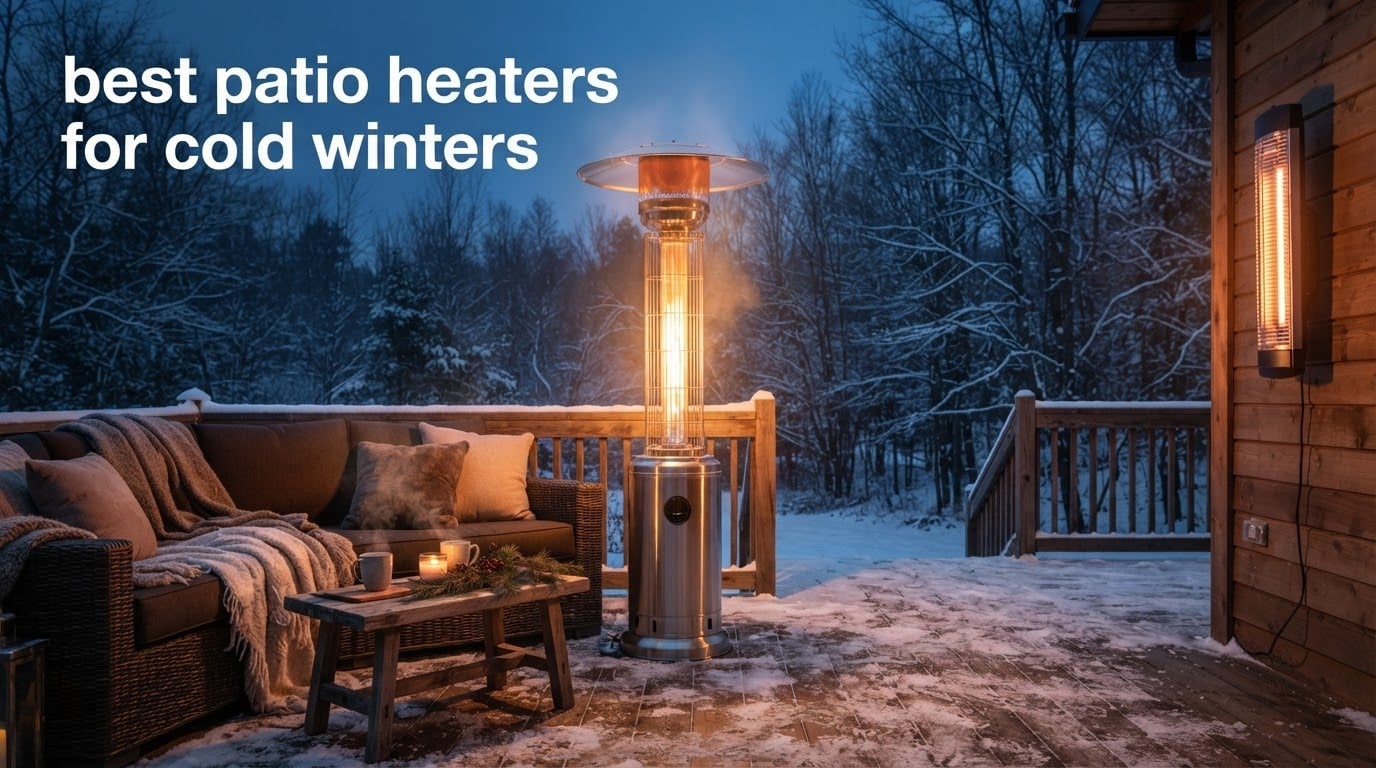
Most patio heaters are built for a shoulder-season evening, not a genuine cold winter. The ones that survive January wind are the ones with serious BTU numbers, a weighted or sand-filled base, and a heat path that reaches people at seated height instead of warming empty air. After reading through the spec sheets, certifications and thousands of owner reviews on the heaters below, the best patio heaters for cold winters come down to two families: high-output propane towers for uncovered decks, and mounted infrared units for covered or semi-enclosed spaces.
The distinction matters more than most shopping guides admit. A radiant propane heater throws heat in a dome roughly 8 to 10 feet wide and loses much of that heat to wind within minutes, which is fine for a covered patio and disappointing on an open deck at 28F. An electric infrared unit warms bodies and surfaces in a narrow cone almost instantly with no flame, no fumes and no fuel logistics, but it needs a nearby circuit and it will never heat a whole patio.
If you have already narrowed the field, our broader guides on the general best patio heaters and the best propane patio heaters cover the year-round categories in more depth. This one is built specifically around cold-weather performance: output, wind tolerance, base weight, clearance rules for vinyl decking, and the extension cord realities that catch electric buyers out. I have also linked the deck furniture and audio picks that make a cold patio actually usable, including patio bistro sets and patio speakers, so you are not sitting in the dark in November.
One honest note before we start. None of these heaters makes an uncovered patio comfortable in genuinely freezing wind for a whole evening. They extend your season by a few weeks and take the edge off a cold night. Where a heater truly shines in a cold winter is under a roof, beside a wall, or in a sheltered corner where radiant heat has somewhere to go.
Table of Contents
Top 3 Picks: Patio Heaters for Cold Winters in 2026

Amazon Basics 46,000 BTU Propane Patio Heater
- 46000 BTU propane output
- 324 sq ft coverage
- Water box base plus tank chain

Hykolity 50,000 BTU Table Top Patio Heater
- 50000 BTU stainless burner
- Piezo ignition no battery
- Wheels and rainproof build

DR Infrared DR-239 3000W Mounted Heater
- 3000W infrared
- IP55 weatherproof
- Wall and ceiling mount kit
Best Patio Heaters Compared Side by Side (October 2026)
Everything below is in the list, with the specification that actually decides cold-weather performance rather than the marketing number. Heat output is listed in BTU for propane units and watts for electric ones, because those are not directly comparable and pretending otherwise is how people end up disappointed.
| Product | Specifications | Action |
|---|---|---|
| Amazon Basics 46,000 BTU Propane Patio Heater |
|
Check Latest Price |
| DR Infrared DR-239 3000W Mounted Heater |
|
Check Latest Price |
 Briza 1500W Infrared Patio Heater Briza 1500W Infrared Patio Heater |
|
Check Latest Price |
 Pamapic 89 Inch Pyramid Quartz Tube Heater Pamapic 89 Inch Pyramid Quartz Tube Heater |
|
Check Latest Price |
 Haimmy 42 Inch 1500W Infrared Tower Haimmy 42 Inch 1500W Infrared Tower |
|
Check Latest Price |
 Thermo Tiki 45,000 BTU Commercial Propane Tower Thermo Tiki 45,000 BTU Commercial Propane Tower |
|
Check Latest Price |
| Hykolity 50,000 BTU Table Top Patio Heater |
|
Check Latest Price |
 Pamapic 50,000 BTU Round Table Patio Heater Pamapic 50,000 BTU Round Table Patio Heater |
|
Check Latest Price |
 Encyclpo 36 Inch 1500W Infrared Tower Encyclpo 36 Inch 1500W Infrared Tower |
|
Check Latest Price |
 Paraheeter 1500W Carbon Infrared Patio Heater Paraheeter 1500W Carbon Infrared Patio Heater |
|
Check Latest Price |
 SereneLife 1500W IP65 Wall Mounted Heater SereneLife 1500W IP65 Wall Mounted Heater |
|
Check Latest Price |
 Cuisinart Perfect Position 38,200 BTU Heater Cuisinart Perfect Position 38,200 BTU Heater |
|
Check Latest Price |
1. Amazon Basics 46,000 BTU Portable Propane Patio Heater
Amazon Basics 46,000 BTU Portable Outdoor Propane Patio Heater with Wheels, Commercial & Residential, Easy to Use, with Water Tank, Havana Bronze, 32.1 x 32.1 x 91.3 inches
46000 BTU propane output
324 sq ft coverage
18.14 kg with wheels
32.12 x 32.12 x 91.3 inches
Pros
- One-touch ignition that fires on the first try
- Wheels make repositioning simple
- Water box base holds weight against wind
- Over 11000 owner reviews to draw on
- Powder coated Havana Bronze finish
Cons
- Assembly instructions confuse some owners
- Reflector size caps the heat radius
- Fixed pole height rather than adjustable
This is the heater I keep coming back to for cold winters, and the reason is unglamorous: it does the fundamentals without a single weak link. At 46000 BTU it throws a warm dome about 18 feet across, which is enough to keep a four-person table comfortable when the temperature drops into the low 30s. The dome falls off fast in wind, but that is physics rather than a defect in this unit.
Ignition is where cheaper towers usually disappoint, and this one does not. Owners report one-touch ignition that catches on the first try after the initial attempt, and long-term owners say it still fires up reliably after several seasons of use. The adjustable temperature knob on top is a simple two-speed control that does not need explaining.
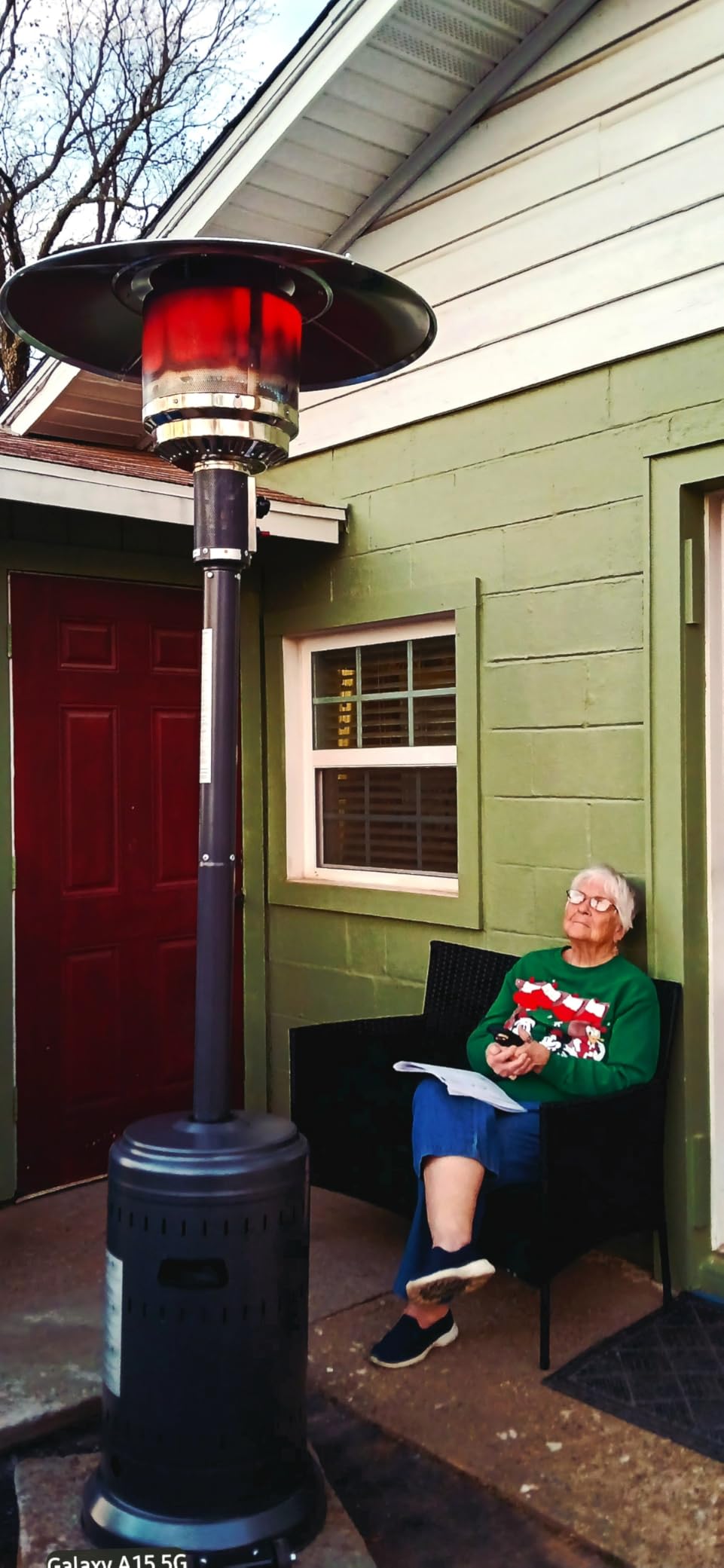
Two design details make this the more practical cold-weather pick. The base is a water box, meaning you fill it with water or sand to add ballast, and a chain holds the propane tank against the frame so a gust cannot rock the assembly. On a windy deck those two features matter more than another few thousand BTU.
The rolling wheels are the other one. Once the tank is full this thing weighs close to 40 pounds, and pushing it to the sheltered corner of the deck rather than leaving it exposed is the single most effective thing you can do for real cold-weather performance.
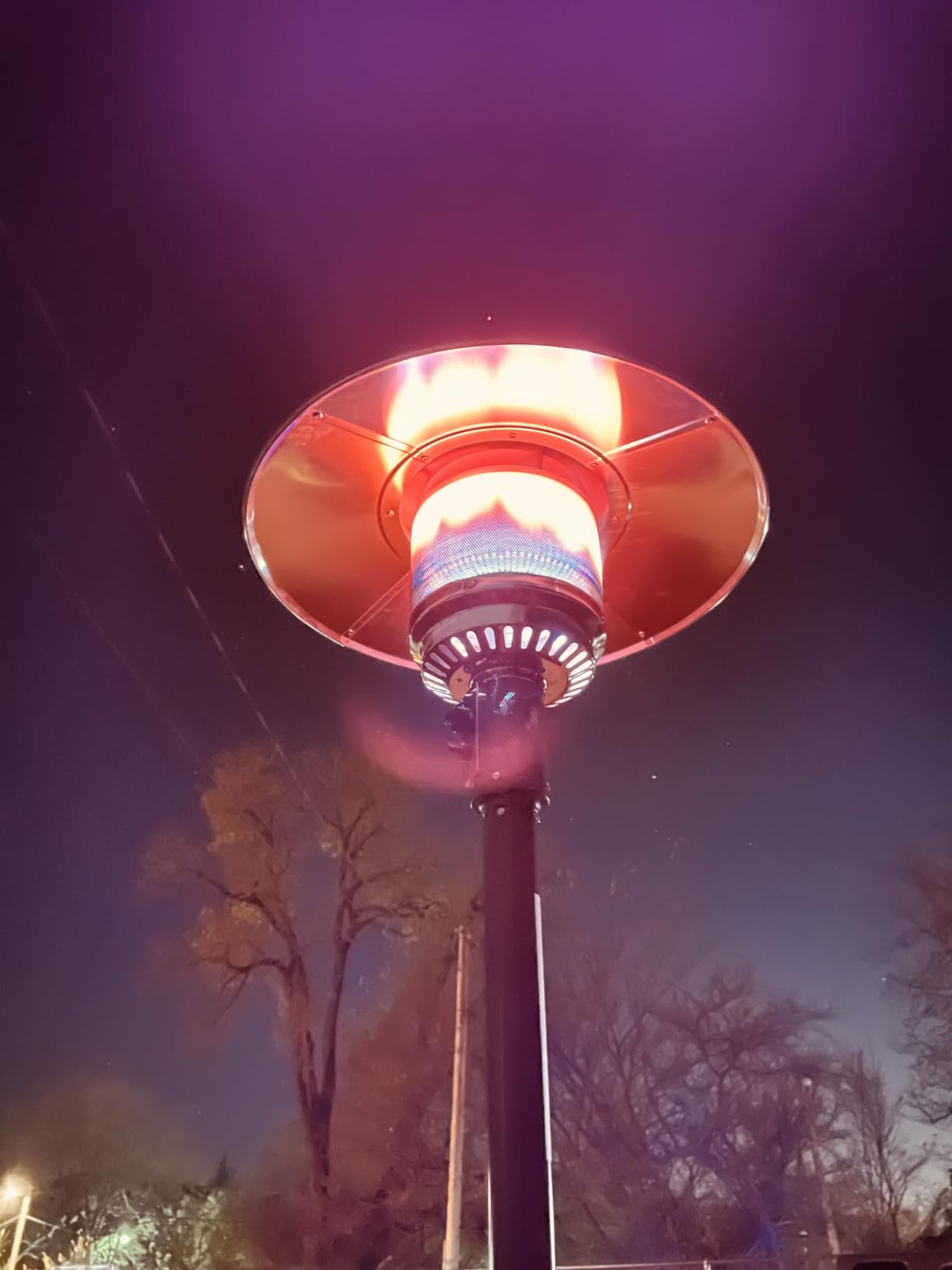
What you get with 46000 BTU of propane
The honest limit is the reflector. Owners describe it as smaller than ideal, which means the heat throws outward and slightly up rather than spreading evenly across the seating area. Sitting roughly six to eight feet away is the sweet spot; at the edge of that you will feel it on your face more than your hands.
The fixed-length pole is worth noting if you plan to stand it under a low roof. There is no height adjustment, so measure your clearance before you fill the tank. Assembly is the other weak point, with a meaningful share of owners reporting confusing or incomplete instructions that add real time to setup.
Where it struggles in freezing weather
Uncovered, in strong wind, at genuinely low temperatures, this heater loses the open-air battle. It heats the air directly around the dome and then the wind moves that air away, so a patio exposed on two sides will feel the difference within ten minutes.
It also needs a 20 lb propane tank that is not included, and it will not run indoors. Given that the fuel logistics get harder in deep winter when nobody wants to walk to the store, plan your tank swaps around milder days or keep a spare on hand.
2. DR. INFRARED HEATER DR-239 3000W Wall and Ceiling Mount
DR. INFRARED HEATER DR-239 3000W Indoor & Outdoor Infrared Patio Heater, Wall or Ceiling Mount, IP55 Weatherproof, Commercial or Residential, 220V-240V Electric Heater with Remote & Mounting Kit
3000W or 10260 BTU
240 volt 12.5A draw
IP55 weatherproof
41.2 x 3.4 x 5.9 inches
Pros
- Silent odorless infrared heat with no flame
- IP55 rated for covered and exposed spots
- Mounting hardware included and install is quick
- Remote with three power levels
- Four plus years of owner reported service
Cons
- Highly directional so you must sit close
- Needs a dedicated 240V circuit not a normal outlet
- Resets to standby after a power loss
This is the mounted answer for a covered patio, a garage, or a kennel run, and it is the single most underused cold-weather option in this roundup. At 3000W it delivers silent infrared heat with zero combustion, zero fumes and no moving parts to ice up. It warms instantly, which matters when you step outside at dusk and want heat now.
Owners in semi-enclosed spaces report strong satisfaction with the mounting, the remote and the durability over multiple seasons. The IP55 rating means you do not have to baby it when drizzle hits, and it carries a one-year limited component warranty.
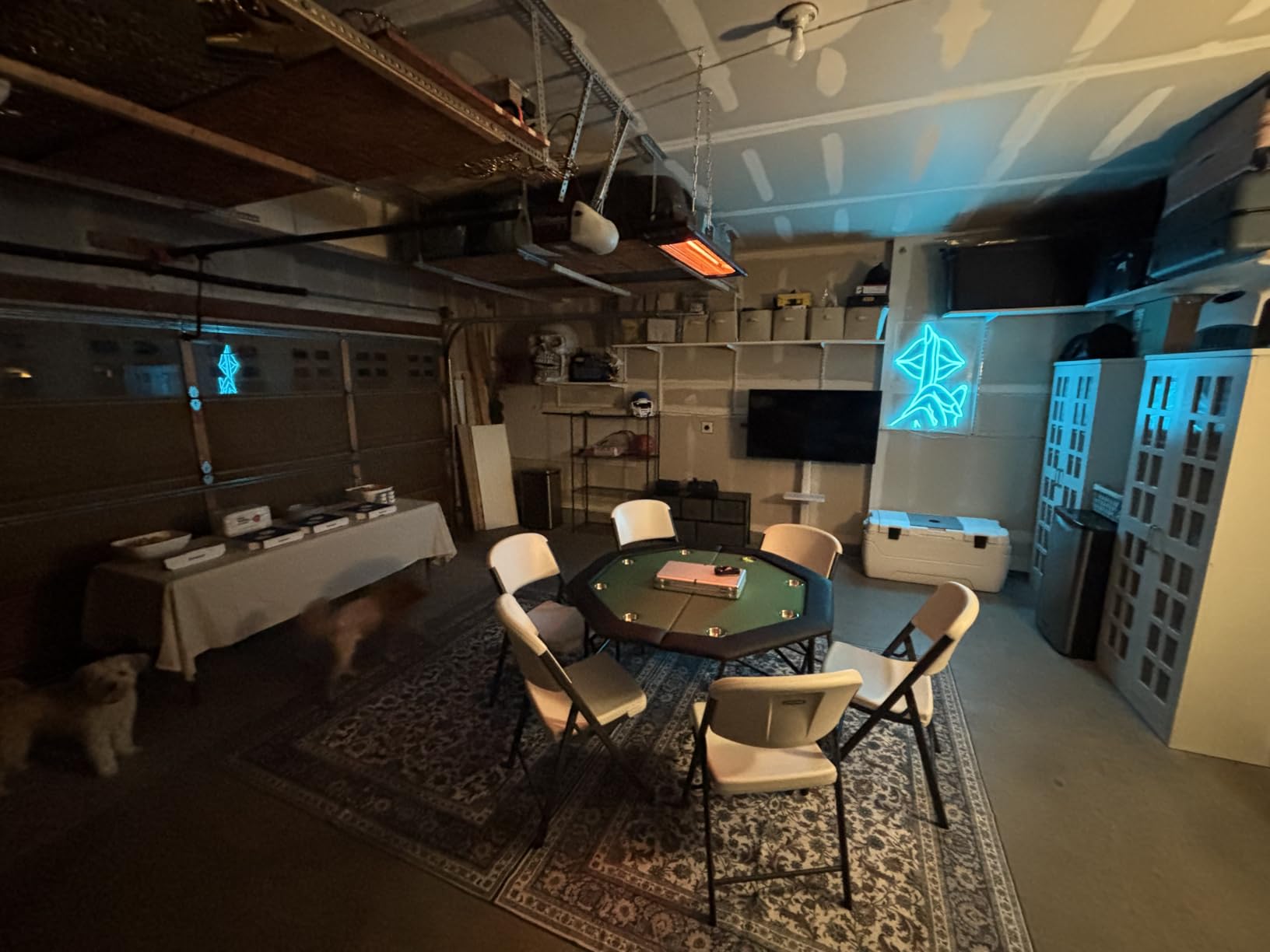
The key thing to understand before you buy is that this warms people and objects in a narrow cone, not the air in a room. Reviews are clear on this: it works beautifully for a seated group in a sheltered spot and disappoints anyone expecting a garage to gain ten degrees. Position it to fire across the seating area, not down at the floor.
Because it draws 12.5A at 240 volts, plan the electrical work before the first cold night. It ships with a UL NEMA 6-15P plug and all mounting brackets, but a dedicated circuit is a job for an electrician if you do not already have one at that spot.
Why mounted electric beats a tower on a covered patio
Elevation is the whole trick. Mounted at roughly head height or above, the infrared cone lands on shoulders and the tabletop instead of the deck surface, so almost none of the output is wasted warming boards that are already cold. A freestanding tower at 36 inches loses a large share of its heat downward.
Wall and ceiling brackets are both included, and the remote gives you three power levels plus a programmable timer up to 24 hours with overheat protection. It is also the only unit here that owners describe as fully silent, which matters if you are hosting.
Where the setup gets awkward
Two frictions show up repeatedly in owner feedback. The unit does not retain its last setting after a power interruption, so after a storm-related outage you restart it with the infrared remote rather than a wall switch. And no drilling template is supplied for the mounting hole spacing, so measure the bracket before you climb a ladder.
It is also strictly directional. If your seating area wraps around a corner, you either need a second unit or you need to accept that one side of the table stays cold. Under a roof with three walls, this is the strongest performer in the group.
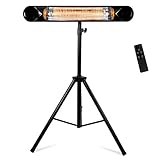
3. Briza 1500W Infrared Patio Heater with Tripod Stand
Briza Infrared Electric Patio Heater – Indoor/Outdoor Heater – Portable Wall/Garage Heater – 1500W – use with Stand – Mount to Ceiling/Wall)
1500W carbon infrared
120 volt 12.5A
IP55 rated
84 inch cord, 3 kg
Pros
- Wall ceiling and tripod mounting in one box
- Three heat levels with remote
- Assembles in about five minutes
- Tip-over sensor cuts power automatically
- Silent radiant heat with no hot air
Cons
- Only about 1 to 3 feet of useful reach
- 12.5A draw can overload a shared circuit
- Adds a few degrees to a garage rather than warming it
Briza is the one to pick when the goal is warmth for two or three specific people rather than a whole patio area. At 1500W with three heat levels and a remote, it is a personal heat source that plugs into a standard wall outlet and works immediately.
What makes it flexible is the mounting kit. Wall brackets, ceiling hardware and an adjustable tripod all come in the box, so you can move it between a covered patio, a garage wall and a screened porch without buying anything else. Assembly takes about five minutes, which is the fastest here.
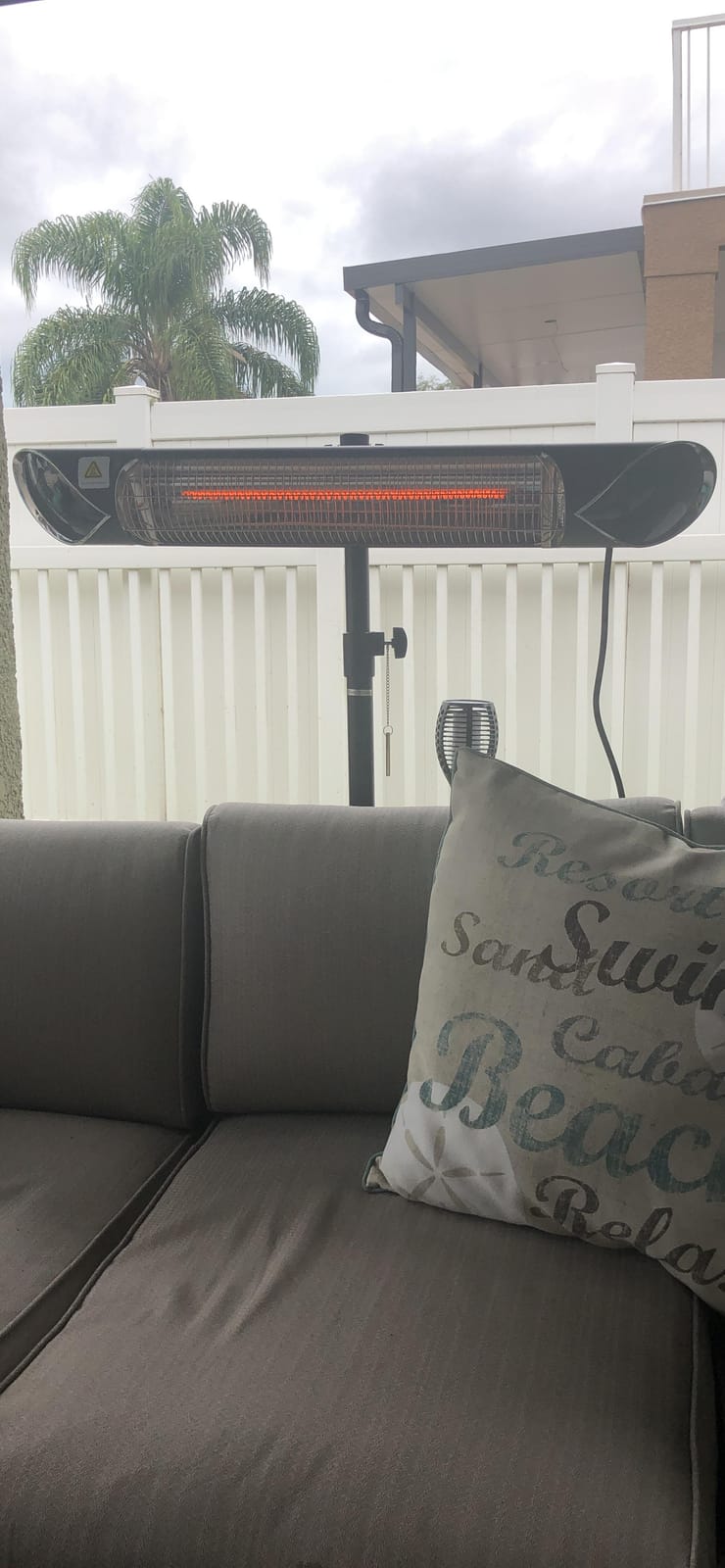
Owners who understand radiant infrared rate it well for quietness and durability through snow and rain, and one reported use even had it performing outdoors at minus 11C when seated nearby. The IP55 rating is the spec that makes it credible for that kind of use.
The catch is expectation. Reviews repeatedly note that it heats people and objects rather than ambient air, so a small garage only gains a few degrees. If you sit two feet away facing it, you will be comfortable. If you sit six feet back expecting a room to warm, you will be disappointed.
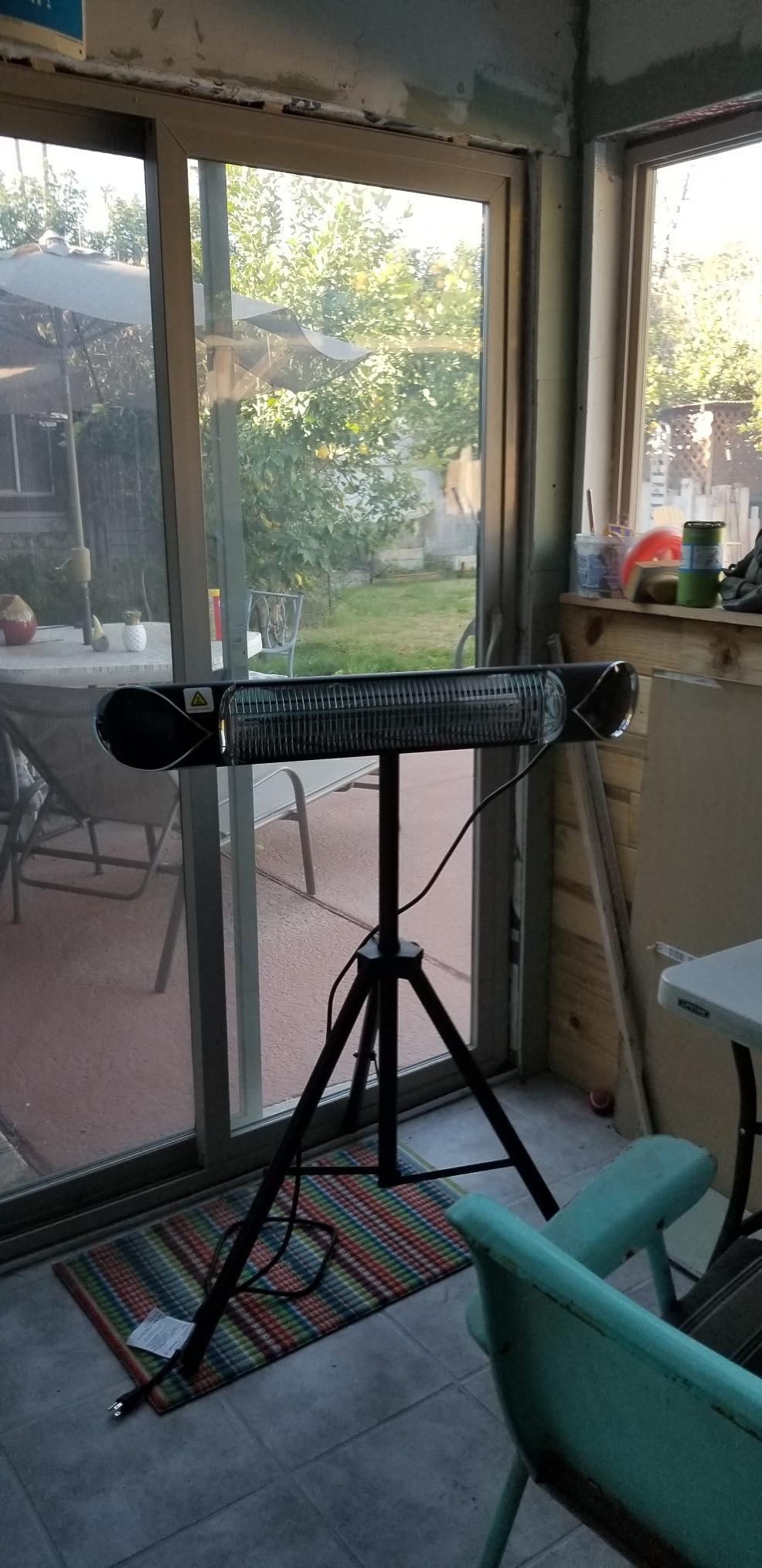
Getting the tripod height right for seated users
The tripod extends to roughly six feet, and that height is usually too tall for a seated adult at a dining table. Most owners end up lowering it and aiming the face at lap and chest height, which is where radiant heat actually does its work. Set it up before your guests arrive rather than during.
The other practical detail is the 12.5A draw on a 120V circuit. On a dedicated patio outlet that is fine, but on a shared kitchen or outdoor kitchen circuit it can trip with a refrigerator or a kettle on the same run.
Where owners report problems
Tilt safety is the recurring theme. The tip-over sensor does exactly what it is designed to do, which means brushing the unit with a chair or a broom shuts it off. On r/patio threads, owners have also reported tilt sensors on infrared units failing after a few weeks, so keep the receipt and know your return window.
The second limitation is reach. At roughly 1 to 3 feet of useful warmth, this is a device for one seating spot, not a table of six. If you want a whole patio warm in cold weather, you need propane output or a mounted 3000W unit.
4. Pamapic 89-Inch Pyramid Patio Heater with Quartz Flame Tube
Pamapic 89″ Pyramid Patio Heater Outdoor, Propane Flame Tower with Quartz Glass Tube, Outdoor Heaters with Wheels & Cover for Deck, Porch, Backyard, Garden, Hammered Bronze
48000 BTU propane
Up to 15 ft coverage
89.4 inch tower
61.7 pounds with cover
Pros
- Quartz glass flame column is a strong visual centerpiece
- 48000 BTU covers up to a 15 foot diameter
- Wheels and a weather cover included
- Hammered bronze finish looks well outdoors
Cons
- 89 inch height concentrates heat overhead
- Tall and heavy at 61.7 pounds
- Needs a separate propane tank
This is the one to buy when the look of the patio matters as much as the warmth. The quartz glass tube flame column is genuinely striking, and at 48000 BTU it has real output behind the look, covering up to a 15-foot diameter.
At 89.4 inches tall, this is a genuine architectural object rather than a piece of patio furniture. Owners love the hammered bronze finish, and the included weather cover means it can stay outside between seasons without looking neglected.
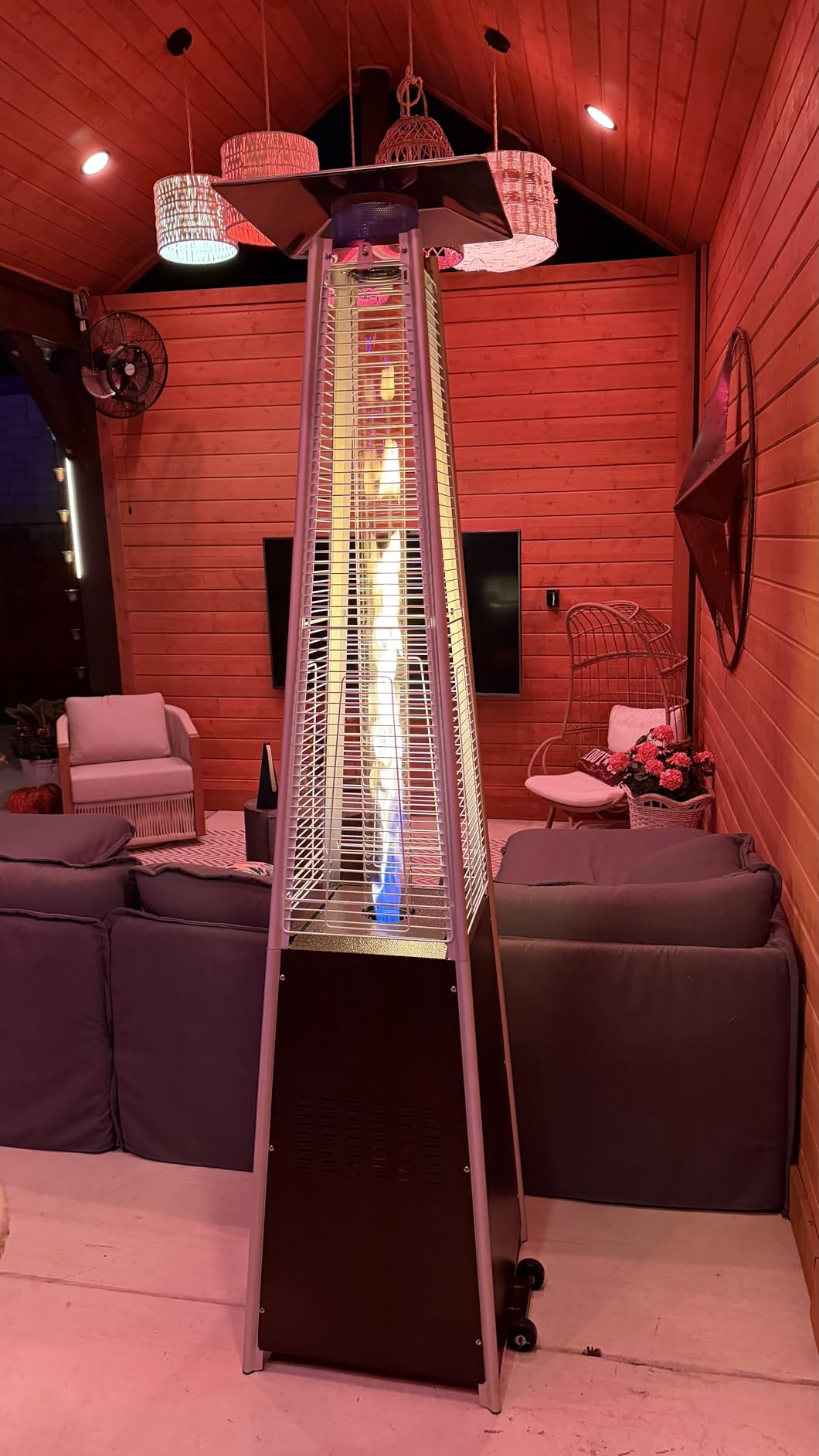
The wheels are a real convenience here because 61.7 pounds is heavy enough that you will want to move it out of the wind rather than fight it. A wheel set on a unit this tall is not just a convenience, it is the difference between repositioning it in a minute and leaving it where it is.
Feedback centres on the flame column, the solid output and the fact that both the cover and the wheels are included. That combination is rare at this size, and it means there is nothing extra to buy before the first gathering.
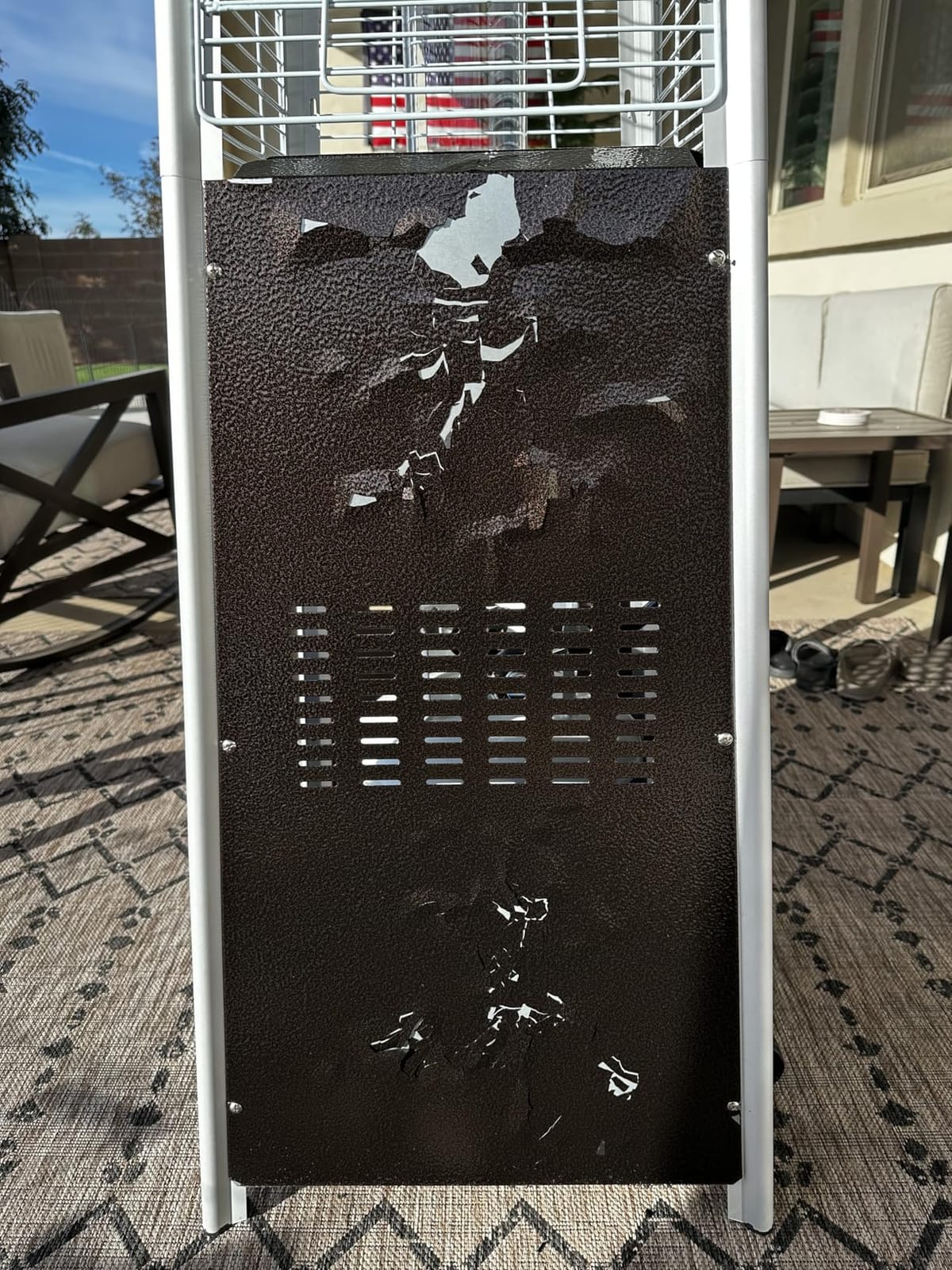
Deciding if the 89-inch height works for your patio
Measure your overhead clearance before anything else. Under a covered patio with a roof line at eight feet, an 89-inch heater plus clearance can be too tall to use without risk of contact. Under a pergola or on an open deck, the height is exactly what you want.
The tall format concentrates warmth at the top of the column, which is the recurring limitation in reviews. Seated users may feel it mostly above them rather than at table height, so plan seating that is close to the base rather than a wide ring around it.
Where the heat falls short in deep cold
A pyramid flame column reads as a very hot object, but it is still a radiant heater with a dome roughly 15 feet across. On an uncovered deck in wind, you will feel it at close range and lose it at the edges, which is the same physics that applies to every propane tower here.
Also factor in the tank. A 20 lb propane tank is not included, and this is a unit you will want to fill where it stands rather than carry around. If your tank connection is far from the sheltered corner, plan the layout first.
5. Haimmy 42-Inch 1500W Infrared Tower Heater
Outdoor Electric Patio Heater, Haimmy 42in Infrared Heater with Remote, 9 Heat Levels, 9H Timers, 1500W Instant Heating, Safety Lock, Tip-Over & Overheat Protection, IPX5 Waterproof Tower Space Heater
1500W carbon fiber element
Nine levels 620W to 1500W
120V 12.5A
IPX5 water resistant
Pros
- Nine heat levels give unusually fine control
- 1-9 hour timer settable from the remote or knob
- Tip-over and overheat automatic cutoffs
- Safety lock blocks children and pets
- Silent fanless operation
Cons
- Warmth is felt only in front of the unit
- Best suited to covered use rather than full exposure
- At 12.5A it wants a dedicated outlet
The Haimmy is the most adjustable 120V heater in this group, and nine heat levels is the feature that owners single out. Most electric heaters give you two or three. Stepping from 620W up to 1500W in small increments is what lets you hold a comfortable temperature on a mild evening without overcooking the one person closest to the unit.
The safety stack is unusually complete for this size. Tip-over auto shutoff, overheat protection and a safety lock with memory all ship standard, and the lock is the one parents will care about most on a patio where kids are running.
It is fully fanless, so there is no motor noise at all. For a covered porch or a screened room where conversation matters, that silence is worth as much as the wattage. The IPX5 water resistance rating covers the drizzle and splash you get under a roof or on a balcony.
Owners also like having both a remote and a knob, with the timer settable either way. The 1-9 hour range is long enough to cover a long dinner without leaving a heater running unattended all evening.
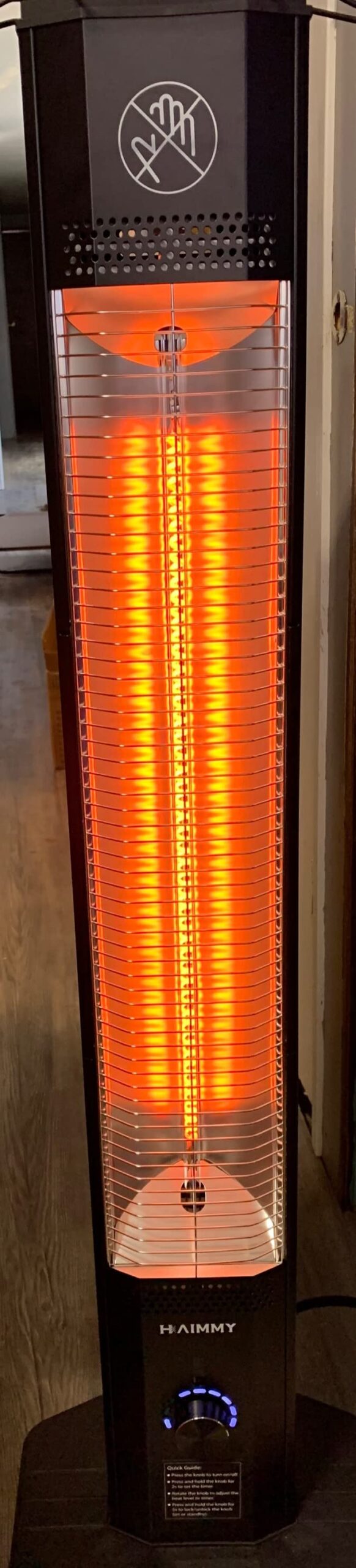
Where a 42-inch tower actually places its heat
A 42-inch floor-standing tower heats the space directly in front of it. Position it at the end of a bench or beside a dining chair rather than in the middle of the patio, and the seated guests get the full benefit. Owners describe it as well suited to screened porches and gazebos, which matches our sense of its strengths.
The listing quotes 500 sq ft of coverage, and that figure applies to the open-air heating claim rather than the felt warmth. For a cold winter, treat it as a personal heat source for one or two people within a few feet, which is exactly how owners use it.
Where it falls short outdoors
Full exposure is the weak spot. Unlike a mounted unit, a floor tower cannot be placed above head height, so more of its output lands on the deck than on people. Under a roof it performs well; standing in the open on a windy deck it underperforms its wattage figure.
Also note the 12.5A draw at 120V. On a standard patio outlet that is the full circuit, and the manufacturer’s guidance is not to run it on an extension cord, which limits where you can put it.
6. Thermo Tiki 45,000 BTU Commercial Propane Tower
Thermo Tiki Outdoor Propane Patio Heater – Commercial LP Gas Porch & Deck Heater – Black
45000 BTU with 38000 BTU true rated
15 ft heating diameter
90 inch tower
57 pounds
Pros
- Commercial steel and aluminum build with corrosion resistant finish
- ANSI CE and CSA compliant with tilt shutoff and pilot light
- Push-button ignition plus temperature knob
- Wheels and a front access cover for tank changes
- Regulator and flexible gas hose included
Cons
- Assembly runs 45 to 90 minutes
- Some reports of the glass tube discolouring
- Occasional reports of main burner failure to ignite
The Thermo Tiki looks the part of a restaurant patio heater because it essentially is one, scaled for a deck. Seven and a half feet of steel and aluminum with a corrosion resistant finish, and it is ANSI, CE and CSA compliant with a tilt shutoff valve and a pilot light.
One detail that matters for real use: the listing states 45000 BTU but notes a 38000 BTU true rating. That kind of transparency is a good sign, and 38000 BTU across a 15-foot diameter is still substantial output for a residential deck.
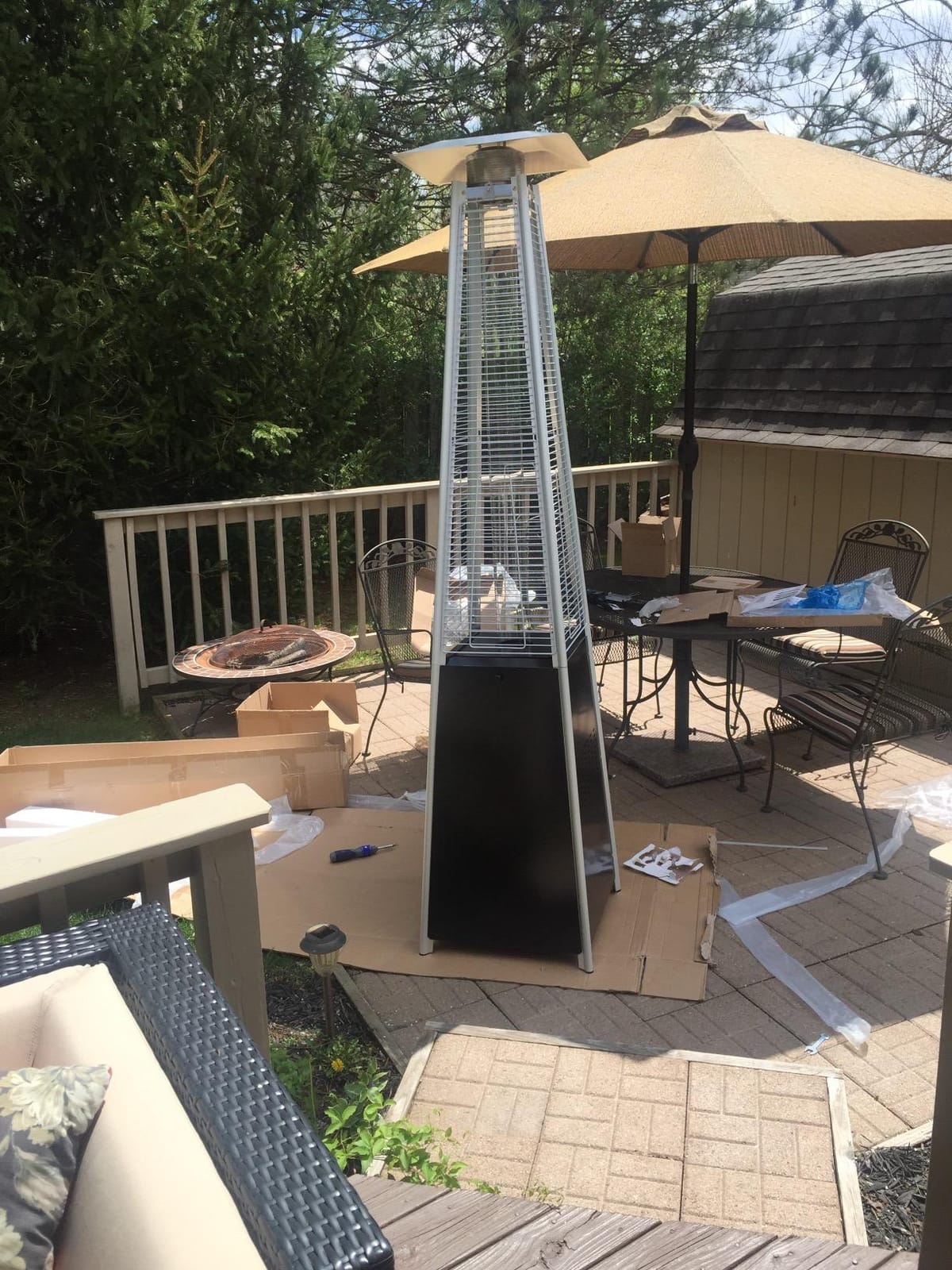
The regulator and flexible gas hose are included, so you are not hunting for parts on assembly day. The front access cover and the wheels make tank changes far less painful than on designs where you have to move the entire unit to swap a cylinder.
Owners describe the assembly as well illustrated with panels and screws that align without forcing, which is generous given the time it takes. It is a two-person job for most people, so budget an evening rather than an afternoon.

What commercial grade actually changes
It is mostly the steel and aluminum frame, the certification and the serviceable layout. A commercial heater is designed to be rebuilt and repaired over years rather than replaced, and the tilt valve plus pilot arrangement here gives you visible confirmation that the gas is actually flowing.
The practical benefit for a homeowner is wind behavior. A heavy base and a 57-pound frame resist gusts far better than a lightweight tower, and the pilot light gives you an instant visual check after a windy night.
Where reliability reports get mixed
A small minority of owners report the glass tube discolouring or burning on one side over time, and there are occasional reports of the main burner failing to ignite while the pilot stays lit. Neither is universal, and both are the kind of issue that shows up after extended season-long use rather than in the first month.
Also be clear on the warranty. This one carries a 90 day limited manufacturer warranty, which is shorter than the three-year coverage some competing propane heaters offer. If long-term support matters to you, factor that in.
7. Hykolity 50,000 BTU Propane Patio Heater with Table Top
Hykolity 50,000 BTU Patio Heater for Outdoor Use, Propane Patio Heater
50000 BTU stainless burner
200 sq ft coverage
87.25 inch pedestal
Table style top
Pros
- Highest rated output in this roundup
- Piezo ignition needs no battery and starts fast
- Waterproof and rainproof body with insulated switch
- Multi speed temperature adjustment
- Assembles in under an hour
Cons
- 200 sq ft coverage is modest for the BTU figure
- Requires a 20 lb propane tank
- Pedestal top is small for large serving trays
The Hykolity carries the highest rated output in this group at 50000 BTU, and at 4.5 stars across its owner reviews it is one of the better-rated heaters we looked at. The umbrella-style top is designed to spread that output more evenly than a flat reflector dome, which is a real improvement for a round table.
Piezo ignition removes one of the most annoying failure points in propane ownership. No battery, no ignition wire, no match on a freezing night. Owners consistently report starting it in minutes with a simple multi-speed temperature adjustment on top.
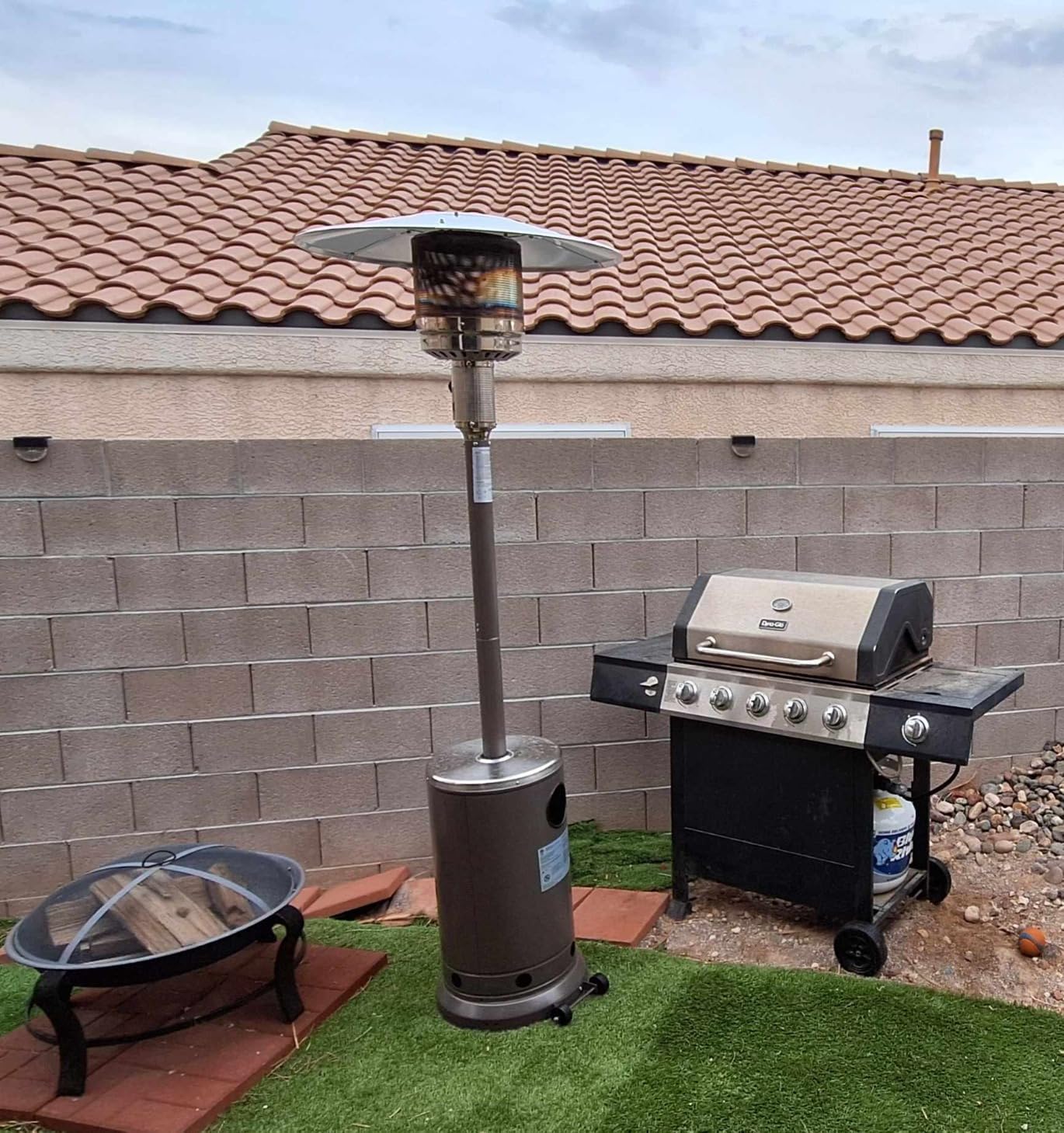
Rain resistance is handled properly. The waterproof and rainproof construction with an insulated switch means you do not have to bring it in every time a shower passes, which on a winter deck is the difference between using it or leaving it in the garage.
The triple protection system covers the usual failure modes for a gas appliance, and the wheels make it portable between a patio, a balcony or a tailgate. Assembly takes under an hour with clear starting directions.
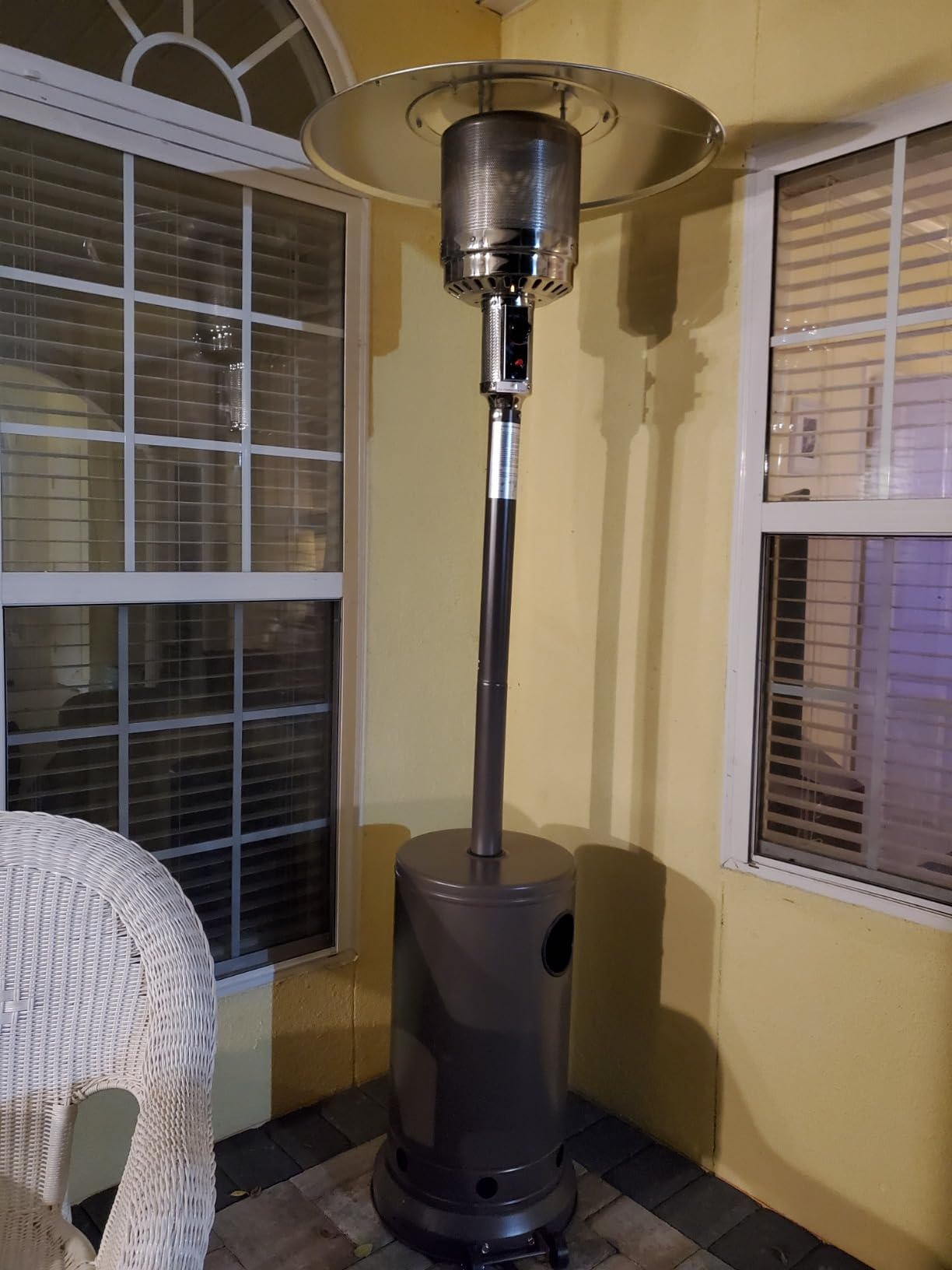
Reading the 50000 BTU and 200 sq ft pair together
Those two figures sit in a bit of tension and owners notice. A 50000 BTU burner sounds enormous, but the rated coverage is 200 square feet, which is roughly a 14-foot circle. For a patio group rather than a large open space, that is exactly right.
The practical reading is that this is a table heater with a strong output, aimed at making a seated group comfortable. That is a different goal from heating an uncovered deck, and at this price point it is a goal it meets well.
Where it struggles in cold weather
With no adjustable height and a fixed pedestal form, you take the heat where the design puts it. Under a table edge or low roof, check clearance carefully. On an exposed patio, the same wind loss that limits every propane tower here applies with equal force.
The 20 lb propane tank is not included. In deep winter that fuel logistics matter, so keep a second cylinder on hand and swap on a day when you are already going out.
8. Pamapic 50,000 BTU Round Table Propane Patio Heater
Pamapic Outdoor Heaters for Patio with Round Table Design, Premium 304 Stainless Steel Burner, Triple Protection System Propane Patio Heater for Porch Garden, Residential & Commercial Use
50000 BTU 304 stainless burner
314 sq ft, 20 ft diameter
87.8 inch pedestal
CSA certified
Pros
- 304 stainless burner described as more durable than mesh
- Round tabletop doubles as a drinks and snacks surface
- Magnetic locking tank door for fast refills
- Tip-over cut-off beyond 45 degrees plus flame failure shutoff
- Heats in about one minute
Cons
- Arrives in two boxes that may come separately
- Some owners find output weaker than lower rated rivals
- Assembly takes about an hour
This is the one to buy if four to six people eat outside regularly. The round tabletop is large enough for drinks and snacks at the same time as four plates, and at 50000 BTU across a 20-foot diameter it covers the widest area of any propane tower here.
The burner is 304 stainless steel rather than the mesh burner used on cheaper models, and owners specifically call out its durability. The aluminum top cover is designed to concentrate heat downward instead of letting it escape upward, which is the right call for a table-height appliance.
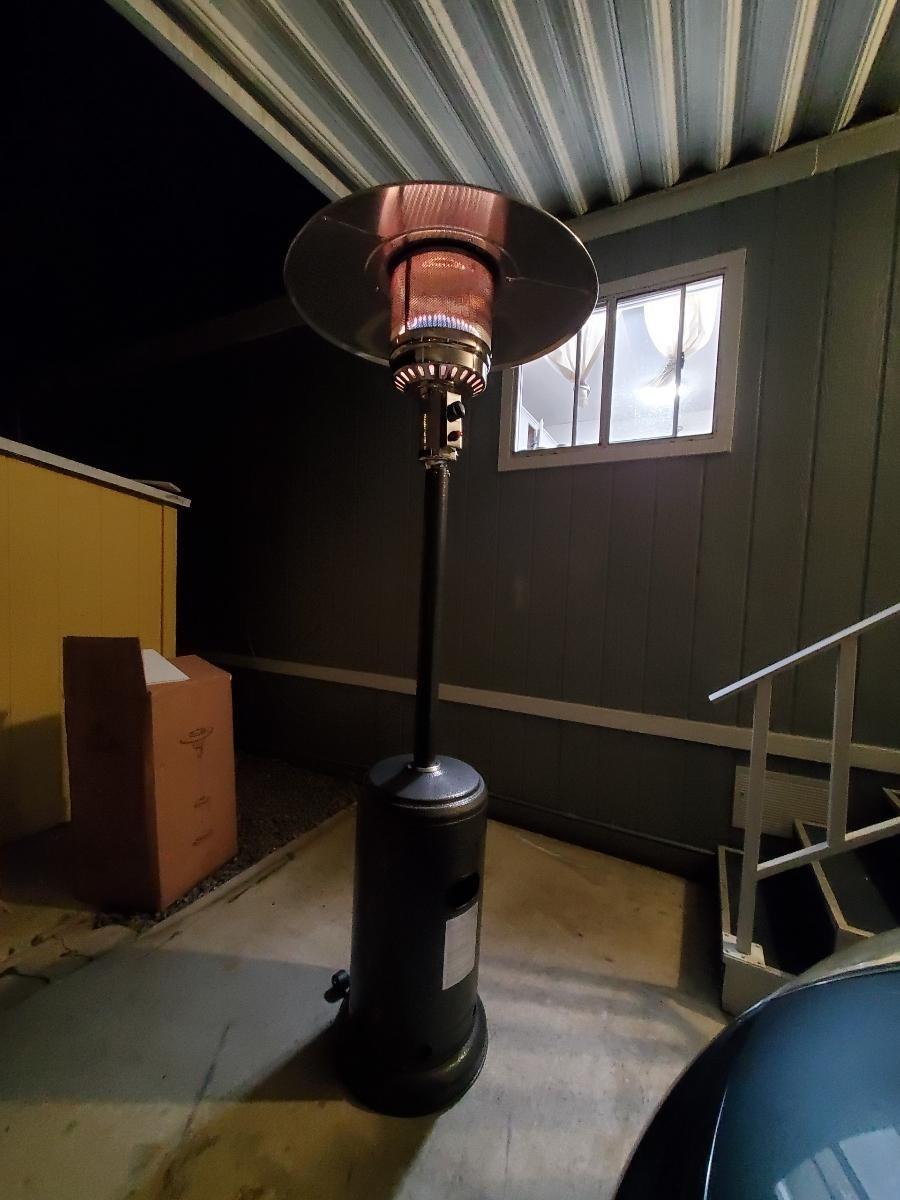
The magnetic locking tank door is a small detail that saves real time. You can refill the propane cylinder without moving the unit, which matters on a 27.5-inch-wide base with a conical footprint. The conical base also helps in wind, resisting tipping better than a flat disc.
Safety is thorough: tip-over cut-off triggers beyond 45 degrees, and a flame-failure valve shuts off the gas if the flame goes out. It is CSA certified and ignition is one-touch, lighting in about five seconds.
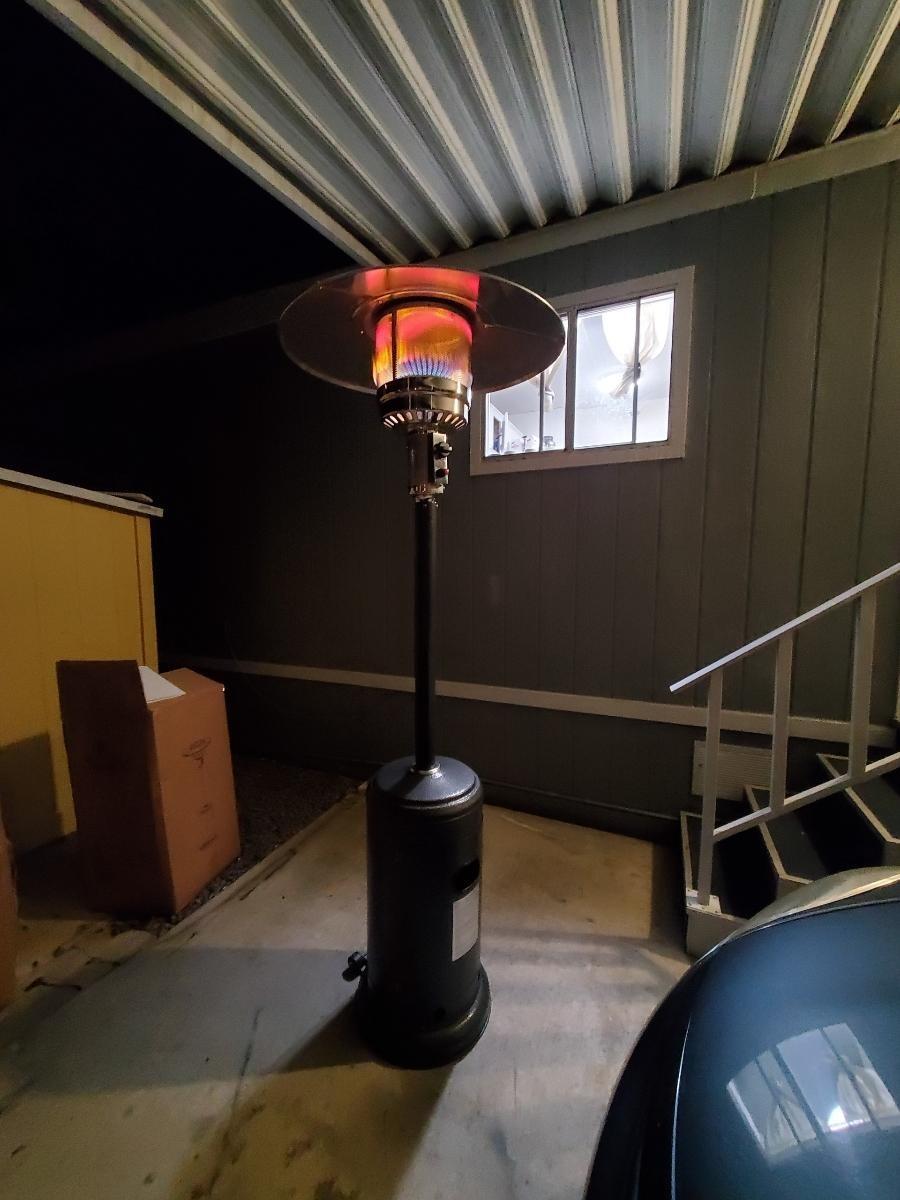
Why the stainless burner matters over time
Mesh burners are the wear item on gas patio heaters. They warp and corrode, and once they do the burner runs unevenly and shows yellow at the tips. A 304 stainless burner resists that, which means steadier output across seasons and fewer burner replacements.
The heat concentration design also matters in winter. Sending heat down and out across the table rather than up into cold air is the difference between a warm tabletop zone and a warm feeling above head height.
Where the logistics get awkward
It arrives in two boxes, and the second one may not show up at the same time, so plan the assembly for a day when you are home to receive the rest. Owners report about an hour for the build.
Some buyers also note that despite the 50000 BTU headline, the felt output can seem weaker than lower-rated competing units once it is running. Treat the diameter figure as the realistic guide for how many people it serves, which is four to six.
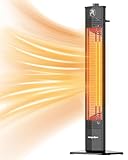
9. Encyclpo 36-Inch 1500W IPX5 Infrared Patio Heater
Encyclpo Patio Heater for Outdoor Use,1500W Infrared, 36 in Portable Tower Heater, 3 Levels, IPX5 Waterproof, Tip-Over&Overheat Protection for Garage, Indoor, Large Room, Backyard, Home
1500W dual carbon fiber element
IPX5 waterproof
Thermostat 40F to 140F
36 inch slim tower
Pros
- Operational in under five minutes out of the box
- Three heat levels at 600W 900W and 1500W
- Quiet fanless operation with a slim 36 inch footprint
- Tip-over and overheat automatic shutoff
- Top mounted controls so no remote is needed
Cons
- Narrow warm zone outdoors
- Tip-over sensor trips on contact
- Short cord and extension cords discouraged
The Encyclpo is a compact 1500W infrared tower built for garages, pool houses and porches where you want warmth in a specific corner. It uses dual carbon fiber heating wires and reaches operating temperature in under five minutes, which owners consistently note as its standout quality.
Unlike most units its controls sit on top of the tower rather than behind a remote. For a heater you walk over to adjust as you move around a garage, that is the more sensible interface, and it removes one failure point entirely.
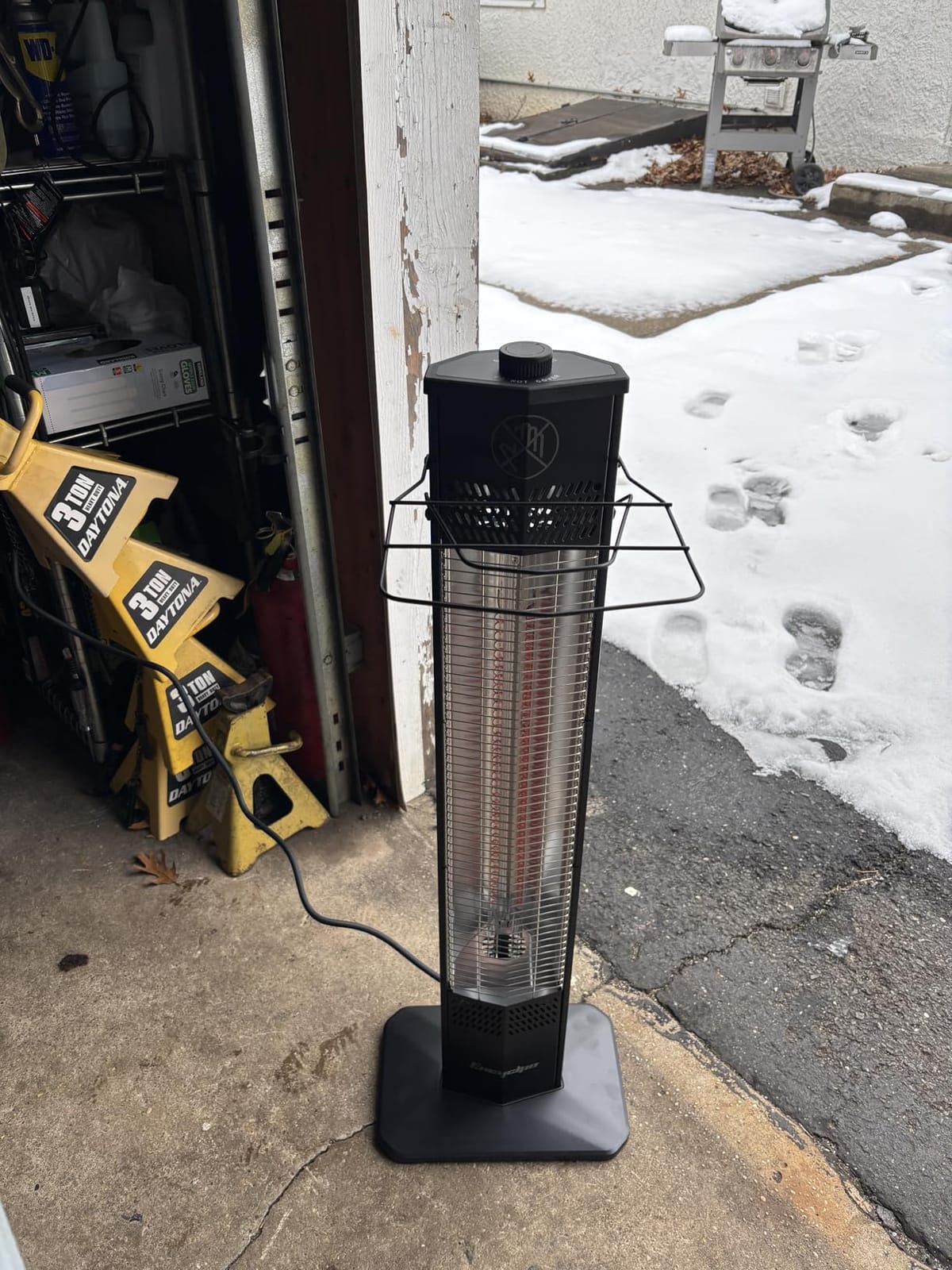
The adjustable thermostat from 40F to 140F is a genuine step above the fixed three-speed approach. Set it to the temperature you actually want rather than guessing at a wattage level and then moving closer or further away.
At 36 inches tall and 7.5 pounds, it is genuinely portable. Owners find it effective at close range in patios, garages and pool houses, and the IPX5 rating covers splash and drizzle without needing a cover.
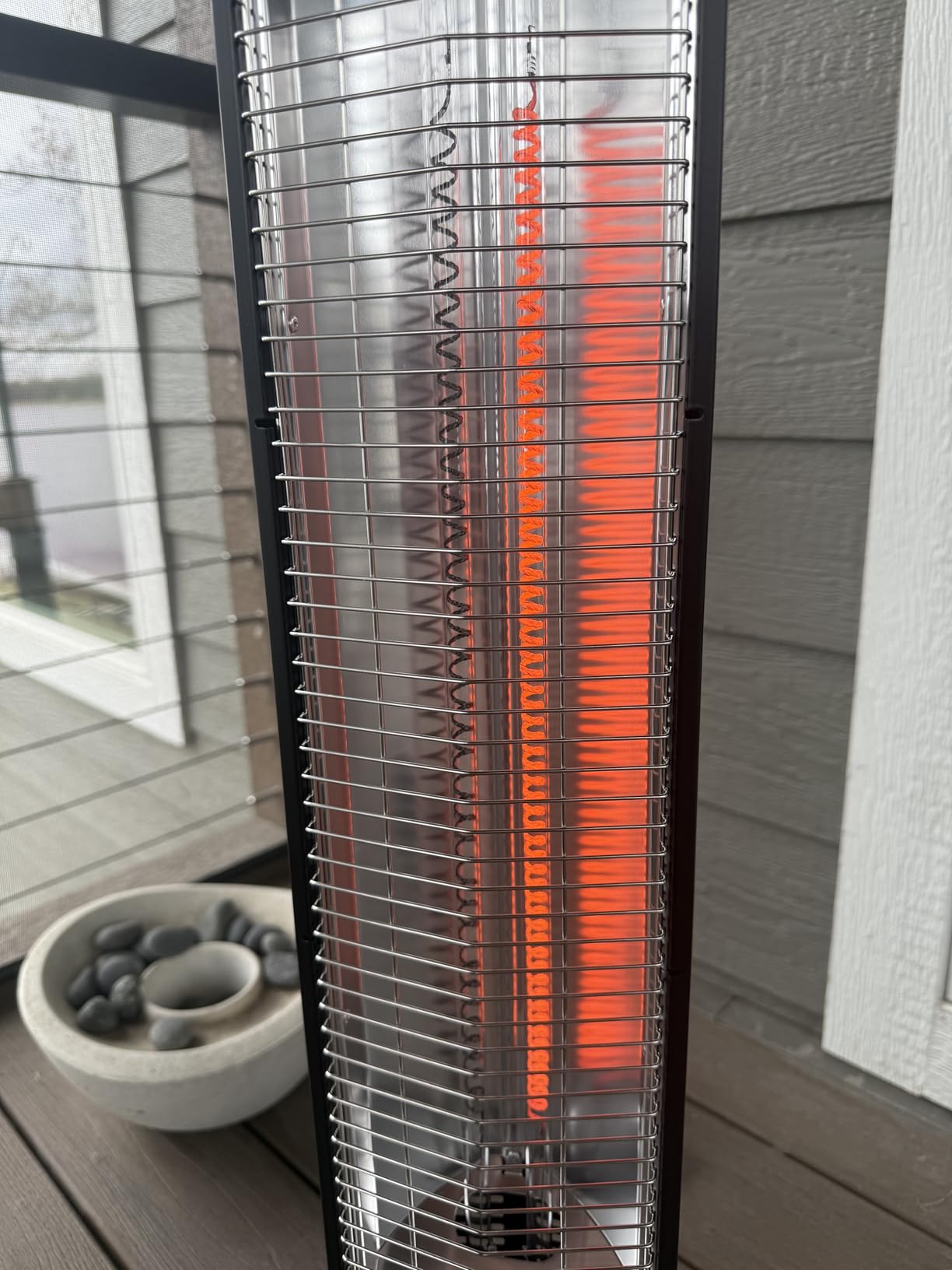
Choosing between it and a mounted unit
Pick the floor tower when the outlet is where the heat is needed and you want to move the warmth around. Pick a wall-mounted unit when you can get the emitter above head height, because radiant heat aimed downward from above lands on people instead of on the floor.
For a garage that is worked in occasionally, the portability wins. For a permanent covered patio, a mounted 3000W unit covers more seats for the same circuit work.
Where owners hit friction
The tip-over sensor is the biggest complaint. It is sensitive enough that brushing the tower with a broom or a chair shuts it down, and in a working garage that will happen. Learn where the sensitive zone is and position the heater out of traffic.
There is also a short cord and manufacturer discouragement of extension cords, which limits placement options. A handful of owners have reported the control knob cracking after several weeks, so keep it somewhere it will not be knocked.
10. Paraheeter 1500W Carbon Infrared Patio Heater
Paraheeter Outdoor Electric Infrared Patio Heater, 1500W
1500W carbon infrared tube
IP65 weatherproof
10,000 hour element life
18.8 pounds
Pros
- Wall mount ceiling mount and tripod all included
- IP65 rating for extended outdoor exposure
- Carbon fiber element rated for a 10000 hour lifespan
- No fumes noise or odors
- CSA certified with a one year warranty
Cons
- Foam pad must be removed from the tube before use
- Narrow infrared throw zone
The Paraheeter is the one here built for people who take heat on the road. No fumes, no noise and no odors means it works in an enclosed camper, a workshop or a campsite where a combustion heater simply is not an option.
The mounting flexibility is the same story as the Briza, done at a slightly higher output: wall bracket, ceiling hardware and an adjustable tripod stand all include. Owners mention garages, RV setups and campsites as the places they actually use it.
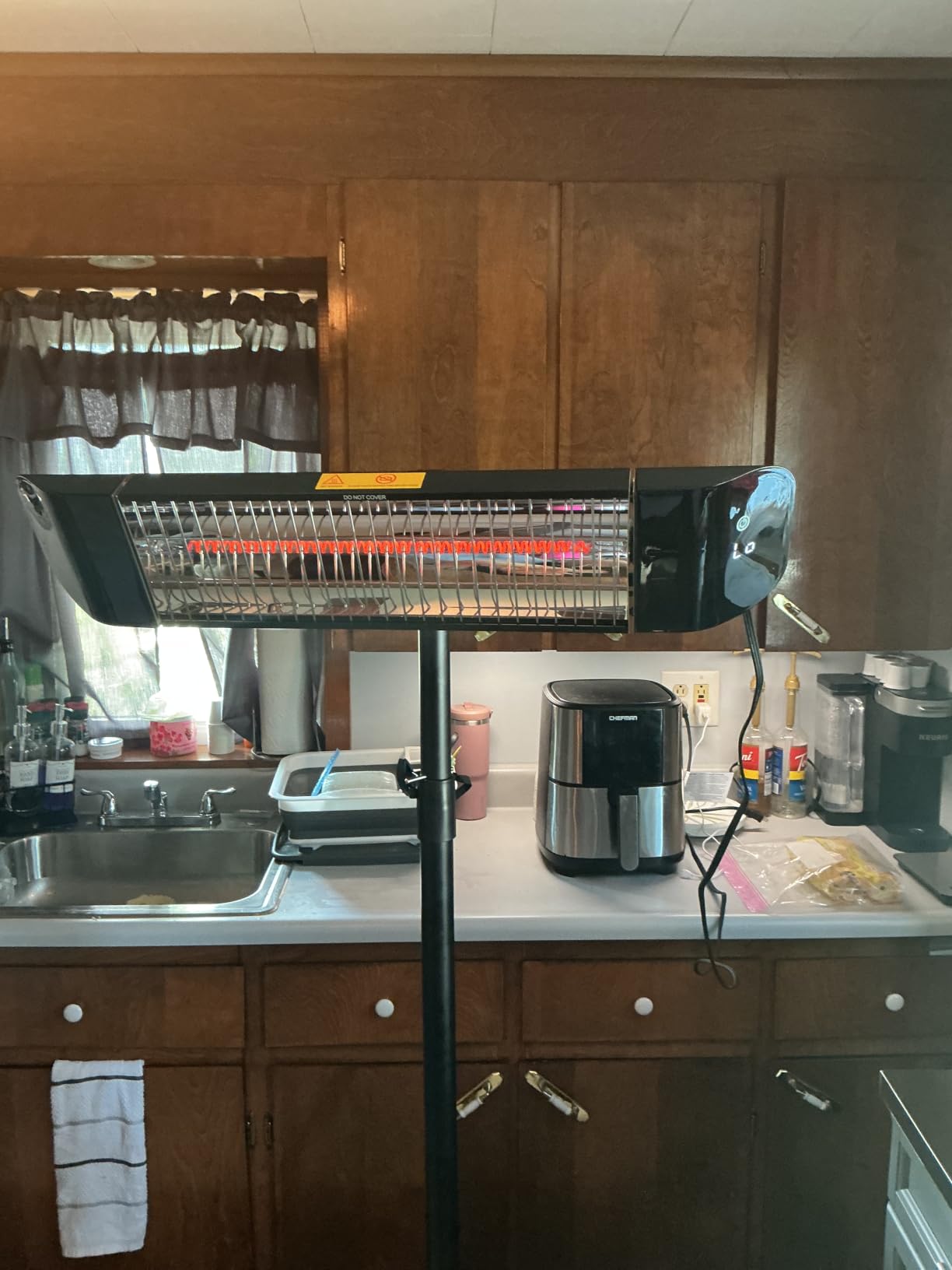
The carbon fiber element is rated for a 10000 hour lifespan, which at a few hours a week through a cold season is many years of service. It is IP65 weatherproof for extended outdoor use and CSA certified with a one-year warranty.
Running costs are the practical reason people move to electric cold-weather heat. Owners note that the operating cost is a fraction of a comparable propane heater, and for someone running a heater on a porch timer through a whole evening that difference adds up over a season.
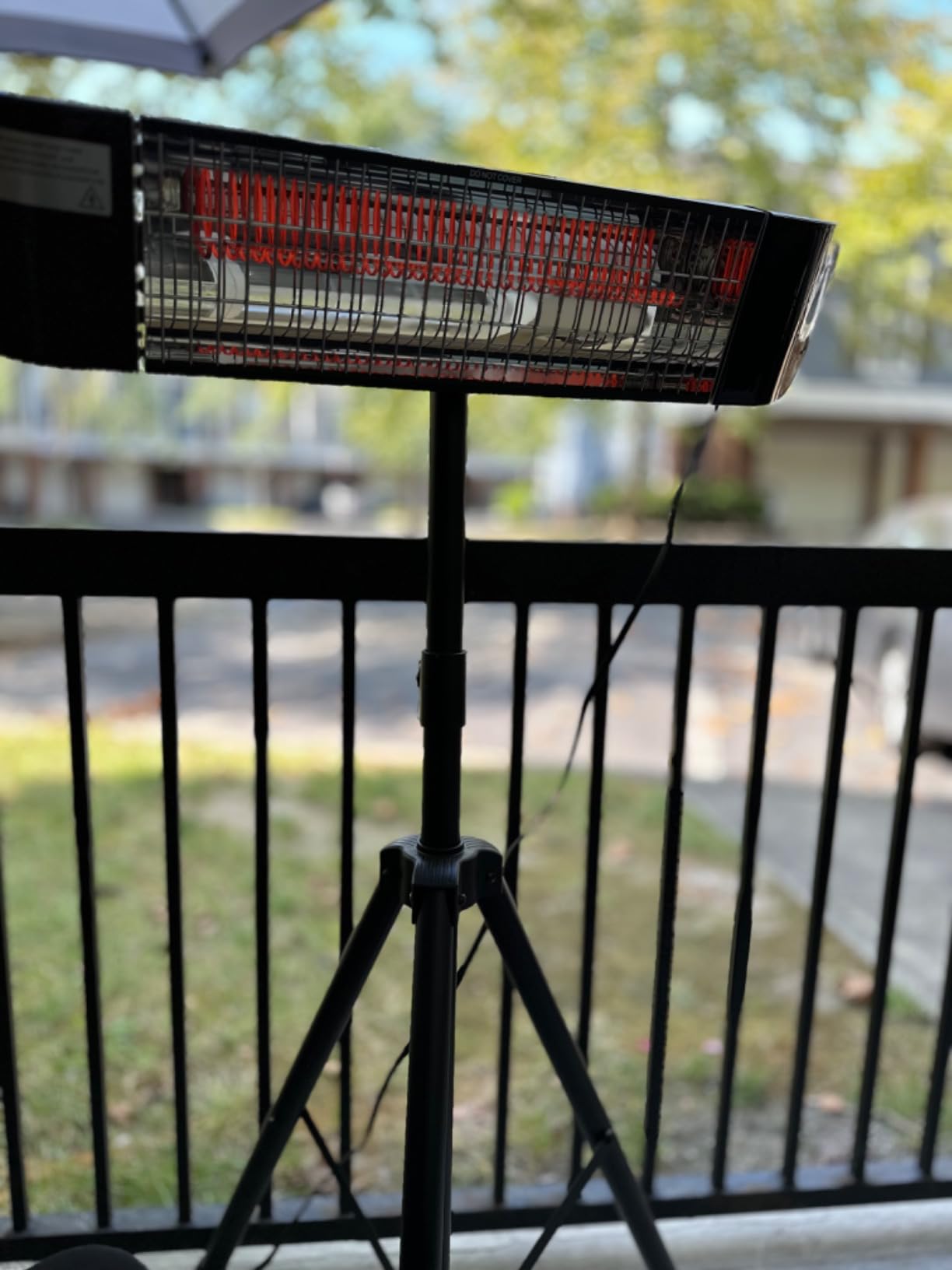
Check the foam packing before you power it on
This is the single most repeated caution in the reviews: the foam protective pad must come off the heating tube before the unit is switched on. Left in place it insulates the element and the unit can overheat. It takes a minute, but it is not optional.
The safety kit is solid otherwise: a metal grille, a grounded three-prong plug, tip-over automatic shutoff and adjustable temperature. The 1500W rating sits at the top of the 120V range, so give it a dedicated outlet.
Where it falls short outdoors
The infrared throw is narrow, so warmth is felt in front of the unit rather than spread around a patio. For a wall-mounted spot aimed at a bench or a workbench, that is exactly what you want. For open-air entertaining, it is too narrow.
Buyers who wanted a room to warm came away disappointed, and that is the expectation to reset before buying. If you are considering this for a camper or workshop rather than a patio, those same reviews become a list of reasons to buy it instead. Our RV heater guide covers the vehicle-specific side of cold-weather heat.
11. SereneLife 1500W IP65 Wall-Mounted Infrared Heater
SereneLife Portable Infrared Indoor and Outdoor Electric Space Heater with Remote, IP65 Approved, 1500 Watt Wall-Mounted Hanging for Patio, Restaurant, Backyard, Garage, Decks, Gazebos, Cafes
1500W carbon fiber element
IP65 aluminum frame
29.13 x 6.4 x 6.1 inches
6.2 pounds
Pros
- Light at 6.2 pounds yet sturdy enough to mount high
- IP65 aluminum alloy frame resists corrosion and rain
- ETL certified with 88 percent efficient carbon fiber elements
- Wall or ceiling mounting
- 360 degree tip-over switch plus overheat protection
Cons
- Blue standby light cannot be switched off
- Four foam inserts must be removed before use
- Metric only instructions and awkward mounting bolts
The SereneLife is the lightest mounted heater here at 6.2 pounds, which makes it much easier to install high on a wall or under a gazebo roof. It is ETL certified and uses carbon fiber elements rated at 88 percent efficiency, with an IP65 aluminum alloy frame that resists rain and corrosion.
Owners like the combination of low weight, simple remote control and the fact that it is safe to leave exposed on an uncovered deck. For a hot tub or gazebo where you want warmth overhead while everyone is sitting in water, that placement is the reason to choose it.
The safety hardware is present: a 360 degree tip-over switch, overheat protection and a mesh safety guard. Two heat levels with a simple on and off remote keep the controls straightforward, which some owners prefer over apps and mode cycling.
This carries the lowest owner rating in the roundup at 4.0 stars across 193 reviews, a thinner evidence base than the picks above. The feedback is not bad, it is just less settled, and that is worth weighing when you compare it against units with thousands of reviews behind them.
Dealing with the standby light and the foam inserts
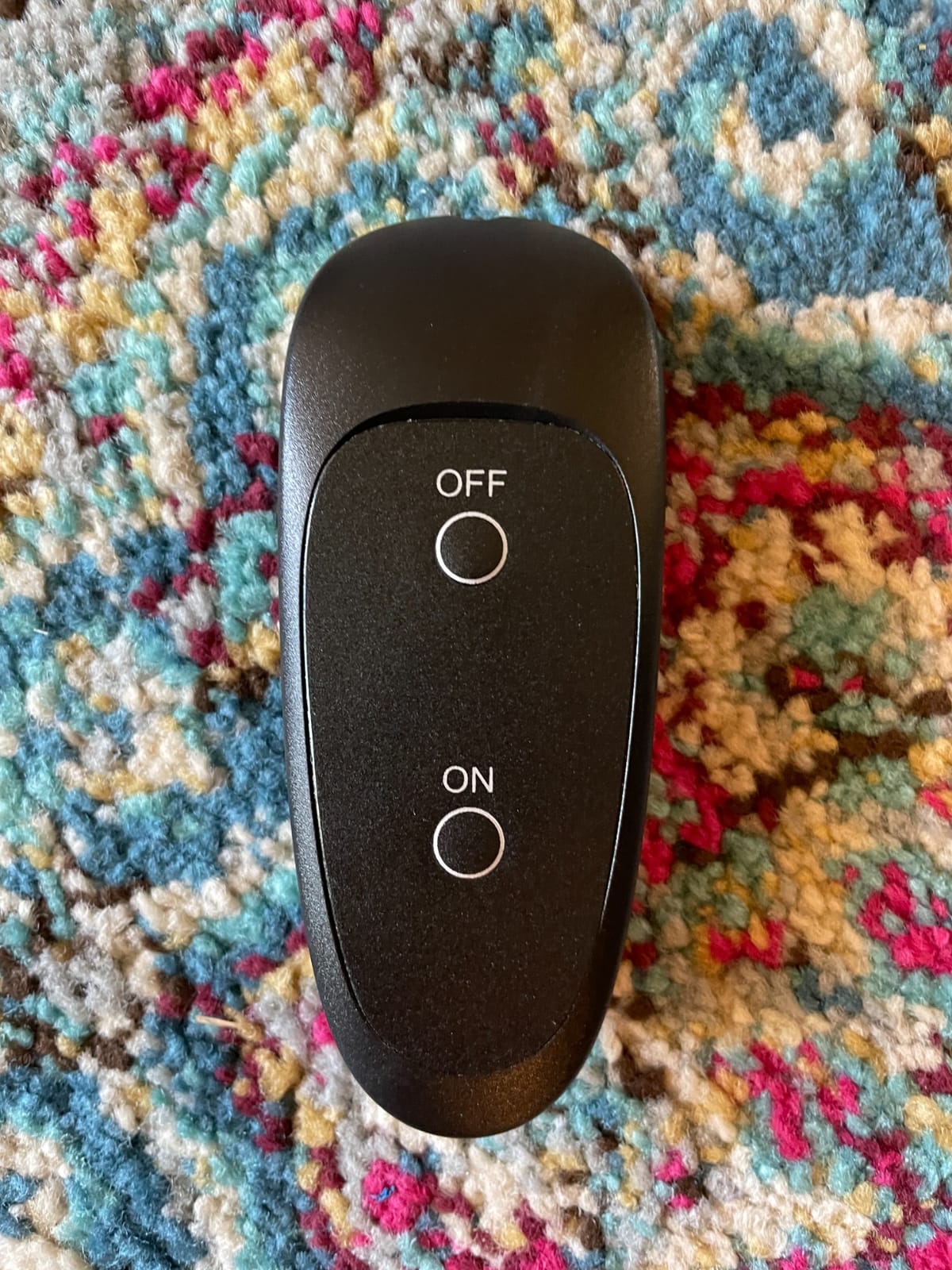
Two things catch people out. The blue standby light keeps flashing and cannot be turned off with the remote, which owners mention often enough that you should know about it before the unit hangs over your patio seating.
Four foam inserts also have to be removed before use, and leaving them in can cause the unit to overheat. Combine that with metric-only installation instructions and awkward mounting bolts, and the honest advice is to have someone comfortable with a tape measure and a drill handle the install.
Where it underperforms
At 1500W it warms users directly beneath or in front of it and does little for anything else, which is the same directional limit as the rest of the 120V group. Reviews also note that the single effective heat level gives less output than expected for the wattage claimed.
The listed coverage figure of 18 sq ft is the honest number to plan around. This is a personal warmth source for a hot tub bench or a two-person gazebo seat, not a patio heater in the sense that a propane tower is.
12. Cuisinart Perfect Position 38,200 BTU Swivel-Arm Patio Heater
Cuisinart Perfect Position Propane Patio Heater, 38,200 BTU Powerful Directional Stainless Steel Outdoor Heater with Hidden Tank and Drink Table, Swivel Arm and Reflective Heat Shield
38200 BTU directional propane
175 sq ft coverage
88 inch height
100 pound sand filled base
Pros
- Swivel arm extends heat left or right across a seating area
- Arm folds down for storage
- 33 inch reflective heat shield with cone shaped burner
- Built in stainless steel drink table
- Enclosed base hides the 20 lb propane tank
Cons
- Highest priced propane heater here
- Lowest propane output in this group at 38200 BTU
- 100 pound weight limits repositioning
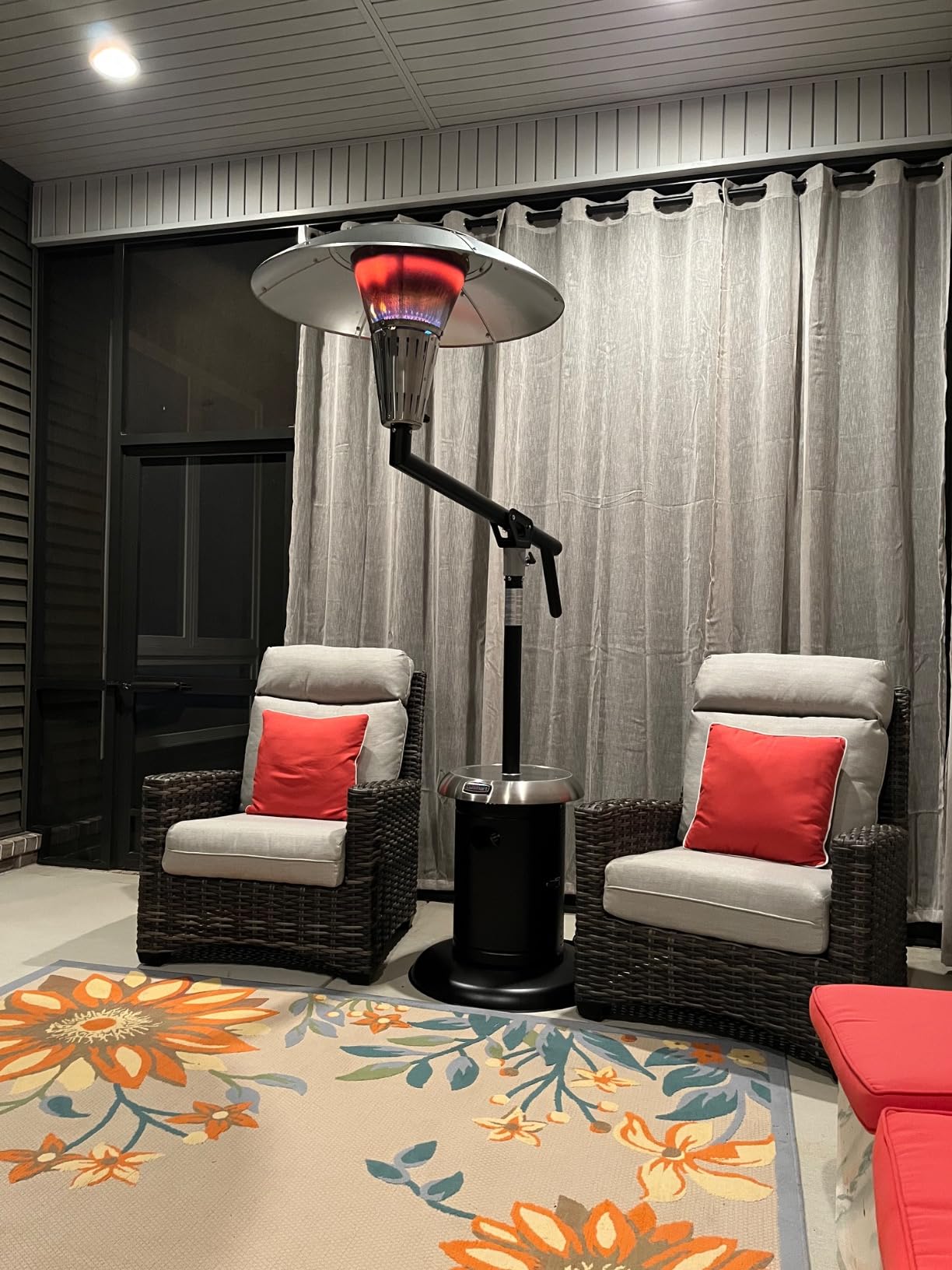
The Cuisinart solves a specific problem that other towers cannot: heat that reaches the far end of a long seating area. The swivel arm extends the burner out to one side or the other, so you can direct warmth at one end of a sectional or move it as the group shifts.
The arm folds down for storage, which matters because this unit weighs 100 pounds, by far the heaviest here. The sand-filled wheeled base gives it stability against tipping and enough mobility to reposition once the season starts.
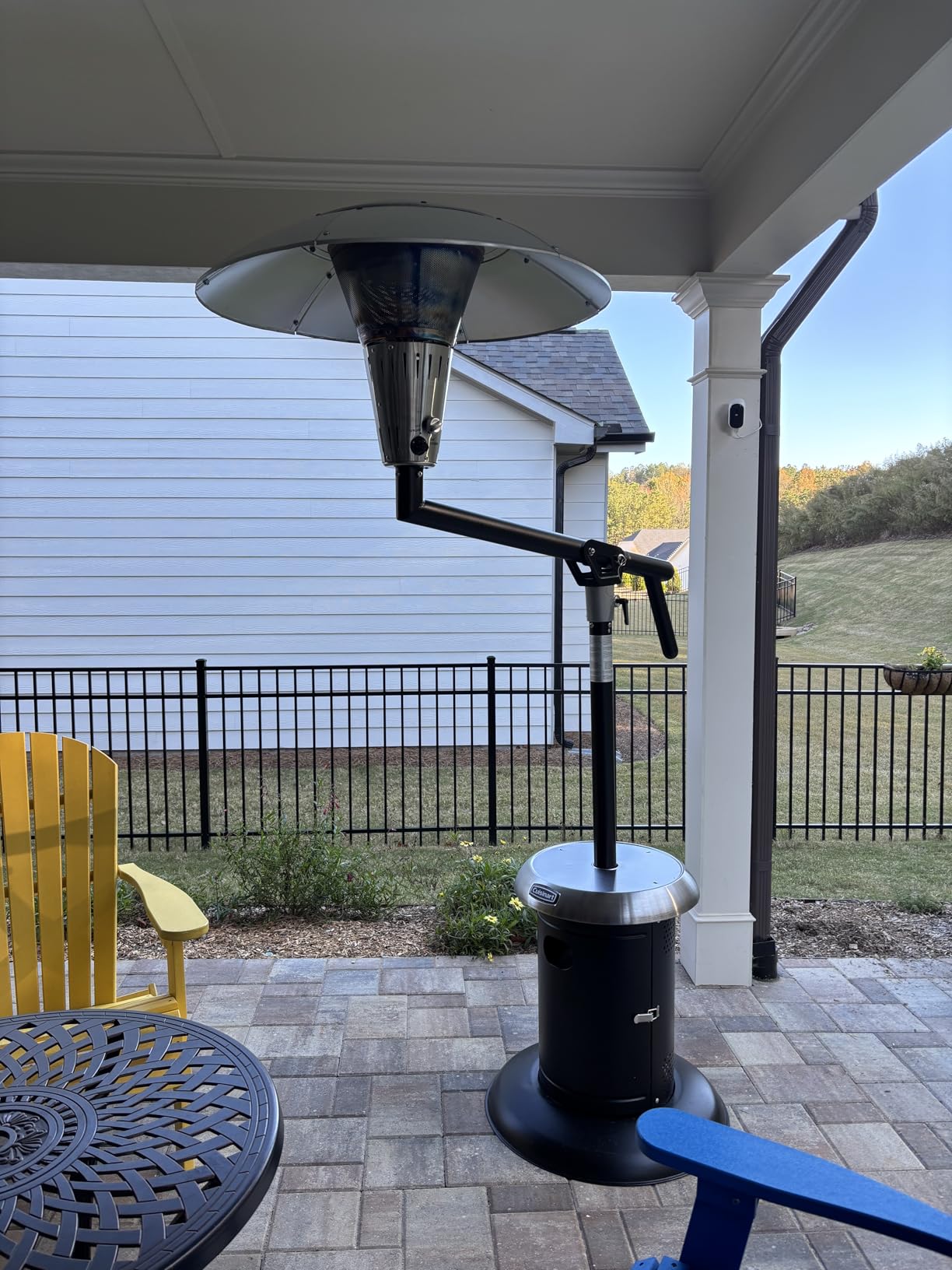
The 33-inch reflective heat shield with a cone-shaped burner is designed to spread heat down and out rather than straight up, and the enclosed base hides the 20 lb propane tank while keeping gas controls easy to reach. The stainless steel drink table adds usable surface to the top.
Owners consistently point to the directional arm, the integrated table and the concealed tank as the reasons they are happy, along with a base heavy enough that wind is not a concern.
When directional control is worth the money
If your seating wraps around an L-shape, a corner of the deck, or a long outdoor sofa, a fixed-dome heater leaves one end cold. The swivel arm is the fix, and no other propane tower in this roundup offers it. For that layout, the feature pays for itself in use rather than in theory.
The fold-down arm also means the unit takes up less space against a wall in spring and summer, which matters more than expected on a small deck.
Where the trade-offs show up
There are three real ones. It is the most expensive propane heater here, its 38200 BTU is the lowest propane output in the group, and at 100 pounds the wheels help but do not make repositioning easy. You are paying for the mechanism and the build, not for raw heat output.
Rated coverage is 175 square feet, so plan seating close in. A 20 lb propane tank is required and not included, and the warranty is one year limited.
How to Choose a Patio Heater for Cold Winters
Most wrong decisions come from comparing a propane tower to an electric heater on a single number, and those numbers are not measuring the same thing. Work through these factors in order and the choice makes itself.
Step 1: Pick the fuel that fits your space. Propane gives real BTU output and works anywhere with no electrical work, but it needs a tank, produces combustion heat, and loses effectiveness in open wind. Electric infrared gives instant, silent, fumeless heat that works well under a roof but throws in a narrow cone and needs a circuit. Natural gas is the most permanent option, requiring professional line installation and the highest upfront work, so it suits a covered patio you plan to use every winter for years.
Step 2: Match output to how many people are sitting. As a rough guide, 1500W electric covers a seated cluster of two to three people at close range, while 38000 to 50000 BTU propane towers are built for groups of four to six around a table. Check the coverage figure rather than the BTU headline, since the two do not always agree. The Pamapic round table and the Hykolity illustrate the gap neatly.
Step 3: Think about wind before anything else. This is the decisive factor for cold winters. Radiant heat is lost to moving air, so an uncovered deck in wind will defeat almost any heater. Two countermeasures matter more than output: move the heater into a sheltered corner near a wall, and add ballast. The Amazon Basics water box base, the Pamapic conical base and the Cuisinart sand-filled base all exist for exactly this reason.
Step 4: Get the clearance right for your surface. This matters enormously for vinyl-covered decks, which is the most common safety worry owners raise. Composite and vinyl decking can soften or distort under prolonged radiant heat, so keep the heater off the deck surface where possible and check the manufacturer’s clearance guidance. Never run a heater inside an enclosed structure with a low ceiling, and keep any heater a safe distance from vinyl siding, fabric screens and overhead roofs. If your deck is vinyl and fully enclosed with a roof, a mounted electric unit that fires above head height is the safer configuration than a propane tower burning at seated level.
Step 5: Read the weather rating. An IP rating tells you how much water the unit tolerates. IP55 means protection against water jets, and IP65 adds dust-tight sealing. Anything rated IP55 or better can stay outside through drizzle without a cover. Anything without a rating belongs under a roof and gets brought in when rain arrives.
Step 6: Plan the electrical run, including the cord. A 1500W heater pulls 12.5A, which is the full capacity of a standard 120V circuit, so give it a dedicated outlet. Several manufacturers discourage extension cords entirely, and where one is permitted, use a heavy outdoor-rated gauge such as 14 AWG or heavier and keep the run as short as possible. A 240V unit like the DR Infrared needs a dedicated 20A circuit and is an electrician job rather than a weekend project.
Step 7: Count the setup time before you commit. Pyramid and commercial towers commonly take 45 to 90 minutes and are easier with two people. Electric units that need no assembly are ready in five minutes. The Amazon Basics unit draws repeated complaints about unclear assembly instructions, so allow extra time there. Set the heater up during a mild day, not the evening of a party.
Step 8: Check the support details. Warranties here range from 90 days on the Thermo Tiki to a three-year period offered by some competing brands. Replacement parts matter more for propane heaters, since burner screens, thermocouples and igniters wear over seasons. A brand with a real parts catalogue will cost you less to own over five winters.
One last practical tip that costs nothing: position the heater before you fill the propane tank. Units weigh 40 to 100 pounds loaded, and the difference between a heater placed well and one placed in an exposed corner decides whether your guests stay outside for an hour or retreat after ten minutes.
Frequently Asked Questions
What type of patio heater gives off the most heat?
Propane heaters give off the most raw heat, with the models here ranging from 38200 BTU on the Cuisinart to 50000 BTU on the Hykolity and Pamapic round table unit. For cold winters, look for 46000 BTU or higher, a weighted base for wind stability, and heat that reaches seated height rather than overhead.
Can outdoor heaters be left out in the rain?
It depends on the IP rating. Electric units rated IP55 or IP65, including the DR Infrared DR-239, the Paraheeter and the SereneLife, are built for rain exposure. Propane heaters with rainproof and waterproof construction, such as the Hykolity, also tolerate rain. Anything without a weather rating should stay under a roof.
How do I make an outdoor patio warm in winter?
Place the heater in the most sheltered corner near a wall, fill any ballast base with water or sand to resist wind, keep the heater low enough that heat reaches seated height, and close off as many open sides of the space as you can. Radiant heat is lost to moving air, so shelter matters more than raw output.
Should I leave a patio heater on all night in freezing weather?
No. Gas heaters should not run unattended, and electric models here include tip-over and overheat cutoffs for a reason. Use the built-in timers instead. The Haimmy offers a 1-9 hour timer and the DR Infrared is programmable up to 24 hours with overheat protection.
My patio heater is not getting gas. What could be the problem?
The usual causes are an empty or disconnected cylinder, a regulator or hose that has been shut off at the valve, a pilot light that has been blown out by wind, or a thermocouple that has tripped after the flame went out. Owners also report ignition sensors failing after extended use. Check the cylinder and valve first, then relight following the manual.
Final Pick for Cold Winters in 2026
After working through twelve heaters, the best patio heaters for cold winters split cleanly by location. On an uncovered or semi-exposed deck, the Amazon Basics 46,000 BTU propane tower is the pick: it has the strongest evidence base of anything here, one-touch ignition, wheels and a fillable base that adds real wind stability. If you want the highest rated output and a table top, the Hykolity 50,000 BTU is the alternative.
Under a roof or on a wall, the DR Infrared DR-239 at 3000W wins on silent, instant, fumeless heat with an IP55 rating, provided you have a 240V circuit. For a standard outlet and one or two people, the Encyclpo or Haimmy covers a sheltered corner at close range for very little money.
Whichever you choose, place it out of the wind, add ballast if the base allows, and give it clearance from vinyl decking. That last habit does more for your winter patio than any difference in BTU between these models.