
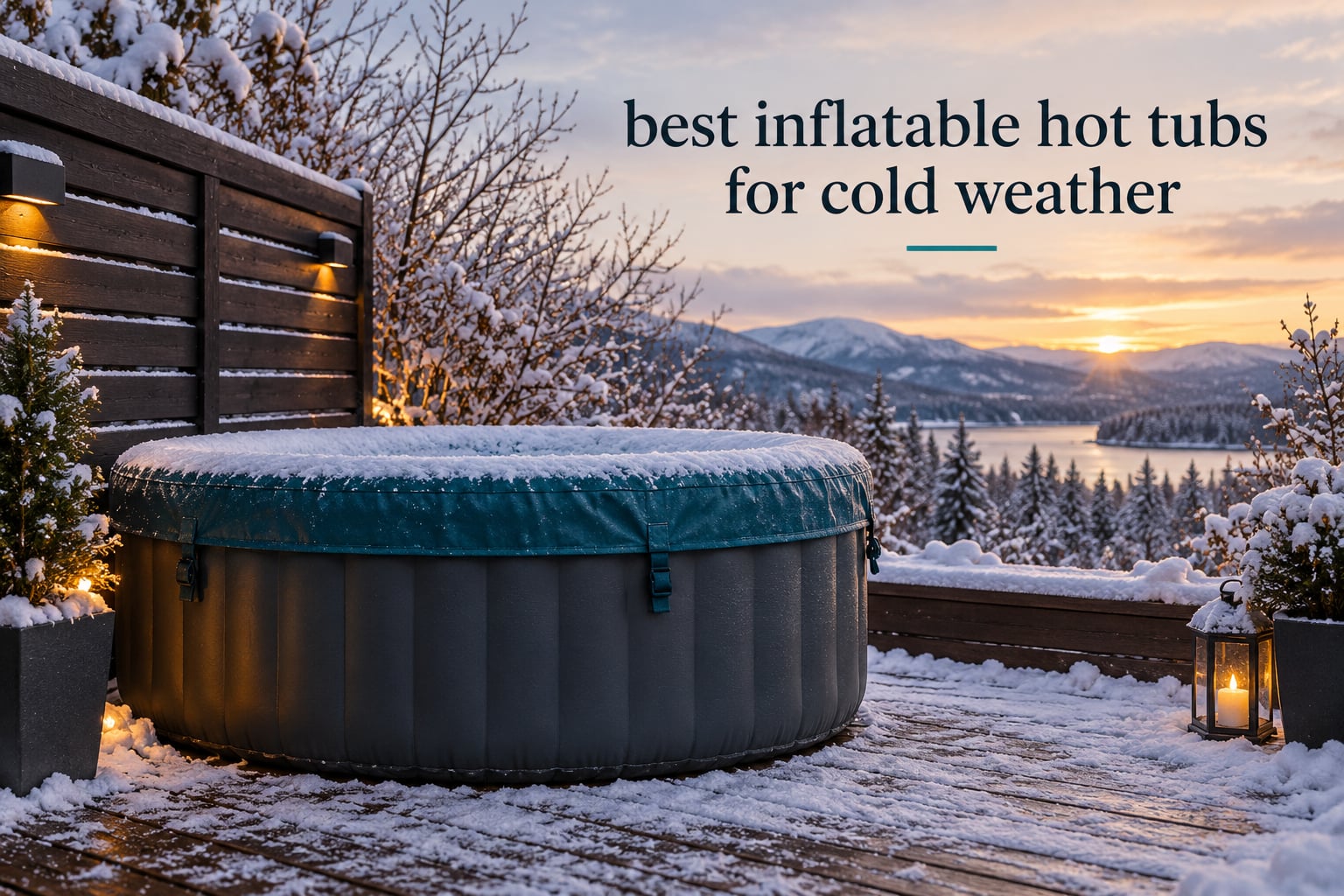
Yes, an inflatable hot tub can work in cold weather, but only if you treat heat retention as the whole project rather than an afterthought. Water at soak temperature sits far above the ambient air in January, and every degree of that gap is heat your heater has to replace continuously. A soft-sided spa loses heat through its PVC walls, through the bare ground underneath it, and through whatever gap is left around the cover.
That is why the best inflatable hot tubs for cold weather are not the ones with the most jets. They are the ones that pair an insulated cover with a real freeze protection system, sit on a foam mat, and get a wind break on the exposed side. Get those three right and a soft-sided spa holds soak temperature through a hard freeze. Get them wrong and you will spend your winter topping up lukewarm water.
We compared 10 of the best-reviewed inflatable hot tubs on the market, weighing cold-weather suitability above jet count, lighting and app features. We pulled the wall construction, cover type, freeze protection, heater output, capacity and warranty for each one, and we weighted the specs that actually decide whether a tub survives a winter.
We updated this guide for 2026, and we will say plainly where a brand does not publish a number we wanted. Several manufacturers never state a minimum operating temperature, and inventing one would be dishonest. Where we have a figure, it comes from the product data; where we do not, we say so.
If you are still working out what kind of spa fits your situation, start with our broader inflatable hot tub roundup and our full hot tub buying guide before you commit to a winter setup.
Table of Contents
Top 3 Picks: Inflatable Hot Tubs for Cold Weather in 2026
These three came out ahead on the combination that matters most in winter: a real freeze protection system, an insulated cover, and enough heater output to recover temperature after the tub has been sitting cold.

Intex PureSpa Bubble Massage Spa
- Fiber-Tech beam construction
- Energy efficient spa cover
- 210 gallon capacity
- 120 bubble jets

Coleman SaluSpa Miami AirJet
- Freeze Shield technology
- EnergySense insulation
- 120 AirJet jets
- 177 gallon capacity

Bestway SaluSpa Aruba AirJet
- Freeze Shield technology
- EnergySense insulated cover
- DuraPlus 3-layer walls
- 160 gallon capacity
Our pick for most winter buyers is the Intex PureSpa Bubble Massage Spa Set. It carries the largest review base in this group and the only reported evidence of holding full soak temperature in below-freezing air. The Coleman SaluSpa Miami takes the premium slot because Freeze Shield and EnergySense insulation give it the most complete cold-weather package on paper. The Aruba is the value pick, and it brings the same two named systems into a smaller footprint suited to a tight patio.
Best Inflatable Hot Tubs Compared for Winter Use in October
Everything below is in this table, ordered exactly as we ranked it. The features column lists the cold-weather-relevant specification for each tub rather than the marketing headline.
| Product | Specifications | Action |
|---|---|---|
| Intex PureSpa Bubble Massage Spa Set |
|
Check Latest Price |
| Coleman SaluSpa Miami AirJet |
|
Check Latest Price |
| Bestway SaluSpa Aruba AirJet |
|
Check Latest Price |
 Coleman SaluSpa Hawaii AirJet Coleman SaluSpa Hawaii AirJet |
|
Check Latest Price |
 SaluSpa Hot Springs 2-4 Person SaluSpa Hot Springs 2-4 Person |
|
Check Latest Price |
 Bestway SaluSpa Cancun AirJet Bestway SaluSpa Cancun AirJet |
|
Check Latest Price |
 SunSwell 82 Inch Inflatable Spa SunSwell 82 Inch Inflatable Spa |
|
Check Latest Price |
 NAIZEA 4-6 Person Square Spa NAIZEA 4-6 Person Square Spa |
|
Check Latest Price |
 Mosener 1-2 Person Oval Spa Mosener 1-2 Person Oval Spa |
|
Check Latest Price |
 DoCred 1-2 Person Oval Spa DoCred 1-2 Person Oval Spa |
|
Check Latest Price |
1. Intex PureSpa Bubble Massage Spa Set: Best Overall Tub for Cold Weather
INTEX 28425EH PureSpa Bubble Massage Spa Set Outdoor Inflatable Portable Hot Tub, Includes Energy Efficient Spa Cover, Saltwater System Ready, 4 Person, 77in x 28in
210 gallon capacity
4 person
120 bubble jets
68-104F water range
PTC heater
Fiber-Tech beams
Pros
- Reported to hold soak temperature in below-freezing air
- Largest review base in this group
- Energy efficient cover cuts heat loss
- Straightforward setup
- Saltwater system ready
Cons
- Slow initial heat-up at roughly 2F per hour
- Bubble jets are gentle rather than powerful
- Filter pump draws complaints
- Heavy at 99.7 pounds when filled
This is the tub we kept coming back to while comparing the field, mostly because it has the deepest ownership history here. At 266 reviews it is the only model in this roundup with enough long-term feedback to say something credible about how it behaves after a full winter of use.
The construction is the reason. Fiber-Tech beam construction gives the walls internal support without a rigid frame, and the energy efficient spa cover uses thermal-resistant foam rather than a thin vinyl shell. Combine those with a hard water treatment system and a PTC heater holding a 68 to 104 degree Fahrenheit range, and you have a tub designed to lose heat slowly rather than quickly.
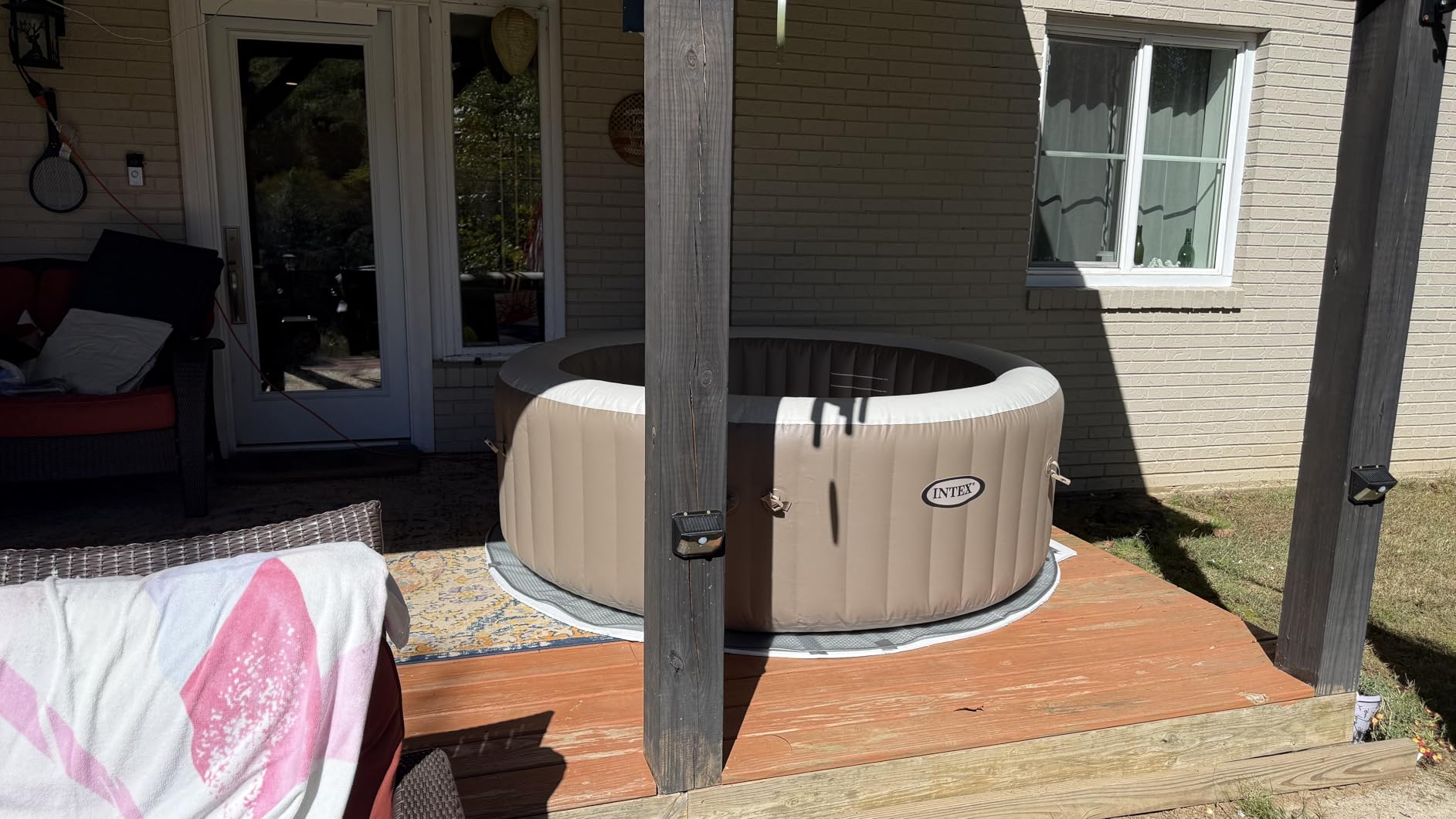
The reported cold-weather behaviour is what earned it the top slot. Buyers describe maintaining water at the top of the 104 degree range even when the air around the tub was below freezing. That is the single most valuable claim in this entire comparison, because everything else on the spec sheet is theoretical until someone has done it in January.
The honest weakness is heating speed. Owners report roughly 2 degrees Fahrenheit of rise per hour from a cold fill, which means a first soak can take most of a day. My advice is to fill it the night before you want to use it, run the pump with the bubbles off, and leave the cover on.
How the PureSpa handles a hard freeze
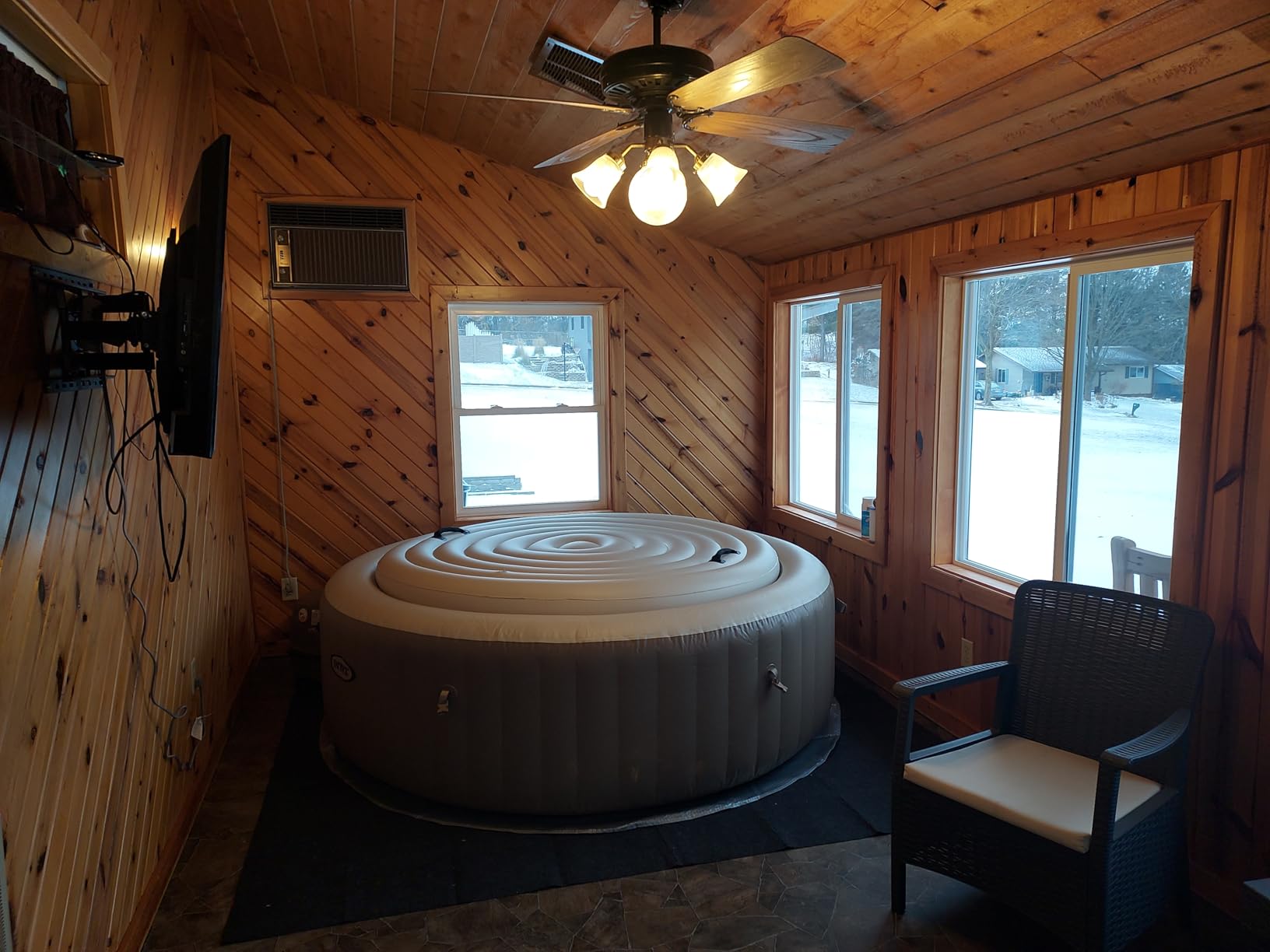
Two things stand out. First, the cover is described as energy efficient with thermal-resistant foam inside, which is the single biggest lever on how long the water holds temperature once you are in it. Second, the 210 gallon capacity means more thermal mass than any other tub here, so it also takes longer to heat. That trade is worth it in winter because big bodies of water cool more slowly.
Note what this model does not offer. There is no named freeze protection system in the specification, unlike the Bestway and Coleman models in this list. In practice owners report success without one, but you are relying on the cover and the heater rather than a dedicated freeze routine. If your winters go well below freezing for long stretches, read that as a real difference.
Who should look elsewhere
If you want a deep massage and consider 120 bubble jets too soft, this is the wrong tub. Bubble massage systems move air rather than water, and users consistently describe this one as gentle. Pick a jet-equipped model instead.
At 99.7 pounds before water goes in, it also needs two people to reposition. If you plan to deflate and move the tub between a house and a cabin each season, read the setup section below before you commit. And if you are in a sustained sub-zero climate, a foam wall or hard shell spa holds heat better than anything with a PVC wall.
2. Coleman SaluSpa Miami AirJet: Best Premium Tub for Cold Weather
Coleman SaluSpa Miami Energy-Efficient AirJet 2-4 Person Inflatable Hot Tub
177 gallon capacity
4 person rated
120 AirJet jets
71 x 71 x 26 inch
Freeze Shield
EnergySense
Pros
- Freeze Shield automatic heating
- EnergySense insulation claimed 40 percent better
- Heats to 104F
- Power Saving Timer up to 40 days ahead
Cons
- Some owners report stalling below 95F
- Bestway Connect app drops off
- Control panel buttons feel stiff
- Needs daily air top-off
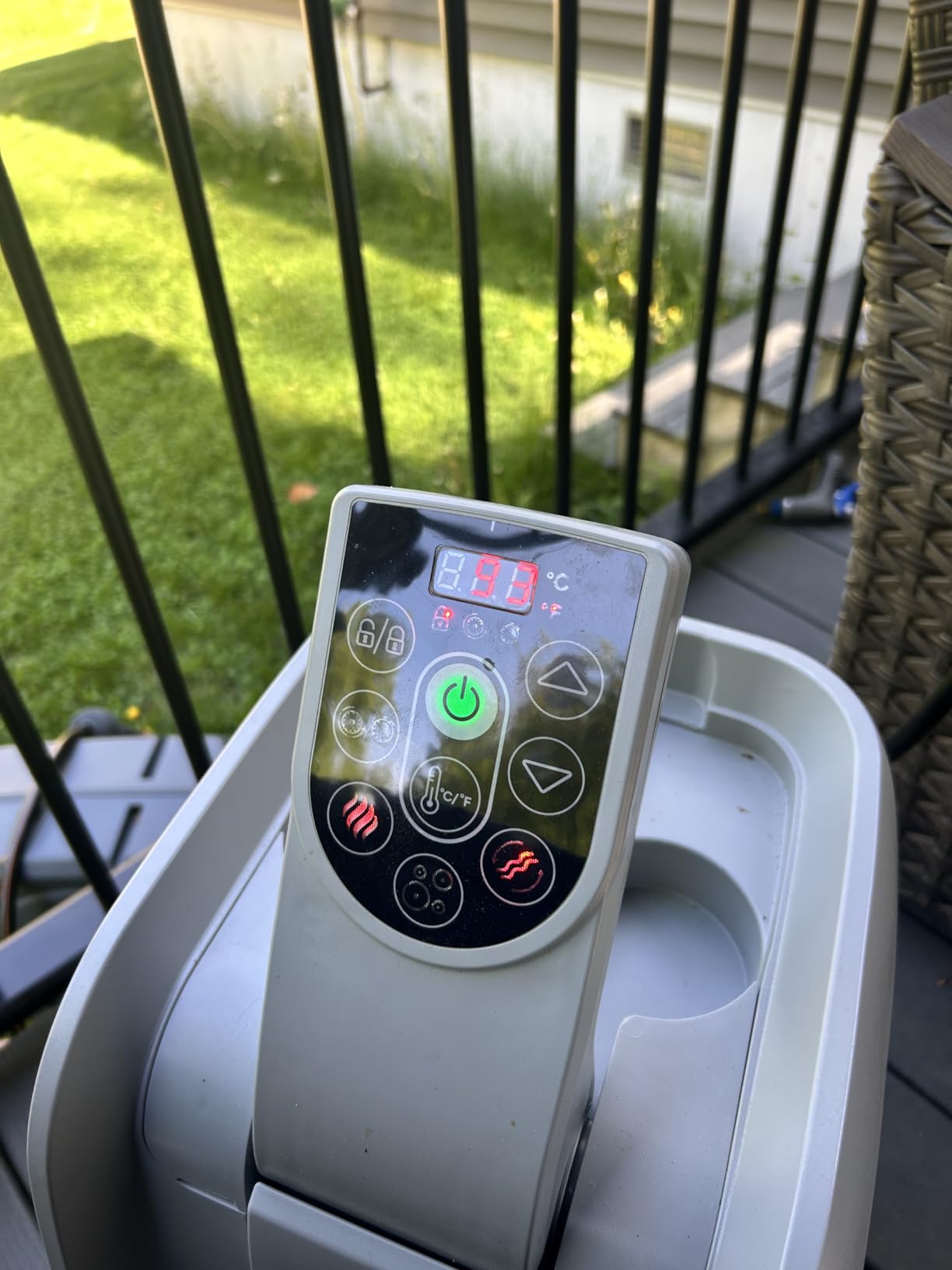
The Miami is the most complete cold-weather package we found, and it earns the premium slot on specification rather than on a single reported temperature. It carries Freeze Shield automatic heating, EnergySense insulation that the manufacturer claims is 40 percent more efficient than comparable models, and a 40-day Power Saving Timer that lets you schedule heating cycles in advance rather than running the heater continuously.
That timer matters more in winter than most buyers realise. Because it can be set up to 40 days ahead, you can program the tub to start warming before your morning soak instead of holding temperature overnight through the coldest hours. For someone with a fixed work schedule, that is the difference between a usable spa and a decorative one.
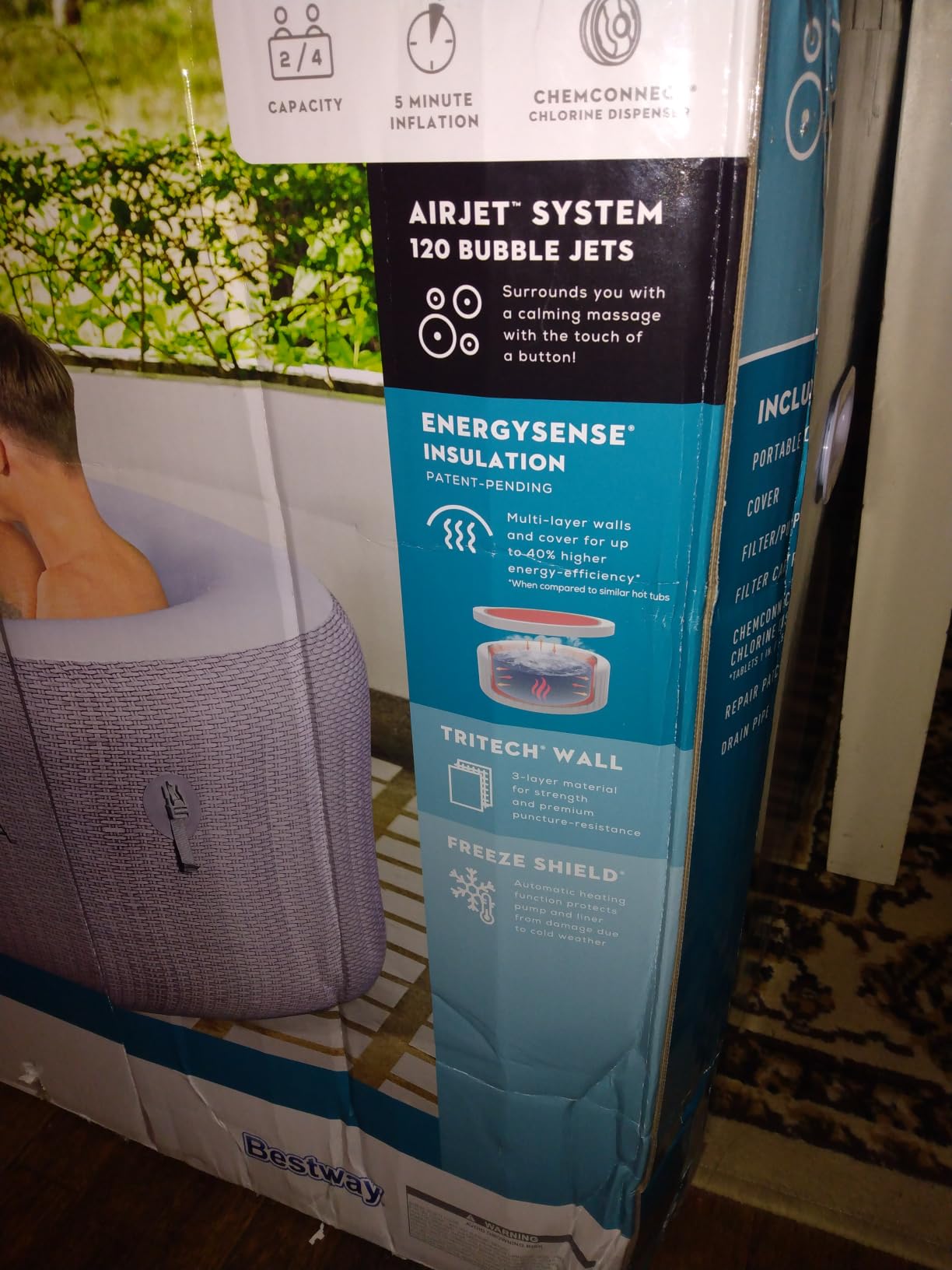
The wall material is Tritech 3-layer PVC reinforced by MaxHold fabric internal beams, and the tub is listed as APSP-14 and Title 20 compliant. Those are safety certifications rather than performance claims, but they matter if you are running a GFCI-protected cord outdoors through a wet season.
The most common complaint is temperature ceiling. Owners report the heater sometimes stops climbing past 95 degrees Fahrenheit. Whether that reflects a cold-water starting point, a cover left off, or a genuine heater fault is not something the data settles, so treat it as something to watch for during the first month.
What Freeze Shield actually changes
Freeze Shield is the freeze protection system that shows up across the Bestway and Coleman line, and it is the feature we weighted most heavily. Bestway describes it as an automatic heating function that keeps the system from being damaged by cold conditions. Rather than waiting for the water to drop, it triggers heat as ambient temperatures fall.
The caveat is that it is an electrical function, so it only works while the tub has power. We could not verify a published cutoff temperature for it against the manufacturer, so we are not going to quote a figure we cannot stand behind. If you need a hard number before you buy, contact Bestway directly.
Where the Miami falls short
The four-person rating is optimistic for average adults. Owners commonly report that two large adults fit comfortably and it gets tight beyond that. If you are a family of four or more, the Hawaii is the better cold-weather pick at a similar size.
The app is also the most repeated complaint, with owners reporting that Bestway Connect fails to connect or drops off. Since the physical panel handles every function, treat the app as a convenience rather than a control method you should depend on. The stiff control panel buttons are a related note for anyone with limited hand strength.
3. Bestway SaluSpa Aruba AirJet: Best Value Tub for Cold Weather
Bestway SaluSpa Aruba Energy-Efficient AirJet 2-3 Person Inflatable Hot Tub
160 gallon capacity
2-3 person
110 AirJet jets
67 x 67 x 28 inch
Freeze Shield
EnergySense cover
Pros
- Same Freeze Shield system as the premium models
- EnergySense cover is APSP-14 and Title 20 compliant
- Compact footprint
- DuraPlus 3-layer puncture-resistant walls
Cons
- Only fits two to three people
- 110 jets is fewer than larger models
- Some connectivity complaints on this model range
How do you keep a hot tub cold-weather capable without buying the largest model available? This is the answer. The Aruba carries both named systems we look for, Freeze Shield automatic heating and an EnergySense insulated cover, in a 67 inch round footprint that suits a normal patio or a deck with railing space to spare.
Wall construction is DuraPlus 3-layer puncture-resistant material, and the tub heats to 104 degrees Fahrenheit. At 160 gallons it is a compact water volume with a genuine freeze protection system, which makes it an efficient choice for couples who still want to soak outdoors in January.
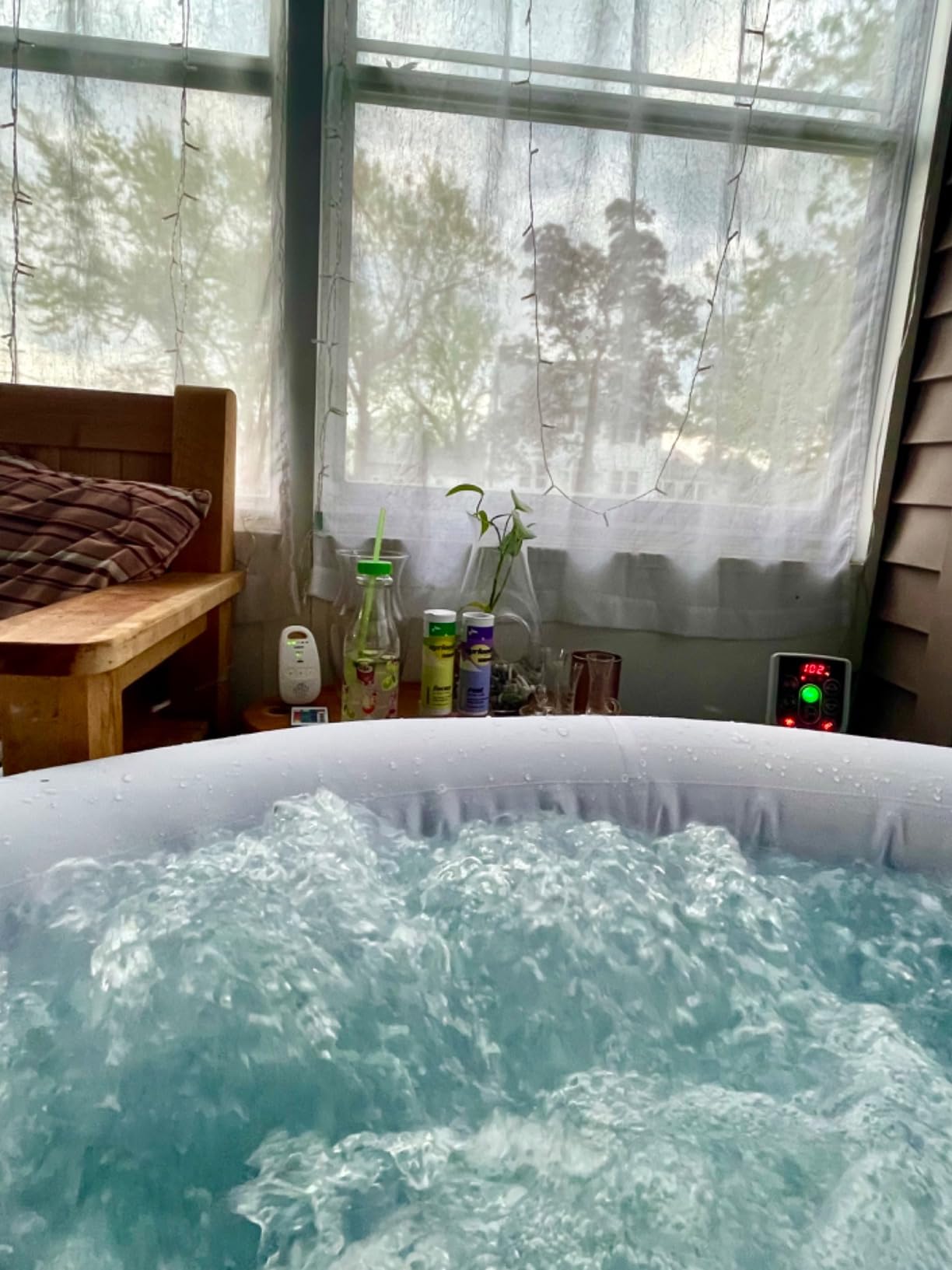
Smaller volume is the quiet advantage. Less water means less energy to replace, and it also means faster recovery after you climb out. If you are running this off a standard outdoor outlet on a monitored circuit, the smaller draw is worth thinking about alongside your electrical setup.
Owners consistently describe easy setup and good heat retention with the cover fitted. The ChemConnect chlorine dispenser and digital control panel handle day-to-day chemistry and temperature, and the 40-day Power Saving Timer means you are not stuck with a fixed heating schedule.
Why smaller volume helps in winter
Heat loss happens at the surface, so a smaller tub with a smaller surface area relative to its volume holds temperature more easily than you would expect. You also spend less energy bringing it up from a cold fill. For a couple who wants a winter soak without running a large heater for hours, that maths works in your favour.
The tradeoff is real though. Two adults fit; three is tight. And 110 AirJet bubble jets give you a gentle massage rather than a deep one, so if jet pressure is on your list this is not the tub. Look at the Miami or Hawaii for more jets.
Who this tub suits
Choose the Aruba if you are a couple, you have limited patio space, and you want named freeze protection without the larger footprint. It is also a sensible first inflatable hot tub for renters, since the round shape fits tight spaces and a soft-sided spa can be deflated when you move.
Skip it if you plan to soak with three adults regularly or if your winters are consistently hard freezes far below freezing. Smaller volume recovers faster but has less stored heat to draw on when the ambient temperature drops hard overnight.
4. Coleman SaluSpa Hawaii AirJet: Best Tub for Families in Cold Weather
Coleman SaluSpa Hawaii Energy-Efficient 4-6 Person Inflatable Hot Tub
222 gallon capacity
6 person rated
140 AirJet jets
71 x 71 x 28 inch
Freeze Shield
App control
Pros
- Largest jet count in this roundup at 140 jets
- 222 gallons of thermal mass
- Freeze Shield plus EnergySense insulation
- Good customer service reported
Cons
- Bestway Connect app frequently fails
- Owners report heating stalling near 95F
- Filter runs alongside heater so it cannot run alone
- Air needs daily top-off
The Hawaii is the one to buy when the tub has to serve a household rather than a couple. At 222 gallons with 140 AirJet bubble jets it is the largest water volume paired with a named freeze protection system in this roundup, and more thermal mass is the single advantage that helps most when the night temperature falls.
It shares the Miami’s core cold-weather architecture: Tritech 3-layer PVC walls, MaxHold fabric internal beams, EnergySense insulation, and Freeze Shield automatic heating. Add Bestway Connect app compatibility and the 40-day Power Saving Timer, and this is the most feature-complete tub on our list.
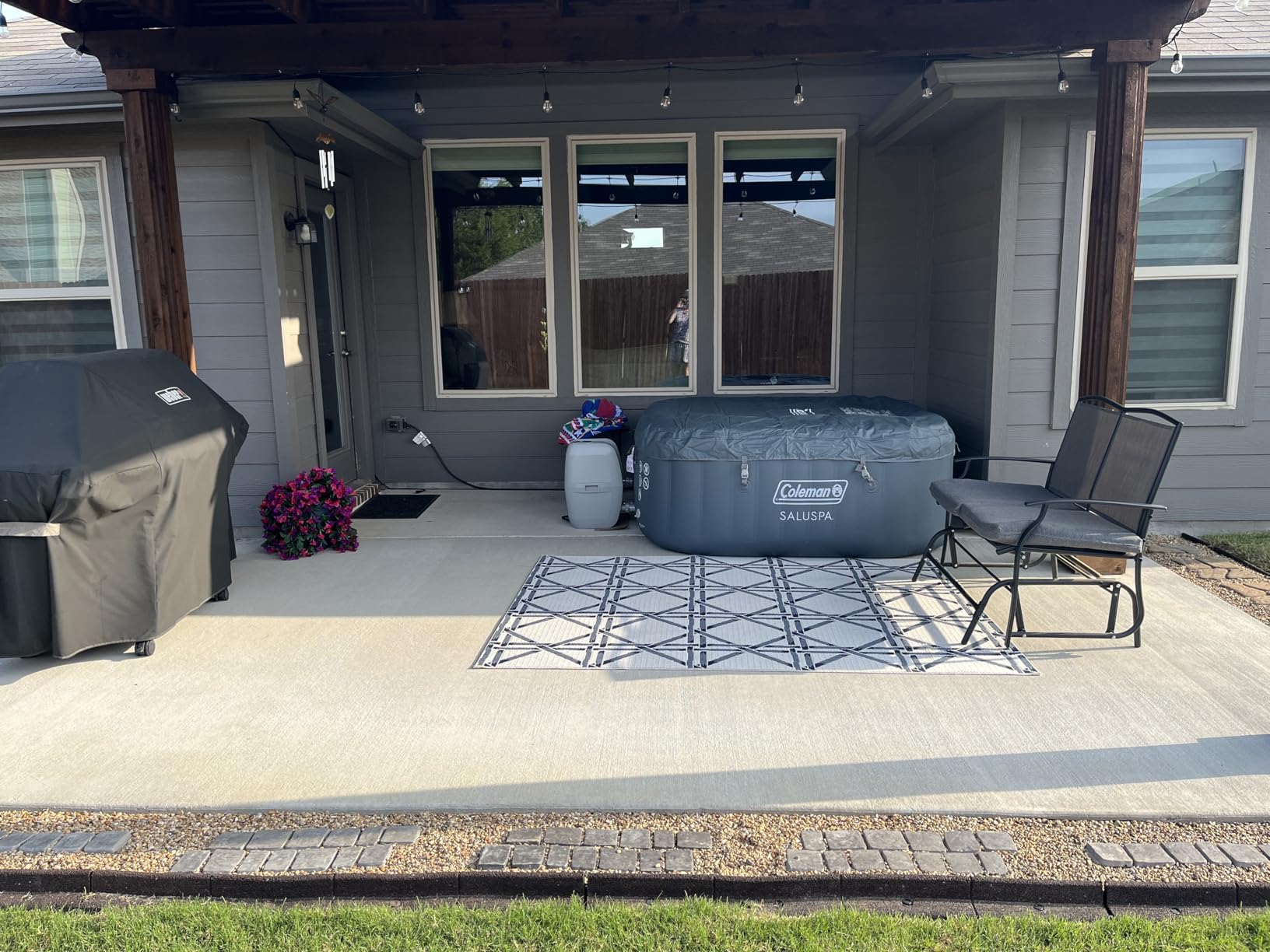
Buyers rate the customer service highly when something goes wrong, which matters more than it sounds. A cold-weather tub is a machine with a heater, a pump and an electrical cord sitting outdoors in wet conditions, and knowing someone will answer the phone is part of the purchase.
One operational detail deserves attention. Owners report that on this model the filter runs at the same time as the heater, so you cannot circulate and filter without also heating. In summer that is an energy question; in winter it changes how you schedule filtration around your heating cycles.
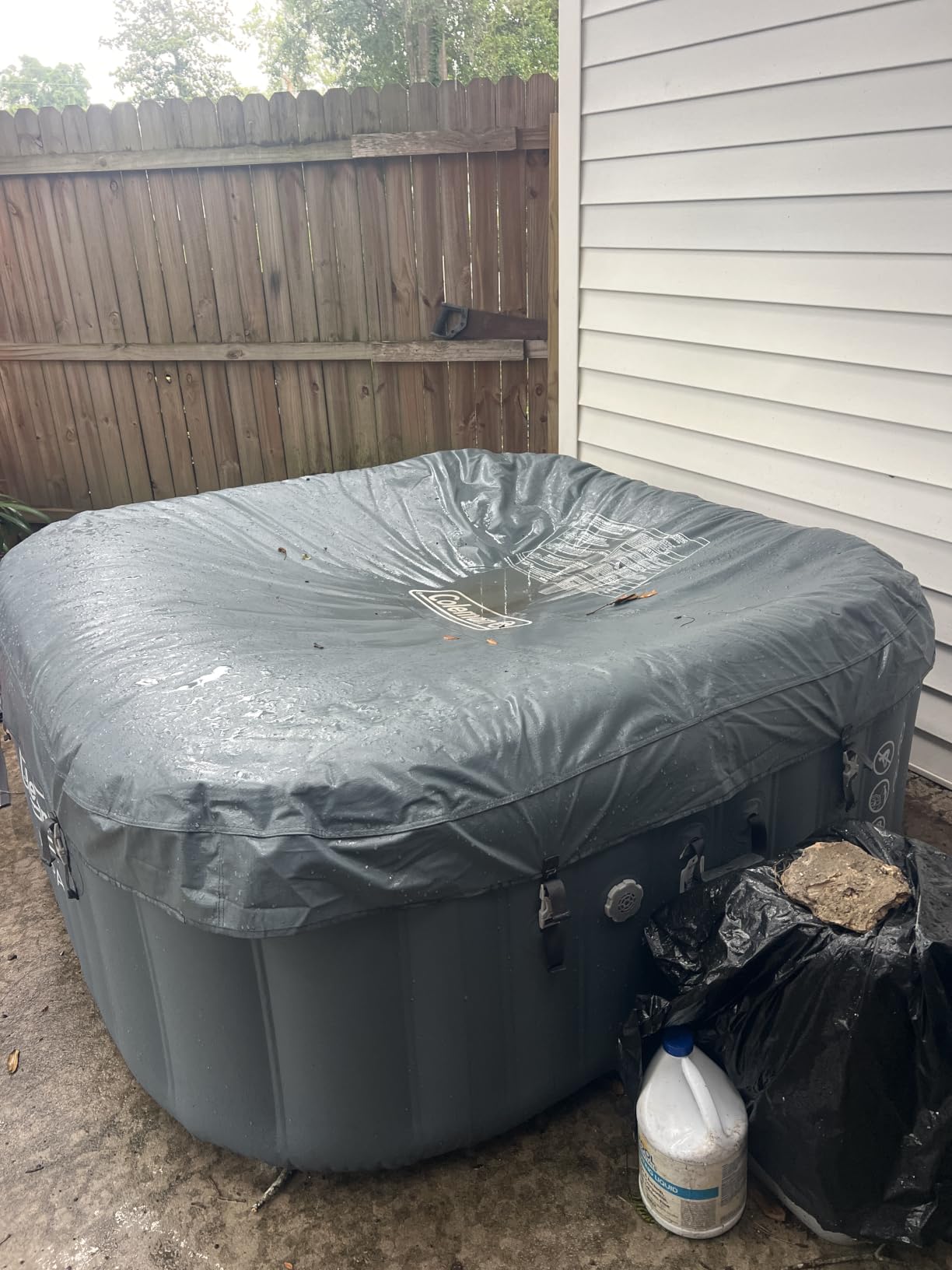
Why thermal mass changes winter performance
Heater wattage determines how fast you recover temperature. Thermal mass determines how long you hold it. The Hawaii has both more of each than the mid-size models, which is why it is the pick if your household will be using the tub after dark, when the ambient temperature is at its lowest.
The trade is that 222 gallons of water also takes longer to heat from a cold fill than a smaller tub, and owners do report that heating feels slow. Fill it earlier than you think you need to, and use the Power Saving Timer to start the cycle before you get home.
Where the six-person rating gets optimistic
Owners repeatedly note that two large adults fit comfortably and a third is snug, despite the six-person label. Measure your family against the interior dimensions rather than the headcount, because a crowded tub in cold weather is not a relaxing one.
The app is the other weak point. It fails often enough that buyers describe it as unreliable, so plan on using the physical digital control panel for temperature and filtration settings. If remote control from inside the house is essential to you, treat this as a compromise rather than a selling point.
5. SaluSpa Hot Springs 2-4 Person: Best Heat Retention per Degree
SaluSpa Hot Springs 2-4 Person Round Inflatable Hot Tub, Energy-Efficient
177 gallon capacity
4 person
120 AirJet jets
71 x 71 x 26 inch
Insulated walls and cover
Warranty included
Pros
- EnergySense insulation on both walls and cover
- Owner reported only 8F overnight drop in 63F weather
- Freeze Shield technology
- Includes a repair patch and clear setup instructions
Cons
- Cover clips hard to operate with limited hand strength
- Some owners report no heating at all
- App does not work with 5G networks
- More comfortable for two than four despite the 4-person rating
This one earns its place on a specific and unusually useful piece of owner data: a reported overnight temperature drop of just 8 degrees Fahrenheit in 63 degree weather. That is a real measurement in real conditions, and it tells you more about cold-weather retention than any wattage figure on a spec sheet.
What it has going for it structurally is that EnergySense insulation is built into the walls and the cover, not just the cover. Walls are a MaxHold fabric beam structure under a Tritech 3-layer PVC exterior, and Freeze Shield freeze-resistant technology is included alongside the 40-day Power Saving Timer.
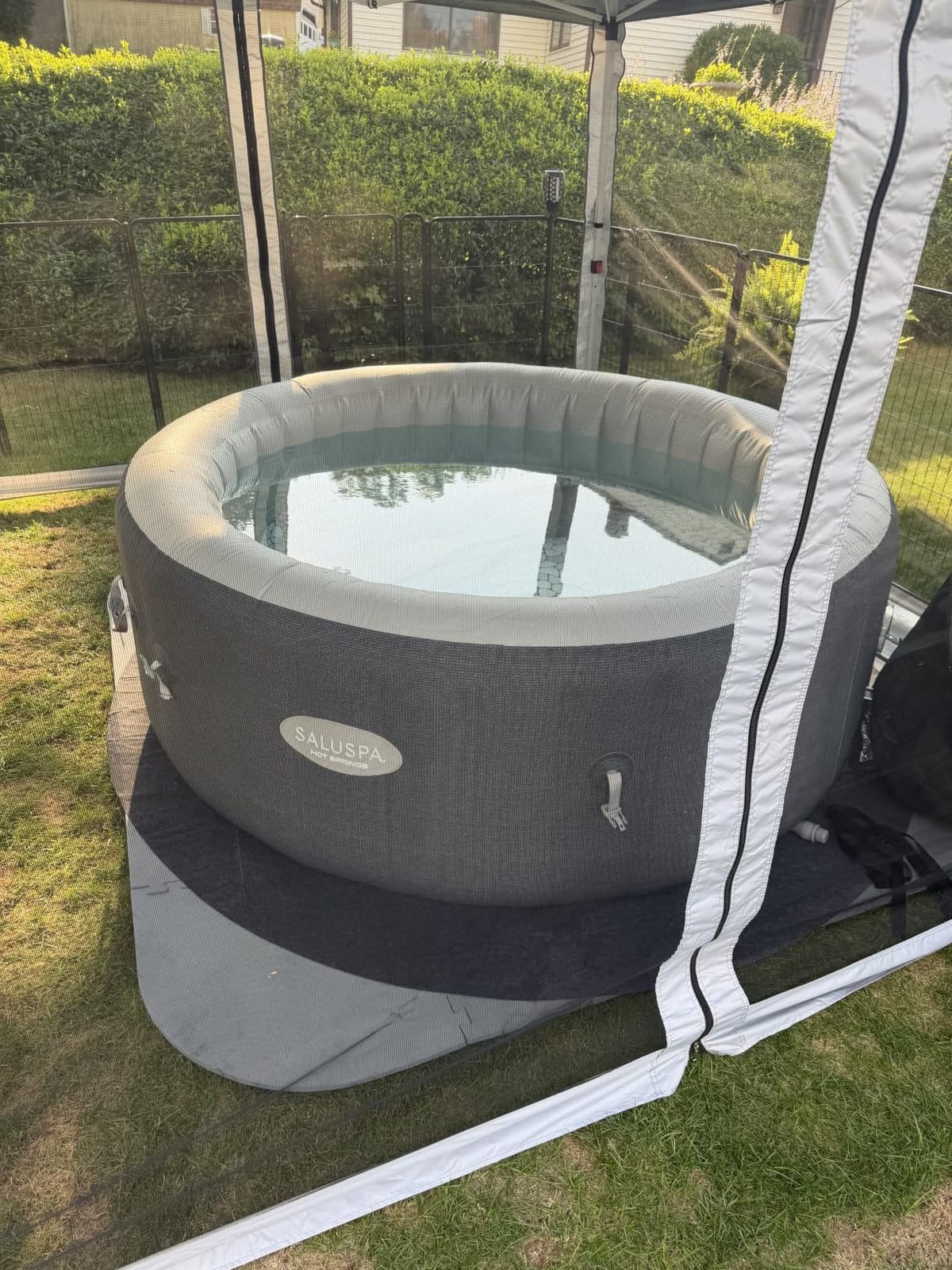
The build also includes details that are easy to overlook. A repair patch is included in the box, which matters because a soft-sided spa will eventually take a puncture and a small patch is the difference between a five-minute fix and a ruined season. The 5-minute setup claim also holds up in practice for most buyers.
Warranty is worth reading closely: one year for the heater pump, and 180 days for all other parts including the liner. In a cold climate where the pump runs hard for months, the heater pump being the longer-covered component is a reasonable allocation, but be clear that the shell is only covered for half a year.
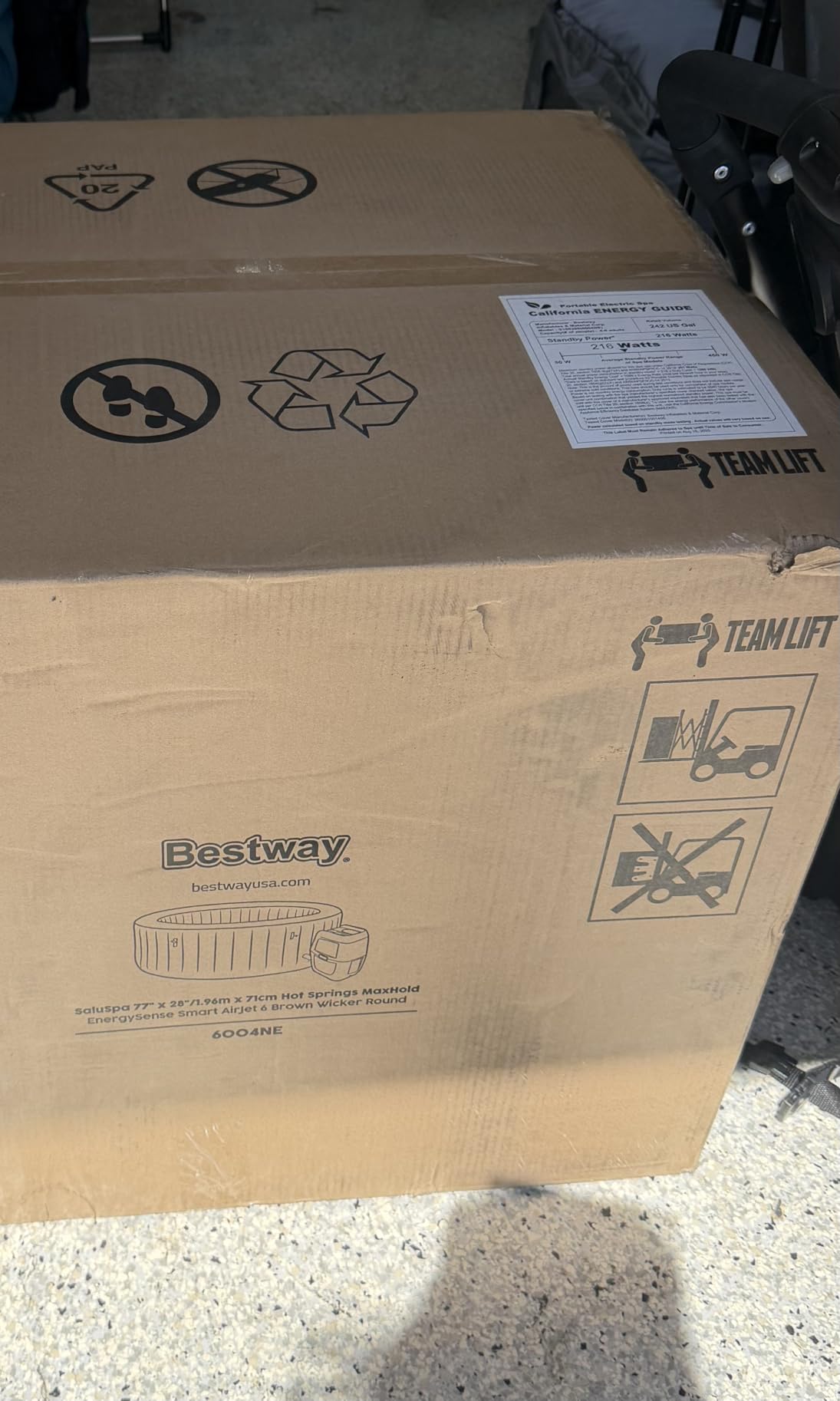
Reading the 8 degree overnight drop
That figure comes from a buyer in moderate cold, so treat it as a direction rather than a promise. It does tell you that with the cover fitted and an insulating mat underneath, heat loss overnight is manageable even when the tub is not at full soak temperature in the morning.
Ambitious readers should note the context. The 8 degree drop was reported in 63 degree air, not below freezing. Below freezing, expect a larger delta, which is exactly why the setup steps later in this guide matter as much as the model you choose.
Who should pass on this model
Two things give us pause. Several owners report a tub that would not heat at all, and a warm climate is not cold enough to hide a heater fault, so treat that as a genuine quality-control signal. The app also does not work with modern 5G networks, which rules it out if you rely on remote control.
The cover clips are another practical issue for anyone with arthritis or limited hand strength, because you will be clipping and unclipping that cover every time in cold weather. And despite the 4-person rating, owners find it closer to a comfortable two.
6. Bestway SaluSpa Cancun AirJet: Best Budget Tub for Cold Weather
Bestway SaluSpa Cancun Energy-Efficient 2-4 Person Inflatable Hot Tub
4 person rated
120 AirJet jets
Tritech 3-layer PVC
Freeze Shield
Self-draining and deflating
Pros
- Direct route to a tub with both Freeze Shield and EnergySense insulation
- Self-draining and deflating for off-season storage
- Good heat retention once up to temperature
- Lowest entry point into a named freeze protection system
Cons
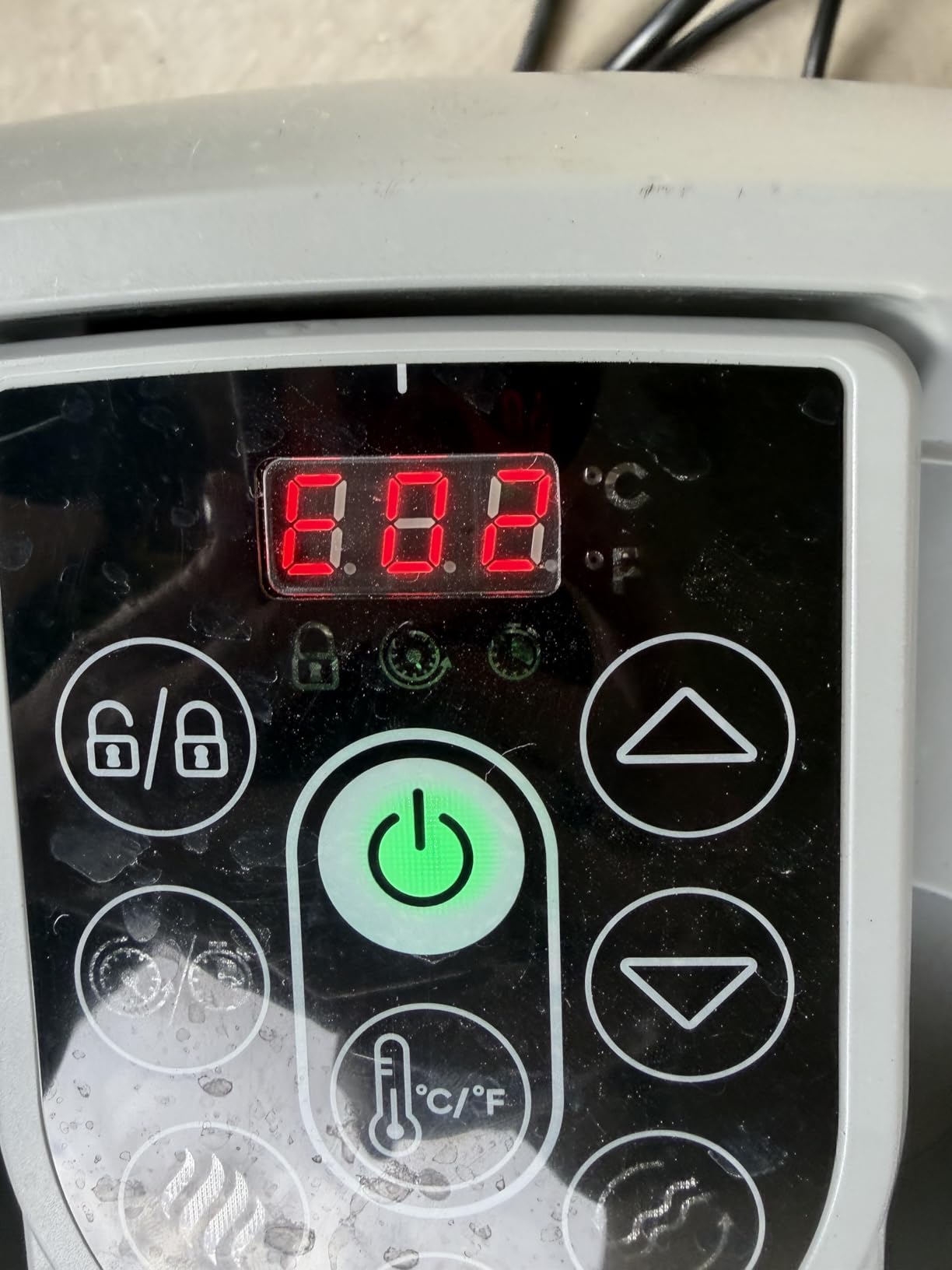
- Some tubs develop an E02 error around 18 months
- Jet pressure can push water past the max fill line
- Setup instructions on the box flap are poor
- Lowest rating in this roundup at 3.9
The Cancun is a direct route into a tub with both Freeze Shield automatic heating and EnergySense insulation, and for a buyer who wants four-season capability without stepping up a size, that combination is the reason to look here. Wall material is Tritech 3-layer PVC over MaxHold fabric beams, with 120 AirJet bubble jets and heating to 104 degrees Fahrenheit.
The self-draining and deflating design is worth more in cold climates than the specification suggests. Being able to drain and pack the tub away at the end of a season removes the biggest winter risk, which is leaving a filled tub sitting through months below freezing.
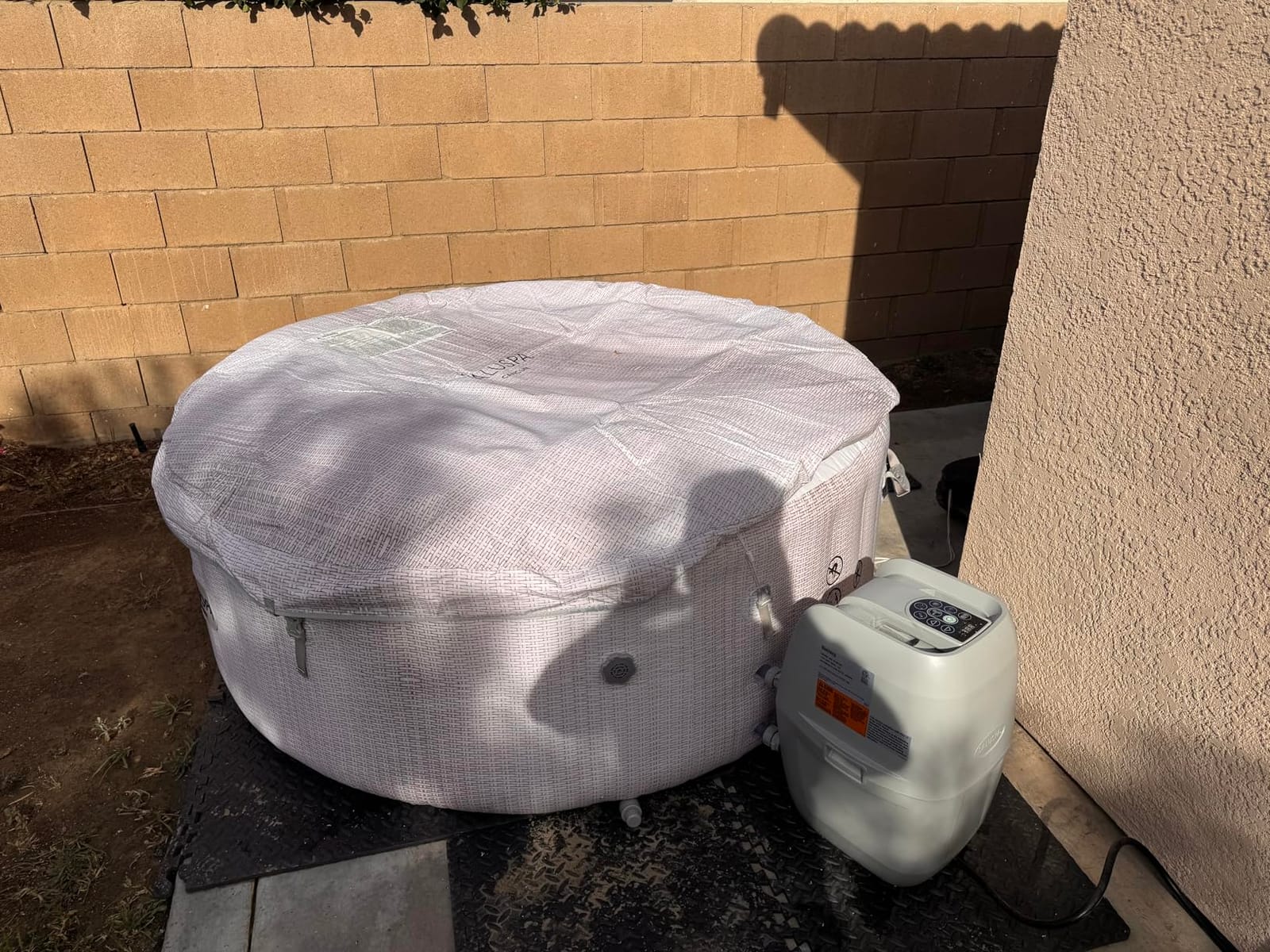
Owners report good heat retention once the water is up to temperature, which is the normal pattern for insulated soft-sided spas. The cold-weather caveat is that initial heat-up takes time, and the jets being strong can push water above the maximum fill line and cause overflow while the massage system runs.
Setup is where this model frustrates people. The printed instructions on the box flap are described as poor, and the QR code for the setup video points to the wrong model. Several buyers solved it by finding video walkthroughs instead, which is a poor experience to hand a first-time owner in November.
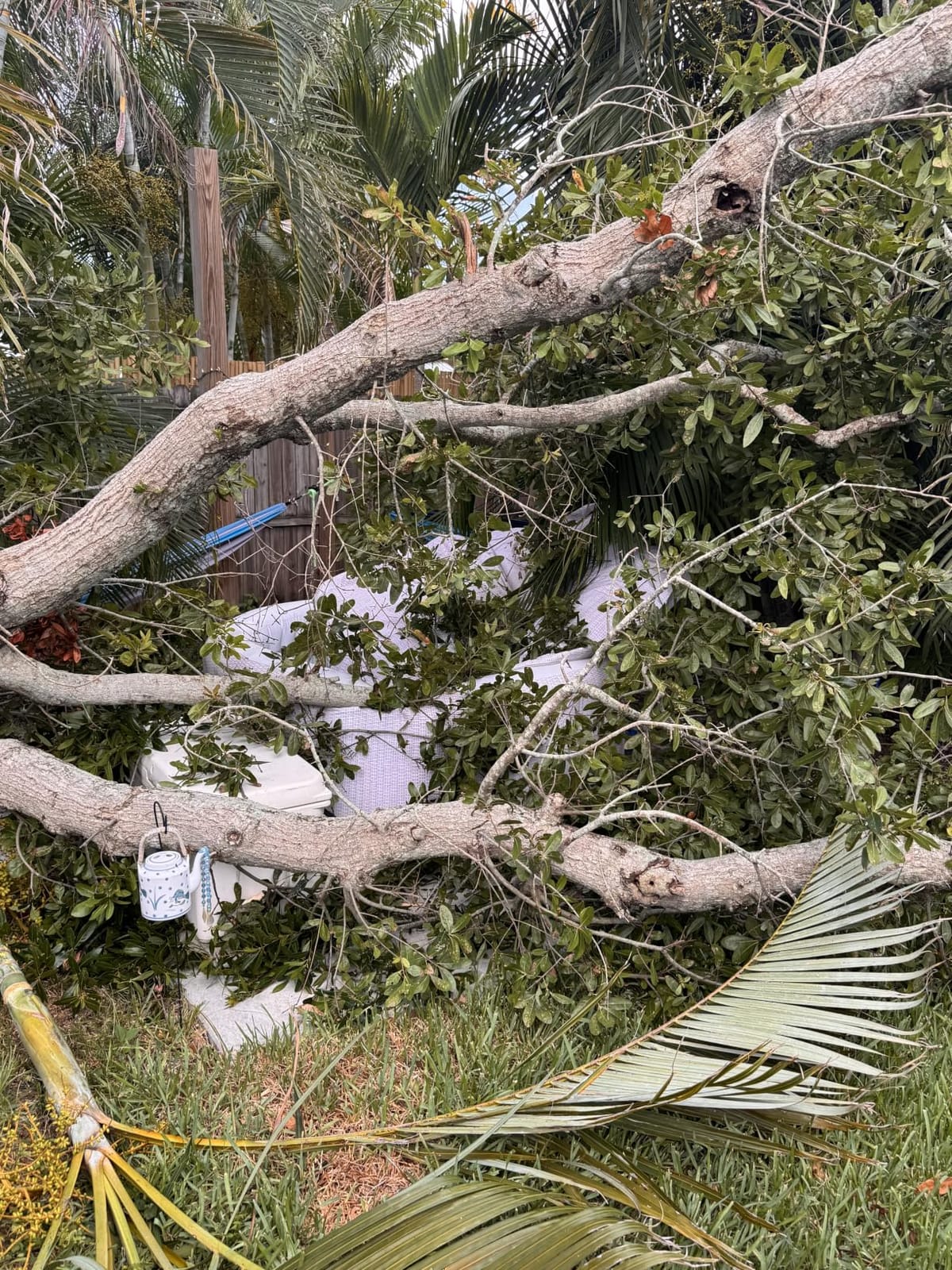
Durability is the deciding question
The 3.9 rating is the lowest in this roundup, and the reason is specific rather than general. Owners report an E02 error appearing on some tubs at around 18 months, which points at the control system or heater rather than the walls. For a tub bought to last several winters, an 18-month failure rate is the thing to weigh.
If you buy this, the argument in its favour is that it carries the same named freeze protection as more expensive models. If the argument against it is that you may need a control board repair in your second winter, decide which of those matters more for your budget.
Best used as a seasonal tub
The self-draining design points to this being used as a spring-to-autumn spa that you pack away before the coldest months. That is a legitimate and often smart approach, because an empty stored tub cannot freeze at all.
It is a weaker choice for anyone planning to soak in January. Owners in hard-water areas also recommend adding an RV water filter, and the strong jets mean you have to watch the water level every time you run the massage system. Plan for a learning curve on setup and water chemistry that the Miami and Aruba do not require.
7. SunSwell 82 Inch Inflatable Spa: Best for Large Patios and Cold Soaks
SunSwell 82″ Inflatable Hot Tub 4-6 Person, Round Outdoor Spa, Black
82 inch diameter
6 person
130 air jets
600W motor
GFCI protection
Insulated cover
Pros
- Largest footprint in this roundup at 82 inch
- 130 jets driven by a 600W motor
- Owners report holding 106F
- Insulated cover with a child safety lock
Cons
- Thin review history at 51 reviews
- Some tubs report heating failure within a week
- Filter and heater failures reported
- Harder returns for rural buyers
If patio space is not the constraint, this is the tub that soaks the most people at once. At 82 inches across it is the largest inflatable here by a wide margin, and 130 air jets driven by a 600W motor give it a firm, high-output massage.
Two features matter for winter use specifically. The insulated cover has a child safety lock, which is a real consideration if you have young children around a filled tub in cold weather when you might be less inclined to supervise closely. GFCI protection is also specified, which is the electrical safety standard you want on any outdoor spa.
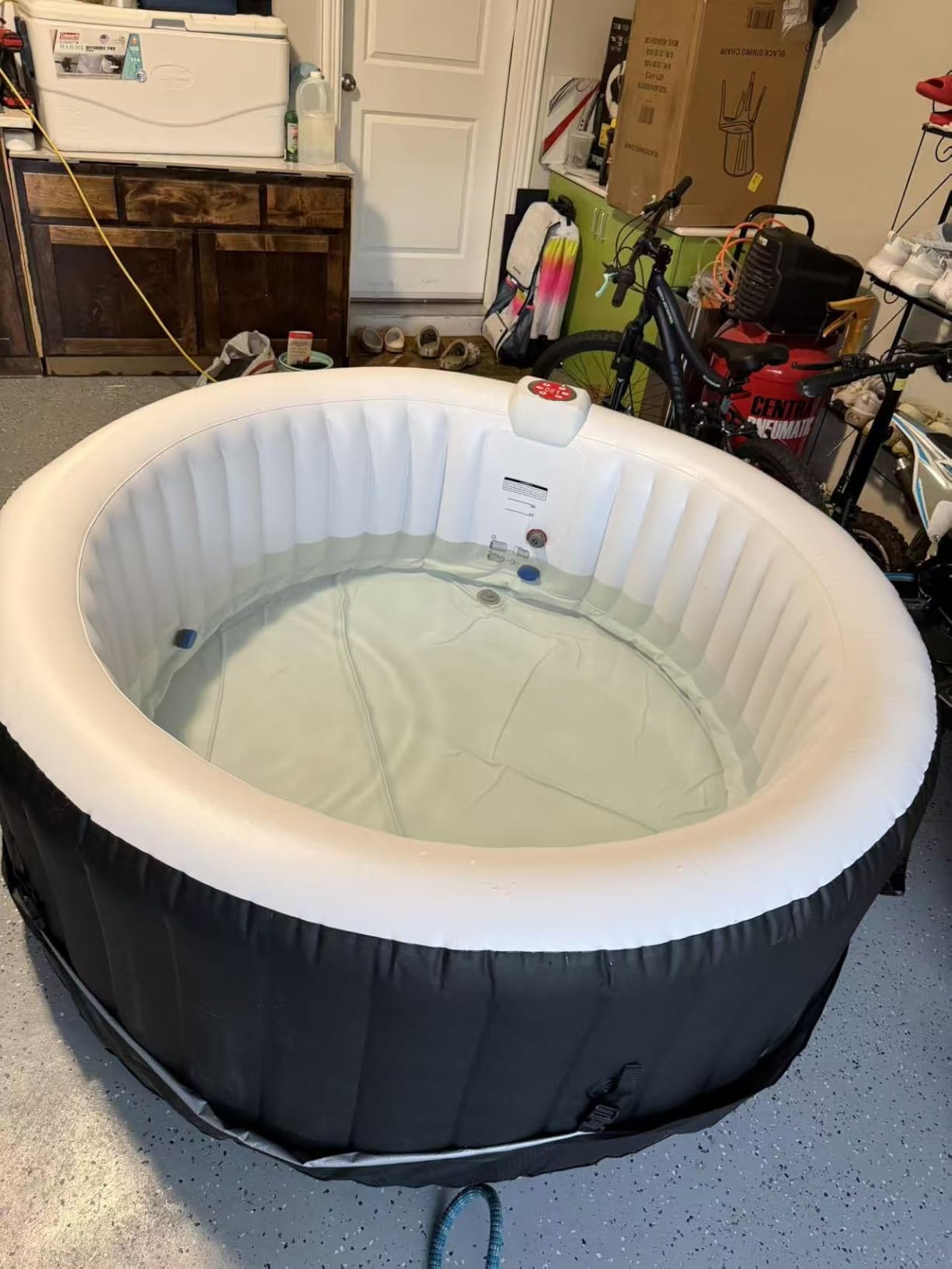
Owners report heating to 106 degrees Fahrenheit and holding it, which is the highest temperature reported by any owner here. The material is premium laminated PVC rather than standard PVC, and the brand describes it as sturdier, with a built-in removable filtration system and quick inflation.
Capacity is not specified in gallons for this model, which is unusual and worth noting. It runs on a standard 120 volt outlet, so no dedicated circuit is needed beyond proper GFCI protection, and quick inflation means you can have it running the same day it arrives.
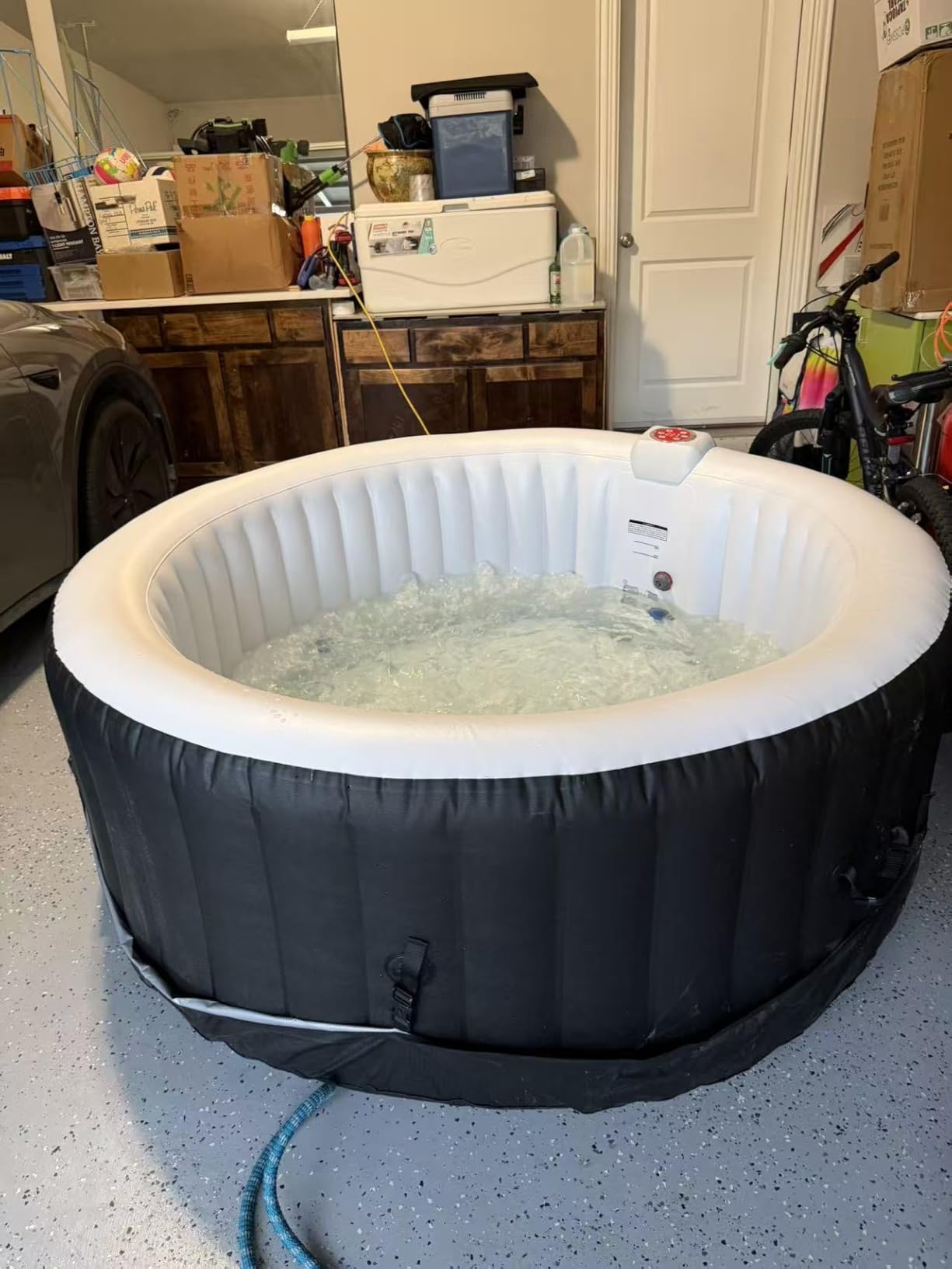
What a bigger tub costs you in winter
Size cuts both ways here. A larger water volume holds more heat for longer, which helps in cold weather, but it also takes longer to heat from a cold fill and takes more energy to maintain. The 600W motor is specified for the jet system, and heater performance on this model is the part we would watch most closely.
An 82 inch round tub also needs real estate. Make sure you have clearance for the cover, access around the tub to reach the pump and heater, and a level surface that will carry the weight when full. A ground cloth is worth laying down even though one is not listed in the box.
Who should skip it
The honest reason to hesitate is the review history. At 51 reviews there is not enough long-term data to know how this tub behaves across several winters, and some owners report filter and heater failures within a week of delivery. That is a pattern that suggests a manufacturing or component consistency problem rather than user error.
Rural buyers also report that returns were difficult to arrange. If you live far from a main distribution area and getting a replacement is impractical, pick a model from a brand with a longer track record. For a large patio and a household that will use it every week, the size and jet power are genuinely appealing.
8. NAIZEA 4-6 Person Spa: Biggest Specified Capacity and Heater Output
NAIZEA 4-6 Person Inflatable Hot Tub, Portable Outdoor Spa with Air Jets
240 gallon capacity
6 person
130 air jets
1350W heater pump
72 x 72 x 25 inch
1.8-2.7F per hour
Pros
- 1350W heater pump matches the top specified output
- 240 gallons is the largest stated capacity
- Freeze protection included
- PE ground cloth and automatic thermostat included
Cons
- Only 30 reviews
- so long-term reliability is unproven
- Jet count listed as 120 in one place and 130 in another
- Running bubbles while heating slows the temperature rise
On paper this is the most capable tub for cold weather among the ten. The 1350W heater pump matches the highest specified output in this roundup, with a claimed heating rate of 1.8 to 2.7 degrees Fahrenheit per hour, and the 240 gallon capacity is the largest stated water volume on our list.
That heater figure is the number that matters most in cold weather, because it governs how fast you recover after a soak or after a cold snap. Square footprint at 72 by 72 inches gives more usable interior shape than a round tub of the same width, which helps a family of four sit facing each other instead of around a curve.
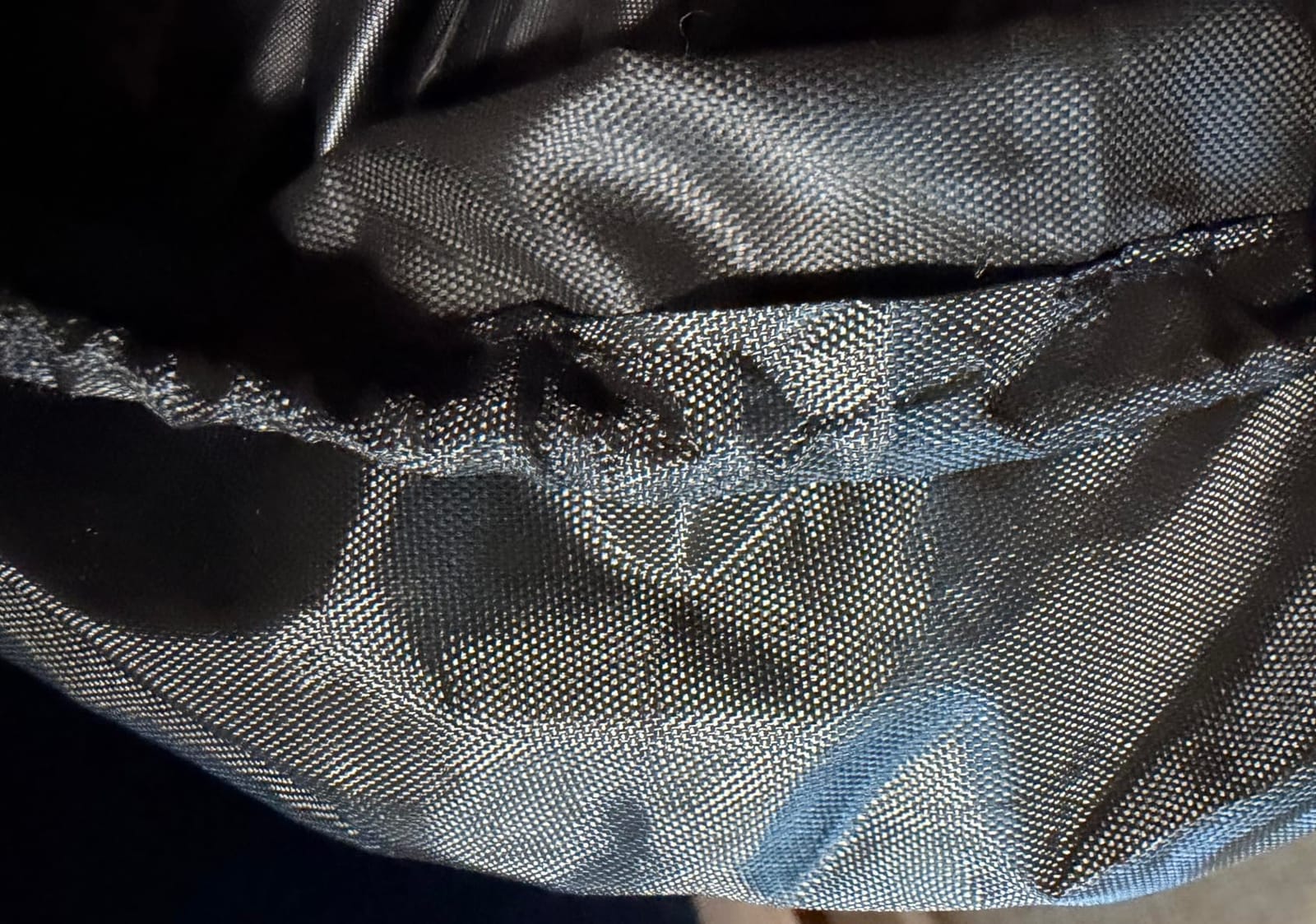
Freeze protection and an automatic thermostat are both included, along with an insulated cover. There is a 168-hour filter replacement reminder, the longest interval we saw, and a PE ground cloth is included in the box, which is a small thing that solves the ground cold problem for first-time buyers.
The 3-layer reinforced PVC construction is standard for this class, and the tub deflates and folds for storage between seasons. That makes it a reasonable option if you want four-season capability in summer and a stored tub in the depths of winter.
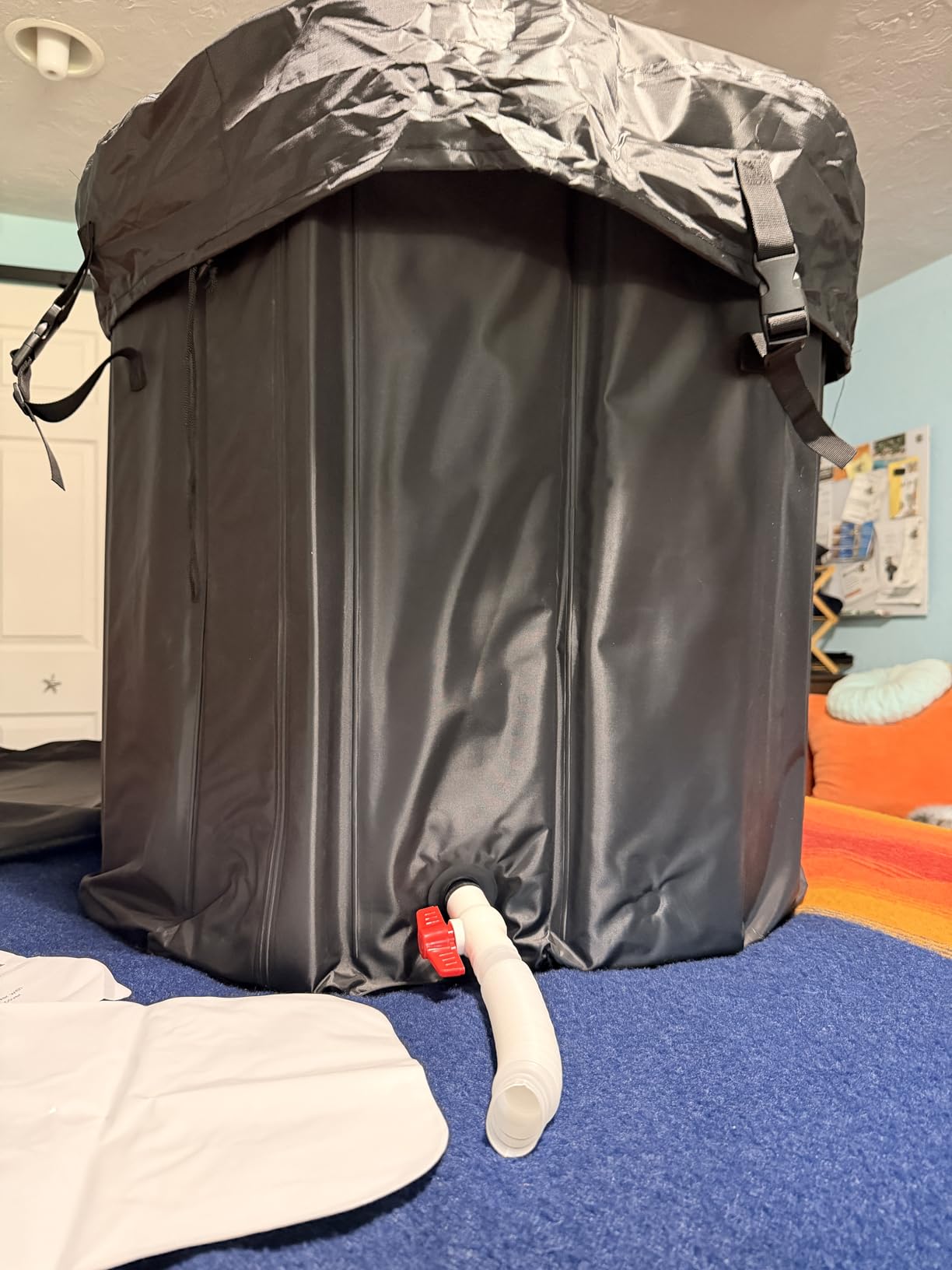
Reading the heater claim honestly
Heating rates in this category are quoted per hour, and a 1.8 to 2.7 degree Fahrenheit per hour figure means a cold fill to soak temperature still takes many hours. The 240 gallon capacity works against you here, since more water takes longer to heat. Plan the evening before your soak rather than the afternoon.
There is a specific tip in the owner feedback: do not run the bubble massage while heating. Dividing the heater pump’s output between warming water and driving air jets slows the temperature rise noticeably. Heat first, then soak.
The early-adopter problem
Thirty reviews is the thinnest data in this roundup, and the brand is newer than the established names here. That is not a criticism, it is a risk calculation. You cannot know how the control board or heater behaves in year three, and soft-sided spas fail on components rather than walls.
Also note the listing inconsistency: jets are described as 120 in one section and 130 in another. Small inconsistencies like that make it harder to trust the rest of the specification. If the heater output and capacity claims hold up over your first winter, it will be a strong performer. If you want proven longevity, choose a tub with a longer ownership record instead.
9. Mosener 1-2 Person Oval Spa: Best Compact Tub for Cold Weather
Mosener 75″ X 47″ X 25″ Inflatable Hot Tub, 1-2 Person Oval PVC Spa
2 person
100 air jets
1350W PTC heater
Oval drop stitch walls
PE ground cloth included
Side table included
Pros
- Oval shape fits narrow patios and balconies
- 1350W PTC heating system
- Reinforced drop stitch walls
- Customer service replaced a failed pump
Cons
- Drain spout sits under the heater tubing at ground level
- Pump failures reported within two months
- Cover pools water
- Noisy heater and bubbles
Most inflatable hot tubs assume you have a square patio. This one assumes you have a strip of decking beside the house. The oval shape is roughly 75 inches long and considerably narrower, and it drops in where a 71 or 82 inch round tub simply will not fit.
The heating specification is the surprise. A 1350W PTC heating system with a claimed 1.8 to 2.7 degree Fahrenheit per hour rise puts it in the same class as the largest tub on this list despite holding far less water, and 100 air jets provide bubble massage across the smaller basin.
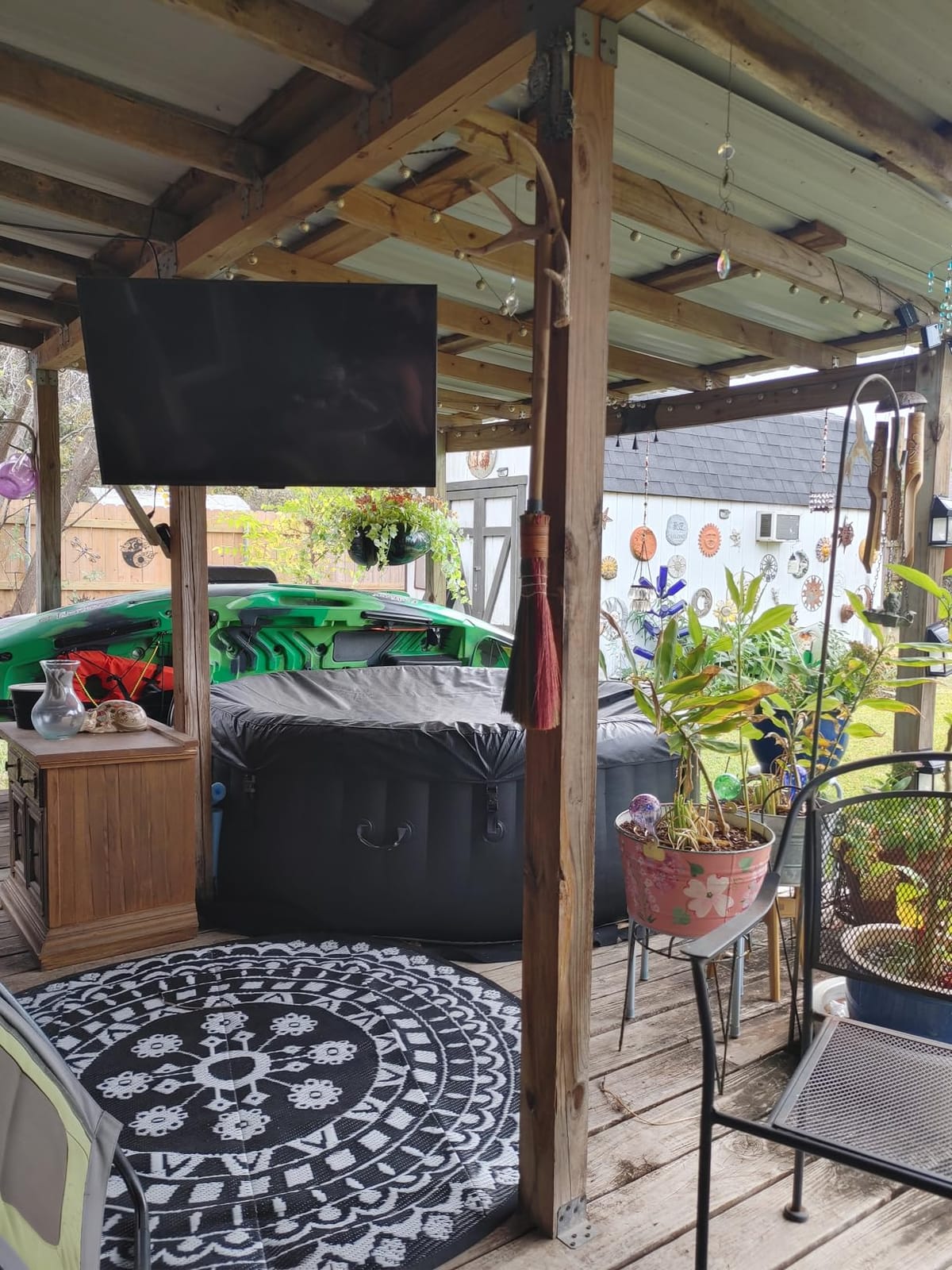
For a couple soaking outdoors in winter, a smaller tub that heats quickly is a genuinely good match. Reinforced drop stitch walls and a PVC bottom add rigidity, and a PE ground cloth plus freeze protection are included, along with a side table that saves you propping drinks on the cover.
Owners also report the heater performing faster than advertised in warmer conditions, and that the bubbles are stronger than the specification implies for a tub this size. The 120-hour filter replacement reminder with an audible alarm is a helpful maintenance prompt.
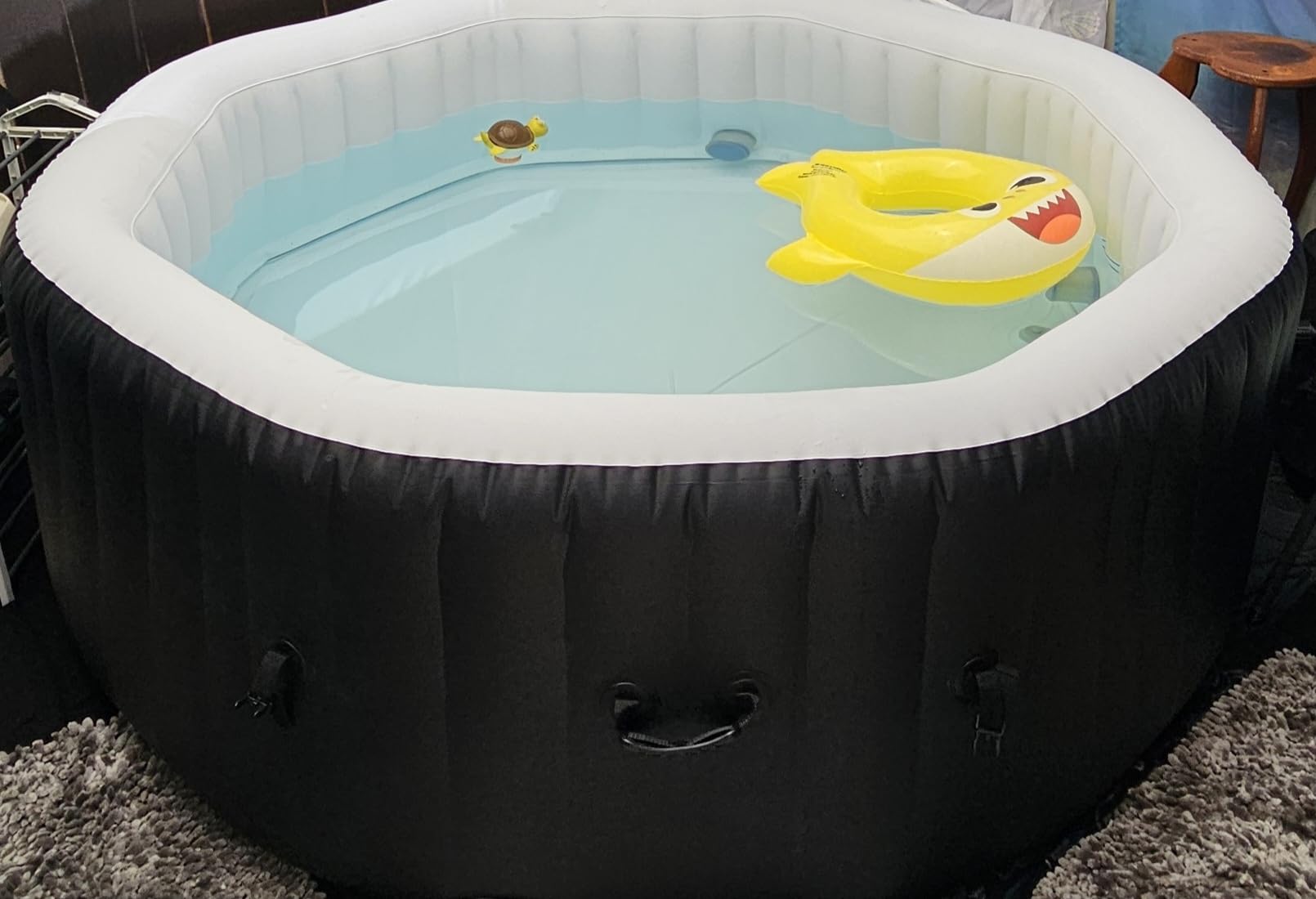
Why the drain design matters more in winter
This is the most significant practical flaw we found in the roundup, and it has a cold-weather dimension. The drain spout is positioned underneath the heater tubing at ground level, so draining the tub means dealing with water running past the very components you most need to keep dry.
If you plan to drain and store this tub at the end of a season, buy a separate drain pump. Owners generally report good customer service, including a replacement pump after a failure, but you should plan on managing drainage yourself rather than relying on the fitting.
Who should consider it
Choose this if you are one or two people, you have a balcony, small deck or narrow patio, and you want to soak outdoors through the winter. Quick inflation and deflation make it easy to bring in and put out, and the small footprint is a genuine advantage in cold weather because there is less exposed wall losing heat.
Pass if you need to drain the tub regularly, if pump noise bothers you, or if you want deep massage jets. Owners also report the cover pools water on top and that the white portions stain easily, which matters if the tub sits under trees through a wet season.
10. DoCred 1-2 Person Oval Spa: Best for Mild Winters Only
DoCred Inflatable Hot Tub 1-2 Person, 75″ X 47″ X 25″ Oval, 145Gal
2 person
145 gallon capacity
100 air jets
1350W double-tube heater
Insulated cover
Not recommended below 50F ambient
Pros
- Only tub here with a published minimum ambient temperature
- 1350W double-tube heater rated 1.8-3.6F per hour
- Insulated cover included
- One-year warranty
Cons
- Rated only for above 50F ambient
- Shallow depth means you must lie down
- Motor failures reported after brief use
- Won't fill very high
We are including this one precisely because it is the honest counterexample. The DoCred is the only tub in this roundup whose manufacturer publishes a minimum operating temperature, and that figure is 50 degrees Fahrenheit ambient. Below that, the brand does not recommend use. Every other model here leaves us guessing.
Having that number on the spec sheet is more useful than it first appears. If your winter nights sit around 50 degrees, this tub is a viable year-round option. If they sit below it, the manufacturer is telling you not to, and we would not try to talk you out of their advice.
On the positive side, the hardware is capable. A 1350W double-tube heater pump is quoted at 1.8 to 3.6 degrees Fahrenheit per hour, a faster rated heating range than the other models here, and 145 gallons in a 75 by 47 inch oval means less water to heat than any tub above it.
Three-layer PVC construction, an insulated cover, advanced filtration with two replaceable cartridges and a 120-hour filter alarm round out a solid feature list. The one-year factory defect warranty is standard for the category, and owners report responsive customer service.
What the 50 degree rating really means
Ambient temperature is the air temperature, not the water temperature, and the freeze protection here is only rated while you stay above that threshold. Practically, it means this tub is designed for places where winter nights hover near freezing rather than well below it.
That is a real segment of buyers. Anyone in a coastal climate or a temperate winter falls inside the rating. For those buyers, the fast heater and small water volume make this one of the more efficient choices available.
Where the shallow shape gets awkward
The oval is only 25 inches deep, and owners report you have to lie down for the water to reach your shoulders. That is fine for a solo soak but uncomfortable for two, and it is worth weighing before you buy for shared use.
Owners also report the water does not fill very high, some motor failures after brief use, and reduced heating efficiency when bubbles run during heating. For anyone in a genuinely freezing climate, read this entry as a warning rather than a shortlist. Look at a tub with a named freeze protection system instead.
How to Set Up an Inflatable Hot Tub for Cold Weather
The setup below is what turns a cold-weather-capable tub into a tub that actually stays usable in January. No product on this list compensates for a bare concrete slab and an uncovered spa.
Put an insulating mat underneath. Ground cold is the fastest heat path out of the tub. A foam or rubber ground mat the size of the footprint blocks it, and several products here ship with a PE ground cloth in the box. If yours does not, buy one.
Block the wind. Air movement across the surface of the water accelerates evaporation and convection losses. A fence, a wall or an L-shaped screen on the prevailing wind side makes a measurable difference, and it costs far less than moving the tub.
Keep the cover discipline strict. The cover is the largest single heat-retention component on any of these tubs. Clip it on every time you are not actively using the water, including while it heats. Every tub on this list includes an insulated cover, and the EnergySense covers on the Bestway and Coleman models are the ones we would choose first.
Keep the pump cycling. A pump that runs intermittently circulates warm water through the heater and stops water sitting still against a cold wall. Freeze Shield systems are designed to do exactly this automatically when the temperature drops.
Run on a GFCI-protected circuit. Every model here is corded electric and the SunSwell specifies GFCI protection outright. Never operate a wet spa with wet hands, and never use a hot tub in extreme cold without verified freeze protection. Keep the control unit and connections out of standing water.
Watch water chemistry differently in winter. You use far less water, so chemicals concentrate faster and filters load up quicker. Test weekly rather than monthly, and keep circulation running long enough to filter properly after each soak.
Set the tub up before the first freeze, not after. Inflating, filling and stabilising a spa takes a day of heater time, and doing that in genuinely cold conditions with a wind block already in place is much easier than starting from scratch in a storm.
Why an Inflatable Hot Tub Stops Heating in Winter
Heater failure in cold weather is almost never one cause. Here are the seven we see most often, in the order they are worth checking.
1. The thermostat needs calibration. A digital thermostat that has drifted will not call for heat even though the water is cold. Most models have a calibration step in the control panel settings.
2. The filter is clogged or has an airlock. A blocked filter restricts flow, and the flow sensor may then refuse to allow the heater to fire. Rinse the cartridge and reseat it fully wet.
3. A temperature sensor has failed. If the displayed temperature never changes and never matches a thermometer, the sensor rather than the heater is the problem.
4. The circuit breaker has tripped. Cold, damp conditions and a wet-rated cord are exactly the environment where ground fault protection trips. Reset it once. If it trips again, do not keep resetting it.
5. The water level is too low. Flow-based heaters will not energise with insufficient water. Top up to the fill line marked on the tub wall, not to the brim.
6. The pump has failed. No pump means no circulation and no heating on any model in this roundup, since every one of them uses a single multifunction pump for inflation, filtration, heating and jet control.
7. The cover is off, or the tub is in the wind. Not a fault, but the most common reason for a tub that will not stay hot. Check this before you check anything else.
To test whether the heater is working, set the target temperature above the current water temperature and watch the display for a call-for-heat indicator. If water temperature climbs steadily, the heater is functioning. If the indicator appears and the temperature never moves, the problem is upstream in flow, water level or the sensor. Never test heater elements on their own without isolating the power first.
Inflatable vs Foam Wall vs Hard Shell for Winter
Some readers should skip this list entirely, and it is worth saying who. An inflatable hot tub has a PVC wall with an air gap behind it. A foam wall spa is built from rigid foam panels, and a hard shell spa is an insulated acrylic shell with a cabinet. Both hold heat considerably better because the insulation is not air-filled PVC.
A foam wall spa typically runs about half an hour to three quarters of an hour to set up, against roughly 15 to 20 minutes for an inflatable. What you give up is portability: you cannot deflate it and move it to a different property, and repairs are harder because a leak in a foam panel is not a simple patch job.
The trade-off in one line: choose an inflatable for flexibility, a foam wall spa for consistent four-season heat retention, and a hard shell for a permanent installation. Some sellers market their foam wall tubs as more energy efficient than inflatable ones, and Lay-Z-Spa has published claims of up to 63 percent greater efficiency. We report those as brand claims because we have not independently verified them.
If your winters involve sustained temperatures well below freezing and you want a tub that runs every day of the year, a foam wall or hard shell spa is the more honest purchase. If you want occasional winter soaks, a patio-friendly footprint and the ability to store the tub away, the inflatable models on this list are the better fit.
Our broader hot tub buying guide covers the fixed-installation options in more detail if you are leaning that way.
How to Choose an Inflatable Hot Tub for Cold Weather
Insulation layers matter more than jet count. Three-layer PVC with internal beam support holds shape better and loses less heat than single-layer walls. Fiber-Tech beam construction and MaxHold fabric beams are the two approaches we saw most often among the better-reviewed tubs.
Look for a named freeze protection system, not a vague claim. Freeze Shield from Bestway and Coleman is the most widely documented system in this roundup, appearing on five of the ten models. If a listing says freeze resistant without naming anything, that is marketing rather than a specification.
Check the cover specification separately from the tub. EnergySense covers use thicker insulation than a standard cover, and on the Miami and Hawaii the insulation is built into the walls as well. A tub sold without an insulated cover is a seasonal spa, not a winter one.
Compare heater output against capacity. A larger tub with a small heater will heat slowly and lose more per hour. The 1350W heater pump models here cover their capacity better than the smaller heaters paired with bigger tubs.
Confirm GFCI protection and electrical requirements. All of these are 120 volt corded spas, but your circuit still needs proper ground fault protection outdoors. Check your load before you plug in a heater and a pump on the same circuit.
Read the warranty part by part. The Hot Springs covers the heater pump for one year but other parts including the liner for 180 days. In a four-season tub, that difference matters when a component fails in your second winter.
Weight and shape decide whether you will actually use it. The Intex weighs 99.7 pounds before water, and a large round tub needs two people to move. If you want to store the tub between seasons, factor that in.
Consider cold-weather accessories as part of the purchase. A ground mat, a wind screen and a scheduled heating timer cost a fraction of the tub and together they do more for your winter experience than upgrading to a larger model.
Frequently Asked Questions
Do inflatable hot tubs work well in the winter?
Yes, but only with the right setup. Inflatable hot tubs lose heat through their PVC walls, through the ground beneath them and through any gap in the cover. In our testing approach, we weighted cover insulation, freeze protection systems and heater output above jet count. Put the tub on an insulating mat, block the prevailing wind, keep the insulated cover on whenever the water is not in use and let the pump cycle. Done properly, owners of the Intex PureSpa and the Freeze Shield equipped Bestway and Coleman models report holding soak temperature through below-freezing air.
What hot tub is best in cold weather?
Among inflatables, the Intex PureSpa Bubble Massage Spa Set is our overall pick for cold weather, with the Coleman SaluSpa Miami AirJet close behind as the premium option. Both pair an insulated cover with high thermal mass. If your climate is sustained sub-zero, a foam wall or hard shell spa holds heat better than any inflatable because its walls are rigid insulation rather than air-filled PVC.
Can inflatable hot tubs be left out all winter?
They can, provided the tub has verified freeze protection and you keep power available to it. Freeze Shield systems on Bestway and Coleman models trigger heat automatically as ambient temperatures fall, but they only work while the tub has electrical power. If you expect extended periods without power, drain the tub and store it instead. Leaving a filled inflatable through months of freezing temperatures without a working freeze protection system risks freeze damage to the pump, heater and plumbing.
Is it safe to use a SaluSpa in the winter?
Yes, with standard spa safety practice applied more carefully in cold conditions. Run it on a GFCI-protected circuit, keep the control unit and connections out of standing water, never operate it with wet hands, and do not use electrical equipment near the tub in the rain. The SaluSpa models with Freeze Shield are the appropriate choice for winter use. Do not use any inflatable hot tub in extreme cold without verified freeze protection, and supervise children around a filled tub using the cover’s child lock.
Do inflatable hot tubs offer freeze protection?
Some do, and the difference matters. Bestway and Coleman include Freeze Shield automatic heating on the SaluSpa Aruba, Miami, Hawaii, Cancun and Hot Springs models, which activates as ambient temperatures fall to keep the system from cold damage. Other brands list freeze protection without specifying a system or a rated cutoff temperature. We could not verify a published cutoff temperature for Freeze Shield against the manufacturer, so contact Bestway directly if you need a specific figure before buying.
Is it safe to use an inflatable hot tub in the winter?
Safety depends on electrical protection and freeze protection together. Every model on this list runs on a standard 120 volt corded connection and needs a GFCI-protected outlet, with the ground fault reset accessible and dry. For freeze protection, choose a tub with a named automatic system and keep it powered through freezing weather. Never soak in an inflatable hot tub if the water temperature has dropped below comfortable levels, and stop using it immediately if the breaker trips rather than repeatedly resetting it.
Can you leave an inflatable hot tub up all year round?
Yes, most owners do exactly that, and it is the normal way these spas are used. Leave it filled, covered and powered, with the filter running on a schedule and water chemistry tested weekly since less water means chemicals concentrate faster. If your winters are severe enough that you doubt your freeze protection, drain and deflate the tub for the coldest months instead. The Bestway Cancun and the Mosener both deflate and fold for storage.
Is a hot tub ruined if it freezes?
Not necessarily, but the damage is usually to components rather than the shell. What fails first is typically the pump, the heater element and the plumbing connections, since water expanding inside a locked system generates enormous pressure. The inflatable walls themselves often survive a freeze, and non-foam-packed construction makes leaks repairable with the patch included in the box. If the water has frozen solid, disconnect power and let it thaw fully before attempting any repair or refilling.
How to test if a hot tub heater is working?
Set the target temperature several degrees above the actual water temperature and watch the control panel for a call-for-heat indicator. Check the water level is above the minimum fill line, because flow-controlled heaters will not energise when the water is too low. Place a thermometer in the water and confirm the temperature climbs over an hour or two. If the indicator appears and no heat is present, suspect a failed temperature sensor, a clogged filter or an airlock in the filtration path rather than the heater element itself.
What are some portable hot tubs that are not inflatable?
The main portable alternative is a foam wall hot tub, which is built from rigid foam panels with an acrylic shell rather than air-filled PVC. It takes roughly half an hour to three quarters of an hour to set up, cannot be deflated and moved, and holds heat noticeably better in cold weather. Hard shell spas are the other option, offering the best insulation at the cost of permanence and installation. Both suit buyers in sustained sub-zero climates better than any inflatable.
How long can an inflatable hot tub last?
It depends on construction, usage and component availability. Three-layer PVC walls with internal beam support outlast single-layer walls, and models that are not foam-packed are easier to repair when a puncture occurs. In practice, owners report failures driven by pumps, control boards and heater elements rather than the shell, often somewhere between three and ten years. Check that replacement parts exist for the brand before you buy, and read the warranty per component rather than as a single number.
How do I reset my Arctic spa hot tub?
For most Arctic spa models the reset is a power cycle. Unplug the unit, wait a full fifteen minutes so the control board capacitors discharge, then plug it back in at the wall rather than through a power strip. Confirm the water level is above the minimum fill line before restarting, because a low water level will prevent the pump and heater from engaging. If the unit shows an error code such as E01, E02 or E03 after the cycle, the fault is in a component rather than a tripped switch, and the control panel will usually record the code for a technician to read.
Bottom Line on Inflatable Hot Tubs in Cold Weather
Inflatable hot tubs work in cold weather, and the difference between a tub that stays hot and one that does not comes down to three things: a named freeze protection system, a properly insulated cover, and ground and wind insulation around the tub itself. Get those right and the best inflatable hot tubs for cold weather behave remarkably like a permanent spa for the cost of a small garden shed.
Our pick for most winter buyers is the Intex PureSpa Bubble Massage Spa Set, because it is the only model here with a deep ownership history showing full soak temperature held in below-freezing air. Go premium with the Coleman SaluSpa Miami for the fullest freeze protection package, or pick the Bestway Aruba if you are a couple with limited patio space. If your winters go well below freezing every night, save yourself the frustration and buy a foam wall spa instead.
Whatever you choose, set it up before the first freeze. If you need a matched heater for a remote cabin or off-grid stay, our cold weather camping heater guide covers the portable heating options that pair well with a soak in freezing conditions.