
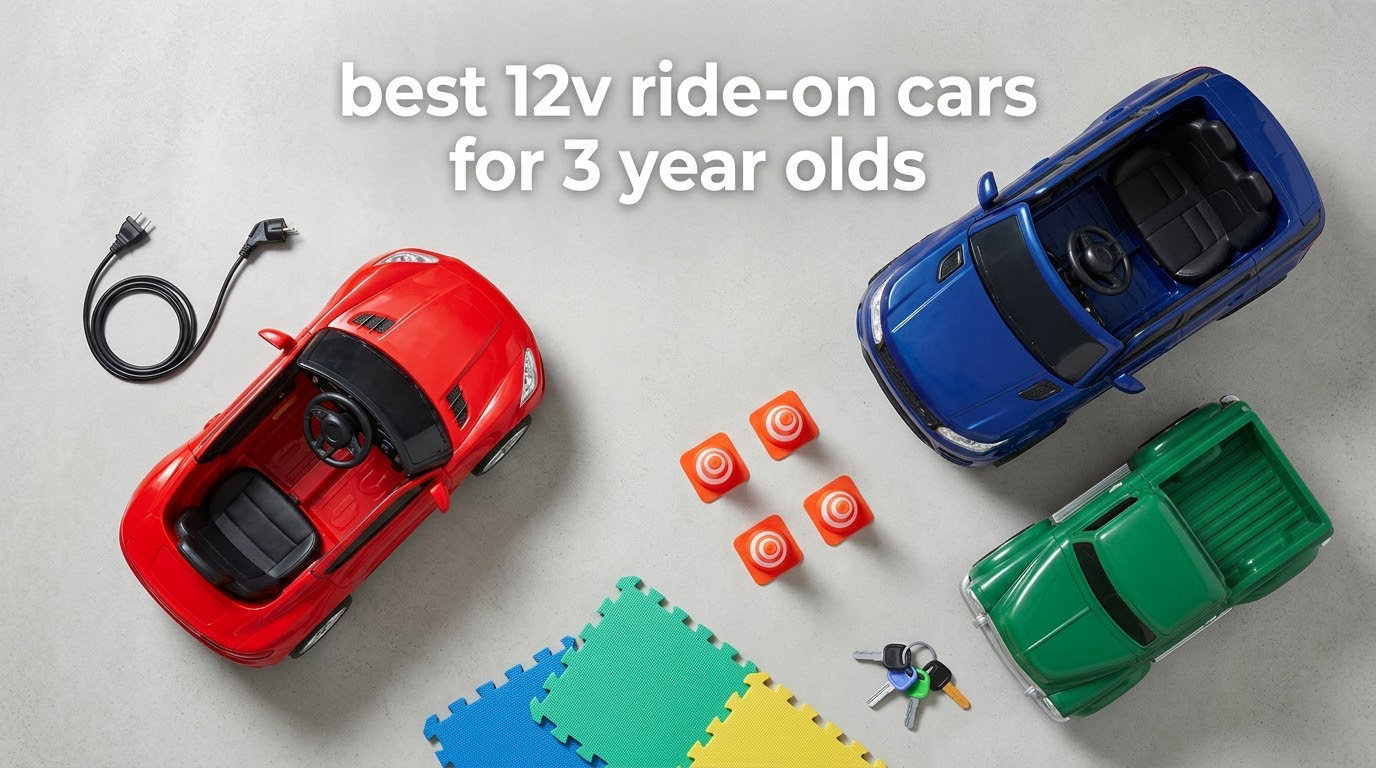
The best 12V ride on cars for 3 year olds are the ones that start slow, stop when you press the remote, and survive grass. A 3 year old is old enough to work a foot pedal but not old enough to judge speed, so the real buying decision is not the badge on the grille. It is whether the car has a parental remote with an override brake, a low speed setting, a seat belt, and tires that grip a lawn instead of spinning.
We went through ten of the strongest 12V models on the market and read thousands of owner reviews, then sorted them by the things a parent actually asks about: how fast it goes, how long the charge lasts, how wide the seat is, how hard it is to assemble, and whether the toy survives a winter. Every car below has a 12V battery, a rechargeable power pack, and a remote so you can take over when a driveway slope turns into a runaway.
There is a reason 12V is the sweet spot for this age. Six volts leaves a 3 year old stranded on the living room carpet, and 24V packs carry enough torque to surprise a small child the first time the pedal goes down. Twelve volts delivers enough power to climb a shallow lawn slope while a gentle soft-start ramp keeps the launch predictable. If you want to see how these compare once your child outgrows the toddler stage, we have a separate guide to 24V ride-on cars for older kids and a broader breakdown of kids electric ride-on cars across all ages.
Table of Contents
Top 3 Picks for Best 12V Ride On Cars for 3 Year Olds (October 2026)
These three stood out once we weighted safety hardware, seat size, and how well each one held up after months of daily use.

Best 12V Ride-On Cars for 3 Year Olds in 2026
All ten cars below are 12V models rated for a 3 year old. The table shows the deciding specs for each one, and the detailed reviews that follow cover the trade-offs in full.
| Product | Specifications | Action |
|---|---|---|
 Best Choice Products 12V Ride-On Car Best Choice Products 12V Ride-On Car |
|
Check Latest Price |
| Hetoy 12V Ride-On Truck |
|
Check Latest Price |
| Winado Mercedes AMG GTR |
|
Check Latest Price |
 Seizeen Ford Bronco Raptor Seizeen Ford Bronco Raptor |
|
Check Latest Price |
 ARBELI 12V Toddler First Car ARBELI 12V Toddler First Car |
|
Check Latest Price |
 TRINEAR 12V Ride-On Truck TRINEAR 12V Ride-On Truck |
|
Check Latest Price |
 Winado Chevrolet Colorado Winado Chevrolet Colorado |
|
Check Latest Price |
 ELEMARA 12V Off-Road Truck ELEMARA 12V Off-Road Truck |
|
Check Latest Price |
 INFANS Audi RS e-tron GT INFANS Audi RS e-tron GT |
|
Check Latest Price |
 Miniature Motors 12V Roadster Miniature Motors 12V Roadster |
|
Check Latest Price |
1. Best Choice Products 12V Kids Ride-On Car: Best Overall for a 3 Year Old
Best Choice Products 12V Kids Electric Vehicle Toy Ride On Car with Parent Remote Control for Toddlers, Seat Harness, 61 lbs Weight Capacity, Locking Doors, Spring Suspension, Bluetooth – Hot Pink
Max speed 2.8 mph
Weight capacity 61 lbs
Item weight 32 lbs
Recommended for ages 3 and up
Pros
- Parent remote with forward and reverse
- Adjustable seatbelt and lockable doors
- Spring suspension with never-deflate wheels
- Gentle 2.8 mph top speed
- AUX input for your own music
Cons
- 9 percent one-star reviews cite durability issues
- Modest 2.8 mph top speed
- 32 lbs is awkward for one adult to lift
More than 21k reviews sit behind this pick, and that depth of history matters more here than a slightly higher spec sheet. It is the single most established 12V ride-on for toddlers we looked at, and owners consistently single out the same three things: the remote works, the seat belt fits, and the headlights make bedtime driveway laps feel like an event.
The 2.8 mph ceiling is the feature parents care most about, since that is roughly a fast walk. and for a child who has just learned that pressing a pedal makes the world move, it is exactly the right amount of momentum. The traction tires and spring suspension let it cross a lawn seam or a driveway crack without throwing the child forward.
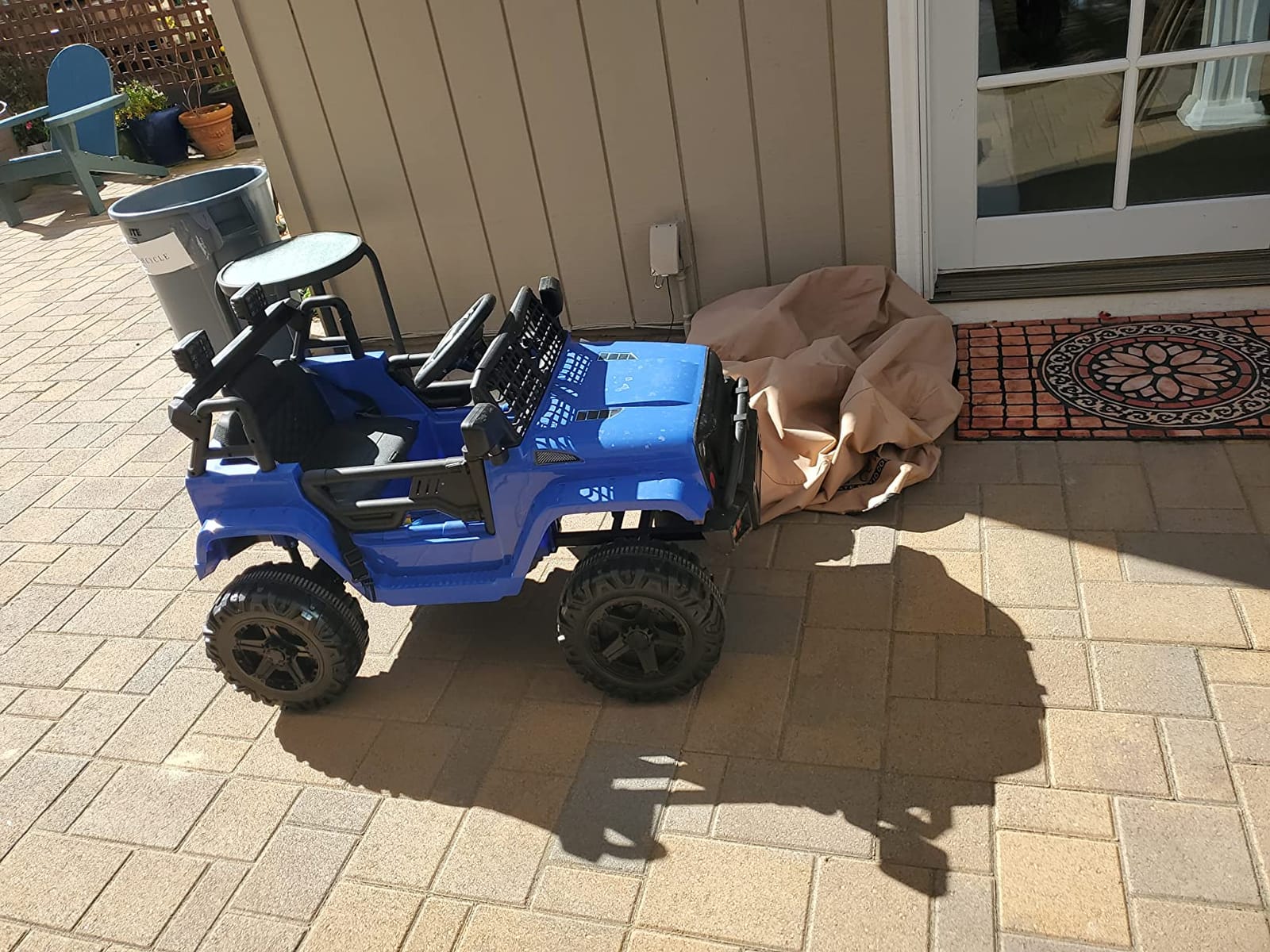
Dimensions are 39.25 inches long, 26 inches wide, and 26 inches tall, which suits a 3 year old without swallowing the driveway. The 61 lb weight capacity is one of the more generous figures in this group, so a child in the upper end of the toddler size range has room to grow into it.
Audio is handled through a built-in AUX outlet rather than Bluetooth, which means you plug in a device and control the playlist yourself. For many families that is the better arrangement anyway, since a toddler does not need access to a music app.
The 9 percent share of one-star reviews is the honest drawback. Those reviews cluster around durability rather than function, and it is worth knowing that before you decide a plastic body panel is worth a replacement risk at the three-year mark. The model number is SKY6743 if you need it for parts lookup.
Is 2.8 mph fast enough for a 3 year old
For a brand new driver, yes. Walking pace is the right target because it leaves the child time to react to a dog, a garden hose, or a change in surface. Reviewers report the top speed feels faster to a three-year-old than it does to an adult watching from the porch, which is exactly the point. It is a speed they can control rather than survive.
The remote has forward and reverse, so you can pull them out of a corner without lifting them. That single feature removes most of the anxiety parents describe in the first weeks of use.
What to watch before it arrives
Measure your storage space first. At 32 lbs and over three feet long, this is not a car that lives in a closet. Families with a garage or a covered patio get far more from it than those hoping to fold it away indoors.
Lockable doors are a genuine safety plus for a three-year-old, since they cannot climb out mid-drive. Keep the remote batteries out of reach of older siblings who might press the override while a younger child is climbing in.
2. Hetoy 12V Ride-On Truck: Best Value With an Emergency-Brake Remote
Hetoy 12V Ride on Toys with Parent Remote Control Toddler Electric Vehicle with Spring Suspension, LED Lights, Bluetooth, Music Player, 3 Speeds Ride on Car Truck for Kids Age 3-8 (White)
Top speed up to 5 mph
Weight capacity 61 lbs
Listed weight 18.89 kg
Recommended for ages 3 to 8
Pros
- Emergency brake on the 2.4GHz remote
- Three-point safety belt and lockable doors
- Handles grass gravel and 15 degree slopes
- 85 percent assembled out of the box
- Three year warranty
Cons
- Listed 5 mph top speed is fast for a 3 year old
- 18.89 kg listed weight is hard to move
- Self-drive mode is aimed at ages 5 and up
This truck arrives 85 percent assembled, which is the single biggest practical difference between it and most competitors. Parents repeatedly mention skipping an hour of hex key work on a Sunday afternoon, and for a birthday gift that can arrive on a Tuesday, that matters a great deal.
The remote is the reason it earns its badge. It carries an emergency brake function rather than a simple stop, so pressing the control halts the car and holds it. For a child learning to modulate a pedal, that is a meaningful upgrade over a remote that only sets direction.
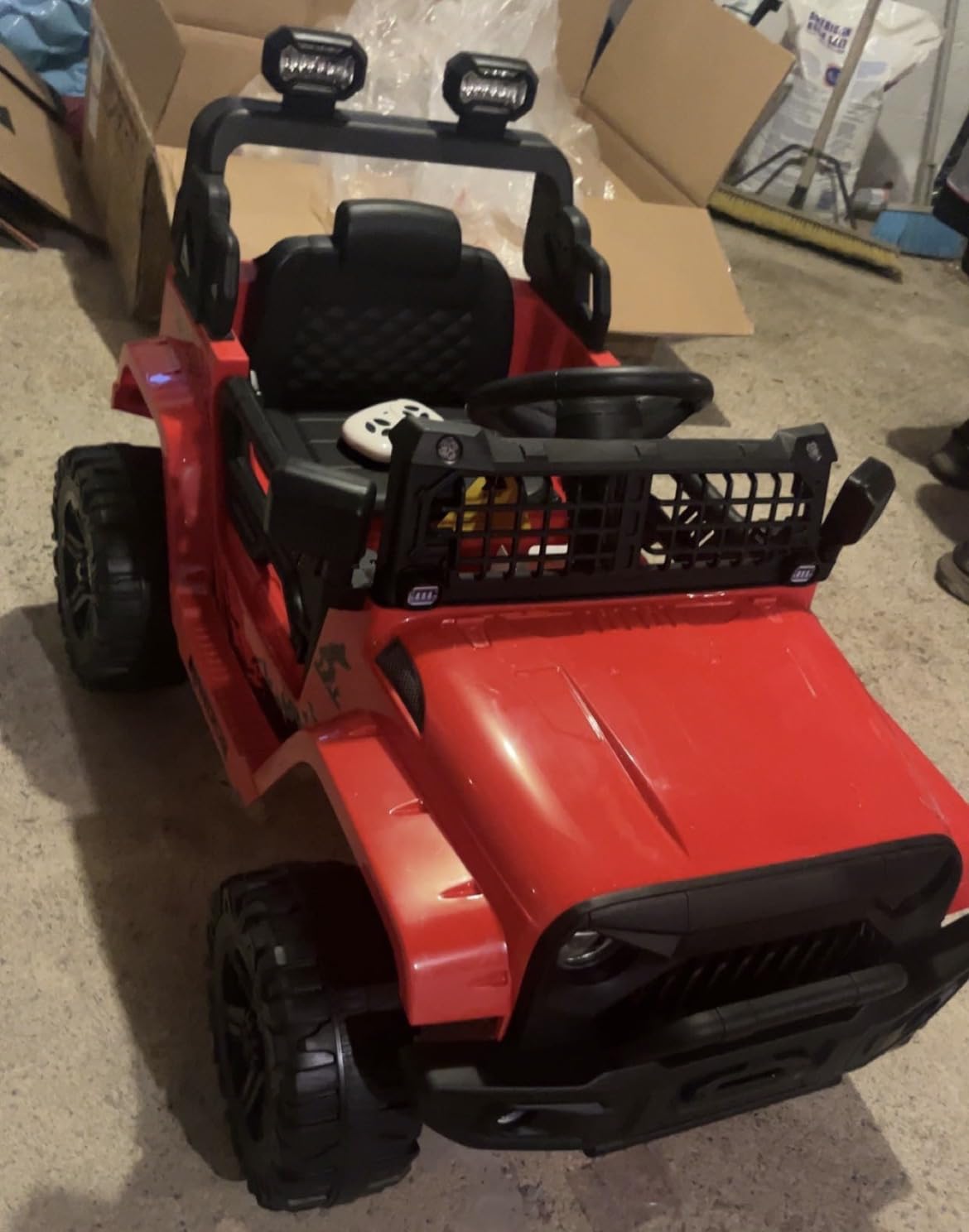
Terrain handling is genuinely strong. The spec sheet claims grass, gravel, and slopes up to 15 degrees, supported by a high-torque 12V motor, spring suspension, and all-terrain traction tires. Forum regulars on r/PowerWheelsMods make the same point about four-wheel drive models generally: traction tires are what separate a lawn-capable ride-on from a driveway-only one.
There are two drive modes. The parent-controlled mode is described for ages 4 and 5, and the self-driving mode for ages 5 to 8, with three speed settings at 2.5 and 5 mph plus smooth acceleration control. That top speed is fast for a 3 year old, so plan to keep the remote in the first or second setting.
Bluetooth speaker, working horn, MP3 input, and engine sound effects round out the entertainment side. There is also a storage compartment, which is where a 3 year old will keep a snack, a toy, or an alarming number of pebbles.
Is the higher top speed a problem at three years old
Only if you leave it unlocked. The remote lets you dial it down before the car ever moves, and the smooth acceleration ramp removes the jolt that makes some toddlers cry on a first ride. Parents who start on the lowest setting report children asking for a turn up the stairs within a few weeks, which is the progression you are paying for.
Check the seat fit rather than the age label. The listing supports 61 lbs and a seat that adjusts as your child grows, and a roomy three-point belt is far better than a two-point strap on a four-year-old.
Is the listed weight a real problem
The listing quotes 18.89 kg, which is heavy to lift alone. If your car lives outside on a patio or in a garage, weight is irrelevant. If you need to move it between rooms or up stairs, budget for two adults or a dolly on day one.
The battery needs 4 to 8 hours of charging for 1 to 2 hours of play, which is normal for the class. The materials are CPSIA certified and the frame is described as impact resistant, and there is a stated three year warranty on this one.
3. Winado 12V Licensed Mercedes AMG GTR: Most Versatile for Licensed Detail
Winado 12V Licensed Mercedes Benz AMG GTR Kids Ride on Electric Car, Black
Top speed 3 mph
Weight capacity 55 lbs
Item weight 20.5 lbs
Rated for ages 3 to 5
Pros
- Officially licensed Mercedes AMG GTR styling
- Three-speed remote plus two-speed manual
- Smooth start ramps acceleration
- 1 to 2 hours of runtime
- USB AUX and TF card inputs
Cons
- Seat belt reported breaking after a few months
- Wide body leaves a smaller seat than sedan styles
- 8 to 12 hour charge for 1 to 2 hours of play
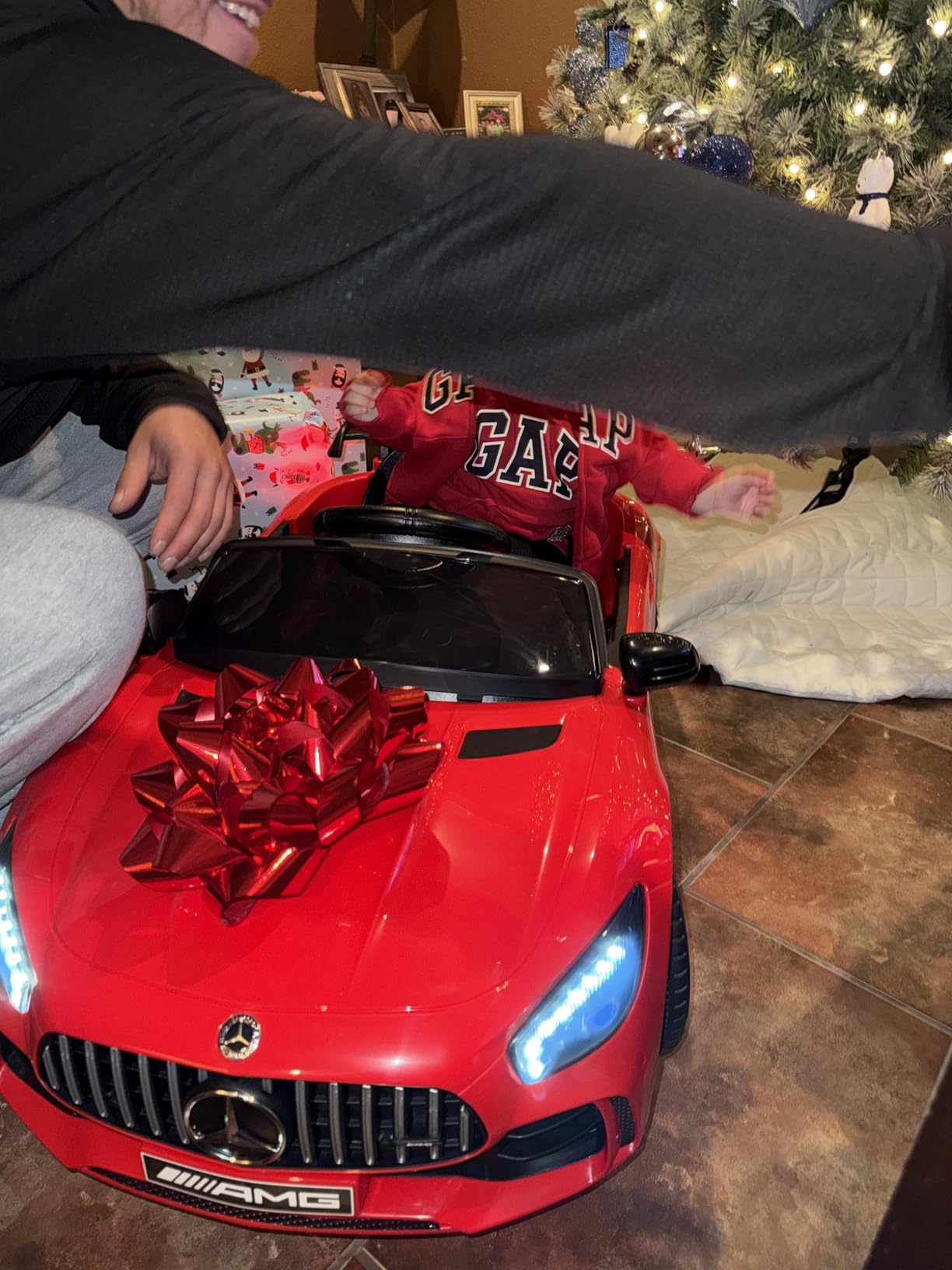
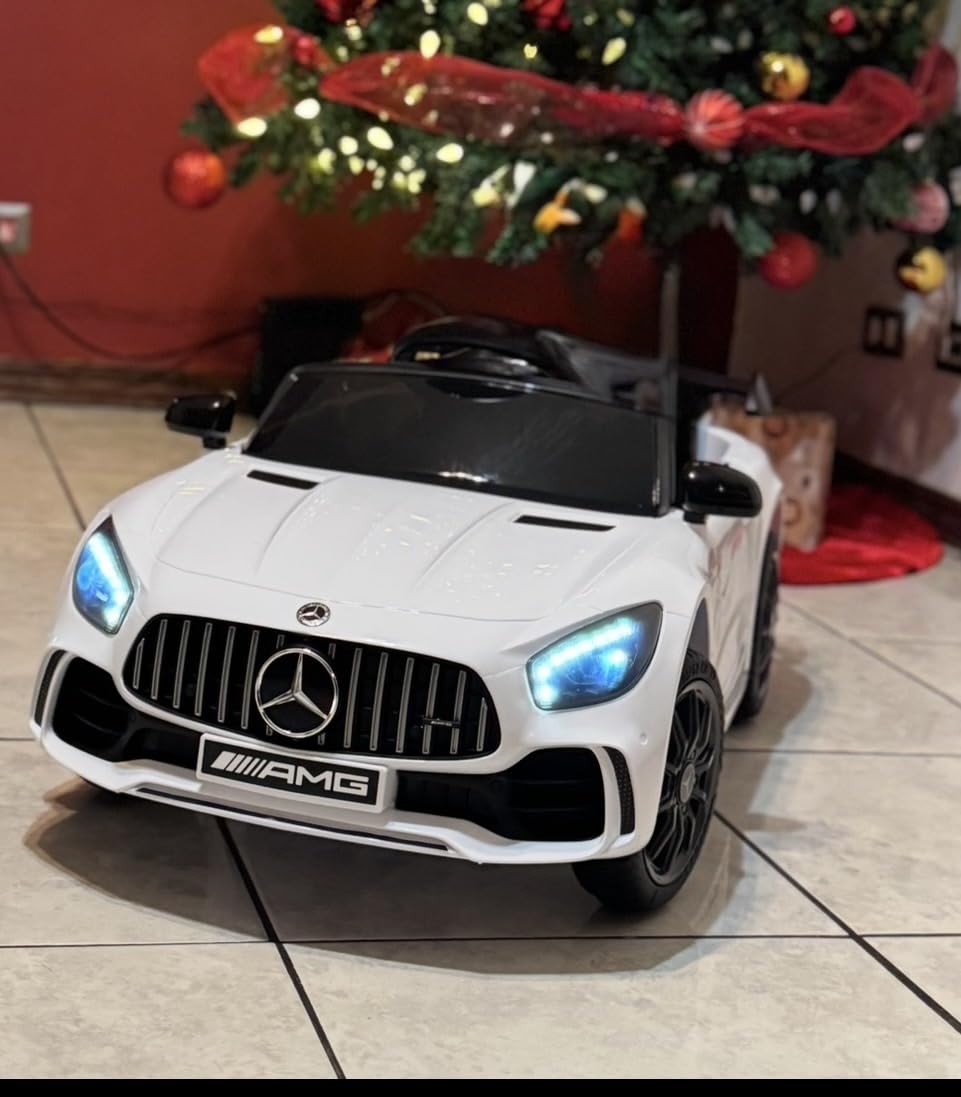
Licensed styling is not just decoration here. The AMG GTR body, openable doors, and realistic dashboard give a 3 year old something that reads as a real car rather than a plastic push-along, and parents note that detail is often what sells a child on actually getting in the seat.
The control setup is well judged for this age. A three-speed remote pairs with a two-speed manual mode, and the smooth start function means the car eases into motion rather than snapping forward. The 3 mph ceiling is a sensible compromise for a first licensed car.
Audio is the most complete on this car. Built-in music, a TF card slot, USB and AUX inputs, a volume control, and a voltage display give you more ways to keep a three-year-old occupied than most rivals list. A voltage readout is quietly useful, since it tells you when the pack needs a full charge rather than a top-up.
Construction is a plastic body on a metal frame, which is a step up from all-plastic shells in terms of rigidity. Dimensions are 39 by 22 by 17 inches, and at 20.5 lbs this is one of the easier cars in the group to lift for a battery swap.
Runtime is listed at 1 to 2 hours from an 8 to 12 hour charge. That ratio is common across the category, and the charger being slow rather than the battery being weak is the more useful way to read it.
Does the licensed badge add real value at this age
At three, the styling matters more than the badge. A recognizable shape, working headlights, and doors that open give a child a reason to climb in, and parents on parent forums repeatedly point out that the licensed models also hold their value better when a younger sibling needs one later.
The 55 lb weight capacity is the trade. It is lower than several rivals here, so check your child against it before buying, especially if they are on the tall side for their age.
The seat belt complaint you should know about
The most repeated negative across reviews is a seat belt that frayed or broke after a couple of months. Inspect the strap and buckle in the first few weeks and treat any fraying as a stop-use signal rather than something to wait out. Because the belt is a load-bearing part of the safety story, it is worth checking even when the car is running perfectly.
The wider body also translates to a smaller seat than some sedan-style designs. Measure your child’s seated height against the opening before you commit, particularly for a child in the upper three-year-old size range.
4. Seizeen 12V Licensed Ford Bronco Raptor: Best for a Big 3 Year Old
12V Licensed Ford Bronco Raptor Ride on Car for Kids, Battery Powered Electric Car for Toddlers w/Remote Control, Spring Suspension, Seat Belt, Bluetooth, Horn, LED Lights, Radio (Black)
Speeds 1.2 and 2.5 mph
Weight capacity 66 lbs
15 inch seat
80 to 120 minutes per charge
Pros
- 15 inch seat with 66 lb capacity
- Two-speed range starting at 1.2 mph
- Two 35W motors with a 12V 7Ah battery
- Four-wheel spring suspension
- Remote with three speeds and emergency brake
Cons
- Rear-heavy chassis can tip back on curbs
- Remote has no auto-off switch
- Some plastic trim pieces detach
- Assembly takes 45 to 60 minutes
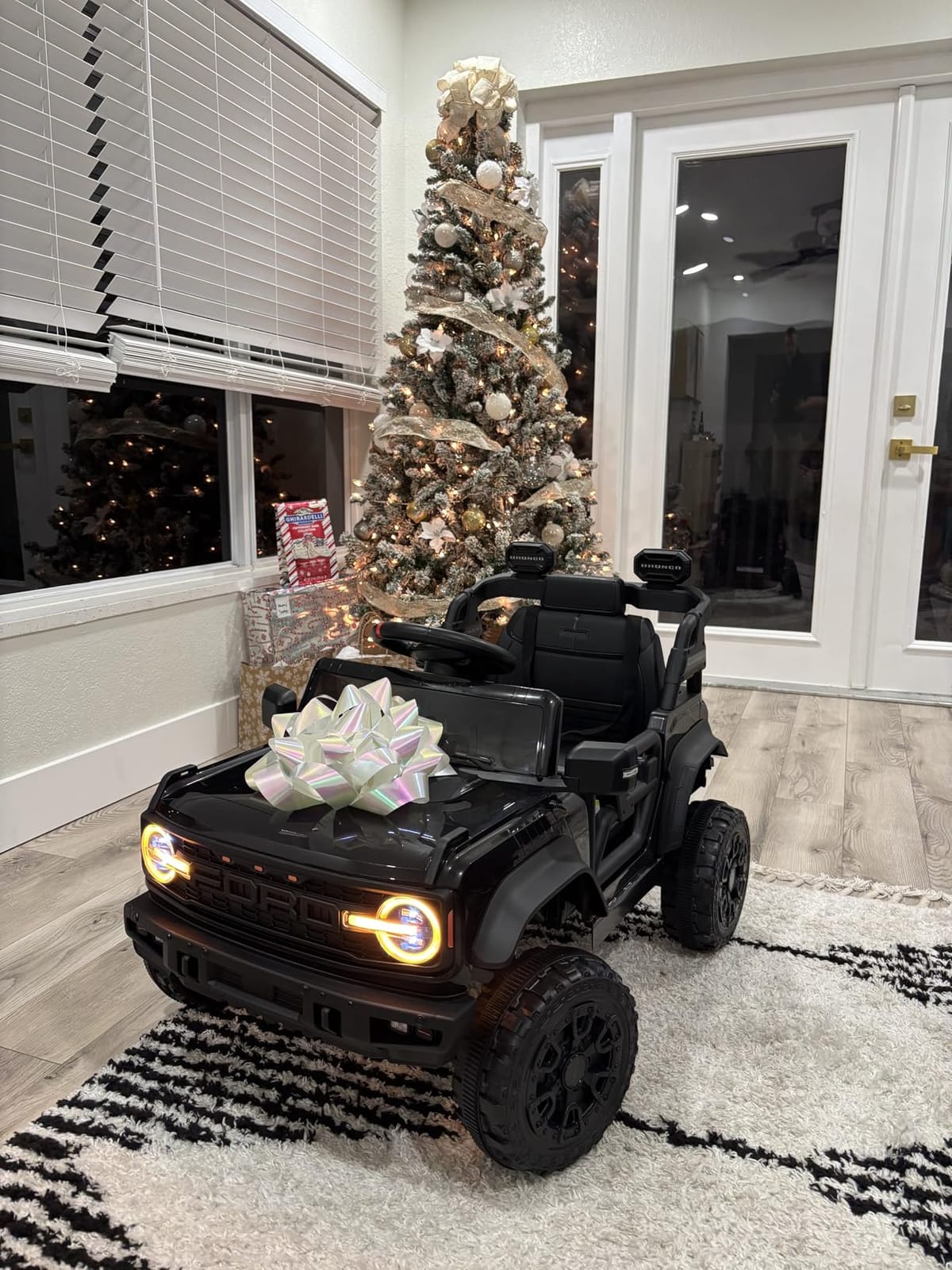
If your 3 year old is physically large, this is the one to look at first. The 15 inch seat is the widest in this roundup and it carries up to 66 lbs, which is enough headroom to keep the car relevant past the fourth birthday instead of being outgrown in a season.
The two-speed design is the smartest safety answer here. A 1.2 mph low setting is barely faster than a walk and is genuinely usable by a three-year-old, with 2.5 mph reserved for when they are ready. A remote with three speeds and an emergency brake override sits alongside the in-car steering wheel and pedal.
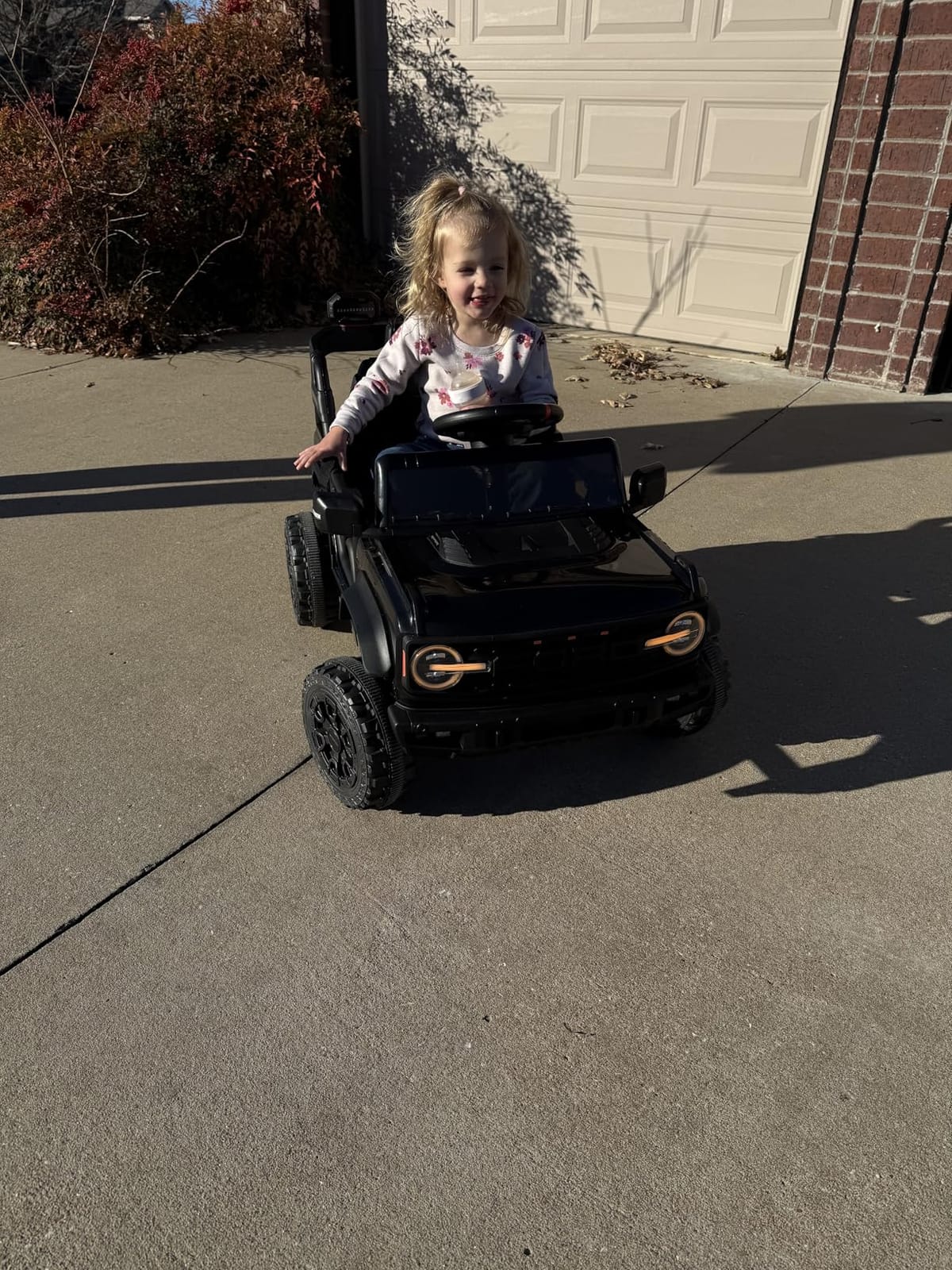
Under the body it is a serious package. Two 35W motors feed a 12V 7Ah rechargeable battery, and owners report 80 to 120 minutes of ride time per charge, with several mentioning a full charge covering a round trip to the park. Four-wheel spring suspension and anti-skid wear-resistant PP tires handle grass, concrete, and gravel.
Entertainment covers Bluetooth music, a radio, a horn, engine sound, and working headlights. The one-button start, safety belt, and lockable doors round out a feature set that goes well past what a three-year-old strictly needs.
Dimensions are 37 by 25 by 25.2 inches, and the listing carries a six month manufacturer warranty, which is the shortest stated cover in this group and worth factoring in if you expect heavy daily use.
Is the tipping tendency a real safety concern
It is the honest drawback and the first thing to ask about at setup. The rear-heavy chassis can tip backward on curbs and small hills, so the car belongs on level ground while your child is small. Flat lawns, driveways, and smooth park paths are where it performs best, and a wide open area without steps is the sensible first testing ground.
The remote lacking an auto-off switch is a smaller irritation. Remove the batteries after a session so a curious sibling cannot restart the car unattended.
What assembly really involves
Roughly 45 to 60 minutes, with the spring coil instructions being the part families find unclear. Two adults and a clear floor make it painless, and the pack includes the car, charger, remote, and instruction sheet. Trim pieces such as the fenders and the piece above the seat can knock loose during assembly, so check them before the first ride.
Because the low speed setting starts at 1.2 mph, you can hand the wheel over sooner than with most single-speed cars. That alone tends to extend how long a child stays interested.
5. ARBELI 12V Toddler First Car: Best for Ages 2 to 3
ARBELI 12V Electric Ride On Car, Toddler First Car, Blue
Max speed 3.1 mph
Dual 35W motors
Weight capacity 50 lbs
Item weight 30 lbs
Pros
- Dual 35W motors with 1 to 2 hours of play
- Soft start plus remote override brake
- 13 inch seat with adjustable belt
- Large-button MP3 panel for small hands
- ASTM F963 and CPSIA certified
Cons
- 50 lb capacity is the lowest in this group
- Remote needs two AAA batteries that are not included
- Dual-motor power keeps the listed weight at 30 lbs
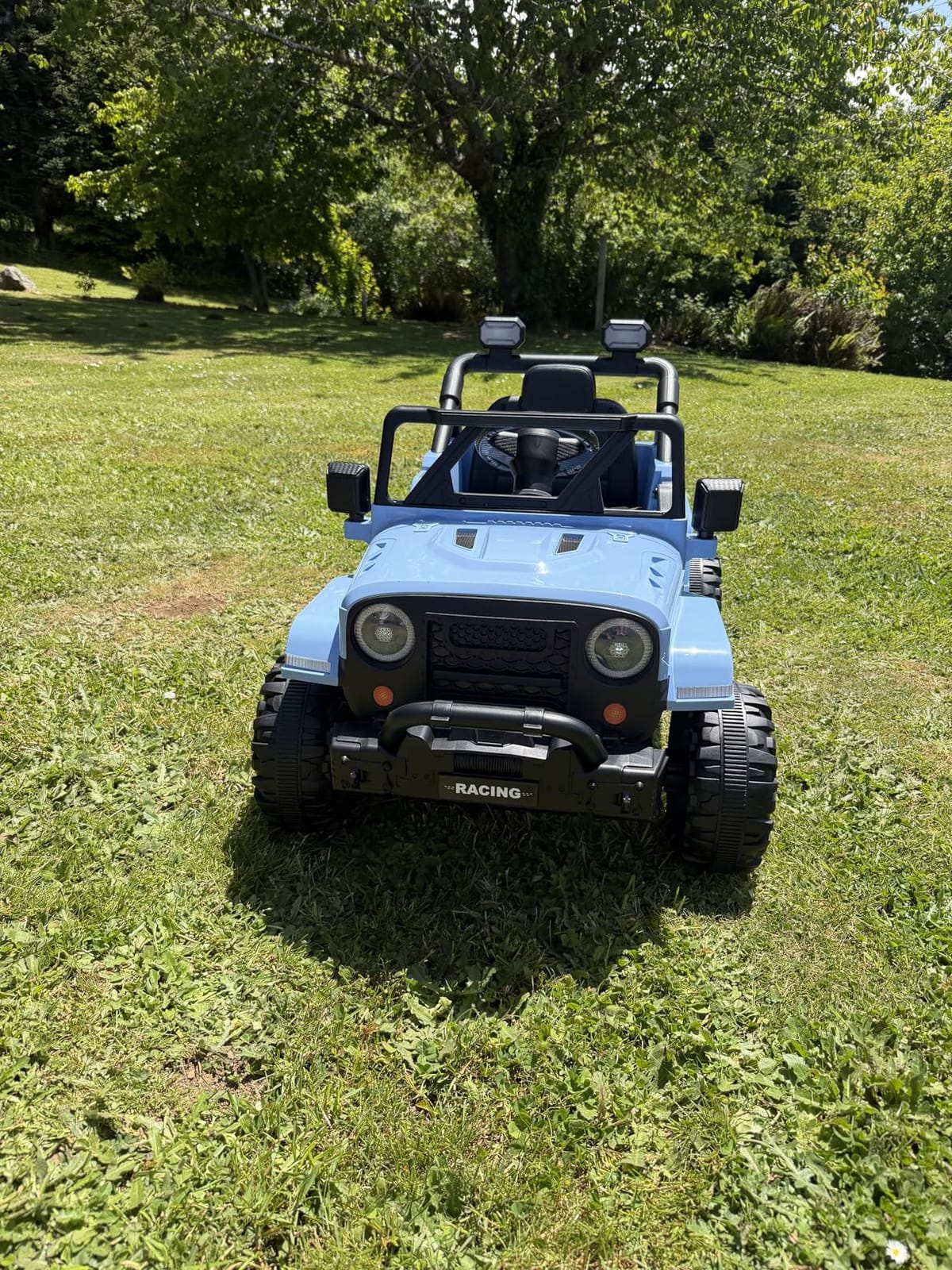
This is the one to consider if your child is on the younger side of three or you are buying ahead for a second birthday. The 36 to 72 month range starts at three years, and the soft start system is designed specifically to avoid sudden acceleration or braking that can unseat a small driver.
Dual 35W motors give more power than most single-motor cars in the class, and owners report 1 to 2 hours of play from that. The 3.1 mph ceiling is reasonable, and the remote offers three-speed adjustment with an override brake function.
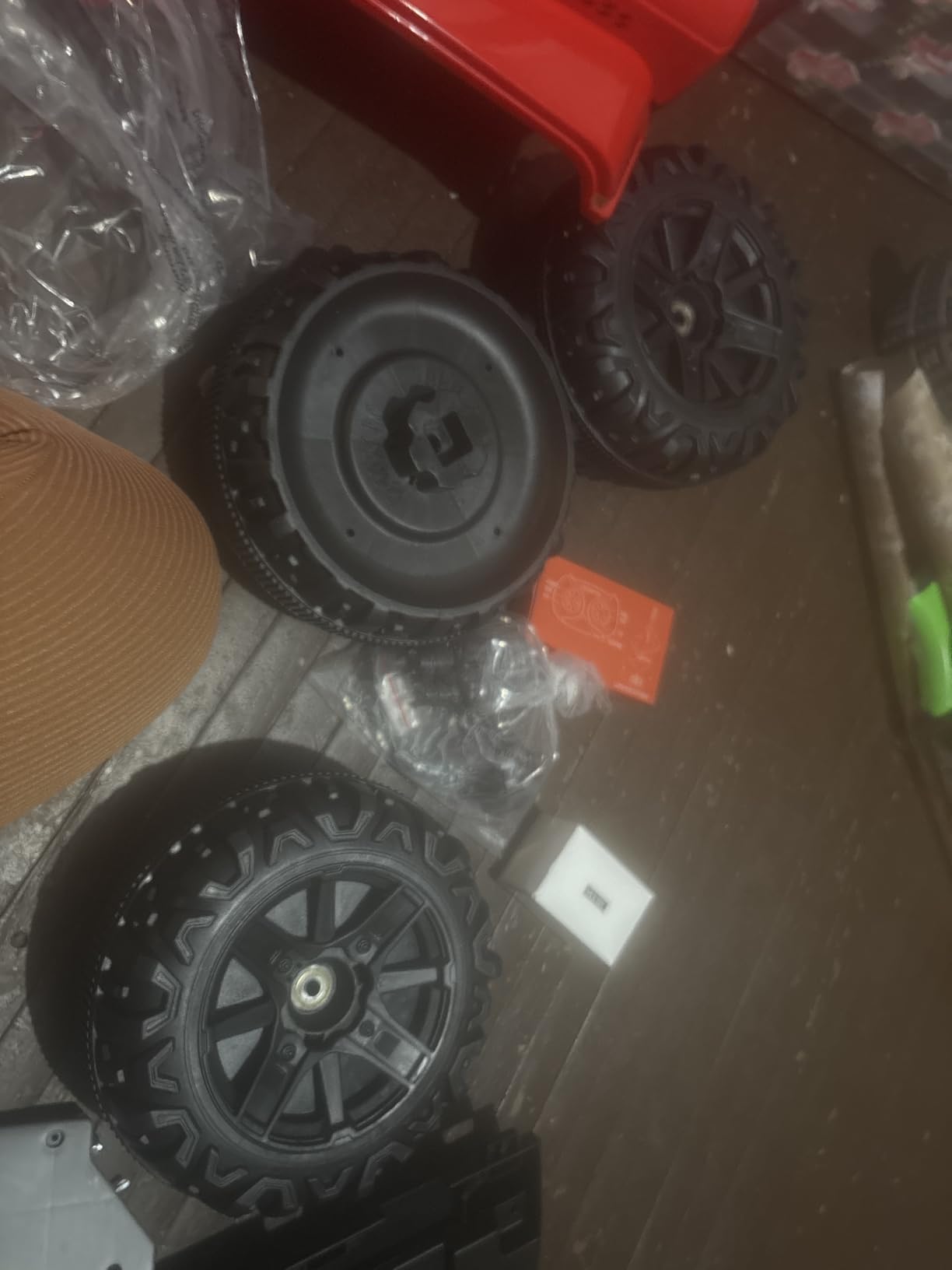
The seat is 13 inches wide with an adjustable safety belt and double lockable doors, which is roomy for a three-year-old. Dimensions are 39 by 25 by 25 inches at 30 lbs, so it fits a standard driveway without dominating the yard.
The audio panel deserves a mention. Large buttons and a rotary volume knob are genuinely sized for toddler hands, and the MP3 player supports wireless phone connection. A battery level bar on the dashboard tells you when the pack is genuinely low rather than guessing from a shorter-than-usual ride.
It is certified to ASTM F963 and CPSIA for ages 2 to 6, which is one of the broader stated age ranges in this group and useful if you want a car that lasts past the third birthday.
Is the 50 lb weight limit a problem at three
For an average three-year-old, no. It becomes a constraint if your child is tall or above average in weight, and it is the one spec on this listing that could end the car early. Weigh your child before you order if the purchase is a birthday gift rather than something you can try in person.
Because the weight ceiling is modest, a family who plans to keep a ride-on through the preschool years should look at the 66 lb models later in this list instead.
What to have ready out of the box
Two AAA batteries for the remote, since they are not included. That is a common gap in this category and worth handling before the first drive, since a dead remote leaves you with manual control only.
Start-up sounds, a horn on the steering wheel, headlights, and top lights are all included, along with an accelerator pedal and built-in audio. The box holds the vehicle, the 12V battery, the charger, and the remote, which is a complete setup for a first ride.
6. TRINEAR 12V Ride-On Truck: Best Budget Pick
TRINEAR 12V Ride on Car for Kids with Parent Remote Control, Red
Recommended for ages 3 and up
Spring suspension
Large sturdy tires
Item weight 37.6 lbs
Pros
- Large tires for backyards parks and gravel paths
- Spring suspension over rough ground
- Dual control from remote to manual steering
- LED lights and a built-in music player
- One year parts warranty
Cons
- 37.6 lbs makes it awkward for one adult to lift
- Resin body feels less rigid than metal frames
- Average rating sits slightly below the rest
This is the entry point for a family buying a first 12V ride-on without spending heavily. It is rated for ages 3 and up and covers the essentials: a parent remote, spring suspension, LED lights, a music player, and a rechargeable battery for extended sessions.
The large sturdy tires are the part worth knowing. Buyers specifically mention backyards, parks, and gravel paths, which puts it ahead of the smooth-plastic-wheel cars that spin on the first lawn edge. Spring suspension takes the edge off roots and paving seams.
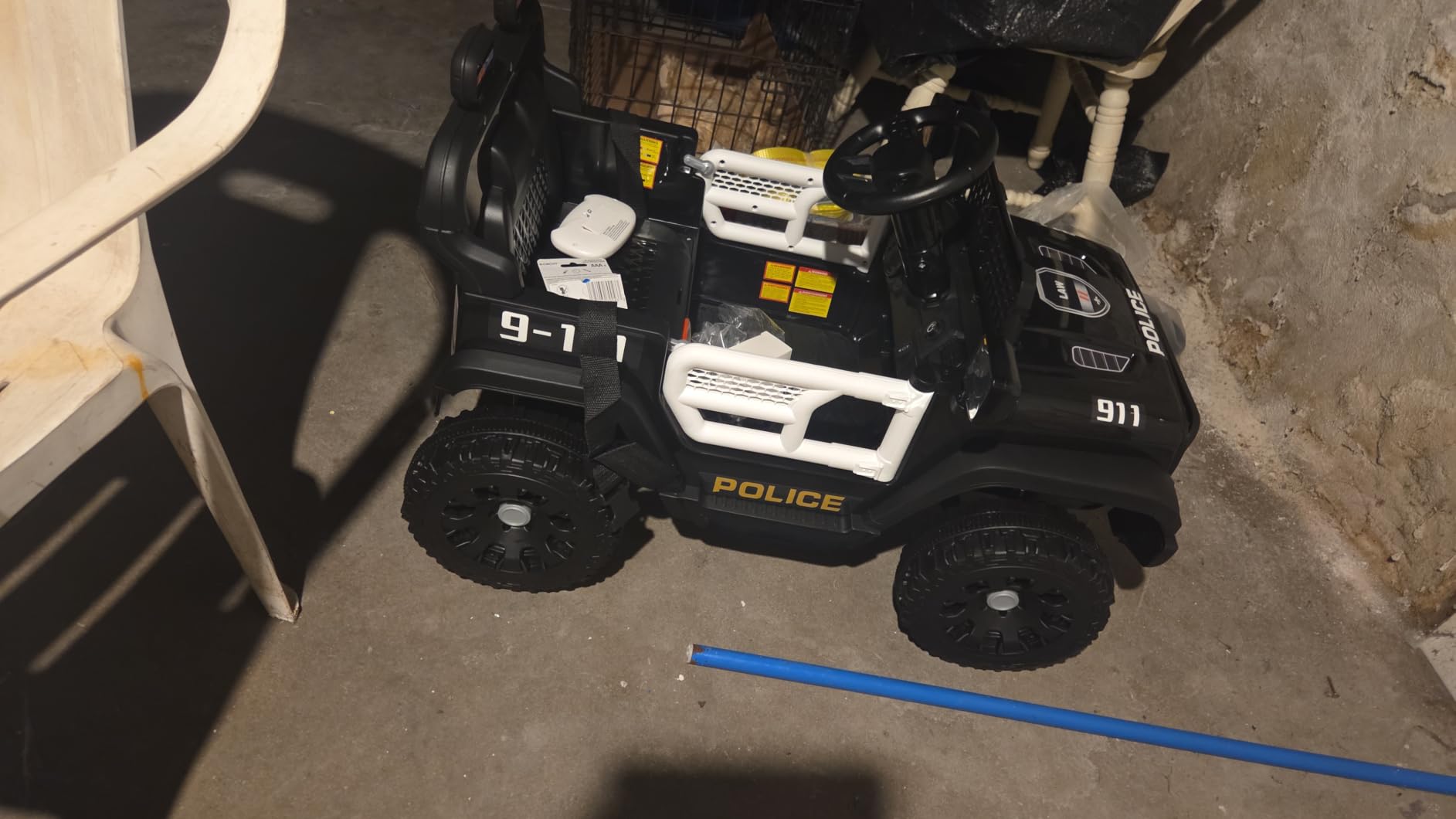
Control is dual mode. A parent guides with the remote at first, then hands over to manual steering as the child gains confidence, which is a sensible progression for a three-year-old who may not be ready for a foot pedal on day one.
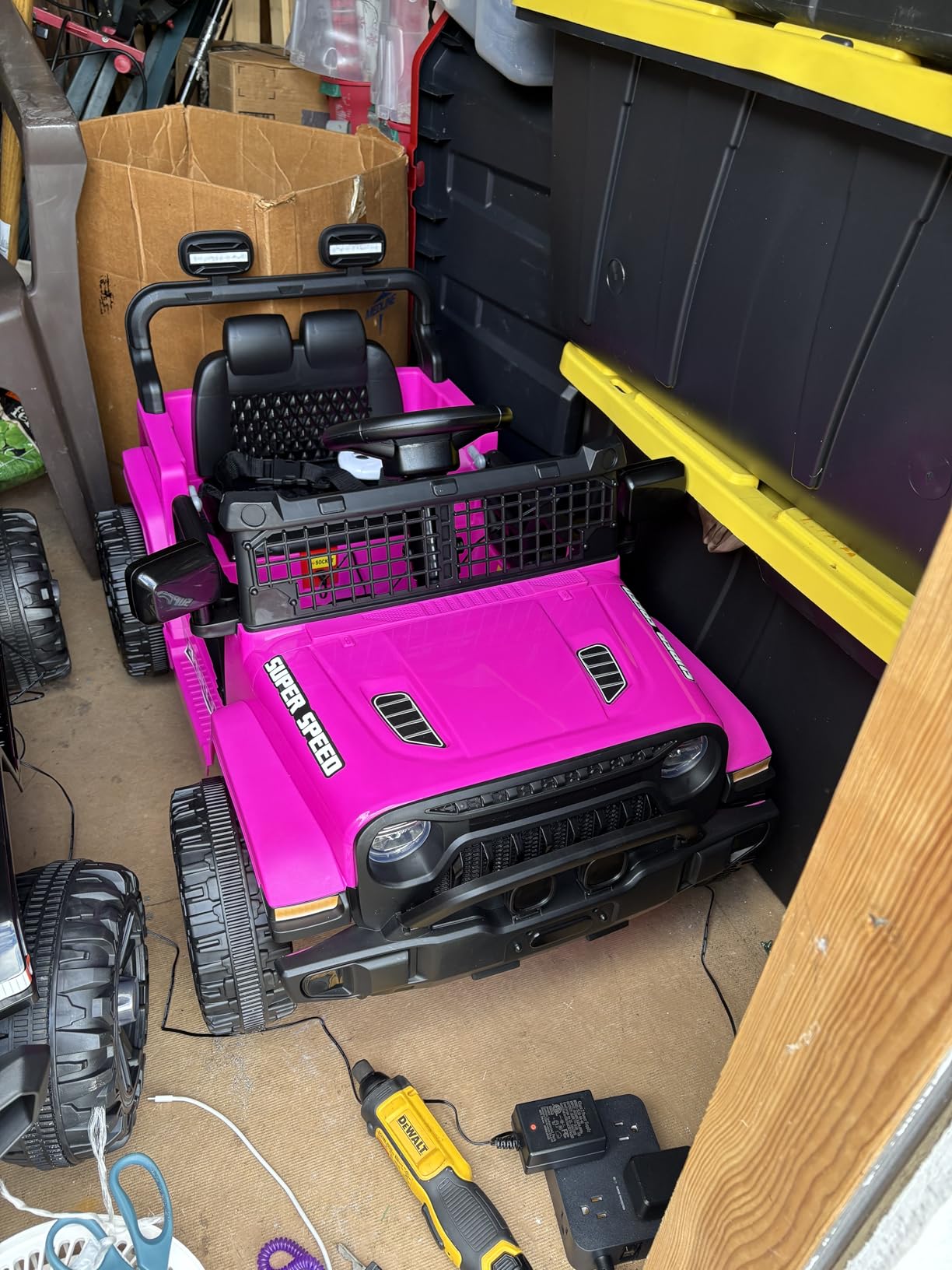
The resin construction is the honest trade-off against the metal-framed models. It feels less rigid, and over years of hard use that difference tends to show at the body panels. There is a one year warranty on parts, which is decent for the bracket.
At 37.6 lbs this is a heavy car to lift, and dimensions of 32.85 by 20.76 by 23.12 inches are compact enough that the weight is manageable if the car lives on the ground rather than being carried between rooms.
Is resin construction going to hold up
For normal backyard use with a three-year-old, it holds up fine, and owners rate the durability as reasonable for the tier. Where it is thinner than a metal frame is under repeated rough-terrain abuse or if the car gets carried and dropped often. If you expect hard use and rough ground as a rule rather than an exception, spend up on an iron or metal-frame model.
The 4.4 average across 395 reviews sits just below the rest of this group, and the feedback is consistently positive rather than disappointed, which tells you the value is in the feature set rather than in refinement.
How does it handle assembly
Straightforward, and reviewers describe it as easy. That is worth more on an entry-level car than extra features, because a confusing first build is a common reason a car sits in a box for a month.
Plan the surface before the first ride. With large tires and suspension, this one is more likely than most to be driven off the driveway, and a level lawn is a better first test than a sloped one.
7. Winado 12V Licensed Chevrolet Colorado: Best for Bluetooth Sound
Winado 12V Licensed Chevrolet Colorado Electric Ride on Car for Kids, Pink
2x25W motors
Weight capacity 66 lbs
8 to 12 hour charge
Ages 3 and up
Pros
- Speakers built into the steering wheel
- Bluetooth with a built-in music player
- Soft start and lockable double doors
- Long slim 40.15 inch body stays stable
- ASTM and CPSIA certified
Cons
- Some buyers report charging failure after about a month
- 8 to 12 hour charge for roughly one hour of play
- Only rear wheel shock absorbers are listed
The audio is the reason to pick this one. Real speakers are built into the steering wheel rather than hidden behind a grille, paired with Bluetooth and a built-in music player, so a toddler hears their own music coming from the direction they are looking.
It is officially licensed Chevrolet Colorado styling with a racing steering wheel, LED lights, and dual door safety locks. Dimensions are 40.15 by 21.65 by 22.83 inches, and that long, slim body is an underrated advantage because it stays stable on uneven grass.
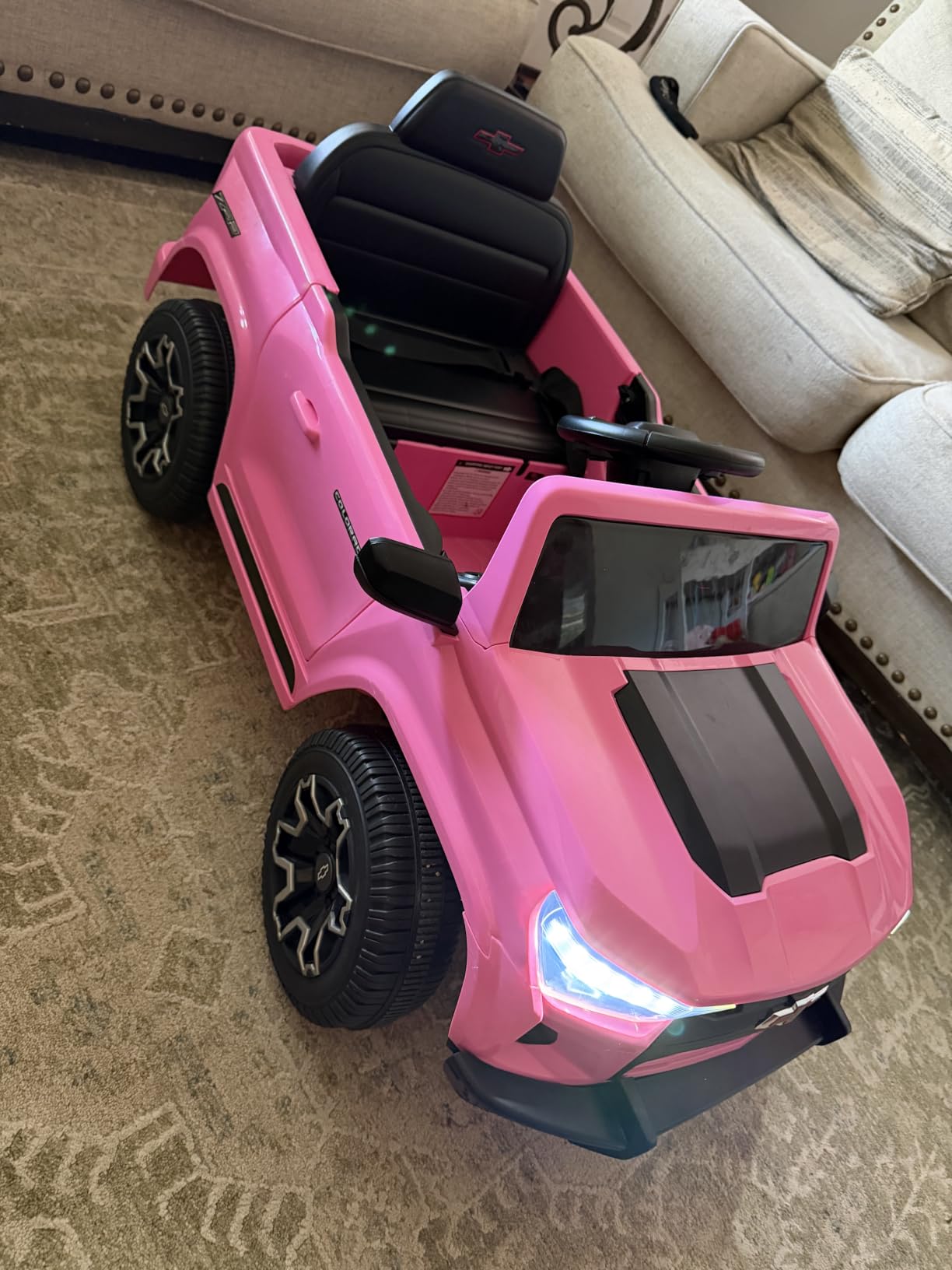
Control combines a three-speed remote with pedal operation, and the soft start means the car eases away rather than launching. Two 25W motors drive it, and the listing gives a 66 lb capacity, which leaves room to grow past the third birthday.
Several reviews describe multi-day battery endurance in regular use, though the stated figures are an 8 to 12 hour charge for roughly one hour of play. Suspension is listed for the rear wheels only, so it is a softer ride over bumps than a four-wheel system.
This sits at the top of the rating range in this roundup with a 4.6 average, and the feedback is consistently enthusiastic about looks, sound, and how easily a young child picks up the controls.
Is the charging complaint common or isolated
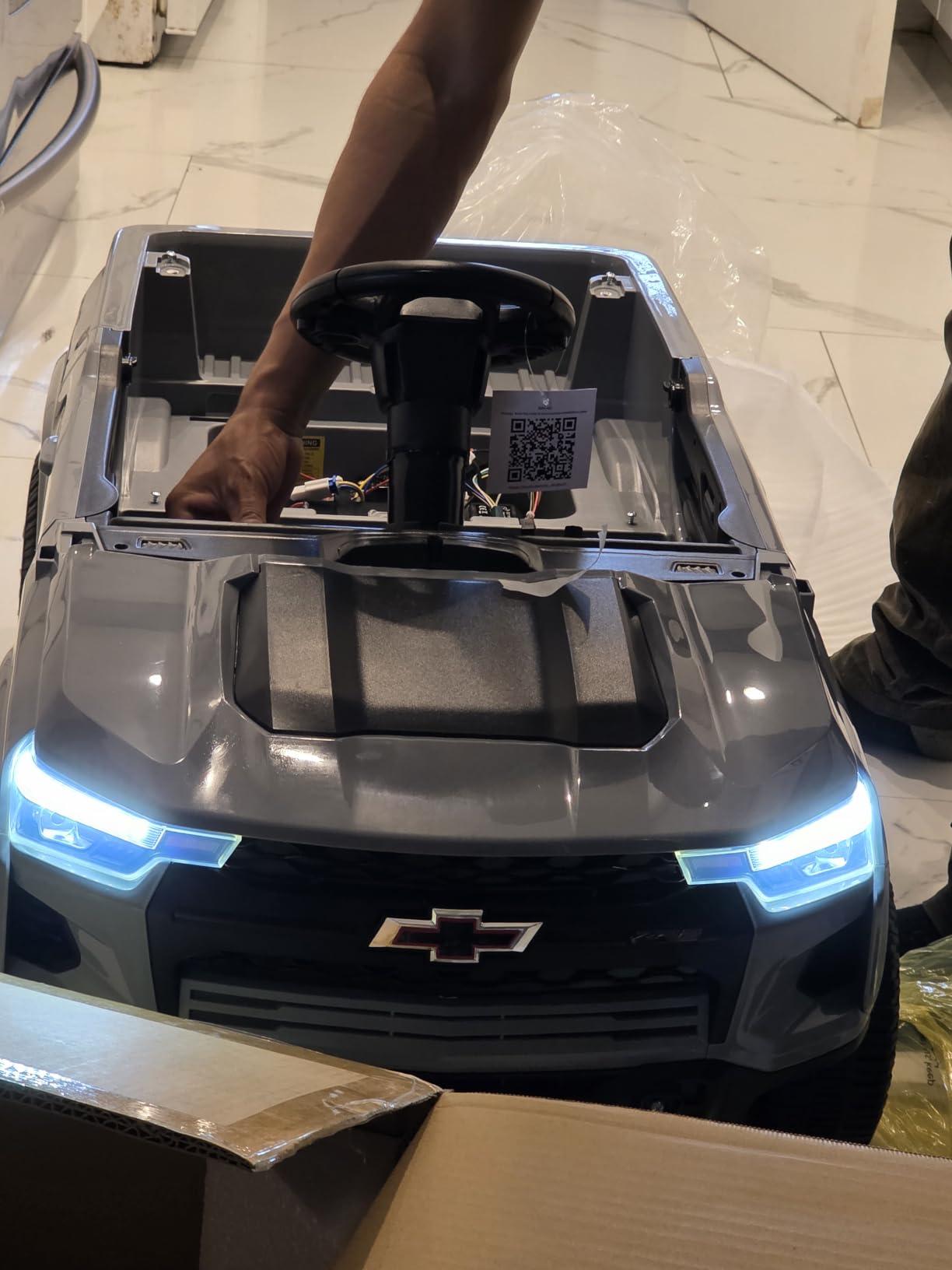
It reads as isolated. One detailed review reports the unit stopped charging after about a month alongside unresponsive third-party seller support, which is worth knowing but is not a pattern across the 313 reviews. The rest describe reliable charging and good battery life.
Keep a simple habit that reduces the risk either way. Charge on a hard indoor surface rather than a bed or carpet, and unplug once the charger indicator settles. That is good practice for any lead-acid pack and costs nothing.
Is the one-hour playtime enough
For a three-year-old, a focused hour on the ride-on is usually enough, and the reported multi-day endurance in ordinary use suggests the pack holds its charge well between outings. If your child is out for longer stretches, the Seizeen or ARBELI models list longer runtime figures and are worth a look.
Confirm the car suits their height. The slim pickup shape seats one child comfortably, and a wide-brimmed sun hat is a better use of the space than a second passenger.
8. ELEMARA 12V Off-Road Ride-On Truck: Best for Heavier Riders
ELEMARA Ride On Car, Bluetooth Ride on Toys for Toddlers, 12V Kids Battery Powered Vehicles w/Remote, 3.5 mph Motorized Off-Road Truck, Electric Car for Kids w/3 Speeds,LED Lights- Olive
Max speed 3.5 mph
Weight capacity 66 lbs
Listed weight 10.3 kg
Ages 3 to 8
Pros
- 66 lb capacity for a mid-range price
- Puncture-proof wheels that never go flat
- All-terrain traction tires for grass and gravel
- Nine color options
- Adjustable seatbelts and lockable doors
Cons
- AUX only audio with no Bluetooth or USB
- Listing dimensions differ from the spec sheet
- 3.5 mph is quick enough to need the remote at this age
At 66 lbs of capacity, this carries the same weight limit as the larger models while staying in a simpler mid-range package. For a three-year-old on the bigger side, or one who will keep growing, that headroom is the argument.
The wheels are puncture-proof plastic, which removes a category of ownership problems entirely. Parents on ride-on forums treat flat tires as one of the more common mid-life failures, and never-flat wheels sidestep it at the cost of some road feel.
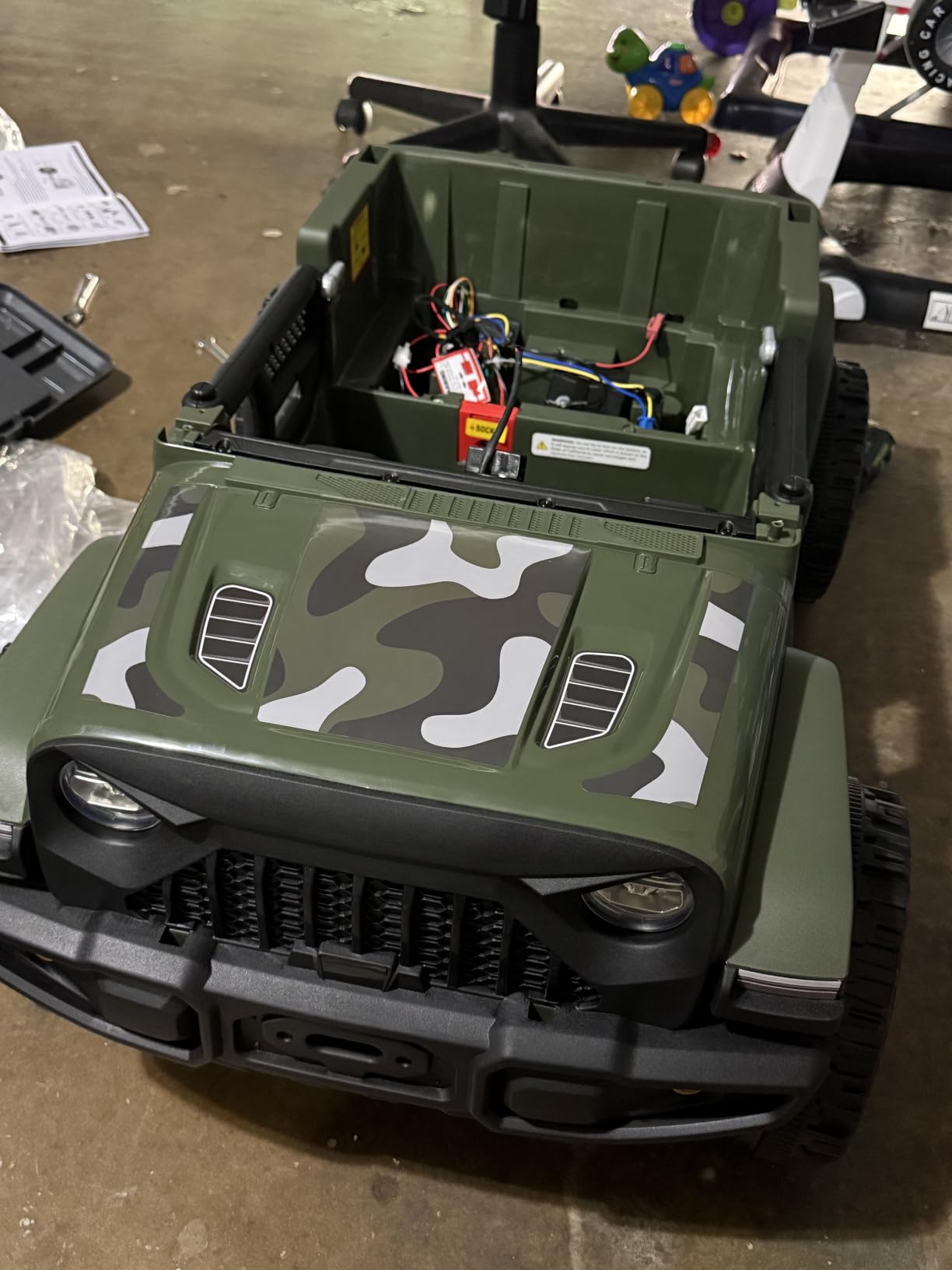
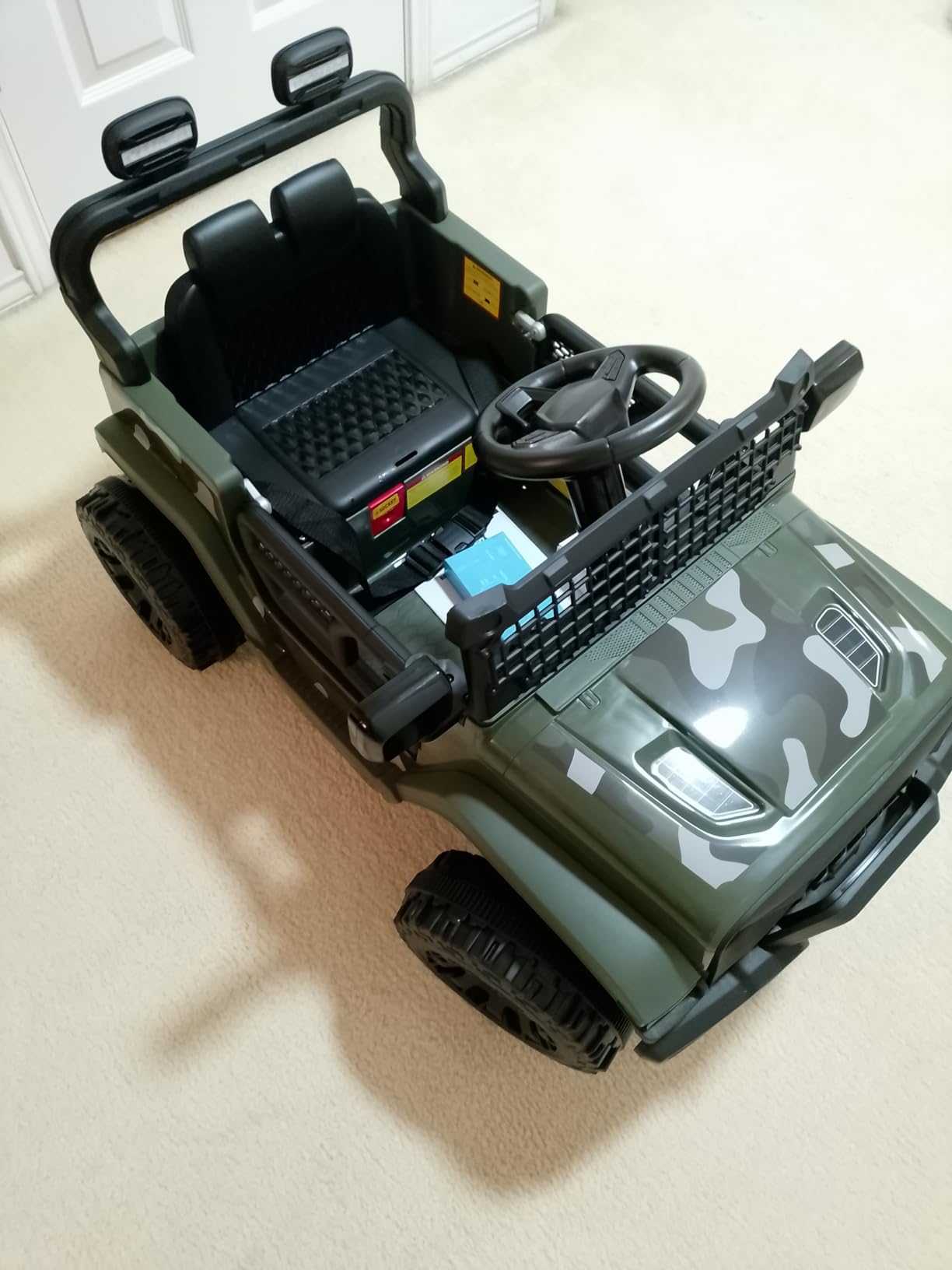
Off-road styling includes a mesh windshield, lockable doors, adjustable seatbelts, and LED headlights. Shock-absorbing spring suspension and all-terrain traction tires handle grass, gravel, and slopes, with a 3.5 mph ceiling that stays controllable through the remote.
The listed weight is 10.3 kg, which is lighter than most metal-framed rivals, and that makes it easier to reposition when a younger sibling needs the driveway.
Nine color options give you more choice than any other car here, which matters more than it sounds when a three-year-old is involved in the decision.
Is the higher top speed risky at this age
Not in practice, because the remote sets the pace and the 3.5 mph figure is the maximum rather than the default. Practise on the lowest remote speed first and hold there until your child is steering reliably. The acceleration ramp is not specified in the listing, which is why we would treat this one as a remote-led car for a first-time driver.
If a soft start is a hard requirement, the ARBELI, Chevrolet Colorado, and INFANS models all document one explicitly.
What about the audio and the size discrepancy
Audio is AUX only. There is no Bluetooth or USB listed, so you supply the playlist through a cable. Several buyers note this is the most common complaint, and for a child whose attention is held by music it is a real limitation.
The listing quotes two different dimension sets, 33.8 by 22.8 by 22.22 inches against a spec sheet of 38.6 by 26 by 27.6 inches. Measure your storage and your child before ordering, since the gap is wide enough to matter for a tight garage.
9. INFANS 12V Licensed Audi RS e-tron GT: Best for Easy Handling Indoors
INFANS 12V Kids Ride On Car, Licensed Audi RS e-tron GT Electric Vehicle with Remote Control, Toddlers Battery Powered Toy with 4 Wheels Suspension, LED Headlight, Music, MP3, USB, TF Port (Red)
Two 30W rear motors
Runtime 40 to 50 minutes
Item weight 4 kg
Rated 37 to 96 months
Pros
- Four-wheel spring suspension for a smooth ride
- MP3 USB and TF card ports covered
- Soft start protects against accidental activation
- Lightest listed weight in this roundup
- Certified to DOE CEC CPSIA and ASTM
Cons
- Shortest runtime in this group at 40 to 50 minutes
- Music volume is described as quiet
- Remote needs two AAA batteries not included
At a listed 4 kg this is the car you can move between rooms without recruiting help, which makes it the practical choice for indoor play on a hard floor, a small patio, or a hallway. Several owners report using it with children well under the stated age when the parent is driving from the remote.
The ride quality is better than the class average. Four-wheel spring suspension, rather than rear-only, smooths out floorboards and paving, and the soft start function protects against accidental activation when a curious three-year-old stands on the pedal.
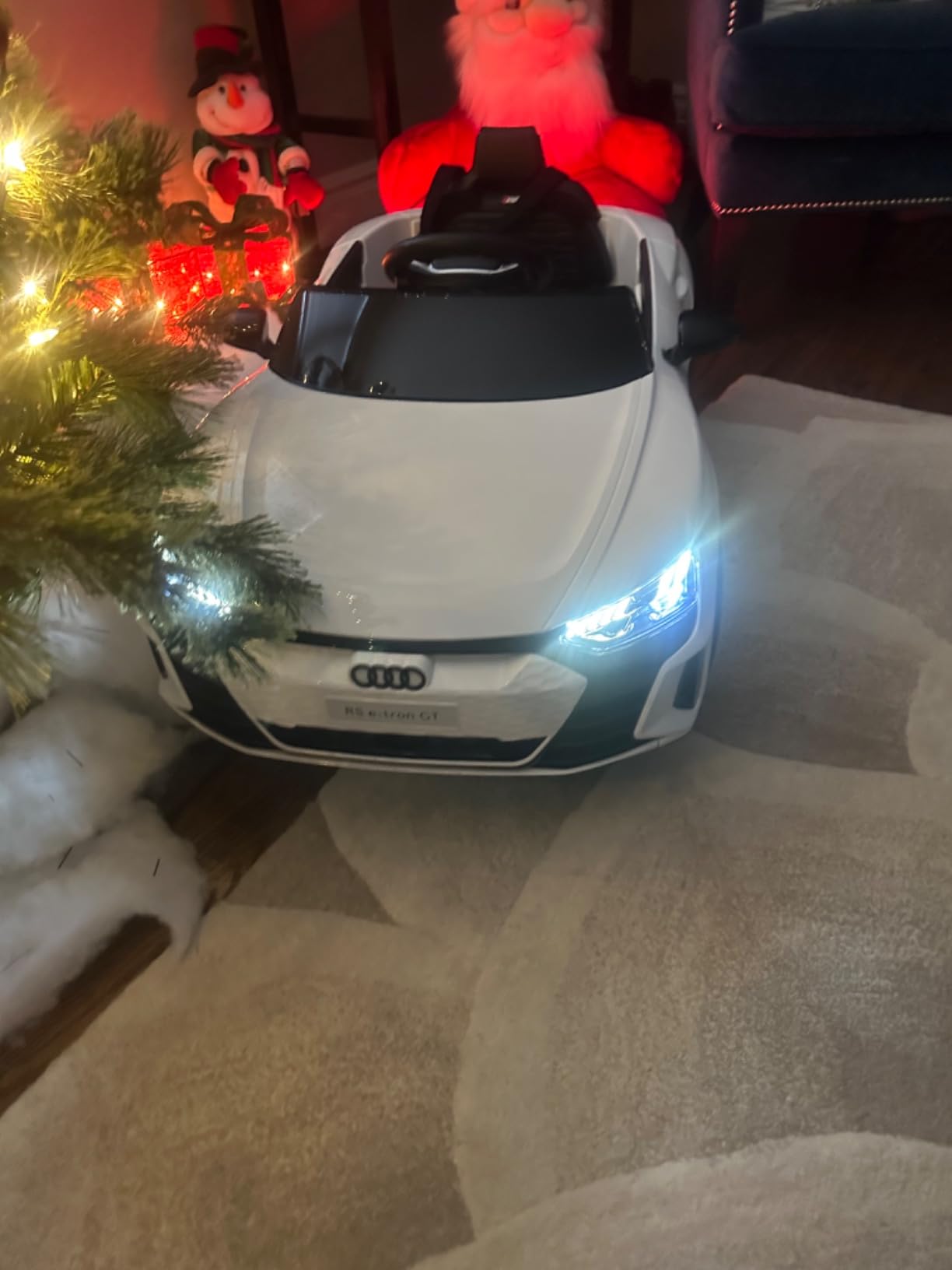
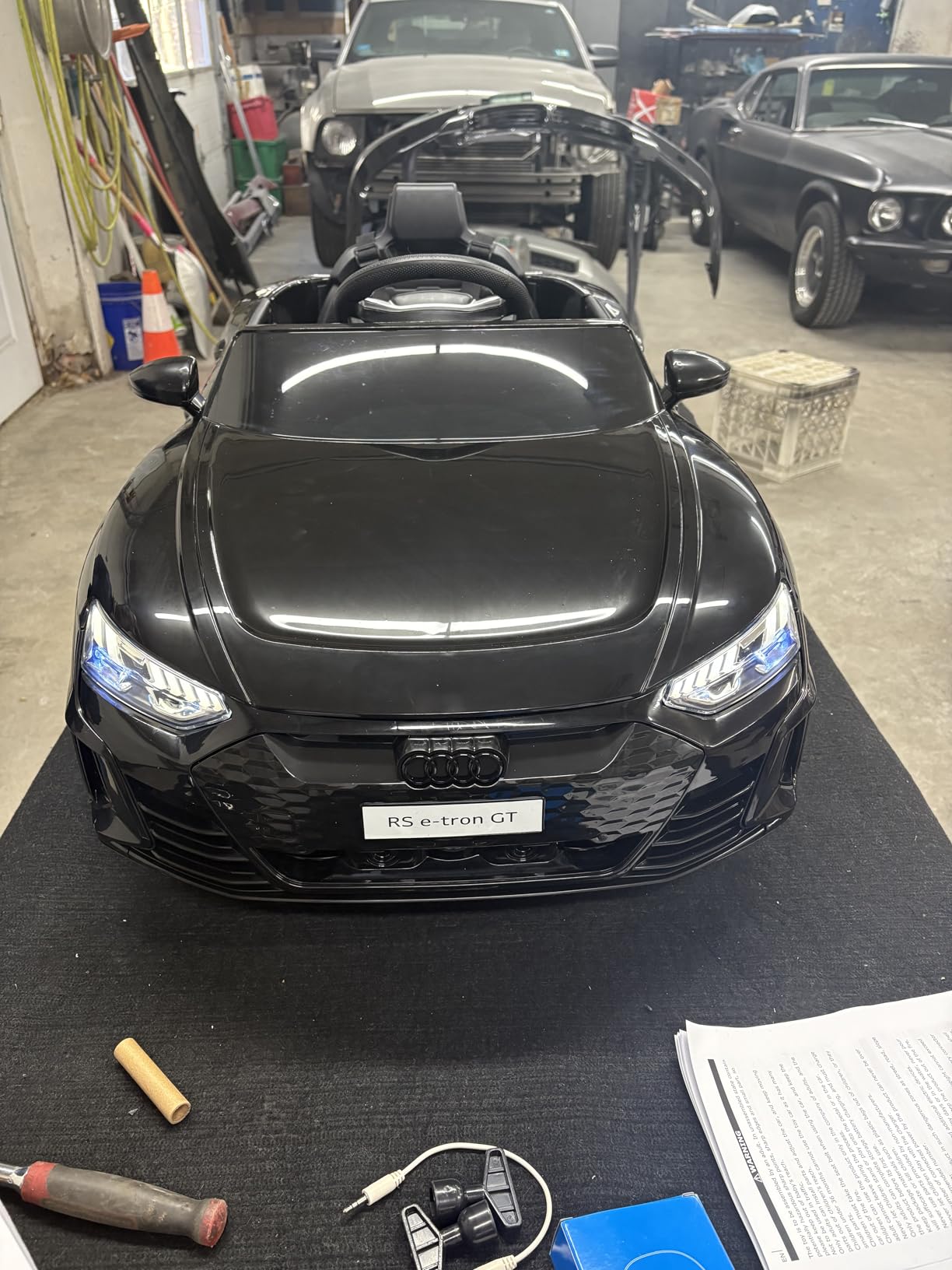
Audio coverage is thorough with USB, MP3, and TF card ports, plus a built-in horn and a forward and backward button. Speakers are noticeably quieter than the steering-wheel setups, so this is a better choice for listening to an audiobook at low volume than for loud music.
Two 30W rear motors push it to a 4 km per hour top speed, which is a walking-plus pace. Dimensions are 41 by 23 by 16 inches, long and low, and the materials are iron and polypropylene with four wear-resistant plastic wheels.
The certification list is the broadest here, covering DOE, CEC, CPSIA, and ASTM, and the listing states it is free of BPA, PVC, phthalates, lead, latex, and formaldehyde with no sharp edges.
Is 40 to 50 minutes of play time a problem
It is the shortest runtime in this roundup, and it is the one specification likely to disappoint. For indoor floor play or a short driveway session it is workable, but a long afternoon at the park will need a mid-session charge or a second car. If you want longer sessions, the Seizeen and ARBELI cars list considerably longer runtimes.
Because the car is light, swapping the pack is not the chore it would be with a 37 lb model, which partly offsets the short runtime.
Is a slim 41 inch car comfortable for a three year old
It fits a three-year-old well and stays out of the way in a smaller home, since the low profile means fewer sharp corners to catch on furniture. Owners report children learning the controls quickly, which suggests the pedal and steering wheel are light enough to manage at this age.
Two AAA batteries are needed for the remote and are not supplied. Have them ready before the first drive so you are not left with manual-only control.
10. Miniature Motors 12V Licensed Roadster: Best for Small Spaces
MINIATURE MOTORS 12V Licensed Electric Car with Remote Control, Kids Ride On Car with Bluetooth Music Player, 3.1MPH Max Speed, Battery Powered Toddler Roadster Birthday Gift for Boy and Girl-Deep Red
Max speed 3.1 mph
Two 25W motors
Runtime 40 to 60 minutes
Item weight 18.9 lbs
Pros
- Three-speed remote from 1.2 to 3.1 mph
- Bluetooth USB and AUX connectivity
- Battery level display on the music dashboard
- Soft start with safety belt and lockable doors
- Fits in an SUV trunk for transport
Cons
- Manual mode is fixed at 3.1 mph with no low setting
- Runs small for children near the upper three-year range
- Bluetooth pairing can be difficult
- Assembly is required before first use
This roadster is the narrowest, lowest profile car in the roundup, and that is its whole appeal for a household without a driveway. At 35.4 by 23.6 by 15.8 inches and 18.9 lbs, owners report fitting it in an SUV trunk for trips to grandparents or grandparents’ gardens, which is unusual for this category.
The remote is unusually well specified. Three speed settings between 1.2 and 3.1 mph mean a parent can genuinely hold a three-year-old at walking pace, and the car includes a soft start, a safety-belt seat, and lockable double doors.

Connectivity is the widest here, with Bluetooth, USB, and AUX ports, a built-in music player, and a horn on the steering wheel. A battery level display on the music dashboard helps you plan a session rather than discovering a flat pack mid-drive.
Two 25W motors and a 12V rechargeable battery give 40 to 60 minutes of play. The design targets children under 35 inches tall and up to 66 lbs, and it is certified to ASTM and CPSIA.
Manual mode is the gap to understand. It is fixed at 3.1 mph with no low-speed option, so the car is remote-led for a three-year-old and only becomes independent once they are confident and older.

Is a single-speed manual mode a dealbreaker at three
Not if you use the remote, which is the intended mode for this age. It becomes worth weighing up only if you want a 3 year old driving independently right away, and at that age most parents keep the remote in hand for the first several months regardless of the car.
Several reviewers note the car suits children under three, so the size is not a stretch. It is the one model here where multiple owners describe using it below the stated minimum age.
Practical notes before the first ride
Assembly is required, and the box includes a charger, a parent remote, two spanners, and a manual. Bluetooth pairing was finicky for some owners, so test the connection before handing the car over rather than discovering it mid-drive.
With 66 lb capacity, this stays useful as your child grows, which makes it a reasonable long-term pick despite the small footprint. If you are shopping for two children, our guide to 2-seater ride-on cars for kids covers when a two-seat model makes more sense than two singles.
12V vs 24V: Which Voltage Suits a 3 Year Old
For a 3 year old, 12V is the correct answer, and the reason is torque rather than excitement. A 24V pack roughly doubles the available power, which means faster acceleration, higher top speeds, and a heavier car that is harder for an adult to stop by hand if something goes wrong. That is a lot of machine for a child who is still learning to release a pedal smoothly.
The trade-off is longevity. A 24V car usually stays relevant from about age four to seven, so families worried about replacing a car at four may prefer to start larger. The counter-argument is that a 3 year old who is bored with their car is the commoner problem, and a 12V model with a 55 to 66 lb capacity already covers the toddler and early preschool years.
Six volts sits at the other end. It is fine for hard indoor floors and very young toddlers but cannot handle grass, which rules it out as a single car for a family that wants outdoor use.
Our rule of thumb: buy 12V now, and upgrade to 24V when your child can reliably reach the brake and steer around obstacles at walking pace. We cover the upgrade options in more detail in our 24V ride-on car guide.
Safety Features That Matter Most for a 3 Year Old
Check these seven things before you buy, in this order. A parental remote with an override or emergency brake is non-negotiable, and the best models go further by letting you change speed from the remote rather than only direction.
Next is a low speed setting. A car that starts at 1.2 to 2.8 mph can be handed over sooner than one that only runs at 3 mph or faster. Look for a documented soft start as well, since an acceleration ramp is what stops a first-time driver crying on the first drive.
A fitted seat belt with an adjustable strap and lockable doors follow. Parents consistently treat both as requirements rather than extras, and the belt strap itself is a wear item worth inspecting every few months.
Finally, look for a forward and reverse function on both the pedal and the remote, and check the maximum rider weight against your child. Certification to ASTM F963 or CPSIA is worth having on the listing, and the models in this roundup all carry it or an equivalent.
Tires and Terrain: Indoor Driveways Versus Outdoor Grass
Tire choice predicts whether you will use the car you bought or watch it sit. Hard plastic wheels work on smooth indoor floors and clean driveways but spin the moment a wheel finds a lawn edge or a fallen leaf, which is frustrating for a three-year-old who cannot judge traction.
Never-flat EVA or plastic wheels with traction tread are the common compromise, and they appear on the Best Choice, ELEMARA, Seizeen, INFANS, and Chevrolet Colorado models here. They will never need inflating, which removes a common failure, and they handle grass and gravel adequately on flat ground.
Rubber traction strips and four-wheel drive suit rougher yards, and parents on r/PowerWheelsMods consistently point to motor count and suspension as the deciding factors once a child starts driving on uneven ground. They do need occasional cleaning, since packed mud and grass reduce grip quickly.
For flat lawns, paved paths, and parks, anything in this roundup will work. For slopes or gravel driveways, prioritise traction tires and spring suspension, and test on a level area first.
Battery Life, Charging Time and Assembly Expectations
Expect 40 to 120 minutes of play per charge across this group, and 4 to 12 hours of charging depending on the model. The Chevrolet Colorado and Mercedes AMG GTR take the longest to charge and give back about an hour of driving, while the Seizeen lists 80 to 120 minutes from a 12V 7Ah pack. Runtime claims in the category tend to be optimistic, so plan a charge between outdoor sessions rather than during one.
Charge on a hard, flat indoor surface rather than a bed or carpet, and unplug once the charger indicator settles. In cold weather, store the car indoors and give the battery a partial charge every few weeks, since lead-acid packs lose capacity when left fully drained in a garage. Our ride-on truck guide for toddlers covers storage and terrain in more detail.
Assembly ranges from under an hour to 45 to 60 minutes for the more complex builds, and the Hetoy arriving 85 percent assembled is a genuine outlier. Most packs include the car, charger, remote, and manual; several remotes need two AAA batteries that are not supplied, so buy a pack before delivery day.
Finally, check the warranty before you commit. Stated cover in this roundup ranges from six months to three years, and a longer warranty is reasonable insurance on a toy that will take knocks from a three-year-old.
Frequently Asked Questions
What age is a 12V ride-on for?
A 12V ride-on is generally intended for children from 3 years old up to around 5 to 6, depending on the weight capacity of the model. Most manufacturers in this roundup state 3 years and up as the minimum. A 3 year old is a good match for 12V because the top speeds of roughly 2.5 to 3.5 mph are controllable when a parent uses the remote and a low speed setting.
Which is better for my child, 12V or 24V ride-on toys?
For a 3 year old, 12V is the better choice. It delivers enough torque for grass and gentle slopes while keeping top speeds at a level a small child can control, and the car stays light enough for an adult to move. A 24V ride-on is faster and heavier, which suits children from about age 4 to 7. Choose 24V later if you want a car that lasts through the primary school years rather than the toddler and preschool years.
What is the safest ride-on car for toddlers?
The safest ride-on for a toddler is the one with a parental remote that includes an override or emergency brake, a low speed setting for beginners, a fitted adjustable seat belt, lockable doors, and a documented soft start. In this roundup, the Best Choice Products car and the Hetoy truck score well on that checklist, with the Seizeen Ford Bronco offering the lowest low-speed setting at 1.2 mph.
How fast does a 12V ride-on car go?
Most 12V ride-on cars for toddlers top out between 2.5 and 3.5 mph, which is roughly walking pace to a brisk walk. The models here range from a 2.8 mph ceiling on the Best Choice Products car to 3.5 mph on the ELEMARA truck. Several cars, including the Seizeen Ford Bronco and the Miniature Motors roadster, include a low speed setting near 1.2 mph that a parent can select from the remote.
How long does a 12V ride-on battery last per charge?
Expect between 40 and 120 minutes of play per charge depending on the model, rider weight, terrain, and how fast the car is driven. The Seizeen Ford Bronco lists 80 to 120 minutes from a 12V 7Ah battery, while the INFANS Audi and Miniature Motors roadster list 40 to 50 and 40 to 60 minutes. Charging takes 4 to 12 hours, so plan a charge between outdoor sessions rather than during one.
Can a 3 year old really drive a 12V ride-on independently?
A 3 year old can usually handle the steering and pedal on smooth ground, but most parents keep the remote in hand for the first several months. The practical approach is to start on the lowest speed setting, which is why models with a documented low speed such as 1.2 to 2.8 mph are the best first cars. A soft start ramp also matters, because it prevents the sudden acceleration that makes some toddlers frightened of a first ride.
The Verdict: Which 12V Ride-On to Buy for a 3 Year Old
The Best Choice Products 12V ride-on is our top pick for a 3 year old. It combines a gentle 2.8 mph top speed, a working parent remote, a fitted seat belt, lockable doors, and the deepest review history of any car here, which is the closest thing to a reliability record you can get in this category.
Buy the Hetoy truck if assembly time and terrain handling matter most, the Seizeen Ford Bronco if your child is large for their age and you want the widest seat and lowest low-speed setting, and the Winado Mercedes AMG GTR if licensed styling is what gets your child excited enough to climb in.
Whichever one you choose, start on the lowest remote speed, test on level ground, and inspect the seat belt every few months. That habit does more for safety than any extra feature on the spec sheet.