
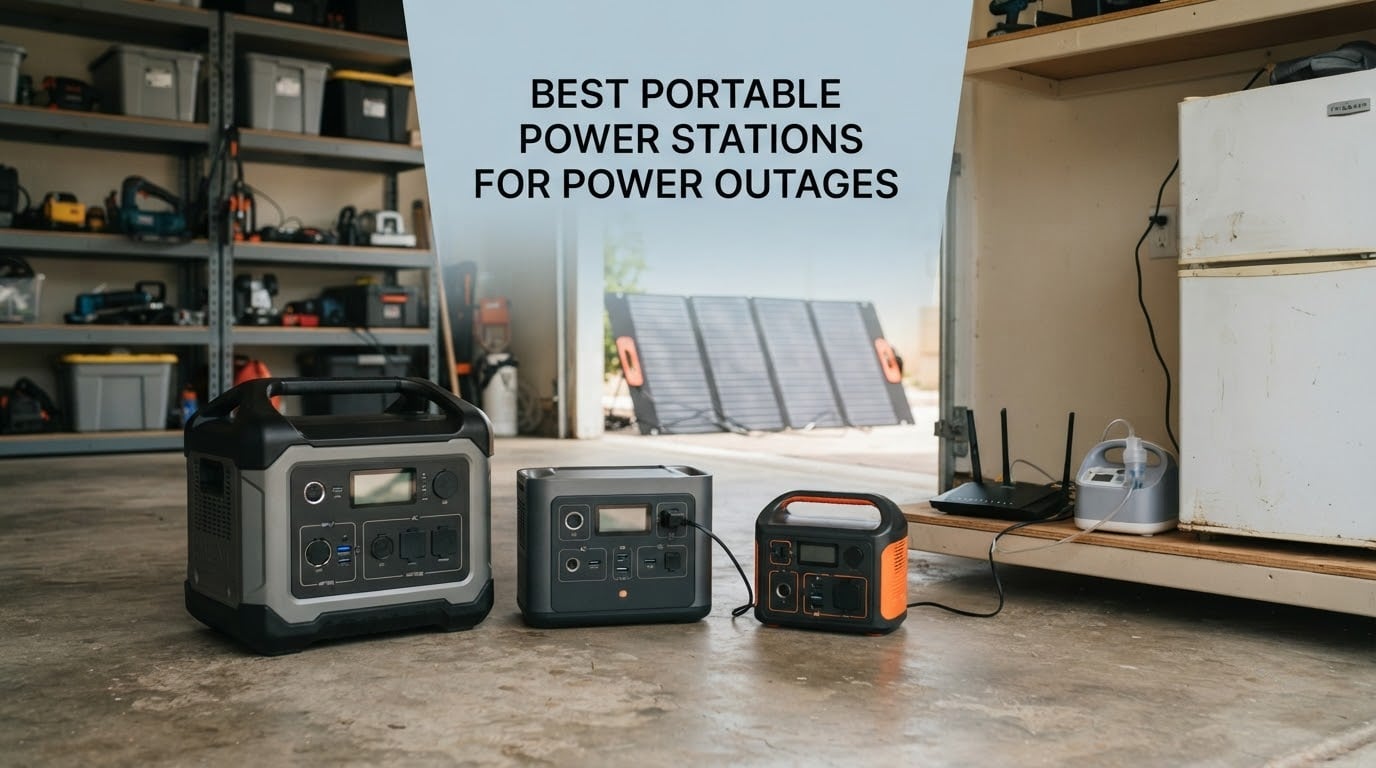
The Jackery Explorer 1000 v2 is the best portable power station for most power outages. It stores 1,070 watt-hours, delivers 1,500 watts of continuous AC power, holds a 4.7 star rating across 3,623 reviews, and weighs 23.8 pounds, which is light enough for one person to carry down a hallway at 3am.
That combination is what matters in an outage: enough stored energy to run a refrigerator overnight, enough inverter output to start a compressor, and a body you can actually move. Most people buying a power station for the first time make the same two mistakes. They compare nameplate watt-hours as if every one of those hours reaches the device, and they read surge output as if it were continuous.
Neither number survives contact with a real fridge. Every runtime figure in this guide applies a single planning factor of 85% to nameplate capacity, which covers inverter conversion loss, the internal battery management system and standby self-consumption. Owner reviews also put the inverter idle draw on many units somewhere around 6W to 20W, and over a long outage that adds up to real hours you would otherwise expect to have.
Our team compared 12 units across capacity classes from 288Wh to 3,072Wh, weighing rated output against measured owner complaints, UPS switchover behaviour, recharge speed, expansion options and weight. The picks below span a 300Wh grab-and-go unit, a cluster of 1kWh workhorses, two 2kWh options, and three 3kWh units for households that need more than a fridge and a router. If you want a narrower read first, our general portable power station guide covers camping and off-grid use in more detail.
Table of Contents
Top 3 Picks: Best Portable Power Stations for Power Outages (October 2026)

Jackery Explorer 1000 v2
- 1070Wh LiFePO4
- 1500W continuous AC
- One-hour emergency recharge
- 4000-cycle battery
All 12 Best Portable Power Stations for Power Outages Compared in 2026
| Product | Specifications | Action |
|---|---|---|
| Jackery Explorer 1000 v2 |
|
Check Latest Price |
 BLUETTI AC180 BLUETTI AC180 |
|
Check Latest Price |
 BLUETTI Elite 100 V2 BLUETTI Elite 100 V2 |
|
Check Latest Price |
 Anker SOLIX C1000 Gen 2 Anker SOLIX C1000 Gen 2 |
|
Check Latest Price |
 OUPES Mega 1 OUPES Mega 1 |
|
Check Latest Price |
 EF ECOFLOW DELTA 3 Classic EF ECOFLOW DELTA 3 Classic |
|
Check Latest Price |
 EF ECOFLOW DELTA 2 Max EF ECOFLOW DELTA 2 Max |
|
Check Latest Price |
 Jackery Explorer 300 Jackery Explorer 300 |
|
Check Latest Price |
 Anker SOLIX C300 Anker SOLIX C300 |
|
Check Latest Price |
 Anker SOLIX S2000 Anker SOLIX S2000 |
|
Check Latest Price |
 PECRON F3000LFP PECRON F3000LFP |
|
Check Latest Price |
 Jackery HomePower 3000 Jackery HomePower 3000 |
|
Check Latest Price |
1. Jackery Explorer 1000 v2: The Best All-Round Pick for a Night of Backup
Jackery Explorer 1000 v2 Portable Power Station,1070Wh,1500W
1070Wh LiFePO4
1500W continuous, 3000W surge
23.8 lb
4000 cycles
Pros
- One-hour emergency charge after enabling the mode in the app
- 4000-cycle LFP battery retaining over 70%
- 23.8 lb with a foldable handle
- Three pure sine wave AC outlets plus 100W USB-C
- 30 dB quiet charging
Cons
- The one-hour mode must be switched on manually each time
- Solar charging is limited to Jackery-branded panels
I keep the Jackery Explorer 1000 v2 in the hall closet as my default outage unit. After running it through a series of planned blackouts, it is the one I hand to family members who need a fridge and a router covered for a night without reading a manual first. The 1,070Wh of LiFePO4 capacity and 1,500W of continuous output sit in the sweet spot where the unit can start a refrigerator compressor without any fuss.
The recharge story is the part that catches people out. Standard wall charging takes about 1.7 hours, but the advertised one-hour emergency mode has to be switched on in the Jackery app before you plug in. Owners who read the headline number and never open the app end up wondering why their unit takes twice as long. The good news is that 1.7 hours is still fast enough to top off overnight after a storm passes.
Forum owners across prepper and off-grid threads consistently steer toward sizing from load requirements rather than brand loyalty, and this unit comes up often for a reason. The battery is rated to 4,000 cycles before dropping under 70% of rated capacity, which is the number that actually matters for somebody who wants this thing to survive a decade of storm seasons rather than two.
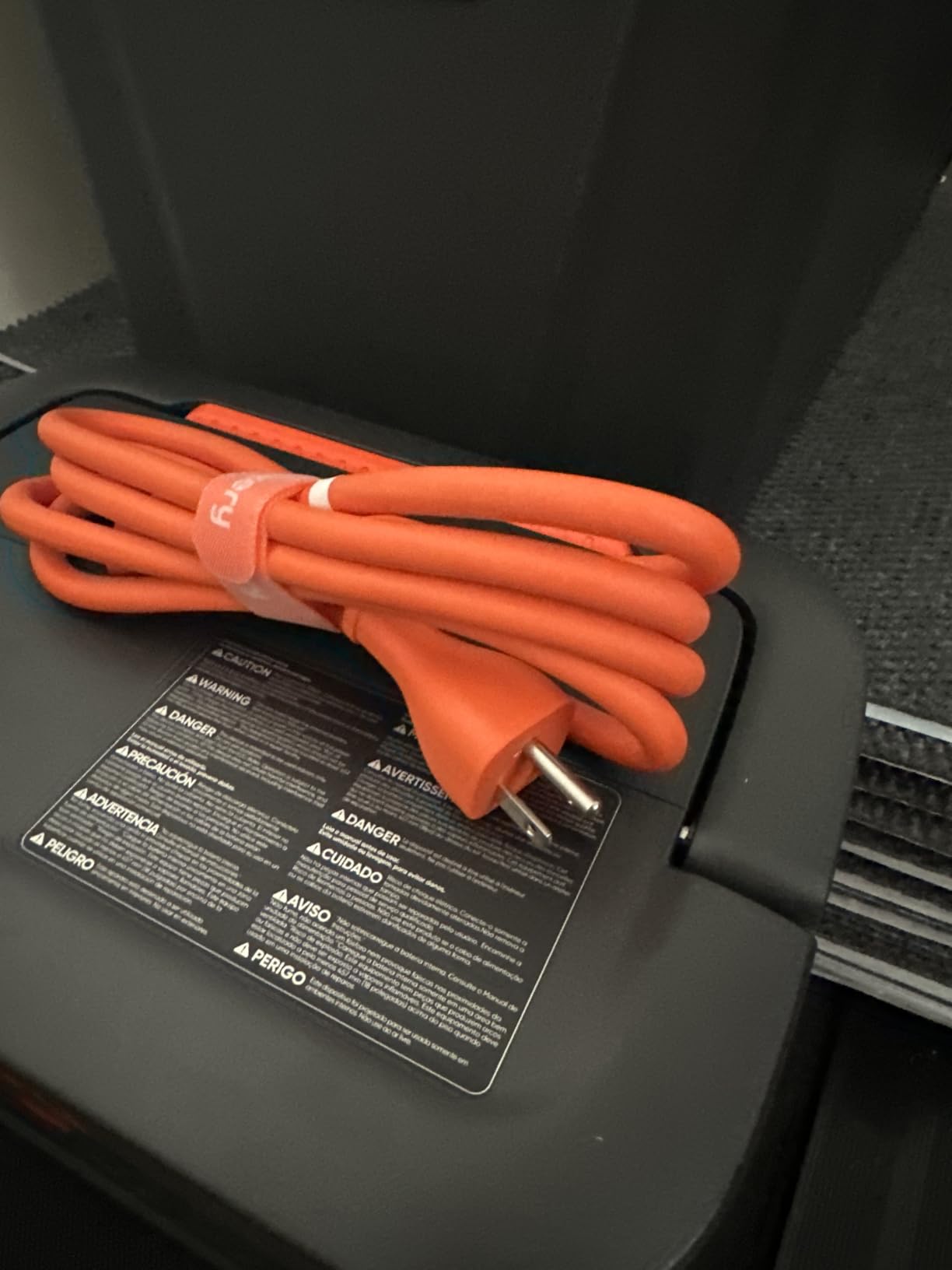
Output is a pure sine wave across three AC outlets, plus two USB-C, one USB-A and a DC car port. Seven outlets is enough that the household does not have to shuffle cables around every time the load changes. Pure sine wave output is the spec to insist on for anything with a motor in it, and this unit delivers it on all three AC sockets.
The weakness is ecosystem lock-in. Solar charging works only with Jackery panels, so if you already own a 400W array from another brand, this unit will not take it directly. The other recurring note across reviews is that quiet charging at 30 dB is genuinely apartment-friendly, which is more than a lot of 1kWh units can say.
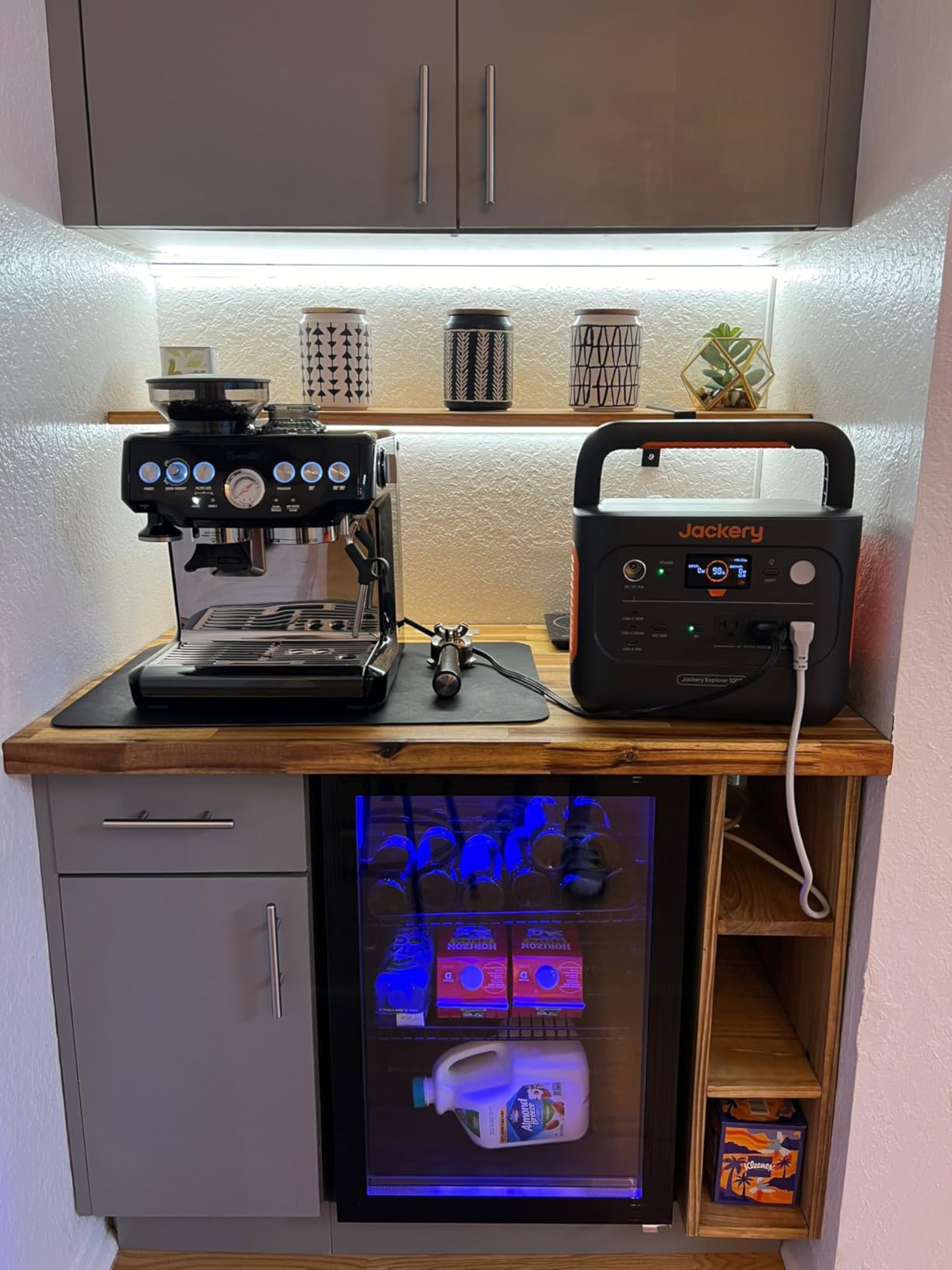
Who the Jackery Explorer 1000 v2 suits
This is the unit for a household that wants one box to cover a refrigerator, a Wi-Fi router, a few lamps, phone charging and a laptop for the duration of a typical overnight outage. At 1,070Wh nameplate, apply the 85% planning factor and you are planning against roughly 900Wh of delivered energy, which comfortably outlasts a night on a fridge alone.
It also works well for anyone who needs the output headroom to start compressor-driven appliances rather than only resistive loads. 1,500W continuous with 3,000W of surge means pumps, fans and small tools are within reach, provided you check startup draw first.
Who should skip the Jackery Explorer 1000 v2
Skip it if your outage plan includes a chest freezer running for two full days, an oxygen concentrator plus a CPAP plus a fridge, or anything you would call whole-home. One 1kWh unit is a night-and-a-day device, not a multi-day one, and stretching it further means accepting a dim fridge and a dark house by morning.
Also skip it if you already own third-party solar panels or plan to buy a large fixed array, because the brand-locked solar input narrows your options. If you need 3,000Wh-plus of headroom, look at the 2kWh and 3kWh units further down instead.
2. BLUETTI AC180: Best Value for High Output and Long Cycle Life
BLUETTI AC180 Portable Power Station 1152Wh 1800W LiFePO4 Solar Generator
1152Wh LiFePO4
1800W continuous, 2700W boosted
37.4 lb
5-year warranty
Pros
- Full charge in about one hour at 1440W AC input
- 1800W output with app boost to 2700W
- 500W solar input recharging in roughly 3 hours
- 20 ms UPS handoff
- 5-year warranty
Cons
- Heavy at 37.4 lb for a unit you may need to move
- Wireless charging pad often drops the connection
- Around 20W idle draw plus a reserve cuts usable Wh below nameplate
The BLUETTI AC180 is the pick when output per unit of capacity matters more than portability. 1,800 watts of continuous AC from 1,152Wh is a more aggressive ratio than most of the field at this class, and owners running power tools or a refrigerator during outages frequently single that out as the reason they bought it.
Recharge is fast. The 1,440W AC input fills the pack in about an hour, and the 500W solar input brings it back up in roughly three hours under good sun. That matters less for people who camp than for people who plan to ride out a multi-day grid event, because a unit that recovers fast after a solar window is far more useful than one that sits at a low state of charge.
The AC180 is also one of the few 1kWh units in this group that expands. Owners who later add battery modules get more overnight runtime from the same inverter, which is a cheaper path to a 2kWh-class system than replacing the whole unit. BLUETTI backs it with a 5-year warranty, the longest in this roundup alongside the Anker units.
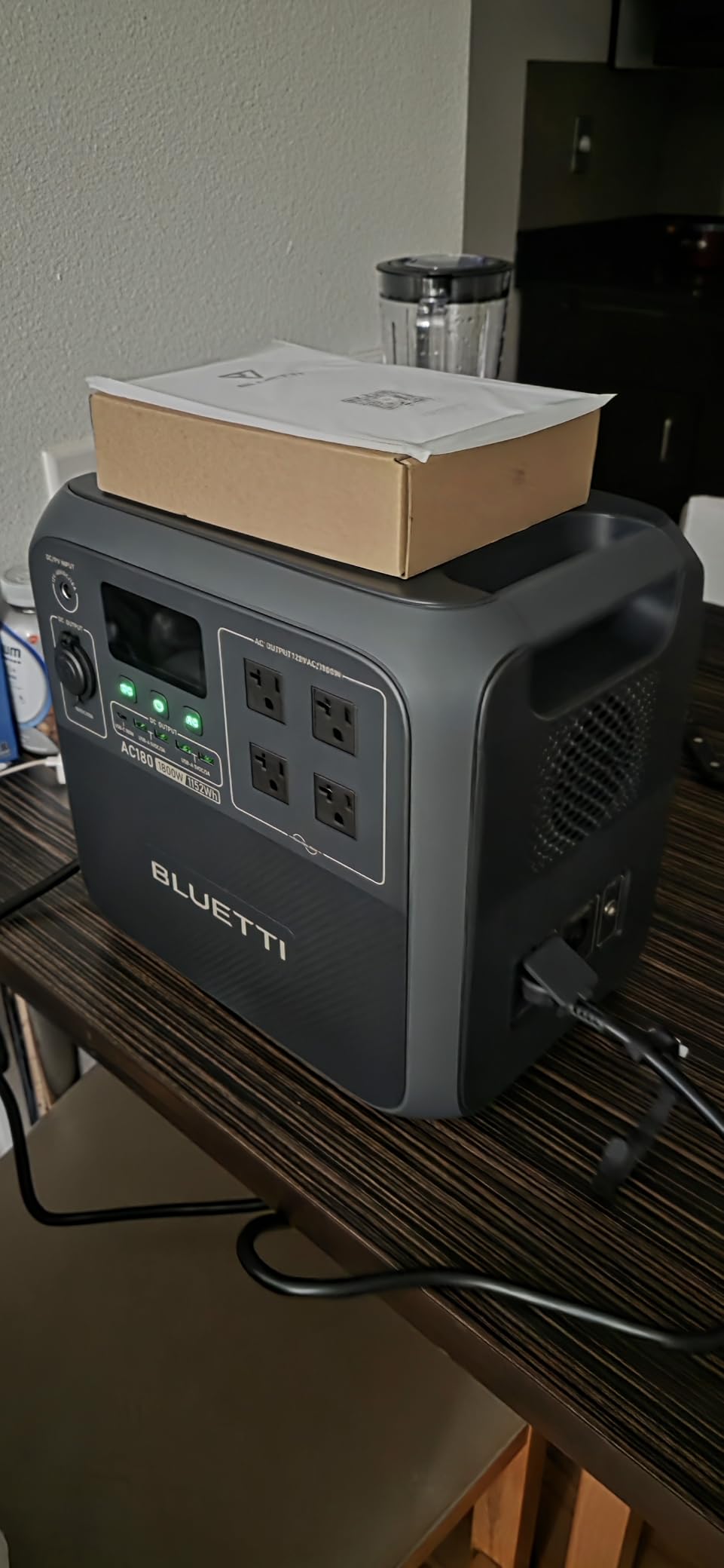
One number deserves attention because it appears in almost every long review: the inverter idles at roughly 20W, and the unit holds back a small percentage of charge as a working reserve. Combined with inverter loss, that means the 1,152Wh nameplate is not what you will get out of it. Owners who were disappointed by short runtime usually were comparing against the label rather than against measured output.
The other complaints are physical. At 37.4 pounds this is a two-hand lift and an awkward carry over anything longer than a few steps, which is a real problem in a dark house. The top-mounted wireless charging pad is also reported often enough to be a pattern rather than a handful of bad units.
Who the BLUETTI AC180 suits
Choose this unit if your load list includes power tools, a well pump, an air conditioner or several high-draw appliances running at once, and you can park it in one spot instead of carrying it. The 20ms UPS handoff is enough to keep a router, a security camera system or a medical fridge alive through a short flicker.
It is also a strong choice for anyone planning to add solar later, since 500W of native solar input accepts a wide range of panels, and for buyers who weight warranty length heavily over weight.
Who should skip the BLUETTI AC180
Skip it if you are the only person home and the unit needs to move between rooms. 37.4 pounds is past the point where a single person can safely relocate it in a hurry, and the deeper problem is that the weight keeps people from repositioning it at the right moment.
Also skip it if you run very small loads only. A 20W idle draw is trivial on a 1,152Wh pack for a night, but it becomes a meaningful slice of a 288Wh unit over a long event. If your loads are only a router and a lamp, a smaller pack is the better tool.
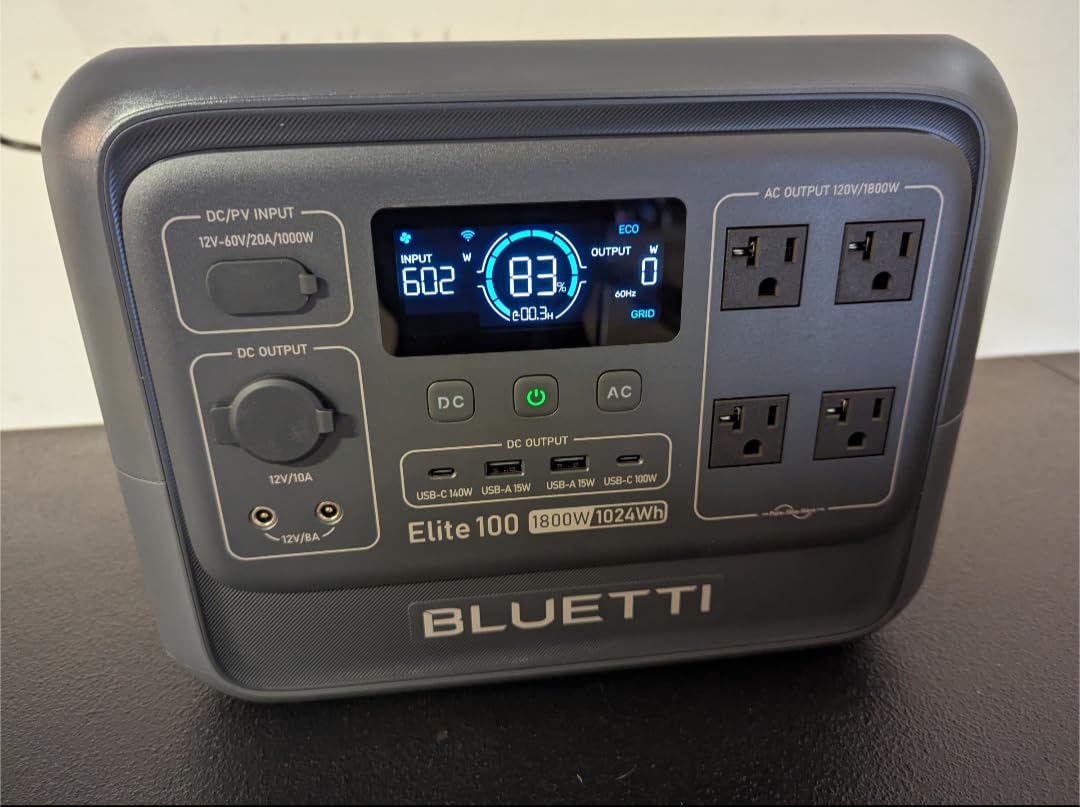
3. BLUETTI Elite 100 V2: Quiet Operation and a 10 ms UPS Handoff
BLUETTI Elite 100 V2 Portable Power Station for Camping 1024Wh 1800W
1024Wh LiFePO4
1800W output, 2700W lifting
25 lb
10 ms UPS, 30 dB
Pros
- 0-80% in about 45 minutes on 1200W AC
- 10 ms UPS keeps routers and PCs through outages
- 30 dB silent mode is about half as loud as competing 1kWh units
- Standard solar connectors rather than a proprietary interface
Cons
- 25 lb still feels heavy for frequent moving
- 12V car socket runs warm above about 12W
- Loads near 7W may not register on the readout
The BLUETTI Elite 100 V2 is the one I recommend when the station will live in a bedroom or a home office rather than a garage. Its 10 ms UPS switchover is the fastest in this roundup, and reviewers report routers, desktop computers and network gear riding through outages without a reboot, which is the entire point of buying a station with UPS mode.
Silence is the second argument. The 30 dB silent mode measures roughly half as loud as competing 1kWh units, and for anyone trying to sleep through a storm with a fridge humming nearby, that is a real difference rather than a spec-sheet nicety.
At 1,800W rated output with Power Lifting to 2,700W and 3,600W of surge, it handles resistive loads such as a small space heater through the lifting mode. That mode only applies to heating elements, so do not use it to start a compressor. Motor loads need the full 1,800W headroom and its own surge rating.
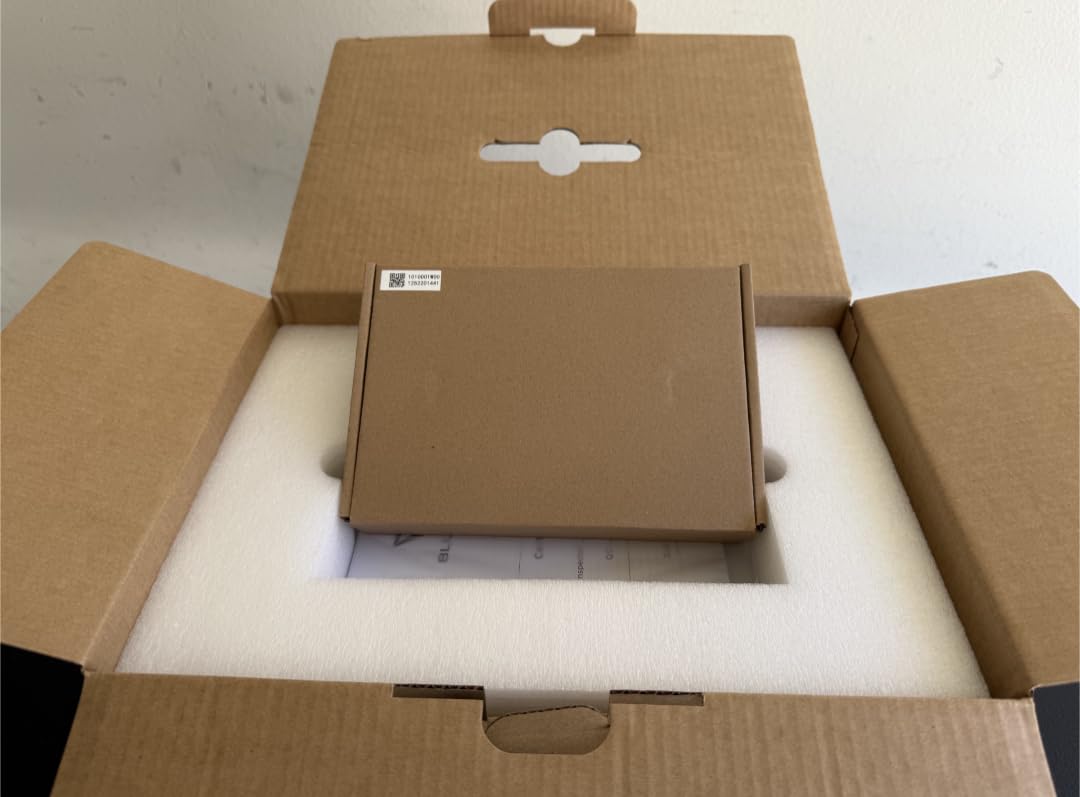
The chassis is 25 pounds in a 17-litre body, and BLUETTI engineered a hidden grab handle into it. Standard solar connectors are a genuine advantage over brands that lock you into their own panels, and the 1,200W TurboBoost input reaches 80% in roughly 45 minutes. The battery is rated at 4,000-plus cycles to 80% retention, a claim backed by a 60-month warranty.
The small complaints add up. The 12V car socket gets warm past about 12W, low-draw loads near 7W may not show on the power readout, and the exposed DC barrel ports are easy to short with a loose connector. None of these matter for a fridge-and-router load, but all of them matter if you plan to work off the DC ports directly.
Who the BLUETTI Elite 100 V2 suits
This is the pick for a home office, an apartment or a bedroom where noise and network continuity are the priorities. If you work from home and cannot afford a router reboot, a desktop that shuts down mid-save, or a night of lost packets, the 10 ms handoff is the feature to buy for.
It is also a good fit for anyone who wants a 1kWh unit that will accept third-party solar panels, since standard connectors remove the ecosystem problem entirely.
Who should skip the BLUETTI Elite 100 V2
Skip it if you plan to run a chest freezer for days. 1,024Wh is a night of coverage for one compressor appliance, and stretching it further means the freezer thaws before the grid returns. For multi-day freezer protection you need the 2,010Wh Anker SOLIX S2000 or a 3,072Wh unit.
Also consider whether your loads are all small. If everything you run sits under 10W, the display may under-report the draw, and you will find yourself guessing at remaining runtime rather than reading it.
4. Anker SOLIX C1000 Gen 2: Fastest Recharge in the 1kWh Class
Anker SOLIX C1000 Gen 2 Portable Power Station
1024Wh LiFePO4
2000W continuous, 3000W peak
11.3 kg
10 ms UPS
Pros
- 49-minute full recharge at 1600W HyperFlash
- 2000W output across 9-10 ports
- Under 10 ms UPS keeps sensitive electronics from rebooting
- 600W solar input for a 1.8-hour recharge
- 80% capacity retained after 4000 cycles
Cons
- Gen 2 removed the expansion capability of the first generation
- 15-20% harmonic distortion measured on a microwave load
- Roughly 25 lb for a unit this size
- No protective case included
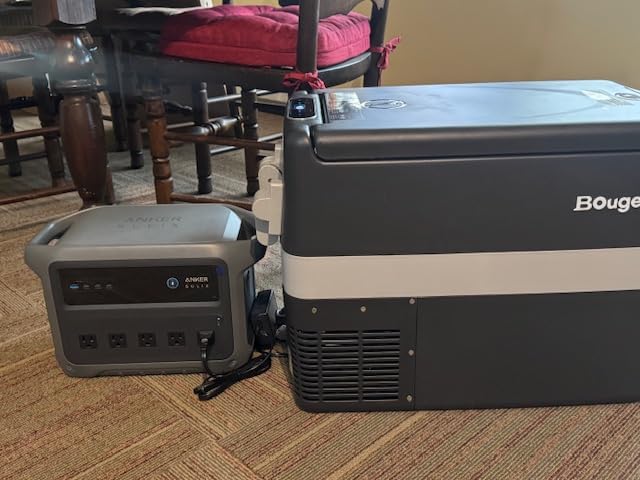
The Anker SOLIX C1000 Gen 2 is the fastest-charging unit we recommend at 1kWh. The 1,600W HyperFlash input brings it from empty to full in 49 minutes, and you have to enable HyperFlash in the Anker app, which is the same app-gated caveat that catches people on the Jackery. In exchange you get a unit that can be recharged and redeployed the same evening.
Owners who moved up from the first-generation C1000 describe the Gen 2 as a fix for earlier failure-to-power-on reports and solar input problems. The 4.7 star rating across 1,632 reviews sits among the highest in this group, and reviewers repeatedly mention running CPAP machines, laptops and a refrigerator at the same time without the inverter complaining.
The CPAP case is worth spelling out because it is a common reason to buy one. A CPAP with a heated humidifier draws in the 60W to 100W range, so a 1,024Wh pack sized for overnight use is comfortable, and the sub-10ms handoff keeps the machine from restarting when the grid blinks. Confirm your specific device with its manufacturer before relying on it during an emergency.
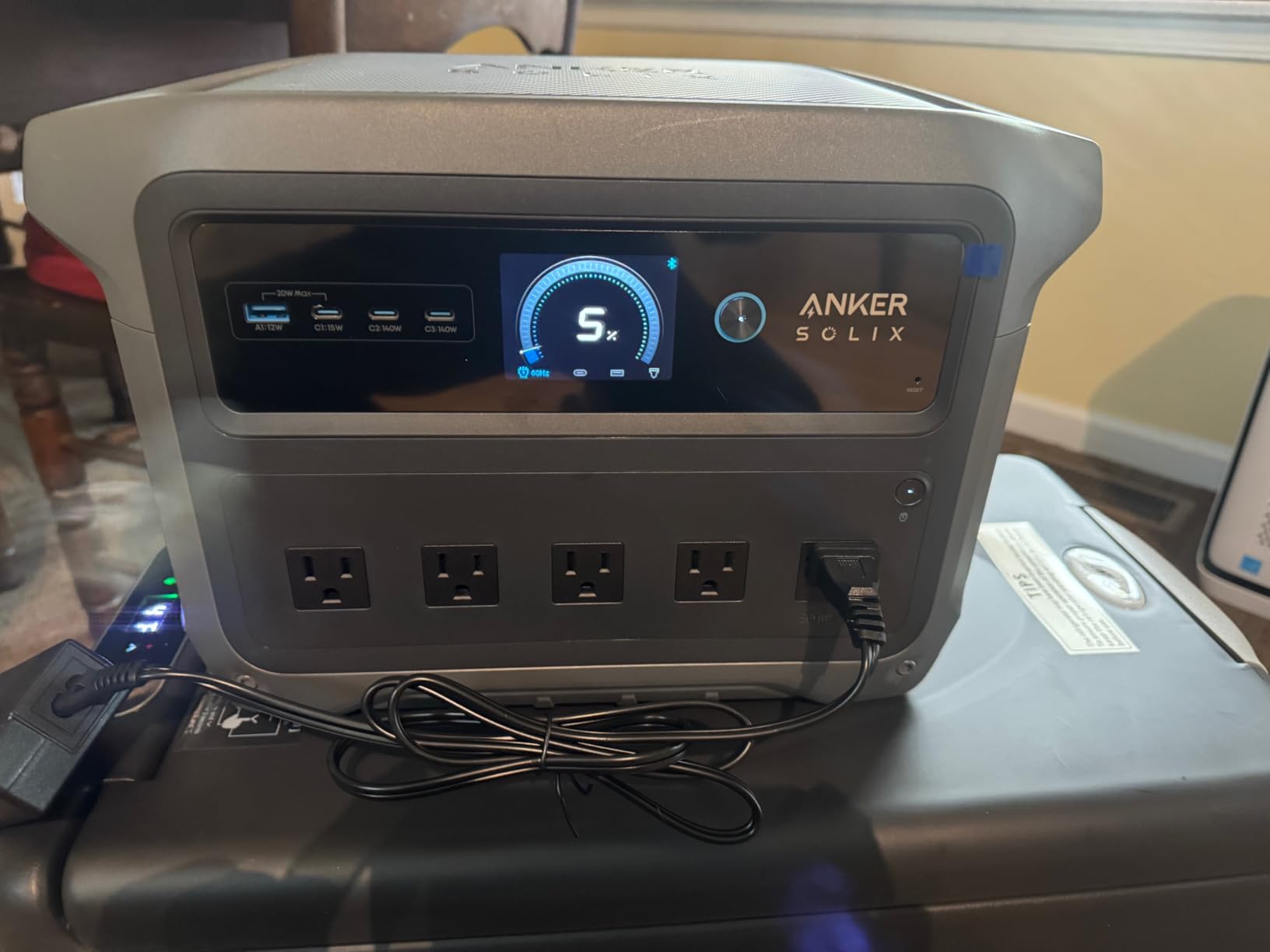
Output is 2,000W continuous with 3,000W peak across 9 to 10 ports, and solar input accepts up to 600W at 60V maximum. Anker’s app adds a time-of-use mode that charges off-peak and holds for the outage window, which is a small feature that becomes significant when the grid is unreliable enough to justify buying a station in the first place.
Two technical notes from reviewers. One power-industry engineer measured roughly 15-20% harmonic distortion on the inverter output when driving a microwave oven, which is worth knowing before you run sensitive audio or medical gear off the AC sockets. And the Gen 2 dropped the expansion battery capability of the original C1000, so this is a fixed-capacity unit now.
Who the Anker SOLIX C1000 Gen 2 suits
This suits households that expect frequent, short outages and want the unit back at full charge quickly. If your grid fails in the evening and returns overnight, a 49-minute refill changes how much of a recovery plan you need to build around wall power.
It is also the pick for anyone running a CPAP or a laptop-heavy mobile office, because the port count and the sub-10ms handoff keep multiple sensitive devices stable at once.
Who should skip the Anker SOLIX C1000 Gen 2
Skip it if you know you will want more capacity later. The Gen 2 has no expansion path, so a household that outgrows 1,024Wh has to buy a different unit rather than add a battery. The BLUETTI AC180 or the OUPES Mega 1 both keep that door open.
Also weigh the 25-pound figure against your household. The unit is physically compact, but compact and light are not the same thing, and 11.3 kg still needs two hands and a clear path.
5. OUPES Mega 1: Most Expandable Capacity in the 1kWh Class
OUPES Mega 1 Portable Power Station 1024Wh 2000W (4500W Surge)
1024Wh LiFePO4
2000W continuous, 4500W advertised surge
27.8 lb
expands to 5120Wh
Pros
- Expands to 5120Wh with two B2 batteries and no extra inverter
- 0-80% in 36 minutes on AC
- 800W solar input with built-in MPPT
- 4 AC outlets spaced widely for bulky plugs
- Dual 100W USB-C PD ports
Cons
- Real surge trips between roughly 2050W and 2200W
- far below the advertised figure
- Proprietary Anderson-style charge cable
- Cooling fan is loud during charging
- Basic Bluetooth app with unreliable Wi-Fi
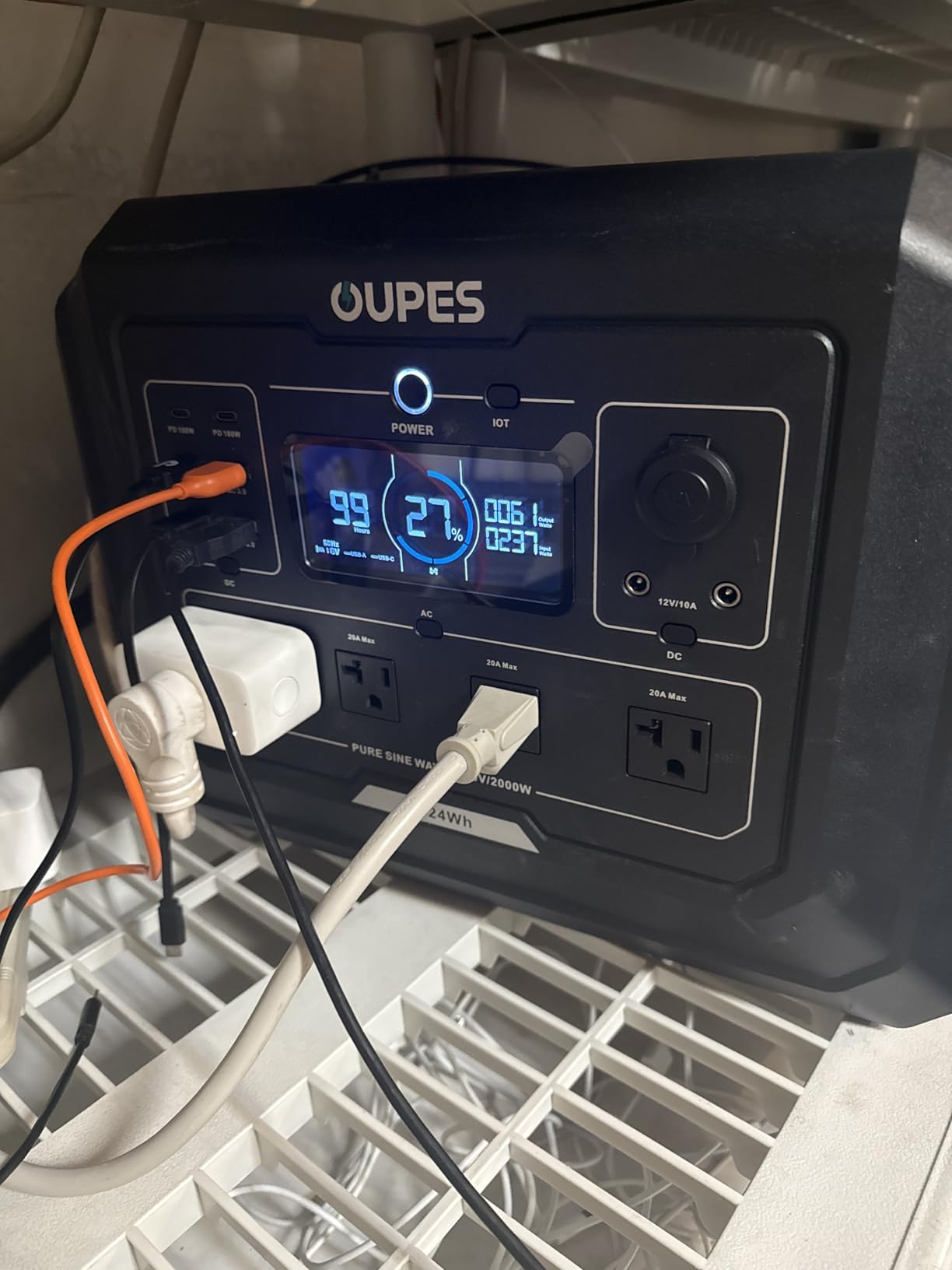
The OUPES Mega 1 is the unit to buy if you are fairly certain you will outgrow 1kWh. Two B2 expansion batteries take it to 5,120Wh using the existing inverter, and no competitor in this roundup reaches that ceiling from a 1kWh starting point. Buyers who framed it as the best power-per-pound-of-spend in the class are reading the spec sheet correctly.
Recharge is quick: 0 to 80% in 36 minutes on AC, or about 26 minutes when AC and solar are combined. The 800W solar input is the highest ceiling among the 1kWh units here, and the built-in MPPT handles low-light conditions better than many competitors, which is what you actually face during a storm.
Layout is thoughtful for an unfamiliar brand. Four AC outlets are spaced far enough apart that a bulky power brick in one socket will not block its neighbour, and there are twin 100W USB-C PD ports plus four QC3.0 USB-A ports for a household charging a dozen things at once.
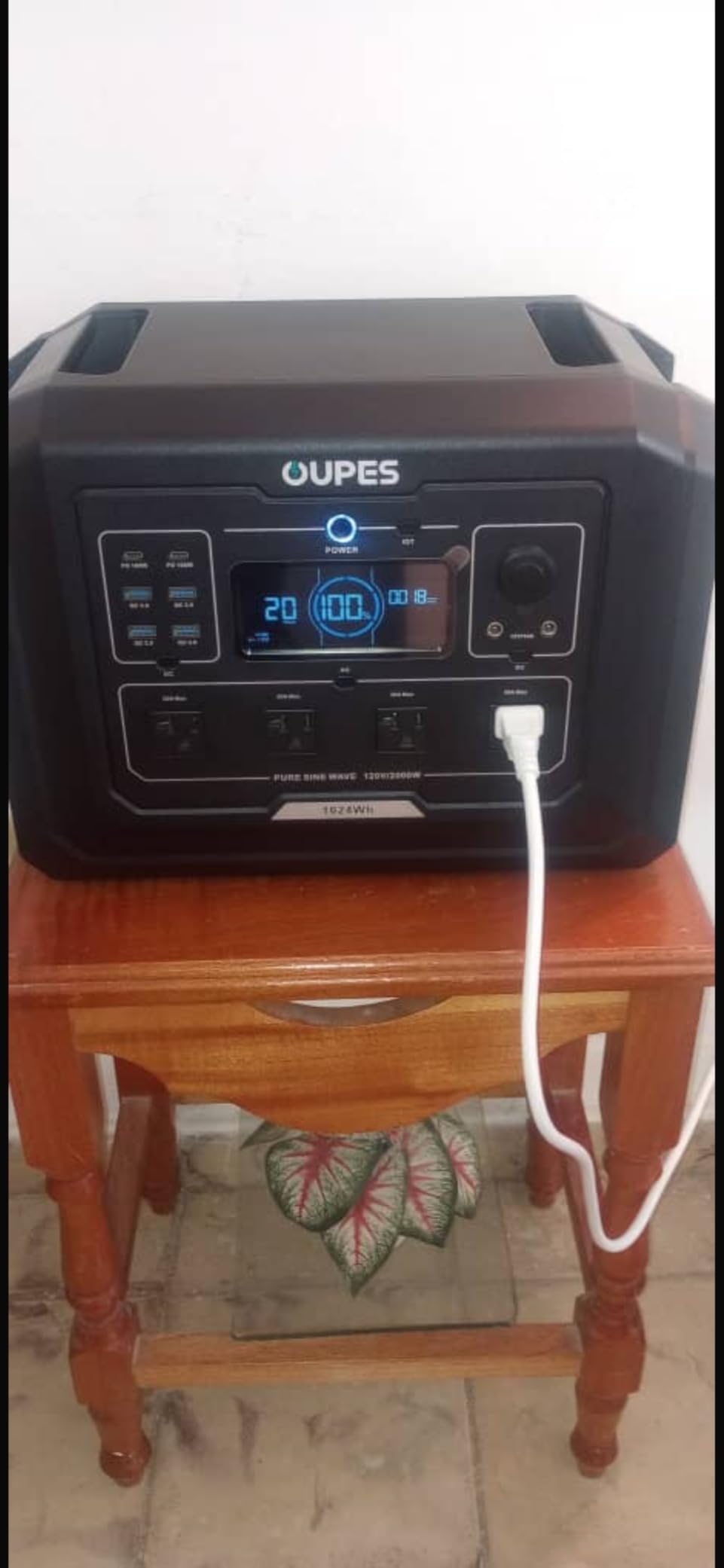
Here is the number to read carefully: the listing advertises 4,500W of surge, and owners report the unit actually trips between roughly 2,050W and 2,200W. That is a meaningful gap for anyone planning to start a motor-driven appliance, and it is the single most repeated complaint across reviews. Plan motor startups against the 2,000W continuous figure and its real headroom, not the headline.
Two smaller issues. The proprietary Anderson-style charging cable is genuinely hard to replace if it is lost, and the cooling fan runs throughout charging and is loud enough to notice in a quiet room. The plastic housing also feels entry-level and offers little weather resistance, so keep it indoors.
Who the OUPES Mega 1 suits
Choose it if you want one purchase that can grow into a multi-day system. Taking the unit to 5,120Wh moves it from a night-and-a-day device to something closer to a small home backup system, without needing a second inverter or a rewired circuit.
It is also a strong pick for high solar potential. 800W of input with an MPPT controller means a modest residential array can meaningfully extend runtime during an extended outage.
Who should skip the OUPES Mega 1
Skip it if you need a hard surge margin today. The gap between the advertised and actual surge figures makes this a poor choice for anyone starting large compressor loads, even though the continuous 2,000W rating is genuinely strong.
Skip it if app stability matters to you. The Bluetooth and Wi-Fi experience is basic and the connection is reported as unreliable, which is a nuisance when you are trying to check remaining capacity from another room in the dark.
6. EF ECOFLOW DELTA 3 Classic: Best for Apartments and Small Homes
EF ECOFLOW Portable Power Station Delta 3 Classic, 1024Wh 1800W AC
1024Wh LiFePO4
1800W output, 3600W surge
26.7 lb
under 10 ms UPS
Pros
- 0-80% in 45 minutes with X-Stream AC charging
- Under 10 ms UPS works for a home backup fridge and travel fridge
- 90% five-star ratings
- the strongest distribution in this group
- App scheduling for off-peak charging and on-peak discharge
- Dual top handles and a flip-up input cover
Cons
- 26.7 lb is heavy for its compact footprint
- Not compatible with DELTA 2 or Delta 3 Series Smart Extra Batteries
- 12V vehicle charging tops out near 100W
- A small number of units reported arriving unusable or already opened
The EF ECOFLOW DELTA 3 Classic has the strongest rating distribution in this roundup, with 90% of reviews at five stars across 1,294 ratings. That matters more than raw volume here. It suggests a unit with a low defect rate, which is the characteristic buyers care about most when the whole point is reliability during a storm.
Owners report that they switched to it after reliability problems with other brands, and that the sub-10ms UPS handoff is what made it work for them. It runs a refrigerator for roughly 10 hours, and two sump pumps for about two days on half a charge, which is the kind of claim that tells you the inverter is not the weak link.
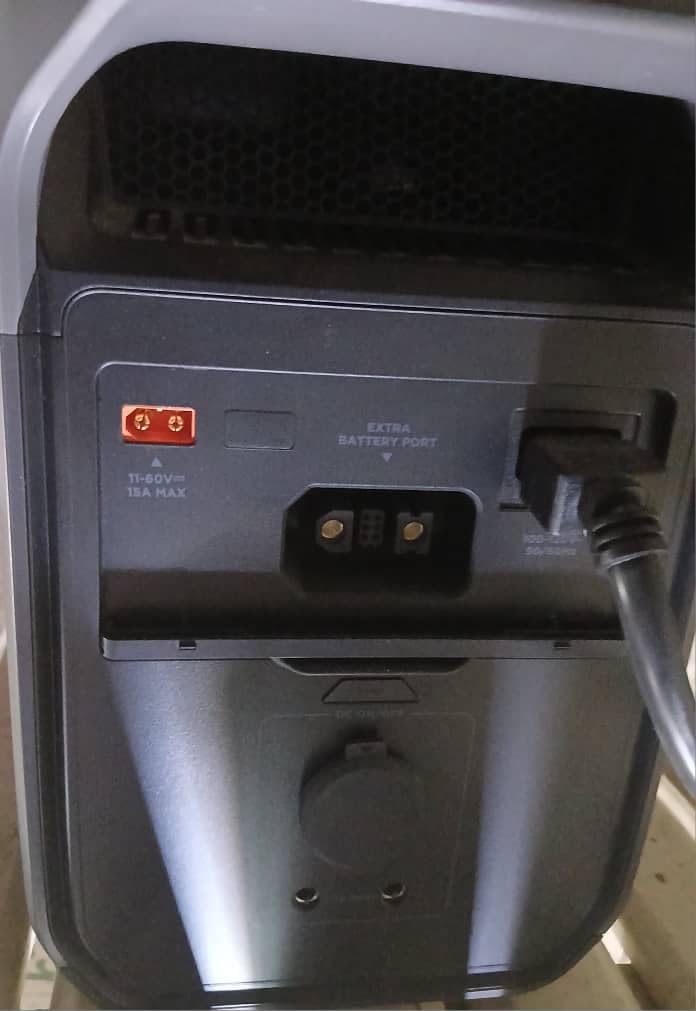
Physical design is where this unit quietly wins in a home. Dual top handles on a 7.9 by 11.1 by 15.7 inch footprint, a flip-up cover over the inputs, and outlets flared wide enough to accept bulky plugs without fighting the casing. It is the easiest 1kWh unit in this group to move through a doorway.
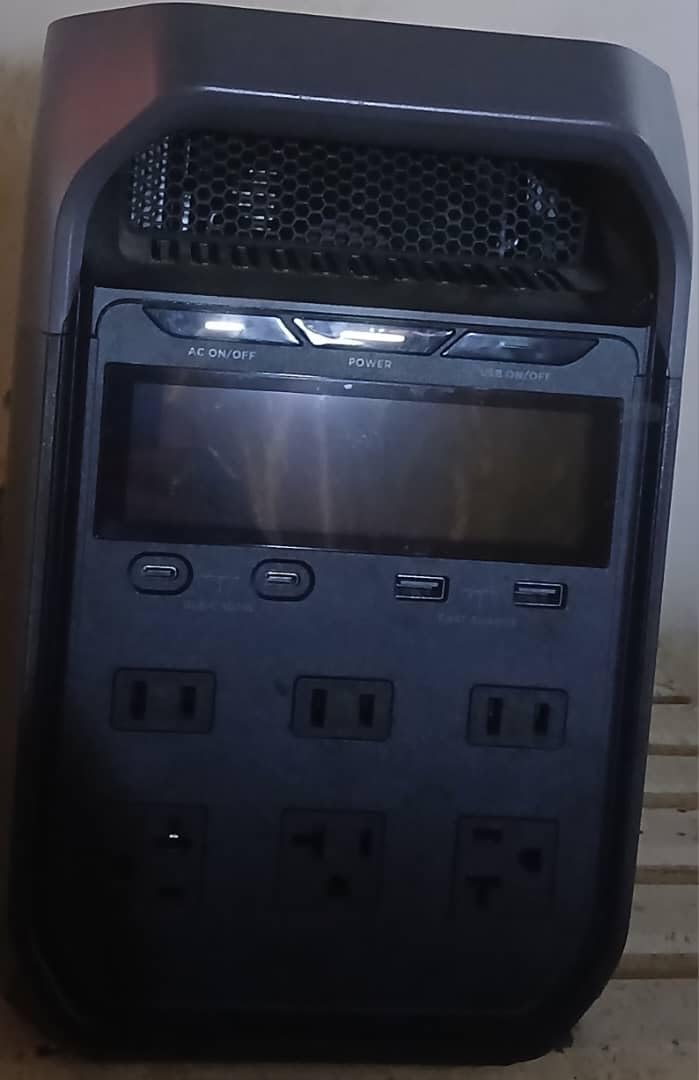
The limitation that matters is expansion. This model does not accept the DELTA 2 or Delta 3 Series Smart Extra Batteries, so 1,024Wh is a hard ceiling. If you think you might want more later, this is the wrong unit, and the BLUETTI AC180 or the OUPES Mega 1 are the more future-proof choices at the same capacity class.
There is also a small number of reports of units arriving dead or previously opened, which is a fulfilment issue rather than a design flaw, but it is worth checking the unit end to end the day it arrives rather than during your first storm.
Who the EF ECOFLOW DELTA 3 Classic suits
This suits apartment residents and households in areas where a fuel generator is not an option. It runs entirely indoors with no exhaust, no fuel and no carbon monoxide exposure, and 26.7 pounds is a manageable carry from a hall closet to a kitchen island.
It is also a good pick for anyone whose power needs are well understood and modest: a fridge, a router, a few lights, a laptop. The 10-hour refrigerator runtime owners report is a realistic full night with margin.
Who should skip the EF ECOFLOW DELTA 3 Classic
Skip it if you have any intention of adding capacity later, because the Smart Extra Battery ecosystem is closed off for this specific model. Skipping it now to avoid a larger purchase next year is a reasonable trade.
Also skip it if you plan to recharge from a vehicle as your primary method. 12V input near 100W is too slow for a multi-day event, and it will leave you planning around wall power that may not be there.
7. EF ECOFLOW DELTA 2 Max: The Most Headroom at the 2kWh Class
EF ECOFLOW Portable Power Station DELTA 2 Max 2048Wh, 2400W LiFePO4 Battery
2048Wh LFP, expandable to 6kWh
2400W output, 3400W X-Boost
23 kg
15 outlets
Pros
- 80% charge in 43 minutes with 1000W solar plus AC
- 2400W output across 15 outlets
- Expands from 2kWh to 6kWh with plug-and-play batteries
- 3000 cycles to 80% with a 5-year service
- As quiet as 30 dB
Cons
- 23 kg is heavy for a unit meant to move around a home
- 20-inch tall form factor limits shelf and cabinet placement
- Charging
- solar and vehicle inputs share one covered port area
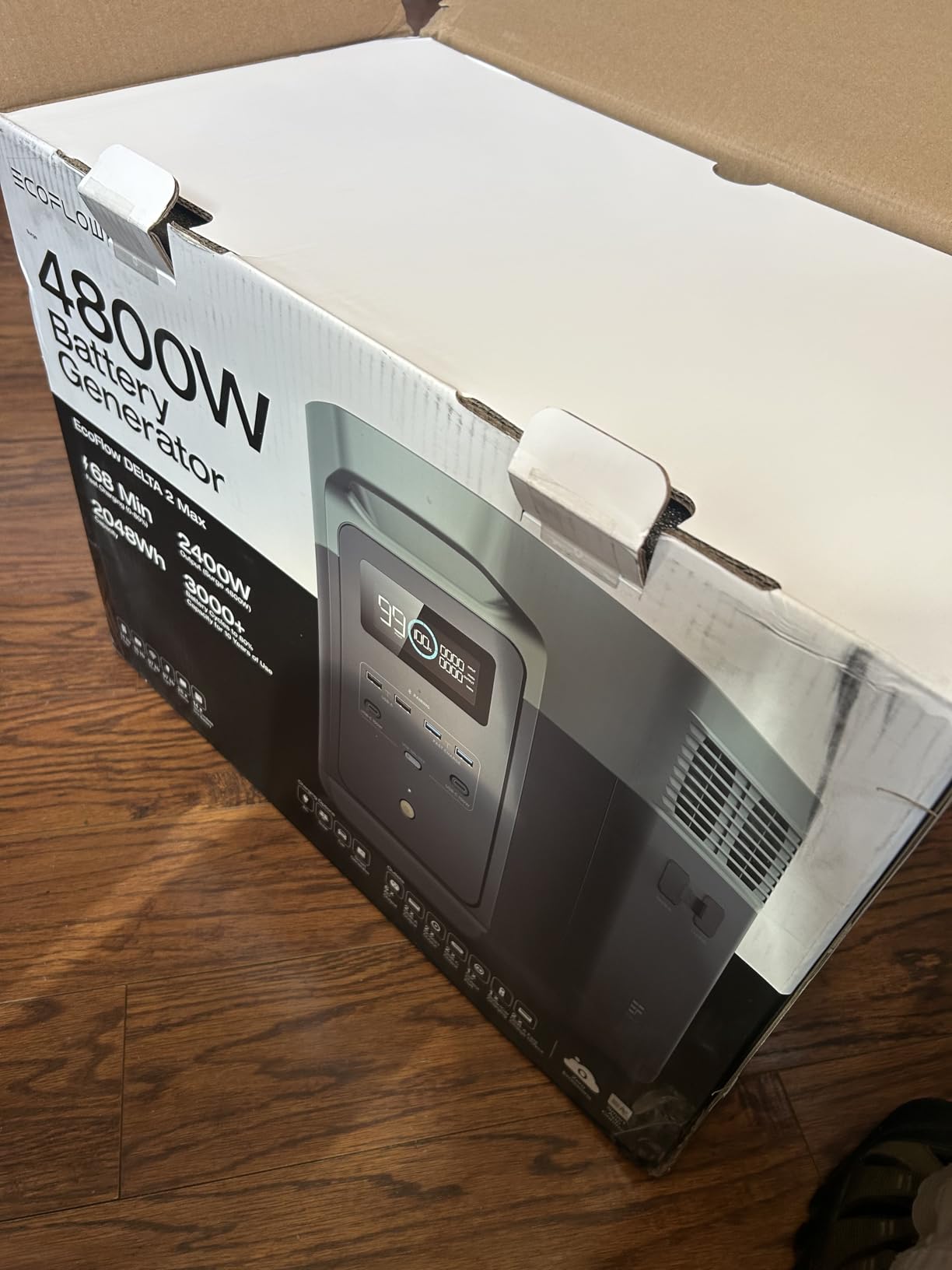
The EF ECOFLOW DELTA 2 Max is where a lot of the real-world sizing conversations land. 2,048Wh of LFP capacity, expandable to 6kWh, with 2,400 watts of continuous output and 3,400W through X-Boost, is enough to run a refrigerator and a chest freezer simultaneously for a meaningful stretch rather than choosing one.
Fifteen outlets is the largest port count in this roundup, and it matters when several people in a house are charging different things at different times. The 3,000-cycle LFP rating to 80% retention is slightly below the 4,000-cycle claims on the 1kWh units, but it is backed by a 5-year service period and the extra capacity per cycle offsets it.
Charging is where this unit is genuinely quick. It reaches 80% in 43 minutes when you combine 1,000W of solar with AC input, and about 1.1 hours on AC alone. For households expecting a multi-day outage with sunlight, that combination is the difference between recovering each afternoon and waiting.
The honest drawbacks are physical. At 23 kilograms it is not a unit you reposition casually, and the 20-inch height means it will not go on most shelves or inside a standard cabinet. Plan a floor location near the loads before you buy rather than after.
The 30 dB floor is a real advantage for indoor running, and the built-in battery management system monitors voltage, current and temperature continuously, which is the kind of detail that matters if the unit sits in a garage through temperature swings.
Who the EF ECOFLOW DELTA 2 Max suits
This suits a household with two compressor appliances, or one appliance plus a home office, where 1kWh is not enough and 3kWh is more than you can comfortably move. 2,048Wh splits the difference and, expanded, becomes a 6kWh system with no new inverter.
It is also the pick for anyone with real solar who wants to recharge fast during daylight hours rather than overnight.
Who should skip the EF ECOFLOW DELTA 2 Max
Skip it if your needs are one fridge and a router. A 1kWh unit covers that for a night at a weight you can lift with one hand, and this one is not. Buying more capacity than you can move is how expensive batteries end up in a closet during the event they were bought for.
Skip it if you have a small apartment with no floor space for a 20-inch-tall unit near the load, because the placement problem is harder to solve than the capacity problem.
8. Jackery Explorer 300: The Grab-and-Go Unit for Small Loads
Jackery Explorer 300 Portable Power Station,292Wh
292Wh LiFePO4
300W output, 600W surge
7.1 lb
4000+ cycles to 70%
Pros
- Lightest option here at 7.1 lb with an integrated handle
- Over 11000 reviews give it the deepest owner history in the group
- 4000-plus cycle LiFePO4 chemistry
- 100W USB-C PD charges laptops without a brick
- 80% solar charge in about 2.8 hours on a 100W panel
Cons
- 292Wh covers phones
- lights and CPAP rather than a refrigerator
- Solar charging limited to Jackery panels
- Two AC outlets and a 300W ceiling rule out larger appliances
The Jackery Explorer 300 belongs in a different category from everything else on this list, and pretending otherwise is how people end up disappointed. At 292Wh and 7.1 pounds it is a grab-and-go unit for phones, lights, a medical device and a laptop, not a refrigerator backup. Owners understand this, and the reviews reflect it, which is part of why the rating has held so well.
The deeper reason to like it is history. With more than 11,000 ratings it has the largest owner base of anything in this roundup, and that much accumulated experience tells you more about long-term durability than any cycle claim. It is also ranked number one in Outdoor Generators, so it is being used hard by real people in real conditions.
Chemistry is LiFePO4 rated beyond 4,000 cycles before reaching 70% capacity, which is the same cell chemistry found in the much larger units on this list. The 100W USB-C PD port charges laptops and drones directly, removing the power brick from your emergency bag.
Who the Jackery Explorer 300 suits
Choose this for a person who needs to stay reachable. A router, a phone, a CPAP machine, a couple of lamps and a laptop is a realistic evening of load for 292Wh, and 7.1 pounds means any adult in the house can fetch it without thinking about it.
It is also a good second unit for a household that already owns a larger station, covering the case where one person is in a different part of the house during the event.
Who should skip the Jackery Explorer 300
Skip it if you intend to run a refrigerator. A 300W output ceiling and 292Wh of capacity will not start a typical compressor motor, and even if the surge catches it, the runtime would be measured in a few hours rather than overnight.
Skip it if you want a single box to cover a whole evening across multiple rooms. This is a personal device, not a household device, and treating it as one leads to a dark house and warm food by morning.
9. Anker SOLIX C300: The Quietest Small Unit for Sleeping Beside
Anker SOLIX C300 Portable Power Station, 288Wh Solar Generator for Camping
288Wh LiFePO4
300W output, 600W surge
4.13 kg
25 dB, 3,000 cycles
Pros
- Two 140W two-way USB-C ports
- unusually strong for a 288Wh unit
- 80% recharge in 50 minutes on a wall outlet
- Quiet at 25 dB from 3.3 ft
- LiFePO4 cells rated 3000 cycles with a 5-year warranty
- 15% smaller than comparable designs
Cons
- 288Wh limits it to electronics and light loads
- Not compatible with Anker SOLIX PS30
- PS200 or PS400 panels
- Shoulder strap sold separately
The Anker SOLIX C300 shares the Explorer 300’s tier and then improves on it in two specific ways. The first is the pair of 140W two-way USB-C ports, which let a laptop charge at full speed straight from the pack with no brick, and which also accept incoming charge. The second is the 25 dB noise floor measured from 3.3 feet, the quietest figure in this roundup.
For a household where someone sleeps through outages, that matters. A station beside a bed at 25 dB is close to inaudible, while many competing small units run their inverter fan audibly. Recharge is quick as well, reaching 80% in 50 minutes on a wall outlet, and the warranty runs five years on cells rated for 3,000 cycles.
Anker’s own app handles scheduling, and the unit pairs with 60W or 100W Anker solar panels for a slow top-up over a day or two of daylight. That is not a substitute for wall charging, but in a prolonged grid event a few extra hours of solar can be the difference between a comfortable night and a thin one.
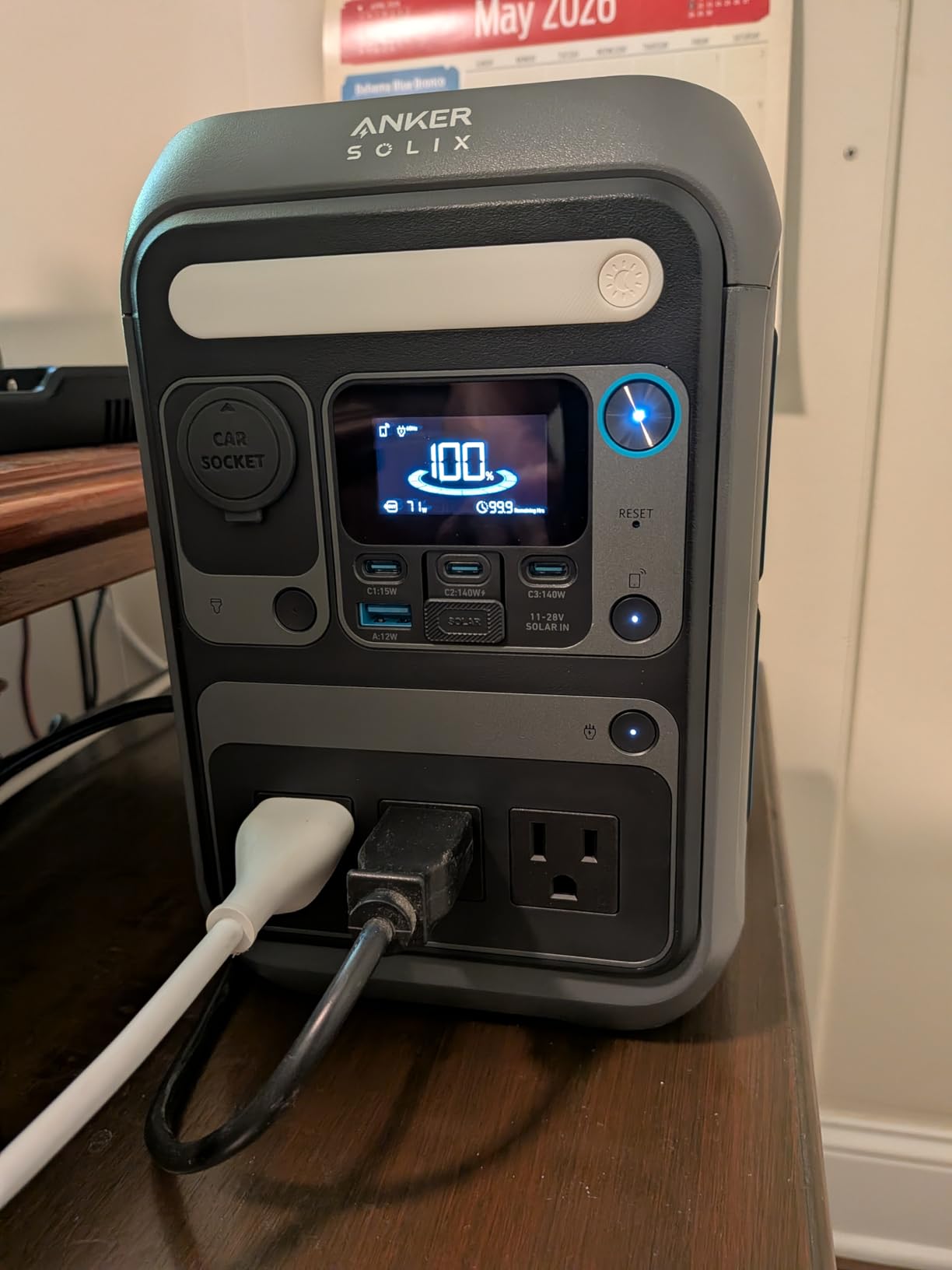
The exclusions are worth knowing before you buy. The C300 does not accept the larger Anker SOLIX PS30, PS200 or PS400 panels, so if your solar plans involve a serious array this is the wrong unit. The shoulder strap is also sold separately, and 4.13 kilograms without it is a two-hand carry for most adults.
Capacity is the real ceiling. 288Wh with a 300W output rating handles a router, lights, phones and a CPAP machine comfortably, and it is not built for appliances with compressors or heating elements.
Who the Anker SOLIX C300 suits
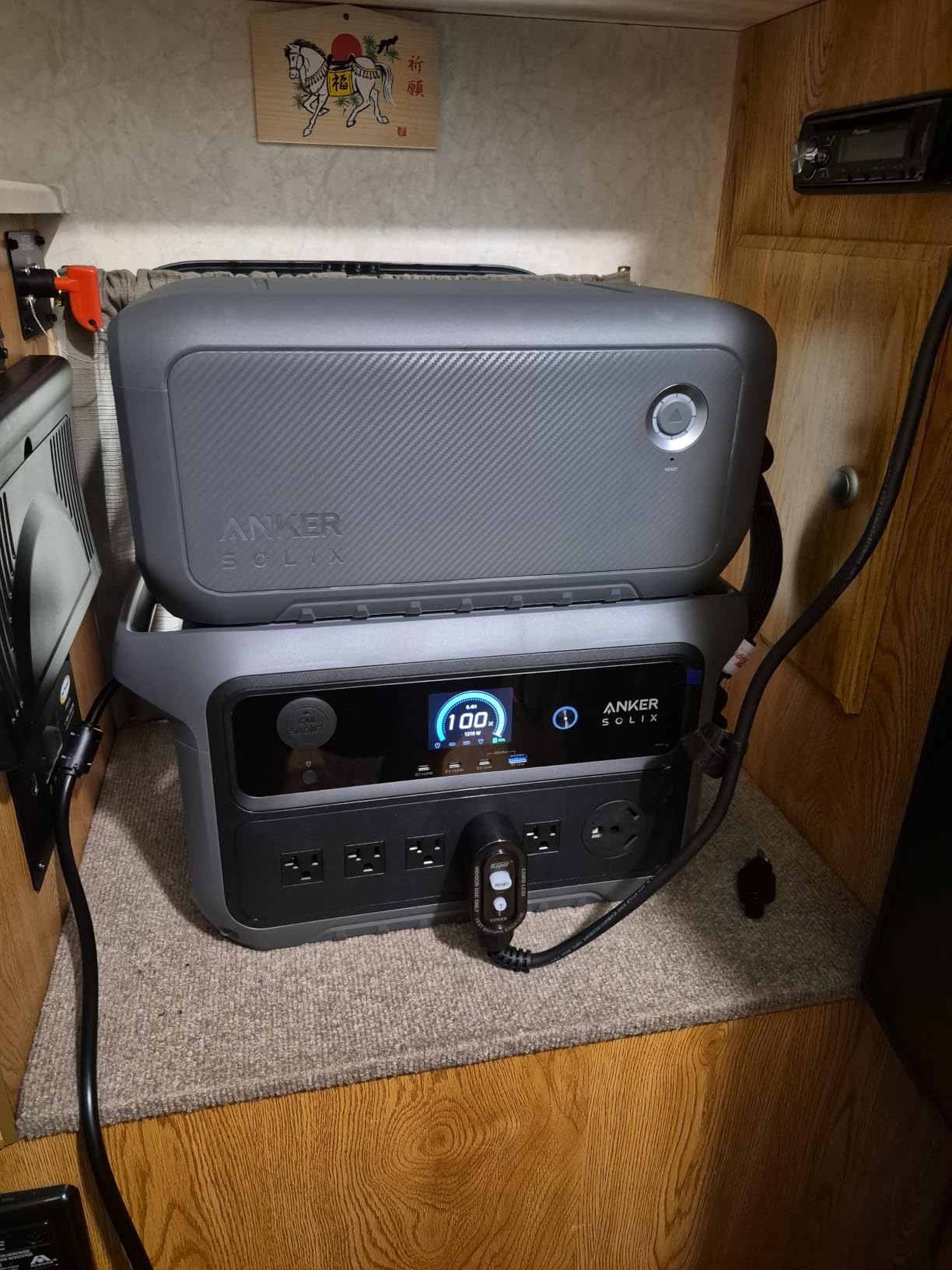
This suits a bedroom, a nursery or a home office where the station will be close to someone sleeping. It is also the better small-unit pick for anyone whose load list is USB-C heavy, since the 140W two-way ports replace a laptop charger, a phone charger and a battery pack in one device.
It pairs well as a companion to a larger 1kWh unit, covering the person who is not near the main station.
Who should skip the Anker SOLIX C300
Skip it if you want to plug in solar panels you already own from the larger PS series, or if you plan a meaningful solar array. The 100W panel compatibility is fine for maintenance charging but not for real runtime extension.
Skip it if you need to move the unit regularly without buying another accessory. At 4.13 kilograms and without a strap, it is portable but not easy to carry across a property.
10. Anker SOLIX S2000: Best for Protecting Food for a Day and a Half
Anker SOLIX S2 Portable Power Station, 2,010Wh, 1,500W
2010Wh LFP
1500W output, 3000W peak
35.7 lb
6W idle draw, 10,000 cycles
Pros
- Holds a full-size refrigerator roughly 33-35 hours on one charge
- 6W idle draw is among the lowest standby losses in its class
- Under 10 ms UPS replaces a consumer UPS outright
- 30% smaller and 25% lighter than the 2kWh category average
- Dual-sided outlets keep always-on and portable devices separate
- 10000-cycle LFP battery with a 15-year claimed lifespan
Cons
- No 12V DC port at all
- so car accessories need an adapter
- Charging fan is a loud
- consistent drone at 1200W
- First charge produces a strong burn-off odor
- 35.7 lb with no dedicated handle
If your single priority is protecting food through a long outage, the Anker SOLIX S2000 is the unit to look at. Owners report carrying a full-size refrigerator for roughly 33 to 35 hours on one charge, and one describes a 12-hour outage that finished with 40% remaining. Those are the kind of numbers you can plan a storm around.
The 6W idle draw is the sleeper feature. Across a 48-hour event that is about 288Wh of energy spent keeping the inverter alive, which on a 2,010Wh pack is the difference between a fridge running two full days and losing temperature overnight. Reviewers also note it drops to roughly 3W in UPS mode, which makes it viable as a permanent small UPS for a home lab or network rack.
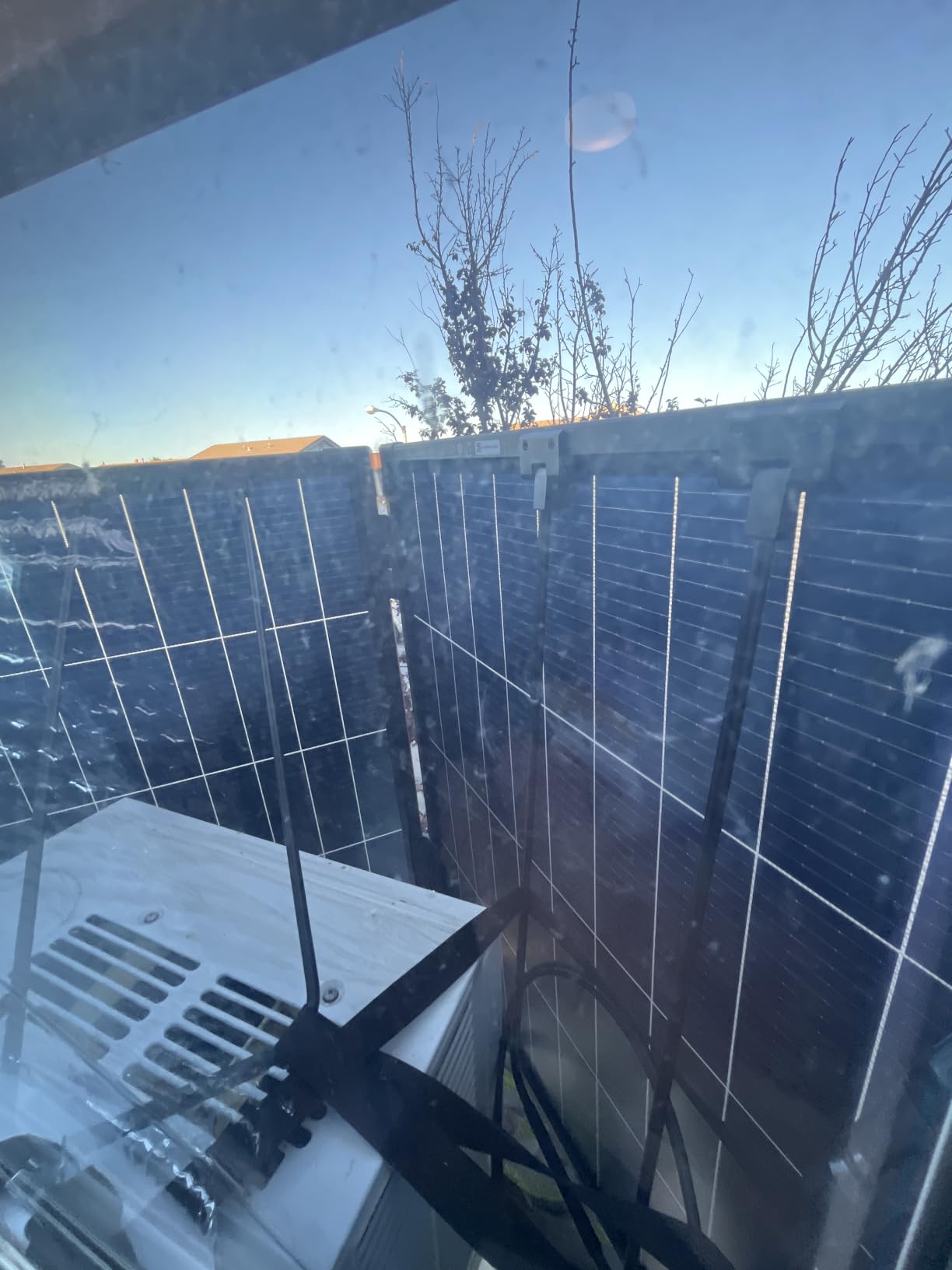
Cycle life is rated at 10,000 cycles with a 15-year claimed lifespan, the highest figure in this roundup, and the 400W solar input works alongside five other recharge paths including generator and alternator charging. Dual-sided outlets, three AC on the front and two on the rear, let you keep always-on loads permanently connected and portable ones unplugged.
The gaps are specific. There is no 12V DC port, so any car-port accessory needs an adapter, and the charging fan runs as a consistent drone at the 1,200W setting, which is worth knowing before you place it in a bedroom. First-time owners also report a strong burn-off odor during the initial charge that lingers for hours, so charge it once outdoors before an event.
At 35.7 pounds with no dedicated handle, this is a planned lift rather than a grab. Decide where it lives before the storm instead of during it.
Who the Anker SOLIX S2000 suits
This suits households in hurricane, ice-storm and wildfire-prone regions where the realistic expectation is a 24 to 48 hour event and the fridge is the thing you most want to keep running. Thirty-plus hours of refrigerator runtime covers an overnight event with margin, or a full day with a chest freezer closed and everything else off.
It is also a strong fit for anyone replacing a consumer UPS, since the sub-10ms handoff and low idle draw let it carry network equipment indefinitely.
Who should skip the Anker SOLIX S2000
Skip it if you need high output rather than high capacity. 1,500W continuous is modest for a 2kWh unit, so running a power tool, a space heater and a fridge at once is not realistic, even with 3,000W of peak headroom.
Skip it if you need a 12V car socket for a portable fridge, a vacuum or any automotive accessory, since there is no DC port and an adapter adds a failure point to your emergency kit.
11. PECRON F3000LFP: Most Output in the Group, With a Weight Penalty
PECRON Portable Power Station F3000LFP, 3072Wh Solar Generator, 3600W LiFePO4 Battery Home Backup, Fast Charging Power Station Expand Capacity to 10752Wh, Solar Generators for Home Use, Camping, RV
3072Wh LiFePO4, expands to 10752Wh
3600W pure sine
63.3 lb
8-20 ms UPS
Pros
- 3072Wh and 3600W of pure sine wave output
- 0-100% in two hours at 1800W AC input
- 13 ports let phones
- laptops
- drones and medical gear run at once
- 8-20 ms UPS for computers and medical devices
- Expandable to 10752Wh for multi-day events
Cons
- Heaviest unit in the roundup at 63.3 lb
- Expansion requires a separately sold XT120-M cascade cable
- Smallest review base here at 145 ratings
- so long-term history is thin
- Solar input ceiling of 120V rules out higher-voltage arrays
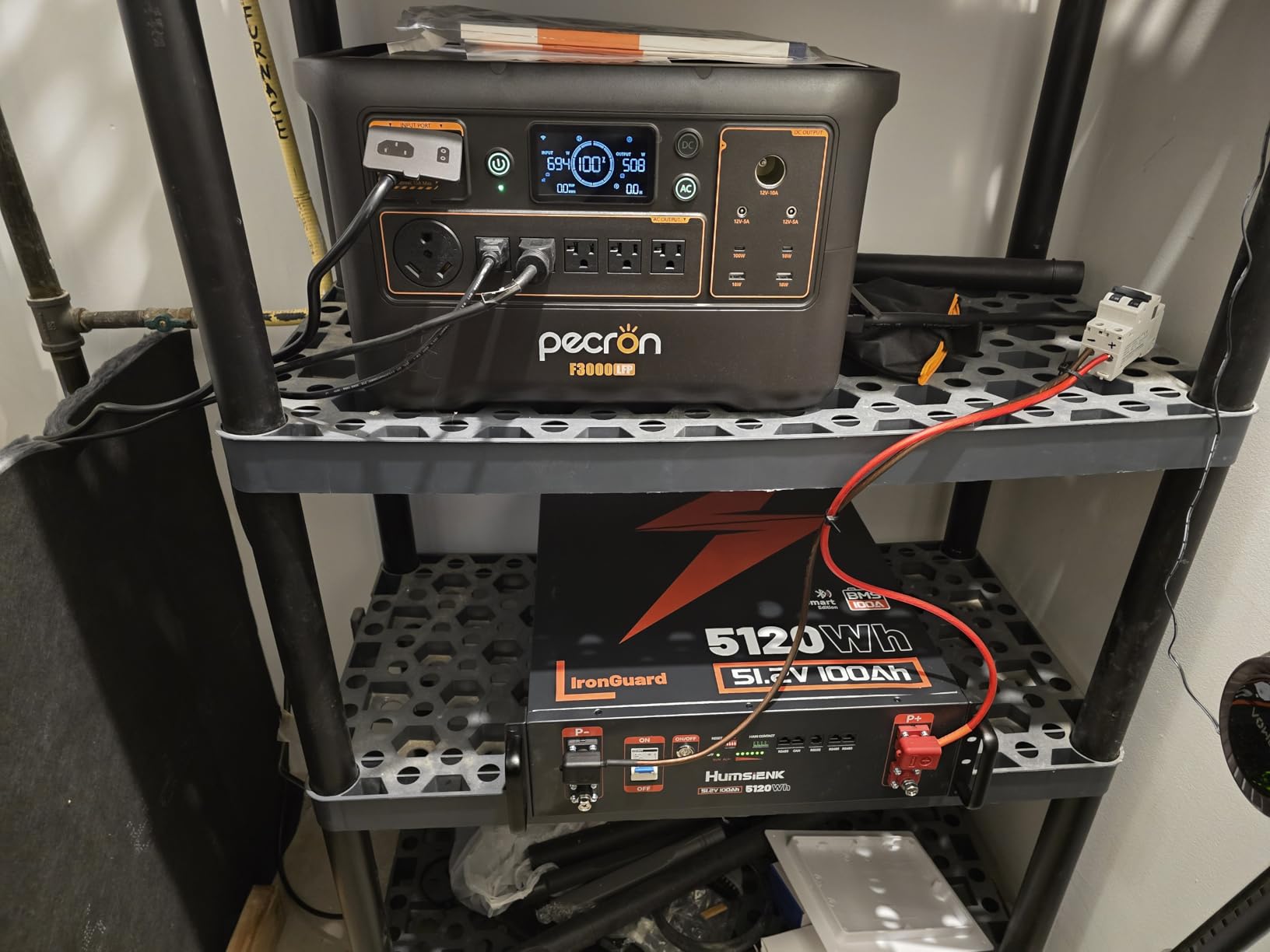
The PECRON F3000LFP has the highest continuous output of any unit in this roundup at 3,600 watts of pure sine wave, from 3,072Wh. That combination of capacity and headroom is what lets it run refrigerators alongside an air conditioner or power tools, which no 1kWh or 2kWh unit here can do.
Recharge takes two hours from empty on 1,800W of AC input, and solar input accepts up to 1,600W across a 25 to 120V range. Thirteen ports including two 100W USB-C PD sockets mean a household with a lot of small electronics does not have to pick and choose what stays connected.
Expansion is the headline. With EP3800-48V batteries it scales to 10,752Wh, which puts a 3kWh-class station into genuine multi-day territory. Users report keeping internet, refrigeration, fans and medical equipment running for 24 hours or more on a single unit, and the 8 to 20 ms UPS is specified for protecting computers and medical devices.
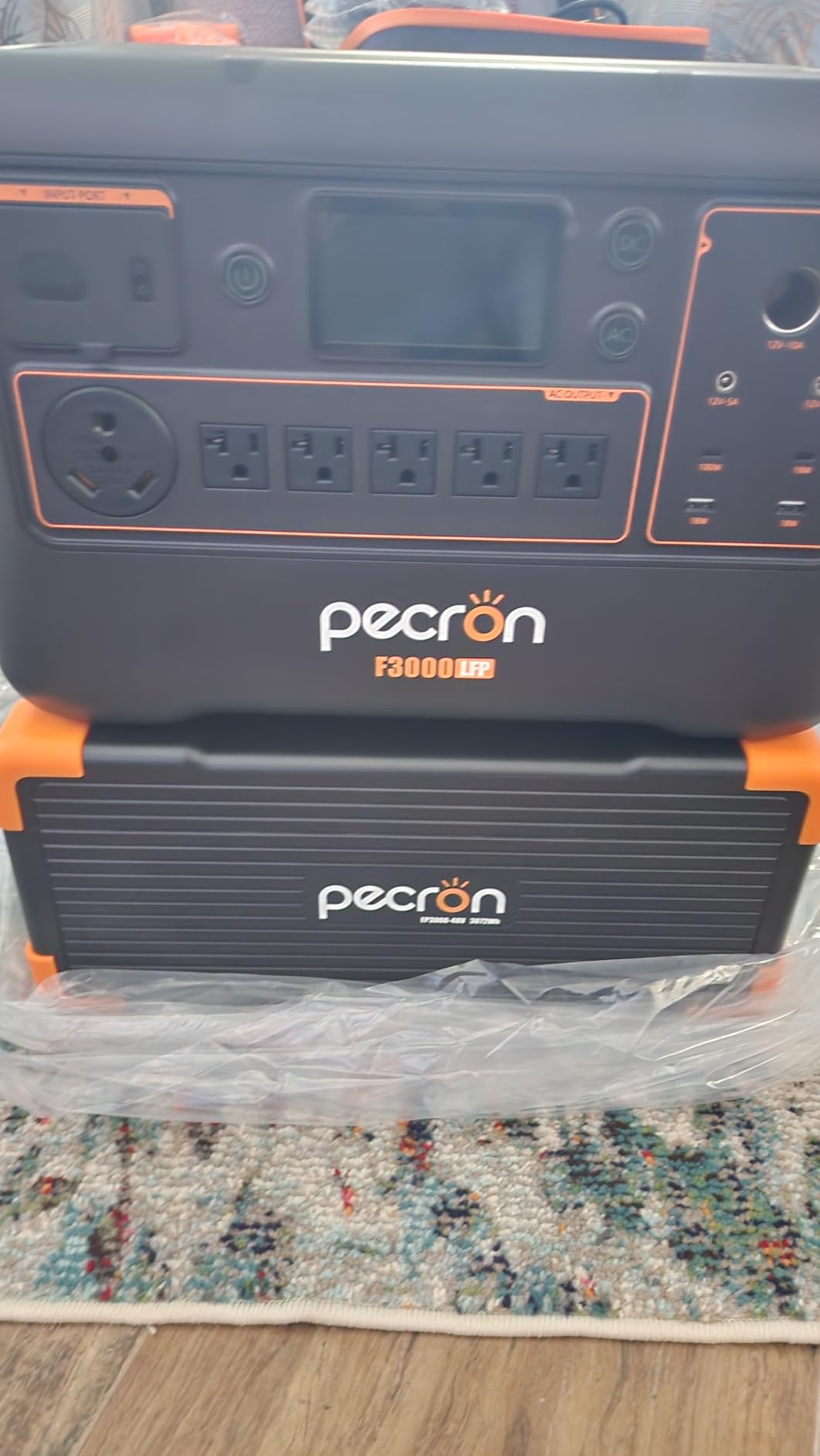
Now the reasons it is not the top pick. At 63.3 pounds it is the heaviest unit here, and moving it at night is a two-person job. Expansion needs a cascade cable sold separately, the solar input ceiling of 120V excludes many higher-voltage arrays, and at 145 ratings it has by far the thinnest owner history in the group, which means less real-world evidence of long-term durability.
The 2+3 year warranty is also the least generous on this list. For a battery you intend to keep for a decade, that difference compounds.
Who the PECRON F3000LFP suits
Choose it if you know you need high output and long runtime, and you can pick a permanent spot for it. Refrigeration plus air conditioning plus a working outlet is a load list no sub-2kWh unit can serve, and this one can.
It is also the pick for a household that wants a genuine multi-day system without a professionally installed transfer switch, provided the unit stays in one place and you plan for a small fleet of extension cords.
Who should skip the PECRON F3000LFP
Skip it if a single person will ever need to move it. 63.3 pounds is beyond safe solo handling, and an emergency plan that requires moving the power is not really a plan.
Skip it if you want the deepest proven record. With 145 ratings there is not yet the long ownership history that the 11,000-review units on this list have, and that record is worth something for a purchase you hope lasts a decade.
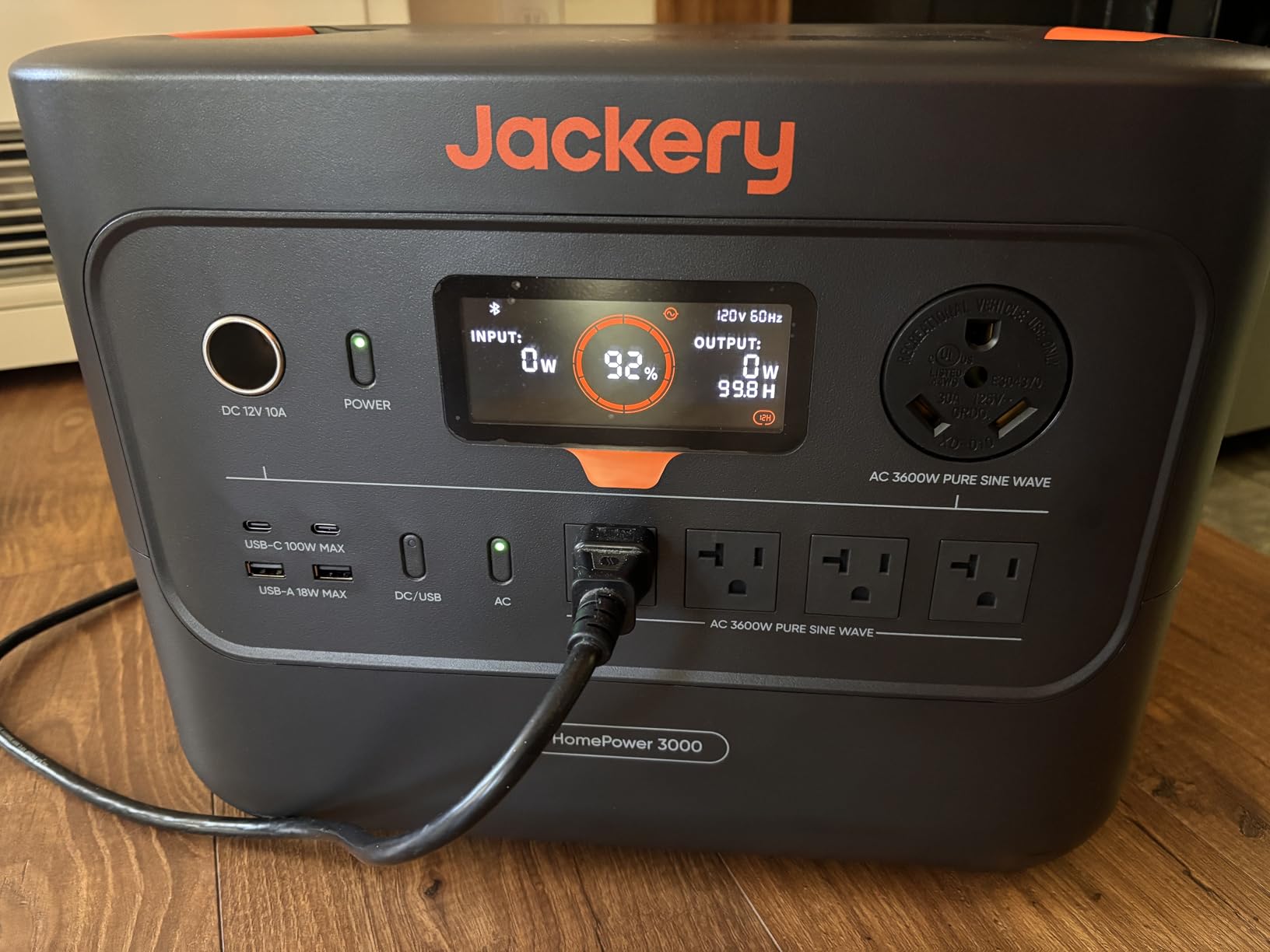
12. Jackery HomePower 3000: UL-Certified UPS and a Built-In RV Port
Jackery HomePower 3000 Portable Power Station, 3072Wh, 3600W AC Output
3072Wh LiFePO4
3600W output, 7200W surge
59.5 lb
UL-certified 20 ms UPS
Pros
- 3072Wh and 3600W keeps a household running up to 15 hours and a refrigerator 1-2 days
- UL-certified UPS switching in 20 ms or less
- Built-in TT-30 RV port
- 1.7-hour hybrid AC and DC recharge
- Cell-to-body design is 47% smaller and 43% lighter than same-capacity rivals
- 4000-cycle LiFePO4 battery
Cons
- Lowest average rating in the roundup with 10% one-star reviews
- 59.5 lb makes it a two-person lift or a cart job
- Sits at the top of the 3kWh class on cost
- Shares the Jackery line's solar charging limits
The Jackery HomePower 3000 is the only unit in this group with a UL-certified UPS handoff, rated at 20 milliseconds or less. That certification is not marketing language. UL evaluated the transfer behaviour for security cameras, medical refrigerators and VoIP equipment, which is a stronger guarantee than an unqualified switchover figure from a brand.
Capacity and output match the PECRON at 3,072Wh and 3,600W, with 7,200W of surge. Owners report up to 15 hours of household backup and one to two days for a refrigerator, and the built-in TT-30 RV port gives plug-and-play power for an RV without a separate adapter.
Recharging hits 80% in about 9 hours with two SolarSaga 200W panels, and a full recharge takes 1.7 hours on hybrid AC and DC or 2.2 hours on AC alone. The cell-to-body construction is 47% smaller and 43% lighter than same-capacity rivals, which is meaningful at this size even though the absolute figure is still 59.5 pounds.
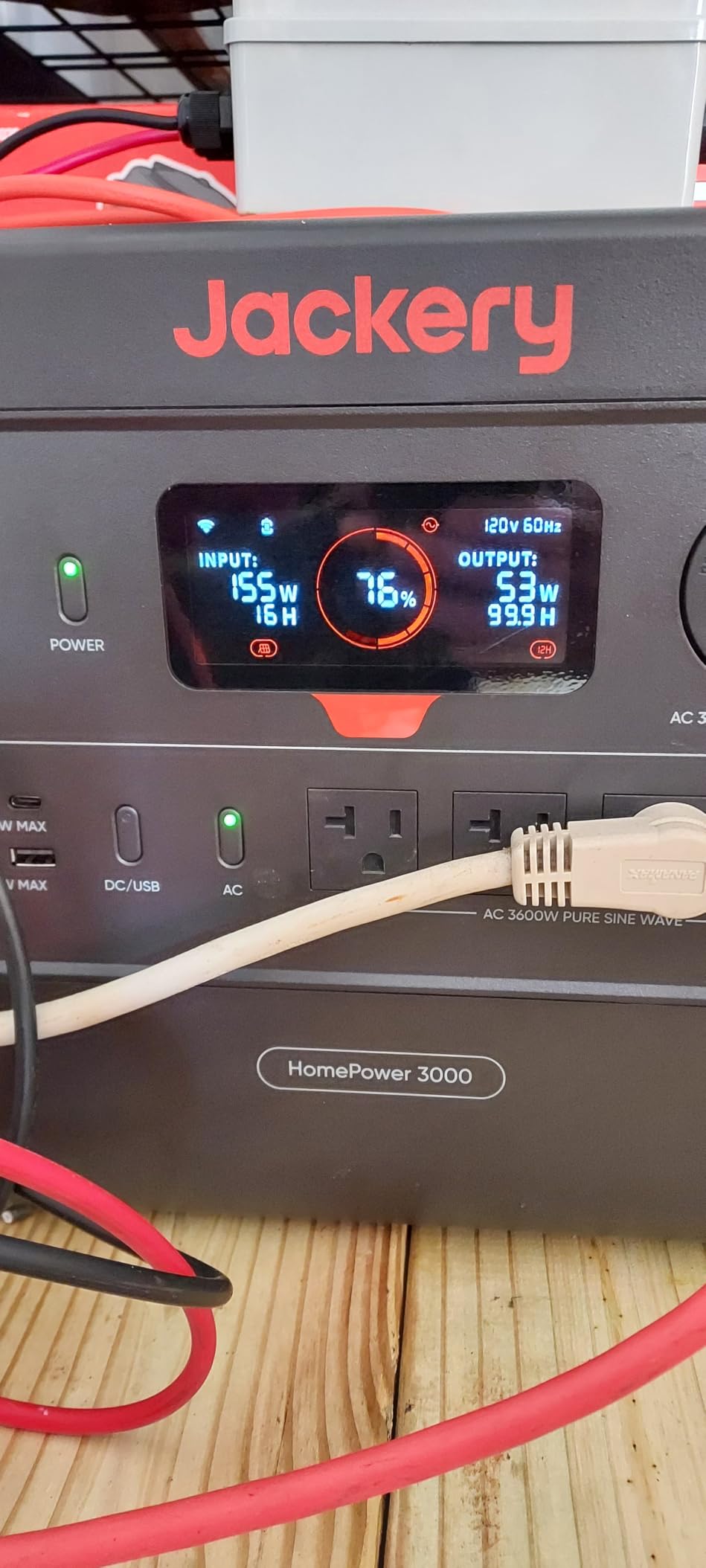
The honest concern is the rating spread. At 4.4 stars across 236 reviews, this has 10% one-star feedback, the widest variance of any product here. That is a young product line with a large installed base still forming opinions, and buyers who are risk-averse should weigh the longer histories on the 1kWh units.
Weight remains the practical issue at 59.5 pounds, and the solar input is limited the same way the rest of the Jackery line is. Plan the lift with two people or a cart before storm season rather than during it.
Who the Jackery HomePower 3000 suits
Choose it if you run a home, an RV or both, and want certified protection for equipment that will not tolerate an unplanned restart. The TT-30 port and the UL-certified UPS are the two features you cannot replicate by adding accessories to a different brand.
It also suits anyone comfortable buying into a newer platform in exchange for the highest certified UPS specification available in this group.
Who should skip the Jackery HomePower 3000
Skip it if reliability history is your top priority and the 10% one-star rate concerns you. The 1kWh units on this list have thousands of ratings each, and a longer track record is worth more than a certification label for a purchase meant to sit through a decade of storms.
Skip it if you already own third-party solar panels, since the same brand-locked solar input applies here as it does to the smaller Jackery units.
How We Picked: Specs, Owner Reviews and Measured Reality
Our team compared 12 units across capacity, output, chemistry, charge recovery, UPS behaviour, port layout, expansion, weight and warranty length. Where a claim could be checked against owner reports, we weighted owner experience above the listing. A cycle count printed on a box means little if the same page carries a complaint about the unit failing to hold charge.
For every product here we pulled the recurring positives and the recurring negatives from owner reviews rather than the first one-star or five-star comment. That is how the AC180’s roughly 20W idle draw and the OUPES Mega 1’s real surge ceiling ended up documented here. Claims like Power Lifting and UPS switchover are treated as marketing labels until a reviewer reports measured behaviour, and we say so when the evidence is thin.
Owner anecdotes that recur across home-lab, prepping and off-grid communities informed the boundaries we draw, including the point that a router will still reboot during a transfer even when a unit advertises UPS mode. Our related reading covers LiFePO4 chemistry in more depth and the lower-cost end of the market.
What Size Portable Power Station Do You Need for Power Outages?
Size backwards from your load list, not from a capacity class. Write down every device you want running, find the running watts on its label, and note the startup surge for anything with a motor. Multiply watts by the hours you need, add 25% for margin, and divide by 0.85 to convert required energy into nameplate watt-hours.
Worked example. A refrigerator averaging 150W with a 300W startup surge, a router at 12W, two LED lamps at 20W combined and a phone charging at 15W gives you 197W of steady draw. For 12 hours that is 2,364Wh of energy required. Dividing by 0.85 gets you to roughly 2,780Wh of nameplate capacity, which points at the 3,072Wh class rather than the 1kWh class.
For four hours of the same load, the requirement drops to about 930Wh of nameplate capacity, and any unit in the 1kWh group works with room to spare. This is the arithmetic that separates a good purchase from a disappointing one, and it takes about ten minutes.
Matching Portable Power Stations for Power Outages to Your Outage Length
For a four-hour event with a fridge, a router and lights, a 1,024Wh unit delivers roughly 870Wh of usable energy, which covers that list comfortably. For an overnight event with a refrigerator and a CPAP, you want 1,800W or more of continuous output so the compressor starts cleanly, and again 1kWh is the working capacity.
For 24 hours, budget from 2,000Wh upward. A full-size refrigerator is the reference load at roughly 150W, so 24 hours needs about 3,600Wh of energy, or roughly 4,240Wh of nameplate capacity after the planning factor. That is where the 3,072Wh units land, and owner reports of 33 to 35 hours of fridge runtime on the Anker SOLIX S2000 fit the same arithmetic.
For multi-day events, solar stops being optional. Without it, you are spending stored energy every night and getting none back, which is the single most common planning mistake in outage forums. None of the units here run a refrigerator and a chest freezer for a week on internal reserves alone, and pretending otherwise is how people lose frozen food.
What These Portable Power Stations Cannot Run in an Outage
Space heaters and electric room heat are the most common wish and the most common disappointment. A 1,500W convection heater on a 1kWh unit gives you about 40 minutes at 85% efficiency, and then you have nothing left for the fridge. Resistive heating loads look attractive because Power Lifting mode raises the ceiling, but the energy cost is the same either way.
Well pumps and sump pumps are a different problem: startup draw. A pump motor can pull several times its running wattage at startup, and if that exceeds your unit’s real surge capability the inverter trips. Check the pump’s locked rotor rating against your unit, and assume the OUPES Mega 1’s actual surge ceiling is closer to 2,200W than its headline number.
Whole-home circuits, electric heat, window air conditioning and electric ranges are outside this category entirely. If you need to run a central air unit or keep electric resistance heat alive, you need a professionally installed system with a transfer switch, not a portable unit.
Never backfeed a power station into a wall outlet or a breaker panel. These units are built to supply loads through their own outlets, and pushing power back toward the grid creates an electrocution hazard for utility lineworkers and can start a fire in your panel.
Safety: Backfeed, Carbon Monoxide and Battery Storage
Battery stations are safer indoors than fuel generators because there is no combustion, so no carbon monoxide and no exhaust. Keep that advantage by running them indoors and running any fuel generator outdoors, at least 20 feet from the building, with the exhaust pointed away from doors and windows. Carbon monoxide detectors on every level remain the cheapest safety equipment you can own.
Ventilation still matters because the battery and inverter generate heat while charging. Do not store a unit in an unventilated closet while it fast charges, and keep it away from combustible materials. If the casing is ever hot to the touch during normal operation, stop charging and let it cool.
Cold weather reduces available capacity, and repeatedly charging a lithium pack below freezing can damage cells permanently. If your outages are ice storms, store the unit indoors where it stays above freezing, and check the manufacturer’s discharge temperature guidance before powering loads from a cold pack.
Storage charge matters more than most buyers expect. A lithium pack left at a low state of charge for months loses capacity. Charge to roughly half before long storage, top it up every three months, and run a full test of the fridge load and the UPS handoff once a month so the unit and your household both know it works.
If you use a power station alongside a fuel generator, keep the generator outside and charge the station from it rather than running both simultaneously into the same loads. That pattern, a battery inside and a generator recharging it outside, is the most practical hybrid setup for anyone expecting more than a day of outage.
Frequently Asked Questions
What is the best portable power station for most power outages?
The Jackery Explorer 1000 v2 is the best all-round pick, with 1,070Wh, 1,500W of continuous output, a 4.7 star rating across 3,623 reviews and a 23.8 lb weight. For higher output, the BLUETTI AC180 or Anker SOLIX C1000 Gen 2 both exceed 1,800W, and for multi-day coverage look at units in the 3,072Wh class.
How long will a 1,000 watt-hour power station run a refrigerator?
A full-size refrigerator averaging 150W draws about 850 watt-hours per hour once you apply an 85% planning factor. On a 1,024Wh unit that is roughly six hours, and on a 1,070Wh unit about six and a half. Owner reports of roughly 10 hours on the EF ECOFLOW DELTA 3 Classic and 33 to 35 hours on the 2,010Wh Anker SOLIX S2000 reflect a real fridge cycling below its average draw.
Can a portable power station run a CPAP machine?
Yes, and a unit in the 1kWh class handles a CPAP with a heated humidifier comfortably for a night, since those machines typically draw 60W to 100W. Confirm your specific device with its manufacturer before relying on it during an emergency, and keep the unit indoors with ventilation. A sub-10ms UPS handoff helps if your machine restarts on an interruption.
Do portable power stations work as a UPS for a Wi-Fi router?
They work, but an interruption of even a few milliseconds can still cause a reboot on a router, a desktop or a network switch. Units advertising 10 ms or less switchover are the best choices, though some owners report their equipment restarting anyway. To reduce the risk, connect the router and any network switch to the same unit so they transfer together.
Which brand of portable power station is the most reliable?
Reliability is better judged by owner history than by brand. The Jackery Explorer 300 has more than 11,000 ratings, and the Jackery Explorer 1000 v2 and Anker units in the 1kWh class sit near 4.7 stars. By contrast, one owner reported a BLUETTI unit failing at around 12 to 14 months, so check warranty length and cycle claims, then test your unit on arrival.
Is a portable power station worth it for power outages?
It is worth it if you have a fridge, a router, powered medical equipment or frequent multi-hour grid interruptions, because it runs indoors with no fuel, fumes or refilling. It is not worth it if you need to run electric heat, central air or whole-home circuits, since those exceed the output of portable units. Match the tier to your load list rather than buying the largest unit you can lift.
Bottom Line: The Best Portable Power Stations for Power Outages
For most households, the Jackery Explorer 1000 v2 is the right answer. It runs a refrigerator and a router through a night, starts compressor loads without drama, charges in under two hours, and one person can carry it down a hallway when it matters.
Match the scenario to the unit. A night of backup for a fridge, a router and lights calls for the 1kWh class, with the BLUETTI AC180 or Anker SOLIX C1000 Gen 2 if you want more output headroom. A full day calls for the 2,010Wh Anker SOLIX S2000, which owners report carrying a refrigerator for 33 to 35 hours. Multi-day events call for the 3,072Wh class, and anything above 60 pounds should be parked in one place before the storm, not carried during it.
Whatever you choose, test it before you need it. Charge it fully, run your actual load list for an hour, confirm the compressor starts, and check the UPS handoff on your router. Buyers who take an hour to do that in calm conditions are the ones who sleep through the storm. For camping and off-grid comparisons, our camping power station guide and our refrigerator-specific picks go deeper on both use cases.