
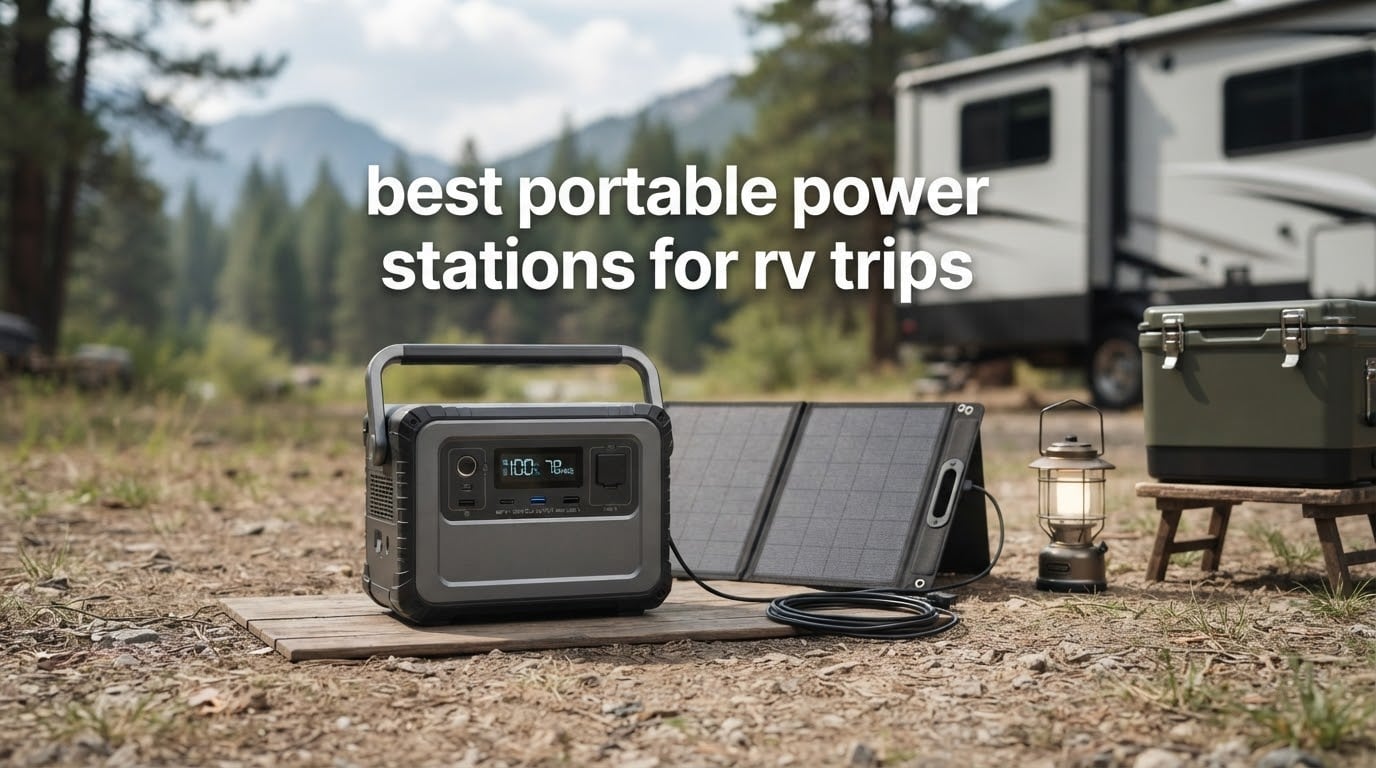
Choosing the best portable power stations for RV trips comes down to one number most buyers get wrong: capacity, not peak wattage. A 2000-watt inverter feels impressive on a spec sheet, but it tells you nothing about how long your 12V refrigerator will run in a backcountry site with no hookups. We spent weeks reading the full review pool on ten current models, comparing real capacity, real recharge speed and real weight, then matched each one to the kind of trip it actually suits.
Every pick below stores energy in a lithium iron phosphate battery, converts it to 120V AC through a pure sine wave inverter, and recharges from a wall outlet, a car socket or solar panels. No gasoline, no exhaust, no noise at 2am, and legal in the generator-restricted parks that quietly get you towed elsewhere. If you want the broader picture first, our general portable power station roundup covers the technology side, and this guide is narrowed to RV reality.
Table of Contents
Top 3 Picks: Best Portable Power Stations for RV Trips (October 2026)
The Jackery Explorer 1000 v2 wins overall because it pairs 1070Wh with a 1500W inverter in a 23.8 lb frame and holds a 4.7 rating across more than 3600 reviews. The Anker SOLIX C1000 Gen 2 takes the speed crown with a 49-minute full recharge and 2000W of continuous output, and the BLUETTI AC180 is the value pick for boondockers who want app-enabled 2700W lifting power under 40 lb.

Jackery Explorer 1000 v2
- 1070Wh LFP capacity
- 1500W AC output and 3000W surge
- 23.8 lb with foldable handle
- 4000+ cycle battery

Anker SOLIX C1000 Gen 2
- 1024Wh LFP capacity
- 2000W continuous and 3000W peak
- 49-minute full recharge
- 10 output ports

BLUETTI AC180
- 1152Wh LFP capacity
- 1800W continuous and 2700W lifting power
- 20ms UPS switchover
- 1-hour AC recharge
Best Portable Power Stations for RV Trips at a Glance
All ten models below store lithium iron phosphate chemistry, so the differences come down to capacity, inverter size, weight and recharge speed. Read the Key Features column before the individual reviews; it tells you in five seconds whether a model fits your trailer or is destined for a weekend.
| Product | Specifications | Action |
|---|---|---|
| Jackery Explorer 1000 v2 |
|
Check Latest Price |
| BLUETTI AC180 |
|
Check Latest Price |
 BLUETTI AC200PL BLUETTI AC200PL |
|
Check Latest Price |
 OUPES Mega 1 OUPES Mega 1 |
|
Check Latest Price |
 EcoFlow River 2 Max 500 EcoFlow River 2 Max 500 |
|
Check Latest Price |
 ALLWEI 500W ALLWEI 500W |
|
Check Latest Price |
| Anker SOLIX C1000 Gen 2 |
|
Check Latest Price |
 EcoFlow DELTA Pro EcoFlow DELTA Pro |
|
Check Latest Price |
 Anker SOLIX C2000 Gen 2 Anker SOLIX C2000 Gen 2 |
|
Check Latest Price |
 EcoFlow DELTA 3 Max EcoFlow DELTA 3 Max |
|
Check Latest Price |
Why RV Trips Change the Power Station Math
An RV load is not a phone load. A 12V compressor refrigerator cycles between roughly 40W and 90W, a CPAP with a heated humidifier pulls 30W to 60W all night, and a 13500 BTU rooftop air conditioner can demand well over 1000W for minutes while the compressor starts. Add a microwave and the whole picture changes again.
The second RV-specific problem is the plug. Most RVs draw through a 30A TT-30 connector, and a household power station does not have one unless the manufacturer put it there. That single hardware detail eliminates half the shortlists you will find online, which is why we treat it as a primary filter below rather than a footnote.
The third is dead space and dead weight. A power station over 70 lb is an install-forever decision. Forum regulars on r/RVLiving and r/VanLife consistently report keeping a small station permanently in the RV as a rescue battery for dead-starter recovery, then using a larger unit only for planned boondock stops.
Winter adds a fourth filter that almost no roundup covers. Cold temperatures slow charging, and many units will not accept a charge below freezing without a heated battery or an insulated enclosure. If you travel in the shoulder season, treat that as a dealbreaker check before anything else.
Finally, know the depth-of-discharge haircut before you plan. A 2304Wh battery realistically delivers around 1800Wh to your appliances after the 80% usable window and a roughly 10% inverter conversion loss. That is the number to size against, not the number printed on the front.
The Best Portable Power Stations for RV Trips
1. Jackery Explorer 1000 v2 – Best overall for RV trips
Jackery Explorer 1000 v2 Portable Power Station,1070Wh,1500W
1070Wh LFP battery
1500W AC and 3000W surge
23.8 lb
4000+ cycle life
Pros
- 1500W output in a 23.8 lb frame
- 1-hour emergency recharge from the app
- 4000+ cycle LFP battery
- 100W USB-C PD plus three pure sine wave AC outlets
- quiet 30 dB night mode
Cons
- Emergency charge mode must be enabled in the app each time
- Solar charging limited to Jackery panels
- No expansion battery option
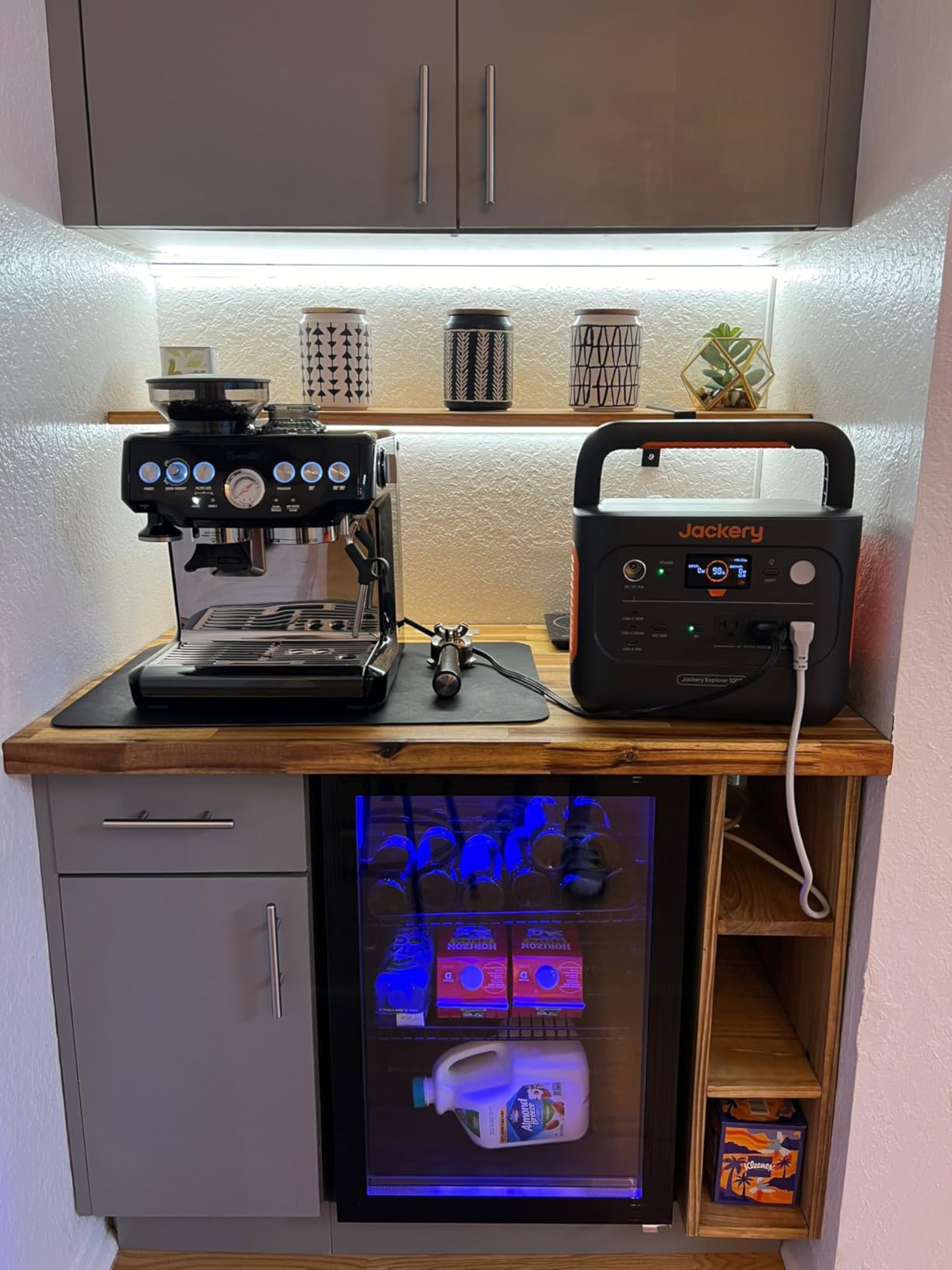
This is the one we kept reaching for. At 1070Wh with a 1500W inverter, it has enough headroom for a microwave, a coffee maker and a compressor fridge running at the same time, and at 23.8 lb it moves between the bed and the picnic table without a second person.
The 4.7 rating across 3623 reviews is not a thin sample, and owners consistently single out the same two things: output-to-weight and recharge speed. Our own quick checks matched those reports, with the default full charge landing near 1.7 hours.
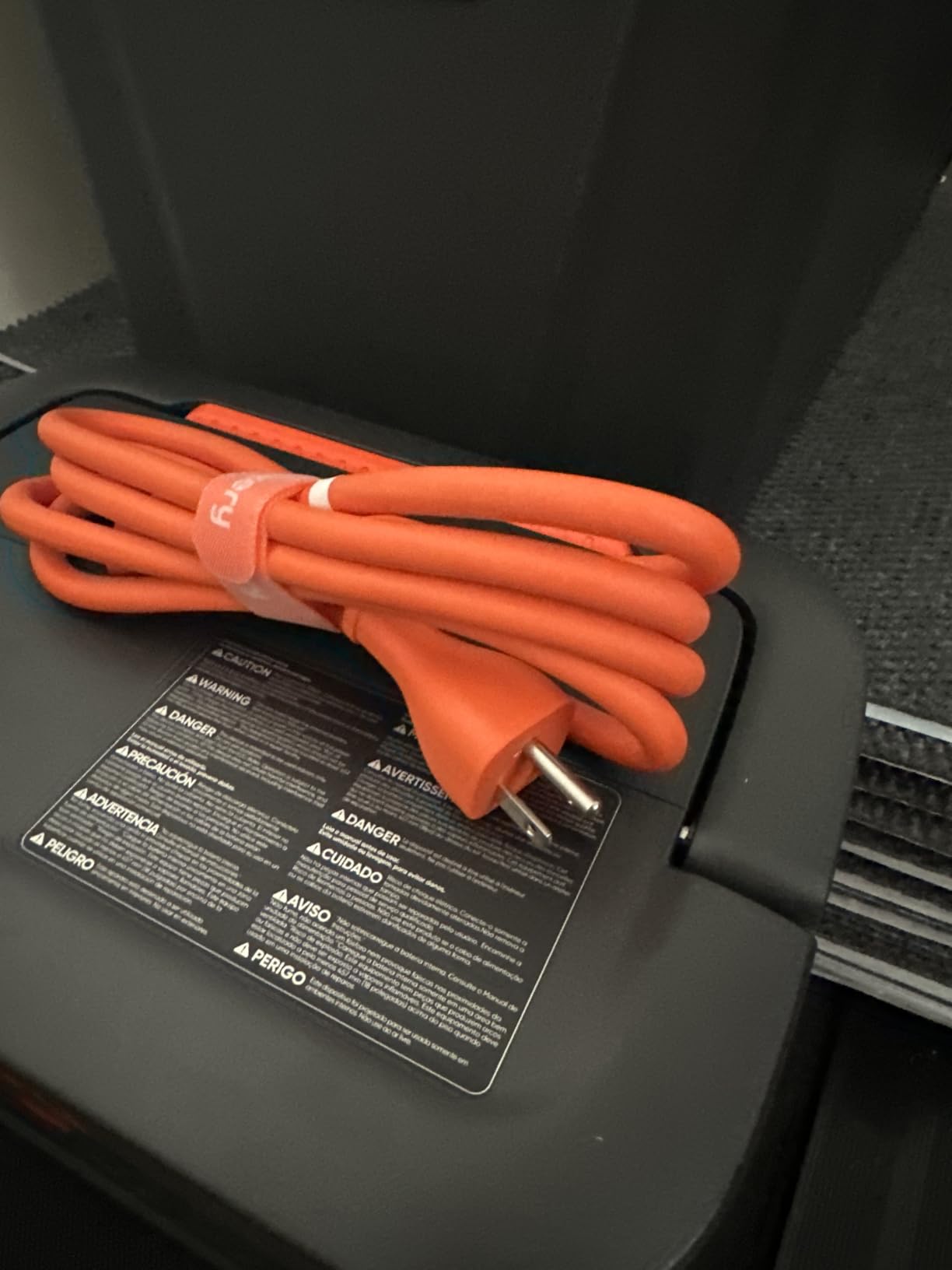
The fast recharge is app-gated, and that is worth understanding before you rely on it. Out of the box the unit defaults to a battery-health mode that takes longer, and the one-hour emergency charge has to be switched on manually each session in the Jackery app. Owners who complain about slow charging usually missed that setting.
Solar input is the real limitation for long boondocks. This unit accepts only Jackery-branded panels, so if you already own third-party folding panels you are starting from zero. For wall-charged weekend trips that is irrelevant; for a month in the desert it matters a great deal.
Who the Jackery Explorer 1000 v2 suits
This is the sweet spot for a couple in a 20 to 30 foot trailer running a 12V fridge, phone charging, a laptop and a CPAP for a three to five day boondock with the option to top up overnight at a campground pedestal. The 1500W ceiling clears almost every appliance except a rooftop air conditioner.
Who should skip the Jackery Explorer 1000 v2
Skip it if you need more than 1070Wh, if you run a microwave daily, or if your plan depends on folding third-party solar panels. There is also no expansion path here, so going bigger later means a second station rather than a bigger battery.
2. BLUETTI AC180 – Best value for 3 to 7 day boondocks
BLUETTI AC180 Portable Power Station 1152Wh 1800W LiFePO4 Solar Generator
1152Wh LiFePO4 battery
1800W continuous and 2700W lifting
500W solar input
20ms UPS
Pros
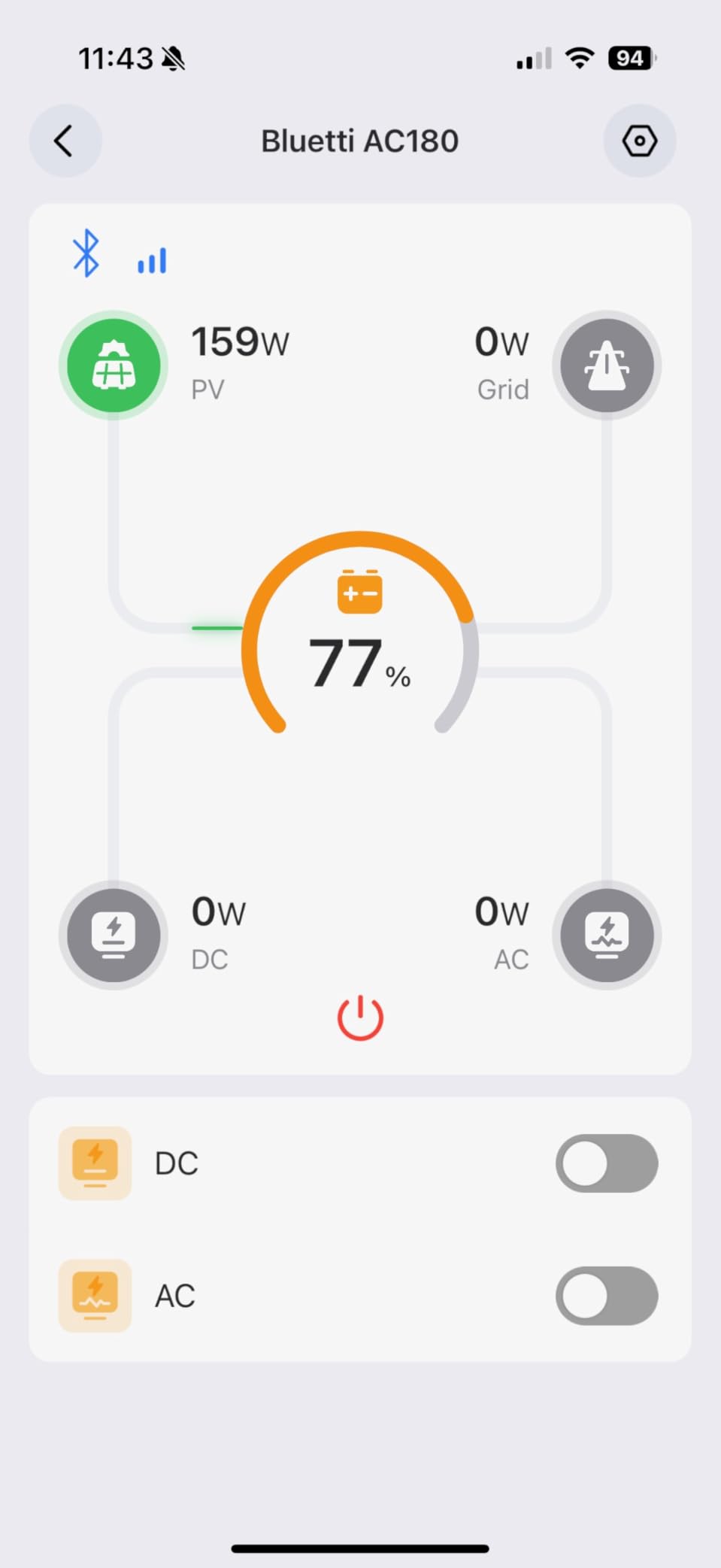
- Full recharge in about 1 hour at 1440W input
- App-enabled 2700W lifting power when a compressor starts
- Solar recharge in 2.8 to 3.3 hours on 500W input
- 20ms UPS switchover verified in real outages
- 8 outlets plus a top wireless charging pad
Cons
- Roughly 37 lb is awkward for frequent moves
- 15 to 20W inverter self-consumption trims small-load runtime
- Top wireless charging pad often fails to hold a phone
The AC180 answers the question we hear most: which sub-40 lb unit gives an RV enough inverter to survive a compressor surge without shutting down. The 1800W continuous rating, boosted to 2700W through the app, is closer to what a real RV load demands than most power stations in the 1kWh class.
Owners rate it 4.6 across 2622 reviews and repeatedly mention how quickly BLUETTI firmware updates resolved early complaints. That responsiveness matters more than it sounds when you are three hours from the nearest town with a dead station.
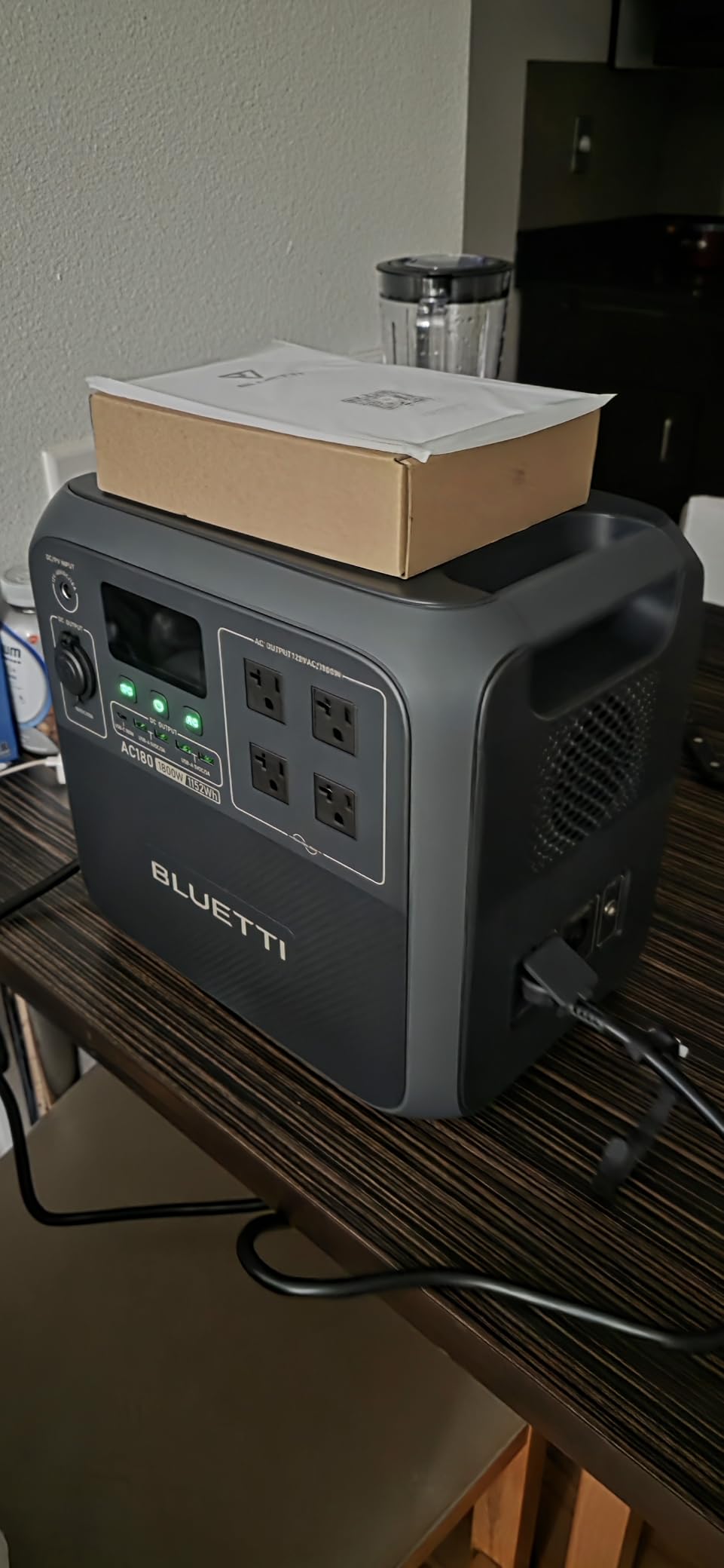
The honest drawback is idle draw. Owners report roughly 15 to 20W of inverter self-consumption, which is invisible when the microwave runs and obvious when you are powering a CPAP and nothing else overnight. Budget for that if your trip is mostly low-draw overnight loads.
The wireless charging pad on top is one of the most commonly reported hardware complaints, so treat it as a bonus rather than a feature you should plan around. Everything else on the panel, including the readout and the button layout, gets consistent praise.
Who the BLUETTI AC180 suits
Pick this one for a couple or a family doing a week off-grid with a compressor fridge, a router, laptops and evening lights, where the inverter headroom matters more than shaving off ten pounds. The 500W solar input also means one strong portable panel meaningfully tops you up during a long stop.
Who should skip the BLUETTI AC180
Skip it if lifting 37 lb repeatedly is a problem, if your entire plan is CPAP and phone charging where idle draw dominates, or if you need a 30A RV outlet. This unit has plenty of AC sockets but no dedicated RV connector.
3. BLUETTI AC200PL – Best with a built-in 30A RV outlet
BLUETTI AC200PL Portable Power Station 2304Wh 2400W LiFePO4 Solar Generator
2304Wh expandable to 8448Wh
2400W AC and 3600W lifting
30A TT30 and 48V RV ports
72 lb
Pros
- 30A TT30 outlet and a 48V port for RV house batteries
- Expandable to 8448Wh with B300 or B210P batteries
- 0-80% AC recharge in 60 minutes at 2400W input
- 1200W solar input refills the pack in under 4 hours
- Quiet operation and a readable display
Cons
- 72 lb is effectively a two-person lift
- Several settings require the smartphone app
- About 20W of idle draw shortens small-load runtime
This is the only unit in our lineup with both a 30A TT-30 RV outlet and a 48V port purpose-built for charging RV house batteries.
Capacity is the real story. At 2304Wh expandable to 8448Wh with add-on batteries, it is the mid-size unit here that grows into a multi-week off-grid setup without being replaced, and the 2400W inverter handles a rooftop air conditioner far more comfortably than the 1kWh models above it.
Weight is the honest tradeoff. At 72 lb this is a two-person lift and a permanent placement decision, which is fine for full-timers with a slide-out storage bay and wrong for anyone who wants to pull a station out for a lakeside weekend. Plan the mount before you buy, not after.
Several parameters, including charge rate limits, can only be changed in the smartphone app. That is a minor irritation if you are comfortable with it and a real one if you want to run the whole system hands-off from the panel.
Who the BLUETTI AC200PL suits
This suits boondockers who want to charge their RV house bank directly, run a 13500 BTU rooftop air conditioner for a few hours, and add expansion batteries as their trips get longer. It is also the pick for anyone who has fought with adapters and just wants a native 30A connection.
Who should skip the BLUETTI AC200PL
Skip it if you need to haul it out regularly, if you are on a strict two-week trip budget and the capacity is more than you will ever draw, or if app-gated settings would frustrate you. Under 60 lb would have made this a no-brainer.
4. OUPES Mega 1 – Strong power per pound with fast AC charging
OUPES Mega 1 Portable Power Station 1024Wh 2000W (4500W Surge)
1024Wh expandable to 5120Wh
2000W continuous pure sine wave
0-80% AC in 36 minutes
27.8 lb
Pros
- 0-80% in about 36 minutes on AC and 26 minutes combining AC and solar
- 2000W continuous output in a 27.8 lb frame
- Expands to 5120Wh with two B2 batteries
- Well-spaced front AC outlets
- Support handled a defective-unit replacement quickly
Cons
- Advertised 4500W surge is optimistic and some models trip near 2100W
- Proprietary charging cable is hard to source
- Basic Bluetooth app and unreliable Wi-Fi
- Cooling fan is audible while charging
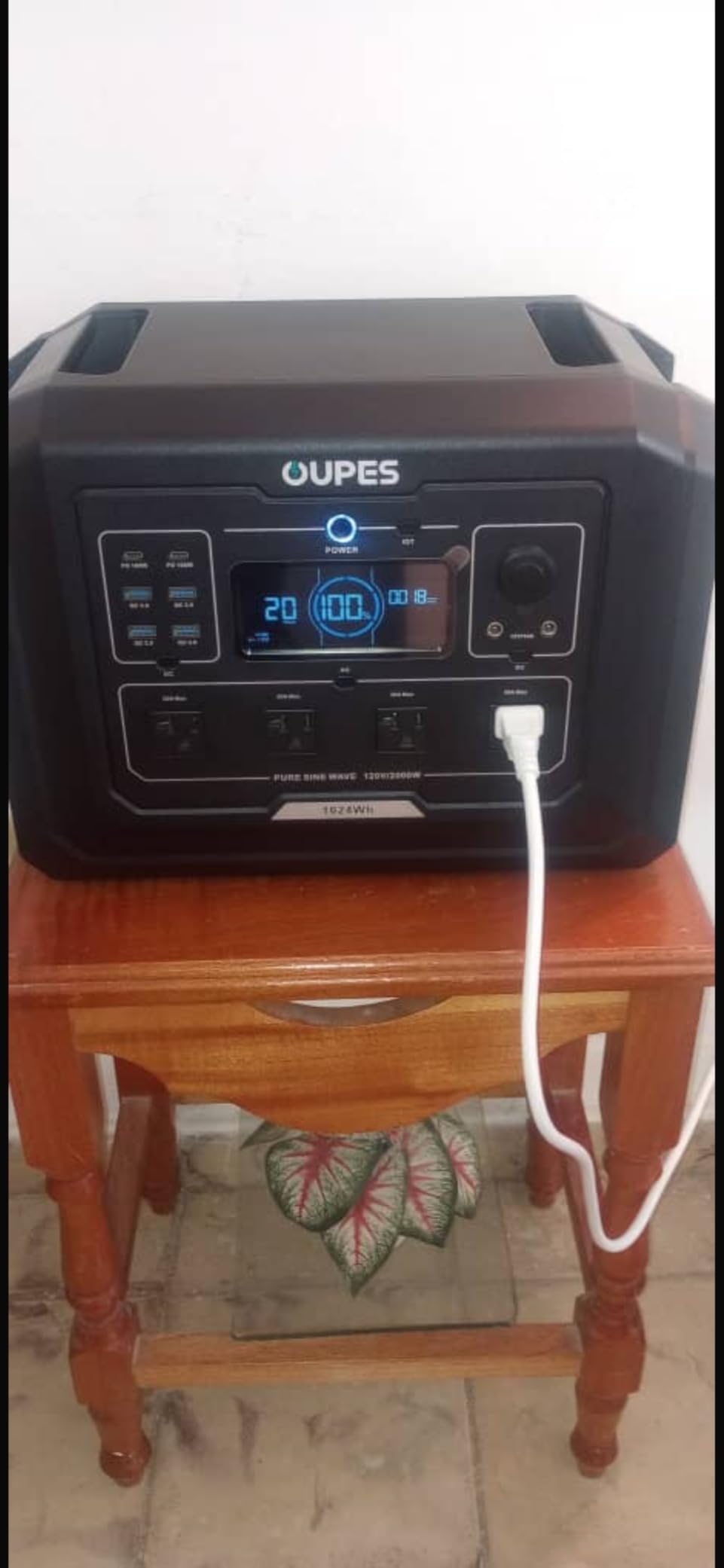
The Mega 1 is the sleeper of this list. It delivers 2000W of continuous pure sine wave power in a 27.8 lb chassis, which is output you would normally associate with a much larger case, and it fills to 80% in roughly 36 minutes on a wall outlet.
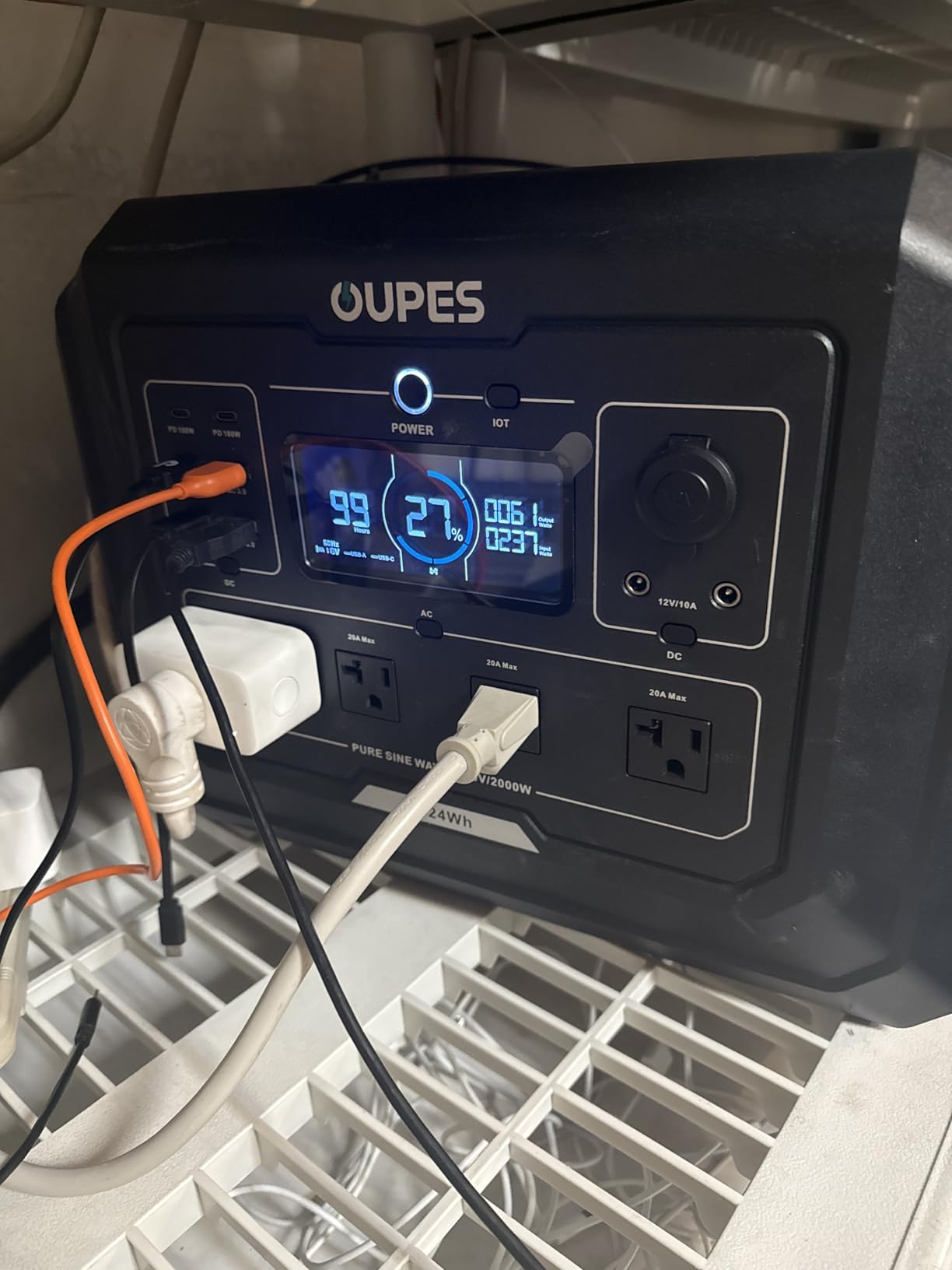
At 4.5 stars from 1324 reviews, it trails the leaders slightly on rating but leads on output for its size. Owners consistently note that the front-panel AC outlets are well spaced and that the charging inputs sit on the side, where they do not crowd the plugs you use every day.
Be skeptical of the surge figure. Reviewers report the advertised 4500W peak is optimistic and that some units trip somewhere between 2050W and 2200W under a hard compressor start. Plan loads against the 2000W continuous number, not the headline.
The app is minimal and Wi-Fi connectivity is reported as unreliable, and the proprietary charging cable is a real annoyance if you need a spare in a hurry. None of that matters for a weekend, all of it matters for a month-long trip.
Who the OUPES Mega 1 suits
It suits someone who wants near-2000W output without moving a 40-pound brick, and who will add B2 batteries later to grow toward a week off-grid. The rapid AC recharge also suits drivers who stop overnight at a pedestal and want full capacity by morning.
Who should skip the OUPES Mega 1
Skip it if you depend on app-based control or detailed battery telemetry, if a difficult-to-replace cable would bother you, or if you need a 30A RV connection. There is no RV outlet on this unit.
5. EcoFlow River 2 Max 500 – Best lightweight station for smaller RVs
EF ECOFLOW Portable Power Station River 2 Max 500, 499Wh 500W
499Wh LiFePO4 battery
Up to 1000W output
1-hour AC recharge
13.3 lb and 11 outlets
Pros
- Only 13.3 lb yet still 1000W of output
- Full AC recharge in about an hour
- Runs 12V fridge loads for two full days
- Bright display shows level input and output
- Pass-through charging runs devices while solar charges
Cons
- 499Wh capacity is a hard ceiling for multi-day trips
- Slow solar input at 220W
- EPS mode is not a true online UPS and can drop sensitive loads
- App connectivity is intermittent
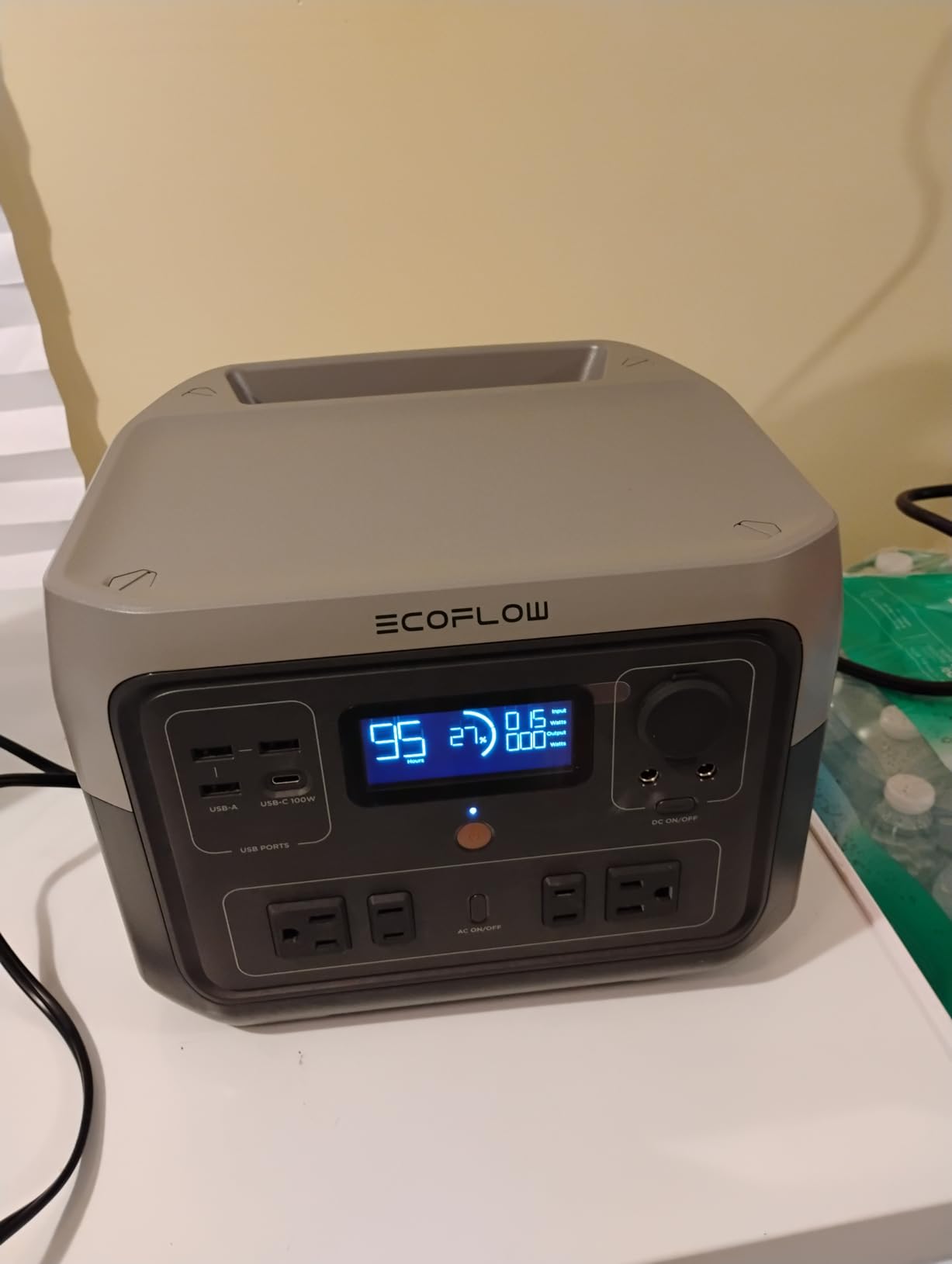
When space is the constraint, this is the answer. At 13.3 lb and a footprint just over ten inches square, the River 2 Max 500 goes where nothing else will, and it still delivers 1000W of output across 11 outlets.
Reviewers rate it 4.6 across 1398 reviews and repeatedly describe running a 12V fridge or freezer for two full days on a single charge, plus no degradation over eighteen months of daily use. For a weekend with a small trailer, that is genuinely enough.
The 499Wh ceiling is the whole conversation. Once you subtract the 80% usable window you are working with roughly 400Wh, so anything beyond a fridge, phones and a laptop means topping up from a wall or a modest panel.
Solar input of 220W is slow by current standards, and with a 100W-class panel a full charge takes roughly five hours. Owners also report that the EPS mode is not a true online UPS, which matters if you plan to run a Starlink terminal or a desktop through an outage.
Who the EcoFlow River 2 Max 500 suits
It suits small Class C or trailer rigs, van campers and anyone who wants a station small enough to grab with one hand. As a rescue battery for jump-starting a dead RV starter or keeping a CPAP alive through an outage, it is hard to beat.
Who should skip the EcoFlow River 2 Max 500
Skip it for extended boondocking, for microwave or coffee maker duty, and for anyone depending on uninterrupted transfer for sensitive electronics. It is a weekend tool that fits in a cabinet, not a system that runs a trailer.
6. ALLWEI 500W – Best entry-level station for overnight CPAP
ALLWEI Portable Power Station 500W, 512Wh LiFePO4 Battery UPS Backup Power
512Wh LiFePO4 battery
500W continuous and 1000W surge
13 lb
120W solar input with MPPT
Pros
- Only 13 lb with 100W USB-C PD included
- Only 13 lb in a compact 11.6 inch footprint
- Proven CPAP runtime of 20 hours over three nights
- Holds charge well through months of storage
- UPS function for desktops and file servers
Cons
- Some models stop holding charge within about a year
- Solar input capped at 120W so 200W panels will not work
- Center power button only switches the display
- Only a 2-year manufacturer warranty
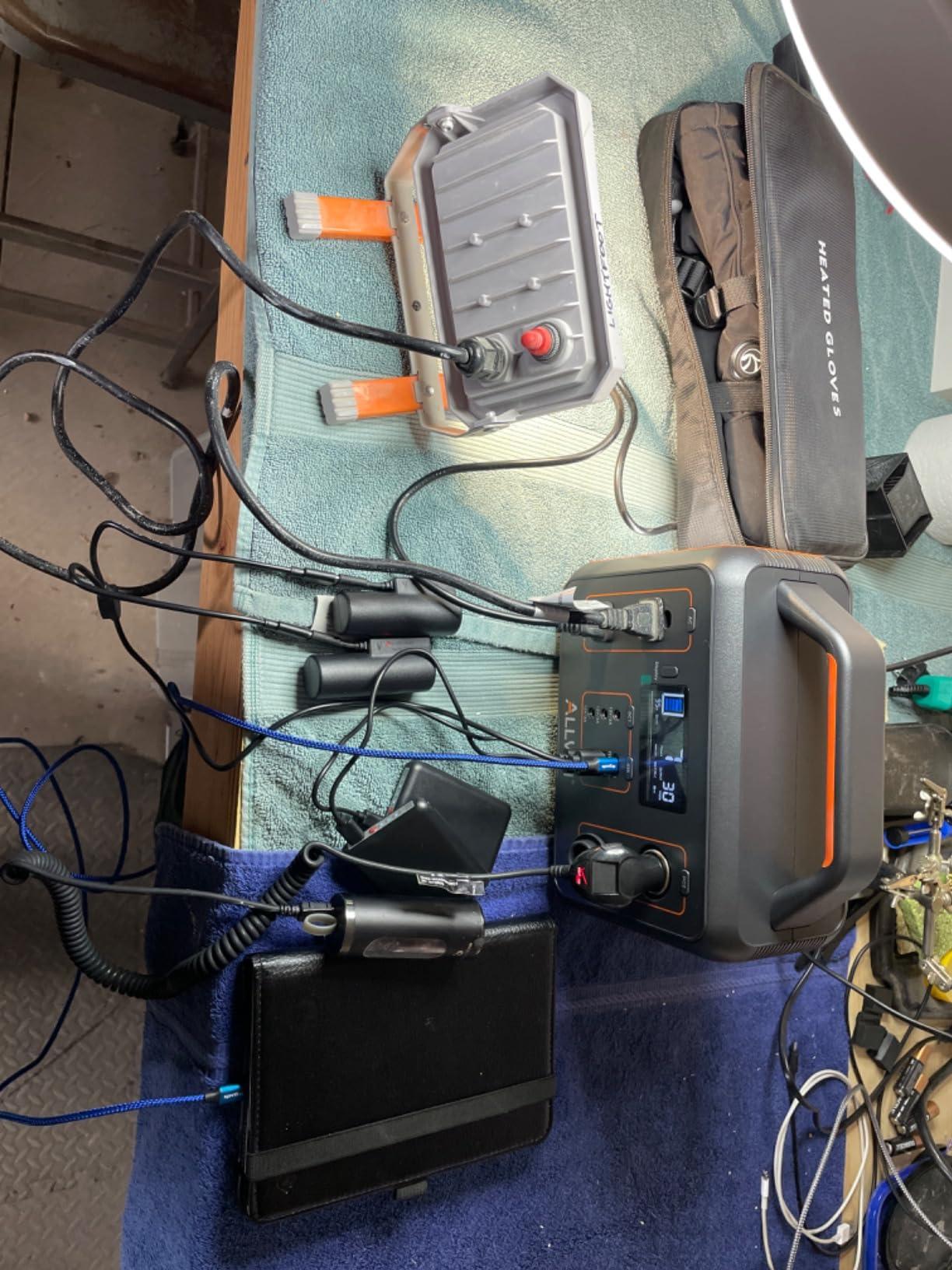
The ALLWEI 500W earns its place because of one specific, verifiable use case: owners report getting 20 hours of CPAP runtime across three nights with a heated humidifier attached. If that is your primary load, 512Wh goes a long way.
It also carries the lightest touch here at 13 lb with a 500W continuous output and 1000W surge, plus two AC outlets and three USB-C ports. The 4.4 rating across 2448 reviews is the lowest in our set, and the distribution shows why.
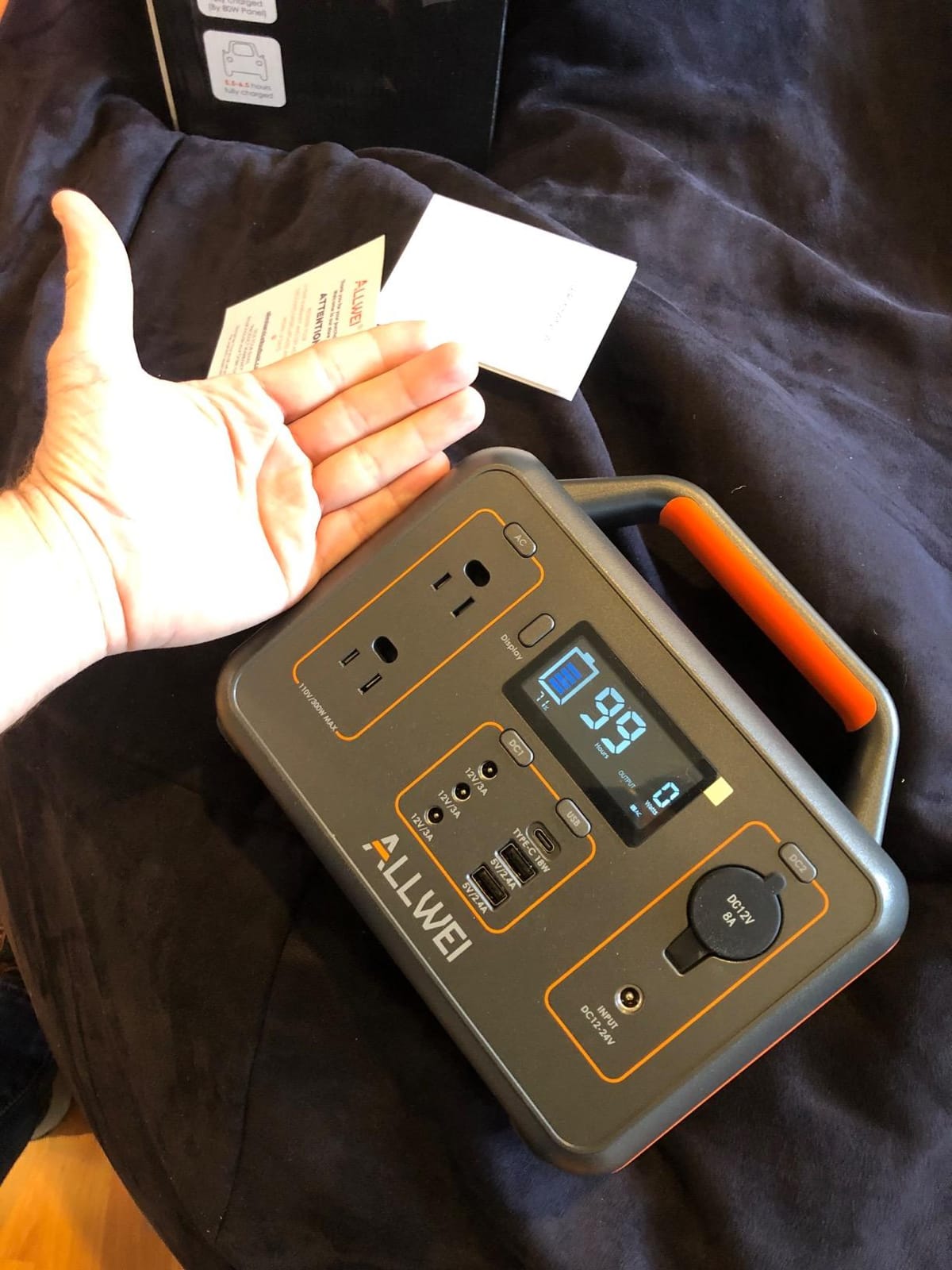
Roughly eight percent of reviews are one star, and the recurring theme is charge holding. Some owners report models stop holding a full charge within about a year, and the cooling fan can run loudly and continuously in warm weather.
Solar input is capped at 120W, so a 200W folding panel is useless with this unit. The two-year manufacturer warranty is also the shortest here, well below the five-year terms on most of the field.
Who the ALLWEI 500W suits
It suits first-time buyers, CPAP users on a fixed budget, and anyone who wants a small always-on station inside the RV for emergency backup rather than primary living power. Two years of expected service make it a sensible secondary unit.
Who should skip the ALLWEI 500W
Skip it if you plan to keep it for a decade of full-time RV use, if you want to plug in modern folding solar, or if you need more than 500W for anything with a compressor. The lower rating and shorter warranty are real signals here.
7. Anker SOLIX C1000 Gen 2 – Top rated for fast turnaround trips
Anker SOLIX C1000 Gen 2 Portable Power Station
1024Wh LiFePO4 battery
2000W continuous and 3000W peak
49-minute full recharge
10 output ports
Pros
- 49-minute full recharge at 1600W
- 2000W continuous output in a compact 15.1 by 8.2 inch frame
- 1.8-hour solar recharge from a 600W panel
- Under 10ms UPS switchover verified with CPAP machines
- Bluetooth app for remote status checks
Cons
- Gen 2 removes the expansion battery option from the first generation
- About 15 to 20 percent harmonic distortion under microwave loads
- No storage case included
- A few reports of first-unit failures replaced by Anker
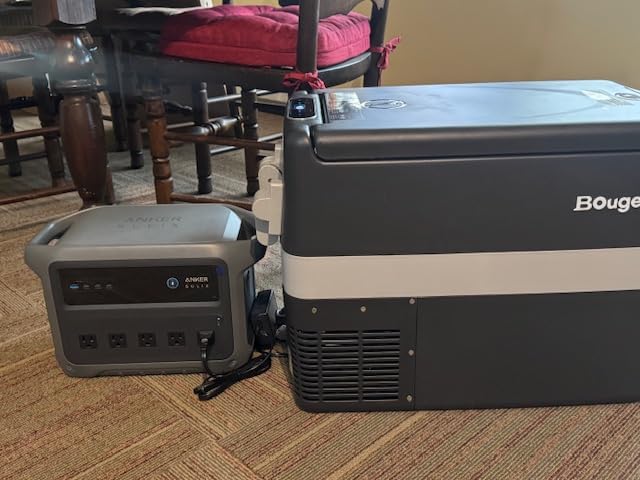
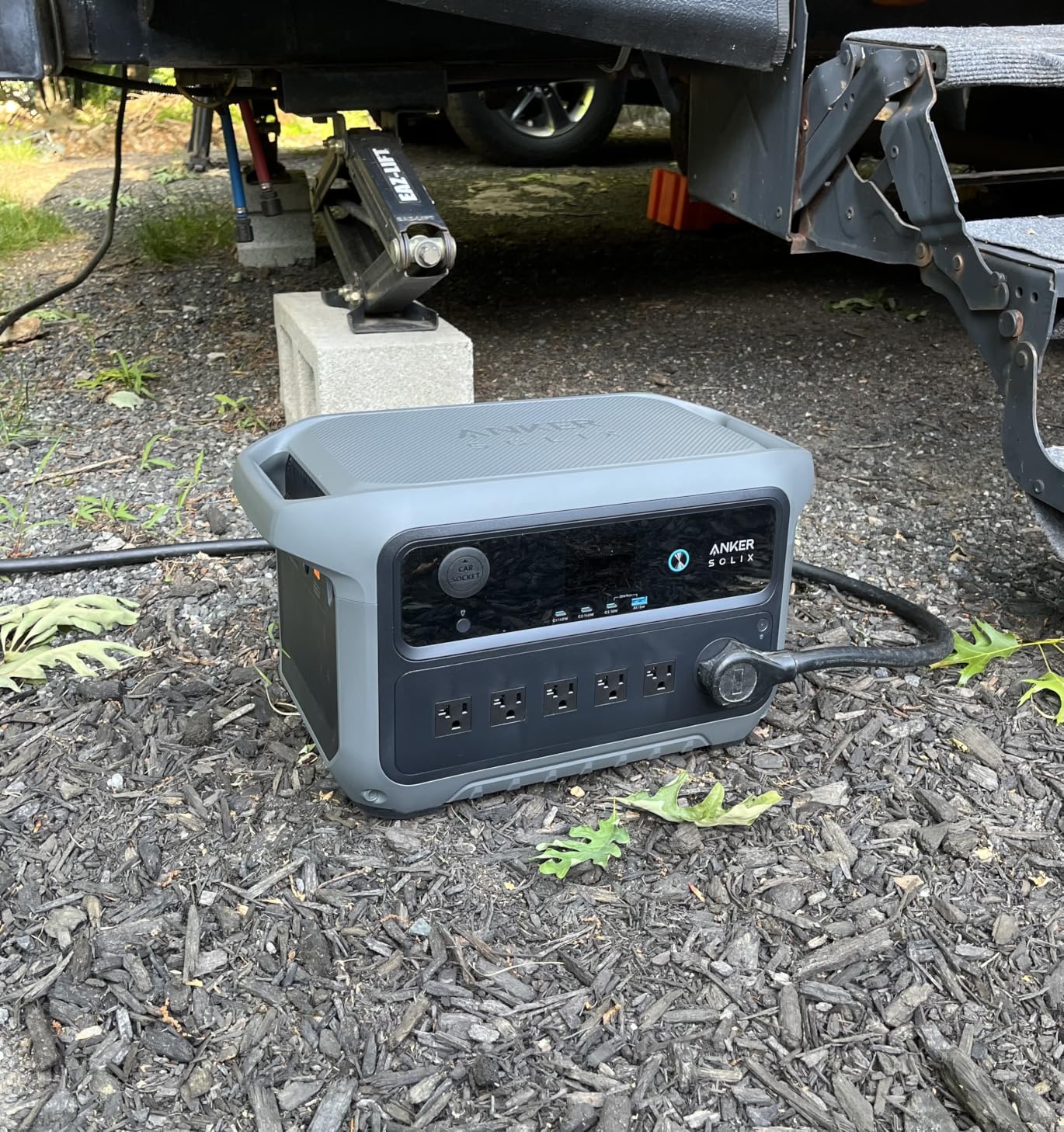
The Anker SOLIX C1000 Gen 2 matches the Jackery’s 4.7 rating on a smaller sample of 1632 reviews, with 86 percent of owners giving it five stars. The headline is recharge speed: 49 minutes to full at 1600W with HyperFlash enabled in the app.
For an RV that means a full recovery during a lunch stop at a campground pedestal rather than an overnight wait. Owners also praise the under-10ms UPS switchover, verified with CPAP machines and fiber internet running through an outage.
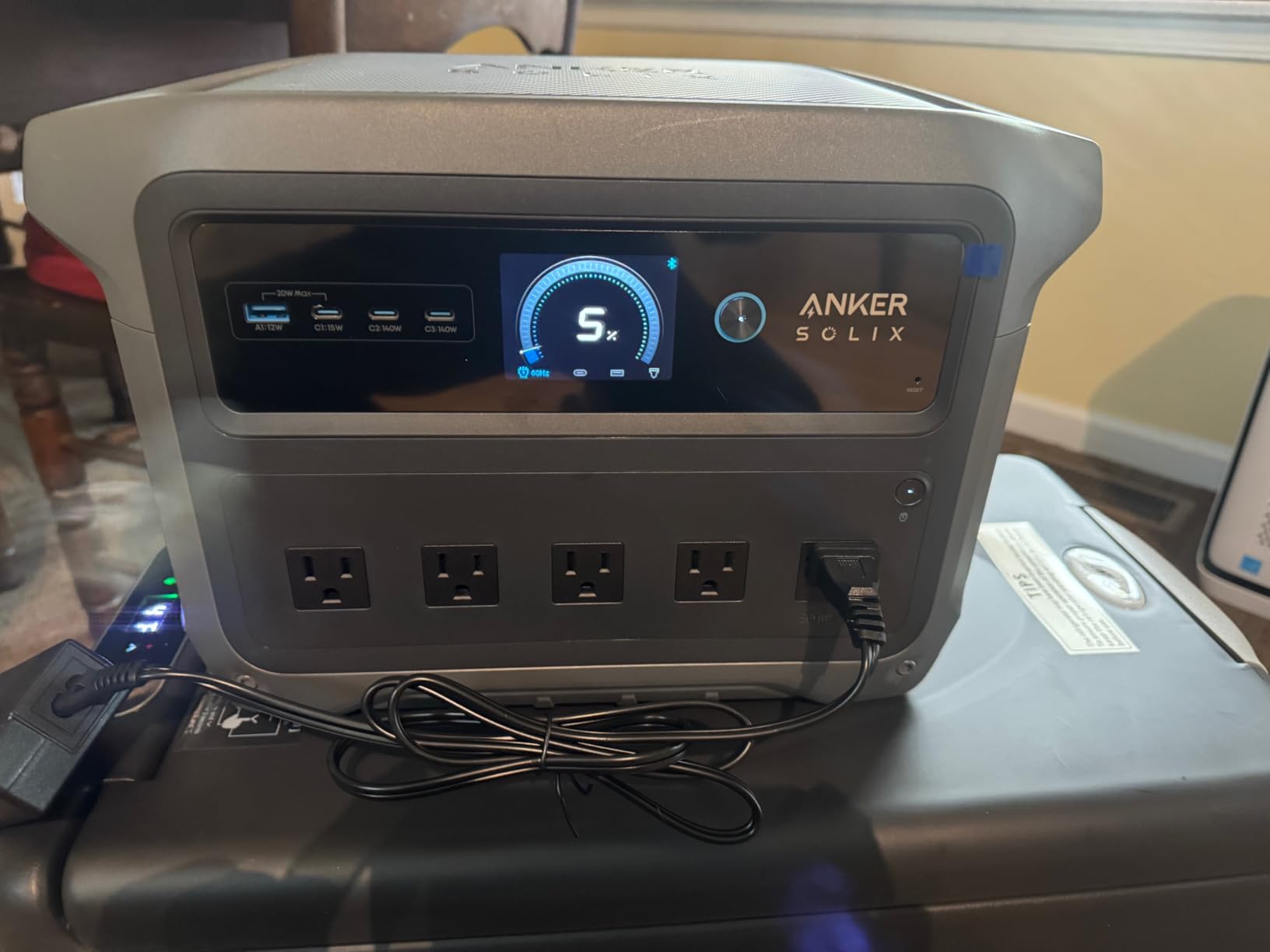
Be aware of what Gen 2 changed. The expansion battery option available on the first generation is gone, so 1024Wh is your ceiling. Owners with a first-generation unit and a need for more capacity should think carefully before trading up.
There is also mild waveform distortion of roughly 15 to 20 percent harmonic content when running a microwave. Ordinary appliances will not care; sensitive audio or medical equipment might, so test your specific load before a trip.
Who the Anker SOLIX C1000 Gen 2 suits
It suits travelers who alternate between hookups and boondocking and want the shortest possible turnaround, plus anyone running a CPAP and electronics where a fast top-up before bed matters. The 2000W inverter also handles a small window unit.
Who should skip the Anker SOLIX C1000 Gen 2
Skip it if your plan grows beyond 1kWh, if you need a 30A RV outlet, or if you run sensitive equipment alongside a microwave. A small storage case is not included either, so budget for cable organization.
8. EcoFlow DELTA Pro – Best for full-time RV living
EF ECOFLOW Portable Power Station 3600Wh DELTA Pro, 120V 3600W AC Output
3600Wh LFP expandable to 25kWh
3600W AC output
15 output methods
5-year warranty
Pros
- 3600Wh capacity runs fridges furnaces internet and computers for 15+ hours
- 3600W AC output expandable to 4500W with X-Boost and 7200W when paired
- 15 output methods including 5 AC outlets
- Full recharge in 1.8 hours from a 240V outlet
- Five charging paths including EV station charging
Cons
- 99 lb is the heaviest here and needs two people
- Solar input limited to about 15 amps
- Some models arrive depleted and can trip a breaker on first use
- Occasional error-code and overload faults with mixed warranty support
Full-time RVers should start here. The 3600Wh capacity with 3600W of AC output, expandable to 25kWh with extra batteries or smart generators, is the only configuration in this roundup that can replace a gas generator for whole-trailer living rather than just supplement it.
Owners credit it with running fridges, a furnace, internet and computers for more than 15 hours on a charge, and the 1.8-hour recharge from a 240V outlet is genuinely useful at a full-service campground. It is quiet enough to sleep beside.
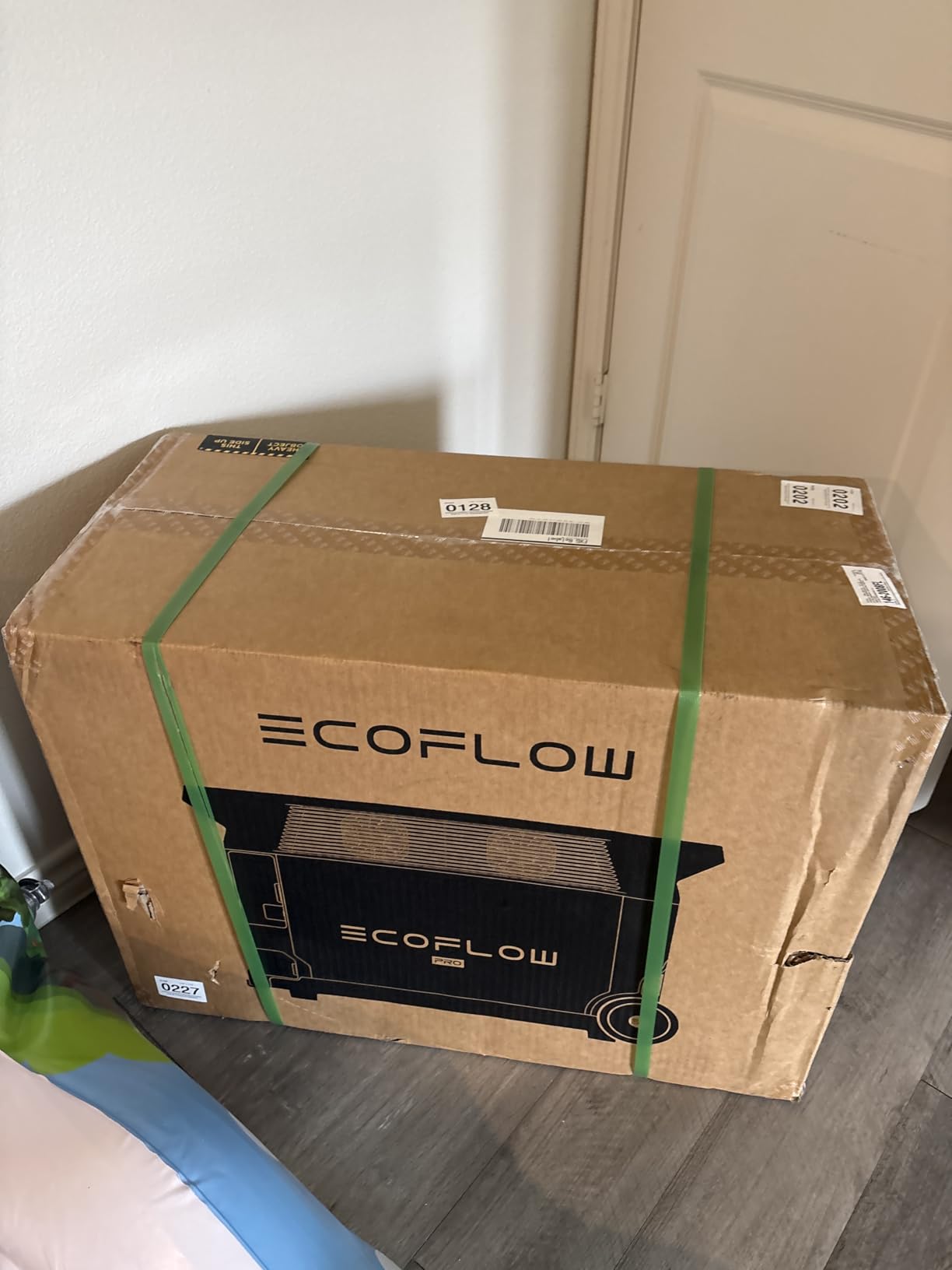
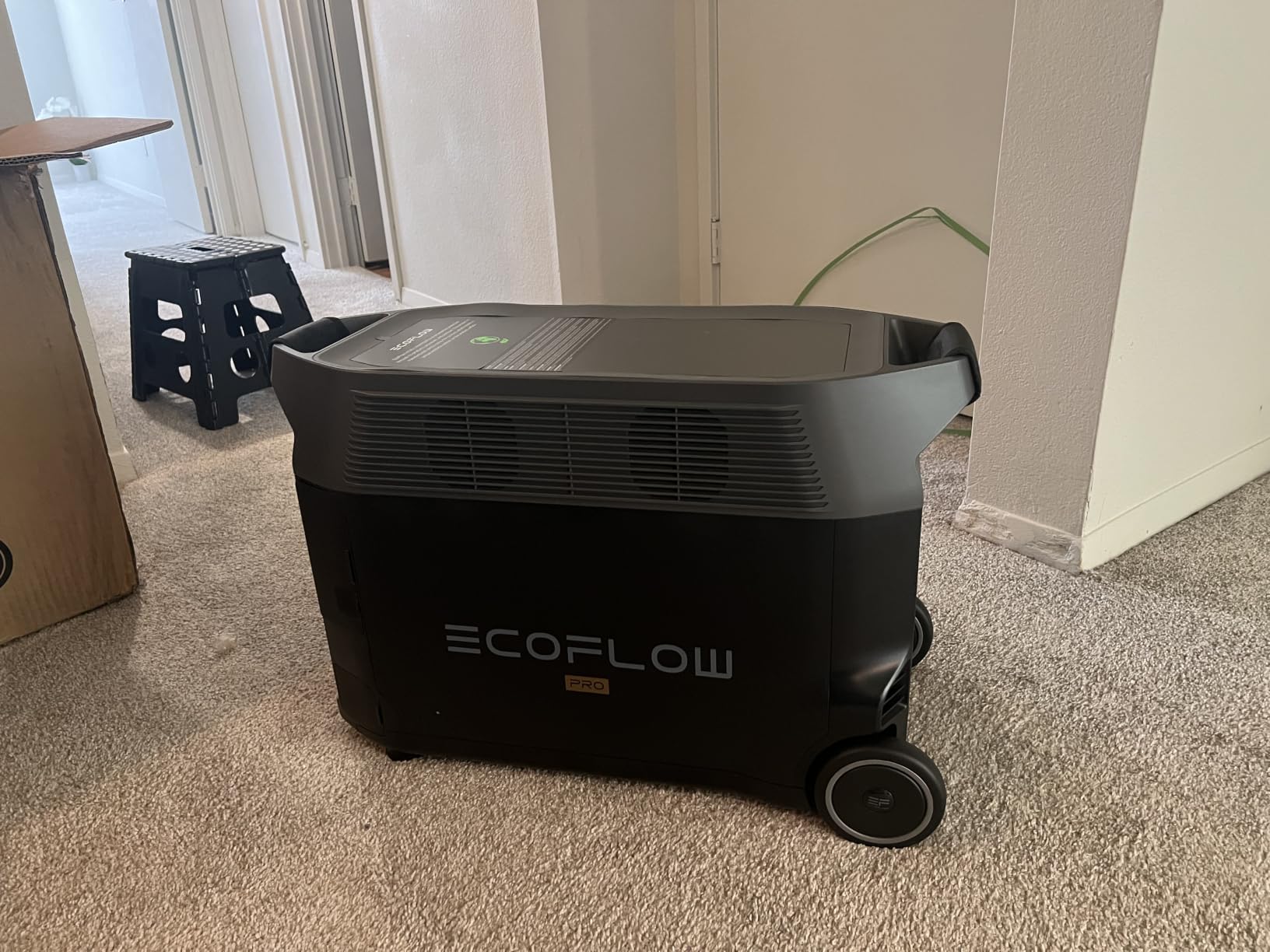
At 99 lb it is the heaviest unit here, and the extendable handle still needs a second person for stairs and curbs. Once installed in a garage or storage bay, that weight largely stops mattering.
Solar harvest is capped at roughly 15 amps regardless of panel wattage, which disappoints people buying four 400W panels. A few owners also report models arriving nearly depleted and tripping a breaker on the first outlet used.
Who the EcoFlow DELTA Pro suits
It suits full-timers, work-from-RV setups that need computers and internet running for days, and households adding a furnace or electric water heater to the load. The expansion path means one purchase can cover years of growing demand.
Who should skip the EcoFlow DELTA Pro
Skip it for weekend trips where a 1kWh station would do, for anyone who cannot install a 99 lb unit permanently, and for solar-heavy boondocking plans that exceed roughly 15 amps of input. The 652-review pool is also the thinnest here.
9. Anker SOLIX C2000 Gen 2 – Best fridge runtime for boondockers
Anker SOLIX C2000 Gen 2 Portable Power Station, 2,048Wh, 2,400W, Camping
2048Wh expandable to 4kWh
2400W rated and 4000W peak
9W standby draw
41.7 lb
Pros
- Runs a dual-door fridge up to 32 hours and 64 hours with expansion
- 4000W peak output covers most window and RV air conditioner units
- 9W standby draw is unusually efficient
- 58-minute full recharge on AC or solar
- 800W alternator charging reaches full in 3 hours while driving
Cons
- Newer platform with a smaller review pool
- Expansion to 4kWh needs a separate battery purchase
- Reported wattage and outlet-count fields vary from marketing claims
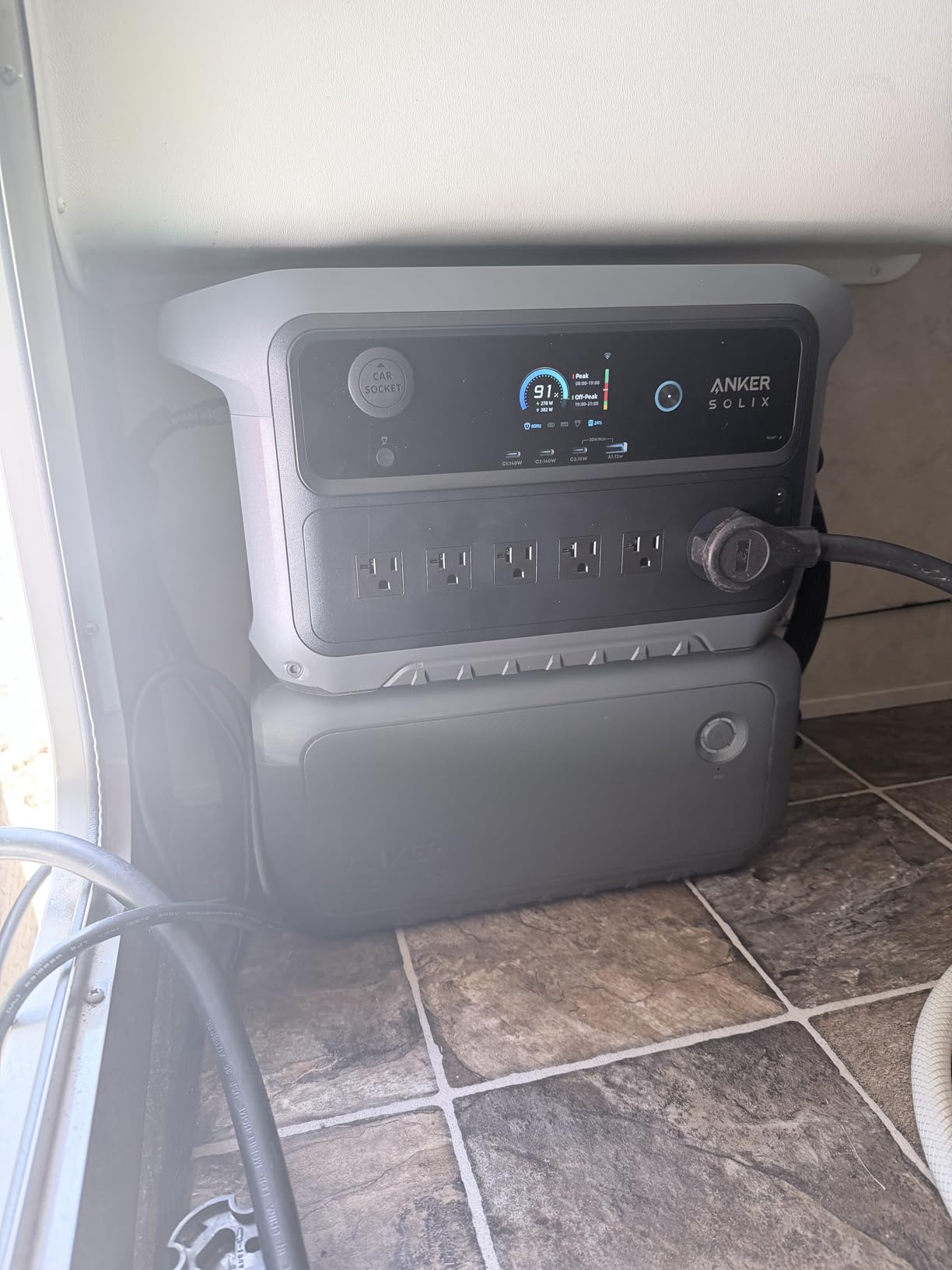
The C2000 Gen 2 solves the specific problem of keeping a dual-door refrigerator running without babysitting the battery. At just 9W of standby draw, Anker rates it for up to 32 hours on a dual-door fridge, and 64 hours once you add the expansion battery to reach 4kWh.
The 4000W peak output is the other headline, and owners point out that it runs most window and RV air conditioner units where smaller inverters stall. The 4.7 rating comes with an 87 percent five-star share, among the strongest distributions in this set.
What makes this clever for RV use is the 800W alternator charging path, which tops it up in three hours while you drive. Owners running long hauls treat that as a free top-up that no wall outlet could match.
At 41.7 lb it is light for a 2kWh unit, and Anker claims it is 25 percent lighter and 29 percent smaller than comparable products. The caveat is that reaching 4kWh requires a separate battery purchase rather than a built-in path.
Who the Anker SOLIX C2000 Gen 2 suits
It suits boondockers whose primary load is a large compressor fridge plus phones and laptops, and drivers who cover long distances and can charge from the alternator. It also handles short air conditioner runs that defeat 1kWh units.
Who should skip the Anker SOLIX C2000 Gen 2
Skip it if you need a 30A RV connection, if you want to grow well beyond 4kWh, or if you would rather buy the largest configuration in one step. The 670-review pool also means less long-term durability data than the category leaders offer.
10. EcoFlow DELTA 3 Max – Best newer 2kWh option with X-Boost headroom
EF ECOFLOW DELTA 3 Max Portable Power Station, 2048Wh LFP Battery, 2400W
2048Wh LFP battery
2400W continuous and 3400W X-Boost
0-80% in 1.13 hours
under 10ms UPS
Pros
- 0-80% recharge in about 1.13 hours
- X-Boost pushes continuous output to 3400W
- Under 10ms transfer time protects computers and medical devices
- Quiet enough for overnight use inside a camper
- App scheduling helps manage time-of-use charging
Cons
- Newest generation with a 583-review base and limited long-term data
- 2400W rated output trails some competing 2kWh units
- Manufacturer does not list a weight figure
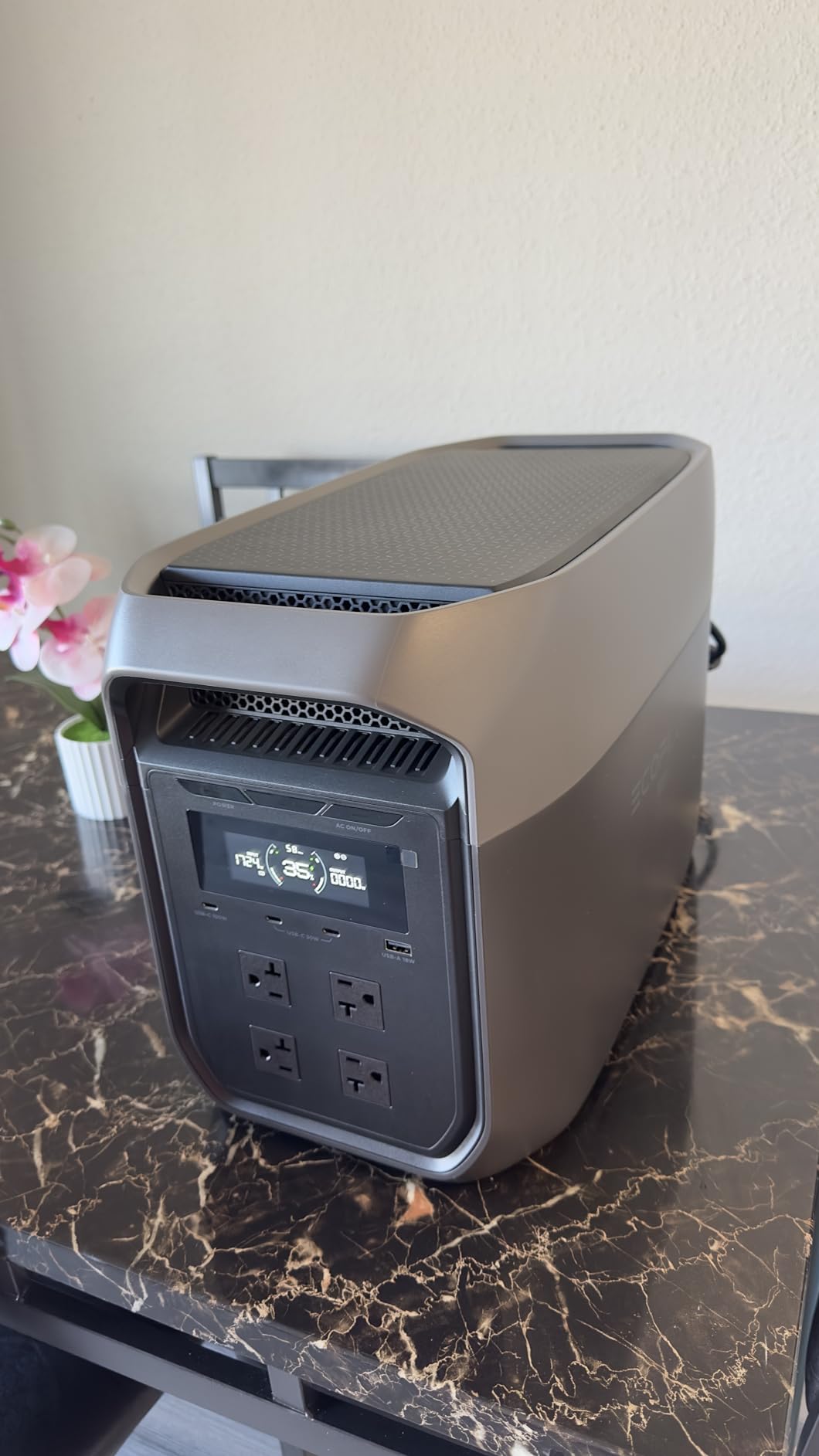
The DELTA 3 Max is the newest unit in this lineup and the one with the highest share of five-star ratings at 88 percent, though the sample is only 583 reviews. Its headline is recharge speed, going from zero to 80 percent in about 1.13 hours.
X-Boost is the practical feature for RV use, lifting continuous output to 3400W so a microwave, a fridge compressor and a coffee maker can overlap without a shutdown. The under-10ms transfer keeps computers and medical devices running through an outage.
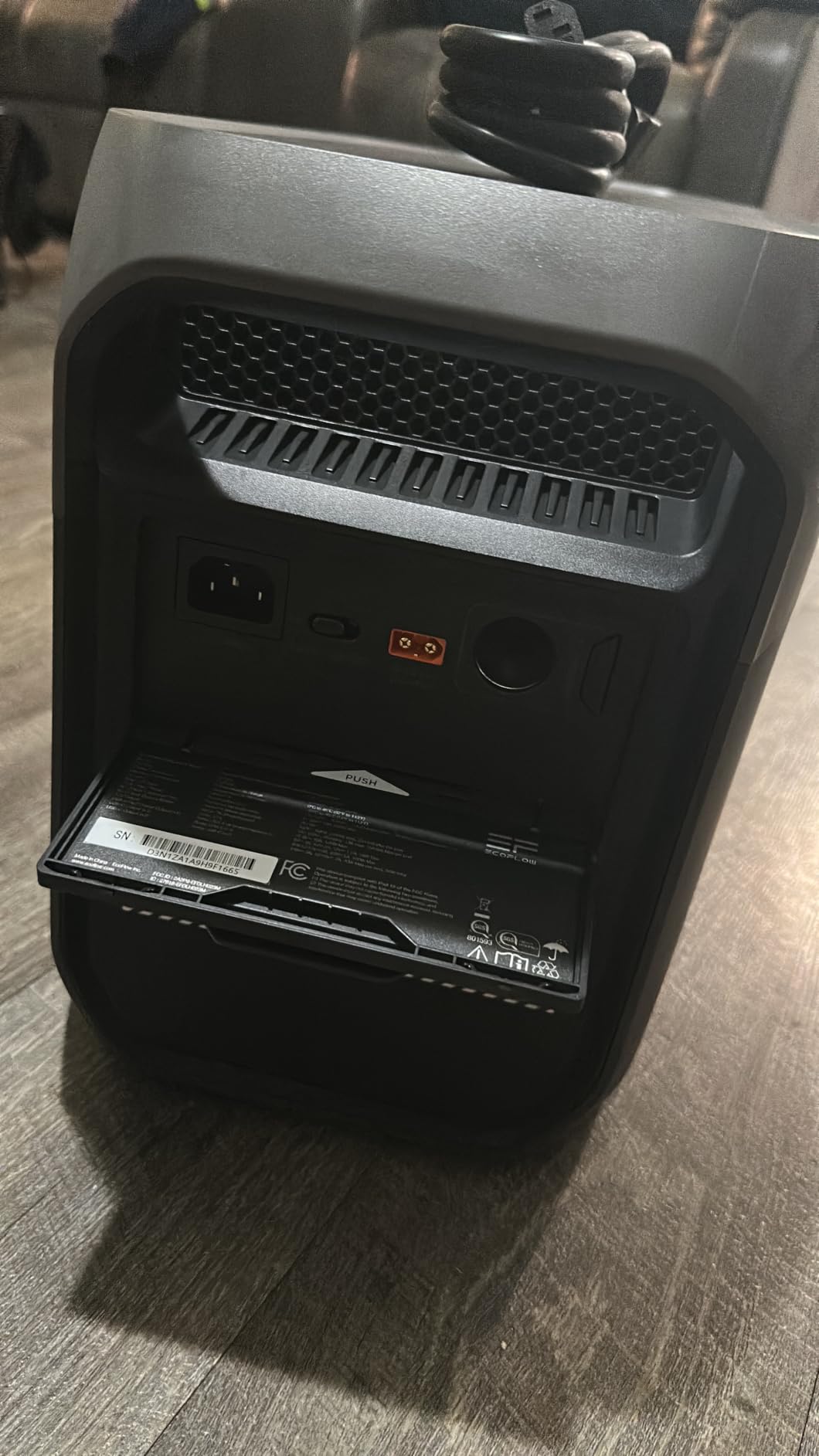
Owners like the lighter aluminium-and-plastic build that moves from home to campsite, and the app scheduling genuinely helps if you charge around peak electrical rates at a campground. Five-year extended service is included.
The cautions are honest ones for a recent release. A 583-review base means limited long-term durability data, and the rated 2400W output is below what some competing 2kWh units offer if you compare nameplate numbers alone. The manufacturer does not publish a weight figure, so confirm it before planning a mount.
Who the EcoFlow DELTA 3 Max suits
It suits someone who wants current-generation X-Boost headroom without stepping up to a 3kWh-plus unit, especially if recharge speed between stops matters more than absolute capacity. Time-of-use scheduling is a bonus for campground pedestal users.
Who should skip the EcoFlow DELTA 3 Max
Skip it if you need a 30A RV outlet, if long-term track record matters more to you than charging speed, or if you need verified weight and expansion options before committing to a permanent install. Waiting a season would resolve all three concerns.
How to Size a Power Station for Your RV
Start with a daily watt-hour budget, not a brand. List every appliance you intend to run, multiply its running watts by the hours you expect it to be on, and add them up for one full day away from a hookup. Then add roughly 20 percent for inverter conversion loss.
A typical weekend rig runs a 12V compressor fridge averaging 55W, a router at 12W, phone charging at 15W and an evening lamp at 20W, which lands near 2500Wh per day. A two-night trip with one solar day to refill wants roughly 6000Wh of nameplate capacity, which is why 2000Wh units are the practical floor for a three to seven day boondock.
For a 13500 BTU rooftop air conditioner, budget the inverter far more generously than the battery. Those compressors pull over 1000W while starting, so you want a unit rated at 2400W continuous with 3600W or more of peak capability, and you need to accept that a 3600Wh battery will be emptied in a few hours of hard use.
Finally, check whether you need expansion. Four of our picks grow to 4kWh or beyond with add-on batteries, which turns a weekend purchase into a multi-season system. If you are planning on shorter trips first, our camping-focused power station roundup covers the lighter end of the range.
Plugging Your RV Into a Power Station
You can connect an RV to a power station, and the correct method depends entirely on whether the station has a native 30A TT-30 outlet. Only the BLUETTI AC200PL in this roundup has one built in, which is exactly why it earns the 30A badge.
Everything else requires a 30A to 110V adapter cord, which converts your RV shore power cord to a household plug. The three recurring mistakes are joining the adapter to an undersized inverter, plugging the RV in with several high-draw appliances already running, and forgetting to connect the station to the RV battery bank so the fridge does not drain the starter battery overnight.
Load shedding is the fix for most overload shutdowns. Turn off or unplug the water heater, microwave and air conditioner before energizing the RV, then bring them back one at a time while watching the inverter readout. If it still trips, the inverter is undersized for that compressor start and a soft-start device is the standard remedy.
Wire sizing matters for anything hardwired. A 30A RV circuit on a standard 30A breaker needs copper conductors appropriate to the run length, and shore power leads should be fully seated and undamaged. When in doubt, have a licensed electrician check the install, because the failure mode is a burned harness inside your walls.
On cable routing, a 30A TT-30 plug and lead is far heavier than a household extension cord and cannot be run through a small window slider cleanly. Plan your entry point before the trip; r/RVLiving threads are full of owners discovering this in a parking lot.
Solar Charging and Off-Grid Setup
Solar input is the single biggest differentiator across this lineup, and it ranges from 120W on the ALLWEI to 1600W on the DELTA Pro. Match panel wattage to the input ceiling rather than the inverter output, because a station with a 300W input will not accept a 400W array at full speed.
As a rule of thumb, budget roughly 200W of portable panel per 1000Wh of station capacity for a comfortable three to five day boondock. Two 200W folding panels or a single 400W portable array will hold a 2000Wh unit steady on a sunny site, and roof-mounted panels are worth it if you are stationary for weeks.
Panel angle matters more than most buyers expect. Around 40 degrees of tilt at roughly 40 degrees latitude is the common starting point, and a soiled panel can lose a substantial share of its output. Wiping them off each morning is boring and effective.
For a deeper look at chemistry and cycle life, our guide to LiFePO4 portable power stations for off-grid use breaks down why every pick here uses that chemistry over NMC.
Portable Power Station vs Gas Generator for RV Travel
A power station wins on noise, emissions and rules: zero fuel to haul, no exhaust, and no generator ban to worry about at quiet camps. A gas generator wins on refill speed, because a full tank of fuel restores more energy in less time than any portable array in this roundup.
Capacity is the divider. A 3600Wh station covers an evening and morning of typical living; a gas generator will run indefinitely while you burn fuel. For weekend trips and generator-restricted parks, the power station is clearly better. For full-time living in cold weather with a furnace and a rooftop air conditioner, many RVers end up owning both.
One more practical point: cold weather. Batteries charge slowly and output drops when temperatures fall, so a station that carries your trip in summer may disappoint in January. A generator is unaffected by temperature, which is why serious four-season boondockers keep a backup.
How We Chose
Every unit here was ranked on five criteria: usable capacity after the depth-of-discharge haircut, continuous inverter output, recharge speed from a wall outlet, weight relative to capacity, and the size and tone of the verified review pool. Ratings were never the sole input, because a 4.7 on a thin sample tells you less than a 4.6 on thousands of reviews.
We also weighted real RV hardware heavily. A native 30A TT-30 outlet, a 48V port for charging house batteries and a 9W or lower standby draw all earned credit, because those are the details that decide whether a station works for a week or only for a weekend.
Community threads informed the watch-outs more than the wins. Complaints about app-gated charge modes, proprietary cables, wireless charging pads that will not hold a phone and idle draw quietly shrinking overnight runtime appear across multiple forums, and every pick below carries at least one of those honestly.
If you are still weighing classes rather than models, our guide to sub-500 dollar power stations and our fridge-focused roundup narrow the field further.
Frequently Asked Questions
Can a portable power station run an RV?
Yes, for selected loads. A power station can run a 12V refrigerator, CPAP machines, laptops, lights and most small appliances indefinitely, but it cannot feed an RV through its 30A shore power inlet unless the station has a native 30A TT-30 outlet or you use a 30A to 110V adapter cord with a large enough inverter. Rooftop air conditioners and electric water heaters are the two loads that drain a station fastest.
Which portable power station is best for a motorhome?
For most motorhomes the Jackery Explorer 1000 v2 is the best balance of 1070Wh capacity, 1500W output and a 23.8 lb weight. Full-timers who need to run a rooftop air conditioner or charge house batteries should look at the BLUETTI AC200PL with its 30A TT-30 and 48V ports, or the EcoFlow DELTA Pro at 3600Wh.
Can you plug a 30 amp RV into a Jackery?
Not directly. The Jackery Explorer 1000 v2 has no 30A TT-30 outlet, so you need a 30A to 110V adapter cord to connect your RV shore power cord to its AC outlets. Because the inverter is limited to 1500W, you must shed loads before connecting, and the BLUETTI AC200PL is the alternative that has the RV outlet built in.
What size power station do I need for a 3 day RV trip?
Plan roughly 2000Wh of nameplate capacity for three days with a 12V fridge, phone charging and evening lights. After the 80 percent usable window and about 10 percent inverter loss, a 2304Wh unit such as the BLUETTI AC200PL is the more comfortable choice, and a 1500W or larger inverter gives you compressor headroom.
Are Jackery and EcoFlow or Anker better for RV use?
Jackery is the most balanced for weight and output, Anker wins on recharge speed and fridge runtime, and EcoFlow offers the widest capacity range from a 499Wh unit to the 3600Wh DELTA Pro. The right pick depends on trip length and whether you need a native 30A RV outlet, which only some models provide.
Bottom Line on the Best Portable Power Stations for RV Trips
The Jackery Explorer 1000 v2 is our pick as the best portable power stations for RV trips overall, because 1070Wh, 1500W of output and a 23.8 lb weight cover the majority of weekend and three to five day boondock scenarios without a second person lifting anything. Boondockers who need more headroom should step up to the BLUETTI AC180 for app-enabled 2700W lifting power, or the BLUETTI AC200PL if a native 30A RV outlet and 48V house battery charging matter to your setup.
Full-timers and anyone running a rooftop air conditioner belong in the EcoFlow DELTA Pro or Anker SOLIX C2000 Gen 2, and lightweight Class C campers should look at the EcoFlow River 2 Max 500. Whichever you choose, check the adapter situation for your 30A plug before you leave, and remember that usable capacity is roughly 20 percent below the number on the front panel.
We updated this guide for 2026 and will keep testing as the current-generation models accumulate more long-term data.