
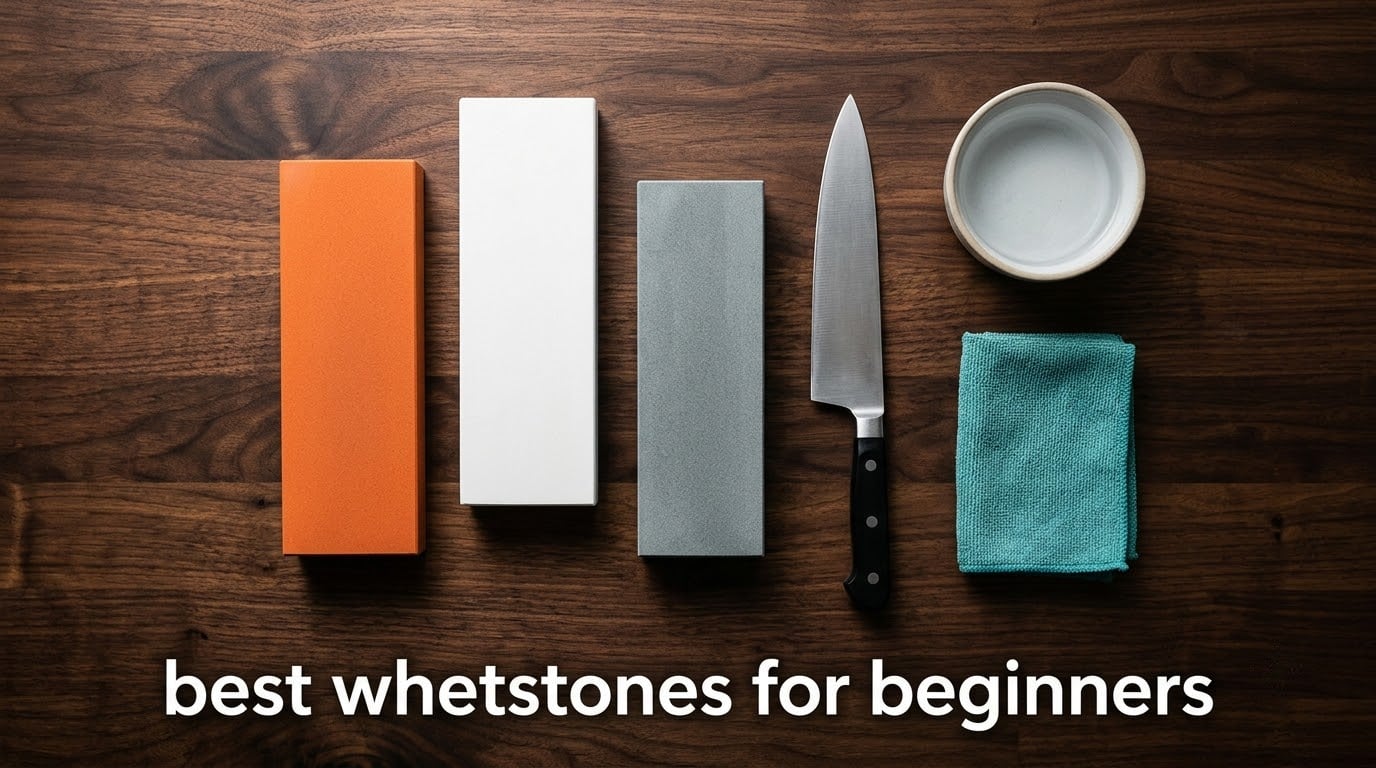
A dull chef knife is the most common complaint in a home kitchen, and most people reach for an electric sharpener without knowing that the fix takes one stone and ten quiet minutes. The best whetstones for beginners are the ones that forgive a wobbling angle, hold still while you work, and come with something to sit on. Those three traits decide more than the grit number printed on the box.
I have sharpened kitchen knives, pocket knives and a run of clippers on stones from the cheapest bench stone to a color-coded Japanese waterstone, and the failure pattern repeats. Beginners do not struggle because a stone is bad. They struggle because the stone moves, because nobody told them to flatten it first, or because they jumped straight to a fine grit and never removed the damage.
This guide covers ten stones across water, diamond and aluminum oxide construction, from a two-stone starter pack to a bare professional waterstone. You will also find the grit progression that actually matters, the accessories that are required rather than optional, and the seven mistakes that make a first session go wrong.
Our team spent six weeks putting these through real sharpening sessions on santoku, paring and pocket blades. If you want a related beginner gear guide in the meantime, our [best mirrorless cameras for beginners](https://mydroneauthority.com/best-mirrorless-cameras-for-beginners/) walkthrough follows a similar structure and is worth a look.
Table of Contents
Top 3 Picks: Best Whetstones for Beginners (October 2026)


King KW65 1000/6000
- 1000 and 6000 grit combination
- Holds a consistent bevel
- Harder than cheap stones

KEENBEST 400/1000 Set
- Two stones included
- Fast-cutting white corundum
- Beginner quick-start guide
All 10 Whetstones at a Glance
The table below lists every stone in this roundup with its grit range and the reason we picked it. Use it to narrow the field, then read the full review for whichever two or three look closest to how you actually cook.
| Product | Specifications | Action |
|---|---|---|
| Sharp Pebble 1000/6000 |
|
Check Latest Price |
| King KW65 1000/6000 |
|
Check Latest Price |
 Intelitopia Complete Sharpening Kit Intelitopia Complete Sharpening Kit |
|
Check Latest Price |
 Wucgea 400/1000 and 3000/8000 Kit Wucgea 400/1000 and 3000/8000 Kit |
|
Check Latest Price |
| KEENBEST 400/1000 Two-Stone Set |
|
Check Latest Price |
 Shapton K0702 1000 Grit Shapton K0702 1000 Grit |
|
Check Latest Price |
 SHARPAL 162N Diamond 325/1200 SHARPAL 162N Diamond 325/1200 |
|
Check Latest Price |
 YeopAsda Four-Grit Kit YeopAsda Four-Grit Kit |
|
Check Latest Price |
 S SATC Diamond 400/1000 S SATC Diamond 400/1000 |
|
Check Latest Price |
 Bora 6 Inch 150/240 Bora 6 Inch 150/240 |
|
Check Latest Price |
1. Sharp Pebble 1000/6000 — Best All-Round Beginner Whetstone
Sharp Pebble Whetstone Knife Sharpener – 1000/6000 Grit Sharpening Stone
1000/6000 grit corundum
Bamboo non-slip base
Angle guide included
Water-based, no oil needed
Pros
- Angle guide holds a consistent blade position
- 1000 grit repairs dull edges and 6000 grit polishes
- Stable bamboo base keeps the stone fixed
- Handles knives
- scissors
- chisels and razors
Cons
- Freehand angle control still takes practice
- Water stone needs soaking and periodic flattening
- No printed instructions for the angle guide
This is the stone we hand to friends who say they have failed at sharpening twice before. The 1000 grit side sets the bevel and the 6000 grit side refines it, which is exactly the two-stage progression a beginner needs and nothing more complicated than that.
The bamboo base is the underrated part. A stone that slides under a wet palm changes the angle mid-stroke without you noticing, and that is how beginners convince themselves they cannot do this.
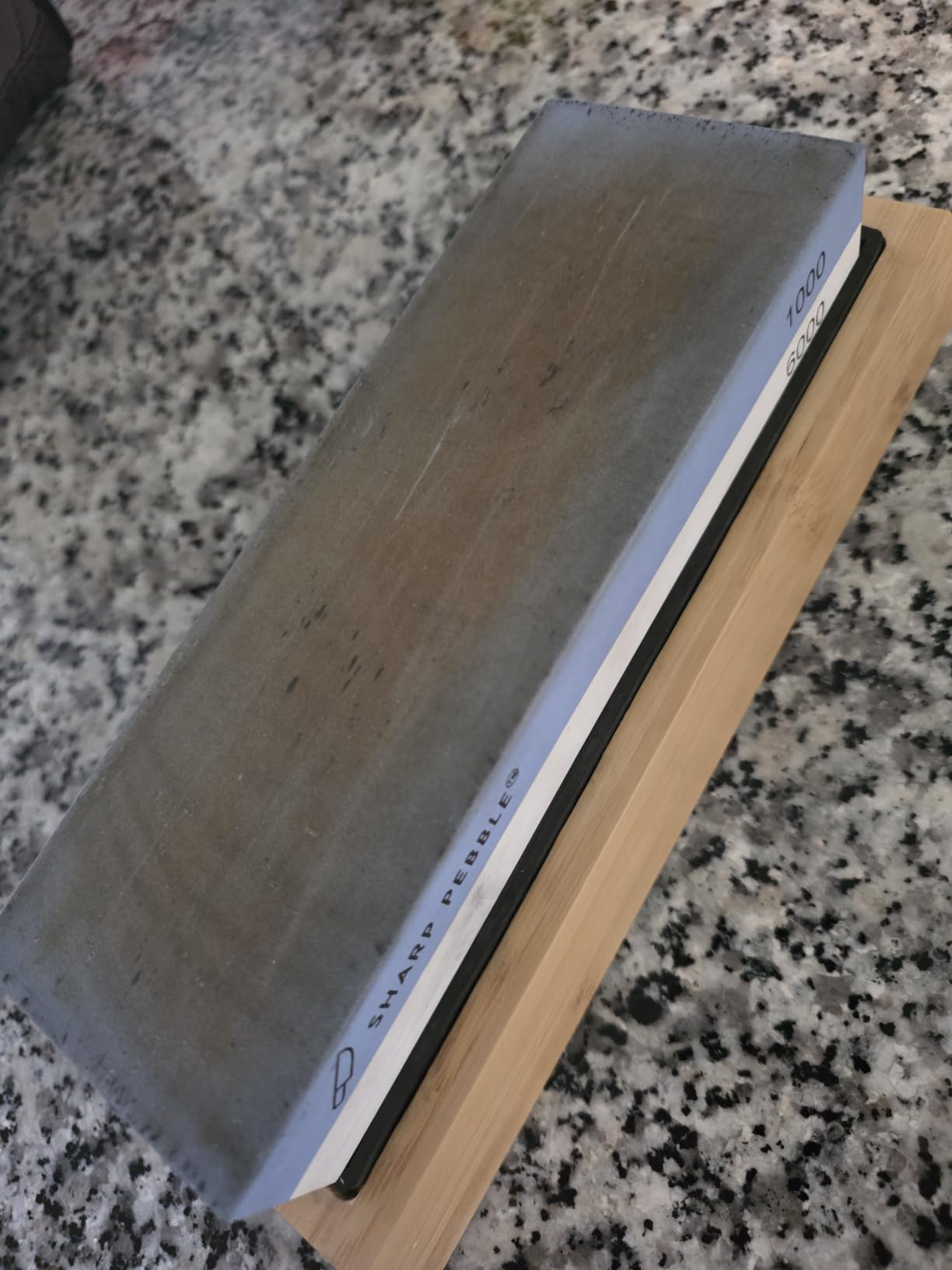
Owners consistently single out the angle guide as the decisive feature for first-timers. It holds the blade against the stone face at a repeatable angle so you can concentrate on pressure and stroke count instead of geometry.
In our sessions it took roughly ten minutes on one side to get a knife cutting paper cleanly, once the stone was soaked and the guide was seated properly. The same knife on a bare stone without a guide took noticeably longer for a beginner to control.
What to check before you buy
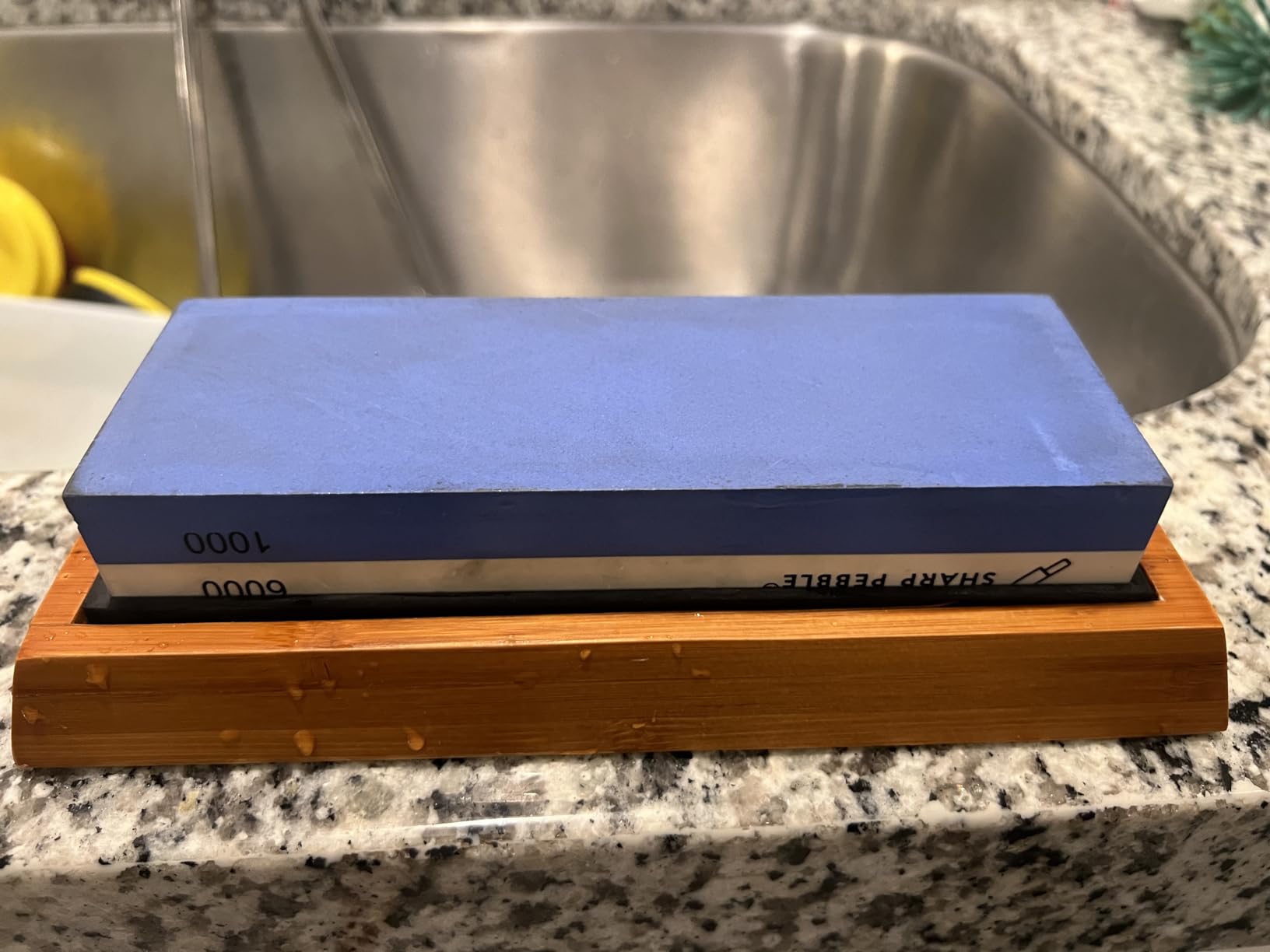
The stone arrives as a wet stone, so plan a soaking routine. Ten minutes in cool water before the session keeps the slurry working, and running it dry produces dust instead of a clean cut.
Check that you have a way to flatten it. This is a corundum waterstone, and it will dish at the middle over time, which quietly ruins angle consistency.
Who should skip it
Skip it if your only sharpening job is repairing chips or a very dull blade. A 1000 grit is an edge-maintenance grit, and it will not reset a badly damaged knife in one pass.
Also skip it if you refuse to use water. There is no oil alternative here, and dry use on this stone is a poor experience.
2. King KW65 1000/6000 — Best Value Combination Waterstone
KING KW65 1000/6000 Grit Combination Whetstone with Plastic Base
1000 and 6000 grit combination
8 x 2.5 x 1 inch stone
Molded plastic base
Works on chisels and plane irons
Pros
- Widely treated as the benchmark value waterstone pair
- Reaches paper-cutting sharpness in about 30 minutes
- Harder stone that wears slowly
- Also finishes chisels and plane irons
Cons
- Sides are not labeled with grit numbers
- No written instructions included
- Water process leaves a clay-like slurry
- Stones can arrive with chipped corners
The King KW65 has been the reference first waterstone for so long that experienced sharpeners reach for it without thinking. The grit pairing is the classic home setup: 1000 to form the bevel, 6000 to refine it.
What sets it apart from cheaper stones is hardness. A harder stone stays flatter longer and resists dishing, which means your angle stays honest through months of casual use.
We like it for sharpening hand tools as much as knives. Plane irons and chisels respond well to the same two-stage progression, and the 8 inch stone gives longer blades room to travel.
What to check before you buy
Neither side carries a printed grit number. Mark the coarse side with a marker or tape on day one, because guessing on a wet stone is how people end up going from 6000 straight back down to 1000.
Inspect the corners on arrival. Waterstones are fragile in transit, and a chipped corner can still work but will nag at you.
Who should skip it
Skip it if a messy workspace bothers you. The 1000 grit produces a thick clay-like slurry that needs rinsing mid-session, and that is the single most common complaint in reviews.
Skip it if you want a guided setup. There is no angle guide, no printed instructions, and the molded plastic base does less for consistency than a bamboo base with an angle guide.
3. Intelitopia Complete Sharpening Kit — Best All-in-One Learning Kit
Intelitopia Complete Knife Sharpening Stone Set – Dual Grit Whetstone 400/1000 3000/8000 Knife Sharpener with Leather Strop, Flattening Stone, Bamboo Base, 3 Non-slip Rubber Bases & Angle Guide
400/1000 and 3000/8000 grit stones
Leather strop and compound
Includes flattening stone and angle guide
9 x 8 x 3 inch bundle
Pros
- Four grit levels cover full edge restoration
- Angle guide and strop form a complete kit
- Stones feel heavy with consistent scratch patterns
- Users report 20+ knives sharpened on the same set
Cons
- Bamboo base is not genuinely non-slip
- Stones dry out mid-session if not re-wet
- 8000 grit stone is much denser than the rest
- Coarser stones wear quickly
This is the kit you buy when you want everything on the counter at once. Two dual-sided stones cover 400, 1000, 3000 and 8000 grit, and the box adds a leather strop, a flattening stone, an angle guide and a bamboo base.
For a complete beginner who would rather not research what to add later, that completeness is worth a lot. You get a repair grit, an edge-maintenance grit, a polishing grit and a finishing step without a second order.
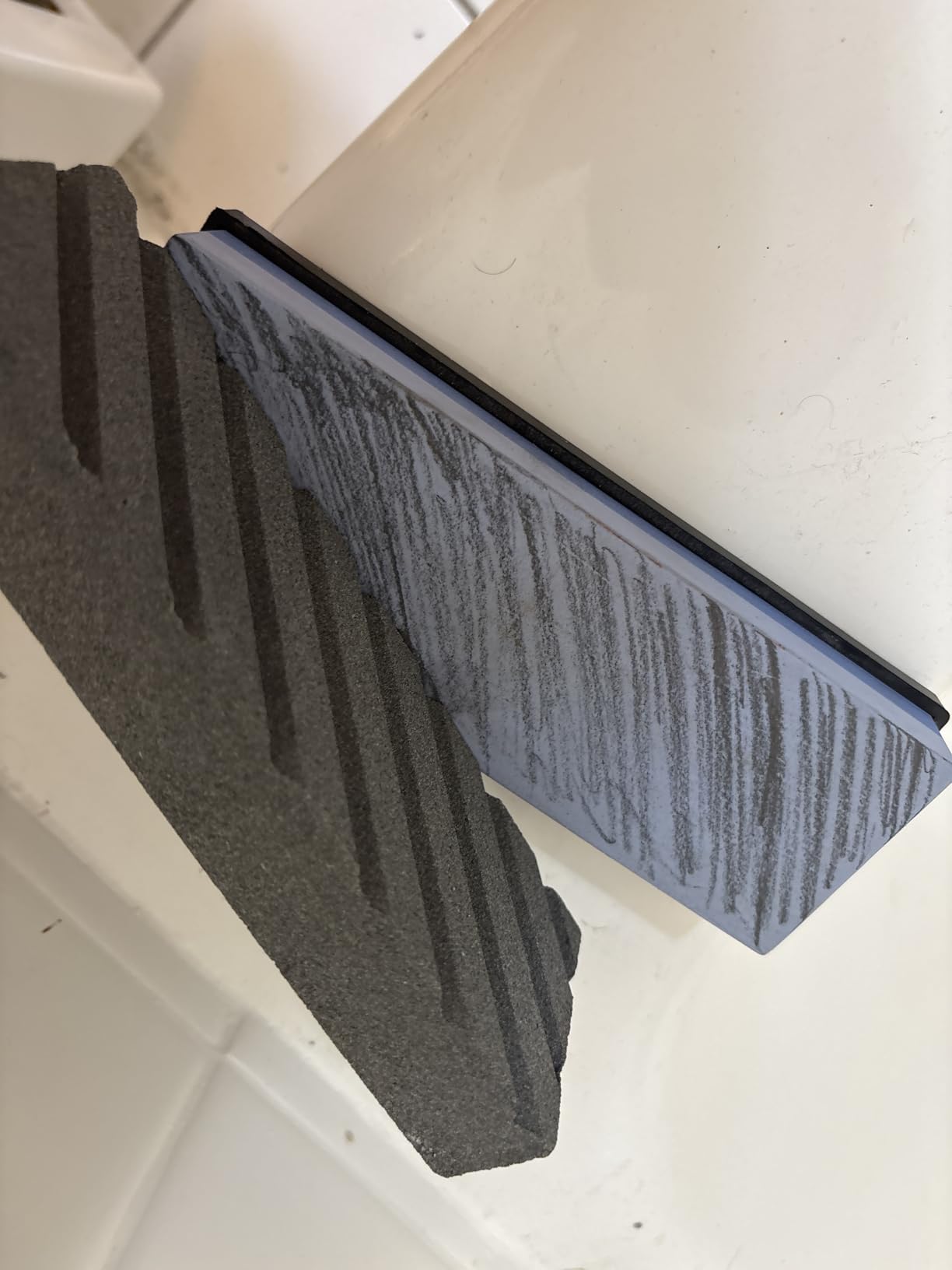
The 400 grit side is the reason this kit works on neglected knives. Most entry stones start at 1000, and a genuinely dull or chipped blade needs a coarser step before any of the refinement matters.
Users report sharpening more than twenty knives on the same set without the stones failing. That longevity comes from white corundum, which self-sharpens as the surface wears down.
The leather strop with polishing compound is the sleeper feature. It removes the burr left by the 3000 and 8000 sides and leaves an edge that feels noticeably sharper than stone finishing alone.
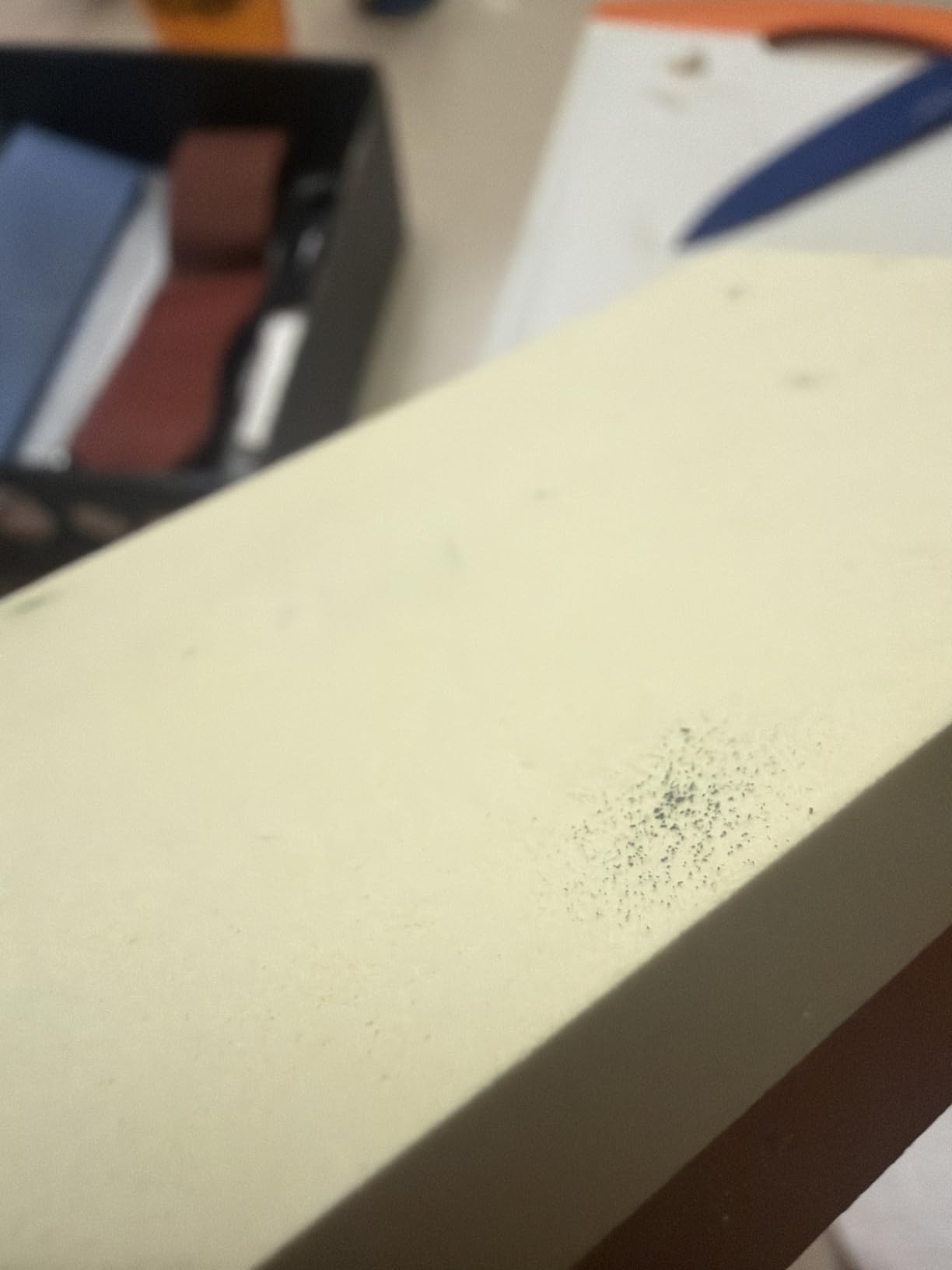
What to check before you buy
Test the base on a wet counter before you start. Reviewers repeatedly note that stones can shift in the bamboo base, and a rubber mat underneath costs nothing to fix.
Keep a damp cloth or a spray bottle next to the stones. They dry out faster than people expect, and a dry stone glazes and stops cutting mid-session.
Who should skip it
Skip it if you want a single stone you can travel with. This is a five-pound bundle with two stones, a strop, a flattener and a guide, and it does not collapse into a drawer.
Also skip it if you have a large knife collection and limited patience for maintenance. Four grits means four surfaces to flatten and four to keep clean.
4. Wucgea Four-Grit Kit — Best Compact Multi-Grit Starter Set
Wucgea Knife Sharpening Stone Kit – 400/1000 3000/8000 Grit Japanese Whetstone Set with Non-Slip Rubber Base, Angle Guide, Flattening Stone and Leather Strop
400/1000 and 3000/8000 grit stones
Bamboo base with rubber holders
Angle guide, flattener and strop
Water only, no oil
Pros
- Bundles two dual-sided stones with base and accessories
- Four grits handle repair and fine polishing
- Water-only workflow keeps supplies simple
- Works on kitchen
- hunting and pocket knives
Cons
- Stones are smaller than full-size bench stones
- Angle control still needs practice
- Accessory quality is functional not premium
This bundle covers the same four grit levels as larger kits in a smaller footprint. For someone sharpening in a shared kitchen or a small apartment, that footprint matters more than owners of bigger kits expect.
White corundum cuts quickly for its size, so a 400 grit pass on a dull blade does not eat your afternoon. The 3000 and 8000 sides then handle routine maintenance and polishing on the same knives.
The instruction line is simple: soak for five to ten minutes, use water only, and re-wet when the slurry thickens. Owners like having a workflow that does not require oil, carrier or a separate strop compound.
What to check before you buy
Measure your longest knife against the stone before ordering. Compact stones suit paring knives and small pocket blades well, and long chef knives will run off the end.
Expect the accessories to be functional. The angle guide, flattener and strop all do their jobs, but none of them feel like a premium tool in the hand.
Who should skip it
Skip it if you mainly sharpen long blades. The stone footprint is the most cited limitation in reviews, and it is a hard limit rather than a preference.
Skip it if you want the smallest possible setup. There is a smaller two-stone option in this roundup that covers the same beginner path with less to store.
5. KEENBEST 400/1000 Two-Stone Set — Best Budget Entry
KEENBEST 400 1000 Premium Material Whetstone Sharpening Stone Set 2 Side Kitchen Knife Sharpener Stone Wet Stones for Sharping Knives Kit Non-slip Rubber Base
Two white corundum stones
400 grit and 1000 grit each
7 x 2.2 x 1.1 inch stones
Soak 10 to 15 minutes before use
Pros
- Lowest-cost way into whetstone sharpening
- White corundum self-sharpens and cuts fast
- 400 grit repairs and 1000 grit smooths
- Quick-start guide included for beginners
Cons
- No coarser grit for badly damaged blades
- Small surface limits stroke length
- Water-only routine needed before every session
Two stones, one coarse side and one fine side each, and that is genuinely all a beginner needs for most kitchen knives. The 4.7 rating across thousands of reviews reflects how forgiving this pairing is.
White corundum is the underrated detail here. It is softer than a premium Japanese stone, so it wears faster, but it also self-sharpens and keeps cutting cleanly well past the point where cheaper aluminum oxide gives up.
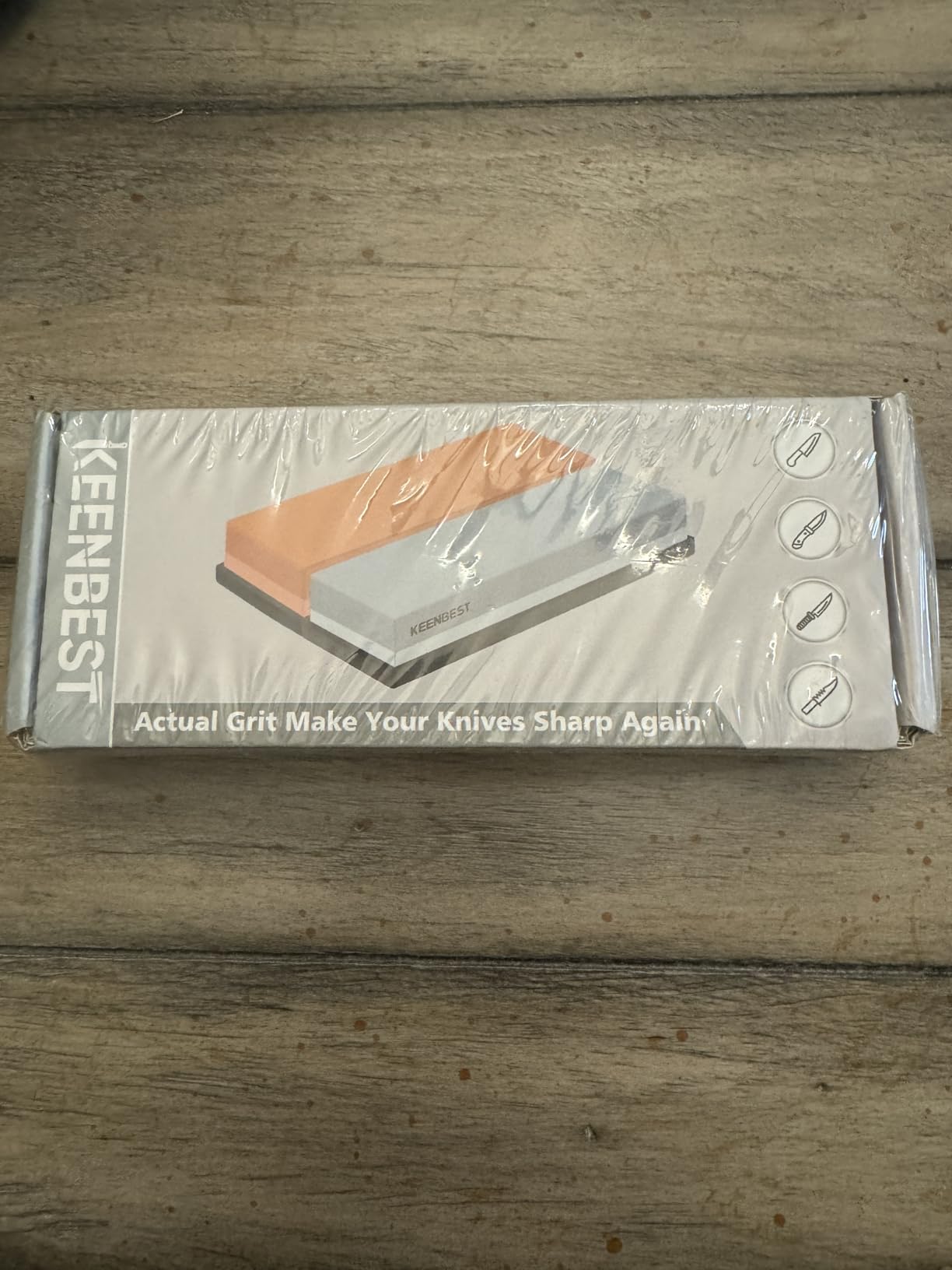
The pairing does something clever. Because each stone is dual-sided, you get a 400 grit for repair and a 1000 grit for finishing without buying two separate slabs.
Soaking is the routine to get used to. Ten to fifteen minutes in water before you start, re-wet during the session, and the slurry stays fluid enough to carry metal away.
We also found it useful on axes, hatchets and chisels during testing. The forgiving grit pairing suits tools that see rough work better than a fine finishing stone would.
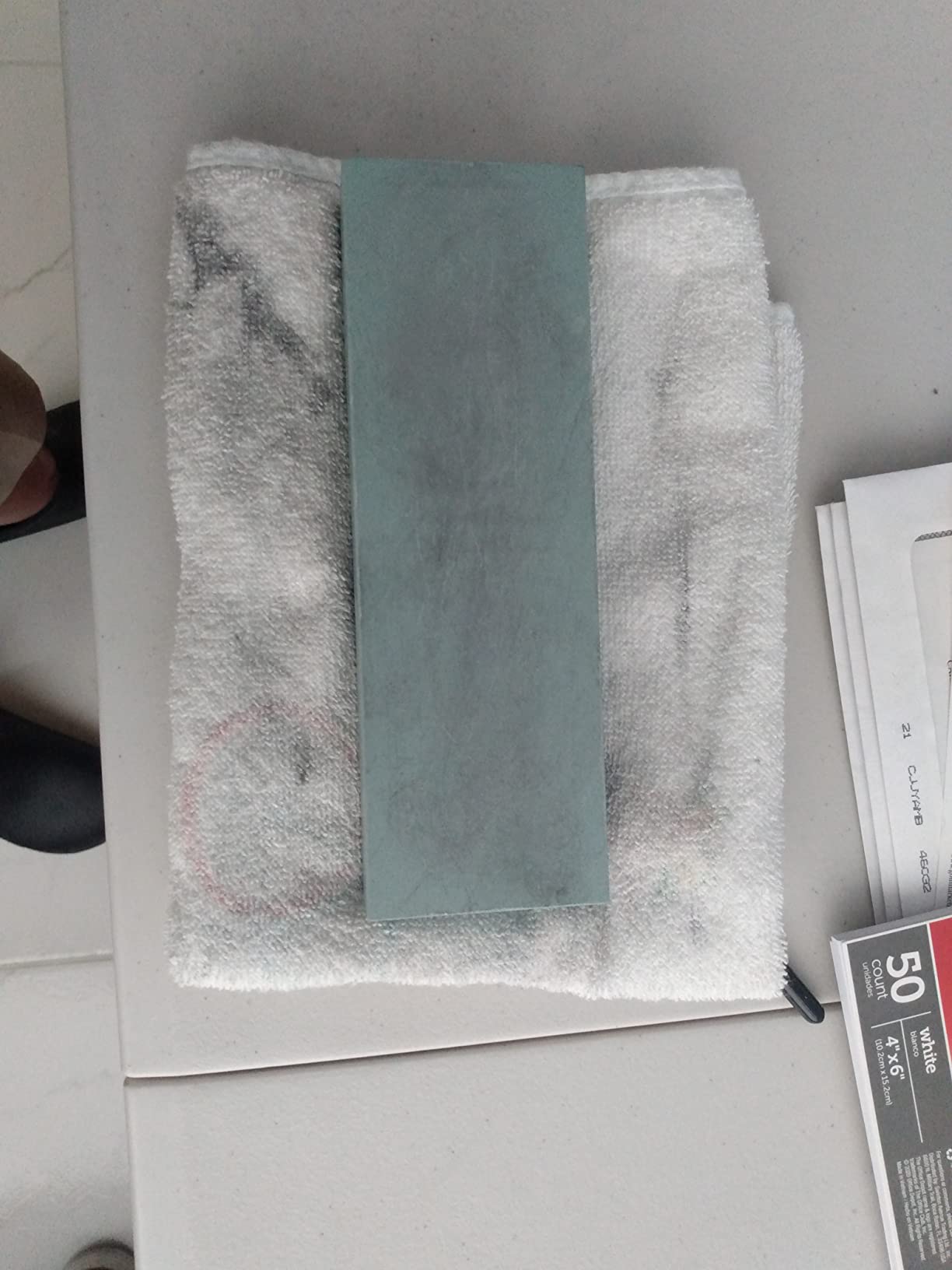
What to check before you buy
Confirm that your blades fit the surface. Each stone measures 7 by 2.2 inches, which is comfortable for paring knives, santoku blades and pocket knives, and tight for a long slicing blade.
Plan to buy a flattener separately. Nothing in the box maintains the surface, and an unflattened stone gives an unconsistently sharp edge.
Who should skip it
Skip it if your knives are severely damaged. With nothing coarser than 400 grit, a deep chip or a badly burred blade takes many long sessions instead of one.
Skip it if you want a polished finish. There is no fine grit above 1000 in this set, so the edge ends at functional sharpness rather than mirror polish.
6. Shapton K0702 1000 Grit — Best Premium Japanese Waterstone
Shapton K0702 Blade, #1000, Medium, Orange
Single-sided 1000 grit waterstone
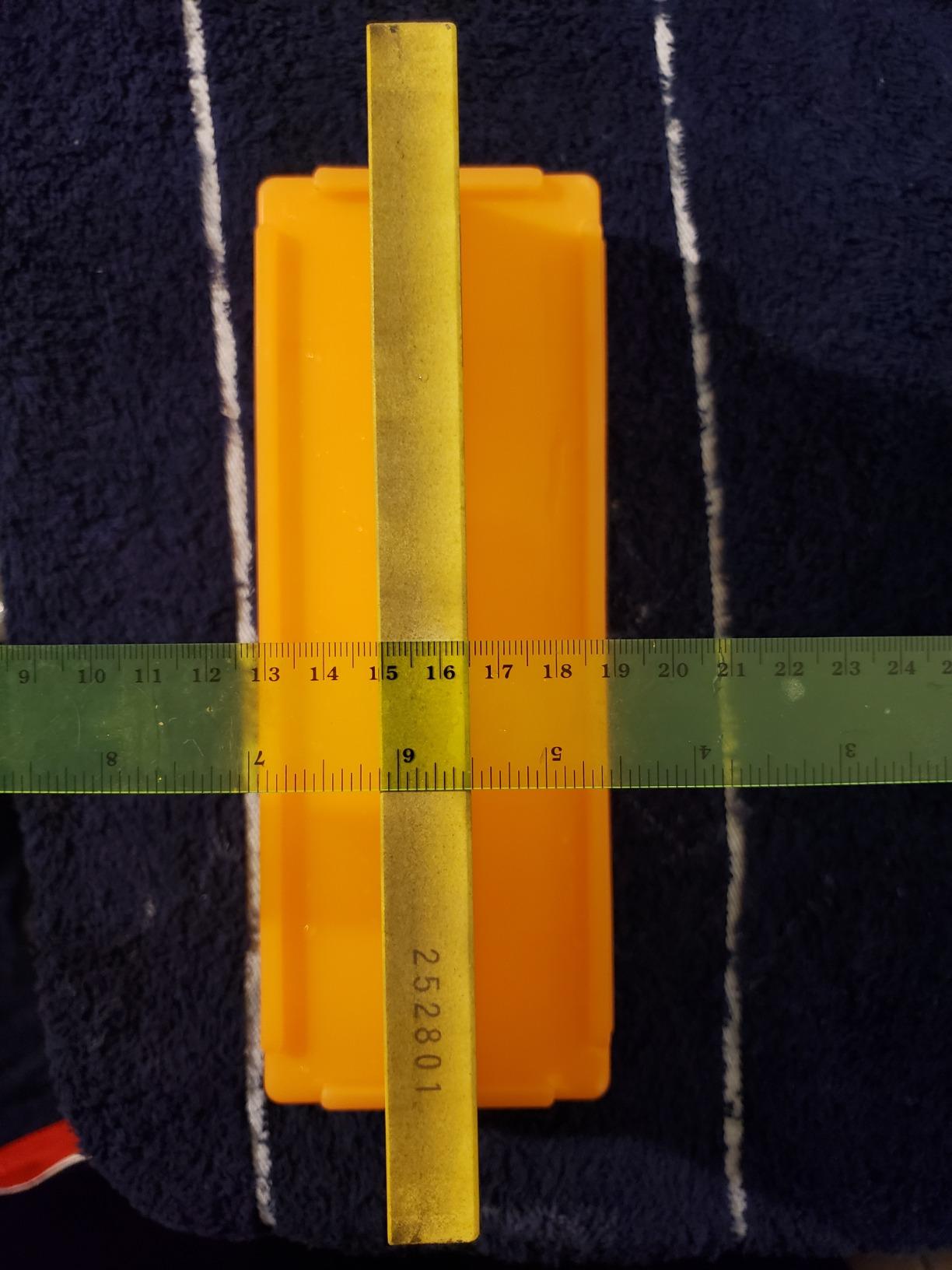
8.3 x 2.8 x 0.6 inch stone
Color-coded orange body
Bare stone, no base included
Pros
- Highest average rating in the roundup
- Premium Japanese stone cuts fast and consistently
- Color-coded grit labeling
- Standard everyday sharpening step
Cons
- Single 1000 grit side cannot polish or repair
- Sold as a bare stone with no base or guide
- Soft stone needs regular flattening
The Shapton K0702 carries the highest average rating of any stone here, and enthusiasts treat it as the quality upgrade step once a beginner has the basics down. At 88 percent five-star reviews, that reputation is earned rather than marketed.
The color-coded body is a small detail with real value. Orange means 1000 grit, and once you own several stones, reading the color is faster than reading a label at the edge of a wet stone.
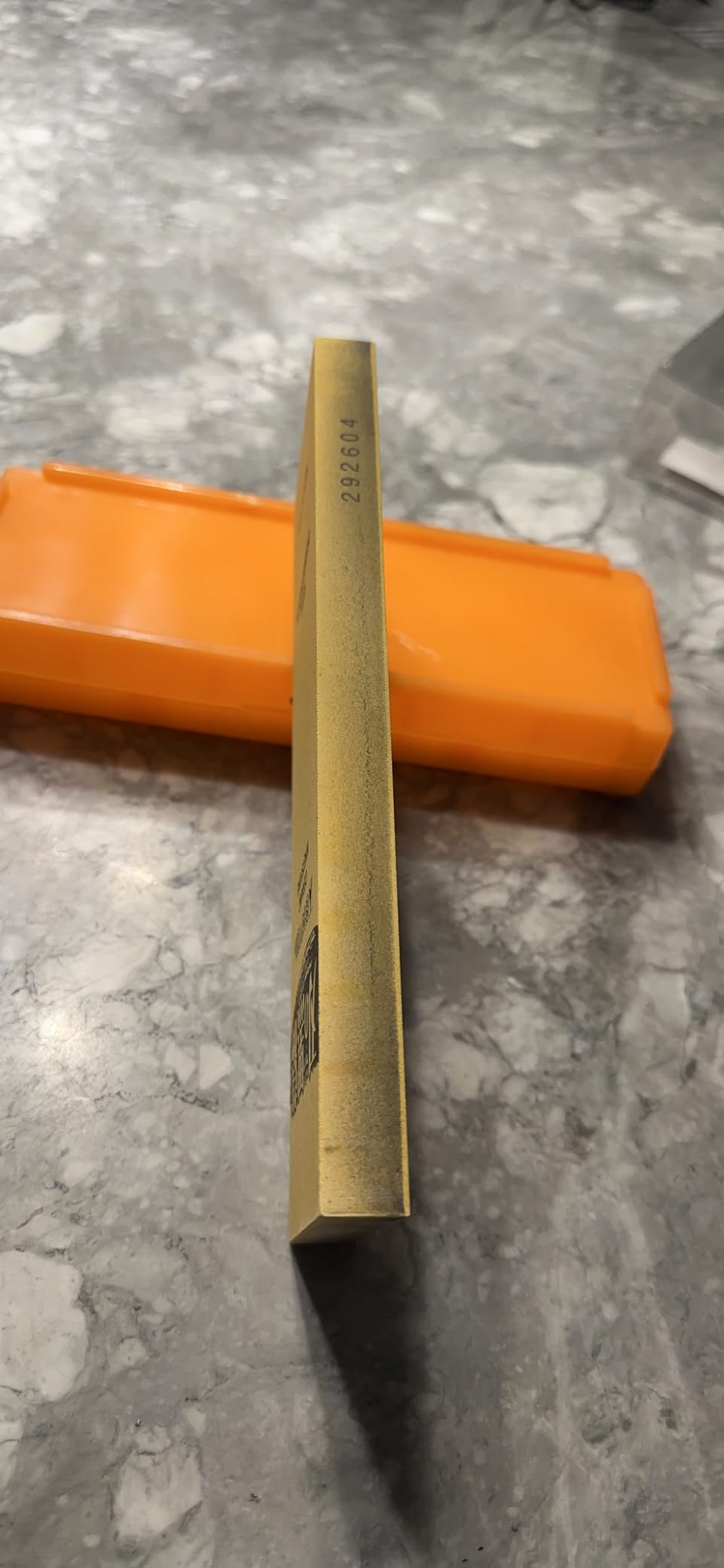
It cuts fast and consistently, which is the honest measure of a sharpening stone. Fast cutting means less time per side and less arm fatigue on a long session.
It is a single 1000 grit stone and nothing more. That is the tradeoff. There is no coarser side for damage repair and no finer side for polishing, so it lives alongside another stone rather than replacing one.
Sold as a bare stone, it also arrives with no base, no angle guide and no flattener. Sharpening forums treat the diamond flattening plate as a required purchase, and this stone is exactly the kind of soft stone that needs one.
What to check before you buy
Budget for three accessories before your first session: a stone holder, a diamond flattening plate and an angle guide. Without them this stone works, but it works harder than it should.
Flatten it before the first use. Soft Japanese stones frequently arrive slightly concave, and sharpening on a dished surface is how beginners conclude the stone is faulty.
Who should skip it
Skip it as a very first purchase. It has one grit, no base and no guide, which is three obstacles between a new user and a sharp knife.
Skip it if you sharpen only occasionally. A guided dual-sided stone will serve a once-a-month user more simply than a premium single-grit stone.
7. SHARPAL 162N Diamond 325/1200 — Best Dry-Use Diamond Stone
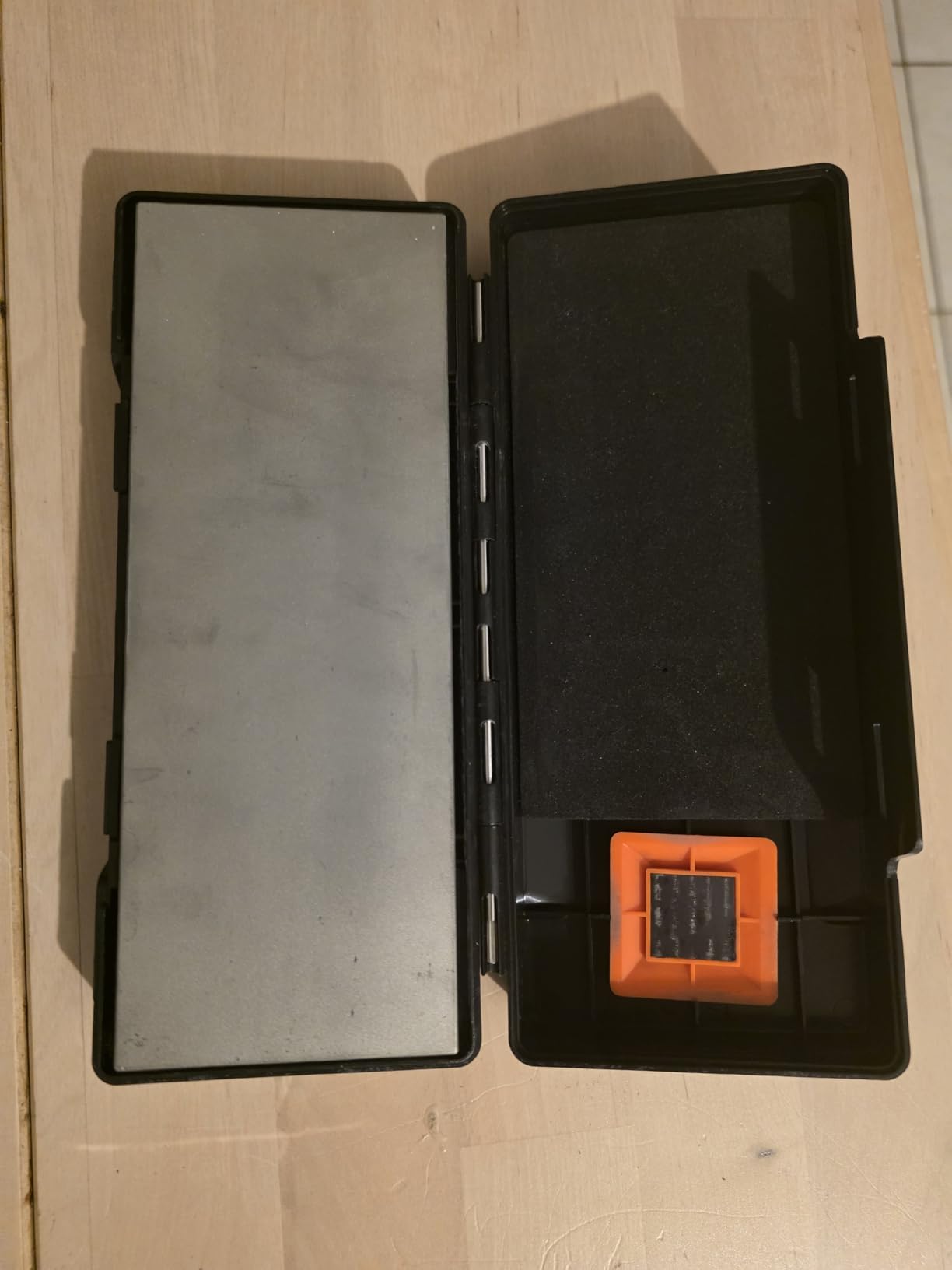
SHARPAL 162N Double-sided Diamond Sharpening Stone, 8 in. x 3 in.
325 grit coarse and 1200 grit fine
Monocrystalline diamond plating
Use dry, no water or oil
Angle guide at 14, 17, 20 and 25 degrees
Pros
- No water or oil needed
- Stays flat and cuts faster than wet stones
- Storage box doubles as a non-slip base
- Works on hardened steels and carbide tools
Cons
- Diamond plate wears faster than wet stones
- Fine side picks up metal particles
- Case lid is not a safe hand hold
- Surface needs bedding in before first use
Diamond stones trade the wet workflow for convenience, and this is the strongest dry option in the roundup. No soaking, no slurry, no wiping down a kitchen counter afterwards.
The 325 grit side is a 45 micron abrasive for setting the edge, and the 1200 grit side is a 12 micron surface for honing and polishing. For a beginner, that is a sensible two-stage path without needing three stones.
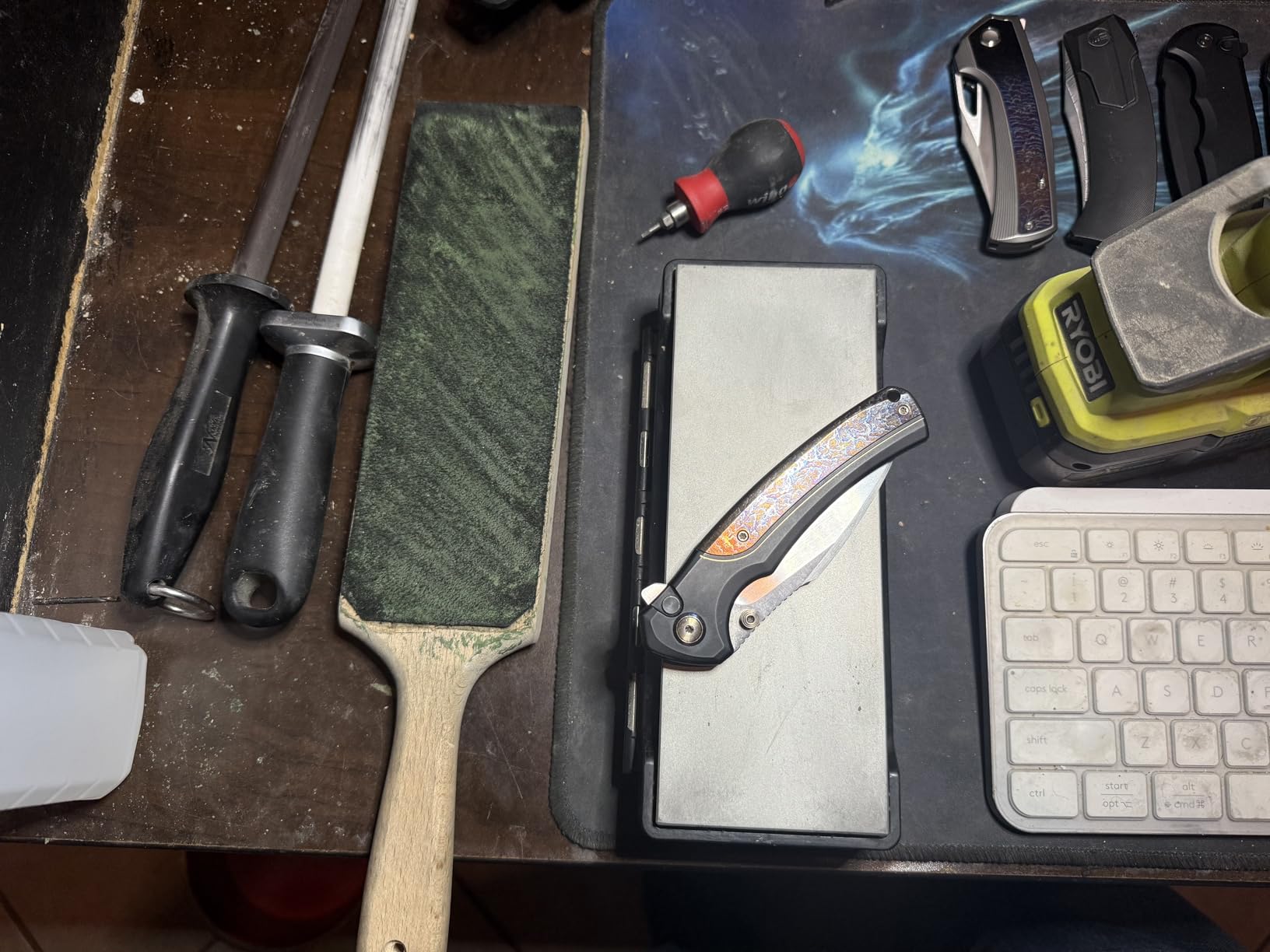
The integrated angle guide is unusually useful here. It has four settings covering 14, 17, 20 and 25 degrees, which covers Asian kitchen knives, European chef knives and hunting blades in one accessory.
Users report a shaving-sharp edge in a couple of minutes per side once the technique is right, and the mess-free workflow is the reason many people move from wet stones to diamond and never go back.
The MirrorFlat surface treatment is why it stays flat. It matters because a plate that dishes needs no flattening, and that removes an entire maintenance task from a beginner’s list.
It also sharpens high speed steel, carbide, ceramic and CBN, including clipper blades. No wet stone in this roundup handles carbide at all.
What to check before you buy
Bed the surface in before the first session. Running a few passes on a scrap of leather or denim knocks off proud diamonds and prevents early scratching.
Clean the fine side often. Tiny metal particles left on a 1200 grit surface cause micro-scratches, and a wipe with a damp cloth or a quick brush keeps it clean.
Who should skip it
Skip it if you sharpen heavily every day. Reviewers note that the diamond layer wears through faster than a waterstone under sustained use.
Skip it if you want a mirror polish. Diamond plates can produce a very keen edge, but the fine side here is a honing surface rather than a true polishing stone.
8. YeopAsda Four-Grit Kit — Best Accessory-Complete Kit
Whetstone Knife Sharpening Stone Set, Double-Sided Grit 400/1000 3000/8000
400/1000 and 3000/8000 grit stones
Gloves, strop and compound included
Angle guide and honing guide
Backed by a 1 year warranty
Pros
- Most accessory-complete kit in the roundup
- Four grits cover repair through polishing
- Base holds stones without slipping
- Restores badly neglected knives
Cons
- Supplied glove developed a hole on first use
- Base feels light and plasticky
- Water-only workflow makes a wet workspace
- Light box lets stones shift in transit
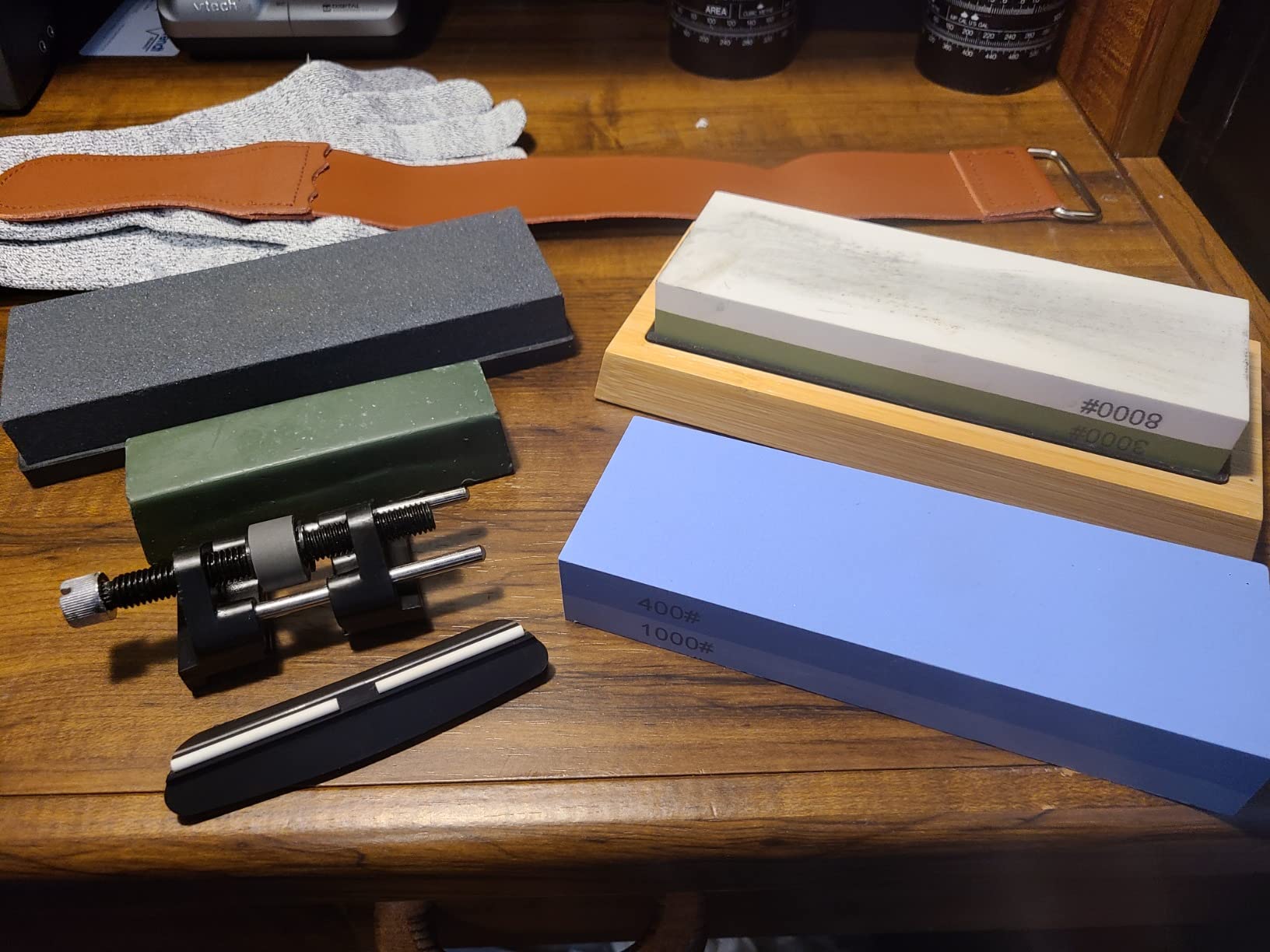
The YeopAsda kit wins on sheer number of included parts. Two dual-sided stones, a bamboo base, a flattening stone, an angle guide, a separate honing guide for chisels and plane blades, a leather strop with compound and a pair of cut-resistant gloves.
The separate honing guide is the part most kits skip. It lets you sharpen a chisel or a plane iron without disturbing your knife angle setup.
Buyers report that the four grit levels cover everything from edge repair to a mirror finish, and that the kit brought badly neglected knives back to cutting properly.
The warranty is a one year manufacturer warranty, which is more reassurance than most kits at this level offer even when the listing is thinner.
Water-only cleaning keeps the supply list short. Rinse the stones under the tap after use and let them dry flat, and the corundum surfaces stay in good shape.
What to check before you buy
Test the glove before your first session. Some buyers reported a hole developing quickly, and wet stones plus a sharp knife is the wrong combination for a compromised glove.
Check the stones on arrival, since a light box lets them shift in transit. Any chipped corner should be reported before you start using the set.
Who should skip it
Skip it if you already own a guide, a strop or a flattener. Duplicate accessories are the most common overbuying mistake among first-time sharpeners.
Skip it if tool weight matters. At nearly six pounds, this is the heaviest kit here and the least convenient for a small kitchen.
9. S SATC Diamond 400/1000 — Best Long Flat Dry Plate
S SATC Diamond Sharpening Stone 2 Side Grit 400/1000 Diamond Plate Honing Stone 8-inch Hone Sharpener White
400 grit and 1000 grit double-sided
8 inch machined steel plate
Works dry with no flattening
Electroplated monocrystalline diamond
Pros
- Long flat plate suits full-length strokes
- No soaking and no flattening needed
- Coarse side repairs and fine side refines
- Thin plate stores easily
Cons
- Thin plate offers little hand protection
- No base or angle guide included
- Diamond layer wears through with heavy use
This is the flat, long, low-maintenance option. An 8 inch machined steel plate gives you room for full-length strokes on a chef knife, which is where smaller diamond plates stop working.
Because the plate is electroplated diamond on steel, it does not crater and it never needs flattening. For a beginner who wants to learn sharpening without adding a maintenance routine, that removes one whole category of frustration.
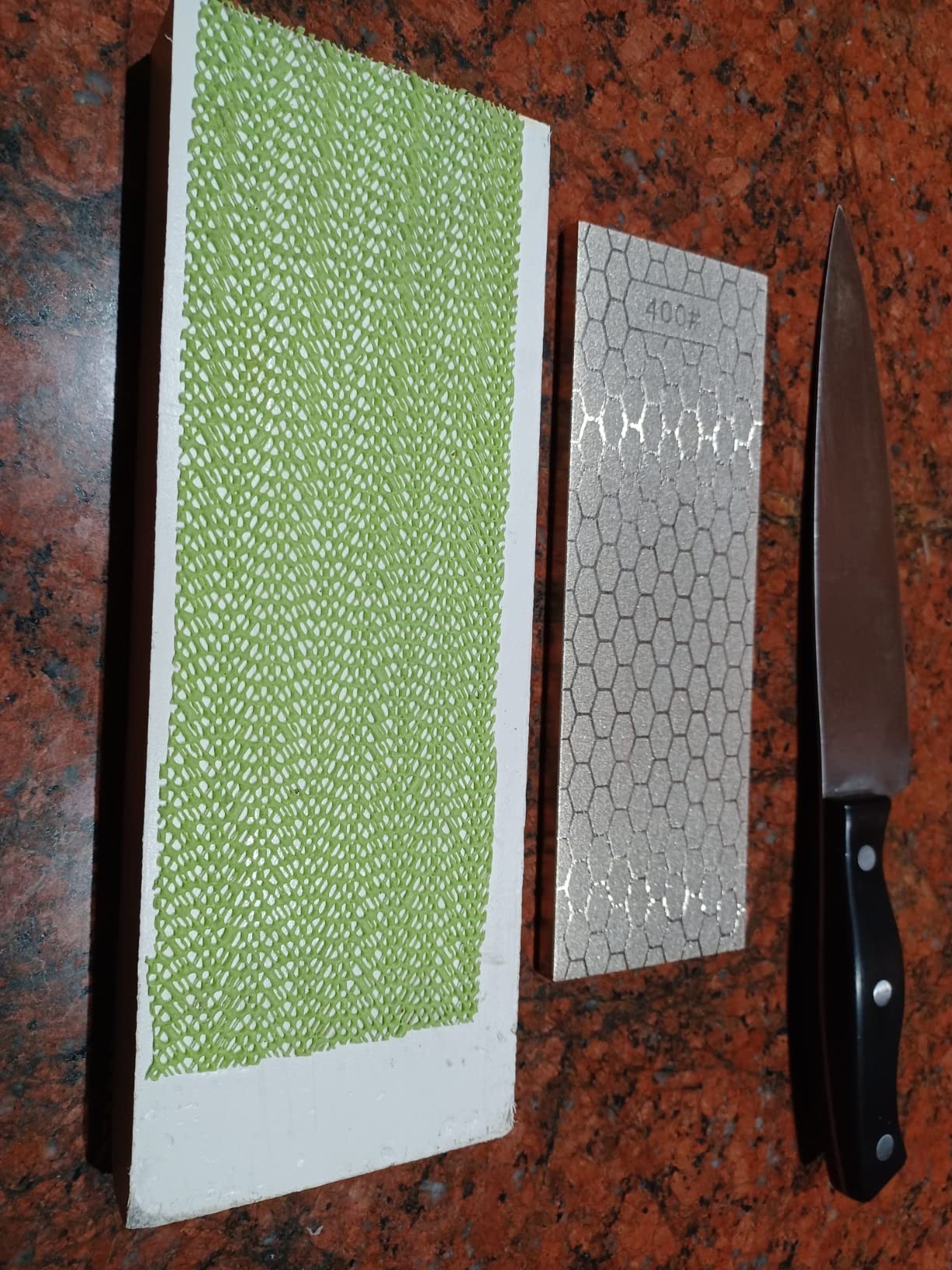
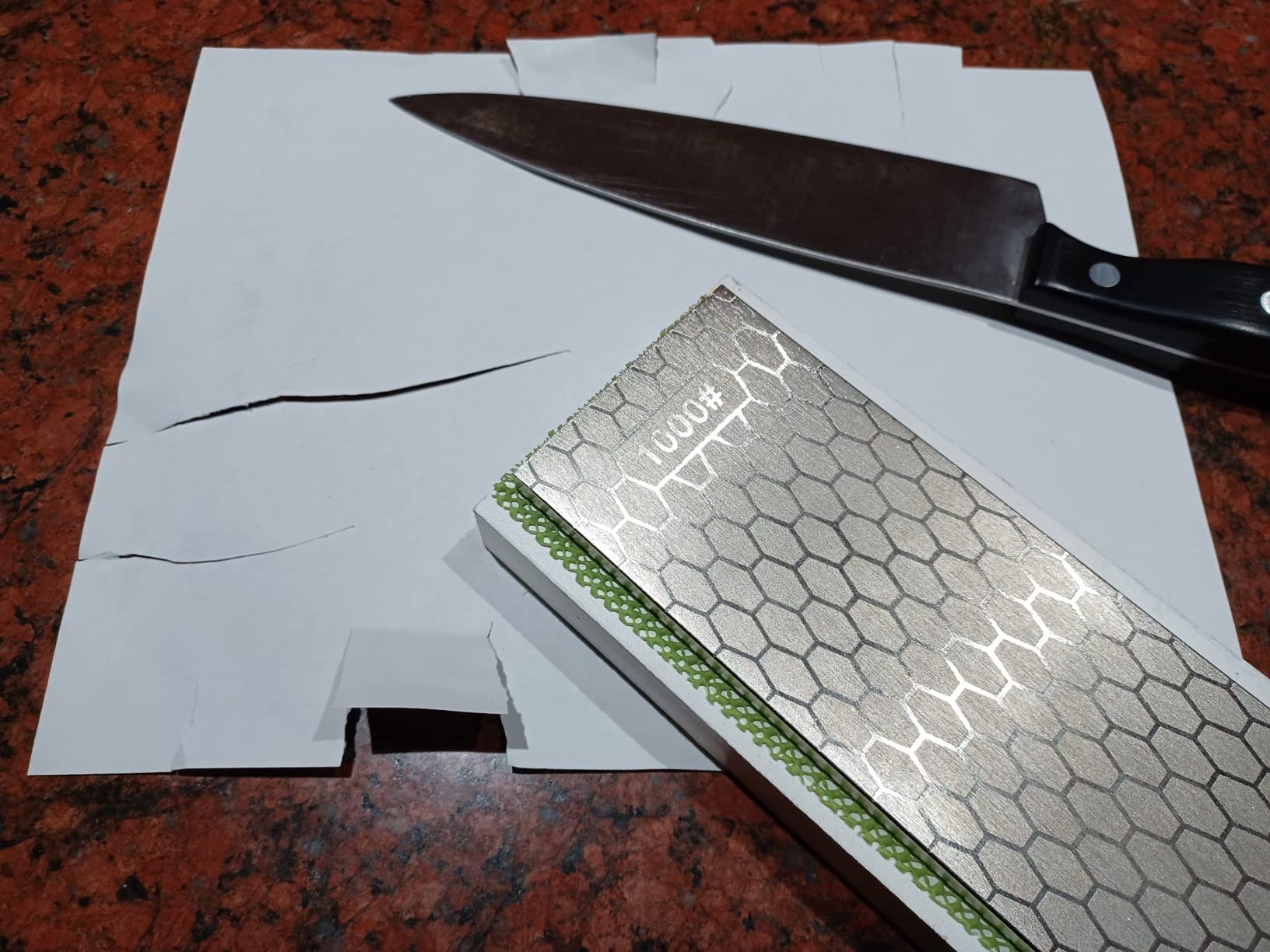
The 400 grit side handles edge repair and the 1000 grit side refines the result. That pairing lands slightly coarser than a 1000/6000 combination, so expect a keener edge with a little more tooth.
It suits straight-edged tools as well as knives. Owners mention using it on chisels and plane blades, where the long flat surface matches the straight sides of those tools.
Other grit configurations exist for the same plate, including 150/600 and 600/1200. If you later want to change pace, you are not locked into this pairing.
What to check before you buy
Add a base before you start. Nothing is included in this configuration, and a thin plate on a wet counter is a slip risk with a sharp blade nearby.
Plan the handling. At 0.3 inch thick the plate gives your supporting hand almost no protection, so keep that hand clear of the stroke path.
Who should skip it
Skip it if you want a polished finish. A 1000 grit diamond side refines an edge without producing the mirror surface you would get from a fine waterstone or a strop.
Skip it if you plan very heavy daily use, because the diamond layer eventually wears through.
10. Bora 6 Inch 150/240 — Best Low-Cost Bench Stone for Tools
Bora Knife Sharpening Stone 6 Inch, Aluminum Oxide, Coarse/Fine Grit
Coarse 150 and fine 240 grit
6 x 2 x 1 inch bench stone
Water or oil lubricant
One year manufacturer warranty
Pros
- Very low-cost entry into bench stone sharpening
- Dual-sided 150/240 handles general maintenance
- Compact size is easy to hold and store
- Accepts either water or oil
Cons
- 150 and 240 grits are too abrasive for a kitchen edge
- Aluminum oxide cuts slowly and wears fast
- Small surface limits long blades
- No base or angle guide included
The Bora stone is a bench stone in the most literal sense. It is a 6 by 2 inch aluminum oxide slab with a coarse 150 grit side and a fine 240 grit side, and it does one job well: taking metal off hard tools.
For garden shears, hoes, a hatchet or a badly neglected utility knife, that grit range is exactly right. It is the grit range that makes it wrong for kitchen knives.
Both water and oil work as lubricant, which makes it flexible in a workshop where you may already have one or the other on the bench.
What to check before you buy
Match it to your work. If your sharpening list is mostly kitchen knives, skip this stone entirely and spend the same money on a 400/1000 waterstone pair.
Add a base. At 6 inches the stone is easy to hold by hand, but a hand-held stone makes consistent pressure harder.
Who should skip it
Skip it if you want a keen kitchen edge. A 240 grit final finish leaves a noticeably toothy edge that will not slice paper cleanly.
Skip it if you want long blades. The short surface means a chef knife runs off the ends before you finish a stroke.
How to Use a Whetstone Step by Step
Sharpening is one of those skills where the technique matters more than the stone. Follow this order and a dull kitchen knife will be cutting paper cleanly in a single session.
Flatten the stone first. Splash water on the surface and rub a diamond plate across it in a figure-eight motion until a thin film spreads evenly. An unflat stone cannot produce a flat bevel.
Soak or wet the stone. Water stones soak for 10 to 15 minutes. Splash-and-go stones need a heavy wetting right before you start. Diamond plates need nothing.
Set the angle. Most home cooks want 15 to 20 degrees per side. Use an angle guide for the first several sessions until the angle becomes automatic.
Raise a bevel. Start on the coarse side. Use steady, even pressure with the blade trailing, and count strokes rather than watching the clock.
Feel for the burr. Run a fingertip down the opposite side of the blade from spine to tip. A wire edge that catches your skin means the bevel has formed.
Raise to the fine side. Move to the higher grit and repeat until the burr is gone or nearly gone. Fewer strokes are needed here.
Strop or finish. A few firm passes on leather or newspaper remove the last burr and leave the edge cleaner than stone finishing alone.
Edge trailing, where the sharp side leads the stroke, is the gentler habit for beginners. Edge leading cuts faster but removes more metal and is harder to control, so most sharpers learn it later.
Test your result the same way every time. Paper cutting is the standard benchmark, and the tomato test tells you how thin and even the edge is.
Seven Common Beginner Mistakes
Almost every frustrated beginner is making one of these seven mistakes. They are listed in the order we see them most often.
Skipping flattening. Stones arrive slightly dished and dish further with use. A diamond flattening plate is a required purchase, not an optional extra, and forum consensus treats it that way.
Starting too fine. Jumping to 1000 grit or finer on a damaged blade wastes time because you are polishing a bad edge. Start at 400 when there is real damage.
Using a dry stone. A dry stone glazes, produces dust and cuts poorly. If the slurry is thick and sticky, add water.
Sharpening a moving target. The angle shifts constantly when freehand. Use a guide or a holder until your strokes are repeatable.
Ignoring the burr. You cannot make a burr disappear by grinding harder on the fine side. Raise it on the coarse side first.
Rushing the coarse step. Edge leading and heavy pressure on a coarse grit strip metal away from the blade faster than you think.
Buying redundant stones. Many beginners own a 500, a 1000 and a 2000 grit stone that do nearly the same job. Spend that money on a holder and a flattener instead.
Fixing mistakes one and three alone removes most of the frustration people report in their first month.
Buying Guide: Grit, Stone Type and Size
Choosing a whetstone comes down to four decisions. Get these right and the rest is straightforward.
Grit. Coarse grits from 150 to 400 set a bevel and remove damage. Medium grits from 600 to 1000 form and maintain the edge. Fine grits from 2000 upward refine and polish. For most beginners, a 400/1000 stone plus a 3000/8000 stone covers everything you will do in the first year.
Stone type. Water stones cut fast and self-sharpen but need soaking and flattening. Oil stones are mess-tolerant and suit hardened steel. Diamond plates need no liquid, stay flat and cut hard steel and carbide, but wear faster. Ceramic stones are very hard and resist glazing.
Size. A longer stone supports more of the blade and allows full-length strokes. An 8 inch stone suits chef knives, while 6 inch stones are fine for paring knives and pocket knives.
Base and guide. A stone holder keeps the angle steady and stops fatigue. An angle guide removes angle guesswork entirely for the first few sessions. Neither is a luxury.
Water stone versus splash-and-go
Soaking stones take 10 to 30 minutes of prep and hold water longer, which suits longer sessions and softer stones. Splash-and-go stones are pre-wetted and ready immediately, and their bonded core resists crumbling when the surface dries out mid-stroke.
Which stones work with which steel
Carbon steel is soft and easy to sharpen, and any stone here will do it. Stainless and high carbon stainless need consistent, slightly coarser work to raise a burr, which is where 400 grit and diamond plates help. Powder metallurgy and other very hard steels hold an edge well but need diamond or a hard ceramic to respond quickly.
Your progression path
Stage one is a single 1000 grit stone with a guide and a flattener. Stage two adds a coarse side around 400 and a fine side around 3000. Stage three is where a dedicated finishing stone or strop enters the picture, and it is a problem you will not have for months.
Our [best calligraphy sets for beginners](https://mydroneauthority.com/best-calligraphy-sets-for-beginners/) guide follows the same staged logic: start with one tool that covers the job, add complexity only when you can already do the basics. The same advice shows up in our [best knitting kits for beginners](https://mydroneauthority.com/best-knitting-kits-for-beginners/) roundup, where one complete starter bundle beats a pile of half-useful accessories.
Maintenance and Care
A stone that stays flat and clean sharpens better for years. A neglected one stops cutting cleanly within months.
Flatten regularly. Check flatness every few sharpening sessions, or monthly if you sharpen often. A splash of water and a few passes with a diamond plate is enough.
Clean after use. Water stones rinse under the tap and dry flat. Do not leave a slurry to dry on the surface, because dried slurry glazes the abrasive.
Store flat and dry. Keep stones on a flat surface away from edges. A bamboo base or a case is better than a drawer with loose slabs.
Mark the coarse side. Once grit numbers are gone from a wet surface, a marker dot saves a real mistake. This is the single most common complaint about stones with unlabelled sides.
Frequently Asked Questions
What is the best whetstone for a beginner?
The best whetstone for a beginner is a dual-sided 1000/6000 waterstone with a base and an angle guide. That pairing sets a bevel on the coarse side and refines it on the fine side, which covers routine edge maintenance and most kitchen knife sharpening without extra stones.
What grit whetstone is best for a beginner?
A 1000 grit whetstone is the best starting grit for most beginners because it forms an edge quickly and forgives small angle errors. Start at 400 grit instead if the blade is chipped or badly dull, and finish above 3000 grit when you want a finer edge.
Do you start with 1000 or 6000 grit?
You start on the coarser side first. Work on 1000 grit until you can feel a burr along the edge, then move to 6000 grit to refine and remove it. Switching to 6000 grit first wastes time because you cannot remove damage on a fine stone.
Do you push or pull on a whetstone?
Pull the blade, keeping the sharp edge trailing behind the stroke. Trailing strokes cut more gently and remove less metal, which makes them easier to control. Edge leading strokes cut faster but strip metal quickly and suit experienced sharpeners.
Conclusion
The best whetstones for beginners are the ones that hold still, keep the angle honest and do not punish a first attempt. That points to the Sharp Pebble 1000/6000 as our top pick, with the angle guide doing the hard work of keeping the blade square while you learn pressure and rhythm.
If you want the simplest possible setup, the King KW65 covers the same grit pairing with a harder, longer-lasting stone. If you want everything in one box including a strop and a flattener, the Intelitopia kit is the shortest route from unopened package to a sharp edge.
Whichever stone you choose, buy a flattener and a base with it, and soak before you start. Those two habits remove most of what makes beginners give up in 2026, and they matter more than any brand name on the box.