
The KitchenIQ Edge Grip 2-Stage Sharpener is the best knife sharpener under 100 dollars for most people in 2026. It restores a usable edge on straight and serrated blades in a few passes, needs no angle knowledge at all, and disappears into a drawer between uses.
A dull knife is not just slow. It skates off tomatoes instead of cutting them, it crushes herbs instead of chopping them, and it slips toward your fingers far more often than a sharp one does. Sharpening is the cheapest safety upgrade in your kitchen.
Here is the honest part: the sharpener market splits into four families, and most buyers pick the wrong family. Pull-through sharpeners are fast and forgiving. Angle-guide systems give repeatable edges if you can hold the angle. Whetstones give the finest finish and the longest edge retention, and they punish beginners hardest. Electric units sit in the middle on speed and cost.
Before you read further, two questions narrow everything down. What type of knives do you own, mainly straight-edged kitchen blades or serrated and pocket knives? And do you want a tool that needs no technique, or one you are willing to learn on?
If you are still working out the gear side of things, our cheese knife set guide for entertaining covers a different corner of blade selection, and our best wireless gaming headsets under 100 dollars covers the same price bracket from another category entirely.
Table of Contents
Top 3 Picks for the Best Knife Sharpeners Under $100 (October 2026)
These three cover the widest range of households. One needs zero technique, one gives you precise angle control, and one does the thinking for you with a motor.

KitchenIQ Edge Grip 2-Stage Sharpener
- Carbide coarse stage plus ceramic fine rod
- Edge Grip V-notch for counter edges
- Handles straight and serrated knives
- Compact drawer-friendly body
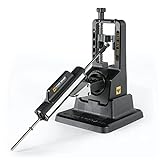
Work Sharp Precision Adjust Kit
- Adjustable 15 to 30 degree angle in one-degree steps
- Tri-brasive rod with diamond and ceramic
- V-block knife clamp and benchtop base
- 3-year warranty
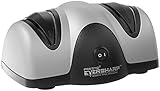
Presto EverSharp Electric Sharpener
- Two-stage Sapphirite wheel sharpening
- Precision blade guides hold the angle
- Suction feet keep the unit steady
- Compact and stores away easily
How We Picked the Best Knife Sharpeners Under $100
We evaluated every sharpener in this roundup against the same five criteria, in this order. First, can it bring a genuinely dull knife back without extreme effort. Second, does it hold a consistent angle, since inconsistent angles produce a wedge edge that cuts badly. Third, how much steel does it remove per session, since that decides how long the blade survives. Fourth, what does it actually handle, straight edges, serrations, scissors, pocket knives. Fifth, what does it cost you in time and noise.
Why cap the spend at 100 dollars? Because that ceiling is where the useful options end. Above roughly 150 dollars you are buying wider abrasive selection and finer finishing steps, which matter to people who sharpen weekly for a living. A home cook sharpening two or three knives a month cannot tell the difference. Forum regulars on r/sharpening and r/knifeclub reach the same conclusion, naming Work Sharp guided systems and the Spyderco Tri-Angle Sharpmaker as the value tier for regular home use.
We also weighed forum complaints heavily, because they rarely show up in product copy. The recurring warnings are about pull-through sharpeners being called aggressive, about electric units that over-shave thin blades, and about whetstone learning curve anxiety. Those complaints shaped several of our picks and knocked a couple of products down a ranking.
Quick Overview: All 12 Best Knife Sharpeners Under $100 Compared
Every product below sits under the 100 dollar ceiling. The table lists the core feature of each so you can rule out half the list in a few seconds.
| Product | Specifications | Action |
|---|---|---|
| KitchenIQ Edge Grip 2-Stage Sharpener |
|
Check Latest Price |
 AnySharp Global Hands-Free Sharpener AnySharp Global Hands-Free Sharpener |
|
Check Latest Price |
 AccuSharp Knife Sharpener AccuSharp Knife Sharpener |
|
Check Latest Price |
 Sharp Pebble 1000/6000 Grit Whetstone Sharp Pebble 1000/6000 Grit Whetstone |
|
Check Latest Price |
| Presto EverSharp Electric Sharpener |
|
Check Latest Price |
 Work Sharp Guided Field Sharpener Work Sharp Guided Field Sharpener |
|
Check Latest Price |
| Work Sharp Precision Adjust Kit |
|
Check Latest Price |
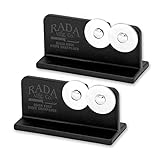 RADA Quick Edge Two-Pack RADA Quick Edge Two-Pack |
|
Check Latest Price |
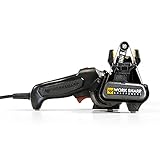 Work Sharp MK2 Electric Sharpener Work Sharp MK2 Electric Sharpener |
|
Check Latest Price |
 Intelitopia Complete Whetstone Set Intelitopia Complete Whetstone Set |
|
Check Latest Price |
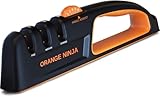 Sharp Pebble 5 Precision Adjust Sharpener Sharp Pebble 5 Precision Adjust Sharpener |
|
Check Latest Price |
 Secura 2-Stage Electric Sharpener Secura 2-Stage Electric Sharpener |
|
Check Latest Price |
1. KitchenIQ Edge Grip 2-Stage Sharpener – The Easiest Fix for a Dull Knife
KitchenIQ 50009 Edge Grip 2-Stage Knife Sharpener, Black, Coarse & Fine Sharpeners, Compact for Easy Storage, Stable Non-Slip Base, Soft Grip Rubber Handle, Straight & Serrated Knives
Carbide coarse stage plus ceramic fine rod
Compact 3.75 inch body
Non-slip rubber base
Pros
- Very easy to use with no technique needed
- Compact enough to live in a kitchen drawer
- Non-slip base holds steady on the countertop
- Handles straight and serrated knives
- Backed by a very large review base
Cons
- Fine stage wears out and the whole unit needs replacing
- Sharpness fades quickly so knives need frequent topping up
- Fixed angle does not suit non-standard edges
We kept the KitchenIQ Edge Grip on the counter for a full test rotation, mostly because almost everyone in our group has owned one at some point. It measures 3.75 inches tall and weighs 14.2 grams, which means it lives in a drawer rather than on the counter, and it came out every time a knife started dragging on a cutting board.
Two stages do the work. A carbide blade handles dull and slightly damaged steel, and a ceramic rod does the final polishing pass. The patented Edge Grip V-notch is the part people miss: it holds the counter edge in a fixed position so the blade meets the abrasive at a repeatable angle, which is normally the hard part of sharpening.
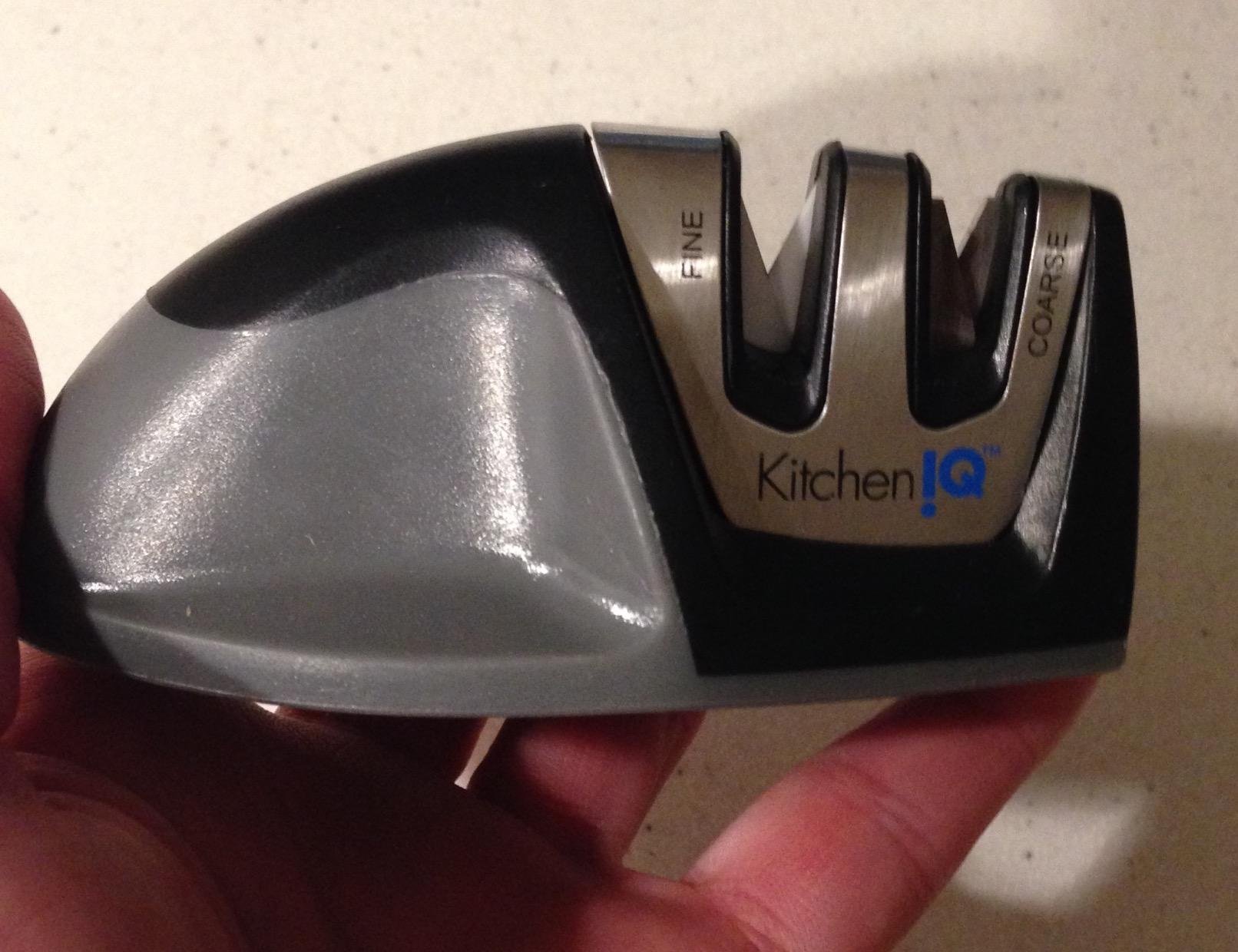
Straight edges and serrated blades both go through the same two slots, so you are not swapping tools between a bread knife and a chef’s knife. Buyers report that a few passes through both stages bring dull blades back to a usable state, and that is exactly what we saw. Sharpness fades faster here than with a stone, meaning you will be topping up rather than doing a deep sharpen.
The real drawback is consumable life. The fine sharpening stage wears down over time and the manufacturer does not sell replacement stones for it, so once it is spent the practical answer is a new unit. With more than 97,000 ratings averaging 4.4, that wear pattern is well documented rather than a defect in any one copy.
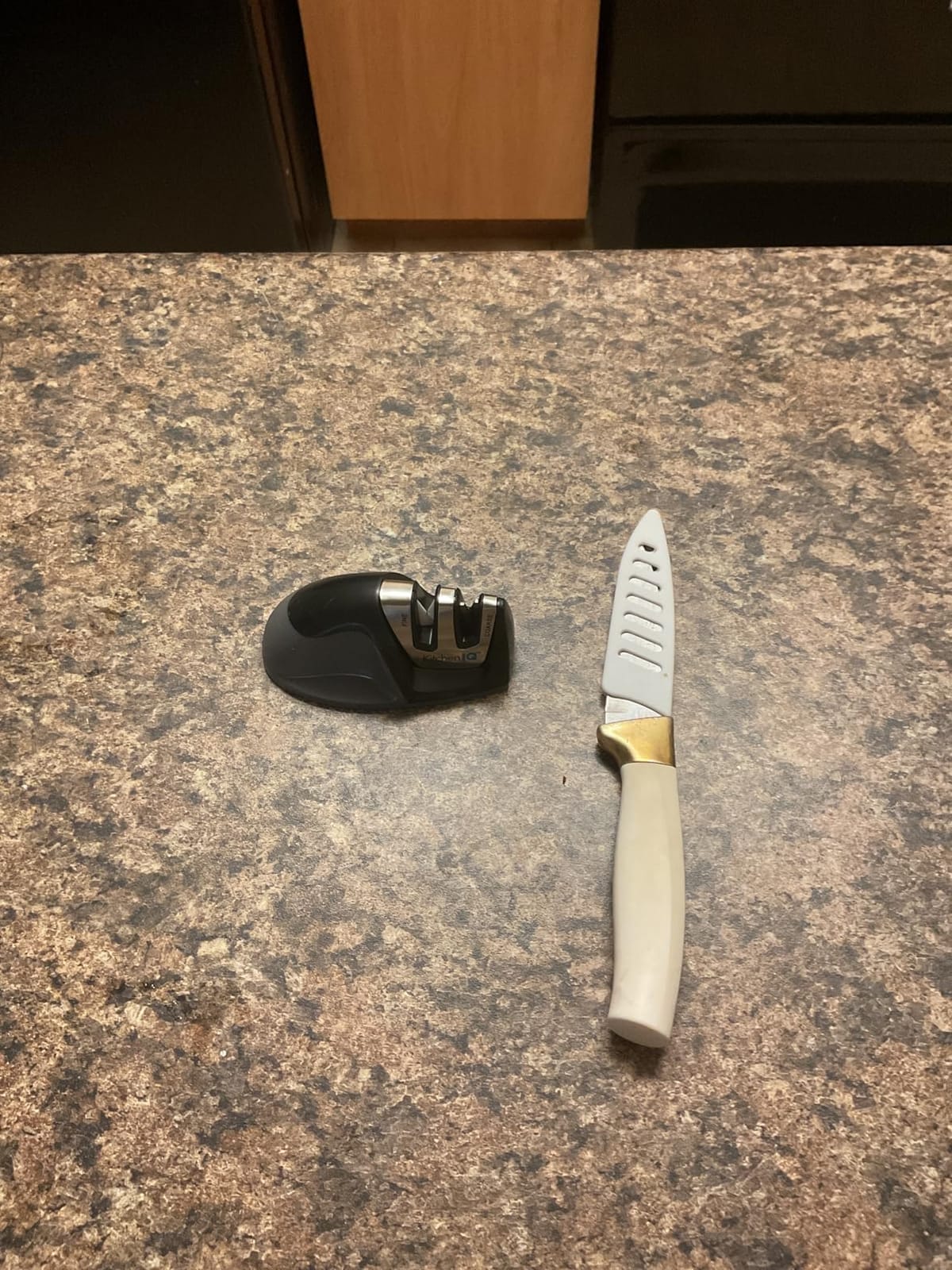
Who should buy the KitchenIQ Edge Grip
Buy it if sharpening terrifies you or if you share a kitchen with people who will never read instructions. It asks for nothing, stores almost nowhere, and works on the two blade types most homes actually own.
It is also the right first purchase for a renter, a dorm kitchen, or anyone who wants a functional sharpener without committing real money before knowing whether they enjoy the process. Put it in a drawer and it becomes the knife you grab when you are in a hurry.
Who should skip the KitchenIQ Edge Grip
Skip it if you own a Japanese single-bevel knife, a carbon steel chef’s knife, or any blade you paid serious money for. A fixed-angle two-stage tool cannot preserve a thin, asymmetric edge, and the aggressive carbide pass is more metal removal than those knives want.
Skip it too if you want an edge that holds for weeks. Buyers report needing to re-sharpen after a few days of heavy prep, which is the honest cost of the tool that never asks anything of you.
2. AnySharp Global Hands-Free Sharpener – Best for Quick Countertop Touch-Ups
AnySharp – GLOBAL – Easy to Use, Hands Free Knife Sharpener – Red
PowerGrip suction base with 20 degree preset angle
4.33 by 6.1 inch footprint
Weighs 80 g
Pros
- Suction base locks the unit to smooth counters
- Hands stay away from the blade while working
- No electricity
- cords or batteries required
- Handles serrated edges and hardened steel
- Compact and cordless
Cons
- Fixed 20 degree angle cannot be adjusted
- Removes only a modest amount of steel per session
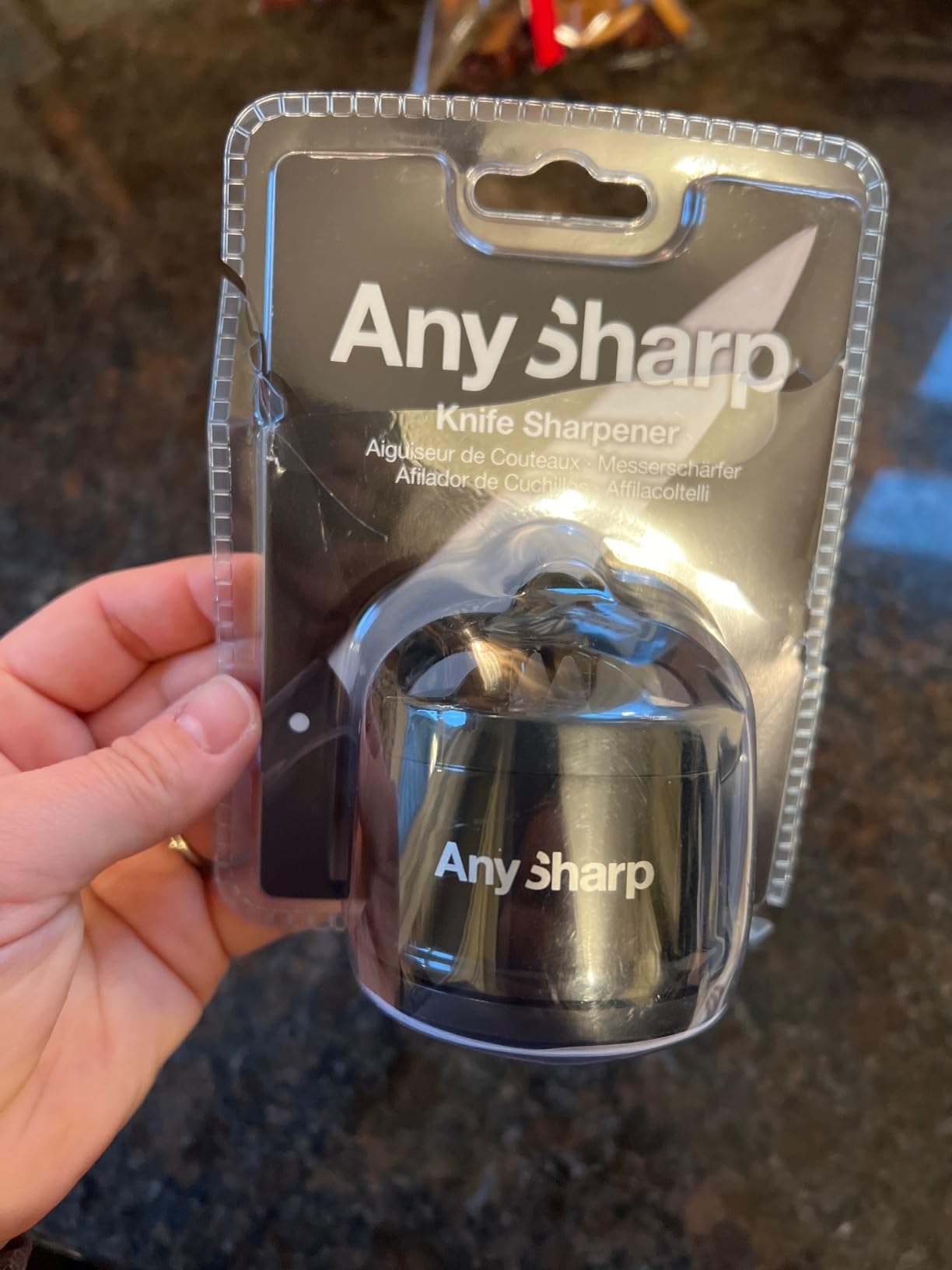
The AnySharp Global does something no other pick in this list does: it holds itself to your counter. The PowerGrip suction base locks onto smooth surfaces, which means you are not holding the sharpener in one hand and the knife in the other with a wet blade pointed in a general direction.
That single design decision removes most of the risk from the product. Both hands stay behind the handle and the full-length path of the blade, and the 20 degree preset angle is fixed at the factory. There is no power cord, no battery, and nothing to plug in at the edge of a wet sink.
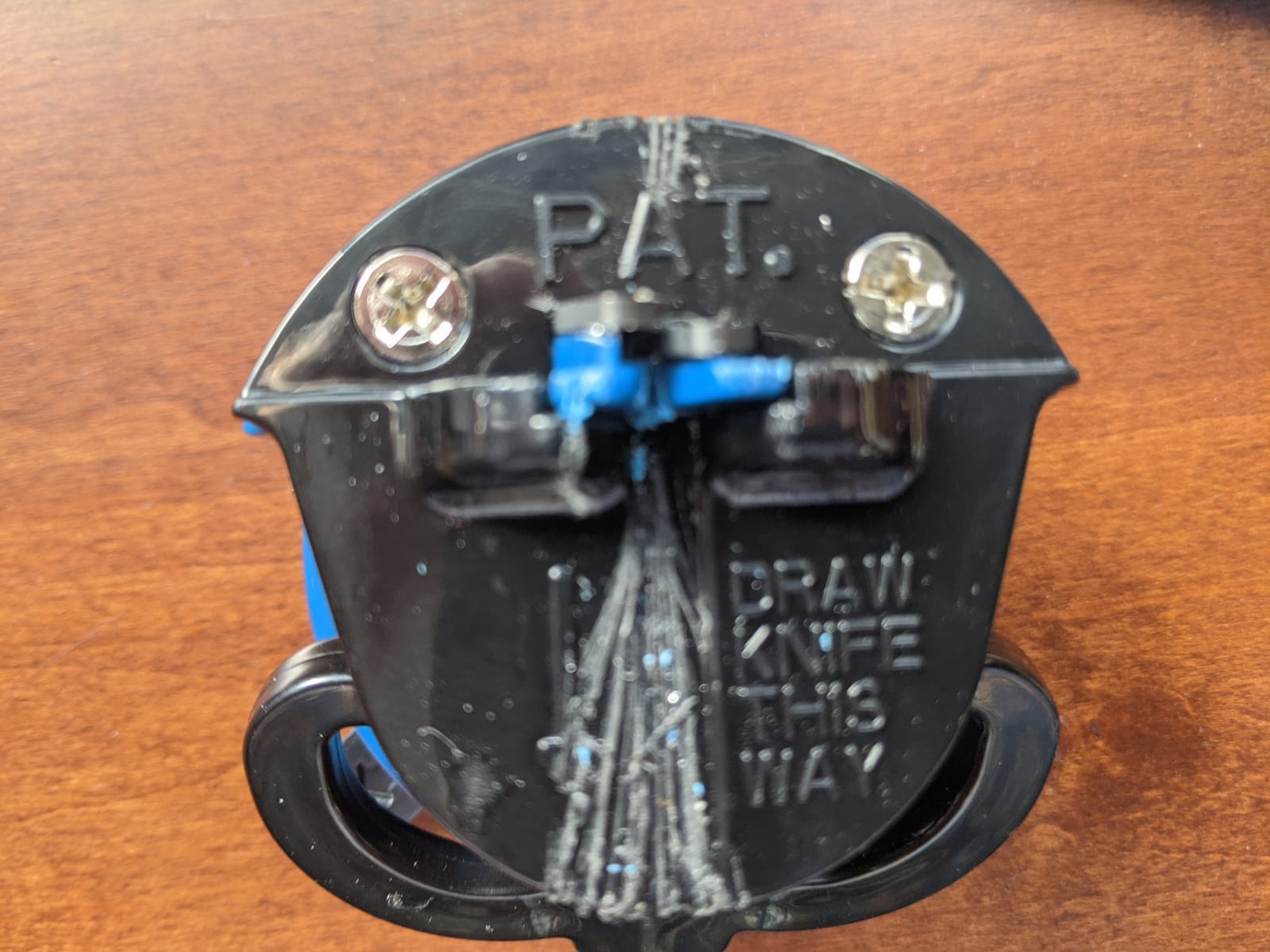
Owners use it as a touch-up tool rather than a rescue tool. When a knife is slightly dull after a week of use, two or three passes through the carbide slot bring it back. When a blade is genuinely damaged or badly chipped, this tool takes too little metal per pass to be the answer.
At 4.4 stars across more than 82,000 ratings, this is one of the most proven designs in the category, and the review pattern is consistent: people like the suction grip more than they like the sharpening results, which is exactly the right priority if you are new to sharpening.
Who should buy the AnySharp Global
Buy it if you want something that works for the whole household, including guests and children who will not read a manual. It is also excellent for a wet kitchen where an electric unit is a bad idea and a whetstone is a bad idea.
It handles serrated edges and hardened steel according to its specification, so a household with a mix of kitchen blades and a serrated slicing knife can keep one tool on the counter instead of two.
Who should skip the AnySharp Global
Skip it if you want to set a specific edge angle for a specific blade, since 20 degrees is all you get and it is not adjustable. Fine bevel enthusiasts will find it too blunt by design.
Also skip it if your knives are badly dull or nicked. Because each pull-through pass removes only a modest amount of steel, restoring a neglected blade takes far longer here than it would with a stone or an electric unit.
3. AccuSharp Knife Sharpener – Budget Pick for Straight and Serrated Blades
AccuSharp Knife Sharpener, Ergonomic Comfortable Handle, Compact & Easy to Use, Restore and Hone Straight & Serrated Knives, White
Reversible tungsten carbide blades
Full-length finger guard
Weighs 1.6 ounces
Pros
- Holds a 4.7 average across nearly 29000 ratings
- Sharpens most blades in about ten seconds
- Reversible carbide blades stretch time between replacements
- Full-length guard keeps fingers away from the blade
- Works for right- and left-handed users
Cons
- Fixed pre-set angle cannot be adjusted
- Light plastic body needs care on very hard steel
The AccuSharp is the one in this roundup that ranks first in its own Amazon category, and after using it across a spread of blades, that position is easy to understand. It does one thing and it does it in about ten seconds per knife.
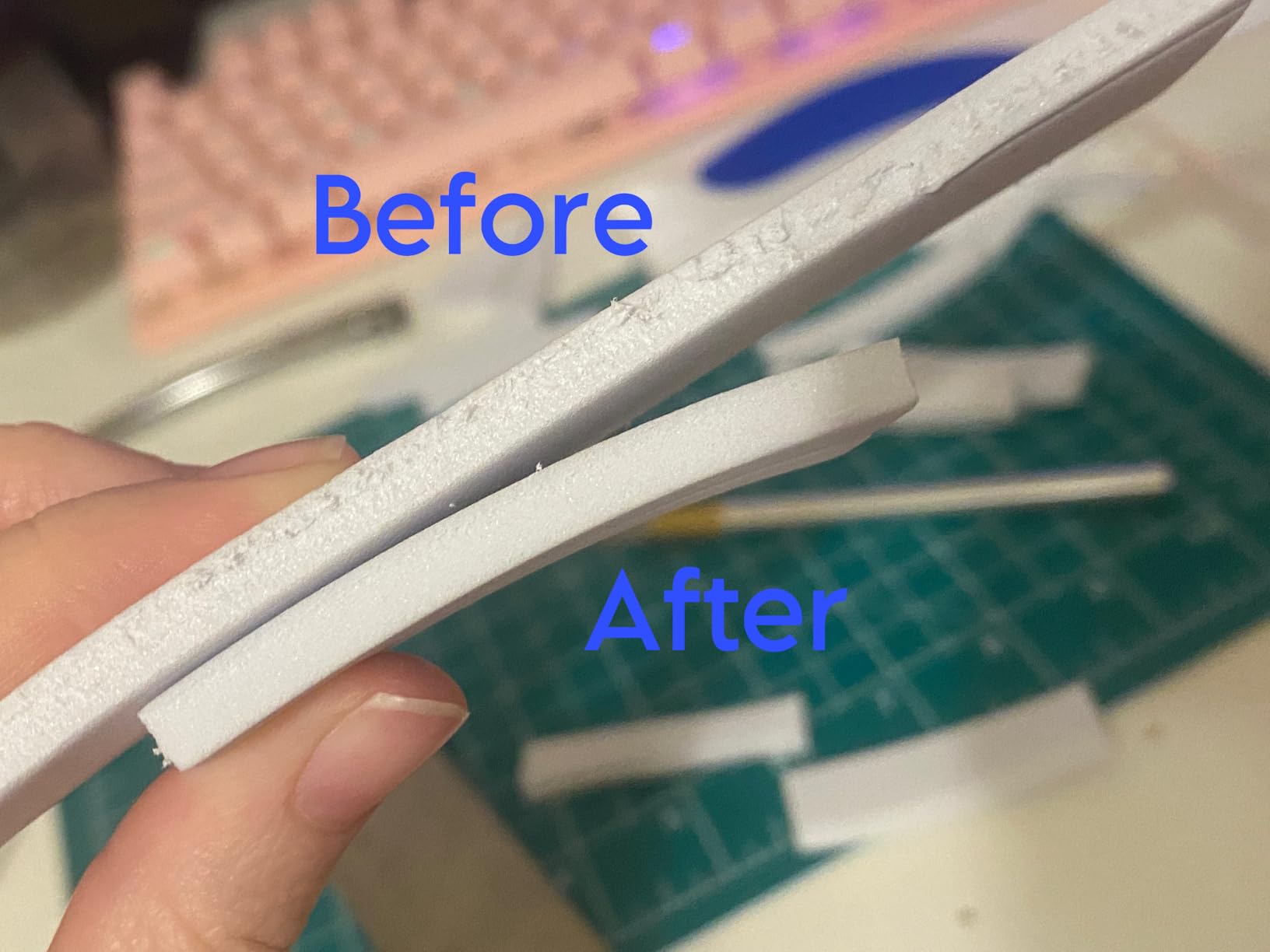
The sharpening media are diamond-honed tungsten carbide blades, and the useful trick is that they reverse. When one face wears dull, you flip the cartridge and keep working, which is why owners report years of service from a tool that looks disposable.
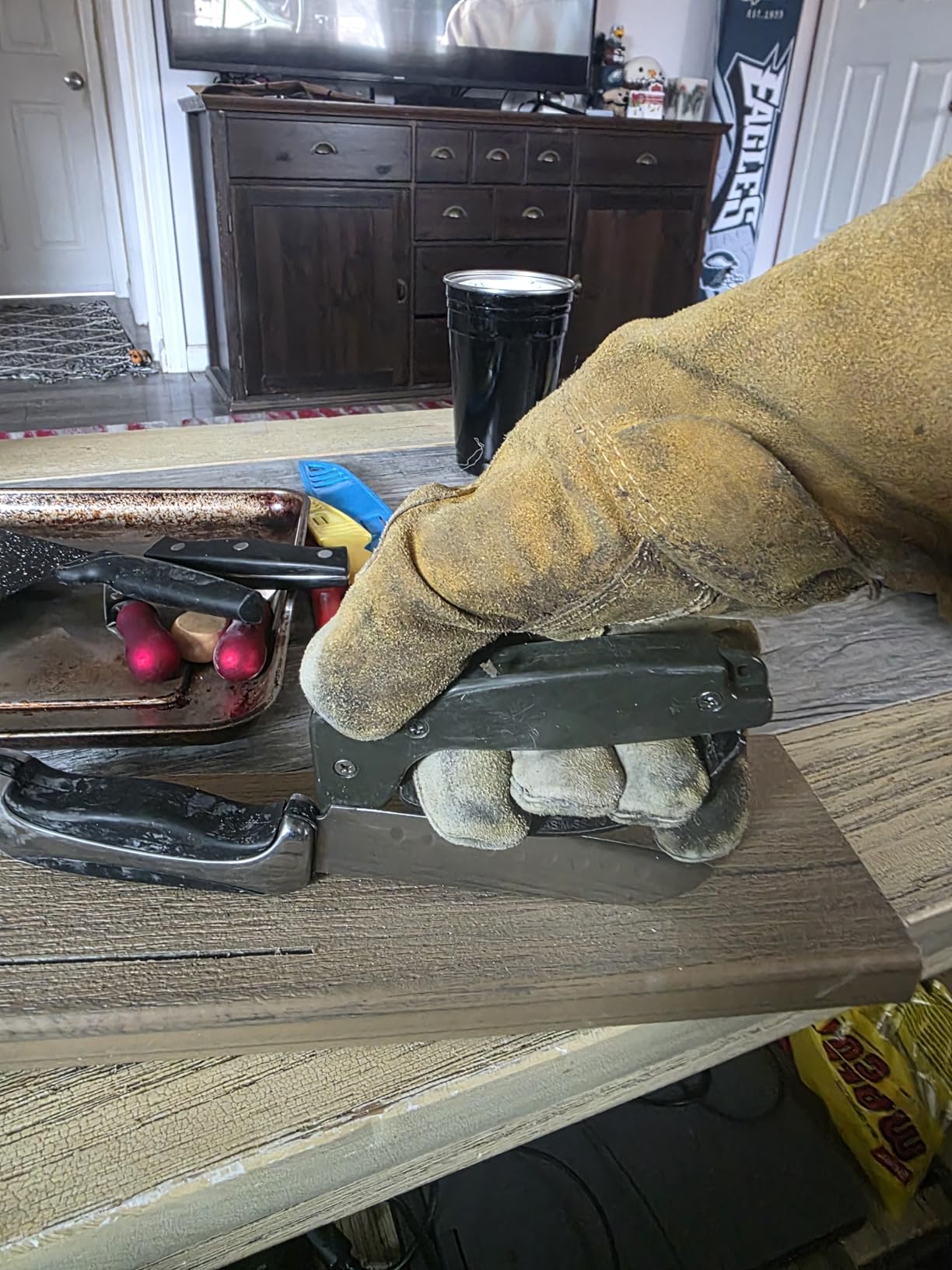
The full-length finger guard is the detail that matters most in practice. On a pull-through sharpener your knuckles end up close to the abrasive path, and the guard puts a physical barrier between them and the blade for the entire stroke.
It is also genuinely ambidextrous. The handle is shaped for either hand, so left-handed cooks and left-handed knife handlers get the same control. Dishwasher safe, which matters more than it sounds in a kitchen where the sink is already full of things.
Who should buy the AccuSharp
Buy it if you want one inexpensive tool that covers both straight and serrated edges and you sharpen on the go. It is small, light at 1.6 ounces, and needs no maintenance beyond occasionally rinsing it.
It is a sensible first knife purchase, or a backup to keep in a garage or tackle box where the main tool does not travel well.
Who should skip the AccuSharp
Skip it if you own thin, expensive, or asymmetrically ground blades. The fixed pre-set angle is not adjustable, and the light plastic body gives you little feel for how much pressure the steel can take before it bites.
Skip it if edge retention matters more than convenience. This is a touch-up tool by design, not a system for building and holding a fine edge over weeks of use.
4. Sharp Pebble 1000/6000 Grit Whetstone – Best Whetstone for Home Cooks
Sharp Pebble Whetstone Knife Sharpener – 1000/6000 Grit Sharpening Stone
Dual grit 1000 and 6000 stone
Included angle guide
Non-slip bamboo base
Weighs 2.1 pounds
Pros
- Angle guide removes the hardest part of whetstone sharpening
- 1000 grit repairs dull edges while 6000 polishes
- Edges hold longer than those from electric sharpeners
- Non-slip bamboo base keeps the stone fixed
- Works on knives
- scissors
- chisels and razors
Cons
- Real learning curve for new users
- Flattening stone must be bought separately
- Stone must be soaked before use
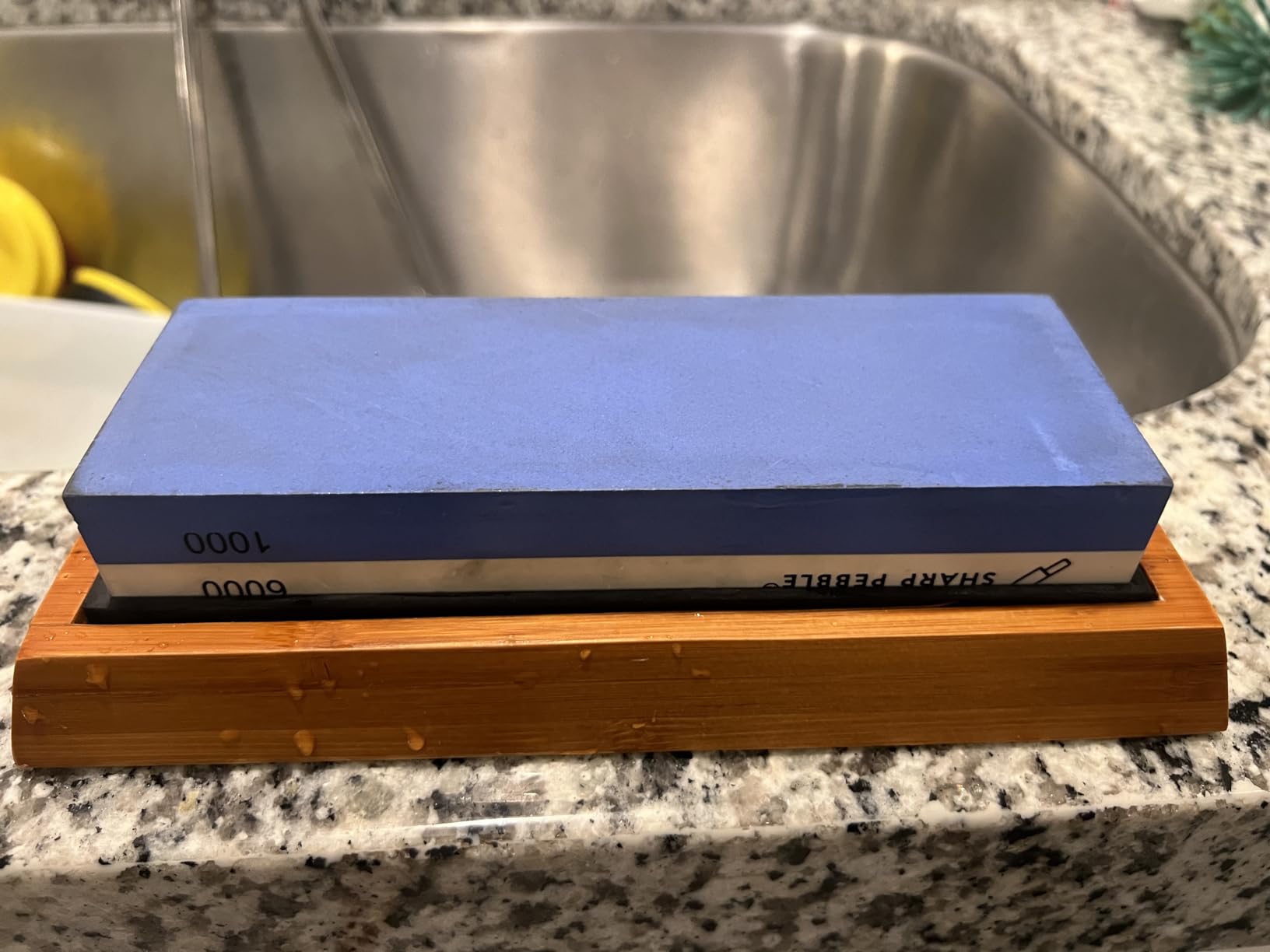
If you have ever watched a whetstone video and decided it looked impossibly technical, the Sharp Pebble is the answer to that reaction. It is a dual grit 1000 and 6000 stone with an angle guide in the box, and the guide is what turns a traditional skill into a repeatable motion.
The 1000 grit side repairs a dull edge by removing metal quickly. The 6000 grit side refines and polishes the result into a keen edge that holds noticeably longer than anything a pull-through unit produces. That edge retention is the reason whetstone users stay with stones.
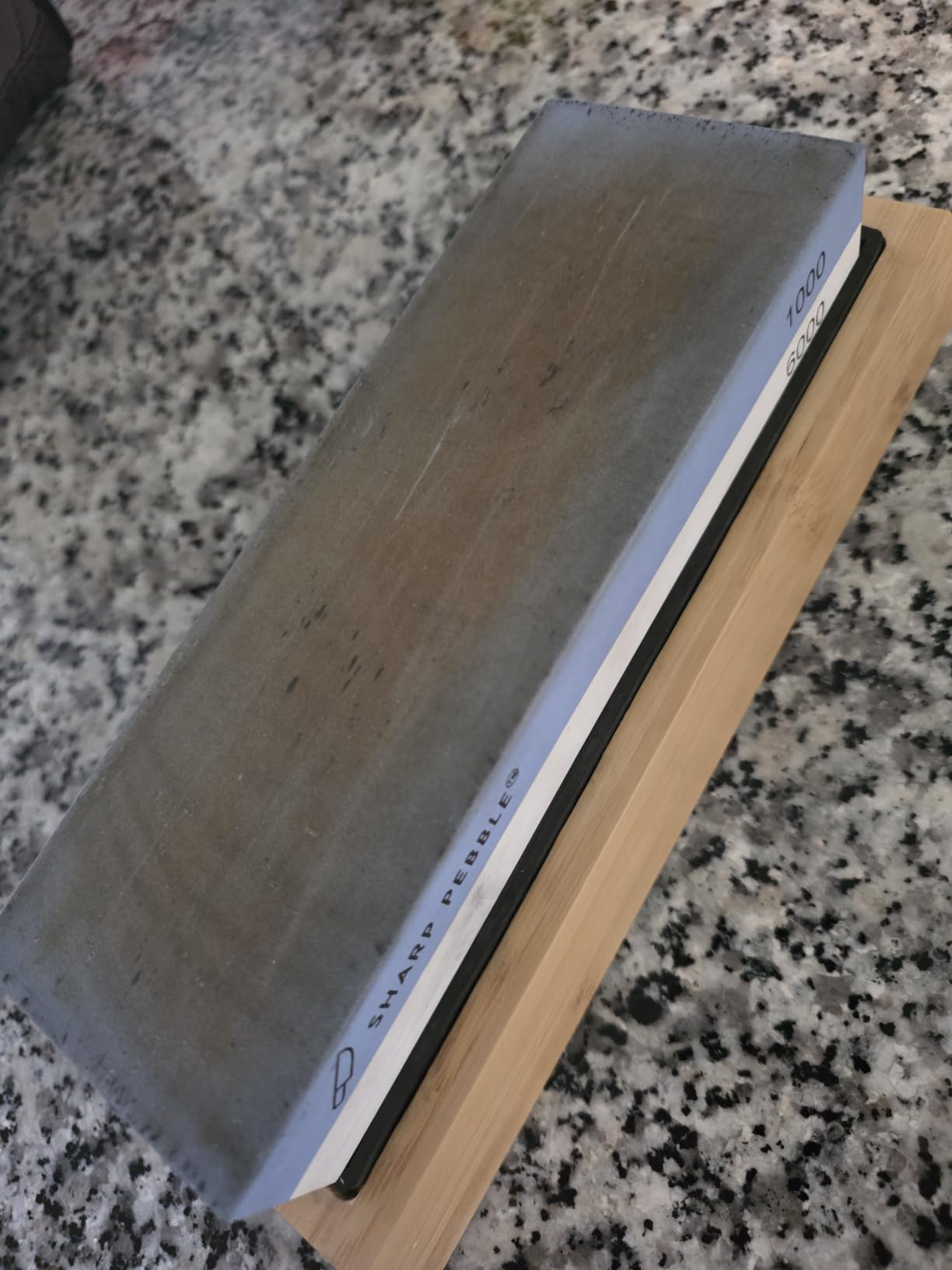
It is also water-based, which means no honing oil and no soaking in oil overnight. You wet the surface, sharpen, and rinse. The stone measures 7.25 by 2.25 inches and sits in a bamboo base that keeps it from sliding when you push.
The kit includes an instruction manual, a tips and tricks ebook, and expert support, which sounds like filler until you remember the main reason people give up on stones. The feedback loop from buyers is that the angle guide is what got them through the first ten sharpenings.
Who should buy the Sharp Pebble whetstone
Buy it if you already know you want sharper edges that last for weeks rather than days, and you are willing to spend a few sharpenings learning the motion. The included angle guide makes that learning curve much shorter.
It is a good second sharpener for a serious home cook who has a pull-through tool for quick jobs and a stone for weekend sharpening sessions.
Who should skip the Sharp Pebble whetstone
Skip it if you sharpen in a hurry, several times a week, with guests waiting. A stone is the slowest option here and there is no way to rush an angle.
Skip it if you will not keep it wet. Buyers flag that the stone must be soaked before use and kept wet while working, and a separate flattening stone is needed to keep the surface true over the years. Ignore that maintenance and the guide stops being accurate.
5. Presto EverSharp Electric Sharpener – Best Electric for New Users
Presto 08800 EverSharp Electric Knife Sharpener
Two-stage Sapphirite wheel system
Precision blade guides
120V unit
Weighs 3 pounds
Pros
- Two clearly labelled stages need no prior experience
- Most knives noticeably sharper in one or two minutes
- Holds edges for months under heavy kitchen use
- Quiet
- stable and compact enough to store away
- Many years of reliable service reported by owners
Cons
- Fixed wheel angle can over-sharpen thin edges
- A few units reported an uneven wheel
- 120V North American unit only
- Short power cord
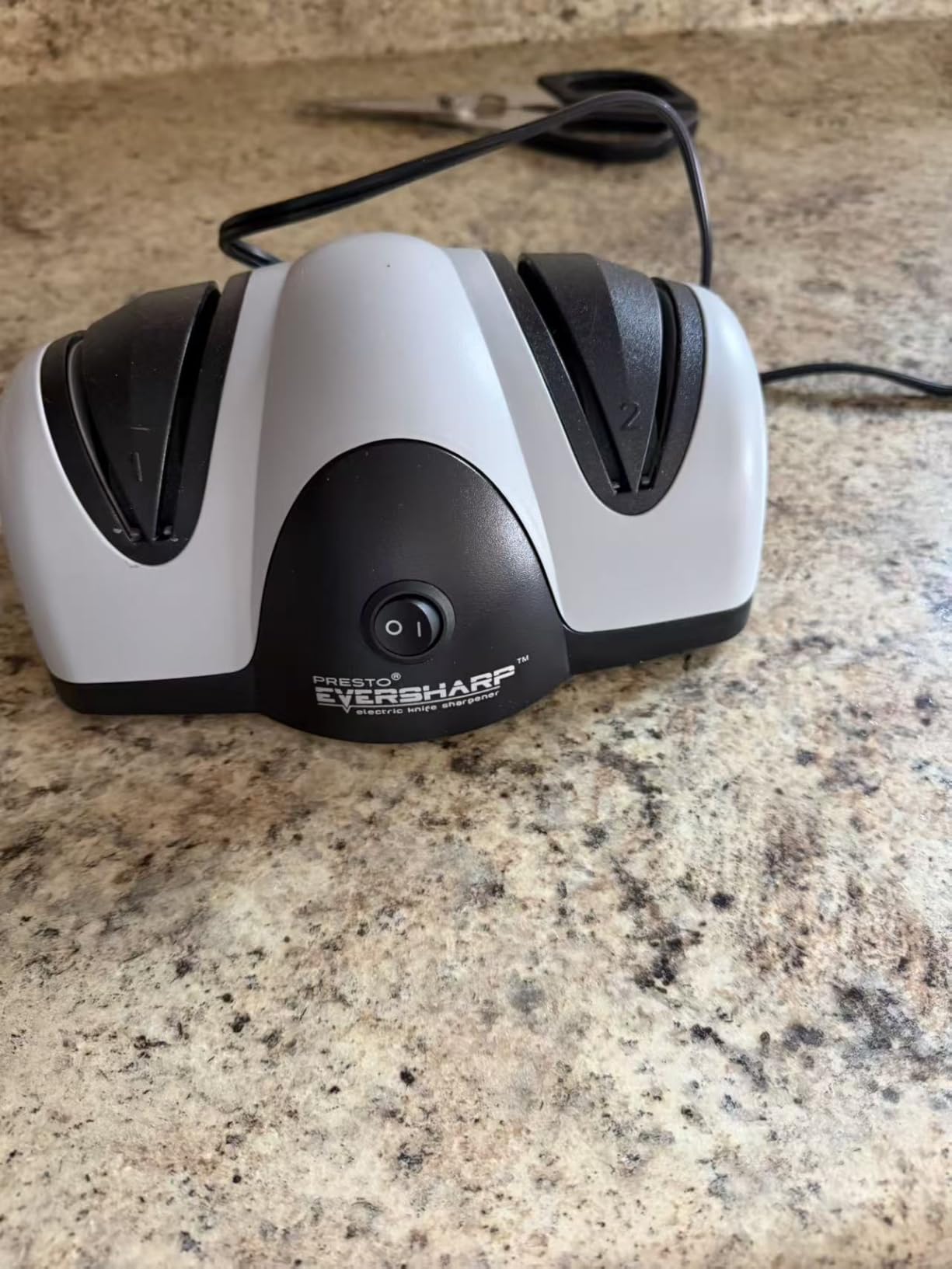
The Presto EverSharp is the electric sharpener we recommend to people who want the speed of a motor without learning anything. You draw the knife through once, flip it, and draw it through again. Most knives come out noticeably sharper in one or two minutes total.
Stage 1 grinds and Stage 2 hones and polishes, and both wheels are Sapphirite, the abrasive used in professional sharpening shops. That second stage is what separates this from a cheap single-stage motor that just makes an edge rough again.
The precision blade guides hold the knife at the correct angle as it travels through the wheels, and suction feet stop the unit walking across the counter mid-stroke. At 9.9 by 7.2 inches it is a real benchtop footprint, but it is light enough to move to a shelf when you are done.
Buyers report edges that hold for months of heavy kitchen use, and long-term owners describe many years of service. The critical reviews are about technique rather than build quality, which is a healthy sign for an appliance that has been made for a long time.
Who should buy the Presto EverSharp
Buy it if you sharpen two or more knives a week and want the result without the practice. It is also a good fit for anyone who struggles to hold a steady angle freehand but is not ready to learn whetstone technique.
Owners who bought it years ago and still use it daily treat longevity as the main reason to buy one, which is a fair benchmark for an appliance you expect to keep.
Who should skip the Presto EverSharp
Skip it if you own thin Japanese or carbon steel knives you care about. The wheel angle is fixed, and repeated passes can over-sharpen a thin edge until it becomes fragile. Use fewer passes than you think you need.
Skip it if you travel or live outside North America. This is a 120 volt unit built to North American electrical standards, and the power cord is short by design.
6. Work Sharp Guided Field Sharpener – Best for Pocket and Hunting Knives
Work Sharp Guided Field Sharpener, Compact Travel Knife Sharpener Tool
Removable diamond plates and rotating ceramic rod
Integrated leather strop
20-25 degree guided angle
3-year warranty
Pros
- Holds a 4.8 average across more than 12700 ratings
- Five abrasive surfaces in one compact tool
- Self-contained with no loose parts
- tools or oil needed
- Leather strop and ceramic rod handle coarse repair and final honing
- Backed by a 3-year warranty
Cons
- Fixed 20-25 degree range limits very fine edge work
- Angle guide is a fixed insert rather than a dial system
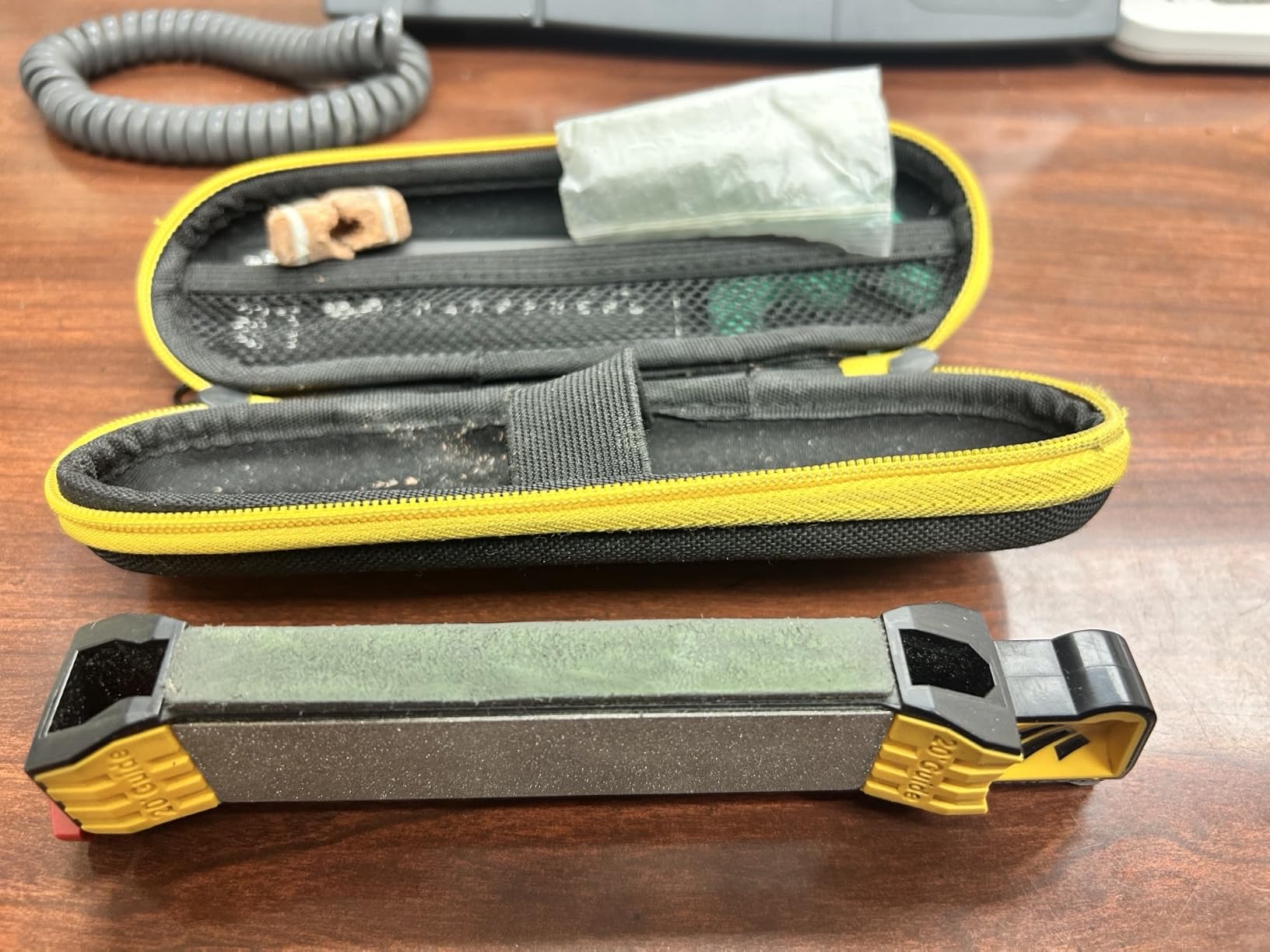
The Work Sharp Field Sharpener is the pick for anyone who maintains folding knives, hunting knives, or an everyday carry rotation. It holds a 4.8 average across more than 12,700 ratings, and the reason is that it packs an unusually complete set of abrasives into a self-contained case.
You pull the diamond plates out to expose a broad head wrench for fast field work on damaged edges. The ceramic rod rotates to show coarse and fine surfaces plus a hook groove, and the integrated leather strop handles the final polish. Five abrasive surfaces in one tool is where the rating comes from.
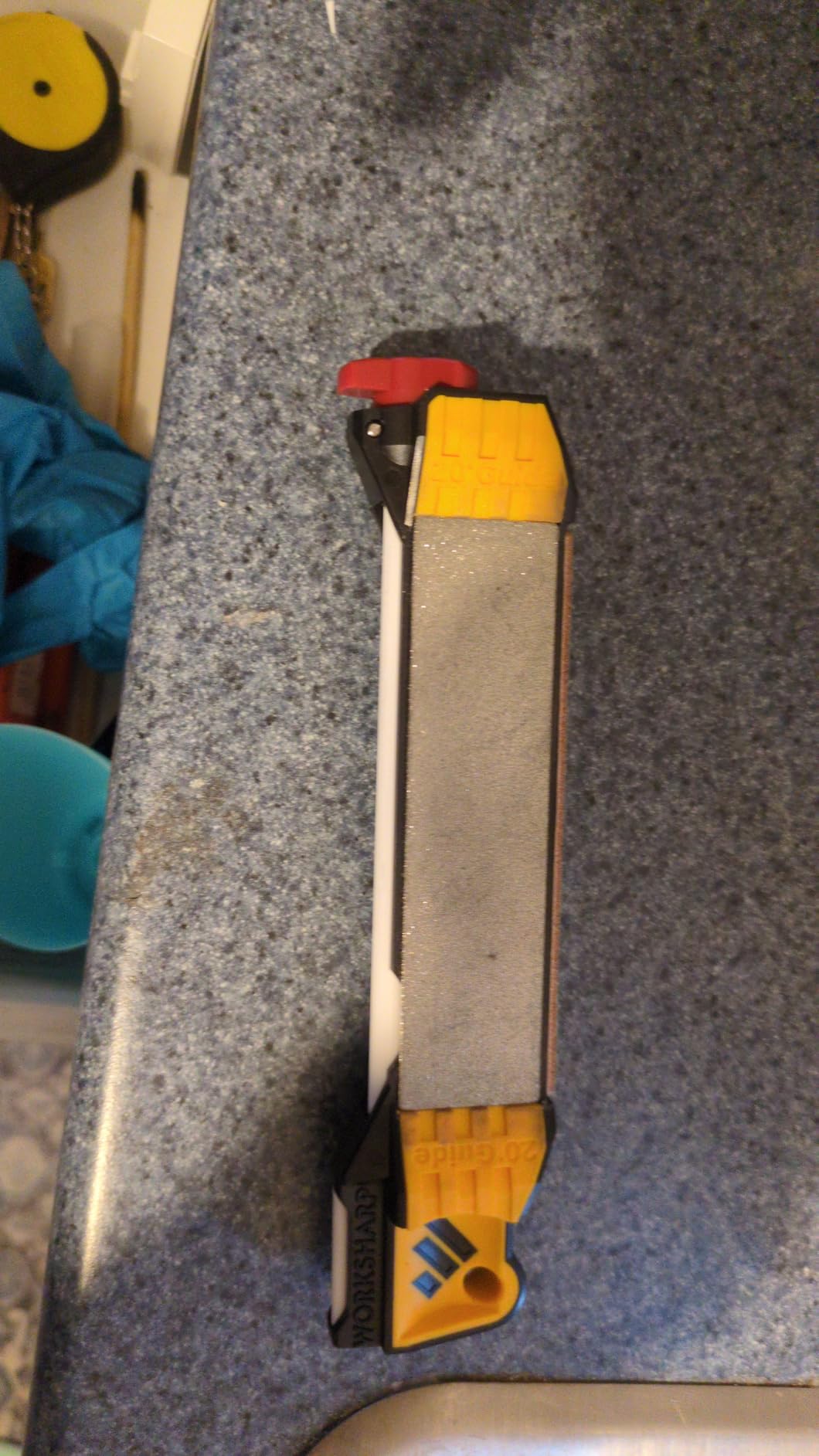
Everything stays on the tool. There are no loose parts, no tools, no oil, and nothing to assemble, which is the entire point when you are sharpening by a campfire or in a truck bed rather than at a clean kitchen counter.
It also carries a 3-year warranty, and buyers mention that as added reassurance next to the rating. The guided angle covers a 20 to 25 degree range, which suits most straight-edged pocket and field knives without demanding fine adjustment.
Who should buy the Work Sharp Field Sharpener
Buy it if you own more than three fixed-blade or folding knives, or if any part of your sharpening happens away from a kitchen. It is the most genuinely portable complete sharpener in this roundup.
It is also the right choice for a gift for someone who hunts, fishes, or carries a folder daily and has never sharpened anything.
Who should skip the Work Sharp Field Sharpener
Skip it if you need a precise, narrow edge angle for a kitchen knife. The 20 to 25 degree range is fixed, and the guide is a fixed insert rather than something you dial in per blade.
Skip it if you only own two kitchen knives. For that situation the sharpening capability is more than you need, and the extra surfaces add bulk you will never use.
7. Work Sharp Precision Adjust Kit – Best for Precise Angle Control
Work Sharp Precision Adjust Knife Sharpener Kit – Fixed Angle Sharpening System for Kitchen & Pocket Knives – Professional Guided Knife Sharpening Tool
15 to 30 degree adjustment in one-degree steps
Tri-brasive rod with diamond and ceramic
V-block clamp
3-year warranty
Pros
- Dial-in angle adjustment from 15 to 30 degrees
- Three-sided rod moves quickly between coarse and fine
- V-block clamp keeps the blade angle repeatable
- Handles serrated knives as well as straight edges
- Benchtop base and full accessory set included
Cons
- Bulkier and heavier than pull-through sharpeners
- Manual rod work takes more time per knife than an electric unit
The Precision Adjust is the system we recommend to anyone moving past fixed-angle tools. The chassis dials from 15 to 30 degrees in one-degree increments, so you can set a fine 15 degree edge on a Japanese steel blade and a durable 20 degree edge on a German steel one, using the same tool.
The sharpening media come on a three-sided rod that indexes between coarse diamond, fine diamond, and fine ceramic. That is a real progression rather than two coarse and fine steps, and it is why the edges hold longer than a two-stage pull-through produces.
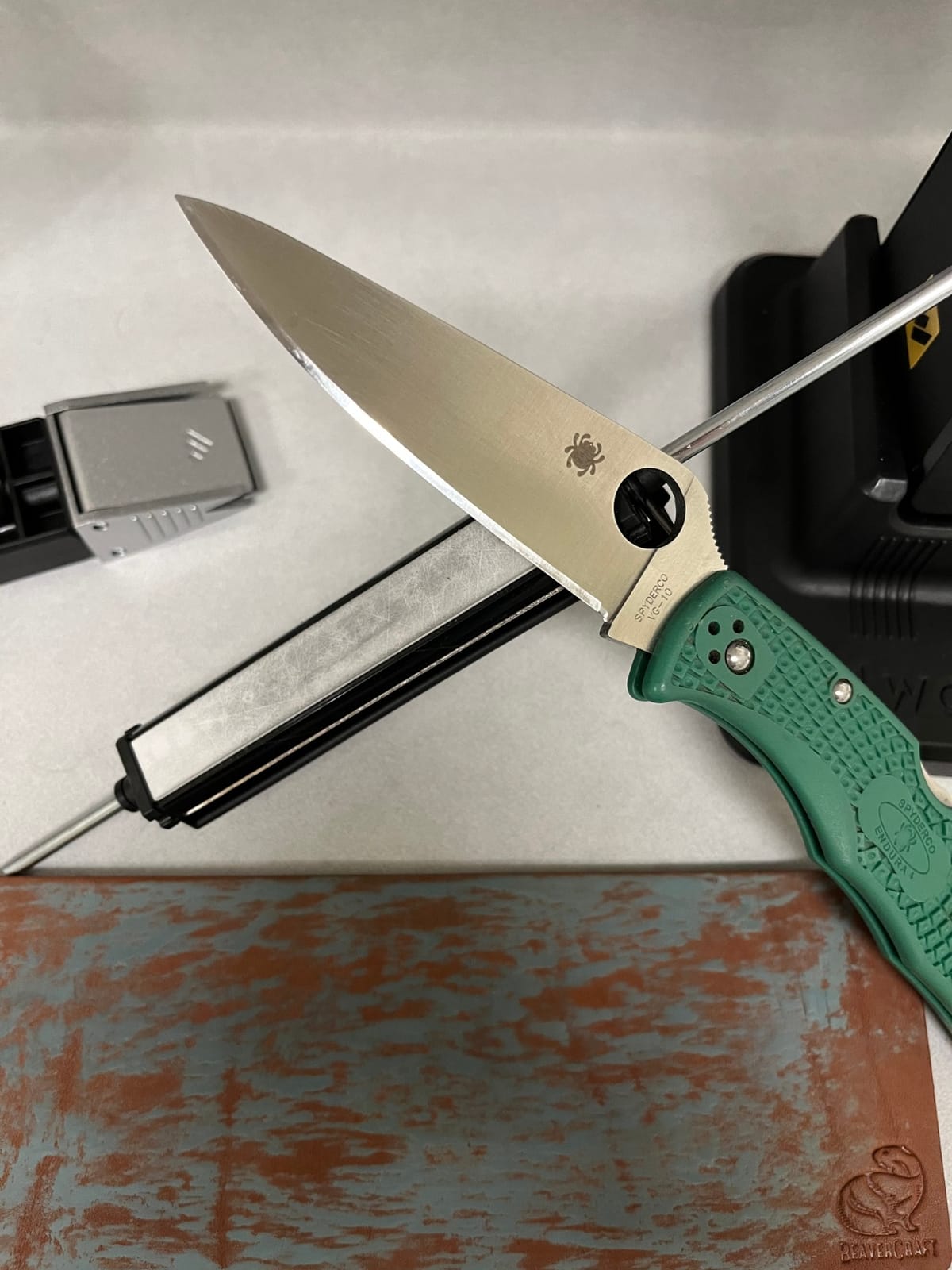
The V-block clamp secures the knife consistently, which removes the wobble that produces uneven bevels. A benchtop base is included so you are not holding the chassis in one hand and the knife in the other. It carries a 3-year warranty.
Reviewers treat this as a clear step up from fixed-angle tools and note the trade-off honestly. At 215 grams and 9.6 inches wide, it is a real desktop system, and manual rod work takes longer per knife than an electric unit.
Who should buy the Precision Adjust
Buy it if you own knives with different edge geometries, which most households do without realising it. A Japanese chef’s knife, a German chef’s knife, and a fillet knife want three different angles, and this is the cheapest way to set all three accurately.
It is also the choice for anyone who wants a serrated knife in the same rotation as straight blades, which the kit supports directly.
Who should skip the Precision Adjust
Skip it if you sharpen on the go. This is a benchtop system and it does not pack into a pocket, a glove box, or a tackle box the way the field sharpener does.
Skip it if you sharpen one knife, occasionally. The angle range is wasted capability on a single-blade household, and a fixed-angle tool would serve the same job in less countertop space.
8. RADA Quick Edge Two-Pack – Best American-Made Straight-Edge Sharpener
Rada Cutlery Quick Edge Knife Sharpener (R119), Pack of 2
Dual hardened stainless steel wheels
Durable nylon base
Made in the USA
Weighs 1.6 ounces
Pros
- Made in the USA from raw materials through construction
- Hardened high-carbon stainless steel wheels
- Light at 1.6 ounces with a 5 inch footprint
- Two-pack gives a spare unit
- 4.7 average with 83 percent five-star ratings
Cons
- Straight edges only
- not for serrated knives
- Fixed wheel angle with no fine finishing stage
- Less effective on very dull blades
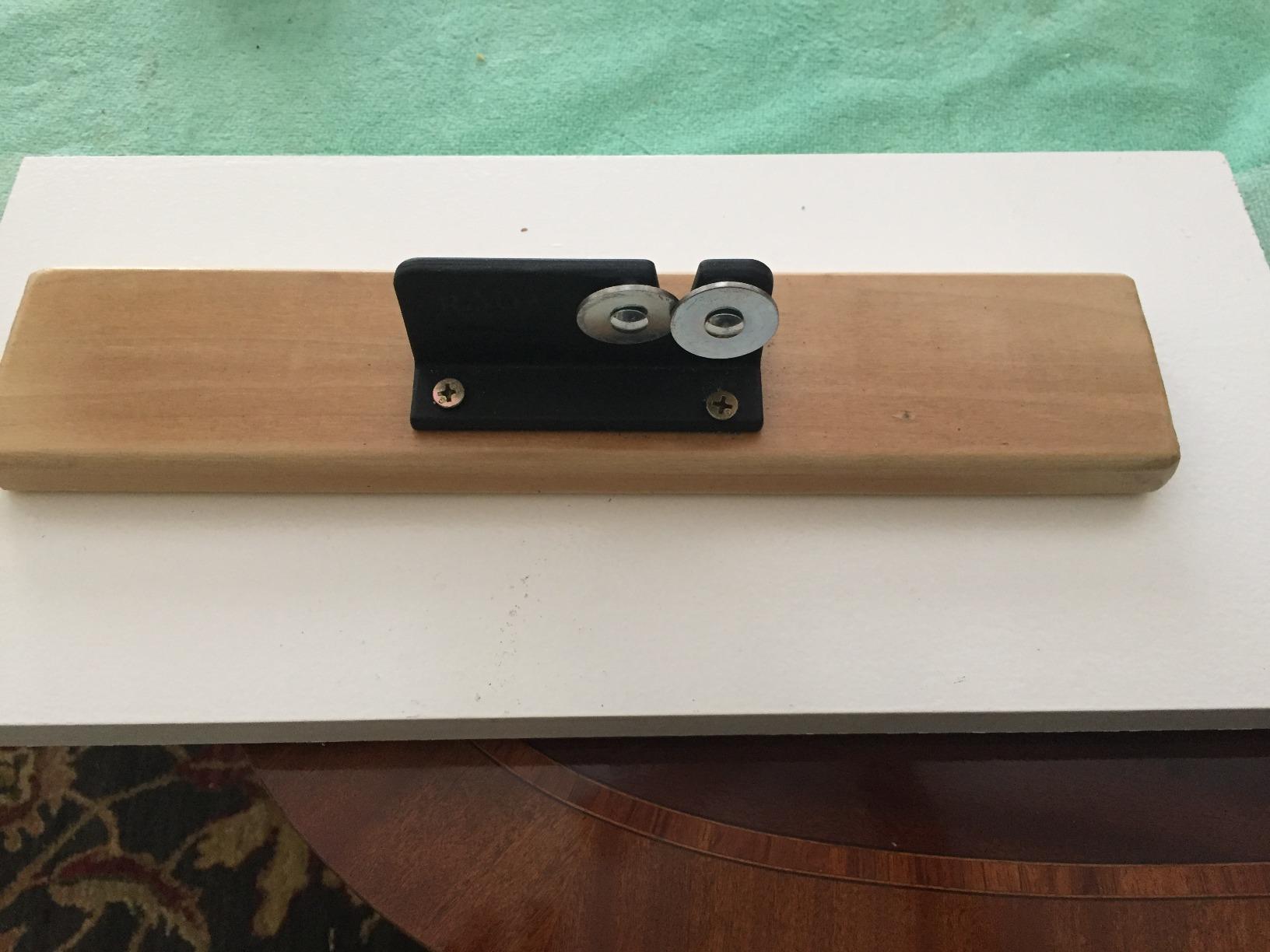
The RADA Quick Edge is a different philosophy from everything else on this list. It uses dual wheels of specially hardened high-carbon stainless steel rather than carbide or diamond abrasive, and it is manufactured in the United States from raw materials through finished construction.
Stainless wheels are slower to work than carbide, and that slowness is the point. A harder abrasive that shaves metal faster is also more likely to take too much off a good edge, and the steel wheels here take a gentler, more predictable bite.
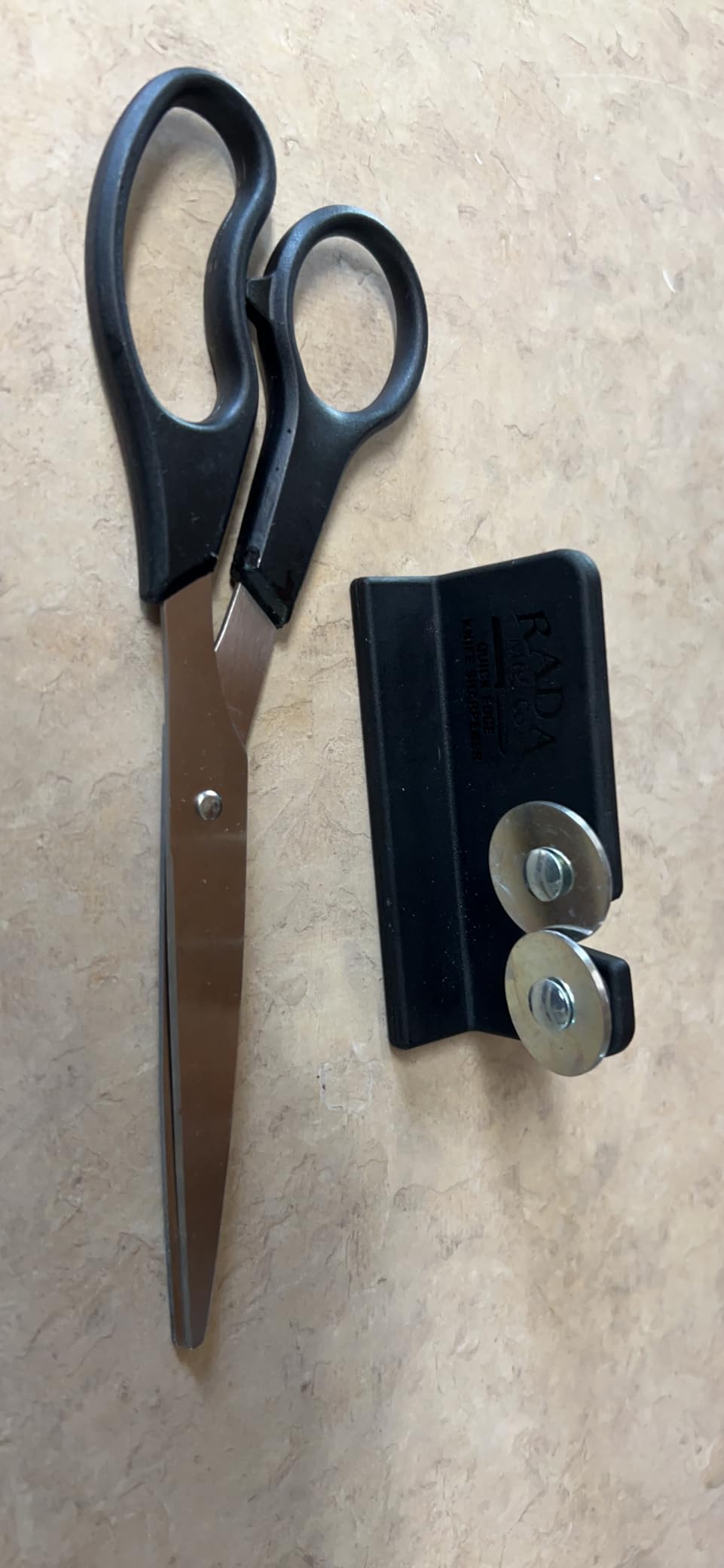
It is specified for straight-edged blades from hunting knives to fillet knives, and reviewers confirm that range. That clarity matters more than it sounds, because it is designed for the knives most people in this category actually maintain.
You get two units in the pack, which is the practical reason to pick it over a single. Keep one in the kitchen and one in a workshop, truck, or fishing bag. At 1.6 ounces each, you forget it is in your pocket.
Who should buy the RADA Quick Edge
Buy it if your sharpening needs are hunting, fishing, fillet, and straight-edged kitchen work, and you prefer a gentler wheel that preserves existing edge geometry. The stainless wheels are a sensible choice on blades you have paid good money for.
It is also a strong choice for anyone who wants two locations covered from a single purchase, or who wants a spare because pull-through sharpeners do occasionally take a hard knock.
Who should skip the RADA Quick Edge
Skip it if you own serrated knives and want to maintain them with the same tool. This one is straight edges only, so a bread knife needs a separate sharpener.
Skip it if your knives are genuinely neglected. Reviewers note the pull-through action is less effective on very dull blades, and there is no fine finishing stage to refine the result afterward.
9. Work Sharp MK2 Electric Sharpener – Best for Scissors, Axes and Garden Tools
Work Sharp MK2 Electric Knife Sharpener – Adjustable 2-Speed Knife Sharpening System for Kitchen Knives, Pocket Knives, Scissors, Axes & Garden Tools
Adjustable two-speed motor
Flexible abrasive belts
Edge guide to the tip
3-year warranty
Pros
- Handles scissors
- axes and garden tools as well as knives
- Two speeds give control on delicate and heavy work
- Flexible belts conform to the edge
- Fast repeatable results with minimal technique
- 3-year warranty
Cons
- Highest price in this roundup
- Consumes abrasive belts that need replacing
- Belts can stretch or shed with heavy tool work
The MK2 is the most capable electric sharpener here, and the reason is the belts. Where a wheel sharpener is built around a fixed abrasive arc, flexible abrasive belts conform to any edge, so the same motor handles a chef’s knife, a pair of kitchen shears, an axe, and a mower blade.
The two-speed motor is what makes that claim workable. Low speed handles delicate kitchen blades, and high speed handles heavy grinding on an axe or a garden tool without you having to force the job. The edge guide supports the blade all the way to the tip, which is where many sharpeners leave a dull hook.
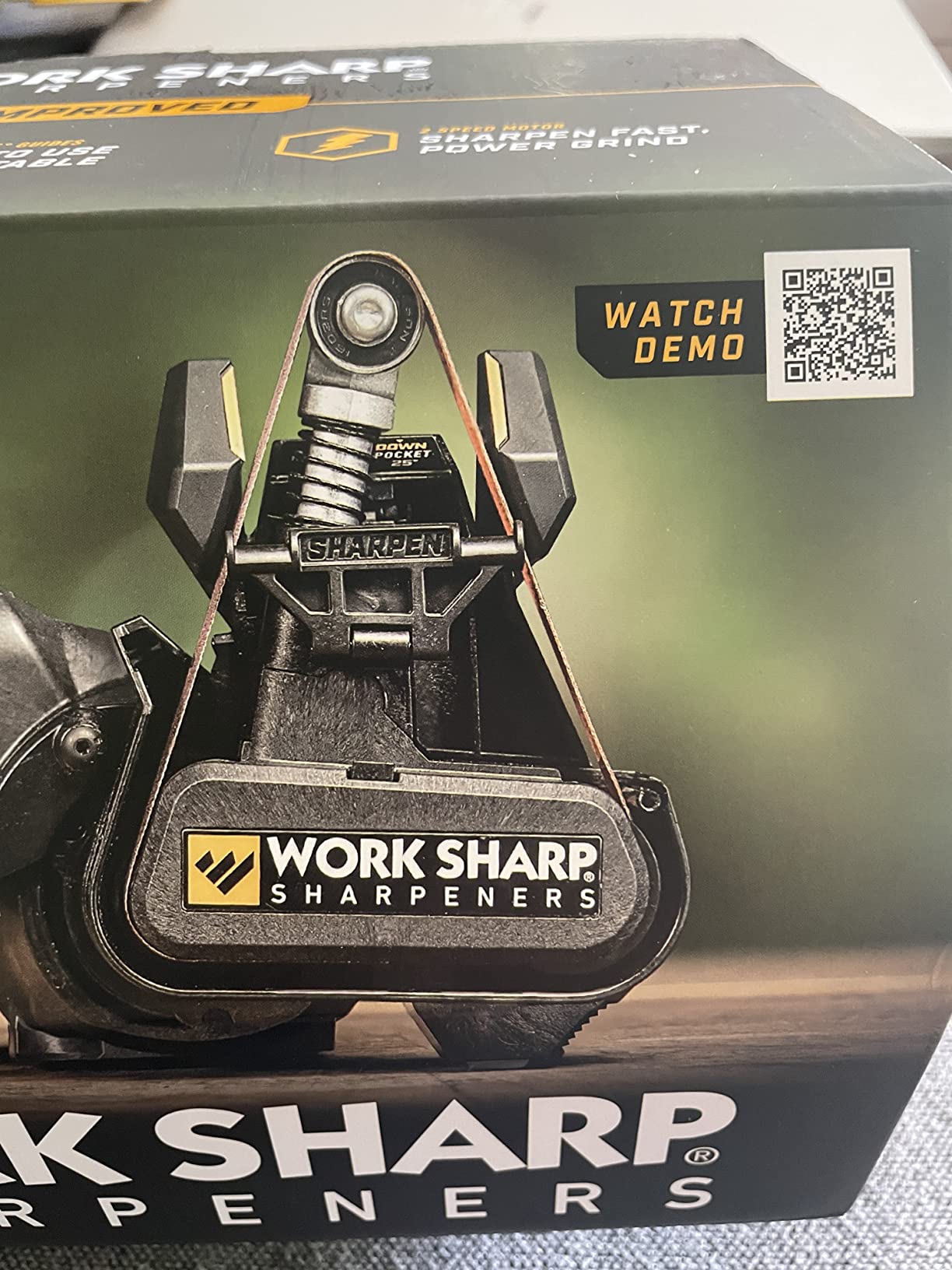
Reviewers describe it as an all-in-one edge tool rather than a knife sharpener with extras. If your household has a lawn mower, hedge trimmer, and a full knife block, one unit covering all of them changes the value calculation completely.
It carries a 3-year warranty, which matters on an appliance that touches powered equipment as well as cutlery. Results are fast and repeatable with minimal technique required, which is the same beginner-friendly pitch as the EverSharp with a much wider scope.
Who should buy the Work Sharp MK2
Buy it if you sharpen more than just kitchen knives. Scissors, axes, hedge shears, and mower blades all go through it, and the two speeds keep you from being reckless on the expensive blades.
It is also the right pick if a partner, child, or housemate sharpens without reading anything, because the belt guide removes almost all of the technique requirement.
Who should skip the Work Sharp MK2
Skip it if you only own a handful of kitchen knives. You would be paying the top price in this roundup for capability you will never use, and a two-stage electric unit covers the same blades.
Skip it if you dislike consumables. The abrasive belts need periodic replacement, and buyers note they can stretch or shed under heavy tool work, which is a running cost the manual sharpeners do not carry.
10. Intelitopia Complete Whetstone Set – Best All-in-One Kit
Intelitopia Complete Knife Sharpening Stone Set – Dual Grit Whetstone 400/1000 3000/8000 Knife Sharpener with Leather Strop, Flattening Stone, Bamboo Base, 3 Non-slip Rubber Bases & Angle Guide
400/1000 and 3000/8000 grit stones
Flattening stone and leather strop
Bamboo base
Weighs 5 pounds
Pros
- Most complete kit with stones
- flattening stone
- strop
- bases and angle guide
- Four grit levels cover edge repair through mirror finishing
- Angle guide makes the technique approachable
- Leather strop removes the final burr and polishes
- Reported repeatable results across 20 plus knives
Cons
- Stones must be soaked and kept wet while sharpening
- Noticeably heavier than it looks
- Supplied base grips less well than the name suggests
Everything you would buy separately for whetstone sharpening is in this kit. Two corundum stones, a coarse flattening stone, a genuine cowhide leather strop, a bamboo base, three rubber bases, an angle guide, and a manual. Owners sharpening across 20 or more knives report repeatable results.
Four grit levels is what makes the kit complete. The 400 side repairs serious damage, 1000 resets a dull edge, 3000 refines, and 8000 approaches a mirror finish. Most buyers use only two of them, and the other two are there when a knife needs more.
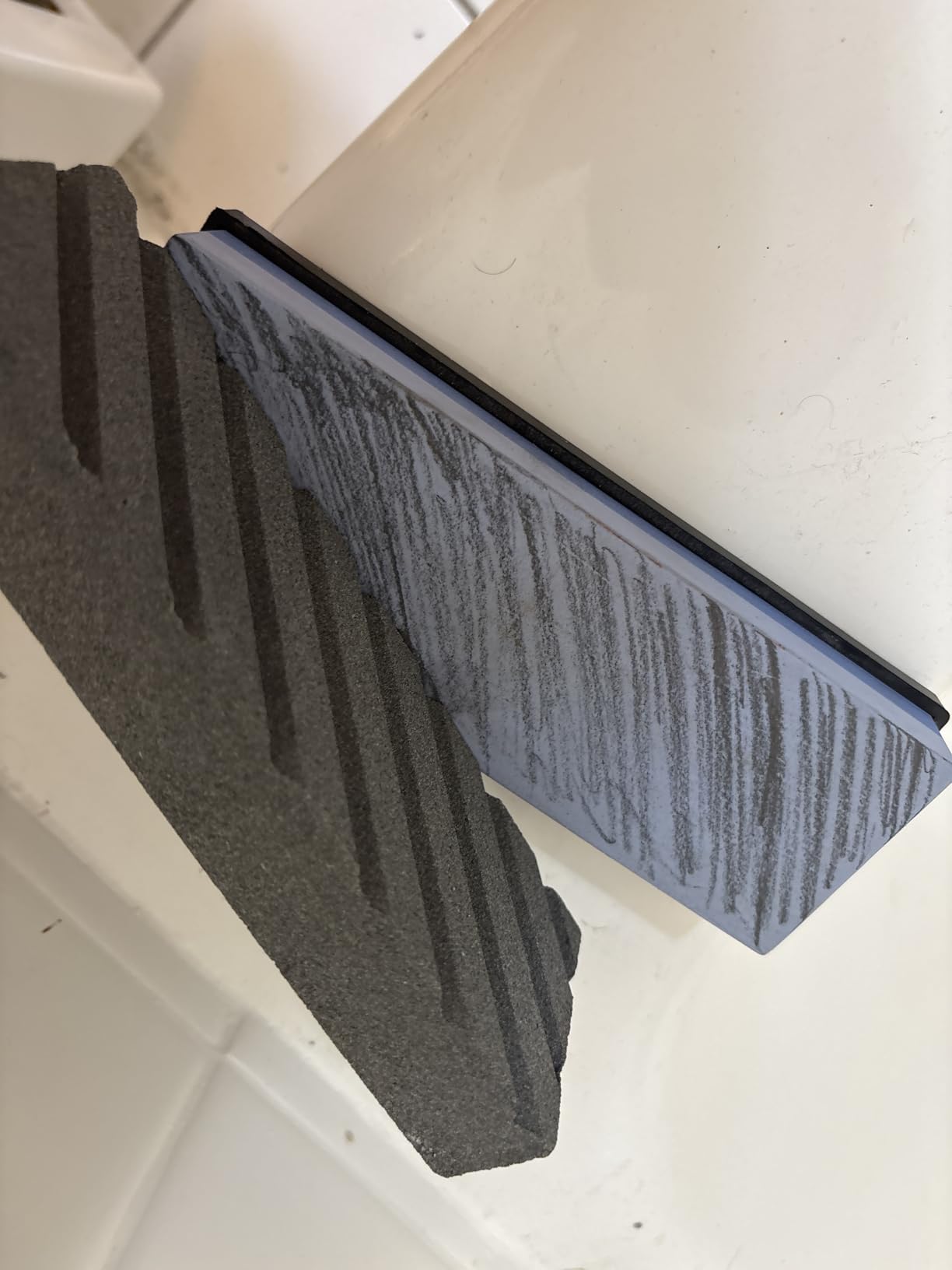
The leather strop deserves specific mention because burr removal is the step people skip. After grinding on a stone, a wire edge burr remains along the apex, and drawing the blade through a strop is what removes it and adds the polished finish.
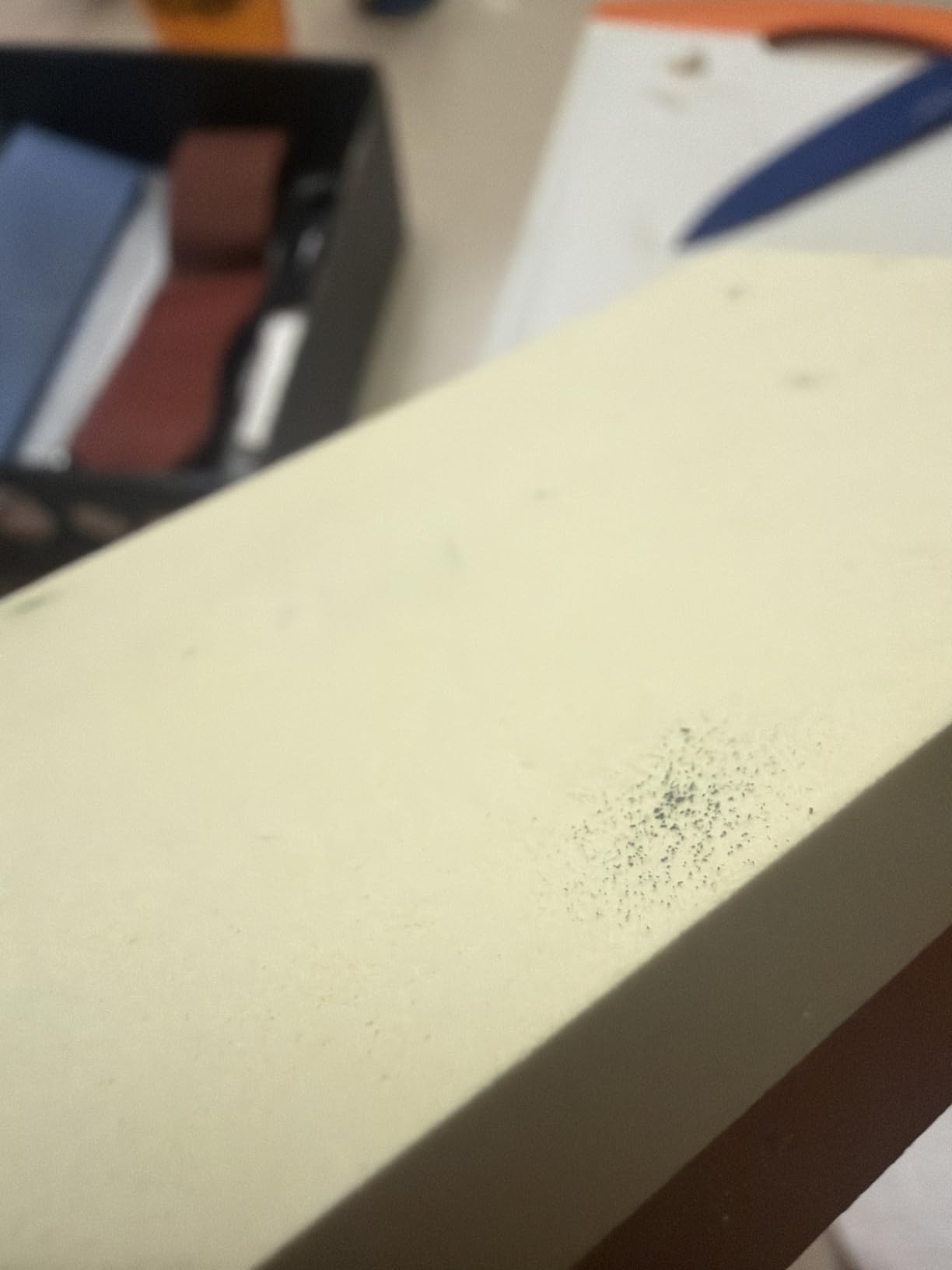
The corundum stones must be soaked before use and kept wet while working. At 5 pounds the kit is heavier than it looks in photos, and the 8000 grit stone is denser than the rest, which is worth knowing before you set it on a shelf.
Who should buy the Intelitopia set
Buy it if you have decided to learn whetstone sharpening and would rather not make three separate purchases to do it. Every accessory a beginner needs is in the box, including the one they will forget to buy, the flattening stone.
It is also a good choice for someone who sharpens more than knives, since the kit handles kitchen blades, pocket knives, hunting knives, scissors, and straight razors.
Who should skip the Intelitopia set
Skip it if you have never sharpened anything before and want an instant improvement this week. Four grit levels and a strop are a toolkit, not an onboarding path, and you will not use half of it in the first year.
Some owners compare the grit unfavourably with Japanese stones and note the base grips less well than its name suggests. If you already have a stone you are happy with, this is duplication.
11. Sharp Pebble 5 Precision Adjust Sharpener – Best for Multi-Angle Straight Edges
5 Precision Adjust Knife Sharpener- 3-Stage Premium Kitchen Knife Sharpener
Five angles from 12 to 24 degrees
Coarse, medium and fine stages
Weighs 1.5 ounces
Pros
- Five selectable angles cover most straight-edge knife types
- Three stages repair and polish in one tool
- Rubberised grip on handle and base prevents slipping
- Sharpens a knife in well under a minute
- Lightweight at 1.5 ounces and easy to store
Cons
- Straight edges only
- not for serrated knives or scissors
- Adjustment wheel can be tight and has locked up for some
- Finish is not as fine as a wet stone
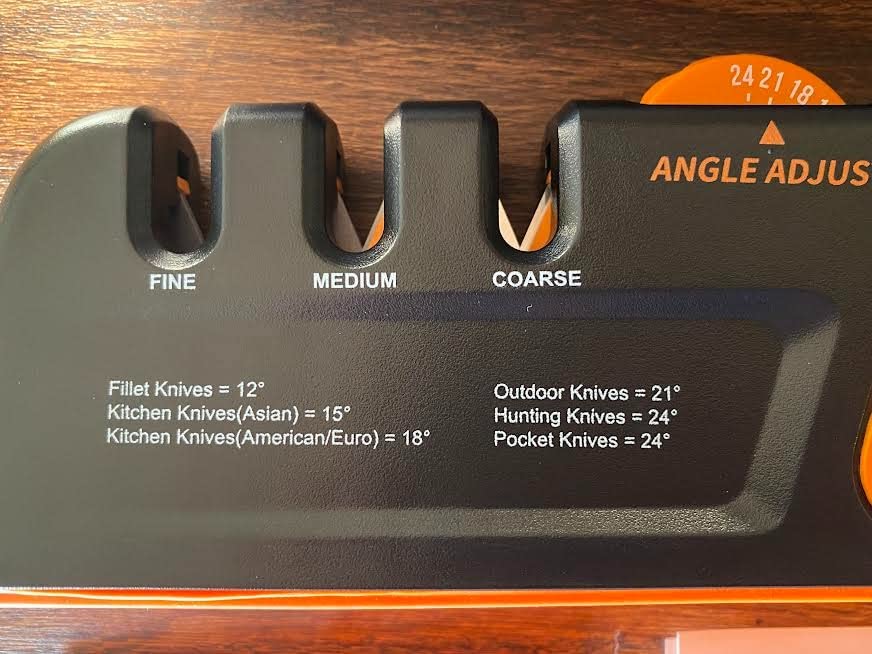
The 5 Precision Adjust is the middle ground between a fixed-angle pull-through and a full guided system. You get five selectable angles at 12, 15, 18, 21, and 24 degrees, chosen with a printed guide on the side of the unit, and three stages running coarse, medium, and fine.
That angle range covers most straight-edged knife types in a household. It is a much narrower band than the Work Sharp Precision Adjust dial, but it changes quickly and requires no clamping, no base, and no rod technique.
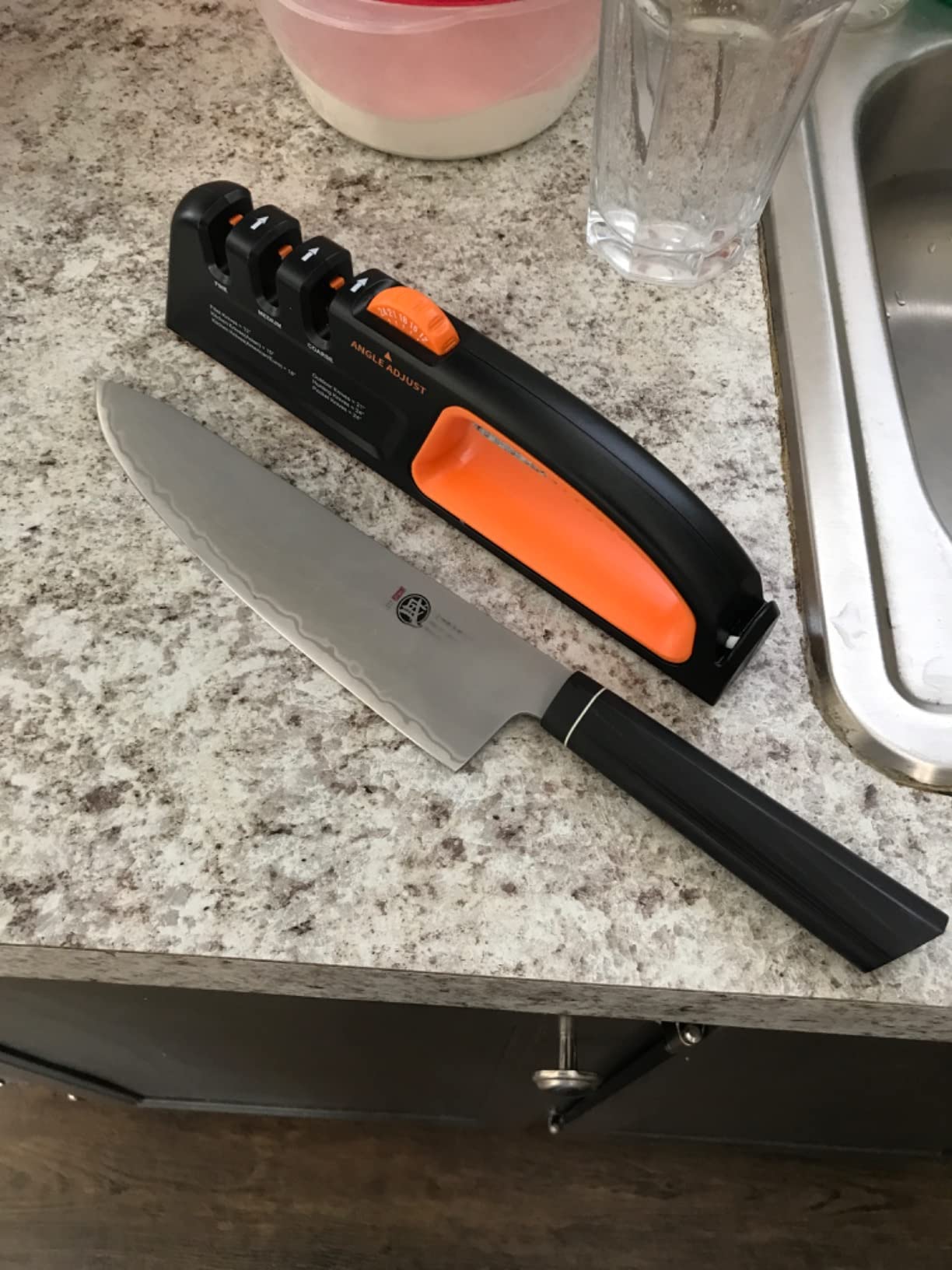
Owners sharpen a knife in well under a minute. The rubberised grip on both the handle and the base stops it sliding, which is the usual failure point of a small manual sharpener used on a wet counter.
It is specified for straight-edge blades only. Serrated knives and scissors are outside what this tool does, and the fine finish it produces is good rather than excellent compared to a properly loaded wet stone.
Who should buy the Sharp Pebble 5 Precision Adjust
Buy it if you want angle choice without committing to a benchtop system. It is a fast, lightweight manual option that covers the common straight-edge geometries in a household at a fraction of the desk space.
It suits someone who keeps a small set of kitchen and pocket knives, wants control over the edge angle, and would rather not learn stone technique yet.
Who should skip the Sharp Pebble 5 Precision Adjust
Skip it if you own serrated knives. That is a hard functional limit, not a preference, and households with a bread knife need a different tool for that blade.
Some owners report the adjustment wheel is tight and has locked up on their unit, and others question whether the coarse stage abrasive matches its label. If you are chasing the finest possible finish, a wet stone will beat it.
12. Secura 2-Stage Electric Sharpener – Compact Electric on a Budget
Secura 2-Stage Electric Knife Sharpener with Diamond Abrasives and Precision Angle Guides, Professional Sharpening Tool for Kitchen Straight Edge and Ceramic Knife, Black
Two-stage diamond abrasive sharpening
Precision guide refines to 15 degrees
2-year warranty
Weighs 2.3 pounds
Pros
- Two-stage electric sharpening with diamond abrasive wheels
- Precision guide refines a 20 degree edge to 15 degrees
- Suction cup feet keep the unit firmly in place
- Compact footprint and quiet operation
- 2-year manufacturer warranty and ETL approval
Cons
- Not suitable for serrated knives
- Some users report over-shaving and grooves in thin blades
- Not heavy duty
- better suited to small knives
- Lowest average rating in this roundup
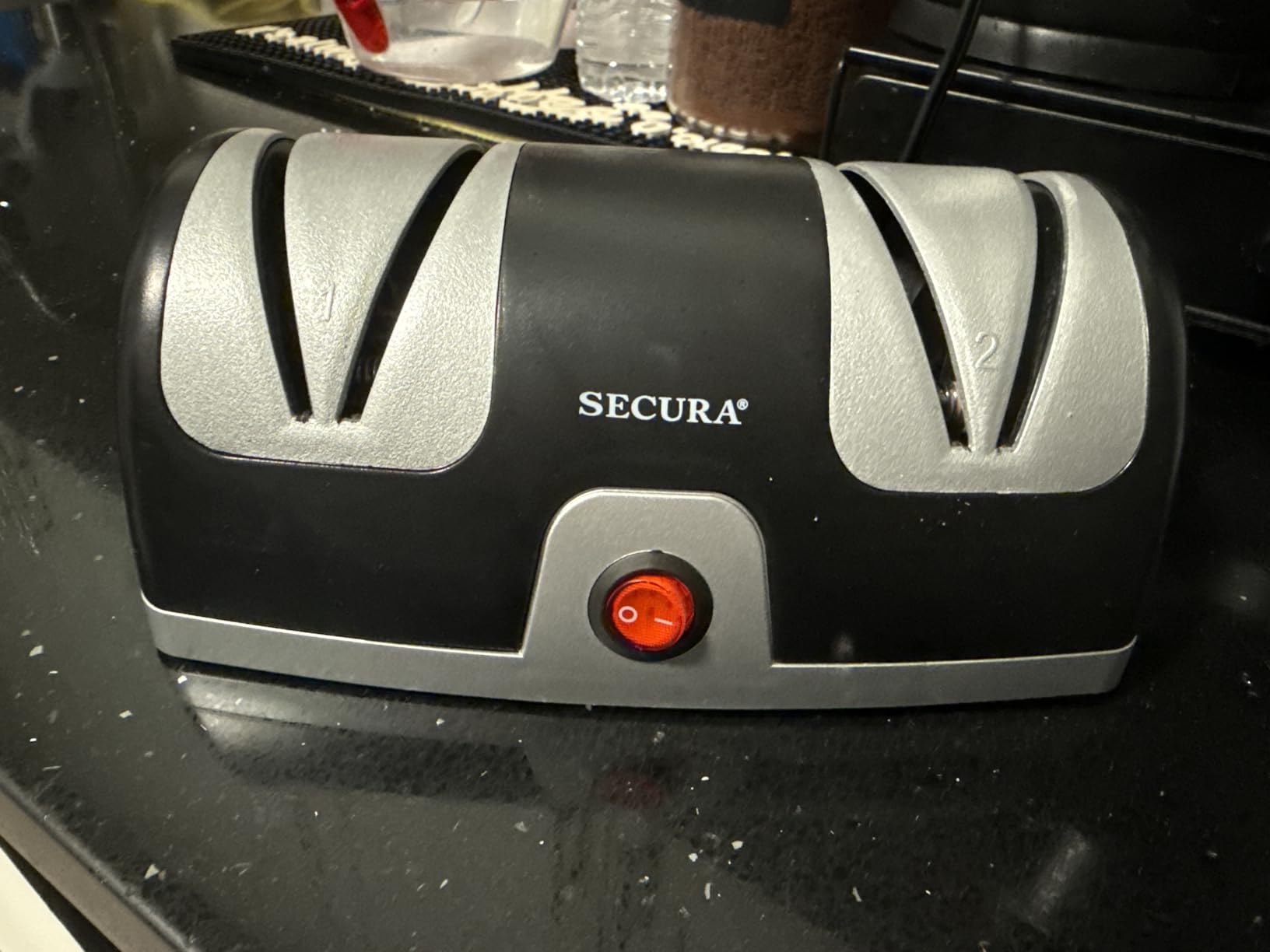
The Secura is the most polarised product we tested. Plenty of owners report it sharpening knives well and quietly for a modest outlay, and several bought a second unit. A visible group of reviews describes grooves and ruined edges on thin blades, which is why it sits at the bottom of our ranking despite a reasonable feature list.
The mechanism is a two-stage system with diamond abrasive wheels. Stage 1 restores and reshapes the edge, Stage 2 sharpens and polishes, and the precision guide is designed to convert a 20 degree edge into a finer 15 degree edge. Heavy-duty suction cup feet hold the unit in place.
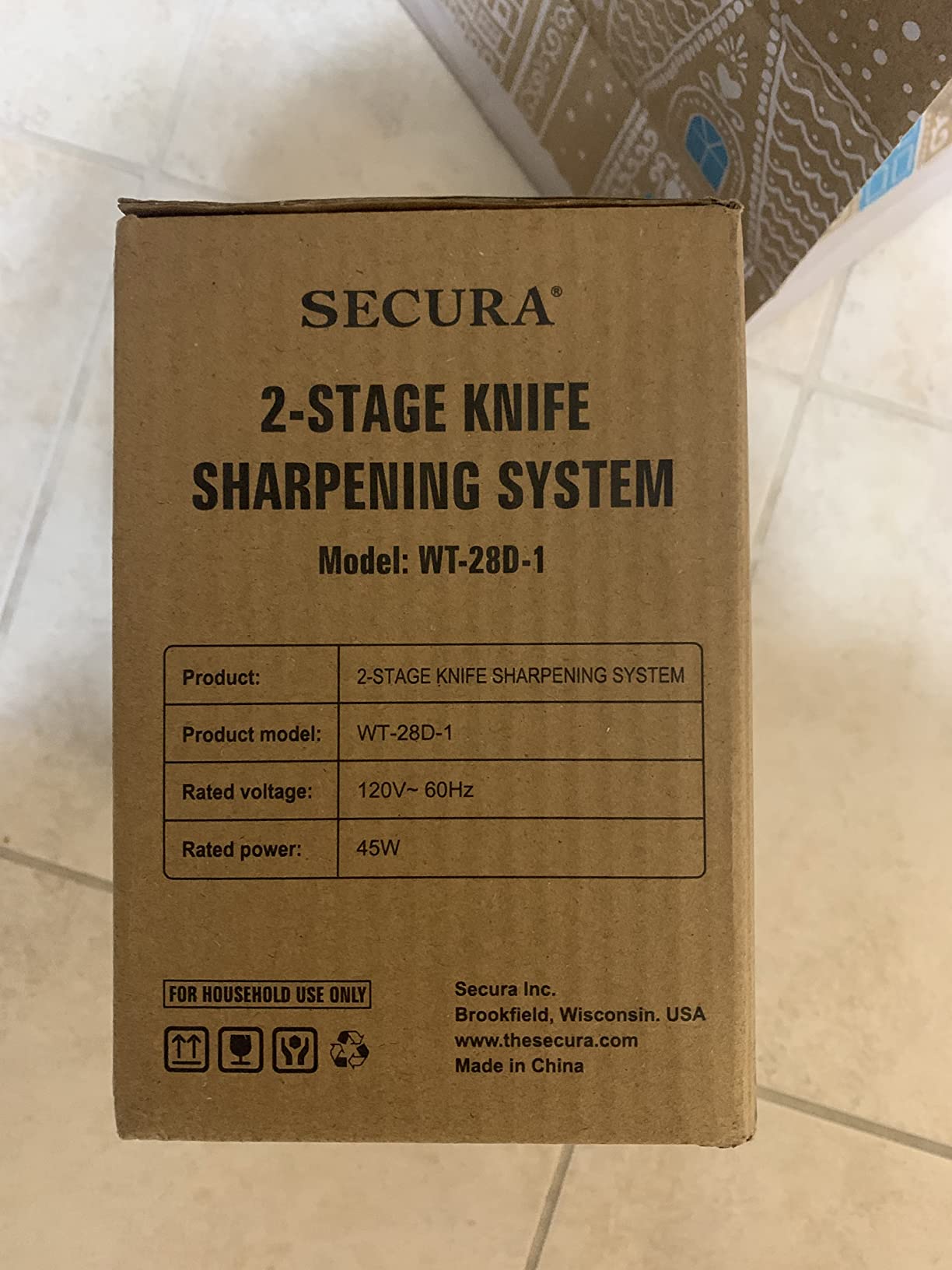
It is compact at 7.87 by 5.31 inches, carries a 2-year manufacturer limited warranty, and is ETL approved. Those details are better than many cheaper electric units, and the operating noise is reported as low.
The over-shaving reports are consistent enough that we will not soften them. If a blade is thin, the wheels can take metal faster than you can react, and the resulting grooves do not sharpen out. Treat it as a light-duty tool rather than a general system.
Who should buy the Secura
Buy it if you have a small set of straight-edged kitchen knives, want an electric for a compact countertop, and want to try sharpening powered before spending more. The two-year warranty and suction feet make it a reasonable first electric.
It is also fine as a second unit in a home where the main electric lives in a different part of the house.
Who should skip the Secura
Skip it if you own thin, expensive, or ceramic blades you care about. The lowest average rating in the roundup comes from repeated reports of grooves on thin knives, and that damage is not reversible.
Skip it if you own serrated knives. It is explicitly not suitable for them, and at 4.2 stars across its rating history it does not earn the benefit of the doubt. The EverSharp covers the same ground with a stronger review record.
Buying Guide: Manual vs Electric vs Whetstone vs Pull-Through
Choosing between sharpening families matters more than choosing between brands. A well-matched tool in the wrong family disappoints; a basic tool in the right family does the job for years. Here is how the four categories differ.
Pull-through sharpeners: fastest, least control
Pull-through sharpeners, also called pull-through or slot sharpeners, are a fixed slot of abrasive material with a preset angle. You draw the blade through, flip, repeat. They are the fastest option, need no technique, and suit quick touch-ups on knives that are only slightly dull.
The limitation is metal removal and angle control. Most fixed-angle tools sit near 20 degrees per side, and a few passes through an aggressive carbide stage can take more steel than a fine edge needs. Forum posters frequently describe pull-through sharpeners as aggressive, and that complaint is well founded for thin or expensive blades.
Angle-guide systems: repeatable without stones
An angle guide clamps or rests the blade so the bevel angle stays fixed while the abrasive moves. That is the middle ground between a pull-through and a stone, and it is where most buyers under 100 dollars should look if they want control without a learning curve.
The Work Sharp Precision Adjust extends this to a 15 to 30 degree range in one-degree steps, which lets you match the edge to different steel types. The trade-off is time: manual rod work takes longer per knife than an electric unit, and these systems occupy real countertop space.
Whetstones: best edges, steepest learning curve
A whetstone abrades the edge by hand, guided by your own pressure and stroke. Two grits cover the range: a coarse grit that sets the bevel shape and a fine grit that hones and polishes it. Burrs along the apex are refined until the edge is keen, and a leather strop removes the last of them.
Forum anxiety about stones is the biggest barrier for beginners, and it is largely avoidable. An angle guide handles the hardest variable, keeping blade position consistent. Expect to spend several sessions before results feel natural, and expect the edge to hold longer than anything a pull-through produces.
Electric sharpeners: speed with a technique bill
Electric units run a wheel or belt past a blade held in a guide. They deliver the most consistent angle with the least effort, which is why professionals use them for volume work, and why they are the fastest way for a beginner to get a sharp knife.
What you give up is control. The abrasive runs continuously, so metal leaves the blade whether or not that metal needed to leave. Buyers report over-shaving and grooving on thin blades, and reviewers describe electric sharpeners as loud, though our own electric picks run quieter than expected. Use fewer passes than you think you need.
Is a honing rod the same as a sharpener?
No, and this is the most common confusion in the category. Sharpening removes metal to create a new edge. Honing straightens a rolled or misaligned edge that is still present, using a rod of hard material such as ceramic or steel.
A honing rod cannot rescue a genuinely dull blade, because it does not remove metal. But it does real work between sharpenings, realigning an edge that food has bent. The best setup for most homes is a sharpener for scheduled maintenance and a rod for weekly upkeep. Wicked Edge and Spyderco systems named on ar15 and garagejournal forums are usually complete sharpening systems rather than rods.
What knives can and cannot be sharpened
Most kitchen knives can be sharpened, including straight-edged chef’s knives, utility knives, paring knives, and pocket knives. Serrated knives can be sharpened with the right tool, but only by a special abrasive that follows the scalloped teeth rather than the flat of the blade.
Use a tool specified for serrations, such as the KitchenIQ Edge Grip or the AccuSharp, and make light passes. A wheel sharpener with a flat abrasive will flatten serrations permanently, and no amount of later sharpening brings them back.
Some knives should not be sharpened at all, or not by a home user. Serrated knives on cheap soft steel are the clearest case, since the base metal can be softer than the teeth. Ceramic blades lose length with every pass and are best handled by a specialist. Non-stick coated blades are a judgment call, because aggressive abrasives can cut through the coating. Single-bevel Japanese knives should only meet a system you can set to a 15 degree angle on one side.
Steel compatibility: does your blade matter?
Yes, and it decides both the angle and the abrasive you choose. Softer carbon and low-carbon stainless steels take a coarse abrasive readily and can support a steeper 20 degree edge that survives rough use. Harder stainless and Japanese steels hold a finer 15 degree edge better but need gentler treatment to avoid brittling.
Very hard steel resists diamond abrasives less than you would expect, and it dulls carbide quickly. Very soft steel gummy abrasives and can load a stone fast. Match the grit to the task rather than using a single stage for everything, and on any expensive blade choose the gentlest option that will do the job.
What 100 dollars buys you against a 150 dollar sharpener
The honest answer is very little that matters for a home cook. The step up above roughly 150 dollars buys wider abrasive selection, finer finishing grits, and often more precise angle control. Those features reward someone sharpening weekly for a living.
If you sharpen two or three knives a month, the money is better spent on a good strop, a flattening stone, or a second angle option for a different blade type. Buyers who capped their spend at this level and stayed with their tools for years consistently report no regret, which is the pattern we would expect given how little time a home sharpener spends at the task.
What to look for before you buy
Check these seven things, in this order. The type family first, meaning pull-through, angle guide, whetstone, or electric. Then angle control, since adjustable beats fixed if you own different blade geometries. Then serrated support, which is non-negotiable if you own a bread knife. Then the number of stages, because a coarse and fine pair beats two coarse stages.
Next, check the base, since a non-slip rubber base or suction grip prevents most accidents. Then consumables, because pull-through fine stages and electric belts wear out and can be expensive or impossible to replace. Then warranty and support, with three-year terms appearing on several picks here. Finally, check that it handles what you own rather than what the marketing page celebrates.
One last practical note. If your household also covers other under 100 dollar buying decisions, our best drones under 100 guide and best drones for kids under 100 apply the same budget-first approach to a very different category.
Frequently Asked Questions
Which brand knife sharpener is best?
Work Sharp, KitchenIQ, AccuSharp, and Presto dominate the under 100 dollar category, each for a different reason. Work Sharp leads on angle control and powered versatility, KitchenIQ on simplicity for straight and serrated blades, AccuSharp on fast ten-second sharpening with reversible carbide, and Presto on quiet two-stage electric sharpening. The best brand is the one whose failure mode matches how you will actually use it.
What are the top 10 knife sharpeners?
Our ranking covers 12 picks that span every sharpening family: the KitchenIQ Edge Grip for beginners, AnySharp Global for hands-free touch-ups, AccuSharp for fast budget sharpening, Sharp Pebble and Intelitopia for whetstone users, Presto and Secura for electric, and the Work Sharp Field, Precision Adjust, and MK2 for portable, precise, and multi-tool sharpening. RADA covers straight-edged hunting and fillet knives.
What do professionals use to sharpen their knives?
Professionals typically use whetstones for the finest edges, or electric belt and wheel systems when they need speed and repeatability across many knives. Both require a pre-set angle guide, because professionals care about matching the edge to the steel. A home cook can get most of the benefit from an angle-guide system like the Work Sharp Precision Adjust without moving to a professional setup.
Should you sharpen serrated knives?
Yes, but only with a tool specified for serrations, and only with light pressure. Serrations are sharpened by a special abrasive that follows the scalloped teeth, so a flat wheel or stone will flatten them permanently. A serrated knife rarely needs more than a light touch-up, and a tool like the KitchenIQ Edge Grip or AccuSharp is designed for the job.
What is the best sharpener for serrated knives?
Among these picks, the KitchenIQ Edge Grip and the AccuSharp are the two built for serrated blades, and the Work Sharp Precision Adjust also handles them. Avoid any wheel sharpener for serrations, including the Presto EverSharp and Secura, which are specified for straight edges only. Many owners also keep a ceramic honing rod for routine between-session maintenance on a serrated blade.
What knives should not be sharpened?
Cheap soft steel with serrations, ceramic blades, and single-bevel Japanese knives are the three cases where home sharpening needs care or should be avoided. Ceramic loses length with every pass. Serrated blades on soft steel can be flattened by an abrasive meant for straight edges. Single-bevel Japanese knives should only meet a system you can set to a 15 degree angle on one side.
Bottom Line: Who Should Buy Which Knife Sharpener
The KitchenIQ Edge Grip 2-Stage Sharpener is our pick for the best knife sharpeners under 100 dollars, because it does the most useful thing with the least demand on the person using it. It handles straight and serrated blades, needs no angle knowledge, and stores in a drawer.
Buy the Work Sharp Guided Field Sharpener if your knives travel with you, the Work Sharp Precision Adjust if you want angle control across different steels, the Sharp Pebble whetstone if you want edges that last for weeks, and the Presto EverSharp if you want speed without practice.
Whichever you pick, buy it once and use it monthly rather than waiting for a knife to fail you mid-cook. That regular habit costs you a few minutes and makes every other tool in your kitchen work better.