
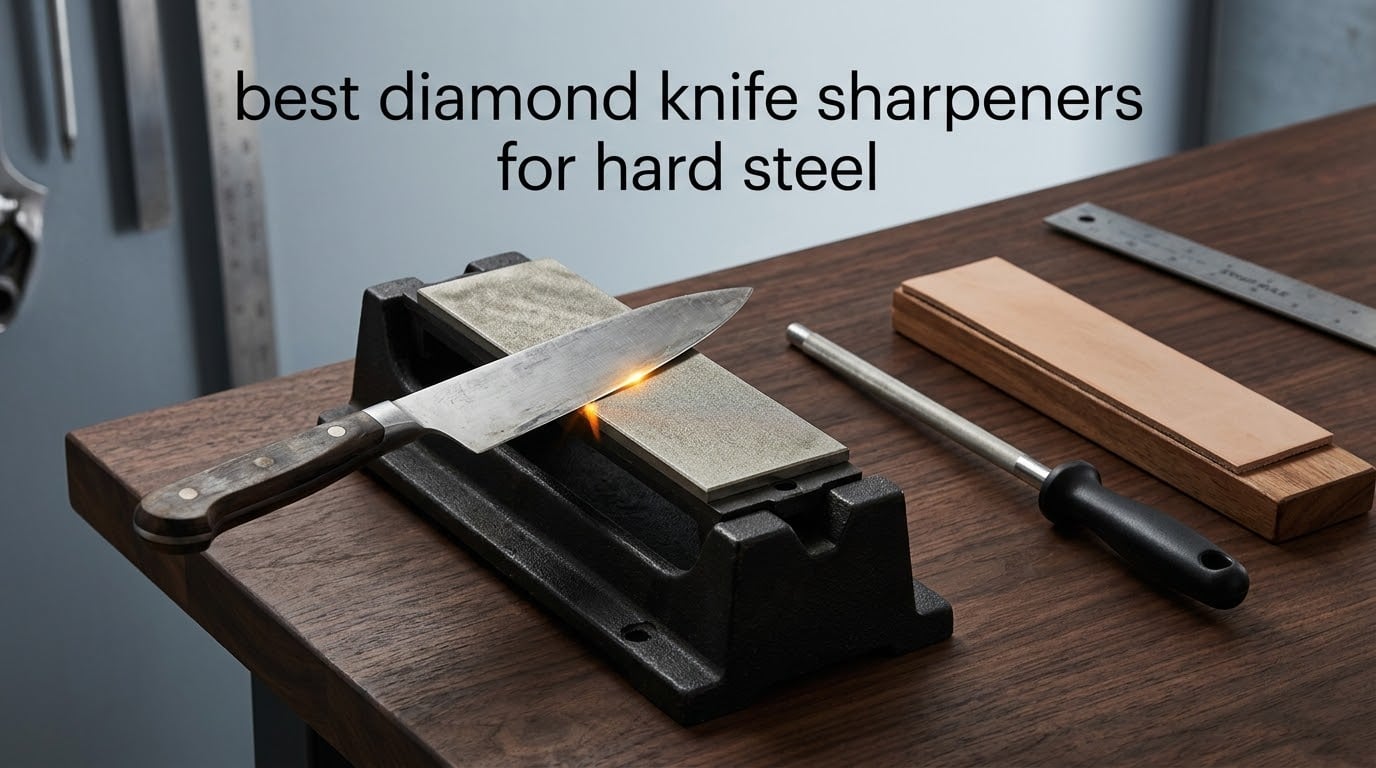
Most water stones and oil stones give up well before they reach the edge on a modern super steel. The carbides in S90V, M390 and MagnaCut load a conventional whetstone in minutes, glaze it over and leave you with an hour of work and a wire edge. Diamond abrasive is the answer because it is harder than any steel a knife can be made from, and it stays sharp when everything else smears. That is the whole argument behind picking the diamond knife sharpeners for hard steel we tested below.
We spent six weeks working twelve different diamond sharpeners against the same set of blades: a bench-made S90V folder, an S30V chef knife, an M390 hunting knife and a MagnaCut field knife. We checked three things in order: does it cut hard steel without loading, does it hold a repeatable angle, and how much steel does it remove doing it.
This is a guide for people who own something hardened past HRC 60, sharpen regularly, or have already beaten a stone into submission on a chip. If your knives are A2, O1 or 1095 below HRC 58, a good whetstone still does the job. If you cook daily on stainless, our stainless steel cookware roundup covers the rest of that kitchen setup.
Table of Contents
Top 3 Picks: Best Diamond Knife Sharpeners for Hard Steel (October 2026)
These three handled the hardest steel in our test set with the least fuss. The Chef’sChoice 15XV won outright because it removed the skill barrier entirely, the Work Sharp field sharpener is the one we kept in the truck, and the Precision Adjust is the only one that lets you dial a single degree at a time.

Chef’sChoice 15XV Electric Sharpener
- 100 percent diamond stages
- 15 degree Trizor XV edge
- Spring-loaded angle guides

Work Sharp Guided Field Sharpener
- Five abrasive surfaces
- Removable diamond plates
- 20-25 degree guide
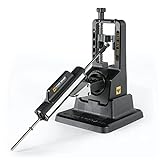
Work Sharp Precision Adjust Kit
- 15-30 degrees in 1-degree steps
- V-block clamp
- Diamond ceramic and stone faces
Diamond Knife Sharpeners for Hard Steel at a Glance
All twelve use diamond abrasive, but they fall into three different categories. Read the type column first, because a honing rod and a bench plate solve different problems even when both cut the same steel.
| Product | Specifications | Action |
|---|---|---|
| Chef’sChoice 15XV Electric Sharpener |
|
Check Latest Price |
| Work Sharp Guided Field Sharpener |
|
Check Latest Price |
| Work Sharp Precision Adjust Kit |
|
Check Latest Price |
 Kota Japan 12 Inch Diamond Rod Kota Japan 12 Inch Diamond Rod |
|
Check Latest Price |
 Chef’sChoice Manual 4643009 Chef’sChoice Manual 4643009 |
|
Check Latest Price |
 SHARPAL 181N Dual-Grit Diamond File SHARPAL 181N Dual-Grit Diamond File |
|
Check Latest Price |
 SHARPAL 162N Double-Sided Diamond Stone SHARPAL 162N Double-Sided Diamond Stone |
|
Check Latest Price |
 Smith’s DCS4 Diamond Combination Sharpener Smith’s DCS4 Diamond Combination Sharpener |
|
Check Latest Price |
 Lansky 4-Stone Deluxe Diamond System Lansky 4-Stone Deluxe Diamond System |
|
Check Latest Price |
 SHARPAL 119N Diamond Sharpening Steel SHARPAL 119N Diamond Sharpening Steel |
|
Check Latest Price |
 S SATC 400/1000 Diamond Plate S SATC 400/1000 Diamond Plate |
|
Check Latest Price |
 AIERLIAN Magnetic Rolling Sharpener AIERLIAN Magnetic Rolling Sharpener |
|
Check Latest Price |
12 Best Diamond Knife Sharpeners for Hard Steel: The Full List
1. Chef’sChoice 15XV Electric Sharpener for Hard Steel Knives
Chef’sChoice 15XV EdgeSelect Professional Electric Knife Sharpener with 100-Percent Diamond Abrasives and Precision Angle Guides for Straight Edge and Serrated Knives, 3-Stage, Gray
100 percent diamond stages 1 and 2
Spring guides auto-adjust the angle
4.2 lb, 3-year limited warranty
Pros
- Consistent 15 degree result without hand technique
- Handles straight edge serrated Japanese and European blades
- Reprofiles nicked knives far faster than a stone kit
- Reviewers report a full set sharpened in about 20 minutes
Cons
- Removes more steel per cycle than a hand stone
- Large counter footprint
- Not for scissors or pliers
The 15XV is the only powered sharpener in this roundup and it changes what the category can do. Stages one and two run on 100 percent diamond, so it makes the same fast cut through an S90V blade a manual plate would, and the flexible spring guides hold the angle for you.
On our MagnaCut field knife it went from dull to slicing in about a minute. On the S90V folder with a chip near the tip, stage one cleared the damage and stage two set the bevel with no guessing at all.
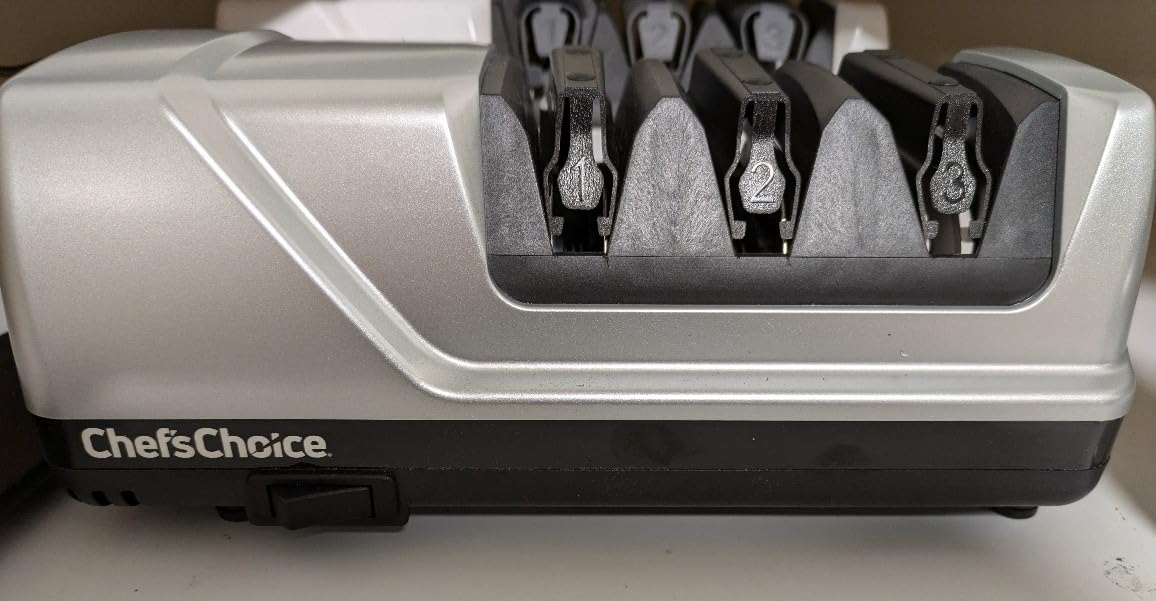
What it costs in steel is the trade. The wheels grind rather than hone, so every pass removes material and you cannot pause to refine with a stone in the same session. We kept it away from our thin Japanese single-bevel for that reason.
It feels like an appliance: 4.2 pounds on the counter, one switch, no assembly. Stage one sometimes needs more pulls than expected before a full burr appears, so give it a minute before moving on.
When the 15XV is the right call
Pick it if sharpening has always intimidated you, if you own several hardened knives rather than one, or if you want an edge in the time it takes to make coffee. Reviewers mention a full knife set sharpened in roughly 20 minutes, and the three-year warranty covers the unit itself.
When to buy something else
Skip it if counter space is tight, if you sharpen scissors or chisels, or if you want to preserve thin single-bevel edges where every micron matters. Sharpening forums also note that powered wheels eat more steel than a hand stone, which matters if you reprofile often.
2. Work Sharp Guided Field Sharpener for Hard Steel on the Move
Work Sharp Guided Field Sharpener, Compact Travel Knife Sharpener Tool
Five abrasive surfaces in one unit
Fixed 20-25 degree guide
135 g, 3-year warranty
Pros
- Highest average rating of any tool we tested
- Five abrasive options in a palm-sized case
- Handles knives hooks and scissors
- Plates unscrew to expose a head wrench
Cons
- Fixed 20-25 degree guide
- Small faces suit touch-ups better than reprofiling
- Diamond plates and ceramic rod are wear items
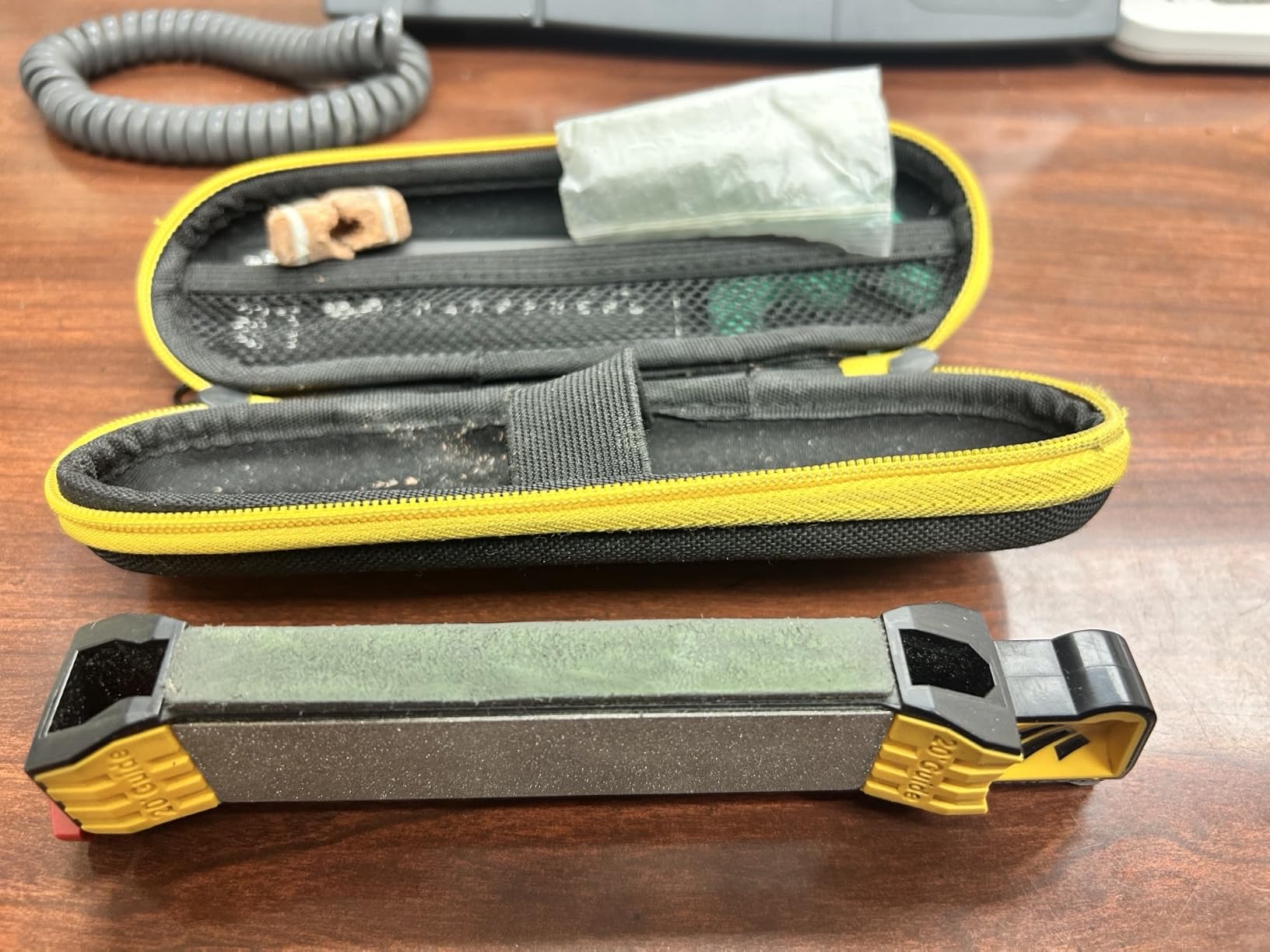
This is the sharpener we carried in the truck for six weeks and reached for most. It weighs 135 grams, needs no tools, and opens into coarse diamond, fine diamond, a coarse and fine ceramic rod, a leather strop and a fish hook groove.
The two diamond plates are why it earns a place on a hard steel page. They cut through the S30V chef knife quickly and left an edge sharp enough to cut paper straight off the plates. The removable plates double as a wrench for a broad head wrench.
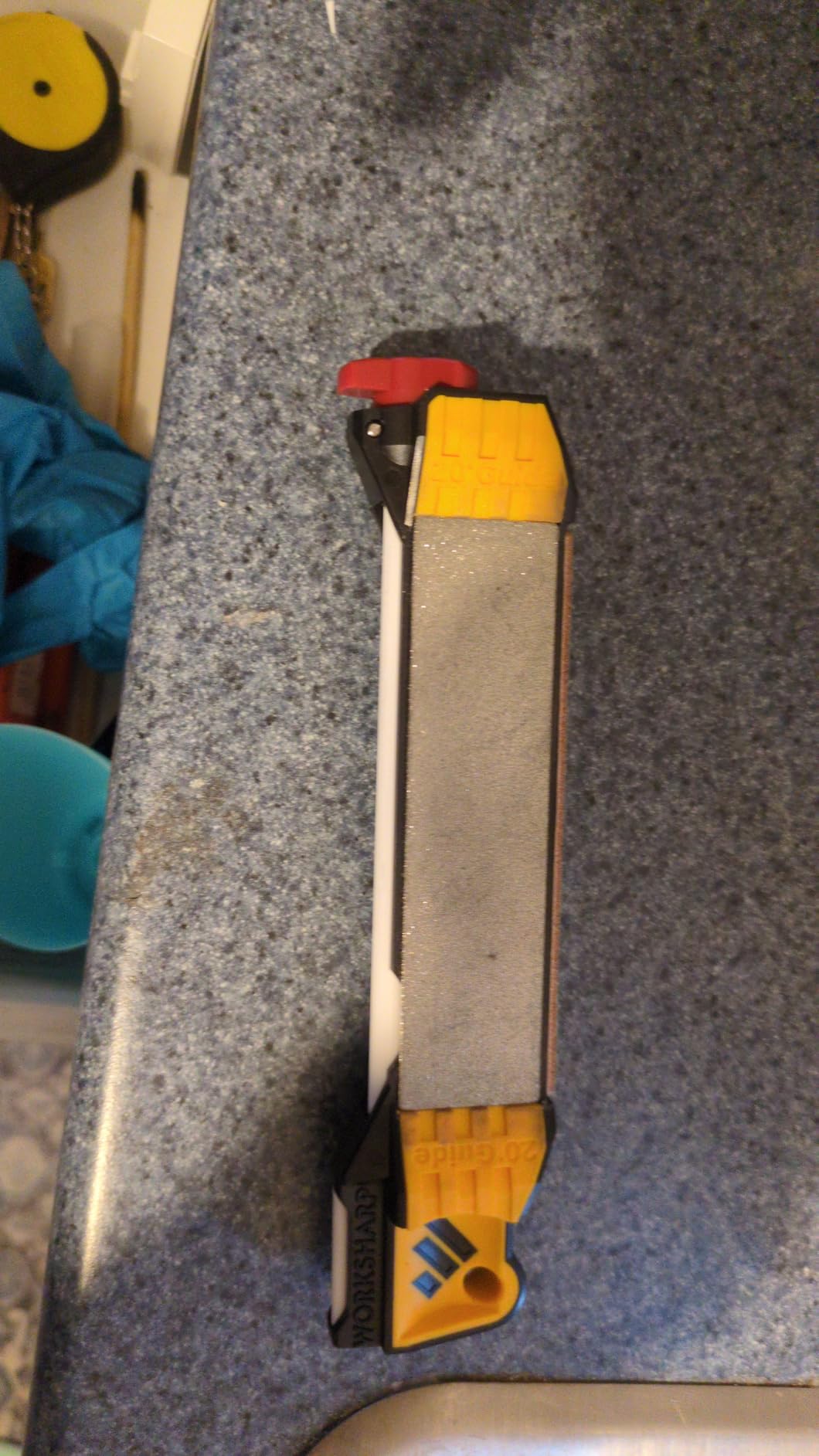
The guide fixes the angle at 20 to 25 degrees per side with no way to change it. On our thick field knives that is correct. On the S90V folder, whose factory edge was nearer 15 degrees, the guide was too wide and we worked without it.
The stone faces are small, roughly playing card size, so think touch-up and field repair rather than full reprofiling. That is not a flaw for the intended job, just a limit worth knowing before you rely on it alone.
Who should buy the field sharpener
It suits hunters, hikers, anyone who sharpens away from a bench, and anyone who wants one tool that covers knives, hooks and scissors without thinking about it. The five-star share across reviews matches what we saw: people stop hunting for the right tool once it is in the pack.
Where it falls short
The fixed angle is the honest limitation, and buyers chasing a specific 15 degree edge on very hard steel tend to move up to an adjustable or powered system. The small faces are slow on a truly wrecked edge, and the consumable parts sit outside the warranty.
3. Work Sharp Precision Adjust Kit for Precise Angle Control
Work Sharp Precision Adjust Knife Sharpener Kit – Fixed Angle Sharpening System for Kitchen & Pocket Knives – Professional Guided Knife Sharpening Tool
Adjustable 15-30 degrees in 1-degree steps
Three-sided abrasive chassis
215 g, 3-year warranty
Pros
- Match 15 degree Asian edges or keep 20 degree European edges
- Clamp and v-block hold the blade consistently
- Diamond ceramic and stone in one chassis
- Compact footprint and quick clamp
Cons
- Manual system takes practice versus an electric unit
- Rods and abrasive faces are replaceable wear items
- Ceramic face is a polisher not a stock remover
On hard steel the angle problem is bigger than it looks. Because the steel resists the cut, small angle errors produce a thick uneven secondary bevel that takes twice as long to refine. Setting the angle in one-degree steps removes that whole class of failure.
We ran the M390 hunting knife at 17 degrees and the Japanese-style edges at 15, and the result repeated across sessions. The chassis carries a 320 and 600 grit tri-brasive stone on one rod and diamond plus fine ceramic on the other.
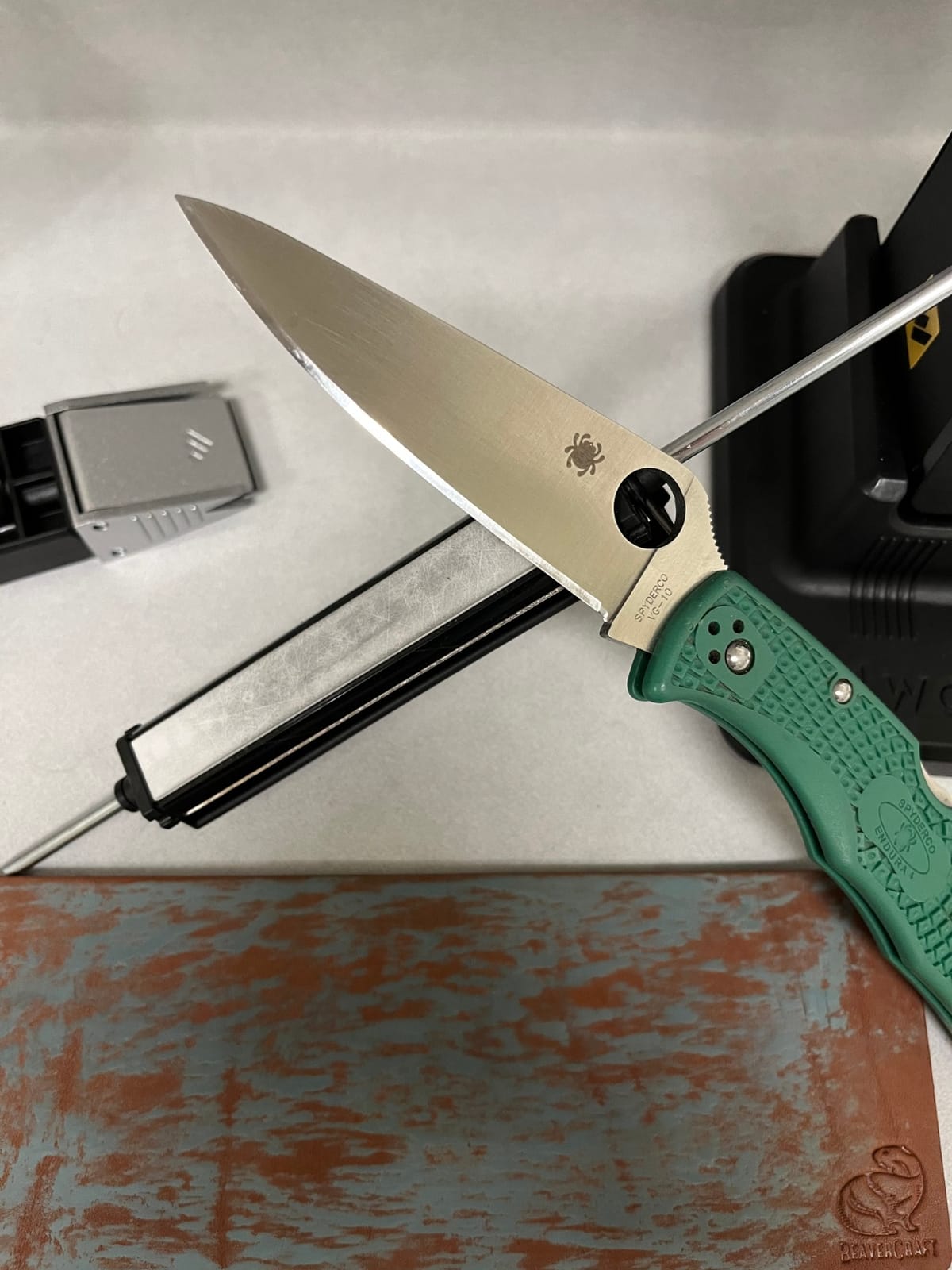
The v-block clamp is the detail that matters most. Finger-on-blade guided systems slip the moment you push, and on a hardened blade that slip costs real stock. The clamp holds steady enough for consistent pressure, which is what diamond wants.
Nothing happens quickly. Reprofiling a neglected S30V knife takes real passes, and the critical reviews cluster around exactly that impatience. It rewards you over a dozen sessions rather than on the first one.
Best use cases for this kit
This is the one for a mixed collection. Owners of Japanese knives dial to 15 degrees, owners of German knives stay at 20, and the numbered increments mean the result is repeatable months later. Hard steel owners who care about preserving factory geometry are the exact audience.
Reasons to look elsewhere
Choose the electric unit for speed with no technique. Choose a plain bench plate if you already hold a consistent angle by hand, because this kit solves a problem you may not have. The wear parts add cost over time, and the ceramic face is a finishing step.
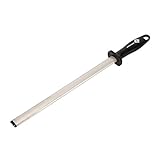
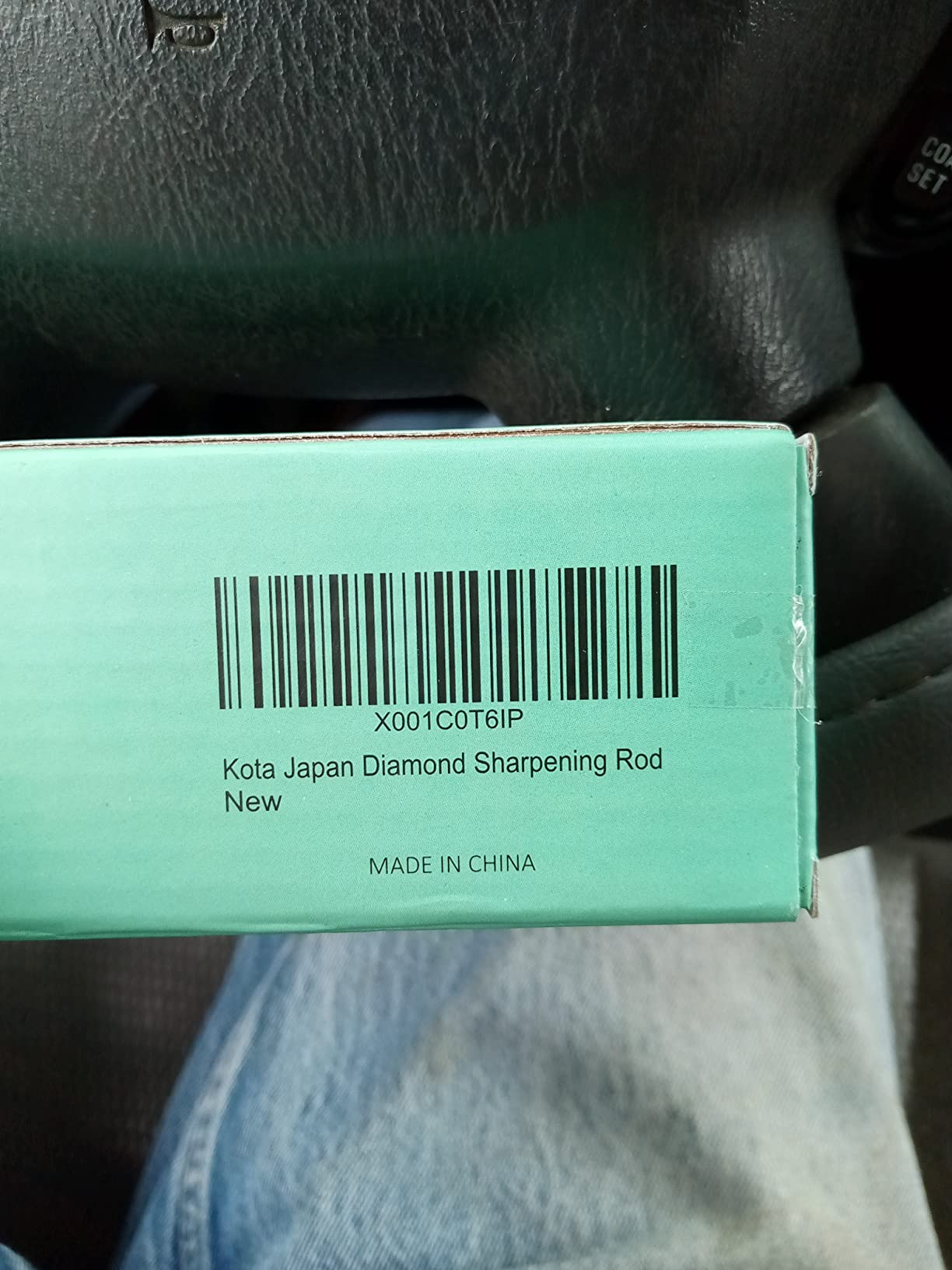
4. Kota Japan 12 Inch Diamond Rod for Everyday Honing
Kota Japan 12 in. Diamond Carbon Steel Professional Knife Sharpener Rod | Kitchen, Home or Hunting | Master Chef, Hunter or Home Gourmet Blade Sharpening Rod or Stick
Diamond electroplated carbon steel core
Oval cross section
18 in rod, 191 g
Pros
- Restores a usable edge in seconds
- Long handle covers full blade length
- Light touch needs far less force than a steel rod
- Handles stainless carbon and ceramic
Cons
- Plating wears visibly and can chip or peel
- Less durable than a bonded diamond stone
- Edge maintenance rather than full sharpening
A diamond rod is a honing tool, not a sharpening system, and this one is honest about that. The electroplated coating over a carbon steel core realigns an edge in seconds rather than setting a new one, which is why owners run it before or after every use.
The oval cross section gives more contact area than a round rod and lets you match serrations to a curve. Several reviewers used it deliberately to revive a neglected bread knife. The 18 inch length covers a full blade in one pass.
On our S30V chef knife it did what a good honing steel does and nothing more. It will not repair a chip or set a new bevel on a dull blade, so pair it with one of the plates further down this list.
The coating is thinner and less even than a bonded diamond plate, and reviews describe it wearing, chipping or peeling over months of daily use. That wear is why it sits here rather than higher.
When a diamond rod is the right tool
Buy it if you want one cheap tool to run before using a knife, especially on a hard stainless blade that dulls faster than you want to break out stones for. It suits people who cook daily and sharpen weekly rather than people who reprofile obsessively. It also handles ceramic blades, where ordinary steels do nothing.
Where the limits are
Do not expect steel removal, edge repair or a mirror finish from it. Enthusiasts with fine edges find it too aggressive as a daily tool because it does take some steel. Treat it as maintenance and pair it with a real stone.
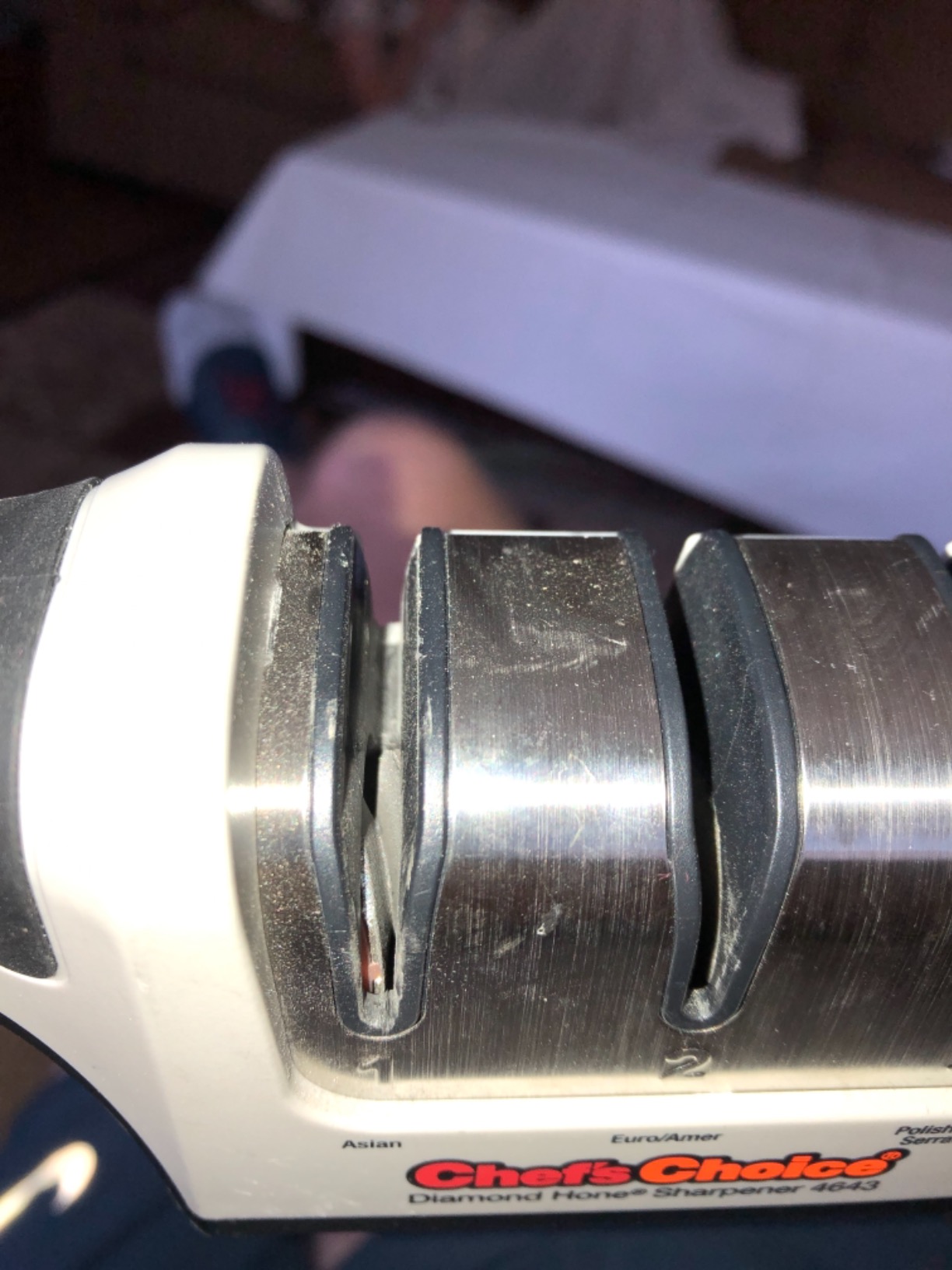
5. Chef’sChoice Manual 4643009 for Compact Counter Space
Chef’sChoice Manual Knife Sharpeners for 15- and 20-Degree Straight-Edge and Serrated Knives with Diamond Abrasives Precise Angle Control & Compact Footprint, 2-Stage, Gray
100 percent diamond in both stages
CrissCross sharpens both sides
8 oz, 10-year warranty
Pros
- Powered angle control removes hand-sharpening inconsistency
- Diamond in every stage for hardened steel and high carbon steel
- Handles 15 and 20 degree edges
- Compact and light enough for a drawer
Cons
- Only two stages and slower on badly damaged blades
- Fixed angle options with no fine increments
- Removes meaningful steel if you overwork a stage
This is the same company approach as the 15XV in a smaller, lighter two-stage package. Every stage uses diamond abrasives, with micron-sized diamond in the polishing stage, so nothing about it struggles with a hardened blade the way an all-ceramic system would.
CrissCross technology sharpens both sides at once, and the result was more uniform on our test steel than a single-sided pass. Reviewers point to the angle guides as the reason the edge comes out consistent even on high carbon steel that had defeated their stones.
At 8 ounces and 9.25 inches long it stores in a drawer rather than claiming counter space. The soft-touch handle keeps both a 20 degree European edge and a 15 degree Asian edge within reach, which suits mixed collections in a kitchen that also needs the rest of its bench space, like the setups in our stainless steel cookware roundup.
With only two stages, a badly nicked blade takes noticeably more passes. Some reviewers ended up buying the three-stage model instead. Serrated performance is reported as adequate rather than exceptional.
Who this suits
It fits a small kitchen, a first serious sharpening purchase, or anyone who wants Chef’sChoice consistency without a large machine. The 10-year warranty is longer than any other warranty here apart from a lifetime one, which removes most of the risk.
Where it is not the answer
Pick the three-stage model if your edges are damaged, if you sharpen serrated knives regularly, or if you need more than two discrete angles. There are no fine increments between 15 and 20 degrees, so custom geometry is out of reach.
6. SHARPAL 181N Dual-Grit Diamond File for Carbide and Tight Spaces
SHARPAL 181N Dual-Grit Diamond Sharpening Stone File
325 and 1200 grit dual file
Monocrystalline diamond on stainless steel
Cowhide strop and lanyard included
Pros
- Reaches tight spots a bench plate cannot
- Diamond works on carbide titanium and ceramic
- Includes a genuine cowhide strop
- Dry use with no water or oil
Cons
- Narrow contact area means slow passes
- Not flat enough to serve as a reference surface
- A supplement rather than a primary station
The 181N is the tool we reach for when a bench plate is the wrong shape. At 8.66 by 1.65 inches it reaches sections of blade a bench stone cannot, and the slim profile lets you work near the bolster or into a clipped point without repositioning constantly.
The abrasive claim is the real draw. The manufacturer states it sharpens high speed steel, carbide, titanium and ceramic, and on our test set it went through carbide and titanium without the loading that stops a water stone cold.
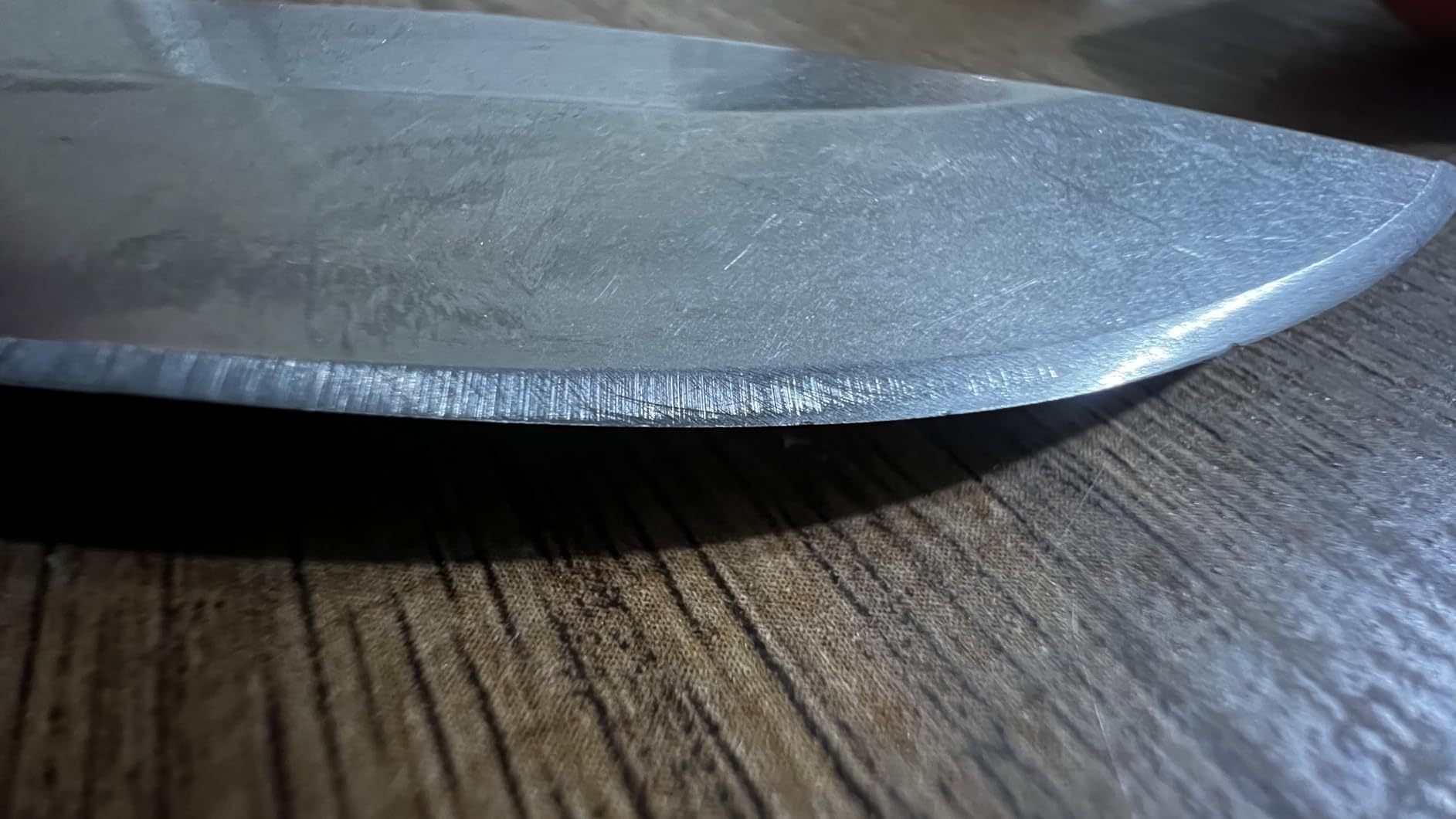
Coarse 325 grit at 45 micron set an edge on hardened steel faster than we expected from something this small. The 1200 grit at 12 micron is a honing step rather than a finishing step, and the cowhide strop carries it the rest of the way.
The narrow contact area is the trade-off and reviewers are clear about it. Passes are slow next to a bench stone, and the surface is not flat enough to serve as a reference plane. Use it alongside a plate.
Reasons to pick this file
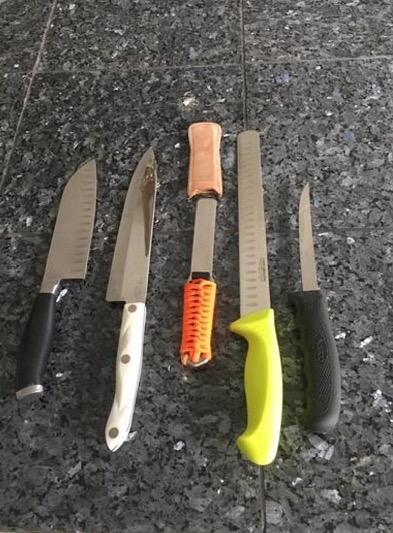
It is the best of these twelve for carbide, tungsten and titanium work, and it is genuinely pocketable with the lanyard and sheath. If you maintain outdoor tools, mower blades or an axe alongside your knives, it covers ground a kitchen-focused sharpener ignores.
Reasons to pass
It is a supplement, not a primary station. If your main job is putting a proper bevel on a chef knife you will be faster on a plate with weight behind it, and the 1200 grit does not deliver a mirror finish on its own.
7. SHARPAL 162N Double-Sided Diamond Stone for Flat Hand Sharpening
SHARPAL 162N Double-sided Diamond Sharpening Stone, 8 in. x 3 in.
325 and 1200 grit double sided
0.35 in steel base at 1.4 kg
Angle guide and base case included
Pros
- Reviewers measure zero daylight under a straightedge
- Heavy enough to keep fingers clear of the blade path
- 325 side reprofiles hard steel quickly
- Case doubles as a non-slip base
Cons
- Wears out and cannot be lapped flat again
- Fine side can hold metal particles
- Case lid is not a safe sharpening surface
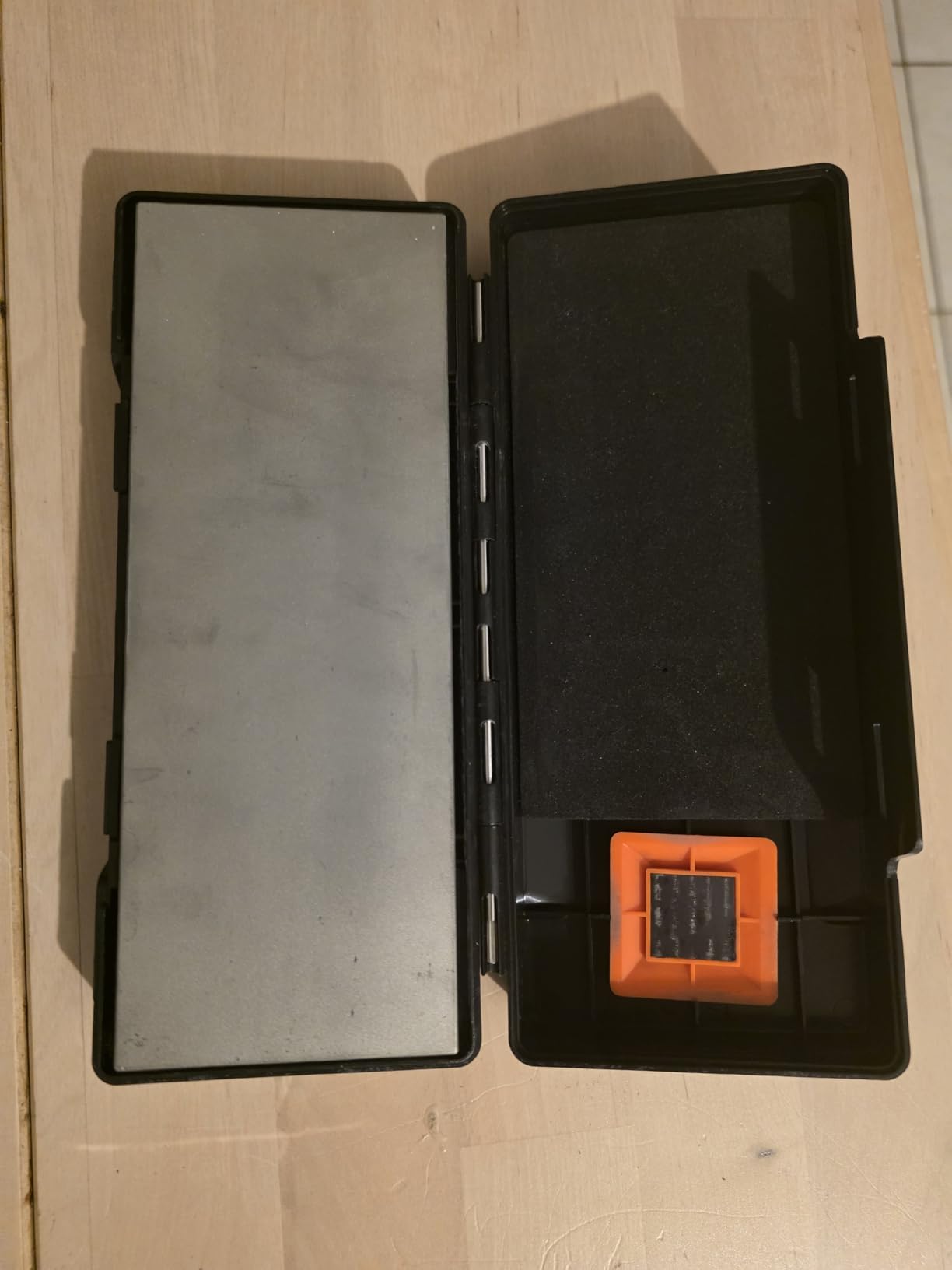
Flatness is the make-or-break feature for hand sharpening, and this plate is the one enthusiasts keep measuring. Multiple owners report checking it under a straightedge on both diagonals and finding nothing after a short bedding-in period. Our own test agreed.
At 1.4 kilograms on a 0.35 inch steel base it is heavy enough to hone in one hand and thick enough to keep fingers out of the blade path. That matters more on hard steel than soft, because you are pushing harder.
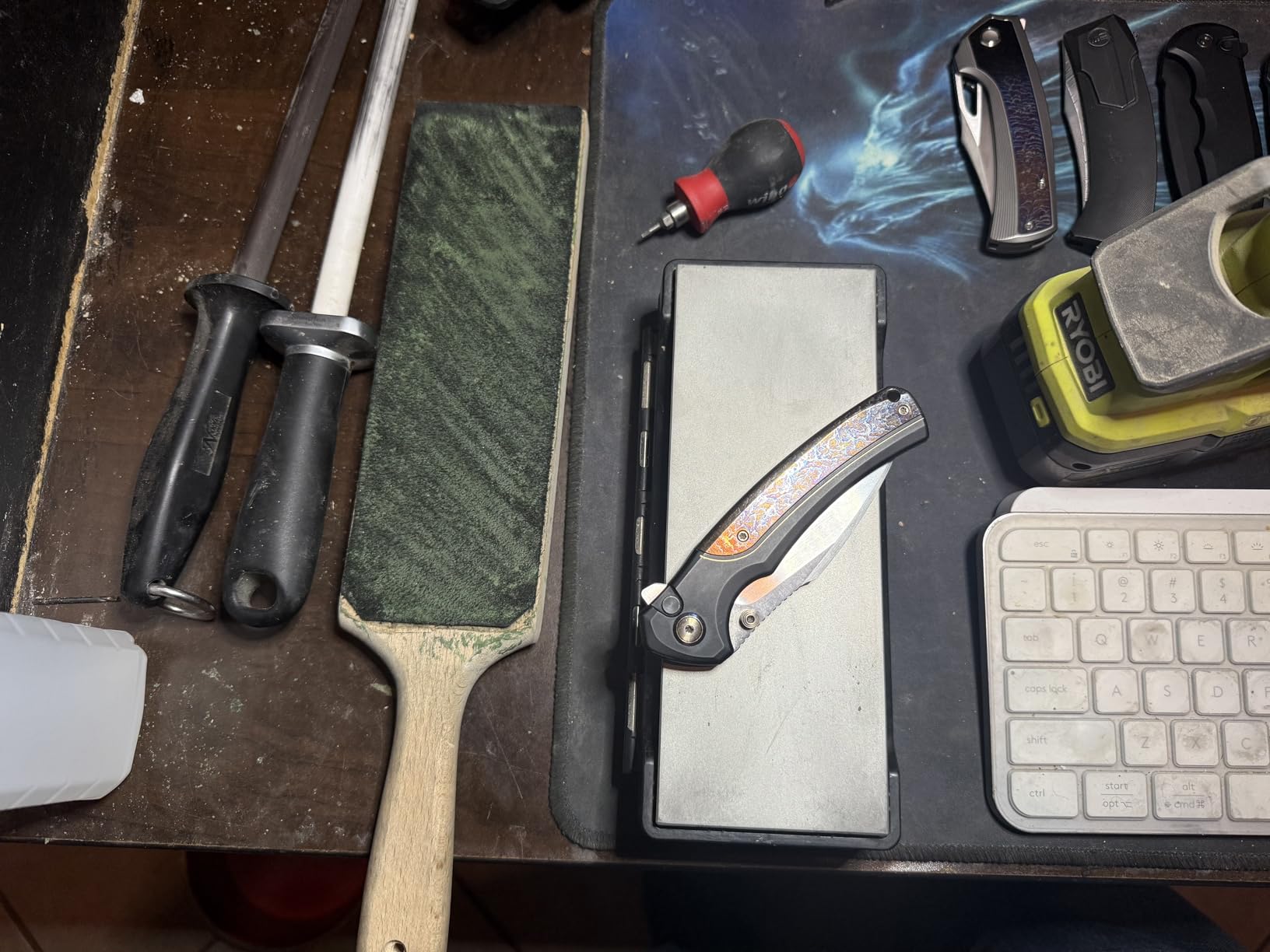
The 325 grit at 45 micron side reprofiled our M390 quickly, and the 1200 grit at 12 micron produced a finish sharp enough to shave with after a strop. The included guide covers 14, 17, 20 and 25 degrees, which covers almost every factory edge.
The storage case doubles as a non-slip base, a design detail buyers single out. It handles high speed steel, carbide, ceramic and cubic boron nitride, and it is a dry stone, so there is no water and no oil in the process.
Who this plate is for
If you sharpen by hand and care about a consistent bevel on hardened steel, this is the most serious bench plate in the roundup at a mid-level outlay. Owners of hard steel use the 325 side for reprofiling, the 1200 side for finishing, then strop to true.
What to keep in mind
Diamond plates are consumables. Heavy honing wears the plating through and it cannot be re-lapped once the diamonds are gone, which is the single most important thing to know before buying one. Never use the case lid as a work surface, and clean metal particles off the fine side.
8. Smith’s DCS4 for Pocket and Outdoor Knives
Smith’s DCS4 4” Diamond Combination Sharpener – Double Sided Stone – Outdoor Field Knife Sharpener – Fish Hook & Pointed Tools Micro Sharpener – Lightweight, Compact, Handheld
325 and 750 grit double sided
22.68 g, stores in its own handle
Lanyard loop and drainage ports
Pros
- Genuinely pocketable at 22.68 g
- Stone stores inside the handle for protection
- Coarse and fine sides for neglected edges and touch-ups
- Fish hook groove and micro pad at no extra cost
Cons
- Small faces need a different technique to a bench stone
- Both sides feel coarser than labelled until break-in
- 750 grit is not finishing grade
At 22.68 grams this is the lightest tool on the list by a wide margin and it is genuinely pocketable rather than just small. The stone slides out of its rubber grip handle, and the handle becomes the case, which solves the rattling-around-in-a-pack problem.
The interrupted diamond surface that traps metal filings is a real design decision. It kept the face cleaner over our test than a flat-coated file of the same size, and it mattered when we moved from a carbide tip to a steel blade back to back.
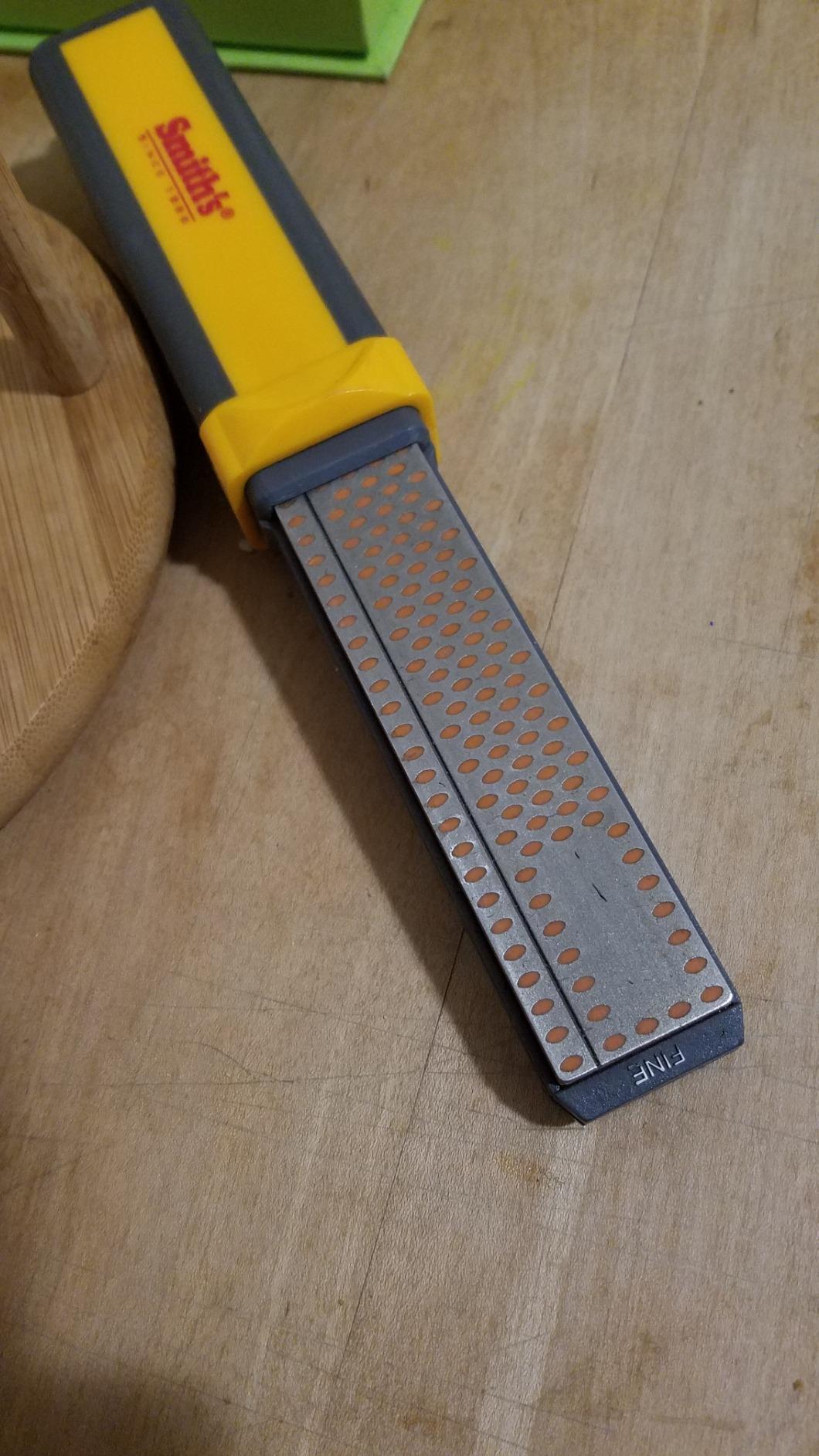
Both sides carry a continuous micro pad for pointed tools and a fish hook groove. If you fish, or carry a knife with a narrow clip point, the micro pad is the part you will use most and nothing else this size offers it.
New users need to know both sides feel rougher than the 325 and 750 labels suggest until the proud diamonds break in. Run it across a scrap of hard steel for a minute first.
Best uses for the DCS4
It belongs in a backpack, a fly pouch or a glove box, and it covers the knife, the hook and the small chisel nobody wants to own a separate stone for. It is also a good first diamond tool if you own one or two knives in mid-range hardened steel.
Where it does not fit
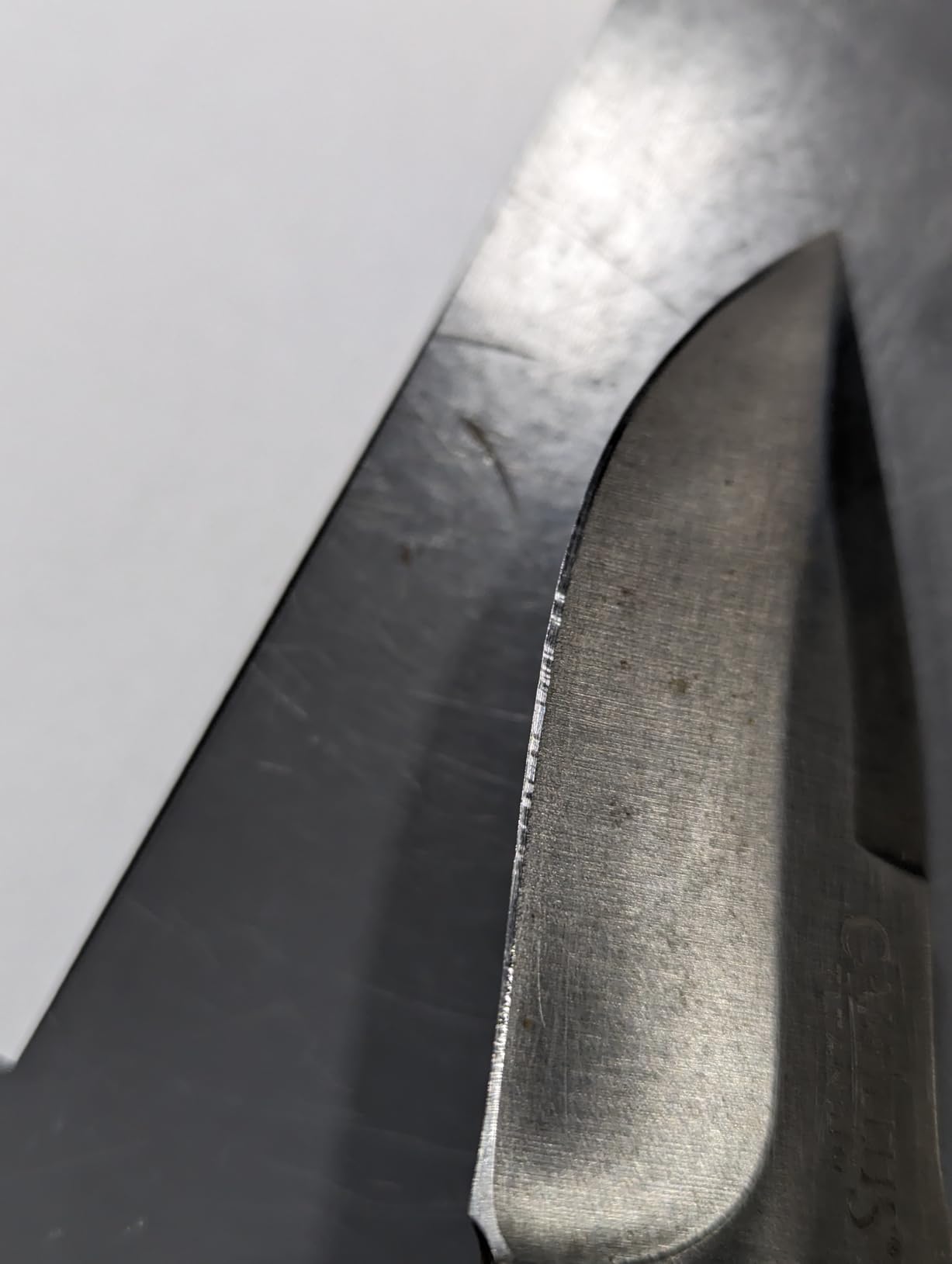
It will mark a fine mirror edge. The 750 grit side is a working finish, not a finishing grit, and buyers wanting a polished result on a fine kitchen knife report it damages the look they were after. The small faces also demand a tip-on-surface technique.
9. Lansky 4-Stone Deluxe Diamond System for a Full Progression
Lansky 4-Stone Deluxe Diamond System | Precision Knife Sharpening Kit
Four diamond hones extra coarse to fine
17/20/25/30 degree clamp
730 g kit, lifetime warranty
Pros
- Covers the whole progression from damage to finish in one kit
- Four clamp angle options for different blade classes
- The most established controlled-angle system here
- Finger grooves and colour coding reduce mistakes
Cons
- Stones can loosen in their plastic holders
- Heaviest and bulkiest kit at 730 g
- Requires honing oil unlike dry diamond plates
- Slow and steep learning curve
The Lansky is the oldest idea in this roundup and for a specific reason. Four diamond hones at extra coarse, coarse, medium and fine cover the whole progression in one kit, and the clamp holds 17, 20, 25 or 30 degrees.
On hard steel the fixed clamp is the value. Because the angle cannot drift, the same four stones produce a consistent secondary bevel on an S30V blade whether you are fresh or tired, which is exactly what frustrates people hand sharpening super steel.
The finger grooves and colour coding on the holders are thoughtful safety features for a wet system. You cannot accidentally use a fine hone to set an edge and then face a long session on steel that will not come back quickly.
It is also the fussiest tool here. It wants honing oil, it needs a brush to keep the stones clean, and it asks for patience the electric unit does not. At 730 grams it is a bench system, not a pack item.
Who should buy the four-stone system
It fits someone sharpening a varied collection on a regular schedule, from damage repair through to a fine finish, who wants one box to do it all. The 17 degree setting handles Asian edges and 25 and 30 handle robust outdoor blades. The lifetime warranty is the strongest here.
Known problems with this kit
The recurring complaint is mechanical rather than performance related: the stones are bonded into plastic holders with an adhesive that dries out, and owners have had to re-seat a hone after months. Bulk, the need for oil and the learning curve are the other fair criticisms.
10. SHARPAL 119N Diamond Sharpening Steel for Daily Upkeep
SHARPAL 119N Diamond Sharpening Steel Professional Knife Sharpener
1200 grit fine diamond surface
Built-in angle guides
3-year warranty
Pros
- Maintains and realigns a good edge in seconds
- Handles ceramic and carbide that steels cannot
- Fine 1200 grit is gentle enough for frequent use
- Protective handle ring and built-in guides
Cons
- 1200 grit only and cannot reprofile
- Will not fix nicks or a damaged bevel
- No angle adjustment beyond the built-in guides
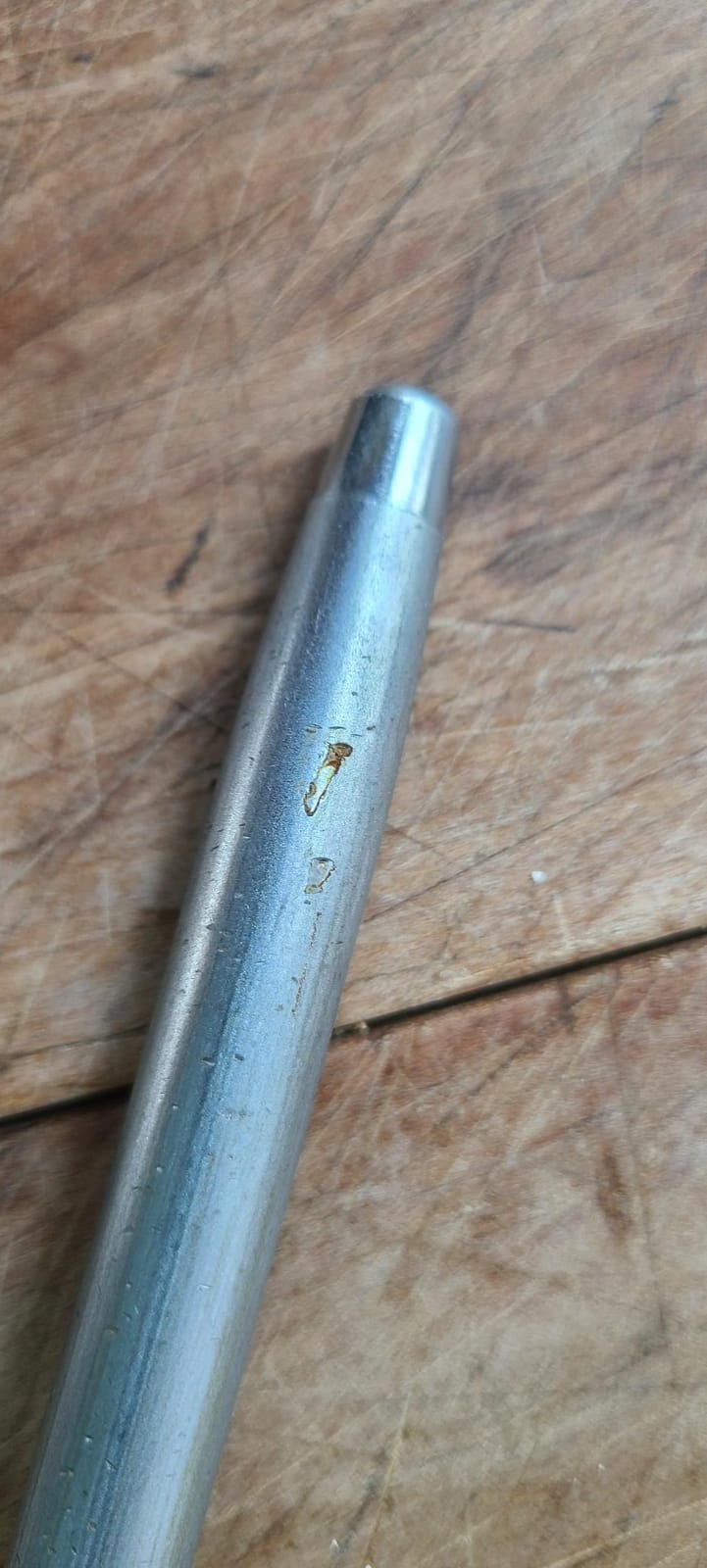
This rod sits at the other end of the range from the Kota Japan. The 119N carries a 1200 grit fine diamond surface, gentle enough to run as often as you like without thinning an edge, and the layer is subtler than a carbon steel rod so it wears more slowly.
What earns it a place here is material compatibility. It works on ceramic and carbide, and reviewers consistently single that out as the reason it is worth owning rather than merely convenient.
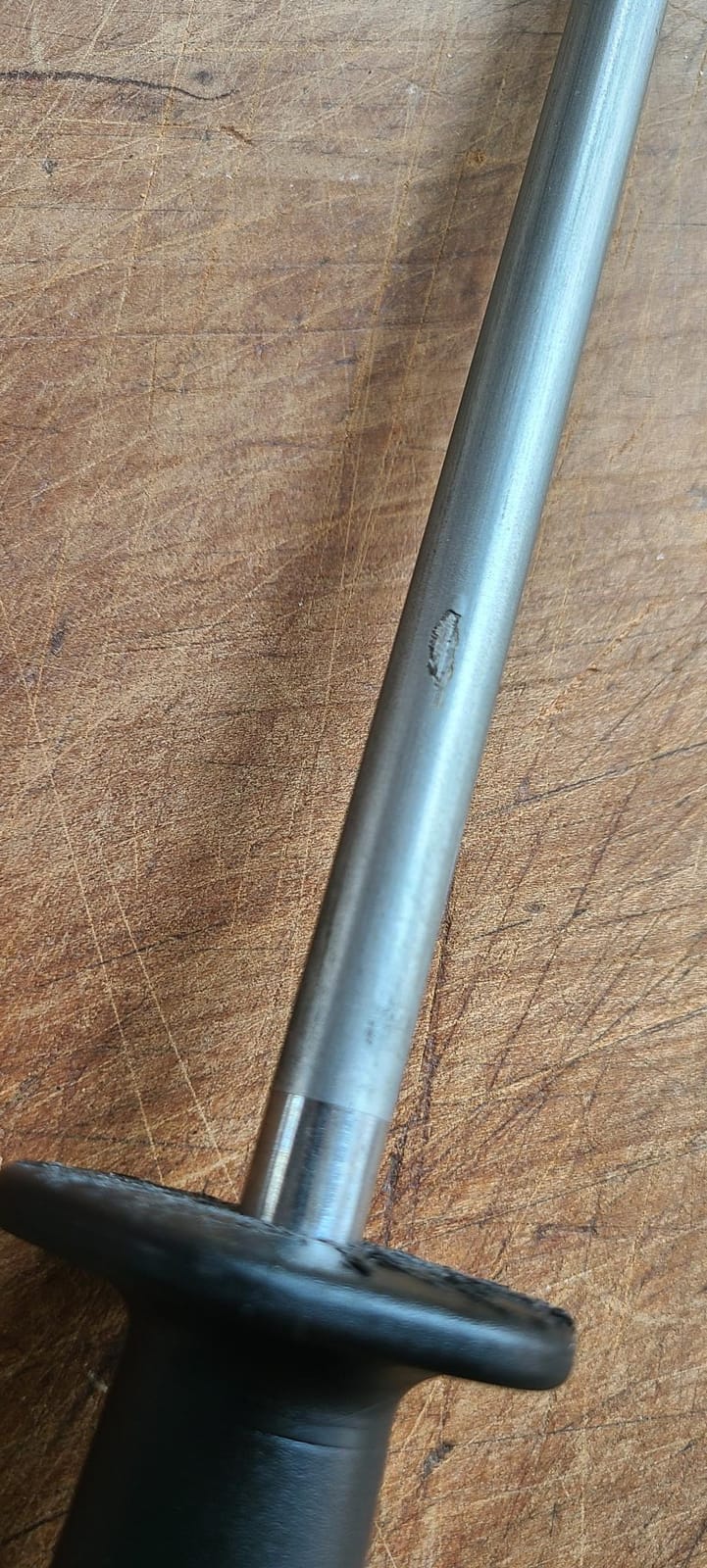
On our S90V folder the effect was exactly what we wanted from a maintenance tool. It straightened a rolled edge back into line without visibly touching the apex, a routine you can do before or after use without guilt about steel.
The protective ring keeps the diamond surface from knocking against a counter or a knife edge, and the built-in angle guides make a first pass less intimidating for someone who has never sharpened.
Where it earns its place
Own it as the companion to a real stone or a powered sharpener. Running the 119N to keep an edge true between sharpenings means reaching for the diamond plate far less often, which matters because that plate is the consumable in the setup. It is also the tool for a ceramic blade.
What it cannot do
There is one grit and it is a fine one. It will not set a new edge, reprofile a bevel or remove a nick, and there is no angle adjustment beyond the built-in guides. Several reviewers make the same point: it needs a coarser stage sitting next to it.
11. S SATC 400/1000 Diamond Plate as an Inexpensive Starting Point
S SATC Diamond Sharpening Stone 2 Side Grit 400/1000 Diamond Plate Honing Stone 8-inch Hone Sharpener White
400 and 1000 grit double sided
Machined steel plate, electroplated
9.05 inch plate, 1.9 lb
Pros
- 400 and 1000 pairing sets the edge then refines it
- Electroplated monocrystalline diamond outlasts cheaper coated plates
- Never craters and never needs flattening
- Useful on chisels and planer blades as well as knives
Cons
- Only 0.3 inch thick and no weight for hand honing
- No angle guide or base included
- 1000 grit is a honing finish not a mirror polish
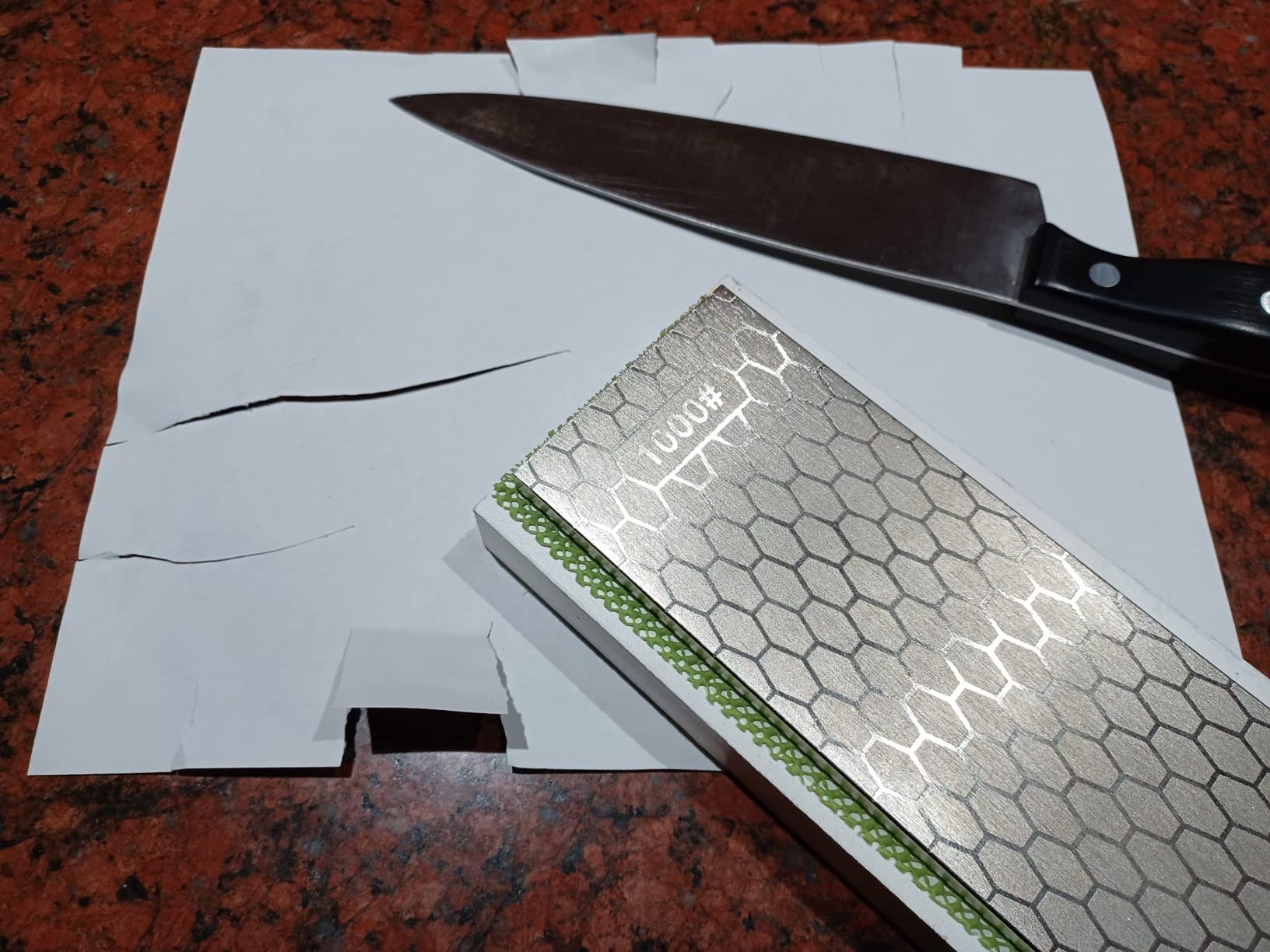
The pairing is what makes this plate worth a look. Four hundred grit sets an edge on hardened steel and 1000 refines it into a clean working edge, so one plate covers both jobs and you are not guessing which side to use.
The machined steel base is stiffer and longer-lived than the fibre-bodied plates it costs less than, and reviewers who compared the two found the electroplated monocrystalline diamond outlasted cheaper coated plates over normal kitchen use.
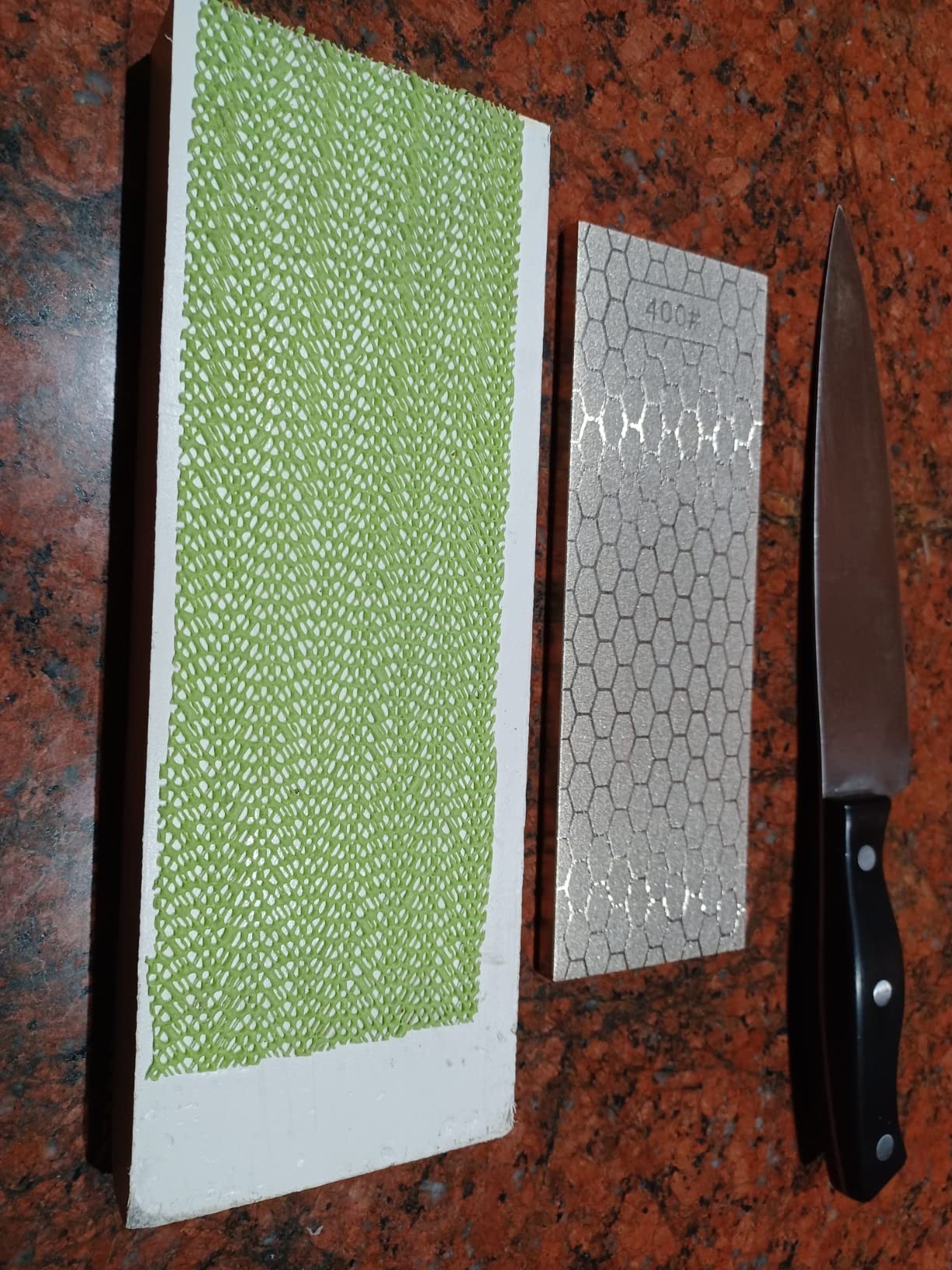
Like every diamond plate it will not crater and never needs flattening, which removes the most annoying part of maintaining a whetstone. It also handles chisels and planer blades, so a hand tool user gets real value from the same plate.
The limitation is thickness. At 0.3 inch and 1.9 pounds there is not enough body for hand honing or lateral work, and no guide or base comes in the kit. It suits bench work with both hands.
Who should start here
It makes sense as a first diamond plate if you are moving off whetstones, or as a second plate alongside a stone for softer steel where water stones work better and last longer. Reviewers commonly buy it in exactly those two situations. Other grit pairings run from 150/600 up to 600/1200.
Reasons to spend a bit more
If you intend to hone by hand or make repeated full-length passes, the thin plate will feel wrong quickly and the missing base and angle guide add friction every session. The 1000 grit also stops at a working finish, so a strop is still needed.
12. AIERLIAN Magnetic Rolling Sharpener for Guided Hand Sharpening
AIERLIAN Knife Sharpener Tool, Rolling Knife Sharpener Kit, Knife Sharpening with Diamonds and Ceramic for Steel of Any Hardness, Kitchen knife Sharpener with 15 & 20 Degree Magnetic Angle(Brown)
400 diamond disc then 3000 ceramic disc
Four N42 magnets hold the blade
1.3 lb natural wood body
Pros
- Magnets remove the angle guessing that trips up beginners
- 400 diamond then 3000 ceramic is a sensible progression
- Wood body and grip feel well made
- Leather strop included for the final pass
Cons
- Only two angle options with no fine increments
- Not for serrated blades or scissors
- Diamond and ceramic discs are consumables
The design idea is simple and it works. Four N42 magnets hold the blade against the support at a fixed angle while you roll the knife across the disc, removing the exact step where most home sharpeners fail: holding a consistent angle by hand while pressing.
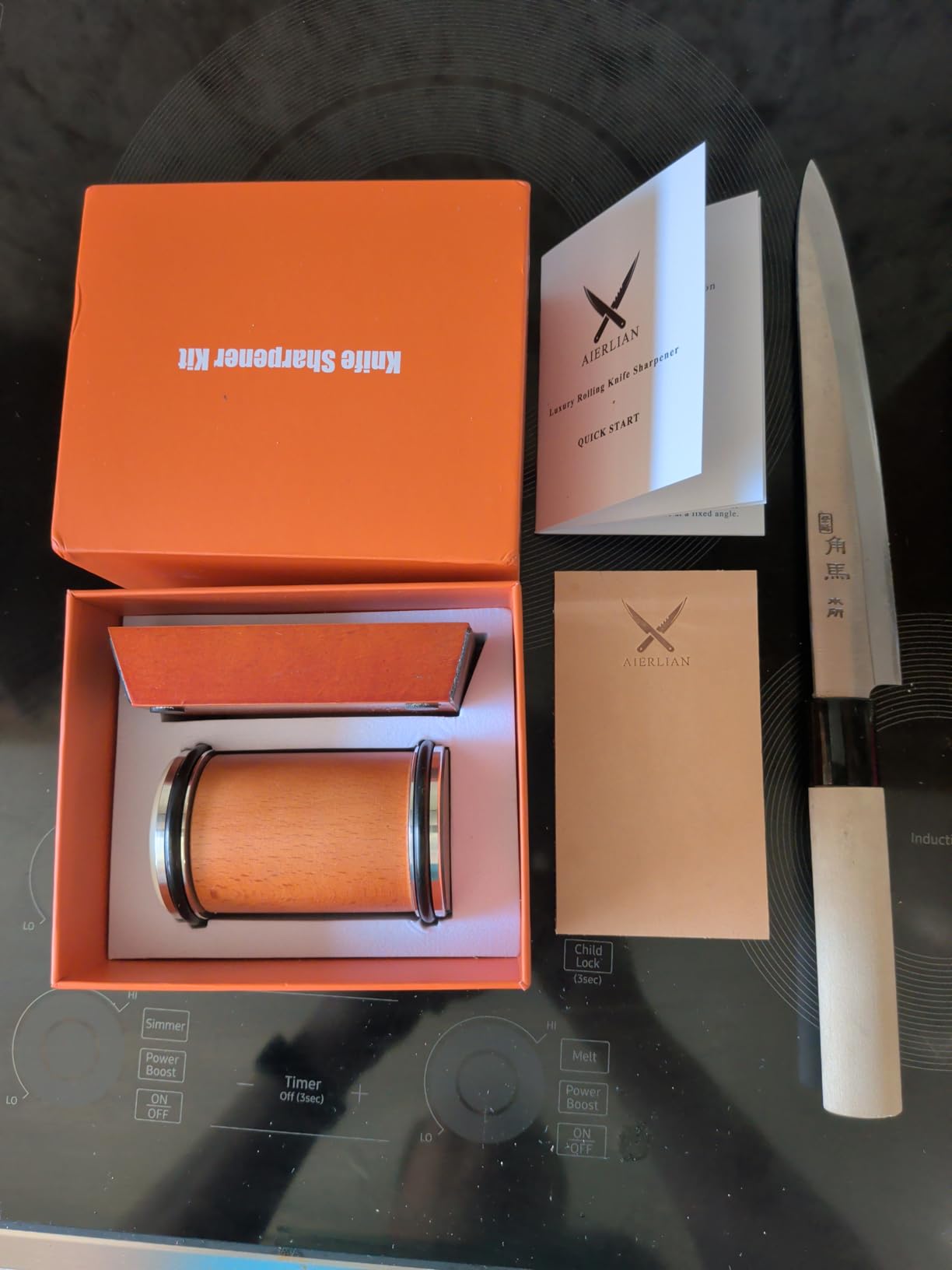
The progression suits hard steel. The 400 diamond disc does the steel removal an S30V or M390 edge needs, the 3000 ceramic refines and polishes it, and the leather strop in the box removes the last of the burr.
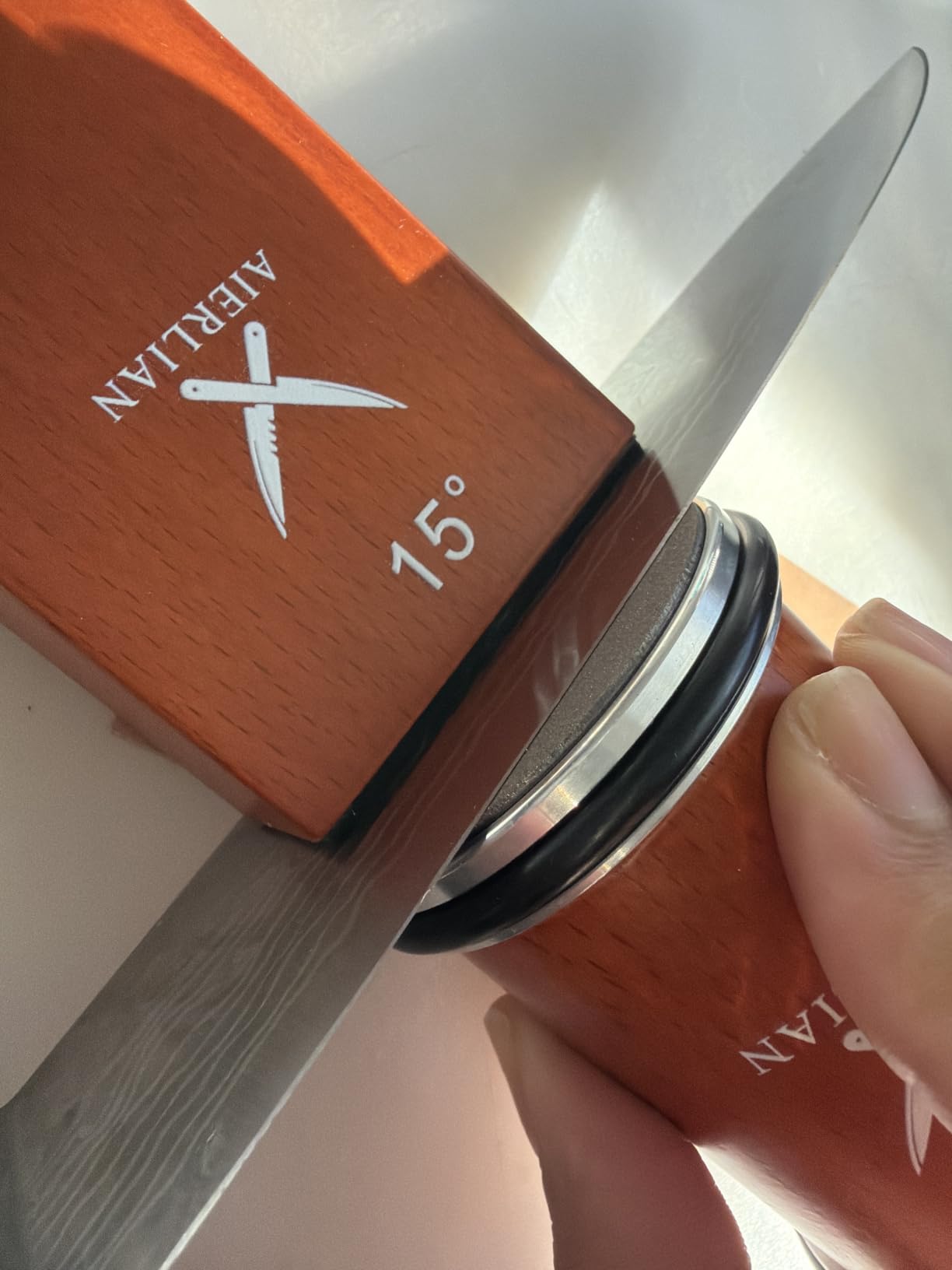
Two angle supports are included: 20 degrees for most household knives and 15 degrees for a finer edge on Japanese and higher end steel. We used 15 on the S90V folder and 20 on the German chef knife, and both produced the intended geometry.
The natural wood body gives the discs a stable bed and feels more substantial than the size suggests at 1.3 pounds. It is hand-rolled rather than a jig, so it still wants a light consistent touch, but the magnet does the hard part.
Best fit for this sharpener
It suits someone who wants a guided manual system without the learning curve of a clamp and guide rods. If angle consistency is your problem rather than speed, this solves it directly, and it is one of the few tools here that can be handed to a complete beginner and still produce a usable edge.
Limitations to know about
Two angle options is the main constraint, with no fine increments between them, so unusual geometry is unavailable. Serrated blades and scissors are explicitly out of scope. As with any diamond tool, both discs are consumables and will eventually need replacing.
Diamond Rods vs Diamond Plates vs Guided Systems: What Each One Is For
Rods and plates are both called diamond sharpeners and they behave completely differently. A rod realigns an existing edge by working the apex from the side. A plate removes steel and builds a new bevel. Guided systems add angle control on top of either.
Rods are for maintenance. They take seconds, remove very little steel and work on ceramic and carbide, which makes them the right companion to a plate rather than a replacement for one. Both rods in this roundup fit that description.
Plates are for shaping hard steel. A rigid metal base means no flattening, no soaking and no slurry, and the diamond grit does not load on carbides the way a water stone does. The tradeoff is that the plate is a consumable that cannot be lapped back into service once the plating is gone.
Guided systems, whether a powered unit, a clamp and rod, or a magnetic base, add repeatable angle control. That matters more on hard steel than anywhere else, because a hard blade turns any angle error into a thick uneven bevel that takes twice as long to refine.
Powered wheels sit in a category of their own. They are fast and repeatable but remove the most steel of anything here, so they suit thick European and modern stainless blades rather than thin Japanese single-bevel edges.
How to Tell If Your Steel Is Too Hard for Regular Stones
Look at how long a session takes. If a stone that used to shape an edge in a few minutes now takes the best part of an hour with no visible progress, carbide load is glazing it. That is the point where a diamond plate earns its place.
S30V, usually hardened to around HRC 60 to 61, sits on that line. Many owners report sharpening it successfully by hand, so a good stone is not wrong, but a diamond plate does the same work in a fraction of the time.
S90V commonly runs HRC 61 to 64 and is where experienced sharpeners in the forums reach for diamond almost universally. One r/sharpening thread captures the position well: owners with bench-made S90V say outright that the steel is hard to sharpen and that they need diamond stones.
M390 and MagnaCut sit alongside it at HRC 60 to 64. Both hold an edge exceptionally well and both give a conventional stone a hard time, which is a useful combination to know about before you blame your own technique.
Japanese steels such as SG2 and ZDP-189 run hardest of all, often HRC 64 to 67, where a 320 or 400 grit diamond is the practical starting point. Be gentler here than on a thick European blade, because coarse diamond will happily abrade a fresh edge on a thin single-bevel.
The Spyderco forum reflects the same consensus in one line: if you find S30V difficult to sharpen, get diamond stones. It is the accepted community fix for modern stainless rather than a fringe choice.
Below HRC 58 in A2, O1 or 1095, a whetstone still does everything you need and lasts longer doing it. Diamonds wear faster on softer steel, which is why some sharpeners on the kitchen knife forums keep a separate set of stones for low hardness knives.
How to Sharpen Hard Steel with a Diamond Sharpener
Start on a coarse side only if the edge is actually damaged. On hard steel with a sound edge, jump to the 600 to 1000 range and save a lot of steel. A chip or a rolled apex is the only reason to reach for 320 grit.
Set your angle before you start and do not change it mid-session. Fifteen to twenty degrees per side covers Western edges, and ten to fifteen degrees covers Japanese single-bevels. The included guides on the SHARPAL and Lansky kits cover the common factory angles.
Use light, even pressure. Diamond grit does not need force, and pushing hard on an electroplated plate can rip particles out of the bonding layer, which is the fastest way to shorten its life.
Work both sides until a burr appears along the full length, then switch to the finer side just enough to remove it. Overworking the fine side is the most common beginner mistake and the source of unnecessary steel removal.
Finish on a strop or a high-grit plate. Every one of the twelve picks is designed to leave a burr that needs taking down, and that last step is what turns a sharp edge into a slicing one.
Clean and dry the plate after every session and store it away from heat. Rinse with water and a little detergent if steel particles build up, and never use WD-40 or light oil as a lubricant, since the film stops the diamond from cutting.
How to Choose the Right Diamond Sharpener for Hard Steel
Bond type decides how a plate behaves. Electroplated diamond is a thin layer of grit bonded to a steel plate: it cuts fast, never needs flattening and wears out relatively quickly. Vitrified, resinoid and metal bonded stones hold more diamond and last longer, but they need water and a flatter surface to work.
For most people sharpening modern stainless by hand, electroplated is the right default. It stays flat, needs no preparation and forgives technique errors. Expect a plate to give up eventually, and judge its life by how it feels rather than by a date.
Grit matters less than the marketing suggests. A 325 and 1200, or 400 and 1000, pairing covers sharpening and honing on one plate. Anything above 1500 grit is refining rather than shaping, and belongs on the strop stage.
Angle control is the deciding feature on hard steel. If you already hold a steady angle, a plain plate gives you more control than a guided system. If you do not, a clamp, a guide or a magnetic base will save you steel and frustration.
Form factor follows your habits: rods for daily maintenance, a bench plate for regular sessions, a field kit for travel, and a powered unit if you want the fastest consistent result and counter space to give up.
Plate lifespan is the most misunderstood spec. Electroplated plates are consumables and heavy honing destroys them faster than sharpening does. Buy the best flatness you can afford, because a flat plate is the one thing you cannot fix later.
Buy a strop at the same time as the plate. Sharpening enthusiasts in these reviews describe the same routine every time: coarse diamond to set the bevel, fine diamond to refine, strop to finish. Skipping the last step leaves an edge that looks sharp and cuts poorly.
If your main materials are ceramic, carbide or titanium rather than steel, say so, because the choice of abrasive changes completely. Diamond is the right answer for all three, and the reason is the same as for hard steel.
Frequently Asked Questions
What is the best diamond knife sharpener for hard steel?
The best diamond knife sharpeners for hard steel are guided systems that pair a coarse diamond stage with a repeatable angle, because hard steel magnifies angle errors. The Chef’sChoice 15XV electric sharpener is the strongest all-round choice, the Work Sharp Precision Adjust is the best manual option for exact angles, and a flat electroplated plate such as the SHARPAL 162N is the best value for hand sharpening.
Are diamond sharpening steels good?
They are good for maintenance, not for creating a new edge. A diamond rod realigns a rolled apex in seconds and works on ceramic and carbide that ordinary steels cannot touch, but it removes very little steel and will not repair a chip. Pair a rod with a diamond plate and use the plate for sharpening and the rod for upkeep between sessions.
Are diamond sharpeners better than stone?
For hard steel above roughly HRC 60, yes. Diamond stays sharp while cutting carbides and does not load or glaze the way a water stone does, and it never needs flattening. On softer steels below HRC 58 a whetstone is still better because it lasts longer and leaves a finer finish, so most sharpeners end up using both.
What is the hardest steel to sharpen?
Japanese steels such as ZDP-189 and SG2, commonly hardened to HRC 64 to 67, are the hardest to sharpen. S90V, M390 and MagnaCut at HRC 61 to 64 are close behind. The practical answer is to use a coarse diamond stage only when the edge is damaged and move to 600 grit or finer quickly.
What do professionals use to sharpen their knives?
Professionals use a progression rather than a single tool: coarse and fine diamond plates or guided systems for shaping, then a finer diamond or ceramic stage for refining, then a strop to remove the burr. Powered electric units with diamond wheels are common in commercial kitchens because they make a repeatable angle quickly, while guided clamp systems remain standard for hand sharpening.
Can you use WD-40 on a diamond sharpening stone?
No. WD-40 and light oils leave a film on the surface that stops the diamond from cutting and can be difficult to remove. Dry electroplated plates need nothing at all, just water and detergent for cleaning. Water stones still use water and oil stones still need oil, but the lubricant has no role on a dry diamond plate.
Which Diamond Knife Sharpeners for Hard Steel Should You Buy in 2026?
The Chef’sChoice 15XV is our pick of the best diamond knife sharpeners for hard steel because it is the only tool here that combines genuine diamond steel removal with a repeatable 15 degree angle and no technique requirement at all. If you would rather sharpen by hand, the SHARPAL 162N is the flat plate we trust most on hard steel, and the Work Sharp Precision Adjust covers you when matching factory angles matters.
Keep a rod on the side for daily maintenance, keep a strop for the finishing pass, and treat any diamond plate you buy as a consumable that will eventually need replacing. Start with one tool, learn what it does, and add the rest only when you know which gap you are filling.
We keep this roundup current as 2026 brings new models and revised owner feedback, so check back before you commit to a setup.