
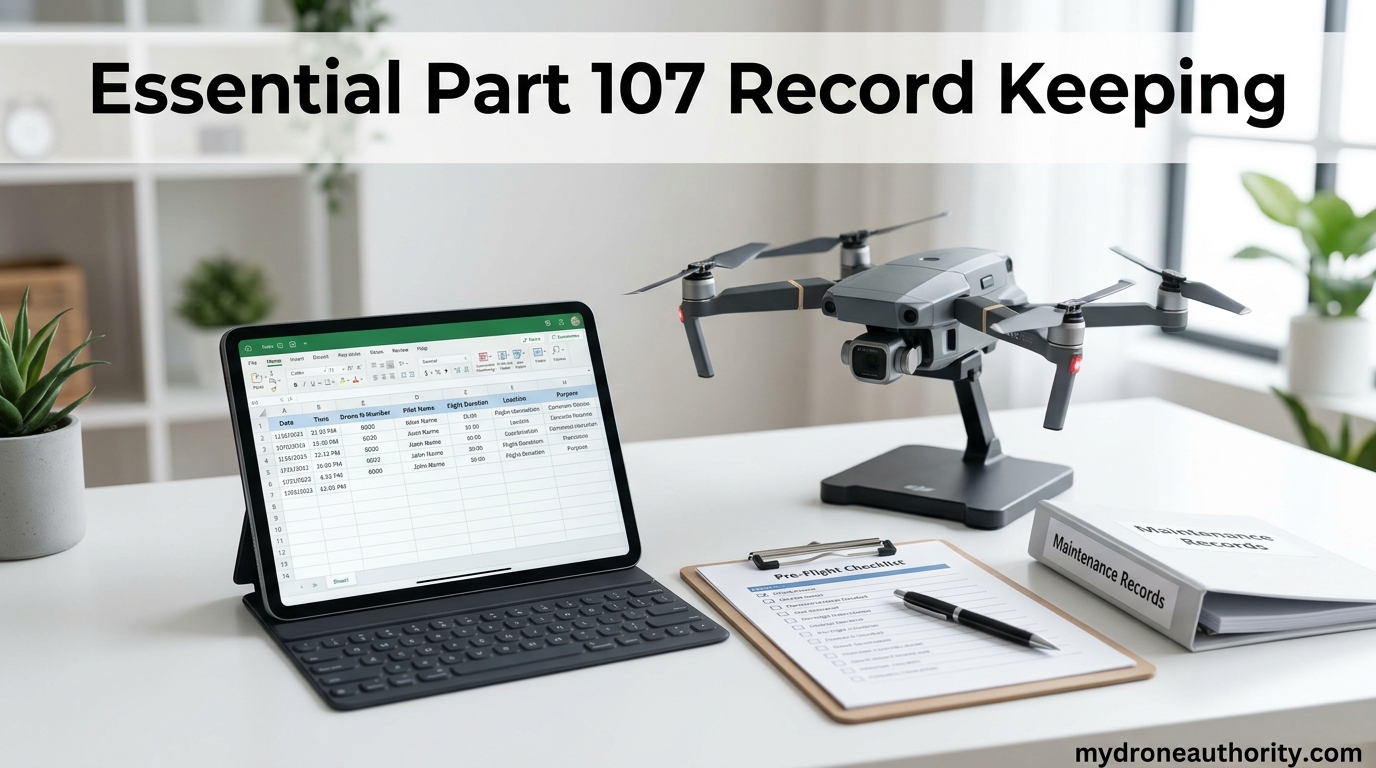
If you fly drones for hire under Part 107, the FAA does not hand you a checklist of required records and walk away. Instead, it puts the burden on you to produce documentation on demand. When an inspector, insurance adjuster, or client asks for proof, the records you kept (or didn’t) determine whether you keep flying or face an enforcement action.
I have spent the last several years working with commercial drone operators, helping them prepare for FAA inspections and insurance audits. The pilots who sail through these reviews all share one habit: they treat record keeping like pre-flight checks, automatic and non-negotiable. The ones who struggle treat it like an afterthought.
What records should you keep as a Part 107 pilot? The FAA’s own guidance, scattered across Advisory Circular 107-2, 14 CFR 107.7, and 14 CFR 107.165, points to six core categories: pilot credentials, aircraft registration and Remote ID, flight logs, maintenance and airworthiness records, airspace authorizations and waivers, and incident or deviation reports. Each one serves a different purpose, and each has a different retention window.
This guide walks through every record type, what to capture, how long to keep it, and the practical workflow that makes it stick. I will also address the four most common questions pilots ask during recurrent training, the ones that show up again and again in FAA knowledge tests and on Reddit threads alike.
If you operate a drone business, the goal of record keeping is not bureaucratic busywork. It is your legal defense, your insurance policy, and your competitive edge, all rolled into a few folders on your laptop or phone.
Table of Contents
Quick Reference: The 6 Records Every Part 107 Pilot Should Keep
Before we dive into the details, here is the at-a-glance summary. Bookmark this section and return to it before every FAA inspection or insurance renewal.
Part 107 Record Types at a Glance
1. Pilot Credential Records. Your Remote Pilot Certificate with small UAS rating, government-issued photo ID, and recurrent training completion records. Required to be in your physical possession during flight per 14 CFR 107.7.
2. Aircraft Registration and Remote ID Records. FAA registration certificate (N-number or registration number for drones over 0.55 lbs), and for drones requiring it, the declaration of compliance proving your drone meets Remote ID requirements under 14 CFR Part 89.
3. Flight Logs. Date, time, location, mission type, weather, aircraft used, pilot in command, and any anomalies. Not strictly required by the FAA, but strongly recommended per Advisory Circular 107-2 Section 7.3.5, and the first thing inspectors ask for.
4. Maintenance and Airworthiness Records. Pre-flight inspection results, repairs, firmware updates, battery cycle counts, and any modifications. Must cover the entire service life of the aircraft.
5. Airspace Authorizations and Waivers. LAANC approvals for controlled airspace, manual FAA airspace authorizations, and any Part 107 waivers covering night operations, operations over people, BVLOS, or other special authorizations.
6. Incident and Deviation Documentation. Records of any accidents, incidents, near-misses, or deviations from Part 107 rules, including the FAA’s 10-day accident reporting compliance under 14 CFR 107.9.
This list represents the consensus of FAA guidance documents and the practical experience of commercial operators I have worked with. Some of these records are required by regulation; others are recommended but functionally essential during any third-party review of your operations.
Does the FAA Require Part 107 Pilots to Keep Records?
Yes and no. The FAA does not require a specific logbook format, a specific app, or a specific piece of paper. What it does require, per 14 CFR 107.7, is that you produce documentation on request. The relevant regulation states that a remote pilot must have in physical possession and readily accessible the Remote Pilot Certificate, a valid government-issued photo ID, and any other document the regulations require.
When you read FAA Advisory Circular 107-2, the agency’s recommended best practices document, Section 7.3.5 specifically encourages recordkeeping. The language is “strongly recommends” rather than “requires,” which is the source of most pilot confusion. Let me clear that up.
Even though the FAA does not mandate a flight log, the practical reality is that inspectors will ask for one first. Insurance companies will require one before paying claims. Clients increasingly request proof of operational history before signing contracts. In every one of these scenarios, the absence of records is treated as a compliance failure, even if the regulation itself only says you must be ready to produce documents upon request.
The Federal Aviation Regulations put the burden of proof on the operator. If you cannot demonstrate that you flew safely, maintained your aircraft properly, and operated within authorized airspace, the assumption defaults against you. That is why the answer to “do I really need to keep records” is functionally yes, even when the regulatory language leaves wiggle room.
What Records Should You Keep as a Part 107 Pilot? The 6 Core Categories Explained
Let me walk through each of the six core record categories in detail, starting with what to capture, why it matters, and how it fits into your operational workflow.
Pilot Credential Records
Your pilot credentials are the only category of records the FAA explicitly requires you to have on your person during flight. Under 14 CFR 107.7, a remote pilot must be able to present, upon request, the Remote Pilot Certificate with a small UAS rating and a government-issued photo identification. This means a driver’s license, passport, or military ID will satisfy the photo ID requirement.
I tell every pilot I work with to carry their Remote Pilot Certificate digitally as well. The FAA accepts a screenshot or PDF of the certificate, and most pilots store it in their phone’s photo library or in their flight app’s documents tab. The physical card stays in your wallet or drone case, and a digital backup ensures you are never caught without it.
Recurrent training records are the third piece of this category. Every 24 months, Part 107 certificate holders must complete recurrent training, either through the FAA’s free online course or through an approved provider. Keep the completion certificate or screenshot of the course completion screen. These records demonstrate that you maintained your certification currency, and they are often required when applying for Part 107 waivers or bidding on government contracts.
Beyond what the regulations require, I recommend keeping a copy of your original Remote Pilot Certificate (the plastic card), your initial aeronautical knowledge exam results (available through the FAA Airman Certification Database), and any additional training certificates for specialized operations like night work or thermal imaging.
Aircraft Registration and Remote ID Compliance Records
Every drone operated under Part 107 that weighs more than 0.55 pounds (250 grams) must be registered with the FAA. The registration certificate, whether you have an N-number for traditional aircraft-style registration or a simple registration number for small UAS, is a core record. Pilots sometimes carry the certificate but fail to keep a digital backup, which creates problems if the original is lost or damaged in the field.
Remote ID compliance adds a new layer to aircraft records. Under 14 CFR Part 89, drones that operate under Part 107 are required to broadcast Remote ID information, either built into the aircraft (Standard Remote ID), through a broadcast module, or through operations at a FAA-Recognized Identification Area (FRIA). The manufacturer provides a declaration of compliance for drones with built-in Remote ID, and operators using broadcast modules must keep the module’s documentation.
Here is where many pilots get tripped up. 14 CFR 107.165 requires that the declaration of compliance for the drone be kept by the operator and made available to the FAA upon request. The declaration is typically a PDF document from the manufacturer’s website. Download it, store it in your drone’s record folder, and you have satisfied the federal recordkeeping requirement for that piece of equipment.
If you operate a fleet of drones, organize your registration and Remote ID documents by tail number or aircraft identifier. When an inspector asks for paperwork on a specific aircraft, you should be able to pull the full compliance packet in under 60 seconds.
Flight Logs
Flight logs are the most important record category for Part 107 pilots, even though the FAA does not formally require them. Advisory Circular 107-2 lists the benefits of recordkeeping as helping the pilot track experience, demonstrate compliance during FAA inquiries, support insurance claims, and document experience for client contracts and waiver applications.
What goes into a flight log? At minimum, you should record the date, time, and duration of each flight, the location (preferably GPS coordinates or a recognizable place name), the aircraft used (tail number or serial number), the pilot in command, the mission type, and the weather conditions. Many pilots also include battery serial numbers, payload details, and any anomalies that occurred during the flight.
I have reviewed thousands of flight logs over the years, and the most useful ones capture what went wrong, not just what went right. A log entry that says “GPS glitch at 3 minutes, recovered by manual control, completed mission” is far more valuable than one that simply says “successful flight.” When an incident occurs weeks later, that detail is what helps you reconstruct the chain of events.
For weather logging, pull METAR and TAF data from the nearest reporting station at the time of the flight. This serves two purposes: it documents the conditions you actually operated in, and it provides legal protection if a claim is filed against you for flying in questionable weather. Several flight apps do this automatically.
The format matters less than the consistency. Pen and paper works, electronic apps work, spreadsheets work. The FAA accepts all of them as long as the records are legible, retrievable, and protected from loss. Most commercial operators I work with use an app because the data is automatically timestamped, geotagged, and backed up to the cloud.
Maintenance and Airworthiness Records
Maintenance records document that your aircraft was airworthy at the time of each flight. While Part 107 does not require a certified mechanic for routine maintenance on small UAS, the operator is responsible for ensuring the aircraft is in a condition for safe operation. That responsibility is documented through maintenance records.
At a minimum, your maintenance records should include pre-flight inspection checklists, post-flight inspection notes, repairs (including parts replaced), firmware updates with version numbers, propeller replacements, battery cycle counts, and any modifications or aftermarket equipment installations. Each entry should include the date, the technician or pilot who performed the work, and a brief description of the result.
Battery records deserve special attention. Lithium polymer batteries degrade over time, and a battery that fails mid-flight can cause a crash. Track the number of charge cycles for each battery, the date of first use, and any cells that have been replaced or rebalanced. If a crash occurs, investigators will examine the battery records first, alongside flight logs.
Firmware updates are an underrated maintenance record. Manufacturers release firmware to fix bugs, improve stability, and add features. Documenting when you updated and to which version creates a paper trail that protects you if a known issue causes an accident and the manufacturer has already released a fix you did not apply.
Maintenance records must be retained for the entire service life of the aircraft. Once you sell, transfer, or retire a drone, the records travel with it. If you operate a fleet, this means years of organized documentation per aircraft, which is where digital recordkeeping really pays off.
Airspace Authorizations, Waivers, and LAANC Records
When you operate in controlled airspace, you need authorization from the FAA. The most common method is LAANC (Low Altitude Authorization and Notification Capability), which provides near-real-time approval for operations in Class B, C, D, and some Class E airspace. LAANC approvals are tied to your pilot certificate and the specific facility you requested authorization from, but you should download or screenshot the approval for your own records.
For operations outside LAANC coverage, you apply for a manual airspace authorization through the FAA DroneZone. These authorizations are issued as PDF documents with specific conditions, altitudes, and time windows. Keep the original PDF in your records. If you fly a job six months later in the same area, having the prior authorization on file helps you understand the pattern of what the FAA has previously approved.
Part 107 waivers are required for operations that fall outside the standard rules: night operations (when not using anti-collision lighting that is visible for 3 statute miles), operations over people, operations from a moving vehicle, BVLOS (Beyond Visual Line of Sight), and operations in certain restricted airspace categories. Each waiver comes with specific limitations, conditions, and reporting requirements.
Waiver records are particularly important because they often include specific recordkeeping requirements as conditions of the waiver itself. Read your waiver carefully and document exactly what it requires you to keep. Some waivers require you to maintain records of every flight conducted under the waiver, while others require quarterly or annual reporting to the FAA.
Incident and Deviation Documentation
Under 14 CFR 107.9, you must report any operation that results in serious injury, loss of consciousness, or property damage of $500 or more to the FAA within 10 days. This is the formal 10-day reporting rule. The report is filed through the FAA DroneZone and creates an official record of the incident.
Beyond the regulatory threshold, I recommend documenting every incident, near-miss, and deviation, even those that fall below the reporting threshold. Near-misses that are not formally reported still create liability exposure. A near-miss with a manned aircraft, even one that did not require evasive action, is information you want to retain and analyze.
Deviation records document any time your operation deviated from your planned flight, whether that was an altitude deviation, a flight into unauthorized airspace due to GPS error, or a contingency landing. These records are not the same as incident reports, but they serve a similar purpose: they document that you noticed the deviation, took corrective action, and learned from the event.
When documenting incidents, capture as much detail as possible in the moment. Date, time, location, weather, aircraft state, what happened, what you did, and what the outcome was. Photographs of the scene, the aircraft, and any damage are extremely helpful. The first 24 hours after an incident are when memory is sharpest, so document immediately, even if a formal report is not yet required.
How Long Should You Keep Part 107 Records? Retention Periods Explained
One of the most common questions pilots ask is how long they need to keep each type of record. The honest answer is that the FAA does not specify a uniform retention period across all record types. Instead, retention requirements are scattered across regulations, advisory materials, and best practice recommendations. Here is the practical guide.
Part 107 Record Retention Periods
Pilot Credentials (Certificate, Recurrent Training, ID): Keep for the duration of your Part 107 operations, plus at least 3 years after you stop flying commercially. Some pilots keep these records indefinitely, especially if they are applying for waivers or government contracts that require historical proof of currency.
Aircraft Registration and Remote ID Declaration of Compliance: Keep registration records and the declaration of compliance for as long as you own or operate the aircraft. Under 14 CFR 107.165, the declaration of compliance must be transferred with the aircraft upon sale.
Flight Logs: Keep for a minimum of 12 to 24 months, though many commercial operators keep them for 3 to 5 years. Insurance claims and contract disputes often surface well after the flight occurred, so older logs have value. For waiver applications, the FAA may request flight logs from the past 24 months as evidence of experience.
Maintenance and Airworthiness Records: Keep for the entire service life of the aircraft. Once you retire or sell the drone, the records should accompany the aircraft or be archived in a permanent location. Battery records should be kept for the operational life of the battery plus 12 months after retirement.
Airspace Authorizations and Waivers: Keep for the duration of the authorization or waiver, plus 3 years. Waivers themselves are typically valid for 4 years, but the records of flights conducted under each waiver should be retained for an additional 3 years to support any post-operations review.
Incident and Deviation Records: Keep until all related FAA reviews, insurance claims, and legal matters are fully resolved, plus an additional 3 to 7 years. Statute of limitations on aviation-related claims varies by state and by the nature of the claim, so erring on the side of longer retention is the safer approach.
The general principle is this: if a record could be relevant to an FAA inquiry, an insurance claim, or a legal dispute, keep it. Storage is cheap. The cost of not having a record when you need it is far higher.
Where to Store Your Records
Choose a storage system that is redundant, searchable, and accessible. The best practice is a primary digital store (cloud storage like Google Drive, Dropbox, or OneDrive) plus a local backup (external hard drive or NAS device). Paper records, if you keep them, should be scanned and stored digitally as a secondary copy.
One of the most common mistakes I see is pilots who relied on a single drone flight app for all their records. When apps like Kittyhawk shut down or change ownership, pilots can lose years of flight data overnight. Cloud storage you control is more durable than storage in a third-party app that may not exist in five years.
For organized operators, I recommend a folder structure organized by aircraft, then by year, then by record type. If you operate three drones, your top-level folders might be “Aircraft 1,” “Aircraft 2,” and “Aircraft 3,” each containing subfolders for “Registration,” “Flight Logs,” “Maintenance,” and “Incidents” organized by year.
Tools and Apps for Part 107 Record Keeping
The right tool for record keeping is the one you will actually use consistently. Here are the categories of tools commercial operators rely on, with specific recommendations based on 2026 capabilities.
Flight Logging Apps
AirData is one of the most popular flight logging apps for Part 107 operators. It automatically captures telemetry, generates flight reports, and syncs data to the cloud. The free tier covers most solo operators’ needs, and the paid tiers add features like custom reports and longer data retention.
Aloft (formerly Kittyhawk, which was rebranded after its acquisition) is another widely used option, with strong airspace integration and LAANC support. If you operate frequently in controlled airspace, Aloft’s airspace awareness features are particularly useful.
DroneLogbook is a Part 107-focused platform that combines flight logs, maintenance records, and compliance documentation in one system. Pilots who want a single tool for all record types often prefer this approach.
Whatever app you choose, the key feature to look for is automatic data export. You want the ability to download your flight logs as a CSV or PDF file, so you are not locked into a single platform. Apps that lock you in create the same data loss risk that pilots experienced when Kittyhawk shut down its original service.
Maintenance Tracking
For maintenance records, you can use a dedicated maintenance app, a spreadsheet, or a section within your flight logging app. The best approach is the one that matches your operational scale. Solo operators with one or two drones often do well with a spreadsheet. Fleet operators benefit from dedicated maintenance tracking software like MaintenanceEdge or a custom database.
For battery tracking specifically, label each battery with a unique identifier (B1, B2, B3, or a serial number) and log the cycle count in a spreadsheet or app after each charging session. A small effort up front saves significant time when an incident occurs and investigators want battery data.
Cloud Storage and Backup
Google Drive, Dropbox, and OneDrive all work well for document storage. The important feature is automatic sync, so any document you save to your phone or laptop is backed up to the cloud within minutes. Enable two-factor authentication on whichever service you use, since your records contain personally identifiable information.
For local backup, an external SSD updated weekly or monthly provides redundancy against cloud service outages or account compromise. The 3-2-1 backup rule (3 copies, on 2 different media, with 1 offsite) is overkill for solo operators but reasonable for drone businesses operating multiple aircraft.
Common Record-Keeping Mistakes to Avoid
After reviewing recordkeeping practices across hundreds of commercial operators, I have seen the same mistakes surface repeatedly. Avoiding these will put you ahead of most pilots.
Waiting Until the End of the Week to Log Flights
Retroactive logging is the single most common recordkeeping mistake. Pilots who fly multiple jobs in a week often postpone logging until Sunday night, when memories of specific flights are already fuzzy. The records end up vague, incomplete, or inaccurate. Log in real-time, even if it is just a quick note in your phone immediately after landing.
Relying on a Single Storage System
Pilots who lost their flight data when Kittyhawk shut down its original service learned this lesson the hard way. Always maintain a second copy of your records outside the app or service that captures them. Cloud storage you control is the safest long-term solution.
Ignoring Recurrent Training Documentation
Recurrent training is required every 24 months, and many pilots complete the FAA’s free online course but fail to save the completion certificate. If the FAA later questions your currency, you need proof that you completed the training on time. Screenshot the completion screen and email it to yourself for permanent storage.
Not Tracking Battery Cycles
Batteries are the most failure-prone component of any drone, and operators who do not track cycle counts are flying blind. A battery that has been charged 400 times is at the end of its useful life, regardless of how it looks externally. Track cycles, retire batteries proactively, and document each retirement.
Skipping Pre-Flight Inspection Records
Pre-flight inspection is required before every flight under Part 107, but the inspection itself is only valuable if documented. A one-line entry that says “pre-flight complete, no issues” creates a timestamped record that you followed the regulation. If an incident occurs and investigators want to know whether you inspected the aircraft, that entry could be decisive.
Throwing Away Records After Sale of a Drone
When you sell or transfer a drone, transfer the records with it. The new owner needs the maintenance history to operate safely, and you need a record showing that you transferred the documents. A simple bill of sale that includes a line for “maintenance records transferred” is sufficient.
Frequently Asked Questions
These are the four questions pilots ask most often about Part 107 record keeping. The answers draw on FAA regulations and Advisory Circular guidance.
How many years are you required to keep a log record of your drone flights?
The FAA does not specify an exact number of years for all record types. Flight records should be kept for 12-24 months as a baseline, with many commercial operators keeping them for 3-5 years. Maintenance records must be retained for the entire service life of the aircraft. Pilot training records should be kept for as long as you conduct Part 107 operations, plus at least 3 years. Incident records should be kept until all related FAA reviews and insurance matters are fully resolved.
What documents must a remote pilot have readily available when flying under part 107?
Under 14 CFR 107.7, a remote pilot must have in physical possession and readily accessible: (1) the Remote Pilot Certificate with small UAS rating, (2) a government-issued photo ID, and (3) upon request, any other document required by the regulations. Most pilots also carry their aircraft registration, airspace authorization for the current flight, and a recent maintenance log entry. Digital copies on a phone are accepted by the FAA.
Do you need to keep records of your flights after you get your certificate?
The FAA does not explicitly require Part 107 pilots to keep flight logs. However, the FAA strongly recommends it per Advisory Circular 107-2 Section 7.3.5. While not mandatory for all pilots, flight logs are the easiest way to demonstrate compliance during FAA inspections, support insurance claims, and document experience for client contracts and Part 107 waiver applications.
Which records or documents shall the owner or operator of an aircraft keep to show compliance with an applicable AD?
A Part 107 operator should keep: Remote Pilot Certificate and recurrent training records for the duration of Part 107 operations; aircraft registration and N-number documentation for the aircraft lifetime; flight logs for 12-24 months minimum; maintenance and airworthiness records for the aircraft lifetime; airspace authorizations and waivers for 5+ years; and incident reports until all related matters are resolved. The 14 CFR 107.165 declaration of compliance for Remote ID must also be retained and transferred with the aircraft upon sale.
Build Your Record-Keeping System This Week
What records should you keep as a Part 107 pilot? The complete list includes pilot credentials, aircraft registration and Remote ID compliance, flight logs, maintenance and airworthiness records, airspace authorizations and waivers, and incident or deviation documentation. Each category serves a distinct purpose, and together they form a complete picture of your operations that protects your certificate, your business, and your clients.
Start with the basics this week. Download your Remote Pilot Certificate, your aircraft registration, and your Remote ID declaration of compliance into a single cloud folder. Set up a flight log in an app or spreadsheet and use it for your next three flights. Capture maintenance entries after your next pre-flight inspection. Within a month, you will have a recordkeeping system that is more robust than 80 percent of commercial operators, and you will be prepared for the next FAA inspection, insurance claim, or client audit that comes your way.
If you operate under a Part 107 waiver, revisit the waiver’s specific recordkeeping conditions and confirm your system meets each requirement. The waiver’s conditions are enforceable, and missing a specific recordkeeping requirement is one of the most common ways operators lose waiver privileges. When in doubt, document more than you think you need to. Storage is cheap, and the cost of a missing record during an investigation is not.