
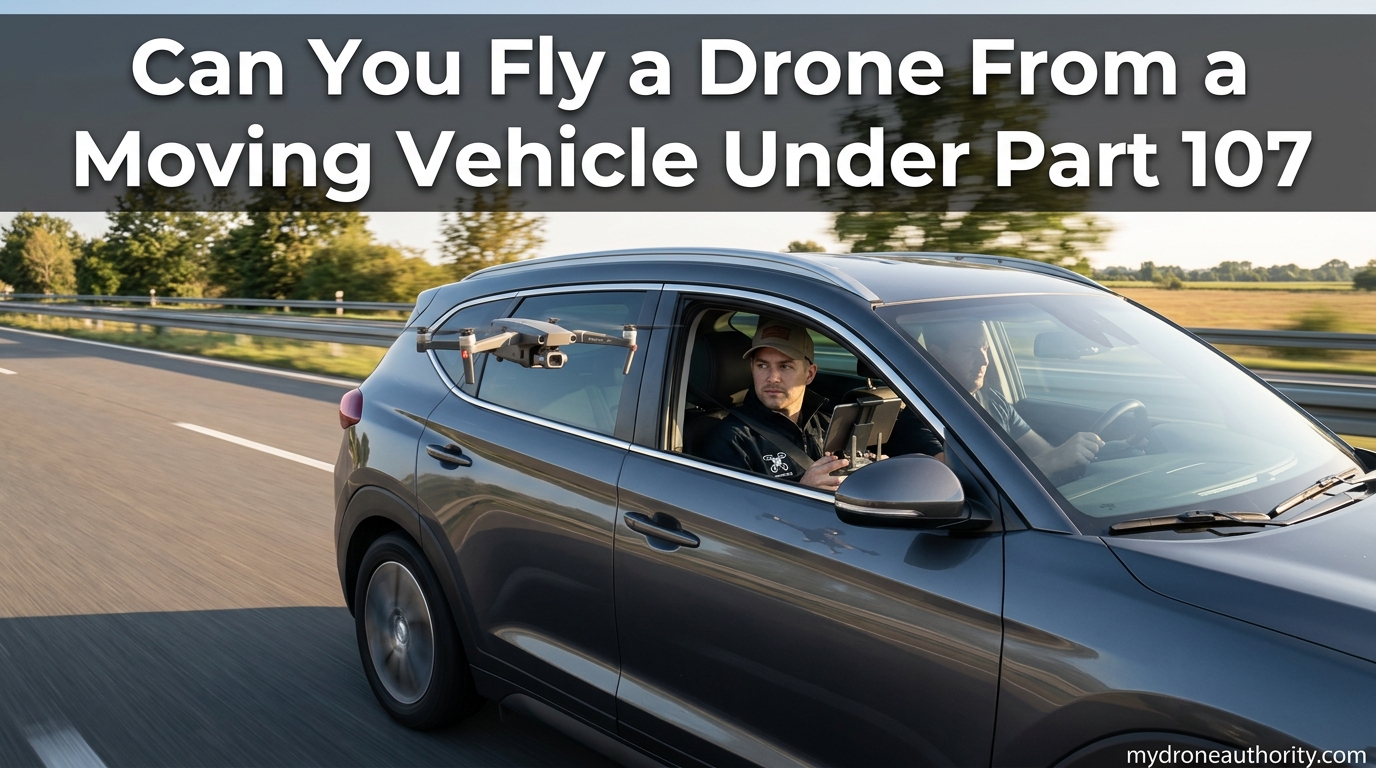
Yes, you can fly a drone from a moving vehicle under Part 107, but only when the drone is operated over a sparsely populated area. According to 14 CFR 107.25, operations from moving aircraft are completely prohibited, and you cannot transport another person’s property for compensation or hire from a moving vehicle. That short answer covers most of the regulatory picture for 2026, but the real-world application is more nuanced.
I dug into the FAA’s actual regulation text, advisory circulars, and case law to put this guide together. If you are a commercial drone pilot considering operations from a car, truck, or boat, here is what the rules actually say and how to stay compliant.
Table of Contents
What 14 CFR 107.25 Actually Says
The FAA spells out moving vehicle operations in 14 CFR 107.25. The full regulation text reads:
“No person may operate a small unmanned aircraft from a moving aircraft.
No person may operate a small unmanned aircraft from a moving land or water-borne vehicle over a human being located inside a moving vehicle, except for a sparsely populated area.
No person may operate a small unmanned aircraft from a moving land or water-borne vehicle unless the operation is over a sparsely populated area and does not involve the transportation of another person’s property for compensation or hire.”
Three rules are stacked into one section. First, operating from a moving aircraft is always off-limits. Second, even on land or water you cannot fly directly over a person who is inside another moving vehicle. Third, the default rule for land and water operations is the sparsely populated area requirement, with an extra limit on paid property transport.
Advisory Circular 107-2 reinforces that the remote pilot in command remains responsible for the safe conduct of the flight, regardless of whether the takeoff point is stationary or moving.
The Sparsely Populated Area Exception Explained
Every legal land and water vehicle operation under Part 107 hinges on what counts as “sparsely populated.” The FAA has not published a strict numerical definition, but the agency’s discussion in the original Part 107 final rule and case law give us useful guidance.
In Mickalich v. United States, a court reviewed a case involving operations over Lake St. Clair and found that remote, open water with no swimmers, boaters, or other people in the area qualified as sparsely populated. The FAA’s own preamble to Part 107 describes sparsely populated areas as open water or remote land where there is little risk of contact with people on the ground.
Here is how I tell whether an area qualifies before I launch from a moving vehicle:
- Are there people, structures, or vehicles visible in the operational area?
- Is the location near a populated area, even if the immediate airspace is open?
- What is the likelihood of people, vehicles, or vessels entering the area during the flight?
If the answer to most of these is “minimal” or “none,” the area likely qualifies. If you see houses, parked cars, beaches, or boat traffic, treat it as non-sparsely populated and get a waiver before operating from a moving vehicle there.
Moving Aircraft Are Always Prohibited
There is no waiver path for operations from a moving aircraft under Part 107. The FAA wrote this rule as a hard line, and Advisory Circular 107-2 confirms it. Whether you are a passenger in a helicopter, a fixed-wing plane, or any other manned aircraft, you cannot operate a drone from that platform.
The reasoning is straightforward. Operating from an aircraft combines the risks of a moving platform with the risk of mid-air collision with the host aircraft. The FAA decided that no operational benefit justifies that risk, so the prohibition is absolute for 2026 and beyond.
What Land and Water-Borne Vehicle Operations Look Like
When the conditions are met, drone pilots use moving vehicle operations for legitimate commercial work. I have seen inspection teams use trucks to follow pipelines and runways, slowly driving while the drone maps the corridor. Survey teams use ATVs to cover large farm fields without landing and re-launching every few hundred feet.
Marine operations are common too. Pilots inspect bridges, shoreline structures, and coastal erosion from boats moving at low speed. As long as the launch point and the area overflown are sparsely populated, these operations fall within 14 CFR 107.25.
The key operational rule is that the vehicle must move at a speed that allows the remote pilot to maintain visual line of sight, full control of the aircraft, and awareness of any people, vessels, or vehicles entering the area.
Property Transport Restrictions You Must Know
14 CFR 107.25 includes a specific carve-out: even in a sparsely populated area, you cannot operate from a moving vehicle if the flight involves transporting another person’s property for compensation or hire. This rule was written to address early commercial drone delivery proposals.
For example, a real estate photographer flying from a moving SUV across a rural listing is allowed. A delivery driver launching packages from a moving van, even in a remote area, is not. The FAA’s reasoning is that delivery operations create additional third-party risk, and the agency wanted time to study the safety case before allowing it.
If your operation involves moving someone else’s goods for payment, you need to land the vehicle, launch, and complete the delivery from a stationary position, or pursue a Part 135 air carrier certificate instead.
Visual Line of Sight and Visual Observer Requirements
Part 107 requires the remote pilot in command to maintain visual line of sight with the small unmanned aircraft at all times. Operating from a moving vehicle makes this harder because the vehicle’s motion, vibration, and window obstructions can break VLOS quickly.
Advisory Circular 107-2 allows the use of a visual observer to help the remote PIC maintain VLOS. In a moving vehicle operation, a visual observer can watch the drone from a different window, scan for hazards, and call out people or aircraft entering the area. This is one of the few situations where a VO is practically essential rather than optional.
Practical tips for keeping VLOS from a moving platform:
- Use a low, consistent vehicle speed so the drone does not lag behind your sight picture.
- Keep the drone within a window where you can see it without turning your body away from the road.
- Assign a visual observer if you have a co-pilot or passenger available.
- Avoid operating in low sun, fog, or precipitation, which can break VLOS fast.
How to Get a Part 107 Waiver for Densely Populated Operations
If your commercial mission requires operating from a moving vehicle over a non-sparsely populated area, you will need a Part 107 waiver. The FAA allows waivers for many Part 107 rules, including 107.25, as long as the applicant shows an equivalent level of safety.
Here is the step-by-step process I recommend:
- Register or log in to the FAA DroneZone portal.
- Select “Part 107 Waiver” and choose the section you want waived (107.25 in this case).
- Submit a complete description of the proposed operation, including the type of vehicle, speed, area, mission profile, and risk mitigations.
- Attach a documented safety case showing how your operation matches or exceeds the safety level of compliant flights.
- Pay the application fee and wait for FAA review, which currently runs between 60 and 90 days.
The FAA evaluates each waiver on a case-by-case basis, with attention to altitude, population density, vehicle speed, and the pilot’s experience. A well-prepared waiver with clear safety procedures has a strong chance of approval, while vague applications are routinely denied.
State Distracted Driving Laws and Part 107
A pain point I see in pilot forums is the interaction between FAA Part 107 and state distracted driving laws. The FAA does not preempt state traffic law, and several states have strict hands-free or handheld device rules that affect drone controllers.
In practice, this means you should never operate a drone while driving. The FAA’s own rules treat distracted operation as “careless or reckless,” and a state officer can pull you over for the traffic violation alone, regardless of the airspace outcome. The safest and most legally defensible setup is to operate the drone as a passenger, with the driver focused solely on the road.
Some states treat a drone controller as an electronic device subject to the same restrictions as a phone. Even where the law is silent, an enforcement officer who sees you staring at a controller while driving has probable cause to act.
Real-World Scenarios Where This Rule Applies
To make this practical, here are the operations that most often come up in pilot forums and that we have helped teams scope out:
- Pipeline inspection along rural rights-of-way, where a slow-moving truck follows the line.
- Linear infrastructure mapping for power lines, railroads, and canals in remote areas.
- Marine inspection of bridges, piers, and shoreline structures from a small boat.
- Wildlife and habitat monitoring across large tracts of open land.
- Agricultural scouting on farms and ranches during planting or harvest.
Each of these is allowed under 14 CFR 107.25 when the area is sparsely populated, the drone stays within VLOS, and no property is being transported for hire.
FAQ: Common Questions About Part 107 Moving Vehicle Operations
Can a remote pilot operate from a moving vehicle under Part 107?
Yes, a remote pilot in command can operate from a moving land or water-borne vehicle under 14 CFR 107.25, but only when the operation takes place over a sparsely populated area and does not involve transporting another person’s property for compensation or hire.
Is it legal to operate a drone from a moving vehicle?
It is legal when the area is sparsely populated, the drone remains within visual line of sight, and no paid property transport is involved. Operations from a moving aircraft are always prohibited.
Can you launch a drone from a moving boat?
Yes, launching from a moving boat is allowed when the operation is over a sparsely populated area such as open water. The remote pilot must still maintain visual line of sight and full control of the small unmanned aircraft.
How can a drone fly from a moving car?
The remote pilot launches and operates the drone while the vehicle is moving slowly, keeping the aircraft within visual line of sight. The operation must be over a sparsely populated area, and the pilot cannot be the driver if the vehicle is in motion on a public road.
Will the FAA know if I fly my drone from a moving vehicle?
The FAA does not have real-time tracking of every drone flight, but it can investigate complaints, request flight logs, and cross-reference drone registration records. Pilots who fly unsafely or outside the rules risk enforcement action including fines and certificate suspension.
Key Takeaways for Pilots in 2026
You can fly a drone from a moving vehicle under Part 107 in 2026, as long as you stay inside the 14 CFR 107.25 box: sparsely populated area, land or water vehicle only, no property transport for hire, and visual line of sight maintained.
Before your next mission, map your operational area, confirm it is sparsely populated, brief your visual observer if you have one, and document your compliance steps. If the mission does not fit the rule, file a waiver through DroneZone rather than improvising in the field. That preparation is what separates a professional Part 107 operation from a careless or reckless one.