
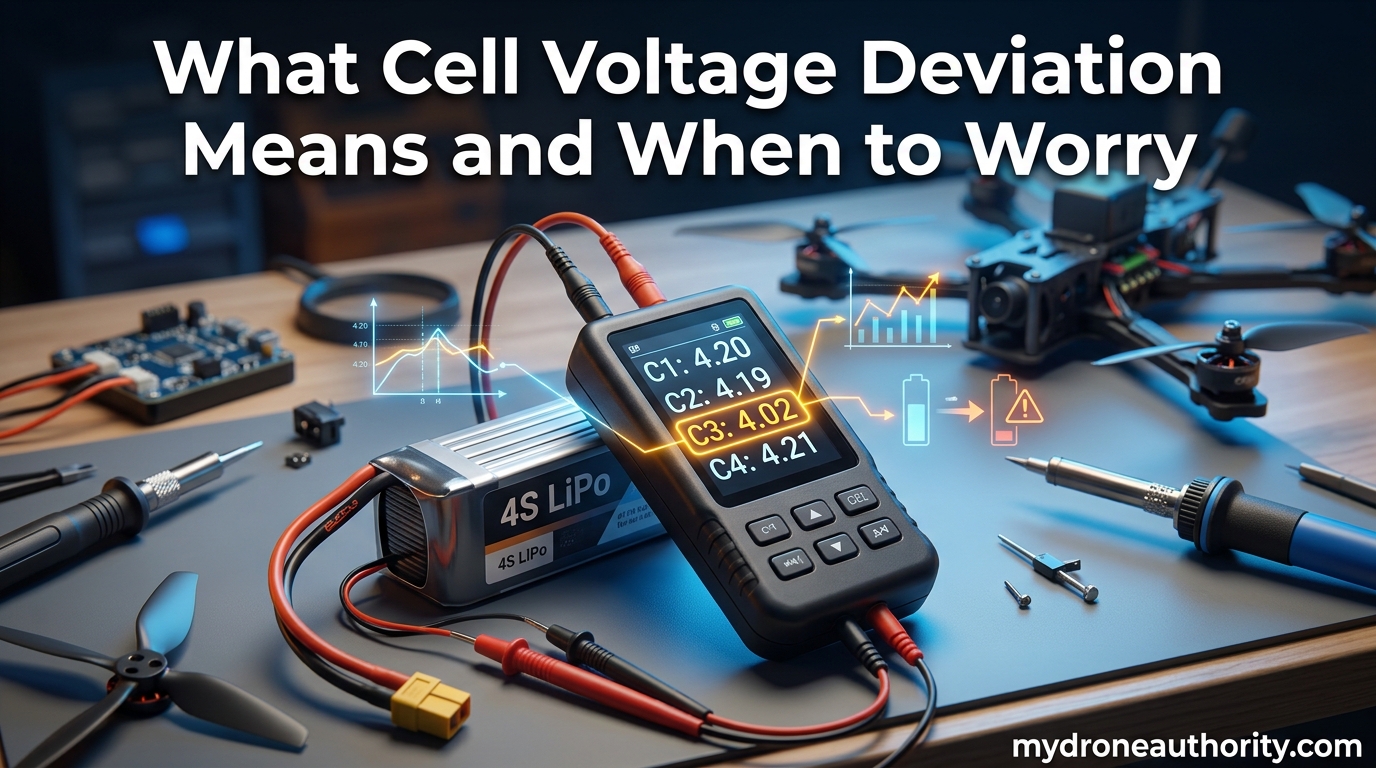
Cell voltage deviation is the difference in voltage between the highest and lowest cell inside a multi-cell battery pack, measured in millivolts (mV). On a drone, that single number tells you how evenly every cell in your LiPo is keeping up with the rest of the pack.
If you’ve ever pulled up the battery screen in your DJI app and seen a row of cell voltages with one slightly off, you’ve looked at cell voltage deviation. It’s the most important health indicator most pilots never learn to read. I ignored it for years before it cost me a battery mid-flight, and I don’t want that to happen to you.
This guide covers what cell voltage deviation actually is, the thresholds pilots use in 2026, what causes it to creep up, and the exact steps I take when a pack starts drifting out of spec.
Table of Contents
What Is Cell Voltage Deviation in a Drone Battery?
Cell voltage deviation is the spread between the highest and lowest cell voltage in a battery pack at any given moment. If a 4S LiPo reads 4.18V, 4.17V, 4.18V, and 4.16V, the deviation is 0.02V (20 millivolts).
Each LiPo cell has a narrow operating window. The nominal voltage is 3.7V per cell, the maximum safe charge is 4.2V, and the minimum safe discharge is 3.0V. Push past either end and you risk permanent damage, swelling, or thermal runaway. The whole point of a battery management system is to keep every cell inside that window at the same time.
Deviation matters because the pack can only deliver as much energy as its weakest cell. The strongest cell hits 4.2V first during charging, the charger shuts off, and the weaker cell never quite catches up. The same thing happens in reverse on landing: the weakest cell drops to 3.0V first and triggers low-battery cut.
Nominal, Minimum, and Maximum Cell Voltage
- Nominal voltage: 3.7V per cell (the marketing number printed on the label)
- Storage voltage: 3.8V per cell (best state for batteries sitting on a shelf)
- Full charge: 4.2V per cell (maximum safe top end)
- Minimum discharge: 3.0V per cell (lowest safe cut-off, never go lower)
- Damage threshold: below 2.7V per cell (permanent capacity loss)
These numbers apply to standard LiPo and LiHV cells. High-voltage LiPo (LiHV) tops out at 4.35V, but most consumer drone batteries still run the 4.2V chemistry.
How Cell Voltage Deviation Works in a Multi-Cell Pack
Drone batteries are wired as series stacks. A 3S pack has three cells in series, a 4S has four, and a 6S has six. The voltages add up, but the pack’s capacity is limited by the worst-performing cell in the line.
Think of it like a chain. If you have a 6S pack rated 22.2V (6 × 3.7V) and one cell sags to 3.5V under load while the others stay at 3.7V, the pack can only deliver 21.7V before the weak cell bottoms out. The other five cells still have usable energy, but the management system cuts output to protect the weak one.
This is why deviation grows with age. The cells don’t degrade evenly. Manufacturing variance gives every cell slightly different internal resistance. After 200 cycles, those tiny differences add up, and the spread between the best and worst cell widens. A pack that read 0.01V deviation new might read 0.06V at 300 cycles, even with perfect care.
Acceptable Cell Voltage Deviation Thresholds
Here is the threshold table I use, and that most drone forums converge on. These apply right after a full balance charge, measured with the pack at room temperature.
- Under 0.02V (20 mV): Healthy. This is the gold standard. Most new batteries ship at 0.005V to 0.015V.
- 0.02V to 0.05V (20-50 mV): Acceptable. Normal for packs with 100+ cycles. Monitor and balance charge after every flight.
- 0.05V to 0.10V (50-100 mV): Concerning. Capacity and flight time will start to suffer. Plan to retire the pack soon.
- Over 0.10V (100 mV): Critical. The pack is failing. Stop using it and recycle it safely.
One pilot on the Mavic Pilots forum put it this way: a 6S pack with 0.021V across all cells is in great shape. Another user reported losing two cells that discharged abnormally fast near empty, dropping from 3.4V to 3.0V in under a minute, and the deviation had been creeping up over weeks before the failure.
Threshold context matters. A pack that measures 0.03V deviation after charging might spread to 0.08V under heavy flight load because of voltage sag. Always check deviation at the same state of charge for fair comparison.
What Causes Cell Voltage Deviation to Increase
Several factors push cells out of alignment, and most of them stack over the life of a pack.
Manufacturing Variance
Even premium cells from the same batch have small differences in internal resistance and capacity. On day one, deviation is usually below 0.01V. Over hundreds of cycles, those tiny differences amplify.
Cycle Count and Age
Every charge cycle degrades the chemistry. A battery that has been cycled 300 times will show noticeably more deviation than one with 50 cycles, even with identical usage. The Mavic Pilots community generally considers 75% battery health with 0.02V deviation still acceptable for casual flying.
Crashes and Hard Impacts
Hard impacts can dent or internally damage individual cells without visible swelling. If your deviation jumps after a crash, the pack is compromised even if it still charges. Retire it.
Temperature Extremes
Cold weather thickens the electrolyte and increases internal resistance unevenly. Hot weather accelerates degradation. Flying at 5°F or charging a hot pack right after a flight is a fast path to imbalance. Let packs come to room temperature before charging.
Unbalanced Loads and Storage Practices
Storing a pack at 4.2V for months, or at 3.0V, both push cells out of alignment. Storage voltage (3.8V per cell) is the calm zone where cells stay matched. Heavy current draws during aggressive flying also expose weak cells faster than gentle cruise flight.
How to Check Cell Voltage Deviation on Your Drone
You don’t need a lab to check this. Every modern drone ecosystem has a built-in way to read individual cell voltages.
Using the DJI Go or DJI Fly App
Open the app, connect to your aircraft, and tap into the battery settings menu. Most DJI drones, including the Mavic, Air, and Mini lines, show individual cell voltages on the battery details screen. The deviation is the difference between the highest and lowest number on that list.
Using AirData UAV
AirData is a third-party flight tracker that pulls post-flight logs from your DJI drone. After each flight, it logs the maximum and minimum cell voltage along with the deviation during the flight. Pilots who track deviation trends across dozens of flights catch problems long before they cause a mid-air failure.
Using a Balance Charger or Cell Checker
For FPV pilots and hobby-grade packs, plug the balance lead into a quality charger like an ISDT, ToolkitRC, or HTRC. The charger’s display shows each cell’s resting voltage. A separate cell checker (a small $10 device with a balance lead plug) gives the same data without a full charging cycle.
I check every pack I plan to fly within 24 hours. If the post-charge deviation is over 0.03V, I run a balance charge cycle and recheck. If it doesn’t come down, I flag the pack for retirement.
Warning Signs You Should Worry About
Voltage deviation is one of several signs of a failing battery. Here are the red flags that mean you should land now and ground the pack.
Swelling or Puffing
Any visible swelling means gas has built up inside the cell from electrolyte breakdown. A swollen pack is a fire risk. Do not charge, do not fly, and recycle it at a LiPo disposal site.
Sudden Power Loss Mid-Flight
If a drone drops out of the sky or suddenly loses power with 30% battery remaining, cell imbalance is a likely cause. The weak cell cut off early, and the rest of the pack shut down with it.
Lost Communication Between Controller and Drone
One forum user reported a complete controller-to-drone dropout right before a battery failure event. The voltage sag from a weak cell pulled the main bus voltage below the radio’s operating threshold. Treat unexplained disconnects as a battery warning, not a radio glitch.
Rapid Voltage Drop Near Empty
Healthy cells discharge on a smooth curve. If one cell plummets from 3.4V to 3.0V in seconds while the others are at 3.5V, that cell is failing. Land immediately.
Capacity Loss Faster Than Expected
If your flight times have dropped 20% or more in just a few months, deviation is usually climbing too. Track both numbers and you’ll spot the trend before it strands the drone.
How to Reduce Cell Voltage Deviation and Extend Battery Life
You cannot reverse degradation, but you can slow it down and keep packs matched for hundreds of extra cycles.
- Balance charge every time. A balance charger equalizes every cell to 4.2V. Cheap non-balance chargers save a few minutes and cost you a pack within 50 cycles.
- Store at 3.8V per cell. Most smart batteries do this automatically if you leave them idle for a week. For hobby packs, run a storage charge before putting them on the shelf.
- Avoid full charges before storage. A 100% charged pack sitting for two weeks drifts more than one stored at 3.8V.
- Let hot packs cool before charging. Charging a warm pack bakes in imbalance. Give it 20-30 minutes after a hard flight.
- Land with 20-30% battery remaining. Forum consensus suggests keeping a reserve because running a pack to 5% stresses the weakest cell. Don’t push it.
- Retire packs that drift past 0.05V regularly. Even a careful balance charge won’t bring a worn cell back. Once a pack keeps drifting, recycle it.
Frequently Asked Questions
What is the acceptable cell voltage deviation?
Under 0.02V (20 mV) is the healthy range for a drone battery. Between 0.02V and 0.05V is acceptable for packs with 100+ cycles. Anything over 0.05V is concerning, and over 0.10V means the pack is failing.
When should I worry about voltage drop?
Worry when the deviation between your highest and lowest cell exceeds 0.05V after a full balance charge, or when one cell drops noticeably faster than the others near the end of a flight. Sudden drops, swelling, or unexplained disconnects are also red flags.
What is the most common cause of voltage drop in drone batteries?
The most common cause is normal cycle aging, where small manufacturing differences between cells widen as the pack is charged and discharged hundreds of times. Crashes, temperature extremes, and storing packs at full charge also accelerate imbalance.
What is an acceptable voltage difference between cells?
An acceptable voltage difference between cells is under 0.02V on a fresh balance charge. Up to 0.05V is still usable for casual flying, but anything over 0.05V means the pack is wearing out and should be monitored closely or retired.
Final Thoughts on Cell Voltage Deviation
Cell voltage deviation is just a number, but it’s the number that tells you whether your battery is healthy or on its way out. Treat anything under 0.02V as the green light, keep an eye on packs creeping toward 0.05V, and ground anything over 0.10V.
Check the cell screen in your app before every flight in 2026. Run a balance charge after every session, store packs at 3.8V per cell, and retire any pack that shows swelling, sudden power loss, or a fast-discharging cell. The pilots who keep their drones flying for years are the ones who read the cell voltages instead of ignoring them.