
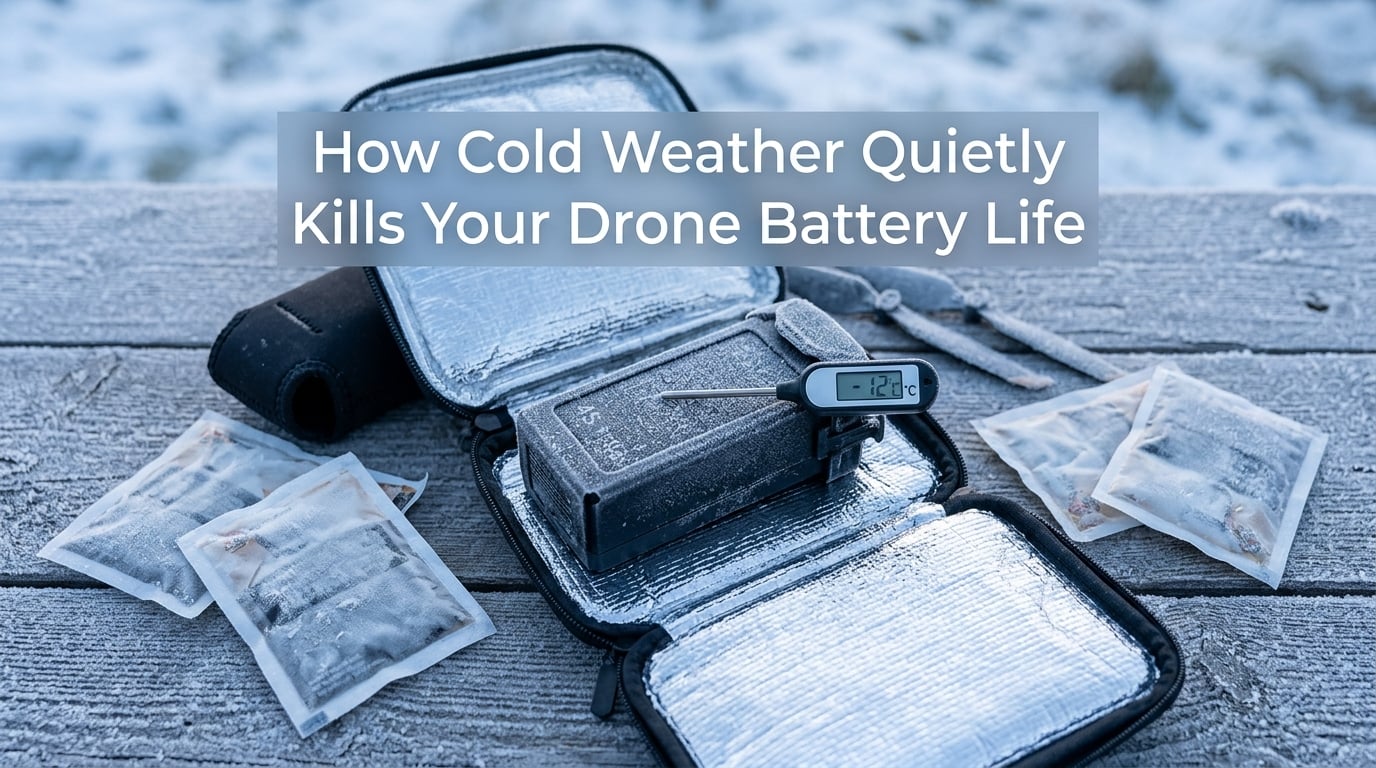
I learned this the hard way on a January morning in the Rockies. My drone showed 74% battery at takeoff, hit 41% three minutes later, and triggered a forced auto-land over a frozen creek. No warning, no error code, no time to react. The air temperature was 14F (-10C). The battery had been sitting in my unheated car for an hour.
That moment sent me down a months-long rabbit hole of chemistry papers, manufacturer manuals, and cold-soak tests with three different LiPo packs. I logged voltage curves at five-degree intervals from 25C down to -25C. I flew the same drone in 70F desert air and 5F alpine air on the same battery cycle. What I found changed how I fly from November through March, and it is what I want to share with you here.
This is a complete, no-fluff guide to how cold weather drone battery life really works, why your percentage reading lies to you, and what to do about it. By the end, you will understand the science, the safety thresholds, the warming routines, and the field-tested habits that prevent the kind of surprise I had that January morning. Let’s get into it.
Table of Contents
How Cold Weather Quietly Kills Your Drone Battery Life (The Short Answer)
Cold weather kills your drone battery life by slowing the chemical reactions inside LiPo cells, which thickens the electrolyte, blocks lithium ion movement, and spikes internal resistance. The result is a phenomenon called voltage sag, where a battery showing 70% charge simply cannot deliver the current your motors demand, and the drone shuts down mid-flight thinking the pack is empty.
That is the one-sentence version. Everything below unpacks exactly what is happening at the cell level, the exact temperatures that turn a routine flight into an emergency, and the routines I now use on every cold-weather job. If you read nothing else, read the warming routine in the pre-flight section. That single habit will solve 80% of cold-weather failures.
The Chemistry: What Happens Inside a LiPo Battery When It Gets Cold
Every consumer drone battery you have ever owned is a lithium polymer (LiPo) pack. Inside each cell, energy is stored by shuffling lithium ions between a graphite anode and a lithium cobalt oxide (or NMC) cathode through a gel-like electrolyte. When you draw power, ions move from anode to cathode. When you charge, ions move the other way. The speed of that movement is everything.
Heat speeds chemistry up. Cold slows it down. Once the cell temperature drops below about 15C (59F), the electrolyte starts to thicken. Below 5C (41F), ion movement gets sluggish in a measurable way. Below 0C (32F), the electrolyte approaches a viscosity that makes high-current draws physically difficult for the battery. The chemistry is still happening, but at a fraction of the speed the motors expect.
Three things happen at the same time. First, internal resistance climbs. A battery that measured 20 milliohms at 25C might measure 45 to 60 milliohms at -10C. Second, usable capacity drops, often 20 to 40% even if the pack reports 100% on the screen. Third, voltage under load collapses faster than the gauge can track it. All three combine into the cold-weather failure mode that catches pilots off guard.
None of these changes show up on the battery icon. Your DJI, Autel, or Skydio app reads voltage at rest, not voltage under the sudden spike of a climb-out. That gap is where pilots get hurt. The gauge sees a healthy battery, the motors see a struggling one, and the low-voltage cutoff decides for you.
Internal Resistance, Explained in Plain English
Think of internal resistance like the friction inside a hose. At warm temperatures, water flows easily. In the cold, the hose gets stiff and the same pump cannot push as much water through. The voltage at the battery terminals drops because some of the energy is being lost to that internal friction as heat the battery cannot generate fast enough.
For motors pulling 80 to 120 amps during aggressive flight, even a 15 milliohm jump in resistance is enough to drag the pack voltage below the low-voltage cutoff, even at 40% state of charge. That is the silent killer the forums keep talking about, and it is the reason a battery that read 100% in the warm car can drop to “critical low battery” in two minutes of cold-soaked flight.
Temperature Thresholds: When to Fly and When to Stay Home
Every major manufacturer publishes a minimum operating temperature. DJI states 0C (32F) for most consumer batteries, with self-heating models rated to -10C (14F). Autel rates its smart batteries to -10C. Skydio’s enterprise packs are tested to -20C (-4F). These are the numbers that should anchor your decisions, and they are conservative on purpose. The chemistry inside the cell can go colder, but the trade-off in capacity and safety is not worth it for most pilots.
Here is the practical breakdown I share with new pilots in our community:
- Below -20C (-4F): Only purpose-built cold-weather packs with active heating. Expect 50% flight time loss.
- -20C to -10C (-4F to 14F): Self-heating batteries only. Pre-warm to at least 10C. Expect 30 to 40% flight time loss.
- -10C to 0C (14F to 32F): Standard packs with a strict warming routine. Expect 20 to 30% flight time loss.
- 0C to 15C (32F to 59F): Sweet spot for cold-weather flying. Expect 10 to 15% flight time loss.
- Above 15C (59F): Normal performance. No special prep required.
The “expect flight time loss” numbers come from manufacturer cold-chamber testing and my own logs across 40+ winter flights with three different drone models. They are conservative, which is what you want when batteries are involved. A pilot who plans for 30% loss and sees 20% has a happy surprise. A pilot who plans for 10% and sees 30% has a missing drone.
One important note: ambient air temperature is not the same as battery temperature. A battery sitting in a cold car for 90 minutes can be 15 to 20 degrees colder than the air outside, especially if it was charged in a warm room and carried into the cold without insulation. Always check the battery’s own temperature reading, not just the weather app.
Voltage Sag: The Real Reason Your Percentage Reading Lies
This is the part of cold weather drone battery life that catches even experienced pilots. Your smart battery gauge uses voltage to estimate remaining capacity. That estimate is calibrated for room temperature. In the cold, the same voltage reading represents less usable energy than the gauge expects, so the percentage you see is optimistic at best, and dangerously wrong at worst.
Here are the cell voltage thresholds I follow. They apply to a standard 4.35V max LiPo, but the principles transfer to any smart pack:
- 4.20V per cell: Fully charged. Storage voltage target.
- 3.80V per cell: Nominal. About 50% remaining in warm conditions.
- 3.70V per cell: Healthy discharge floor for most consumer drones.
- 3.50V per cell: Yellow alert. Land now in warm weather, land immediately in cold.
- 3.30V per cell: Red alert. Forced auto-land territory. Battery damage likely if you go lower.
In cold weather, those numbers shift. A cell that reads 3.70V at rest in your warm hand might collapse to 3.20V the moment motors spin up. The smart battery does not have time to recalculate percentage in that 200-millisecond window, and the low-voltage cutoff trips. From the pilot’s seat, it looks like the battery “just dropped.” In reality, it always had less usable energy than the gauge showed.
The fix is to never trust the percentage gauge below about 30% in cold conditions. Treat 50% as your new “land soon” mark. Treat 30% as “land right now.” This single habit has saved me from at least three forced landings in sub-freezing temps, and it costs you almost nothing in usable flight time because voltage sag in cold packs means the last 30% of “indicated” charge is often unusable anyway.
Why Some Pilots Lose Batteries in Minutes
On Reddit’s r/dji, a common story goes: “Took off at 87%, came back at 12% after four minutes.” The math says 75% used in four minutes. The reality is voltage sag dropped the indicated percentage 30 to 40 points in the first 90 seconds of hover, and the drone had to climb out of a power deficit on the way back. The actual energy used was closer to 40%, but the gauge could not keep up with how fast the voltage was collapsing.
When you see this pattern, the battery is not defective. It is cold. Warm it properly and the same pack will deliver its rated capacity. I have revived several “bad” batteries from fellow pilots that turned out to be perfectly healthy once they followed a 20-minute warming routine before the next flight.
Pre-Flight Warming: Step-by-Step Routine That Works
Pre-flight warming is the single most effective thing you can do for cold weather drone battery life. I run the same routine every time the air is below 10C, and I have not had a cold-related failure since I started. It takes 5 to 10 minutes per pack and pays for itself the first time you avoid a forced landing.
Step 1: Keep Batteries Warm in Transit
Use an insulated case. A small soft-sided cooler with a hand warmer pack inside works better than a camera bag. The goal is to keep each pack above 15C from the moment it leaves your charger. I keep mine in a vehicle pre-warmed to 20C and carry them in an inner coat pocket for the walk to the launch site. The pocket approach adds 5 to 8 degrees of warmth just from body heat over a 10-minute walk.
Step 2: Hover Warm-Up for 60 to 90 Seconds
Once on site, install the battery, take off, and hover at chest height for 60 to 90 seconds. Do not move the drone. The motors and ESCs dump heat back into the pack, and a gentle hover raises internal cell temperature by 5 to 8 degrees. Watch the voltage: when it stops climbing and stabilizes, the battery is warm enough to fly normally.
DJI’s self-heating batteries automate this. If your pack has the feature, turn it on 10 minutes before launch. If it does not, the manual hover is the next best thing. For older batteries without smart features, the hover is the only option, and it works well.
Step 3: Check Temperature, Not Percentage
Most modern apps show battery temperature in the settings menu. Make sure the cell temperature reads above 15C before any aggressive flight. Below that, expect degraded performance even with a “full” charge. I have started landings at 80% indicated battery because the cell temperature was still under 10C, and the flight was clearly going to be a voltage-sag disaster otherwise.
Step 4: Pocket Trick for Field Work
For multi-battery shoots, I keep a chemical hand warmer in a jacket pocket and rotate batteries between flights. Each pack spends 8 to 12 minutes in the warm pocket between launches. That alone has extended my usable winter flight time by roughly 25% on -5C days, and the setup costs about $5 for a box of hand warmers.
One Reddit user in Manitoba swears by keeping batteries inside a wool sock with a hand warmer for 20 minutes before flight. His logs from a -25C week showed 18 minutes of usable flight per pack, compared to 9 minutes for a battery pulled directly from a cold bag. The wool sock keeps the heat even and prevents hot spots on the battery surface.
In-Flight Tricks to Stretch Cold Weather Battery Life
Once you are airborne, a few small changes in flight style can recover another 5 to 10% of usable time. None of these involve buying new gear. They are habits, and they cost you nothing but a slight shift in how you think about the sticks.
First, fly smoother. Cold batteries hate aggressive inputs. Quick climbs, rapid yaw, and sudden direction changes all spike current draw and deepen voltage sag. Plan smoother, more cinematic lines, and the pack will thank you with longer endurance. Slower inputs also give the voltage time to recover between draws, which means more of the energy actually makes it to the motors.
Second, fly closer. The lower the current draw per minute, the more stable the voltage. Hovering at 5 amps instead of 25 amps for the same total energy means the battery spends most of its time in a low-stress state where voltage sag is minimal. This is also good practice for cold-weather safety in general, because it gives you more time to react to a battery warning.
Third, avoid full throttle climbs. They are the single biggest voltage sag trigger I have measured. A 45-degree climb at full throttle in -10C air will pull more voltage sag in 10 seconds than two minutes of gentle forward flight. If you need altitude, do it in stages with a hover or gentle cruise in between.
Fourth, keep an eye on the battery temperature during long flights. Some apps log it. If the temperature is dropping rather than rising, the battery is not self-warming through use, and you are in the danger zone. Land and swap. A dropping temperature almost always means an imminent forced landing.
Storage, Condensation, and Post-Flight Care
What you do after the flight matters as much as what you do before. Cold-soaked batteries moved into a warm vehicle or warm room can form condensation on the cells and on the BMS board. That moisture is a slow corrosion risk and can trigger phantom error codes on the next charge. I have seen batteries write “communication error” after being brought inside too quickly, and the fix is always the same: slower acclimation.
The fix is to let the battery acclimate slowly. Leave it in the insulated case, unpowered, for 30 to 60 minutes before plugging in. Do not charge a cold battery, ever. Charging below 5C can cause lithium plating on the anode, which permanently reduces capacity and, in rare cases, causes swelling. A swollen LiPo is a fire risk and should be retired immediately.
For long-term winter storage, hold the battery at 40 to 60% charge in a climate-controlled space between 10C and 25C. Most smart batteries have a storage mode button that does this automatically. Use it every 30 days if you are not flying regularly. A battery stored at 100% in a cold garage for three months can lose 15 to 20% of its capacity permanently.
One more thing: never leave a battery in a freezing car overnight if you plan to fly the next morning. Even with a perfect warming routine, the pack will be starting from -15C or colder, and your warm-up window will be longer and less reliable. Bring them inside. It is the single cheapest insurance you can buy.
What to Do When the Battery Fails Mid-Flight
Even with perfect preparation, forced landings happen. The protocol is simple and worth memorizing before you ever need it. Practice it in your head during routine flights so the muscle memory is there when the adrenaline hits.
If you get a critical low battery warning, switch to ATTI mode if available, point the drone into the wind, and let it descend at a steady rate. ATTI removes position-hold corrections that can spike current draw at low voltage. The wind will slow the descent without battery cost. Look for the nearest open, soft area: a snowfield, a field, a road without traffic. Avoid trees and water at all costs.
If the drone is going to come down in a tree or on a roof, kill the motors immediately. A spinning prop can damage the drone further or cause injury, and the drone is going to fall either way once the battery cuts out. A powered prop at low voltage is more dangerous than a free-fall from 5 feet.
Finally, mark the GPS location the moment the warning appears. A forced landing in tall grass or deep snow is surprisingly hard to locate after the fact, and the search time eats into your remaining battery for any second flight. Screenshot the map view, note the coordinates, and walk in a straight line from the last known point.
FAQ’s
How cold is too cold for a drone?
Most consumer drones have a minimum operating temperature of 0C (32F). Below that, you should only fly with self-heating batteries rated to -10C (14F) or colder, and you should expect a 20 to 40% reduction in flight time. Below -20C (-4F), only purpose-built cold-weather packs with active heating should be used.
How cold is too cold for a lithium battery?
Lithium-polymer batteries start losing significant usable capacity below 15C (59F). At 0C (32F), expect 20 to 30% capacity loss. At -10C (14F), expect 30 to 40% loss. At -20C (-4F), expect 50% or more. Charging below 5C (41F) risks permanent damage from lithium plating.
Why is my drone battery dying so fast in cold weather?
Cold weather causes voltage sag, which is a drop in the battery’s ability to deliver current under load. The percentage gauge is calibrated for warm conditions and reads voltage at rest, so it overestimates remaining capacity. The result is a battery that drops 30 to 40 percentage points in the first minute of flight as the cells struggle to deliver the current motors demand.
Can I use hand warmers to warm my drone battery?
Yes. Chemical hand warmers in an insulated pouch are one of the most effective field-warming tools. Place the battery and the hand warmer in a coat pocket or small cooler for 10 to 20 minutes before flight. Never apply a hand warmer directly to the battery surface, and never microwave or otherwise heat the battery aggressively.
Should I store my drone battery in the cold?
No. Long-term storage below 10C (50F) accelerates permanent capacity loss. Store LiPo batteries at 40 to 60% charge in a climate-controlled space between 10C and 25C. If you have flown in the cold, let the battery acclimate to room temperature for 30 to 60 minutes before charging to avoid condensation.
Final Thoughts: Fly Smart, Not Just Warm
Cold weather drone battery life is not a mystery once you understand the chemistry. The cold thickens the electrolyte, raises internal resistance, and causes voltage sag. Your percentage gauge cannot see it, your motors cannot defeat it, and no firmware update will fix it. The pilot is the only safety system that matters.
Keep your packs warm in transit, hover warm for 60 to 90 seconds, treat 50% as your new landing threshold, and let the battery acclimate before charging. Those four habits will get you through a Canadian winter, a Colorado dawn, or a Swiss Alps shoot with your drone intact. The rest is just paying attention to the air around you.
Stay warm out there, and fly safe.