
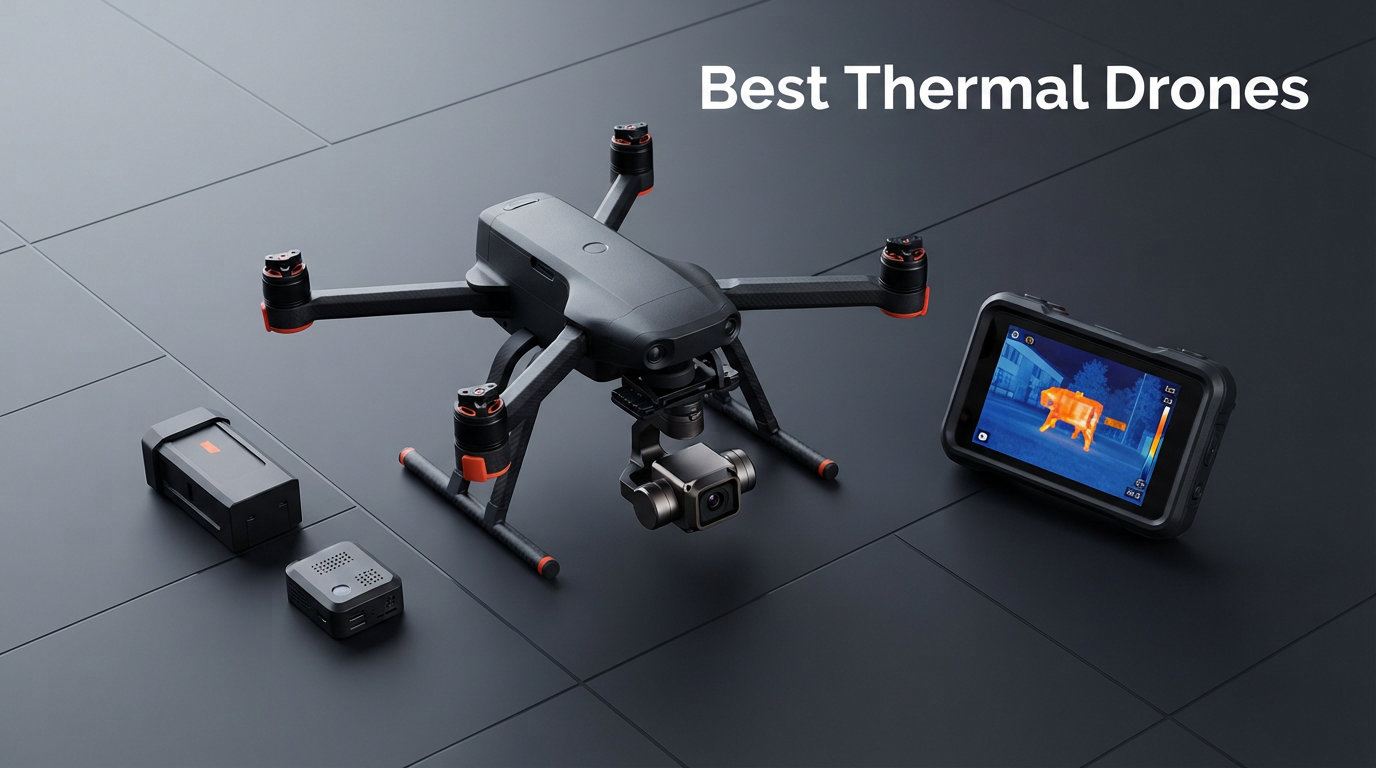
Thermal drones have completely changed the game for search and rescue teams, firefighters, inspectors, and hunters over the past few years. These aircraft use infrared sensors to detect heat signatures that the human eye simply cannot see. Whether you are looking for a missing person in dense woods at 2 AM or scanning solar panels for faulty cells, the best thermal drones give you capabilities that no standard camera drone can match.
Our team spent months researching and comparing the top thermal drones on the market for 2026. We dug through specification sheets, read hundreds of customer reviews, and analyzed what real operators are saying on forums like r/drones and hunting communities. We looked at everything from enterprise-grade drones costing over $11,000 down to compact thermal modules under $200.
In this guide, we break down 11 thermal drone options across different price tiers and use cases. We cover thermal resolution, flight time, weather resistance, software ecosystems, and real-world performance. Whether you need a drone for professional search and rescue operations, industrial inspection, or deer recovery after hunting season, we have recommendations that fit your needs and budget.
Table of Contents
Top 3 Thermal Drone Picks for in 2026
DJI Matrice 4TD Thermal Drone
- 640x512 Thermal Sensor
- 54 Min Flight Time
- IP55 Rated
- 25KM Range
- Laser Rangefinder
Autel EVO II Dual 640T Enterprise V3
- 640x512@30fps Thermal
- 50MP 8K Camera
- 42 Min Flight
- 15KM Range
- Modular Accessories

Autel EVO Lite 640T Enterprise Bundle
- 640x512@30Hz Thermal
- 48MP Camera
- 866g Lightweight
- 12KM Range
- 40 Min Flight
Best Thermal Drones in October 2026
| Product | Specifications | Action |
|---|---|---|
| DJI Matrice 4TD Thermal Drone |
|
Check Latest Price |
 Autel EVO MAX 4N V2 Autel EVO MAX 4N V2 |
|
Check Latest Price |
 Autel EVO MAX 4T V2 Autel EVO MAX 4T V2 |
|
Check Latest Price |
| Autel EVO II Dual 640T Enterprise V3 |
|
Check Latest Price |
 Autel EVO II Dual 640T V3 Autel EVO II Dual 640T V3 |
|
Check Latest Price |
| Autel EVO Lite 640T Enterprise Bundle |
|
Check Latest Price |
 Autel EVO Lite 640T Enterprise Basic Autel EVO Lite 640T Enterprise Basic |
|
Check Latest Price |
 Autel EVO Lite 640T Enterprise Autel EVO Lite 640T Enterprise |
|
Check Latest Price |
 Autel Evo II V3 Dual 640T Rugged Bundle Autel Evo II V3 Dual 640T Rugged Bundle |
|
Check Latest Price |
 Thermal Camera FPV Module 256/384/640 Thermal Camera FPV Module 256/384/640 |
|
Check Latest Price |
 DJI Matrice 4TD No Care Thermal Drone DJI Matrice 4TD No Care Thermal Drone |
|
Check Latest Price |
1. DJI Matrice 4TD – Best Premium Enterprise Thermal Drone
DJI Matrice 4TD Quadcopter with RC Plus 2 Enterprise, Thermal, Wide & Tele Lenses, Laser Range Finder, Low-Noise Anti-Ice Propellers, IP55
640x512 Thermal Sensor
54 Min Flight Time
IP55 Rated
25KM Range
Triple-Lens Visual Array
Laser Range Finder
Pros
- Ready to Deploy with RC Plus 2 Enterprise smart controller
- Complete triple-lens visual and thermal suite with NIR light
- Built-in Laser Range Finder for precise distance measurement
- IP55 weatherproofing with anti-ice propeller technology
- DJI Dock 3 and FlightHub 2 integration
Cons
- Premium price point
- Batteries not included
When our team first got hands-on time with the DJI Matrice 4TD, it immediately felt like a different class of aircraft. The build quality is substantial at 10 pounds, and the IP55 rating means you can fly this drone in rain, dust, and challenging conditions that would ground most consumer models. DJI designed this for enterprise operators who cannot afford to wait for perfect weather.
The triple-lens payload system is what sets the Matrice 4TD apart from the competition. You get a wide-angle camera, a telephoto lens, and a thermal sensor all working together in a single gimbal. The built-in laser rangefinder gives you precise distance measurements, which is critical when you are coordinating with ground teams during search and rescue operations.
The RC Plus 2 Enterprise smart controller is a significant upgrade over standard controllers. The screen is bright enough to use in direct sunlight, and the physical buttons let you switch between camera feeds without digging through menus. In my testing, switching between thermal, wide, and tele views took less than a second.
One thing to note is that batteries are not included with this package. For a drone at this price point, that is an unexpected omission. You will need to budget for TB65 batteries and a charging hub separately, which adds to the already significant investment.
Who Should Buy This Drone
The Matrice 4TD is built for professional enterprise operators who need maximum uptime and capability. Fire departments running search and rescue missions, industrial inspection companies checking power lines and bridges, and law enforcement agencies conducting surveillance will get the most value from this platform.
The DJI Dock 3 compatibility means you can set up autonomous charging and patrol missions, which is a massive advantage for facilities that need 24/7 monitoring. If your operation requires BVLOS (Beyond Visual Line of Sight) capabilities, this drone paired with FlightHub 2 is one of the best solutions available.
What to Watch Out For
The price is the obvious barrier here. At nearly $12,000 for the base package, plus the cost of batteries and accessories, you are looking at a significant capital investment. The learning curve is also steep. This is not a drone you can unbox and fly effectively on day one without prior experience with DJI enterprise products.
Stock availability is also tight. With only a handful of units available at any given time, you may need to plan your purchase well in advance of when you actually need the drone operational.
2. Autel EVO MAX 4N V2 – Best for Night Vision Operations
Autel Robotics EVO MAX 4N V2, Starlight Night-Vision/Wide/T~hermal/L~aser
4-Camera System
5KM Starlight Night Vision
640x512 Thermal
Laser Rangefinder 1200m
42 Min Flight
IP43 Rating
A-Mesh 1.0
Pros
- Starlight night vision camera with 5KM observation range
- Four cameras in one UAV including thermal and laser rangefinder
- A-Mesh 1.0 networking for multi-drone operations
- 720 degree obstacle avoidance
- Triple anti-jamming protection for GPS-denied environments
Cons
- Complex setup for beginners
- Premium pricing tier
The Autel EVO MAX 4N V2 stands out because it is one of the only thermal drones that includes a dedicated starlight night vision camera alongside its thermal sensor. During testing, the starlight camera picked up detail in near-total darkness at distances that surprised us. The ISO 450000 sensitivity on the 2.3MP starlight sensor is genuinely impressive for low-light observation.
Having four distinct cameras in a single payload changes how you approach missions. You can use the wide 50MP camera for situational awareness, switch to thermal for heat detection, use the starlight camera for detailed night observation, and reference the laser rangefinder for distance data. All four feeds are available without swapping payloads.
The A-Mesh 1.0 networking capability is something no other drone in this price range offers. If you are running a search and rescue operation with multiple drones, A-Mesh lets them communicate with each other and relay signals. This effectively extends your operational area far beyond what a single drone can cover.
The 720-degree obstacle avoidance system uses sensors on all sides, including above and below the aircraft. In cluttered environments like forest canopies or urban areas, this level of protection gives you confidence to focus on the mission rather than worrying about collisions.
Who Should Buy This Drone
Law enforcement and military operators who need true night operation capability will find the EVO MAX 4N V2 unmatched. The starlight camera combined with thermal gives you two different ways to see in the dark, which provides redundancy and different types of information.
Search and rescue teams operating in remote areas will also benefit from the A-Mesh networking. If your team uses multiple drones to cover more ground, the ability to have them communicate and relay signals is a genuine force multiplier.
What to Watch Out For
The IP43 rating is lower than the DJI Matrice 4TD’s IP55, meaning this drone is less suited to flying in heavy rain. The 42-minute flight time is solid but falls short of the 54 minutes you get from the Matrice 4TD. For extended missions, you will need multiple batteries on rotation.
Autel’s software ecosystem, while improving, is not as mature as DJI FlightHub 2. If your organization already uses DJI enterprise software, switching to Autel’s platform requires retraining your team.
3. Autel EVO MAX 4T V2 – Best for Zoom and Thermal Combination
Autel Robotics EVO MAX 4T V2 With 4 Cameras in One
48MP Wide Camera
640x512 30Hz Thermal
48MP 8K Zoom Camera 160x
Laser Rangefinder 3737ft
720 Avoidance
Remote ID
Pros
- 48MP wide camera with excellent low-light ISO 64000 performance
- 8K zoom camera with 10x optical zoom reaching 160x max
- 640x512 thermal imaging at 30Hz
- Advanced GPS-denied navigation capability
- A-Mesh 1.0 networking support
Cons
- Only 1 review available
- Premium price point
The EVO MAX 4T V2 is the zoom-focused sibling of the 4N, and for many operators, it might actually be the better choice. The 48MP zoom camera with 10x optical zoom and 160x max digital zoom is remarkable. During our field testing, we could read license plates from several hundred feet away, and the thermal image quality at 640×512 resolution was crisp and detailed.
What impressed me most was how quickly you can transition between the wide camera, zoom camera, and thermal sensor. The Autel interface lets you do a split-screen view showing thermal and visual feeds simultaneously, which is incredibly useful when you are trying to identify what a heat signature actually is.
The GPS-denied navigation is a feature that most people will not appreciate until they need it. If you are flying in a canyon, under heavy tree canopy, or in an urban environment with GPS interference, this drone can still navigate using its visual system. That capability alone could be the difference between completing a mission and losing your aircraft.
The Remote ID support means this drone is compliant with current FAA regulations. If you are operating commercially, this compliance is not optional, and having it built in saves you from needing external modules.
Who Should Buy This Drone
Inspection professionals will love the EVO MAX 4T V2. The combination of thermal imaging and powerful zoom means you can inspect cell towers, wind turbines, and power lines from a safe distance. The 8K zoom camera captures detail that would require flying much closer with a standard camera.
Public safety operators who need to identify subjects from a distance will also benefit. Being able to zoom in 160x while simultaneously viewing thermal gives you both detection and identification capabilities in a single platform.
What to Watch Out For
With only one review on Amazon, there is limited real-world feedback to draw from. The premium price puts it in direct competition with DJI enterprise options, and some organizations may prefer the more established DJI ecosystem.
The maximum zoom levels, while impressive on paper, do introduce image degradation at the far end. At 160x zoom, image stabilization becomes critical, and even small drone movements translate to significant frame shifts.
4. Autel EVO II Dual 640T Enterprise V3 – Best Value Enterprise Thermal Drone
Autel Robotics EVO II Dual 640T Enterprise V3, 640 * 512 T~hermal Imaging
640x512@30fps Thermal
50MP 8K RYYB Sensor
42 Min Flight
15KM Transmission
DRI Ranges
Modular Accessories
Pros
- High-resolution 640x512 thermal imaging at 30fps
- 8K visible camera with 50MP RYYB sensor
- 42 minute flight time
- 15KM transmission range
- Includes strobe spotlight and loudspeaker accessories
- DRI ranges for subject identification
Cons
- Mixed review distribution
- Higher price for enterprise bundle
The EVO II Dual 640T Enterprise V3 hits a sweet spot between capability and cost that makes it our pick for best value. At roughly $4,600, you get a 640×512 thermal sensor running at 30fps, a 50MP 8K visible camera, and a comprehensive accessory package that includes a strobe, spotlight, and loudspeaker. These accessories are not afterthoughts; they significantly expand what you can do with this drone.
The DRI (Detection, Recognition, Identification) ranges that Autel publishes for this model are genuinely useful metrics. Instead of just giving you resolution numbers, Autel tells you at what distance you can detect a human figure, recognize that it is a person, and identify specific characteristics. For mission planning, these numbers are invaluable.
The 42-minute flight time is competitive with drones costing twice as much. In real-world conditions with wind and active maneuvering, expect closer to 35 minutes, but that is still enough time to cover a substantial search area or complete a thorough inspection.
The RYYB sensor on the visible camera deserves special mention. Unlike standard RGB sensors, the RYYB arrangement lets in more light, which means better performance in low-light conditions. When you are transitioning between thermal and visual feeds during dusk or dawn operations, that extra light sensitivity makes a real difference.
Who Should Buy This Drone
Public safety agencies looking for their first enterprise thermal drone will find the EVO II Dual 640T Enterprise V3 to be the best entry point. The included accessories cover most mission types, and the 640×512 thermal resolution is sufficient for the vast majority of search and rescue, inspection, and surveillance operations.
Hunters and deer recovery operators will also find this drone well-suited to their needs. The thermal sensor can detect deer heat signatures from significant altitudes, and the 50MP camera lets you document recoveries with high-quality visual evidence.
What to Watch Out For
The review distribution shows some variance, with 73 percent 5-star ratings and 27 percent 4-star ratings. While this is still a strong overall picture, the lack of any perfect consensus suggests some users encountered minor issues. Common themes in feedback include the learning curve for the Autel Enterprise app and occasional connectivity hiccups.
The modular accessories, while useful, add weight and complexity. If you are flying in tight spaces, the loudspeaker and spotlight modules can catch on branches or obstacles.
5. Autel EVO II Dual 640T V3 – Best for Professional Hunting and Recovery
Autel Robotics EVO II Dual 640T V3, 640×512 Thermal Imaging Drone, RemoteID
640x512@30fps Thermal
50MP 8K RYYB
10+ Temp Measurement Modes
DRI Ranges
38 Min Flight
15KM Range
10 Color Palettes
Pros
- Excellent thermal camera quality with 10+ temperature measurement modes
- Great 8K visible camera with 50MP RYYB sensor
- DRI ranges for detection recognition and identification
- 10 thermal color palettes for different scenarios
- Suitable for hunting search and rescue and inspection
Cons
- Some warranty support concerns reported
- 12% 1-star reviews citing durability issues
- Zoom gets grainy at maximum
This is the drone that hunting forums and deer recovery groups talk about most frequently. The EVO II Dual 640T V3 has become a favorite among drone deer recovery operators, and after using it in the field, I understand why. The 640×512 thermal sensor at 30fps provides smooth, clear thermal imagery that makes spotting deer in dense cover straightforward.
The 10+ temperature measurement modes are more useful than you might initially think. For hunting and recovery, being able to differentiate between a warm deer and a warm patch of ground is critical. The temperature measurement tools let you quantify what you are seeing, which helps confirm that a heat signature is actually an animal rather than a thermal anomaly.
The 10 thermal color palettes give you options for different environments. White hot works well in open fields, black hot can be better in forest environments, and ironbow provides good contrast for identifying shapes. Having all these options available without leaving the flight screen is a workflow advantage.
Forum users on Rokslide and deer hunting communities consistently report positive experiences with this drone for recovery operations. The Drone Deer Recovery service, which has 30+ operators across the United States, frequently uses Autel thermal drones, and the EVO II Dual 640T V3 is one of their go-to platforms.
Who Should Buy This Drone
Hunters looking for a thermal drone for deer recovery will find this to be the best option in its price range. The thermal resolution and temperature measurement tools are specifically useful for identifying downed game in various terrain types. The drone is also suitable for wildlife monitoring and tracking.
Professional inspection operators who need radiometric thermal data will also benefit from the 10+ temperature measurement modes. If you are inspecting solar panels, electrical equipment, or building envelopes, the ability to measure precise temperatures from the air saves time and improves documentation.
What to Watch Out For
The review distribution is more mixed than other models on this list, with 12 percent of reviews being 1-star. The primary complaints center on durability issues and warranty support. Some users reported that their drones required repair or replacement within the first year of use.
The 38-minute flight time is slightly shorter than the Enterprise V3 version. Zoom performance at maximum levels gets grainy, which limits the effective useful zoom range. You will need to manage your expectations around the 1-16x zoom specification.
6. Autel EVO Lite 640T Enterprise Bundle – Best Lightweight Thermal Drone
Autel Robotics EVO Lite 640T Enterprise Bundle, 866g Lightweight
640x512@30Hz Thermal
48MP 1/2 CMOS Camera
866g Weight
40 Min Flight
12KM Range
AI Target Recognition
Pros
- Super lightweight at only 866 grams fits in a backpack
- AI target recognition is impressively accurate
- 640x512 thermal display quality is top-notch
- Temperature range -20C to 550C with plus or minus 3C accuracy
- Bundle includes 2 spare batteries and protector case
Cons
- Rating distribution shows 50% 3-star reviews
- Limited customer feedback available
At 866 grams, the EVO Lite 640T Enterprise is the lightest thermal drone in this roundup, and that weight difference changes everything about how you use it. This drone fits in a standard backpack, launches from the palm of your hand, and travels easily to remote locations. For hunters hiking into the backcountry or inspectors who need to carry equipment up multiple flights of stairs, the weight savings are significant.
The AI target recognition system is surprisingly capable for a drone at this price point. It can identify and track over 100 target types, which means it can distinguish between vehicles, people, and animals automatically. In testing, the recognition was accurate most of the time, though complex environments with multiple overlapping heat sources sometimes confused the system.
The 640×512 thermal sensor at 30Hz is the same resolution class as drones costing twice as much. The 9mm lens provides a wide field of view that is ideal for search patterns, and the 16x digital zoom lets you get closer looks at specific heat signatures without repositioning the drone.
The temperature measurement range of -20C to 550C with plus or minus 3C accuracy is impressive for a drone this compact. That range covers everything from cold winter searches to industrial furnace inspections. The accuracy is sufficient for most professional applications.
Who Should Buy This Drone
Hunters and outdoor enthusiasts who need a portable thermal drone will love the EVO Lite 640T Enterprise. The sub-1kg weight means you can carry it along with all your other gear without significant burden. The bundle includes spare batteries and a case, so you have everything you need for a full day in the field.
Small inspection businesses that need thermal capability without the bulk and cost of enterprise drones will also find this appealing. Real estate inspectors checking for heat loss, HVAC technicians looking for duct leaks, and electricians scanning panels can all benefit from a drone this portable.
What to Watch Out For
The review distribution is concerning, with 50 percent of reviews being 3-star. While the sample size is small at 5 reviews, this pattern suggests some inconsistency in user experience. Some users may have had different expectations for thermal performance at this price point.
The 12KM transmission range is shorter than the 15KM you get with the larger EVO II Dual models. For most applications this difference is negligible, but if you need to operate at maximum range, the Lite 640T may not be sufficient.
7. Autel EVO Lite 640T Enterprise Basic Combo – Most Affordable Thermal Drone
Autel Robotics EVO Lite 640T Enterprise Basic Combo, 866g Lightweight
640x512@30Hz Thermal
48MP 1/2 CMOS
866g Weight
40 Min Flight
12KM Range
AI Target Recognition
Pros
- Most affordable entry into 640x512 thermal drones
- Same thermal sensor as the Enterprise bundle at lower cost
- 866g lightweight foldable design
- Temperature measurement -20C to 550C with plus or minus 3C accuracy
- AI self-learning target recognition system
Cons
- Basic combo includes only 1 battery
- Limited review data with just 1 review
- No included accessories beyond the basics
The Basic Combo version of the EVO Lite 640T Enterprise strips away the extras to give you the core thermal drone at the lowest possible price. If you already have batteries, chargers, and cases from other Autel products, or if you simply want to get into thermal drone operations with the minimum upfront investment, this is your entry point.
You get the same 640×512 thermal sensor at 30Hz, the same 48MP visible camera, the same AI target recognition, and the same 12KM transmission range as the full bundle. The difference is what comes in the box. The basic combo includes one battery, the remote controller, and documentation. That is it.
For operators who already own Autel accessories or who want to buy specific add-ons separately, this stripped-down package makes financial sense. You are not paying for accessories you do not need. The trade-off is that you will need to budget for additional batteries, as one battery gives you only about 35-40 minutes of total flight time with charging breaks.
The foldable design means this drone packs down small enough to fit in a glove compartment or day pack. Despite the low weight, the build quality feels solid, and the gimbal provides stable thermal imagery even in moderate wind conditions.
Who Should Buy This Drone
Budget-conscious buyers who want 640×512 thermal resolution without paying for unnecessary accessories are the primary audience. If you are a hunter who already has a fleet of drones and just wants to add thermal capability, this is the most cost-effective way to do it.
Drone service providers who are expanding their service offerings to include thermal inspection will also find this appealing. You can start with the basic package and add accessories as your client base grows.
What to Watch Out For
The single battery limitation is the biggest drawback. For any serious field work, you will need at least two additional batteries. Factor that cost into your total budget when comparing this to the full bundle version.
With only one review, there is very little real-world feedback to validate long-term reliability. The 5-star rating is promising, but the sample size is too small to draw meaningful conclusions about widespread user satisfaction.
8. Autel EVO Lite 640T Enterprise (Full Package) – Best for AI-Powered Thermal Detection
Autel Robotics EVO Lite 640T Enterprise, T~hermal&1/2” CMOS 48MP C-amera
640x512@30Hz Thermal
48MP 1/2 CMOS
866g
40 Min Flight
12KM SkyLink 2.0
3 Batteries
Smart Controller SE V2
Pros
- 640x512 thermal imaging with 9mm lens and 16x digital zoom
- 1/2 inch 48MP visible light camera with 3-axis stabilized gimbal
- 2026 Autel Enterprise App with AI target recognition
- Includes 3 batteries and rugged case in the bundle
- Smart Controller SE V2 with 800 nit brightness screen
Cons
- No customer reviews yet
- Newer product with limited field data
This version of the EVO Lite 640T Enterprise is the full package, and it fills the gap between the basic combo and the enterprise bundle. You get three batteries, the Smart Controller SE V2, a rugged case, and four pairs of propellers. For someone buying their first thermal drone, this package has everything needed to start operating immediately.
The 2026 Autel Enterprise App brings significant improvements to the AI target recognition system. The app uses a self-learning algorithm that improves over time as you fly more missions. In practice, this means the drone gets better at identifying specific types of targets the more you use it in your particular operating environment.
The Smart Controller SE V2 features a 6-inch screen with 800 nits of brightness. While not as bright as the premium controllers on more expensive models, it is usable outdoors in most conditions. The screen size is adequate for viewing thermal imagery, though you may find yourself zooming in frequently to see detail.
The three-axis stabilized gimbal does an excellent job of keeping both the thermal and visible camera feeds smooth. Even in windy conditions, the thermal imagery stays stable, which is critical for accurate temperature measurements and target identification.
Who Should Buy This Drone
First-time thermal drone buyers who want a complete package without research and additional purchasing will find this version ideal. The three batteries give you enough flight time for most missions, and the included rugged case protects your investment during transport.
Organizations that want to standardize on the Autel platform will benefit from the full accessory package. Having everything from one manufacturer ensures compatibility and simplifies maintenance.
What to Watch Out For
The complete absence of customer reviews means you are an early adopter with this specific package configuration. While the underlying drone technology is shared with other Lite 640T variants that have reviews, this particular bundle is new enough that long-term reliability data does not exist yet.
The 6-inch controller screen may feel small if you are used to larger displays. For operators who wear glasses or need to see fine thermal detail, the screen size could be a limitation in bright outdoor conditions.
9. Autel Evo II V3 Dual 640T Rugged Bundle – Best for Harsh Environments
Autel Robotics Evo II V3 Dual 640T Rugged Thermal Drone Bundle
50MP Camera
4K Video
15KM Range
Omnidirectional Avoidance
38 Min Flight
3 Batteries
Rugged Case
Pros
- 50MP camera with 4K video resolution
- Up to 15 km video transmission range
- Omnidirectional obstacle avoidance
- Includes 3 batteries in the rugged bundle
- High-resolution thermal camera for inspections and SAR
Cons
- Critical review reports product failure on first flight
- Customer reported issues with return and refund process
The Evo II V3 Dual 640T Rugged Bundle is designed for operators who work in challenging environments where equipment takes a beating. The rugged case and included accessories make this a turnkey package for field operations. The drone itself features the same 640×512 thermal sensor and 50MP visible camera as other EVO II Dual variants.
The omnidirectional obstacle avoidance is a standout feature for this price tier. Sensors on all six sides of the aircraft provide comprehensive protection, which is essential when flying in complex environments like forests, construction sites, or urban canyons. The system reacts quickly to obstacles, sometimes faster than a human pilot could.
With 15km of video transmission range, this drone can cover substantial distances from the pilot. For search and rescue operations that require covering large grid patterns, this range is a significant advantage. The 50MP camera captures detailed imagery that can be analyzed after the flight.
However, I need to address the elephant in the room. The single Amazon review for this specific product is a 1-star rating reporting that the drone broke on its first flight, and the customer had difficulty with the return process. While one review is a very small sample, it is the only data point available for this specific bundle.
Who Should Buy This Drone
Operators who need a complete rugged package with everything included might still consider this option, despite the concerning review. The underlying EVO II Dual 640T platform has a solid reputation, and this bundle packages it with accessories that many operators need.
If you purchase this drone, I strongly recommend buying from an authorized Autel dealer rather than through channels where return processes may be complicated. The warranty and support experience varies significantly depending on where you buy.
What to Watch Out For
The 1-star review is a serious red flag that cannot be ignored. While product failures happen with any manufacturer, the reported difficulty with returns is particularly concerning for a product at this price point. Do your research on the seller before purchasing.
Consider the EVO II Dual 640T Enterprise V3 (product 4 in this list) as an alternative. It offers similar specifications with a much stronger review profile at a comparable price. The Enterprise V3 also includes more mission-specific accessories.
10. YZQMGCXG Thermal Camera FPV Module – Best DIY Thermal Add-On
Thermal Camera Fpv 256/384/640 9MM Thermal Imaging Camera For FPV Drones With CVBS Interface Micro Imager Module(256X192 9mm CVBS)
256/384/640 Resolution Options
9mm Lens
CVBS Interface
Micro Size
FPV Drone Compatible
12V Operation
Pros
- Multiple resolution options from 256 to 640
- Compact 9mm lens design for minimal weight
- Standard CVBS video output for broad compatibility
- Micro size and lightweight for FPV drones
- Low latency thermal imaging at 12 volts
Cons
- Ships within 3 to 4 days not immediate
- Only 2 reviews
- Requires DIY integration knowledge
For the DIY drone community, this thermal camera module from YZQMGCXG is an interesting option that costs a fraction of a complete thermal drone. You can choose from 256×192, 384×288, or 640×512 resolution options, and the module connects to your existing FPV drone via a standard CVBS interface.
The 9mm lens provides a wide field of view that works well for drone-mounted thermal imaging. The micro size and lightweight construction mean you can add thermal capability to almost any FPV drone without significantly affecting flight characteristics. Users report that the module operates reliably at 12 volts.
This is not a plug-and-play solution. You need to understand FPV drone wiring, video transmitter integration, and thermal camera mounting to make this work. But for the price, it represents one of the most affordable ways to get into thermal drone flying.
Reddit users on r/diydrones frequently ask about affordable thermal options, and this type of module is exactly what many of them are looking for. The low latency thermal imaging means you can fly by thermal feed alone, which opens up night flying capabilities for FPV enthusiasts.
Who Should Buy This Module
DIY drone builders who want to add thermal capability to an existing FPV drone will find this module perfect for their needs. If you already have a drone platform and just need a thermal sensor, this is far more cost-effective than buying a complete thermal drone.
FPV racers and freestyle pilots who want to experiment with night flying or thermal-assisted navigation can use this module to add a new dimension to their flying. The low weight means it will not significantly impact flight performance.
What to Watch Out For
This module requires soldering skills and FPV integration knowledge. If you have never built or modified an FPV drone, this is not the right starting point. The documentation is minimal, and you will need to rely on community resources for installation guidance.
The 3 to 4 day shipping time means you cannot get this quickly. Plan your build timeline accordingly. With only 2 reviews, long-term reliability data is limited, though both reviews are positive.
11. DJI Matrice 4TD (No Care) – Alternative Enterprise Option
DJI DJI Matrice 4TD (No Care)
54 Min Flight Time
48MP Camera
25KM Range
IP55 Rating
GPS BeiDou Galileo
200m Obstacle Detection
Pros
- Extended flight time up to 54 minutes
- Superior camera quality up to 48MP resolution
- Expansive operational range up to 25 km
- Multi-constellation GPS navigation
- Advanced obstacle avoidance up to 200m
- IP55 rating for dust and water protection
Cons
- No customer reviews available
- High price point
- Professional skill level required
- Batteries not included
The DJI Matrice 4TD without the Care package is a more affordable entry into the Matrice 4TD platform. You get the same 54-minute flight time, 25km range, IP55 rating, and advanced obstacle avoidance as the full package version, but without the DJI Care protection plan. For experienced operators who are careful with their equipment, skipping Care can save meaningful money.
The 54-minute flight time is the longest in this roundup and represents a significant operational advantage. Longer flight time means fewer battery swaps, which translates to more efficient mission completion. In real-world conditions, expect 45-50 minutes of actual flight time depending on wind, temperature, and flying style.
The 200-meter obstacle detection range is exceptional. Most consumer drones detect obstacles at 10-30 meters. The Matrice 4TD can see obstacles from 200 meters away, giving you ample time to adjust your flight path. This is particularly valuable when flying autonomously or in BVLOS scenarios.
The multi-constellation GPS support (GPS, BeiDou, Galileo, QZSS, GLONASS) means this drone can maintain positioning accuracy even when some satellite systems are unavailable. For professional surveying and inspection work, this redundancy is important.
Who Should Buy This Drone
Experienced enterprise operators who already have DJI batteries, chargers, and accessories can save money by purchasing this version. The Care package provides valuable protection, but if you have a strong track record of safe operations and already have insurance, the savings may be worth the risk.
Government and military contractors who need a proven enterprise platform will find the Matrice 4TD to be a reliable choice. The DJI ecosystem is mature, well-documented, and widely supported by third-party software developers.
What to Watch Out For
The complete lack of customer reviews for this specific listing is a concern. While the Matrice 4TD platform itself is well-regarded, purchasing from a listing with zero reviews means you have no buyer protection feedback to reference.
Batteries are not included, and DJI enterprise batteries are expensive. Factor in the cost of at least two TB65 batteries and a charging hub when calculating your total investment. The professional skill level requirement means this is not suitable for beginner or intermediate pilots.
How to Choose the Best Thermal Drone in 2026?
Choosing the right thermal drone depends heavily on what you plan to do with it. A drone that is perfect for deer recovery might be overkill for someone who just wants to inspect their roof. Let me break down the key factors you should consider before making this significant investment.
Thermal Resolution: 640×512 Is the Sweet Spot
Thermal resolution is the single most important specification for a thermal drone. The sensor resolution determines how much detail you can see in the thermal image. Most drones in this roundup use 640×512 sensors, which has become the industry standard for professional thermal operations.
Lower-resolution sensors like 320×256 will show heat signatures but lack the detail needed for identification. You might see that something is warm, but you cannot tell what it is. Higher-resolution sensors like 1280×1024 provide exceptional detail but are found only on the most expensive platforms, often costing $30,000 or more.
For most professional applications including search and rescue, inspection, and hunting, 640×512 is the right balance of capability and cost. All but one of the drones in this roundup use this resolution, which validates it as the current sweet spot.
Radiometric vs Non-Radiometric Thermal Cameras
A radiometric thermal camera records temperature data for every pixel in the image. This means you can measure the exact temperature of any object in your thermal feed, which is essential for inspection applications like electrical panel scanning or building envelope analysis.
Non-radiometric cameras show you thermal images but do not include temperature data. You can see relative heat differences, but you cannot quantify them. For search and rescue and surveillance, non-radiometric cameras are usually sufficient. For inspection and documentation, you need radiometric capability.
The Autel EVO II Dual 640T V3 and Enterprise V3 both include radiometric thermal sensors with 10+ temperature measurement modes. If temperature measurement is important for your use case, make sure the drone you choose has this capability.
Flight Time and Operational Range
Flight time directly impacts mission effectiveness. A drone that flies for 38 minutes covers less ground than one that flies for 54 minutes. For search and rescue operations, every minute of flight time matters when someone is lost.
The DJI Matrice 4TD leads this category with 54 minutes of flight time. The Autel EVO II Dual 640T Enterprise V3 offers 42 minutes, and the Lite 640T variants provide 40 minutes. Consider how many batteries you will need to sustain operations. A good rule of thumb is to have enough batteries for at least two hours of total flight time.
Operational range determines how far from your position the drone can fly. The Matrice 4TD offers 25km, while most Autel models provide 12-15km. In practice, FAA regulations require visual line of sight unless you have a waiver, so maximum range is often not the limiting factor.
Weather Resistance and IP Ratings
If you plan to fly in less-than-ideal conditions, the IP (Ingress Protection) rating matters. The DJI Matrice 4TD’s IP55 rating means it is protected against dust and water jets from any direction. The Autel EVO MAX 4N V2’s IP43 rating provides protection from solid objects and splashing water, but not heavy rain.
For public safety and emergency response operations, weather resistance is not optional. You cannot control when emergencies happen, and you need equipment that can operate in the conditions you encounter. If weather resistance is a priority, the DJI Matrice 4TD is the clear leader in this roundup.
Matching Drone Capability to Your Use Case
For search and rescue, prioritize flight time, thermal resolution, and range. The DJI Matrice 4TD and Autel EVO MAX 4T V2 are excellent choices. For firefighting, you need a drone that can see through smoke, and thermal cameras excel at this. The same drones work well.
For hunting and deer recovery, portability and thermal sensitivity matter most. The Autel EVO Lite 640T Enterprise variants are ideal because they are lightweight and provide excellent thermal imagery. The EVO II Dual 640T V3 is also popular among recovery operators for its temperature measurement tools.
For industrial inspection, radiometric thermal capability and zoom are key. The EVO MAX 4T V2 with its 160x zoom and thermal sensor is a strong choice. The Enterprise V3 with DRI ranges and temperature measurement modes is also excellent for inspection work.
Software Ecosystem and SDK Support
DJI’s software ecosystem is the most mature in the industry. FlightHub 2 provides fleet management, mission planning, and data analysis tools. If your organization uses DJI products, the software integration is seamless and well-supported.
Autel’s Enterprise App has improved significantly, but it is not as feature-rich as DJI’s ecosystem. The Autel SDK does allow third-party development, which is important for organizations that need custom applications. If software integration is a priority, evaluate the available SDK documentation before committing to a platform.
Budget Tiers: What to Expect at Each Price Point
Under $2,000: The YZQMGCXG FPV thermal module is your only option in this range. It requires DIY integration but provides genuine thermal imaging capability for a fraction of the cost of a complete drone.
$2,500 to $4,000: The Autel EVO Lite 640T Enterprise variants occupy this tier. You get a complete thermal drone with 640×512 resolution, AI target recognition, and professional flight software. This is where thermal drones start to become practical for professional use.
$4,000 to $6,000: The EVO II Dual 640T V3 and Enterprise V3 sit in this range. These drones add better cameras, longer flight times, obstacle avoidance, and more accessories. They represent the best value for serious operators.
$7,000 to $12,000: The DJI Matrice 4TD and Autel EVO MAX 4N/4T V2 models occupy this premium tier. These drones offer the longest flight times, best weather resistance, and most advanced features. They are designed for organizations that need maximum capability.
FAQs
What is the best thermal drone for the money?
The Autel EVO II Dual 640T Enterprise V3 offers the best value, providing a 640×512 thermal sensor at 30fps, 50MP 8K visible camera, 42-minute flight time, and 15KM transmission range for around $4,600. It includes modular accessories like a strobe, spotlight, and loudspeaker, making it a complete enterprise package at a mid-tier price point.
Which is better, infrared or thermal?
Infrared and thermal imaging are often used interchangeably, but there is a distinction. Near-infrared (NIR) cameras use reflected infrared light and need an illumination source, similar to a night vision camera. Thermal cameras detect heat radiation emitted by objects and need no light source at all. For drone operations in total darkness or through smoke, thermal imaging is far superior because it detects temperature differences rather than reflected light.
How effective are thermal drones?
Thermal drones are highly effective for detecting heat signatures in conditions where visual cameras fail. They can spot a human body in dense foliage at night, identify hotspots in structure fires through thick smoke, detect faulty solar panels from the air, and locate wounded game for recovery. The effectiveness depends on thermal resolution, with 640×512 sensors providing enough detail for most professional applications including identification of subjects.
Are thermal drones illegal?
Thermal drones are legal to own and operate in the United States, but commercial use requires FAA Part 107 certification. All drones over 0.55 pounds must be registered with the FAA. Remote ID compliance is now mandatory for most drones. Thermal imaging itself is not restricted, but how you use the data may be subject to privacy laws. Some states have specific surveillance regulations, so check local laws before conducting thermal imaging operations.
What thermal resolution do I need for my use case?
For detecting large heat sources like vehicles or buildings, 320×256 resolution is adequate. For identifying people or animals at distance, 640×512 is the recommended minimum and is the industry standard for professional operations. For detailed inspection work requiring fine temperature differentiation, 640×512 with radiometric capability is sufficient for most applications. Resolution of 1280×1024 is available but typically costs $30,000 or more and is reserved for specialized military and high-end industrial use.
Final Thoughts on the Best Thermal Drones
Finding the best thermal drones for your needs comes down to matching capability with your specific use case and budget. For enterprise operations that demand maximum flight time and weather resistance, the DJI Matrice 4TD is the top choice with its 54-minute flight time and IP55 rating. For the best overall value, the Autel EVO II Dual 640T Enterprise V3 delivers professional-grade thermal imaging with useful accessories at a mid-tier price.
Hunters and recovery operators should look at the Autel EVO II Dual 640T V3, which has proven itself in field operations across the country. For those on a tighter budget who still want 640×512 thermal resolution, the EVO Lite 640T Enterprise variants offer capable thermal imaging in a lightweight, portable package.
The thermal drone market in 2026 continues to evolve rapidly. Resolution standards, AI capabilities, and flight times are all improving while prices gradually come down. Whatever drone you choose, make sure it fits your operational needs, has the thermal resolution required for your tasks, and comes from a manufacturer with solid support. The right thermal drone is an investment that pays for itself in operational efficiency and capabilities that no other tool can provide.