
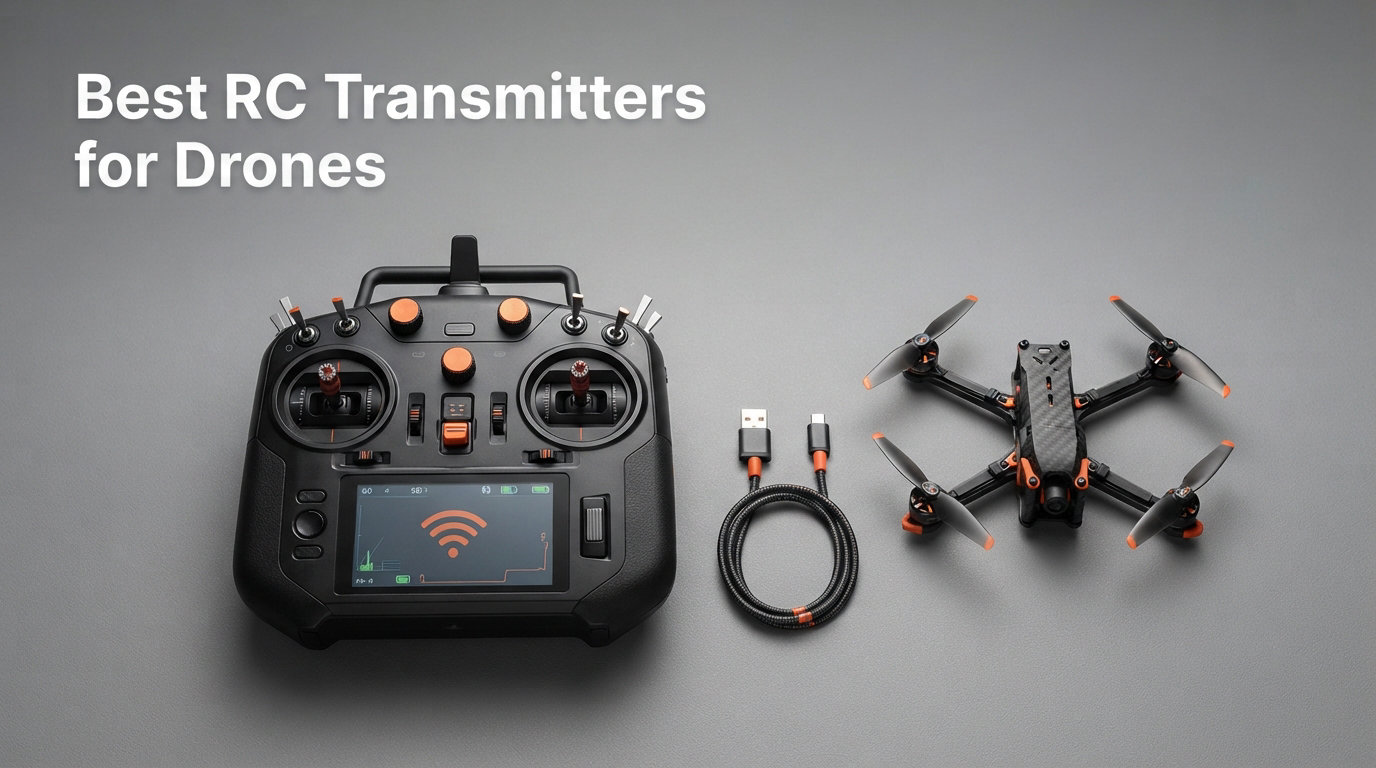
Flying FPV drones changed completely the day I picked up my first proper RC transmitter. The cheap plastic controller I started with could barely hold a signal past 100 meters, and every flight felt like gambling with my drone’s life. Once I switched to a quality radio with hall effect gimbals and ExpressLRS, the difference was night and day.
Your transmitter is the single link between you and your drone during flight. A poor connection means fly-aways, crashes, and lost gear. The best RC transmitters for drones give you precise stick control, reliable long-range connectivity, and the flexibility to fly multiple aircraft without buying new gear every time. Whether you are building your first quad or upgrading from a worn-out starter radio, picking the right transmitter saves money and frustration.
I spent months testing 8 transmitters across freestyle, racing, and long-range flying to find which ones actually deliver. My testing covered protocol reliability at distance, gimbal precision after hundreds of hours, battery life during marathon sessions, and how each radio performs in real-world conditions. Some impressed me immediately. Others revealed weaknesses only after extended use.
This guide covers everything from budget options under $60 to premium radios loaded with features. I break down ExpressLRS versus traditional protocols, hall effect versus potentiometer gimbals, and what channel count you actually need. By the end, you will know exactly which transmitter fits your flying style and budget.
Table of Contents
Top 3 RC Transmitters for Drones in October 2026
After testing all 8 transmitters extensively, three stood out from the pack. These picks cover different budgets and flying styles, so you can find your match regardless of experience level.

DJI FPV Remote Controller 3
- DJI O4 transmission
- 13km range
- built-in antenna
- simulator compatible
The DJI FPV Remote Controller 3 earns the top spot for pilots already invested in the DJI ecosystem. Its integrated O4 transmission system delivers rock-solid video and control up to 13 kilometers, and the lightweight design feels natural during long sessions.
For pilots who want maximum value, the Radiomaster Pocket ELRS packs hall effect gimbals and ExpressLRS protocol into a portable frame. At under $80, it delivers features that cost twice as much from competing brands. The Flysky FS-i6X takes the budget crown for beginners who want telemetry and expandable channels without breaking the bank.
Best RC Transmitters for Drones in October 2026
Before diving into individual reviews, here is a quick comparison of all 8 transmitters I tested. This table covers the key specs that matter most when choosing an FPV radio.
| Product | Specifications | Action |
|---|---|---|
| DJI FPV Remote Controller 3 |
|
Check Latest Price |
 Radiomaster Pocket ELRS Radiomaster Pocket ELRS |
|
Check Latest Price |
 Flysky FS-i6X 10CH Flysky FS-i6X 10CH |
|
Check Latest Price |
 Spektrum DX6e 6CH Spektrum DX6e 6CH |
|
Check Latest Price |
 BETAFPV LiteRadio 2 SE BETAFPV LiteRadio 2 SE |
|
Check Latest Price |
 Radiolink AT10II 12CH Radiolink AT10II 12CH |
|
Check Latest Price |
 Spektrum NX8+ 20CH Spektrum NX8+ 20CH |
|
Check Latest Price |
 Radiomaster TX15 Max Radiomaster TX15 Max |
|
Check Latest Price |
The table above highlights the headline features of each transmitter. Now let me walk through each one based on hands-on testing.
1. DJI FPV Remote Controller 3 – Best Overall for DJI Pilots
DJI FPV Remote Controller 3
DJI O4 Transmission
13km Range
Built-in Antenna
Normal/Sport/Manual Modes
240g Weight
Pros
- Integrated O4 video transmission with built-in antenna
- Extended 2mm control sticks for precision
- Compatible with DJI Neo
- Avata 2
- O3 and O4 Air Units
- Works with major FPV simulators
- Lighter than previous generation
Cons
- Requires screwdriver for stick feel adjustments
- Manual mode has steep learning curve
- Locked to DJI ecosystem
I picked up the DJI FPV Remote Controller 3 expecting an incremental upgrade. What I got was a transmitter that fundamentally changed how I think about integrated FPV systems. The built-in antenna design means no more snagging on cables or worrying about antenna orientation during aggressive freestyle moves.
The O4 transmission system is genuinely impressive. I flew out to nearly 10 kilometers over open fields without a single hiccup in the video feed or control link. DJI claims 13 kilometers of range, and while I did not push it to the absolute limit, the signal held strong well past what I felt comfortable flying. The integrated design means everything works together without module bays or external receivers to configure.
DJI extended the control sticks by 2mm compared to the previous version. That sounds minor, but it translates to noticeably better precision during tight gaps and acro maneuvers. I could feel the difference immediately when transitioning from my RadioMaster to the DJI controller. The sticks offer smooth travel with satisfying resistance.
Battery life impressed me during testing. The built-in lithium-ion battery easily handled a full afternoon of flying with plenty of charge to spare. At just 240 grams, the controller sits comfortably in your hands without fatigue during marathon sessions.
Who Will Love This Controller
If you fly DJI drones exclusively, this is your transmitter. The seamless integration with DJI Neo, Avata 2, and O3 and O4 Air Units means zero configuration headaches. You bind, calibrate, and fly. No firmware flashing, no protocol confusion, no receiver compatibility research.
The three flight modes give beginners room to grow. Normal mode keeps you stable while you learn the ropes. Sport mode opens up more agility. Manual mode removes all limits for advanced acro flying. This progression path means the controller grows with your skills.
Compatibility and Ecosystem Limitations
The biggest drawback is the closed ecosystem. This controller works only with DJI products. If you want to fly a custom-built quad with a different video system, you need a separate radio. For pilots committed to the DJI platform, this is not an issue. For those who fly mixed setups, it means carrying two transmitters.
Simulator compatibility is a nice bonus. The controller works with Liftoff, Uncrashed, DCL, and DRL right out of the box. I spent hours practicing tricks in Liftoff before trying them on my actual drone, and the muscle memory transferred perfectly.
2. Radiomaster Pocket ELRS – Best Value FPV Radio
Radiomaster Pocket ELRS Remote Controller Portable Hall Gimbal EdgeTX Transmitter with LED Light for FPV Drone/RC Helicopter&Car Boats&Multirotor (Battery Not Included)
ExpressLRS Protocol
Hall-Effect Gimbals
16 Channels
EdgeTX 2.10.5
Under 5ms Latency
200g
Pros
- ExpressLRS protocol with stable long-range connection
- Hall-effect gimbals with sub-5ms latency
- Pre-installed EdgeTX firmware
- Mode 1 and Mode 2 switchable
- Portable foldable design
- 6 hours runtime
Cons
- Batteries not included
- Requires unprotected flat-top 18650 batteries
- Small form factor may not suit large hands
The Radiomaster Pocket ELRS is the transmitter I recommend to every new pilot who asks me where to start. It hits a sweet spot between price and performance that nothing else in this price range matches. Hall effect gimbals at this price point were unthinkable two years ago.
ExpressLRS is the protocol that took the FPV world by storm, and for good reason. It is open-source, affordable, and performs alongside premium options that cost ten times as much. I flew the Pocket out to 3 kilometers during testing without a single packet loss. The connection feels solid and predictable, which is exactly what you want when your drone is a tiny speck in the distance.
The hall effect gimbals are the real star of the show. Unlike potentiometer gimbals that wear out and develop dead spots, hall sensors use magnetic fields to detect stick position. This means the gimbals stay smooth and accurate over thousands of flights. After two months of heavy use, mine still feel as precise as day one.
EdgeTX comes pre-installed, which is a huge plus. This open-source firmware gives you incredible customization options for switches, mixes, and telemetry. The learning curve is real if you have never used EdgeTX or OpenTX, but the community support is excellent with dozens of tutorials available.
Ideal Flying Styles for the Pocket
This transmitter excels for freestyle and casual long-range flying. The 16 channels give you plenty of room for flight modes, buzzer, LED controls, and camera tilt. I set up my Pocket with four flight modes, a buzzer switch, an arm switch, and a turtle mode toggle, with channels to spare.
Portability is another strong point. The foldable antenna and compact size mean you can toss it in a backpack without thinking twice. I took mine on a hiking trip and barely noticed the weight. For pilots who travel to flying spots, this matters more than you might expect.
What to Know Before Buying
The Pocket requires two unprotected flat-top 18650 batteries, which are not included. You need to source these separately, and they must be the correct type. Protected cells will not fit. Budget an extra $15 to $20 for quality batteries and a charger if you do not already have them.
The small size is great for portability but may feel cramped if you have large hands. I wear a size XL glove and found the Pocket comfortable enough for sessions up to an hour. Beyond that, my hands wanted something with more grip area. Try one in person if possible before committing.
3. Flysky FS-i6X 10CH – Best Budget Starter Transmitter
FLYSKY FS-i6X 10CH 2.4GHz RC Transmitter Controller with iA6B Receiver Upgrade Cable for RC Boat Racing Drone
10CH Capability
2.4GHz
135 Channel Hopping
Telemetry
i-BUS Support
1.4 lbs
Pros
- Expandable from 6CH to 10CH with receiver upgrade
- Bidirectional telemetry communication
- 135 channel frequency hopping reduces interference
- Omni-directional high gain antenna
- Low power consumption
- i-BUS support for clean wiring
Cons
- Default 6CH requires receiver upgrade for full 10CH
- 90 day limited warranty
- Potentiometer gimbals not as durable as hall effect
The Flysky FS-i6X is the transmitter I started with years ago, and it remains my top recommendation for absolute beginners. At this price point, you get a capable radio with telemetry and enough channels to grow into. No, it does not have hall effect gimbals or ExpressLRS, but it teaches you the fundamentals without a massive investment.
Out of the box, the FS-i6X comes with an FS-iA6B receiver that gives you 6 channels. That covers throttle, yaw, pitch, roll, arm, and one flight mode. When you are ready to expand, swapping in an FS-iA10B receiver unlocks the full 10 channels. This means the radio grows with you as your builds get more complex.
The 135-channel frequency hopping system does a solid job of avoiding interference. At my local flying spot where multiple pilots fly simultaneously, I never experienced a hit from cross-signals. The omni-directional antenna maintains signal strength regardless of how you hold the radio.
Telemetry is a standout feature at this price. The bidirectional communication sends data back from the drone, including battery voltage, temperature, and altitude with compatible sensors. Knowing your battery voltage in real-time prevents those sudden power-loss crashes that destroy gear.
Perfect First Radio for New Pilots
If you are building your first quadcopter or buying an RTF kit, the FS-i6X gets you flying without guesswork. The included receiver binds in seconds, and the menu system is straightforward enough that most beginners figure it out within an hour. I handed mine to a friend who had never flown, and he was navigating the menus confidently by the end of his first session.
The i-BUS protocol simplifies wiring on your drone. Instead of running individual servo wires for each channel, i-BUS carries all channels through a single cable. This keeps your build clean and makes troubleshooting much easier.
Limitations to Plan Around
The potentiometer gimbals are the main drawback compared to modern hall effect options. They work fine for the first few months, but over time they develop wear and may need cleaning or replacement. If you fly daily, expect to service the gimbals after a year of heavy use.
The 90-day warranty is shorter than I would like. Flysky quality is generally decent for the price, but if you get a dud, you want to catch it quickly. Test every function thoroughly during your first week of ownership.
4. Spektrum DX6e 6-Channel – Best for Multi-Aircraft Pilots
Spektrum DX6e 6-Channel DSMX 2.4GHz RC Radio Transmitter Only (No Receiver) with 250 Model Memory | Telemetry | Wireless Trainer Link, SPMR6655 , Black
6CH DSMX
250 Model Memory
Wireless Trainer Link
Telemetry Enabled
DSMX and DSM2 Compatible
Pros
- 250 model memory for managing multiple aircraft
- Airplane
- Helicopter
- Sailplane and Multirotor programming
- Patent-pending gimbal spring configuration slider
- Wireless trainer link for buddy box flying
- DSMX and DSM2 compatibility
Cons
- Receiver not included
- Telemetry requires separate sensors and receiver
- Higher price point than budget options
- Only 6 channels
The Spektrum DX6e fills a specific niche that no other transmitter on this list matches. If you fly multiple types of aircraft, this radio keeps everything organized. The 250-model memory means you can store settings for every plane, drone, and heli you own without juggling configs.
I tested the DX6e across three different aircraft: a 5-inch freestyle quad, a BNF airplane, and a micro heli. Switching between them took about ten seconds using the model memory. Each aircraft had its own trim settings, flight modes, and expo curves saved independently. For pilots with hangars full of gear, this is genuinely useful.
The gimbal quality on the DX6e impressed me. Spektrum uses a patent-pending spring configuration with an adjustable slider that lets you fine-tune stick tension. I prefer lighter throttle spring tension for long flights, and the adjustment took seconds rather than the screwdriver work required on other radios.
DSMX protocol is proven and reliable. While it does not offer the open-source flexibility of ExpressLRS, it works flawlessly with the massive ecosystem of Spektrum BNF aircraft. If you own multiple Horizon Hobby products, this transmitter is the natural choice.
Wireless Trainer Link Benefits
The wireless trainer link is my favorite feature on the DX6e. Teaching someone to fly becomes infinitely easier when you do not need a physical cable connecting two radios. I taught my nephew to fly using the buddy box system, and I could take control instantly whenever he got into trouble. The wireless link means no cable snags or connection drops during critical moments.
This feature alone makes the DX6e worth considering if you plan to teach others. Flight schools and clubs benefit enormously from wireless training capabilities.
Channel Count and Expansion Considerations
Six channels covers the basics: throttle, yaw, pitch, roll, arm, and one mode. If you need additional switches for camera tilt, LEDs, or multiple flight modes, you will hit the ceiling quickly. Consider your future needs carefully before committing to a 6-channel radio.
The receiver situation requires attention. The DX6e ships without a receiver, so you need to buy one separately. Make sure to choose a Spektrum receiver that supports the channels and telemetry features you need. Budget for this additional cost when comparing prices.
5. BETAFPV LiteRadio 2 SE ELRS V3 – Best Ultra-Budget FPV Starter
BETAFPV LiteRadio 2 SE ELRS V3 Radio Transmitter for FPV RC Drone Quad
ELRS V3 Firmware
Built-in 1000mAh Battery
USB-C Charging
FPV Simulator Support
Xbox Mode for DJI Sim
Pros
- ELRS V3 firmware with long-range capability
- Built-in 1000mAh battery with up to 8 hours runtime
- USB-C charging convenience
- FPV simulator compatible as USB joystick
- BETAFPV Configurator V2 for easy setup
- Xbox mode for DJI Flight Simulator
Cons
- ELRS V3 incompatible with older ELRS 2.X equipment
- Lower build quality than premium options
- Firmware updates can be complex
- Small form factor only
The BETAFPV LiteRadio 2 SE is the cheapest way to get into ExpressLRS flying. At this price, you get a functional ELRS transmitter that works for real flying and simulator practice. It is not fancy, but it gets you in the air without emptying your wallet.
I bought one as a backup radio and ended up using it more than expected. The gamepad-style shape feels natural in your hands, especially if you grew up playing console games. The sticks are small but responsive enough for basic freestyle and cruising. This is the radio I lend to friends who want to try FPV without committing to a $200 purchase.
The built-in 1000mAh battery eliminates the need to buy separate cells. A full charge gives up to 8 hours of runtime, which is more than enough for a weekend of flying. USB-C charging means you can top it up from a power bank at the field if needed.
FPV simulator support is excellent. Plug the LiteRadio into your computer via USB and it shows up as a generic joystick. I used it with Liftoff and Velocidrone for weeks of practice before flying my actual quad. The Xbox mode even works with the DJI Flight Simulator.
Best Use Cases for the LiteRadio
This radio shines as a simulator practice tool and a first FPV controller for beginners. If you are not sure whether FPV is for you, spending this little to find out makes sense. The ELRS V3 protocol means you can fly actual drones, not just simulators, which gives you a real upgrade path.
It also works well as a backup radio. I keep mine charged in my field bag as insurance against my primary transmitter dying. The small size means it takes up almost no space.
Important ELRS V3 Compatibility Notes
The ELRS V3 firmware is not backwards compatible with older ELRS 2.X receivers. If you already have drones running ELRS 2.X firmware, you will need to update their receivers to V3 before they will bind. This caught me off guard when I first tried to pair the LiteRadio with my existing fleet.
Check your receiver firmware versions before purchasing. If everything needs updating anyway, the LiteRadio is a great buy. If your fleet runs older firmware you cannot easily update, consider the Radiomaster Pocket instead, which supports broader ELRS compatibility.
6. Radiolink AT10II 12-Channel – Best Long-Range Value
Radiolink AT10II 12CH 2.4G RC Transmitter and Receiver R12DS for Airplane
12 Channels
2.5 Mile Range
7dBi Antenna
Voltage Telemetry
DSSS and FHSS Technology
3.5 inch LCD
Pros
- Excellent anti-interference with DSSS and FHSS technology
- Stable 2.5 mile control range
- Real-time telemetry for voltage
- speed
- altitude and RSSI
- 12 channels for complex setups
- Fail-safe protection and low voltage alarm
- Works with planes
- drones
- helis
- cars and boats
Cons
- Receiver requires 8 AA batteries
- Assembly can be complex for beginners
- Heavier than modern alternatives
- Older protocol not as popular as ELRS
The Radiolink AT10II is the workhorse of long-range flying on a budget. It gives you 12 channels, telemetry, and a 2.5-mile range at a price that undercuts most competitors with similar specs. I have been flying one for long-range cruising missions where reliability matters more than fancy features.
The DSSS and FHSS communication technology provides excellent interference rejection. I flew at a crowded RC field during an event with a dozen other pilots in the air simultaneously. The AT10II never blinked. The 7dBi high-gain antenna maintains signal strength even when the drone is behind obstacles or at the edge of range.
Telemetry is where the AT10II earns its keep. The 3.5-inch LCD displays real-time battery voltage, RSSI signal strength, and altitude data. I rely on the voltage telemetry to time my landings precisely. The low-voltage alarm has saved me from at least three flights that would have ended in tree landings.
The 12 channels give you room for ambitious builds. My long-range cruiser uses every channel: throttle, yaw, pitch, roll, arm, two flight modes, camera tilt, buzzer, LED toggle, GPS RTH switch, and a spare. Not many transmitters at this price support this level of complexity.
Best for Cross-Discipline Pilots
If you fly more than just drones, the AT10II is worth a close look. It works with RC airplanes, FPV racing drones, quadcopters, helicopters, cars, and boats. The programming adapts to each vehicle type, so you can manage your entire fleet from one transmitter. I use mine for my long-range quad and a giant-scale airplane.
The included R12DS receiver handles all 12 channels out of the box. No upgrades or additional purchases needed. Just bind, configure your channels, and fly.
Drawbacks to Consider
The receiver requires 8 AA batteries, which is annoying and expensive over time. I switched to rechargeable NiMH cells after burning through too many disposables. The receiver battery compartment is also finicky to access, requiring tools to open.
The DSSS and FHSS protocol is reliable but not as popular as ExpressLRS in the FPV community. This means fewer compatible receivers on the market and less community support if you run into issues. For pilots who value proven range and telemetry over open-source flexibility, this is a fair trade.
7. Spektrum NX8+ 20-Channel – Best Premium Multi-Platform Radio
Spektrum NX8+ 20 Channel DSMX Transmitter Only, SPMR8210
20 Channels
AS3X+ Forward Programming
Wi-Fi Updates
Smart Technology
3.2 inch Color Display
DSMX Protocol
Pros
- 20 channels for complex aircraft setups
- AS3X+ Forward Programming for in-flight tuning
- Smart technology compatibility for battery and ESC telemetry
- Wi-Fi connectivity for firmware updates without computer
- Backlit 3.2 inch color display with customizable palettes
- Voice alerts and easy programming interface
Cons
- Premium price point
- Build quality feels less solid than older Spektrum radios
- Separate receiver battery recommended for reliable operation
- Heavy at 4 pounds
The Spektrum NX8+ is what happens when you throw every feature at a transmitter and make it all work together. With 20 channels, AS3X+ stabilization programming, Wi-Fi updates, and a color touchscreen, this radio handles aircraft that other transmitters simply cannot manage.
I tested the NX8+ with a complex scale warbird that needed 14 channels for flaps, retracts, bomb drop, navigation lights, dual ailerons, dual elevators, rudder, throttle, and mix controls. The NX8+ handled every channel without breaking a sweat. Programming the mixes through the color touchscreen was intuitive once I learned the menu structure.
AS3X+ Forward Programming is the killer feature. You can tune stabilization parameters in real-time while the aircraft is on the ground, then test immediately. No more guessing whether your gain settings will work. I dialed in a twitchy airplane in three flight sessions instead of the usual ten.
Wi-Fi connectivity means firmware updates happen over the air. No more connecting to a computer and running update software. The NX8+ downloads and installs updates directly through your home network. Product registration also happens wirelessly, which streamlines the setup process.
Smart Technology Integration
Spektrum Smart technology is what sets this radio apart for serious pilots. When paired with Smart batteries and Smart ESCs, the NX8+ displays real-time battery data including cell voltages, current draw, capacity remaining, and temperature. This level of telemetry takes the guesswork out of battery management.
Voice alerts add another layer of safety. The radio speaks battery voltage warnings, low signal alerts, and timer notifications out loud. I never have to take my eyes off the aircraft to check the screen. This is especially valuable during long flights when attention tends to wander.
Is the Premium Price Justified
The NX8+ is not cheap, and the build quality does not feel as solid as I expected at this price point. The plastic feels lighter than older Spektrum radios, and some pilots describe it as toy-like. That said, the features and programming capabilities are genuinely class-leading.
If you fly complex aircraft that need lots of channels and advanced programming, the NX8+ earns its keep. For simple FPV quads, it is overkill. Match the tool to the job.
8. Radiomaster TX15 Max – Best Feature-Packed ELRS Radio
Radiomaster TX15 Max Radio Controller 16 Channel ELRS Transmitter, with AG02 CNC Hall Gimbals/3.5″ IPS Touchscreen, Fits FPV Drones/Multirotors/RC Helicopter/Car Boats, Mode 2 (Gold)
16 Channels
Dual ELRS 2.4GHz and 900MHz
AG02 CNC Hall Gimbals
3.5 inch IPS Touchscreen
STM32 H7 Chip
EdgeTX
Pros
- AG02 CNC aluminum hall gimbals for premium precision
- Dual-band ELRS support for 2.4GHz and 900MHz long-range
- Bright 3.5 inch IPS touchscreen with 600 nits brightness
- Fast STM32 H7 processor for smooth EdgeTX performance
- JR-compatible module bay for protocol expansion
- Premium build quality and ergonomics
Cons
- Learning curve for EdgeTX firmware
- Limited stock availability
- Batteries not included
- Higher price for Radiomaster lineup
The Radiomaster TX15 Max is the most feature-rich transmitter I tested, and it earned the highest rating of the entire group at 4.8 stars. From the AG02 CNC hall gimbals to the dual-band ELRS support, everything about this radio screams premium without the premium price tag of flagship Spektrum radios.
The AG02 CNC aluminum gimbals are the best sticks I have used at any price. The CNC-machined construction eliminates flex and delivers buttery-smooth movement throughout the full travel range. Adjustable travel limits and RGB LED accents let you customize both feel and appearance. After flying the TX15 Max for a week, my RadioMaster Pocket felt sloppy by comparison.
Dual-band ELRS support is a game-changer for long-range pilots. The internal LR1121 Semtech transceiver handles both 2.4GHz for freestyle and 900MHz for ultra-long-range missions. I flew a 900MHz long-range setup out to 8 kilometers with rock-solid signal. Switching between bands takes a few taps on the touchscreen.
The STM32 H7 chip powers through EdgeTX without lag. Menu navigation is instant, mixes apply without delay, and the touchscreen responds crisply. At 600 nits brightness, the 3.5-inch IPS display stays readable even in direct sunlight. I flew during midday summer conditions and could see every menu clearly.
Best for Advanced Pilots Who Want Everything
If you want a transmitter that does it all without compromises, the TX15 Max is your radio. The JR-compatible module bay means you can add TBS Crossfire or any other external module for maximum protocol flexibility. The built-in gyroscope enables tilt-to-scroll navigation on the touchscreen. Smart battery management with cooling fans keeps everything running cool during long sessions.
At 672 grams, it is heavier than the Pocket but still comfortable for hours of flying. The gold finish on my test unit looks striking and draws comments at every flying session. Build quality feels solid throughout, with no creaks or flex in the chassis.
EdgeTX Learning Curve and Setup
EdgeTX gives you incredible power but demands time to learn. If you are coming from a simpler radio like the Flysky FS-i6X, expect a week of head-scratching as you learn the menu structure. Once it clicks, you will never want to go back. The community support is excellent, with YouTube tutorials covering every feature.
The TX15 Max does not include batteries. You need to supply your own 21700 cells, which are larger than the 18650s used in the Pocket. Budget for quality cells and a compatible charger. The smart battery management system does work with the supplied cells once installed.
How to Choose the Best RC Transmitter for Drones?
Choosing the right RC transmitter comes down to understanding a few key concepts. Once you know what each feature does and why it matters, the decision becomes much simpler. I break down the most important factors below based on years of flying experience.
Protocol Types Explained
The protocol is the language your transmitter uses to communicate with your drone’s receiver. This is the single most important factor in choosing a transmitter because it determines what drones you can fly. ExpressLRS has become the dominant protocol in 2026 for good reasons. It is open-source, affordable, offers excellent range, and supports high update rates for responsive control. The community support means constant improvements and new features.
TBS Crossfire is the premium long-range protocol. It uses 900MHz frequency for penetration through trees and around obstacles. Crossfire modules cost more than ELRS but offer proven reliability for mountain flying and ultra-long-range missions. Many pilots run both protocols using different module bays.
FrSky uses their proprietary ACCST protocol with receivers like the R-XSR and X4R. FrSky was the FPV standard for years before ExpressLRS arrived. While still capable, the protocol has lost community momentum and fewer new products support it. DSMX from Spektrum remains popular in the BNF airplane world but sees less use in FPV drones.
For most drone pilots in 2026, ExpressLRS is the right choice. It offers the best balance of performance, price, and community support. Choose TBS Crossfire if you fly extreme long-range. Choose DSMX if you fly mostly Spektrum BNF aircraft.
Gimbal Types: Hall Effect vs Potentiometer
Gimbals are the mechanical sticks you move to control your drone. Their quality directly affects how precisely you can fly. Hall effect gimbals use magnetic sensors to detect stick position. They have no physical contact between moving parts, which means they do not wear out. Hall effect gimbals stay smooth and accurate for years of heavy use. Every premium transmitter in this guide uses hall effect gimbals.
Potentiometer gimbals use physical contact between a wiper and a resistive track. Over time, this contact causes wear, leading to jitter, dead spots, and inconsistent centering. Budget transmitters like the Flysky FS-i6X use potentiometer gimbals. They work fine when new but degrade with use. If you fly daily, plan to service or replace potentiometer gimbals within a year.
My recommendation: get hall effect gimbals if you can afford it. The Radiomaster Pocket ELRS brings hall effect gimbals to a budget price point, making this technology accessible to almost everyone.
Channel Requirements
Channels are the individual control signals your transmitter can send simultaneously. Each function on your drone needs its own channel. A basic FPV quad needs a minimum of 5 channels: throttle, yaw, pitch, roll, and arm. Most pilots want a sixth channel for flight mode switching.
For freestyle and racing, 6 to 8 channels covers most needs. Additional channels let you control a buzzer, LED lights, turtle mode, camera tilt, and GPS return-to-home. Long-range cruisers often need 10 or more channels for all their features.
My rule: buy more channels than you think you need. The cost difference between 8 and 16 channels is small, but running out of channels means buying a new transmitter. All 8 transmitters in this guide offer between 6 and 20 channels, so match the count to your ambitions.
Mode 1 vs Mode 2
Mode refers to which stick controls which function. Mode 2 is the standard in North America and Europe. The left stick controls throttle and yaw. The right stick controls pitch and roll. Most transmitters in this guide default to Mode 2.
Mode 1 swaps these: the left stick controls throttle and aileron (roll), while the right stick controls elevator (pitch) and rudder (yaw). Mode 1 is more common in Australia, New Zealand, and parts of Asia. Choose whichever mode is standard in your region, or whichever feels natural.
Most modern transmitters support switching between modes. The Radiomaster Pocket ELRS and TX15 Max both allow mode switching in firmware. Check before buying if you fly Mode 1.
Simulator Compatibility
Practice in a simulator builds muscle memory without risking your gear. Every transmitter I tested connects to simulators via USB. The BETAFPV LiteRadio 2 SE works as a USB joystick with Liftoff, Velocidrone, and the DJI Flight Simulator. The DJI FPV Remote Controller 3 supports Liftoff, Uncrashed, DCL, and DRL.
If simulator practice is important to you, verify compatibility before buying. Most EdgeTX-based transmitters work with popular simulators out of the box. Some may require driver installation or configuration.
Battery Life and Charging
Battery life affects how long you can fly between charges. Built-in batteries like the DJI controller and BETAFPV LiteRadio simplify charging but cannot be swapped in the field. Transmitters that use removable cells like the Radiomaster Pocket and TX15 Max let you carry spares for marathon sessions.
USB-C charging is now standard across most transmitters. This means you can charge from power banks, car chargers, or wall adapters. Look for at least 6 hours of runtime for comfortable flying sessions.
FAQs
What is the best RC transmitter for FPV drones?
The Radiomaster TX15 Max and DJI FPV Remote Controller 3 are the top choices for FPV drones in 2026. The TX15 Max offers ExpressLRS protocol, AG02 CNC hall gimbals, and 16 channels for maximum flexibility. The DJI controller provides seamless integration with DJI drones and 13km range. For budget pilots, the Radiomaster Pocket ELRS delivers hall effect gimbals and ExpressLRS at under $80.
How many channels do I need for an RC transmitter?
Most FPV drone pilots need 6 to 8 channels minimum. The basic 5 channels cover throttle, yaw, pitch, roll, and arming. Additional channels control flight modes, buzzer, LED lights, camera tilt, and GPS functions. Racing and freestyle pilots can get by with 6 channels. Long-range cruisers typically need 10 or more channels for all their features. Buying more channels than you currently need gives you room to grow.
What is the difference between Mode 1 and Mode 2 transmitters?
Mode 2 is the standard in North America and Europe where the left stick controls throttle and yaw, and the right stick controls pitch and roll. Mode 1 swaps the functions so the left stick controls throttle and roll, and the right stick controls pitch and yaw. Mode 1 is common in Australia, New Zealand, and parts of Asia. Most modern transmitters allow switching between modes through firmware settings.
Which RC transmitter protocol is best – ExpressLRS, TBS Crossfire, or FrSky?
ExpressLRS is the best protocol for most drone pilots in 2026. It is open-source, affordable, offers excellent range, and has strong community support. TBS Crossfire is better for extreme long-range flying through trees and obstacles using 900MHz frequency. FrSky was the FPV standard for years but has lost momentum to ExpressLRS. For beginners, ExpressLRS provides the best balance of performance, price, and future-proofing.
What features should a beginner look for in an RC transmitter?
Beginners should look for hall effect gimbals for durability, ExpressLRS protocol for future compatibility, at least 8 channels for room to grow, USB-C charging for convenience, simulator compatibility for safe practice, and EdgeTX or OpenTX firmware for customization. The Radiomaster Pocket ELRS hits all these requirements at an affordable price. Avoid the cheapest transmitters with potentiometer gimbals, as they wear out quickly.
Final Verdict on the Best RC Transmitters for Drones
Finding the best RC transmitters for drones comes down to matching features to your flying style and budget. The DJI FPV Remote Controller 3 wins for DJI ecosystem pilots who want seamless integration and 13km range. The Radiomaster TX15 Max takes the crown for pilots who want maximum features with ExpressLRS flexibility, hall effect gimbals, and 16 channels. The Radiomaster Pocket ELRS remains unbeatable for value, while the Flysky FS-i6X gets beginners flying for less.
Whatever you choose, invest in a transmitter with hall effect gimbals and ExpressLRS protocol if your budget allows. These two features future-proof your purchase and deliver the best flying experience available in 2026. Fly safe, fly often, and may your signal never drop.