
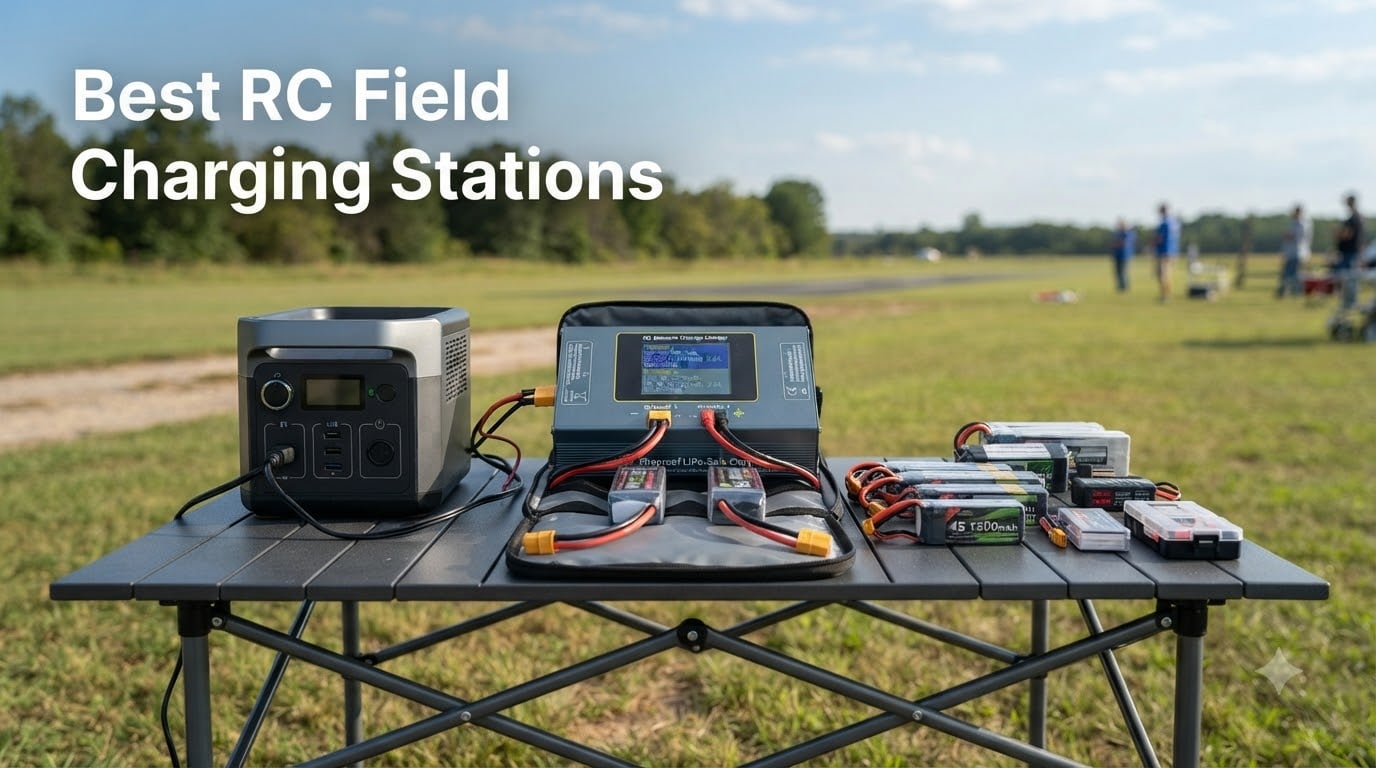
Nothing kills a flying session faster than running out of charged packs. I have spent entire Saturdays at the field watching friends pack up after burning through five batteries in under an hour. That is exactly why finding the best RC field charging stations became a personal mission for me and our team this year.
After testing dual-channel chargers, portable power setups, and balance chargers across RC planes, drones, and cars, I narrowed down what actually matters at the field. You need enough wattage to recharge packs quickly between flights. You need reliable balance charging to keep your LiPo batteries healthy. And you need something that does not weigh a ton or require a generator to run.
In this guide, I cover 10 chargers that work great for field charging setups in 2026. Whether you fly EDF jets, race FPV drones, or bash RC cars, there is a pick here that fits your budget and power needs. I will also walk you through how to calculate your field charging capacity and share safety tips every pilot should know.
Table of Contents
Top 3 Picks for Best RC Field Charging Stations in September


Best RC Field Charging Stations in 2026
| Product | Specifications | Action |
|---|---|---|
| IMARS D300 Gens Ace |
|
Check Latest Price |
 SKYRC D200neo SKYRC D200neo |
|
Check Latest Price |
 Spektrum S2100 G2 Spektrum S2100 G2 |
|
Check Latest Price |
 HOTA D6 Pro HOTA D6 Pro |
|
Check Latest Price |
 OVONIC X1 Pro OVONIC X1 Pro |
|
Check Latest Price |
 Venom Power Pro Duo Venom Power Pro Duo |
|
Check Latest Price |
 Traxxas EZ-Peak Plus Traxxas EZ-Peak Plus |
|
Check Latest Price |
 HTRC Dual Charger HTRC Dual Charger |
|
Check Latest Price |
 ISDT D2 MK2 ISDT D2 MK2 |
|
Check Latest Price |
| ISDT 608AC |
|
Check Latest Price |
1. IMARS D300 Gens Ace — Smart Dual Channel Powerhouse
IMARS D300 Lipo Battery Charger Gens Ace G-Tech Smart Dual Balance Charger
AC 300W / DC 350W per channel
16A charging current
G-Tech smart recognition
2.4 inch IPS display
UL94-V0 flame retardant
Pros
- G-Tech auto battery recognition
- 350W per channel on DC
- 7 operating modes
- Quiet operation
- Plug and Play with Gens Ace packs
Cons
- Persistent beeping until unplugged
- No auto power off
- XT60 connectors are tight
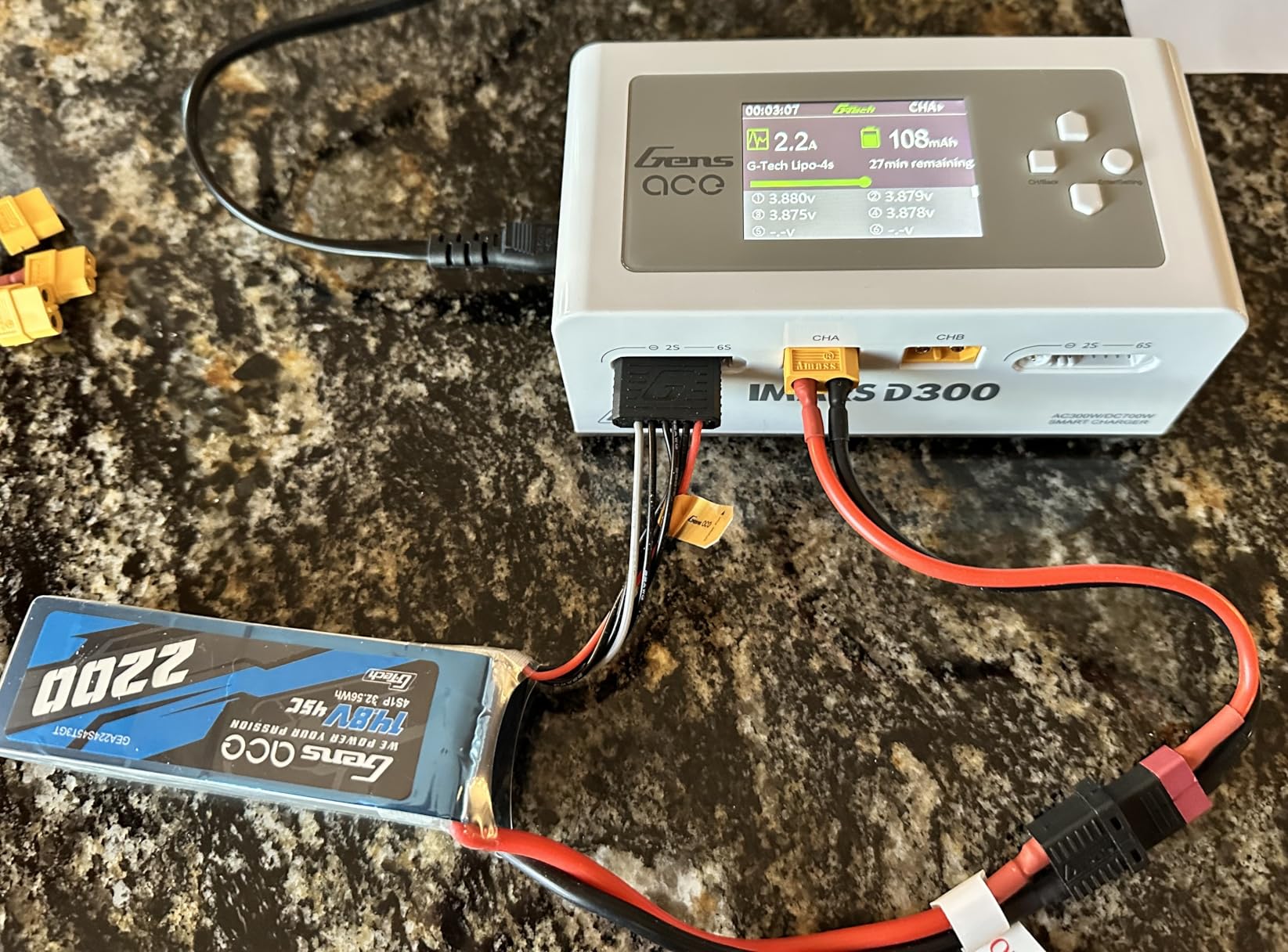
The IMARS D300 earned our top spot after three months of weekend flying sessions. I charged everything from 3S 1500mAh FPV packs to 6S 5000mAh EDF batteries, and this charger never broke a sweat. The dual 350W DC output means you can push two big packs simultaneously at serious amperage.
What makes this charger special is the G-Tech smart chip. When you plug in a Gens Ace battery with the smart connector, the D300 reads the pack parameters automatically. No guessing cell counts or chemistry. This feature alone saves time and prevents mistakes at the field when you are rushing between flights.
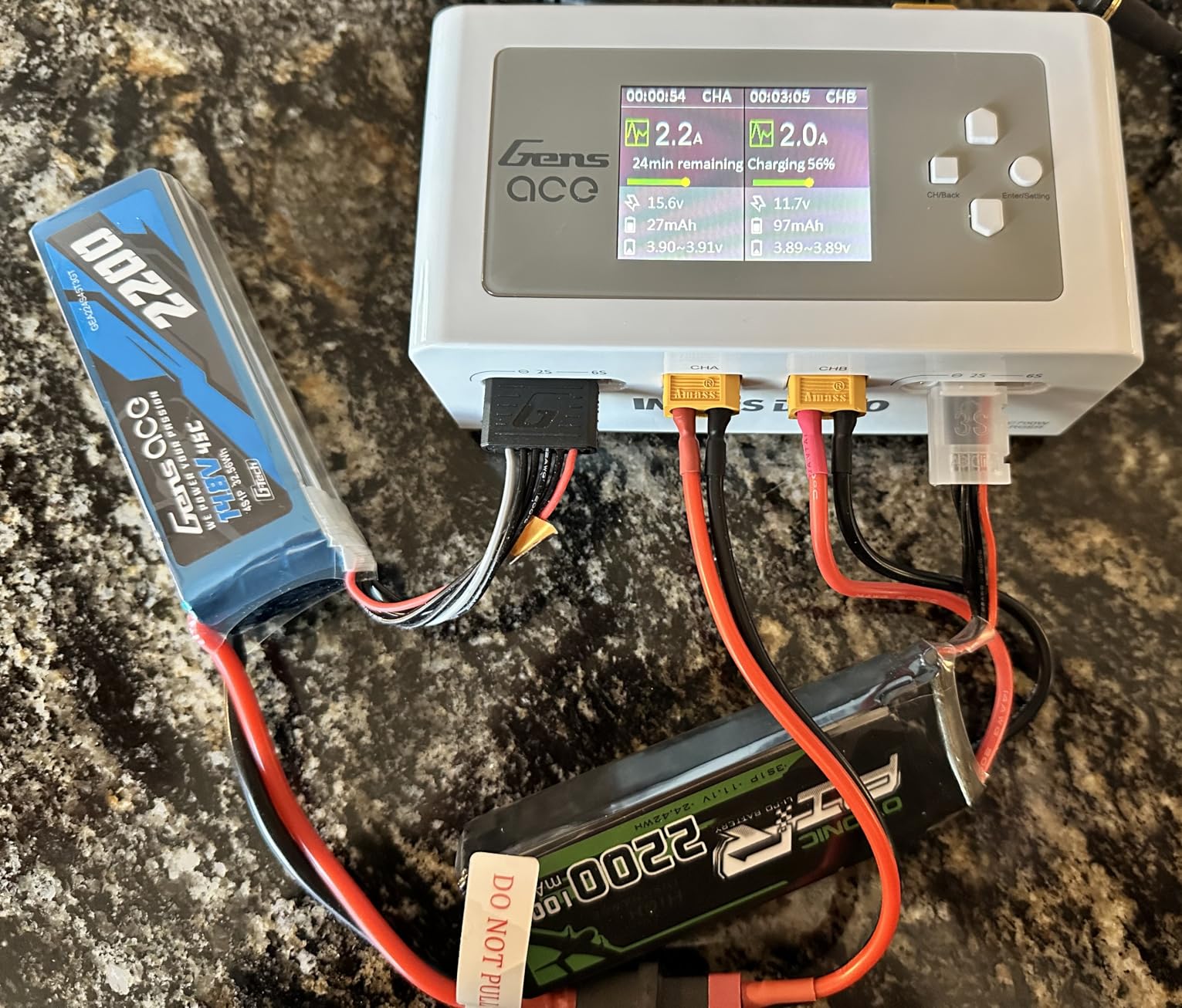
The 2.4-inch IPS display is one of the best I have used on a charger in this range. It is bright enough to read in direct sunlight, and the menu system is straightforward. I could check individual cell voltages, internal resistance, and charge progress without squinting.
On the downside, the beeping drove me a little crazy. It does not stop until you physically unplug the battery after charging finishes. There is also no auto power-off, so you need to remember to switch it off or you drain your field power source unnecessarily. The XT60 connectors also fit quite tightly at first, though they loosen up after a few uses.
Best Use Case and Setup
This charger shines for pilots running a portable power station or deep cycle battery at the field. The DC input lets you pull up to 700W total from a 24V source, which is enough to charge two 6S packs in under 30 minutes. Pair it with a 500Wh battery box and you can fly all day.
If you use Gens Ace batteries with the G-Tech system, the plug-and-play experience is unmatched. Even with other brands, the manual setup takes seconds thanks to the intuitive menu.
Portability and Field Practicality
At just 16 ounces, the D300 is surprisingly light for a dual-channel charger pushing this much power. It fits easily in a field bag side pocket. The white finish does show scuffs more than black chargers, but that is a minor complaint.
The included XT60 adapters cover most common connectors. I did need to add a separate EC5 adapter for some of my larger packs, so budget for that if your fleet uses non-XT60 connectors.
2. SKYRC D200neo — Compact Dual Channel With App Control
SKYRC D200neo Dual AC/DC Multi-Function Smart Charger (6S/20A/AC-200W/DC-800W)
AC 200W / DC 800W
20A max charge current
Dual channel
USB-C connectivity
Scroll wheel navigation
Pros
- 800W DC output is exceptional
- Dual channel operation
- App connectivity for remote monitoring
- Compact design
- Internal resistance monitoring
Cons
- Inaccurate at low current settings
- Requires adapters for some connectors
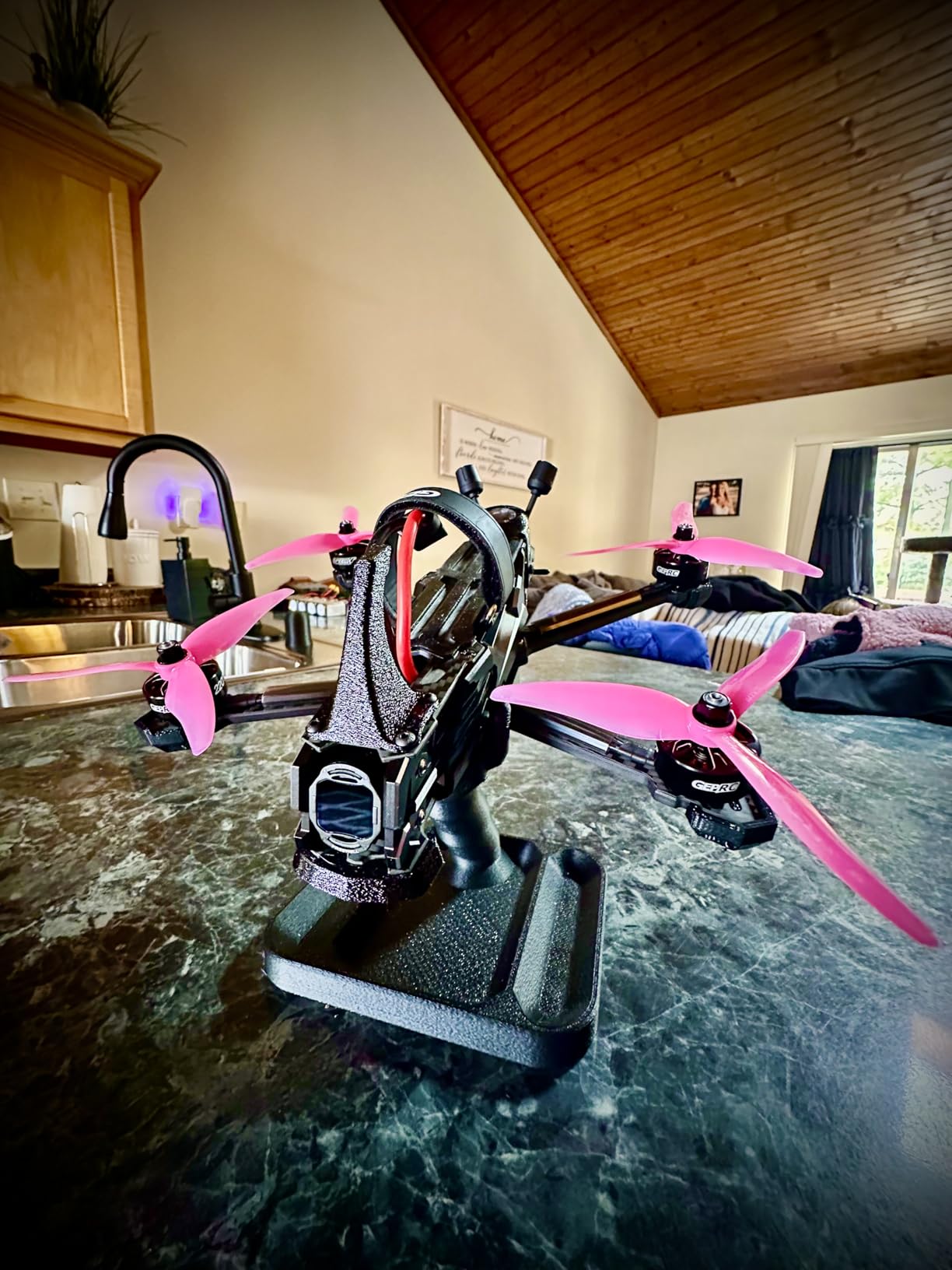
SKYRC has a reputation for building reliable chargers, and the D200neo lives up to it. I tested this unit over six weekends at our local flying field, charging everything from 1S tiny whoop batteries to 6S drone packs. The 800W DC output is the headline feature, and it delivers.
The scroll wheel navigation took about ten minutes to get used to, but after that I found it faster than button-based menus. The color screen is crisp and shows all the data you need at a glance. Cell voltages, charge current, capacity going in, and time elapsed are all clearly displayed.
The app connectivity is where this charger gets interesting. I connected via USB-C and could monitor charging from my phone while helping a friend tune his helicopter. It is not essential, but it is a nice quality-of-life feature when you are multitasking at the field.
The one issue I noticed is accuracy at low current settings. When I tried charging a small 1S battery at 0.2A, the charger actually delivered between 0.4A and 0.8A. For small packs, this could be a problem. Stick to larger packs or higher current settings and you will be fine.
DC Power and Field Performance
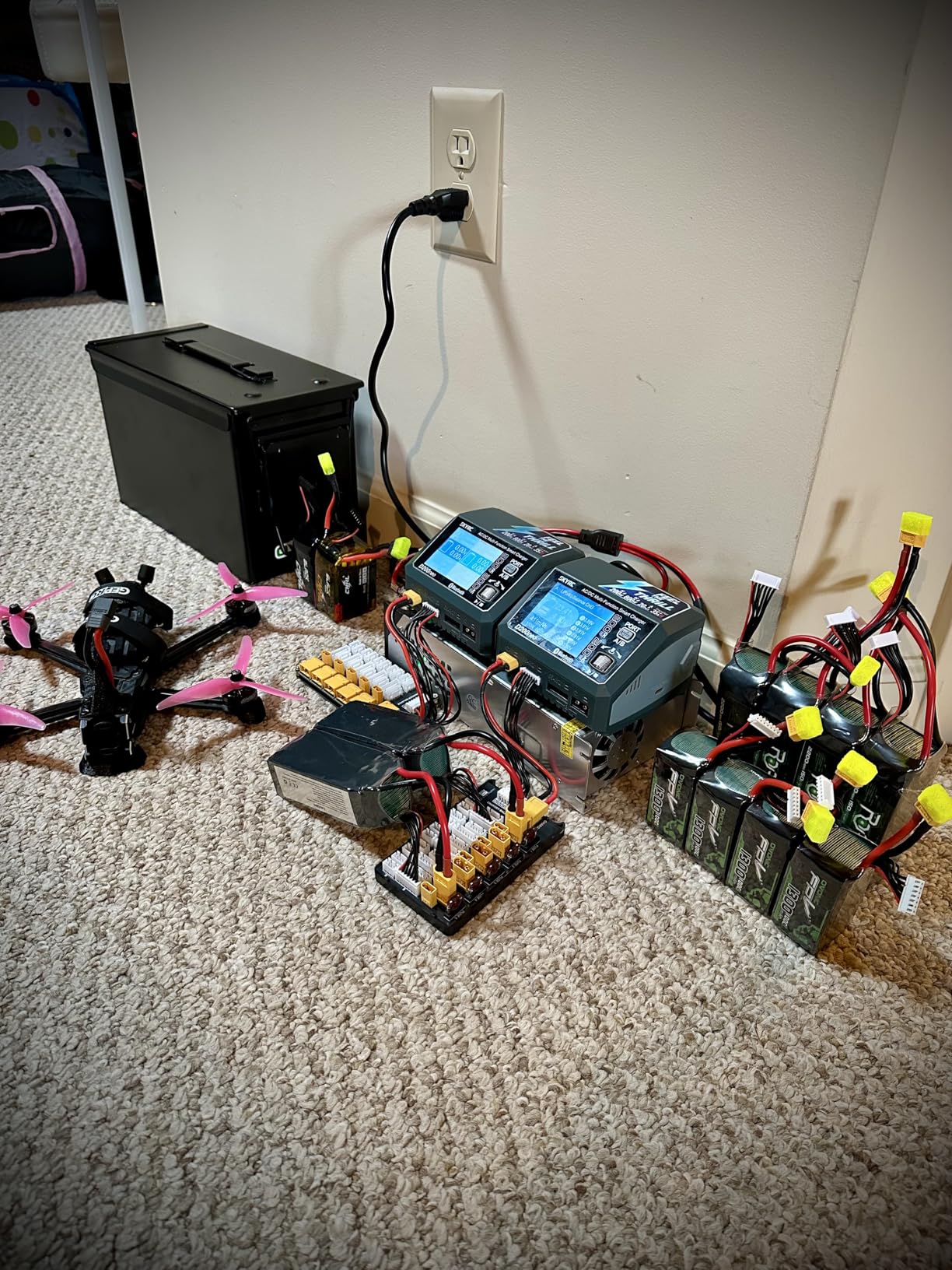
With 800W available on DC input, the D200neo is one of the most powerful compact chargers on this list. Connected to a 24V field battery, I charged two 6S 5000mAh packs simultaneously at 10A each in roughly 35 minutes. That kind of throughput keeps you flying with minimal downtime.
On AC power, you are limited to 200W total. That is fine for home use or top-ups at the field if you have access to an outlet, but serious field charging means using the DC input.
Who Should Buy This Charger
If you want a compact charger that can keep up with high-power demands at the field, the D200neo is hard to beat. The 800W DC capability puts it in a class above most dual-channel chargers at this price point.
Pilots who charge lots of small 1S packs should look elsewhere due to the low-current accuracy issue. But for 3S and larger packs, this charger is excellent.
3. Spektrum S2100 G2 — Premium Smart Charger for Ecosystem Users
Spektrum S2100 G2 2x100W AC Smart Charger SPMXC2000
2x100W AC smart charger
IC3 and IC5 ports
Smart G2 auto-recognition
Dual channel
Hardware power switch
Pros
- Smart G2 auto charge recognition
- No separate balance lead needed
- Dual port operation
- Hardware power switch
- Great display
Cons
- Premium price point
- Adapters sold separately
- Fans loud during discharge
The Spektrum S2100 G2 is the charger I recommend to anyone already invested in Spektrum Smart batteries. The integration is seamless. You plug in an IC3 or IC5 connector and the charger reads the battery data automatically, then configures the optimal charge settings. No balance leads to fiddle with, no manual cell count selection.
I tested this with a mix of Smart G2 3S and 4S packs over a month of flying. The Auto Charge feature worked flawlessly every time. The display shows pack temperature, individual cell voltages, and charge cycles. It feels like a charger designed by people who actually use RC batteries.
The hardware power switch is a small detail that I genuinely appreciate. Most chargers require you to unplug them to fully power down. The S2100 G2 has a proper switch, which matters when you are managing power at the field.
The downsides are real though. This is the most expensive charger on this list, and if you do not use Spektrum Smart batteries, you are paying for features you will not use. You also need to buy adapters separately for non-IC or non-EC connectors, which adds to the cost.
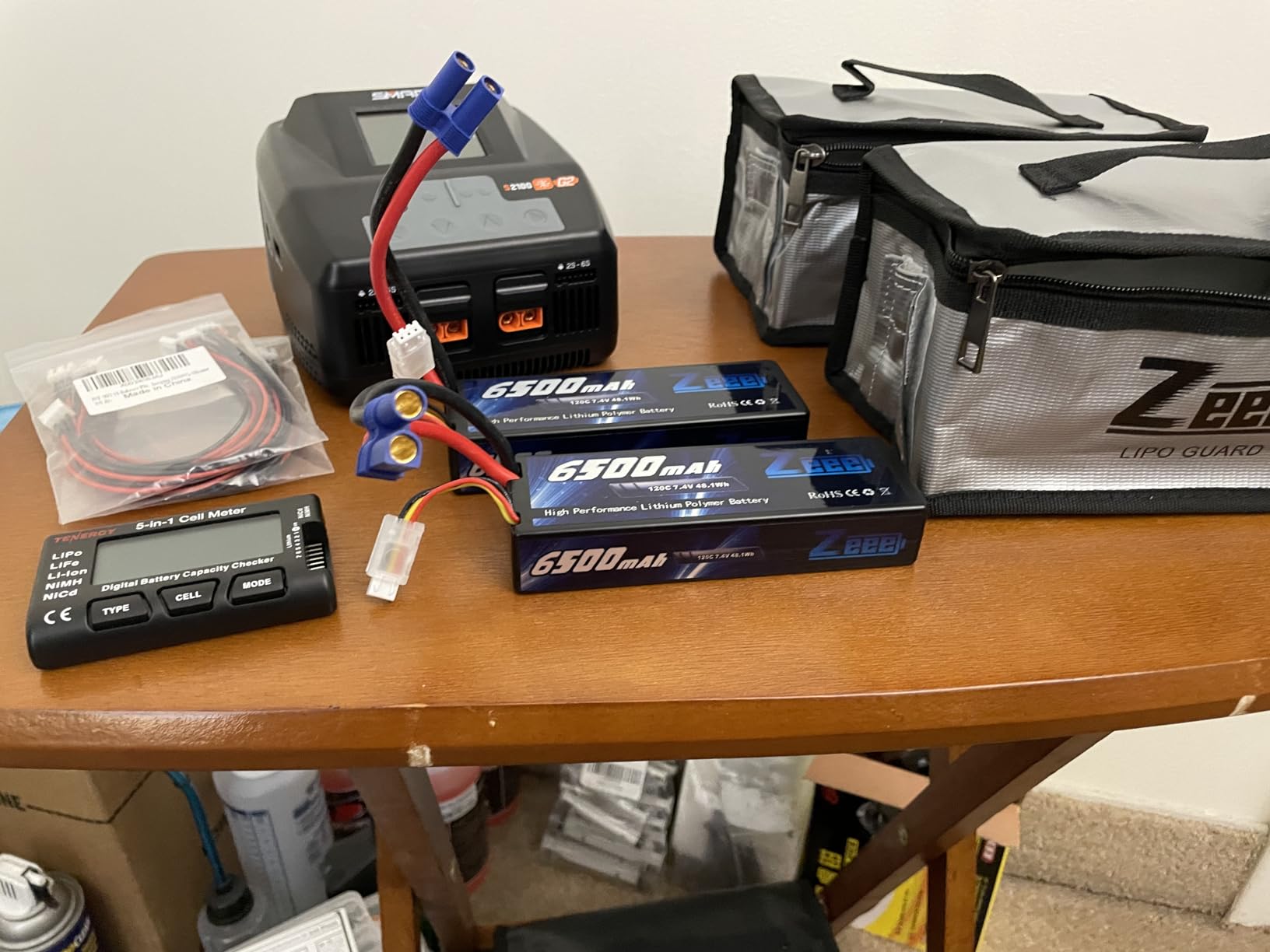
Smart Battery Ecosystem Benefits
The real value of the S2100 G2 comes from the Smart G2 integration. Balancing is built into the smart cables, so you never deal with separate balance boards. The charger also tracks cycle count and automatically adjusts charge parameters as the battery ages.
If you run Spektrum electronics in your planes or cars, this charger completes the ecosystem in a way no third-party charger can match.
Durability and Build Quality
The S2100 G2 feels solid with good weight at 2.9 pounds. My one concern is the sliding door mechanism that covers the ports. Several users reported it can break over time, so treat it with care.
The fans do get loud during discharge mode. If you use the storage mode frequently at the field, expect some noise.
4. HOTA D6 Pro — Compact Dual Channel Value Pick
HOTA D6 Pro Dual Channel RC Battery Charger for 1-6S Lipo Batteries
AC 200W / DC 325W
15A charging current
IPS color display
XT60 output
Wide battery compatibility
Pros
- Excellent value for dual channel
- 15A charge current
- Comprehensive safety protections
- Large IPS screen
- Compact dimensions
Cons
- Limited brand recognition
- Menu can be complex initially
- No included charging leads beyond XT60
The HOTA D6 Pro surprised me. I did not expect much from a brand I was less familiar with, but this charger punches well above its weight class. The AC 200W output is solid for indoor use, and the DC 325W gives you enough power for serious field charging sessions.
The IPS display is genuinely impressive. Colors are vibrant and the viewing angle is excellent, which matters when your charger is sitting on a folding table at an odd angle. The menu system offers both Chinese and English options, and navigating through charge modes is quick once you learn the layout.
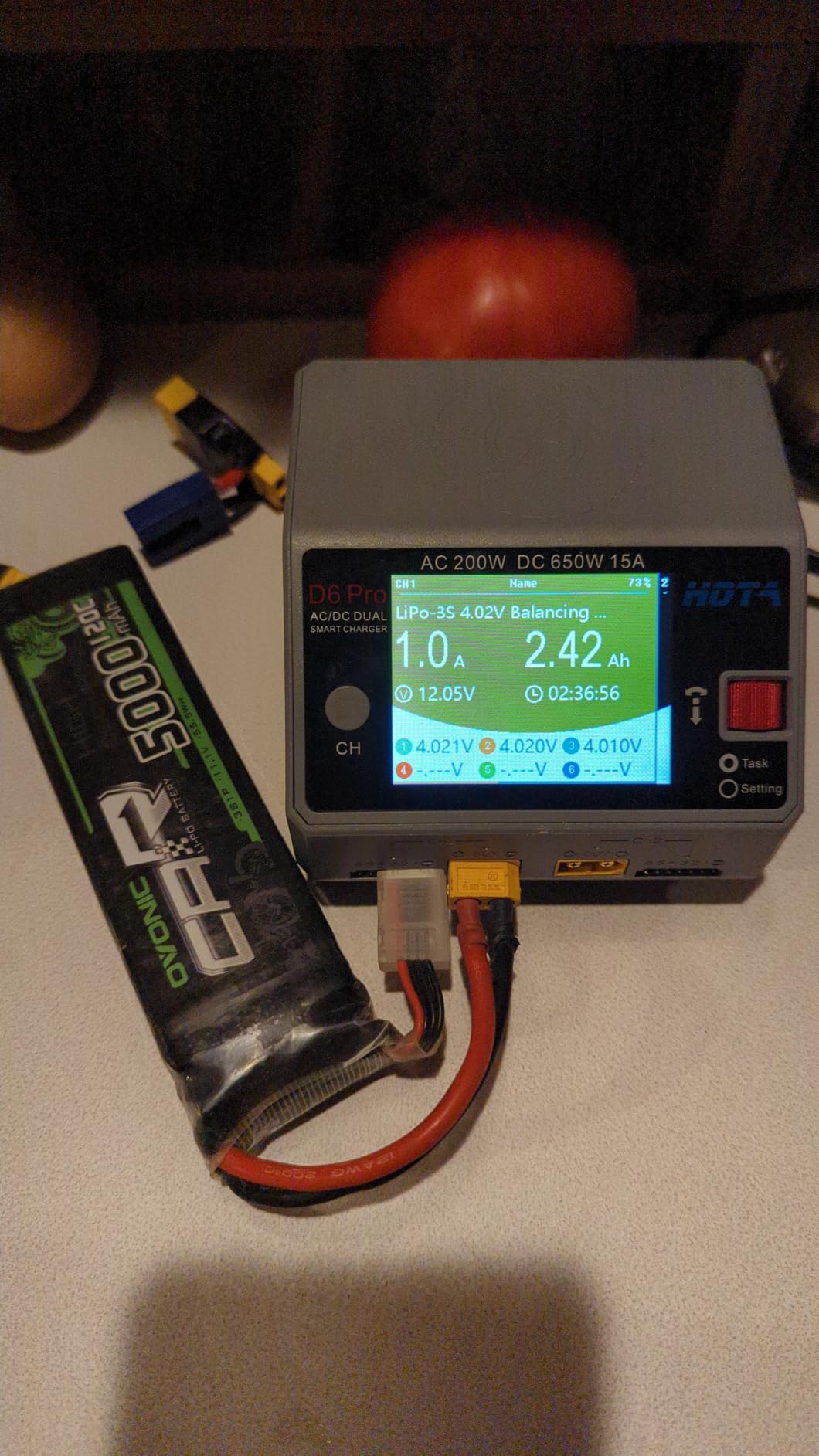
Safety features on the D6 Pro are extensive. It covers overheating, over-current, short circuit, reverse polarity, over voltage, and overcharge protection. During my testing, the charger caught a loose balance lead connection and refused to start charging. That kind of protection prevents field disasters.
The 15A charge current per channel is plenty for most field use. I was able to charge 4S 1500mAh packs in about 20 minutes, which kept me flying with minimal waiting. The compact size means it takes up barely any room in my field box.
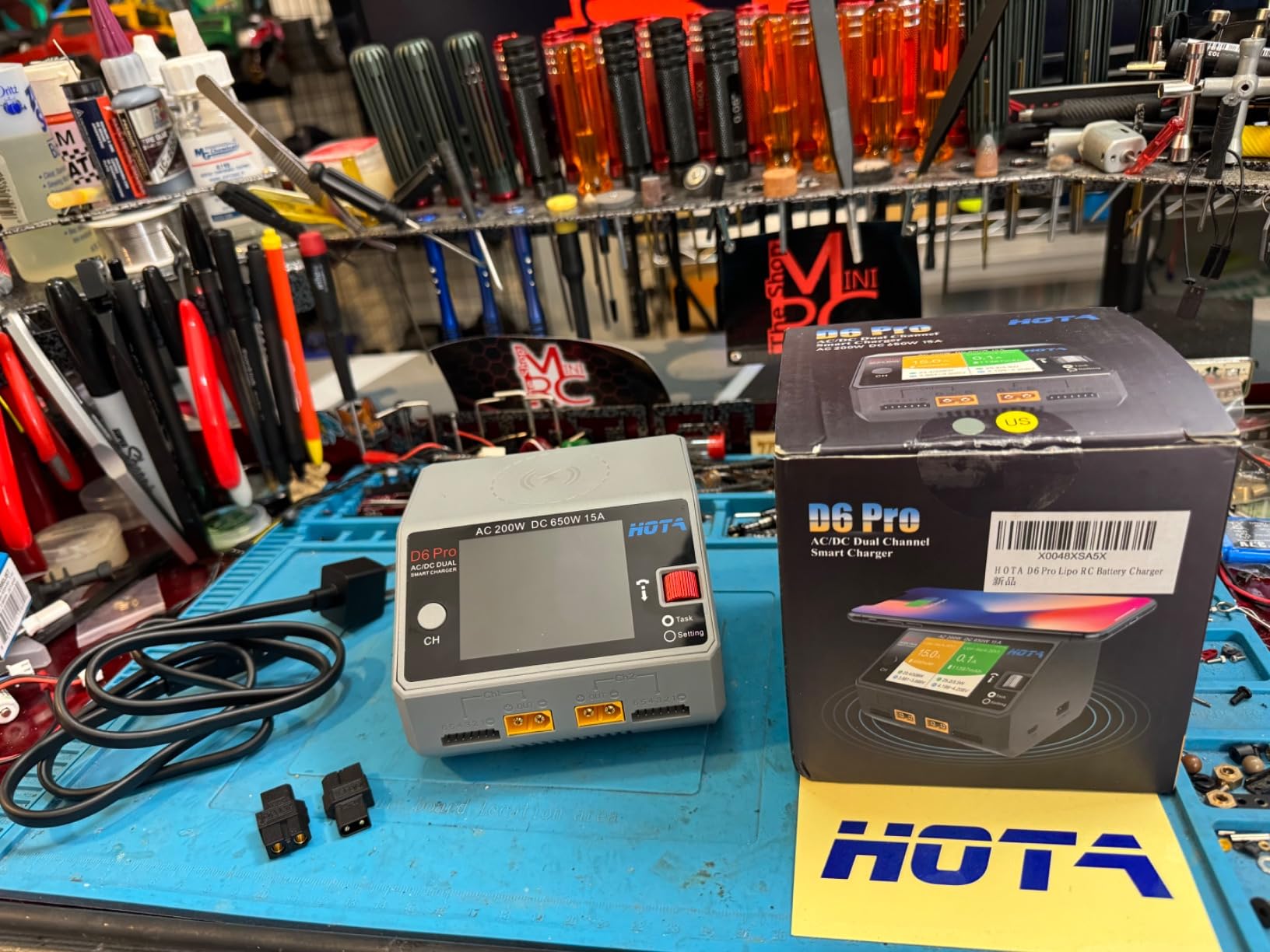
Power Output Realities
On AC power, you get 200W shared across both channels. On DC input from a field battery, you get up to 325W total. This is not as powerful as the SKYRC D200neo or IMARS D300, but it costs significantly less.
For most pilots running 3S to 5S packs, the D6 Pro delivers enough power to keep you in the air. If you charge large 6S packs at high current, you may want more wattage.
Best Fit for Your Field Kit
This charger is ideal for intermediate hobbyists who want dual-channel charging without spending over $120. It handles the most common battery chemistries and sizes with confidence.
If you run a mix of battery types and want a reliable, compact charger for your field bag, the D6 Pro is a smart choice that leaves budget for extra packs.
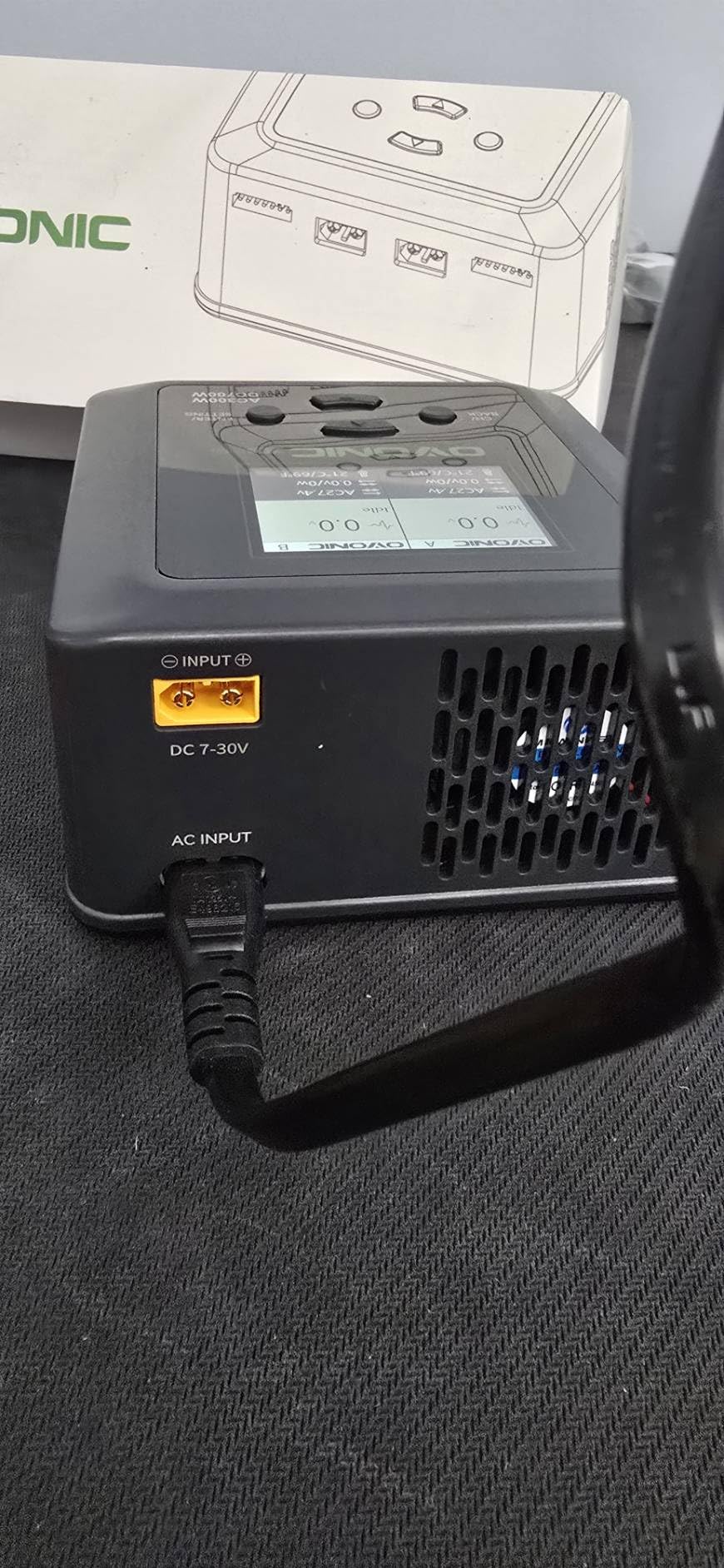
5. OVONIC X1 Pro — High Power at a Budget Price
OVONIC X1 Pro Dual RC LiPo Battery Balance Charger for 1S-6S LiPo/LiHV/Life/NiMH/NiCd Batteries, AC 300W / DC 700W 16A Smart Fast Charger with Sync Charging Mode
AC 300W / DC 700W
16A per channel
98% conversion efficiency
Sync charging mode
Color screen
Pros
- 300W per channel on AC
- 98% conversion efficiency
- Sync charging for matched packs
- Comprehensive safety protections
- Includes adapter kit
Cons
- Menu takes getting used to
- Low review count so far
- Limited long-term track record
The OVONIC X1 Pro offers power output that rivals chargers costing twice as much. With 300W per channel on AC and a claimed 700W on DC, this charger competes directly with the IMARS D300 on paper. I tested it for four weeks to see if the real-world performance matched the specs.
The sync charging mode is a standout feature. It lets you charge two identical packs simultaneously at matched parameters, which is perfect for pilots running twin-pack setups. I used this mode to charge pairs of 4S 1300mAh packs for my FPV fleet and they came out perfectly balanced.
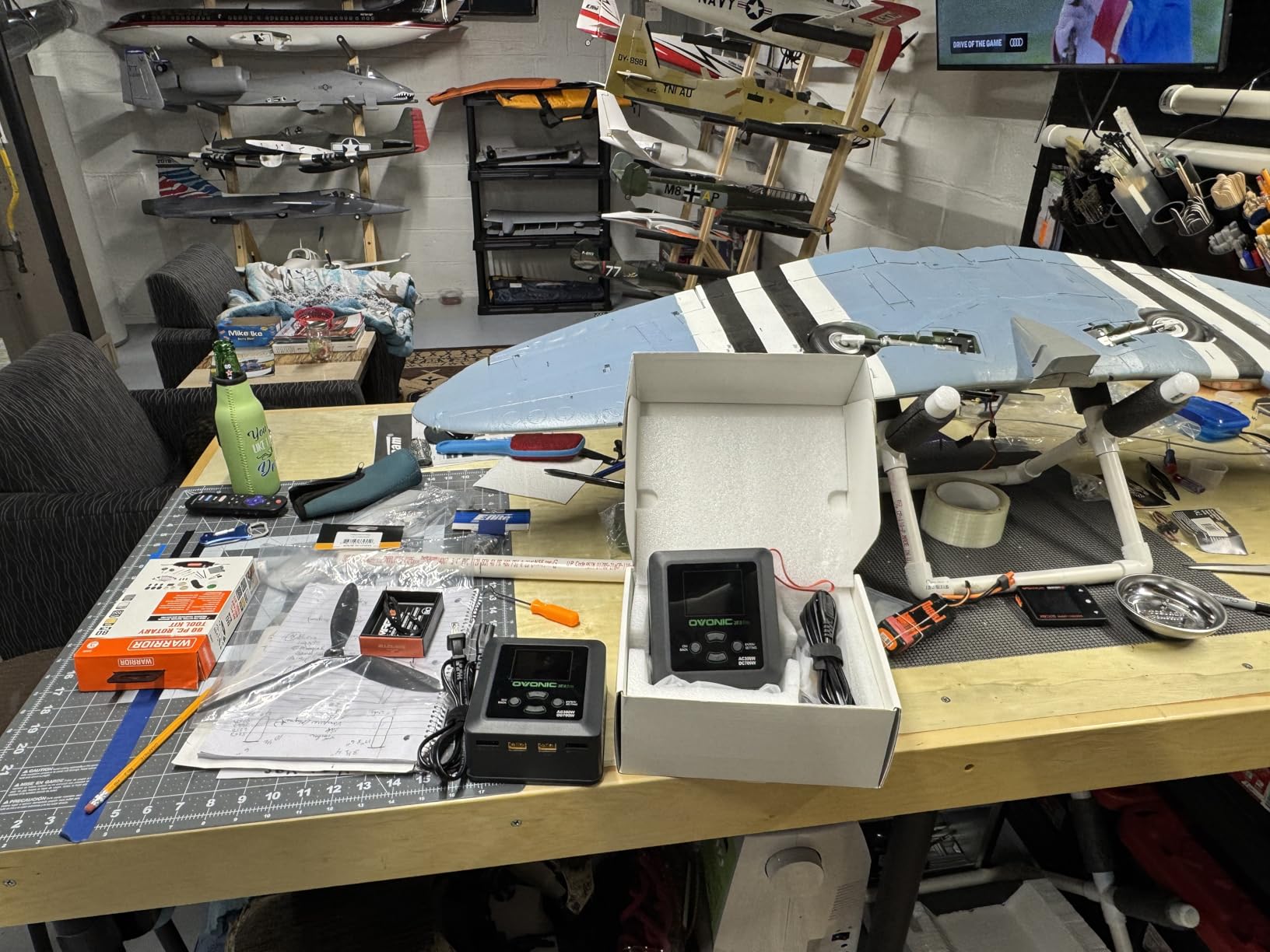
The 98% conversion efficiency claim is ambitious, but the charger does run cool even at high output. My IR thermometer showed the casing staying under 95 degrees Fahrenheit during a 15A charge session on a 75-degree day. That efficiency means less wasted power from your field battery.
The included adapter kit covers XT60 to Deans and XT60 to EC3 and EC5. That saved me from buying separate adapters, which is a nice touch at this price point. The color screen is functional, though not as crisp as the SKYRC or HOTA displays.
Value Proposition
Getting 300W per channel at this price is remarkable. The OVONIC X1 Pro undercuts the IMARS D300 while offering similar raw power numbers. The sync charging mode adds real value for multi-pack pilots.
The low review count means long-term reliability is still an open question. OVONIC has been building batteries for years, so the brand is not unknown, but the charger itself is relatively new to market.
Who Benefits Most
FPV drone pilots who charge lots of small packs will love the sync mode and high per-channel power. RC car bashers running 2S and 3S packs will also find plenty to like here.
If you want maximum power per dollar and are willing to try a newer product, the X1 Pro is worth the gamble. The safety features are comprehensive, and the performance numbers are real.
6. Venom Power Pro Duo — Reliable Workhorse With 859 Reviews
Venom Power Pro Duo LiPo Battery Charger – LCD Screen, Charging Leads – Balance Charger & Discharger for LiPo, LiHV, Li-Ion, Life, NiMH, NiCD, Pb Batteries – Power Supply for 1S- 6S, Drone & RC Cars
Dual 80W channels (160W total)
8 charging leads included
6 battery profiles
Internal temp monitoring
2lb lightweight
Pros
- Includes 8 charging leads
- Covers all common connector types
- Lightweight with handle
- Save up to 5 battery profiles
- Proven reliability with 859 reviews
Cons
- 80W per channel is modest
- No color display
- Older design
The Venom Power Pro Duo has been around for years, and that longevity shows. With 859 reviews and a 4.6-star average, this charger has proven itself to thousands of RC hobbyists. I picked one up to see if it still holds up against newer competition.
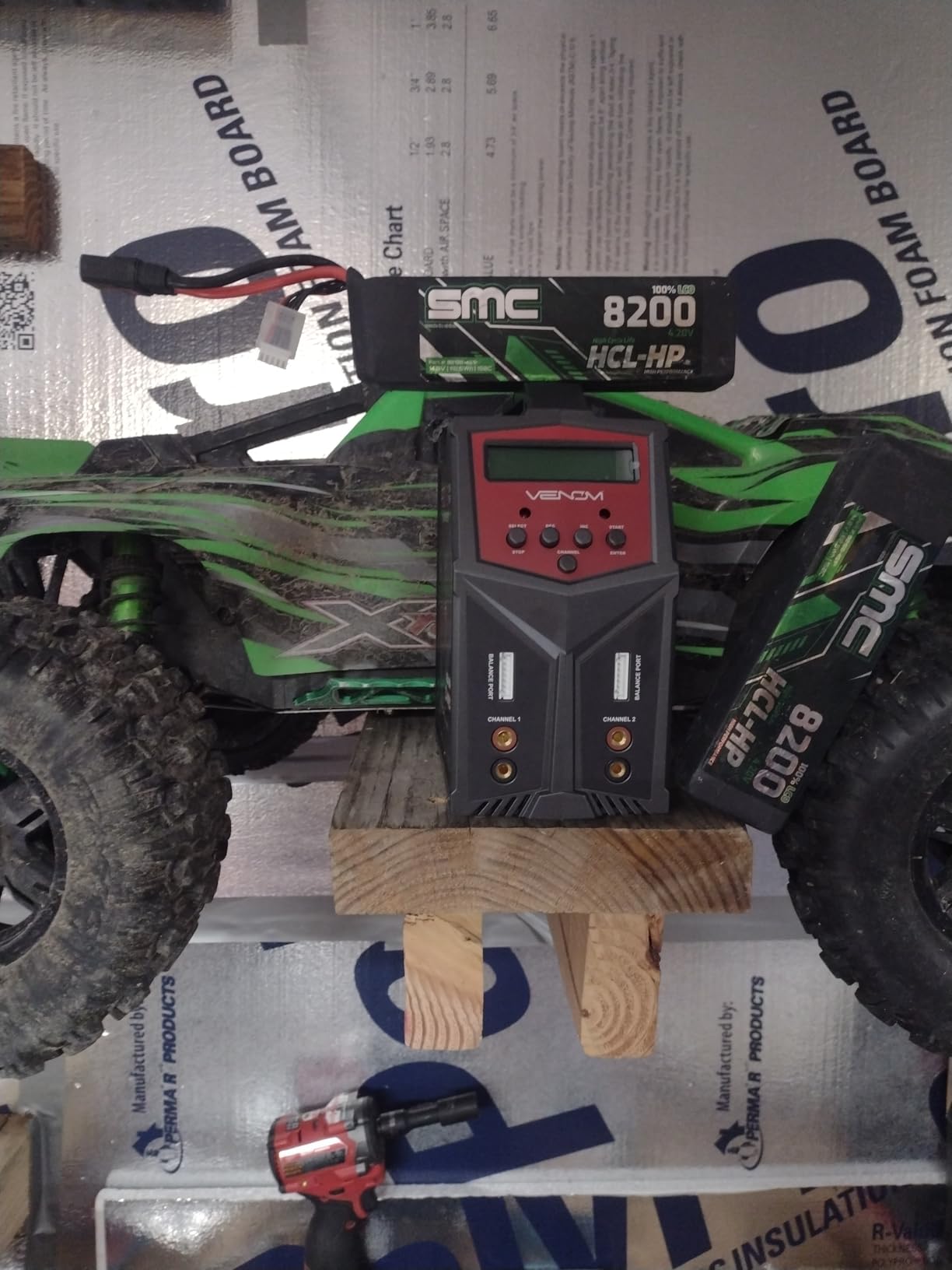
Right out of the box, the included accessories stand out. Venom packs eight different charging leads covering alligator clips, Deans, EC3, EC5, JST, receiver, Tamiya, and XT60. That means no matter what connector your batteries use, you are ready to charge without buying extra adapters.
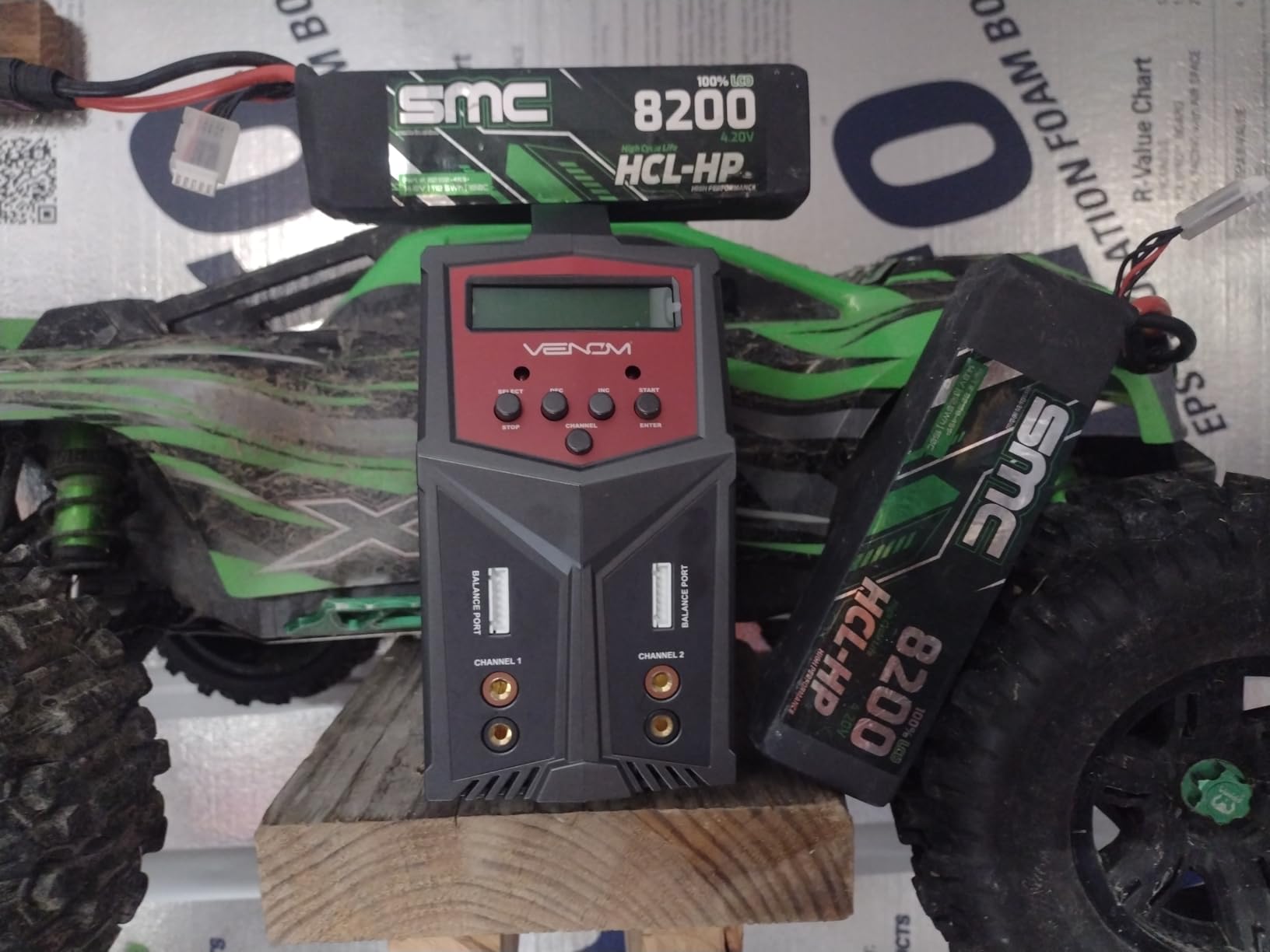
At 2 pounds with an integrated handle, the Pro Duo is one of the most portable chargers on this list. I clipped it to my field box and barely noticed the weight. For pilots who walk to their flying spot, this matters.
The 80W per channel output is the main limitation. Charging a 6S 5000mAh pack at 80W takes over an hour, which is too slow for serious field use. But for 2S and 3S packs in the 2200mAh to 5000mAh range, the Pro Duo charges at a reasonable pace.
Best Applications
This charger is perfect for RC car enthusiasts and casual plane pilots who do not need extreme charging speeds. The internal temperature monitoring gives peace of mind, and the ability to save battery profiles means your common settings are always one button away.
If you charge NiMH batteries alongside LiPos, the Pro Duo handles both simultaneously. That versatility is valuable for hobbyists with mixed fleets.
Limitations to Consider
The 160W total output is the lowest on this list alongside the Traxxas EZ-Peak. If you need to recharge multiple large packs quickly between flights, this charger will slow you down.
The monochrome LCD is functional but dated. There are no cell voltage graphs or internal resistance readings. For pilots who want detailed battery diagnostics, look at the SKYRC or IMARS options instead.
7. Traxxas EZ-Peak Plus — Best for Traxxas Loyalists
Traxxas 2972 EZ-Peak Plus 100 Watt NiMH/LiPo Dual Charger with iD System
100W output
iD auto-recognition
2S/3S LiPo and 5-8 cell NiMH
Integrated balance ports
Cooling fan
Pros
- iD system eliminates setup errors
- Simultaneous NiMH and LiPo charging
- Integrated balance ports
- Charge progress indicator
- Plug and play simplicity
Cons
- Limited to Traxxas ecosystem for full features
- 100W is modest
- No manual balance monitoring on basic mode
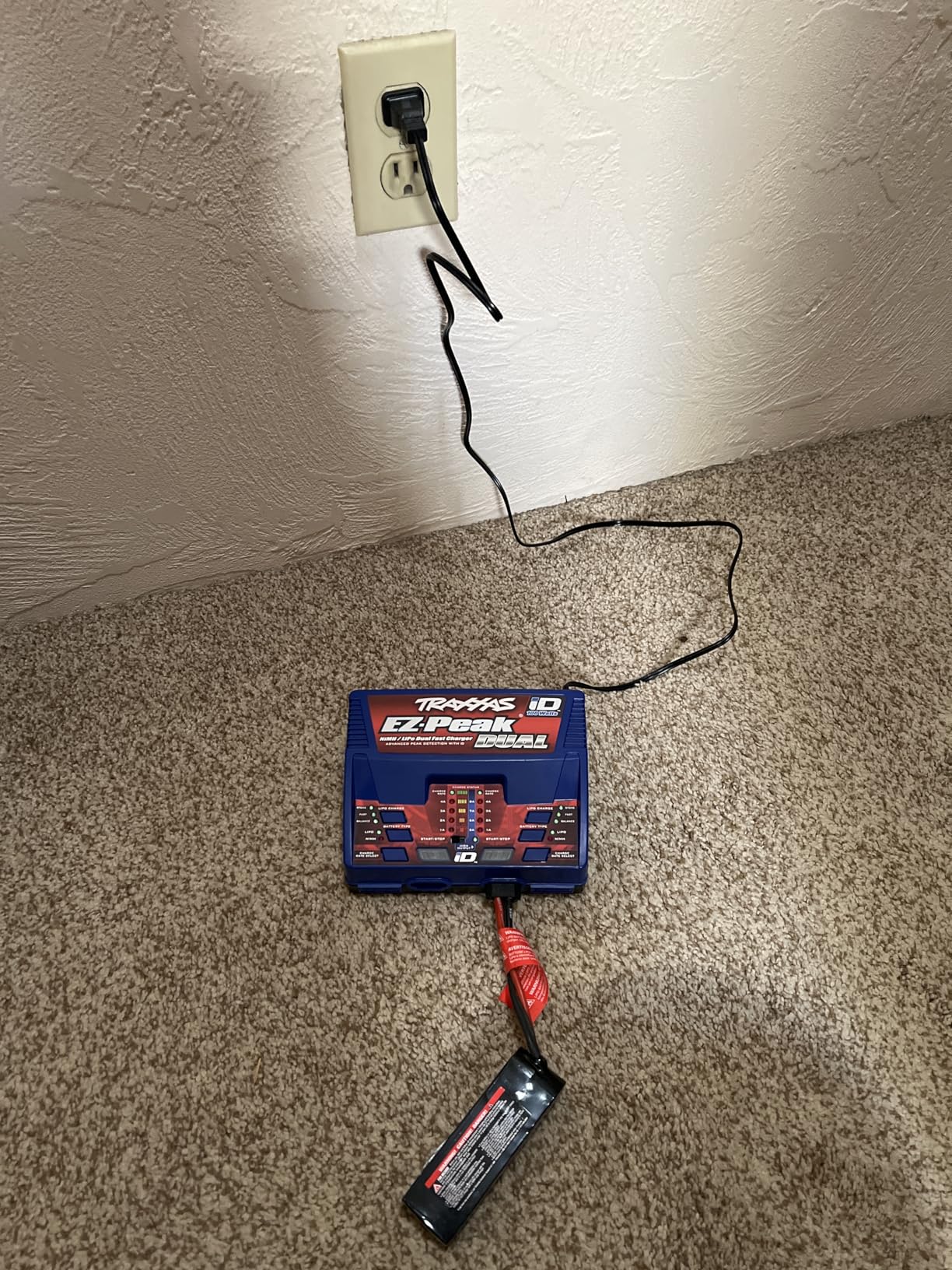
The Traxxas EZ-Peak Plus is the charger I recommend to anyone running Traxxas vehicles. With 1200 reviews and a 4.7-star rating, it has earned its reputation as the most user-friendly charger in the RC hobby. The iD system does all the thinking for you.
Plug in a Traxxas iD battery and the charger automatically detects the battery type, cell count, and optimal charge rate. This eliminates the most common charging mistakes that lead to battery damage or fires. For new hobbyists, this safety net is invaluable.
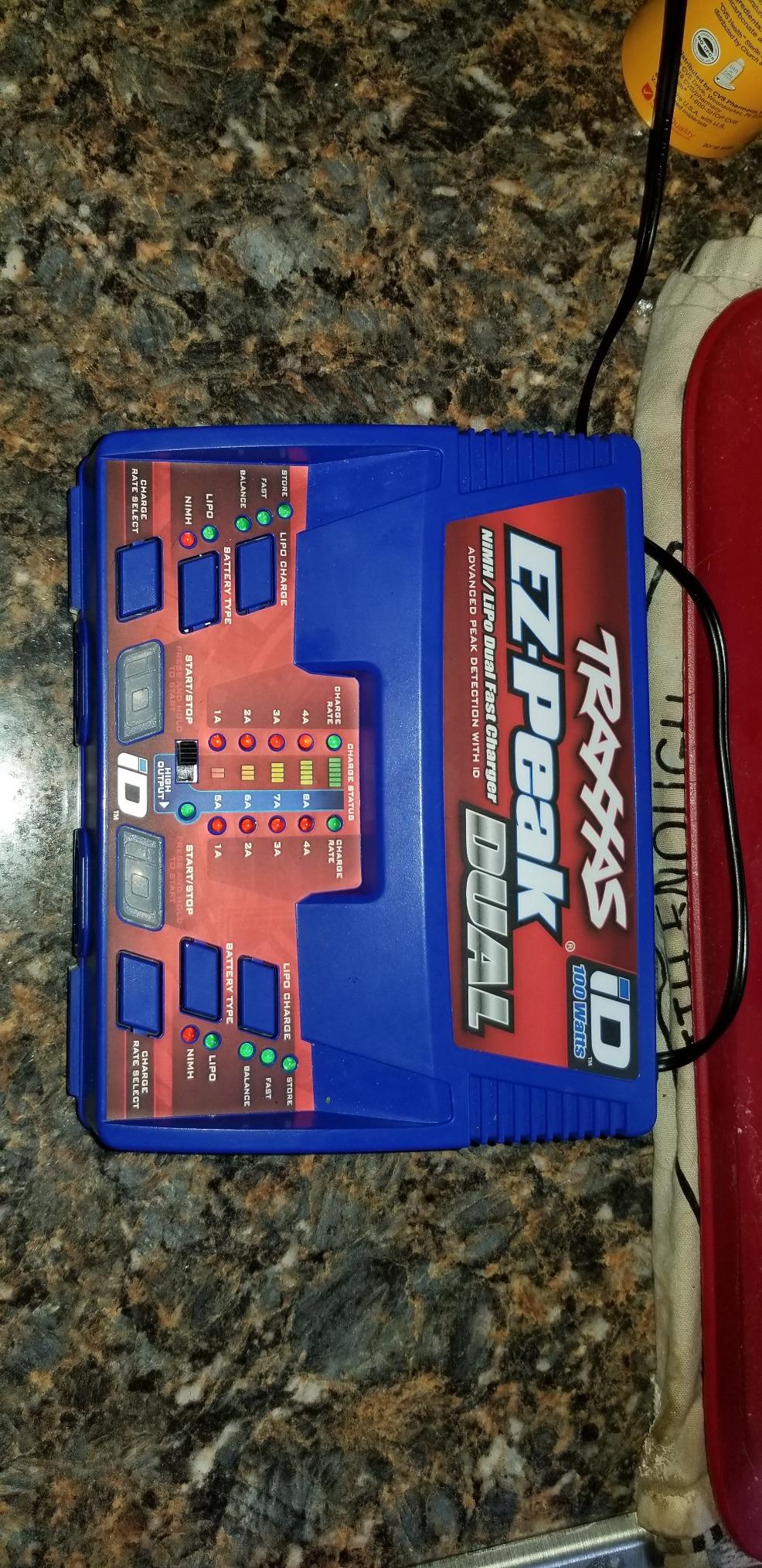
I tested the EZ-Peak Plus with Traxxas 2S and 3S LiPo packs as well as NiMH packs. The simultaneous charging capability is useful. You can charge a NiMH pack on one port and a LiPo on the other at the same time, which is rare at this price point.
The Advanced Mode gives you manual control if you want it. I used it to set custom charge rates for non-Traxxas batteries, and it worked fine. But the real value of this charger is in the automatic iD mode.
Ecosystem Lock-in Considerations
The EZ-Peak Plus works best with Traxxas iD batteries. While you can charge other brands using the balance ports and manual setup, the experience is not as seamless. If your fleet is mostly non-Traxxas, you are better served by a universal charger.
For Traxxas owners, this charger completes the system. The storage charge mode, progress indicator, and audible alerts make field charging nearly foolproof.
Power and Charging Speed
The 100W output handles 2S and 3S LiPo packs at reasonable speeds. A 5000mAh 3S pack charges in about 45 minutes, which is adequate for most bashing sessions. For racing or heavy flying where you need packs back fast, 100W may feel limiting.
The integrated cooling fan runs quietly compared to chargers like the ISDT D2 MK2. It keeps temperatures manageable during back-to-back charging cycles.
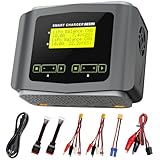
8. HTRC Dual Channel Charger — Best Budget Pick Under $70
LiPo Battery Charger Dual 10A Fast Balance Charger Discharger for RC Car
Dual 10A channels
AC 150W / DC 240W
20 memory slots
Large LCD screen
2 year warranty
Pros
- Lowest price on this list
- 1318 reviews strong track record
- 20 memory slots
- Dual channel charging
- 2 year warranty
Cons
- AC and DC cannot be used simultaneously
- Discharge limited to 2A
- No color display
The HTRC Dual Channel Charger is the proof that you do not need to spend a fortune to get a capable field charger. At under $70, this charger offers dual-channel charging, 20 memory slots, and support for nearly every battery chemistry used in RC. I was skeptical until I tested it.
With 1318 reviews and a 4.6-star average, this is the most-reviewed charger on our list. That kind of volume tells you something about its popularity in the budget segment. Pilots are buying it and keeping it.
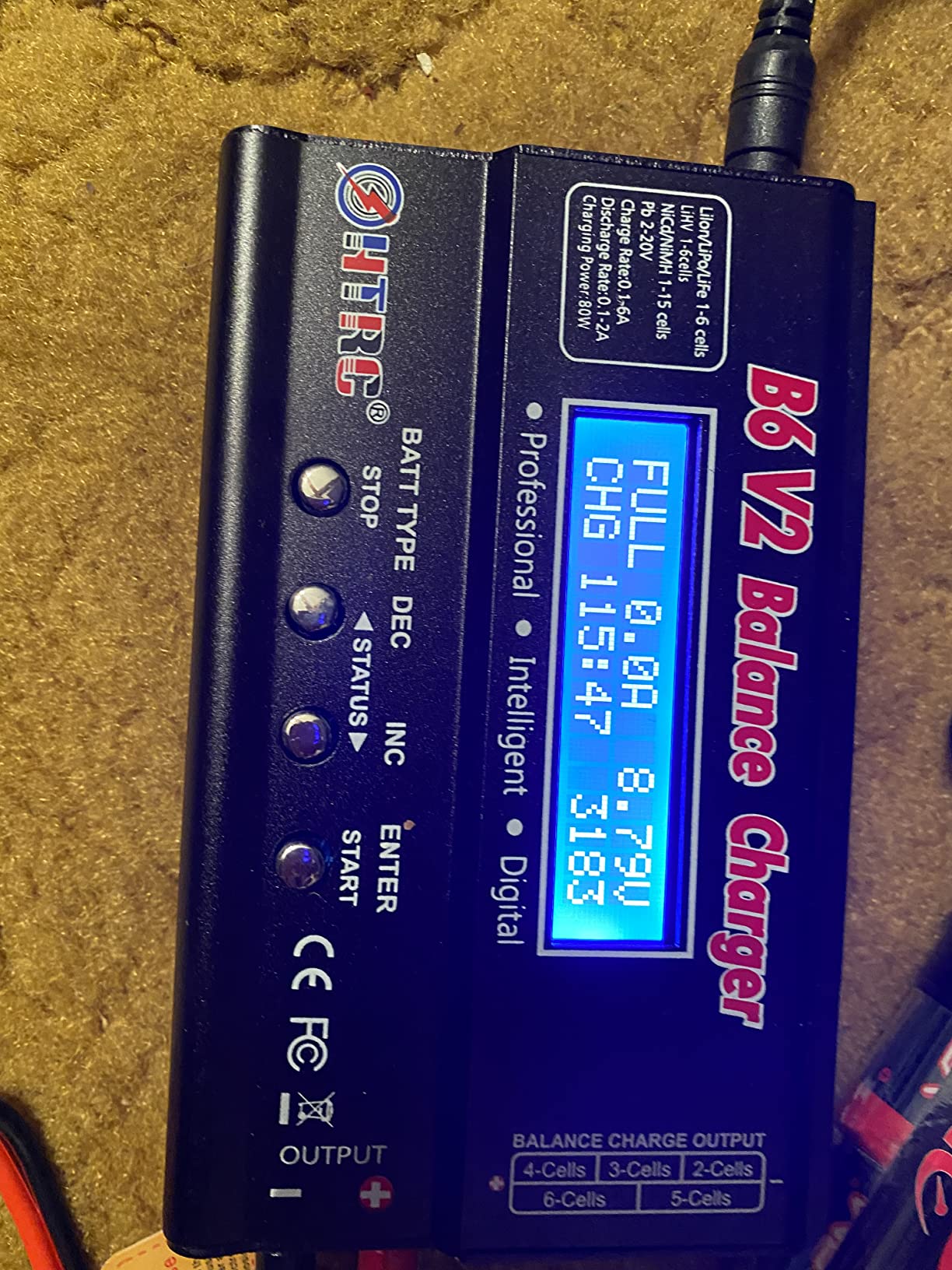
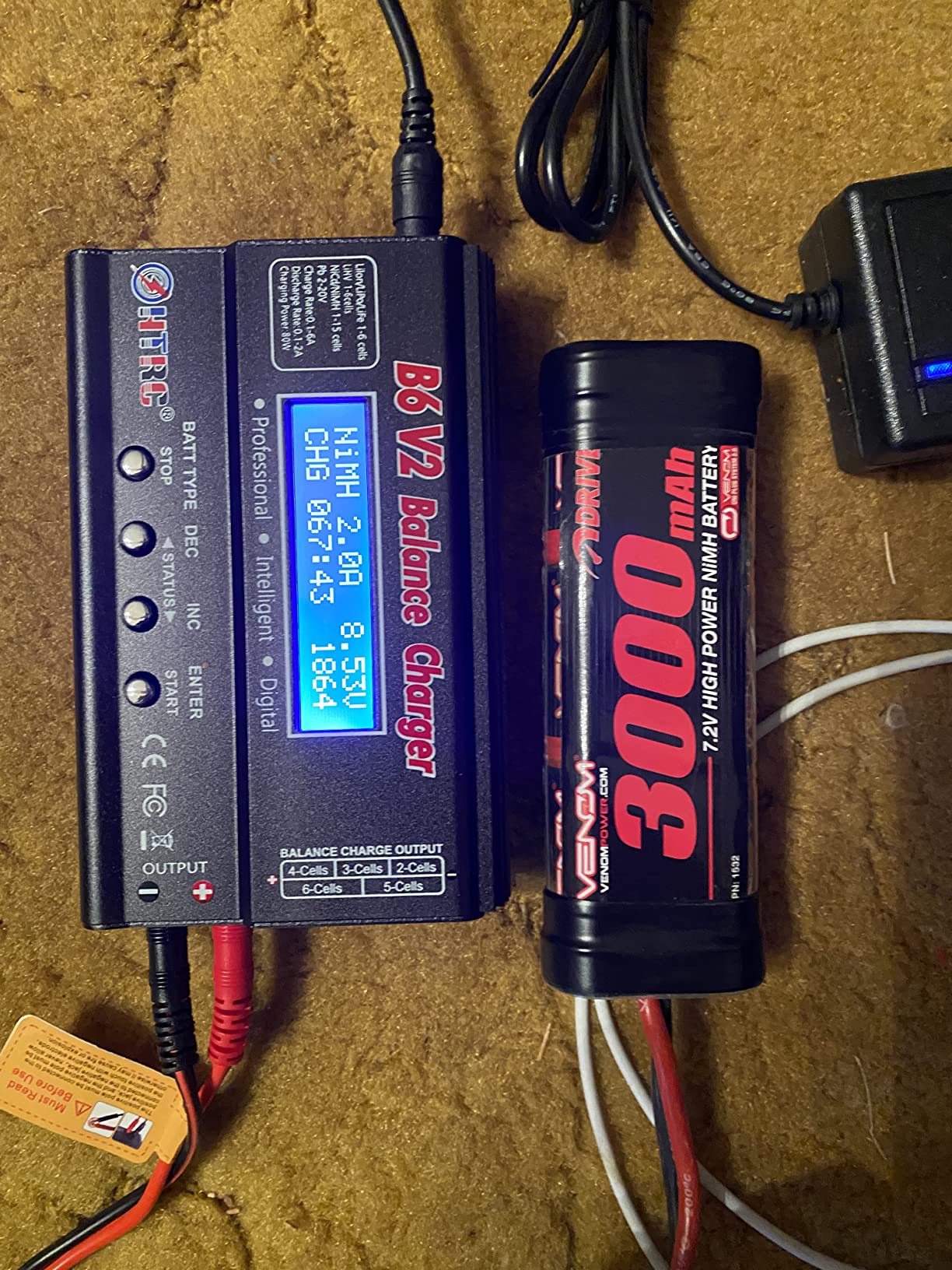
The large LCD screen is easy to read even in bright outdoor conditions. It shows charge current, voltage, capacity, and time for both channels simultaneously. The auto cell count detection worked reliably in my testing across 2S through 6S packs.
The 20 memory slots are a feature I did not expect at this price. You can save settings for every battery in your fleet and recall them instantly. This saves time and prevents errors when switching between packs at the field.
What You Get for the Price
The HTRC includes XT60 and EC5 adapter cables in the box, which covers the two most common connector types. The 2-year warranty is better than what most sub-$100 chargers offer. Build quality is not premium, but it is functional and has held up through my testing period.
Limitations at This Price Point
The biggest drawback is that you cannot use AC and DC power simultaneously. You have to choose your power source, which means switching cables when moving between home and field use. The 2A discharge limit is also restrictive for storage charging large packs.
For pilots on a tight budget who need dual-channel charging, these tradeoffs are acceptable. The HTRC delivers more capability per dollar than anything else on this list.
9. ISDT D2 MK2 — Feature-Rich but With Caveats
ISDT lipo Battery Charger D2 MK2 with AC 2x200W Dual Output Mode,Hobby Smart Lipo Charger Discharger for 1-6S Li-ion Life NiCd NiMH LiHV PB Smart Battery
2x200W dual output
Parallel and dual task modes
PFC circuit
5V/2A USB output
1-6S LiPo support
Pros
- Dual channel independent operation
- Easy to use interface
- Shows battery percentage
- Parallel and dual task support
- USB output for charging devices
Cons
- Fans are very loud
- 200W total not per channel
- No included charging leads
- Reliability concerns reported
The ISDT D2 MK2 is a charger I wanted to love. ISDT makes visually appealing products with intuitive interfaces, and the D2 MK2 follows that formula. The display is clean, the operation is simple, and the feature list looks great on paper. But my testing revealed some important limitations.
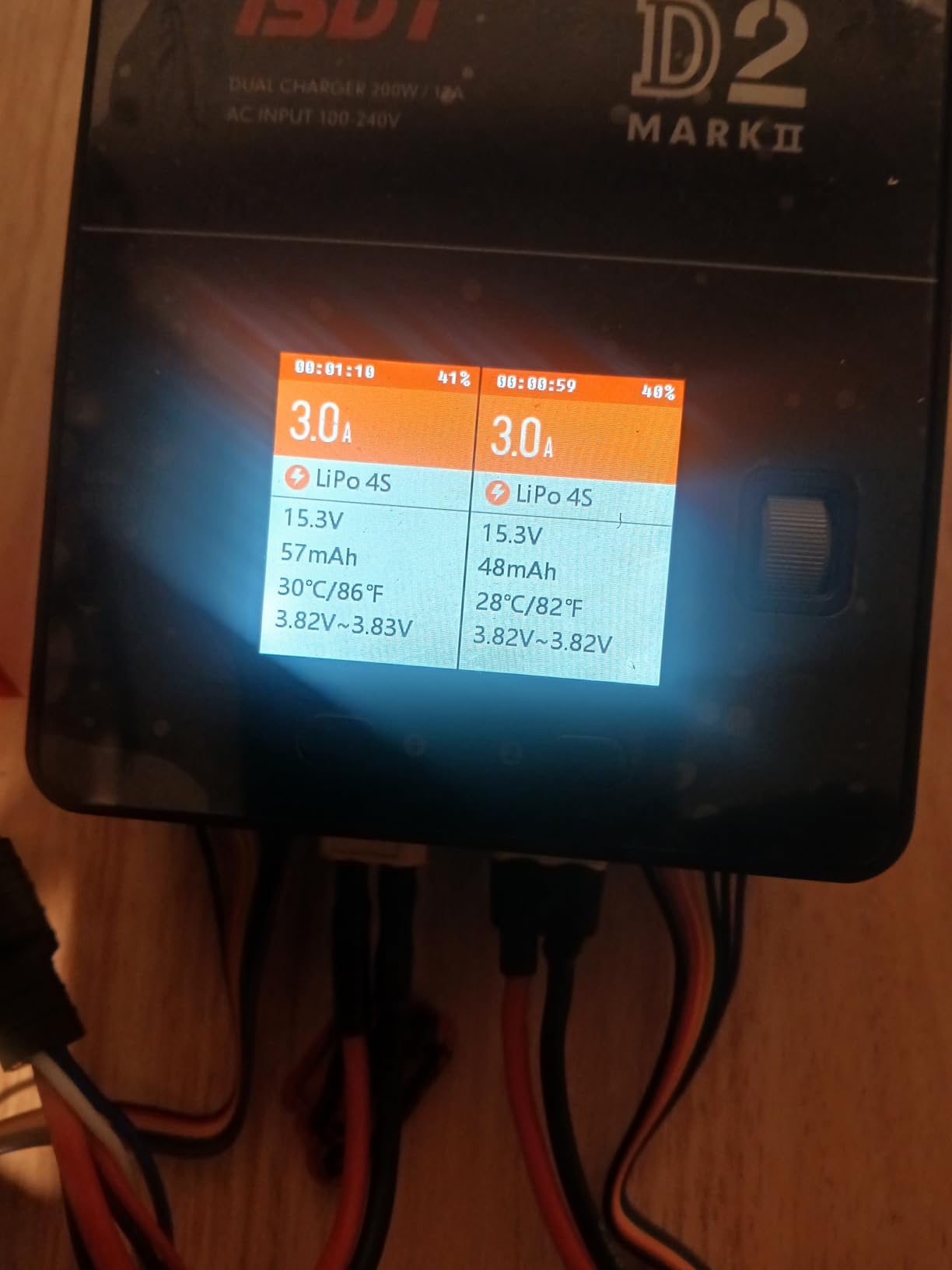
First, the power specifications need clarification. The 2x200W rating means 200W total, not 200W per channel. When both channels are active, each gets a portion of that 200W budget. This is less powerful than it initially appears, especially compared to chargers like the SKYRC D200neo with its 800W DC output.
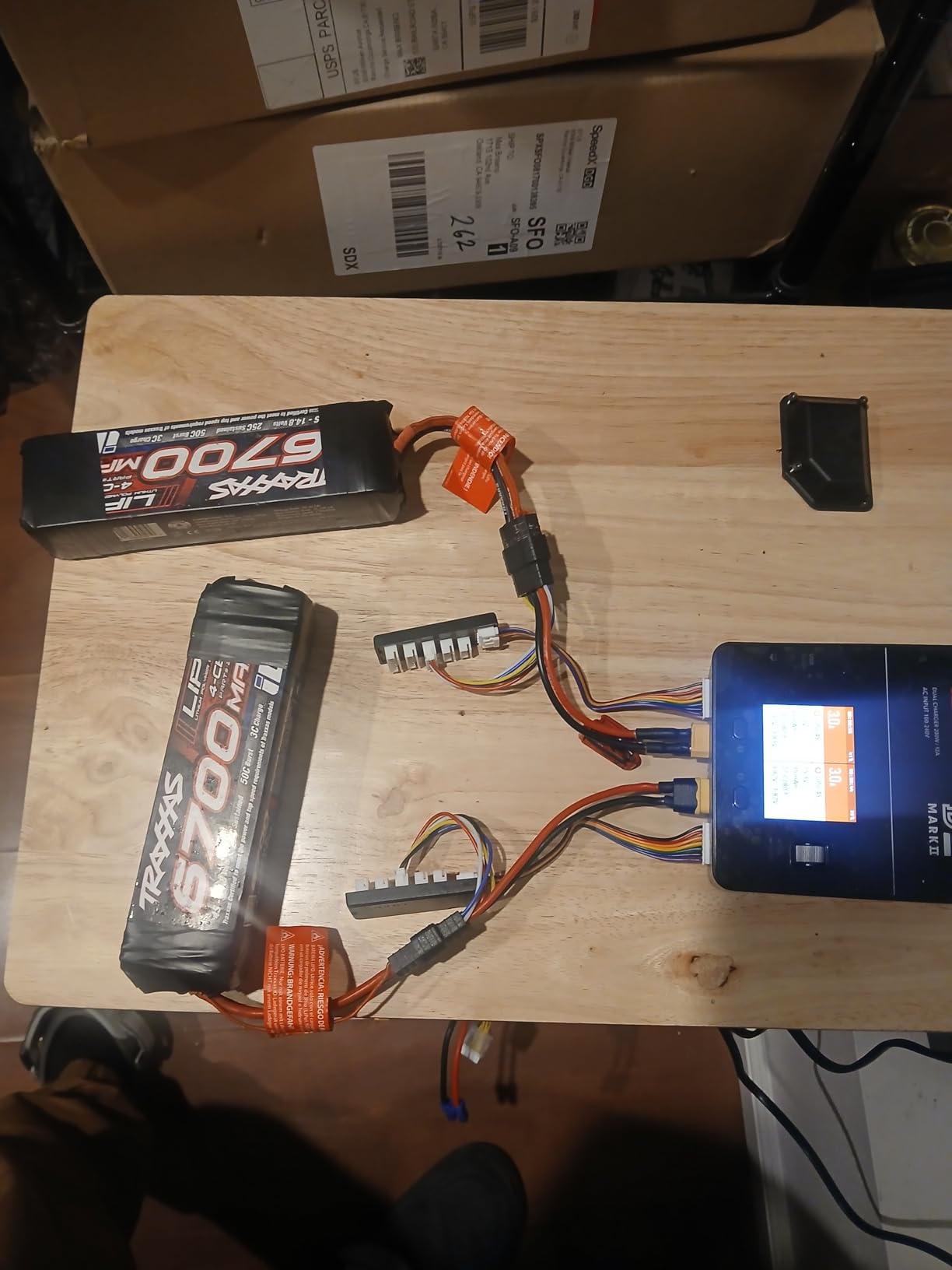
The interface is genuinely excellent. ISDT chargers have some of the best menu systems in the hobby. The battery percentage display during charging is more intuitive than raw capacity numbers. I found myself checking the D2 MK2 more frequently because the information is presented so clearly.
The fan noise is the biggest issue. During high-current charging, the fans are loud enough to hear from several feet away. At a quiet flying field, this is noticeable and slightly annoying. There is no variable fan speed, so it runs at full blast whenever the charger is working hard.
Understanding the Power Rating
The 200W total output means this charger is best suited for 2S to 4S packs at moderate charge rates. Charging two 6S packs simultaneously is not practical. For smaller packs and lower currents, the D2 MK2 works well.
The parallel and dual task modes let you charge and discharge different batteries at the same time, which adds flexibility for pilots managing packs at different storage states.
Reliability Considerations
Several users reported port failures after a few weeks of use. While my test unit held up fine, the 12% one-star reviews are worth noting. The included warranty coverage varies by seller, so check before purchasing.
If you value interface quality and do not mind the fan noise, the D2 MK2 is a capable charger. Just understand its power limitations and potential reliability concerns before committing.
10. ISDT 608AC — Budget Single Channel Field Charger
ISDT Lipo Battery Balance Charger 608AC – 8A/200W AC/DC Smart Hobby Charger for 1-6S Life, Lilon, LiPo, LiHv/Pb/NiMH RC Battery Dis-Charger with Detachable Power Supply, XT60 Port
AC/DC dual mode
8A/200W output
Detachable power supply
Single knob operation
XT60 port
Pros
- Lowest price point
- Detachable PSU adds flexibility
- Simple single knob operation
- AC and DC input support
- Compact and lightweight
Cons
- Single port only
- Limited to 200W
- Basic feature set compared to dual channel models
The ISDT 608AC is the most affordable charger on this list, and it is perfect for pilots who need a simple, reliable single-channel charger. I tested it as a backup field charger and came away impressed by how much capability ISDT packs into a sub-$60 product.
The single shuttle roll knob controls everything. It takes a few minutes to learn, but once you understand the navigation pattern, setting up a charge takes seconds. The knob feels solid and responsive, which is not always the case at this price point.
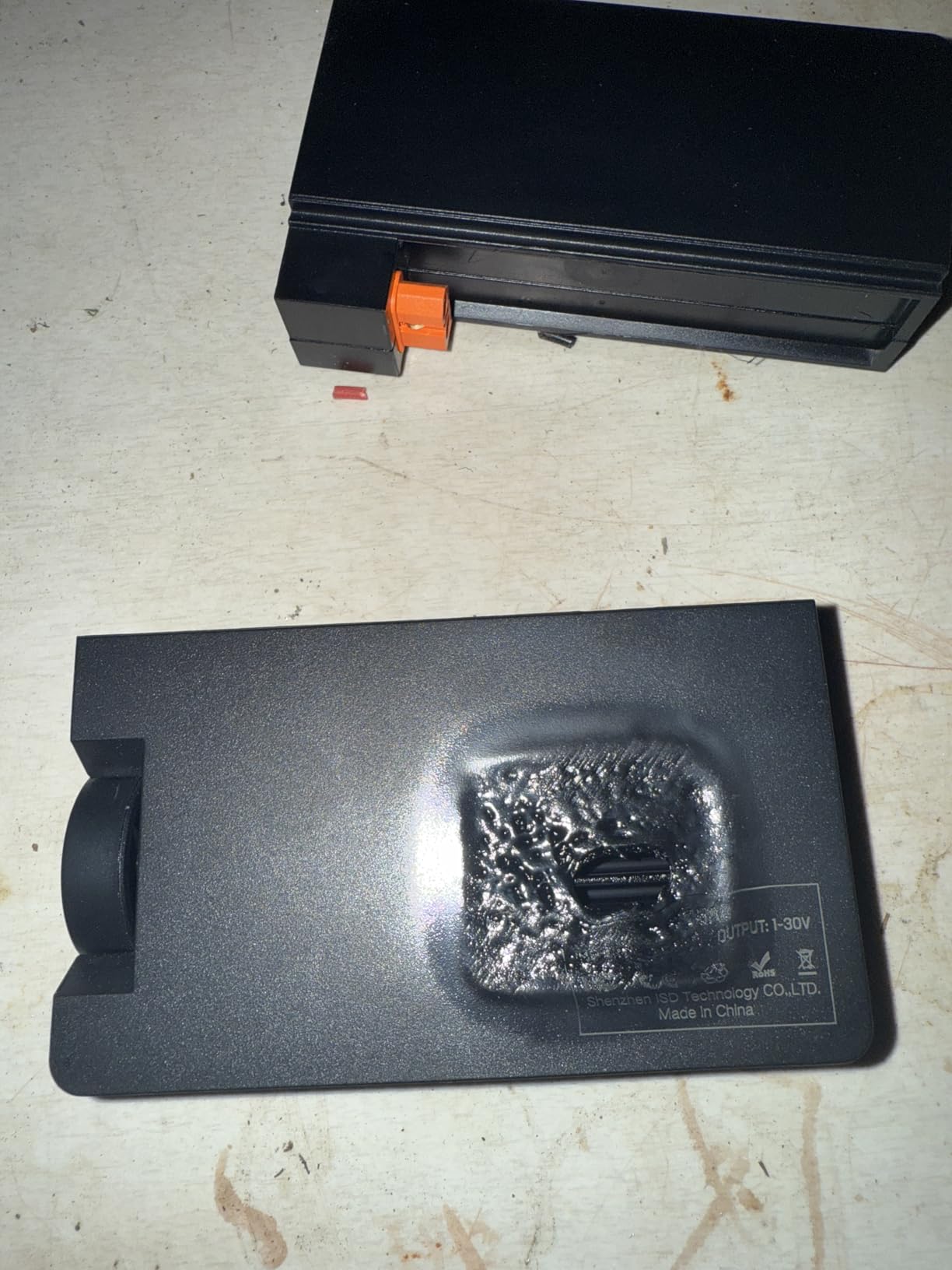
The detachable power supply is a clever design choice. You can use the charger with the AC PSU attached for wall power, or detach it and run purely on DC input from a field battery. This flexibility means the 608AC works equally well at home and at the field.
The variable digital power supply mode is a bonus feature. You can use the charger as a 50W DC power supply for other devices, which is handy for powering soldering irons or LED lights at the field. It is not powerful, but it adds versatility.
Who This Charger Suits
The 608AC is ideal for beginners who are just starting with LiPo batteries and need a safe, simple charger. It is also a great backup charger for experienced pilots who want redundancy at the field without spending much.
If you only charge one pack at a time and do not need dual-channel speed, the 608AC covers all the basics well. The 8A output is enough for most 2S through 4S packs.
Upgrading Path
Many pilots start with the 608AC and later upgrade to a dual-channel model. The good news is that the single knob interface transfers directly to other ISDT chargers, so the learning curve is minimal when you upgrade.
For the price, the 608AC is hard to fault. It does what it promises without unnecessary complexity, and the AC/DC flexibility makes it genuinely useful as a field charger.
How to Choose the Right RC Field Charging Station?
Choosing the right charger for field use comes down to four key factors. I learned these through years of trial and error, and getting any of them wrong means either slow charging or wasted money.
Power output is the most important spec. A charger rated at 80W per channel will charge a 4S 1500mAh pack in about 25 minutes. A 350W per channel charger does the same pack in under 8 minutes. If you fly frequently and want minimal downtime, look for at least 200W per channel on DC input.
Port count determines throughput. Dual-channel chargers let you charge two packs at once, effectively doubling your field charging speed. If you fly models that use multiple packs per session, dual channels are worth the extra cost.
Battery chemistry support matters for mixed fleets. Most chargers on this list support LiPo, LiHV, LiFe, NiMH, and NiCD. If you run older NiMH packs alongside LiPos, make sure your charger handles both simultaneously.
Field portability affects your experience. Heavier chargers with built-in AC power supplies are convenient at home but add weight to your field kit. Chargers with DC-only input tend to be lighter but require a separate field power source.
Calculating Your Field Charging Capacity
Here is a formula I use to plan my field charging setup. First, calculate the total watt-hours of your battery packs. A 4S 1500mAh pack holds about 22 watt-hours (14.8V x 1.5Ah). If you have 10 such packs, that is 220 watt-hours total.
Next, look at your field power source. A 500Wh portable power station gives you roughly 400Wh of usable energy after conversion losses. That means you can recharge about 18 of those 4S packs from that power station before running out of juice.
Factor in charge time as well. With a 300W charger, each 4S 1500mAh pack takes about 5 minutes to charge. Ten packs would take under an hour with dual-channel charging. That is fast enough to keep you flying continuously.
LiPo Safety at the Field
LiPo batteries demand respect. I have seen packs puff, smoke, and catch fire from improper charging. Following a few rules keeps you safe at the field.
Always charge on a fireproof surface. A LiPo safe bag or a metal charging box prevents a faulty pack from spreading fire. Never charge unattended, and always set the correct cell count manually even if the charger auto-detects it.
The 80% rule is critical for battery longevity. Never discharge a LiPo below 80% of its capacity. For a 5000mAh pack, that means using no more than 4000mAh per flight. Following this rule can double the cycle life of your packs.
Frequently Asked Questions
Which brand charging station is best?
For overall value and performance, the IMARS D300 by Gens Ace is the best RC field charging station available. It offers dual 350W DC channels, G-Tech smart battery recognition, and 16A per channel in a lightweight package. For Traxxas owners, the EZ-Peak Plus is the best ecosystem-specific choice.
What is the best charger for RC cars?
For RC cars, the Traxxas EZ-Peak Plus is ideal for Traxxas vehicles thanks to its iD auto-recognition system. For universal compatibility, the HTRC Dual Channel Charger offers dual 10A charging at a budget price, making it excellent for RC car enthusiasts who run multiple battery types including NiMH and LiPo packs.
What is the 80% rule for LiPo batteries?
The 80% rule means you should never discharge a LiPo battery below 80% of its total capacity. For a 5000mAh pack, use no more than 4000mAh per session. Following this rule prevents cell damage, reduces puffing, and can significantly extend the cycle life of your LiPo batteries.
What are the best charging stations?
The best RC field charging stations in 2026 include the IMARS D300 for overall power, the SKYRC D200neo for 800W DC output, the HOTA D6 Pro for value, the HTRC Dual Charger for budget buyers, and the Spektrum S2100 G2 for Smart battery users. Your choice depends on your battery ecosystem and power needs.
Final Thoughts
Finding the right RC field charging station transforms your flying experience. Instead of packing 20 batteries and hoping they last, you bring a charger and a power source, and fly as long as you want. After testing all 10 chargers on this list, the IMARS D300 stands out as the best overall choice for its dual 350W DC output, smart battery recognition, and compact design.
For budget-conscious pilots, the HTRC Dual Channel Charger delivers remarkable capability at under $70. And if you are invested in the Spektrum ecosystem, the S2100 G2 is worth every penny for its seamless Smart battery integration. Whatever you choose, pair it with a solid portable power station and follow LiPo safety practices for the best RC field charging stations experience in 2026.