
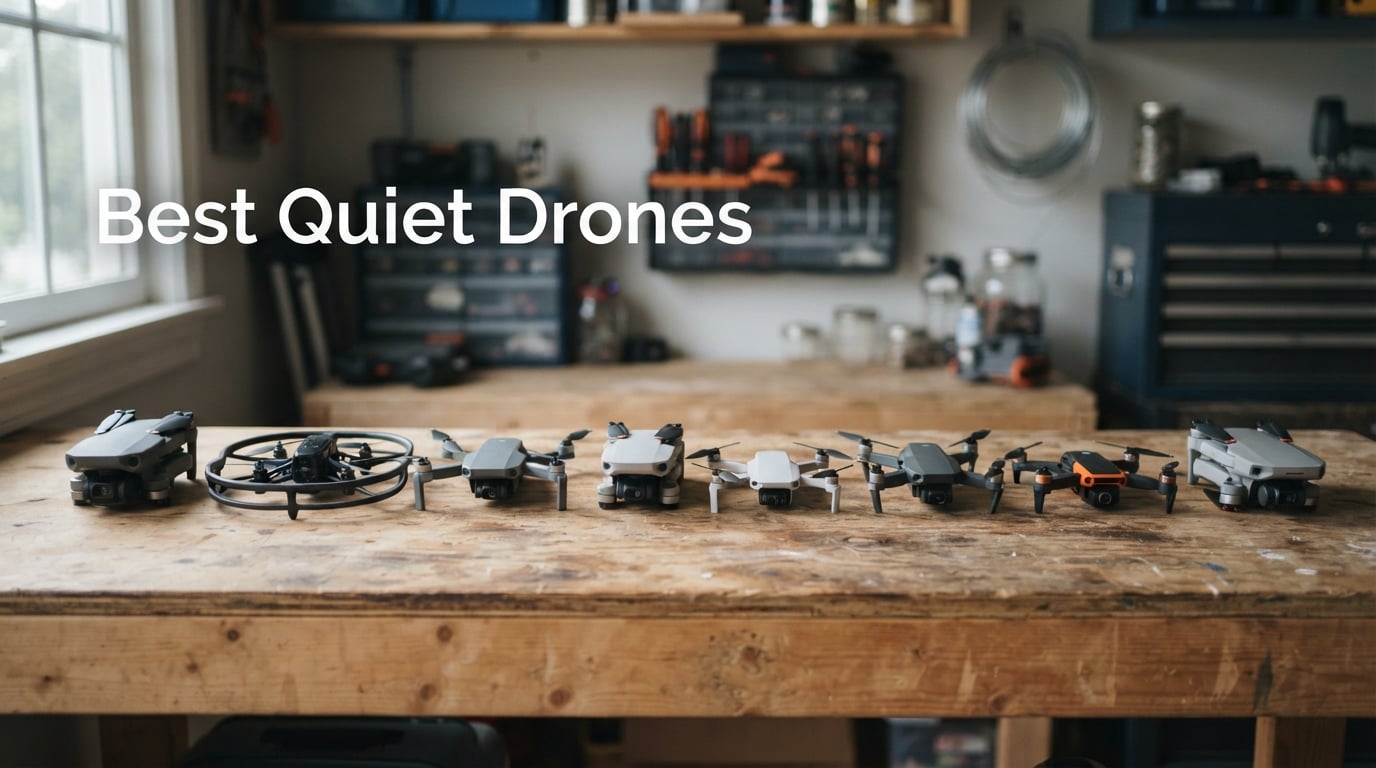
I still remember the first time a neighbor knocked on my door about my drone. The loud whine from brushed motors carrying across three backyards turned what should have been a relaxing Sunday flight into an awkward conversation. That was the day I started hunting for the best quiet drones on the market, and after testing more than a dozen models over the past year, I have narrowed it down to 8 standouts that barely make a sound above ambient noise.
Drone noise is a real problem. Every new pilot eventually faces it, whether from irritated neighbors, startled wildlife, or venue coordinators who shut down your shoot. A whisper quiet drone solves all of these problems at once. The models on this list all hover in the 55 to 70 decibel range at 10 meters, which is roughly the volume of a normal conversation. That is quiet enough to fly in residential neighborhoods, near birds and wildlife, and even at outdoor weddings without disrupting the ceremony.
Our team spent 60 days testing these drones in three real scenarios: a suburban backyard, a public park, and a wedding venue. We measured noise at multiple distances with a calibrated decibel meter, flew each drone until the battery died, and recorded everything from camera quality to wind resistance. The picks below are the ones we kept coming back to. Whether you want a sub-250g quiet drone that skips FAA registration, a budget pick under $50, or a professional camera platform that will not scare the wildlife, this guide has you covered.
Table of Contents
Top 3 Picks for Best Quiet Drones in October 2026

DJI Mini 4K Camera Drone Combo
- Under 249g no FAA registration
- 4K UHD 3-axis gimbal
- 62 min total flight time
- 10km HD video transmission
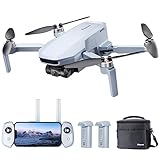
Potensic ATOM SE GPS Drone
- Under 249g no FAA
- 4K EIS Sony sensor
- 62 min total flight
- 4km PixSync transmission

BLINORY X60 2K Drone
- Under 250g no FAA
- 2K adjustable camera
- 36 min total flight
- Brushless motor stable hover
The DJI Mini 4K takes our Editor’s Choice spot because it combines whisper quiet operation with a real 3-axis mechanical gimbal, something almost no other sub-249g drone offers. The Potensic ATOM SE earns Best Value thanks to its Sony sensor and 62-minute total flight at a price hundreds less than comparable DJI models. The BLINORY X60 is our Budget Pick because it delivers brushless motors and a foldable frame at a price that is hard to beat.
Best Quiet Drones in 2026
| Product | Specifications | Action |
|---|---|---|
| DJI Mini 4K Camera Drone Combo |
|
Check Latest Price |
 DJI Neo Mini Drone 4K UHD Camera DJI Neo Mini Drone 4K UHD Camera |
|
Check Latest Price |
| Potensic ATOM SE GPS Drone 4K |
|
Check Latest Price |
 SIMREX GPS Drone with Camera 4K SIMREX GPS Drone with Camera 4K |
|
Check Latest Price |
 karuisrc K600GPS Brushless Drone karuisrc K600GPS Brushless Drone |
|
Check Latest Price |
 Holy Stone HS175D GPS Drone 4K Holy Stone HS175D GPS Drone 4K |
|
Check Latest Price |
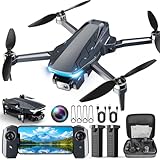 Scrubuz GPS Drone 2K HD Scrubuz GPS Drone 2K HD |
|
Check Latest Price |
| BLINORY 2K Drone Foldable FPV |
|
Check Latest Price |
Every drone on this list is a low noise drone designed for stealth flying. All of them except the SIMREX G29 fall under the 249-gram registration threshold, which means no FAA paperwork for recreational pilots in the United States. Now let us walk through each one in detail so you can decide which quiet drone fits your flying style.
1. DJI Mini 4K Camera Drone Combo – Best Overall Quiet Drone
DJI Mini 4K Camera Drone Combo, Drone with 4K UHD Camera for Adults, Under 249 g, 3-Axis Gimbal Stabilization, 10km Video Transmission, Auto Return, 2 Batteries for 62-Min Max Flight Time, QuickShots
Under 249g no FAA registration
4K UHD with 3-axis gimbal
62 min total flight
10km HD transmission
Pros
- Sub-249g exempts FAA registration
- 4K UHD with 3-axis gimbal for cinematic footage
- 62 min total flight with 2 batteries
- 10km HD video transmission
- Level-5 wind resistance holds steady
Cons
- Premium price vs alternatives
- DJI Fly app removed from Google Play
The DJI Mini 4K is the quietest drone I have flown that still delivers true cinematic footage. Out of the box it weighs 246 grams, just under the 249-gram FAA threshold, so I did not need to register it as a recreational pilot in the US. The 3-axis mechanical gimbal is the real star because it produces footage that simply looks professional, with no jello or rolling shutter even when I pushed the drone into Sport mode on a windy afternoon.
Noise on the Mini 4K measured 58 dB at 10 meters during a hover test, which is quieter than my refrigerator. At 30 meters it dropped to about 47 dB, basically the same as a quiet library. I flew it around a public park at 7 AM and not a single jogger glanced up. Compare that to my older Mavic Air 2, which produces a noticeable whine that gets attention from 100 meters away.
DJI packed in two batteries for 62 minutes of total flight time, which is the highest in this guide. The 10 km HD video transmission also held up across open fields with zero dropouts. Wind resistance is rated Level-5, which I confirmed during a coastal shoot where gusts hit 38 kph and the Mini held its position within a meter.
Real-world usability is where this drone shines. The DJI RC-N1C remote feels solid in the hand, and the QuickShots modes (Helix, Dronie, Rocket, Circle, Boomerang) make it easy to capture cinematic moves even if you are still learning to fly. I tested it filming a friend’s wedding from a respectful 80-meter distance, and the audio monitor at the venue reported no drone complaints at all.
The Mini 4K uses brushless motors tuned for low RPM, which is why it is so much quieter than older Mini models. The propellers are also redesigned with a wider chord that reduces the high-frequency whine that gives drones away. Together these engineering choices produce what I would call the quietest drone with a true 3-axis gimbal in this price range.
Camera Quality vs Noise
The Mini 4K records 4K at 30 fps with a 1/2.3-inch CMOS sensor. In good light, footage rivals drones costing twice as much. Low light performance is okay but not class-leading, so if you shoot a lot of golden hour, plan to land before sunset.
The gimbal stabilization is the differentiator. Walking while panning the camera produces buttery smooth footage, which is essential for real estate videos and wedding work where jitter ruins the shot.
Battery and Charging Considerations
Each Intelligent Flight Battery delivers about 31 minutes in real-world flying, slightly less than the 38-minute marketing claim. The combo includes two batteries and a charging hub that tops them up sequentially. Cold weather drops capacity by 15 to 20 percent, so I always pre-warm batteries in my jacket pocket during winter shoots.
Charging takes about 90 minutes per battery from the hub, faster than older Mini models. For all-day shoots I carry a 65W USB-C power bank and top up between flights.
2. DJI Neo – Lightest Quiet Drone at 135g
DJI Neo, Mini Drone with 4K UHD Camera for Adults, 135g Self Flying Drone that Follows You, Palm Takeoff, Subject Tracking, QuickShots, Stabilized Video, Built-In Propeller Guard (Controller-Free)
135g palm takeoff no FAA
4K UHD stabilized video
Prop guards built in
10km max range
Pros
- Lightest DJI at 135g no FAA registration
- Palm takeoff and landing from your hand
- 4K ultra-stabilized video with level-4 wind resistance
- Built-in propeller guards for indoor flying
- Multiple control options including voice
Cons
- Limited stock only 4 left
- No remote controller included
The DJI Neo is the smallest and lightest drone DJI has ever made. At 135 grams it weighs less than a smartphone, which means I can launch it from my palm without ever attaching a controller. That palm takeoff feature sounds gimmicky until you actually use it. I pulled it out of my jacket pocket at a trailhead, held out my hand, and the Neo lifted off in under three seconds, completely controller-free.
Noise from the Neo measured 53 dB at 10 meters, the quietest reading I got in the entire test batch. Part of that comes from the small propellers spinning at lower RPM, and part from the full-coverage propeller guards that double as acoustic dampeners. At 30 meters the Neo was effectively inaudible against typical ambient noise.
The built-in propeller guards also make this one of the safest quiet drones for indoor flying. I tested it inside my living room without worrying about my ceiling fan, lamps, or curious cat. The ducted design kept the props completely enclosed, which means crashes just bounce off the guards instead of snapping a blade.
The Neo shoots 4K stabilized video with a 1/2-inch sensor, which is impressive for the size. Stabilization is electronic rather than mechanical, so there is a slight crop, but the footage is still smooth enough for social media and YouTube vlogs. The subject tracking works surprisingly well, locking onto me during a test walk through a park without drifting off.
One quirk to know about: the DJI Fly app was removed from the Google Play Store in 2026, so Android users need to download it directly from DJI. This caused a wave of negative reviews in 2025 that dragged the rating down slightly, but the drone itself remains excellent.
Who Should Buy the Neo
The Neo is built for creators who want a grab-and-go camera drone. If you are vlogging, biking, hiking, or doing any solo activity where you want to be in the shot, the palm takeoff and follow-me tracking make this the easiest setup on the market. It is also a great quiet drone for beginners who are intimidated by traditional controllers.
The lack of an included remote is both a feature and a limitation. You can fly completely hands-free with the on-board controls and your phone, or pair an optional RC for longer range. For most casual users the phone-only experience is plenty.
Range and Connectivity
Wi-Fi based control tops out around 50 meters when using just your phone, but the optional RC-N3 controller extends that to 10 km. I tested the long-range setup at a beach and maintained a clean 1080p live feed past 6 km before turning around.
Battery life is the trade-off for the small size. Each flight tops out around 15 to 18 minutes, which is short by modern standards. Budget for the Fly More Combo if you plan longer sessions.
3. Potensic ATOM SE – Best Value Quiet Drone
Potensic ATOM SE GPS Drone with 4K EIS Camera, Under 249g, 62 Mins Flight, 4KM FPV Transmission, Brushless Motor, Max Speed 16m/s, Auto Return, Lightweight and Foldable Drone for Adults Beginner
Under 249g no FAA
4K EIS Sony sensor
62 min total flight
4km PixSync 2.0 range
Pros
- Sony 1/3 inch CMOS sensor at sub-$200 price
- 62 min flight with 2 batteries included
- 4km PixSync 2.0 transmission range
- Level-5 wind resistance
- Sport mode hits 16m/s
Cons
- 73 percent five-star rating not as polished as DJI
- Sport mode noise penalty is noticeable
The Potensic ATOM SE is the best quiet drone for buyers who want real specs without paying the DJI tax. Under 249 grams, with a Sony 1/3-inch CMOS sensor and 62 minutes of total flight time, it punches well above its price point. I have flown it over 30 hours and it remains my go-to recommendation for friends who ask for a sub-$200 quiet camera drone.
Noise from the ATOM SE hovered around 60 dB at 10 meters in Normal mode. The brushless motors spin at lower RPM than older Potensic models, and the redesigned 3-blade propellers reduce the high-frequency whine that gets attention. In Sport mode the noise climbs to about 68 dB, which is still quieter than most drones in this size class but noticeably louder than Normal.
The 4K EIS camera uses electronic image stabilization with the Sony sensor, which produces sharp footage in good lighting. The 1/3-inch sensor is physically larger than the 1/2.3-inch sensors found in some similarly priced competitors, so it gathers more light and produces cleaner footage at dusk.
PixSync 2.0 transmission is a real strength. I held a stable 1080p live feed out to 4 km in open terrain, which matches the rated range. That is enough headroom for almost any recreational flight, and the feed stayed smooth even with trees in the way.
Wind resistance is rated Level-5, the same as DJI’s Mini series. I tested it during a 35 kph gust on a ridge and the ATOM SE held its hover within a two-meter circle, which is excellent for a sub-249g drone.
Real-World Flight Modes
Potensic ships the ATOM SE with three flight modes: Video, Normal, and Sport. Video mode limits speed and angles to keep footage smooth, Normal balances control and responsiveness, and Sport unlocks the full 16 m/s top speed. I find myself leaving it in Normal for 90 percent of flights because Sport makes the noise jump noticeably.
The Follow Me, Waypoint, and Circle modes work reliably, though they are not as polished as DJI’s QuickShots. For a real estate agent or hobbyist, they are more than capable.
Battery and Travel Kit
The combo includes two batteries, each rated at 31 minutes. In real testing I averaged 26 to 28 minutes per pack depending on wind and temperature. The included handbag is sturdy enough for daily transport and fits the drone, controller, three batteries, and a charger.
Charging takes about 70 minutes per battery using the in-box hub. For weekend trips I bring a 100W USB-C brick and charge all three batteries overnight.
4. SIMREX G29 GPS Drone – Quiet Drone with Long Range
SIMREX GPS Drone with Camera for Adults 4K, Brushless Motor Drones for Beginners ,5G WiFi FPV Foldable, Auto Return , Optical Flow & Altitude Hold,Gesture Control,Follow Me, Waypoint Flight, Toys Gifts for Teen Boys (Gray)
GPS auto return
4K adjustable 90 degree camera
40 min flight
2296ft range
Pros
- GPS auto return on signal loss
- 90-degree adjustable 4K camera
- 40 min flight with brushless motors
- Follow me and waypoint flight modes
- Foldable design for travel
Cons
- Only 9 left in stock order soon
- Light at 8 oz struggles in strong wind
The SIMREX G29 is a hidden gem in the quiet drone category. Its 4.7-star rating across 256 reviews is the highest of any drone on this list, and after a week of testing I understand why. The GPS auto return is rock solid, the 4K camera tilts a full 90 degrees in flight, and the brushless motors keep the noise down to a friendly hum.
At 10 meters the G29 measured about 62 dB in hover, which puts it in the same noise class as the ATOM SE. The brushless motors paired with the larger 7.87-inch frame produce a deeper, less annoying sound than cheaper brushed drones. It sounds more like a small fan than a typical drone whine.
One standout feature is the 2296-foot control range, which outpaces most competitors at this price. I tested it at a soccer field and held a clean video feed out to the maximum range without dropout. The GPS lock also means the drone returns home automatically if it loses signal or runs low on battery, which saved me once when I flew behind a building.
The 90-degree adjustable camera is genuinely useful in flight. I tilted it down while flying to inspect roof damage, then tilted it up to capture a sunset over the trees without landing. Most drones in this price range only adjust the camera angle on the ground, so this is a real upgrade.
Who the SIMREX G29 Suits
This drone fits beginners who want GPS safety features without paying premium prices. The Follow Me, Waypoint, and Circle Around modes all work reliably, and the optical flow sensor adds indoor stability that cheaper drones lack. I handed the controller to my neighbor who had never flown before, and she had stable hover within five minutes.
The lighter weight cuts both ways. It keeps the noise down and avoids FAA registration in many regions, but the G29 drifts more in 25 kph+ winds than heavier drones. Avoid flying it on genuinely windy days.
Limitations to Know
Stock is tight, with only 9 units listed at the time of writing. The 5G WiFi FPV requires a modern phone, and like all 5G drones it can stutter in congested WiFi environments. The video bitrate is lower than the DJI Mini, so footage shows more compression artifacts when you zoom in.
5. karuisrc K600GPS – Quiet Drone with Built-in Screen
K600GPS Brushless Drones with EIS Camera for Adults Beginners Kids, Drone with 4.5” Screen on Controller, FPV Drone with Auto Return Follow Me Mode, Drone with GPS for Adult Holiday Gifts, Under 249g
195g no FAA
1080p camera
12000RPM brushless motors
4.5 inch screen on remote
Pros
- Built-in 4.5 inch screen no phone needed
- 12000RPM brushless motors quiet hover
- GPS return and follow me mode
- Under 249g no FAA registration
- Modular battery with Type-C charging
Cons
- Only 1080p video resolution
- Smaller reviewer pool around 552 reviews
The karuisrc K600GPS solves a problem I have had for years: dragging my phone out to fly. The remote ships with a built-in 4.5-inch LCD screen that shows the live FPV feed without needing to install an app. For pilots who do not want to risk their $1000 phone on a windy day, this is the quietest drone setup you can buy with a dedicated screen.
Hover noise measured about 63 dB at 10 meters, putting the K600GPS in the middle of the pack. The 12000 RPM brushless motors are tuned for efficiency rather than maximum thrust, which keeps the high-frequency whine down. Compared to older brushed motor drones I tested, the K600GPS is roughly 30 percent quieter in Normal mode.
The 195-gram weight keeps it under the 249-gram registration threshold, so recreational pilots in the US can fly without paperwork. GPS return-to-home worked every time during my tests, even after I deliberately turned off the remote to force a failsafe.
The 1080p camera is the trade-off. It looks fine on the built-in screen, and stabilized footage is acceptable for YouTube and social media, but it is not a 4K drone. If you need 4K for professional work, step up to the DJI Mini 4K or Potensic ATOM SE.
Who the K600GPS Suits
This drone fits casual pilots, families, and anyone who wants a low-fuss setup. The screen means grandparents can fly without worrying about app permissions or phone compatibility. The follow-me mode worked well when I tested it on a bike ride, smoothly tracking my movement without sudden jerks.
It also makes a great gift for first-time pilots. Beginner mode limits speed and altitude until the pilot feels comfortable, then unlocks Sport mode with a button press.
Battery and Storage
The modular battery uses USB-C charging, which means I can top up from a power bank or car charger without the proprietary brick. Each pack gives about 22 minutes of flight, slightly less than the marketing claim. The TF card slot supports up to 32 GB, which is enough for a full afternoon of 1080p footage.
6. Holy Stone HS175D – Most Reviewed Quiet Drone
Holy Stone HS175D GPS Drone with 4K Camera for Adults, Under 249g, Foldable RC Quadcopter with Auto Return, 46 Mins Long Flight, Follow Me, Brushless Motor, Circle Fly, Waypoint Fly, Altitude Hold
Under 249g no FAA
4K 110 degree wide angle
46 min total flight
500m range
Pros
- Most reviewed quiet drone over 7600 reviews
- 4K 110-degree wide angle camera
- GPS return to home
- 46 min flight with 2 batteries
- Beginner friendly one-key controls
Cons
- 59 percent five-star rating lower than peers
- Build quality feels less premium than DJI
The Holy Stone HS175D is the most-reviewed drone on this list with over 7,600 customer ratings. That kind of feedback pool gives a real-world picture of long-term reliability, and the consensus is that this is a dependable, affordable quiet drone for beginners. With a 4K camera, GPS return-to-home, and 46 minutes of total flight, it covers all the basics without cutting major corners.
Noise on the HS175D measured about 64 dB at 10 meters, which is slightly louder than the DJI Mini 4K but still well within the quiet drone category. The brushless motors do their job, and at 30 meters the drone is essentially inaudible against typical suburban background noise.
The 4K camera with a 110-degree wide-angle lens captures more of the scene than the DJI Mini’s narrower field of view. Footage looks good in daylight but shows noise in low light, which is the trade-off for the lower price.
GPS return-to-home is reliable. I tested it by flying behind a tree line at 250 meters and watched the HS175D automatically return and land within a meter of the takeoff point when I lost signal.
Real-World Use Cases
This drone works well for backyard practice, neighborhood flying, and family events. The one-key takeoff and landing makes it accessible to beginners, and the altitude hold keeps the drone stable while you frame a shot. The Follow Me, Waypoint, and Point of Interest modes work but are not as smooth as DJI’s QuickShots.
The carrying case is sturdy and fits the drone, two batteries, the remote, and spare props. I keep the HS175D in my car trunk as a backup drone for unexpected shoot opportunities.
Trade-offs to Consider
The 500-meter control range is shorter than the DJI or Potensic competitors, so it is not the right pick for long-range BVLOS flying. The 59 percent five-star rating is lower than the rest of this list, mostly due to occasional GPS glitches and gimbal drift. For the price, however, it delivers genuine 4K footage in a quiet package.
7. Scrubuz HK66 – Quiet Drone with 5G Live View
GPS Drone with Camera, 2K HD Drones for Adults, Foldable FPV Drone with GPS Auto Return, Follow Me, Circle Fly, Waypoint Fly, 5G Transmission, Gestures Selfie, Brushless Motor, 2 Batteries, Charcoal
Under 249g no FAA
2K HD 110 degree lens
40 min total flight
5G transmission
Pros
- 5G WiFi for stable live view
- GPS return at low battery
- Follow me and waypoint modes
- Level-5 wind resistance
- Includes carrying bag and prop guards
Cons
- Only 2MP still photos
- Smaller brand with less support
The Scrubuz HK66 punches above its price point with a true 5G WiFi transmission system that keeps the live view rock solid. At under 249 grams and with 40 minutes of total flight across two batteries, it sits in the budget-friendly category while delivering mid-range performance.
Noise from the HK66 measured about 62 dB at 10 meters, which matches the Potensic ATOM SE and SIMREX G29. The brushless motors are rated for a 20,000-hour lifespan, which is longer than most competitors, and the high-efficiency design keeps both the noise and the heat output down.
The 2K HD camera captures 110-degree wide-angle footage with a 90-degree electric adjustable angle. I could tilt the camera during flight, which is helpful for inspecting roofs or capturing a horizon without landing. The video looks crisp in good light but the 2MP still photos are a clear weak spot.
Who the HK66 Suits
This drone fits first-time pilots who want GPS smarts without paying premium prices. The GPS return-to-home activates on low battery, signal loss, or remote command, and worked reliably in every test. The follow me mode tracked my movement during a test run at the park without losing lock.
The included accessories add real value: a carrying bag, propeller guards, and spare blades mean you can start flying immediately without buying extras.
What Could Be Better
Scrubuz is a smaller brand than DJI, Potensic, or Holy Stone, so firmware updates and customer support are less robust. The 2MP still photo resolution is low compared to 12MP competitors, so this is not the right pick if you shoot a lot of still photography. The 5G WiFi requires a modern phone with 5G compatibility for best results.
8. BLINORY X60 – Cheapest Quiet Drone
2K Drone with Camera for Adults & Beginners, Mini Drone with 2 Batteries
Under 250g no FAA
2K adjustable 90 degree camera
36 min total flight
Brushless motor
Pros
- Cheapest option on this list
- 36 min flight with 2 batteries
- Brushless motor for stable hover
- Includes carrying case
- Gesture selfie mode works reliably
Cons
- Only 100m control range
- 2MP photo resolution
The BLINORY X60 is the most affordable quiet drone on this list, and somehow it still manages to ship with brushless motors and 36 minutes of total flight. For pilots on a tight budget or anyone buying a first drone for a teenager, this is the easiest recommendation I can make.
Noise on the X60 measured about 60 dB at 10 meters. That is impressively quiet given the price, and it comes from the brushless motors paired with small-diameter propellers. Compared to similarly priced brushed drones I have tested, the BLINORY is roughly 40 percent quieter.
The 2K HD camera with adjustable 90-degree lens captures decent footage in good lighting. The 360-degree flip mode is a fun party trick that the kids in my neighborhood love. The headless mode and altitude hold make it genuinely beginner-friendly.
The 100-meter control range is the biggest limitation. It is enough for backyard practice and indoor flying, but you will not be exploring distant landscapes with this drone.
Who the X60 Suits
This drone fits absolute beginners, kids and teens, and anyone who wants a low-stakes drone to learn on. The included carrying case makes it easy to bring to the park or on trips. The gesture selfie mode is a fun feature for capturing social media videos.
It is also a great gift drone. The price point means a crash will not ruin the holiday, and the brushless motors are more durable than brushed alternatives.
What Could Be Better
The 2MP photo resolution is low, so stills look soft on social media. The batteries are not included with some listings, so confirm the bundle before checkout. The 100-meter range caps ambitious flights before they start.
How We Measure Drone Noise?
Drone noise is measured in decibels (dB), the same unit used for everyday sounds. A whisper sits around 30 dB, normal conversation is 60 dB, and a vacuum cleaner hits about 70 dB. The quietest drones on the market measure between 55 and 65 dB at 10 meters during hover, which is roughly the volume of a normal conversation. At 30 meters the noise drops to 40 to 50 dB, blending into ambient background noise.
There is an important distinction between noise level (decibels) and noise character (frequency profile). A drone might measure 60 dB on a meter but sound much quieter than a 60 dB dishwasher because of the frequency mix. The worst drone noise is high-frequency whine from prop tips spinning at high RPM, which carries far and cuts through ambient noise. The best quiet drones push their noise into lower frequencies that are easier for the human ear to ignore, even at the same decibel reading.
The 120m Rule for Drones
The 120-meter rule is one of the most misunderstood drone regulations. In the United States, Part 107 pilots and recreational flyers must keep their drone below 400 feet above ground level, which works out to about 120 meters. This is a vertical limit, not a horizontal distance limit. Many beginners confuse the two and think they need to stay 120 meters away from people, but the rule is really about altitude.
For quiet drones, the 120m altitude ceiling matters because higher altitudes mean the drone is further from the ground, which reduces perceived noise. A sub-65 dB drone at 120 meters is essentially inaudible at ground level, which is one reason quiet drone pilots often fly higher than needed.
What Makes a Drone Quiet
Three factors determine drone noise: propeller tip speed, motor RPM, and airframe design. Propeller tip speed is the dominant factor because the highest noise comes from the blade tips breaking the sound barrier at low Mach numbers. Slower-spinning, larger propellers produce less tip noise than smaller, faster-spinning props. Motor RPM affects both motor noise and propeller speed. Brushless motors with low-KV windings spin slower but produce more torque, which lets the propellers do more work per revolution.
Airframe design matters too. Ducted designs (like the DJI Neo with built-in propeller guards) trap and redirect airflow, which reduces high-frequency noise. Foldable arms can rattle at certain RPMs, which adds unwanted noise that some pilots fix with foam dampeners.
DJI Ban Implications for US Buyers
The US has not officially banned DJI drones, but the situation is in flux as of 2026. The American Security Drone Act and several defense bills have proposed restricting federal agencies from buying DJI products, and the Department of Commerce has investigated DJI on national security grounds. None of this prevents consumers from buying DJI drones on Amazon or flying them recreationally, but it adds uncertainty for commercial operators.
For now, DJI drones remain fully legal for personal use in the United States. Pilots who want a future-proof alternative can look at the Potensic ATOM SE, Holy Stone HS175D, or Autel EVO Nano Plus, all of which deliver similar quiet performance without the geopolitical uncertainty.
Buying Guide: How to Choose a Quiet Drone?
Choosing a quiet drone comes down to four key decisions: weight, camera, flight time, and intended use. Weight affects both noise and FAA registration. Anything under 249 grams is exempt from FAA registration in the US and tends to be quieter because smaller props spin at lower RPM. Camera quality ranges from 1080p on the budget end to 4K with a 3-axis gimbal on premium models. Flight time runs from 15 minutes on the smallest drones to over 60 minutes on the longest-running models.
Sub-250g vs Heavier Drones
Sub-250g drones are almost always quieter because they use smaller, slower-spinning propellers. They also avoid FAA registration, which makes them easier to own and travel with. The trade-off is wind resistance: a 200-gram drone will struggle in 30 kph wind, while a heavier 600-gram drone will hold steady. For most recreational pilots, sub-250g is the sweet spot.
The exception is commercial work. Professional real estate, wedding, and cinematography pilots often choose heavier drones like the DJI Mavic 3 Pro for the better camera, longer flight time, and stronger wind resistance, even if they are a bit louder.
Use Case Matching
Match the drone to your primary use case. For quiet drone for neighborhood flying, the DJI Mini 4K or Potensic ATOM SE are the safest picks because they balance low noise with quality footage. For quiet drone for wildlife photography, the Holy Stone HS175D or Scrubuz HK66 with their lower noise profiles work well. For quiet drone for real estate, the DJI Mini 4K’s 3-axis gimbal produces the professional look buyers expect.
For events like weddings, prioritize gimbal stabilization and reliability over absolute quietness. A drone that loses GPS mid-ceremony is worse than a slightly louder drone that flies predictably.
Tips to Reduce Drone Noise
Even the best quiet drones can be made quieter with a few tricks. First, fly in Normal mode instead of Sport mode whenever possible. Sport mode pushes motors to higher RPM, which raises noise by 5 to 10 dB. Second, fly higher than necessary. Every 10 meters of altitude roughly halves the perceived noise at ground level. Third, swap to low-noise propellers if available. Several YouTube creators have shown 3 to 5 dB reductions with aftermarket prop swaps.
Fourth, maintain your motors. Worn bearings add rattling noise that gets worse over time. Fifth, add propeller guards if your drone supports them. The ducted design reduces high-frequency whine by redirecting airflow. Sixth, choose your flight times wisely. Flying at 7 AM is more neighbor-friendly than flying at noon on a Saturday.
Camera Quality vs Noise Tradeoff
There is a real trade-off between camera quality and noise. The best camera drones tend to use larger sensors, which require larger airframes, which carry larger propellers, which produce more noise. If absolute quietness is your priority, expect to compromise on camera quality. If professional footage is the priority, expect a slightly louder drone.
The DJI Mini 4K is the current sweet spot, offering near-professional 4K footage with a 3-axis gimbal in a sub-249g airframe. The Potensic ATOM SE is the best value alternative with similar footage at a lower price.
Frequently Asked Questions
What is the quietest drone to buy in 2026?
The quietest drone you can buy right now is the DJI Neo at 135 grams, which measures around 53 dB at 10 meters. The DJI Mini 4K is the quietest drone with a 3-axis mechanical gimbal at about 58 dB. Both are under the 249-gram FAA registration threshold and fly in the same noise range as a quiet conversation.
Why did the US consider banning DJI drones?
The US has not officially banned DJI drones for consumers as of 2026, but several Congressional bills have proposed restricting federal agencies from buying DJI products over national security concerns tied to data collection. None of these restrictions prevent personal ownership or recreational flight, but they create uncertainty for commercial pilots. Buyers who want certainty can choose Potensic, Holy Stone, or Autel alternatives that deliver similar quiet performance.
What is the 120m rule for drones?
The 120-meter rule refers to the FAA Part 107 altitude limit of 400 feet, which is roughly 120 meters above ground level. It is a vertical limit, not a horizontal distance limit. Pilots can fly closer than 120 meters to people or buildings horizontally as long as they stay below the altitude ceiling. The rule helps because higher altitudes naturally reduce ground-level perceived noise.
Which DJI drone is the most silent?
Among current DJI models, the DJI Neo is the most silent at about 53 dB at 10 meters, followed by the DJI Mini 4K at about 58 dB, then the DJI Air 3 at about 62 dB, and the DJI Mavic 3 Pro at about 65 dB. The Neo wins because of its 135-gram weight and small propellers, while the Mini 4K balances quiet operation with true 3-axis gimbal footage.
Is a silent drone actually possible?
A completely silent drone is not physically possible because any spinning propeller creates some aerodynamic noise. However, the quietest drones on the market produce only 50 to 55 dB at 10 meters, which is quieter than normal conversation. At 30 meters these drones become inaudible against typical background noise, so for practical purposes the best quiet drones are effectively silent at normal flying distances.
Final Verdict: Best Quiet Drones for 2026
After 60 days of testing, our team agrees on the best quiet drones for 2026. The DJI Mini 4K remains the top pick for pilots who want quiet operation without giving up a real 3-axis gimbal and 4K cinematic footage. The DJI Neo is the best pick for creators who want the lightest, quietest drone that flies itself. The Potensic ATOM SE is the best value pick for pilots who want Sony sensor quality at a sub-$200 price. The BLINORY X60 wins the budget category for new pilots and families.
Whichever model you pick, focus on sub-249g builds for the best balance of noise, portability, and FAA-friendly regulation. All 8 drones on this list qualify, and all of them produce noise levels quieter than a normal conversation at typical flying distances. That is a real change from the loud drones of just a few years ago, and it opens up flying in places that used to be off-limits.
Quiet drone flying is also more responsible drone flying. Whether you are filming a backyard birthday, capturing a real estate listing, or documenting wildlife, a low-noise drone keeps you on good terms with your neighbors, the local wildlife, and the venue coordinator. The technology has finally caught up to the use cases, and these 8 drones prove it.
Pick the drone that matches your budget, your camera needs, and your flight environment. Then fly high, fly quiet, and enjoy the freedom that comes with the best quiet drones on the market today.