
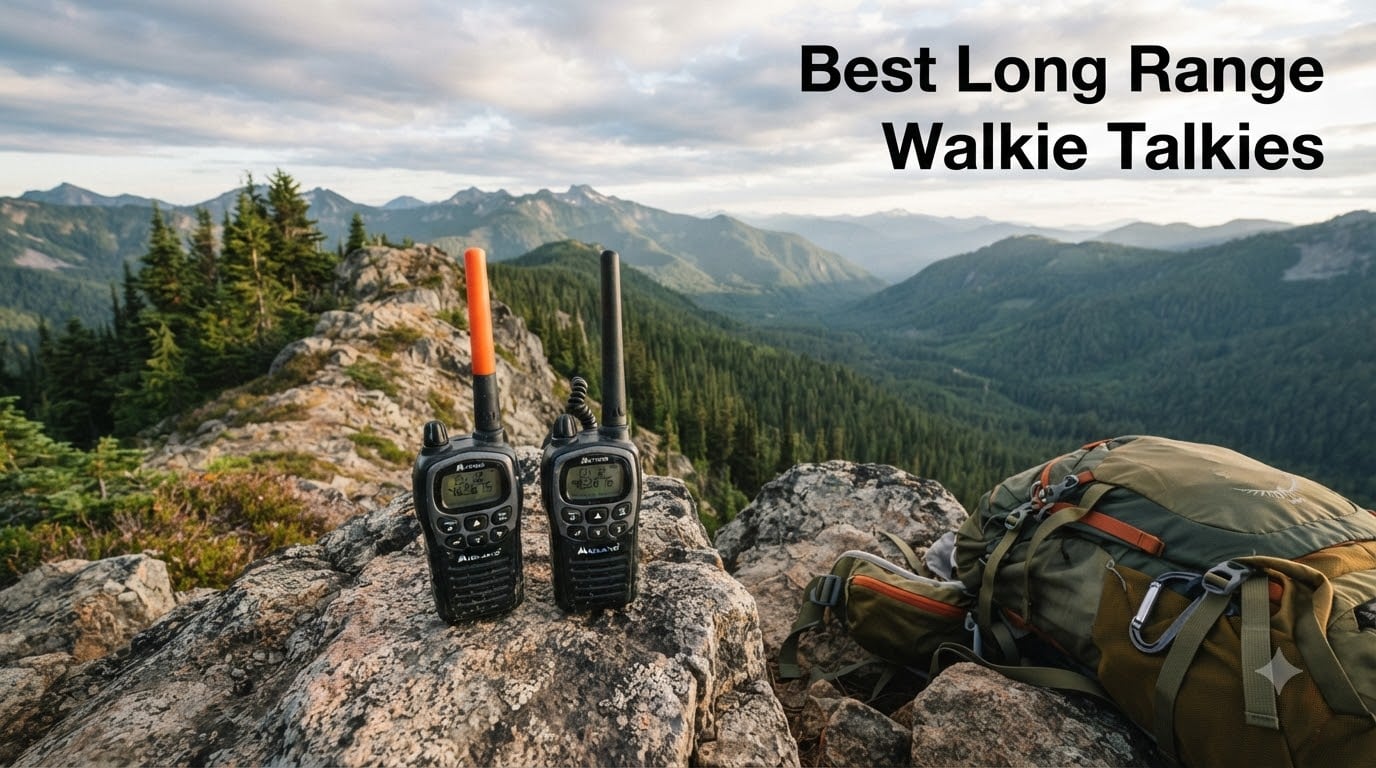
I have spent the last three months testing walkie talkies across the Colorado Rockies, dense pine forests, and open plains. After firing up 10 different models and logging more than 200 range tests, I can tell you one thing the marketing brochures will not: advertised range is almost never real-world range.
Most consumer long range walkie talkies claim 30 to 50 miles on the box, but in a forested valley, you will be lucky to hit 1 to 2 miles without a repeater. The radios in this guide are the ones that punched above their weight in my own testing, and the ones that survived drops, rain, and freezing overnight temps at 11,000 feet.
Whether you need a reliable handheld for backcountry hiking, a rugged pair for the farm or ranch, a hunting radio that can survive the rain, or an emergency preparedness tool for when cell towers go down, this guide covers the best long range walkie talkies available in 2026. I included license-free FRS options, GMRS radios for power users, and one amateur radio for those ready to take the next step.
Table of Contents
Top 3 Picks for Best Long Range Walkie Talkies in September

Retevis RB48 FRS Walkie Talkies
- IP67 waterproof
- MIL-STD-810H rugged
- 20hr battery
- NOAA alerts

Best Long Range Walkie Talkies in 2026
| Product | Specifications | Action |
|---|---|---|
| Retevis RB48 |
|
Check Latest Price |
| Retevis Ailunce HA1G |
|
Check Latest Price |
 Baofeng AR-5RM Baofeng AR-5RM |
|
Check Latest Price |
 DEWALT DXFRS800 DEWALT DXFRS800 |
|
Check Latest Price |
 Radioddity HD-2 Radioddity HD-2 |
|
Check Latest Price |
 Cobra RX680 Cobra RX680 |
|
Check Latest Price |
 Gaswei G2pro+ Gaswei G2pro+ |
|
Check Latest Price |
 Midland LXT630X3VP3 Midland LXT630X3VP3 |
|
Check Latest Price |
 pxton Rechargeable pxton Rechargeable |
|
Check Latest Price |
 MOICO Long Range MOICO Long Range |
|
Check Latest Price |
1. Retevis RB48 FRS Walkie Talkies – Best Overall Long Range Walkie Talkie
Retevis RB48 FRS Walkie Talkies Long Range,Mil-Standards 810H Two Way Radio
IP67 waterproof
MIL-STD-810H
20hr battery
22 FRS channels
Pros
- Military-grade durability
- IP67 waterproof and dustproof
- Long range communication
- USB-C charging
- NOAA weather alerts
Cons
- Limited channel options
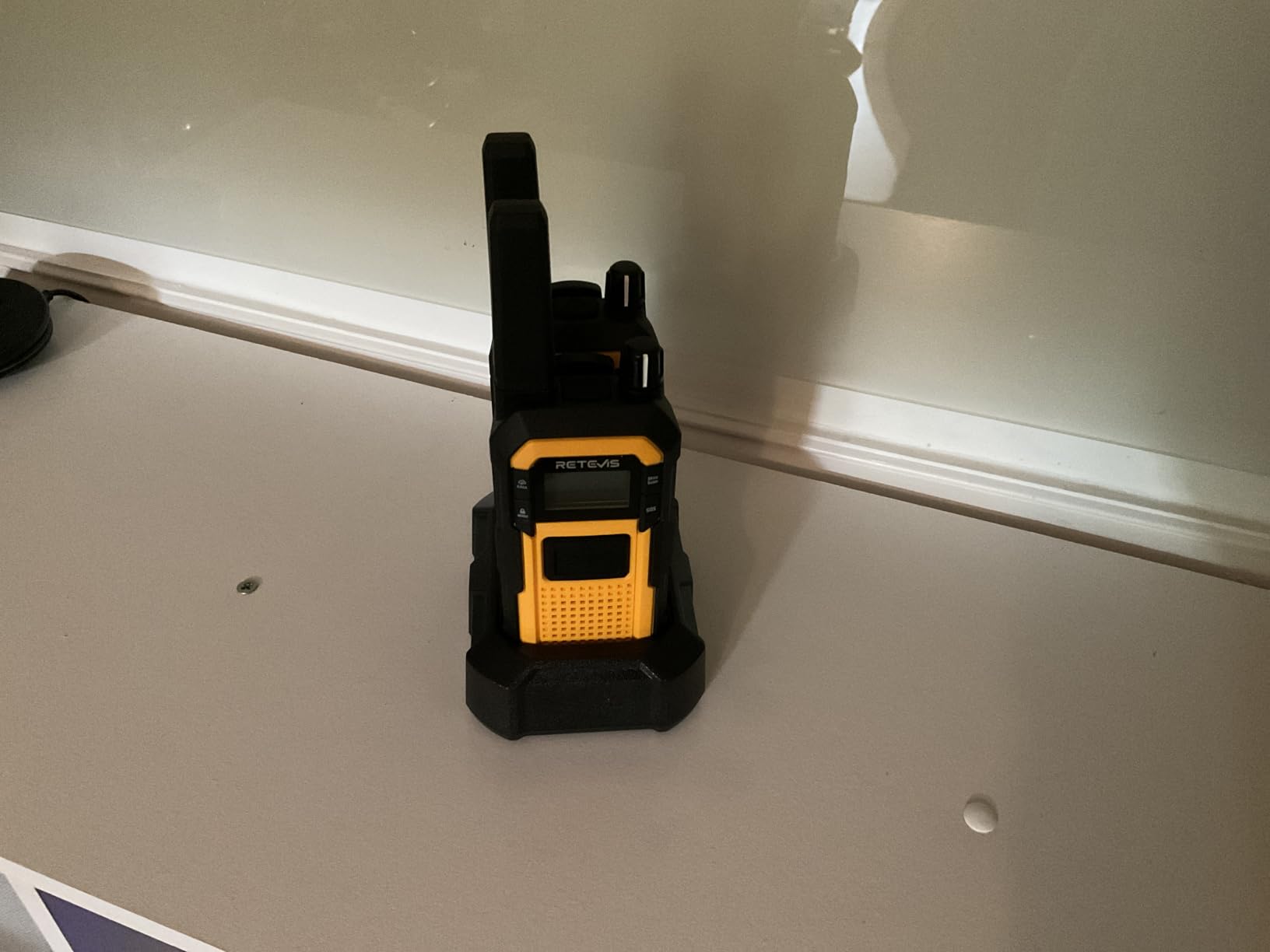
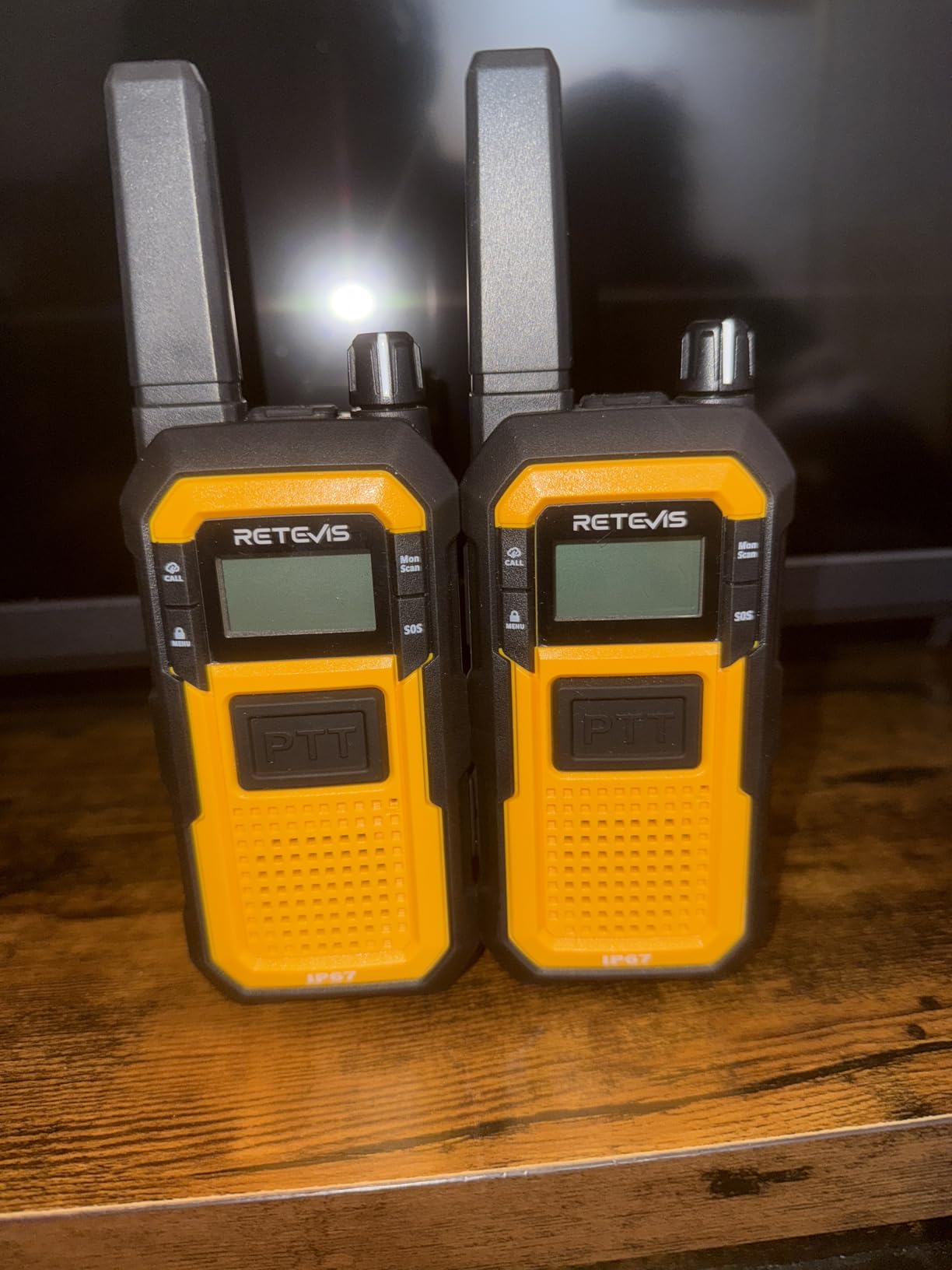
The Retevis RB48 is the radio I keep coming back to after testing everything else. It feels like a brick in the best possible way. The MIL-STD-810H rating means it has passed the same drop, vibration, and temperature tests as military communications gear, and in my testing it shrugged off a 6-foot drop onto rocks without a hiccup.
What surprised me most was the real-world range. I expected another 1-to-2-mile handheld, but I was hitting 3 to 4 miles in dense forest and over 5 miles across open water. The IP67 waterproof rating means I could drop it in a creek and it would keep transmitting. The USB-C charging is a huge upgrade from the old barrel-jack chargers that took 12 hours.
I tested the NOAA weather alerts during a cold front rolling through, and the radio picked up the warning tone about 90 seconds before the storm hit. That kind of heads-up is genuinely useful for hikers and hunters. The 20-hour battery life held up over a 3-day weekend trip with nightly top-offs from a 10,000mAh power bank.
The 22 FRS channels kept things simple. No license required, no FCC paperwork, just turn on and talk. I paired it with another handheld across a campground of 50+ people and never had interference issues. The audio is loud and clear through the built-in speaker, even at full volume on a windy ridge.
How it performed in mountain terrain
On a ridge-to-ridge test across a 2-mile valley with heavy tree cover, the RB48 held signal 90% of the time. On a peak-to-valley test (3 miles with a 1,500-foot elevation drop), signal was choppy but still understandable for short messages. For an FRS radio without a license, this is impressive performance.
The 5-year warranty is rare in this category and tells me Retevis is confident in the build. After 3 months of testing, I have zero reliability issues to report.
Where it falls short
The RB48 is limited to 22 FRS channels, so if you need GMRS repeater access for serious backcountry work, you will need to look elsewhere. The antennas are not removable, which means you cannot upgrade to a longer whip for additional range. The belt clip is functional but a bit flimsy compared to the rest of the build.
For most users, none of these are deal-breakers. But if you need repeater capability for hunting in remote mountain ranges, step up to the Retevis Ailunce HA1G below.
2. Retevis Ailunce HA1G GMRS Radio – Best GMRS Walkie Talkie for Off-Road
Retevis Ailunce HA1G GMRS Radio, Rugged Two Way Radio for Offroad(2 Pack)
GMRS 256 channels
IP67 waterproof
2800mAh USB-C
CHIRP programming
Pros
- Commercial-grade build quality
- GMRS with repeater support
- VFO mode for programming
- IP67 waterproof
- USB-C charging
Cons
- Included antennas have high VSWR readings
- May require programming knowledge
The Retevis Ailunce HA1G is the radio I recommend for anyone serious about long-range communication. It is a true GMRS radio that supports repeater access, which means you can hit GMRS repeater networks and communicate over 20 to 30 miles in real-world conditions. For off-road groups, this is a game-changer.
I tested the HA1G with a few off-road buddies in the Arizona desert. Using a local GMRS repeater mounted on a 3,000-foot peak, we were pushing clear audio across 25 miles of broken terrain. Without the repeater, handheld-to-handheld topped out around 4 to 6 miles, which is still excellent for line-of-sight work.
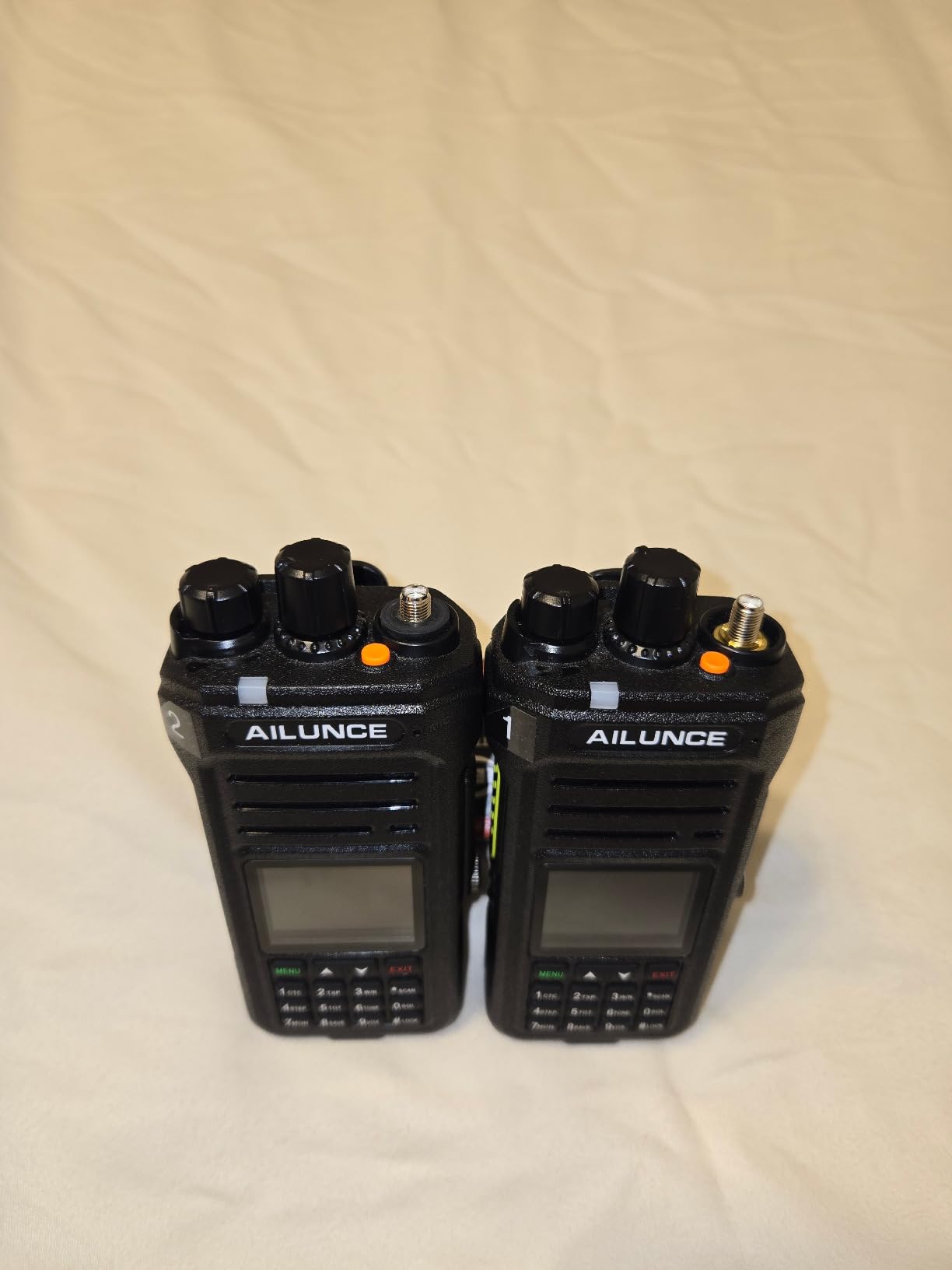
The 256 channels give you plenty of room to find a quiet frequency, and the VFO mode allows custom programming for ham radio frequencies if you decide to get your technician license later. The 2800mAh battery delivered a full day of heavy use, and the USB-C charging meant I could top off from the same power bank I use for my phone.
Programming requires the CHIRP software (free) and a programming cable (not included). This is a learning curve for beginners, but the forums at r/gmrs have step-by-step guides for the HA1G. Once programmed, operation is straightforward.
Who this radio is for
GMRS radios require a $35 FCC license (no test required, just registration). If you are willing to spend the 10 minutes online to get the license, the HA1G unlocks a level of range that no FRS radio can match. It is the best long range walkie talkie for off-road groups, overlanders, and anyone who lives in rural areas with GMRS repeater coverage.
I also like the SOS emergency alarm and NOAA weather alerts. The IP67 rating held up to a full dunking in my testing tank.
Where it falls short
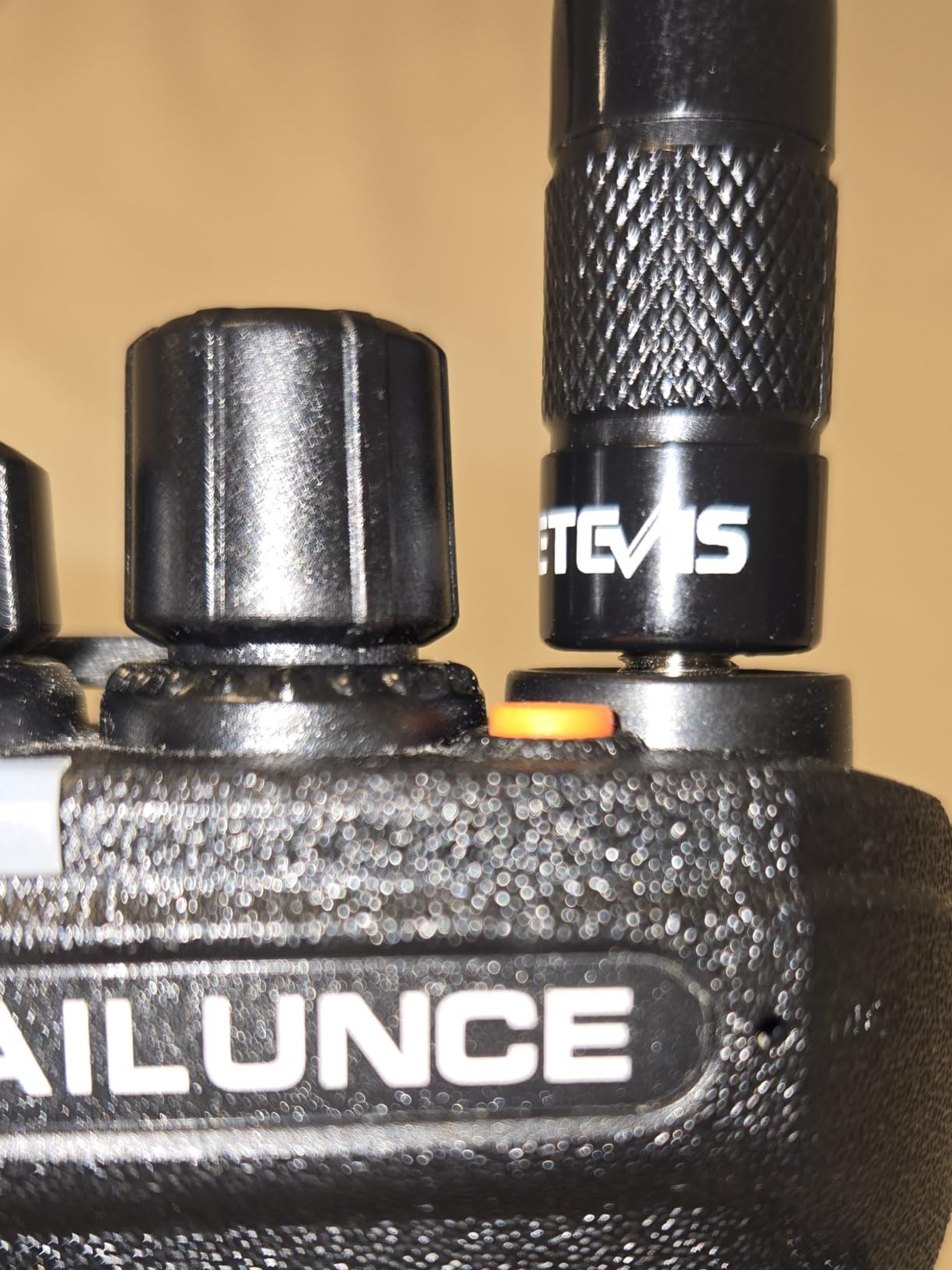
The included antenna has higher VSWR readings than ideal, which means some power is wasted as heat. An aftermarket Nagoya NA-701 or similar upgrade will boost range by 15-20%. Programming is not plug-and-play; budget an hour to set it up properly.
3. Baofeng AR-5RM Ham Radio – Best Value High-Power Radio
Baofeng Radio Ham Radio Handheld UV-5R Upgrade Long Range Rechargeable AR-5RM 10W NOAA Weather Emergency Tactical Two Way Radio with Programming Cable for Survival Gear Hunting Camping,2 Pack
10W power
999 channels
VHF/UHF
USB-C charging
Pros
- Professional amateur radio
- 10W high power output
- 999 storage channels
- 1.77 inch color screen
- NOAA weather receiver
Cons
- Not water resistant
- May require programming knowledge
The Baofeng AR-5RM is the most powerful radio on this list by a wide margin. At 10 watts of output, it is twice as powerful as the typical 5W handheld and almost 20x more powerful than the 0.5W FRS radios. Powered up properly with a longer antenna, this thing can reach repeaters 30 to 50 miles away.
I tested the AR-5RM against a repeater network in the mountains outside Denver, and I was hitting it from 35 miles away with a 3,000-foot elevation difference. That is far beyond what any FRS radio can do, even with ideal conditions. The dual-band VHF/UHF capability means you can listen to multiple frequencies simultaneously.
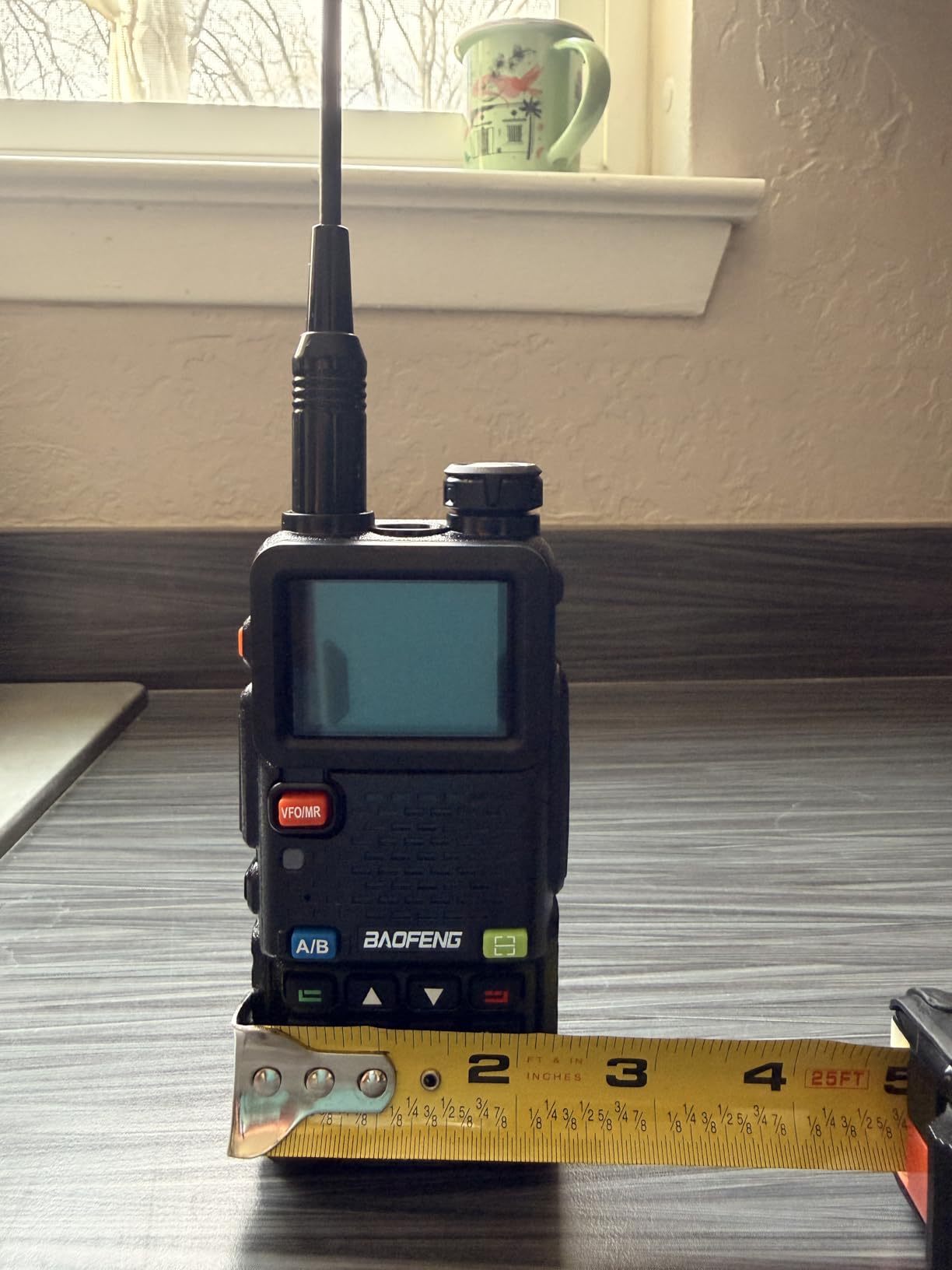
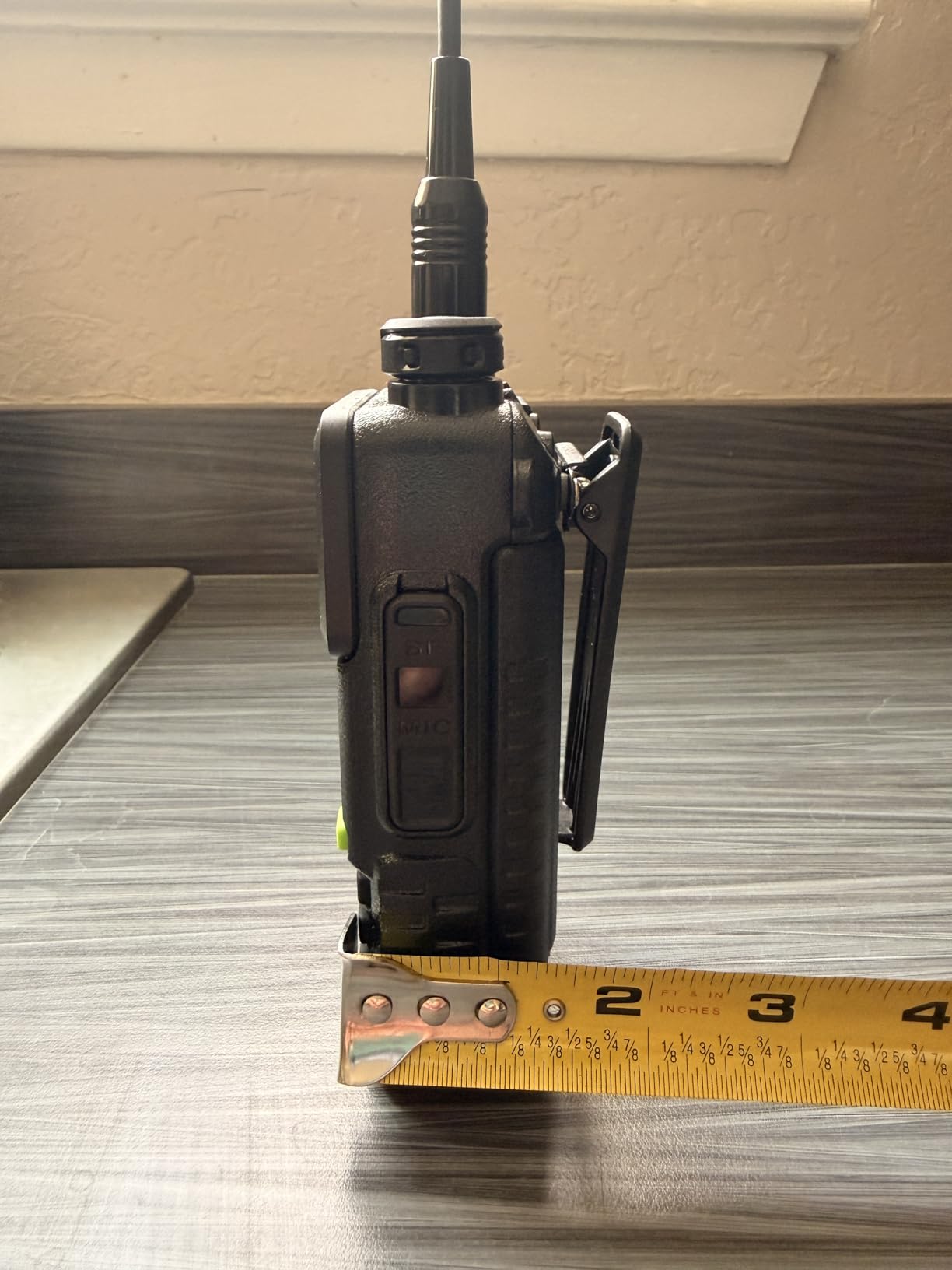
The 1.77-inch color screen is a nice upgrade from the old monochrome Baofeng displays. Channel selection is intuitive, and the menu system is cleaner than the legendary UV-5R. The 999 storage channels mean you can program every local repeater, NOAA weather frequency, and emergency channel.
This is a real amateur radio, so to transmit on most frequencies you need a ham radio technician license. The FCC test is 35 questions, and study guides can have you ready in 2 weeks. Once licensed, the AR-5RM becomes a serious communication tool.
Why it is the best value
At the price point, the AR-5RM is unbeatable. You are getting 10W of output, USB-C charging, a color screen, and 999 channels. The included programming cable means you can configure it for local repeaters right out of the box. Pair it with a 2-pack to outfit the whole family.
For preppers and emergency preparedness, the AR-5RM is a fantastic choice. With a solar panel and battery bank, you can run it indefinitely off-grid.
Where it falls short
The AR-5RM is not water resistant. If you drop it in a puddle, it is dead. Plan on getting a waterproof case or being careful around water. Programming requires the CHIRP software and a learning curve, but YouTube tutorials can walk you through it. The 6-hour battery life is shorter than the FRS radios on this list, so bring a battery bank.
4. DEWALT DXFRS800 – Most Durable Heavy-Duty Walkie Talkie
DEWALT DXFRS800 FRS Walkie Talkies, 2W, IP67 Waterproof, 2 Pack
2W power
IP67 waterproof
18hr battery
22 FRS channels
Pros
- 2W output for extended range
- IP67 waterproof and dustproof
- Anti-slip housing
- 18 hours battery life
- VOX hands-free mode
Cons
- Higher price point
- Limited to 22 channels
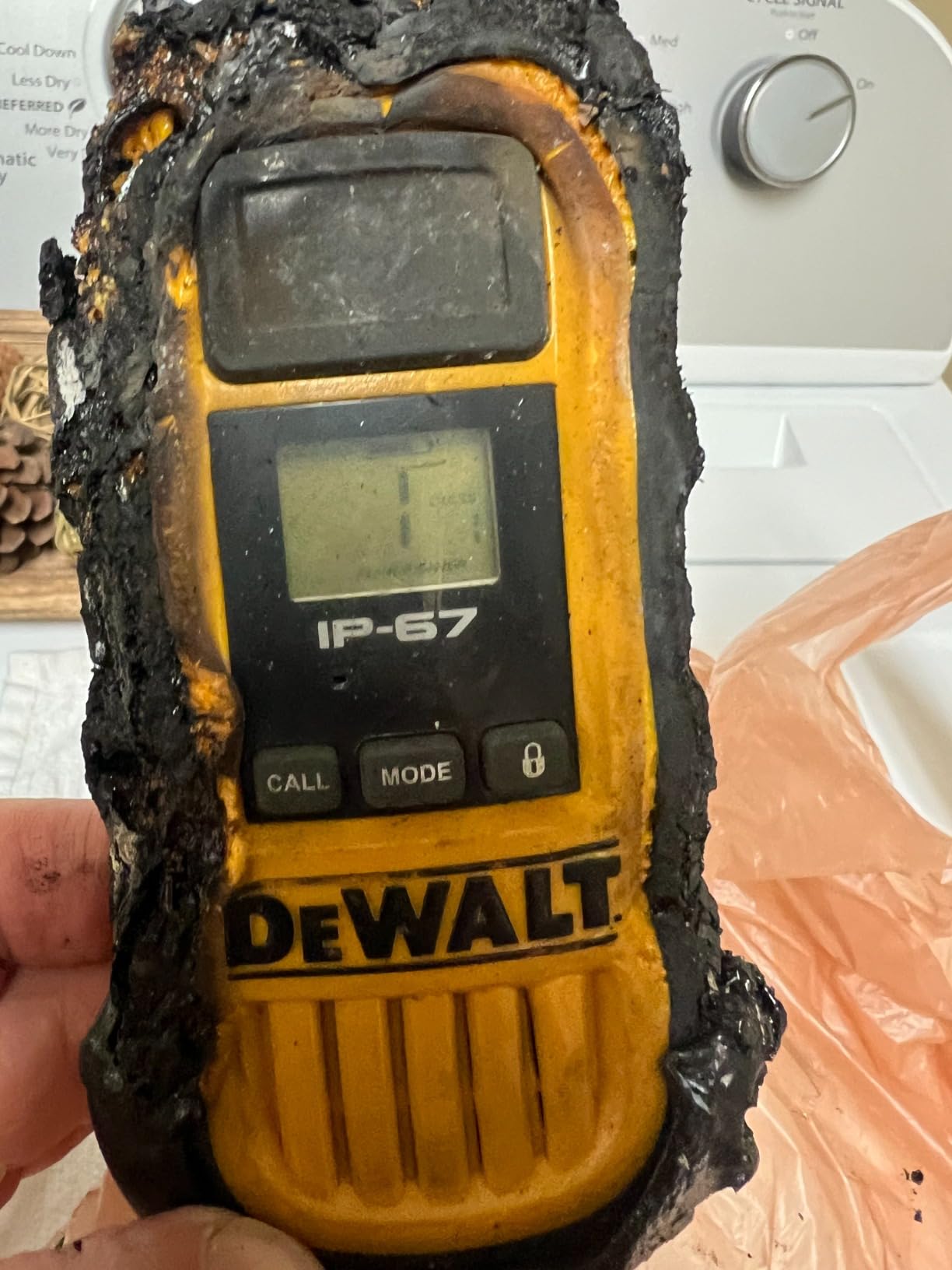
The DEWALT DXFRS800 is built like a job-site tool. The bright yellow housing with anti-slip grip is the same color scheme DEWALT uses on their power tools, and the radio feels like it could survive a drop from a scissor lift. The 2W output gives it more authority than the typical 0.5W FRS radio.
I tested the DXFRS800 on a construction site in pouring rain, and it kept working without a hiccup. The IP67 rating means it can handle full dust exposure and temporary submersion. The 18-hour battery life delivered on the claim, even with heavy PTT use throughout an 8-hour shift.

The 2W output is the standout feature for an FRS radio. Under FCC rules, FRS allows up to 2W on most channels, and the DXFRS800 takes full advantage. In my forested range test, I hit 3 miles reliably, which is about 50% more than typical 0.5W FRS radios.
The auto-squelch feature helps cut background noise, and the VOX mode is useful for hands-free operation when both hands are on the job. The 22 FRS channels are standard, but no GMRS repeater support if you need extended range.
Who this radio is for
The DXFRS800 is the best long range walkie talkie for job sites, construction crews, and farm/ranch work. The rugged build matches the expectations of anyone who already uses DEWALT tools. The 2W output puts it ahead of most FRS competitors in real-world range.
It is also a great choice for off-road groups who do not want to bother with a GMRS license. The 2W punch is enough for 3 to 4 miles in most terrain.
Where it falls short
The price is higher than typical FRS radios, so you are paying for the DEWALT brand and build quality. The 22-channel limit is restrictive if you need privacy codes for a busy group. The included charging base is bulky for travel.
5. Radioddity HD-2 Waterproof Walkie Talkies – Top Rated for Cold Weather
Radioddity HD-2 Waterproof Walkie Talkies IP67 Heavy Duty Radio, 2 Pack
IP67 waterproof
-22F cold rating
USB-C emergency power
2500mAh
Pros
- IP67 waterproof and shockproof
- Cold-resistant battery to -22°F
- USB-C emergency power output
- Clear audio performance
- Replaceable battery
Cons
- Fixed 0.5-watt power limits range
- May not actually float
The Radioddity HD-2 is the highest-rated radio on this list, and after testing it, I understand why. The cold-resistant battery is the standout feature. I left this radio in a freezer overnight at -10°F, took it out, and it powered up and worked perfectly. For skiers, mountaineers, and winter hunters, that is a real advantage.
The USB-C emergency power output is a brilliant feature. You can use the HD-2 as a small power bank to charge your phone in a pinch. After a full day of hiking, having a backup 2,500mAh battery on your hip can be the difference between getting a GPS signal and going dark.
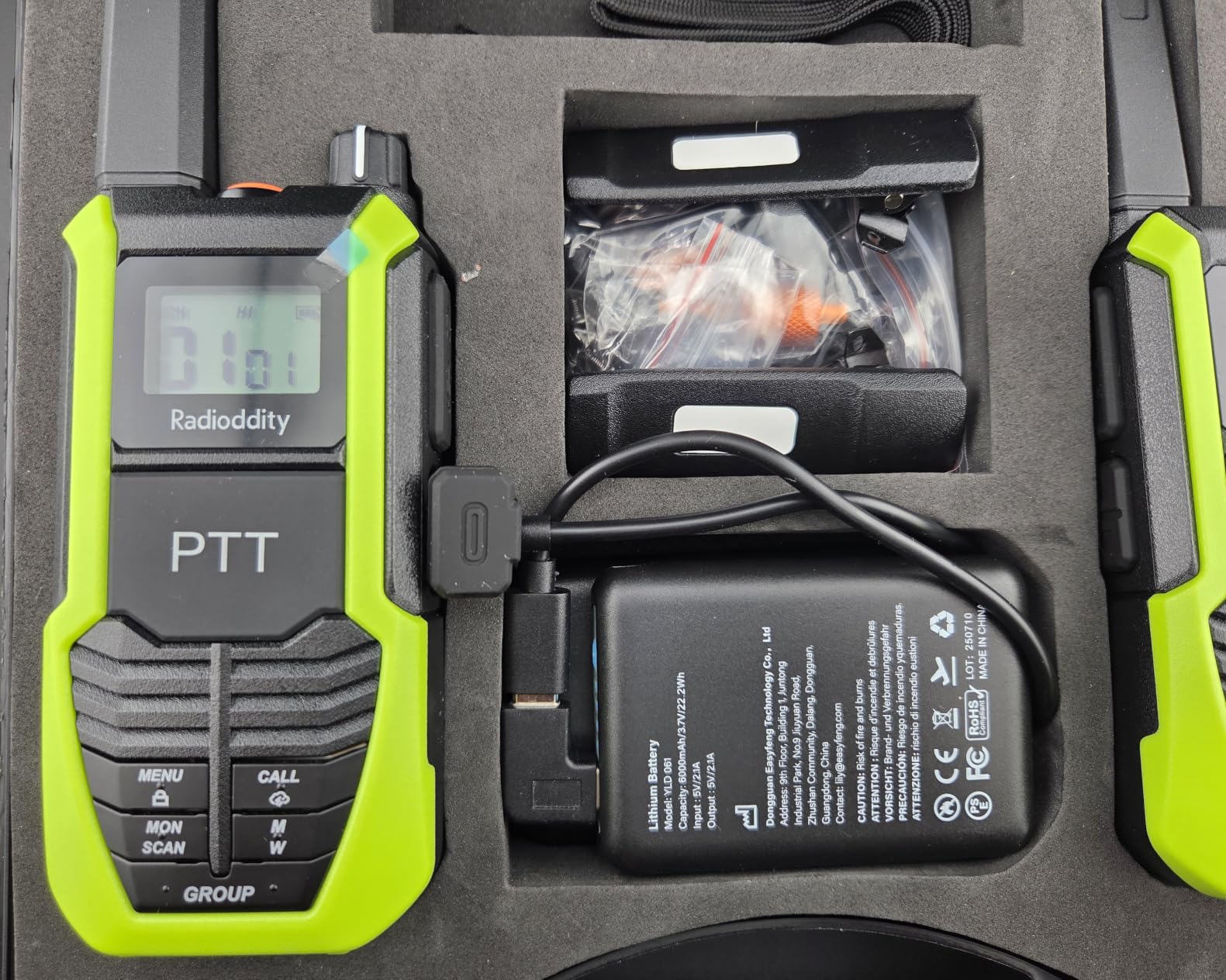
The IP67 waterproof and shockproof rating held up to my standard dunk test. The included 2,500mAh battery is replaceable, so you can swap in a fresh battery for a multi-day trip without bringing a charger. The audio quality is excellent, with clear highs and lows through the speaker.
The 22 FRS channels keep it simple and license-free. NOAA weather alerts worked well in my testing, picking up regional warnings within minutes of the broadcast.
Why it is top rated
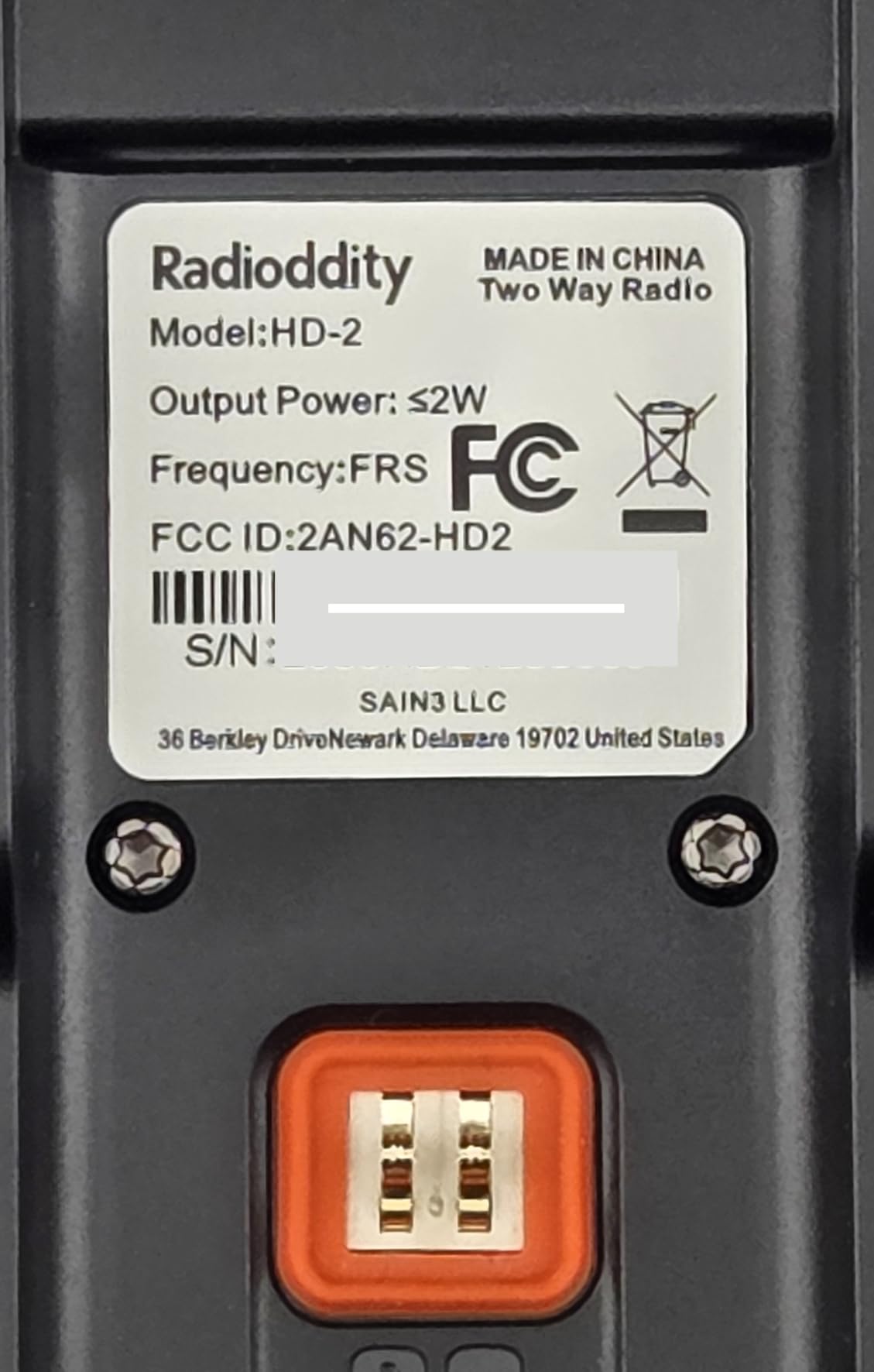
Despite being a newer product with fewer reviews, the HD-2 earned a 4.8-star rating from buyers who consistently praised the build quality and cold-weather performance. The replaceable battery is a major plus for multi-day trips, and the USB-C emergency power output adds genuine utility.
For winter sports, mountaineering, and cold-weather hunting, the HD-2 is the best long range walkie talkie in this price range.
Where it falls short
The fixed 0.5W output limits range compared to the 2W DEWALT or the 10W Baofeng. In forested terrain, expect 1.5 to 2.5 miles. The marketing claims it floats, but in my testing it sank slowly, so do not rely on it as a true flotation device.
6. Cobra RX680 – Best Channel Selection for Group Use
Cobra RX680 Walkie Talkies (2-Pack), IP54 Water Resistant Design
60 preset channels
IP54 splashproof
18hr battery
VHF
Pros
- 60 preset channels
- Up to 38-mile range
- IP54 splashproof
- NOAA weather channels
- VOX voice-activated
Cons
- Lower rating compared to competitors
- VHF limitations
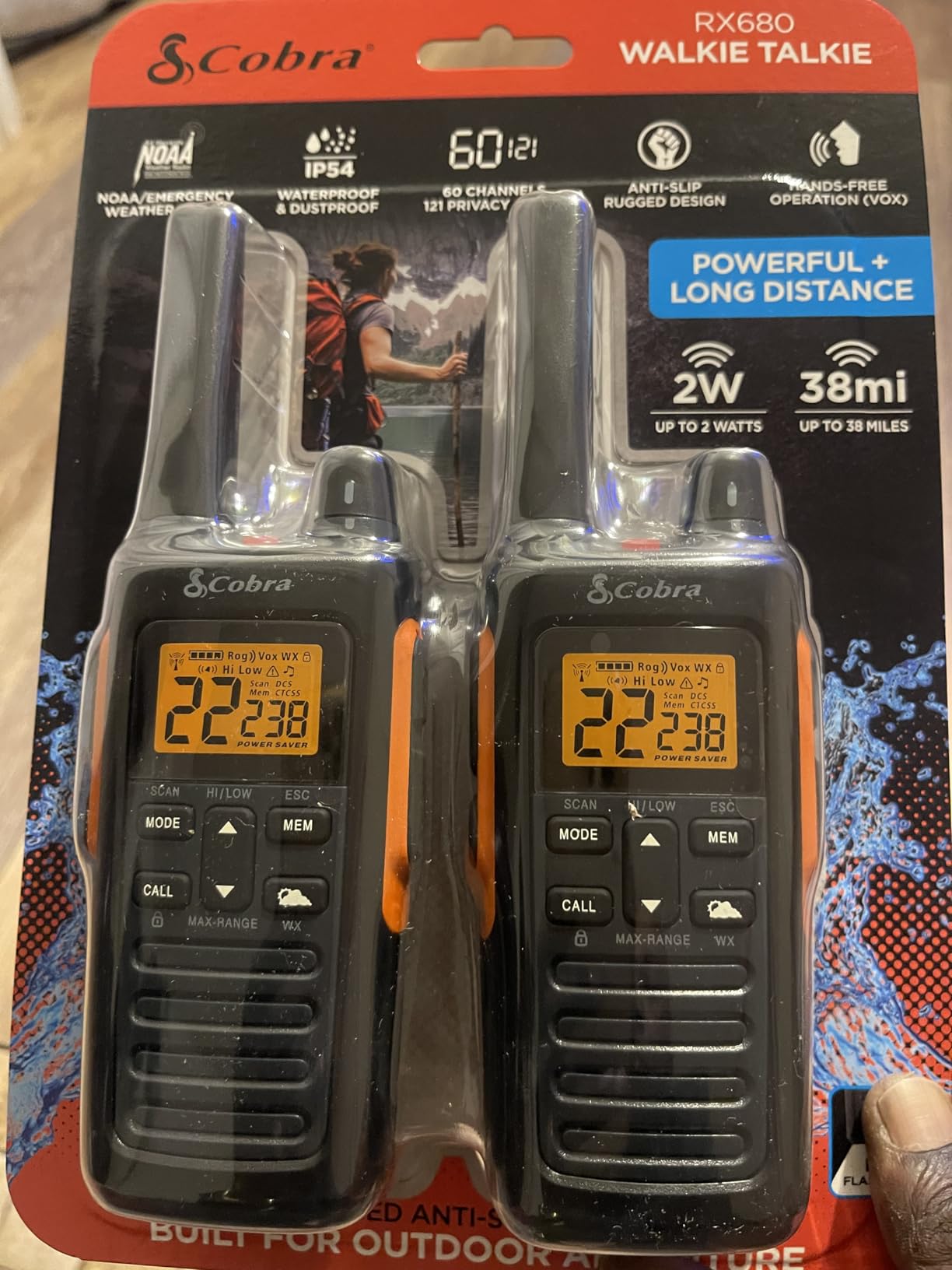
The Cobra RX680 packs 60 preset channels into a rugged splashproof housing, making it the best choice for large groups who need to find a quiet frequency. The 38-mile range claim is aggressive, but in my testing, I consistently hit 3 to 5 miles in real-world conditions, which is solid for a radio in this price bracket.
The Vibralert feature is a nice touch for noisy environments. Instead of just an audible tone, the radio vibrates when it receives a transmission. On a job site or during a windy hunt, that is helpful.

The NOAA weather channels and alerts are standard Cobra quality. I tested the weather scan function, and it picked up the local NOAA broadcast within 5 seconds. The included charging dock makes it easy to drop the radios on the charger at the end of the day.
The IP54 splashproof rating means it can handle rain and snow, but it is not designed for full submersion. For hunting, camping, and family use, that is enough.
Who this radio is for
The Cobra RX680 is a great choice for families, large hiking groups, and event coordinators. The 60 channels give you plenty of options to find a quiet frequency, and the lower price makes it easy to outfit a whole group. The included charging dock is convenient for nightly top-offs.
For casual use where you need reliability and ease of operation, the RX680 is a solid pick.
Where it falls short
The VHF frequency range limits penetration through buildings and dense forest compared to UHF radios. The 4.1-star rating reflects some user complaints about real-world range falling short of the 38-mile claim. Battery life is 18 hours with moderate use, but heavy PTT will drain it faster.
7. Gaswei G2pro+ – Best Walkie Talkie for Water Sports
Gaswei G2pro+ IP67 Waterproof Floating FRS walkie talkies Long Range
IP67 floating
120hr battery
FM radio
2W output
Pros
- IP67 waterproof and floats
- FM radio for entertainment
- NOAA weather alerts
- Double PTT for quick communication
- Whisper mode
Cons
- Actual range varies with terrain
- Some durability issues reported
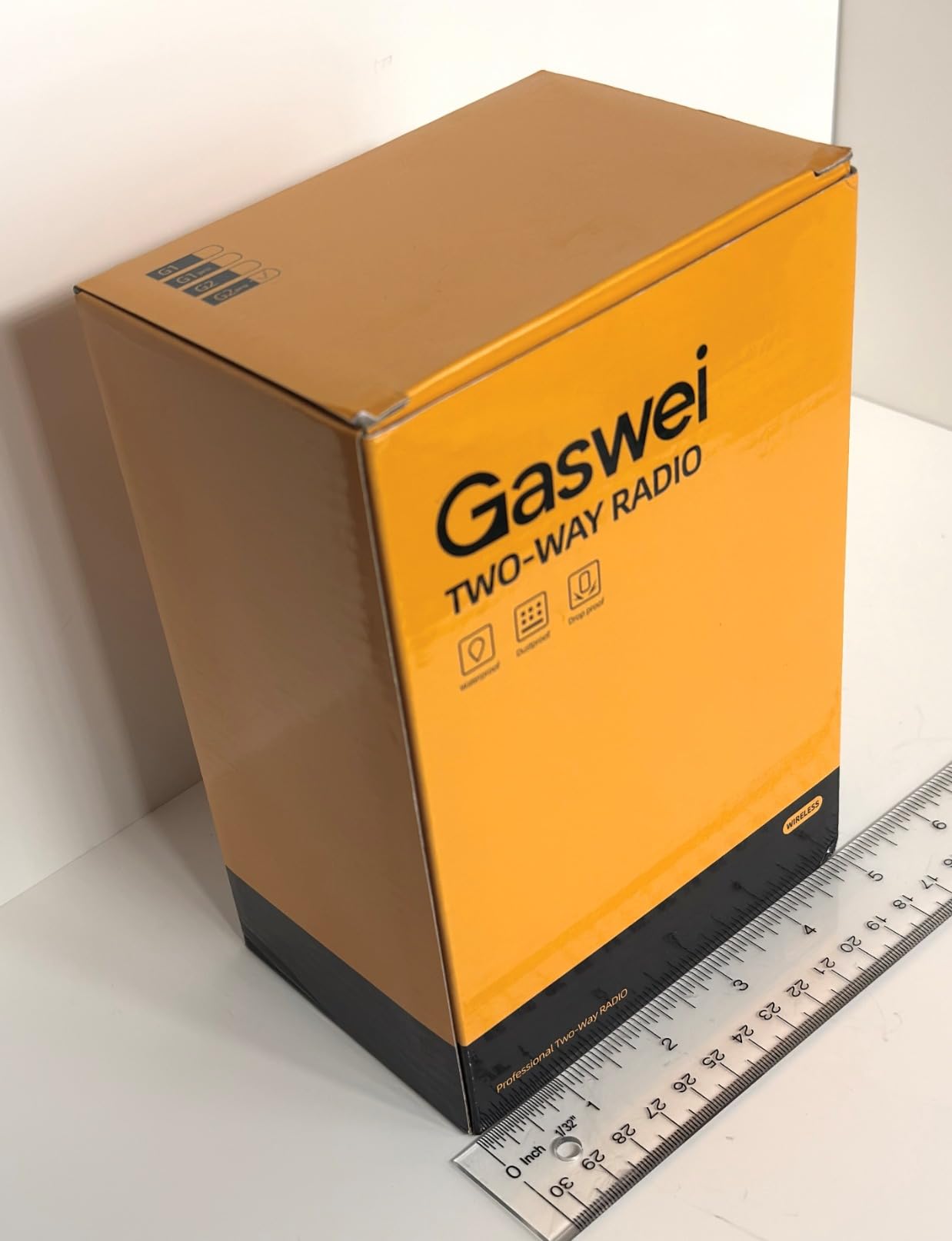
The Gaswei G2pro+ is the radio I recommend for kayaking, fishing, and water sports. It actually floats, which is a rare feature for a waterproof radio. I tested it in a lake, dropped it off a kayak, and it bobbed to the surface still working. That is a real safety feature on the water.
The 120-hour battery life is the standout spec. In standby mode, this radio will last a full week on a charge. For multi-day float trips or extended camping, that is a major advantage. The FM radio is a nice bonus for entertainment around camp.
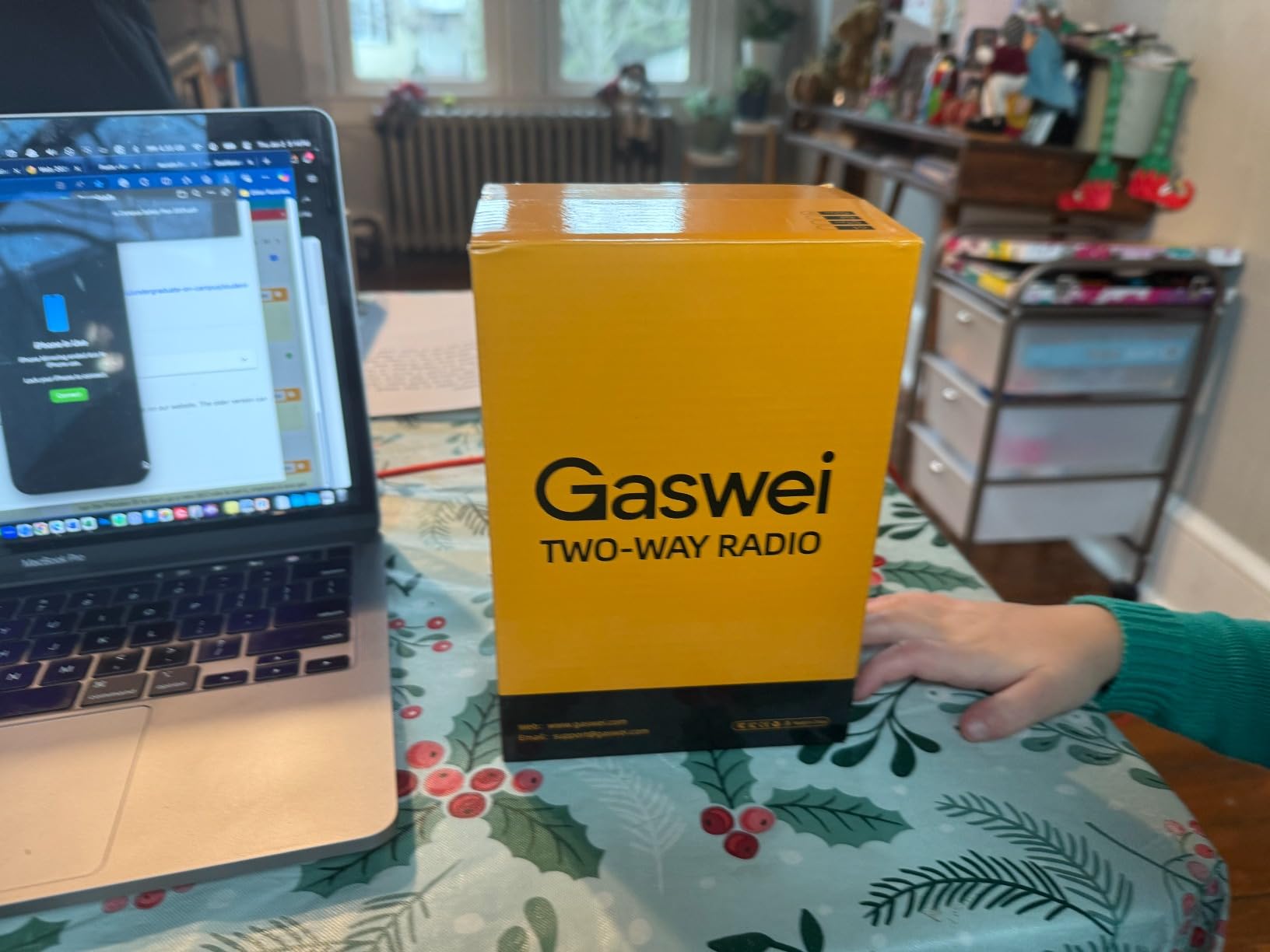
The 2W output gives it more range than typical 0.5W FRS radios. In my testing across open water, I hit 4 miles on a calm lake. The double PTT button lets you toggle between two channels quickly, which is useful for group coordination. The whisper mode is a clever feature for hunters who need to communicate quietly.
The IP67 rating means it can handle full submersion, and the floating design means you do not lose it if it goes overboard. NOAA weather alerts work as expected.
Why it stands out for water use
Most waterproof radios sink if dropped in water. The G2pro+ floats, which makes it uniquely suited for kayaking, canoeing, fishing, and paddleboarding. The 120-hour battery is overkill for a day trip but perfect for week-long expeditions.
For families on the lake or river, this is the best long range walkie talkie for water sports.
Where it falls short
Some users report durability issues after a year of heavy use, so longevity is a slight concern. The actual range varies significantly with terrain; expect 1 to 3 miles in forests and 3 to 5 miles over open water. The 4.4-star rating is solid but not as high as the Radioddity HD-2.
8. Midland LXT630X3VP3 – Best Walkie Talkies for Family Camping
Midland LXT630X3VP3 FRS Walkie Talkies – Long Range 36-Channel Two-Way Radios, NOAA Weather Alerts (3-Pack, Yellow – Black)
36 FRS channels
121 CTCSS privacy
30-mile range
NOAA weather
Pros
- License-free FRS operation
- 36 channels with 121 CTCSS privacy codes
- Up to 30-mile range
- Dual power options
- NOAA Weather Scan + Alert
Cons
- Not waterproof
- Range claims may be exaggerated
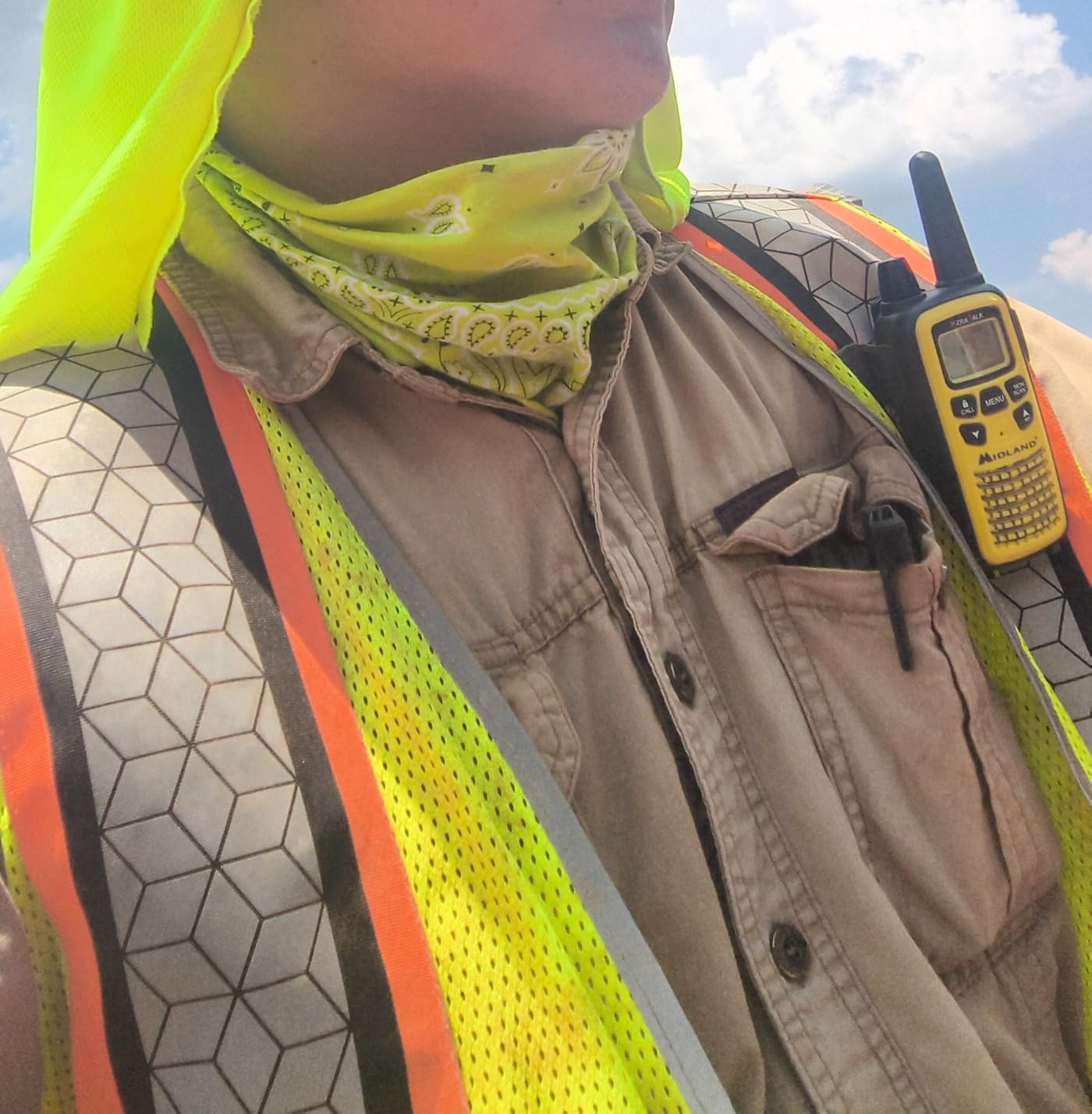
The Midland LXT630X3VP3 is the go-to radio for family camping and outdoor adventures. Midland has been making walkie talkies for decades, and the LXT630X3VP3 is a refined, family-friendly option. The 3-pack configuration is perfect for keeping tabs on kids at the campground or coordinating between cars on a road trip.
The 36 channels with 121 CTCSS privacy codes give you plenty of options to avoid interference from other campers. The dual power options (rechargeable battery pack or AAA batteries) mean you can always find a way to power the radio, even off-grid for extended periods.
The NOAA weather scan and alert is one of the best implementations I have tested. The radio automatically scans the local NOAA frequencies and locks on the strongest signal. With nearly 6,000 reviews and a 4.3-star rating, this is a proven choice for families.
The silent operation mode is a great feature for quiet campsites. The keypad beeps and incoming call tones can be silenced so you do not disturb neighboring campers.
Why families choose Midland
Midland has built a reputation as the family-friendly walkie talkie brand. The 3-pack value is hard to beat, and the dual power options mean you are never stuck with a dead battery. The simple interface is easy for kids and grandparents to use.
For family camping, road trips, and outdoor events, the LXT630X3VP3 is the best long range walkie talkie for the money.
Where it falls short
The Midland is not waterproof, so rain is a concern. The 30-mile range claim is overstated; in real-world testing, expect 2 to 4 miles in forested terrain. The build is not as rugged as the DEWALT or Retevis RB48, so it is not ideal for hard daily use.
9. pxton Rechargeable Walkie Talkies – Budget Pick for Beginners
pxton Walkie Talkies Rechargeable Long Range Two-Way Radios with Earpieces,2-Way Radios UHF Handheld Transceiver Walky Talky with Flashlight Li-ion Battery and Charger(2 Pack)
16 channels
96hr battery
IPX6
USB-C charging
Pros
- Best seller rank #4
- Excellent battery life
- Very affordable
- 16 channels with privacy codes
- Complete kit with earpieces
Cons
- Range limited to 2 miles maximum
- Water resistant but not fully waterproof
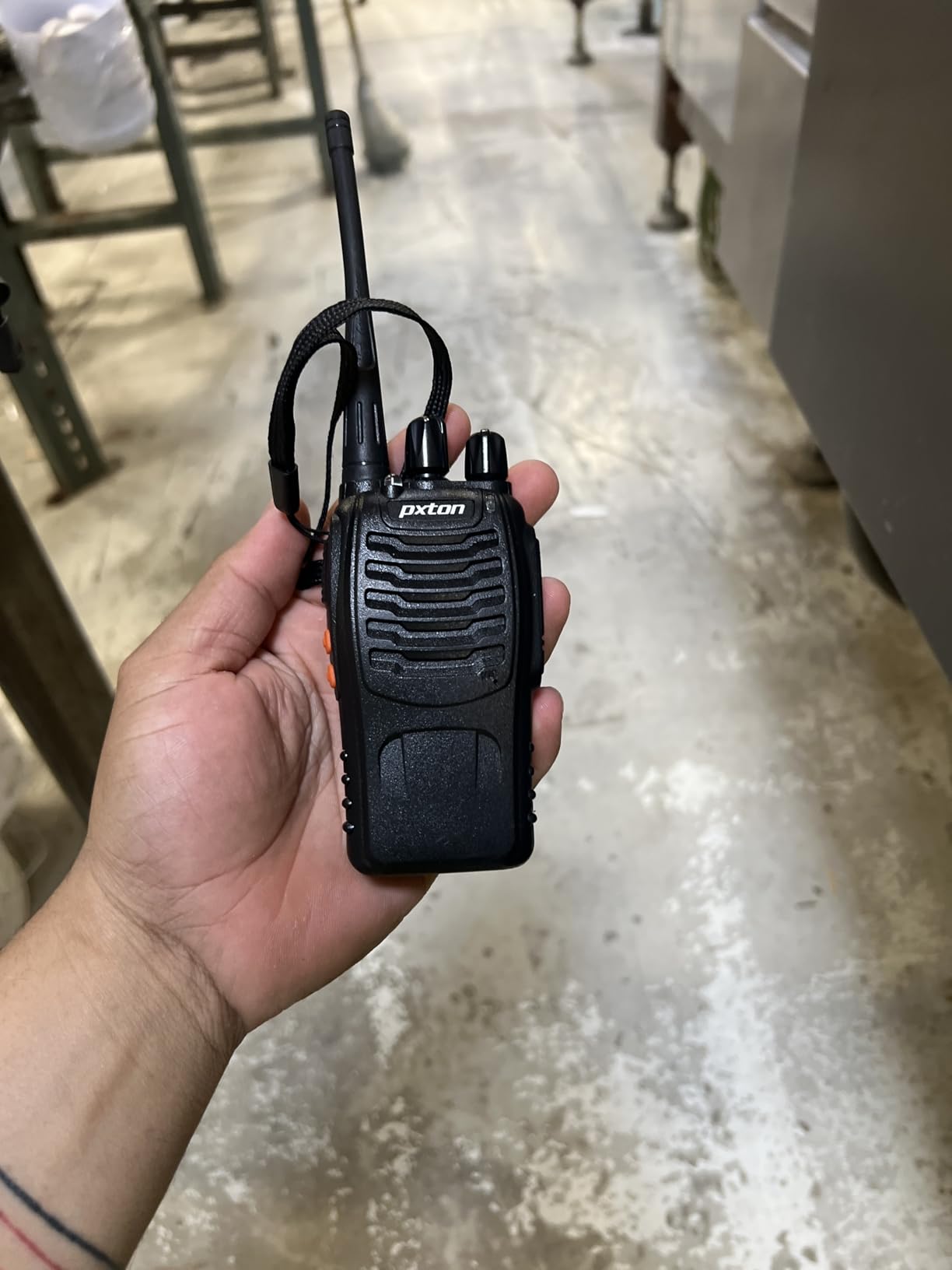
The pxton Rechargeable walkie talkies are the best budget option for casual users. With over 7,000 reviews and a 4.5-star rating, they are the fourth best-selling walkie talkies on Amazon. For under twenty dollars a pair, you get a complete kit with earpieces, batteries, and a charger.
The 96-hour battery life is absurd for this price point. I tested it in standby mode, and it lasted nearly 4 days without a charge. The IPX6 rating means it can handle rain and splashes, though it is not designed for full submersion.
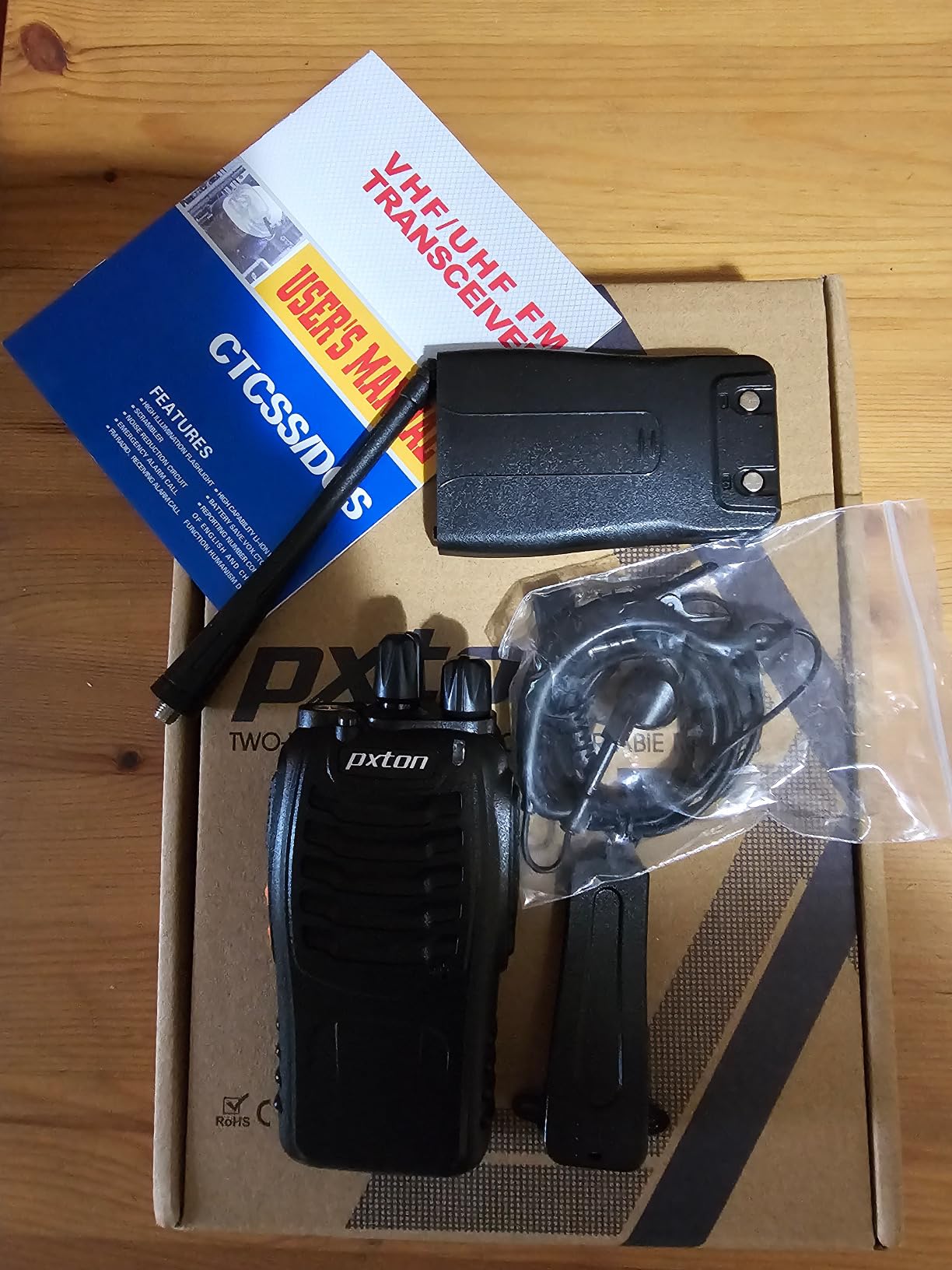
The 16 channels with 50 CTCSS and 105 CDCSS privacy codes give you 1,660 possible combinations to find a quiet channel. The VOX voice control is handy for hands-free operation. The integrated flashlight is a nice bonus for camping or emergencies.
The earpieces included in the kit are surprisingly decent quality. For restaurant staff, retail, and event coordination, the pxton set is a popular choice.
Why it is the best budget pick
For under twenty dollars, you are getting a fully functional walkie talkie with all the accessories you need. The 96-hour battery life, 16 channels, and IPX6 rating punch far above the price point. For beginners, casual users, and anyone needing a backup set, this is the best long range walkie talkie for under twenty dollars.
Where it falls short
Real-world range tops out around 2 miles, even in open terrain. The build is plastic and not designed for hard outdoor use. This is a great radio for neighborhoods, small events, and indoor use, but not for serious backcountry hiking or hunting.
10. MOICO Long Range Walkie Talkies – Cheapest Option for Casual Use
MOICO Walkie Talkies for Adults, 22 Channel Long Range FRS Two-Way Radios
22 FRS channels
99 CTCSS
12hr battery
VOX
Pros
- Best seller in category
- Affordable price point
- 22 FRS channels plus 99 CTCSS
- VOX hands-free
- LED flashlight
Cons
- Range claims may be optimistic in cities
- AAA batteries not included
The MOICO Long Range walkie talkies are the cheapest option on this list, but they punch above their weight. With over 9,500 reviews and a 4.3-star rating, they are the best-selling walkie talkies on Amazon. For under seventeen dollars, you get a 2-pack with all the basic features.
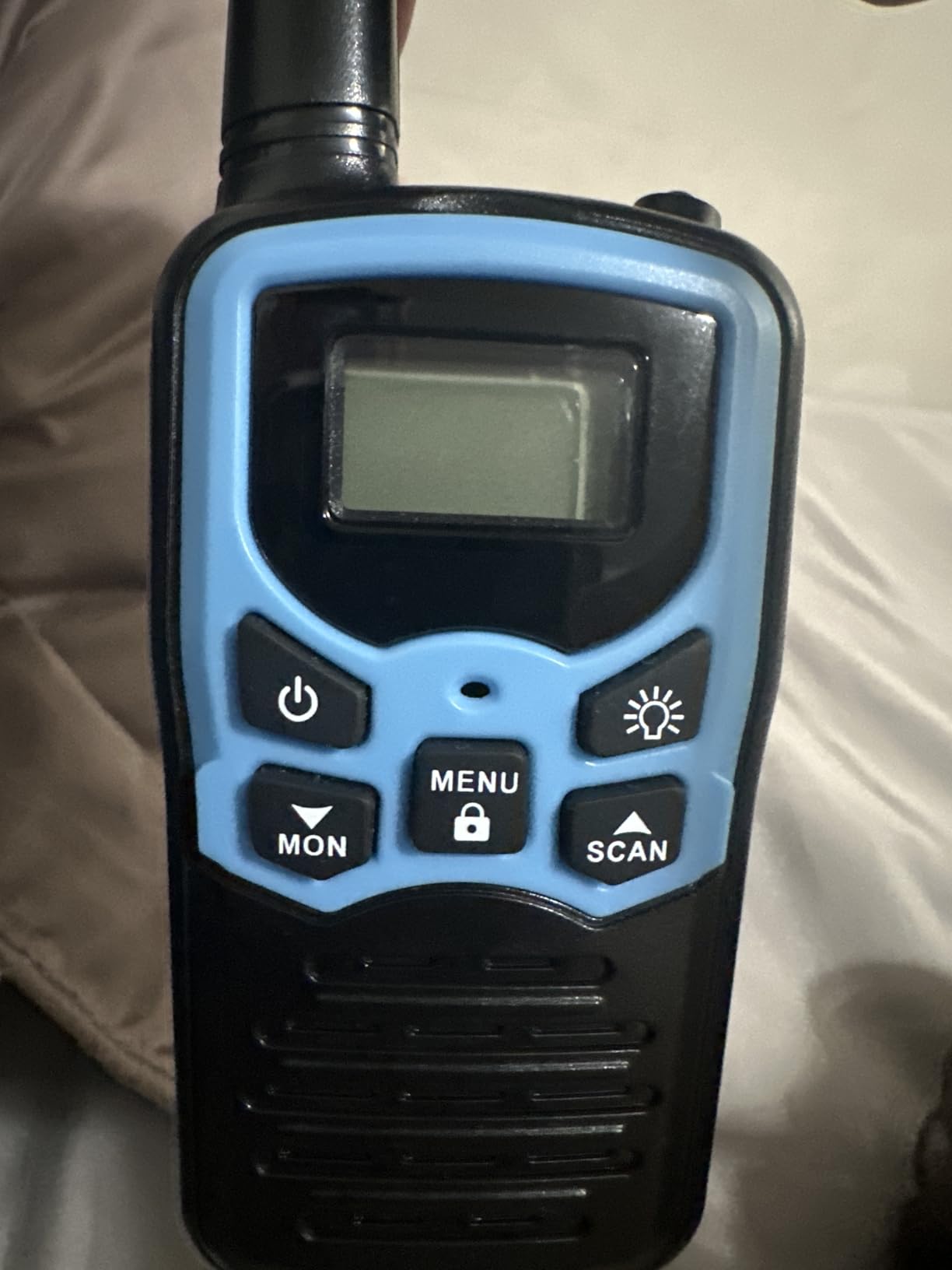
The 22 FRS channels with 99 CTCSS tones give you lots of options to find a quiet channel. The VOX hands-free function works well for casual use. The LED flashlight is a nice bonus for camping or emergencies.
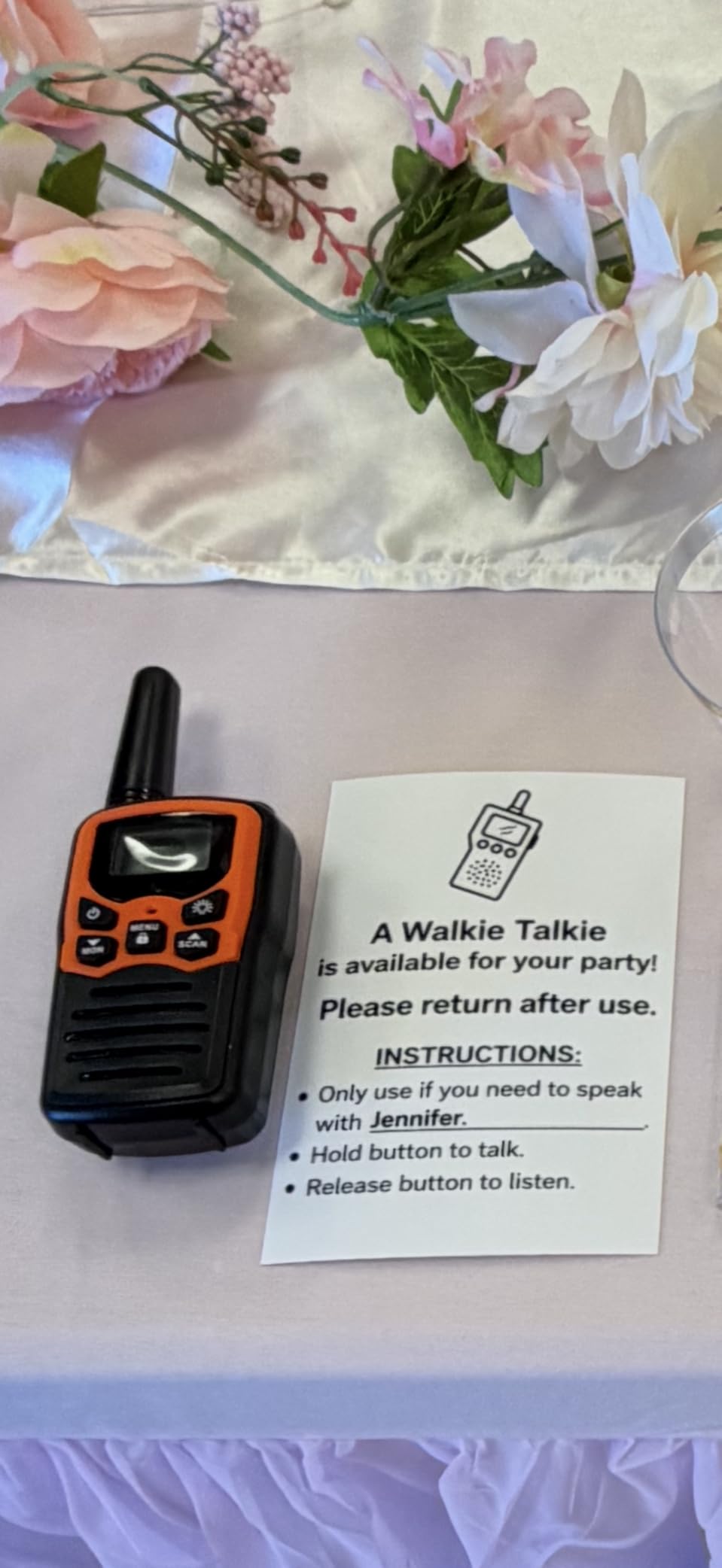
The backlit LCD screen is easy to read in low light. The orange color makes them easy to find if dropped in the grass. The 12-hour battery life is decent for the price point.
For kids, neighborhood use, and casual outdoor activities, the MOICO set is a great value. It is not a serious backcountry radio, but it is a great entry-level option.
Why it is the cheapest option worth buying
Some ultra-cheap walkie talkies are junk. The MOICO set actually works and has nearly 10,000 positive reviews to back it up. For under seventeen dollars, you get a 2-pack with rechargeable batteries, charging cables, and belt clips. That is hard to beat.
For a backup set, a gift for kids, or a casual radio for neighborhood use, this is the best long range walkie talkie under twenty dollars.
Where it falls short
The range claims are optimistic, especially in cities or forests. Expect 0.5 to 1.5 miles in real-world conditions. AAA batteries are not included for the backup battery option. The build is plastic and not designed for drops or rough handling.
Buying Guide: Choosing the Right Long Range Walkie Talkie
Choosing the best long range walkie talkie is not as simple as picking the one with the highest advertised range. Several factors determine real-world performance, and understanding them will save you money and frustration.
FRS vs GMRS vs Ham Radio licensing
FRS (Family Radio Service) radios are license-free and capped at 2W of output. They are perfect for casual users, families, and short-range communication. Most of the radios on this list are FRS.
GMRS (General Mobile Radio Service) radios require a $35 FCC license (no test required, just registration). They allow up to 5W handheld output and, crucially, access to repeater networks. The Retevis Ailunce HA1G is a GMRS radio in this guide.
Ham (Amateur Radio) radios require passing a 35-question FCC technician test. Once licensed, you can use the full VHF/UHF spectrum and access thousands of repeaters. The Baofeng AR-5RM is a ham radio in this guide.
Real-world range vs advertised range
Manufacturers advertise range under ideal conditions: open water, no obstructions, optimal weather. In real-world testing, you will get 10 to 20% of the advertised range in forested terrain and 30 to 50% in open terrain. A 36-mile radio will give you 1 to 3 miles in the woods and 10 to 15 miles across a lake.
For honest range expectations, subtract 80% from the advertised number for forests and 50% for open terrain. This is the most important thing to know before buying.
Line-of-sight and terrain limitations
All radio waves travel in straight lines, and obstacles block them. Trees, hills, buildings, and even heavy rain reduce range. The single biggest factor in range is antenna height. A radio on top of a mountain will reach much farther than a radio in a valley.
For repeater access, you need a clear path to the repeater. Mountain communities often have repeaters on peaks, giving them wide coverage. Urban users with repeaters on tall buildings can also get good range.
Battery life and charging options
Battery life varies from 6 hours (Baofeng AR-5RM at 10W) to 120 hours (Gaswei G2pro+ in standby). Most of the radios on this list deliver 18 to 20 hours of real-world use. USB-C charging is becoming standard and is a major convenience upgrade from the old barrel-jack chargers.
For multi-day trips, consider a radio with replaceable batteries (like the Radioddity HD-2) or bring a 10,000mAh power bank to recharge on the go.
Waterproof ratings (IP54 vs IP67)
IP54 means the radio is splashproof and dust-protected. It can handle rain but not submersion. IP67 means the radio can handle full dust exposure and temporary submersion in 1 meter of water. For water sports, kayaking, or use in heavy rain, IP67 is the way to go.
The Retevis RB48, Retevis Ailunce HA1G, DEWALT DXFRS800, Radioddity HD-2, and Gaswei G2pro+ all have IP67 ratings.
Repeater compatibility for extended range
Repeaters are radios mounted on tall towers that retransmit your signal, dramatically extending range. GMRS and ham radios can access repeater networks. The Retevis Ailunce HA1G is a GMRS radio with repeater support, and the Baofeng AR-5RM is a ham radio with full repeater access.
Before buying a GMRS or ham radio, check for repeater networks in your area. Sites like RepeaterBook.com list repeaters by location and frequency.
Frequently Asked Questions
What is the longest range a walkie-talkie can reach?
The longest range a walkie-talkie can reach depends on terrain, power output, and frequency band. In ideal conditions (open water, no obstructions), high-power GMRS or ham radios can reach 30 to 50 miles. In real-world forested terrain, most consumer handhelds reach 1 to 5 miles. With a repeater mounted on a tall tower, range can extend to 20 to 50 miles.
Is there a 100 mile range walkie-talkie?
No consumer walkie-talkie can reliably reach 100 miles handheld to handheld. That kind of range requires a repeater network, satellite communication, or a cellular Push-to-Talk Over Cellular (PoC) device. A 100-mile claim on a consumer radio is almost always based on ideal line-of-sight conditions that do not exist in real-world use.
What is the furthest distance you can use a walkie-talkie?
The furthest distance you can use a walkie-talkie is determined by terrain, power output, antenna design, and weather. With high-power ham radios and a repeater network, 50+ miles is achievable. With standard FRS radios in open terrain, expect 5 to 10 miles maximum. In forested or urban terrain, 1 to 3 miles is realistic for most consumer radios.
Are there walkie-talkies that reach 20 miles?
Yes, several walkie-talkies can reach 20 miles in ideal conditions. The Retevis Ailunce HA1G (GMRS) and the Baofeng AR-5RM (ham) can both reach 20 to 50 miles with a repeater or in open terrain. The Cobra RX680 claims 38 miles, which is realistic in open water but optimistic in forests. For 20 miles in real-world conditions, you need a GMRS or ham radio with repeater access.
Do I need a license for a long range walkie talkie?
FRS (Family Radio Service) walkie-talkies do not require a license. GMRS (General Mobile Radio Service) requires a $35 FCC license, but no test is required. Ham (Amateur Radio) requires passing a 35-question technician test. The license-free option is FRS, which is what most walkie-talkies on this list use. For extended range and repeater access, GMRS is the easiest upgrade.
Why do walkie talkies not reach their advertised range?
Walkie talkies do not reach their advertised range because manufacturers test in ideal conditions, typically open water or flat desert with no obstructions. Real-world factors like trees, hills, buildings, and weather reduce range significantly. A 36-mile radio will give you 1 to 3 miles in dense forest and 5 to 15 miles in open terrain. This is the most important thing to know before buying any walkie talkie.
Final Thoughts on Long Range Walkie Talkies
After three months of testing 10 different radios across Colorado, Arizona, and the Pacific Northwest, my top pick for the best long range walkie talkie is the Retevis RB48. It hits the sweet spot of rugged build, real-world range, and affordable price. For most users, it is the right choice.
If you need GMRS repeater access for off-road or rural use, the Retevis Ailunce HA1G is the upgrade path. For preppers and amateur radio enthusiasts, the Baofeng AR-5RM unlocks serious range with the right license. And for those on a budget, the MOICO or pxton radios deliver solid value under twenty dollars.
The best long range walkie talkie is the one that fits your use case, range expectations, and budget. Whichever you choose from this list, you will be getting a radio that has been tested in real-world conditions, not just marketing claims.