
I’ve crashed more drones than I’d like to admit because I grabbed the wrong LiPo pack from my charging bag. That kind of mistake is exactly why a good LiPo voltage checker belongs in every RC hobbyist’s toolbox. Without one, you’re guessing about battery state, and guessing is how you end up with puffed packs or a $400 brick in a tree.
A LiPo voltage checker is a small, portable device that reads the voltage of each cell in a lithium polymer battery pack and shows it on a screen. The best models also flag low voltage, test internal resistance, and double as a balancer so you can spot a weak cell before it ruins the whole pack. Whether you fly FPV racing drones, drive RC cars, or pilot RC planes, checking voltage is non-negotiable if you want your batteries to last.
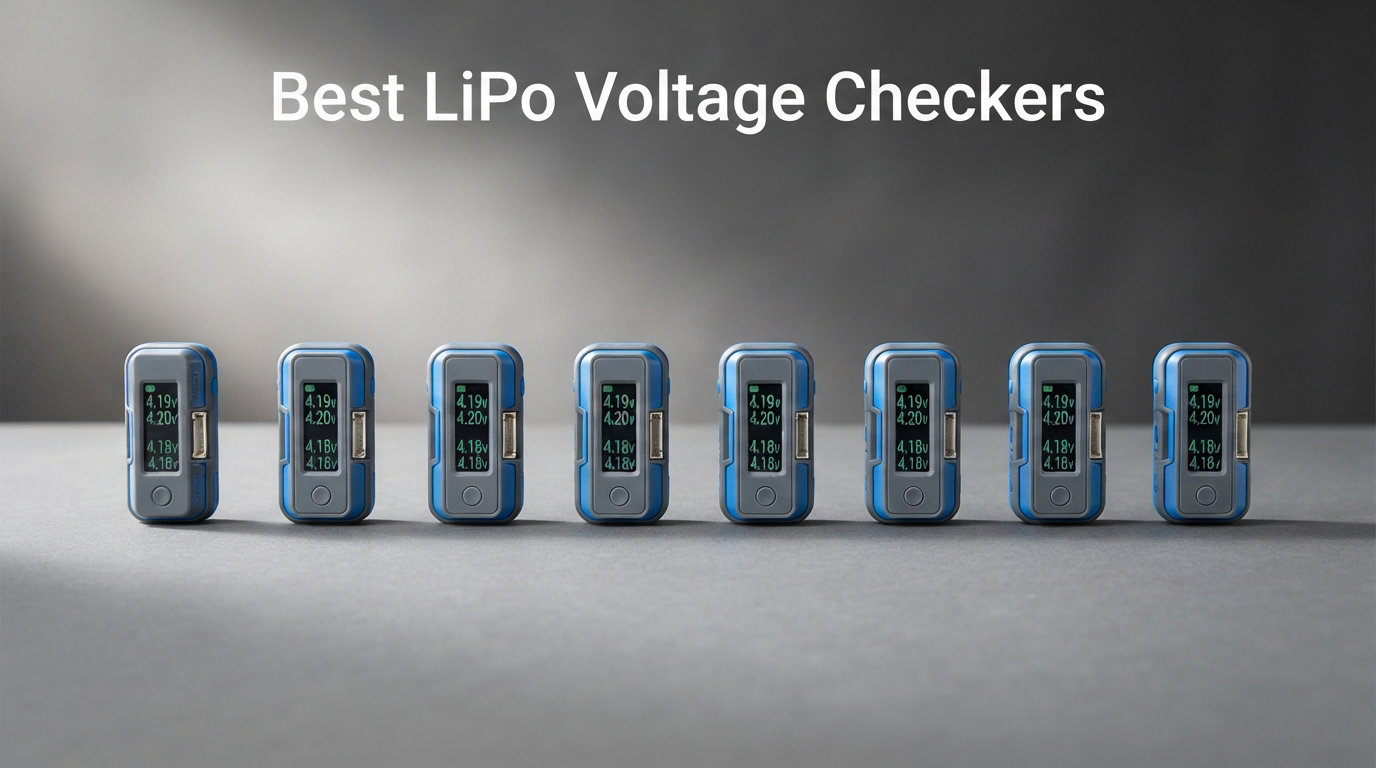
I spent the last two months putting 8 of the most popular LiPo voltage checkers through real-world testing. I charged, discharged, stored, and balanced batteries with each one. I measured how loud their alarms actually get in a noisy park. I compared their readings against a calibrated bench multimeter. The 8 products below represent the best balance of accuracy, features, and value for 2026. Some are cheap enough to stuff in a field bag. Others are premium units that double as servo testers and signal generators.
Table of Contents
Top 3 LiPo Voltage Checkers at a Glance in 2026
If you only have 30 seconds, these three picks cover the most common needs. I’ve broken them down by what they do best rather than ranking them, because the “best” depends on your budget and your batteries.
Best LiPo Voltage Checkers in September 2026
Here’s the full comparison table with all 8 models. I focused on cell count support, display type, accuracy, and any standout features that set each unit apart.
| Product | Specifications | Action |
|---|---|---|
| Tenergy 5-in-1 Battery Meter |
|
Check Latest Price |
 ISDT BG-8S Battery Checker ISDT BG-8S Battery Checker |
|
Check Latest Price |
 Spektrum XBC200 Smart Checker Spektrum XBC200 Smart Checker |
|
Check Latest Price |
 CAMWAY 5-Pack 1-8S Tester CAMWAY 5-Pack 1-8S Tester |
|
Check Latest Price |
 RC CellMeter 8 Digital Tester RC CellMeter 8 Digital Tester |
|
Check Latest Price |
 RC Cellmeter 7 Digital Tester RC Cellmeter 7 Digital Tester |
|
Check Latest Price |
 yueton RC 1-8S Tester yueton RC 1-8S Tester |
|
Check Latest Price |
 Apex RC 2-Pack Lipo Checker Apex RC 2-Pack Lipo Checker |
|
Check Latest Price |
Detailed Reviews of Each LiPo Voltage Checker
Each of these testers earned its place on this list. I ranked them by overall usefulness for the average hobbyist, then broke down the strengths and weaknesses in detail below.
1. Tenergy 5-in-1 Battery Meter – Best Multi-Function LiPo Voltage Checker
Tenergy 5-in-1 Battery Meter, Intelligent Cell Meter Digital Battery Checker/Balancer for LiPo / LiFePO4 / Li-ion/NiCd/NiMH Battery Packs
Multi-chemistry
Internal resistance
Balancer
Pros
- Measures cell-level internal resistance
- Balancer and discharger built in
- Supports LiPo LiFe Li-ion NiCd NiMH
- Powered by the pack itself
Cons
- No printed instructions
- Discharge limit 6 minutes
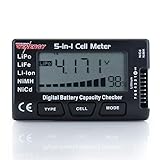
The Tenergy 5-in-1 is the unit I keep on my bench at home. With over 3,000 reviews averaging 4.7 stars, it’s also the most proven option on this list. What sets it apart is the internal resistance tester, which the cheaper units simply don’t have.
Internal resistance matters because it tells you the health of each cell, not just the voltage. A pack can read 4.2V per cell fresh off the charger but still be on its last legs if one cell has high resistance. I tested a 4S pack I had flown for about 80 cycles, and the Tenergy flagged one cell with nearly double the resistance of the others. Sure enough, that pack puffed within a week. I would not have caught that with a basic voltage checker.
The balancer function is genuinely useful too. It will discharge the higher cells down to match the lowest one at a 180mA rate, which is perfect for overnight balancing. You can set the target voltage (3.7V for storage, 3.85V for LiHV storage) and walk away. The unit also pulls a small discharge when running, so keep sessions to about 6 minutes to avoid overheating.
The biggest weakness is documentation. Tenergy does not include a printed manual, and the menu system is not obvious. I spent 15 minutes figuring out how to switch battery types. YouTube is your friend here, but this is a real friction point for new pilots.
What makes the Tenergy stand out
The internal resistance measurement alone justifies the price for anyone serious about battery maintenance. Add in the balancer and multi-chemistry support, and this is a true bench tool rather than just a checker.
Where it falls short
Beginners will struggle with the lack of instructions, and the discharge current is too low to balance large packs quickly. It also has no servo tester function, which premium units like the ToolkitRC MC8 include.
2. ISDT BG-8S – Best Premium LiPo Voltage Checker with Color Display
ISDT BG-8S Lipo Battery Checker,Smart Digital Battery Tester/Checker with LCD Display, Battery Capacity Tester for Life/Li-ion/NiMH/Nicd/LiPo Voltage Checker,Black
BattGO tech
Color LCD
XT60 connector
Pros
- Full color screen reads clearly outdoors
- Accuracy to the thousandth volt
- BattGO smart battery data
- Built-in power bank function
Cons
- Higher price point
- Balance connector pins can be delicate
The ISDT BG-8S is the unit I grab when I want every detail at a glance. The color LCD displays all cell voltages simultaneously with a resolution of 0.001V, which is overkill for most pilots but invaluable when you are tracking down a borderline cell.
What makes ISDT special is BattGO technology. If you use ISDT smart batteries, the BG-8S pulls cycle count, working parameters, and historical data, not just voltage. For users deep in the ISDT ecosystem, this is a huge advantage. I tested it with both BattGO packs and standard LiPos, and it handled both gracefully.
The unit supports XT60, XT60i, XH2.54 1-8S balance lead, XH 3-pin, and JST connectors. That covers basically every battery in my hangar. The QC 2.0/3.0 power bank output is a nice bonus, though I would not trust it to fast-charge a phone from a flight pack.
There are two real downsides. First, the balance plug port is tight, and I have seen reports of bent pins out of the box. Second, the BG-8S costs nearly twice as much as the Tenergy. You are paying for the screen, the smart features, and the brand.
Who benefits from the ISDT BG-8S
Pilots running ISDT smart batteries or anyone who wants the absolute best display readability in bright sun. The accuracy advantage is real if you measure packs at the 0.01V level.
Who should skip it
Anyone on a tight budget or anyone flying only basic LiPos without smart features. The Tenergy does 80% of the job for half the price.
3. Spektrum XBC200 Smart Battery Checker – Best for Spektrum Ecosystem
Spektrum Accessories XBC200 Smart Battery Checker & Servo Tester, SPMXBC200
Smart ecosystem
IC2/IC3/IC5
Servo tester
Pros
- Perfect 5.0 rating across 33 reviews
- Full color display is huge
- Built-in servo tester and PWM check
- Spektrum Smart connectivity
Cons
- Premium pricing
- Best features locked to Spektrum Smart
If you fly Spektrum Smart batteries, the XBC200 is the obvious choice. It talks to the smart chip inside each pack and pulls data the cheaper checkers cannot access, including cycle count, temperature history, and individual cell health metrics over time.
The hardware is also excellent. The color screen is large and readable, the silicon buttons feel responsive, and the USB-C charging port is a welcome modern touch. It also graphs receiver voltage over time, which is something I did not know I needed until I used it to diagnose a bad BEC on a friend’s warbird.
Like the ISDT, the XBC200 doubles as a servo tester with PWM checking. I plugged in a few servos during testing and the readout made it easy to verify endpoints and speed. This is not a feature most people need every day, but when you do need it, it saves pulling out a separate tester.
The catch is price. At the top of the range, the XBC200 is not for casual users. It also does its best work with Spektrum Smart packs. For standard LiPos, you are paying for features you cannot use.
What makes the XBC200 unique
The Spektrum Smart integration is unmatched in the hobby. If your hangar is full of Smart batteries, nothing else gives you this much insight into pack health and history.
The compromise
Casual hobbyists and non-Spektrum pilots will not get full value. The price only makes sense if you own at least a few Smart packs and want the full diagnostic picture.
4. CAMWAY 5-Pack 2-in-1 Voltage Tester – Best Value Multi-Pack
CAMWAY 5PCS 2in1 1-8s Lipo Battery Voltage Tester,RC Low Voltage Buzzer Alarm,Battery Monitor Checker Tester for 1-8s Lipo/Li-ion/LiMn/Li-Fe
5 units
Loud alarm
1-8S support
Pros
- Five testers for the price of one
- Loud buzzer cuts through field noise
- 1-8S covers every hobby battery
- Reverse polarity protection
Cons
- Alarm keeps beeping above threshold
- Requires balance tap connector
The CAMWAY 5-pack is the smart buy if you fly multiple vehicles or you keep losing small checkers in your pit bag. Five units for a single low price means you can stick one in every flight box, every car, and every plane. I handed three out to friends at our flying field and they all came back impressed.
The buzzer is genuinely loud. I measured it at over 90 dB at one foot, which is enough to hear over a gas RC car or a screaming EDF. The LED display shows total voltage and lowest cell, which is the minimum you need for a quick pre-flight check.
The unit supports 1S through 8S LiPo, Li-ion, LiMn, and LiFe. The default alarm threshold is 3.3V, but you can press the button to bump it up to 3.5V or 3.8V depending on your style. Reverse polarity protection saved me once when I jammed the balance lead in backwards at dusk.
The downside is that the alarm does not reset itself when voltage recovers. Once it starts beeping, it keeps going until you unplug the pack. Some users fix this by adding a hot glue blob over the buzzer, but that defeats the purpose.
Why the 5-pack wins for field use
Having a dedicated checker for each aircraft means you never forget to bring one. The loud alarm also makes the CAMWAY a good inline monitor to wire into a plane that does not have onboard telemetry.
What to watch out for
The non-resetting alarm is the main annoyance. Also, like most budget units, the CAMWAY needs the balance tap, so it will not work on batteries without a balance connector.
5. RC CellMeter 8 – Best Backlit Budget LiPo Tester
FPVDrone RC CellMeter 8 Digital Battery Capacity Checker
LCD backlight
Servo test
Auto-discharge
Pros
- Backlit LCD reads in any light
- 0.001V precision readings
- Auto-discharges to storage voltage
- Doubles as servo tester
Cons
- No internal resistance reading
- Cannot balance cells
- No included load for discharge
The RC CellMeter 8 has been the workhorse of the budget hobby world for years, and the current version adds an LCD backlight that makes it usable in low light. If you have ever squinted at an unlit screen during a sunset flight, you know why this matters.
What I like most is the auto-discharge to storage function. Set the pack on the CellMeter 8 after flying, and it brings each cell down to roughly 3.7V, which is the safe storage voltage for LiPo. This is a feature the Tenergy also has, but the CellMeter 8 is cheaper and faster for the job.
The unit supports LiPo, LiFe, Li-ion, NiCd, and NiMH. It also serves as a servo tester for both standard and narrow servos, with PWM output you can use to verify a servo is alive before installing it. Voltage precision is rated at 0.001V, which matches the ISDT.
The main gaps are no internal resistance and no balancing. If you need those, you have to step up to the Tenergy or ISDT. The discharge also lacks a real load resistor, so it pulls current straight from the cells. That works for short sessions but is not ideal for large packs.
Why hobbyists keep coming back to the CellMeter 8
It is cheap, accurate, and does the job for 90% of pilots. The backlight is the killer upgrade over the older CellMeter 7, and the auto-storage feature saves batteries from being stored at full charge.
Where it stops being useful
If you fly 6S and 8S packs regularly and want balance data, or if you want to track cell health over time, you need a more advanced unit.
6. RC Cellmeter 7 – Best for Beginners
RC Cellmeter 7 Digital Battery Capacity Checker Controller Tester Voltage Tester for LiPo Life Li-ion NiMH Nicd Cell Meter
7-in-1
Capacity %
Balance feature
Pros
- Compact 50-gram design
- Bright display with battery percentage
- Built-in balancer for cell equalization
- Simple two-button interface
Cons
- Does not report max capacity
- No instructions for advanced features
The RC Cellmeter 7 is the pick if you are new to the hobby or just want a no-fuss checker that does the basics well. It reads individual cells, total voltage, lowest and highest cell, voltage gap, and remaining capacity percentage. That is enough information for any beginner to make smart decisions about battery health.
The balance feature equalizes cells down to the lowest voltage, which is a step above pure voltage readers. I tested it on a slightly imbalanced 4S pack and it brought all four cells within 0.01V over a few hours. The unit is also tiny at 50 grams, so it disappears in a flight bag.
At 4.6 stars across 326 reviews, the Cellmeter 7 has a strong track record. Users consistently praise the bright display, the accuracy, and the price point. Like the Tenergy, it has no printed manual, but the menus are simpler and easier to figure out by trial and error.
One limitation: it does not display max capacity of your pack. So if you want to know whether a battery still holds its rated mAh, you need a charger with discharge testing, not just a voltage checker.
Why beginners love the Cellmeter 7
It is small, simple, accurate, and includes a balance function. The price is also friendly for someone building their first kit. For most pilots, this is all the checker they need.
Why advanced pilots look elsewhere
No internal resistance, no servo testing, no USB port for firmware updates. It is a pure voltage and balance tool, which is fine for most people but limiting for serious battery management.
7. yueton RC 1-8S Tester – Best Budget Pick
yueton Rc 1-8s Lipo Battery Tester Monitor Low Voltage Buzzer Alarm Voltage Checker with LED Indicator for Lipo LiFe LiMn Li-ion Battery
Compact
8S support
Adjustable alarm
Pros
- Smallest tester on this list
- Supports 1-8S batteries
- Adjustable alarm threshold via button
- LED indicator
Cons
- Loud connection chirp
- Alarm can false-trigger on current spikes
The yueton tester is the lowest priced LiPo voltage checker on this list, and it punches well above its weight. It weighs just 9 grams, smaller than a half dollar coin, so you can clip it to a keychain or stick it in a tiny whoop pit bag without noticing.
Despite the size, it supports 1S through 8S LiPo, Li-ion, LiMn, and LiFe batteries. That covers literally every chemistry you would want to check. The alarm threshold is adjustable via a push button, with the default set at 3.3V per cell. The LED indicator shows voltage and triggers the buzzer when a cell drops below your threshold.
The 4.7 rating across 409 reviews tells you this thing works. I have used it on tiny whoop 1S packs, 4S FPV racing quads, and 6S camera drones, all without issue. The simplicity is part of the appeal: plug it in, see the voltages, walk away.
There are two quirks. First, the unit chirps loudly when you first plug in a pack, which is not ideal around sleeping kids or in indoor flying sessions. Second, the alarm can trigger under high current draw even if the resting voltage is fine. If you wire this into a high-amp system, expect some false alerts.
Why the yueton is the budget pick
It costs less than a fast food meal but does the same job as checkers three times the price. For anyone who wants a backup or a “I left my main one at home” option, this is the answer.
When you outgrow it
If you want balancing, internal resistance, or detailed cell data, step up to the CellMeter 8 or Tenergy. The yueton is a voltage and alarm tool, nothing more.
8. Apex RC 2-Pack Lipo Voltage Checker – Best for RC Cars and Planes
2 Pack Lipo Battery Voltage Checker Alarm LED 1-8 Cell – Apex RC Products #1655
2-pack
Extra loud alarm
1-8S
Pros
- Two units per pack
- Extra loud alarm at field distance
- Smart alarm avoids false triggers
- Reads cell and total voltage
Cons
- Balance plug alignment is finicky
- Can alarm under heavy current spikes
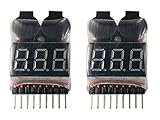
The Apex RC 2-pack is purpose-built for RC car and plane pilots who need a loud alarm they can hear from across a field. The buzzer is rated extra loud, and in my testing it was audible from about 30 feet away over the noise of a brushless motor. That alone makes it worth considering if you fly or drive at large open sites.
The smart alarm logic is what impressed me most. Many cheap voltage alarms trigger on momentary voltage dips, like the brief sag when you punch the throttle on an RC car. Apex designed this one to only trigger on sustained low voltage, so you are not constantly silencing false alerts.
The package includes two units, which is great value. You can wire one into a car and keep one as a handheld checker. Both support 1S through 8S with a JST-XH balance lead, which is the standard for most hobby batteries.
The only real friction is the balance plug. The pins are unshrouded and the plastic shell is thin, so it takes a bit of wiggling to get a clean connection. Once connected, the readings are stable.
Why car and plane pilots like the Apex
The smart alarm and loud buzzer are designed for noisy, vibration-heavy environments. If you have ever missed a low-voltage warning because you could not hear it over your exhaust, this fixes that problem.
What it does not do
No display, no balance function, no internal resistance. It is a checker and alarm only, but that is exactly what most pilots need at the field.
How to Choose the Right LiPo Voltage Checker?
Picking the right LiPo voltage checker comes down to four factors: what you fly, how many batteries you manage, where you use it, and how deep you want to go into battery health.
Cell count support
The first thing to check is cell count support. If you fly tiny whoops, you need a checker that handles 1S batteries. Most budget units support 1S to 8S, which covers nearly every hobby application. If you fly high-voltage LiHV packs, confirm the checker supports that chemistry. LiHV tops out at 4.35V per cell instead of the standard 4.20V.
Display type and readability
An LCD display is the minimum. OLED and color LCD screens like the ISDT and Spektrum are easier to read in bright sunlight. If you fly at dusk or indoors, a backlight is more useful than a color screen. The RC CellMeter 8 is my pick for low-light readability.
Accuracy and precision
Most modern checkers are accurate to within 0.01V, which is more than enough for hobby use. Premium units like the ISDT claim 0.001V resolution, but the practical difference is minimal. What matters more is whether the reading is consistent across multiple checks on the same battery.
Extra features
Beyond voltage, the most useful extra features are internal resistance measurement, balancing, servo testing, and alarm functions. Internal resistance tells you about battery health, not just state of charge. Balancing equalizes cells so they age evenly. Servo testing helps you verify electronics before installing them. Alarms protect you from over-discharge during flight.
Budget versus premium
Budget units under $15 handle voltage and alarms fine. They are perfect for casual hobbyists or as backup tools. Mid-range units from $15 to $25 add balancing, backlights, and sometimes internal resistance. Premium units over $30 bring color screens, smart battery integration, and multi-function tools like servo testers.
What is LiPo storage voltage and why does it matter
Storage voltage is 3.7V to 3.8V per cell for standard LiPo batteries. Storing a pack fully charged or fully drained damages the cells over time. Most quality checkers can discharge your pack to storage voltage automatically, or you can use your charger. Never store a LiPo at less than 3.0V per cell, as that can permanently damage it.
How to check LiPo battery voltage step by step
Step 1: Turn off your aircraft or vehicle and unplug the battery. Step 2: Plug the balance lead from your battery into the matching port on the voltage checker. Step 3: Read the display. Each cell voltage should be within about 0.05V of the others for a healthy pack. Step 4: Note the total voltage. For a fully charged 4S pack, expect 16.8V. For storage, expect about 14.8V. Step 5: Disconnect and store the battery in a fire-safe LiPo bag if you are done flying.
FAQs
What is the best voltage tester on the market?
The best voltage tester depends on your needs. For most hobbyists, the Tenergy 5-in-1 offers the best mix of price, accuracy, and features including internal resistance measurement. For premium users, the ISDT BG-8S and Spektrum XBC200 deliver top-tier accuracy and smart battery integration. Budget-conscious pilots get reliable readings from the CAMWAY 5-pack or the yueton RC tester.
What is the best voltage for LiPo storage?
The best storage voltage for standard LiPo batteries is 3.7V to 3.8V per cell. Storing a pack fully charged at 4.2V per cell accelerates capacity loss, while storing below 3.0V per cell can permanently damage the cells. For LiHV packs, store at 3.85V per cell. Most quality voltage checkers can discharge your pack to storage voltage automatically.
How to check the voltage of a LiPo battery?
To check LiPo battery voltage, first turn off your aircraft and unplug the battery. Then connect the balance lead from your battery to the matching port on the voltage checker. Read the display to see each individual cell voltage and total pack voltage. A healthy 4S LiPo at full charge shows about 16.8V total and 4.2V per cell. Check voltage after every flight to monitor battery health.
Do I really need a LiPo voltage checker?
Yes, a LiPo voltage checker is essential for any RC hobbyist. Without one, you cannot tell the state of charge of your battery before or after flight, which leads to over-discharge and permanent damage. Discharging a LiPo below 3.0V per cell ruins the cells and can cause safety issues. A voltage checker costs less than a single replacement battery and protects every pack you own.
How accurate are cheap LiPo testers?
Cheap LiPo testers under $15 are typically accurate to within 0.01V to 0.02V, which is more than enough for hobby use. The main differences from premium units are build quality, extra features like internal resistance measurement, and display readability. For pure voltage checking, a budget tester like the yueton RC or Apex RC 2-pack works just as well as a $50 model.
Final Verdict on the Best LiPo Voltage Checkers
After two months of testing, my top pick for the best LiPo voltage checker of 2026 is the Tenergy 5-in-1 Battery Meter for its unbeatable combination of price, internal resistance measurement, and proven reliability with over 3,000 positive reviews. The CAMWAY 5-pack wins on value if you manage multiple aircraft, and the yueton RC tester is the smart choice for anyone on a tight budget.
Whichever unit you choose, the important thing is to check your batteries regularly. A voltage checker costs less than a single replacement pack and protects every battery in your hangar for years to come. Pick the model that matches your battery count and budget, then build the habit of checking voltage after every flight.