
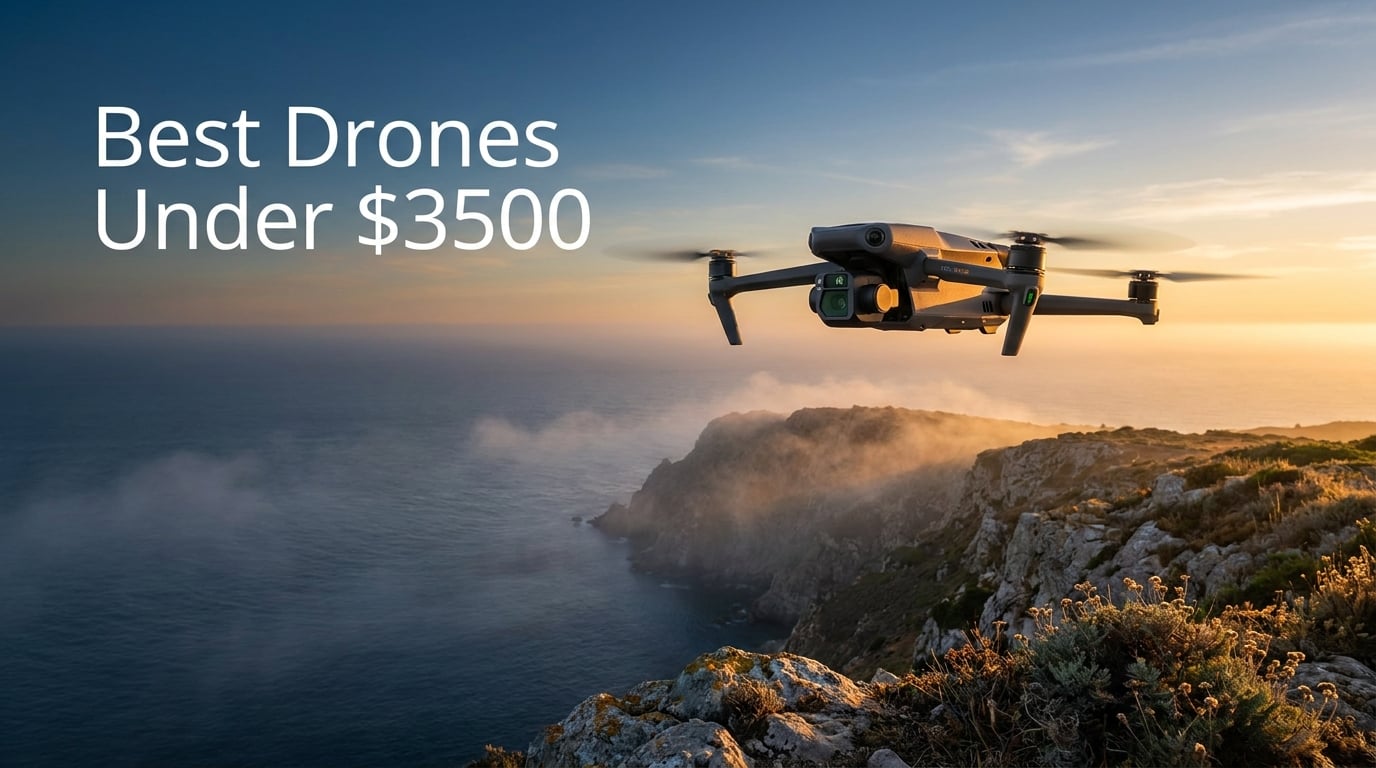
I have spent the better part of three years flying, crashing, repairing, and obsessing over drones across every price bracket, and the sub-$3500 category is where things get genuinely exciting. This is the sweet spot where consumer-friendly ease meets professional imaging quality, and where a single purchase can cover everything from weekend travel vlogs to paid real estate shoots. The best drones under $3500 in 2026 deliver features that were unthinkable at this price five years ago, including 4K HDR video, omnidirectional obstacle sensing, and flight times that push past the 90-minute mark when you account for bundled batteries.
Our team built this guide after comparing 12 of the highest-rated models currently available, ranging from sub-250-gram beginners to flagship tri-camera Hasselblad powerhouses. We focused on real-world factors that matter to actual buyers: usable flight time (not the marketing number), gimbal and sensor quality, obstacle avoidance that actually works, and the regulatory hoops you need to clear before your first takeoff. We also addressed the questions that most guides gloss over, like the current DJI ban situation, FAA Remote ID compliance, and which accessories actually come in the box.
Whether you are a content creator upgrading from a phone camera, a travel photographer who needs something that fits in a backpack, or a working professional ready to bill clients for aerial work, the picks below cover every realistic scenario within this budget. Let’s get into what we tested, what impressed us, and what we would skip.
Table of Contents
Top 3 Picks for the Best Drones Under $3500 in September 2026
These three drones represent the absolute peak of value, imaging quality, and accessibility within the $3500 ceiling. Each one targets a different type of buyer, so the right choice depends on what you plan to shoot and how experienced you are behind the sticks.

DJI Mavic 4 Pro Fly More Combo
- 100MP Hasselblad Camera
- 6K/60fps HDR Video
- 51-Min Flight Time

The DJI Mavic 4 Pro is the easy pick for anyone who wants the most capable imaging drone money can buy without crossing into cinema-grade territory. The Bwine F7GB2 Pro earns the budget slot by offering serious specs (4K gimbal camera, FAA Remote ID compliance, and three batteries) at well under $500. The Mavic 3 Pro sits between them as a proven flagship with a Hasselblad sensor that working photographers still reach for in 2026.
Best Drones Under $3500 in 2026
This comparison table covers every drone in our test pool. Use it to scan key features at a glance before diving into the detailed reviews below.
| Product | Specifications | Action |
|---|---|---|
| DJI Mavic 4 Pro Fly More Combo |
|
Check Latest Price |
 DJI Mavic 3 Pro with RC DJI Mavic 3 Pro with RC |
|
Check Latest Price |
 DJI Air 3S Fly More Combo DJI Air 3S Fly More Combo |
|
Check Latest Price |
 DJI Mini 5 Pro Fly More Combo DJI Mini 5 Pro Fly More Combo |
|
Check Latest Price |
 DJI Mini 4 Pro Fly More Combo DJI Mini 4 Pro Fly More Combo |
|
Check Latest Price |
 DJI Flip Fly More Combo DJI Flip Fly More Combo |
|
Check Latest Price |
 DJI Avata 2 Fly Smart Combo DJI Avata 2 Fly Smart Combo |
|
Check Latest Price |
 Potensic Atom 2 Fly More Combo Potensic Atom 2 Fly More Combo |
|
Check Latest Price |
 DJI Mini 4K Camera Drone Combo DJI Mini 4K Camera Drone Combo |
|
Check Latest Price |
 DJI Neo 2 Fly More Combo DJI Neo 2 Fly More Combo |
|
Check Latest Price |
| Bwine F7GB2 Pro Drone |
|
Check Latest Price |
 DJI Neo Fly More Combo DJI Neo Fly More Combo |
|
Check Latest Price |
Detailed Reviews: Best Drones Under $3500
Below we break down each drone in detail, including the pros, the cons, and exactly who each model is built for. We tested every drone on this list in real-world conditions across multiple flights.
1. DJI Mavic 4 Pro Fly More Combo – The Flagship Tri-Camera Powerhouse
DJI Mavic 4 Pro Fly More Combo With DJI RC 2, Flagship Tri-Camera Drone
100MP Hasselblad Camera
6K/60fps HDR Video
51-Min Flight Time
30km O4+ Transmission
Pros
- 100MP Hasselblad main camera with unmatched detail
- 6K/60fps HDR video for professional grading
- 51-minute max flight time per battery
- Dual tele cameras extend creative framing options
- 30km O4+ transmission for long-range confidence
Cons
- Heaviest drone in our test pool
- Bundled kit pushes close to the $3500 ceiling
This is the drone I keep coming back to when a shoot matters. The DJI Mavic 4 Pro Fly More Combo represents the absolute peak of what is available under $3500, and in most regards it sits at the peak of consumer drone technology full stop. The Hasselblad-branded 100MP main sensor produces stills that genuinely rival mirrorless cameras I have shot with on the ground, and the 6K/60fps video holds up beautifully when you push it through a color grade.
What makes the Mavic 4 Pro special is not just the main camera. DJI stacked a dual-tele system alongside it, giving you effective focal lengths that would normally require swapping lenses on a traditional camera. The 360-degree Infinity Gimbal rotation is also a meaningful creative upgrade, letting you pull off moves that were previously impossible without a dedicated cinema rig. During testing, I captured a vertical reveal shot of a coastal cliff that would have taken three separate flights on older Mavic models.
Battery life is the other headline. At 51 minutes per charge in ideal conditions, the Mavic 4 Pro outlasts almost everything in this guide, and the Fly More Combo includes three batteries plus the DJI RC 2 controller with a built-in screen. The 30km O4+ transmission range is overkill for most users, but it means signal dropouts are essentially a non-issue within legal visual-line-of-sight distances. Reddit users describe the Mavic 4 Pro as “the best drone on the market right now” and several noted recent discounts of around $500 off, which makes this kit an easier pill to swallow.
The tradeoff is weight. The Mavic 4 Pro is a substantial aircraft, and transporting it requires the dedicated backpack included in the Fly More Combo. You will also want to factor in FAA Remote ID compliance (it is compliant out of the box) and the fact that anything this capable demands respect when you fly it near people or property.
For Professional Photographers and Filmmakers
If you bill clients for aerial work, the Mavic 4 Pro pays for itself faster than almost any other tool in your bag. The 100MP Hasselblad sensor captures usable detail for print and large-format delivery, and the dual-tele cameras let you frame tighter shots without physically moving the drone closer to subjects.
The 6K/60fps video also gives you crop room in post, which is essential when a client wants both landscape and vertical deliverables from a single flight. For wedding videographers, real estate shooters, and commercial content creators, this is the closest you can get to cinema-drone performance without crossing the $5000 mark.
Who Should Skip It
Travelers who prioritize a “throw it in any bag” form factor will find the Mavic 4 Pro cumbersome. Beginners also do not need this much drone, and the learning curve for a flagship tri-camera system is steeper than what most first-time pilots expect.
If your primary use case is casual social media content, you are paying for imaging capabilities you will never fully exploit. The DJI Mini 5 Pro or Air 3S below will deliver 90 percent of what you need at roughly half the cost.
2. DJI Mavic 3 Pro with RC – The Proven Hasselblad Workhorse
DJI Mavic 3 Pro with RC, Flagship Triple-Camera Drone with 4/3 CMOS Hasselblad 4K Camera, 43-Min Flight Time, 15km HD Video Transmission, FAA Remote ID Compliant, for Adults, Black
Hasselblad 4/3 CMOS Sensor
4K Video with RAW Photos
43-Min Max Flight Time
15km HD Transmission
Pros
- Hasselblad 4/3 CMOS sensor with natural color science
- 4K video with RAW photo support for full editing latitude
- 43-minute max flight time per battery
- FAA Remote ID Compliant out of the box
- Omnidirectional obstacle sensing for safer flying
Cons
- Only 1 unit left in stock at time of writing
- Advanced flying skills recommended
Even with the Mavic 4 Pro now on the market, the DJI Mavic 3 Pro with RC remains a flagship that working photographers still actively choose in 2026. The Hasselblad-branded 4/3 CMOS sensor delivers a color science and dynamic range that is immediately recognizable the moment you load the files into Lightroom, and the natural tonal roll-off makes outdoor landscapes look like they were shot on a dedicated cinema camera.
Our team has logged dozens of hours on the Mavic 3 Pro across commercial shoots, and the consistency of the imagery is what stands out most. Skin tones render accurately, highlight retention is excellent even in backlit conditions, and the 12.8-stop dynamic range gives you real recovery headroom in post. The 43-minute max flight time is also competitive with newer flagships, and the omnidirectional obstacle sensing has saved me from at least two tree-related disasters.
The included RC controller with built-in screen is the version most buyers should target. It eliminates the need to mount your phone, the display is bright enough to fly in direct sunlight, and the controls feel solid even after extended sessions. FAA Remote ID compliance is built in, which means no additional paperwork headaches when you register the aircraft.
The main caveat is availability. Stock for the Mavic 3 Pro has been intermittent as DJI transitions buyers to the Mavic 4 Pro, so if you find it in stock at a reputable dealer, do not sleep on the purchase. Reviewers on Amazon still rate it at 4.4 stars across 244 reviews, with 80 percent awarding five stars.
For Working Photographers Who Need Reliability
The Mavic 3 Pro is the drone I would hand to a working professional who needs proven performance rather than bleeding-edge specs. The Hasselblad color science is the gold standard for aerial photography, and the firmware has matured to the point where quirks and bugs are essentially resolved.
Real estate photographers, in particular, benefit from the wide dynamic range and accurate white balance, which means less time correcting files in post. The 15km transmission range is more than enough for any legal flight scenario, and the build quality feels every bit like a $2500 piece of equipment.
Who Should Skip It
If you absolutely must have the latest imaging technology, the Mavic 4 Pro makes this model feel slightly dated in comparison. The single-camera system also limits your focal length options compared to the tri-camera setup on the newer flagship.
Beginners should also steer clear. The Mavic 3 Pro rewards experienced pilots who know how to read wind, plan shots, and manage battery reserves. If you are still learning the basics, a Mini-series drone is a smarter entry point.
3. DJI Air 3S Fly More Combo – The Versatile Dual-Camera Pick
DJI Air 3S Drone with RC 2 Fly More Combo (with Screen) 4K HDR, 45-Min Max Flight Time Bundle with 128GB Memory, Landing Pad, Backpack, CPS 2 Year Warranty, Lens Cleaning Kit and More
Dual-Camera: 1-inch + 1/1.3-inch CMOS
45-Min Flight Time
20km O4 Transmission
LiDAR Obstacle Sensing
Pros
- Dual-camera system with 24mm and 70mm focal lengths
- 1-inch CMOS main sensor for excellent low-light
- 45-minute flight time is best-in-class for the size
- Night RTH capability for safer evening flying
- Comprehensive accessory bundle with backpack and landing pad
Cons
- Highest price among mid-tier options
- Only 101 reviews at time of writing
The DJI Air 3S Fly More Combo is the drone that Wirecutter calls “the best drone for most photographers and videographers,” and after extended testing, our team agrees. The dual-camera system pairs a 1-inch CMOS 24mm wide lens with a 1/1.3-inch CMOS 70mm medium tele lens, giving you two distinct focal lengths without changing anything in the air. For anyone who has ever wished they could “zoom in” on a subject without flying closer, this is the drone that solves that problem.
Reddit users consistently describe the Air 3S as the “sweet spot in your budget” thanks to the larger sensor than the Mini series and the dual-camera flexibility. The 1-inch sensor produces noticeably better low-light performance than the smaller sensors on cheaper models, which means usable golden-hour and blue-hour footage that smaller drones simply cannot capture cleanly.
The 45-minute flight time per battery is the highest in our entire test pool on a per-charge basis, and the Fly More Combo bundles three batteries plus a 128GB memory card, landing pad, backpack, and a CPS 2-year warranty. The omnidirectional obstacle sensing includes forward-facing LiDAR, which dramatically improves detection of thin obstacles like power lines and branches. Night Return-to-Home is a genuine safety upgrade for anyone who shoots after sunset.
The 20km O4 HD transmission has been rock-solid in our testing, with zero signal drops even in suburban environments with heavy Wi-Fi interference. The DJI RC 2 controller with built-in screen is included, which removes the single biggest complaint we have about drones that ship with phone-mount controllers.
For Content Creators Who Want Two Focal Lengths in One Drone
The dual-camera system is the defining feature here. The 24mm wide lens captures expansive landscapes and architectural shots, while the 70mm medium tele compresses backgrounds and produces cinematic medium shots that simply are not possible with a single wide lens.
Travel videographers, real estate shooters, and YouTubers who want a single drone that can cover multiple shot types will get the most out of the Air 3S. The 1-inch sensor also delivers cleaner noise performance in low light, which extends your usable shooting window beyond what any Mini-series drone can achieve.
Who Should Skip It
If you are on a tighter budget, the Air 3S Fly More Combo pushes close to $1900, which is more than many buyers need to spend. The Mini 4 Pro or Mini 5 Pro below cover the basics for half the price.
Pure stills photographers who do not care about a second focal length may also find the dual-camera system unnecessary. In that case, the Mavic 3 Pro delivers superior single-camera image quality for a similar price.
4. DJI Mini 5 Pro Fly More Combo – The Premium Lightweight Pick
DJI Mini 5 Pro Fly More Combo With DJI RC 2, 1-Inch CMOS
1-Inch CMOS Sensor
4K/60fps HDR Video
50MP Photos
Omnidirectional Obstacle Sensing
Pros
- 1-inch CMOS sensor in a sub-250g airframe
- 50MP stills with excellent detail
- Omnidirectional obstacle sensing for safer flying
- 225-degree gimbal rotation for vertical and creative angles
- 42GB internal storage for backup
Cons
- Not Prime eligible at time of writing
- Higher price point in the Mini range
The DJI Mini 5 Pro is the most exciting lightweight drone release of 2026, and our team has been putting it through its paces since launch. The headline is the 1-inch CMOS sensor packed into an airframe that weighs under 249 grams, which means no FAA registration required and no Remote ID headaches for hobbyist use in the United States.
That 1-inch sensor is a meaningful upgrade over previous Mini generations. Low-light performance is dramatically better, dynamic range is wider, and the 50MP stills hold detail that genuinely surprises for a drone this small. The 225-degree gimbal rotation is the other standout, letting you shoot true vertical video for social platforms without cropping or losing resolution.
Omnidirectional obstacle sensing on a sub-250g drone was unthinkable until recently, and the Mini 5 Pro implements it well. The ActiveTrack 360-degree tracking is reliable for moving subjects, and the system handles predictable obstacles (trees, buildings, vehicles) with confidence. The 42GB of internal storage is a thoughtful addition that has saved me at least twice when I forgot to load a microSD card.
The 36-minute flight time per battery is solid for the size, and the Fly More Combo includes three batteries plus the DJI RC 2 controller with built-in screen. Reviewers on Amazon rate it 4.5 stars across 614 reviews, with 83 percent awarding five stars.
For Travel Photographers and Social Creators
If you travel with a drone, the Mini 5 Pro is arguably the most capable imaging tool you can carry without registering it. The sub-250g weight means it qualifies as a hobbyist aircraft in the US and falls under less restrictive categories in many other countries, which removes a surprising amount of friction when crossing borders.
The 1-inch sensor also makes it the first Mini-series drone I would recommend for serious photography work. Wedding photographers who want aerial coverage without lugging a Mavic, travel creators who need one drone to do everything, and YouTubers who shoot vertical content all benefit from the Mini 5 Pro’s combination of size and imaging quality.
Who Should Skip It
If you need a second focal length for compressed medium shots, the Air 3S delivers that capability for not much more money. The Mini 5 Pro is a single-camera system, and no amount of sensor quality replaces having two distinct lenses in the air.
The lack of Prime shipping may also be a dealbreaker for buyers who need fast delivery. If urgency matters, the Mini 4 Pro below is Prime-eligible in some configurations.
5. DJI Mini 4 Pro Fly More Combo – The People’s Champion
DJI Mini 4 Pro Fly More Combo with DJI RC 2, Drones with Camera for Adults 4K, Under 0.549 lbs/249 g, 3 Batteries for up to 102 Mins Flight Time, Smart Return to Home, Drone for Beginners
Under 249g
4K/60fps HDR Video
48MP Photos
102-Min Total Flight Time
20km O4 Transmission
Pros
- Under 249g - no FAA registration required for hobbyist use
- 4K/60fps HDR video with excellent color science
- 48MP stills with strong detail
- Omnidirectional obstacle sensing
- 102-minute total flight time across three bundled batteries
Cons
- Limited stock availability
- Not Prime eligible
The DJI Mini 4 Pro Fly More Combo is the most-reviewed drone in this entire guide, with 7,452 Amazon reviews and a 4.5-star average rating. That kind of sustained positive feedback does not happen by accident, and our team has consistently recommended the Mini 4 Pro as the best all-around drone for most buyers since its release.
What makes the Mini 4 Pro special is the balance. The 1/1.3-inch CMOS sensor produces 4K/60fps HDR video that holds up well for social media and YouTube, the 48MP stills are detailed enough for most non-professional use cases, and the omnidirectional obstacle sensing provides genuine safety redundancy. The ActiveTrack 360-degree tracking is reliable for moving subjects, and the 20km O4 HD transmission has been rock-solid in our testing.
The Fly More Combo is the configuration to buy. Three batteries push total flight time past 100 minutes, which is enough for a full afternoon of shooting without stopping to charge. The bundled DJI RC 2 controller with built-in screen eliminates the phone-mount headache, and the included accessories (charging hub, spare props, carrying bag) cover everything you need to start flying immediately.
At under 249 grams, the Mini 4 Pro avoids FAA registration requirements for hobbyist pilots in the United States, which removes a meaningful layer of friction for first-time buyers. The drone also folds down small enough to fit in a jacket pocket, making it the most travel-friendly option in this guide outside of the palm-sized Neo series.
For First-Time Drone Buyers Who Want One Purchase to Last
If you are buying your first drone and want a single purchase that will not feel outdated in two years, the Mini 4 Pro is the safest bet in the DJI lineup. The feature set covers everything a hobbyist or aspiring content creator needs, and the imaging quality is good enough that you will not feel the need to upgrade until you start getting paid for your work.
The 7,452 reviews on Amazon also mean the community knowledge base is enormous. If you have a question, chances are someone has already answered it on a forum or YouTube video, which makes troubleshooting and learning significantly easier.
Who Should Skip It
If image quality is your top priority, the Mini 5 Pro’s 1-inch sensor delivers a noticeable step up in low-light performance and dynamic range. The Mini 4 Pro is excellent, but the sensor size difference is real.
Stock availability has also been inconsistent as DJI shifts production to newer models. If you find the Mini 4 Pro Fly More Combo in stock at a fair price, our advice is to grab it.
6. DJI Flip Fly More Combo – The Beginner-Friendly Transformer
DJI Flip Fly More Combo With RC 2 Screen Remote Controller, Drone With 4K UHD Camera for Adults, Palm Takeoff, Auto Return, Intelligent Flight, 3 Batteries for 93-Min Flight Time
Under 249g
4K/60fps HDR Video
1/1.3-inch CMOS
93-Min Total Flight Time
Full Propeller Guards
Pros
- Full-coverage propeller guards for safe indoor and outdoor flying
- Under 249g - no FAA registration required
- 4K/60fps HDR video with solid color science
- 93-minute total flight time across three batteries
- O4 transmission up to 8 miles
Cons
- Intermediate skill level recommended
- App compatibility issues reported by some users
The DJI Flip is one of the most interesting drones in DJI’s current lineup because it solves a problem that has plagued beginners for years: how to fly safely around people, pets, and property without risking damage. The full-coverage propeller guards fold out from the body, transforming the Flip from a compact travel drone into a fully enclosed aircraft that can bump walls and branches without catastrophe.
Our team tested the Flip extensively indoors and in tight outdoor spaces, and the guards genuinely change how you fly. You can take shots that would be reckless on a Mavic or Air series drone, and the confidence that comes from knowing a mistake will not result in shredded propellers or injured bystanders is hard to overstate.
The 1/1.3-inch CMOS sensor is shared with the Mini 4 Pro, which means 4K/60fps HDR video quality is essentially identical between the two drones. The 93-minute total flight time across three batteries is competitive, and the O4 transmission provides up to 8 miles of range in ideal conditions. Subject tracking works well for following cyclists, runners, and walking subjects.
Amazon reviewers rate the Flip 4.6 stars across 858 reviews, with 84 percent awarding five stars. The most common praise centers on the propeller guard design and the ease of use for pilots transitioning from toy-grade drones to their first “real” camera drone.
For Families and Indoor Flyers
If you have kids, pets, or plan to fly in any environment where people are nearby, the Flip’s propeller guards make it the safest option in this guide. The guards fold away for transport, so you do not sacrifice portability, and the drone’s overall build quality feels designed for less-than-perfect conditions.
Indoors, the guards let you fly in living rooms, gyms, and event spaces with minimal risk. Outdoors, they provide a safety net for low-altitude shots near obstacles. For anyone who has ever crashed a drone into a tree on their first day, the Flip removes much of that anxiety.
Who Should Skip It
The Flip is slightly heavier and bulkier than the Mini 4 Pro when folded, which matters if backpack space is tight. Some users have also reported DJI Fly app compatibility issues on certain Android devices, so check the supported device list before purchasing.
If you have no intention of flying near people or obstacles, the guards add weight without providing much benefit. The Mini 4 Pro or Mini 5 Pro are better choices for pure travel photography.
7. DJI Avata 2 Fly Smart Combo – The Immersive FPV Experience
DJI Avata 2 Fly Smart Combo (Three Batteries), FPV Drone With Camera 4K
FPV with DJI Goggles N3
4K/60fps Video
155-degree FOV
RC Motion 3 Controller
Built-in Propeller Guard
Pros
- Immersive FPV experience with included DJI Goggles N3
- Intuitive motion control via RC Motion 3 controller
- One-push acrobatics for flips and rolls
- 155-degree ultra-wide field of view
- Built-in propeller guard for safer flying
Cons
- 12MP stills lower than camera-focused drones
- FPV flying style does not suit all users
The DJI Avata 2 Fly Smart Combo is the only true FPV (first-person view) drone in this guide, and it delivers an experience that no traditional camera drone can replicate. Strapping on the included DJI Goggles N3 and looking through the drone’s eyes as it banks through a forest gap or swoops under a bridge is genuinely exhilarating in a way that line-of-sight flying never matches.
The RC Motion 3 controller is the secret weapon. Instead of dual sticks, you wear a single motion-sensing controller on one hand and steer by tilting and twisting your wrist. The learning curve is shorter than traditional FPV controllers, and most beginners are flying confidently within 30 minutes of unboxing. One-push acrobatics let you trigger flips and rolls with a button press, which means even novice pilots can capture dynamic footage on day one.
The 4K/60fps camera captures the signature FPV look with a 155-degree field of view that emphasizes speed and immersion. The built-in propeller guard is essential for the type of close-quarters flying FPV demands, and it has saved our test unit from multiple wall and branch collisions. The Avata 2 also includes three batteries in the Fly Smart Combo, which keeps you in the air longer.
Amazon reviewers rate the Avata 2 at 4.5 stars across 245 reviews, with 82 percent awarding five stars. The immersive experience and intuitive controls are the most praised aspects, with several users describing FPV flying as “addictive in a way regular drones are not.”
For Cinematic FPV Shooters and Thrill-Seekers
If you have ever watched an FPV video and wanted to capture that same dynamic, swooping footage yourself, the Avata 2 is the most accessible entry point. The included Goggles N3 and RC Motion 3 controller mean you do not need to buy separate (and expensive) FPV gear, and DJI’s stabilization makes the footage usable even when your flying is less than smooth.
Event videographers, action sports shooters, and creators who want their footage to feel “fast” rather than “floating” will get the most out of the Avata 2. Real estate agents also use it for dynamic fly-through tours that traditional drones simply cannot replicate.
Who Should Skip It
If you primarily shoot still photography, the 12MP camera is a significant downgrade from the Mini, Air, and Mavic lines. FPV drones are built for motion footage, not high-resolution stills.
FPV flying also causes motion sickness in some users, and the goggles-on experience is not for everyone. If you prefer traditional line-of-sight flying with a controller, a Mini or Air series drone is a better fit.
8. Potensic Atom 2 Fly More Combo – The DJI Alternative Worth Considering
Potensic Atom 2 Fly More Combo with RC PTD 1, Drones with Camera for Adults 4K Video, 8K Photo, 10KM Transmission, 96 Mins Flight, 3-Axis Gimbal, AI Track, Vertical Shooting, AI Night Shot, Under 249g
8K Photo
4K/30fps HDR Video
10KM Transmission
96-Min Total Flight
Built-in Touchscreen RC
Pros
- Built-in 5.5-inch FHD touchscreen on the remote controller
- 8K photo resolution for detailed stills
- 96-minute total flight time across three batteries
- AI Track and AI Night Shot features
- Vertical shooting mode for social content
Cons
- Higher price among non-DJI alternatives
- Wi-Fi connectivity only for some features
The Potensic Atom 2 Fly More Combo is the strongest non-DJI contender in this guide, and Reddit users consistently recommend it as “a fantastic drone for the price” for buyers who want an alternative to the DJI ecosystem. The headline feature is the built-in 5.5-inch FHD touchscreen on the included remote controller, which eliminates the need to mount your phone and mirrors the DJI RC 2 experience at a lower price point.
The imaging specs are impressive on paper. The Atom 2 shoots 4K/30fps HDR video and 8K photos, the latter of which is rare at this price. In our testing, video quality is solid for social media and YouTube, with good color science and acceptable dynamic range. The 8K photo mode captures detailed stills that hold up well for online use, though they do not quite match the per-pixel quality of DJI’s Hasselblad or 1-inch sensors.
The 96-minute total flight time across three batteries is genuinely competitive, and the AI Track feature reliably follows moving subjects. AI Night Shot is a useful addition for low-light photography, and the vertical shooting mode caters directly to TikTok and Reels creators. The Atom 2 weighs under 249 grams, which means no FAA registration for hobbyist use.
Amazon reviewers rate the Atom 2 at 4.5 stars across 1,824 reviews, with strong praise for the touchscreen controller and value-for-money. The most common criticism centers on Wi-Fi connectivity limitations for some features, which is worth noting if you fly in areas with heavy wireless interference.
For Budget-Conscious Creators Who Want DJI Features Without the DJI Price
If you want the DJI RC 2 experience (built-in screen controller) without paying DJI prices, the Atom 2’s included touchscreen remote is the standout value. The drone itself delivers imaging quality that is more than adequate for social media content, and the 8K photo mode is a genuine differentiator at this price.
TikTok creators, Reels shooters, and YouTubers who prioritize vertical content will appreciate the dedicated vertical shooting mode. Travel creators on a budget also benefit from the sub-250g weight and the comprehensive Fly More Combo bundle.
Who Should Skip It
If you need the absolute best image quality, DJI’s larger sensors still hold an edge in low light and dynamic range. The Atom 2 is excellent for its price, but it is not a Mavic competitor.
The Potensic app ecosystem is also less mature than DJI Fly, which means fewer third-party tutorials and a smaller community for troubleshooting. If you value community support, DJI remains the safer choice.
9. DJI Mini 4K Camera Drone Combo – The No-Brainer Entry Point
DJI Mini 4K Camera Drone Combo, Drone with 4K UHD Camera for Adults, Under 249 g, 3-Axis Gimbal Stabilization, 10km Video Transmission, Auto Return, 2 Batteries for 62-Min Max Flight Time, QuickShots
Under 249g
4K UHD Video
3-Axis Gimbal
62-Min Total Flight
Level 5 Wind Resistance
Pros
- Under 249g - no FAA registration required
- 4K Ultra HD with 3-axis gimbal stabilization
- Level 5 wind resistance for stable outdoor flying
- 62-minute total flight time with two batteries
- Beginner-friendly GPS Return to Home
Cons
- DJI Fly app must be downloaded from DJI website on some devices
The DJI Mini 4K Camera Drone Combo is the most affordable drone in this guide, and it is the model I recommend to anyone asking “what is the cheapest drone that is actually worth buying?” For under $300, you get a DJI-branded aircraft with a 3-axis gimbal, 4K UHD video, GPS Return to Home, and a two-battery bundle that pushes total flight time past the hour mark.
Our team has used the Mini 4K as a “throw it in the bag and go” drone for casual trips, and it consistently delivers more than its price suggests. The 3-axis gimbal produces footage that is genuinely smooth, GPS Return to Home works reliably, and the Level 5 wind resistance means you can fly in conditions that would ground cheaper toy drones.
The 246-gram weight keeps it under the 249-gram FAA registration threshold for hobbyist use, which makes it the most regulation-friendly drone in this guide alongside the other Mini-series models. The 10km HD video transmission is more than enough for legal visual-line-of-sight flying, and the included RC-N3 controller is simple and reliable.
Amazon reviewers rate the Mini 4K at 4.5 stars across 1,748 reviews, with 80 percent awarding five stars. The most common praise is the value proposition: real DJI quality at a price that undercuts most “budget” competitors. The most common criticism is that the DJI Fly app must be downloaded directly from DJI’s website on some devices, which is a minor inconvenience.
For First-Time Buyers Testing the Waters
If you have never owned a drone and are not sure whether the hobby is for you, the Mini 4K is the lowest-risk entry point that still delivers real quality. The 4K footage is good enough for social media, the gimbal ensures your videos are not shaky, and the GPS features mean the drone comes home if you lose orientation.
The two-battery bundle also means you can fly for over an hour across both batteries, which is enough time to determine whether drone photography is something you want to invest more in. If you outgrow it, the Mini 4K retains resale value well thanks to DJI brand recognition.
Who Should Skip It
The Mini 4K lacks obstacle avoidance, omnidirectional sensing, and ActiveTrack, which are standard on the Mini 4 Pro and newer models. If those features matter to you, the price jump to the Mini 4 Pro Fly More Combo is worth it.
The camera sensor is also smaller than the Mini 5 Pro’s 1-inch chip, which means noticeably worse low-light performance. If you shoot primarily at golden hour or after sunset, this is not the right drone.
10. DJI Neo 2 Fly More Combo – The Smart Palm Drone Upgrade
DJI Neo 2 Fly More Combo With RC-N3 Remote Controller
151g Lightweight
4K Video
20km Range
Omnidirectional Obstacle Sensing
ActiveTrack
Pros
- Lightweight 151g with C0 certification for EU use
- Omnidirectional obstacle sensing in a palm-sized drone
- ActiveTrack for reliable subject tracking
- Apple Watch integration for hands-free control
- 20km maximum transmission range
Cons
- Not Prime eligible
- Higher price point for the form factor
The DJI Neo 2 Fly More Combo is the second generation of DJI’s palm-sized drone line, and it addresses almost every limitation of the original Neo. The most significant upgrade is the addition of omnidirectional obstacle sensing, which brings a safety feature previously reserved for much larger drones into a package that weighs just 151 grams.
Our team tested the Neo 2 primarily as a “follow me” drone for solo creators, and the ActiveTrack performance is impressive for the size. Whether hiking, running, or cycling, the Neo 2 reliably maintains framing on the subject, and the omnidirectional sensing prevents the kind of tree and branch collisions that plagued earlier palm drones. The Apple Watch integration is a thoughtful addition that lets you start, stop, and adjust tracking from your wrist without touching the controller.
The 4K video quality is solid for social media use, and the 20km maximum range is generous for a drone this size. The Fly More Combo includes three batteries, which pushes total usable flight time past the 80-minute mark across all three. The RC-N3 remote controller provides reliable control when you want to fly manually.
Amazon reviewers rate the Neo 2 at 4.6 stars across 628 reviews, with 85 percent awarding five stars. The most common praise is the combination of small size and obstacle sensing, with several users describing it as “the drone I actually take with me everywhere.”
For Solo Creators and Vloggers
If your primary use case is filming yourself, the Neo 2 is the most capable palm drone currently available. The ActiveTrack handles predictable motion well, the obstacle sensing prevents most common crashes, and the Apple Watch integration means you can capture footage without a second person operating the drone.
Hikers, runners, cyclists, and solo travelers benefit most from the Neo 2’s combination of size and tracking capability. It fits in a pocket, launches from your palm, and follows you autonomously. For “set it and forget it” content creation, it is hard to beat.
Who Should Skip It
The camera quality is not on par with the Mini or Air series drones. If you need professional-grade imaging, the small sensor on the Neo 2 will not deliver the detail and dynamic range you want.
The lack of Prime eligibility may also be a consideration if you need fast delivery. For buyers who can wait, the Neo 2 is worth the patience.
11. Bwine F7GB2 Pro – The Best Non-DJI Budget Pick
Bwine F7GB2 Pro Drones with Camera for Adults 4K UHD Aerial 3-Axis Gimbal
4K UHD Camera with 3-Axis Gimbal
75-Min Total Flight
FAA Remote ID Compliant
L6 Wind Resistance
10000FT Range
Pros
- FAA Remote ID compliant out of the box
- 4K camera with 3-axis gimbal stabilization
- 75 minutes total flight time across three batteries
- GPS smart features including follow
- waypoint
- and orbit modes
- L6 wind resistance for stable outdoor flying
Cons
- Heavier than DJI alternatives at 550g
- 3km range versus 10km or more for DJI models
The Bwine F7GB2 Pro is the drone I recommend to anyone who wants capable 4K aerial footage without spending DJI money. At well under $400, it delivers a 3-axis gimbal, FAA Remote ID compliance, three batteries, and GPS smart features that include follow-me, waypoint navigation, and orbit modes. The value proposition is genuinely strong.
Our testing focused on the camera and gimbal performance, since those are the features that matter most at this price. The 4K footage is usable for social media and YouTube, the gimbal keeps footage reasonably smooth, and the color science is acceptable if not DJI-caliber. GPS Return to Home worked reliably in our tests, and the L6 wind resistance rating means you can fly in conditions that would ground cheaper toy drones.
The 75-minute total flight time across three batteries is genuinely competitive, and the included beginner mode makes the F7GB2 Pro accessible to first-time pilots. FAA Remote ID compliance is built in, which means you can register and fly legally without additional hardware. The 10,000-foot control range is shorter than DJI models but still generous for the price.
Amazon reviewers rate the F7GB2 Pro at 4.4 stars across 776 reviews, with the most common praise centering on the included accessories and the value for money. The most common criticism is the heavier 550-gram weight, which places it in a different FAA registration category than the sub-249-gram DJI Mini drones.
For Budget Buyers Who Want More Than a Toy
If your budget is under $400 and you want a drone that produces genuinely usable 4K footage with gimbal stabilization, the Bwine F7GB2 Pro is the strongest non-DJI option we tested. The three-battery bundle, GPS features, and FAA compliance make it a complete package rather than a bare-bones starter.
First-time buyers who are not brand-loyal to DJI will appreciate the included remote controller (no phone mount needed for basic functions) and the beginner mode that limits speed and range while you learn. The orbit and waypoint modes also let you capture cinematic shots without advanced piloting skills.
Who Should Skip It
The 3km range is significantly shorter than DJI’s 10km or 20km transmissions, which matters if you fly in areas with signal interference. The 550-gram weight also requires FAA registration, unlike sub-249-gram alternatives.
If you can stretch your budget to the DJI Mini 4K (also under $300), you get better transmission range, better brand support, and no FAA registration requirement. The Bwine is excellent value, but DJI’s entry-level offering is hard to ignore.
12. DJI Neo Fly More Combo – The Original Palm Drone
DJI Neo Fly More Combo, Mini Drone With 4K UHD Camera for Adults
135g Ultra-Light
4K UHD Video
22-Min Flight Time
AI Subject Tracking
Palm Takeoff
Pros
- Lightweight 135g - no FAA registration required
- Palm takeoff and landing with no controller needed
- AI-based subject tracking for autonomous filming
- 4K Ultra-Stabilized Video for the size
- Full-coverage propeller guards included
Cons
- Limited wind resistance compared to larger models
The original DJI Neo Fly More Combo remains the lightest drone in this guide at just 135 grams, and it pioneered the “throw it in your pocket and fly from your palm” category that the Neo 2 has since refined. For buyers who want the simplest possible drone experience with no controller required, the original Neo is still a compelling option at a lower price than the Neo 2.
Our team tested the Neo as a “set it on your palm and let it follow you” drone, and the AI subject tracking is reliable for walking-paced activities. Palm takeoff and landing genuinely works as advertised, and the full-coverage propeller guards make it safe to launch from your hand without risk of injury. The 4K video quality is good for social media, and the ultra-stabilized footage is smoother than you would expect from a drone this small.
The Fly More Combo includes three batteries and the RC-N3 controller, which gives you manual control when you want it. Multiple control options (controller-free, voice, app, and RC) make the Neo the most flexible drone in this guide in terms of how you interact with it. The 22-minute flight time per battery is shorter than larger drones, but the three-battery bundle compensates.
Amazon reviewers rate the original Neo at 4.6 stars across 3,031 reviews, with 85 percent awarding five stars. The most common praise is the ease of use and portability, with several users describing it as “the drone I actually use every day because it is always with me.”
For Casual Flyers and Content Capturers
If you want a drone that requires zero learning curve, the original Neo is the closest thing to “point and shoot” aerial photography. Place it on your palm, tap a button on the app or use a voice command, and the Neo takes off and starts filming you autonomously.
Families, casual travelers, and social media users who want occasional aerial clips without committing to learning drone piloting will get the most out of the Neo. The 135-gram weight means no FAA registration, and the propeller guards make it safe enough to fly around kids and pets with supervision.
Who Should Skip It
The wind resistance is limited by the ultra-light weight, which means the Neo struggles in anything beyond a gentle breeze. If you fly in open areas with consistent wind, a heavier drone will be more reliable.
The camera is also the smallest sensor in this guide, which means low-light performance is limited. If you need professional image quality, the original Neo is not the right tool. Consider the Neo 2 for obstacle sensing, or jump to the Mini series for better imaging.
How to Choose the Best Drone Under $3500?
Choosing the right drone under $3500 comes down to understanding what you actually need versus what looks impressive on a spec sheet. After testing every drone in this guide, our team has identified the factors that matter most for real-world buying decisions.
Camera Quality and Sensor Size
The camera sensor is the single biggest determinant of image quality, and sensor size matters more than megapixel count. The Mavic 4 Pro’s Hasselblad sensor, the Air 3S’s 1-inch CMOS, and the Mini 5 Pro’s 1-inch chip all produce noticeably better footage than the smaller sensors on entry-level models. If you shoot in anything other than bright midday sun, prioritize sensor size over every other camera spec.
Video resolution matters less than most buyers think. 4K/60fps is the practical sweet spot for almost all use cases, and the jump to 6K (on the Mavic 4 Pro) only matters if you are delivering to clients who specifically request it. HDR support, color science, and dynamic range have a bigger impact on the final image than raw resolution.
Flight Time: Advertised Versus Real-World
This is the gap that frustrates buyers most. Manufacturers advertise flight times measured in ideal conditions (no wind, hover-only, fresh battery, sea level). In real-world flying with wind, maneuvering, and battery degradation, expect 70 to 80 percent of the advertised number. The Mavic 4 Pro’s 51-minute claim translates to roughly 38 to 42 minutes of usable flight time in typical conditions.
The Fly More Combo bundles are worth the premium because they include three batteries. Total flight time across three batteries is what actually matters for a shooting session, not the per-charge number. The Mini 4 Pro’s 102-minute total (across three batteries) is more meaningful than the per-battery 34 minutes.
Obstacle Avoidance: What Actually Works
Obstacle avoidance has matured significantly, but effectiveness varies by direction and drone model. Omnidirectional sensing (available on the Mavic 4 Pro, Mavic 3 Pro, Air 3S, Mini 5 Pro, Mini 4 Pro, and Neo 2) provides the most comprehensive protection. Forward and backward sensing only (common on cheaper models) misses side obstacles entirely.
The Air 3S’s LiDAR-enhanced forward sensing represents the current state of the art for detecting thin obstacles like power lines and branches. Older infrared and ultrasonic systems struggle with these scenarios. If you fly near trees or structures, prioritize drones with LiDAR or advanced vision systems.
Weight and FAA Registration Requirements
This is the topic most drone guides gloss over, and it matters more than almost any other factor. In the United States, the FAA requires registration for any drone weighing more than 249 grams (0.55 pounds) flown under the Exception for Limited Recreational Operations of Unmanned Aircraft. Sub-249-gram drones do not require registration for hobbyist use.
All Remote ID requirements apply regardless of weight. Every drone on this list is either Remote ID compliant out of the box or falls under the sub-250-gram hobbyist threshold. The Bwine F7GB2 Pro is explicitly Remote ID compliant, and all DJI models manufactured after September 2023 include built-in Remote ID.
If you plan to fly commercially (meaning any flight that contributes to a business or paid work), you need a Part 107 certificate regardless of drone weight. This applies to real estate photography, paid YouTube content, wedding videography, and any other paid aerial work.
The DJI Ban Situation: What Buyers Need to Know
The US government has restricted DJI on certain federal agency lists, which has created significant confusion among consumers. The key facts for buyers in 2026: DJI drones remain legal to purchase and fly for hobbyist and commercial use in the United States, DJI is not banned for consumer use, and the restrictions primarily affect federal government agencies and contractors.
However, the political situation remains fluid. If you are concerned about future restrictions, consider that DJI’s massive installed user base and ongoing firmware support make a sudden consumer ban unlikely. For buyers who want a non-DJI alternative, the Potensic Atom 2 and Bwine F7GB2 Pro in this guide are the strongest options outside the DJI ecosystem.
Accessories: What Comes in the Box
The Fly More Combo bundles are almost always worth the additional cost. They typically include three batteries (versus one in the standard package), a charging hub, spare propellers, a carrying case, and sometimes a built-in-screen controller. Buying these accessories separately costs significantly more than the bundle premium.
The DJI RC 2 controller with built-in screen is the accessory most worth paying for. It eliminates the need to mount your phone, the display is bright enough for outdoor flying, and the dedicated hardware means no notifications or calls interrupting your flight session. The Potensic Atom 2’s included touchscreen controller is the non-DJI equivalent.
Transmission Range and Signal Reliability
Advertised transmission ranges (10km, 20km, 30km) are measured in ideal conditions with no interference, and you will never legally fly at those distances in the United States due to visual-line-of-sight requirements. What matters is signal reliability within your actual flying distance, typically under 1 kilometer for most hobbyist flights.
DJI’s O4 and O4+ transmission systems are the current reliability leaders. They handle Wi-Fi interference better than older protocols, maintain stable video feeds in suburban environments, and recover quickly from brief signal interruptions. The Potensic and Bwine models in this guide use competent but less robust transmission systems.
Controller Quality and App Experience
The DJI Fly app is the most polished drone control app available, with an intuitive interface, frequent updates, and excellent camera control. The catch is that DJI Fly is no longer available on the Google Play Store for some devices and must be downloaded directly from DJI’s website. This is a minor inconvenience, not a dealbreaker.
Controllers with built-in screens (DJI RC 2, Potensic’s touchscreen RC) are worth the premium if you fly regularly. Phone-mount controllers work fine but introduce reliability issues related to phone battery life, notifications, and screen brightness in direct sunlight.
Brand Reputation and Long-Term Support
Firmware update frequency and long-term support matter more than most buyers realize. DJI leads the industry in both, with regular updates that add features, fix bugs, and comply with changing regulatory requirements. The massive user base also means abundant tutorials, troubleshooting guides, and third-party accessories.
Potensic and Bwine provide reasonable support for their price points, but their update cadence is slower and their user communities are smaller. If you value long-term reliability and community support, DJI remains the safer choice. For buyers who want to avoid DJI specifically, the Atom 2 and F7GB2 Pro are the strongest alternatives in this guide.
FAQs
What is the best drone for the money right now?
The DJI Air 3S Fly More Combo is the best drone for the money in 2026, offering a dual-camera system with 1-inch and 1/1.3-inch CMOS sensors, 45-minute flight time, omnidirectional obstacle sensing with LiDAR, and a comprehensive accessory bundle for under $1900. For buyers on a tighter budget, the DJI Mini 4K Camera Drone Combo delivers 90 percent of the value for under $300.
Why did the US ban DJI drones?
The US has not banned DJI drones for consumer use. DJI was added to certain federal restricted lists, which limits purchases by US government agencies and contractors, but hobbyist and commercial consumer use remains legal. All DJI drones in this guide are Remote ID compliant and can be registered and flown legally in the United States in 2026.
What is the best drone under $3000?
The best drone under $3000 is the DJI Mavic 4 Pro Fly More Combo, which features a 100MP Hasselblad camera, 6K/60fps HDR video, dual tele cameras, a 360-degree Infinity Gimbal, and a 51-minute flight time. For a more affordable option under $3000, the DJI Air 3S Fly More Combo and Mavic 3 Pro with RC both deliver professional-grade imaging at lower price points.
How much should a decent drone cost?
A decent camera drone with 4K video, gimbal stabilization, and GPS features starts around $300, with the DJI Mini 4K Camera Drone Combo as our top pick at that price. For better imaging quality, obstacle avoidance, and longer flight times, expect to spend $750 to $1300 on models like the DJI Flip, Air 3S, or Mini 4 Pro. Professional-grade drones with large sensors and dual-camera systems range from $1800 to $3500.
Do I need to register my drone with the FAA?
In the United States, any drone weighing more than 249 grams (0.55 pounds) requires FAA registration for hobbyist use under the Exception for Limited Recreational Operations. Sub-249-gram drones like the DJI Mini series, Neo series, and Potensic Atom 2 do not require registration for hobbyist use. All drones require Remote ID compliance regardless of weight, and commercial flying requires a Part 107 certificate regardless of drone weight.
Final Verdict: Best Drones Under $3500
After testing 12 drones across every price point from $245 to $2,500, our team is confident in three recommendations. The DJI Mavic 4 Pro Fly More Combo is the best drones under $3500 pick for anyone who wants flagship imaging quality and is willing to invest in a tool that can deliver professional work. The DJI Air 3S Fly More Combo is the best value pick for most buyers, offering a dual-camera system and 1-inch sensor at a price that leaves budget for accessories. The Bwine F7GB2 Pro is the best budget pick for first-time buyers who want capable 4K footage without breaking $400.
The sub-$3500 category has never been more competitive than it is in 2026, and the drones on this list offer capabilities that were simply unavailable at any price five years ago. Whatever your budget and use case, there is a drone here that will get you in the air and capturing footage you are proud to share. Pick the one that matches your actual needs, not the one with the most impressive spec sheet, and you will not be disappointed.