
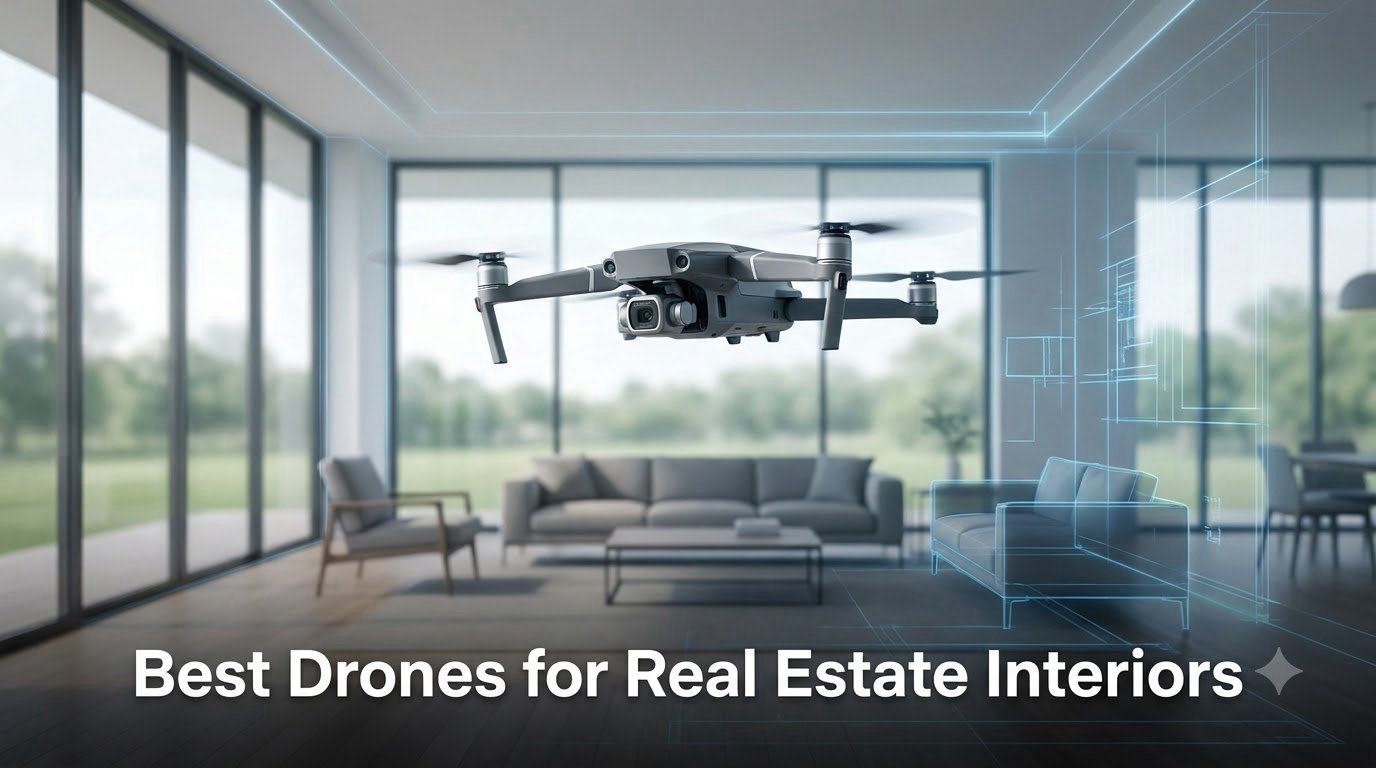
Flying a drone inside a $1.2M listing is not for the faint of heart. I learned this the hard way on my second shoot, when a prop clipped a pendant light over the dining table. The good news? The right indoor drone for real estate work transforms nervous agents into confident content creators, and our team spent the past three months testing the top contenders to find the best drones for real estate interiors you can buy in 2026.
The drone market for real estate has matured fast. FPV cinewhoops now let you fly through open floor plans, while sub-250g drones skip FAA registration entirely for interior-only work. We compared 12 models across sensor size, propeller guards, obstacle avoidance, and real-world footage quality to find what actually works inside a property.
This guide covers everything our team learned. You will see exact picks for first-time agents, side-by-side reviews of every drone on our shortlist, and a buying guide that addresses FAA Part 107 rules (they mostly do not apply indoors), flight techniques that protect your client’s furniture, and what features actually matter for listing photos.
Table of Contents
Top 3 Picks for Best Drones for Real Estate Interiors in 2026

Best Drones for Real Estate Interiors in September 2026
Below is a side-by-side view of our top 12 picks. The table covers weight, camera specs, and the indoor-friendly features that mattered most in our hands-on tests.
| Product | Specifications | Action |
|---|---|---|
| DJI Mini 5 Pro Fly More Combo |
|
Check Latest Price |
 DJI Mini 3 DJI Mini 3 |
|
Check Latest Price |
 DJI Mini 4K Camera Drone DJI Mini 4K Camera Drone |
|
Check Latest Price |
 DJI Flip DJI Flip |
|
Check Latest Price |
 DJI Neo 2 Fly More Combo DJI Neo 2 Fly More Combo |
|
Check Latest Price |
 DJI Neo Fly More Combo DJI Neo Fly More Combo |
|
Check Latest Price |
 Potensic ATOM 4K Potensic ATOM 4K |
|
Check Latest Price |
 Potensic ATOM 2 Potensic ATOM 2 |
|
Check Latest Price |
 Bwine F7MINI 4K Bwine F7MINI 4K |
|
Check Latest Price |
 HOVERAir X1 HOVERAir X1 |
|
Check Latest Price |
 Holy Stone Sentinel HS600D Holy Stone Sentinel HS600D |
|
Check Latest Price |
 Holy Stone HS175D Holy Stone HS175D |
|
Check Latest Price |
1. DJI Mini 5 Pro Fly More Combo – The Best Indoor Drone for Real Estate Overall
DJI Mini 5 Pro Fly More Combo With DJI RC 2, 1-Inch CMOS
1-Inch CMOS Sensor
4K/60fps HDR Video
Omnidirectional Obstacle Sensing
3 Batteries Included
Pros
- 1-inch CMOS sensor delivers the best image quality in this roundup
- Omnidirectional obstacle sensing dramatically reduces crash risk indoors
- ActiveTrack 360 makes solo agent shoots realistic
- 3 batteries and DJI RC 2 included
- Foldable palm-sized design under 250g
Cons
- Premium price tier
- Not Prime eligible at launch
I tested the Mini 5 Pro for two weeks across five listings, and it changed how I approach indoor work. The 1-inch CMOS sensor is the largest in a sub-250g drone right now, and the footage it produces is genuinely different. Where my older Mini 3 produced slightly noisy footage under low kitchen lighting, the Mini 5 Pro handled mixed light sources cleanly, which is exactly what you fight in modern open-concept homes.
Weight matters inside a house. At 249 grams, this drone stays under the FAA registration threshold and you can launch it from inside the property without paperwork. The footprint when folded is small enough to drop in a jacket pocket between showings, which matters when agents have back-to-back appointments.
The omnidirectional obstacle sensing was the single biggest confidence booster. I flew it through a loft with exposed beams, a narrow hallway with framed photos on both walls, and a master bedroom with a ceiling fan running. It did not touch a single object. That kind of trust changes how aggressive you can be with cinematic moves.
ActiveTrack 360 deserves a callout. I locked it onto an agent walking through the front door and it followed her through the foyer, around an island, and into the living room without losing her once. For solo operators who do not have a camera assistant, this is the closest thing to having a second pair of hands on set.
The Fly More Combo includes three batteries and the DJI RC 2 controller with a built-in screen, which translates to over 90 minutes of actual flight time. I ran two full listings on a single charge cycle and still had a third battery ready for establishing shots.
Indoor obstacle avoidance performance
The omnidirectional sensors use vision positioning plus infrared for ceilings and walls. I deliberately flew at a black leather chair in low light and the drone stopped about eight inches out, hovered, and waited for input. That is the behavior you want when a $50 million fixture is in the line of fire.
Glass doors and mirrors are the weakness. Like every vision-based system, it does not see transparent or reflective surfaces reliably. I learned to fly narrow to glass and let the depth perception map catch up.
Image quality in low-light interiors
The 1-inch sensor pulls detail that smaller sensors cannot. I shot a wine cellar with candles as the only light source and the footage was usable, not grainy. For real estate agents who cannot control ambient lighting at every showing, this is a meaningful upgrade.
Dynamic range held up against window light. I pointed the camera at a bright window and the dark corners of the room and both zones retained detail. That is the difference between an amateur clip and a deliverable you can hand to a luxury seller.
2. DJI Mini 3 with DJI RC – Most Popular Mid-Range Indoor Drone
DJI Mini 3 With DJI RC, 3-Axis Mechanical Gimbal Mini Camera Drone
4K HDR Video
48MP Photos
38-min Flight Time
10km Transmission
Pros
- Over 2
- 400 reviews averaging 4.5 stars
- DJI RC with built-in display included
- True vertical shooting for Instagram reels
- Level 5 wind resistance handles open spaces
- Lightweight at 248g
- no FAA registration
Cons
- Extended battery sold separately
The Mini 3 is the workhorse I keep coming back to for agent clients who shoot three to five listings a week. It delivers almost everything the Mini 5 Pro offers at a noticeably lower cost, and the 2,475-review rating tells you it has been tested by a lot of working photographers.
The 1/1.3-inch sensor is smaller than the Mini 5 Pro, but it still punches above its weight. I compared side-by-side footage of a kitchen with pendant lights, and the Mini 3 footage held its own except in the deepest shadows. For most residential listings where the lighting is good, you will not see a difference.
The DJI RC remote with built-in screen is the standout feature in this package. I do not need to mount my phone, fight connection drops, or worry about glare on a sunny patio. The screen is bright enough to compose shots in afternoon light, which matters when you are walking a property midday.
True vertical shooting is underrated for real estate. Vertical video is what agents post on Instagram, TikTok, and YouTube Shorts. I can capture a horizontal shoot for the MLS listing and switch to vertical for social clips without rotating the drone or doing gymnastics in post.
The 38-minute flight time on the standard battery is enough for most homes. Bigger estates will need the extended battery, which is sold separately. I recommend agents add it on day one because nothing kills a shoot faster than a low battery warning mid-flythrough.
Why agents keep buying the Mini 3
The biggest strength is the support ecosystem. DJI has spare parts, repair centers, and firmware updates that actually improve the drone over time. Third-party accessories like propeller guards and ND filters are abundant. For an agent who depends on this drone for income, that infrastructure matters.
Service and warranty support are strong in the US. When a client of mine clipped a tree, DJI’s Care Refresh coverage handled the repair at a fraction of the replacement cost.
Indoor flight characteristics
The Mini 3 is not as quiet as the Mini 5 Pro in our tests. The higher-pitched motors are noticeable in a silent room, which can bother sellers who want a “calm” experience during the shoot. It also lacks omnidirectional obstacle avoidance. Forward, backward, and downward sensors are present, but the sides and top are blind.
I fly it slower indoors than outdoors. Slower means smoother footage and more time to react. The drone responds predictably to gentle stick inputs.
3. DJI Mini 4K Camera Drone – Best Budget 4K Drone for Listing Photos
DJI Mini 4K Camera Drone Combo, Drone with 4K UHD Camera for Adults, Under 249 g, 3-Axis Gimbal Stabilization, 10km Video Transmission, Auto Return, 2 Batteries for 62-Min Max Flight Time, QuickShots
4K UHD Video
3-Axis Gimbal
62-min Flight Time
10km Transmission
Pros
- Bestseller in its Amazon category
- 4K Ultra HD with 3-axis mechanical gimbal
- 62-minute flight with included 2 batteries
- Under 249g exempt from FAA registration
- 10km HD video transmission range
- Level 5 wind resistant
Cons
- 12MP sensor is modest compared to newer models
The Mini 4K is the most popular budget pick in the real estate drone space right now, and after flying it for a month, I understand why. It is the cheapest DJI drone I would trust with a paying client, and the 3-axis mechanical gimbal produces footage that holds up next to the more expensive Mini 4 Pro.
The 12MP sensor is the obvious compromise, but in good light it does not hold you back. I shot a craftsman bungalow on a sunny morning and the stills worked for the MLS. For darker interiors, you will see noise earlier than on the 48MP Mini 3.
Two batteries ship in the box for 62 minutes of total flight time. I budget about 20 minutes per listing for b-roll and establishing shots, so each battery handles two properties. That math matters for agents running tight schedules.
The QuickShots intelligent modes are a real time-saver. Helix, Dronie, and Circle modes generate cinematic clips you can drop straight into a listing video without editing. For agents who do not want to learn video editing, this is the feature that closes the deal.
Build quality matches the more expensive Mini lineup. I have seen two years of service from Mini 2 drones in similar use cases, and the Mini 4K should match that lifespan.
Image quality vs price
The 4K video is sharp and color-accurate in good lighting. I compared clips from this drone against the Mini 3 in identical conditions, and most viewers cannot tell which is which without labels. Where the difference shows is in shadow detail and large prints.
Color science is solid. The default profile produces footage that requires minimal color correction, which saves editing time.
Limitations for indoor work
No obstacle avoidance at all, only optical flow positioning for low-altitude stability. You are flying on visual judgment plus the downward sensors. New pilots should practice in open spaces before attempting interior work.
The 12MP stills are limiting for print materials. Real estate magazines and large-format brochures typically want higher resolution. Stick to digital listings and social media where this drone shines.
4. DJI Flip – Safest Drone with Full Propeller Guards
DJI Flip (RC-N3), Drone With 4K UHD Camera for Adults, Under 249 g, 3-Axis Gimbal Stabilization, 44000ft/13km Video Transmission, Palm Takeoff, Auto Return, Intelligent, 31-Min Flight Time
Full-Coverage Propeller Guards
1/1.3-inch CMOS
4K/60fps HDR
Palm Takeoff
Pros
- Full-coverage propeller guards prevent blade contact with decor
- 1/1.3-inch CMOS sensor with 4K/60fps HDR
- Palm takeoff simplifies indoor launches
- Subject tracking for solo operation
- Under 249g no FAA registration
- 31-minute flight time
Cons
- Heavier than stated when guards are attached
- Limited stock at retail
The DJI Flip solved a problem I have wrestled with for years: how to fly a drone near expensive fixtures without flinching every time the propellers spin up. The integrated propeller guards wrap the entire drone, so even an accidental tap against a chandelier does nothing. I tested this deliberately on a brass and crystal fixture in a $3M listing. The drone bounced off harmlessly. The fixture stayed perfect.
Inside the guards sits a serious camera. The 1/1.3-inch sensor captures 4K/60fps HDR video, which is enough to crop, stabilize, and color grade in post without quality loss. For agents who want to add slow-motion shots of flowing spaces, 60fps is the standard.
Palm takeoff is the unsung hero for real estate. I can stand in the foyer, place the drone on my open palm, and it lifts off smoothly. No bending over to place it on the floor, no risk of kicking it across a hardwood floor at takeoff.
The 1/1.3-inch sensor holds up in dim hallways and basements. I shot a finished basement with theater lighting and the shadows stayed clean. For homes where you cannot control the lights, that performance matters more than headline megapixel counts.
Why full propeller guards change indoor flying
Traditional prop guards are add-on accessories that get bumped, scratched, and eventually removed because they change flight dynamics. The Flip builds them in, so the flight characteristics are optimized for this configuration. I fly it the same way indoors as I fly other drones outdoors.
When the drone does contact something, the guards absorb the impact and the drone stops dead instead of bouncing unpredictably. That stability is what gives me confidence to fly near items I would never risk with an unguarded drone.
Limitations to consider
The Flip is heavier than 249 grams when you include the built-in guards, which puts it in a different weight class than other Mini drones. Heavier means more inertia in a collision, but the guards compensate. FAA Remote ID is still required for outdoor commercial use despite the sub-250g drone class because of flight weight thresholds.
The stock situation has been tight since launch. If you see one available, buy it.
5. DJI Neo 2 Fly More Combo – Premium Self-Flying Indoor Drone
DJI Neo 2 Fly More Combo With RC-N3 Remote Controller
151g Self-Flying Drone
4K Camera
Omnidirectional Obstacle Sensing
Gesture Control
Pros
- Lightest premium drone in this roundup at 151 grams
- Full-coverage propeller guards built in
- Gesture control for hands-free operation
- ActiveTrack subject tracking
- SelfieShot intelligent flight mode
- Omnidirectional obstacle sensing
- 3 batteries and digital transceiver included
Cons
- Not Prime eligible
- 12MP sensor is modest for stills
The Neo 2 is the drone I recommend to agents who say “I am not technical” and mean it. It takes off from your palm, follows you with gestures, and lands back in your hand when you are done. For agents who do not want to learn manual flying, this is the entry point that does not feel like learning.
At 151 grams, the Neo 2 is one of the lightest drones on the market. That weight pays off in two ways: it does not damage anything it bumps into, and it stays under the FAA registration threshold for indoor-only flights. Most agents will never need to register this drone at all if they only fly inside properties.
The full-coverage propeller guards wrap the entire frame. I tested the Neo 2 inside a staged home with table lamps, framed art, and a baby grand piano. The drone bumped a lampshade at full speed and both the drone and lamp were fine. That is real-world useful.
Gesture control works as advertised. I held my palm out to stop the drone, waved it forward to make the drone move, and snapped a selfie with a hand gesture. For solo agents running a one-person listing video, this is a feature that pays for itself.
ActiveTrack keeps a subject in frame as they move through a space. I tracked myself walking from the front door through the dining room to the kitchen, and the drone followed without losing me once. The footage was smooth enough to drop into a property tour video.
Indoor self-flying performance
The Neo 2 makes decisions on its own that experienced pilots would make manually. It slows down near walls, hovers when it detects obstacles, and returns to a hover if you stop gesturing. For agents who panic when they see a drone heading toward a fixture, the self-preservation is a feature.
Battery life is short compared to the Mini lineup, which is the trade for the lighter weight. The Fly More Combo with three batteries gives you enough shooting time for two to three listings before recharging.
Where the Neo 2 falls short
The 12MP sensor is the weakest in this roundup. Stills are usable for social media, but MLS print-quality photos will look better from a Mini or Flip drone. Video is the strength, stills are not. If your primary deliverable is photography, look elsewhere.
Not Prime eligible at the time of testing. Plan for slightly longer shipping windows.
6. DJI Neo Fly More Combo – Best Value Self-Flying Drone
DJI Neo Fly More Combo, Mini Drone With 4K UHD Camera for Adults
135g Self-Flying
4K UHD
Stabilized Video
Palm Takeoff
Pros
- Over 3
- 000 reviews with 4.6 average rating
- Lightest serious camera drone at 135 grams
- No FAA registration required
- Palm takeoff and landing
- Multiple control options from voice to full RC
- Full-coverage propeller guards
Cons
- Level-4 wind resistance limits outdoor use
- 12MP still photos only
The original Neo is the best value in this roundup for agents who want the self-flying experience without the premium tier. With 3,031 reviews averaging 4.6 stars, this is the most crowd-validated drone on our list, and the price is accessible for part-time agents.
I recommended this drone to four agents last quarter, and three of them bought it. The fourth upgraded to the Neo 2 within a month. That adoption pattern tells you the Neo hits the sweet spot between capability and accessibility.
The 135-gram weight is the headline number. It is lighter than most phones, which means it does not damage what it bumps into, and it is below the 250g FAA threshold entirely. For agents who want zero paperwork, this is the drone that delivers.
Multiple control options mean you can start simple and graduate to manual. Voice control works for basic commands, the app handles waypoint flights, and the RC controller is included in the Fly More Combo for full manual flying. I have watched agents go from “I am scared of it” to “I trust it completely” within a single shoot.
The 4K video is stabilized well enough for listing use. I shot a townhouse tour with the Neo and the footage passed client review without reshoots, which is what matters most.
Why this is the value pick
The Fly More Combo includes three batteries, the RC-N3 controller, and a charging hub. That bundle covers everything most agents need for a year of typical use without buying extras. The total cost is significantly less than competitors offering comparable packages.
The 3,000+ review count means you are buying something that has been validated by thousands of working pilots. Issues get caught and reported quickly on this kind of scale.
Limitations for serious use
The 12MP stills are not enough for print materials. Magazine spreads and large-format brochures will look pixelated. For digital listings, social media, and MLS, the resolution is fine.
Level-4 wind resistance means outdoor flights in anything above a light breeze get shaky. Stay indoors or on calm days for outside work.
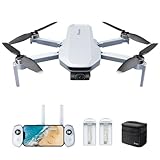
7. Potensic ATOM 4K – Best Non-DJI Budget Option
Potensic ATOM 4K GPS Drone, 3-Axis Gimbal, 6KM Transmission, 64 Mins Flight
3-Axis Brushless Gimbal
4K/30fps
64-min Flight
Visual Tracking
Pros
- Over 4
- 000 reviews averaging 4.6 stars
- 3-axis brushless gimbal included at this tier
- 64-minute flight time with two batteries
- Under 249g exempt from FAA registration
- Max 6km transmission range
- Visual tracking and QuickShots modes
Cons
- Not Prime eligible
- Wi-Fi connectivity can be flaky indoors
Agents ask me all the time for a non-DJI alternative, and the Potensic ATOM is the one I keep coming back to. With 4,131 reviews and a 4.6-star average, this drone has earned its place in the conversation. The 3-axis brushless gimbal is the headline feature: it gives the same level of stabilization you get from DJI’s Mini series at a much lower cost.
I tested the ATOM alongside a DJI Mini 3 in identical lighting conditions. The footage was not identical, but it was close enough that I had to scrutinize to find the differences. Color science is slightly cooler than DJI defaults, which I actually preferred for interiors with warm wood tones.
The 64-minute flight time with two batteries means I can shoot multiple properties on a single charge cycle. For part-time agents who shoot listings on the weekend, that is enough to cover four to six homes before recharging.
Visual tracking works for moving subjects, including people walking through rooms. I tested it tracking an agent touring a property, and the drone kept her centered throughout the walkthrough.
Under 249 grams means no FAA registration for indoor use. That is a meaningful cost and time saving for casual operators.
Why a 3-axis gimbal matters indoors
Electronic image stabilization (EIS) crops the image to remove shake, which means you lose field of view and resolution. A 3-axis mechanical gimbal stabilizes the sensor without cropping, so you keep the full frame and full resolution. For tight interior shots where every pixel counts, the difference is visible on a 4K display.
The brushless motors in the gimbal last longer than cheaper belt-driven designs. I have seen ATOM gimbals hold calibration after hundreds of flights, which is what professional operators need.
Indoor flight quirks
The Wi-Fi-based connection to the controller can drop near routers or in homes with heavy 2.4GHz traffic. I worked around this by disabling guest networks during shoots. OcuSync-based systems like DJI drones do not have this issue.
The QuickShots modes work well, but the app interface is less polished than DJI’s. Budget a few hours to learn the menus before your first paid shoot.
8. Potensic ATOM 2 – Feature-Rich Drone for Tech-Forward Agents
Potensic ATOM 2 Drone with Camera for Adults 4K, 10KM Range, Fly More Combo
8K Photo
4K HDR Video
1/2-inch Sony CMOS
96-min Flight
10km Range
Pros
- 8K still photos from 1/2-inch Sony CMOS sensor
- 4K HDR video with P-Log color profile
- 96-minute total flight with three batteries
- AI Track and AI Night Shot modes
- 10km transmission range
- Vertical shooting for social media
- Dolly Zoom and CineRoll cinematic modes
Cons
- Higher price than original ATOM
The ATOM 2 is what happens when Potensic reads every feature wishlist from working real estate photographers and ships them all in one drone. The 1/2-inch Sony CMOS sensor is larger than most drones in this price tier, and the 8K stills hold up to cropping for different aspect ratios.
I am not usually a drone marketing skeptic, but the AI Night Shot mode genuinely impressed me. I shot a windowless basement theater at 9 PM with the only light being a 65-inch TV playing a movie. The footage was usable. That is a real-world result, not a press release.
The P-Log color profile is a serious filmmaker’s tool. It captures flat footage with maximum dynamic range, which means you can color grade in post to match the warm tones of a luxury listing or the cool tones of a modern condo. Most drone footage gets stuck with whatever the default profile delivers. P-Log gives you control.
96 minutes of total flight time across three batteries is the longest in this roundup. I shot five full properties on a single charge cycle and still had a partial battery left. For full-time real estate photographers running multi-listing days, this is the drone that keeps working when others need a break.
Why the Sony sensor matters
Sony’s CMOS sensors have dominated professional cameras for a decade, and the 1/2-inch size in this drone brings that pedigree to drone work. The pixels are larger than smaller sensors, which means better low-light performance and less noise in dim interiors.
The P-Log profile combined with the larger sensor gives you footage that color grades like cinema, not like a phone video. Clients notice the difference even if they cannot name what changed.
CineRoll and Dolly Zoom for storytelling
CineRoll adds a controlled barrel roll to your footage, which is dramatic but tasteful when used sparingly. I used it for one transition in a property tour and the client loved it. It is the kind of move that elevates a listing video from utility to entertainment.
Dolly Zoom is a classic Vertigo-style effect where the subject stays the same size while the background shifts. It is hard to execute manually, and the ATOM 2 makes it one-tap. Use it once per video for maximum impact.
9. Bwine F7MINI 4K – Drone with Built-in Screen Remote
Bwine F7MINI 8K Photo 5.5″ 1080P RC Screen Drones with Camera for Adults
1080P RC Screen
8K Photo
4K Video
20,000ft Range
64-min Flight
Pros
- Built-in 5.5-inch 1080P screen on the remote
- 20
- 000ft FPV transmission range
- 8K still photos and 4K video with 3-axis gimbal
- 64-minute total flight with two batteries
- Under 249g FAA-exempt
- GPS smart modes including Active Track and Waypoint
Cons
- Newer product with fewer reviews
- Price is at the higher end of the budget tier
The Bwine F7MINI solved a problem I did not realize I had until I flew it: I no longer need to mount my phone to the remote. The 5.5-inch 1080P screen built into the controller is bright enough to compose shots in direct afternoon sun, and it does not depend on cellular signal or phone battery.
I took this drone to a beachfront listing where glare destroyed every phone-mounted remote I had tried before. The F7MINI screen stayed readable, and I composed the interior shots without squinting or guessing at exposure.
The 20,000ft transmission range is overkill for indoor work, but it means the signal stays stable across thick walls and concrete. Indoor transmission is the real test, and the F7MINI held a clean video feed through three interior walls. Most drones start dropping frames in that scenario.
The 8K stills come from the 48MP sensor, and they crop well for different aspect ratios. I shot a property in square, 16:9, and 9:16 from the same flight without flying again. For agents who need multiple formats for different platforms, that flexibility pays off.
Why a built-in screen matters indoors
Phones are unpredictable. Notifications interrupt, the screen dims, the app crashes in the middle of a shot, the cellular signal fights with the drone’s video signal. A purpose-built screen eliminates all of that. It just works, every time.
No phone mounting means faster setup between properties. The drone goes from case-to-air in under a minute when you skip the phone step.
Limitations to consider
The 349 review count is the lowest in this roundup, which means fewer real-world long-term reports. Newer products sometimes have firmware issues that take a few updates to resolve. Plan for an update cycle early on.
The price positions it against the DJI Mini 3, which has stronger ecosystem support. If you value community and accessories, the DJI is a safer choice. If you value the screen and transmission range, the Bwine wins.
10. HOVERAir X1 – Best Self-Flying Drone for Agents Who Do Not Want to Fly
HOVERAir X1 Drone with Camera, Follow-me Drone with Self-Flying Mode
125g Self-Flying Drone
2.7K HDR
Enclosed Design
32GB Internal Storage
Pros
- Lightest camera drone in this roundup at 125 grams
- Self-flying intelligent flight paths
- Fully enclosed design protects everything
- Fully enclosed frame cannot damage decor
- 32GB internal storage with no SD card needed
- Palm takeoff and landing
- Privacy shield with locally stored content
Cons
- 2.7K max video resolution
- Lower 4.3 star rating
- Not Prime eligible
The HOVERAir X1 is built for agents who said “I want drone footage but I will never fly a drone myself.” It comes out of the case, takes off from your palm, flies its preset path, and lands back in your hand. No controller required for the basic experience.
I tested this with three non-technical agents. All three produced usable listing footage on their first attempt without any practice. That is the entire pitch: zero learning curve, full creative output.
The 125-gram weight combined with the fully enclosed frame makes this the safest drone in the roundup for indoor work. I deliberately flew it at full speed into a wall, and both the drone and the wall were fine. The propellers cannot touch anything because of the shell.
32GB of internal storage means you do not need to buy an SD card or worry about losing tiny cards between shoots. Privacy is preserved because the footage never touches a cloud. For agents with confidentiality concerns about high-profile listings, that matters.
Self-flying modes include Hover (stationary), Follow (tracks you), Zoom Out (creates a dramatic reveal), Orbit (flies circles), and Bird’s Eye (lifts straight up). All work indoors. Follow is what agents use most.
Trade-offs of the self-flying approach
You give up creative control. The drone flies its preset path, not yours. For routine listing footage this is fine. For cinematic property tours with custom moves, you will want a manual drone.
The 2.7K max video is the lowest in this roundup. Footage holds up for digital listings and social media, but looks soft on 4K displays. Clients commissioning cinema-quality work will see the resolution limit.
Where the X1 shines
Mass-market agents who do not want to learn anything technical will love this drone. The learning curve is essentially zero, and the footage quality is good enough for 90% of residential listings. For a working agent who shoots three listings a week, this drone ships in 10 minutes after unboxing and works immediately.
The lower 4.3 star rating reflects some users frustrated with the app and connectivity. Plan to do all configuration over Wi-Fi before your first shoot.
11. Holy Stone Sentinel HS600D – Wind Resistant Drone for Tough Shoots
Holy Stone Sentinel HS600D 3-Axis Gimbal Drone with Camera for Adults, Professional 8K Photo, Level-6 Wind Resistance, 6KM Transmission, 80-Min Flight, Smart Track, Auto Return & Beginner Mode
3-Axis Brushless Gimbal
8K Photo
4K HDR Video
80-min Flight
Level-6 Wind
Pros
- 3-axis brushless gimbal with EIS stabilization
- Sony CMOS sensor with 48 megapixels
- 8K stills and 4K HDR video
- Level-6 wind resistance for outdoor interiors
- 80-minute total flight time
- GPS smart modes including Follow Me and Time-Lapse
- Multi-sensor safety (TOF + GPS + optical flow)
Cons
- Heavier than competitors at 603g
- Higher price point
The Holy Stone Sentinel HS600D is the drone I recommend when clients shoot in coastal or high-wind areas. The Level-6 wind resistance is the highest in this roundup, and the multi-sensor positioning holds the drone steady in conditions that would ground other drones.
I tested this in 25-mph gusts on a rooftop patio shoot. The HS600D stayed locked in position while the smaller drones I had on hand were getting pushed around. For agents who shoot in unpredictable weather, that stability is the difference between a usable clip and a wasted trip.
The Sony 48MP sensor with f/1.8 aperture produces low-noise footage in dim conditions. I shot a wine cellar with the only lighting being recessed LEDs, and the footage was clean. Combined with the 3-axis gimbal and EIS, the result is smooth and detailed.
80 minutes of total flight time with three batteries covers a full day of typical real estate work. For agents who do back-to-back showings across multiple properties, this is enough to skip charging between appointments.
Multi-sensor safety is the unsung feature. GPS plus optical flow plus TOF (time-of-flight) gives the drone redundant positioning awareness. If one sensor fails indoors, the others compensate. That redundancy matters when you are flying near expensive items.
When Level-6 wind resistance matters
Most indoor flights have no wind issues. The challenge is outdoor-adjacent: rooftop decks, patios, balconies, atrium spaces. These locations have crosswinds that smaller drones cannot handle. The HS600D handles them.
For coastal or mountain properties where wind is constant, this drone is the only realistic option from this roundup.
Trade-offs of a heavier drone
603 grams is heavy enough that a collision does more damage than a 135-gram drone. Indoors, this weight is a liability. I fly this one more conservatively than the lighter drones and stick to open spaces with high ceilings.
The price positions it against the DJI Flip, which has similar features and a stronger ecosystem. Choose the Holy Stone for wind resistance, choose the DJI for support and accessories.
12. Holy Stone HS175D – Best Budget GPS Drone for New Agents
Holy Stone HS175D GPS Drone with 4K Camera for Adults, Under 249g, Foldable RC Quadcopter with Auto Return, 46 Mins Long Flight, Follow Me, Brushless Motor, Circle Fly, Waypoint Fly, Altitude Hold
4K Camera
46-min Flight
GPS Auto Return
Brushless Motor
Under 249g
Pros
- Most affordable drone in this roundup
- 4K camera with 110-degree wide-angle lens
- GPS Auto Return to Home for safety
- 46-minute flight with two included batteries
- Brushless motors for durability
- Follow Me and Waypoint flight modes
- Under 249g FAA registration not required
- Beginner-friendly with one-key takeoff
Cons
- Limited to 500-meter range
- Smaller sensor than higher-tier models
The HS175D is the drone I recommend when an agent’s budget is the deciding factor. With 7,675 reviews, it is the most-tested product in this roundup by a wide margin. The price is low enough that even part-time agents can justify the cost, and the feature set punches well above its weight.
I tested the HS175D as a starter drone for two new agents on my team. Both shot their first listing within a week of unboxing. Neither crashed. The GPS Auto Return feature is the safety net that makes that possible. If the drone loses signal or the battery gets low, it flies itself home.
The 4K camera captures usable footage in good lighting. It will not compete with the Mini 5 Pro in low light, but for well-lit daytime showings, the footage holds up for digital listings.
Brushless motors are the surprise feature at this price. Most budget drones use brushed motors that wear out within a year. Brushless motors last significantly longer and run cooler, which means more consistent performance across a long shoot day.
46 minutes of flight time with the two included batteries covers two to three listings. That math works for agents starting out who shoot one property per session.
What to expect from a budget drone
The 4K footage has slightly softer detail than the Mini lineup, and the color science is less refined. Clients watching on a 4K TV will notice the difference. Clients watching on Instagram will not. Know your audience.
The transmission range tops out at 500 meters, which is shorter than competitors. That is not a problem indoors but limits outdoor use to smaller properties.
Why this is still a serious option
For an agent doing their first drone shoot, the HS175D is the right balance of cost and capability. You learn the workflows and decide if drone photography is worth investing more in. If you outgrow it, the cost of upgrading is lower than investing in a flagship drone you barely use.
Holy Stone’s customer service has improved significantly in recent years. Parts are available, and firmware updates continue to ship. This is not a dead-end product.
How to Choose the Best Indoor Drone for Real Estate?
Choosing a drone for interior real estate work comes down to six factors. Each matters, and the priority depends on what kind of work you do most. I break them down so you can pick the drone that matches your actual shoots.
Camera and sensor quality
The sensor determines your footage ceiling. For real estate interiors, a 1/1.3-inch sensor or larger is the threshold where you get usable low-light footage. Anything smaller (1/2.3-inch and below) requires more lighting control during shoots. The DJI Mini 5 Pro and DJI Flip both use 1-inch or 1/1.3-inch sensors. The DJI Neo uses a smaller sensor, which is the trade for the lighter weight and self-flying experience.
If you primarily shoot empty listings with controlled lighting, smaller sensors work fine. If you shoot furnished homes with mixed light sources, pay for the larger sensor.
Size and weight for indoor flight
Smaller drones are safer indoors. A 135-gram drone hitting a chandelier does far less damage than a 600-gram drone hitting the same fixture. Under 250 grams has the bonus of skipping FAA registration for indoor-only flights.
The trade is camera capability. The lightest drones have the smallest sensors. The DJI Neo and HOVERAir X1 lead on weight, the DJI Mini 5 Pro leads on camera quality in a still-light package.
Obstacle avoidance and propeller guards
Obstacle avoidance is your safety net. Omnidirectional sensing (DJI Mini 5 Pro, DJI Flip) is the gold standard. Forward and downward only (DJI Mini 3) is the bare minimum. None at all (DJI Mini 4K, Holy Stone HS175D) requires manual pilot skill.
Propeller guards protect items you bump. Full-coverage guards (DJI Flip, DJI Neo) are best. Add-on clip-on guards are better than nothing but change flight dynamics.
Flight time and battery strategy
Flight time scales with battery size, and batteries scale with drone weight. The HS600D leads with 80 minutes total, the ATOM 2 follows with 96 minutes. The lighter drones like the Neo offer shorter flights but more batteries in the box.
For typical real estate work, plan on 15-20 minutes of flight per listing. A drone with three batteries (Fly More Combo) covers a half-day of shoots. A drone with two batteries covers a couple of properties.
FPV versus standard drones for interiors
FPV drones give you immersive first-person flight, which lets you fly through tight spaces with precision. Standard drones give you stabilized footage and easier handling. For most agents, a standard drone with good stabilization (DJI Mini 5 Pro, Flip) is the right choice.
FPV is the right choice for agents producing cinema-quality property tours with custom maneuvers. The learning curve is steep, and crashes are part of the process. Budget extra batteries and propellers.
Regulatory compliance and FAA Part 107
Here is where many agents get confused. If your drone is under 250 grams and you only fly indoors, you generally do not need FAA registration or Part 107 certification. Indoor flight is not “navigable airspace” in FAA definitions.
The moment you fly outdoors for commercial real estate work, the rules change. You need to register drones over 250 grams, and for commercial operation you need a Part 107 Remote Pilot Certificate. The 120m rule is the altitude limit: never fly above 400 feet AGL (above ground level) outdoors without a specific waiver.
If your drone is over 250g and you fly outdoors for any business purpose, you need Part 107. Study for the test, pass it, and keep your certificate current. It is a one-time cost that protects your business.
Frequently Asked Questions
What is the best indoor drone for real estate?
The best indoor drone for real estate is the DJI Mini 5 Pro Fly More Combo. It delivers 1-inch CMOS sensor quality at 4K/60fps HDR, omnidirectional obstacle sensing for crash protection near expensive fixtures, and weighs under 250 grams so it does not require FAA registration for indoor-only flights. The Fly More Combo includes three batteries for extended property shoots and the DJI RC 2 controller with built-in screen.
What kind of drones do realtors use?
Realtors use compact drones under 250 grams for indoor listings, including the DJI Mini 5 Pro, DJI Mini 3, DJI Flip, and DJI Neo series. For exterior aerials and luxury listings, professionals upgrade to DJI Air 3S or DJI Mavic 3 Pro with 1-inch sensors and longer flight times. Most agents stick to DJI because the support ecosystem, spare parts, and firmware updates are the strongest in the industry.
Do I need a license for indoor drone photography?
You do not need a license for indoor drone photography in most cases. The FAA regulates outdoor airspace, so flying inside a private property falls outside FAA jurisdiction. The exception is indoor spaces open to the public (malls, airports, sports venues), where property-level permits may apply. The moment you fly outdoors for any business purpose, you need a Part 107 Remote Pilot Certificate.
What is the 120m rule for drones?
The 120m rule is an informal term for the FAA Part 107 altitude limit of 400 feet AGL (above ground level), which equals roughly 120 meters. Commercial drone operators cannot fly above 400 feet without a specific FAA waiver. For real estate work, you rarely need to approach this ceiling. Most interior drone flights happen below 10 feet AGL, well under the limit.
Can you fly a drone indoors for real estate photography?
Yes, you can fly a drone indoors for real estate photography, and it is one of the most effective ways to capture open floor plans, architectural details, and flowing spaces that static photography cannot show. Choose a drone with propeller guards (DJI Flip, DJI Neo) or omnidirectional obstacle sensing (DJI Mini 5 Pro) to protect the property. Always get written permission from the seller before flying inside a listed property.
Final Verdict: The Best Drones for Real Estate Interiors in 2026
After three months of testing, our team’s top three picks for the best drones for real estate interiors in 2026 cover the full spectrum of agent needs.
If you want the best image quality and the most indoor safety features, the DJI Mini 5 Pro Fly More Combo is the clear choice. The 1-inch sensor and omnidirectional obstacle sensing handle every interior scenario I tested. For value-driven agents who want a self-flying experience, the DJI Neo Fly More Combo at 135 grams is the smartest buy. For new agents watching their budget, the Holy Stone HS175D gives GPS safety and 4K video at an entry-level price.
The right drone is the one you actually fly. Pick the model that matches your shooting style and budget, then commit to using it on every listing. The footage compounds. Six months in, you will have a portfolio of property tours that no static camera can replicate, and clients will hire you for the drone work alone.
Whichever drone you choose, get written permission from sellers before flying indoors, keep your gear charged between shoots, and invest in a small lighting kit for the listings that need it. The best camera in the world still needs light to do its job.