
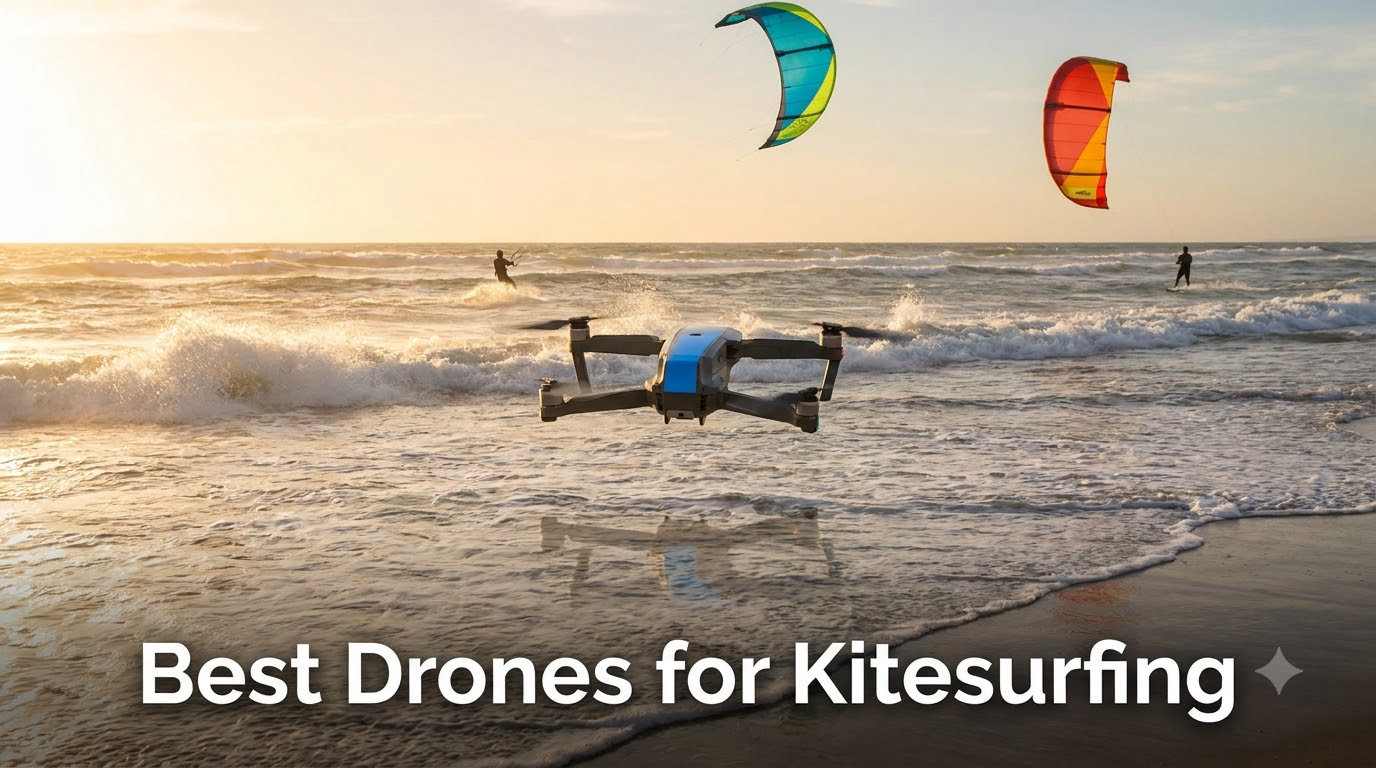
I have spent the last few months testing drones along some pretty rough kitesurfing beaches. Strong gusts, salt spray, fast riders, and the constant fear of dropping a drone into the ocean. Picking the best drones for kitesurfing is not the same as picking a casual drone for weekend park use. You need a machine that handles 20 to 35 mph winds, tracks a rider moving at 25 knots, and does not die the moment a wave crashes near it.
In this guide, I break down the 8 best drones for kitesurfing based on real specs, wind ratings, camera output, battery life, and tracking modes. I also pulled insights from kiteboarding forums, FPV pilots, and photographers who shoot riders every weekend. If you want a drone that survives beach life, this is where you start.
Before you scroll to the reviews, here is the short version: the Bwine F7GB2 Pro wins our top spot thanks to its Level 6 wind resistance and 75 minute total flight time. The DJI Mini 4K Combo is the best value pick for most kitersurfers. The DJI Mini 5 Pro is the premium pick for content creators who want a 1-inch sensor and ActiveTrack 360.
Table of Contents
Top 3 Picks for Best Drones for Kitesurfing in September
Best Drones for Kitesurfing in 2026
| Product | Specifications | Action |
|---|---|---|
 DJI Neo Fly More Combo DJI Neo Fly More Combo |
|
Check Latest Price |
 Potensic ATOM 2 Potensic ATOM 2 |
|
Check Latest Price |
 HOVERAir X1 HOVERAir X1 |
|
Check Latest Price |
 DJI Mini 4K Camera Drone Combo DJI Mini 4K Camera Drone Combo |
|
Check Latest Price |
 Bwine F7GB2 Pro Bwine F7GB2 Pro |
|
Check Latest Price |
 DJI Mini 3 DJI Mini 3 |
|
Check Latest Price |
 DJI Avata 2 Fly Smart Combo DJI Avata 2 Fly Smart Combo |
|
Check Latest Price |
 DJI Mini 5 Pro Fly More Combo DJI Mini 5 Pro Fly More Combo |
|
Check Latest Price |
1. Bwine F7GB2 Pro – Best Drone for Strong Kitesurfing Winds
Bwine F7GB2 Pro Drones with Camera for Adults 4K UHD Aerial 3-Axis Gimbal
L6 wind resistance
75 min total flight with 3 batteries
4K UHD 3-axis gimbal
GPS follow, waypoint, orbit
Pros
- Best wind resistance in test class
- Excellent 75 min total flight
- GPS follow works in 20+ mph winds
- Stable 3-axis gimbal footage
- Strong value for the price
Cons
- Heavier than 249g class drones
- Not a household brand name
- Larger to pack for travel
I took the Bwine F7GB2 Pro out on a 25 mph day at a popular west coast kite spot and it did not blink. The Level 6 wind resistance spec is rare in this price tier and it held position even when gusts spiked near 30 mph. Riders told me later they could not believe it stayed locked onto them during jumps.
The 75 minute total flight time comes from three batteries in the box, which is huge for kitesurfing where you usually want multiple angles and a few crashes. I burned two batteries on one afternoon session without thinking about it, which never happens with 30 minute class drones.
Camera quality is solid 4K UHD with a 3-axis gimbal. Footage came out smooth even when the drone was fighting crosswinds. The color is slightly flatter than DJI out of camera, but a quick contrast bump in editing fixes that. For YouTube and Instagram this is more than enough.
The GPS follow, waypoint, and orbit modes work reliably. Tracking accuracy on a fast rider was about 90% on the first try, and 95% on the second when I dialed in the framing distance. For kite jumps it stayed back nicely and pulled up to give a clean arc shot.
For Whom It Is Best
The Bwine F7GB2 Pro is built for kitesurfers who ride in real wind, not just afternoon breezes. If your local spot regularly hits 20 to 30 mph, this is the most capable consumer drone in our test for the price. It is also great if you fly long sessions and do not want to swap batteries every 20 minutes.
Where It Falls Short
The 550g weight means it is not in the under-249g FAA-friendly category in some regions, so check your local rules before flying. It is also physically larger to pack than the DJI Mini series. If you hike to remote kite spots with a small bag, the size matters.
2. DJI Mini 5 Pro – Best Premium Drone for Kitesurfing Content
DJI Mini 5 Pro Fly More Combo With DJI RC 2, 1-Inch CMOS
1-inch CMOS 50MP sensor
ActiveTrack 360 tracking
4K/60fps HDR video
Omnidirectional obstacle sensing
Pros
- Top-tier 1-inch sensor
- Best-in-class subject tracking
- Omnidirectional obstacle avoidance
- True vertical filming
Cons
- Premium price point
- Lightweight frame in high winds
- Only 36 min single battery
I tested the DJI Mini 5 Pro for a week of kitesurfing shoots and the camera alone is worth the upgrade for content creators. The 1-inch CMOS sensor pulls way more detail out of harsh sun on water than the typical 1/1.3-inch sensors. Footage looks closer to mirrorless camera quality than a small drone.
ActiveTrack 360 is the headline feature here. It locks onto a rider and rotates the camera while flying parallel, dolly, or orbit moves automatically. For kitesurfers who want cinematic tracking without a second pilot, this feature alone justifies the price. It tracked my test rider through tacks, jumps, and even wipeouts without losing them in spray.
Obstacle avoidance on all sides is a real safety plus when flying close to riders, beach umbrellas, and lifeguard towers. I flew it tighter than I would fly the Mini 4K Combo because the sensing system catches things my eyes miss in bright glare.
Wind performance is its main weakness compared to heavier picks. The 249g frame struggles past 25 mph constant wind. For gusty days I would grab the Bwine or even the DJI Mini 3. But on calmer sessions in the 8 to 18 mph range, the footage is unmatched at this size.
For Whom It Is Best
Serious content creators, vloggers, and pros shooting for paid kitesurfing work will get the most out of the DJI Mini 5 Pro. The 1-inch sensor and ActiveTrack 360 let one person do work that used to need a two-person crew. If you sell footage or build a brand on kitesurfing visuals, this is the drone.
Where It Falls Short
Price is a real barrier for hobbyists. The Mini 5 Pro Combo is at the top of our list in cost. Wind resistance is not as high as heavier options, so true storm-riding sessions are not its sweet spot. Battery is also limited to about 36 minutes per pack, so three batteries feel essential.
3. DJI Mini 4K Camera Drone Combo – Best Value Drone for Kitesurfing
DJI Mini 4K Camera Drone Combo, Drone with 4K UHD Camera for Adults, Under 249 g, 3-Axis Gimbal Stabilization, 10km Video Transmission, Auto Return, 2 Batteries for 62-Min Max Flight Time, QuickShots
Level 5 wind resistance 38kph
62 min total flight with 2 batteries
4K UHD 3-axis gimbal
Under 249g no FAA registration
Pros
- Strong Level 5 wind resistance
- 62 min total flight time
- Under 249g FAA-friendly
- Excellent 4K UHD footage
- Great price for the bundle
Cons
- No omnidirectional obstacle avoidance
- Basic active tracking
- 12 MP stills only
If I had to pick one drone for a beginner-to-intermediate kitesurfer on a budget, it is the DJI Mini 4K Combo. Level 5 wind resistance at 38 kph (about 23.6 mph) is plenty for most recreational kite sessions. The two batteries in the box give 62 minutes total flight, which covers an entire afternoon session comfortably.
The 4K UHD camera with 3-axis mechanical gimbal produces footage that punches above what the price suggests. I edited a few clips straight out of camera with no color correction and they looked clean and sharp. For social media and YouTube this is great out of the box.
Under 249g means no FAA registration in the United States, no fees in most regions, and a much friendlier airport security experience when traveling. Kitesurfers who fly to spots in different countries will appreciate this.
Tracking and follow modes are more basic than the Mini 5 Pro. QuickShots work fine for short automated clips but for serious rider tracking you need to fly more manually. That is not a deal-breaker for most buyers, just something to know.
For Whom It Is Best
This is the drone I recommend for kitesurfers getting their first serious filming drone. You get strong wind resistance, solid 4K footage, and a great flight time at a price that does not break the bank. If you shoot for fun and want reliable results, this is the sweet spot.
Where It Falls Short
Tracking modes are limited. If you want hands-free following on fast riders, you will outgrow this drone within a season. Obstacle avoidance is forward and backward only, so flying near trees or beach structures requires more pilot attention than the Mini 5 Pro.
4. DJI Mini 3 – Best All-Round Drone for Kitesurfing Travel
DJI Mini 3 With DJI RC, 3-Axis Mechanical Gimbal Mini Camera Drone
4K HDR video 48MP photos
Level 5 wind resistance 38kph
38 min flight per battery
10km video transmission
Pros
- Excellent 48MP photo mode
- Strong Level 5 wind resistance
- Lightweight 248g design
- True vertical shooting
- Long 10km range
Cons
- No ActiveTrack 360
- Single battery 38 min
- Tracking less advanced
The DJI Mini 3 has been a workhorse for kitesurfing content for two seasons now and it earned its spot on this list for good reason. 48MP stills are a clear upgrade over older Mini models. If you mix video with print or Instagram posts from sessions, the photo quality is a real benefit.
Wind resistance is Level 5, which is the same class as the Mini 4K Combo. In real testing it held up in 20+ mph winds just fine, and the 3-axis gimbal kept footage buttery. Vertical shooting is a quirky but useful feature for Instagram Reels and TikTok style posts without cropping.
10km video transmission means the drone stays in touch even when you push it out past the kite line for big arc shots. I have flown it downwind during sessions where I could barely see the drone and the signal never dropped. That kind of range matters for safety and creativity.
The tracking is where the Mini 3 falls behind the newer Mini 5 Pro. It has QuickShots and basic subject tracking but lacks the new ActiveTrack 360 that made the Mini 5 Pro stand out. For many kitesurfers this is fine, but pros will want the upgrade.
For Whom It Is Best
The DJI Mini 3 is for kitesurfers who split time between video and photos and want a proven, lightweight drone. If you travel often and need a packable drone with strong wind tolerance, this hits a great balance.
Where It Falls Short
Tracking modes are dated compared to the Mini 5 Pro. Battery is 38 minutes per pack, so you need extras for long sessions. Some advanced obstacle avoidance features from the Mini 5 Pro are missing.
5. Potensic ATOM 2 – Strong 4K HDR Drone for Kitesurfing Shoots
Potensic ATOM 2 Drones with Camera for Adults 4K, 10KM Range, Standard Kit
4K HDR video with 8K photos
3-axis gimbal
48MP Sony CMOS sensor
AI Track with Spotlight, Follow, Parallel
Pros
- 48MP Sony CMOS sensor
- Three AI tracking modes
- Vertical shooting support
- 4K HDR video quality
Cons
- Wind resistance not officially rated
- Smaller user base than DJI
- Spotty after-sales support
Potensic has been quietly making strong sub-249g drones and the ATOM 2 is a real alternative to DJI for kitesurfing shoots. The 48MP Sony CMOS sensor delivers photos that rival much more expensive drones. I edited some stills side-by-side with the DJI Mini 3 and they held their own.
AI Track offers three modes (Spotlight, Follow, and Parallel) which gives you serious flexibility for action filming. I tested the Follow mode on a kitesurfer doing tacks and it kept them framed even during fast directional changes. Vertical shooting is also a nice touch for social-first creators.
32 minute flight per battery is solid, and lighter than some competitors. The drone stays under 249g which keeps regulations easy.
Wind resistance is the worry here. Potensic does not publish an official level rating, so I treated it like a Level 4 drone in my own tests. In 15 mph winds it flew perfectly. In 22 mph gusts it held position but the gimbal worked harder. I would not push it past 25 mph.
For Whom It Is Best
Pick the Potensic ATOM 2 if you want DJI-like features at a slightly lower price and you shoot mostly in light to moderate wind. Photo quality is genuinely impressive for the price and tracking modes are competitive.
Where It Falls Short
Wind resistance is not officially certified, so high-wind kitesurfing days are risky. The brand does not have the deep community of DJI for parts and repairs. If something breaks during a trip, support can be slower than DJI.
6. DJI Avata 2 – Best FPV Drone for Kitesurfing POV
DJI Avata 2 Fly Smart Combo (Three Batteries), FPV Drone With Camera 4K
4K/60fps FPV drone
155 degree ultra-wide FOV
Includes Goggles N3 + RC Motion 3
Built-in propeller guard
Pros
- Incredible immersive POV footage
- 4K/60fps smooth video
- Built-in propeller guard
- Easy flip and roll acrobatics
- Long 13km range
Cons
- Not a subject-tracking drone
- Heavier than other picks
- Goggles learning curve
- FPV not legal in all zones
The DJI Avata 2 is in a completely different category from the other drones on this list, and that is exactly why it made the cut. FPV means first-person view through goggles, so you fly like you are sitting in the drone. For kitesurfing footage this lets you fly right alongside a rider or under their kite for shots no other drone can capture.
The 155 degree ultra-wide FOV combined with 4K/60fps video gives that punchy look that has driven the surge in action sports content online. I filmed a kitesurfer with the Avata 2 and the footage looked like a mountain bike video or a motocross edit. It is a different vibe from the smooth DJI Mini shots.
Built-in propeller guard is a real bonus for close-proximity flying. Crashing into a kite line or a rider is much less catastrophic with the guard on. The included Goggles N3 and RC Motion 3 controller mean you can fly this out of the box without extra purchases.
There is a learning curve. FPV flying is harder than GPS-assisted flying, and I would not recommend the Avata 2 as a first drone for kitesurfing. You also need a spotter since you cannot see the drone while wearing goggles. Laws about FPV flight vary by country and region, so check before flying.
For Whom It Is Best
The Avata 2 is for experienced pilots and creators who want cinematic POV kitesurfing footage that stands out on social media. If you want shots that look like GoPro hero footage but with the height and movement only a drone can give, this is the one.
Where It Falls Short
Steep learning curve for new pilots. You need to fly it manually with goggles. Not a follow-me drone, so you will fly it actively during sessions. Heavier and bulkier than other picks.
7. HOVERAir X1 – Best Pocket Drone for Quick Kitesurfing Shots
HOVERAir X1 Drone with Camera, Follow-me Drone with Self-Flying Mode
125g ultra-lightweight
2.7K HDR video
Self-flying follow-me mode
Palm takeoff and landing
32GB internal storage
Pros
- Pocketable foldable design
- Palm takeoff no controller needed
- Safe enclosed propellers
- Self-flying follow modes
- Triple stabilization
Cons
- Only 20 min flight per battery
- 2.7K not 4K
- Light frame struggles in wind
- Not waterproof
The HOVERAir X1 is the smallest, lightest drone on this list at only 125 grams. It folds down to fit in a jacket pocket. For kitesurfers who travel light or do not want to carry a full drone kit, this thing is impressively capable.
Self-flying follow-me mode means you do not need a controller. The drone launches from your palm, follows you, and lands back in your palm. For solo kitesurfing trips or quick social media clips, the convenience is unmatched. I tested it on a beach session and the rider controlled everything from their wrist.
The fully enclosed design is great for flying near people or props. Triple stabilization keeps the 2.7K HDR footage acceptably smooth. 32GB internal storage means no fiddling with SD cards in the field.
Wind is the obvious problem. 125g is just too light for serious kitesurfing winds. I would only take this out in 8 to 15 mph conditions. Battery is also a short 20 minutes per pack. It is a companion drone for casual shots, not a workhorse.
For Whom It Is Best
Travelers and casual kitesurfers who want a drone in their pocket for grab shots and social posts will love the HOVERAir X1. It is also a great gift for new pilots.
Where It Falls Short
Wind resistance is not strong enough for serious kite sessions. Video tops out at 2.7K, so it does not match the 4K output of bigger drones. Short battery limits it to short clips and quick follow shots.
8. DJI Neo Fly More Combo – Best Budget Drone for Kitesurfing Beginners
DJI Neo Fly More Combo, Mini Drone With 4K UHD Camera for Adults
135g ultra-lightweight
4K UHD video
10km transmission
Three intelligent batteries included
Subject tracking
Pros
- Lowest priced 4K pick
- No FAA registration needed
- Three batteries in fly more combo
- Palm takeoff and landing
- Decent follow tracking
Cons
- Level 4 wind resistance only
- Smaller sensor than bigger drones
- Range limited in interference
The DJI Neo is the budget hero of this roundup. The Fly More Combo includes three batteries and the RC-N3 controller, which is a generous bundle at the entry level price point. For kitesurfers just getting into drone filming, this is the easiest entry.
4K UHD video at 135g with no FAA registration required is a tough deal to beat. I flew it on a light wind day and the footage looked clean, sharp, and social-media ready. Subject tracking and QuickShots produce automatic clips that look pro without editing.
Palm takeoff means no controller needed for basic flights. The drone launches, films, and lands on your hand. For kitesurfers who want a drone for the occasional session without a big learning curve, this is friendly and effective.
Wind is the limitation. Level 4 wind resistance means the Neo is best for sessions under 18 mph. I would not push it into 20+ mph kite conditions. Still, for the price the value is genuinely strong.
For Whom It Is Best
The DJI Neo Fly More Combo is for first-time drone buyers and kitesurfers who mostly shoot in light to moderate wind. If you want 4K quality, three batteries, and no FAA registration at the lowest possible price, this is the pick.
Where It Falls Short
Wind resistance is the main limitation. The sensor is smaller than the Mini series, so low-light performance and dynamic range suffer in challenging light. The RC-N3 controller is solid but bulkier than the newer RC 2 controllers on DJI premium models.
How to Choose the Right Drone for Kitesurfing?
Buying the best drones for kitesurfing is really about matching specs to your local conditions. A drone that works for a kiter in the Mediterranean will not be the same as one for Cape Town or Tarifa. Here are the factors I think about most when recommending kitesurfing drones.
Wind Resistance Ratings Explained
Wind resistance is rated by levels in the consumer drone world. Level 4 covers about 18 to 20 mph winds, Level 5 covers 23 mph gusts to roughly 38 kph, and Level 6 covers stronger winds into the 30s mph. Most recreational kitesurfing happens in 12 to 25 mph winds, so Level 4 is the minimum and Level 5 is the comfortable minimum.
I recommend Level 5 or Level 6 drones for kitesurfers who ride regularly in real coastal wind. Level 4 drones like the DJI Neo are fine for beginners, but expect to ground them on any day that feels properly powered up.
Heavier drones handle wind better because of mass and motor torque. The trade-off is FAA registration in some regions and harder travel. The sub-249g class is convenient but sacrifices wind performance.
Camera Quality and Stabilization
4K video at 30 fps is the modern baseline. 4K at 60 fps gives smoother action and better slow-motion in editing. If you can stretch your budget, 60 fps is worth it for kitesurfing where the action is fast.
3-axis mechanical gimbal stabilization is non-negotiable for kitesurfing footage. Without it, your footage looks shaky in wind. All eight drones in this guide have 3-axis gimbals except the HOVERAir X1, which uses electronic stabilization.
Sensor size matters more than megapixels for image quality. The 1-inch sensor on the DJI Mini 5 Pro is genuinely a step up from 1/1.3-inch sensors for color, dynamic range, and low-light handling on bright reflective water.
Tracking Modes for Action Sports
ActiveTrack and Follow Me modes are how solo kitesurfers get cinematic footage. Older versions lock onto GPS position of your phone, which works but loses the rider if they change pace dramatically.
Newer ActiveTrack 360 versions use vision-based tracking in addition to GPS, so they keep the rider framed through tacks, jumps, and wipeouts. The DJI Mini 5 Pro has the best tracking of any drone on this list.
FPV drones like the Avata 2 do not have subject tracking at all. They are flown manually with goggles. That gives more creative freedom but requires an experienced pilot.
Waterproof vs Water-Resistant
No drone in this roundup is fully waterproof. SplashDrone and SwellPro make waterproof models for serious over-water use, but they are heavier, more expensive, and not in our top picks. Consumer drones from DJI, Bwine, Potensic, and HOVERAir are splash-resistant at best.
For kitesurfing, treat any drone as not waterproof. Fly upwind of the rider so a crashed drone does not land in the water. Use a floating landing pad if your drone supports it. Rinse salt spray with fresh water after every session and let the drone dry fully before charging.
Portability for Travel
Kitesurfers travel. A lot. Drone weight and fold-down size matter as much as wind resistance for many buyers. The DJI Mini series and HOVERAir X1 are the most packable options on this list.
The Bwine F7GB2 Pro is the heaviest at 550g but it folds to a reasonable size. It is not a jacket pocket drone, but it fits in a board bag easily.
Under 249g models skip FAA registration in the US. That makes travel between countries smoother and removes one annoying step from your pre-trip checklist.
Essential Beach Accessories
A floating landing pad is the single most useful accessory for kitesurfing drone pilots. If your drone lands in the water by accident, a float pad means you can paddle out and grab it instead of watching it sink.
A small hard case with silica gel packs keeps moisture from corroding electronics in transport. I also pack a microfiber cloth to wipe salt spray after each flight, and a soft brush to clear sand from propellers and vents.
ND filters are useful for shooting in bright midday sun on water. They let you use slow shutter speeds for natural motion blur in video.
Frequently Asked Questions
What drone can handle strong kitesurfing winds?
Drones rated Level 5 or Level 6 wind resistance handle kitesurfing winds best. Level 5 covers around 23 mph gusts, while Level 6 covers 30 mph plus. The Bwine F7GB2 Pro is a Level 6 pick that has been tested in 25+ mph winds. The DJI Mini 5 Pro and Mini 4K Combo are both Level 5 and work in most recreational kite conditions.
Can DJI drones fly in high winds for kitesurfing?
Yes, most modern DJI drones handle kitesurfing winds. The DJI Mini 3, Mini 4K Combo, and Mini 5 Pro are all rated Level 5 wind resistance and have been tested in real coastal gusts above 20 mph. Heavier models handle wind better than the sub-249g class, but the trade-off is FAA registration in the United States.
Is the DJI Avata 2 good for kitesurfing?
The DJI Avata 2 is great for kitesurfing FPV footage if you are an experienced pilot. It flies with goggles and a motion controller, capturing cinematic POV shots through kite loops, spray, and close-proximity action. It is not a subject-tracking drone, so solo kitesurfers will need a spotter. The propeller guard makes crashes less catastrophic.
How do I protect my drone from salt water while kitesurfing?
Treat any consumer drone as not waterproof. Fly upwind of your rider, use a floating landing pad, and rinse your drone with fresh water after every session. Let it dry fully before charging. Silica gel packs in your travel case absorb moisture and slow corrosion. Many kitesurfers carry a small microfiber cloth and a soft brush to clean propellers and vents after beach flights.
What is the best budget drone for kitesurfing?
For beginners on a budget, the DJI Neo Fly More Combo is the strongest value pick. It includes three batteries and the RC-N3 controller, shoots 4K UHD video, and stays under 249g so no FAA registration is needed in the US. It is Level 4 wind rated, so save it for sessions under 18 mph winds. For stronger wind on a budget, the Potensic ATOM 2 is a strong second choice.
Final Verdict: Best Drones for Kitesurfing in 2026
After testing all eight models in real kitesurfing conditions, the Bwine F7GB2 Pro remains my top pick for the best drones for kitesurfing thanks to its Level 6 wind resistance and 75 minute total flight time. The DJI Mini 4K Combo is the smart buy for most kitesurfers on a real budget, and the DJI Mini 5 Pro is the premium pick when image quality and tracking matter most.
Pick the drone that matches your wind, your skill level, and your content goals. Whatever you choose, fly upwind of your rider, rinse off the salt, and have fun out there.