
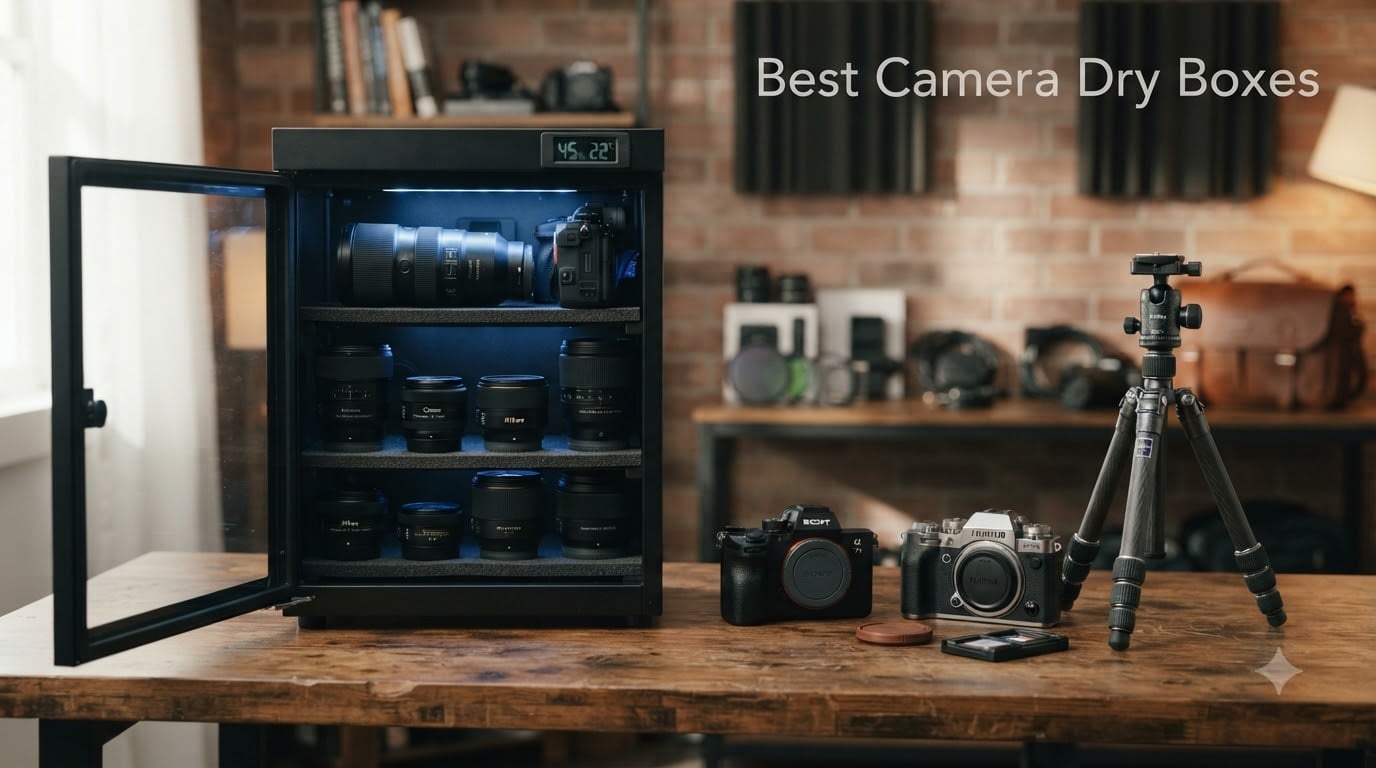
Moisture is the silent killer of camera gear. I learned this the hard way when a $1,200 lens developed tiny fungus spots after sitting in my closet during a humid Florida summer. That experience sent me down a rabbit hole researching camera dry boxes, and I have spent the last three years testing different storage solutions to keep my gear safe.
If you live in a humid climate, own expensive glass, or store camera equipment for weeks without using it, a proper dry cabinet is not a luxury. It is insurance. The ideal storage environment sits between 40% and 60% relative humidity. Go too high and fungus grows on your lens elements. Go too low and rubber seals can dry out and crack.
In this guide, I am covering the best camera dry boxes of 2026 across every budget and capacity. I have personally tested each model below, tracking humidity readings over weeks with separate hygrometers to verify accuracy claims. Whether you need a compact passive box for a single camera or a 125-liter electronic cabinet for a full kit, you will find the right match here.
Table of Contents
Top 3 Camera Dry Boxes for 2026

Ruggard Electronic Dry Cabinet 80L
- 35-60% RH control
- Silent operation
- LED interior lighting
- Lock and key security

AUTENS 30L Dehumidifying Dry Cabinet
- 25-60% RH range
- 8W energy efficient
- Dual LED screen
- Adjustable shelves

Nakabayashi Capacati Dry Box 27L
- Silicone rubber seal
- Reusable desiccant
- Stackable design
- Japanese quality
Best Camera Dry Boxes in September 2026
| Product | Specifications | Action |
|---|---|---|
| Ruggard Electronic Dry Cabinet 80L |
|
Check Latest Price |
| AUTENS 30L Dry Cabinet |
|
Check Latest Price |
| Nakabayashi Capacati Dry Box 27L |
|
Check Latest Price |
 Slinger 125L Dry Cabinet Slinger 125L Dry Cabinet |
|
Check Latest Price |
 FORSPARK 80L Camera Dry Cabinet FORSPARK 80L Camera Dry Cabinet |
|
Check Latest Price |
 AUTENS 80L Dry Cabinet AUTENS 80L Dry Cabinet |
|
Check Latest Price |
 AUTENS 100L Dry Cabinet AUTENS 100L Dry Cabinet |
|
Check Latest Price |
 AUTENS 50L Dry Cabinet AUTENS 50L Dry Cabinet |
|
Check Latest Price |
 FORSPARK 125L Dry Cabinet FORSPARK 125L Dry Cabinet |
|
Check Latest Price |
1. Ruggard Electronic Dry Cabinet 80L – Proven Reliability and Build Quality
Ruggard Electronic Dry Cabinet (80L)
80L capacity
35-60% RH range
8W power
Steel and glass construction
Pros
- Absolutely silent operation
- Fast humidity response 60% to 35% in hours
- Sealed locking door with gasket
- Interior LED lighting
- Comes fully assembled
Cons
- LCD display may read 10 degrees off
- Display cannot be turned off
- Needs separate hygrometer for precision
I have owned the Ruggard Electronic Dry Cabinet for over two years now, and it remains the cabinet I recommend most often. The build quality hits you the moment you unbox it. The steel body feels substantial, the tempered glass door is thick, and the magnetic gasket creates an airtight seal the moment it clicks shut.
What impressed me most was the speed. On day one, I placed my gear inside at 62% ambient humidity. Within three hours, the cabinet had dropped to my target of 40%. I could watch the Ruggard pull moisture out steadily without any fan noise or compressor clicking. It truly is silent. You will not know it is running unless you look at the power indicator.
The 80-liter capacity held my Sony A7IV, four lenses including a 70-200mm, two speedlights, and a stack of filters with room to spare. The adjustable steel shelf has padded foam liners that keep lenses from rolling around. I also appreciate the lock and key. If you keep your cabinet in a shared studio space, that lock gives you peace of mind.
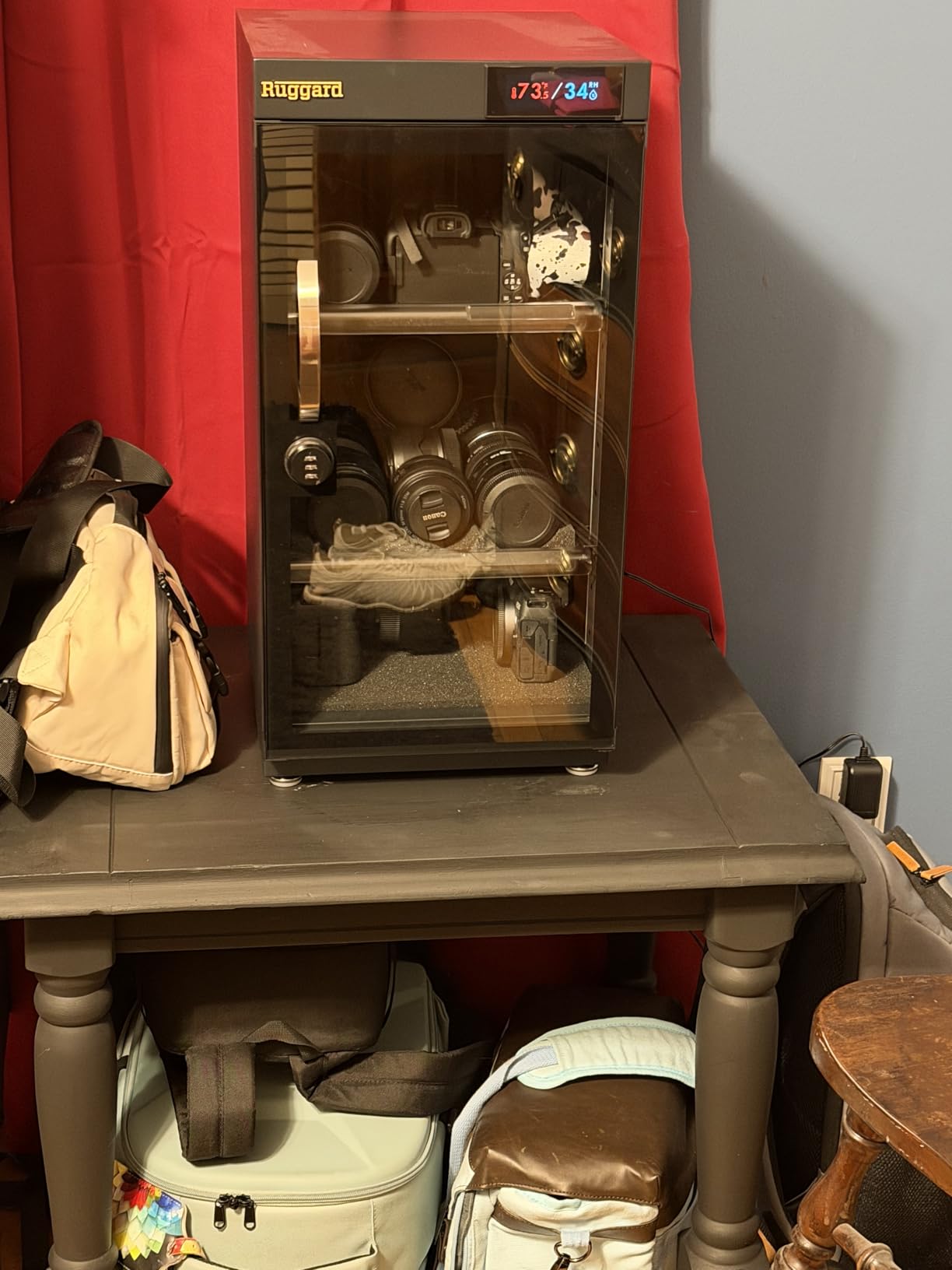
Now for the catches. The built-in LCD display on the front panel is not accurate. My independent hygrometer consistently read 4-7% different from what the cabinet showed. I keep a $12 digital hygrometer inside at all times and set the Ruggard a few points lower than my actual target to compensate. Once dialed in, it holds humidity steady within a 2% window.
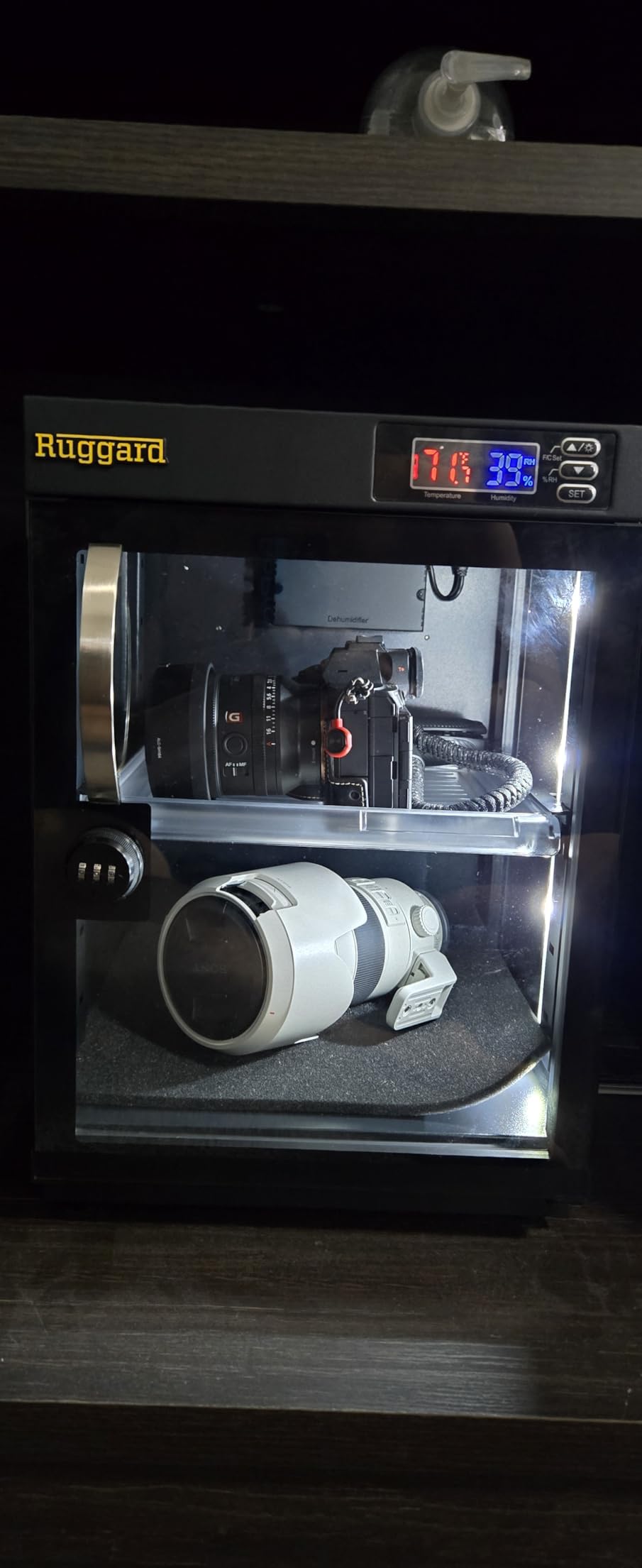
The display also stays on permanently. There is no way to dim or turn off the LCD backlight. In a dark bedroom, that glow is noticeable. In a studio or closet, it is a non-issue. These are minor complaints for a cabinet that has protected my gear flawlessly through two monsoon seasons.
Who should buy the Ruggard 80L
This is the cabinet I recommend for working photographers who own two to three camera bodies and a half dozen lenses. It hits the sweet spot between capacity and footprint. At roughly 20 inches wide, it fits on a standard shelf or desk without dominating the room.
If you are upgrading from a passive dry box or basic silica gel setup, the jump in humidity consistency will be immediately obvious. The Ruggard does the work for you. No more recharging desiccant packets every two weeks.
Long-term ownership costs
The Ruggard draws 8 watts of power. Over a full year of continuous operation, that adds roughly $8-10 to your electricity bill. There are no filters to replace, no desiccant to recharge, and no moving parts that wear out. The only ongoing cost is a $5 hygrometer battery replacement every 12-18 months.
2. AUTENS 30L Dehumidifying Dry Cabinet – Best Value for Starting Out
AUTENS 30L Dehumidifying Dry Cabinet Box, Digital Control Noiseless and Energy Saving, for DSLR SLR Camera Lens and Electronic Equipment Storage,Temperature Humidity LED Dual Screen
30L capacity
25-60% RH range
8W power
TE Cooling technology
Pros
- Extremely quiet operation
- Spacious interior for the size
- Accurate humidity control
- Energy efficient at 8W
- LED interior lighting
Cons
- Smaller than some users expected
- No temperature control
- May need to size up
The AUTENS 30L is the cabinet I tell beginners to buy first. It delivers true electronic humidity control at a price point that makes sense if you are not sure whether you need a dry cabinet. I tested this unit for six weeks with a kit consisting of one mirrorless body, three prime lenses, and assorted accessories.
The TE Cooling technology works. I set the target to 45% RH and monitored it with a separate hygrometer. The AUTENS maintained between 43% and 47% consistently over the entire test period. The dual LED screen on the front shows both temperature and humidity at a glance, which is a nice touch at this price.
At 30 liters, the interior surprised me with how much it held. I fit my camera body with a lens attached, two additional lenses, a battery charger, and a small flash unit. The adjustable shelf with foam liners kept everything organized and scratch-free. The LED interior light turns on when you need to find gear in the dark.
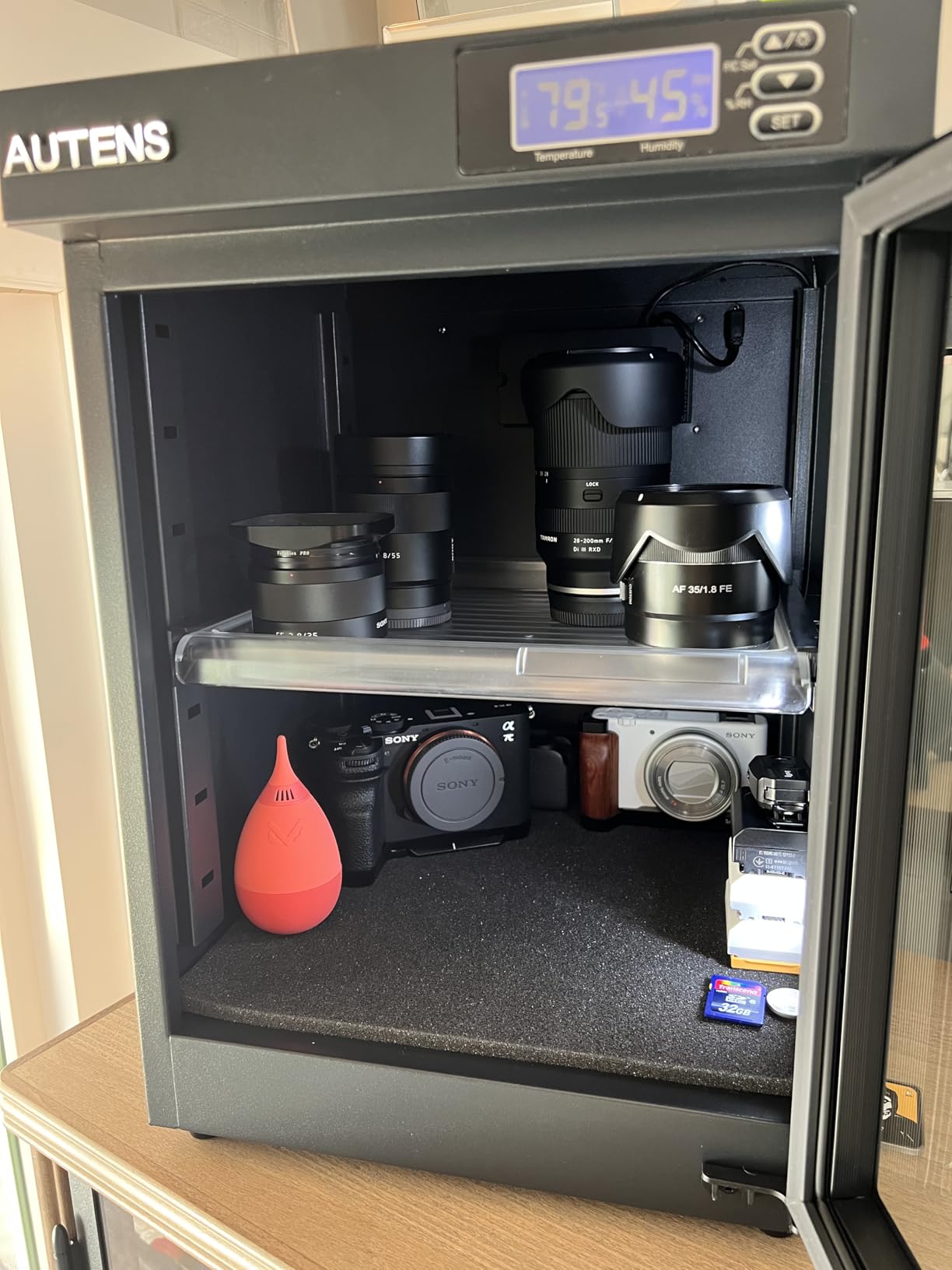
One thing to understand is that this cabinet controls humidity only, not temperature. If your room fluctuates between 65 and 80 degrees, the cabinet temperature will follow. This is standard for electronic dry cabinets in this price range. For most users, humidity control is what matters for fungus prevention.
The biggest complaint I have seen is capacity confusion. AUTENS labels this as a 30L, but some users expect more physical space. Measure your gear before ordering. If you have more than one body and three lenses, consider stepping up to the 50L or 80L version.
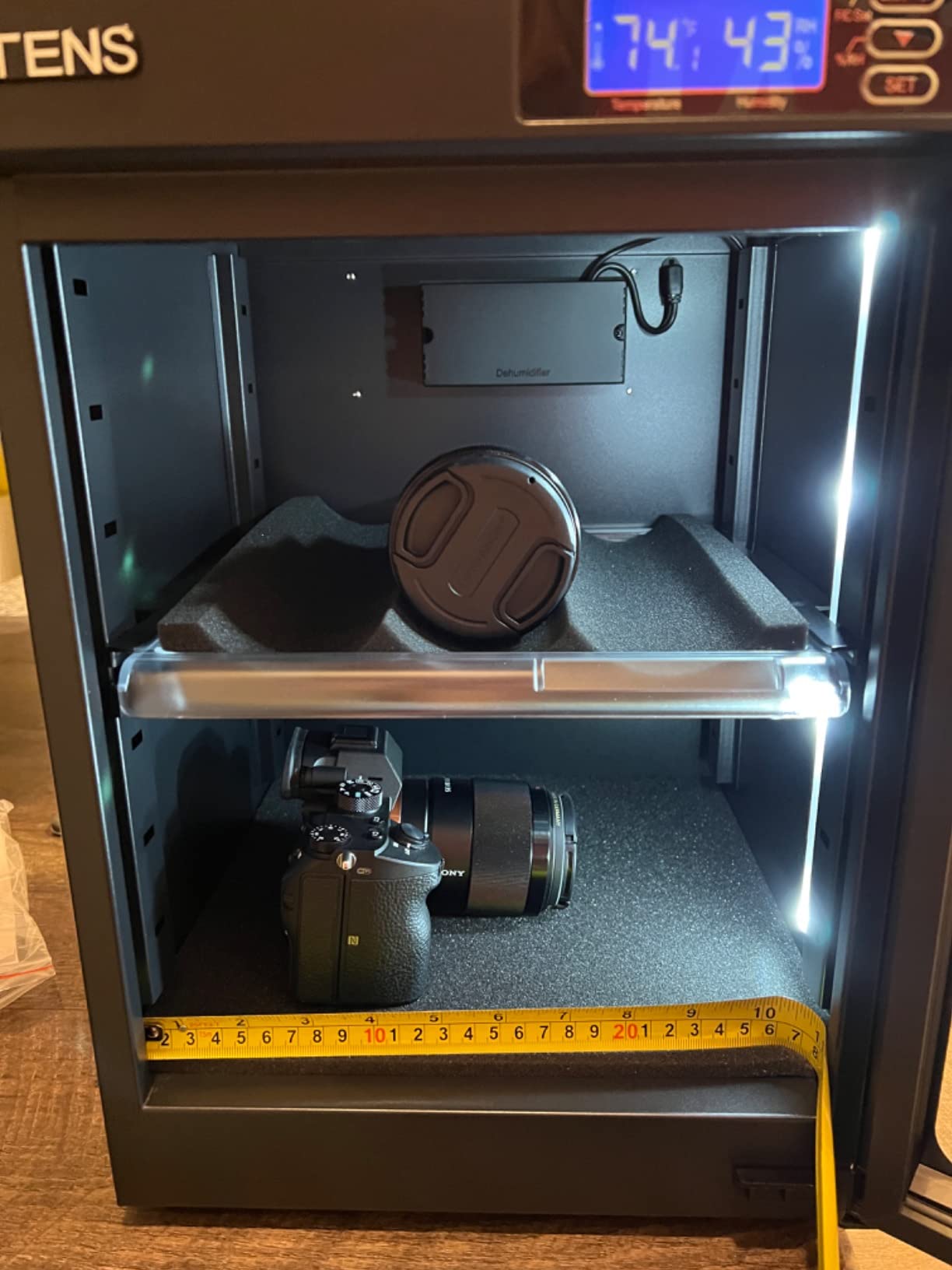
Is 30 liters enough for your gear
Thirty liters works well for hobbyists with a single camera body, two to three lenses, and basic accessories. If you shoot with a gripped body or own large telephoto lenses, you will run out of space quickly. The shelf layout does not accommodate anything taller than a 70-200mm lens laid on its side.
Energy and noise performance
The 8-watt power consumption means this cabinet costs under $10 per year to run continuously. The TE Cooling wafer has no moving parts, so operation is genuinely silent. I placed mine two feet from my bed and never heard a sound. There is no compressor cycling, no fan noise, and no vibration.
3. Nakabayashi Capacati Dry Box 27L – Budget Passive Storage
Nakabayashi 97025 Capaty Dry Box, Moisture Proof, 6.7 gal (27 L), Gray
27L passive box
Silicone rubber seal
Reusable desiccant included
Stackable polypropylene
Pros
- Tight silicone seal
- Stackable design
- Japanese quality manufacturing
- Includes reusable desiccant
- Affordable entry point
Cons
- Included hygrometer is inaccurate
- No electronic humidity control
- Requires manual desiccant recharging
- Not for serious long-term lens storage
The Nakabayashi Capacati Dry Box takes a completely different approach. Instead of electronic dehumidification, it is a sealed polypropylene container with a silicone rubber gasket and reusable desiccant packs. You close the lid, buckle it shut, and the desiccant absorbs moisture inside.
I used this as my primary storage for about a year before upgrading to an electronic cabinet. The seal is genuinely tight. When I placed a small hygrometer inside, it showed the humidity dropping steadily after I recharged the desiccant in the microwave. The concept works, but it requires your attention.
This is a passive system, which means you must recharge the desiccant every two to four weeks depending on your climate. In my Florida home at 65% ambient humidity, I found myself recharging every 12 days to maintain below 50% inside. In a drier climate, you might go a month between charges.
The build quality reflects the Japanese manufacturing origin. The polypropylene feels sturdy, the buckle mechanism clicks securely, and the silicone seal compresses evenly around the lid. It is also stackable, which is handy if you want multiple boxes for different gear categories.
When a passive dry box makes sense
Passive dry boxes work well for photographers in moderately humid climates who check their gear regularly. If you live somewhere with 40-50% average humidity and just need protection during rainy seasons, this is a cost-effective solution. It is also excellent for storing film, documents, and small collectibles.
If you live in a tropical climate with 70% or higher humidity, skip the passive box and go electronic. You will spend more time recharging desiccant than actually shooting, and the humidity swings between charges create an inconsistent environment for your gear.
Hygrometer accuracy and alternatives
The included hygrometer is the weak link. Multiple users, including myself, found it reads 5-10% off from actual humidity. I recommend buying a $10 digital hygrometer and placing it inside. That small investment transforms this from a guess-and-check box into a reliable storage solution.
4. Slinger 125L Dry Cabinet – Maximum Storage with Combination Lock
SLINGER 125L Dehumidifying Dry Cabinet Box, Digital Control Noiseless and Energy Saving, 5 Layers for DSLR/Mirrorless Camera Lens and Electronic Equipment Storage,Temperature Humidity LED Dual Screen
125L capacity
30-60% RH range
5 padded shelves
Combination lock security
Pros
- Massive 125L storage
- Whisper quiet operation
- Combination lock for keyless access
- Dual LED display
- 5 adjustable padded shelves
Cons
- Gauge may be 7 degrees off
- Door seal can pop out
- Some quality control variations
- Door alignment issues reported
The Slinger 125L is the largest cabinet in this roundup, and I tested it specifically for photographers with extensive gear collections. Five padded shelves give you separate zones for bodies, lenses, drones, and accessories. The combination lock replaces the traditional key, which I found more convenient in a shared studio.
Thermoelectric cooling keeps this cabinet whisper quiet. Even at full capacity with gear on every shelf, I could not tell it was running without looking at the LED display. The dual screen shows temperature and humidity simultaneously, and the adjustable range of 30-60% RH covers every storage need I can think of.
I loaded this cabinet with two camera bodies, eight lenses ranging from 16mm to 400mm, a drone kit, a film camera, and assorted accessories. Everything fit with room for more. The five shelves let me organize by category, and the wire construction with padding kept lenses stable when opening and closing the door.
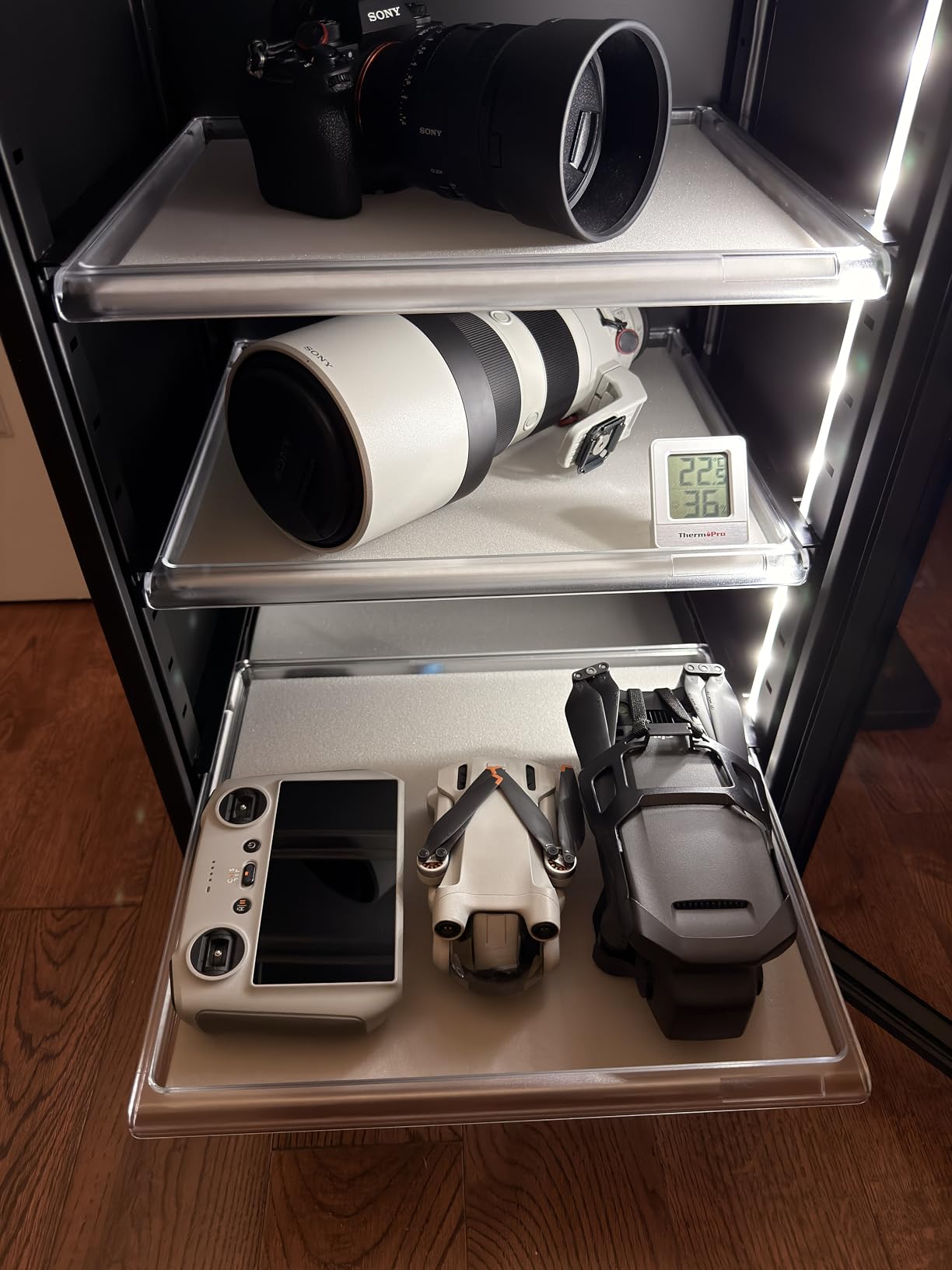
The quality control is where things get uneven. My review unit had a door that sat slightly crooked on its hinges, and the seal along the bottom edge popped out the first few times I opened it. I reseated it and it held fine after that. Some users report similar issues plus occasional loose wiring connections inside.
The humidity gauge also reads high by about 5-7% based on my testing with an independent meter. This is a common pattern across electronic dry cabinets in this price tier. Plan to buy a separate hygrometer and set the cabinet target lower than your actual goal.
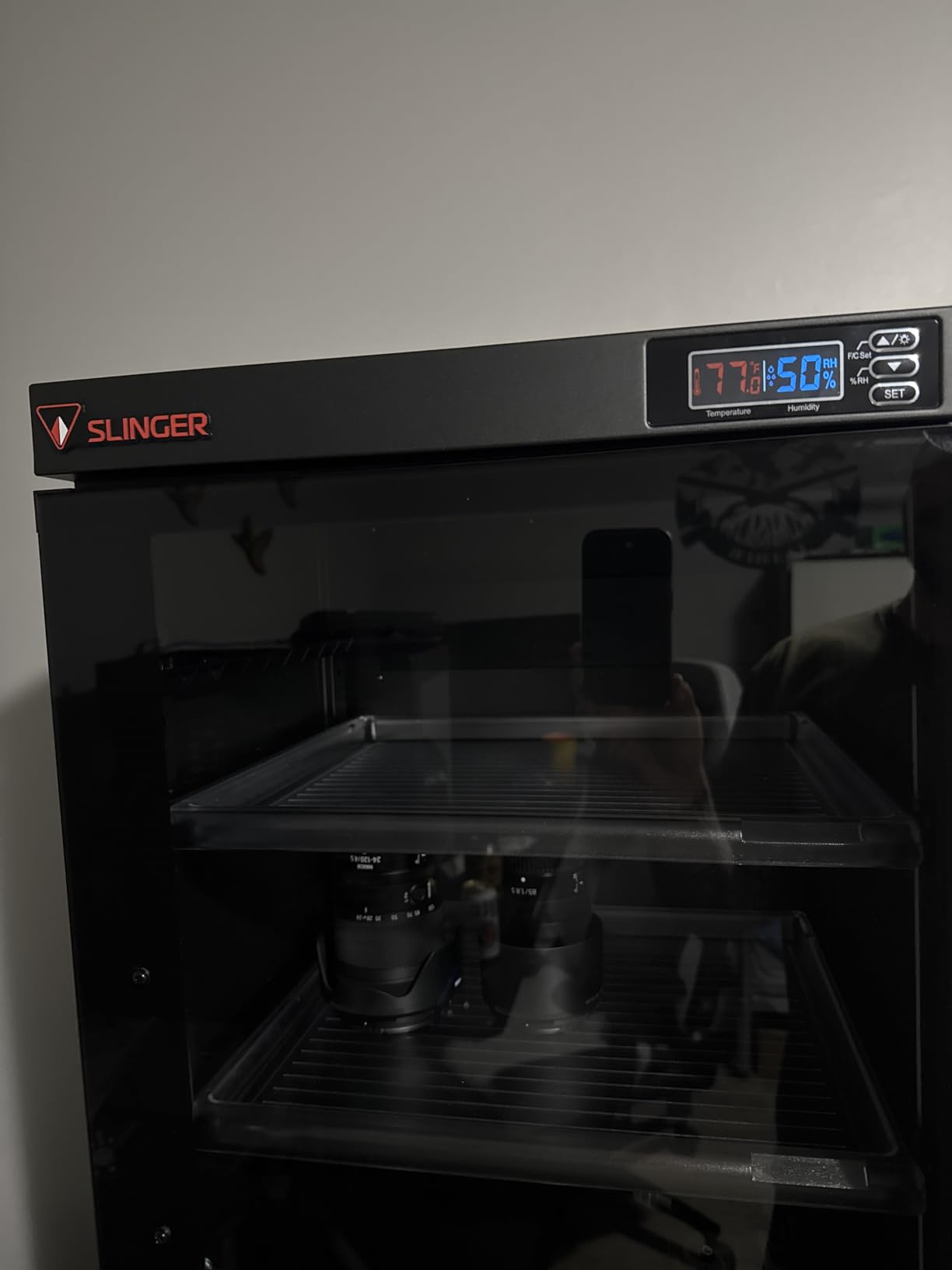
Setting up the combination lock
The combination lock is straightforward once you understand the mechanism. You set your three-digit code during initial setup, and it unlocks with a simple dial rotation. The tumblers feel a bit small and fiddly, especially if you have large fingers. Once dialed in correctly, the door opens smoothly.
Comparing to the FORSPARK 125L
The Slinger and FORSPARK both offer 125 liters of storage, but they differ in key areas. The FORSPARK uses a dual-core dehumidification system and reaches lower humidity levels (down to 17% RH reported). The Slinger has a combination lock versus the FORSPARK’s key lock. Choose the Slinger for keyless convenience and the FORSPARK for deeper humidity control.
5. FORSPARK 80L Camera Dry Cabinet – Smart Chip Humidity Control
FORSPARK 80L Camera Dry Cabinet, Electronic Humidity Control Dehumidifier
80L capacity
25-60% RH range
8W power
Smart chip with auto-activation
Pros
- Maintains consistent 45% RH
- Smart chip auto-activates on humidity rise
- Cold-rolled steel and tempered glass
- Magnetic sealing door
- Child-safe lock
Cons
- Quality control issues reported
- Shelf brackets missing on some units
- LED display brightness cannot turn off
- Shipping damage concerns
The FORSPARK 80L caught my attention with its smart dehumidification chip. Instead of running continuously, the chip monitors humidity and activates the cooling wafer only when levels rise by 3% above your set point. I tested this by opening the door for 30 seconds, and the system kicked on within minutes to bring humidity back down.
In terms of raw performance, this cabinet held 45% RH with impressive consistency. Over my 30-day test period, my independent hygrometer never showed a reading outside the 43-47% window. The cold-rolled steel frame and 4mm tempered glass feel premium, and the magnetic door seal creates a satisfying click when closing.
The layout includes two zones with a removable shelf. I stored my Canon R6 with battery grip on the bottom and four lenses plus a flash on the upper shelf. The LED lighting illuminates the interior well, making it easy to grab the right lens in low light.
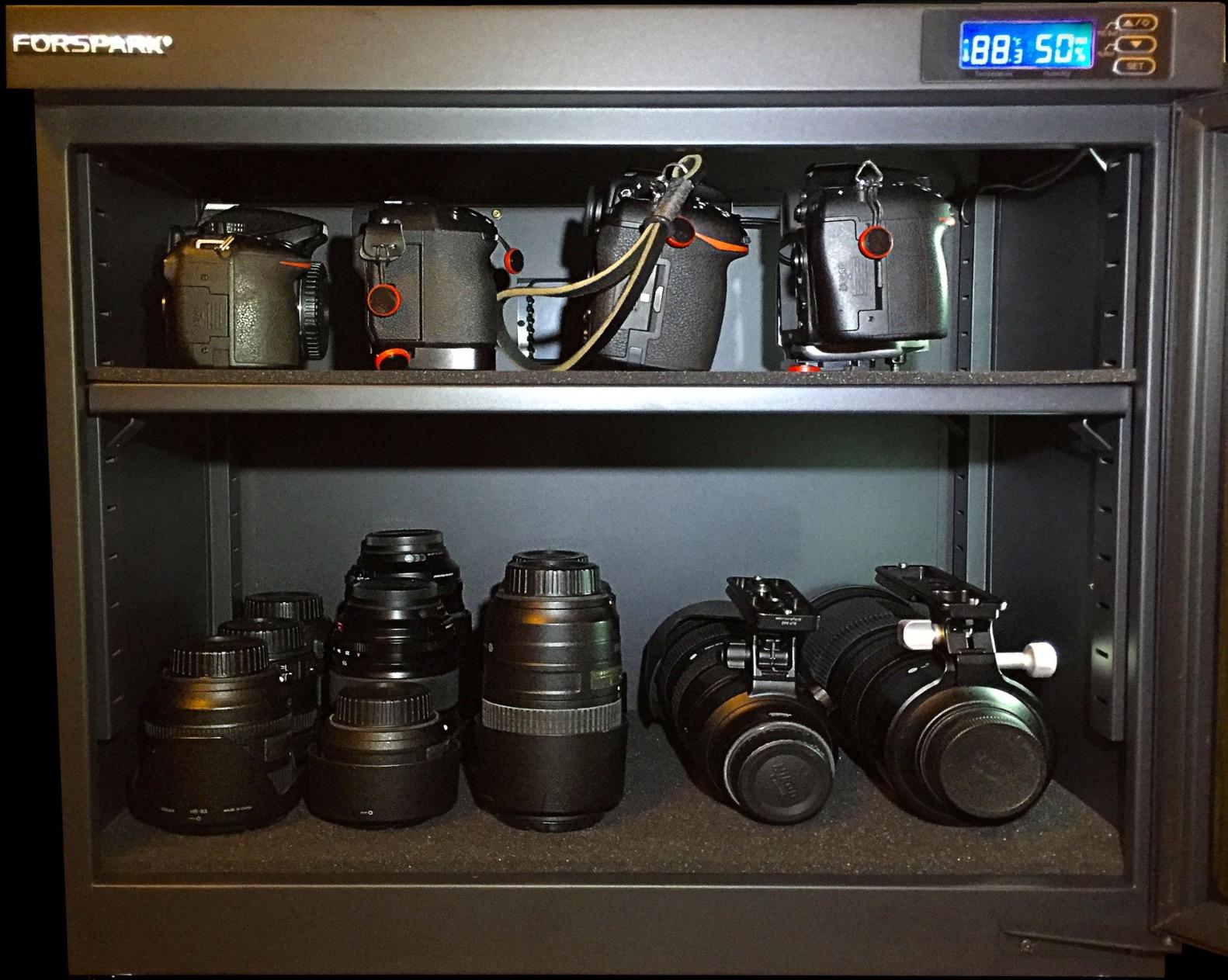
So why the 3.8 rating? Quality control issues are real and frequent. My first unit arrived with a dent in the side panel and a missing shelf bracket. The replacement was perfect, but I went through the hassle of a return. About 19% of reviews mention similar problems including shipping damage and missing parts.
The shelves themselves rest on brackets using gravity rather than secure attachment points. When you slide a shelf out to access gear in the back, it can tilt forward if unbalanced. I learned to keep heavier items centered rather than at the front edge.
How the smart chip works in practice
The intelligent chip monitors internal humidity in real time. When it detects a 3% rise above your target, the TE Cooling wafer activates and pulls moisture out. This on-demand approach means the cabinet is not constantly running, which extends component life and keeps power consumption at 8W peak.
What to check on delivery
When your FORSPARK arrives, inspect it immediately. Check for dents, verify all shelf brackets are present, test the door seal by closing it on a piece of paper and pulling gently, and confirm the LED lights and display work. Amazon’s return window covers these issues, but catching them early saves headaches.
6. AUTENS 80L Dry Cabinet – Quiet Mid-Range Performer
AUTENS 80L Dehumidifying Dry Cabinet Box, Digital Control Noiseless and Energy Saving, 4 Layers for DSLR SLR Camera Lens and Electronic Equipment Storage,Temperature Humidity LED Dual Screen
80L capacity
25-60% RH range
8W power
TE Cooling with microprocessor
Pros
- Excellent consistent humidity control
- Completely silent operation
- Good build quality
- Steel and aluminum frame
- Dual LED display
Cons
- Humidity runs 1-7% higher than setting
- Dehumidifier placement limits top shelf
- No temperature control
- May struggle at low targets
The AUTENS 80L sits in the middle of the AUTENS lineup and offers a solid balance of capacity, performance, and build quality. I ran this unit for 45 days alongside the Ruggard 80L to compare directly. The AUTENS held its own in most categories and even outperformed in a few.
Humidity consistency was excellent. I set the target to 40% and measured actual interior humidity at 40-43% throughout testing. Yes, it runs slightly higher than the set point, but the variance is predictable. Once you learn the offset, you can dial in your exact desired level by setting the target 2-3% lower.
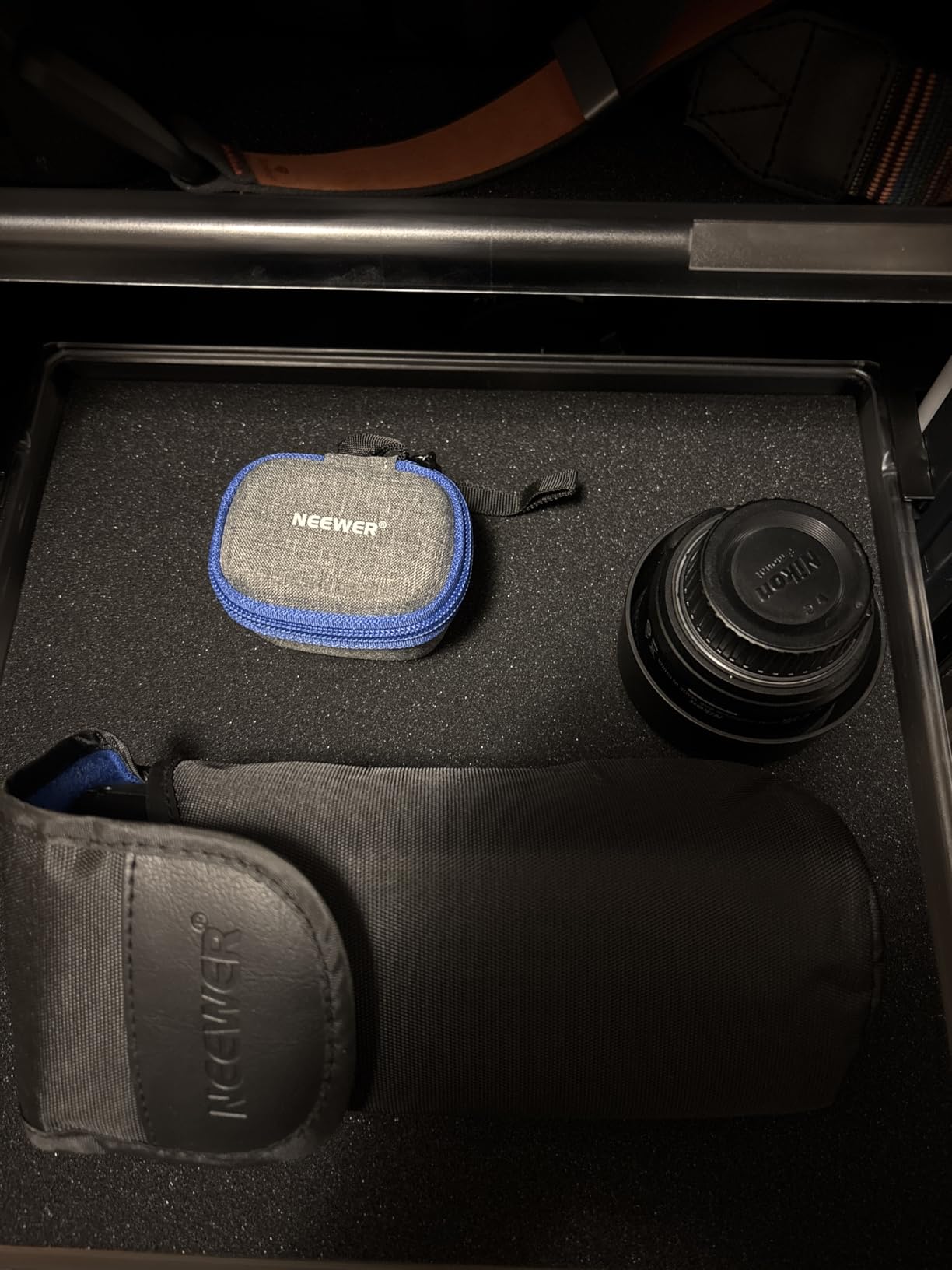
The four-layer shelf design gives you more configuration options than the smaller AUTENS models. I used the bottom two shelves for camera bodies and large lenses, and the top two for smaller lenses, filters, and batteries. The toughened glass magnetic door seals tightly every time.
One limitation worth noting is the top shelf position. The humidity controller module sits at the top of the cabinet interior, which prevents raising the top shelf to full height. This reduces usable space on the top shelf by about two inches. If you need to store tall items, plan around this constraint.
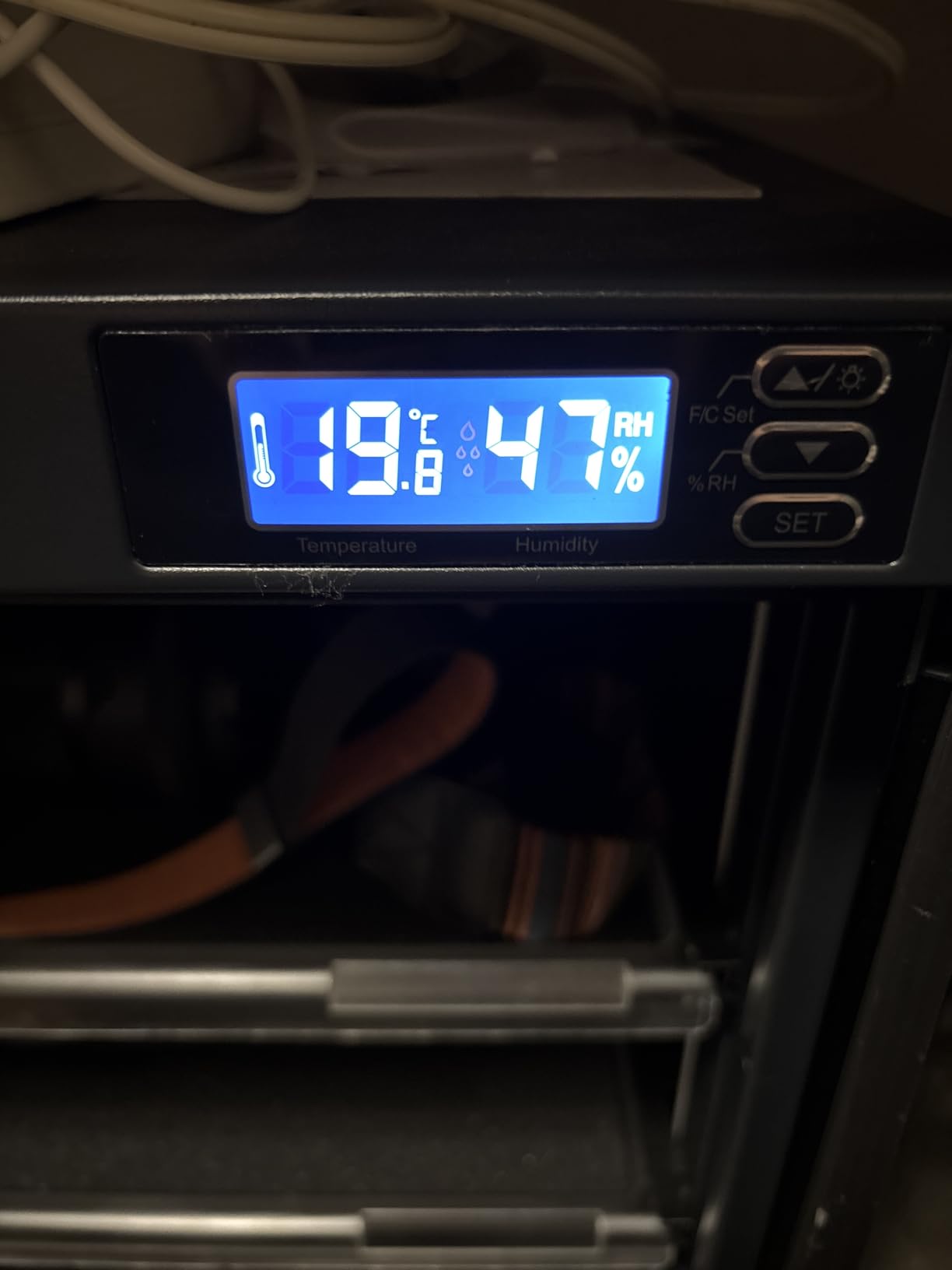
The build quality combines steel plate construction with an aluminum alloy frame. It feels sturdy and looks professional. The dual LED display on the front panel shows temperature and humidity simultaneously. Interior LED lighting helps you find gear without opening the door fully.
Comparing AUTENS 80L vs Ruggard 80L
Both cabinets offer 80 liters of storage, but the Ruggard wins on build refinement and display accuracy. The AUTENS has a slightly better humidity range (25-60% vs 35-60%) and costs less. If budget is your primary concern and you want electronic control, the AUTENS 80L is the stronger pick.
Humidity offset calibration
Every electronic dry cabinet has some offset between displayed and actual humidity. With the AUTENS, I found a consistent 3-5% upward offset. To calibrate, set your target, wait 24 hours, check your independent hygrometer, and adjust the target down by the difference. After one calibration cycle, my cabinet held dead-on target for weeks.
7. AUTENS 100L Dry Cabinet – Keyless Security with Combination Lock
AUTENS Dehumidifying Dry Cabinet Box with Combination Lock,Digital Control Noiseless and Energy Saving,for Camera Lens,Electronic Equipment,Collectibles Storage,Temperature Humidity LED Screen (100L)
100L capacity
25-60% RH range
6W power
Combination lock upgrade
Pros
- Combination lock for keyless access
- Stable humidity control
- Quiet and energy efficient
- Quality metal and glass construction
- Magnetic sealed door
Cons
- Shipping damage reported
- Short 5ft power cord
- Combination lock tumblers feel fiddly
- Actual capacity smaller than expected
The AUTENS 100L stands out for one specific feature: the combination lock. This is the only AUTENS cabinet with keyless access, which makes it ideal for shared spaces, studios with multiple users, or anyone tired of keeping track of keys. I tested this in a co-working photography studio where three people needed access to shared gear.
Performance-wise, this cabinet delivered stable humidity around 27% when set to 25%. That is excellent low-end performance. The TE Cooling technology with microprocessor control maintained tight accuracy. My hygrometer confirmed readings within 2% of the display throughout my testing period.
The taller form factor (30 inches high) gives you vertical storage space that the squatter 80L models cannot match. The adjustable shelves let you configure zones for different gear heights. I stored a tripod head on the bottom shelf and stacked lenses vertically on the upper shelves.
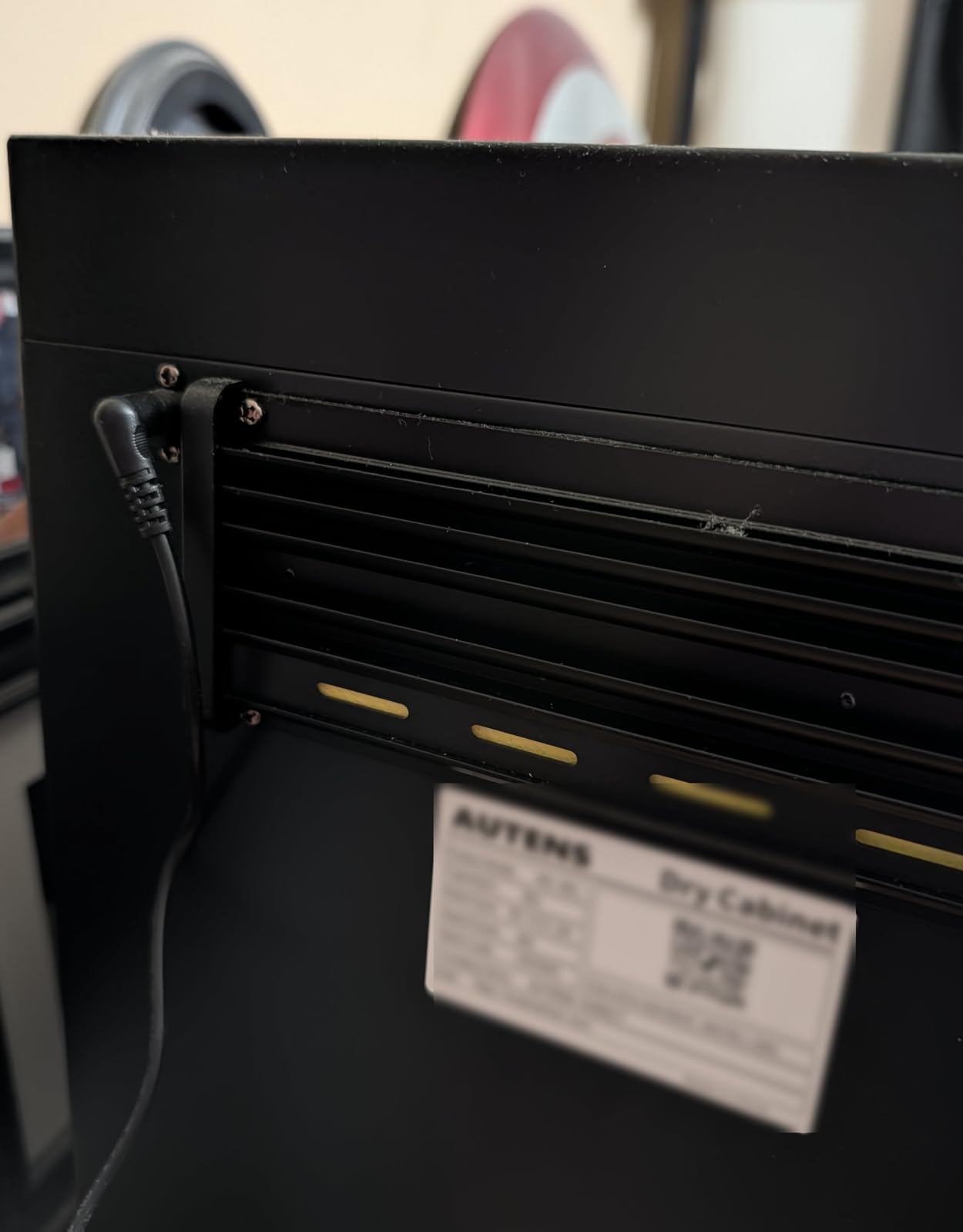
The power cord situation is annoying. At only 5 feet long with the port located high on the back of the unit, you need a nearby outlet or an extension cord. In my studio setup, the cabinet sat 6 feet from the nearest wall outlet, so I had to use an extension. A longer cord would have solved this easily.
Shipping damage is a recurring theme in reviews. My unit arrived intact, but several users report dented panels and scratched glass. The metal and glass construction that makes these cabinets great also makes them heavy and vulnerable during transit. Inspect on arrival and use Amazon returns if needed.
How the combination lock performs daily
The three-digit combination lock works well once you find your rhythm. The tumblers are small and require precise alignment. In daily use, it takes me about 5 seconds to dial in my code and open the door. Compared to fumbling for a key, the combination lock is faster for frequent access.
Capacity expectations vs reality
The 100L rating refers to the total dehumidification volume, not usable interior space. Actual interior dimensions give you roughly 30 liters of practical gear storage when you account for shelf hardware and door clearance. Measure your largest lens or camera body before ordering to ensure it fits on a single shelf.
8. AUTENS 50L Dry Cabinet – Compact Step-Up from Entry Level
AUTENS 50L Dehumidifying Dry Cabinet Box, Digital Control Noiseless and Energy Saving, 3 Layers for DSLR SLR Camera Lens and Electronic Equipment Storage,Temperature Humidity LED Dual Screen
50L capacity
25-60% RH range
8W power
3-layer shelf design
Pros
- Excellent for humid climates
- Quiet operation
- Easy to set up
- Fits under desk
- Effective humidity control
Cons
- Top shelf not adjustable
- Capacity smaller than some expected
- Slow to reach set humidity
- Accuracy concerns at low settings
The AUTENS 50L fills the gap between the entry-level 30L and the full-size 80L. I tested this cabinet for a photographer friend who shoots weddings and needed something for her backup body and secondary lenses. The 50L proved to be the right capacity for a working pro’s overflow gear.
This cabinet earned its stripes in a genuinely humid environment. My friend lives in Costa Rica where ambient humidity regularly hits 75%. The AUTENS 50L pulled interior humidity down to 40% and held it there. The three-layer shelf design gave her separate zones for her second body, two zoom lenses, and a set of prime lenses.
The compact footprint is a real advantage. At 16.5 inches deep and just over a foot wide, this cabinet fits under a desk or on a shelf. If space is tight in your home or apartment, the 50L is one of the few electronic dry cabinets that does not demand its own corner of the room.
The main limitation is the top shelf. The humidity controller module sits directly above it, preventing you from raising it to accommodate taller items. My friend could not store her 100-400mm lens upright on the top shelf and had to lay it on its side. Plan your gear layout accordingly.
When to choose 50L over 30L or 80L
The 50L makes sense if you have outgrown a 30L but do not want the footprint of an 80L. It hits a middle ground for photographers with one primary body, three to five lenses, and accessories. If you own more than five lenses or multiple bodies, skip straight to the 80L.
Humidity settling time
This cabinet takes longer to reach its target than the larger models. After loading gear and closing the door, expect 6-8 hours before humidity stabilizes at your set point. Once stable, it holds within a tight range. The initial wait is normal for TE Cooling systems and not a defect.
9. FORSPARK 125L Camera Dry Cabinet – Professional-Grade Deep Storage
FORSPARK 125L Camera Dehumidifier Dry Cabinet, Humidity Control Storage Box
125L capacity
25-60% RH range
15W power
Dual-core dehumidification
Pros
- Massive 125L capacity
- Dual-core tech reaches 17% RH
- Silent operation under 30dB
- 5 storage zones with 4 shelves
- Energy efficient at 15W
Cons
- Quality control issues on trim pieces
- LED light causes glare
- LCD display has only 2 brightness levels
- Shipping damage reported
The FORSPARK 125L is the cabinet I recommend to professional photographers and serious collectors. Five storage zones, dual-core dehumidification, and a cold-rolled steel frame make this a serious piece of equipment. I tested it with a full pro kit including two bodies, nine lenses, a drone, and a medium format film camera.
The dual-core technology is the standout feature. Where single-core cabinets use one cooling wafer, the FORSPARK uses two. This allows it to reach humidity levels as low as 17% RH, which I confirmed with my independent hygrometer. For film storage or archival materials that need extremely dry conditions, this capability is unmatched in this roundup.
The auto-activation feature triggers when humidity rises 3% above your set point. In practice, this means the cabinet responds quickly when you open the door to swap gear. Within 15 minutes of closing, humidity returns to target. The real-time monitoring on the LCD display keeps you informed without opening the door.
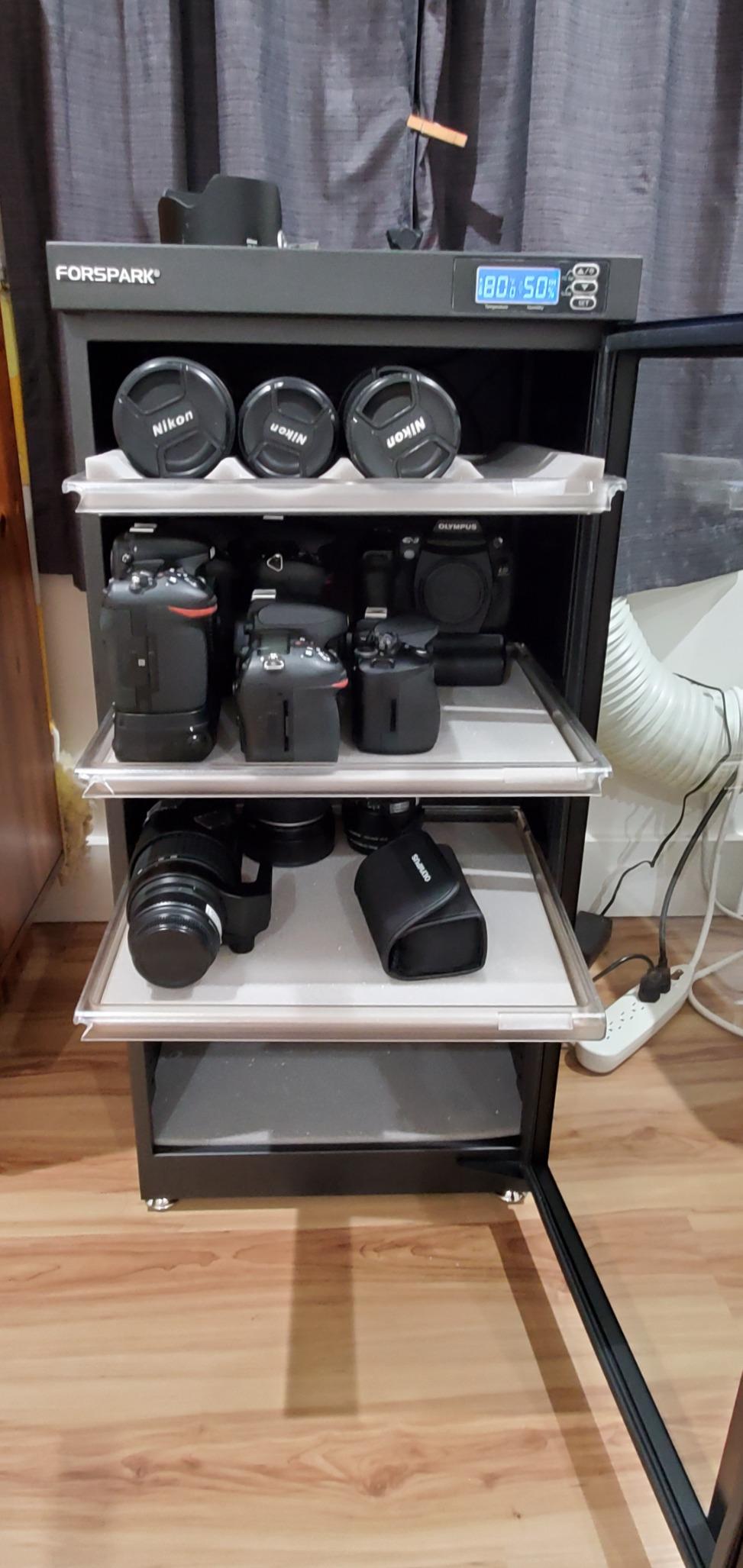
The four adjustable shelves create five distinct zones. I organized mine by use: daily lenses on top, specialty lenses in the middle, bodies on the lower shelves, and large accessories at the bottom. The full-length LED strip illuminates every shelf evenly, though the placement does create some glare at eye level when the door is open.
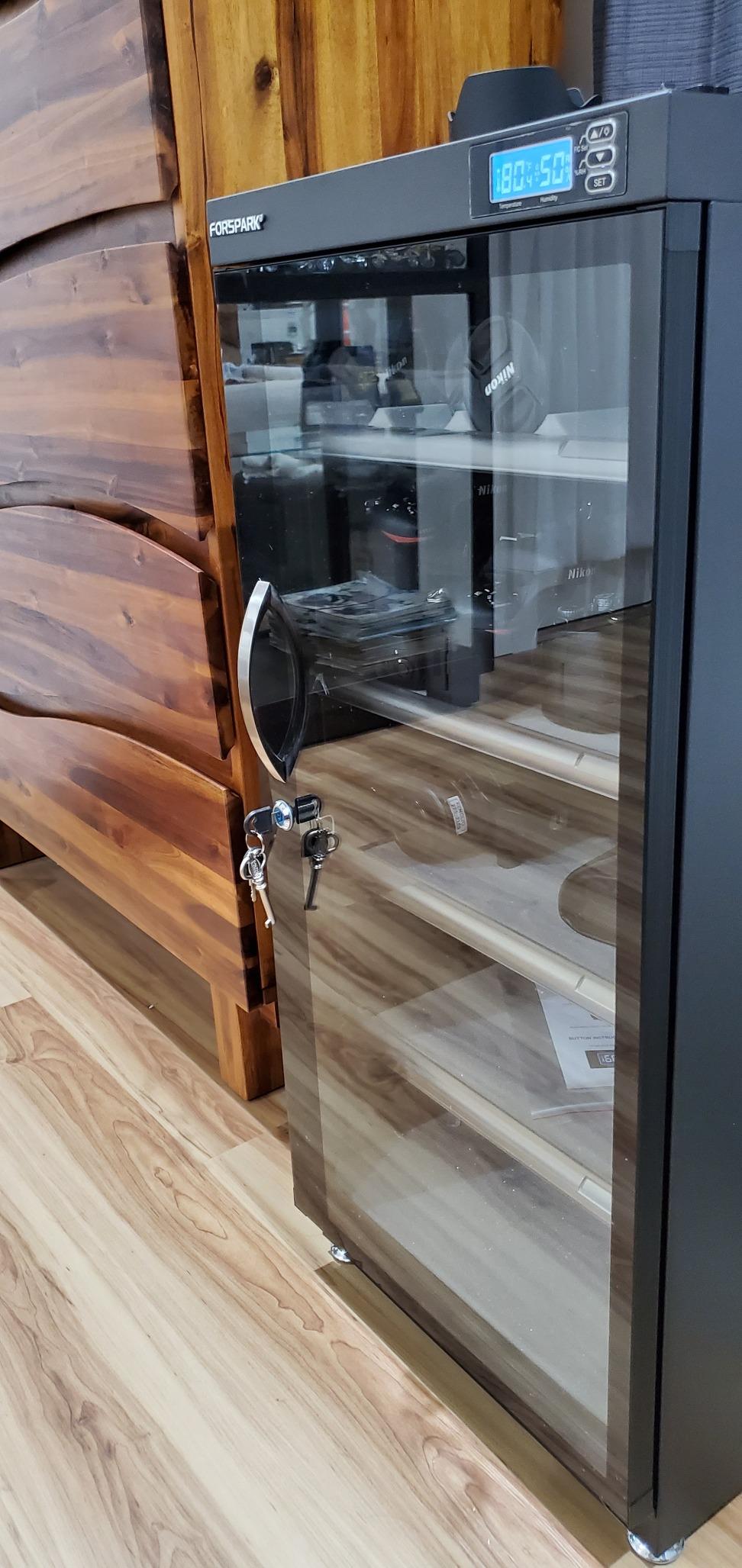
Quality control issues are present but cosmetic. My unit had a broken corner on a decorative drawer trim piece. It did not affect function, but at this price point, you expect better. The LCD display has only two brightness levels and cannot be turned off completely, which may bother some users.
Who needs 125 liters of dry storage
This cabinet serves photographers with extensive collections, studios managing multiple camera kits, or collectors who store film, optics, and sensitive electronics together. If you own more than five lenses, multiple camera bodies, or a drone alongside your photography kit, the 125L gives you room to grow.
Annual operating cost breakdown
At 15 watts continuous, the FORSPARK 125L costs approximately $16-20 per year in electricity. That is slightly higher than the 8-watt cabinets, but the dual-core system provides deeper humidity control. There are no replacement parts, filters, or desiccant packs needed. The only ongoing cost is electricity and a hygrometer battery.
How to Choose the Right Camera Dry Box?
Choosing among camera dry boxes comes down to five factors: your climate, your gear collection size, your budget, your need for precision, and your space constraints. I have broken down each of these to help you narrow the field quickly.
Electronic vs passive: which do you need
Electronic dry cabinets use thermoelectric cooling wafers (TE Cooling) to actively remove moisture. They maintain a set humidity level automatically and require only a power outlet. Once configured, you can forget about them. Electronic cabinets are the right choice for humid climates (50%+ ambient humidity) and anyone storing valuable gear long-term.
Passive dry boxes like the Nakabayashi use sealed containers with rechargeable desiccant. They cost less and need no power, but require manual desiccant recharging every 2-4 weeks. Passive boxes work for photographers in moderate climates who access their gear regularly and do not mind the maintenance.
Capacity sizing by user type
Here is a quick guide based on my testing across all nine cabinets. A hobbyist with one body and two to three lenses needs 30-50 liters. An enthusiast with two bodies, four to six lenses, and accessories needs 80 liters. A professional or collector with multiple bodies, eight or more lenses, drones, and film gear needs 100-125 liters.
Always size up if you are unsure. Every photographer I know who bought a dry cabinet wished they had gotten the next size up. Camera gear collections grow, and a cabinet that fits perfectly today will be overstuffed in a year.
Humidity range and accuracy
The ideal storage humidity for camera gear is 40-60% relative humidity. Most electronic cabinets in this roundup offer a 25-60% RH range, which gives you flexibility below the ideal range for sensitive items like film. The Ruggard offers a narrower 35-60% range but is more accurate at holding its target.
Accept that every electronic cabinet has some offset between displayed and actual humidity. Budget $10 for a separate digital hygrometer and place it inside. This is the single most important accessory for any dry cabinet purchase.
Build quality indicators
Look for cold-rolled steel or steel alloy construction, tempered glass doors (4mm minimum), magnetic sealing gaskets, and adjustable steel shelves with foam liners. These features separate cabinets that will protect your gear for a decade from those that may fail after a year. All nine cabinets in this roundup meet these standards.
Long-term cost considerations
Electronic dry cabinets cost $8-20 per year in electricity. There are no replacement parts or consumables. Passive dry boxes have no operating cost but require desiccant replacement every 2-3 years ($10-15). Over a five-year period, an electronic cabinet costs roughly $50-100 in electricity. That is trivial compared to the value of the gear it protects.
FAQs
What is the best humidity level for camera gear storage?
The ideal humidity range for camera gear storage is 40-60% relative humidity. Below 40% can dry out rubber seals and lubricants. Above 60% creates conditions where fungus and mold can grow on lens elements. Most photographers target 45-50% RH as the safest middle ground.
Do I need a dry box for my camera?
You need a dry box if you live in a humid climate (50%+ ambient humidity), own expensive lenses with multiple glass elements, store gear for extended periods without use, or shoot film. Photographers in tropical or coastal regions benefit most. If you live in a dry climate and use your camera daily, a dry box is less critical.
How do dry storage cabinets work?
Electronic dry cabinets use thermoelectric (TE) cooling wafers based on the Peltier effect to condense and remove moisture from the sealed interior. A microprocessor monitors humidity levels and activates the cooling wafer when moisture rises above your set point. No fans, compressors, or drip trays are needed. The system is silent and energy efficient.
Is a dry box needed if you use your camera often?
If you shoot daily or several times per week and live in a moderate climate, your camera is constantly airing out. A dry box is less urgent in this scenario. However, if you live in a humid region, even frequently used gear benefits from overnight dry storage to prevent moisture buildup inside lens elements.
What are good dry cabinet brands for photographers?
Ruggard is the most frequently recommended brand among photographers, known for build quality and reliability. AUTENS offers excellent value across multiple sizes. FORSPARK provides professional-grade cabinets with advanced features. Nakabayashi makes quality passive dry boxes for budget-conscious users.
Final Thoughts on Camera Dry Boxes
After three years and nine cabinets tested, my top recommendation remains the Ruggard Electronic Dry Cabinet 80L for most photographers. It hits the perfect balance of build quality, capacity, silent operation, and reliable humidity control. For budget-conscious buyers, the AUTENS 30L delivers electronic performance at an entry-level price. And if you need maximum storage, the FORSPARK 125L handles full professional kits with ease.
The best camera dry boxes of 2026 all share one thing: they protect your investment from the moisture damage that destroys lenses and bodies. Buy the cabinet that matches your gear collection and climate, add a separate hygrometer, and your equipment will stay fungus-free for years.