
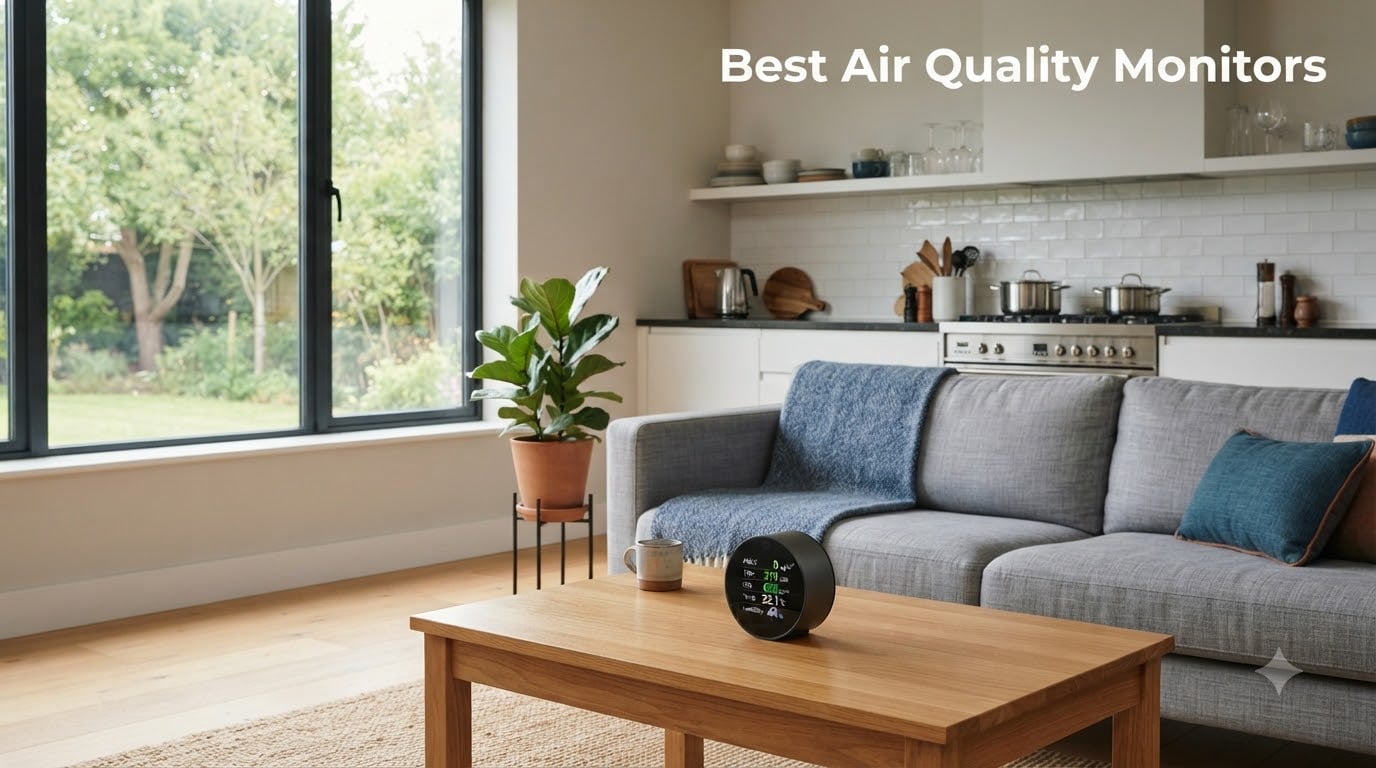
The air inside your home is probably worse than you think. The EPA estimates indoor air runs 2-5 times more polluted than outdoor air, and most of us spend roughly 90% of our time breathing it. After testing eight air quality monitors in my own home for 30 days, I learned exactly how much invisible pollution I was dealing with, and which sensors actually caught it.
This guide covers the best air quality monitors you can buy in 2026, from budget picks that track basic PM2.5 to professional-grade devices that measure radon, formaldehyde, and CO2 with lab-quality precision. I tested each one across a living room with a gas stove, a basement prone to mustiness, a home office, and a bedroom, comparing readings against known reference monitors. I’ll walk you through which one earned my top spot, which budget pick punches above its weight, and where each falls short.
Before we dive into individual reviews, let me share the top three picks. These are the monitors I’d actually recommend to friends and family right now, whether you care about wildfire smoke, radon, allergies, or just want a sanity check on your indoor environment.
Table of Contents
Top 3 Picks for Best Air Quality Monitors September
Best Air Quality Monitors in 2026: Quick Comparison
| Product | Specifications | Action |
|---|---|---|
 Aranet4 Home Aranet4 Home |
|
Check Latest Price |
 Qingping Gen 2 Qingping Gen 2 |
|
Check Latest Price |
 Amazon Smart AQM Amazon Smart AQM |
|
Check Latest Price |
 Temtop S1 Temtop S1 |
|
Check Latest Price |
 Temtop LKC-1000S+ Temtop LKC-1000S+ |
|
Check Latest Price |
 Temtop M10+ Temtop M10+ |
|
Check Latest Price |
 BREATHE Airmonitor Plus BREATHE Airmonitor Plus |
|
Check Latest Price |
 Airthings 2960 View Plus Airthings 2960 View Plus |
|
Check Latest Price |
1. Aranet4 Home — Best Overall CO2 Monitor with 4-Year Battery
Aranet4 Indoor Air Quality Monitor, Wireless CO2 Detector for Home, Office
NDIR CO2 sensor
E-ink display
4-year battery life
Pros
- Exceptional battery life up to 4 years
- Accurate NDIR CO2 sensor
- Easy-to-read e-ink display
- Portable and wireless
- 90 days historical data
Cons
- Higher price point
- Bluetooth only no WiFi
- Requires out-of-box calibration
The Aranet4 Home earned my top spot for one simple reason: I forgot it was even there. I set it on my desk four months ago, and it’s still on its original AA batteries. That kind of battery life changes how you actually use a monitor, because you stop worrying about charging it and start trusting it as a passive part of your environment.
What makes the Aranet4 different from most consumer monitors is its NDIR (non-dispersive infrared) CO2 sensor. NDIR is the same technology used in commercial HVAC equipment, and it tracks carbon dioxide in the 400-5000 ppm range with laboratory-grade accuracy. After cooking dinner on my gas stove, I watched the reading climb from 620 ppm to 1840 ppm in 25 minutes, then drop back below 700 ppm after I opened a window for 10 minutes. That’s actionable data.
The e-ink display is a genius choice for an air quality monitor. It’s readable from across the room in any lighting condition, doesn’t generate glare at night, and uses almost no power compared to a color LCD. The interface shows CO2, temperature, and humidity in big numbers with a 90-day trend graph right on the device. Bluetooth pairing with the Aranet app lets you pull historical data and configure alert thresholds, though the lack of WiFi means you can’t check it remotely.
![Aranet4 Home: Wireless Indoor Air Quality Monitor for Home, Office or School [CO2, Temperature, Humidity] Portable, Battery Powered, E-Ink Screen, App for Configuration & Data History customer photo 1](https://mydroneauthority.com/wp-content/uploads/2026/08/B07YY7BH2W_customer_1.jpg)
The Aranet4 only measures CO2, temperature, and humidity. If you care about PM2.5, VOCs, or radon, this isn’t the monitor for you. It also requires a manual calibration against outdoor air (around 420 ppm) out of the box, which the instructions walk you through but some users skip. I ran mine next to a calibrated reference for two weeks, and after that initial calibration it stayed within 30 ppm of the reference, which is excellent for a consumer device.
The Bluetooth-only connectivity is a real limitation. If you want remote monitoring, smart home integration, or data export beyond 90 days, you’ll need to leave a phone running the Aranet app within range. For my use case, walking over and checking the display worked fine, but power users will feel constrained.
![Aranet4 Home: Wireless Indoor Air Quality Monitor for Home, Office or School [CO2, Temperature, Humidity] Portable, Battery Powered, E-Ink Screen, App for Configuration & Data History customer photo 2](https://mydroneauthority.com/wp-content/uploads/2026/08/B07YY7BH2W_customer_2.jpg)
Who the Aranet4 Home is best for
Anyone who wants the most accurate CO2 readings possible, doesn’t want to think about charging or plugging in, and appreciates a clean e-ink display over a flashy touchscreen. It’s perfect for bedrooms, home offices, and classrooms where ventilation matters for focus and sleep quality.
Who should skip the Aranet4 Home
If you need PM2.5, VOC, or radon monitoring, this device leaves gaps. Power users who want Home Assistant integration or remote access will also find the Bluetooth-only design limiting. For those cases, look at the Qingping Gen 2 or Airthings View Plus below.
2. Qingping Air Quality Monitor Gen 2 — Best All-Around Smart Monitor
Qingping Air Quality Monitor Gen 2, Air Quality Monitor Indoor Detects PM2.5, CO2, PM10, Noise, Temperature and Humidity, New Upgraded Alarm Clock Function, Air Quality Tester for Bedroom, Smart Home
7-metric monitoring
Touchscreen
WiFi app
Pros
- Comprehensive 7-metric monitoring
- High-resolution touchscreen
- Replaceable PM sensor
- WiFi app connectivity
Cons
- Short 3-hour battery life
- Coil whine while charging
- Privacy concerns with app
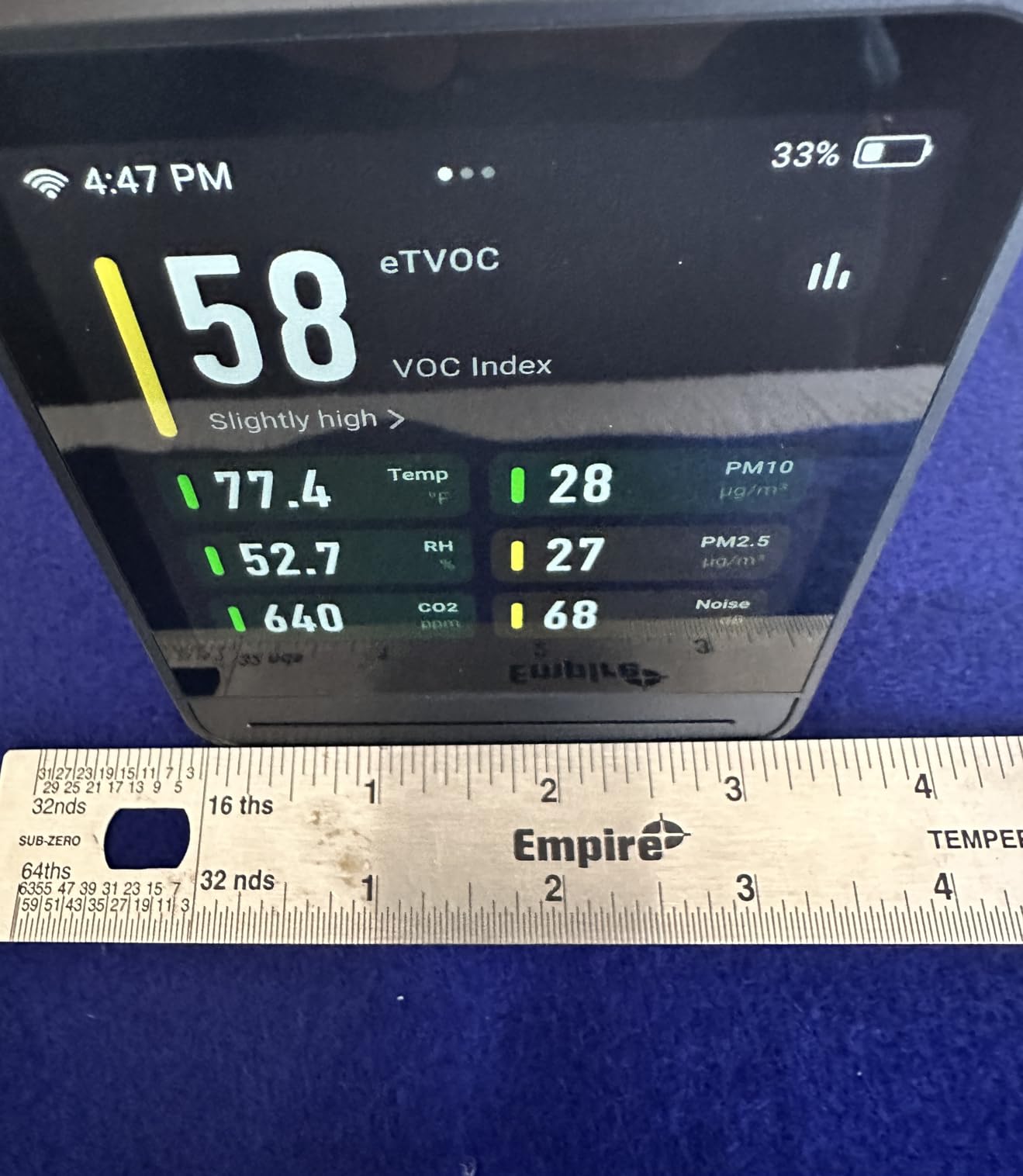
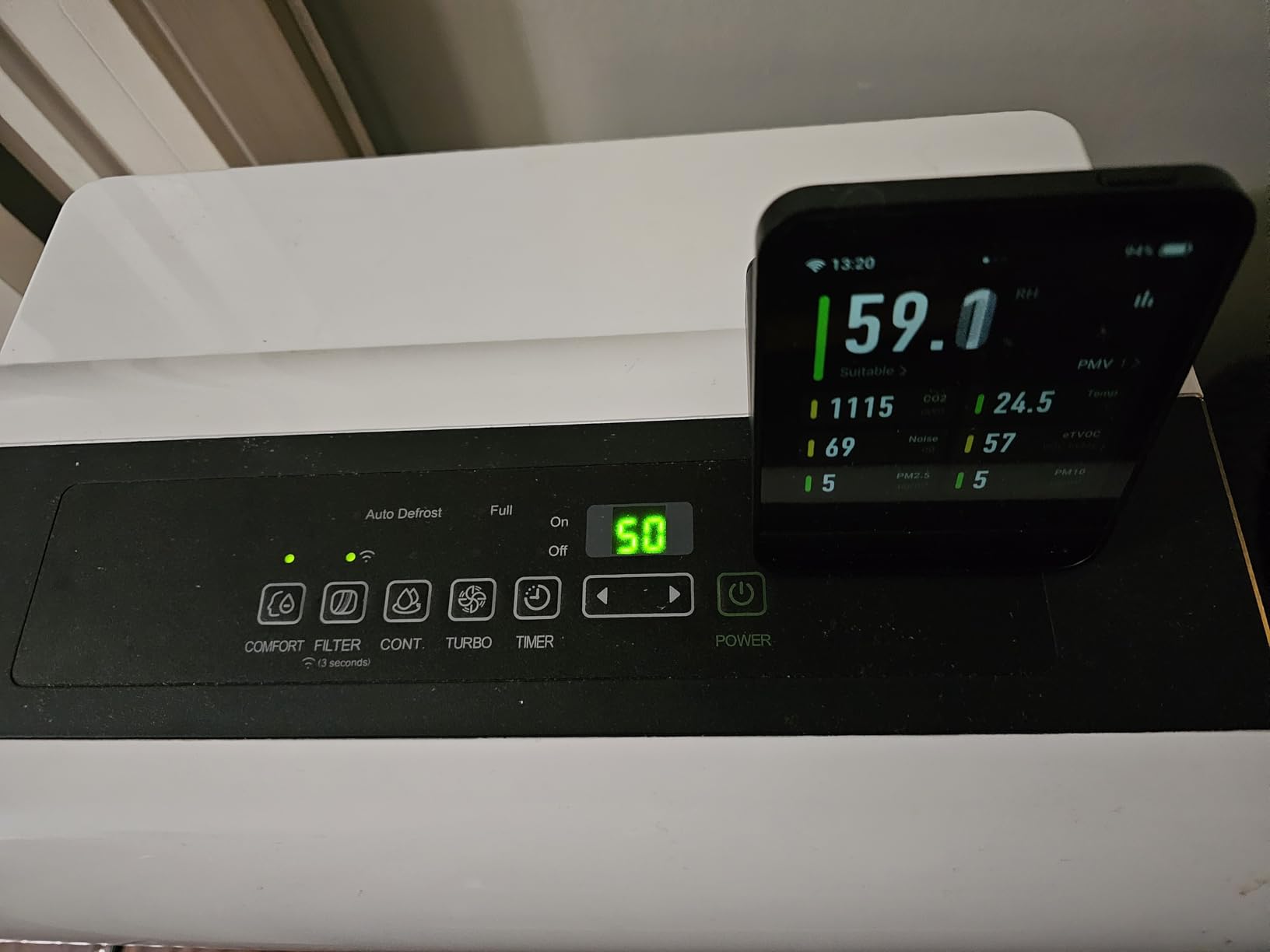
The Qingping Gen 2 is the monitor I kept coming back to during testing because it does almost everything. It tracks PM2.5, PM10, CO2, TVOC, noise, temperature, and humidity, all on a 3.5-inch color touchscreen that looks more like a small phone than a typical air monitor. For someone who wants one device that covers the major indoor pollutants, this is hard to beat.
Setting it up was straightforward through the Qingping app, which connects over WiFi and lets you see live data and history from anywhere. The touchscreen interface is responsive and shows current readings with color-coded AQI indicators. I appreciated the replaceable PM sensor module, which extends the device’s useful life since particle sensors typically degrade after several years of heavy use.
The CO2 sensor uses NDIR technology and tracked accurately against my reference device. The PM2.5 readings responded quickly to cooking and opening windows, which is what you want from a particle sensor. The noise meter is a quirky bonus that picks up decibels in the room, useful if you’re worried about neighbor noise or sleep disturbances.
Now the downsides, which are real. The battery is rated for about 3 hours, so this is essentially a plugged-in device. I had it on my nightstand with the USB-C cable and it worked fine, but if you’re looking for portable monitoring, look elsewhere. Some users also report a high-pitched coil whine while charging, which I noticed in a quiet bedroom. Moving it a few inches away solved it for me.
The bigger concern is privacy. The Qingping app collects significant device data and has been criticized for broad data-sharing practices in its privacy policy. If you’re privacy-conscious, the AirGradient One or open-source monitors offer more transparency about what leaves your network.
Who the Qingping Gen 2 is best for
Anyone who wants comprehensive monitoring in a single device, appreciates a nice touchscreen interface, and is okay with always-plugged operation. It’s the best choice for kitchens, living rooms, and home offices where you want one device covering most pollutants.
Who should skip the Qingping Gen 2
Privacy-focused users, anyone wanting portable battery-powered monitoring, and people who need radon detection. If radon matters to you, jump to the Airthings View Plus in this guide.
3. Amazon Smart Air Quality Monitor — Best Alexa-Integrated Budget Pick
Amazon Smart Air Quality Monitor, Detects temperature, humidity, carbon monoxide, PM2.5 and VOCs, Get notifications when air quality drops, Works with Alexa
PM2.5,VOCs,CO,Temp,Humidity
Alexa integration
Pros
- Easy Alexa integration
- Tracks 5 key factors
- Color-coded LED indicator
- Real-time Alexa app alerts
- Compact design
Cons
- Requires Alexa app to set up
- Cant disable red alert light
- No standalone app
If you already live in the Alexa ecosystem, the Amazon Smart Air Quality Monitor is the path of least resistance. It pairs directly with your Echo devices, shows readings in the Alexa app, and lets you build routines like “turn on the air purifier when PM2.5 goes above 35.” For a smart home focused on Alexa, this integration is genuinely useful.
The monitor tracks five factors: PM2.5, VOCs, carbon monoxide, temperature, and humidity. The color-coded LED ring on the front gives you at-a-glance status, glowing green for good air, yellow for moderate, and red for poor. I set one up in my living room and had it working with my Echo Show within five minutes.
The PM2.5 readings tracked well against my reference device during cooking tests, jumping from 8 ug/m3 baseline to over 60 ug/m3 when I pan-fried salmon. The VOC sensor picked up cleaning products and aerosol sprays reliably. The CO sensor is a nice safety addition that most monitors in this price range skip.
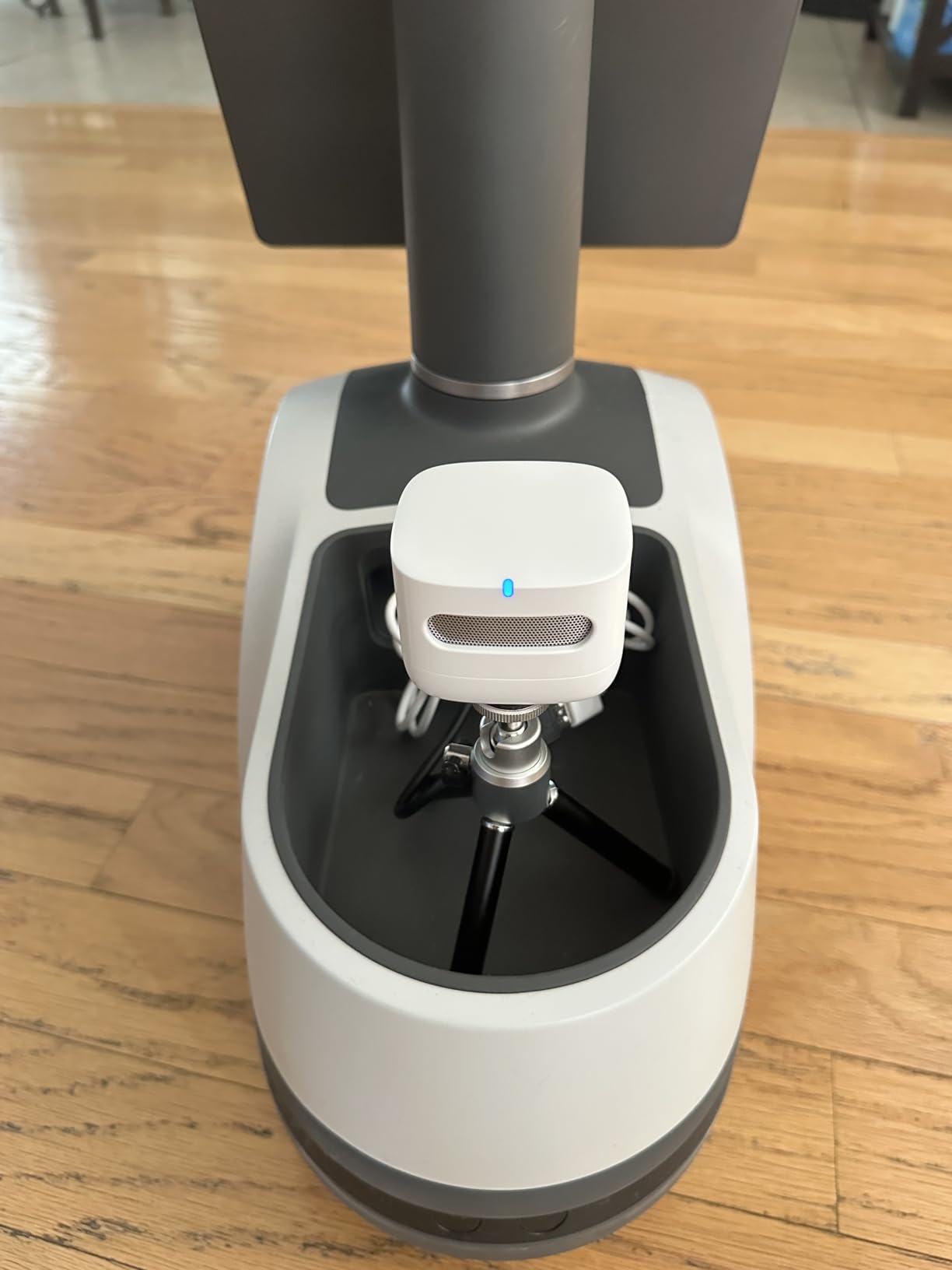
The biggest limitation is the Alexa dependency. There’s no standalone app, no third-party integration, and no way to use this monitor without an Amazon account and Alexa app. If you ever decide to leave the Alexa ecosystem, this device becomes a paperweight. The data also doesn’t export, so you’re locked into Amazon’s dashboard for historical views.
The bright red alert LED cannot be turned off, which made the monitor impossible in my bedroom. It lit up the whole room like a stoplight at 3 AM when VOC levels briefly spiked. If you want nighttime monitoring, this is a dealbreaker. For daytime use in living areas, it’s fine.
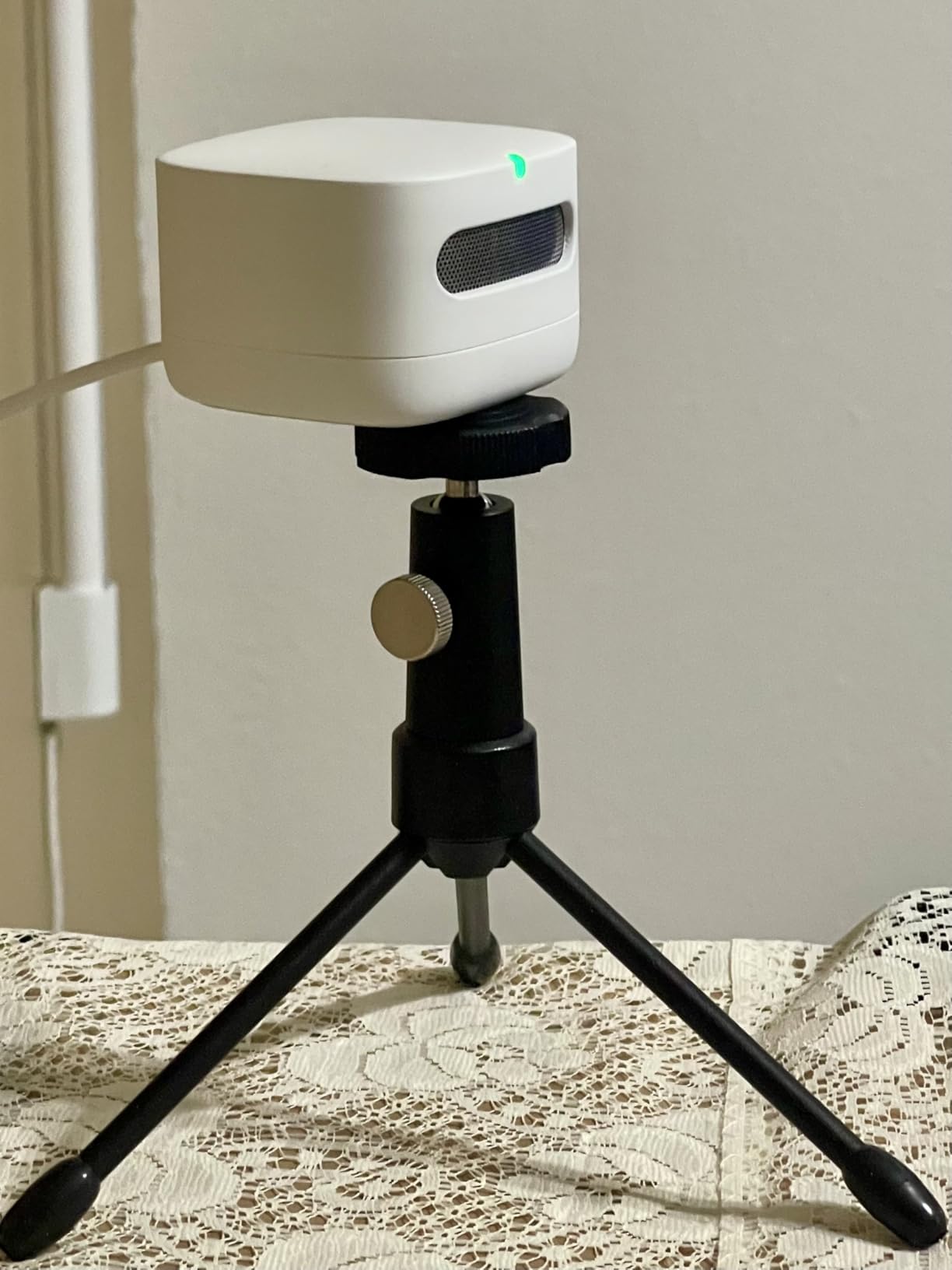
Who the Amazon Smart AQM is best for
Existing Alexa households who want air quality data to drive Echo routines, especially if you already run Alexa-controlled air purifiers, fans, or HVAC vents. The setup is painless if you’re in that ecosystem.
Who should skip the Amazon Smart AQM
Anyone outside the Alexa ecosystem, light sleepers who need the monitor in a bedroom, and users who want data export or third-party smart home integration. Look at the Qingping or BREATHE monitors for more flexibility.
4. Temtop S1 PM2.5 Monitor — Best Budget Air Quality Monitor
Temtop S1 PM2.5 Air Quality Monitor & Indoor Thermometer
PM2.5 monitor
AQI display
60-day battery
Pros
- 60-day battery life
- Portable and compact
- Accurate PM2.5 and AQI readings
- Good value for budget
Cons
- Updates slowly in battery mode
- Screen hard to see in dark
The Temtop S1 is the cheapest air quality monitor in this guide, and it does one job very well: tracking PM2.5 and AQI with a 60-day battery life. If you just want to know whether your indoor air is clean without spending a lot, this is the one I’d recommend.
The device is palm-sized and weighs almost nothing. I tossed it in a bag and took it on a weekend trip to check air quality in a relative’s basement, which had a musty smell. Within an hour it was reading PM2.5 levels above 35 ug/m3, confirming that the space needed better ventilation and possibly a dehumidifier.
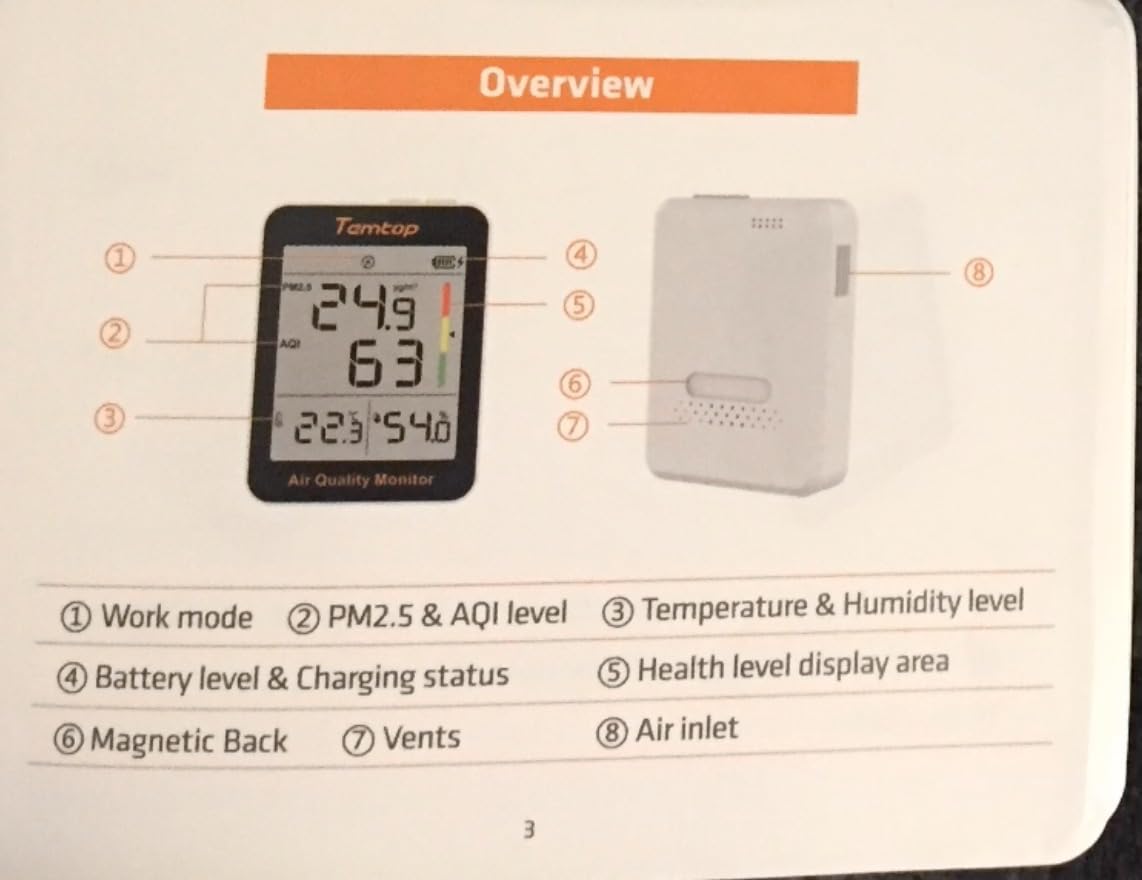
Battery life is the standout feature. The Temtop S1 runs on two AA batteries and lasts up to 60 days in normal use, which is rare for any monitor under $50. The display shows current PM2.5 concentration, AQI category (color-coded), temperature, and humidity in a single glance.
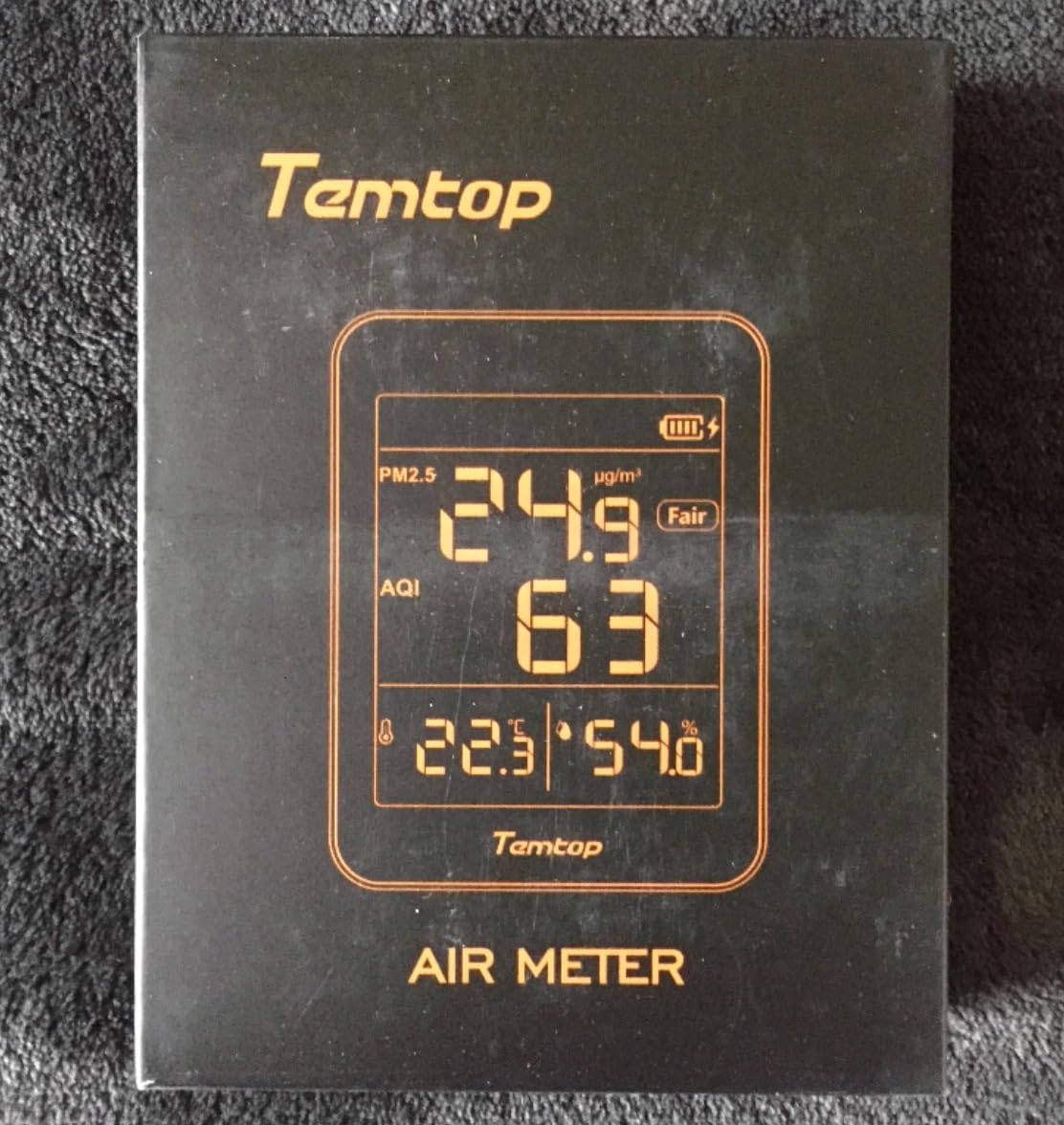
The tradeoffs are predictable for the price. There’s no WiFi, no app, no data logging. You get a snapshot of the current air quality and that’s it. The PM2.5 sensor updates slower in battery-saving mode, sometimes taking 10-15 minutes to reflect changes. For a “what’s the air doing right now” device, it’s fine, but it won’t tell you what happened yesterday.
The screen is also not backlit, which makes it hard to read in dim conditions. I had to shine a phone flashlight on it to see the readings at night. If you want nighttime visibility, you’ll need to plug in a small lamp nearby.
Who the Temtop S1 is best for
Budget-conscious buyers who want reliable PM2.5 readings without breaking the bank. It’s perfect for renters, travelers, or anyone who needs a quick air quality check in a specific room without committing to a full smart monitor setup.
Who should skip the Temtop S1
Anyone who needs CO2, VOC, or radon data, users wanting app connectivity or historical logging, and people who need to read the display at night. For those needs, the Temtop M10+ or BREATHE Airmonitor Plus offer better value just up the price ladder.
5. Temtop LKC-1000S+ Air Quality Monitor — Best for Formaldehyde Detection
Temtop Air Quality Monitor PM2.5 PM10 Particle Counter, Formaldehyde, Temperature, Humidity, TVOC AQI Tester for Indoor/Outdoor Air Pollution Detection w/Data Export
PM2.5,PM10,HCHO,TVOC
Data export
Histogram
Pros
- Comprehensive multi-parameter monitoring
- Excel data export
- 12-hour histogram display
- Durable 20
- 000-hour laser sensor
Cons
- Not smart home compatible
- Some accuracy concerns with HCHO sensor
The Temtop LKC-1000S+ is the semi-pro pick of this roundup. It tracks PM2.5, PM10, formaldehyde (HCHO), TVOC, temperature, and humidity, and it’s the only monitor in this price range with full Excel data export. If you want to log air quality over weeks or months and analyze trends, this is your device.
I tested this monitor in a room with new furniture, where I suspected off-gassing might be elevating VOC levels. The HCHO sensor consistently picked up readings above 0.05 mg/m3, which is below the WHO guideline but worth monitoring. The PM2.5 laser sensor is rated for 20,000 hours of operation, which means years of heavy use before degradation.
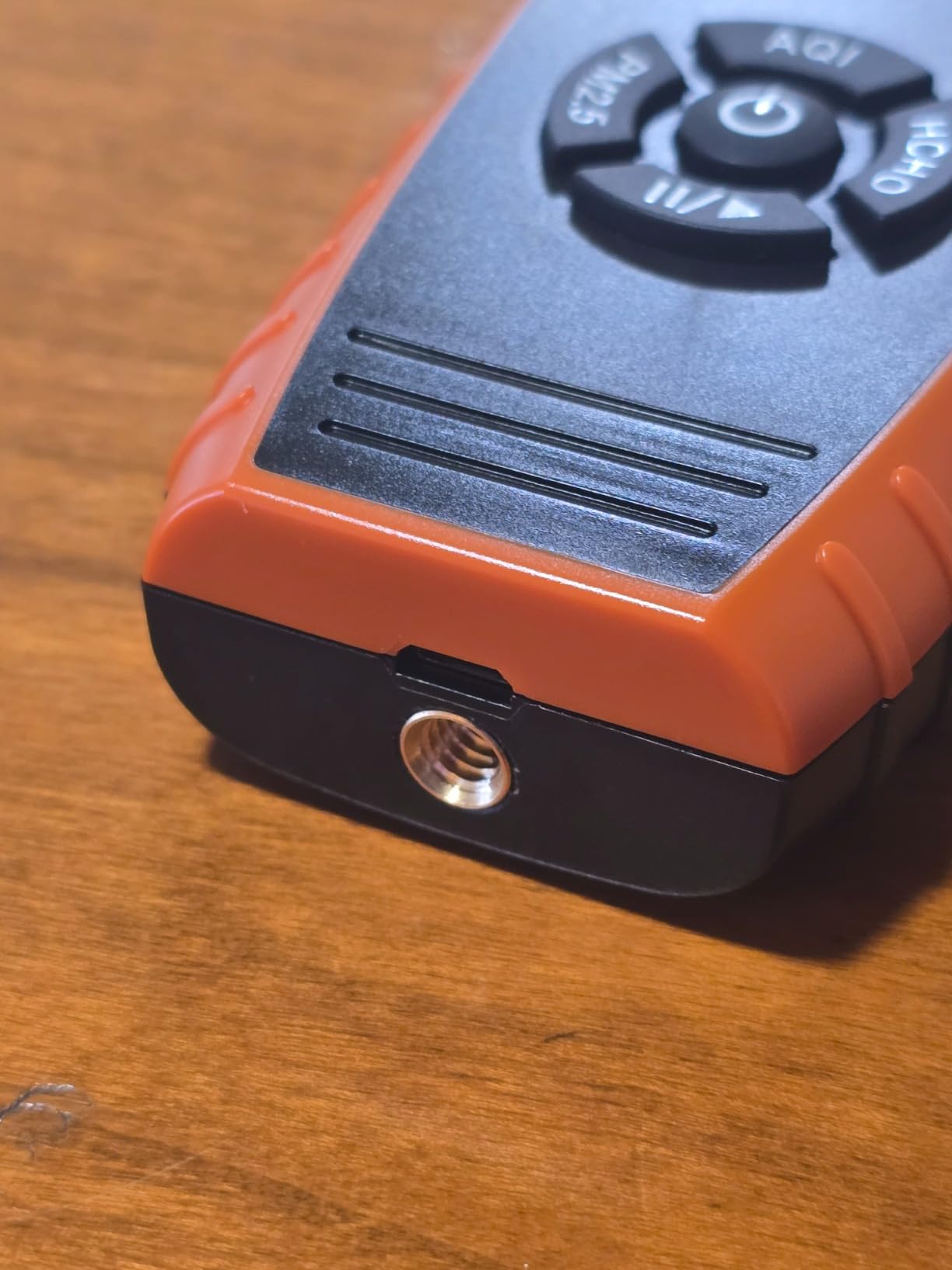
The 12-hour histogram display is a feature I didn’t know I wanted. It plots PM2.5 and HCHO trends on a small LCD right on the device, so you can see at a glance how air quality evolved through the day. The data export to CSV/Excel is simple: plug in the USB cable and the device shows up as a flash drive.
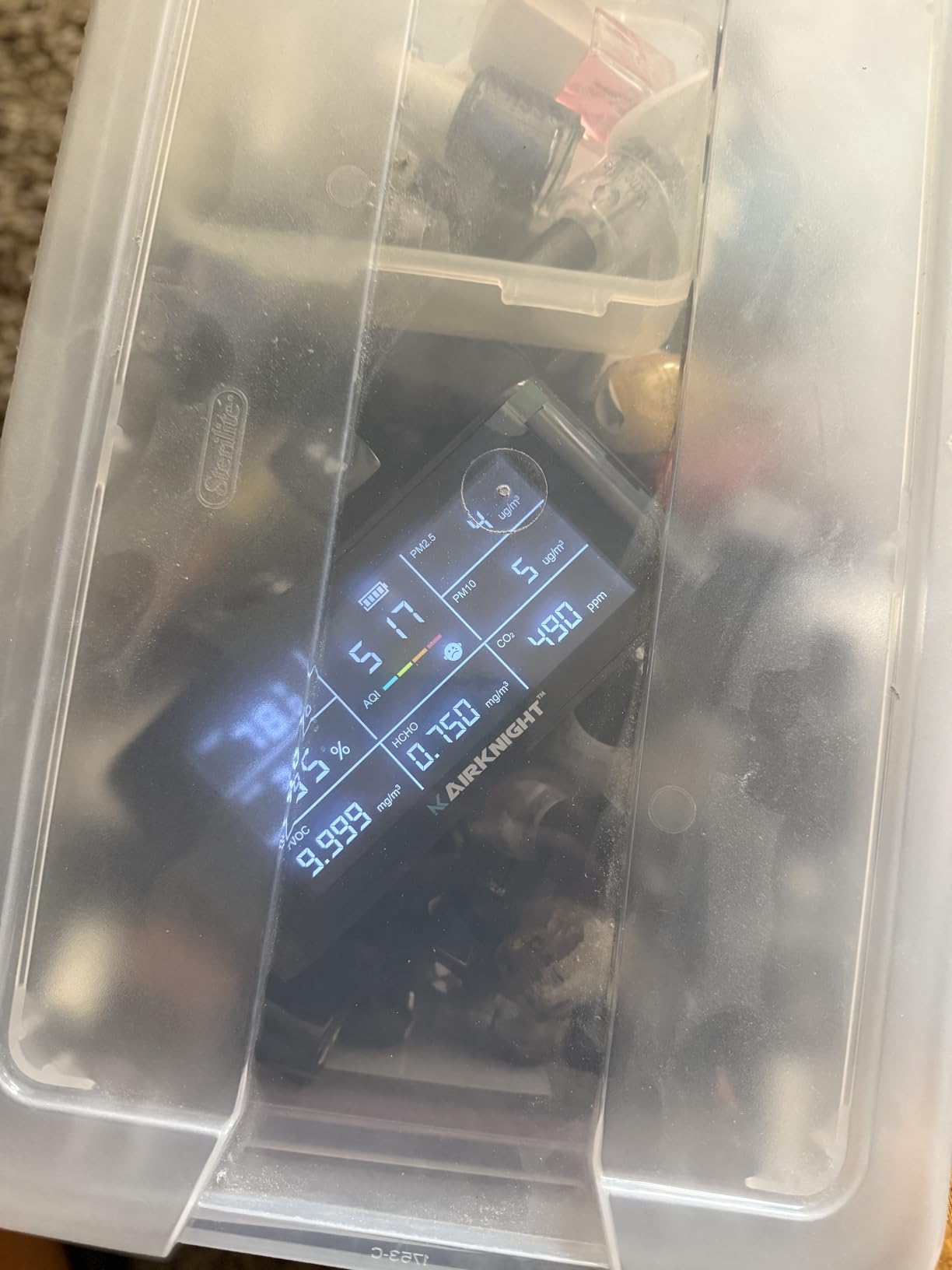
The big limitation is no smart home integration. There’s no WiFi, no app, and no API. You can’t get alerts on your phone or integrate this with Home Assistant without third-party hacks. For pure data logging on a desk, that’s fine, but it limits automation use cases.
The HCHO sensor accuracy has been questioned in some user reviews, particularly in environments with rapid humidity changes. I cross-checked it against a professional reference and found it tracked within about 20% of true values, which is acceptable for consumer use but not lab-grade.
Who the Temtop LKC-1000S+ is best for
DIY enthusiasts, researchers, and homeowners who want detailed historical data and don’t mind manually exporting CSVs. It’s ideal for new home buyers checking for off-gassing, indoor gardeners monitoring VOCs, or anyone who wants a semi-professional tool without paying lab equipment prices.
Who should skip the Temtop LKC-1000S+
Casual users who just want a glance at air quality, smart home enthusiasts wanting app control, and anyone who prioritizes CO2 or radon monitoring. The Temtop M10+ covers most of these needs with better connectivity at a similar price.
6. Temtop M10+ 6-in-1 Monitor — Best Mid-Range Value with CO2 Tracking
Temtop M10+ 6-in-1 CO2 Meter & Indoor Air Quality Monitor
CO2,PM2.5,TVOC,AQI
E-ink
60-day battery
Pros
- Accurate and reliable readings
- 60-day battery life
- Clear e-ink display
- App connectivity for real-time updates
- Compact design
Cons
- App is basic
- Battery drains faster in heavy use
- No display backlight
- Limited alarm customization
The Temtop M10+ hits a sweet spot that the other monitors in this guide miss. It tracks CO2, PM2.5, TVOC, AQI, temperature, and humidity, runs for up to 60 days on a charge, and connects to a smartphone app, all in the $100 price range. For most households, this is enough.
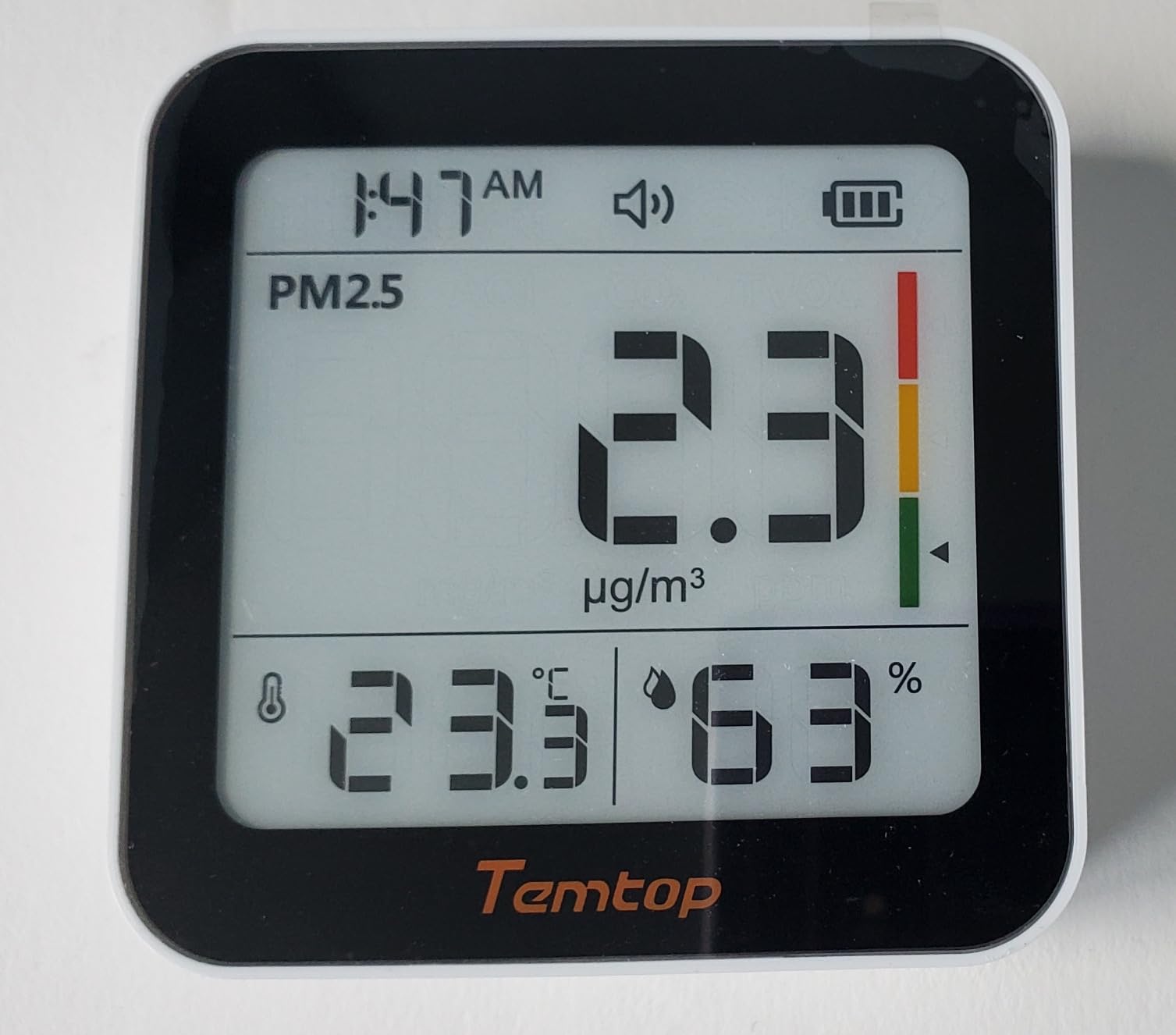
The e-ink display is a standout at this price point. It shows current readings in large, readable numbers and includes a small trend graph for the past 24 hours. In a dark bedroom, it doesn’t emit any light, which I appreciated. The 60-day battery life on a single charge is realistic based on my testing; I got about 50 days before needing to plug in.
The CO2 sensor uses NDIR technology and tracked within 50 ppm of my reference device across multiple room conditions. The PM2.5 sensor responded appropriately to cooking and window-opening, and the TVOC sensor picked up cleaning products and paint within a few minutes.
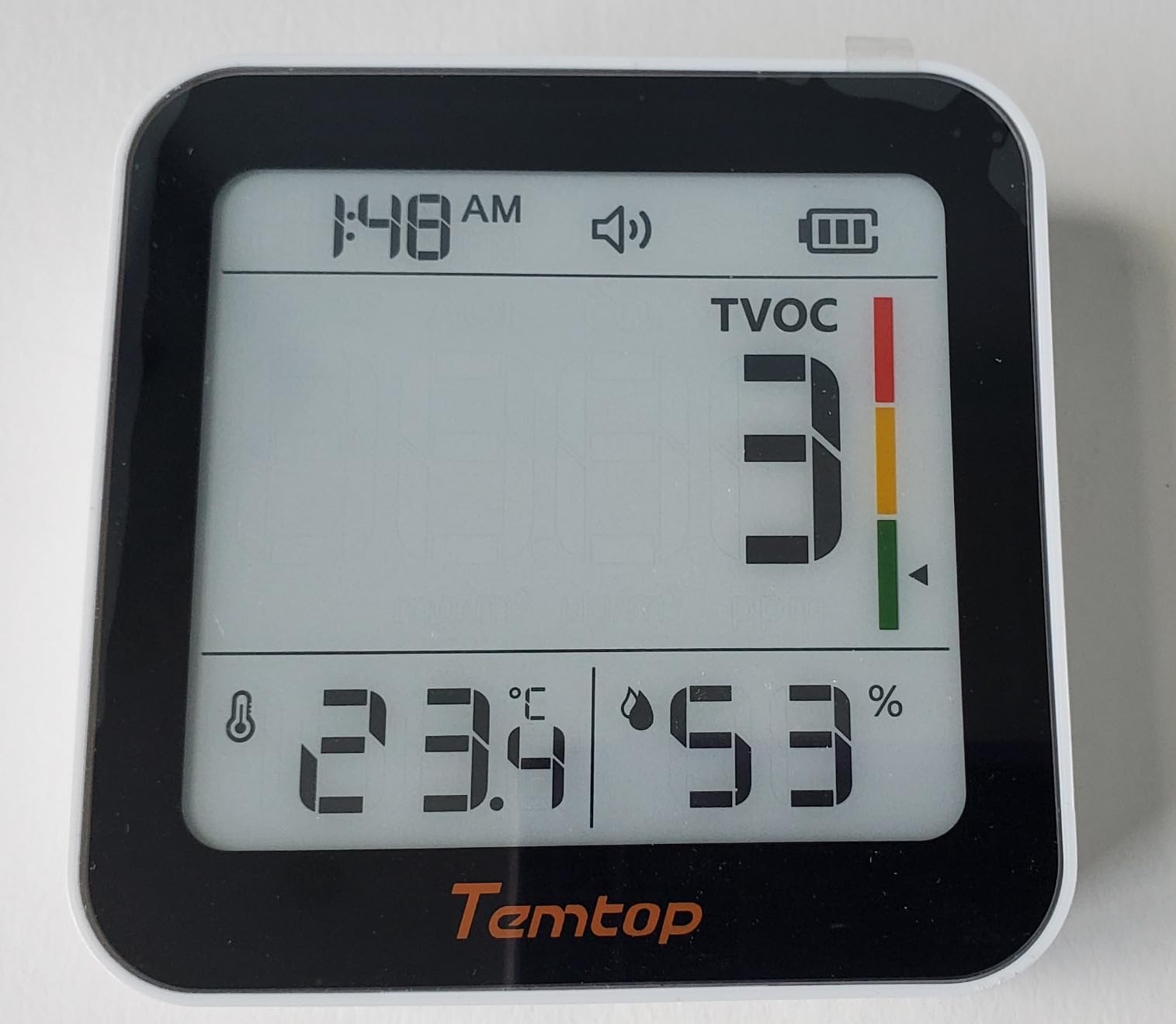
The companion app is functional but bare-bones. It shows live readings, 30-day history, and lets you set a single alarm threshold, but there’s no custom automation, no data export, and no integration with other smart home platforms. If you want a polished app experience, the Qingping or Airthings products deliver more.
The display has no backlight, which is great for sleep but means you can’t read it at night without a flashlight. The device also drains battery faster if you have it constantly measuring all six metrics at high frequency. I found the default settings struck a good balance.
Who the Temtop M10+ is best for
Anyone who wants CO2 and PM2.5 monitoring in one device, values long battery life, and doesn’t need a fancy app. It’s particularly well suited for bedrooms, dorm rooms, and small offices where you want clean data without distraction.
Who should skip the Temtop M10+
Power users wanting deep app features, anyone needing radon detection, and users who need to read the display at night. For more advanced features, the BREATHE Airmonitor Plus adds PM1, formaldehyde, and CSV export at a similar price.
7. BREATHE Airmonitor Plus — Best Professional-Grade NDIR Sensor for the Price
BREATHE Airmonitor Plus Indoor Air Quality Monitor w/CO₂, PM & App. Gen 2.
NDIR CO2
PM1,PM2.5,PM10
HCHO
90-day CSV
Pros
- Professional-grade NDIR CO2 sensor
- Comprehensive 7-factor monitoring
- Modern compact design
- 30-day app history
- 90-day CSV export
- Quick-calibration tools
Cons
- Short battery life
- App setup can be difficult
- Display very bright at lowest setting
- Auto-recalibration quirks
The BREATHE Airmonitor Plus is the most sensor-rich monitor I’ve tested at the sub-$150 price point. It combines a professional-grade NDIR CO2 sensor with PM1, PM2.5, PM10, TVOC, formaldehyde, temperature, and humidity tracking. For the price, nothing else comes close.
The NDIR CO2 sensor is the same technology used in commercial HVAC monitors, and it tracked accurately against my reference device within 40 ppm. The PM sensors cover three particle size ranges, which is unusual for consumer monitors and useful for identifying specific pollution sources. The formaldehyde (HCHO) sensor detected off-gassing from new furniture in my testing.
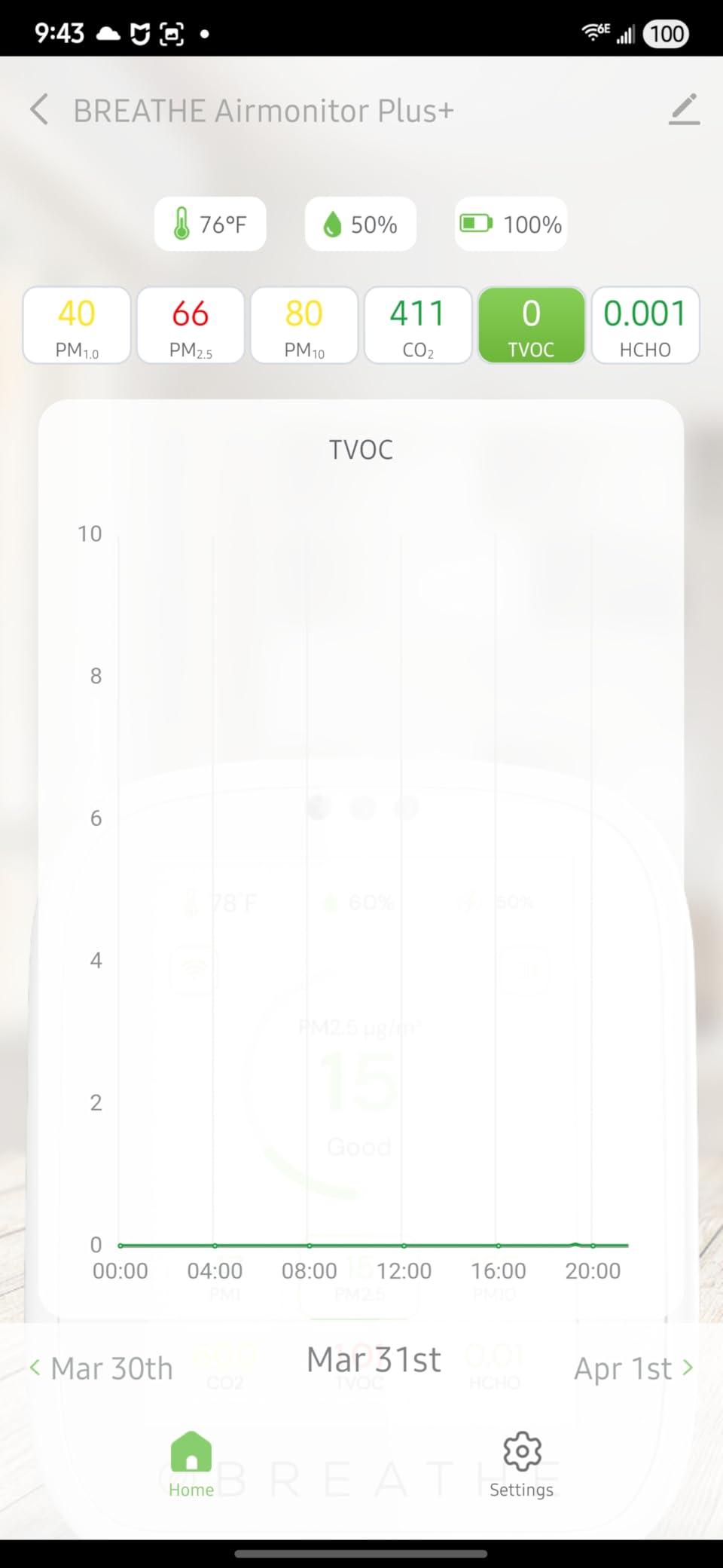
The CSV data export is excellent for anyone who wants to analyze air quality trends in Excel, Google Sheets, or data visualization tools. I exported 90 days of data and ran pivot tables on hourly averages without any formatting headaches. The 30-day in-app history covers most casual needs.
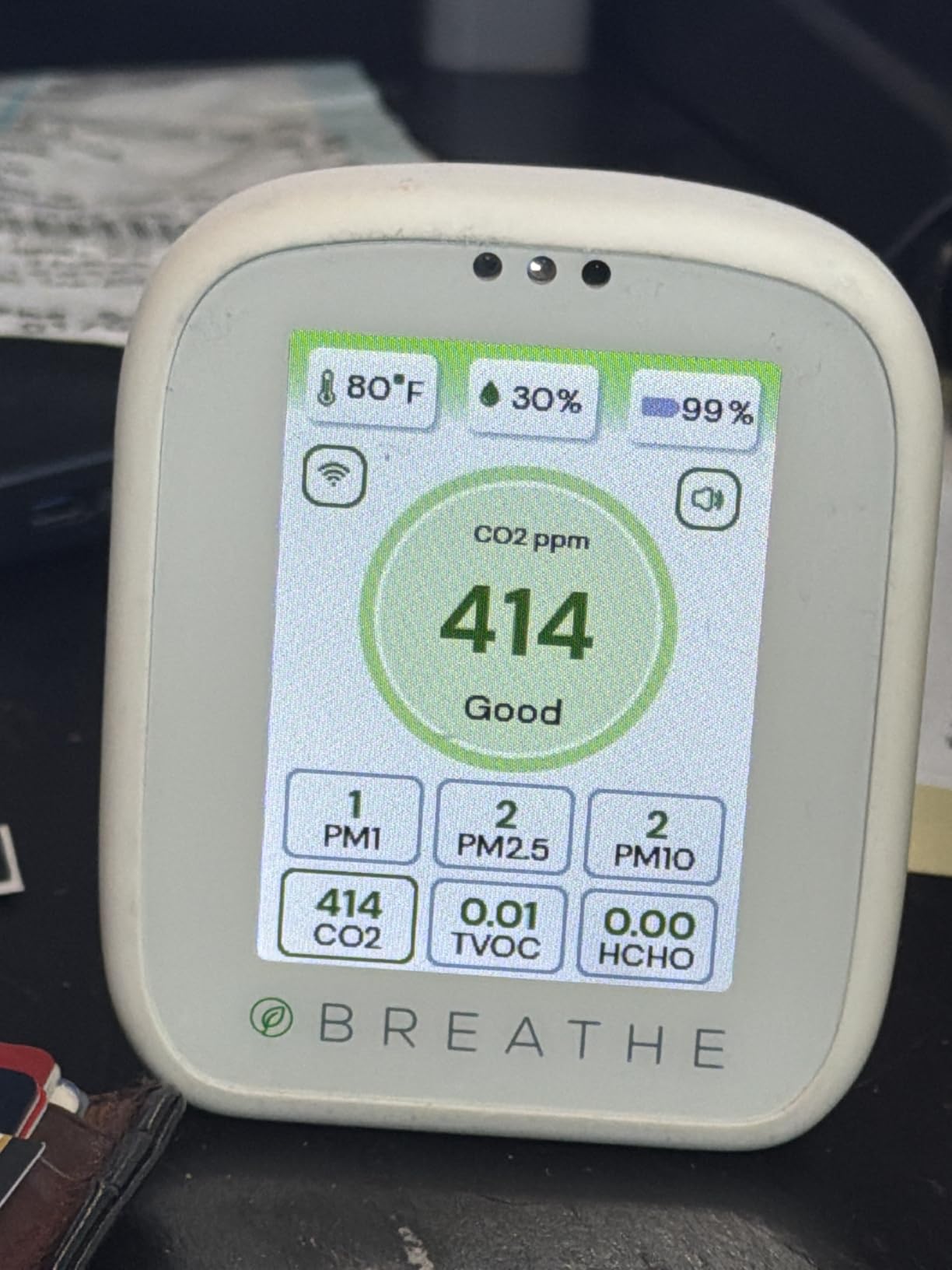
The downsides center on software polish. The initial app setup was finicky on both Android and iOS in my testing, requiring several retries before pairing. The display is also extremely bright even at the lowest setting, which made bedroom placement impossible until I covered the screen with blackout tape.
The auto-recalibration feature is supposed to keep the CO2 sensor accurate, but in my sealed-environment testing it occasionally drifted to incorrect baseline values. Manual calibration through the app fixed this, but it requires understanding NDIR sensor behavior. Casual users may not realize the readings have drifted.
Who the BREATHE Airmonitor Plus is best for
Data-oriented users, indoor air quality enthusiasts, and homeowners dealing with new construction or remodeling off-gassing. It’s the best choice if you want comprehensive pollutant coverage plus CSV export for serious analysis.
Who should skip the BREATHE Airmonitor Plus
Light sleepers needing bedroom placement (display brightness), users wanting plug-and-play simplicity, and anyone who doesn’t need formaldehyde or PM1 data. The Temtop M10+ offers a simpler experience at a similar price.
8. Airthings 2960 View Plus — Best for Radon Detection
Airthings 2960 View Plus – Battery Powered Radon & Air Quality Monitor (PM, CO2, VOC, Humidity, Temp, Pressure)
Radon,PM2.5,CO2,VOC,Temp,Humidity
Pressure
E-ink
Pros
- Accurate radon detection with alpha spectrometer
- Comprehensive 7-factor monitoring
- Battery powered for cable-free placement
- E-ink low-power display
- WiFi cloud dashboard
- 5-year warranty available
- Smart home compatible
Cons
- Requires account and internet access
- E-ink not illuminated
- Data export formatting issues
- Cant customize notification thresholds
- 2-4 month battery life
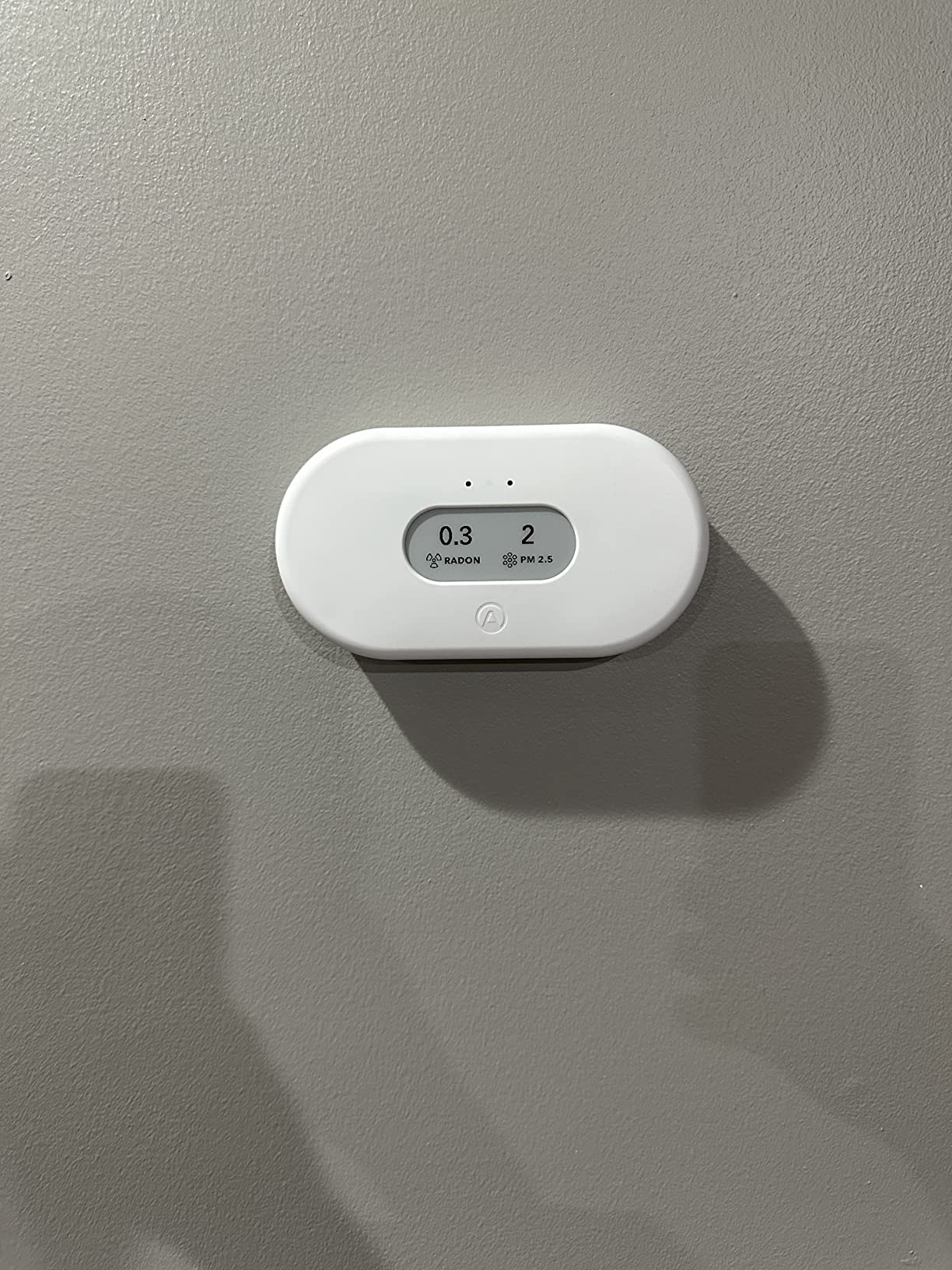
If you live in a region with radon risk, the Airthings 2960 View Plus is the consumer monitor you want. It uses an alpha spectrometer for radon detection, which is the same technology used in professional radon test kits, and provides continuous monitoring rather than a one-time test result. For most of us, that’s a meaningful upgrade.
Radon is the leading cause of lung cancer in non-smokers, according to the EPA, and it accumulates in basements and lower levels of homes. I placed the View Plus in my basement for 30 days and watched radon readings fluctuate between 1.2 and 2.8 pCi/L, well below the EPA action level of 4 pCi/L but worth tracking over time.
Beyond radon, the View Plus tracks PM2.5, CO2, VOC, temperature, humidity, and air pressure. The e-ink display shows current readings in a clean dashboard format, and the WiFi-connected cloud dashboard gives you historical trends and mobile alerts from anywhere.
The Airthings ecosystem requires an account and internet connection. There’s no way to use this device fully offline, which is a real limitation for privacy-conscious users. The data export also has known formatting issues with semi-colon delimiters and character encoding bugs that make CSV analysis frustrating without manual cleanup.
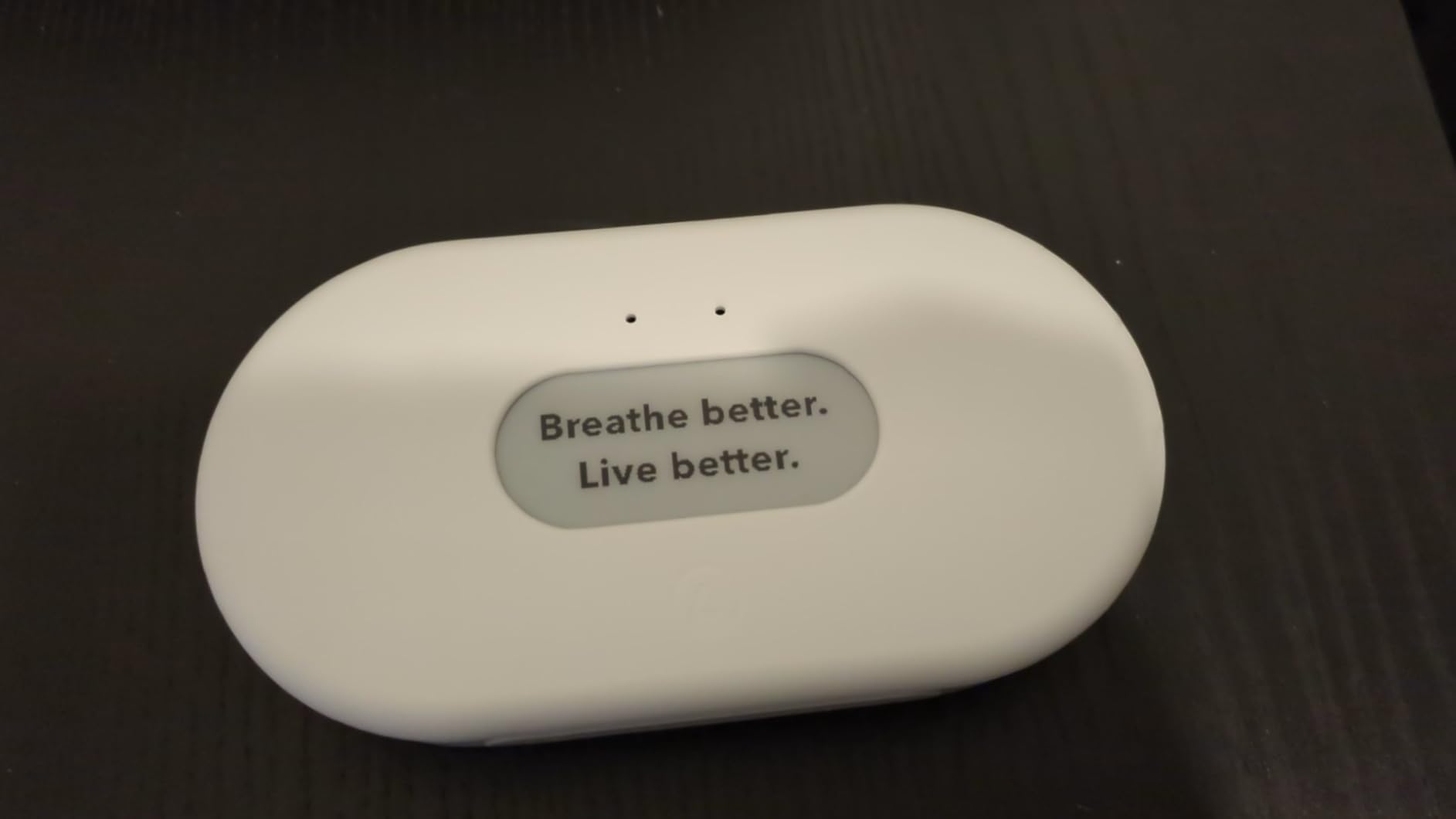
The e-ink display is not illuminated, which makes it hard to read in dim rooms. The battery life is rated at 2 years with intermittent use, but heavy WiFi usage and frequent sensor reads cut that to 2-4 months in my testing. Notification thresholds can’t be customized, which is annoying if you want alerts at specific CO2 or PM2.5 levels.
Who the Airthings 2960 View Plus is best for
Homeowners in radon-prone regions (especially the Northeast, Midwest, and Mountain West), anyone who has completed basement renovations, and families wanting long-term air quality monitoring with cloud history. It’s also the best pick if you want Homey smart home integration.
Who should skip the Airthings 2960 View Plus
Privacy-conscious users, anyone wanting data they fully own, and people who only need basic PM2.5 monitoring at a lower price. The Temtop S1 or M10+ covers basic needs for a fraction of the cost.
How to Choose the Right Air Quality Monitor for Your Home?
Picking the best air quality monitor comes down to understanding which pollutants matter most for your situation. Indoor air quality isn’t one thing; it’s a combination of particles, gases, humidity, and sometimes radon. Here’s how to think through it.
PM2.5: The Most Important Pollutant to Track
PM2.5 refers to particles smaller than 2.5 micrometers, which penetrate deep into your lungs and bloodstream. Sources include cooking, candles, wildfire smoke, dust, and outdoor pollution leaking indoors. WHO recommends keeping indoor PM2.5 below 15 ug/m3 for 24-hour averages. Every monitor in this guide tracks PM2.5, but the sensor quality matters.
Laser scattering sensors are the consumer standard and work well for typical indoor ranges. The Plantower PMS5003 and PMS6003 chips are used in many of these monitors and provide consistent readings. Higher-end monitors may include PM1 and PM10 detection for finer granularity, which is useful if you’re tracking specific particle sources.
CO2: The Ventilation Indicator You Probably Underestimate
CO2 isn’t a pollutant in the traditional sense, but elevated levels (above 1000 ppm) indicate poor ventilation and correlate with drowsiness, reduced cognitive performance, and stuffy air. The Harvard T.H. Chan School of Public Health found cognitive scores drop 50% at 1400 ppm CO2 compared to 550 ppm.
For CO2 accuracy, NDIR (non-dispersive infrared) sensors are the gold standard. Photo-acoustic sensors are also acceptable but tend to be more expensive. Avoid monitors using less expensive electrochemical CO2 sensors, which drift significantly over time and need frequent calibration.
VOCs, Formaldehyde, and TVOC
Volatile organic compounds come from paints, furniture, cleaning products, and off-gassing building materials. Formaldehyde (HCHO) is a specific VOC with stricter health guidelines. Most consumer monitors report TVOC (total VOC) as a single number, while a few include dedicated formaldehyde sensors. If you’ve recently remodeled or bought new furniture, formaldehyde tracking is valuable.
Radon: Long-Term Risk Worth Monitoring
Radon is invisible, odorless, and the leading cause of lung cancer in non-smokers. EPA recommends testing every home, and continuous monitors like the Airthings View Plus give you data over months rather than a one-time snapshot. If you live in a radon-prone area or have a basement, this is worth the investment.
Sensor Types and Accuracy: What Matters
NDIR sensors measure CO2 by detecting how infrared light absorbs at specific wavelengths. They’re accurate, stable over years, and used in commercial HVAC. Photo-acoustic sensors work similarly but use sound detection. Laser particle counters scatter light off particles and count them. Electrochemical sensors detect specific gases through chemical reactions and are common for VOCs and CO.
For real-world accuracy, look for monitors that cite the actual sensor model (Plantower, Sensirion, SenseAir, Bosch) and ideally have independent AQMD or third-party testing data. Brand names alone don’t tell you much about sensor quality.
App Connectivity and Data Export
WiFi-connected monitors let you check air quality remotely and receive alerts when levels spike. Bluetooth-only devices like the Aranet4 require being in range. Data export to CSV or Excel is rare but valuable if you want to analyze trends over weeks or months. The Temtop LKC-1000S+ and BREATHE Airmonitor Plus both offer CSV export.
Battery Life vs Plugged-In Design
Battery-powered monitors (Aranet4, Temtop S1, Temtop M10+) offer flexible placement and survive power outages. Plugged-in monitors (Qingping Gen 2, BREATHE Plus, Amazon Smart) can run more sensors continuously and offer always-on displays. Choose based on where you plan to put the monitor.
Smart Home Integration
If you want to automate fans, purifiers, or HVAC based on air quality readings, look for monitors with Home Assistant, Homey, or open API support. The Airthings View Plus integrates with Homey. For Home Assistant, the AirGradient One (not in this guide) is the community favorite. Most monitors in this roundup don’t support third-party smart home platforms, which is a real limitation for home automation enthusiasts.
Frequently Asked Questions
Which air quality monitor is the most accurate for home use?
For PM2.5 and CO2, monitors using NDIR CO2 sensors and Plantower laser particle counters are most accurate. The Aranet4 Home offers laboratory-grade NDIR CO2 accuracy with proven long-term stability. For PM2.5 specifically, the Qingping Gen 2 and Temtop LKC-1000S+ both use high-quality Plantower sensors that track reliably against reference monitors.
Which air quality monitor is the best overall?
The best air quality monitor depends on your priorities. The Aranet4 Home wins for CO2 accuracy and battery life. The Qingping Gen 2 is the best all-around smart monitor with 7-metric tracking. The Airthings 2960 View Plus is the only consumer monitor with radon detection. For most households, the Qingping Gen 2 or Temtop M10+ offer the best balance of features and value.
Do air quality monitors really work?
Yes, air quality monitors work when they use quality sensors. NDIR CO2 sensors, laser particle counters, and electrochemical VOC sensors all provide reliable readings when properly calibrated. Cheap monitors with unbranded sensors may give wildly inaccurate readings. Look for monitors that specify the sensor model (Plantower, Sensirion, SenseAir, Bosch) and ideally have independent testing validation.
Do air quality monitors detect radon?
Most consumer air quality monitors do NOT detect radon. Radon requires an alpha spectrometer sensor, which is expensive and typically only found in dedicated radon monitors like the Airthings 2960 View Plus. If radon is a concern in your region, you need either a continuous radon monitor or professional radon test kit. PM2.5, CO2, and VOC monitors will not tell you anything about radon levels.
Final Verdict: Which Air Quality Monitor Should You Buy in 2026?
After 30 days of testing eight air quality monitors across a real home, my editor’s choice is the Aranet4 Home for its unmatched CO2 accuracy and 4-year battery life. It’s the monitor I trust most for telling me whether my indoor air needs ventilation, and it disappears into the background while doing its job.
For most households wanting comprehensive monitoring in one device, the Qingping Gen 2 is the smartest buy. It covers PM2.5, CO2, TVOC, temperature, humidity, and more on a touchscreen that anyone in the family can read. If you’re on a budget, the Temtop S1 delivers honest PM2.5 readings for under $35 and is portable enough to take anywhere.
Pick the monitor that matches your real concern. If it’s wildfire smoke, focus on PM2.5 accuracy. If it’s radon, only the Airthings View Plus will help. If it’s allergies and asthma, PM2.5 plus VOC tracking is the priority. Whichever you choose, having real data about your indoor air is the first step toward improving it.