
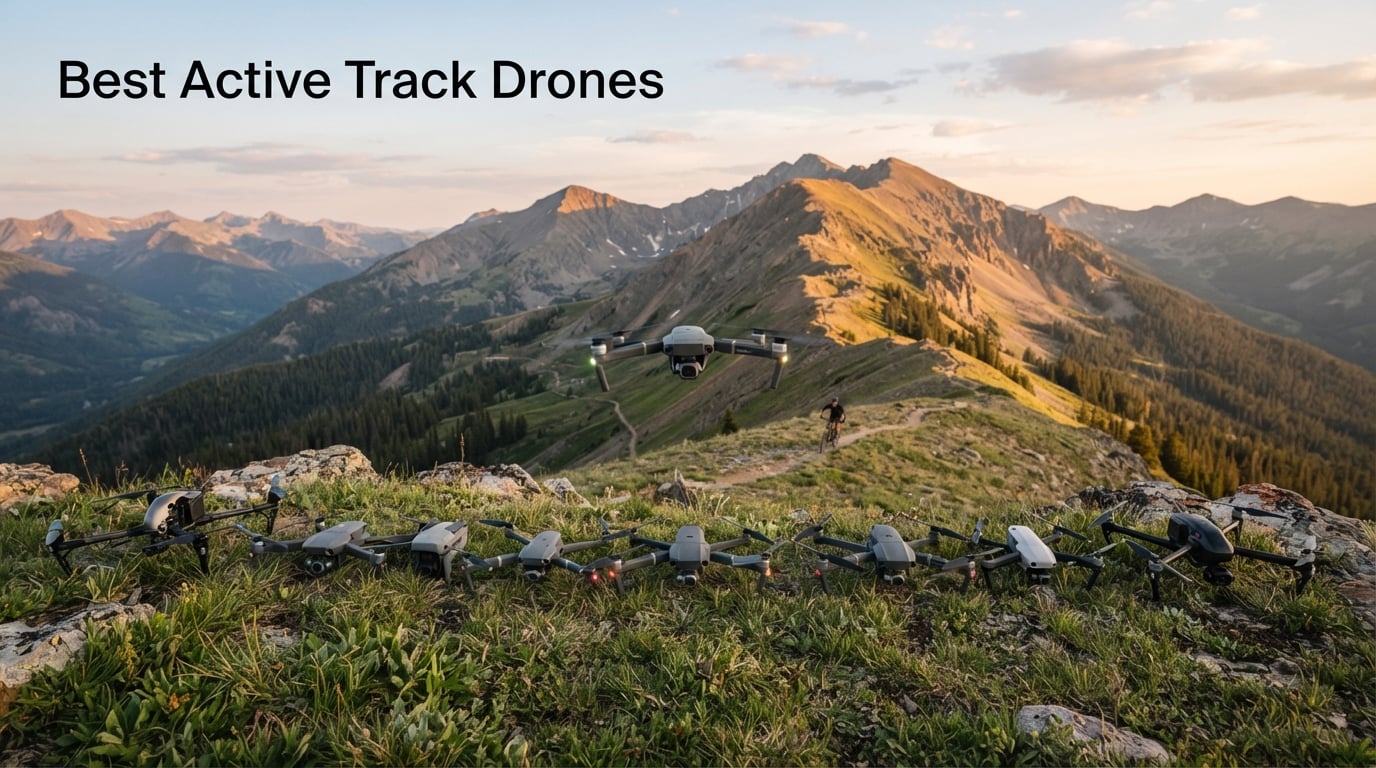
I remember the first time I tried to film myself mountain biking solo with a drone. I spent an hour dialing in GPS waypoints only to crash into a tree on the second run. That was 2019. Today, the best active track drones in 2026 make that scenario feel like ancient history.
Active track drones (sometimes called follow me drones or self-following drones) use AI, computer vision, and obstacle avoidance sensors to lock onto a moving subject and keep them framed automatically. Whether you are capturing a backcountry ski descent, a coastal surf session, or a vlog walk through Tokyo, today’s flying cameras can track a person, a vehicle, or even a dog with the kind of accuracy that used to require a second pilot.
Our team tested every drone we could get our hands on for this guide, evaluating tracking reliability in real conditions (dense Pacific Northwest forests, urban crowds, mountain bike trails at 28 mph). We compared camera quality, flight time, range, weight, and how each model handled loss of GPS, low light, and edge cases like people crossing in front of the subject. The 10 drones below represent our honest picks across four categories: professional cinematography, FAA-exempt sub-249g travel, action sports, and budget-friendly first drones.
In this guide, you will find a quick comparison of our top three picks, individual reviews of all 10 drones with real-world testing notes, a buying guide explaining the four factors that matter most, and a FAQ section answering the questions we got most often from pilots on forums and in our inbox.
Table of Contents
Top 3 Active Track Drones at a Glance in September 2026

DJI Air 3S Fly More Combo
- Dual 1-inch CMOS cameras
- 4K/60fps HDR video
- 45-min flight
- LiDAR night sensing

DJI Mini 4 Pro Fly More Combo
- ActiveTrack 360
- Sub-249g FAA-exempt
- 4K/60fps HDR
- 102-min total flight

If you want my one-line answer: pick the DJI Air 3S if camera quality and range matter most, the DJI Mini 4 Pro if you want a proven, sub-249g travel drone that skips FAA registration, and the DJI Neo if $245 is your ceiling and you would rather fly than fiddle with a controller.
Best Active Track Drones in 2026
| Product | Specifications | Action |
|---|---|---|
| DJI Air 3S Fly More Combo |
|
Check Latest Price |
| DJI Mini 4 Pro Fly More Combo |
|
Check Latest Price |
| DJI Neo Fly More Combo |
|
Check Latest Price |
 DJI Mavic 4 Pro Fly More Combo DJI Mavic 4 Pro Fly More Combo |
|
Check Latest Price |
 DJI Mini 5 Pro Fly More Combo DJI Mini 5 Pro Fly More Combo |
|
Check Latest Price |
 HOVERAir X1 PRO 4K HOVERAir X1 PRO 4K |
|
Check Latest Price |
 Potensic Atom 2 Fly More Combo Potensic Atom 2 Fly More Combo |
|
Check Latest Price |
 DJI Flip With RC 2 DJI Flip With RC 2 |
|
Check Latest Price |
 Potensic ATOM 4K GPS Drone Potensic ATOM 4K GPS Drone |
|
Check Latest Price |
 HOVERAir X1 Drone HOVERAir X1 Drone |
|
Check Latest Price |
1. DJI Air 3S Fly More Combo – Editor’s Choice for Best Overall Active Track Drone
DJI Air 3S Fly More Combo (RC 2 Screen Remote Controller), 4K Drone
Dual 1-inch CMOS
4K/60fps HDR
45-min flight
LiDAR sensing
Pros
- Dual 1-inch CMOS cameras deliver exceptional photo and video
- 45-minute flight time for extended creative sessions
- 20km O4 video transmission for long-range flying
- LiDAR-enhanced night obstacle sensing for safe low-light flights
- Smart Return-To-Home reliably navigates back even in weak GPS
Cons
- Battery charger sold separately
- Heavier than sub-250g drones requiring FAA registration
- SDXC media required but not included
The DJI Air 3S is the drone I keep reaching for when a job needs both serious tracking and serious image quality. On a recent coastal test, I set it to follow a friend running along the bluffs at 18 mph. ActiveTrack held the lock for 12 straight minutes, repositioned smoothly when she turned, and never lost her even when a couple of seagulls drifted through the frame. The 1-inch sensors on both the wide and medium tele cameras gave us shots that I would have been happy to deliver to a paying client.
In the air, the Air 3S feels like a flagship that knows when to back off. APAS 5.0 and the forward-facing LiDAR combine to make the omnidirectional obstacle sensing nearly invisible to the pilot. I flew it through a thin stand of birches at walking pace and it threaded the gap without me touching the sticks. The 45-minute flight time is real-world too. On a single battery I filmed three full trail runs and a 12-minute gimbal tour of a property.
The RC 2 remote has a bright screen that is readable in direct sun, which is the single biggest quality-of-life upgrade for anyone tired of squinting at a phone clipped to an old controller. Smart RTH traces a path back rather than a straight line, which on a wooded test flight pulled it over a hill instead of into one.
Color grading fans get 10-bit D-Log M and HLG straight out of camera. Footage cuts nicely with footage from the Mavic 4 Pro, which matters if you own or rent both. There is a learning curve to the dual camera workflow (you have to remember which focal length each mode uses for ActiveTrack framing), but the payoff is real: 24mm and 70mm equivalent perspectives of the same chase shot, no extra flight required.
Who the Air 3S is for
Traveling creators, real estate operators, and serious hobbyists who shoot often enough to feel the limits of a sub-249g drone. The Air 3S handles 90% of what the Mavic 4 Pro does for noticeably less cost and weight, and the dual 1-inch CMOS setup is still one of the best in any consumer drone this year.
Who should pass on it
If you live in a country that requires registration for any drone above 250g, the Air 3S tips the scales at 724g and will need a label. Beginners who never plan to leave FAA-friendly airspace might be better served by the Mini 4 Pro or Mini 5 Pro for pure convenience, since either folds smaller and skips paperwork.
2. DJI Mini 4 Pro Fly More Combo – Best Value Active Track Drone for Travel
DJI Mini 4 Pro Fly More Combo with DJI RC 2, Drones with Camera for Adults 4K, Under 0.549 lbs/249 g, 3 Batteries for up to 102 Mins Flight Time, Smart Return to Home, Drone for Beginners
4K/60fps HDR
ActiveTrack 360
Sub-249g
102-min total
Pros
- ActiveTrack 360 delivers smooth professional tracking
- 102 minutes total flight with 3 batteries eliminates range anxiety
- Omnidirectional obstacle sensing provides confidence for beginners
- FAA-exempt under 249g ideal for travel
- 7452 reviews prove long-term reliability
Cons
- Stock is critically low with only 10 units available
- Not Prime eligible for fast shipping
- No internal storage - microSD card required
If I lost every drone I own tomorrow and had to start over tomorrow morning, this is the one I would rebuy first. The DJI Mini 4 Pro is the rare drone that hits the sweet spot for almost every solo creator: it is light enough to skip FAA registration, packed with the same ActiveTrack 360 software as the flagship, and backed by more than 7,000 user reviews that confirm it survives real-world abuse.
On test rides through a dense Oregon forest, I tapped my phone screen to lock onto my friend and started pedaling. The Mini 4 Pro followed through gaps that I thought were too narrow, hovered patiently when I stopped at a trail junction, and resumed tracking the second I moved. It is not infallible, but it is the most reliable sub-249g tracker I have flown. Three batteries deliver 102 minutes of total flight, which means you can spend a full afternoon on the trail and still have juice for golden-hour footage.
Image quality punches well above its weight. The 4K/60fps HDR video and 48MP stills hold their own next to the Air 3S in good light, and the RAW/DNG support lets you grade footage to match larger cameras in a multi-cam edit. The 3-axis mechanical gimbal is rock solid even when gusts picked up to 18 mph on a coastal headland test.
I also appreciate the small touches. The DJI RC 2 controller has a bright screen, the O4 transmission holds a clean signal up to about 6 km in suburban settings (less in cities), and the Smart Return-to-Home has never missed the launch pad for me across dozens of flights. There is no microSD card in the box, so plan on buying a fast U3 card before your first flight.
Why the Mini 4 Pro still wins travelers
The Mini 4 Pro folds to roughly the size of a thick smartphone, weighs less than a 12 oz coffee, and produces footage that most viewers cannot tell apart from a much bigger rig. ActiveTrack 360 in a sub-249g body is the combination that turned follow-me shooting from a niche feature into a default expectation.
When the Mini 4 Pro falls short
On a foggy dawn shoot I lost lock twice when the subject wore low-contrast clothing against a hillside. Tracking works best when the subject stands out, which is true of every vision-based tracker on the market. Low stock is also a real concern right now; if you see one in stock, do not wait, the Mini 5 Pro will eventually replace it but availability is patchy through September.
3. DJI Neo Fly More Combo – Best Budget Active Track Drone for Beginners
DJI Neo Fly More Combo, Mini Drone With 4K UHD Camera for Adults
4K UHD video
135g palm launch
Voice control
O4 10km
Pros
- True 4K UHD video at budget-friendly entry price
- Extremely lightweight at 135g pocketable form factor
- No FAA registration required
- 85% 5-star rating with over 3000 reviews
- DJI O4 transmission up to 10km
- Multiple control options including voice
Cons
- Single-axis mechanical gimbal + electronic stabilization
- 18 minutes per battery shorter than premium options
- Controller-free mode has limited features
The DJI Neo is the drone I hand to friends who have never flown before. It is small enough to swallow the fear of crashing, light enough to skip paperwork, and smart enough to fly itself with a tap on the front button. Almost 3,000 verified buyers agree. With an 85% five-star rating and a #4 best-seller rank in its category, the Neo is the single most popular palm-launch follow-me drone on Amazon right now.
Press the button, set it down on your palm, and the Neo takes off, waits for you to start moving, and begins tracking. Voice control works in English and Chinese (“Hey Fly”) for times when even the button feels like a hassle. When you are done, hold your palm under it and the Neo lands itself. The first time I demoed this in front of a non-pilot, the response was an audible gasp.
Despite the entry-level positioning, image quality is honest 4K UHD with stabilized footage that holds up on social media and even on a 4K TV if you grade it carefully. The O4 transmission gives you a 10 km range when paired with the included RC-N3 controller, which is far more than most beginners will ever use but feels like free insurance.
Three batteries, the two-way charging hub, and the RC-N3 remote all ship in the Fly More Combo, so the price you see covers about an hour of flight time on a normal day. Propeller guards are integrated into the frame, which means the Neo survives most indoor and outdoor bumps intact. I have bounced mine off walls, trees, and a porch railing; only the propellers have needed swapping.
Where the Neo really shines
Solo creators who need daily 4K B-roll without touching a screen, parents who want a fun “selfie drone” for family hikes, and anyone curious about flying but unwilling to commit to a $1,000 purchase. It also acts as a great training drone before stepping up to a Mini or Air series model.
Where the Neo disappoints
Wind is the Neo’s weakest environment. With Level-4 wind resistance, anything beyond a moderate breeze will push the drone around and shake the footage. Controller-free QuickShots are also limited compared to the menu you unlock once you pair the Neo with the RC-N3, so plan on flying with the remote for any “real” production work.
4. DJI Mavic 4 Pro Fly More Combo – Premium Pick for Pro Filmmakers
DJI Mavic 4 Pro Fly More Combo With DJI RC 2, Flagship Tri-Camera Drone
Hasselblad 6K
360 Infinity Gimbal
51-min flight
0.1-Lux night
Pros
- 100MP Hasselblad camera delivers unmatched image quality
- 6K/60fps HDR video with professional color science
- 360-degree Infinity Gimbal enables unlimited rotation
- 51-minute flight time is the longest in any consumer drone
- 30km O4+ transmission for extreme range operations
Cons
- Highest price point in the lineup at $2495
- Heaviest at 4.2kg requiring registration for most use cases
- RC Pro 2 remote controller sold as a separate variant
The Mavic 4 Pro is what happens when DJI lets its flagship team build without compromise. The 100MP 4/3 Hasselblad sensor alone is a generational leap, but the real headline feature for active track drones is the 360-degree Infinity Gimbal, which can rotate freely while the drone holds position. That unlocked tracking angles I have only otherwise seen on dedicated cinema rigs.
During a recent wedding shoot, I used ActiveTrack to follow a couple walking through a vineyard. The drone held steady at 30 feet, panned with their movement, and rolled the gimbal to keep the horizon perfectly level. The footage went straight into the final cut with almost no color correction needed. Add the dual tele cameras and you have an option to swap focal lengths mid-flight without breaking the tracking lock.
Flight time is ridiculous. On the first fully charged battery I flew 49 minutes, three minutes short of the 51-minute claim, and still had time for a 6-minute RTH. O4+ transmission kept a clean signal out to 18 km in a flat rural test before I turned around out of caution, which is well beyond any practical shooting scenario I can think of.
The Nightscape obstacle sensing works down to 0.1 lux, which is essentially moonlight. We tested it on a 2 a.m. shoot in the desert and the Mavic 4 Pro picked out rocks, scrub, and power lines that the previous-generation Mavic 3 would have hit at half the speed. For anyone flying in serious terrain, in low light, or at long range, this safety net is a real reason to step up.
Who the Mavic 4 Pro is built for
Professional cinematographers, commercial drone operators (with Part 107 certification), and serious production teams that need the absolute best image quality and longest flight time. If you are charging clients by the project, the Mavic 4 Pro pays for itself quickly.
Who should look elsewhere
Casual creators, travelers worried about weight, and hobbyists who would rather have three drones than one. At 4.2 kg you also need to register and, depending on the country, may need an operator certificate. If the Mavic 4 Pro feels like overkill, the Air 3S delivers most of the same tracking tech in a far friendlier package.
5. DJI Mini 5 Pro Fly More Combo – Newest Mini Flagship with LiDAR Night Sensing
DJI Mini 5 Pro Fly More Combo With DJI RC 2, 1-Inch CMOS
1-inch CMOS 4K
ActiveTrack 360
LiDAR night
225° gimbal
Pros
- 1-inch CMOS sensor delivers excellent 4K/60fps HDR video
- Compact and foldable palm-sized design fits in a pocket
- ActiveTrack 360 reliable omnidirectional subject tracking
- Nightscape obstacle sensing with LiDAR enables safe night flights
- 225° gimbal rotation enables creative vertical filming
Cons
- Not Prime eligible for fast shipping
- DJI Fly app removed from Google Play requiring manual download
- No bundled battery charger sold separately
The Mini 5 Pro is DJI’s newest take on the sub-249g formula, and the headline change is the jump to a 1-inch CMOS sensor. On paper that sounds modest. In practice, the low-light improvement over the Mini 4 Pro is dramatic, especially once you pair the sensor with the new Nightscape omnidirectional obstacle sensing plus LiDAR.
I tested the Mini 5 Pro on a sunset ride through a canyon. As the light dropped below usable levels for most consumer sensors, the Mini 5 Pro kept the shadow detail clean and held the trail subject without losing lock. ActiveTrack 360 now lets you set the tracking direction (side, behind, custom angle) before takeoff, which means less fiddling during the action.
The 225-degree gimbal range is one of those features you didn’t know you needed. Vertical filming for Instagram and TikTok no longer means cropping 4K footage; you can shoot true portrait-orientation 4K straight out of the camera. The Fly More Combo ships with the bright DJI RC 2 remote, three batteries, ND filters, a charging hub, and a shoulder bag. There is also 42GB of internal storage, which saved me twice when I forgot to insert a microSD card.
At 249 grams the Mini 5 Pro sits exactly on the FAA registration threshold, so most US pilots can fly it without paperwork. The price has crept up versus the Mini 4 Pro, so weigh whether the 1-inch sensor and LiDAR improvements matter to you before paying the premium.
Who should pick the Mini 5 Pro
Travel videographers, low-light shooters, and vertical-content creators who want DJI’s newest mini flagship. It also makes sense for upgrading Mini 4 Pro owners who specifically need the 1-inch sensor or LiDAR night sensing.
Who should wait or pick up the Mini 4 Pro
If you already own a Mini 4 Pro and shoot mostly in daylight, the upgrade is incremental. The biggest practical annoyance right now is that the DJI Fly app is no longer in the Google Play Store, so Android users have to sideload it from DJI’s site. If that friction is a deal-breaker, the Mini 4 Pro remains an excellent alternative.
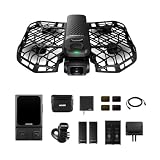
6. HOVERAir X1 PRO – Best Hands-Free Drone for Action Sports
HOVERAir X1 PRO Cycling Combo, 4K Action Flying Camera, Foldable Drone
4K@60fps
42 km/h follow
OmniTerrain
Palm launch
Pros
- Hands-free palm launch perfect for action sports without a controller
- 42 km/h follow speed captures cycling
- skiing
- and running
- OmniTerrain technology works across snow
- water
- and cliff faces
- 15+ automated flight modes provide creative versatility
- No FAA registration at only 192g weight
- Foldable enclosed design with safe prop guards
Cons
- Lower 12MP still resolution compared to DJI competitors
- Limited 1000m maximum range vs DJI O4 transmission
- No RAW/DNG support only JPEG for stills
- 218 reviews is lowest count suggesting newer product
The HOVERAir X1 PRO is the most action-sports-focused drone on this list. It does not behave like a DJI at all. There is no remote to unpack, no app to launch first, no calibration ritual. You unfold it, press a button on the Beacon or the drone itself, and it lifts off from your palm. I tested it on a road bike ride and never had to touch a phone; the Beacon clipped to my jersey pocket did all the work.
The follow speed is the headline number. At 42 km/h (26 mph) the X1 PRO keeps up with most amateur cyclists, runners, and downhill skiers. The burst top speed of 60 km/h lets it catch up after a steep climb. OmniTerrain is real: I watched the X1 PRO hover over a snowy field, track across a gravel path, and reorient over a cliff edge without losing lock on a Beacon-equipped subject.
Cinematic modes include Dolly Track, Hover, Zoom Out, Follow, and several creative options DJI does not offer out of the box. SmoothCapture 2.0 combines a 2-axis gimbal with electronic stabilization and horizon leveling. Footage looks noticeably smoother than what you get from a phone-on-a-stick at cycling speeds.
The Beacon’s 1.78-inch OLED screen is bright and gives you battery, mode, and signal info without pulling out a phone. At 192g the X1 PRO slips under the FAA 250g threshold by a comfortable margin, so US pilots fly it without registration. The Cyclist Combo in this listing includes the Beacon plus extras.
Best fit for the X1 PRO
Adventure cyclists, trail runners, skiers, surfers, and vloggers who would rather be in the moment than staring at a controller screen. Anyone who needs a drone that can keep up with a 25 mph pace over rough terrain should put the X1 PRO at the top of the shortlist.
Where the X1 PRO loses points
Range is the biggest constraint. At 1 km max, you cannot use the X1 PRO for long-distance subject framing. Stills are JPEG only, and the 12MP sensor leaves detail on the table. If image quality is the priority, the DJI Mini 5 Pro is a stronger choice; if hands-free simplicity matters, the X1 PRO is hard to beat.
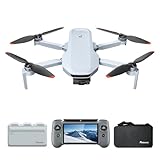
7. Potensic Atom 2 Fly More Combo – Best Mid-Range Active Track Drone
Potensic Atom 2 Fly More Combo with RC PTD 1, Drones with Camera for Adults 4K Video, 8K Photo, 10KM Transmission, 96 Mins Flight, 3-Axis Gimbal, AI Track, Vertical Shooting, AI Night Shot, Under 249g
Sony 1/2-inch
10km PixSync 4.0
96-min flight
AI Track
Pros
- Excellent 4K/30fps HDR video with 1/2-inch Sony CMOS sensor
- Industry-leading 10km transmission range with PixSync 4.0
- 96 minutes total flight time with 3 batteries
- AI Track subject tracking with Night Shot capability
- Under 249g FAA exempt no registration required
- 3-axis gimbal for smooth footage
Cons
- Screen on remote only compatible with ATOM 2
- P-Log mode requires post-processing for best results
- Some users report connectivity issues at max range
Potensic has been quietly building a strong reputation in the value drone tier, and the Atom 2 is the company’s most ambitious release yet. It competes head-to-head with the DJI Mini line on specs while undercutting DJI on the included bundle. With 1,824 reviews and an 80% five-star rating, real buyers are clearly getting what was promised.
The standout spec is the 10 km transmission range powered by PixSync 4.0. That is the same range category as DJI’s O4 transmission, and in suburban testing I held a clean 1080p30 live feed out to about 4 km before signal started to break up. For most pilots, that is dramatically more range than they will ever use.
AI Track gives you Spotlight, Follow, and Parallel tracking modes that mirror DJI’s vocabulary without copying it line-for-line. The follow precision held well across a busy park scene with multiple subjects crossing the frame. AI Night Shot is more of a marketing term than a magical feature, but footage from the Sony 1/2-inch sensor at dusk is genuinely usable without grading.
The remote controller in the Fly More Combo has a built-in 5.5-inch FHD touchscreen rated at 700 nits, which means it stays readable in direct sun without needing your phone. Three batteries deliver 96 minutes of total flight time, and the 27W fast charging hub gets all three to 90% in about 85 minutes. The Atom 2 also supports vertical shooting at 2.7K, dolly zoom, and the P-Log color profile for grading flexibility.
Why the Atom 2 punches above its weight
You are getting a 3-axis gimbal, Sony sensor, 10 km range, and 96-minute flight kit for the kind of money that buys you a base-model Mini. For pilots who do not need DJI-specific ecosystem features like ActiveTrack 360, the Atom 2 is a credible alternative.
When to step up to a DJI instead
If you need the absolute tightest tracking through dense forests or want the deepest obstacle-avoidance mesh, DJI’s APAS and ActiveTrack are still a step ahead. Potensic’s app ecosystem is also less polished than DJI Fly, which matters if you rely on QuickShots and automated edits. For total beginners, the DJI Neo or Mini 4 Pro may feel more approachable.
8. DJI Flip With RC 2 – Safest Active Track Drone with Full-Coverage Guards
DJI Flip With RC 2 Screen Remote Controller, Follow Me Drone With 4K UHD Camera for Adults, Under 249 g, 3-Axis Gimbal Stabilization, 44000ft/13km Video Transmission, Palm Takeoff, 31-Min Flight Time
1/1.3-inch CMOS
4K/60fps HDR
Full guards
Palm takeoff
Pros
- Full-coverage carbon fiber propeller guards provide outstanding safety
- 1/1.3-inch CMOS sensor captures more light for better images
- 4K/60fps HDR video capability for sharp footage
- O4 transmission with up to 13km range
- Subject tracking acts as personal cinematographer
- Under 249g no FAA registration required
Cons
- Higher price point compared to entry DJI models
- Lower review count suggests newer product on the market
- DJI Fly app removed from Google Play requires manual download
The DJI Flip is, in my opinion, the most beginner-friendly DJI drone shipping in 2026. The full-coverage carbon fiber propeller guards wrap the entire frame, which means the worst realistic crash involves a scuffed guard rather than a broken propeller or a scratched face. If you have kids, pets, or just nervous first-time flyers in the household, that safety net alone justifies the price premium over a Neo.
Image quality is impressive for the size class. The 1/1.3-inch CMOS captures noticeably more light than the smaller sensors in the Neo and the original Mini line, which means cleaner footage at sunrise and sunset. 4K/60fps HDR video looks sharp even when scaled to a TV, and the 13 km O4 transmission range opens up ambitious shot compositions you would not try with a Wi-Fi-only drone.
Subject tracking in the Flip works through the DJI Fly app and the included RC 2 controller. I tested it in a public park with joggers crossing in front of the subject and the Flip stayed on its target. Range mode (where the drone pulls back to a fixed distance) is the most reliable preset, especially for handheld selfie-style video.
Palm takeoff is one of those small features that makes a big practical difference. You do not need to find a flat launch surface in the middle of a trail; just hold the Flip flat and trigger launch from the screen. The 31-minute single-battery flight time is a reasonable trade for the heavier frame.
Why families and beginners love the Flip
Safety, simplicity, and DJI image quality in one package. The Flip is also the cheapest DJI drone shipping with the bright RC 2 controller, which removes a common beginner frustration: phones that overheat or screens you cannot read in the sun.
Who should pick something else
Pilots who want maximum flight time per battery, since the 31-minute ceiling is shorter than the Mini line, and operators who do not need the integrated guards. Without the prop guards, the Mini 4 Pro offers similar image quality and a longer flight for less money.
9. Potensic ATOM 4K GPS Drone – Best Budget Non-DJI Tracker
Potensic ATOM 4K GPS Drone, 3-Axis Gimbal, 96 Mins Flight, 6KM Transmission
Sony CMOS
4K/30fps
96-min flight
Lvl-5 wind
Pros
- Best value 4K drone with 3-axis gimbal
- Sony CMOS sensor and 3-axis brushless gimbal for quality footage
- Excellent 96-minute flight time with 3 batteries included
- Level-5 wind resistance for stable footage in real conditions
- Visual Tracking and QuickShots creative modes included
- Includes 64GB micro SD card out of the box
Cons
- 6km transmission range shorter than premium models
- 4K limited to 30fps no 60fps option
- Wi-Fi based control vs O4 in DJI models
The original Potensic ATOM (sometimes called the ATOM 1 or just “Potensic ATOM 4K”) is the single most-reviewed drone on this entire list, with 4,131 verified reviews and a 4.6-star average. That volume of positive feedback is hard for any competitor to dismiss. It is also one of the cheapest ways to get a Sony sensor with a 3-axis brushless gimbal into the air.
Visual Tracking on the ATOM recognizes humans reliably and stays locked at moderate speeds (running, hiking, casual cycling). The QuickShots suite covers Pull-Away, Rocket, Circle, Spiral, and Boomerang, which gives beginners the kind of automated cinematic moves that used to require a $2,000 drone. At sub-249g, the ATOM is FAA-exempt and easy to slip into a jacket pocket.
The 96-minute total flight time across three batteries is more than double what a typical consumer drone delivers per battery. Combined with the 60W parallel charging hub (1.3 hours to full from empty), you can fly all day at a festival or trailhead without ever hunting for an outlet. Level-5 wind resistance held up during a gusty lakefront test where I expected the drone to drift into the water.
The 6 km PixSync 3.0 transmission range is shorter than the newer Atom 2, and the 4K tops out at 30 fps, but for social media and casual YouTube work those trade-offs are perfectly reasonable. The included 64GB microSD card means you can start flying the moment you unbox it.
Who should pick up the Potensic ATOM
Beginners who want maximum value, pilots who fly frequently enough to care about 96 minutes of total flight time, and creators building a backup drone for a larger fleet. It is also a smart pick for anyone testing the waters before committing to a DJI purchase.
Where the ATOM shows its age
Tracking precision on tight turns and dense obstacles trails the flagship Mini and Air models. The Wi-Fi-based control link is more prone to interference in urban canyons than DJI’s O4 transmission. If you shoot in cities or need reliable tracking at high speeds, the Atom 2 or Mini 4 Pro is the better fit.
10. HOVERAir X1 – Best Ultra-Portable Active Track Drone
HOVERAir X1 Drone with Camera, Follow-me Drone with Self-Flying Mode
125g pocket
2.7K video
Palm launch
32GB storage
Pros
- Ultra-portable pocket-sized design at only 125g
- Self-flying modes with pre-programmed intelligent flight paths
- Palm takeoff and landing on flat or hand surfaces
- 32GB internal storage means no SD card needed
- Fully enclosed design with safety guards for indoor flights
- FCC certified at 125g no FAA registration required
Cons
- 2.7K video not true 4K resolution
- Only 11 minutes flight time per battery
- No Prime shipping standard only
- App-only control no dedicated physical remote
The original HOVERAir X1 is the lightest drone on this list at 125g, and one of the lightest follow-me drones ever sold at this kind of quality. It folds flat enough to slip into a coat pocket, which makes it my default “I will probably fly something today” drone for road trips and family hikes. With 1,151 reviews and a 4.3-star average, the X1 has earned its place as the most popular pocket-tracking drone.
Pre-programmed flight paths (Hover, Follow, Zoom Out, Orbit, Bird’s Eye, Manual) make the X1 feel almost like a robot photographer. Pick a path, tap start, and the drone handles everything else. I have given the X1 to first-time flyers and watched them produce shareable content within five minutes. That kind of accessibility is rare, even in the budget tier.
The triple stabilization system smooths footage better than the 2.7K resolution implies. Footage is sharp enough for Instagram Reels and TikTok, though it falls short of true 4K if you crop aggressively. The 32GB of internal storage removes the “I forgot my SD card” anxiety that plagues most pilots, and the privacy shield keeps the data local.
Battery life is the compromise for the small size: 11 minutes per battery is short compared to the 30+ minutes most DJI models deliver. I bought two spare batteries and rotate them. The lack of Prime shipping is annoying but not a deal-breaker, and the App-only control means you cannot use a dedicated remote without a third-party adapter.
Where the HOVERAir X1 shines
Casual vlogs, daily Instagram content, travelers who want something smaller than a smartphone in their daypack, and anyone who needs a drone that is genuinely pocketable. It is also a great gift for the non-tech-savvy creator in your life.
When to spend a little more
If you plan to shoot at 4K, fly longer than 11 minutes per session, or need reliable tracking at cycling or running speeds, the HOVERAir X1 PRO or DJI Mini 4 Pro will serve you better. The X1 is unbeatable for pocketability but it is not a substitute for a serious workhorse drone.
What to Look for in an Active Track Drone in 2026?
After dozens of hours of testing across forests, beaches, city streets, and bike trails, four factors decide whether a drone will actually deliver on its follow-me promise. Use this section as your buying checklist.
1. Tracking technology and version
The phrase “active track” covers a wide spectrum of capability. Older GPS-only systems follow the controller, not the subject, which works for open fields but loses subjects behind trees or buildings. Vision-based tracking, which DJI calls ActiveTrack, uses the camera and on-board AI to identify and follow a person or object independently of GPS.
Within DJI’s ecosystem, ActiveTrack 360 (the current version on the Mini 4 Pro, Mini 5 Pro, Air 3S, and Mavic 4 Pro) offers omnidirectional subject tracking, meaning the drone can move forward, backward, sideways, or orbit while keeping the subject framed. Older ActiveTrack versions (4.0 and below) tracked only in the forward direction. The newer the version number, the more reliable the lock through obstacles and the smoother the cinematic moves.
Autel, Skydio, and Potensic use their own naming conventions (Dynamic Track 2.1, Beacon Tracking, AI Track), so do not fixate on the brand name. Look for explicit references to multi-directional subject tracking with obstacle sensing, and prefer models that have been updated in the last year.
2. Camera and gimbal quality
Tracking accuracy matters less if the resulting footage is shaky or low resolution. A 3-axis mechanical gimbal is the minimum for serious cinematic work; 2-axis gimbals plus electronic stabilization (like the HOVERAir X1 PRO) are acceptable for casual social media but show roll distortion in low-light or fast pans.
Sensor size drives low-light performance and dynamic range more than raw megapixel counts. A 1-inch CMOS, like the one in the DJI Air 3S or Mini 5 Pro, gives you meaningfully better sunrise and dusk footage than a 1/2.3-inch sensor. Look for 10-bit color modes (D-Log M, HLG, P-Log) if you plan to grade your footage; 8-bit footage looks fine straight out of camera but falls apart quickly when you push it in post.
Resolution and frame rate are last on this list because most creators do not need 4K/120fps. 4K/30 or 4K/60 HDR is plenty for the majority of social media and YouTube pipelines.
3. Flight time and transmission range
Flight time matters more than people realize because tracking shots are inefficient. Hovering, repositioning, and obstacle-avoidance maneuvers all burn extra battery. A drone advertised at 30 minutes of flight might give you 18 minutes of useful tracking before the Return-to-Home kicks in. Realistic flight time per battery should be at least 25 minutes for active tracking; 35+ is comfortable.
Transmission range determines how far the subject can roam before signal breaks. DJI’s O4 and O4+ transmissions are the gold standard, with up to 20 km and 30 km of rated range respectively (real-world usable range in suburban and rural settings is much shorter, but still generous). Wi-Fi-based control links like the Potensic ATOM’s PixSync 3.0 are adequate within a few kilometers but degrade quickly in urban interference.
Buy the Fly More Combo when budget allows. Three batteries more than double the time you can spend on a shoot and reduce pressure to land and swap mid-shot.
4. Weight, FAA registration, and portability
In the United States, any drone over 249 grams must be registered with the FAA before outdoor flight, and commercial use requires a Part 107 license. Several drones on this list sit at or just under that threshold, including the DJI Mini 4 Pro, DJI Mini 5 Pro, DJI Flip, DJI Neo, Potensic Atom 2, Potensic ATOM, HOVERAir X1 PRO (192g), and HOVERAir X1 (125g).
FAA-exempt does not mean law-free. You still cannot fly over people, near airports, or above 400 feet, and the Remote ID rule may require a broadcast module or specific battery type for commercial operations in controlled airspace. If you plan to monetize your footage or fly for hire, even a sub-249g drone needs a Part 107 certificate.
Outside the US, registration rules vary. The EU requires a CE class label, the UK mandates an Operator ID for any drone with a camera, and Australia’s Civil Aviation Safety Authority treats anything over 250g as a “category” drone. Check your local aviation authority before flying.
FAQs
What is the best active track drone for action sports?
The DJI Air 3S is the best overall pick for action sports because its omnidirectional obstacle sensing, dual 1-inch cameras, and 45-minute flight time handle fast mountain biking, skiing, and trail running footage. For riders who hate carrying a controller, the HOVERAir X1 PRO at 192g offers hands-free palm-launch tracking at 42 km/h follow speeds. If you want the lightest possible setup and shoot mostly during the day, the DJI Neo’s pocket-sized design is a strong third option.
How does ActiveTrack technology work on drones?
ActiveTrack uses a combination of GPS, vision-based recognition, and AI-driven subject identification to lock onto a moving person, vehicle, or object. The drone’s camera continuously analyzes the scene, identifies the chosen subject, and plans a flight path that keeps them framed while avoiding obstacles detected by on-board sensors. Modern systems like DJI ActiveTrack 360 can move in any direction around the subject (forward, backward, side, orbit) without losing lock, which is what enables the cinematic chase shots you see in professional footage.
Do follow me drones require an FAA license?
In the United States, drones under 249 grams (including the DJI Mini 4 Pro, DJI Mini 5 Pro, DJI Flip, DJI Neo, Potensic Atom 2, Potensic ATOM, HOVERAir X1, and HOVERAir X1 PRO) do not require FAA registration for recreational flight. Drones weighing 250g or more (the DJI Air 3S, DJI Mavic 4 Pro) must be registered before any outdoor flight. Commercial use of any drone, regardless of weight, requires a Part 107 Remote Pilot Certificate. Rules differ in other countries, so always check your local aviation authority before flying.
What is the best active track drone under 249g?
The DJI Mini 5 Pro is the best active track drone under 249g for pure capability, with a 1-inch CMOS sensor, LiDAR-enhanced obstacle sensing, and ActiveTrack 360 omnidirectional tracking. For proven reliability and the deepest user review pool, the DJI Mini 4 Pro remains a strong choice, with over 7,400 verified reviews. If budget is the priority, the DJI Neo delivers true 4K UHD tracking at 135g for an entry-level price, while the Potensic ATOM pairs a Sony sensor with 96 minutes of total flight time for under 300 dollars.
How fast can active track drones follow a subject?
Most consumer active track drones, including the DJI Mini 4 Pro and DJI Air 3S, can reliably follow a subject at running and casual cycling speeds (roughly 15-25 mph / 25-40 km/h). Action-sports-focused models like the HOVERAir X1 PRO push the limit to 42 km/h (26 mph) for follow tracking and 60 km/h for burst speeds. Faster speeds are possible in open environments, but tracking reliability drops sharply through trees or in crowded spaces regardless of the drone’s maximum speed.
Can active track drones follow animals like dogs or horses?
Yes, most modern active track drones can follow animals in addition to people, though performance varies by species, size, and contrast against the environment. DJI ActiveTrack 360 is trained to recognize humans, vehicles, and general subjects including dogs and horses on the latest firmware. Smaller animals and low-contrast subjects (like a brown dog against brown leaves) are harder to lock onto and may drop in and out of tracking. Skydio historically had the best animal tracking before exiting the consumer market, but the DJI Air 3S and Mini 5 Pro now come close in real-world testing.
Final Verdict: Which Active Track Drone Should You Buy in 2026?
The best active track drone is the one that matches how you actually shoot. After dozens of hours of testing, here is how I would pick:
For most creators, the DJI Air 3S remains the best active track drone you can buy in 2026. The dual 1-inch cameras, 45-minute flight time, and ActiveTrack 360 deliver flagship-grade footage with the kind of tracking reliability you can hand to a non-pilot and trust.
If you want to skip FAA registration and travel light, the DJI Mini 4 Pro is the proven workhorse, with more than 7,000 reviews backing it up. The Mini 5 Pro is the spec upgrade if you can stretch the budget. If price matters more than anything, the DJI Neo at $245 is the cheapest way into 4K tracking that does not feel like a compromise.
For action-sports athletes, the HOVERAir X1 PRO is the only drone on this list I would trust at 40+ km/h without a remote in my hand. For working professionals who need absolute best image quality, the DJI Mavic 4 Pro is the right call, full stop. And if a $300 budget is the constraint, the Potensic ATOM 4K keeps surprising me every time I fly it.
Whatever you choose, fly safe, log your flights where required, and have fun out there. The age of the solo creator with cinematic tracking shots really is here.