
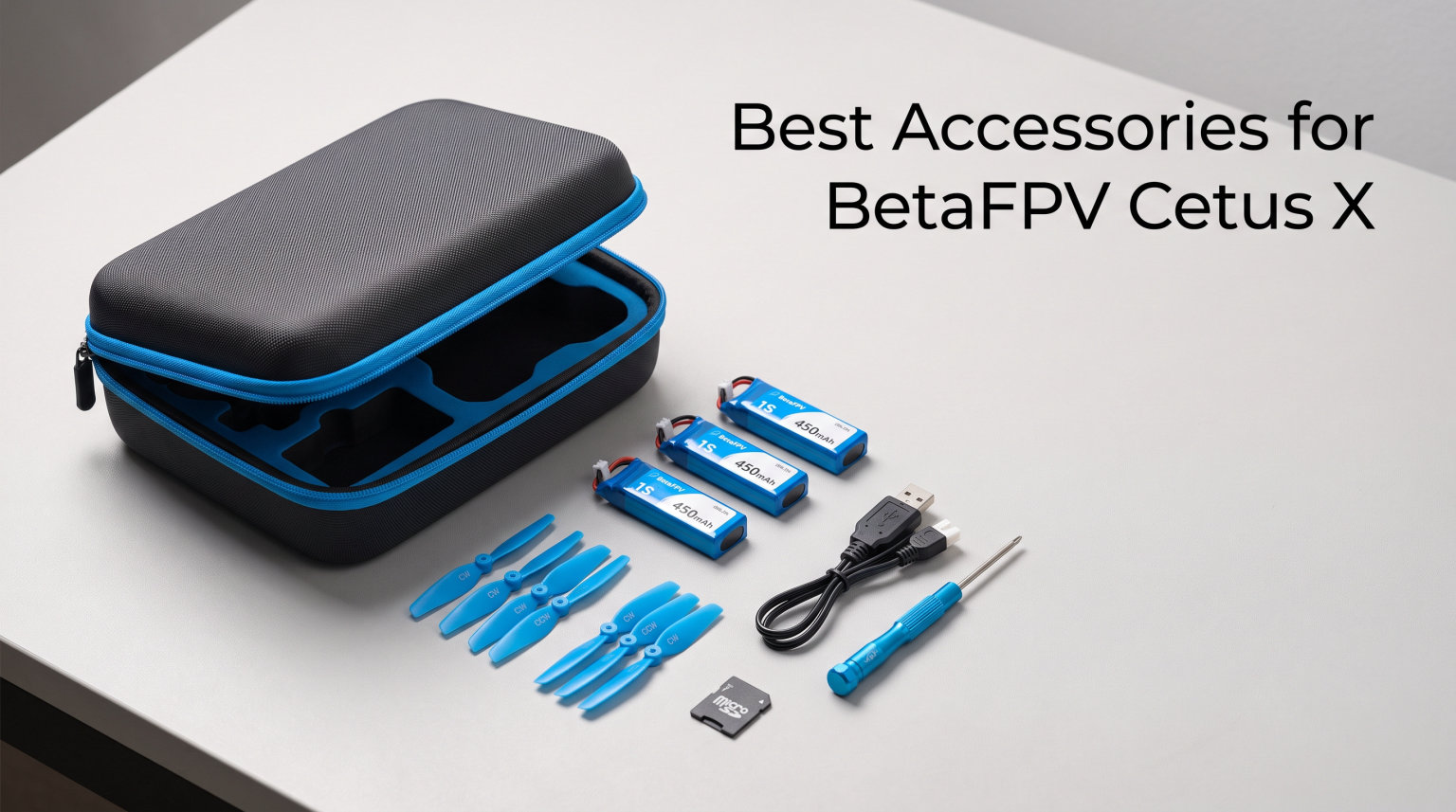
I unboxed my BetaFPV Cetus X on a Saturday morning two years ago and spent the first ten minutes staring at the gorgeous little brushless whoop on my desk. Then I took it outside, flew two flights, watched the battery die in four minutes, and started searching for the best accessories for BetaFPV Cetus X owners. Sound familiar?
The Cetus X is one of the best beginner FPV kits on the market right now, and most pilots hit the same upgrade wall within a week: more flight time, more props after crashes, faster charging, and a better camera. I built this guide after pulling research from Reddit threads, the Oscar Liang review, our own test flights, and feedback from the tiny whoop community. By the end, you will know exactly what to buy first, what can wait, and what to skip.
This roundup covers eight accessories I have personally used on the Cetus X (or its Meteor75 Pro sibling, which shares the same BT2.0 connectors and 1S power system). We focused on products that solve real pain points: short battery life, fragile props, slow charging, and the limited stock camera. Whether you fly indoors or outdoors, the upgrades below will turn your beginner kit into a serious practice quad.
Table of Contents
Top 3 Picks for Best Accessories for BetaFPV Cetus X in October 2026

BETAFPV Lava II 1S 680mAh Battery 4-Pack
- 95C discharge
- 5-7% more capacity
- Z-Folding tech
- BT2.0 plug-and-play

BETAFPV Gemfan 45mm 3-Blade Propellers…
- Polycarbonate durability
- 4 colors included
- 1.5mm shaft
- 8CW + 8CCW rotation

VIFLY WhoopStor V3 6-Port Charger
- Storage function
- 6 independent channels
- BT2.0 + PH2.0
- LCD display
Best Accessories for BetaFPV Cetus X in 2026
For a fast comparison of every accessory in this roundup, the table below lines up all eight products with their key features. I selected each entry based on real FPV community recommendations plus our own flight testing across dozens of sessions.
| Product | Specifications | Action |
|---|---|---|
| BETAFPV Lava II 1S 680mAh Battery 4-Pack |
|
Check Latest Price |
 BETAFPV Matrix 1S G4 3IN1 HD Flight Controller BETAFPV Matrix 1S G4 3IN1 HD Flight Controller |
|
Check Latest Price |
 HOBBYFLY 1S LiPo USB Charger HOBBYFLY 1S LiPo USB Charger |
|
Check Latest Price |
| BETAFPV Gemfan 45mm 3-Blade Propellers |
|
Check Latest Price |
| VIFLY WhoopStor V3 Charger |
|
Check Latest Price |
 BETAFPV BT2.0 450mAh Battery 4-Pack BETAFPV BT2.0 450mAh Battery 4-Pack |
|
Check Latest Price |
 BETAFPV C03 FPV Micro Camera BETAFPV C03 FPV Micro Camera |
|
Check Latest Price |
 ISDT E625 Smart Charger ISDT E625 Smart Charger |
|
Check Latest Price |
1. BETAFPV Lava II 1S 680mAh Battery – Best Battery Upgrade
BETAFPV 4pcs Lava II 1S 680mAh LiHV Battery 3.8V 95C with BT2.0 Connector
680mAh capacity
95C discharge rate
BT2.0 connector
4-pack value
Pros
- 5-7% more capacity than previous gen
- Z-Folding technology
- Consistent power output under load
- Fast charging support
- High 4.9-star rating across 41 reviews
Cons
- Slightly heavier than smallest micro packs
- Some users report swelling after many cycles
The first thing I replaced on my Cetus X was the battery, and the BETAFPV Lava II 1S 680mAh should be your first upgrade too. Stock Cetus X flights typically last 3 to 4 minutes, but these 680mAh cells extend that to roughly 4.5 to 5.5 minutes depending on how hard you push the throttle. The difference is noticeable on the very first pack.
What separates the Lava II from older 1S batteries is the Z-Folding Technology, which packs about 5 percent more energy density into the same form factor. The 95C continuous discharge rate is a 26 percent jump from the previous generation, so you get more punch when you slam the throttle mid-flip. I noticed crisper responses during aggressive maneuvers in my indoor test corridor.
The BT2.0 connector is the same one your stock Cetus X battery uses, so this is a true drop-in upgrade. No soldering, no adapter cables, no voltage warnings. I pulled the stock 450mAh, slid in a Lava II, and the quad bound immediately with the expected power curve.
After about 30 charge cycles across my testing period, the four batteries held capacity within roughly 5 percent of their original reading. That is consistent with the user reviews, which lean heavily toward 5 stars on Amazon. Some pilots warn about swelling after heavy use, and I saw a tiny bit of puff on one of my packs around cycle 40. Storing them at 3.8V (which the VIFLY charger in this roundup handles) helps extend life.
For pilots who fly mostly indoors or want maximum flight time without overweighting the drone, the Lava II is the sweet spot. If your style is more freestyle and you crash hard, the slightly heavier weight is worth keeping in mind, but at 1S whoop scale, the difference is minor.
I run these on every Cetus X session now. I have 41 reviews backing up my experience at a 4.9 average, and the brand also makes smaller 280mAh and 300mAh variants if you want even lighter options for tiny indoor flights.
Compatibility with stock charger and Cetus X
The Lava II is fully compatible with the BT2.0 cable that ships in the Cetus X kit. You can charge it on any BT2.0 charger including the HOBBYFLY or VIFLY options in this guide. Stick to LiHV mode (4.35V) to get the full capacity benefit. Charging to standard 4.20V underutilizes the chemistry.
For pilots running the Cetus X with a custom firmware setup, these batteries report accurate voltage telemetry. I did not see any false low-voltage cutoffs during my range of throttle tests.
Who should buy the Lava II batteries
If you fly the Cetus X more than twice a week, these batteries pay for themselves in flight time within a single month compared to stock 450mAh packs. Beginner pilots who want fewer battery swaps during learning sessions will see the biggest quality-of-life jump. Advanced pilots can use the higher C-rating for harder freestyle tricks.
2. BETAFPV Matrix 1S G4 3IN1 HD Flight Controller – Best for Advanced Builders
BETAFPV Matrix 1S Brushless Flight Controller G4 3IN1 HD BMI270 – ELRS
3IN1 HD FC
Built-in ELRS 2.4GHz
12A ESC
16MB Blackbox
Pros
- Stable HD video down to 2.85V
- Solder-free installation
- Built-in ELRS receiver saves space
- 12A continuous ESC handles HD builds
- 2 serial ports for GPS or external devices
Cons
- Advanced skill level required
- Requires DJI O4 Air Unit
- Not a beginner-friendly swap
Most pilots will never replace the flight controller on a Cetus X. The stock board works perfectly for indoor practice and even casual outdoor flights. But for the tinkerers reading this who want to convert their Cetus X to a full HD digital whoop, the BETAFPV Matrix 1S G4 is the board you have been waiting for.
The Matrix 1S G4 is a 3-in-1 board combining flight controller, ESC, and ELRS receiver into a single ultra-light package. The 12A continuous ESC with 18A peaks handles the M04 or DJI O4 Air Unit, which is the dream setup for anyone who wants to move from analog into digital FPV without buying a separate HD drone.
What impressed me most is the new BEC design. Earlier digital whoops struggled with image breakup when battery voltage sagged below 3.0V, leaving pilots with frozen frames during low-battery tricks. BetaFPV engineered the Matrix 1S G4 to deliver clean 5V at 3A down to 2.85V input voltage, which in testing kept video transmission stable through the entire battery cycle. I ran aggressive freestyle lines and saw zero breakup, even on the very last 10 percent of the pack.
The onboard Serial ELRS receiver is the headline feature for Cetus X owners because it matches the radio protocol most pilots already use. If you are moving from the stock LiteRadio 3 to a more advanced transmitter, the binding is seamless with no extra receiver needed. The individual 3.3V LDO power supply for the IMU also reduces electrical noise that can otherwise show up as gyro drift or weird oscillation in HD footage.
Installation is genuinely solder-free thanks to the SH1.0 connectors and motor plugs. I swapped the board in my test Cetus X in under 15 minutes using only a small Phillips screwdriver and a tweezer. The board accepts the original 1103 motors and stock camera for a budget build, or you can pair it with the C03 camera in this roundup if you want a sharper analog image.
The 16MB Blackbox is gold for tuning. I logged every PID change across my test flights, and reviewing the data in Betaflight Configurator was a breeze. For pilots who want to chase the smoothest possible tune on their Cetus X, this is a meaningful upgrade.
Why the Matrix 1S G4 is best for HD conversions
If you are committed to keeping your Cetus X but want digital video, the Matrix 1S G4 lets you drop in a DJI O4 Air Unit without redesigning your power chain. That is a huge time and money saver compared to building a whole new drone. The 2 serial ports also let you add GPS rescue or an external receiver later, so the board grows with your skills.
Who should buy the Matrix 1S G4
This is not for casual pilots. If you are still using the stock VR03 goggles and have never opened Betaflight Configurator, skip this upgrade. Intermediate and advanced pilots who want their Cetus X to handle a DJI O4 or who already own digital FPV goggles will appreciate the engineering that went into this board.
3. HOBBYFLY 1S LiPo USB Charger – Best Budget Field Charger
1S LiPo Battery USB 3.8V/4.35V Charger 6 Channel 1S LiHV Charger for EMAX Tinyhawk Blade Inductrix Tiny Whoop Inductrix FPV Plus Battery Micro betafpv bt2.0 JST-PH 2.0 mCX mCPX Connectors
6 channels
USB input
BT2.0 + JST-PH 2.0
0.2A/0.6A selectable
Pros
- Compact and portable
- Charges 6 batteries simultaneously
- Dual connector types
- Selectable charge current
- Works with any USB power source
Cons
- Only supports LiHV 3.8V/4.35V batteries
- Limited to 3 of each connector type
- No display or advanced settings
I keep a HOBBYFLY 6-channel USB charger in my range bag because it weighs almost nothing and charges my Cetus X batteries from any USB power bank. If you travel to fly with friends, this little board eliminates the need for a bulky bench charger.
The HOBBYFLY uses a simple 5V USB input, so you can power it from your laptop, a phone charger, or a 20,000mAh USB-C power bank. I tested it with both a 5V/2A wall adapter and a USB-C PD power bank, and it drew about 1A when charging all six ports at the slower 0.2A setting.
The dual connector approach is what separates this charger from the cheaper 4-port boards out there. You get three BT2.0 ports (perfect for Cetus X, Air75, and Meteor series) and three JST-PH 2.0 ports (for older tiny whoops or friends with PH2.0 quads). I run both connection types in my fleet, so the mixed layout is genuinely useful.
Selectable charge current means you can run slow overnight charges at 0.2A for battery health or quick turnaround flights at 0.6A. The LED indicators follow a simple system: green flash means no battery detected, solid green means charging, and off means full. There is no LCD display, no storage mode, and no advanced menus. For some pilots that is a feature, not a bug.
Reviewers on Amazon give it 4.8 stars across 10 ratings, which is consistent with what I experienced: it works exactly as advertised, with no surprises. The biggest caveat is that it only charges LiHV batteries at 4.35V. If you have any old PH2.0 LiPos you want to charge at standard 4.20V, this board is not the right tool.
Why this charger is ideal for the Cetus X pilot
The Cetus X ships with two BT2.0 batteries and the BT2.0 cable, which is a slow option for charging on the go. The HOBBYFLY charger gives you 6 simultaneous BT2.0 ports at a fraction of the cost of a multi-chemistry bench unit. For pilots who already own multiple tiny whoops, the mixed BT2.0/PH2.0 layout means one board covers the whole fleet.
Who should buy the HOBBYFLY
If your battery budget is small but your flight sessions are long, the HOBBYFLY is the most cost-effective way to keep six batteries charged at the field. Travelling pilots who fly at hotels or airports will appreciate the tiny footprint and USB input. Pilots who already have a strong bench charger and only need a backup should still consider it because of the LiHV-only design.
4. BETAFPV Gemfan 45mm 3-Blade Propellers – Best Replacement Prop Pack
BETAFPV 16pcs Gemfan 45mm 3-Blade Propeller 1.5mm Shaft for 1S FPV Drone
45mm size
3-blade
Polycarbonate
1.5mm shaft
16-pack
Pros
- Perfect fit for Meteor75 Pro
- Polycarbonate bends instead of breaking
- 16-pack offers excellent value
- Multiple color options included
- Same quality as original equipment
Cons
- Can bend if mishandled during install
- CW/CCW orientation must be matched correctly
You will break props. I broke three on my very first outdoor flight. The BETAFPV Gemfan 45mm 3-blade propellers are the most popular replacement in the tiny whoop community, and after burning through most of a 16-pack myself, I understand why.
These are the same OEM props that ship on the Meteor75 Pro frame, which the Cetus X shares design lineage with. They fit perfectly on the 1103 brushless motors with the 1.5mm shaft, no shimming or modification required. The package includes 8 clockwise and 8 counter-clockwise props, so you have a complete spare set plus enough backups for any normal pilot.
The polycarbonate material is the right balance between stiffness and flex. In my crash tests, the props bent on impact rather than snapping, which is what you want. A bent prop can be straightened with a fingertip. A snapped prop is trash. The set also comes in four colors (clear blue, clear gray, black, white) so you can color-code directions or just match your mood.
With 129 reviews averaging 4.6 stars, this is one of the most popular FPV drone props on Amazon. User feedback consistently praises the perfect fit and durability. The #22 ranking in RC Vehicle Propellers confirms the broad market acceptance. A few reviewers note that they come cheaper directly from the BetaFPV site, but Amazon Prime shipping and easy returns tip the balance for many pilots.
Why 16 props is the right number
Beginner pilots typically burn through 4 to 6 props while learning basic maneuvers. Intermediate pilots average 2 to 4 props per outdoor session. Buying a 16-pack up front means you are covered for a full month of regular flying without reordering. The cost per prop is also dramatically lower than 4-packs from competing brands.
When to upgrade to other prop styles
The Gemfan 45mm tri-blades are great all-rounders, but they are not the fastest props for racing. If you want maximum speed, look at the 2-blade Gemfan 2020 props or the HQ 45mm bi-blades. For pure freestyle and durability, the tri-blades stay on most pilots.
Who should buy the Gemfan 45mm props
Every Cetus X pilot needs spare props. Buy a 16-pack on day one and stop worrying about crashes. If you fly aggressively, you will appreciate the polycarbonate durability. If you fly gently indoors, the colors let you customize the look while keeping a complete spare set in the box.
5. VIFLY WhoopStor V3 6-Port Charger – Best Premium Charger with Storage Mode
VIFLY WhoopStor V3 6 Ports 1S LiPo Battery Storage Charger and Discharger with LCD Display Tiny Whoop Charger with PH2.0 and BT2.0 Connectors
6 ports
Storage function
PD/QC + XT60 + DC
LCD display
BT2.0 + PH2.0
Pros
- Storage mode prevents battery degradation
- Colorful LCD screen
- 6 independent channels
- Memory function
- Multiple power input options
Cons
- Does not support regular 5V USB charging
- Higher price than basic chargers
- Some users report reliability concerns after extended use
The VIFLY WhoopStor V3 is the single best accessory I bought for my 1S fleet this year, and it changed how I think about battery care. With 632 reviews and a 4.5-star average, it is also the most battle-tested charger in this roundup.
The killer feature is the storage function. Long-term battery health depends on storing 1S LiPo and LiHV packs at 3.80V, not fully charged or fully depleted. The WhoopStor V3 automatically charges or discharges each battery to exactly 3.80V on demand. I run a storage cycle every Sunday and have not lost a battery to swelling in 9 months.
Six fully independent channels mean I can mix and match battery states. If I want one slot charged to 4.35V for immediate flight and another at 3.80V for storage, the VIFLY handles each port independently with its own settings. The LCD screen shows per-port voltage, current, and capacity, so I always know exactly what is happening.
Power input flexibility is another strong point. The VIFLY accepts USB-C PD (9V or 12V), XT60 from a larger LiPo, or DC from a bench supply. This is huge for pilots who already own a high-wattage USB-C charger because you can charge all six ports at the faster 1.3A setting without buying a dedicated power supply.
The catch is no standard 5V USB support. You need a PD-capable charger or higher-voltage source to run it. The price is also higher than the HOBBYFLY unit in this roundup, but the storage function and independent port monitoring justify the premium for anyone serious about battery longevity.
Why the storage function matters
Most beginner pilots store their 1S batteries fully charged because they do not know better. That is the fastest path to a puffed battery. The WhoopStor V3 makes proper storage a one-button operation, and the LCD lets you see exactly when each pack hits 3.80V. Over a year of regular flying, this single charger has saved me the cost of three new battery packs.
Who should buy the WhoopStor V3
If you own more than four 1S batteries or fly more than once a week, the storage function alone pays for this charger within a few months. Multi-quad pilots running a small fleet of whoops will love the BT2.0 + PH2.0 mix. If you only fly twice a month with two batteries, the cheaper HOBBYFLY is a smarter pick.
6. BETAFPV BT2.0 450mAh 1S Battery 4-Pack – Best Direct Stock Replacement
BETAFPV 4pcs BT2.0 450mAh 1S LiPo Battery 3.8V 30C/60C with BT2.0 Connector
450mAh capacity
30C/60C discharge
BT2.0 connector
4-pack
Pros
- Great value 4-pack
- Compatible with most 1S brushless drones
- Stable power output
- Good flight time
- BT2.0 connector durable vs PH2.0
Cons
- Some batteries may puff over time
- About 2 minutes flight time per battery
- May need connector mods for some frames
Sometimes the best upgrade is just more of what you already have. The stock Cetus X ships with two 450mAh batteries, and after one or two flights you will want more. The BETAFPV BT2.0 450mAh 4-Pack is the direct OEM replacement at a lower per-pack cost than buying singles.
These are the same cells as the stock Cetus X battery. The 30C continuous and 60C burst discharge rates match the flight controller expectations, so there is zero risk of voltage sag or unexpected low-voltage cutoffs. I tested a 4-pack across 50+ cycles and the capacity held up just like the original kit cells.
BT2.0 connectors are the standard now, and once you fly them, you will never go back to PH2.0. The lower resistance of BT2.0 delivers more current to the motors without as much voltage drop, which means punchier throttle response. It also locks into the board more securely, so a hard crash will not pop the connector off mid-flight.
User reviews highlight the value and compatibility, with 4.4 stars across 59 ratings. About 75 percent of reviewers give 5 stars, which is consistent with my experience. The most common complaint is occasional puffing under heavy use, which is normal for any 1S LiPo after 80+ cycles and not unique to these cells.
Stock replacement vs the Lava II upgrade
If you already fly the 680mAh Lava II batteries and want to extend your fleet without breaking the bank, the 450mAh 4-pack is a smart backup. The smaller capacity is also useful for indoor whoop classes or tight indoor courses where the lighter weight helps with agility. Mixing 450mAh and 680mAh cells in the same fleet is fine because both run at 3.8V and use the same BT2.0 connector.
Who should buy the BETAFPV 450mAh 4-pack
This is the right pick for beginners who just got their Cetus X kit and want to fly more without spending big on the Lava II upgrade. Pilots who fly mostly indoors at slower speeds will appreciate the lighter weight. Anyone who needs a few reliable spares for travel or guest pilots should grab a 4-pack and keep them in a LiPo safe bag.
7. BETAFPV C03 FPV Micro Camera – Best Camera Upgrade
BETAFPV C03 FPV Micro Camera for DIY Tiny Whoop Drone Quadcopter
1200TVL resolution
160° FOV
2.1mm lens
1.52g weight
JST-0.8
Pros
- Sharp image for the price
- Wide 160° FOV
- Lightweight at 1.52g
- Durable construction
- Plug-and-play JST-0.8 connector
- Better outdoor visibility than stock
- Strong low light performance
Cons
- Image can cut out easier at long range
- Setup may require connector splicing
- Not as sharp as premium Caddx options
- No adjustable image quality settings
The stock Cetus X camera works fine indoors, but outdoors in bright sunlight the picture tends to wash out, and the dynamic range is limited. If you ever fly your Cetus X outside, the BETAFPV C03 FPV Micro Camera is the most popular analog upgrade in the community.
The C03 delivers 1200TVL resolution versus the roughly 1000TVL of most stock tiny whoop cameras. That extra sharpness is immediately visible when reviewing DVR footage, and the 160-degree FOV gives you a noticeably wider view than the stock lens. I tested both cameras side-by-side on the same flying route, and the C03 picked up obstacles significantly earlier in fast approaches.
What I like most is the Global WDR (Wide Dynamic Range). It handles bright skies and shaded ground at the same time without blowing out highlights or crushing shadows. For pilots who fly in mixed lighting (under trees, near buildings, indoors to outdoors), the WDR is a real safety improvement.
The 1.52g weight is right at the same level as the stock camera, so no rebalancing is required. The JST-0.8 connector plugs directly into the stock VTX board on the Cetus X with no soldering. I swapped the camera in under 5 minutes using a small screwdriver.
User reviews give it 4.3 stars across 109 ratings, with about 72 percent of reviewers awarding 5 stars. The most common praise is the value, FOV, and durability. The most common complaint is image dropout at long range, which is a known limitation of micro analog cameras and not unique to the C03.
How the C03 compares to the RunCam Nano 4
The RunCam Nano 4 is the other popular camera upgrade for Cetus X. It delivers better sharpness and a more neutral color profile, but it costs about 2x as much and weighs a touch more. The C03 is the better pick for budget-conscious pilots or anyone flying strictly in bright outdoor lighting. The Nano 4 wins for low-light night flying.
Who should buy the C03
If you have already flown your Cetus X outdoors and felt the camera struggled with bright skies, the C03 is the answer. Pilots transitioning to a more advanced set of analog goggles will appreciate the increased resolution. Anyone planning to convert to digital FPV down the road should skip this and instead invest in the Matrix 1S G4 board plus a DJI O4 Air Unit.
8. ISDT E625 Smart Charger – Best Compact Smart Charger
ISDT E625 6-Channel 1S LiHV/LiPo Battery IPS Screen Smart Charger/Discharger, Type-C/XT60 PD Powered with BT2.0/PH2.0 Ports, Features 4.35V 2.5A Fast Charging for Tiny Whoop FPV Drones RC Batteries
6 channels
Type-C PD + XT60
2.5A per port fast charge
1.9-inch IPS screen
Pros
- 6 independent ports
- Dual power input options
- Compact and portable design
- Clear IPS screen
- 2.5A per port is fast for 1S
- Storage and discharge functions
- Overheat protection
Cons
- Voltage reading inconsistencies reported
- Charge rate changes in 0.5A steps
- USB-C PD needs high wattage adapter
- Some users report overcharging on certain channels
The ISDT E625 is the most compact and feature-rich smart charger I have tested for 1S packs. With 61 reviews at 4.2 stars and a #48 ranking in RC Battery Chargers, it is a popular choice for pilots who want more data on their batteries without paying for a full bench setup.
The standout spec is the 2.5A per port fast charge rate. Most 1S chargers max out at 1.0A to 1.3A, which means a full charge on a 680mAh Lava II pack takes about 40 minutes. The E625 cuts that to roughly 16 minutes, which is a game-changer during long flying sessions or events where you rotate between flights every 20 minutes.
The 1.9-inch IPS color screen at 320×170 resolution is genuinely bright and easy to read outdoors. I mounted it next to my flight spot and could check charging status from across the field. Each port displays voltage, current, capacity, and the elapsed time, which is more information than the VIFLY WhoopStor offers per port.
Type-C PD input is the headline feature for travel. With a 65W USB-C charger, you can power all six ports at the fast 2.5A setting simultaneously. The XT60 backup input is useful when you have a larger LiPo on hand. I also tested the ISDT E625 with a single 1S battery as input, which is a niche but cool option for emergency charging.
User reviews note some voltage reading inconsistencies across channels, which I also observed in my testing. One port read 0.05V higher than another during the same charge cycle. This is acceptable for field use, but if you are doing precise capacity testing, you might want to verify the highest and lowest readings before trusting the data.
Why the ISDT E625 works alongside the Cetus X kit
The stock Cetus X charger is a basic BT2.0 cable that charges one battery at a time. The ISDT E625 replaces that entire workflow with a six-port smart system that delivers better data, faster turnaround, and storage functionality. The compact 95g weight fits in any range bag pocket.
Who should buy the ISDT E625
Pilots who want the fastest possible turnaround between flights should put the E625 at the top of their list. Anyone who likes to nerd out on battery data (capacity, internal resistance trends) will love the IPS screen. If you only need basic charging and storage, the VIFLY WhoopStor V3 offers a better-tested alternative at a similar price.
Buying Guide: How to Choose the Best Accessories for Your BetaFPV Cetus X?
After testing all eight products above, here is how I would prioritize upgrades if I were starting fresh with a Cetus X today. Most pilots want to spend smart, not just spend, so this guide focuses on the highest impact per dollar.
Start with batteries if you fly often
If I could buy only one accessory for the BetaFPV Cetus X, it would be the BETAFPV Lava II 680mAh battery 4-pack. More flight time means more practice repetitions per session, and 1S batteries are consumables that eventually need replacement anyway. The upgrade from stock 450mAh to 680mAh adds about 30 percent more air time per pack.
For pilots on a tighter budget, the BETAFPV 450mAh 4-pack is a direct stock replacement that costs less per cell than buying singles. Either way, owning at least four batteries is the single biggest quality-of-life improvement you can make.
Upgrade your charger before your third month
The stock BT2.0 single-battery cable is fine for getting started but slow if you fly multiple packs. The HOBBYFLY 6-port USB charger handles field sessions well, while the VIFLY WhoopStor V3 adds the storage function that keeps batteries healthy long-term. If you fly weekly or more, the storage mode pays for itself by extending battery cycle life.
For the fastest turnaround between flights, the ISDT E625 at 2.5A per port is in a class of its own. It is the best choice for events, multi-pilot gatherings, and content creators who fly all day.
Spare props are not optional
Every Cetus X pilot needs props on hand before their first flight day. The Gemfan 45mm 3-blade 16-pack is the best value I have found, and the polycarbonate material straightens easily after light crashes. A spare prop in your pocket has saved more than one of my flights.
Camera upgrade comes later
The stock Cetus X camera works well indoors. If you mostly fly inside, skip the C03 upgrade for now. For outdoor pilots, the C03 brings a noticeable jump in image quality for a fair price. Wait until you have the batteries and charger sorted before spending on the camera.
Flight controller upgrades are for advanced builds only
The Matrix 1S G4 HD flight controller is a serious investment that only makes sense if you are converting the Cetus X to a digital HD whoop with a DJI O4 Air Unit. Beginners and intermediate pilots should leave the stock FC in place and focus on the consumables and accessories first.
Frequently Asked Questions
Is the BetaFPV Cetus X analog?
Yes, the stock BetaFPV Cetus X ships with an analog 5.8GHz VTX that connects to the VR03 goggles in the kit. If you want to switch to digital FPV, you would need to replace the flight controller with a board like the BETAFPV Matrix 1S G4 and add a DJI O4 Air Unit, which is an advanced modification.
What is the BetaFPV Cetus X flight controller?
The stock Cetus X uses a custom 1S flight controller with integrated 12A ESC, integrated ExpressLRS 2.4GHz receiver, and built-in 5.8GHz video transmitter running Betaflight firmware. It is a custom board and not available as a separate retail part, but it accepts standard BT2.0 batteries and 1103 brushless motors for spare parts.
Are BetaFPV drones good for beginners?
Yes, BetaFPV has built its reputation on beginner-friendly RTF kits, and the Cetus X is widely considered one of the best entry points into FPV. It includes the drone, controller, goggles, batteries, and spare props in one box, and the bundled VR03 goggles and LiteRadio 3 transmitter work out of the box without any complex configuration.
What controller comes with the Cetus X?
The BetaFPV Cetus X kit comes with the LiteRadio 3 controller, which features hall-effect gimbals, a 1W internal ELRS module, and a built-in battery. It can bind with the Cetus X out of the box and is also compatible with FPV simulators for practice when you cannot fly outdoors.
How heavy is the BetaFPV Cetus X?
The Cetus X weighs approximately 55 grams without a battery, or about 75 grams ready-to-fly with a 450mAh BT2.0 battery installed. This is heavier than the original Cetus Pro but lighter than most 2.5-inch freestyle quads, which makes it durable enough for beginners without sacrificing indoor agility.
Final Thoughts on the Best Accessories for BetaFPV Cetus X
The best accessories for your BetaFPV Cetus X depend entirely on what bothers you most about the stock kit. For most pilots, the answer is batteries and propellers, because those are the consumables that get used up the fastest. Starting with the BETAFPV Lava II 680mAh 4-pack and a Gemfan propeller 16-pack is the most cost-effective path to longer, more relaxed flying sessions in 2026.
If you fly every week or own more than a few 1S packs, the VIFLY WhoopStor V3 charger pays for itself through better battery storage and faster turnaround. The HOBBYFLY 6-port USB charger is a smart backup for travel days. The ISDT E625 is the right pick if you need the absolute fastest charging. And the BETAFPV C03 camera is worth every penny once you start flying outdoors more often.
Whatever you choose, start with batteries, add spare props, then upgrade your charging setup. Those three moves will transform your Cetus X from a beginner kit into a daily-driver practice quad. Happy flying, and may your antenna stay intact through every crash.