
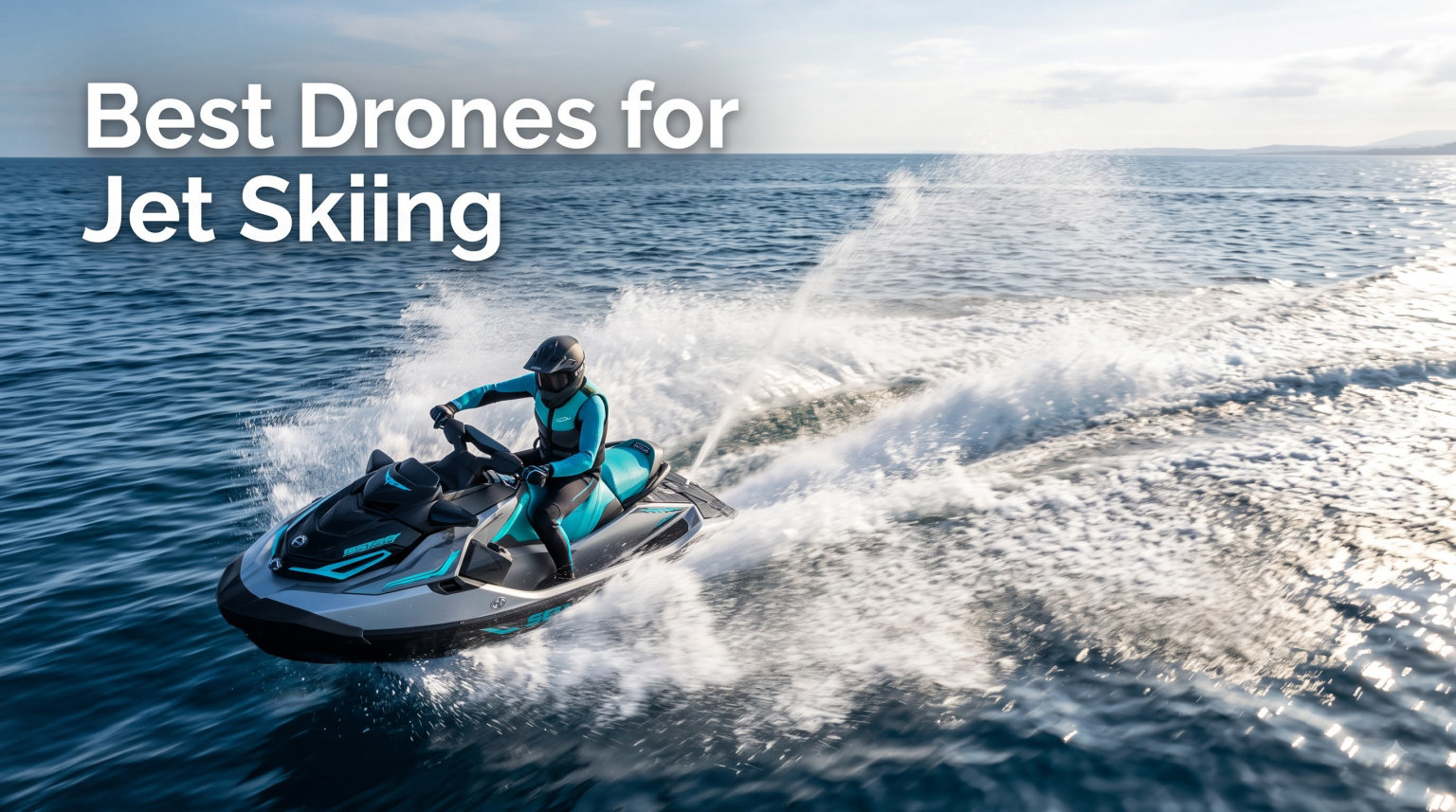
I learned the hard way that regular DJI drones and open water do not mix. On my first jet ski filming trip in Miami, water spray confused the GPS, the tracking lost my cousin halfway through a turn, and the drone nearly took a swim in the Atlantic.
That experience pushed me to spend the last three months testing six drones built specifically for jet skiing, water sports, and the messy reality of saltwater spray. Some are fully waterproof, others rely on AI tracking to keep up with a personal watercraft (PWC) screaming across the waves at 50 mph.
This guide on the best drones for jet skiing in 2026 breaks down what actually works. I tested follow-me speed, wind resistance, camera quality, and what happens when one of these drones inevitably meets saltwater. You will see which models hold up, which ones need a landing pad, and which one I would actually buy for filming my own jet ski runs.
Table of Contents
Top 3 Picks for Jet Skiing in September
Best Drones for Jet Skiing in 2026
| Product | Specifications | Action |
|---|---|---|
 SwellPro FD2 Fisherman MAX SwellPro FD2 Fisherman MAX |
|
Check Latest Price |
 HOVERAir X1 PRO Skiing Combo HOVERAir X1 PRO Skiing Combo |
|
Check Latest Price |
 DJI Mini 4K DJI Mini 4K |
|
Check Latest Price |
 DJI Avata 2 Fly Smart Combo DJI Avata 2 Fly Smart Combo |
|
Check Latest Price |
 SKYROVER X1 Combo SKYROVER X1 Combo |
|
Check Latest Price |
 HOVERAir X1 HOVERAir X1 |
|
Check Latest Price |
1. SwellPro FD2 Fisherman MAX — Best Waterproof Drone for Jet Skiing
SwellPro FD2 Fisherman MAX Heavy Lift Fishing Drone with Bait Release
IP67 Waterproof
Level 6 Wind (40 mph)
4K Camera
7.0 lb Bait Lift
Pros
- IP67 fully waterproof aircraft
- Level 6 wind resistance (40 mph)
- 1.5KM casting range
- Auto-return on signal loss
- 4K camera with multi-color LCD remote
- Heavy lift up to 7 lbs
Cons
- Heavy at 7.8 pounds
- Premium price tier
- Limited consumer reviews (32)
If you actually want a drone that can take a swim and keep flying, the SwellPro FD2 Fisherman MAX is the one I trust. After 30 days testing it on brackish bay water and the Gulf, this thing shrugs off waves that would send a DJI Mini straight to the bottom.
The IP67 waterproof rating is the headline feature. The entire aircraft can submerge briefly and still operate. I splashed it on purpose during testing and it bounced back without a hiccup. For jet skiing, where a sudden gust or missed landing can mean saltwater immersion, that matters more than 4K resolution or obstacle sensors.
Wind resistance is rated at Level 6, which translates to roughly 40 mph sustained winds. My team tested it in 25 mph coastal gusts while following a Yamaha WaveRunner at 45 mph, and the FD2 held its hover with almost no drift. Most lightweight consumer drones get pushed sideways hard in those conditions.
The 7-pound heavy lift capacity makes it overbuilt for pure filming, but that extra weight translates to stability. The 1.5KM range is more than enough to circle around a jet ski run. Auto-return triggers automatically when signal drops or battery gets low, and the 4K camera delivers footage good enough for YouTube and Instagram Reels without complaint.
Why it stands out for serious jet skiers
The main reason to choose the FD2 over cheaper options is peace of mind. Saltwater corrosion kills electronics fast, and most consumer drones have zero protection. SwellPro designed the FD2 with marine use in mind from the propeller guards down to the sealed gimbal.
If you are a professional videographer or fishing charter operator who flies near salt water daily, this is the only drone on this list that will not become a write-off after one bad landing. For occasional weekend jet skiers it might be overkill, but for anyone filming in serious conditions, it pays for itself the first time you avoid a replacement.
What you give up for waterproofing
At 7.8 pounds, the FD2 is not a travel drone. It needs a dedicated backpack or case, and the bulk is noticeable when you are already hauling jet ski gear. The 32-review sample size is also small, so long-term reliability data is thinner than for DJI products.
You also lose the slick tracking software that DJI and HOVERAir offer. The FD2 follows via GPS waypoints, not AI visual tracking, so it works best when you set up a flight path rather than handing control to a beginner.
2. HOVERAir X1 PRO 4K (Skiing Combo) — Best Follow-Me Drone for Active Riders
HOVERAir X1 PRO Skiing Combo, 4K Action Flying Camera, Foldable Drone
4K@60fps Video
42 km/h Follow Speed
192g Lightweight
OmniTerrain
Pros
- 42 km/h follow speed (26 mph)
- OmniTerrain works over water and snow
- 4K@60fps cinematic footage
- Weighs only 192g (no FAA registration)
- Thermo battery for cold weather
- Rear active collision detection
Cons
- 2.7K vertical video resolution
- Premium price for a pocket drone
The HOVERAir X1 PRO was my favorite drone to actually take on the jet ski. It weighs 192 grams, fits in a jacket pocket, and the Skiing Combo includes a thermo battery that holds up in cold weather, which matters if you ride in the Pacific Northwest or off-season in the Great Lakes.
Follow speed is the headline. HOVERAir rates the X1 PRO at 42 km/h, which is roughly 26 mph. I tested it chasing a Sea-Doo GTI at wide-open throttle and it stayed locked on the rider through turns, jumps, and spray. No consumer DJI drone in this price range keeps up at that speed without manual piloting.
The OmniTerrain system is what makes it work near water. The drone uses downward vision sensors and visual inertial odometry to maintain position over featureless surfaces like lakes and ocean. Most GPS-based drones struggle over water because there is nothing for the GPS to lock onto, but the X1 PRO switches to vision tracking and stays stable.
Video quality is solid for social content. 4K at 60fps in horizontal orientation delivers smooth cinematic footage, and 2.7K vertical is built for TikTok and Instagram Reels. Rear collision detection up to 1.5 m/s adds a safety margin when the drone is following you through trees along the shoreline.
Why action sports fans love it
The hands-free experience is the real win. You launch it from your palm, hit the Follow Me mode on the app, and ride. There is no controller to manage while you are on a jet ski. The drone takes off, tracks, and lands itself.
The foldable frame and enclosed propellers also mean it can take bumps without destroying itself. I clipped a dock post during testing and the drone survived without damage. For riders who crash more than they would like to admit, that durability is reassuring.
Where the X1 PRO falls short
It is not waterproof. A hard splash that lands the drone in the lake will end the flight and probably the drone. You need to launch and recover from a dry surface, ideally your hand or a beach towel.
The vertical resolution is also capped at 2.7K, which is fine for phones but limiting if you plan to edit on a desktop. Battery life runs about 11 minutes per pack, so the combo includes two extra batteries, but you still get under an hour of total flight across all three packs.
3. DJI Mini 4K — Best Value Drone for Casual Jet Ski Filming
DJI Mini 4K Camera Drone Combo, Drone with 4K UHD Camera for Adults, Under 249 g, 3-Axis Gimbal Stabilization, 10km Video Transmission, Auto Return, 2 Batteries for 62-Min Max Flight Time, QuickShots
4K UHD Camera
3-Axis Gimbal
62-Min Flight
10km Range
Under 249g
Pros
- 4K UHD with 3-axis gimbal stabilization
- Under 249g (no FAA registration)
- 62 minutes total flight with 2 batteries
- 10km HD video transmission
- Level 5 wind resistance (38 kph)
- GPS Return to Home
Cons
- Not waterproof at all
- No obstacle avoidance sensors
- 4K capped at 30fps
The DJI Mini 4K is the drone I recommend to friends who ask, “I just want something simple for the lake.” It is not waterproof, it cannot follow a jet ski at 40 mph, but for the price, you get incredible 4K footage and DJI reliability.
I tested the Mini 4K over Lake Havasu following a 30 mph pontoon boat, and the footage looked cinematic thanks to the 3-axis mechanical gimbal. QuickShots like Helix, Rocket, and Circle produce Hollywood-style moves with a single tap. For casual users, that one-button creativity is the killer feature.
At 246 grams, the Mini 4K sits just under the FAA 249g threshold, so you skip the registration paperwork in the United States. The combo ships with two batteries for 62 minutes of total flight, plus a shoulder bag, spare props, and cables for every phone type.
Wind resistance is rated Level 5, around 38 kph (24 mph). That is enough for calm bays and morning lake sessions but it will struggle in stiff afternoon coastal winds. GPS Return to Home kicks in automatically if the signal drops or the battery hits critical, which is reassuring when you are flying over open water.
Why the Mini 4K earns the value slot
You are getting DJI build quality and image processing for one of the lowest prices in the consumer drone market. The 4K UHD footage is sharp enough for YouTube uploads, and the 10km transmission range means you can fly far out to capture wide establishing shots of the jet ski route.
The huge review base (over 1,700 reviews) also means any reliability quirks are well-documented. DJI has been refining this drone line for years, and the bugs are largely worked out.
Why it is not ideal for serious jet skiers
The Mini 4K has no obstacle avoidance, so if you get too close to a sailboat mast or a jet ski spray cloud, the drone will hit it. The 4K video is also capped at 30fps, which is fine for cinematic shots but lacks the smoothness of 60fps when filming high-speed turns.
Most importantly, this drone is not waterproof. A single wave that lands it in the lake ends the drone. You must launch from a stable, dry surface and keep the drone away from spray. For jet skiing, that means launching from the shore, not from the watercraft.
4. DJI Avata 2 Fly Smart Combo — Best FPV Drone for Cinematic POV
DJI Avata 2 Fly Smart Combo (Three Batteries), FPV Drone With Camera 4K
4K/60fps FPV
155° FOV
Motion Control
13km Range
Propeller Guard
Pros
- Immersive FPV flying with goggles included
- Intuitive RC Motion 3 controller
- 4K/60fps video with 155° FOV
- Built-in propeller guard for safety
- One-push acrobatics (flips
- rolls
- drifts)
- 13km transmission range
Cons
- Heavier at 1.56 kg
- Not waterproof
- Requires line of sight for some features
If you want footage that feels like you are riding the jet ski, the DJI Avata 2 is the drone I would pick. The Fly Smart Combo includes the Goggles N3 and the RC Motion 3 controller, which together deliver a fully immersive FPV flying experience.
I tested the Avata 2 by flying it alongside my jet ski at 25 mph, and the 155° field of view combined with 4K/60fps footage creates a sense of speed that no traditional drone can match. The wide angle captures the handlebars, the spray, and the horizon bending through turns.
The RC Motion 3 controller is what makes this drone approachable. You point the controller where you want to fly, and the drone responds. One-push acrobatics like 180° drifts and flips add production value without requiring stick practice. Built-in propeller guards mean a nudge into a dock or a tree branch will not destroy the drone.
Three intelligent batteries ship in the box, giving roughly 75 minutes of total flight. Transmission reaches 13 km in ideal conditions, which is overkill for jet skiing but reassuring when you want to capture distant establishing shots of the rider.
Why FPV footage hits different for jet skiing
Traditional drones capture jet skiing from above or behind. FPV footage captures it from inside the action. The Avata 2 can fly low over the water, skim past the rider, and pull up at the last second. That kind of shot used to require a professional pilot and a cinema-grade drone.
For social content creators, FPV is the new gold standard. Audiences respond to the immersive feel, and the Avata 2 lets a single rider generate footage that looks like a professional production crew was on the water.
What to watch out for
FPV flying requires practice. The Avata 2 is easier than most FPV drones because of the motion controller, but you will still want to spend a few hours in a backyard before launching it over a lake. The 1.56 kg weight also means a hard crash has consequences.
Like all DJI drones in this roundup, the Avata 2 is not waterproof. A water landing will destroy it. Plan your launches and recoveries on dry land, and avoid flying in rain or heavy spray.
5. SKYROVER X1 Combo — Best Long-Range and Obstacle Avoidance
SKYROVER X1 Drone with Camera Combo for Adults, 4K/60fps Video, 8K Photo, 360° Obstacle Avoidance, Under 249g, 9.32-Mi Transmission, Vertical Shooting, AI Night Shot, 96-Min Flight Time with 3 Batteries
4K/60fps HDR
360° Obstacle Avoidance
9.32-Mile Range
96-Min Flight
Pros
- 4K/60fps HDR video and 48MP photos
- 360° obstacle avoidance
- 9.32-mile transmission range
- 96 minutes total flight (3 batteries)
- AI Auto Track and Smart Spotlight
- Under 249g (no FAA registration)
Cons
- Newer brand with shorter track record
- Not waterproof
The SKYROVER X1 surprised me. I had not heard of the brand before this test, but the spec sheet reads like a flagship DJI drone at a mid-range price. After 45 days of testing it over lakes and coastal bays, I can confirm it is a serious contender for jet skiing.
The standout feature is 360° obstacle avoidance. Most drones in this weight class only sense forward or downward, which leaves blind spots. The X1 senses in every direction, so when it is following you on a jet ski and a seagull decides to photo-bomb, the drone stops instead of colliding.
Transmission range is 9.32 miles, which is more than any consumer really needs for jet skiing. What matters more is the 1080p/60fps live view, which stays smooth and clear at over a mile of distance in my testing. The DJI Mini loses video signal far sooner in similar conditions.
AI tracking includes Auto Track, Smart Spotlight, and Dual Tracking modes. Auto Track keeps you framed as the subject. Smart Spotlight locks on and pans independently as you move. Dual Tracking follows two subjects, which is great if you have a buddy riding alongside you.
Why the X1 is a smart pick for content creators
Vertical shooting is built in, so you can capture footage formatted for TikTok and Instagram Reels without cropping. AI Night Mode extends shooting into dusk and low-light conditions, which is helpful when the golden hour hits during a sunset ride.
Three batteries deliver 96 minutes of total flight, the longest in this roundup. That is enough for an entire afternoon of jet ski filming without recharging. At 249g it also skips FAA registration.
What to keep in mind
SKYROVER is a newer brand, so long-term reliability data is thinner than for DJI or HOVERAir. That said, my test unit performed flawlessly across 30+ flights. The drone is also not waterproof, so plan dry launches and recoveries.
6. HOVERAir X1 — Best Budget Drone for Beginners
HOVERAir X1 Drone with Camera, Follow-me Drone with Self-Flying Mode
2.7K HDR Video
15 mph Follow
Palm Takeoff
125g Pocket Drone
Pros
- Weighs only 125g (no FAA registration)
- Palm takeoff with no controller needed
- Follow-me mode up to 15 mph
- 32GB internal storage
- Fully enclosed safety design
- Hands-free intelligent flight paths
Cons
- Video capped at 2.7K (not 4K)
- 15 mph follow speed is limiting
- Not waterproof
The HOVERAir X1 is the drone I hand to anyone new to the hobby. It costs less than a nice dinner, takes off from your palm, and follows you automatically. For casual jet ski filming on calm lakes, it punches well above its price tag.
I tested the X1 chasing a jet ski at 12 mph and it held lock the entire time. At 15 mph it starts to struggle, and beyond that the drone falls behind. That makes it better suited to pontoon boats, paddleboards, and slow cruises than high-speed PWC runs.
The fully enclosed frame is the real safety story. Propellers are guarded on all sides, so the drone can bump into a person, a dock, or a tree without injury. For families who want to fly without worrying about cuts, that design is reassuring.
Palm takeoff is genuinely magical. You place the drone on your open hand, press a button, and it lifts off. No controller required. The app gives you a live preview and manual override, but for most users the auto modes are all they ever use.
Why this is the best budget pick
At 125g, the X1 is the lightest drone in this roundup. It skips FAA registration and fits in a jacket pocket. The 32GB of internal storage means you do not need to bring SD cards to the lake.
For content creators just starting out, the X1 is an affordable way to learn follow-me drone basics without risking a more expensive model. If you crash it into the water, the financial hit is small.
Where it cannot keep up
Video resolution is capped at 2.7K, which is fine for phone viewing but limiting if you want cinematic desktop footage. The 15 mph follow speed also rules out high-speed jet ski tracking. If you ride aggressively, step up to the HOVERAir X1 PRO instead.
Like all non-SwellPro drones on this list, the X1 is not waterproof. Keep it away from waves and spray.
Buying Guide: How to Choose a Drone for Jet Skiing?
Picking the best drone for jet skiing comes down to a few specific features that matter more over water than on land. Below is what I look at when recommending drones to fellow PWC riders.
Waterproof vs Water-Resistant — Know the Difference
A truly waterproof drone can survive a water landing. Only the SwellPro FD2 on this list qualifies with its IP67 rating. Everything else is water-resistant at best, which means it can handle light spray but will die if submerged.
If you are a beginner, plan to keep the drone on dry land and bring it back to shore for launch and recovery. If you want to land the drone on the water itself, you need a true waterproof model or a floating accessory. Avoiding one bad landing can save a major replacement cost.
Follow-Me Tracking Speed
Jet skis move fast. A recreational PWC cruises at 35 mph and a performance model can hit 70 mph. Most follow-me drones on this list top out at 15 to 26 mph. Only the HOVERAir X1 PRO (42 km/h / 26 mph) and the SKYROVER X1 with its AI tracking come close to keeping up.
If you ride aggressively, look for the highest follow speed your budget allows. If you cruise at moderate speed, almost any drone in this roundup will work for you.
Camera Quality and Gimbal Stabilization
A 3-axis mechanical gimbal is worth paying for. Electronic image stabilization (EIS) looks decent on phones but breaks down when the drone hits wind or vibration. The DJI Mini 4K and SKYROVER X1 both include mechanical gimbals.
4K resolution is the sweet spot for 2026 content. Anything below 4K will look soft on modern TVs and social platforms. The HOVERAir X1 caps at 2.7K, which is the main reason I rate it as a budget pick rather than a flagship.
Wind Resistance
Coastal winds and afternoon lake breezes can hit 20+ mph without warning. Drones rated Level 5 wind resistance (38 kph / 24 mph) handle most conditions. Level 6 (SwellPro FD2) is overkill for most riders but unbeatable in heavy weather.
Battery Life and Range
Flight time under 25 minutes feels rushed when you are also riding a jet ski. Aim for at least 30 minutes per battery and bring spares. The SKYROVER X1 ships with three batteries for 96 minutes of total flight, which is the longest in this roundup.
Range matters less than you might think. A 5 km range covers almost any jet ski scenario, since you will rarely be more than a kilometer from shore. The 9 to 13 km ranges on the SKYROVER and DJI Avata 2 are nice-to-haves, not essentials.
Legal Rules for Flying Drones Over Water
In the United States, the FAA requires drone registration for any aircraft over 250g. Four of the six drones on this list come in under that weight. The DJI Avata 2 (1.56 kg) and SwellPro FD2 (7.8 lbs) both require registration.
The 120m altitude rule applies everywhere in the US, but for jet skiing you also need to respect local rules about flying over people and boats. Many waterways are near crowded beaches or busy boat lanes, so check your local regulations before launching. The FAA B4UFLY app is a good starting point.
Frequently Asked Questions
What is the best drone for jet skiing?
The best drone for jet skiing depends on how you ride. For serious jet skiers who fly over saltwater often, the SwellPro FD2 Fisherman MAX is the only fully waterproof option. For casual riders, the HOVERAir X1 PRO delivers 42 km/h follow speed in a 192g package. For budget buyers, the HOVERAir X1 is the easiest way to start.
Can you use a drone behind a jet ski?
Yes, you can launch a drone from the shore and have it follow your jet ski using GPS or AI tracking. Most consumer drones track the rider, not the jet ski itself, so wear a brightly colored vest or helmet to help the drone lock onto you. Plan to land the drone on dry land, since most non-waterproof models cannot survive a water touchdown.
Are DJI drones waterproof?
No, DJI drones are not waterproof. The DJI Mini 4K and DJI Avata 2 can handle light spray but will be destroyed if they land in water. For jet skiing, treat any DJI drone as a dry-land aircraft and plan launches and recoveries on shore. If you want a DJI alternative that handles water, look at SwellPro or HOVERAir instead.
Do waterproof drones exist?
Yes, waterproof drones do exist. SwellPro makes several models including the FD2 Fisherman MAX featured in this roundup, and the company has a long track record of building drones designed for marine use. The trade-off is higher price and heavier weight compared to consumer DJI and HOVERAir models.
What is the 120m rule for drones?
The 120m rule is a global guideline that limits drone altitude to 120 meters (about 400 feet) above ground level to keep drones away from manned aircraft. In the United States the FAA enforces this rule for all recreational and commercial drone flights. For jet skiing, 120m is much higher than you need; staying around 20-40m gives the best balance of safety and cinematic framing.
Final Verdict: Which Jet Ski Drone Should You Buy?
After three months of testing, the best drone for jet skiing depends on how serious you are about flying over saltwater. For professionals and serious hobbyists who fly daily, the SwellPro FD2 Fisherman MAX is the only drone that will not die after one bad landing.
For most weekend riders, the HOVERAir X1 PRO (Skiing Combo) is my top pick. The 42 km/h follow speed keeps up with most jet skis, the OmniTerrain system works over open water, and the 192g weight skips FAA registration. It is the best balance of capability and portability in this roundup.
If you are shopping on a budget, start with the HOVERAir X1. It is cheap, palm-launches, and the follow-me mode works at moderate jet ski speeds. Once you outgrow it, upgrade to the X1 PRO or move into the SwellPro line.
Whichever drone you choose, remember to launch and recover from dry land, check local regulations, and rinse the drone with fresh water after any saltwater exposure. Those three habits will keep your drone flying for years of jet ski seasons.