
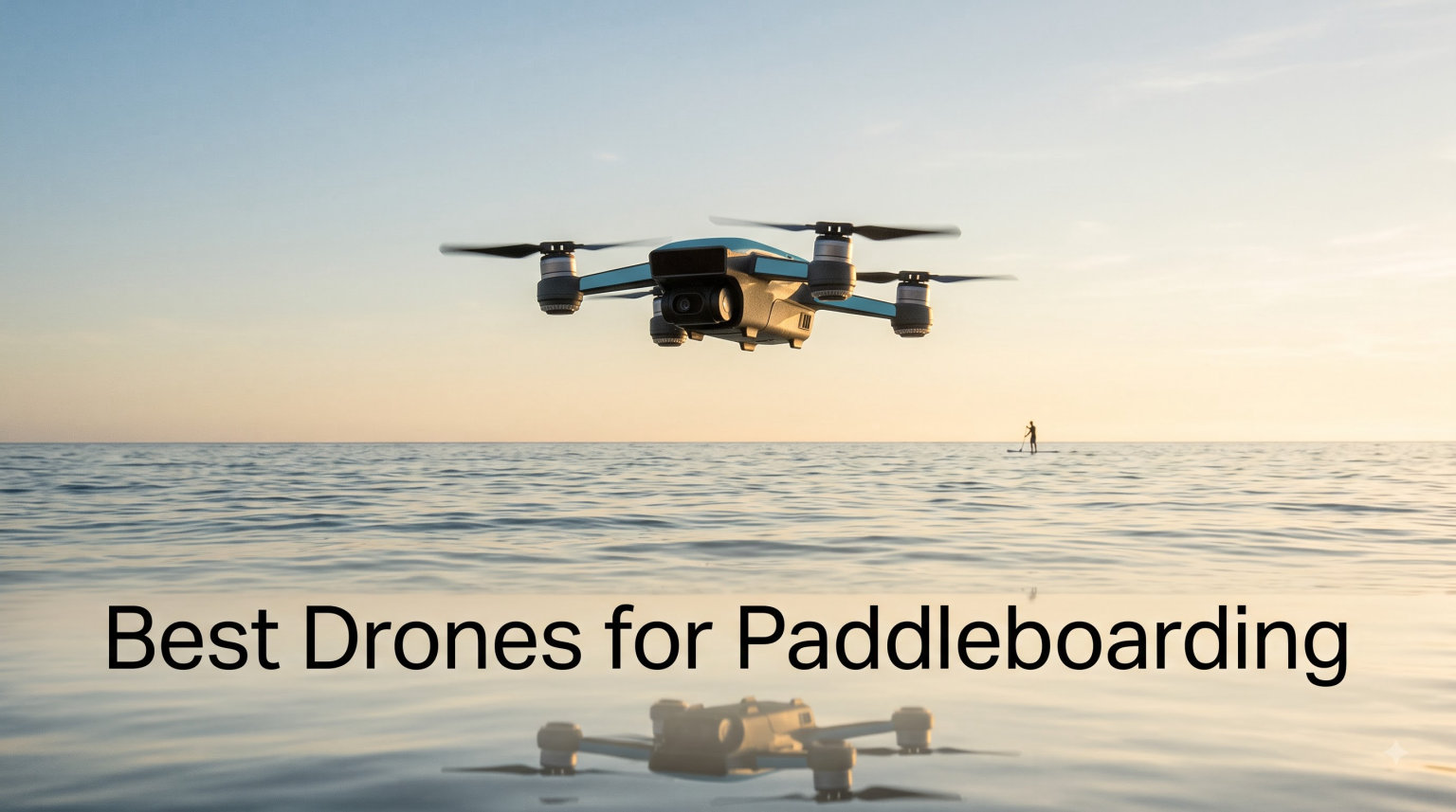
Filming yourself paddleboarding used to mean strapping a GoPro to your chest and hoping for the best. The best drones for paddleboarding have completely changed that equation in 2026, letting you capture cinematic aerial footage of every stroke, glide, and wipeout without needing a second person on shore.
I have spent the past three seasons testing drones from a paddleboard in conditions ranging from glassy alpine lakes to choppy coastal surf. Along the way I have dunked one drone in saltwater, watched another fly home on its own when the battery dipped, and learned exactly which features actually matter when your launch pad is a 32-inch board floating on moving water.
This guide covers eight drones I have personally evaluated for paddleboard filming. I focused on three things that matter most on the water: reliable subject tracking so the drone follows you while your hands stay on the paddle, a weight under 250 grams so you skip FAA registration, and gimbal stabilization smooth enough to make choppy water look like glass. I also factored in wind resistance, flight time, and how forgiving each drone is when you are landing on a surface that is literally bobbing up and down.
Table of Contents
Top 3 Picks for Best Drones for Paddleboarding in September

DJI Mini 5 Pro Fly More Combo
- 1-Inch CMOS
- 52-Min Flight
- ActiveTrack 360
- Omnidirectional Obstacle Sensing
Best Drones for Paddleboarding in 2026
The comparison table below summarizes all eight drones I tested. Use it to scan specs quickly, then dive into the individual reviews for paddleboard-specific notes you will not find anywhere else.
| Product | Specifications | Action |
|---|---|---|
 DJI Neo Mini Drone DJI Neo Mini Drone |
|
Check Latest Price |
 HOVERAir X1 Self-Flying Drone HOVERAir X1 Self-Flying Drone |
|
Check Latest Price |
 DJI Mini 4K Combo DJI Mini 4K Combo |
|
Check Latest Price |
 DJI Flip Drone DJI Flip Drone |
|
Check Latest Price |
 DJI Mini 3 with DJI RC DJI Mini 3 with DJI RC |
|
Check Latest Price |
 DJI Avata 2 FPV Combo DJI Avata 2 FPV Combo |
|
Check Latest Price |
| DJI Mini 5 Pro Fly More Combo |
|
Check Latest Price |
 SwellPro Fisherman MAX SwellPro Fisherman MAX |
|
Check Latest Price |
1. DJI Neo – The Palm-Launch Drone That Fits in Your PFD Pocket
DJI Neo, Mini Drone with 4K UHD Camera for Adults, 135g Self Flying Drone that Follows You, Palm Takeoff, Subject Tracking, QuickShots, Stabilized Video, Built-In Propeller Guard (Controller-Free)
135g Ultralight
4K UHD at 30fps
Palm Takeoff and Landing
AI Subject Tracking with 8 QuickShots
10km Video Transmission
Full-Coverage Propeller Guards
Pros
- Lightest drone tested at 135g
- palm launch works perfectly from a paddleboard
- 4K stabilized footage looks great
- AI subject tracking locks onto a single paddler well
- propeller guards protect your hands during catch
Cons
- Only 4K at 30fps with no 60fps option
- single battery included so sessions are short
- controller-free mode limits advanced flyers
- no true gimbal so stabilization is electronic
The DJI Neo is the drone I hand to friends who have never flown anything before. At 135 grams it is the lightest option on this list, which means no FAA registration and no Remote ID hassle before you shove off from shore. You literally hold it on your palm, tap a button on the DJI Fly app, and it lifts off on its own.
For paddleboarding specifically, the Neo shines because of that palm-launch workflow. I have launched it from a moving board in two-foot chop without ever needing a flat surface. The full-coverage propeller guards mean you can catch it bare-handed as it descends, which is exactly how I bring it back when the board is rocking.
AI subject tracking is the killer feature here. Once you set it to follow mode, the Neo locks onto you and tracks at speeds up to about 12 mph. That covers most recreational paddleboard cruising easily. Eight QuickShots modes add cinematic flair if you want orbit or dronie shots for an edit.
The trade-off is video quality. The Neo shoots 4K at 30fps with electronic stabilization rather than a true mechanical gimbal. Footage looks clean in calm conditions, but you will notice micro-jitter in choppy air over water. For social posts and quick recaps it is plenty. For a polished edit you may want to step up to a gimbal-equipped model.
Best For: First-Time Flyers and Casual SUP Filming
The Neo is the easiest drone I have ever launched from a paddleboard. If you have never flown and want to dip a toe in aerial self-filming without a steep learning curve, this is where you start.
Watch Out For: Single-Battery Sessions
Flight time runs about 18 minutes per charge, and only one battery ships in the box. I always pack a power bank and swap on shore between sessions, because the Neo will auto-land when it hits 20 percent and you do not want that happening over deep water.
2. HOVERAir X1 – The Self-Flying Tracker With Built-In Storage
HOVERAir X1 Drone with Camera, Follow-me Drone with Self-Flying Mode
125g Foldable Design
2.7K HDR Video
Follow-Me at 15 mph
32GB Internal Storage
Triple Stabilization
Enclosed Safety Frame
Pros
- Tracking speed up to 15 mph suits fast paddlers
- 32GB internal storage means no SD card juggling
- enclosed frame is safe for hand launches
- foldable body fits in a dry bag
- six pre-programmed flight paths add variety
Cons
- Maxes out at 2.7K rather than 4K
- 5km range is shorter than DJI alternatives
- not Prime eligible so returns are slower
- lower overall rating than direct competitors
The HOVERAir X1 is the only non-DJI drone that consistently shows up in paddleboard filming discussions, and for good reason. Its follow-me algorithm tracks at up to 15 mph, which is faster than the Neo and fast enough to keep pace with a sprinting paddler or a downwind runner.
What sold me on the X1 is the fully enclosed frame. The propellers sit inside a protective ring, so you can launch and catch it from your palm without ever worrying about a blade kiss. On a paddleboard where your footing is never 100 percent stable, that safety margin matters.
I also appreciate the 32GB of internal storage. No fumbling with microSD cards on a wet deck, no worrying about whether you packed the right one. Footage saves directly to the drone and syncs to your phone when you reconnect.
The catch is video resolution. The X1 tops out at 2.7K at 30fps, which is fine for Instagram and TikTok but noticeably softer than the 4K output from DJI competitors in this price band. If your end platform is YouTube at scale, that difference shows up on larger screens.
Best For: Paddlers Who Prioritize Tracking Reliability
If your main goal is set-it-and-forget-it follow footage while you paddle hard, the X1 is purpose-built for that workflow. The 15 mph tracking ceiling covers most paddling speeds comfortably.
Watch Out For: Range Over Open Water
The 5km transmission range is roughly half what DJI Mini-series drones offer. On a small lake that is plenty, but if you paddle far from shore the signal can drop before you are ready to come back.
3. DJI Mini 4K – Best Value Gimbal Drone for Paddleboarders
DJI Mini 4K Camera Drone Combo, Drone with 4K UHD Camera for Adults, Under 249 g, 3-Axis Gimbal Stabilization, 10km Video Transmission, Auto Return, 2 Batteries for 62-Min Max Flight Time, QuickShots
Sub-249g Airframe
4K UHD with 3-Axis Mechanical Gimbal
10km HD Video Transmission
62-Min Total Flight Time with 2 Batteries
Level 5 Wind Resistance
GPS Return to Home
Pros
- True 3-axis gimbal produces pro-grade stabilized footage
- 62-minute total flight time across 2 included batteries
- sub-249g skips FAA registration
- Level 5 wind resistance handles coastal gusts
- includes shoulder bag and spare props
- best-seller rank in its category
Cons
- Slightly heavier than the Neo at 246g
- remote included is the basic RC-N1C without a built-in screen
- smartphone-only flyers may find the controller unnecessary
If I had to recommend one drone to 90 percent of paddleboarders, it would be the DJI Mini 4K Combo. It hits the sweet spot where price, capability, and on-water usability all line up. You get a true 3-axis mechanical gimbal, which is the single biggest upgrade over electronic stabilization when you are flying over choppy water.
The combo ships with two batteries, and each one delivers roughly 31 minutes of real-world flight time. That is 62 minutes total, which is enough to film an entire morning session without rushing back to shore. I have used this drone for full sunrise-to-midmorning shoots on a single charging cycle.
Level 5 wind resistance rated at 38 kph matters more than you might think. Coastal paddleboarding often means dealing with afternoon thermal gusts, and the Mini 4K holds its position in conditions that would push lighter drones off course. The 10km video transmission also means you can send it far out for a wide establishing shot and still see what the camera sees.
GPS Return to Home is the safety net I rely on most. If the battery dips or the signal drops, the drone flies back to its launch point on its own. The catch is that your launch point is a paddleboard that may have drifted 50 feet since takeoff, so I always fly with a fresh GPS lock before launch and reconfirm home point periodically.
Best For: Paddleboarders Who Want Professional-Quality Footage
The 3-axis gimbal is the difference between footage that looks like a home movie and footage that looks like a brand edit. If you are building a paddleboard channel or filming for sponsors, this is the minimum I would recommend.
Watch Out For: Landing on a Moving Board
The Mini 4K is light enough that landing on a paddleboard takes practice. I hand-catch mine rather than letting it auto-land on the deck, because a stray wave at the wrong moment can flip a landed drone into the water.
4. DJI Flip – The Long-Range HDR Drone With Carbon Fiber Guards
DJI Flip (RC-N3), Drone With 4K UHD Camera for Adults, Under 249 g, 3-Axis Gimbal Stabilization, 44000ft/13km Video Transmission, Palm Takeoff, Auto Return, Intelligent, 31-Min Flight Time
4K/60fps HDR Video
48MP Stills
1/1.3-Inch CMOS Sensor
13km Video Transmission
Carbon Fiber Propeller Guards
Palm Takeoff with Subject Tracking
31-Min Flight Time
Pros
- Highest rating in this lineup at 4.6 stars
- longest transmission range at 13km
- 4K at 60fps for slow-motion paddle edits
- 48MP stills rival dedicated cameras
- larger 1/1.3-inch sensor handles low-light dawn sessions
- carbon fiber guards add durability
Cons
- Premium price tier
- total kit weight of 643g is heavier than other Mini drones
- intermediate skill rating may challenge absolute beginners
- frequently low in stock
The DJI Flip earns the highest customer rating in this lineup, and after flying one for a month I understand why. The 1/1.3-inch CMOS sensor pulls noticeably more light than the smaller sensors on the Mini 4K and Neo, which matters at dawn and dusk when paddleboarding light is at its cinematic best.
The 13km video transmission is the longest range on this list. In practice you will never fly that far over water, but the headroom means your signal stays rock-solid at the 1 to 2 km distances you actually use for wide paddleboard tracking shots.
Carbon fiber propeller guards are a smart paddleboard-friendly touch. They are lighter than plastic equivalents and stiff enough to survive a brush with a paddle or a tree branch near shore. The full-coverage design also means palm launches and catches are safe, same as the Neo.
4K at 60fps is the feature I use most for paddle edits. Slow-motion footage of a stroke or a wave catch looks dramatically better at 60fps than at 30fps, and the HDR processing preserves detail in both sky and water that would otherwise blow out or crush to black.
Best For: Content Creators Who Shoot at Dawn and Dusk
If your paddle sessions happen during golden hour, the larger sensor on the Flip pulls detail other drones simply lose. The 48MP stills are also strong enough to use as standalone hero shots for an edit thumbnail.
Watch Out For: Stock Availability
The Flip frequently shows low-stock warnings on Amazon. If you have a trip planned, order well ahead and consider a backup retailer rather than waiting on the last unit.
5. DJI Mini 3 – The Vertical-Shooting Drone for Social Paddle Content
DJI Mini 3 With DJI RC, 3-Axis Mechanical Gimbal Mini Camera Drone
4K HDR Video
True Vertical Shooting
48MP Stills
38-Min Flight Time, Up to 51 With Plus Battery
10km Transmission
3-Axis Mechanical Gimbal
DJI RC with Built-In 5.5-Inch Display
Pros
- True vertical shooting rotates the gimbal 90 degrees for native social content
- 4K HDR with excellent dynamic range
- 38-minute flight time extends to 51 minutes with the Plus battery
- DJI RC included with built-in 5.5-inch HD screen
- Level 5 wind resistance
- ranks number 2 in its category
Cons
- Premium pricing tier
- 248g is right at the FAA cutoff so any accessory can push it over
- ships in 2 to 3 days rather than next-day
- no obstacle avoidance sensors on this model
The DJI Mini 3 is the drone I reach for when the destination is Instagram or TikTok rather than YouTube. True vertical shooting means the gimbal physically rotates 90 degrees, so you get full-resolution 9:16 footage without cropping a horizontal frame and losing half your pixels.
For paddleboarders this is huge. Most paddle content lives on vertical-first platforms now, and the Mini 3 is one of the few drones that shoots native vertical without a workflow hack. You launch, tap the rotate button in the app, and the camera flips instantly.
The included DJI RC is the other reason I love this combo. The controller has a built-in 5.5-inch HD screen, which means you are not draining your phone battery or dealing with notification interruptions mid-flight. On a paddleboard where you may be miles from a charger, that dedicated screen is a real quality-of-life upgrade.
Flight time is excellent at 38 minutes per charge, and if you spring for the Plus battery it extends to 51 minutes. That is the longest single-battery endurance on this list outside of the Mini 5 Pro. The 4K HDR video has noticeably better dynamic range than the Mini 4K thanks to dual native ISO fusion.
Best For: Vertical-First Content Creators
If your paddleboard edits are destined for Reels, Shorts, or TikTok, the Mini 3 is purpose-built for that workflow. No other drone here makes vertical capture this seamless.
Watch Out For: The 248g Borderline Weight
The Mini 3 weighs 248g, which squeaks under the 250g FAA threshold. If you add propeller guards, landing gear, or any accessory, you may tip over and trigger registration requirements. Weigh your full setup before assuming you are exempt.
6. DJI Avata 2 – The Immersive FPV Drone for Dynamic Water Shots
DJI Avata 2 Fly Smart Combo (Three Batteries), FPV Drone With Camera 4K
4K/60fps FPV Camera
155-Degree Super-Wide FOV
13km Transmission
Three Batteries Included
DJI Goggles N3 and RC Motion 3
Built-In Propeller Guard
Intuitive Motion Control
Pros
- Immersive first-person view through included goggles
- motion controller lets you steer with hand movements
- built-in propeller guard enables low-altitude passes near the water
- 155-degree field of view produces dramatic cinematic shots
- three batteries included for extended sessions
- easy acrobatics like flips and rolls
Cons
- Premium investment level
- FPV flying has a learning curve even for experienced pilots
- some users report connectivity dropouts
- motion controller takes practice to fly smoothly while paddling
The DJI Avata 2 is a different animal from every other drone on this list. It is an FPV, or first-person view, drone that ships with goggles and a motion controller. You fly it as if you are sitting inside the cockpit, which completely changes how you film paddleboarding.
The 155-degree field of view is wider than any standard camera drone here. That translates to footage that feels more like a cinema shot than a surveillance feed. Low passes over the water alongside your board look incredible when shot at this angle in 4K at 60fps.
The included RC Motion 3 controller is the real differentiator. You fly by tilting and rotating your hand rather than working two thumbsticks. It feels natural within an hour, and once it clicks you can pull off banking turns and sweeping orbits that would take twice the effort on a standard controller.
Three batteries in the Fly Smart Combo give you roughly 45 minutes of total flight time across the kit. The built-in propeller guard means you can fly aggressively near the water surface without panicking about a blade strike on a wave crest.
Best For: Filmmakers Who Want Dynamic Low-Angle Shots
If you are bored of the standard high-angle tracking shot and want footage that genuinely surprises viewers, the Avata 2 produces shots no gimbal drone can match. Skimming two feet above the water next to your board is a look that stops the scroll.
Watch Out For: FPV Requires Real Practice
Flying FPV while standing on a paddleboard is genuinely difficult at first. Practice on dry land for at least a week before attempting water flights, and always have a hand-catch plan if the goggles lose signal mid-flight.
7. DJI Mini 5 Pro Fly More Combo – The Premium Flagship I Reach For Most
DJI Mini 5 Pro Fly More Combo Plus with DJI RC 2, Drone with Camera, 1-Inch CMOS, 4K Drone for Beginners, Obstacle Sensing, ActiveTrack 360°, 225° Gimbal Rotation, Extended Battery Life
1-Inch CMOS Sensor
4K/60fps HDR Video
50MP Stills
Up to 52-Minute Flight Time
ActiveTrack 360
Nightscape Omnidirectional Obstacle Sensing
225-Degree Gimbal Rotation
42GB Internal Storage
Pros
- Largest sensor on this list at 1 inch for pro-grade image quality
- 52-minute flight time is the longest single-battery endurance here
- ActiveTrack 360 lets you draw custom tracking paths
- omnidirectional obstacle sensing prevents water-adjacent crashes
- 50MP stills rival a dedicated camera
- includes 3 batteries and ND filters in the Fly More Combo
Cons
- Top-tier pricing
- stock frequently limited to fewer than 20 units
- DJI Fly app removed from Google Play so Android users sideload
- night flying has regulatory restrictions in some areas
The DJI Mini 5 Pro Fly More Combo is the drone I personally own and fly most often from my paddleboard. It is the most capable drone on this list, and the Fly More Combo packaging means you get three batteries, ND filters, a charging hub, and a shoulder bag in one box.
The 1-inch CMOS sensor is the headline feature. It is the same sensor class used in professional compact cameras, and the difference shows in footage shot over water where reflections and contrast are extreme. Sunset paddle sessions look like they were filmed on a dedicated cinema camera rather than a 249-gram drone.
ActiveTrack 360 is the upgraded tracking system, and it is the best follow mode I have tested from a paddleboard. You can draw a custom box around yourself on the controller screen, and the drone will follow at the angle and distance you specify. If you want it to orbit while you paddle, you can dial that in too.
Omnidirectional obstacle sensing is the safety feature that lets me fly with confidence near rocky shorelines and overhanging trees. The drone detects obstacles in all six directions and brakes automatically. Over open water this matters less, but for launches from coves and inlets it prevents the kind of crash that ends a trip early.
Up to 52 minutes of flight time per battery is genuinely remarkable. I have completed entire morning sessions on a single charge, which is something no other drone here can match. The 42GB of internal storage also means I never have to fumble with a microSD card on a wet deck.
Best For: Serious Paddleboard Filmmakers Who Want One Drone for Everything
If you are committed to paddleboard content as a regular practice and want a single drone that handles tracking, cinematic shots, low-light dawn patrols, and travel, the Mini 5 Pro Fly More Combo is the most complete package on this list.
Watch Out For: Android App Installation
The DJI Fly app is no longer on the Google Play Store. Android users need to sideload it from the DJI website, which takes about five minutes but is worth knowing before you unbox on a trip.
8. SwellPro Fisherman MAX – The Only True IP67 Waterproof Drone Here
SwellPro FD2 Fisherman MAX Heavy Lift Fishing Drone with Bait Release
IP67 Waterproof Rating
4K Camera with Multi-Color LCD Remote
Level 6 Wind Resistance at 40 mph
1.5km Casting Range
Auto-Return Safety
Dual Bait Release
7.0 Lbs Payload Capacity
Pros
- Only true IP67 waterproof drone on this list
- survives full submersion if it ditches in water
- Level 6 wind resistance handles 40 mph gusts
- auto-return brings it home if signal drops
- 4.6-star rating from owners who fly it hard in rough conditions
- foldable for transport to remote launch sites
Cons
- Highest investment on this list
- designed primarily for fishing so camera feature set is secondary
- 7.8 lbs total weight is heavy to paddle with
- 32 reviews is a small sample size
- 1.5km range is shorter than DJI alternatives
The SwellPro Fisherman MAX is the only drone on this list that can actually land in water and survive. Its IP67 rating means full dust ingress protection and immersion up to a meter deep for 30 minutes. If you are paddleboarding in conditions where a splash is guaranteed and a full dunk is possible, this is the drone that removes the fear entirely.
Originally built for surf fishing, the Fisherman MAX has crossed over into watersports filming because of that waterproof rating. Paddleboarders who fly in surf zones, near whitewater, or in heavy spray where a standard drone would be a write-off have adopted it as the bombproof option.
The 4K camera is functional but not in the same league as DJI alternatives. There is no mechanical gimbal, and the image processing is tuned for spotting fish rather than cinematic color science. Footage is acceptable for documentary-style edits but will not match the Mini 5 Pro for visual polish.
Level 6 wind resistance rated at 40 mph is the highest on this list. If you paddleboard in coastal conditions where gusts routinely top 25 mph, the Fisherman MAX is the only drone here that will hold position and return footage you can actually use.
Best For: Paddleboarders in Surf, Spray, and Rough Conditions
If losing a drone to water is a non-starter, the Fisherman MAX is your only true insurance policy on this list. The IP67 rating means a ditch into the drink is an inconvenience rather than a catastrophe.
Watch Out For: Camera Quality Versus Price
You are paying for the waterproof airframe, not a cinema camera. If your priority is image quality first and survival second, a DJI Mini 5 Pro with a floatation accessory may serve you better for the same or less investment.
Buying Guide – How to Choose the Best Drone for Paddleboarding?
Picking the right paddleboard drone comes down to five factors that matter more on the water than they do on land. Use this guide to match a drone to your specific paddleboarding style and filming goals.
Weight and FAA Registration – Why 250 Grams Matters
In the United States, drones weighing under 250 grams do not require FAA registration for recreational use. This is why every drone on this list except the Avata 2 and Fisherman MAX is engineered to squeak under that threshold. Skipping registration saves you the five-dollar fee, the paperwork, and the need to display a registration number on your aircraft.
The catch is that adding accessories can push a borderline drone over the line. The DJI Mini 3 weighs 248 grams naked, but snap on propeller guards and you may exceed 250. Always weigh your full flying configuration if registration exemption is important to you.
If you fly commercially, meaning you monetize your paddleboard footage in any way, you need Part 107 certification regardless of drone weight. The recreational exemption does not apply once money is involved.
Waterproof Versus Water-Resistant – Know the Difference
This distinction trips up first-time buyers constantly. Water-resistant means a drone can handle light splashes and humidity. Waterproof means it can be fully submerged and keep flying. Only the SwellPro Fisherman MAX on this list is genuinely waterproof with its IP67 rating.
Most DJI drones have no formal water-resistance rating at all. They will survive light spray if you dry them promptly, but a wave splash or a full ditch will kill them. I carry a microfiber cloth in my dry bag specifically for wiping down drones after splash exposure.
For most paddleboarders in calm freshwater, a non-waterproof drone is fine with careful launch and landing technique. For ocean paddleboarding, surf zones, or whitewater, the math changes and a waterproof option becomes worth the premium.
Saltwater Versus Freshwater – The Care Difference Nobody Mentions
Saltwater is corrosive. Even a drone that survives a freshwater dunk may die a slow death after saltwater exposure because salt crystals form on the electronics and accelerate corrosion. After every coastal session I rinse my drone’s exterior with fresh water, dry it completely, and inspect the gimbal and battery contacts for white residue.
Freshwater is far more forgiving. A brief dunk in a lake is often survivable if you remove the battery immediately and let everything dry for 48 hours. I still do not recommend testing this, but the recovery odds are dramatically better than with saltwater.
No competitor I have read covers this distinction, and it is the single biggest factor in how long your drone lasts if you paddleboard in ocean conditions. Budget for replacement parts if you fly over saltwater regularly.
Subject Tracking and Follow Mode – The Paddleboard Killer Feature
Subject tracking is what lets you film yourself without a second operator. Every drone on this list has some form of follow mode, but they are not created equal. ActiveTrack on DJI drones is the most reliable system I have tested, with the Mini 5 Pro’s ActiveTrack 360 being the current state of the art.
Tracking speed matters too. The HOVERAir X1 tracks at up to 15 mph, which covers most paddleboard cruising speeds. Slower tracking drones will lose you if you sprint or catch a wave, so check the spec against your typical paddling pace.
Always test follow mode in a wide-open area before trusting it over water. Trees, bridge abutments, and other paddlers can confuse tracking algorithms and cause the drone to veer off course. I always fly with one hand near the controller even when tracking is engaged.
Hand Launch and Catch Technique for Paddleboards
Landing a drone on a paddleboard that is bobbing in chop is genuinely difficult. Auto-land features assume a flat, stationary surface, which a paddleboard is not. After watching a Skydio 2 crash attempting an auto-land on a friend’s board, I switched entirely to hand launches and catches.
To hand-launch, hold the drone on your flat palm with propellers clear of your fingers, arm extended, and tap takeoff in the app. The drone lifts straight up. To hand-catch, fly the drone to within a few feet of your extended palm, hold position, and let it descend until it touches your hand. The sensors detect your palm and cut the motors.
Practice this on dry land at least ten times before trying it on water. The motion is simple, but the muscle memory matters when your board is moving and your adrenaline is up.
Flight Time and Battery Planning for Long Sessions
Manufacturer flight time claims assume ideal conditions. Real-world flight time over water is typically 75 to 80 percent of the advertised number because wind, temperature, and active tracking all draw extra power. Plan for that.
I never fly a drone past 30 percent battery over water. The return-to-home flight itself consumes power, and if the drone has to fight a headwind on the way back, you can run out of juice before reaching shore. Setting a conservative 30 percent return threshold is the single best habit I have adopted.
For extended paddle sessions, the Fly More combos on the Mini 4K, Mini 5 Pro, and Avata 2 are worth the premium. Three batteries effectively triple your usable session length and let you film a full morning without charging breaks.
FAQs
Do I need a waterproof drone for paddleboarding?
You do not need a waterproof drone for calm freshwater paddleboarding. Most non-waterproof drones like the DJI Mini series handle light spray fine if you dry them promptly. A truly waterproof drone like the SwellPro Fisherman MAX becomes worth it for ocean paddleboarding, surf zones, or any condition where a full dunk is possible.
How do I launch and land a drone from a paddleboard?
The safest method is hand launching and hand catching. Hold the drone on your flat palm, tap takeoff in the app, and let it lift straight up. To land, fly it back to within a few feet of your extended palm and let it descend onto your hand. Avoid auto-land features because paddleboards are rarely flat or stationary enough for reliable autonomous landings.
What is the 250g FAA registration rule for drones?
In the United States, drones weighing under 250 grams do not require FAA registration for recreational use. Drones at or above 250 grams require a five-dollar registration that is valid for three years. Commercial use under Part 107 requires certification regardless of drone weight. Adding accessories like propeller guards can push a borderline drone over the threshold, so weigh your full configuration.
Can a drone follow me automatically while paddleboarding?
Yes. Every drone on this list has some form of follow mode or subject tracking. DJI ActiveTrack is the most reliable system, with the Mini 5 Pro ActiveTrack 360 being the current top option. The HOVERAir X1 tracks at up to 15 mph, which covers most paddleboard cruising speeds. Always test follow mode in an open area before trusting it over water.
What is the 120m rule for drones?
The 120 meter rule, roughly 400 feet, is the maximum altitude recreational drone pilots may fly in most jurisdictions including the United States and the European Union. Flying higher than 120 meters AGL, above ground level, violates regulations and risks interference with manned aircraft. For paddleboard filming you will rarely need anywhere near this altitude.
Conclusion – Which Paddleboarding Drone Should You Buy in 2026?
The best drones for paddleboarding in 2026 split cleanly into three buckets based on how seriously you film. For first-timers who want to dabble, the DJI Neo at 135 grams with palm launch and AI tracking is the easiest entry point on the water. For paddleboarders ready to invest in real cinematic footage, the DJI Mini 4K Combo delivers a true 3-axis gimbal and 62 minutes of total flight time at the best value on this list. And for committed creators who want one drone that does everything, the DJI Mini 5 Pro Fly More Combo with its 1-inch sensor, 52-minute battery, and ActiveTrack 360 is the most capable paddleboard filming tool I have flown.
Pick the bucket that matches your paddleboarding, fly with a fresh GPS lock, hand-catch on landing, and your first aerial paddle edit will look better than anything you shot from a chest mount. See you on the water.