
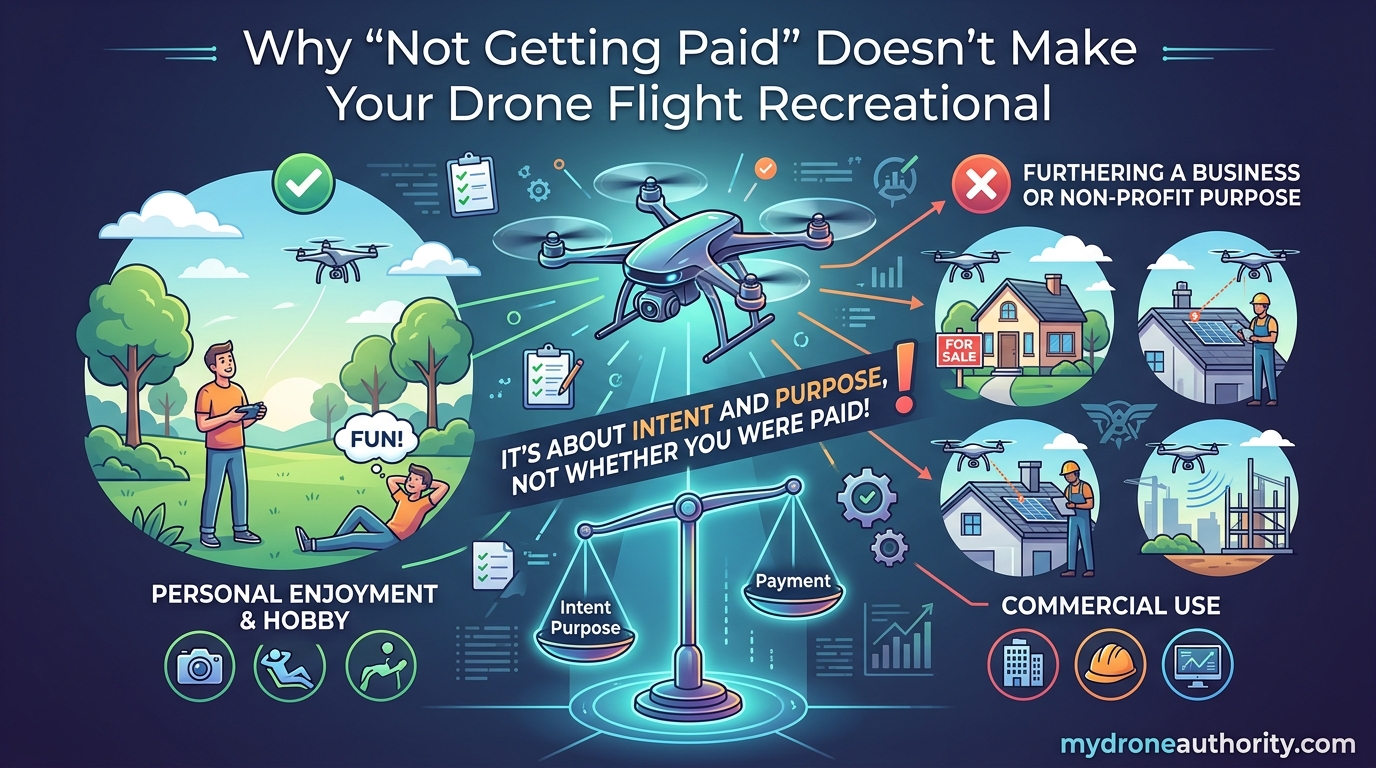
If you fly a drone and assume the only thing that turns a flight “commercial” is whether money hits your bank account, you are operating under one of the most common and most expensive misconceptions in U.S. drone law. The Federal Aviation Administration determines whether your flight is recreational by looking at the purpose of the operation, not your paycheck. That single distinction is the difference between flying legally under the Exception for Limited Recreational Operations and breaking 14 CFR Part 107.
I’ve been flying drones since the early Part 107 days, and I have personally watched two friends absorb FAA letters because they thought a volunteer gig at a church or a favor for a real estate agent was “just hobby flying.” They were wrong. This guide walks through what the regulation actually says, the scenarios most people miss, and the decision framework I use before every non-paid flight.
Table of Contents
What Counts as Recreational Drone Flight Under USC 44809
Recreational drone flight is defined by federal statute, not by whether you cashed a check. The relevant law is 49 U.S.C. § 44809, the “Exception for Limited Recreational Operations.” This is the section that lets you fly a drone for fun without holding a Part 107 Remote Pilot Certificate.
Under that exception, a flight is recreational only when the sole purpose of the operation is personal enjoyment. The FAA’s own recreational flyer page states this directly: a recreational flight is one conducted for “personal enjoyment.” Anything else, even if unpaid, falls outside the exception.
Here is the actual text from USC 44809 that matters for our purposes:
“…a person may operate a small unmanned aircraft without specific certification or operating authority from the Federal Aviation Administration if the operation is conducted strictly for recreational purposes.”
Notice the words “strictly” and “recreational purposes.” The statute is not asking whether you received a 1099 or a Venmo notification. It is asking why the aircraft left the ground. That question of “why” is the entire ballgame, and it is what the FAA enforcement team uses when they open a case file on you.
The Three Conditions Stacked Together
To stay inside the recreational exception, all three of these must be true at the same time:
- The flight is for personal enjoyment, not for any business, job, charity, or content-monetization purpose.
- You follow the airspace rules: under 400 feet AGL, in Class G airspace unless you coordinate with ATC, and always within visual line of sight.
- You have passed the TRUST test, registered your drone if it weighs over 0.55 lbs, and fly from an FAA-recognized Community-Based Organization location when in controlled airspace.
Break any one of those three and you are no longer flying under 44809. You are now flying under Part 107, which means you need a Remote Pilot Certificate, even if you never receive a single dollar.
The Intent Rule: Why Compensation Is Not the Deciding Factor
Compensation is one piece of evidence the FAA looks at, but it is not the test. The test is intent. The Pilot Institute covers this clearly, and I have heard the same explanation from FAA representatives at industry events: if a reasonable person would conclude that the flight was conducted for a purpose other than the operator’s personal enjoyment, the FAA will treat it as non-recreational.
This is why a guy who flies his drone around a church roof because the pastor asked is in a different legal category than a guy who flies the same drone around his own roof for fun. The pilot may be unpaid in both cases. The intent is what separates them. One is gathering data for a building owner. The other is just flying.
What “Intent” Looks Like in Practice
The FAA evaluates intent through the surrounding facts. They ask: who benefits, what is the deliverable, and what was agreed to before the flight? If the answer to any of those suggests the flight was done for someone else’s purpose, the FAA considers it non-recreational. Some of the most common indicators:
- The flight produces a deliverable someone else uses (a video, a photo, a map, a measurement report).
- The flight was requested, scheduled, or directed by another person or organization.
- The flight supports a business activity, even a side hustle or a single sale.
- The flight generates content for a channel, post, or platform that earns revenue, directly or indirectly.
If you can tick any of those boxes, payment is irrelevant. You need a Part 107.
5 Common Scenarios Where You Still Need a Part 107 Certificate
These are the situations that show up again and again in FAA enforcement actions and on pilot forums. I have grouped them by how often I see them cause confusion in our community.
Scenario 1: Volunteering for a Nonprofit or Church
This is the single most common trap. Someone from your church, your kid’s school, or a local nonprofit asks you to fly their roof, shoot their event, or survey their coastline. You say yes. You don’t get paid. You assume it’s recreational. It is not.
The flight is for the benefit of an organization, not your personal enjoyment. The deliverable supports their mission. Even if the only thing you receive is a thank-you, the FAA still considers the operation non-recreational. A Reddit user in r/drones asked exactly this question, and the consensus from certified pilots in the thread was unanimous: volunteer flights for any third party require Part 107.
Scenario 2: Flying a Drone as Part of Your Job
If your employer asks you to fly a drone and that flight is one of your job duties, you are operating under Part 107 whether you are separately compensated for the flight or not. Salary, hourly wage, and ownership stake all count as compensation in the FAA’s eyes.
A real estate agent who is also a licensed drone pilot might think, “I fly this drone for my own listings, so it’s recreational.” The FAA disagrees. You are operating for the benefit of your brokerage. That is a commercial operation, and it requires a Part 107 certificate.
Scenario 3: YouTube and Social Media Content
Posting drone footage on a monetized YouTube channel, an Instagram with brand deals, or a TikTok in the creator fund puts your flights outside the recreational exception. The flight now supports content that earns money. Intent is non-recreational.
The gray area is unmounted hobby channels with no monetization. If you are genuinely posting for fun with no revenue, sponsorship, or affiliate links tied to the channel, the flight can still be recreational. The moment any money is involved, even indirectly, you need a Part 107.
Scenario 4: Helping a Friend or Family Member
Your cousin is selling his house and wants aerial shots. Your friend is launching a small business and needs product photos from above. Your neighbor wants to know where his roof is leaking. None of them are paying you. All of these still require a Part 107 if the drone is being used to produce a deliverable that supports their activity.
The FAA does not have a “favors are free” exception. The deliverable supports someone else’s purpose. That is non-recreational.
Scenario 5: Real Estate Listings and Marketing Material
Real estate drone photography is one of the highest-violation categories in FAA enforcement history. Pilots who list drone services on their real estate website, or even just use a drone to shoot their own listings, are conducting commercial operations. A Part 107 certificate is required, along with the right airspace authorization if the property is in controlled airspace.
Even if you are the homeowner, a drone flight that supports the sale of your own home (for your listing photos, a buyer’s inspection, etc.) is a gray area the FAA tends to treat as non-recreational. The safest path is always to hold a Part 107.
Part 107 vs Recreational: A Side-by-Side Comparison
Here is how the two regulatory paths differ for the everyday pilot. Use this when you are deciding which rules apply to your next flight.
- Purpose allowed: Recreational is personal enjoyment only. Part 107 is any non-recreational purpose, including paid, volunteer, and content work.
- Certification required: Recreational requires the TRUST test. Part 107 requires passing the FAA Part 107 knowledge test and holding a Remote Pilot Certificate.
- Drone registration: Both categories require FAA registration for drones over 0.55 lbs.
- Airspace rules: Recreational flyers must follow 44809 conditions, including CBO coordination in controlled airspace. Part 107 pilots use LAANC for airspace authorization.
- Altitude limit: Both default to 400 feet AGL, but Part 107 allows waivers for higher operations.
- Visual line of sight: Required for both. Part 107 has a formal BVLOS waiver path; recreational does not.
- Operations over people: Recreational is heavily restricted. Part 107 has defined categories (Category 1-4) with specific requirements.
- Night flying: Recreational flyers need anti-collision lighting visible for 3 statute miles. Part 107 pilots need completed night training and the same lighting.
- Remote ID: Both categories must comply with Remote ID broadcast requirements unless flying at an FAA-recognized identification area.
- Penalties for violations: Both are enforceable. Civil penalties can reach $27,500 per violation; criminal penalties can reach $250,000 and 3 years imprisonment.
Remote ID and TRUST Test Requirements for Both Categories
Remote ID applies to nearly every drone flight in the U.S. now. Whether you fly recreationally or under Part 107, your drone needs to broadcast Remote ID information unless you are operating from an FAA-recognized identification area (FRIA). The rule is the same on both sides, but the compliance path is different.
Part 107 pilots usually fly Standard Remote ID drones that broadcast automatically. Recreational flyers have a few extra options, including broadcast modules for older aircraft. Either way, the FAA expects you to be compliant. The 2023 Remote ID compliance date has passed, and enforcement is active.
The TRUST test, or The Recreational UAS Safety Test, is the other piece that catches people off guard. Recreational flyers must complete it before their first flight and carry proof of completion. Part 107 pilots do not need to take TRUST because their Remote Pilot Certificate covers the same ground and more. The TRUST is short, free, and online through FAA-approved test administrators.
FAA Penalties: What Happens When You Fly Without a License
The FAA does not treat Part 107 violations as paperwork issues. They treat them as aviation safety violations, and the fines reflect that. The base civil penalty for non-recreational operations without a Part 107 certificate is up to $27,500 per violation. Each flight can count as a separate violation.
Criminal penalties are rarer but real: up to $250,000 in fines and up to three years in prison for willful violations. The FAA has also ordered drone seizure in enforcement cases, meaning your aircraft can be taken as part of a settlement.
The case that gets quoted in every drone law article is the PhillyDroneLife YouTube channel. The operator posted drone videos for years, racked up millions of views, and earned revenue from the channel. He did not hold a Part 107. The FAA eventually proposed a $182,000 civil penalty. That is not an outlier; it is the kind of outcome that happens when monetization and lack of certification meet an active enforcement window.
There are also smaller, more common cases. Pilots who fly for a real estate agent without a license and get reported. Church volunteers who shoot roof inspections and someone reports them. The fines in these cases are often lower than the headline numbers, but they are never zero, and they always include the legal costs of fighting the FAA.
Decision Tree: Do I Need Part 107 for My Next Flight?
Run through this list before every non-paid flight. If you answer “yes” to any of the questions, you need a Part 107 certificate, regardless of whether you receive payment.
- Will the flight produce a photo, video, map, or report that someone else will use?
- Was the flight requested, scheduled, or directed by another person or organization?
- Does the flight support a business, employer, nonprofit, church, school, or community group?
- Is the flight generating content for a channel, page, or platform that earns revenue?
- Will the flight be used in marketing, listings, sales materials, or branded content?
- Are you flying in connection with your job, even if not separately compensated for the flight?
If you answered no to all six, and the flight is purely for your own enjoyment, you can fly under the recreational exception. If you answered yes to even one, get your Part 107 before you take off. The test costs $175, the study materials are widely available, and the certificate is good for two years with a free online recurrent training to renew.
FAQ
What is the drone exception for limited recreational operations?
The Exception for Limited Recreational Operations is found at 49 U.S.C. § 44809. It allows drone flights conducted strictly for personal enjoyment without requiring a Part 107 Remote Pilot Certificate. The exception is narrow: the flight must be for personal enjoyment, must follow airspace and altitude rules, and the pilot must have passed the TRUST test.
Do you need a license to fly a drone for personal use?
For purely personal, non-commercial use, you do not need a Part 107 license. You do need to pass the TRUST test, register your drone if it weighs over 0.55 lbs, follow the 400-foot altitude limit, and stay in Class G airspace (or coordinate properly in controlled airspace). The moment the flight supports anyone else’s purpose, Part 107 is required.
What is the fine for flying a drone without a license?
Civil penalties for operating a drone non-recreationally without a Part 107 certificate can reach $27,500 per violation. Each unauthorized flight can be treated as a separate violation. Criminal penalties for willful violations can reach $250,000 and up to three years in prison. The FAA has also ordered drone seizure in enforcement actions.
Will the FAA know if I fly my drone?
In many cases, yes. The FAA receives reports from the public, other pilots, airports, and law enforcement. Remote ID broadcasts give the FAA a live signal trail. If a complaint is filed or an inspector investigates, they can match flights to registrations and operators. Anonymous flights are getting harder to sustain as Remote ID coverage expands.
Are all recreational drones exempt from Remote ID?
No. Recreational drones are not exempt from Remote ID. Both recreational flyers and Part 107 pilots must comply with Remote ID requirements. The only exception is flying at an FAA-recognized identification area (FRIA), which is a fixed location approved for non-broadcast operations.
Do I need Part 107 to fly for a nonprofit or church?
Yes. Flying a drone to produce a deliverable for a nonprofit, church, school, or charity is a non-recreational operation regardless of whether you receive payment. The intent of the flight is to support the organization’s purpose, not your personal enjoyment. A Part 107 certificate is required.
Can I post drone videos on YouTube without a Part 107?
Yes, if the channel is genuinely hobby-only, has no monetization, no sponsorships, no affiliate links, and the content is for personal enjoyment. The moment the channel earns revenue, has brand deals, or supports any commercial activity, the flights that produce that content require a Part 107 certificate.
What is the 120m rule for drones?
The 120m rule refers to the widely adopted 400-foot altitude limit for drone operations, which equals approximately 120 meters. This applies to both recreational flyers under USC 44809 and Part 107 pilots. Part 107 allows waivers for higher altitudes in specific operational scenarios.
Key Takeaway: It’s About Intent, Not Income
The single most important point in this whole topic: a drone flight is recreational only when the purpose is your own personal enjoyment. If the flight produces a deliverable, supports someone else’s business or mission, generates content that earns money, or is part of your job duties, it is not recreational. Whether or not you are paid is one piece of evidence the FAA looks at, but it is never the only piece, and it is never the deciding piece.
If you are flying a drone for a nonprofit, a church, a school, a friend selling a house, an employer, or a monetized channel, you need a Part 107 certificate. The good news is the test is straightforward, the study material is widely available, and the certificate opens up the entire commercial drone market to you. Our team has helped dozens of hobby pilots cross over to Part 107, and almost all of them say the same thing afterward: they wish they had done it years earlier.
For 2026, the FAA enforcement environment is more active than at any point in the drone era, and the gap between “hobby” and “non-recreational” is being enforced with real dollars. Take the time to confirm your flights fall under USC 44809 before you take off, and if there is any doubt, get your Part 107. The cost of the test is a tiny fraction of the cost of a single FAA enforcement letter.