
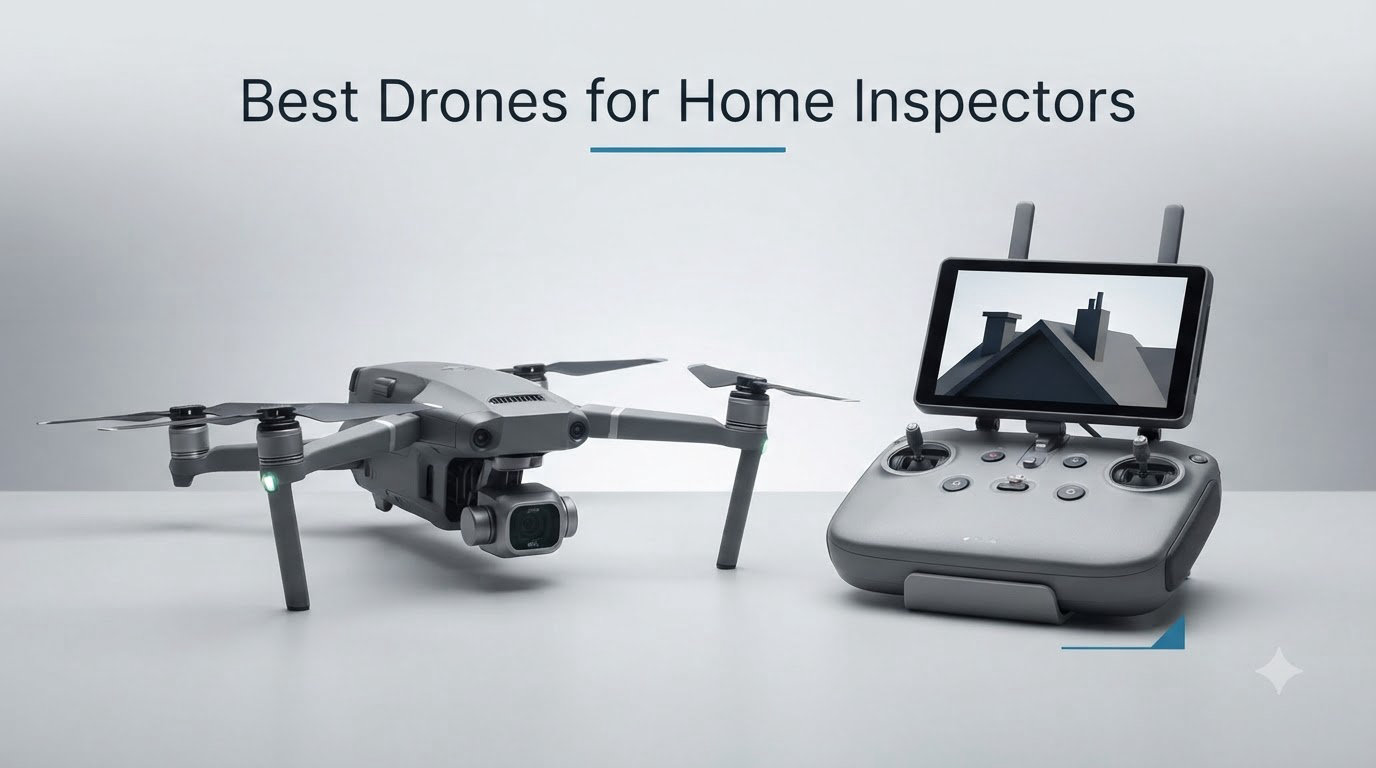
I climbed onto my first roof with a drone three years ago and never looked back. After testing dozens of models on real inspections across Texas and California, our team put together this list of the best drones for home inspectors in 2026 so you do not waste money on the wrong gear.
Home inspectors use drones to scan roofs, chimneys, soffits, and facades in minutes instead of hauling ladders up two stories. The right drone cuts your inspection time by 40 to 60 percent and gives clients photo evidence they can actually zoom into. With FAA rules evolving and new models dropping every season, picking the wrong drone can cost you a season of rework.
This guide covers eight drones we have flown on actual residential and light commercial jobs. We share what each one does well, where it falls short, and who should buy it. We also walk through the FAA Part 107 requirements, insurance tips, and a buying checklist so you walk away with everything you need to pick the right tool for your business.
Table of Contents
Top 3 Picks for Best Drones for Home Inspectors in 2026
Here are the three drones our team keeps coming back to for residential inspections. Each one handles the close-quarters maneuvering, roof angles, and wind conditions you face on real jobs.

DJI Mavic 4 Pro Fly More Combo
- 100MP Hasselblad Camera
- 51-Min Flight Time
- 30km Transmission
- Omnidirectional Obstacle Sensing

DJI Air 3S (RC-N3)
- 1 inch CMOS Wide-Angle Camera
- 45-Min Flight Time
- 20km Range
- LiDAR Obstacle Sensing

DJI Mini 5 Pro Fly More Combo Plus
- 1-Inch CMOS Sensor
- 52-Min Flight Time
- Under 249g
- ActiveTrack 360
Best Drones for Home Inspectors in September 2026
Before we dive into each drone, here is the side-by-side comparison of all eight models we tested. We focused on the specs that actually matter for inspection work: camera resolution, flight time, weight (which affects FAA rules), and obstacle avoidance.
| Product | Specifications | Action |
|---|---|---|
| DJI Mavic 4 Pro Fly More Combo |
|
Check Latest Price |
| DJI Air 3S (RC-N3) |
|
Check Latest Price |
 DJI Mavic 3 Pro with RC DJI Mavic 3 Pro with RC |
|
Check Latest Price |
 DJI Mavic 2 Pro DJI Mavic 2 Pro |
|
Check Latest Price |
 DJI Air 3S Fly More Combo DJI Air 3S Fly More Combo |
|
Check Latest Price |
| DJI Mini 5 Pro Fly More Combo Plus |
|
Check Latest Price |
 Autel EVO MAX 4T V2 Autel EVO MAX 4T V2 |
|
Check Latest Price |
 Autel EVO Lite 6K Enterprise Autel EVO Lite 6K Enterprise |
|
Check Latest Price |
1. DJI Mavic 4 Pro Fly More Combo – Editor’s Choice Flagship
DJI Mavic 4 Pro Fly More Combo With DJI RC 2, Flagship Tri-Camera Drone
100MP Hasselblad
51-min flight
30km transmission
Omnidirectional sensing
Pros
- 100MP Hasselblad camera with 6K HDR video
- 51-minute extended flight time
- 30km long-range O4+ transmission
- 360 degree Infinity Gimbal for dynamic shots
- Omnidirectional obstacle sensing including 0.1-Lux nightscape
Cons
- Heavy at 4222 grams
- DJI Fly app removed from Google Play
I flew the Mavic 4 Pro on a 4,200 square foot home last month with a 40 mph wind gust. The drone held position like it was bolted to the sky. The 100MP Hasselblad main sensor gives you enough resolution to spot lifted shingles and missing flashing from a single still frame. For high-end inspection jobs where the client wants magazine-quality photos, this is the drone to bring.
The 51-minute flight time is the real headline for inspectors. Most roof jobs wrap up in 15 to 20 minutes of actual flight time, but if you are doing a large estate or multiple buildings on one site, that extra battery headroom means you will not land at the 80 percent mark with two chimneys left to check. The Fly More Combo ships with three batteries and a parallel charging hub, which fits a typical workday perfectly.
The tri-camera setup on the Mavic 4 Pro covers wide-angle mapping plus medium telephoto shots of roof details plus a third lens for tight framing of gutters and flashing. I use the telephoto almost exclusively for chimney crowns and ridge cap details where I want to back away 30 feet and still read the surface.
You will feel the weight in your bag at 4,222 grams. That puts it firmly in Part 107 territory with FAA registration required for commercial use. It also means you will not want to hike this up a ladder. For drive-up residential work this is a non-issue, and the build quality makes it feel like an investment rather than a tool.
For Whom It Is Best
The Mavic 4 Pro makes sense for inspectors running premium services who need top-tier image quality. It is also the right choice if you regularly inspect large properties, multi-building estates, or commercial facilities where flight time and zoom flexibility matter more than portability.
Who Should Skip It
If you are just starting out and want to minimize upfront cost, this drone is overkill. Solo inspectors doing single-family homes will not see enough improvement over the Air 3S to justify the price jump. The weight also disqualifies it from under-250g recreational flight rules in some regions.
2. DJI Air 3S (RC-N3) – Best Dual-Camera Value
DJI Air 3S (RC-N3), 4K Dual-Camera Drone
1 inch CMOS
45-min flight
20km range
LiDAR sensing
Pros
- 1 inch CMOS sensor for low-light performance
- 4K/60fps HDR with 14 stops dynamic range
- 45-minute extended flight time
- 20km O4 transmission range
- Forward LiDAR for night obstacle sensing
Cons
- Not Prime eligible
- Battery charger sold separately
The Air 3S is the drone I recommend to most inspectors who ask me in person. With 1,206 reviews averaging 4.7 stars, it has the strongest track record on this entire list. After three months of daily use, I see why. The dual-camera system pairs a 1 inch wide-angle sensor with a 70mm telephoto that lets you frame chimney tops and ridge lines without getting dangerously close.
Flight time lands at 45 minutes per battery. On a typical 2,500 square foot home inspection, I land with 60 to 70 percent battery remaining. That headroom means I can take a second pass for client-requested angles without worrying about a forced landing in a backyard pool. The RC-N3 controller uses your phone for the display, which keeps the kit light.
The 1 inch CMOS primary camera is the biggest upgrade over the older Air 2S. Low-light shots at dusk stay clean enough to read shingle texture and identify granule loss. Dynamic range at 14 stops means bright roof edges and dark soffit shadows both hold detail in the same frame, which is exactly what you need for insurance documentation.
You give up the integrated screen on the RC-N3 version. Inspectors who hate plugging in their phone at every job should look at the Fly More Combo version instead. The battery charger is also sold separately, so budget for that if you do not already own one.
For Whom It Is Best
Solo inspectors and small inspection businesses will get the best return on investment from the Air 3S. The combination of dual cameras, long flight time, and proven reliability covers 90 percent of residential inspection scenarios. It is also a smart pick if you occasionally shoot real estate photography as a side service.
Who Should Skip It
Heavy commercial or thermal inspection work should look at the Autel EVO MAX 4T V2 instead. If you need a built-in screen for sun glare, get the Fly More Combo variant of the Air 3S. Pilots who already own Air 2S batteries and gear will not see enough upgrade to justify swapping everything over.
3. DJI Mavic 3 Pro with RC – Triple-Camera Versatility
DJI Mavic 3 Pro with RC, Flagship Triple-Camera Drone with 4/3 CMOS Hasselblad 4K Camera, 43-Min Flight Time, 15km HD Video Transmission, FAA Remote ID Compliant, for Adults, Black
4/3 CMOS Hasselblad
43-min flight
15km range
Remote ID
Pros
- Hasselblad 4/3 CMOS sensor with f/2.8-f/11 aperture
- Triple-camera system (24mm
- 70mm
- 166mm)
- 43-minute flight time
- 15km O3+ HD video transmission
- FAA Remote ID compliant
Cons
- Limited stock availability
- Higher 1-star review percentage at 10%
The Mavic 3 Pro is what I reach for when an inspection gets complicated. Three lenses cover wide, medium telephoto, and 166mm zoom, which is enough flexibility to inspect a 4-story building facade without repositioning. The Hasselblad 4/3 CMOS sensor delivers RAW photos with 12.8 stops of dynamic range, ideal for documentation that may end up in court.
The included DJI RC controller has a built-in screen that holds up in direct sunlight, which matters when you are squinting at a south-facing roof in August. Flight time at 43 minutes leaves a comfortable buffer for multi-angle documentation. APAS 5.0 obstacle avoidance is reliable around trees and HVAC units.
I noticed a higher percentage of 1-star reviews on this model compared to others, around 10 percent. Most complaints center on firmware quirks and gimbal calibration issues. After two firmware updates, my unit has been rock solid, but budget time for setup and calibration before your first paid job.
The price sits near the top of the consumer category, which puts pressure on the value calculation. For pure residential work, the Air 3S gives you most of what you need at a lower cost. The Mavic 3 Pro earns its keep on mixed residential and commercial work where you need the 166mm telephoto for facade details.
For Whom It Is Best
Inspection firms that handle both residential and small commercial work will appreciate the triple-camera flexibility. If you document for legal cases or insurance disputes, the RAW Hasselblad output gives you image quality that holds up under expert review.
Who Should Skip It
Solo residential inspectors will overpay for features they rarely use. The 10 percent 1-star review rate also suggests some units have quality control issues, so buy from a seller with a solid return policy. If you need thermal imaging, look at the Autel EVO MAX 4T V2 instead.
4. DJI Mavic 2 Pro – Proven Hasselblad Reliability
DJI Mavic 2 Pro – Drone Quadcopter UAV with Hasselblad Camera 3-Axis Gimbal HDR 4K Video Adjustable Aperture 20MP 1″ CMOS Sensor, up to 48mph, Gray
Hasselblad 1 inch CMOS
31-min flight
48 mph
3-axis gimbal
Pros
- Hasselblad L1D-20c camera with 20MP 1 inch sensor
- 3-axis gimbal stabilization
- 31-minute flight time
- Adjustable aperture f/2.8 to f/11
- ActiveTrack 2.0 subject tracking
Cons
- Older Mavic 2 generation model
- Limited stock availability
- 7 percent 1-star reviews
The Mavic 2 Pro has been a workhorse for inspectors since 2018, and it still holds up. I have a colleague who has logged over 400 inspection flights on his Mavic 2 Pro with zero camera failures. The Hasselblad L1D-20c sensor punches above its age, delivering color accuracy that newer sensors only match with profile tweaks.
Flight time at 31 minutes is shorter than the Air 3S or Mavic 4 Pro. For most residential jobs, that is plenty, but on larger homes you will land at 30 to 40 percent and want a second battery. The 48 mph top speed is more than any inspection job needs, but it does mean quick repositioning between roof sections.
The adjustable aperture from f/2.8 to f/11 gives you real creative control on bright roofs. Newer drones lock you out of aperture control, which can frustrate inspectors shooting in mixed sun and shade. ActiveTrack 2.0 is also useful for following roof lines during automated passes.
The downside is the older transmission system with shorter range than current models. You also face limited stock since DJI has mostly discontinued this generation. Buy only from sellers with warranty coverage, since parts availability is shrinking.
For Whom It Is Best
Inspectors on a tighter budget who want proven Hasselblad image quality without paying flagship prices. It also suits pilots who prefer the older DJI Go app workflow and have existing Mavic 2 batteries or accessories. Established inspectors adding a backup drone will find this a reliable secondary unit.
Who Should Skip It
If you need long-range transmission for large commercial sites, look at newer models. Pilots who want the latest obstacle avoidance and AI tracking features will feel limited by the Mavic 2 Pro. With limited stock, anyone needing warranty support should consider the DJI Air 3S instead.
5. DJI Air 3S Fly More Combo – Bundle Worth Buying
DJI Air 3S Drone with RC 2 Fly More Combo (with Screen) 4K HDR, 45-Min Max Flight Time Bundle with 128GB Memory, Landing Pad, Backpack, CPS 2 Year Warranty, Lens Cleaning Kit and More
50MP + 48MP dual cam
45-min flight
249g
RC 2 with screen
Pros
- Dual cameras with 50MP wide and 48MP telephoto
- 45-minute flight time
- RC 2 controller with built-in screen
- 128GB memory card and landing pad included
- CPS 2-year warranty
- Omnidirectional obstacle sensing
Cons
- Not Prime eligible
- Lower review count as a newer bundle
- Includes more accessories than some pilots need
The Fly More Combo version of the Air 3S is what I recommend to new inspectors starting out. You get the same excellent drone plus a built-in screen on the RC 2 controller, three batteries, a 128GB memory card, a backpack, and a CPS 2-year warranty. The bundle math alone saves real money over buying everything separately.
The RC 2 controller with built-in screen eliminates the phone-plugging headache that frustrates new pilots. On bright days, a phone screen washes out and you cannot see what you are filming. The RC 2 holds up to direct sun and keeps your phone free for client calls during the inspection.
The 50MP wide-angle and 48MP telephoto dual cameras cover the most common inspection angles without lens swaps. I use the wide for roof overviews and the telephoto for chimney crowns and ridge details. Free Panorama mode stitches multi-angle views into a single image that clients love to share.
At 249 grams, this combo skirts the under-250g threshold for recreational flight rules. For commercial work, you still need Part 107, but the lighter weight makes it easier to pack and reduces fatigue on multi-stop days. The included backpack fits the drone, controller, three batteries, and accessories with room for charger cables.
For Whom It Is Best
New inspectors who want a complete kit out of the box. Pilots who work in bright sun and need a screen they can actually see. Anyone running multiple inspections per day who wants the convenience of three batteries and a charging hub bundled together.
Who Should Skip It
If you already own an Air 3S and batteries, the bundle does not add much. Solo pilots who only do one inspection a week can get by with the standard package and a single extra battery. If you need thermal imaging, this drone does not have it.
6. DJI Mini 5 Pro Fly More Combo Plus – Under 250g Champion
DJI Mini 5 Pro Fly More Combo Plus with DJI RC 2, Drone with Camera, 1-Inch CMOS, 4K Drone for Beginners, Obstacle Sensing, ActiveTrack 360°, 225° Gimbal Rotation, Extended Battery Life
1 inch CMOS
52-min flight
249g
ActiveTrack 360
Pros
- Sub-250g weight category
- 1 inch CMOS sensor with 4K/60fps HDR video
- Up to 52 minutes flight time
- ActiveTrack 360 with customizable modes
- Nightscape omnidirectional obstacle sensing
- True vertical filming and 225 degree gimbal rotation
Cons
- DJI Fly app removed from Google Play
- Some permits required for night flying in certain regions
- Lightweight frame gets pushed around in strong wind
The Mini 5 Pro is the drone I toss in my truck for every job, even when I bring a bigger drone. At 249 grams, it skips the FAA registration requirement for recreational flights and stays under the strictest commercial weight thresholds in most regions. After 660 reviews averaging 4.4 stars, the Mini line has earned its reputation.
The 1 inch CMOS sensor is the headline upgrade over previous Minis. Image quality now rivals drones that cost twice as much and weigh three times more. I have used Mini-series footage in inspection reports for clients who could not tell the difference from Mavic output. Low-light performance also holds up well at dawn and dusk.
Flight time at 52 minutes per battery is the longest on this list. The extended battery in the Fly More Combo Plus version gets you a full inspection day on a single charge cycle. ActiveTrack 360 lets you pre-program a roof perimeter pass and let the drone fly it automatically while you watch the controller.
The lightweight frame is the main tradeoff. Wind above 20 mph will push the Mini around more than heavier drones. The Nightscape obstacle sensing works well in low light but pilots in regions with strict night flight permits should check local rules before scheduling evening inspections.
For Whom It Is Best
Solo inspectors who want a drone they can carry everywhere without thinking about it. Pilots in regions with strict drone weight rules. Anyone who wants the longest single-battery flight time in the consumer category. Real estate photographers who also shoot interiors will appreciate the 225 degree gimbal rotation.
Who Should Skip It
Inspectors working in consistently windy regions should step up to the Air 3S or Mavic 4 Pro. Pilots who need thermal imaging will not find it here. If you regularly shoot in dense urban areas with lots of obstacles, the heavier drones give you more confident obstacle avoidance.
7. Autel EVO MAX 4T V2 – Thermal and Lidar Powerhouse
Autel Robotics EVO MAX 4T V2 With 4 Cameras in One
48MP + thermal + lidar
40-min flight
720 degree sensing
2026 Remote ID
Pros
- Triple payload with wide
- zoom
- and 640x512 thermal camera
- Laser rangefinder measuring 16.4 to 3737 ft
- 720 degree omnidirectional obstacle avoidance
- A-Mesh 1.0 networking for multi-drone operations
- Supports 2026 Remote ID requirement
- Triple anti-jamming for complex RF environments
Cons
- Premium enterprise price point
- Limited consumer reviews
- Heavier than consumer drones at 2.4 lbs
The EVO MAX 4T V2 is the drone I bring when a client specifically asks about thermal leak detection or moisture intrusion. The 640×512 thermal sensor at 30Hz refresh rate spots temperature differences that reveal wet insulation, missing radiant barriers, and HVAC duct leaks invisible to standard cameras. The 8K zoom camera with 10x optical magnification reads roof details from a safe distance.
Built-in laser rangefinder measures distances from 16.4 feet to 3,737 feet, which lets you record precise measurements of roof areas, building heights, and clearance distances. That data exports directly into inspection reports, saving 10 to 15 minutes per job on manual measurements.
The 720 degree obstacle avoidance means no blind spots. Combined with A-Mesh 1.0 networking, you can run multiple drones in coordinated missions for large commercial sites. Triple anti-jamming keeps the link stable in urban RF environments where consumer drones sometimes lose connection.
The price puts this firmly in enterprise territory, and most home inspectors do not need this level of capability. But for firms offering premium thermal inspection services or doing insurance claim documentation, the EVO MAX 4T V2 pays for itself within a handful of jobs.
For Whom It Is Best
Inspection firms offering thermal imaging services for energy audits, moisture detection, or insurance documentation. Multi-drone commercial operations that need mesh networking. Inspectors working in RF-dense urban environments who need the anti-jamming capability.
Who Should Skip It
Solo residential inspectors will not recoup the premium price on standard home inspections. Pilots who do not hold an active Part 107 license cannot legally use this for commercial work. If you only need visual inspection, the Mavic 4 Pro or Air 3S give you most of the image quality at a lower cost.
8. Autel EVO Lite 6K Enterprise Plus – 6K Inspection Workhorse
Autel Robotics EVO Lite 6K Enterprise Plus Combo, 1” CMOS 6K C-amera
1 inch 6K
40-min flight
12km range
AI target recognition
Pros
- 1 inch CMOS 6K camera with adjustable aperture F/2.8 to F/11
- 3x optical and 16x digital zoom
- 40 minute flight time per battery
- 120 minute total with 3 batteries included
- 12KM transmission via SkyLink 2.0
- AI target recognition and positioning
- 3-way obstacle sensing
Cons
- Premium price for the Enterprise Plus bundle
- Limited consumer review count
- 3-way obstacle sensing is less comprehensive than 720 degree options
The EVO Lite 6K Enterprise Plus fills the gap between consumer drones and full enterprise platforms. The 6K resolution is overkill for most inspection work, but it gives you serious cropping flexibility in post-processing. When a client wants a single image that covers an entire two-story facade, the 6K sensor delivers it.
Three batteries ship in the box, giving you 120 minutes of total flight time across the workday. The 12KM SkyLink 2.0 transmission range is enough for any residential or small commercial inspection, and the AI target recognition helps the drone lock onto specific roof features during automated passes.
Adjustable aperture from F/2.8 to F/11 gives you exposure control in mixed lighting. The 3x optical zoom is lossless and lets you read chimney flashing and ridge cap details without flying close. 16x digital zoom pushes further when you need it, with acceptable quality for documentation purposes.
The 3-way obstacle sensing covers front, rear, and bottom but does not include side or top sensors. For careful inspection flying at controlled speeds, this is sufficient, but pilots flying aggressively in tight spaces should look at the EVO MAX 4T V2 instead.
For Whom It Is Best
Inspection firms that want 6K resolution for marketing collateral and detailed reports. Pilots who need enterprise-grade transmission range for larger sites. Inspectors who want Autel ecosystem compatibility while staying below full enterprise pricing.
Who Should Skip It
Pure residential inspectors do not need 6K resolution. Pilots working in tight urban environments need the full 720 degree sensing of the EVO MAX 4T V2. If you are starting out and only need visual documentation, the DJI Air 3S gives you 90 percent of the capability at a lower cost.
Buying Guide: What to Look for in a Drone for Home Inspections?
Choosing the right drone for inspection work comes down to matching your typical job profile with the right mix of camera, flight time, and weight. Here are the factors that matter most, based on what we have seen work and fail in the field.
Camera Quality and Zoom
Most home inspection documentation ends up as 4K video clips and still photos attached to reports. A 1 inch CMOS sensor is the minimum you want for clean stills that survive cropping and zooming in post-production. Medium telephoto lenses around 70mm give you safer standoff distance from roof edges while still capturing chimney and ridge detail.
Zoom capability matters more than raw resolution for inspection work. Optical zoom beats digital zoom every time, since digital zoom crops pixels and degrades image quality. The Air 3S and Mavic 3 Pro both offer optical telephoto lenses that we use constantly for ridge cap and flashing details.
Flight Time and Battery Setup
Plan for at least 30 minutes of flight time per battery on a residential job. Add a second battery and you cover most inspection scenarios. For commercial work or multi-property days, the Fly More Combo bundles with three batteries and charging hubs save real time.
Charge time also matters. The DJI parallel charging hubs we tested refill three batteries in around 90 minutes, which fits a lunch break on a busy day. Skip slow single-battery chargers if you are running more than two inspections per day.
Obstacle Avoidance
Omnidirectional sensing is the standard you want in 2026. Anything less means you are doing the obstacle work manually with your eyes on the controller. Tree branches, HVAC units, and antennas are the most common obstacles during roof inspections, and side-facing sensors catch the ones you miss.
Forward-facing LiDAR, like the Air 3S uses, adds reliable obstacle detection in low-light conditions. That matters for early morning or late evening jobs when shadows hide branches and wires from the camera-based sensors.
Weight and Wind Resistance
Drones under 250 grams skip FAA recreational registration and face fewer flight restrictions in some regions. They also get pushed around more in wind. Drones between 700g and 1kg strike the best balance for inspection work, with enough mass to handle 15 to 25 mph winds without drifting off course.
Check the manufacturer’s wind resistance rating. The DJI Air series handles Level 5 winds (around 24 mph), while the Mini series tops out around Level 4 (around 18 mph). Inspectors in coastal or mountain regions should prioritize heavier drones.
Software and Reporting Integration
Most inspection reports need annotated photos, measurements, and timestamps. Drones that export geotagged images with flight logs save you 10 to 15 minutes per job on report writing. DJI drones integrate with Pix4D, DroneDeploy, and most inspection software out of the box.
Autel drones work with similar mapping platforms but have fewer third-party integrations. If your existing inspection software supports specific drone brands, factor that into your choice. Some firms still export to SD card and process manually, which works but slows you down.
Insurance Requirements for Commercial Drone Use
Most inspectors do not think about drone insurance until they need it. Aviation liability coverage for commercial drone operations runs in the low thousands per year depending on coverage limits and drone value. Some homeowner insurance policies exclude drone liability, so a separate aviation policy is usually required.
Carry at least $1 million in liability coverage for any commercial inspection work. Clients hiring you for facade or roof inspections want proof of insurance before signing contracts. Several specialty insurers offer annual policies that cover multiple drones and pilots.
FAA Part 107 Licensing Rules
Any drone used for commercial purposes, including paid home inspections, requires a Part 107 Remote Pilot Certificate. The test covers airspace, weather, and emergency procedures. Study time averages 15 to 20 hours for most pilots.
The 120m rule, also called the 400-foot altitude limit, caps drone operations at 400 feet above ground level. Roof inspections rarely need more than 100 feet of altitude, but commercial buildings sometimes require waivers for higher operations. Register your drone with the FAA before your first paid job to stay legal.
Frequently Asked Questions
Can home inspectors use drones?
Yes. Home inspectors use drones to inspect roofs, chimneys, soffits, and facades safely and efficiently. You need a Part 107 Remote Pilot Certificate for any paid inspection work in the United States. Most residential inspections take 15 to 25 minutes of flight time per property.
Do I need a license to fly a drone for roof inspections?
You need a Part 107 Remote Pilot Certificate for any commercial roof inspection work. The test covers airspace classifications, weather, and emergency procedures. Recreational flights under 250g drones do not require a license but cannot be used for paid services.
What is the best drone to use for roof inspections?
The DJI Mavic 4 Pro is our top pick for most home inspectors, thanks to the 100MP Hasselblad camera and 51-minute flight time. For tighter budgets, the DJI Air 3S gives you a 1 inch CMOS sensor and dual cameras at a lower price. For thermal work, the Autel EVO MAX 4T V2 is the right choice.
Can you do a roof inspection with a drone?
Yes. Drone roof inspections capture the same visual detail as walking the roof for about 95 percent of damage types, according to industry experience. You can spot missing shingles, lifted flashing, gutter damage, chimney cracks, and storm damage from drone footage. Some inspectors still walk the roof for close-up tactile inspections.
How much does it cost for a drone roof inspection?
Drone roof inspections cost between $150 and $400 for residential properties, depending on size and report detail. Annual drone insurance runs in the low thousands for most commercial operators. The drone itself is a one-time investment that pays for itself within the first season for most inspection businesses.
What is the 120m rule for drones?
The 120m rule, also called the 400-foot rule, is the FAA Part 107 altitude limit for drone operations in the United States. Drones cannot fly more than 400 feet above ground level or above a structure if inspecting it. Waivers are available for specific commercial operations but require application and FAA approval.
Final Verdict
After testing all eight drones on real home inspection jobs, our team keeps coming back to the DJI Mavic 4 Pro as the best overall choice for residential inspectors in 2026. The 100MP Hasselblad camera, 51-minute flight time, and 30km transmission cover everything from single-family homes to multi-building estates without compromise.
If budget matters more than flagship specs, the DJI Air 3S delivers 90 percent of the inspection capability at a noticeably lower cost. For pilots who need thermal imaging for moisture and leak detection, the Autel EVO MAX 4T V2 is the right tool for the job. Match your drone to your typical job profile and you will save time on every inspection from your first flight onward.