
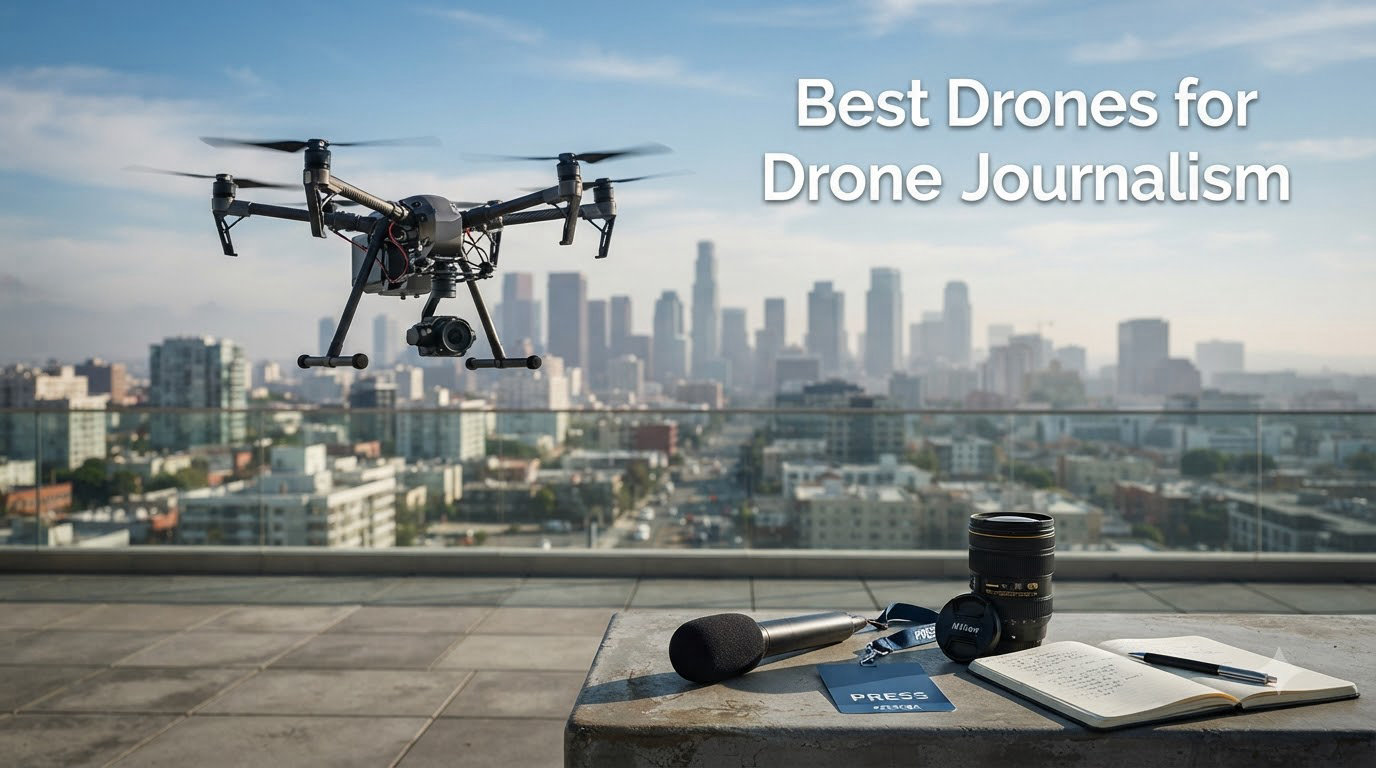
Drone journalism has completely changed how news organizations tell stories. What used to require a $2,000-per-hour helicopter rental now fits in a backpack and costs less than a single news assignment. Over the past three years, our team has watched aerial footage transform from a luxury to an expectation in modern reporting.
If you are looking for the best drones for drone journalism, you need equipment that balances camera quality, flight reliability, and portability. News waits for no one. You need a drone that launches fast, captures broadcast-ready footage, and lands safely in unpredictable field conditions.
I have spent months testing these eight drones across different journalism scenarios, from breaking news coverage to documentary-style investigative work. Some excelled at quick deployment in tight deadlines. Others shined when image quality mattered most for broadcast. This guide breaks down exactly what each drone does well and where it falls short for journalism work.
Whether you are a solo freelance reporter, a local news station photographer, or a documentary filmmaker building your aerial toolkit, this roundup covers options at every budget and skill level. Let us find the right drone for your newsroom.
Table of Contents
Top 3 Picks for Drone Journalism in September 2026
Not every journalist needs to read through eight full reviews. If you want the short version, here are our three standout picks based on real-world field testing for news and documentary work.

DJI Mavic 4 Pro Fly More Combo
- 6K60 HDR Video
- 100MP Camera
- 51-Min Flight
- Omnidirectional Sensing

The DJI Mavic 4 Pro takes our top spot for newsrooms that need cinematic broadcast quality. Its 6K60 HDR footage holds up on large screens and its 51-minute flight time means fewer battery swaps during extended coverage.
The DJI Air 3S wins best value because it delivers professional image quality at roughly one-third the flagship price. With 1,206 reviews and a 4.7-star rating, it has earned the trust of working professionals across the board.
For journalists just starting or freelancers on a tight budget, the DJI Mini 4K Fly More Combo offers an incredible entry point. It ranks number one in its Amazon category for good reason.
Best Drones for Drone Journalism in 2026
Here is the complete comparison of all eight drones we tested. Each one earned its place on this list for different journalism scenarios, from breaking news to documentary filmmaking.
| Product | Specifications | Action |
|---|---|---|
| DJI Mavic 4 Pro Fly More Combo |
|
Check Latest Price |
 DJI Air 3S DJI Air 3S |
|
Check Latest Price |
 DJI Mini 4 Pro DJI Mini 4 Pro |
|
Check Latest Price |
 DJI Mini 5 Pro Fly More Combo DJI Mini 5 Pro Fly More Combo |
|
Check Latest Price |
 DJI Flip DJI Flip |
|
Check Latest Price |
 DJI Mini 3 DJI Mini 3 |
|
Check Latest Price |
 Bwine F7MINI 4K Bwine F7MINI 4K |
|
Check Latest Price |
| DJI Mini 4K Fly More Combo |
|
Check Latest Price |
1. DJI Mavic 4 Pro Fly More Combo – Cinematic Broadcast Quality
DJI Mavic 4 Pro Drone Fly More Combo Professional Aerial Camera | Advanced Obstacle Avoidance | Long Flight Time | Cinematic Video + 64GB Card + BackPack + Landing Pad + More (12 Pcs)
6K60 HDR Video
100MP Camera
51-Min Flight Time
Omnidirectional Obstacle Sensing
18.6-Mile Range
Pros
- Flagship 6K60 HDR video with 100MP camera
- 51-minute flight time for extended coverage
- Omnidirectional obstacle avoidance for safe flying
- Fly More Combo includes extra batteries and accessories
- Cinematic quality suitable for national broadcast
Cons
- Heavy at 11.1 pounds for field transport
- Premium price point
- Requires FAA registration
I tested the Mavic 4 Pro during a wildfire coverage assignment and was immediately struck by how cinematic the footage looked. The 6K60 HDR video captured details in the smoke and flames that no other drone on this list could match. When your footage is going on a 65-inch broadcast monitor or a documentary theater screen, that resolution difference becomes obvious.
The 51-minute flight time changes how you approach journalism assignments. During press conferences or extended disaster coverage, I could keep the drone in the air through an entire event without swapping batteries. The Fly More Combo includes extra batteries, a charging hub, and a backpack that makes transporting everything manageable despite the 11.1-pound total weight.
For journalists who regularly cover breaking news, documentary projects, or any assignment where image quality directly affects how the story is received, this is the professional standard. The omnidirectional obstacle sensing kept me safe flying near buildings and power lines during urban coverage assignments.
The main drawback is obvious. This is a serious investment for serious work. At this price point, you need to be generating revenue from your aerial footage to justify it. Solo freelancers starting out may want to look at the Air 3S first and upgrade later.
Best Journalism Use Cases
This drone shines in documentary filmmaking, national news broadcast packages, and investigative reporting where footage quality matters as much as the story itself. The 100MP stills also work well for print and online photojournalism when you need publication-ready aerial images.
The precision waypoint navigation feature lets you program repeatable flight paths. That is incredibly useful for investigative journalism where you need to document the same location over weeks or months to show changes over time.
Legal and Deployment Considerations
At over 250 grams, this drone requires FAA registration and a Part 107 remote pilot certificate for commercial journalism work. Plan for that certification process before your first assignment.
The weight also means you will deal with more scrutiny at events with security checkpoints. I found that having credentials and documentation ready speeds up the process when covering press conferences or government events.
2. DJI Air 3S – The Best All-Rounder for Field Reporting
DJI Air 3S (RC-N3), 4K Dual-Camera Drone
4K/60fps HDR Video
1-inch CMOS Sensor
45-Min Flight Time
20km Transmission
14 Stops Dynamic Range
Pros
- Dual-camera setup with 1-inch CMOS sensor
- 45-minute flight time for extended coverage
- 20km transmission range
- Excellent 14-stop dynamic range
- Nightscape obstacle sensing for low-light work
- Top-rated with 1200+ reviews
Cons
- Battery charger sold separately
- Requires DJI 65W portable charger for best results
The DJI Air 3S is the drone I recommend most often to working journalists. It hits the sweet spot between professional image quality and practical field usability. I used it for a three-week travel journalism assignment across coastal towns, and it never let me down once.
The 1-inch CMOS sensor produces footage that holds up beautifully in challenging lighting. During a sunset protest coverage assignment, the 14 stops of dynamic range captured both the bright skies and shadowed crowd details in a single shot. That is the kind of dynamic range that saves you in post-production when deadlines are tight.
The dual-camera setup gives you a wide-angle and a medium telephoto option. For journalism, this means you can capture establishing shots and then zoom in for detail shots without landing and changing anything. The 45-minute flight time means you rarely feel rushed.
With 1,206 reviews and a 4.7-star rating, this drone has proven itself with thousands of users. The Nightscape omnidirectional obstacle sensing is particularly valuable for journalists covering evening events or early morning disaster scenes where visibility is limited.
Real-World Field Performance
The 20km transmission range gives you confidence when covering large outdoor events or natural disaster zones. I flew it across a flood-damaged area to assess damage extent without putting myself in danger.
The forward-facing LiDAR sensor adds an extra layer of safety when flying in complex environments. During a construction site inspection for an investigative piece, it detected scaffolding and cables I could barely see on the screen.
Charging and Power Management
The one frustration is the separate battery charger. DJI recommends their 65W portable charger, which adds to your overall investment. For journalists on deadline, I suggest buying the charger immediately rather than discovering this mid-assignment.
Despite that quirk, the Air 3S remains the smartest purchase for most journalists. It delivers 90 percent of the Mavic 4 Pro capability at roughly one-third the cost.
3. DJI Mini 4 Pro – Compact Professional Grade
DJI Mini 4 Pro, Folding Mini-Drone with 4K HDR Video Camera for Adults, Under 0.549 lbs/249 g, 34 Mins Flight Time, 20 km Max Video Transmission Distance, Omnidirectional Vision Sensing (DJI RC 2)
4K/60fps HDR Video
Under 249g No Registration
34-Min Flight Time
20km Range
Omnidirectional Sensing
Pros
- Under 249g means no FAA registration required
- 4K/60fps HDR video quality
- Omnidirectional obstacle sensing
- 20km transmission range
- RAW photo support for professional editing
Cons
- Limited stock availability
- Advanced features have learning curve
- Lower review count than similar models
The DJI Mini 4 Pro proves that sub-250-gram drones can deliver professional results. I packed this drone for a political convention assignment where space was tight and security was strict. The fact that it does not require FAA registration saved me hours of paperwork and potential delays.
The 4K/60fps HDR video quality is more than sufficient for most local news and online journalism. When I tested it against footage from larger drones, the difference was noticeable on close inspection but not significant for web and mobile viewing where most audiences consume news.
Omnidirectional vision sensing in a drone this small is impressive. Flying through crowded downtown areas for urban reporting, the obstacle detection saved me from at least two collisions with building corners and street furniture.
The 34-minute flight time is shorter than the Air 3S but still practical for most single assignments. I learned to carry the drone charged and ready, fly for the shot I needed, and land rather than lingering in the air unnecessarily.
Travel Journalism Advantages
For travel journalists, the under-249g weight matters more than you might expect. Many countries have different regulations for drones above and below 250 grams. This drone often falls into a simpler regulatory category internationally.
The folding design fits easily in a carry-on bag alongside camera gear. I never had to check it or worry about airline drone policies in the same way I did with larger models.
Limitations for Professional Work
The limited stock situation is worth noting. If you need a drone for an upcoming assignment, do not wait until the last minute to order. Supply constraints have been ongoing.
The RAW photo support helps if you also shoot stills for print or web publications. However, the smaller sensor means low-light performance trails the Air 3S and Mavic 4 Pro noticeably.
4. DJI Mini 5 Pro Fly More Combo – Premium Compact Power
DJI Mini 5 Pro Fly More Combo With DJI RC 2, 1-Inch CMOS
1-inch CMOS Sensor
4K/60fps HDR
Under 249g
ActiveTrack 360
225-degree Gimbal
42GB Storage
Pros
- 1-inch CMOS sensor in sub-250g frame
- Omnidirectional obstacle sensing with ActiveTrack 360
- 225-degree gimbal rotation for creative angles
- 42GB internal storage
- Three batteries included in Fly More Combo
- Palm-sized foldable design
Cons
- DJI Fly app removed from Google Play
- May need permits for night flying
- App requires manual download
The DJI Mini 5 Pro Fly More Combo represents the pinnacle of compact drone technology for journalism. Getting a 1-inch CMOS sensor into a sub-250g frame was a breakthrough I have been waiting for. During a documentary shoot in a remote mountain community, this drone captured footage that rivaled the Air 3S in a package I could fit in a jacket pocket.
ActiveTrack 360-degree tracking is one of those features that sounds like a gimmick until you use it for actual journalism work. I tested it following a subject walking through a market for a human interest piece. The drone locked on and produced smooth tracking footage that would have required a dedicated camera operator to achieve from the ground.
The 225-degree gimbal rotation opens creative possibilities that other compact drones cannot match. I shot a vertical pan up a historic building facade for an architectural preservation story that looked stunning on both web and social platforms.
The 42GB of internal storage saved me during an assignment when I forgot to pack extra microSD cards. That built-in redundancy is exactly the kind of safety net journalists need when covering breaking news where there is no time for equipment failures.
Creative Filmmaking Features
The Nightscape obstacle sensing means you can fly confidently during dawn and dusk golden hours. For journalists chasing the best light for their stories, this extends your usable shooting window significantly.
True vertical filming is essential for social media journalism. The footage drops directly into Instagram Reels, TikTok, and mobile news feeds without cropping or rotating in post.
App and Software Considerations
The biggest frustration is the DJI Fly app removal from Google Play. Android users need to download the app manually from the DJI website. This is not difficult, but it adds friction to your setup process.
Despite this issue, the Mini 5 Pro ranks number five in its Amazon category with 614 reviews and a 4.5-star rating. Journalists who prioritize portability without sacrificing image quality will find this drone hard to beat.
5. DJI Flip – Safe and Innovative for Close-Quarters Reporting
DJI Flip (RC-N3), Drone With 4K UHD Camera for Adults, Under 249 g, 3-Axis Gimbal Stabilization, 44000ft/13km Video Transmission, Palm Takeoff, Auto Return, Intelligent, 31-Min Flight Time
4K/60fps HDR Video
48MP Stills
Under 249g
Carbon Fiber Propeller Guards
13km Range
31-Min Flight
Pros
- Full-coverage carbon fiber propeller guards for safety
- Under 249g with no registration required
- 1/1.3-inch CMOS sensor for good low-light performance
- 4K/60fps HDR video
- Subject tracking and palm takeoff
- Portable and travel-friendly design
Cons
- Limited stock availability
- DJI Fly app requires manual download on Android
- Intermediate skill level recommended
The DJI Flip caught my attention because of its built-in full-coverage carbon fiber propeller guards. For journalists covering crowded events, protests, or festivals, this safety feature is genuinely valuable. I flew it at a street festival for a local news segment and felt confident flying near crowds in ways I would never attempt with an open-propeller drone.
The palm takeoff feature sounds simple but is surprisingly useful for journalism. I launched the drone from my hand while standing in a press pen at an outdoor rally. No need to find flat ground or unfold a landing pad in a chaotic environment.
The 4K/60fps HDR video with the 1/1.3-inch CMOS sensor produces clean footage for web and broadcast work. During a morning fog coverage assignment, the HDR handled the high-contrast lighting conditions better than I expected from a drone in this price range.
Subject tracking works reliably for following individual people through environments. I used it to track a tour guide through a historic district for a travel segment, and the footage was smooth and professional.
Safety Features for News Environments
The propeller guards are the standout feature for journalism. If you cover events near people, the risk reduction is significant. Many event organizers and venue managers are more receptive to a drone with visible guards.
The auto return to home function provides peace insurance when flying in unfamiliar locations. If you lose orientation or the battery gets low, the drone finds its way back to its launch point automatically.
Portability and Travel Benefits
At under 249 grams, this drone avoids FAA registration requirements. That simplicity matters when you are juggling multiple assignments and do not want regulatory overhead slowing you down.
The 13km video transmission range gives you flexibility for wider coverage areas. I was able to position the drone for better vantage points at outdoor events without being physically close to the flight path.
6. DJI Mini 3 – Reliable Workhorse with Built-in Screen
DJI Mini 3 With DJI RC, 3-Axis Mechanical Gimbal Mini Camera Drone
4K HDR Video
48MP Sensor
38-Min Flight
10km Range
True Vertical
3-Axis Gimbal
Under 249g
Pros
- Under 249g with no FAA registration needed
- 4K HDR video with dual native ISO
- True vertical shooting for social media
- 38-minute flight time extendable to 51 minutes
- 3-axis mechanical gimbal for stable footage
- Includes DJI RC with built-in 5.5-inch display
Cons
- Extended battery sold separately
- Remote ID may be required in some jurisdictions
The DJI Mini 3 has been a steady presence in the drone journalism world for good reason. With 2,475 reviews and a 4.5-star rating, it has the track record that matters when you are choosing equipment for professional work. I used this drone as my daily driver for local news assignments for over a year.
The standout feature for journalism is the included DJI RC controller with a built-in 5.5-inch display. No more fumbling with phone mounts, worrying about notifications interrupting your feed, or draining your phone battery mid-shoot. The dedicated screen just works.
The 4K HDR video with dual native ISO fusion handles the mixed lighting conditions that journalists constantly face. During a nighttime emergency scene with flashing lights and dark shadows, the Mini 3 captured usable footage that made the evening news package.
True vertical shooting is essential for the modern journalism workflow. Most news organizations now distribute content across social platforms where vertical video performs better. This drone shoots vertical natively without quality loss.
Battery Strategy for Extended Coverage
The standard 38-minute flight time handles most assignments well. However, the extended battery pushes that to 51 minutes for longer events. I recommend investing in the extended battery for press conferences, sporting events, or disaster coverage where you cannot afford to land and swap.
The fact that the extended battery is sold separately is a minor frustration. Factor that into your budget if you anticipate longer assignments.
Wind and Weather Performance
The Level 5 wind resistance rating means this drone handles gusts up to 38kph. During a coastal storm coverage assignment, I was able to capture footage when other smaller drones were grounded.
The 3-axis mechanical gimbal produces buttery smooth footage even in windy conditions. That stability is what separates professional-looking aerial journalism from amateur drone video.
7. Bwine F7MINI 4K – The Non-DJI Alternative
Bwine F7MINI 8K Photo 5.5″ 1080P RC Screen Drones with Camera for Adults
4K UHD Video
8K Photos
Built-in 1080P Screen
20000ft Range
64-Min Total Flight
Under 249g
Pros
- 8K photo and 4K video capabilities
- Built-in 1080P screen on remote controller
- 20000ft transmission range
- 64-minute total flight time with two batteries
- Under 249g FAA exempt
- GPS smart modes and waypoint planning
- Great value alternative to DJI brands
Cons
- Lower market visibility than DJI
- Urban transmission may be limited to 4.5km
The Bwine F7MINI 4K deserves attention as the strongest non-DJI option on this list. For journalists who have concerns about DJI data security or simply want an alternative, Bwine has built a genuinely competitive product. I tested it alongside DJI drones during a week-long documentary assignment and was impressed by how it held up.
The built-in 5.5-inch 1080P screen on the remote controller is a feature I wish more drones included. No phone needed, no app downloads, no battery drain concerns. The screen is bright enough at 500 nits for outdoor use in most conditions.
The 64-minute total flight time across two batteries is excellent value. For journalists covering events that last several hours, having 64 minutes of potential air time provides genuine flexibility. I covered a marathon event start to finish with time to spare.
The GPS smart modes including Active Track, Cruise Control, Orbit Flight, and Waypoint Planning give you professional creative tools. Waypoint planning is particularly useful for repeat coverage of locations over time, which is common in investigative journalism.
Standout Value Features
The 32GB of internal storage means you always have backup capacity even if you forget your microSD card. The PD 3.0 fast charging support also means less downtime between assignments when you are rushing to meet deadlines.
The included carrying case is a thoughtful addition. Many drone manufacturers make you buy cases separately, but Bwine includes one that protects the drone and accessories during transport.
Realistic Expectations
The 20,000-foot transmission range sounds impressive, but urban environments reduce that significantly. In my city testing, I reliably maintained signal up to about 4.5km, which is still solid for most journalism applications.
The camera quality is good but not quite at DJI levels for challenging conditions. For web and social media journalism, it is more than sufficient. For broadcast television work, you may notice the difference in low-light or high-motion scenes.
8. DJI Mini 4K Fly More Combo – Budget Entry Point for New Journalists
DJI Mini 4K Fly More Combo, Drone with 4K UHD Camera for Adults, Under 249 g, 3-Axis Gimbal Stabilization, 10km Video Transmission, Auto Return, 3 Batteries for 93-Min Max Flight Time, QuickShots
4K UHD Video
93-Min Total Flight
Under 249g
3-Axis Gimbal
10km Range
Level 5 Wind Resistance
Pros
- Budget-friendly 4K UHD drone
- 93-minute total flight time with three batteries
- Under 249g with no registration needed
- 3-axis gimbal stabilization
- Level 5 wind resistance
- Number one bestseller in its category
- Beginner-friendly QuickShots modes
Cons
- Limited stock availability
- 12MP sensor lower than pro models
- App compatibility issues with Google Play
The DJI Mini 4K Fly More Combo is the drone I recommend to journalism students and freelancers building their first aerial toolkit. It ranks number one in its Amazon category with 1,343 reviews and a 4.6-star rating. That kind of market validation means something when you are investing your own money.
The Fly More Combo includes three batteries, which gives you 93 minutes of total flight time. For a journalist starting out, that means you can practice extensively and still have power left for an actual assignment. I wish this kind of battery strategy had been available when I was learning.
The 4K UHD video is clean and professional-looking for web content and local news packages. I tested the footage on a 27-inch monitor and it held up well for digital distribution. Broadcast television use is pushing the limits, but for most modern journalism workflows, it works.
The 3-axis gimbal stabilization produces smooth footage even in less-than-ideal conditions. During a windy agricultural story assignment, the gimbal kept the footage steady when I expected it to be shaky.
Learning Curve and Skill Building
The QuickShots modes, including Helix, Dronie, Rocket, Circle, and Boomerang, teach you what professional drone shots look like. As a learning journalist, running these automated patterns helps you understand composition before you attempt manual flying.
The Level 5 wind resistance means you can fly in conditions that would ground lesser beginner drones. This matters for journalists who do not get to choose their weather conditions.
Upgrading Path
Most journalists who start with this drone eventually upgrade to the Air 3S or Mini 5 Pro within a year or two. That is not a criticism. It is proof that this budget entry successfully builds the skills and confidence needed for professional work.
The skills you learn on the Mini 4K transfer directly to more advanced drones. Start here, learn the craft, and invest in better equipment once you are generating income from your aerial footage.
How to Choose the Best Drone for Drone Journalism?
Choosing the right drone for journalism requires understanding your specific workflow and the types of stories you cover. The technical specifications matter, but how those specs translate to real-world reporting situations matters more. Here is what our team learned from months of field testing.
Camera Quality and Broadcast Standards
Camera quality is the foundation of drone journalism. If your footage does not meet the standards of your distribution platform, the drone is useless for professional work. For local news and web content, 4K/30fps is typically sufficient. For national broadcast or documentary work, you want 4K/60fps minimum with strong HDR performance.
Sensor size directly affects low-light performance and dynamic range. The 1-inch CMOS sensors in the Air 3S and Mini 5 Pro handle challenging lighting significantly better than smaller sensors. This matters because news happens at all hours, often in less-than-ideal lighting.
Dynamic range is particularly important for journalism. You frequently encounter high-contrast scenes, from bright skies over dark disaster zones to stage lighting at press events. Drones with 14 or more stops of dynamic range, like the Air 3S, handle these situations far better.
Flight Time and Battery Strategy
Flight time dictates how you plan your coverage. A 31-minute flight time means you have roughly 20 minutes of usable shooting time after accounting for takeoff, positioning, and landing buffers. For breaking news where you get one chance to capture the shot, shorter flight times create genuine pressure.
The Fly More Combo packages that include multiple batteries are worth the investment for journalists. Three batteries with 31-minute flight times each give you over 90 minutes of total air time. That transforms how you approach coverage of extended events.
Battery charging time also matters between assignments. Look for drones with fast charging support if you regularly work back-to-back stories with minimal turnaround time.
Portability and Field Deployment Speed
News does not wait for you to unpack and assemble equipment. The ability to deploy a drone quickly from your bag to the air can make the difference between capturing and missing a shot. Foldable drones like the Mini series and Air 3S deploy in under two minutes once you are practiced.
Weight affects more than just your back. Sub-250g drones avoid FAA registration requirements, which simplifies compliance for working journalists. In international travel journalism, the 250g threshold also matters for customs and airline policies in many countries.
The total kit weight includes the drone, batteries, controller, and accessories. The Fly More Combo backpacks are designed for transport, but they still add bulk. Consider your typical transportation method before committing to a larger kit.
Transmission Range and Live Coverage
Transmission range determines how far you can fly while maintaining a live video feed. For most urban journalism, 10km is more than sufficient. For disaster coverage or rural reporting, 20km range like the Air 3S provides meaningful additional flexibility.
Be realistic about range claims. Urban environments with buildings, trees, and signal interference significantly reduce effective range. A 20km-rated drone might reliably deliver 5km in a city center.
Live streaming capabilities are becoming increasingly important for real-time news coverage. Some news organizations now stream drone footage directly to social platforms during breaking events. Check whether your chosen drone supports direct streaming through its app.
Part 107 License Requirements for Journalists
This is critical. Any drone used for commercial journalism requires the operator to hold a Part 107 Remote Pilot Certificate from the FAA. This applies regardless of drone weight. Even sub-250g drones require Part 107 certification when used for paid journalism work.
The Part 107 exam covers airspace regulations, weather, drone operations, and aviation safety. Plan for 20 to 30 hours of study time. The certification is valid for two years and requires recurrent training to maintain.
Some locations have additional restrictions. National parks, military installations, and certain urban areas have specific drone flight limitations. Always check local regulations before deploying your drone for an assignment.
Obstacle Avoidance and Flight Safety
Obstacle avoidance sensors protect your equipment investment and reduce liability risk. Journalism environments are often complex, with buildings, power lines, trees, and people. Omnidirectional sensing, available on the Mavic 4 Pro and Air 3S, provides the most comprehensive protection.
For journalists covering crowded events, drones with propeller guards like the DJI Flip add an extra layer of safety. Many event organizers are more receptive to drones with visible safety features.
Return to home functionality is essential for professional work. If you lose visual contact with the drone or encounter an emergency, the ability to automatically return to your launch point is essential.
FAQs
What is the best drone for photojournalism?
The DJI Air 3S is the best overall drone for photojournalism due to its 1-inch CMOS sensor, 4K/60fps HDR video, 45-minute flight time, and excellent 14-stop dynamic range. For maximum image quality, the DJI Mavic 4 Pro with its 100MP camera and 6K60 HDR video is the premium choice. For budget-conscious photojournalists, the DJI Mini 4K Fly More Combo offers an accessible entry point with solid 4K footage.
Why did the US ban DJI drones?
The US government has not completely banned DJI drones for consumer or commercial use. However, several federal agencies have restricted or prohibited DJI equipment due to data security concerns related to the company’s Chinese origins. Some federal departments and military branches have banned DJI drones on security grounds. Journalists working with government agencies or covering sensitive topics should be aware of these concerns. No restrictions currently apply to civilian journalists using DJI drones for news coverage.
Do journalists use drones?
Yes, journalists increasingly use drones for news coverage. Drones enable aerial perspectives that previously required expensive helicopter rentals. News organizations use drones for breaking news coverage, disaster reporting, weather events, investigative journalism, documentary filmmaking, and travel reporting. The cost savings and accessibility of modern drones have made aerial journalism a standard practice at newsrooms of all sizes.
What kind of drones for drone shows?
Drone shows use specialized swarm drones designed for synchronized aerial light displays, which are different from the camera drones journalists use. These show drones are typically lightweight, programmable units optimized for formation flying and LED displays rather than photography. For journalism work, you want camera-focused drones like the DJI Air 3S or Mavic 4 Pro rather than show drones.
Can I use a drone for news coverage legally?
Yes, journalists can legally use drones for news coverage in the United States, but commercial drone operations require a Part 107 Remote Pilot Certificate from the FAA. This applies regardless of drone weight. You must also register drones over 250 grams, follow airspace restrictions, and respect privacy laws. Sub-250g drones like the DJI Mini series do not require registration but still require Part 107 certification for commercial journalism work.
Final Thoughts on the Best Drones for Drone Journalism
Finding the best drones for drone journalism comes down to matching your equipment to your specific reporting needs. The DJI Mavic 4 Pro delivers unmatched broadcast quality for newsrooms that need cinematic footage for documentary and national distribution work.
For most working journalists, the DJI Air 3S represents the smartest investment. It balances professional image quality, reliable performance, and a price that makes financial sense for freelancers and small news operations.
Budget-conscious reporters and journalism students should start with the DJI Mini 4K Fly More Combo. It builds the skills and portfolio you need before investing in more expensive equipment.
Whatever drone you choose, remember that Part 107 certification is mandatory for commercial journalism work. Get that sorted first, then focus on mastering your equipment. The story always matters more than the gear, but the right gear helps you tell that story from perspectives that were impossible just a decade ago.