
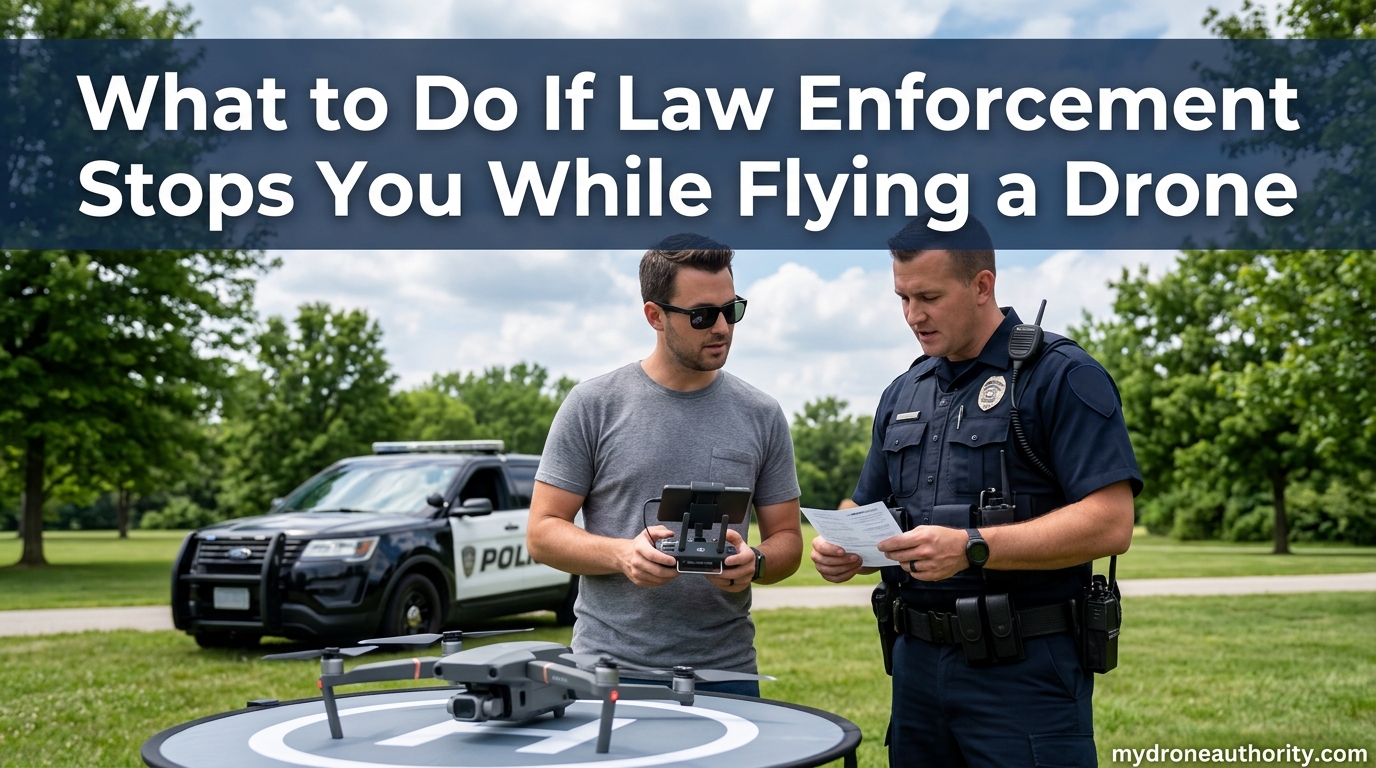
Getting approached by police while flying a drone is one of the most stressful situations a pilot can face. Whether you are flying recreationally at a local park or shooting commercial footage at an event, an officer walking toward you with questions can feel intimidating. Knowing what to do if law enforcement stops you while flying a drone ahead of time means the difference between a calm five-minute conversation and a costly misunderstanding.
This guide walks through every step of the encounter, from the moment an officer approaches to the follow-up actions you should take afterward. You will learn exactly what documents to carry, what to say, what your legal rights are, and how to handle an officer who may be misinformed about drone regulations. I have pulled from FAA guidance, real pilot experiences shared on drone forums, and the same law enforcement checklist the FAA hands to officers themselves.
The reality is that most police stops happen because someone called in a complaint, not because the officer is a drone law expert. Many pilots on the mavicpilots and Reddit drone communities report being told to land when they were flying legally. Some were asked for licenses that do not exist. Understanding your rights keeps these encounters professional and protects you legally.
Table of Contents
Quick Action Checklist: If Police Approach While You Are Flying
Here is the 30-second version for anyone who needs answers right now. Follow these steps in order, and you will handle the encounter the right way.
- Stay calm and keep your hands visible. Do not reach into your bag suddenly.
- Land your drone safely if the officer requests it. Argue the law later, not in the moment.
- Be polite and cooperative with reasonable requests.
- Provide your FAA registration and Part 107 certificate if you have them.
- Show your Remote ID is active if asked.
- State clearly that you are flying legally and ask what the concern is.
- Do not consent to a search of your equipment without a warrant.
- Document everything: officer name, badge number, time, location.
- Save your flight logs from your drone app immediately after.
- File an FAA complaint or contact an aviation attorney if your rights were violated.
Print this list, screenshot it, or keep it on your phone. The full breakdown of each step follows below.
What to Do If Law Enforcement Stops You While Flying a Drone: Step-by-Step
Every encounter is different, but the sequence of events tends to follow the same pattern. Here is how to handle each stage of the interaction from start to finish.
Step 1: Land Your Drone Safely
If an officer approaches and asks you to land, do it. This is not the moment to debate FAA jurisdiction over the National Airspace System. Many drone forum regulars recommend landing immediately because refusing can escalate the situation and create problems that did not need to exist.
Fly your drone back to your takeoff point and land it on your pad or case. Power down the drone and place the controller on the ground or on a table. The goal is to show the officer that you are cooperative and in control of your equipment.
If the officer has not asked you to land, you can still ask whether they would prefer you bring it down before talking. This small courtesy often sets a positive tone for the entire conversation.
Step 2: Stay Calm and Be Cooperative
Your demeanor matters more than almost anything else in these encounters. Pilots who report smooth interactions on Reddit and MavicPilots almost universally describe staying calm, speaking respectfully, and treating the officer as someone doing their job. Pilots who describe bad outcomes often admit they got defensive or confrontational.
Keep your hands visible. Do not reach into your bag or pockets without telling the officer what you are doing. Move slowly. Say something like, “My FAA registration card is in my bag, can I reach in and grab it?” before you go for it.
Answer basic questions truthfully. The officer likely has no idea whether you are flying legally or not. Most stops start because a bystander called in a complaint, and the officer is responding to that call. Treat the encounter as a chance to educate, not a fight.
Step 3: Know What Documents to Show
Have your documentation ready before you ever leave home. The FAA expects drone pilots to be able to produce specific paperwork on request, and showing it confidently ends most encounters quickly.
Here is what you should carry for every flight:
- FAA registration card (required for any drone between 0.55 lbs and 55 lbs, including recreational and commercial flights)
- Part 107 Remote Pilot Certificate if you are flying commercially (a physical or digital copy is acceptable)
- TRUST completion certificate if you are flying recreationally under the Exception for Limited Recreational Operations
- Proof of Remote ID compliance (built into newer drones, or a broadcast module for older models)
- LAANC authorization if you are flying in controlled airspace
- A government-issued photo ID to match your registration and certificate
Keep these in a small waterproof pouch or in your drone case. When an officer asks for documentation, you can hand them the entire pouch at once. This level of preparation signals that you are a serious, legal pilot and not someone to worry about.
Step 4: What to Say (Exact Script)
One of the biggest content gaps across competing articles is that nobody gives drone pilots an actual script. Forum users constantly ask what they should say, and the answer is usually vague advice like “be polite.” Here is language you can adapt to your situation.
When the officer first approaches:
“Good afternoon, officer. I’m flying my drone here today. Is there something I can help you with?”
If asked to land:
“Of course, I’ll bring it down now.”
If asked for ID:
“Sure, my FAA registration and Part 107 certificate are right here in my bag. May I reach for them?”
If asked why you are flying:
“I’m flying recreationally” or “I’m a Part 107 certified remote pilot and I’m flying for commercial photography. Here is my certificate.”
If the officer claims you cannot fly in this location:
“I understand your concern. I checked the B4UFLY app and LAANC before taking off, and this area is not restricted airspace. I’m happy to show you the authorization on my phone.”
If asked to stop flying permanently or surrender equipment:
“I want to cooperate fully. I don’t consent to a search of my equipment. Can you clarify what regulation I’m violating so I can address it?”
The key throughout is respect plus clarity. You are not arguing, but you are not rolling over either. You are stating your position calmly and inviting the officer to point to a specific rule if there is one.
Step 5: Handling Requests to Search or Confiscate
This is where encounters can turn problematic. Officers sometimes ask to look through your drone, your phone, or your footage. They may ask you to hand over your equipment. Understanding consent here is critical.
You are not required to consent to a search of your drone, your controller, or your phone without a warrant. If an officer asks to look through your footage, you can politely decline by saying, “I don’t consent to a search of my equipment, but I’m happy to keep talking with you.”
Confiscation is a separate issue. Officers can seize equipment if they have probable cause to believe a crime was committed, but routine drone stops rarely meet that threshold. If your gear is taken, do not resist. Ask for a receipt, get the officer’s name and badge number, and contact an aviation attorney afterward.
Never physically resist an officer, even if you believe they are acting beyond their authority. The place to contest an unlawful stop is in court or through an FAA complaint, not on the side of the road.
Step 6: Documenting the Encounter
Document everything while the encounter is still fresh. As soon as the officer walks away, pull out your phone and start taking notes. Details fade fast, and accurate records protect you if the situation escalates later.
Capture the following information:
- Officer name and badge number
- Agency or department (city police, county sheriff, state patrol, park ranger)
- Time the encounter started and ended
- Exact location with GPS coordinates if possible
- What the officer said, in as close to their words as you can remember
- What you said and did
- Names and contact info of any witnesses
- Photos of the location, your drone setup, and any landing pad or signage
Also save your flight logs from your drone app immediately. DJI Fly, Autel Explorer, and most major apps store detailed telemetry including altitude, path, speed, and timestamps. Export the log file and back it up to cloud storage. These logs are your proof of legal flight if the encounter becomes a formal complaint.
Your Legal Rights During a Drone Stop
Understanding the legal framework before you fly gives you confidence during any encounter. The most important thing to know is that the FAA, not local police, has primary authority over the National Airspace System. This is settled federal law, and state and local agencies cannot create their own rules about where drones fly.
That said, police can enforce other laws that overlap with drone operations. These include trespassing, voyeurism, harassment, interfering with emergency operations, and violations of temporary flight restrictions. An officer who approaches you may be acting on one of these concerns rather than a drone-specific rule.
You have the right to remain silent beyond basic identifying information. You have the right to refuse consent to a search. You have the right to ask whether you are being detained or are free to leave. If you are not being detained, you can politely end the encounter and pack up your gear.
State laws vary widely. Some states have passed laws restricting drone use near critical infrastructure, wildfires, correctional facilities, and large public gatherings. Others require explicit consent to fly over private property for certain purposes. Always check the local rules for your state before flying somewhere new.
If you believe your rights were violated, do not confront the officer. File a complaint with the officer’s department, submit an incident report to the FAA, and consult an attorney who handles drone and aviation law. Organizations like the ACLU also provide know-your-rights resources that apply to drone encounters.
What Law Enforcement Can and Cannot Ask For
Clarity on what officers are authorized to request during a drone stop prevents confusion on both sides. The FAA publishes a law enforcement pocket card that outlines what officers should look for, and understanding it from the pilot’s perspective is just as important.
What officers can ask for:
- FAA registration for the drone
- Part 107 Remote Pilot Certificate if flying commercially
- Remote ID broadcast verification
- Identification to match the registered owner
- Voluntary statements about the flight purpose
- Observation of the drone in operation
What officers generally cannot require:
- A state-issued drone license (no such thing exists in most states)
- A permit to fly in uncontrolled, unrestricted airspace
- Forcing a drone to land mid-flight (FAA jurisdiction, not local)
- Search of your phone or footage without a warrant or your consent
- Confiscation of equipment without probable cause of a separate crime
- Information beyond what is needed to identify you and verify compliance
This list reflects federal guidance, but state laws can add specific requirements. For example, California has its own drone privacy laws, Florida restricts drone surveillance by private parties, and several states have wildfire flight restrictions during fire season. Know the rules where you fly.
Part 107 vs Recreational Flying During Encounters
Your certification status changes the documentation you should carry and the rules you must follow. Both pathways are legal, but they are governed by different sections of FAA regulations.
Part 107 certificate holders are commercial pilots. You completed the FAA knowledge test, passed a background check, and hold a Remote Pilot Certificate. During an encounter, show the certificate, your FAA registration, and explain that you are operating under Part 107. If you are flying in controlled airspace, you obtained LAANC authorization, and you can show the approval in the app.
Recreational flyers operate under the Exception for Limited Recreational Operations of Unmanned Aircraft, also known as Section 44807. You completed the free TRUST test, your drone is registered, and you are flying for personal enjoyment, not for compensation. Show your TRUST completion certificate and FAA registration.
The encounter itself plays out similarly either way. The main difference is the documentation you produce. Being able to immediately show the correct certificate for your type of flying is what closes out the conversation fastest.
Post-Encounter Checklist: What to Do After the Stop
Most guides stop at the encounter itself, but the actions you take afterward matter just as much. This is a content gap no competitor fills, and following this checklist protects you legally if the situation resurfaces.
Within 24 hours of the encounter:
- Write down everything you remember in a dedicated notebook or notes app. Be specific about times, locations, and exact words.
- Export and back up your flight logs, including any video footage recorded during the flight.
- Screenshot the B4UFLY status, LAANC authorization, and any airspace data for the location and time of your flight.
- Save the officer’s business card or photograph their badge number and name.
- Reach out to any witnesses and ask if they would be willing to confirm what they saw.
Within one week, if the encounter was problematic:
- File a formal complaint with the officer’s department if you believe your rights were violated.
- Submit an incident report through the FAA DroneZone portal.
- Contact an aviation attorney for a consultation, especially if you were threatened with arrest or had equipment confiscated.
- Post about your experience on drone forums like r/drones or MavicPilots to warn other pilots and gather similar accounts.
- Follow up in writing with the department to request documentation of any formal action taken.
Long-term, regardless of how the encounter went:
- Review what triggered the stop and whether you can avoid that scenario next time.
- Update your pre-flight checklist to include the documentation pouch.
- Consider carrying a printed know-your-rights card specific to drone operations.
- Wear a high-visibility vest and use a landing pad, both of which forum users say reduce confrontations by making you look like an official operator.
- Stay current on FAA rule changes that affect where and how you fly.
This checklist exists because encounters do not always end at the scene. FAA investigations can begin weeks later based on a complaint, and having your documentation in order is what saves you.
FAQ’s
Is it illegal to fly a drone over a police investigation?
Flying a drone over an active police investigation can be illegal if it interferes with law enforcement operations, violates a temporary flight restriction, or breaches state laws about interfering with emergency responders. Even where no specific law applies, doing so risks obstruction charges and nearly guarantees a stop. Stay clear of accident scenes, crime scenes, and active emergency operations.
Can law enforcement fly a drone over your house?
Police can fly drones over private property, including homes, under certain conditions. The Fourth Amendment limits unreasonable searches, and the 2024 FAA Reauthorization addressed some surveillance rules, but courts have generally held that observations from navigable airspace do not require a warrant. State laws vary, and some states now require warrants for police drone surveillance in specific scenarios.
What is the fine for flying a drone illegally?
FAA civil penalties for drone violations range from hundreds to tens of thousands of dollars depending on the offense. Flying without registration can carry fines up to $27,500, and criminal penalties can reach $250,000 and three years in prison for the most serious violations. Careless or reckless operation and flying in restricted airspace carry the steepest penalties.
Can law enforcement track a drone?
Yes, especially with Remote ID now required on nearly all drones sold in the United States. Remote ID broadcasts identification and location data that can be received by anyone with the right equipment. Law enforcement agencies also use RF sensors, optical systems, and radar to detect and locate drone operators, particularly at large events and critical infrastructure sites.
Can police confiscate my drone?
Police can seize your drone if they have probable cause to believe a crime was committed, but routine stops rarely meet that threshold. If equipment is taken, ask for a receipt, get the officer’s name and badge number, and contact an aviation attorney immediately. Do not resist physically, even if you believe the seizure is unlawful.
Do I have to show ID when flying a drone?
You should carry your FAA registration and Part 107 or TRUST certificate, but whether you must show a state driver license depends on your state’s stop-and-identify laws. In most states, you are only required to identify yourself if you are being lawfully detained. Showing your FAA documentation voluntarily usually ends the encounter quickly.
Conclusion
Knowing what to do if law enforcement stops you while flying a drone comes down to preparation, composure, and clear documentation. Land your drone when asked, stay polite, produce your FAA registration and certification, and use the script above to keep the conversation productive. Refuse consent to any search you are not comfortable with, and document everything before the details fade.
Carry the right paperwork on every flight, keep your flight logs accessible, and treat every encounter as a chance to show that drone pilots are responsible members of the aviation community. The more prepared you are, the shorter and smoother these stops tend to be. If you found this guide useful, share it with your local flying group, and bookmark this page so the checklist is one tap away the next time you head out to fly.